The 7 Deadly Sins of AGI Design
How AI Lost Its Way - By Peter Voss | Published: Nov 27, 2024
Abstract
Explores misconceptions in AGI design, highlighting seven key mistakes preventing progress toward real artificial general intelligence.
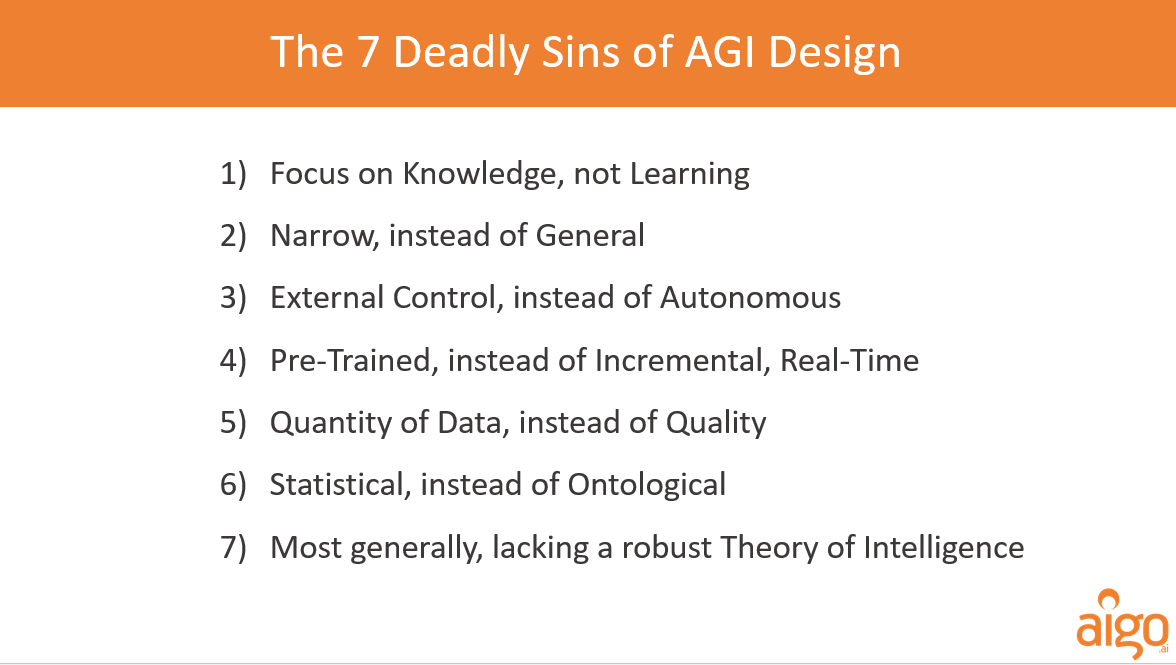
The 7 Deadly Sins
Sin 1: Focus on Knowledge
Misconception that knowledge equals intelligence. AI should dynamically acquire and generalize knowledge, not just store it.
Sin 2: Narrow AI
Focus on specific abilities rather than general intelligence for novel problems. AGI should be excellent generalists.
Sin 3: External Intelligence
Intelligence comes from human programmers, not the system. Real AGI must figure things out autonomously.
Sin 4: Pre-Trained
Models trained upfront can't update in real-time, making them disposable and limited.
Sin 5: Quantity
Reliance on massive data quantities leads to hallucinations. Focus on quality over quantity.
Sin 6: Statistical
Statistical predictions cause errors; knowledge isn't grounded in real-world interactions.
Sin 7: Lack of Theory
No deep understanding of human intelligence; brute-force approach is inefficient.
Key Defined Terms
Artificial General Intelligence (AGI)
Systems that can learn and perform any intellectual task that a human can.
Large Language Model (LLM)
AI models trained on vast text data for language tasks, but limited in generalization.
Cognitive AI
Third Wave AI focusing on real-time learning and reasoning, path to AGI.
Backpropagation
A training algorithm used in neural networks for error minimization.
Hallucinations
Factual errors generated by AI due to statistical predictions.
Ontological Concepts
Knowledge representations grounded in real-world attributes.
Third Wave AI
DARPA's term for adaptive, contextual AI systems.
INSA
Integrated Neuro-Symbolic Architecture for Cognitive AI.
How-To Guides
How to Avoid the 7 Deadly Sins in AGI Design
How to Implement Real-Time Learning in AI
How to Ground AI Knowledge Ontologically
FAQ: Questions and Answers
What is the proper definition of AGI?
AGI refers to systems that autonomously learn novel human-level cognitive tasks with limited resources.
Why won't Deep Learning achieve AGI?
Deep Learning relies on pre-training and can't update in real-time or generalize broadly.
What is the first sin: Focus on Knowledge?
Emphasizing stored knowledge over the ability to acquire and generalize new knowledge dynamically.
How does Narrow AI hinder AGI progress?
It focuses on specific tasks, not general intelligence for novel problems.
What is External Intelligence in AI?
Intelligence derived from human engineers rather than the AI system itself.
Why is pre-training a problem?
Models can't update core knowledge in real-time, becoming outdated quickly.
How does quantity over quality affect AI?
Massive, uncurated data leads to hallucinations and poor robustness.
What are issues with statistical AI?
Predictions are randomized, not grounded in real-world ontology.
Why is lack of theory the overarching sin?
Without understanding human intelligence, AGI is pursued via brute force inefficiently.
What is Cognitive AI?
DARPA's Third Wave: Learns incrementally with less data, path to real AGI.
What is INSA?
Integrated Neuro-Symbolic Architecture, an example of Cognitive AI for AGI.
How much data do humans need for language mastery?
A few million words, not trillions like LLMs.
What are examples of Narrow AI systems?
IBM's Deep Blue for chess, AlphaFold for protein folding, and specialized LLMs.
How does real-time learning improve AGI?
Allows adaptation to new information without full retraining, enhancing flexibility.
Why do LLMs hallucinate?
Due to statistical predictions from uncurated data, leading to plausible but false outputs.
What is the role of epistemology in AGI theory?
Studies how knowledge is acquired and validated, essential for building intelligent systems.
How does Cognitive AI differ from Deep Learning?
Cognitive AI focuses on real-time, adaptive learning vs. Deep Learning's static pre-training.
Related Video
Bill Dally Interview with Yann LeCun at GTC 2025: Discussing LLM limitations.
Related Entities
Aigo.ai (Organization)
Company developing Cognitive AI for AGI. Visit
DARPA (Organization)
U.S. agency advancing technology. Visit
AlphaFold (Software)
AI for protein prediction, narrow AI example.
Deep Blue (Software)
IBM's chess AI, narrow system.
Substack Subscription (Offer)
Paid access: $5 USD/month.
GTC 2025 (Event)
NVIDIA's tech conference. Details