<?xml version="1.0" encoding="UTF-8" ?>
<!--RDF based XML document generated By OpenLink Virtuoso-->
<rdf:RDF xmlns:rdf="http://www.w3.org/1999/02/22-rdf-syntax-ns#">
 <rss:channel xmlns:rss="http://purl.org/rss/1.0/" rdf:about="http://www.openlinksw.com/weblog/public/search.vspx?blogid=127&amp;q=conceptual%20data%20model&amp;type=text&amp;output=html">
  <rss:title>Kingsley Idehen&#39;s Blog Data Space</rss:title>
  <rss:link>http://www.openlinksw.com/weblog/public/search.vspx?blogid=127&amp;q=conceptual%20data%20model&amp;type=text&amp;output=html</rss:link>
  <dc:date xmlns:dc="http://purl.org/dc/elements/1.1/">2026-06-16T11:07:27Z</dc:date>
  <dc:creator xmlns:dc="http://purl.org/dc/elements/1.1/">Kingsley Uyi Idehen&lt;kidehen@openlinksw.com&gt;</dc:creator>
  <rss:description>About conceptual data model</rss:description>
  <openSearch:totalResults xmlns:openSearch="http://a9.com/-/spec/opensearchrss/1.0/">29</openSearch:totalResults>
  <openSearch:startIndex xmlns:openSearch="http://a9.com/-/spec/opensearchrss/1.0/">1</openSearch:startIndex>
  <openSearch:itemsPerPage xmlns:openSearch="http://a9.com/-/spec/opensearchrss/1.0/">10</openSearch:itemsPerPage>
  <rss:items>
   <rdf:Seq>
      <rdf:li rdf:resource="http://www.openlinksw.com/dataspace/kidehen@openlinksw.com/weblog/kidehen@openlinksw.com%27s%20BLOG%20%5B127%5D/1145" />
      <rdf:li rdf:resource="http://www.openlinksw.com/dataspace/kidehen@openlinksw.com/weblog/kidehen@openlinksw.com%27s%20BLOG%20%5B127%5D/1122" />
      <rdf:li rdf:resource="http://www.openlinksw.com/dataspace/kidehen@openlinksw.com/weblog/kidehen@openlinksw.com%27s%20BLOG%20%5B127%5D/1174" />
      <rdf:li rdf:resource="http://www.openlinksw.com/dataspace/kidehen@openlinksw.com/weblog/kidehen@openlinksw.com%27s%20BLOG%20%5B127%5D/1475" />
      <rdf:li rdf:resource="http://www.openlinksw.com/dataspace/kidehen@openlinksw.com/weblog/kidehen@openlinksw.com%27s%20BLOG%20%5B127%5D/1405" />
      <rdf:li rdf:resource="http://www.openlinksw.com/dataspace/kidehen@openlinksw.com/weblog/kidehen@openlinksw.com%27s%20BLOG%20%5B127%5D/1072" />
      <rdf:li rdf:resource="http://www.openlinksw.com/dataspace/kidehen@openlinksw.com/weblog/kidehen@openlinksw.com%27s%20BLOG%20%5B127%5D/989" />
      <rdf:li rdf:resource="http://www.openlinksw.com/dataspace/kidehen@openlinksw.com/weblog/kidehen@openlinksw.com%27s%20BLOG%20%5B127%5D/882" />
      <rdf:li rdf:resource="http://www.openlinksw.com/dataspace/kidehen@openlinksw.com/weblog/kidehen@openlinksw.com%27s%20BLOG%20%5B127%5D/650" />
      <rdf:li rdf:resource="http://www.openlinksw.com/dataspace/kidehen@openlinksw.com/weblog/kidehen@openlinksw.com%27s%20BLOG%20%5B127%5D/1662" />
      <rdf:li rdf:resource="http://www.openlinksw.com/dataspace/kidehen@openlinksw.com/weblog/kidehen@openlinksw.com%27s%20BLOG%20%5B127%5D/1609" />
      <rdf:li rdf:resource="http://www.openlinksw.com/dataspace/kidehen@openlinksw.com/weblog/kidehen@openlinksw.com%27s%20BLOG%20%5B127%5D/1608" />
      <rdf:li rdf:resource="http://www.openlinksw.com/dataspace/kidehen@openlinksw.com/weblog/kidehen@openlinksw.com%27s%20BLOG%20%5B127%5D/1592" />
      <rdf:li rdf:resource="http://www.openlinksw.com/dataspace/kidehen@openlinksw.com/weblog/kidehen@openlinksw.com%27s%20BLOG%20%5B127%5D/1590" />
      <rdf:li rdf:resource="http://www.openlinksw.com/dataspace/kidehen@openlinksw.com/weblog/kidehen@openlinksw.com%27s%20BLOG%20%5B127%5D/1531" />
      <rdf:li rdf:resource="http://www.openlinksw.com/dataspace/kidehen@openlinksw.com/weblog/kidehen@openlinksw.com%27s%20BLOG%20%5B127%5D/1524" />
      <rdf:li rdf:resource="http://www.openlinksw.com/dataspace/kidehen@openlinksw.com/weblog/kidehen@openlinksw.com%27s%20BLOG%20%5B127%5D/1520" />
      <rdf:li rdf:resource="http://www.openlinksw.com/dataspace/kidehen@openlinksw.com/weblog/kidehen@openlinksw.com%27s%20BLOG%20%5B127%5D/1519" />
      <rdf:li rdf:resource="http://www.openlinksw.com/dataspace/kidehen@openlinksw.com/weblog/kidehen@openlinksw.com%27s%20BLOG%20%5B127%5D/1514" />
      <rdf:li rdf:resource="http://www.openlinksw.com/dataspace/kidehen@openlinksw.com/weblog/kidehen@openlinksw.com%27s%20BLOG%20%5B127%5D/1512" />
      <rdf:li rdf:resource="http://www.openlinksw.com/dataspace/kidehen@openlinksw.com/weblog/kidehen@openlinksw.com%27s%20BLOG%20%5B127%5D/1457" />
      <rdf:li rdf:resource="http://www.openlinksw.com/dataspace/kidehen@openlinksw.com/weblog/kidehen@openlinksw.com%27s%20BLOG%20%5B127%5D/1424" />
      <rdf:li rdf:resource="http://www.openlinksw.com/dataspace/kidehen@openlinksw.com/weblog/kidehen@openlinksw.com%27s%20BLOG%20%5B127%5D/1320" />
      <rdf:li rdf:resource="http://www.openlinksw.com/dataspace/kidehen@openlinksw.com/weblog/kidehen@openlinksw.com%27s%20BLOG%20%5B127%5D/1254" />
      <rdf:li rdf:resource="http://www.openlinksw.com/dataspace/kidehen@openlinksw.com/weblog/kidehen@openlinksw.com%27s%20BLOG%20%5B127%5D/1231" />
      <rdf:li rdf:resource="http://www.openlinksw.com/dataspace/kidehen@openlinksw.com/weblog/kidehen@openlinksw.com%27s%20BLOG%20%5B127%5D/1224" />
      <rdf:li rdf:resource="http://www.openlinksw.com/dataspace/kidehen@openlinksw.com/weblog/kidehen@openlinksw.com%27s%20BLOG%20%5B127%5D/1175" />
      <rdf:li rdf:resource="http://www.openlinksw.com/dataspace/kidehen@openlinksw.com/weblog/kidehen@openlinksw.com%27s%20BLOG%20%5B127%5D/1161" />
      <rdf:li rdf:resource="http://www.openlinksw.com/dataspace/kidehen@openlinksw.com/weblog/kidehen@openlinksw.com%27s%20BLOG%20%5B127%5D/1114" />
   </rdf:Seq>
  </rss:items>
 </rss:channel>
 <rss:item xmlns:rss="http://purl.org/rss/1.0/" rdf:about="http://www.openlinksw.com/dataspace/kidehen@openlinksw.com/weblog/kidehen@openlinksw.com%27s%20BLOG%20%5B127%5D/1145">
  <dc:description xmlns:dc="http://purl.org/dc/elements/1.1/">Alex James has just written an interesting piece titled: Who Controls Your Model, that sets the stage for introducing the concept of &quot;Self Describing Data&quot;. To cut a long story short, RDF is one example of a mechanism that facilitates the assembly/construction of self-describing databases (built around a Concrete Conceptual Model) that allows instance data to be serialized using open serialization formats such as: XML, N3, Turtle, TriX. Rich Internet Applications ultimately enable intelligent processing of self-describing databases originating from data servers as demonstrated by these examples: My Dynamic Data Web Start Page Chris Bizer Data Space Our RDF Browser (just enter a Web URI e.g http://sites.wiwiss.fu-berlin.de/suhl/bizer/foaf.rdf or http://www.openlinksw.com and then drill down; not Grandma&#39;s unobtrusive Data Web Navigator, but headed in that direction..)</dc:description>
  <content:encoded xmlns:content="http://purl.org/rss/1.0/modules/content/"><![CDATA[<p>
<a href="http://www.base4.net">Alex James</a> has just written an interesting piece titled: <a href="http://www.base4.net/Blog.aspx?ID=329">Who Controls Your Model</a>, that sets the stage for introducing the concept of &quot;Self Describing Data&quot;. To cut a long story short, RDF is one example of a mechanism that facilitates the assembly/construction of self-describing databases (built around a Concrete Conceptual Model) that allows instance data to be serialized using open serialization formats such as: XML, N3, Turtle, TriX.</p>
<p>Rich Internet Applications ultimately enable intelligent processing of self-describing databases originating from data servers as demonstrated by these examples:</p>
<ol>
<li>
  <a href="http://demo.openlinksw.com/DAV/home/demo/Public/Queries/kidehen_dataspace.isparql.xml">My Dynamic Data Web Start Page</a>
</li>
<li>
  <a href="http://demo.openlinksw.com/DAV/home/demo/Public/Queries/bizer_dataspace.isparql.xml">Chris Bizer Data Space</a>
</li>
<li>
  <a href="http://demo.openlinksw.com/DAV/JS/tests/rdfbrowser/index.html">Our RDF Browser</a> (just enter a Web URI e.g http://sites.wiwiss.fu-berlin.de/suhl/bizer/foaf.rdf or http://www.openlinksw.com and then drill down; not Grandma&#39;s unobtrusive Data Web Navigator, but headed in that direction..)</li>
</ol>]]></content:encoded>
  <rss:title>Rich Clients, Conceptual Models, and Self-Describing Data</rss:title>
  <rss:link>http://www.openlinksw.com/dataspace/kidehen@openlinksw.com/weblog/kidehen@openlinksw.com%27s%20BLOG%20%5B127%5D/1145</rss:link>
  <dc:date xmlns:dc="http://purl.org/dc/elements/1.1/">2007-02-26T23:27:47Z</dc:date>
  <dc:creator xmlns:dc="http://purl.org/dc/elements/1.1/">Kingsley Uyi Idehen &lt;kidehen@openlinksw.com&gt;</dc:creator>
 </rss:item>
 <rss:item xmlns:rss="http://purl.org/rss/1.0/" rdf:about="http://www.openlinksw.com/dataspace/kidehen@openlinksw.com/weblog/kidehen@openlinksw.com%27s%20BLOG%20%5B127%5D/1122">
  <dc:description xmlns:dc="http://purl.org/dc/elements/1.1/">Stefano Mazzocchi, via his blog: Stefano&#39;s Linotype, delivers insightful contribution to the ongoing effort to recapture the essence of the original Semantic Web vision. The Semantic Web is about granular exposure of the underlying web-of-data that fuels the World Wide Web. It models &quot;Web Data&quot; using a Directed Graph Data Model (back-to-the-future: Network Model Database) called RDF. In line with contemporary database technology thinking, the Semantic Web also seeks to expose Web Data to architects, developers, and users via a concrete Conceptual Layer that is defined using RDF Schema. The abstract nature of Conceptual Models implies that actual instance data (Entities, Attributes, and Relationships/Associations) occurs by way of &quot;Logical to Conceptual&quot; schema mapping and data generation that can involve a myriad of logical data sources (SQL, XML, Object databases, traditional web content, RSS/Atom feeds etc.). Thus, by implication, it is safe assume that the Semantic Web&#39;s construction is basically a Data Integration and exposure effort. The point that Stefano alludes to in the blog post excerpts that follow: The semantic web is really just data integration at a global scale. Some of this data might end up being consistent, detailed and small enough to perform symbolic reasoning on, but even if this is the case, that would be such a small, expensive and fragile island of knowledge that it would have the same impact on the world as calculus had on deciding to invade Iraq. The biggest problem we face right now is a way to &#39;link&#39; information that comes from different sources that can scale to hundreds of millions of statements (and hundreds of thousands of equivalences). Equivalences and subclasses are the only things that we have ever needed of OWL and RDFS, we want to &#39;connect&#39; dots that otherwise would be unconnected. We want to suggest people to use whatever ontology pleases them and then think of just mapping it against existing ones later. This is easier to bootstrap than to force them to agree on a conceptualization before they even know how to start! Additional insightful material from Stefano: A No-Nonsense Guide to Semantic Web Specs for XML People [Part I] A No-nonsense Guide to Semantic Web Specs for XML People [Part II] Benjamin Nowack also chimes into this conversation via his simple guide to understanding Data, Information, and Knowledge in relation so the Semantic Web.</dc:description>
  <content:encoded xmlns:content="http://purl.org/rss/1.0/modules/content/"><![CDATA[<p>
<a href="http://www.betaversion.org/~stefano/">Stefano Mazzocchi</a>, via his blog: <a href="http://www.betaversion.org/~stefano/linotype/">Stefano&#39;s Linotype</a>, delivers <a href="http://www.betaversion.org/~stefano/linotype/news/99/">insightful contribution</a> to the ongoing effort to recapture the essence of the original <a href="http://en.wikipedia.org/wiki/Semantic_Web">Semantic Web </a>vision.</p>

<p>The Semantic Web is about granular exposure of the underlying web-of-data that fuels the World Wide Web. It models &quot;<a href="http://www.w3.org/1999/04/WebData">Web Data</a>&quot; using a <a href="http://en.wikipedia.org/wiki/Graph_(mathematics)">Directed Graph</a> Data Model (back-to-the-future: <a href="http://en.wikipedia.org/wiki/Network_model">Network Model Database</a>) called <a href="http://www.w3.org/TR/rdf-primer/">RDF</a>.</p>
<p>In line with contemporary database technology thinking, the Semantic Web also seeks to expose Web Data to architects, developers, and users via a concrete <a href="http://en.wikipedia.org/wiki/Conceptual_schema">Conceptual Layer</a> that is defined using <a href="http://www.w3.org/TR/rdf-schema/">RDF Schema</a>.</p>
<p>The abstract nature of Conceptual Models implies that actual instance data (<a href="http://en.wikipedia.org/wiki/Entity-relationship_diagrams">Entities, Attributes, and Relationships/Associations</a>) occurs by way of &quot;Logical to Conceptual&quot; schema mapping and data generation that can involve a myriad of logical data sources (SQL, XML, Object databases, traditional web content, <a href="http://en.wikipedia.org/wiki/Rss_%28file_format%29">RSS</a>/<a href="http://en.wikipedia.org/wiki/Atom_%28standard%29">Atom</a> feeds etc.). Thus, by implication, it is safe assume that the Semantic Web&#39;s construction is basically a <a href="http://en.wikipedia.org/wiki/Data_integration">Data Integration</a> and exposure effort. The point that Stefano alludes to in the blog post excerpts that follow: </p>
<blockquote>
<p>The semantic web is really just data integration at a global scale. Some of this data might end up being consistent, detailed and small enough to perform symbolic reasoning on, but even if this is the case, that would be such a small, expensive and fragile island of knowledge that it would have the same impact on the world as calculus had on deciding to invade Iraq.</p>

<p>The biggest problem we face right now is a way to &#39;link&#39; information that comes from different sources that can scale to hundreds of millions of statements (and hundreds of thousands of equivalences). Equivalences and subclasses are the only things that we have ever needed of <a href="http://www.w3.org/TR/owl-features/">OWL</a> and RDFS, we want to &#39;connect&#39; dots that otherwise would be unconnected. We want to suggest people to use whatever ontology pleases them and then think of just mapping it against existing ones later. This is easier to bootstrap than to force them to agree on a conceptualization before they even know how to start!</p>
</blockquote>

<p>Additional insightful material from Stefano:</p>
<ol>
<li>
<a href="http://www.betaversion.org/~stefano/linotype/news/57/">A No-Nonsense Guide to Semantic Web Specs for XML People [Part I]</a>
</li>
<li>
<a href="http://www.betaversion.org/~stefano/linotype/news/78/">A No-nonsense Guide to Semantic Web Specs for XML People [Part II]</a>
</li>
</ol>
<p>
<a href="http://bnode.org/blog/sw_en">Benjamin Nowack</a> also chimes into this conversation via his <a href="http://rdfer.com/swk/data-information-knowledge">simple guide to understanding Data, Information, and Knowledge</a> in relation so the Semantic Web.</p>]]></content:encoded>
  <rss:title>Semantic Web &amp; Data Integration</rss:title>
  <rss:link>http://www.openlinksw.com/dataspace/kidehen@openlinksw.com/weblog/kidehen@openlinksw.com%27s%20BLOG%20%5B127%5D/1122</rss:link>
  <dc:date xmlns:dc="http://purl.org/dc/elements/1.1/">2007-01-18T14:25:51Z</dc:date>
  <dc:creator xmlns:dc="http://purl.org/dc/elements/1.1/">Kingsley Uyi Idehen &lt;kidehen@openlinksw.com&gt;</dc:creator>
 </rss:item>
 <rss:item xmlns:rss="http://purl.org/rss/1.0/" rdf:about="http://www.openlinksw.com/dataspace/kidehen@openlinksw.com/weblog/kidehen@openlinksw.com%27s%20BLOG%20%5B127%5D/1174">
  <dc:description xmlns:dc="http://purl.org/dc/elements/1.1/">Danny Ayers responds, via his post titled: Sampling, to &quot;Stefano Mazzochi&#39;s post about Data Integration using Semantic Web Technologies. &quot;There is a potential problem with republication of transformed data, in that right away there may be inconsistency with the original source data. Here provenance tracking (probably via named graphs) becomes a must-have. The web data space itself can support very granular separation. Whatever, data integration is a hard problem. But if you have a uniform language for describing resources, at least it can be possible.&quot; Alex James also chimes in with valuable insights in his post: Sampling the global data model, where he concludes: &quot;Exactly we need to use projected views, or conceptual models. &#39; See a projected view can be thought of as a conceptual model that has some mapping to a *sampling* of the global data model. The benefits of introducing this extra layer are many and varied: Simplicity, URI predictability, Domain Specificity and the ability to separate semantics from lower level details like data mapping. Unfortunately if you look at today’s ORMs you will quickly notice that they simply map directly from Object Model to Data Model in one step. This naïve approach provides no place to manage the mapping to a conceptual model that sampling the world’s data requires. What we need to solve the problems Stefano sees is to bring together the world of mapping and semantics. And the place they will meet is simply the Conceptual Model.&quot; Data Integration challenges arise because the following facts hold true all of the time (whether we like it or not): Data Heterogeneity is a fact of life at the intranet and internet levels Data is rarely clean Data Integration prowess are ultimately measured by pain alleviation A some point human participation is required, but the trick is to move human activity up the value chain Glue code size and Data Integration success are inversely related Data Integration is best addressed via &quot;M&quot; rather than &quot;C&quot; (if we use the MVC pattern as a guide. &quot;V&quot; is dead on arrival for the scrappers out there) In 1997 we commenced the Virtuoso Virtual DBMS Project that morphed into the Virtuoso Universal Server; A fusion of DBMS functionality and Middleware functionality in a single product. The goal of this undertaking remains alleviation of the costs associated with Data Integration Challenges by Virtualizing Data at the Logical and Conceptual Layers. The Logical Data Layer has been concrete for a while (e.g Relational DBMS Engines), what hasn&#39;t reached the mainstream is the Concrete Conceptual Model, but this is changing fast courtesy of the activity taking place in the realm of RDF. RDF provides an Open and Standards compliant vehicle for developing and exploiting Concrete Conceptual Data Models that ultimately move the Human aspect of the &quot;Data Integration alleviation quest&quot; higher up the value chain.</dc:description>
  <content:encoded xmlns:content="http://purl.org/rss/1.0/modules/content/"><![CDATA[<p>
<a href="http://dannyayers.com/">Danny Ayers</a> responds, via his post titled:
<a href="http://dannyayers.com/2007/03/30/sampling">Sampling</a>, to &quot;Stefano Mazzochi&#39;s post about <a href="http://www.betaversion.org/~stefano/linotype/news/101/">Data Integration using Semantic Web Technologies</a>.</p>
<blockquote>
<p>&quot;There is a potential problem with republication of transformed data, in that right away there may be inconsistency with the original source data. Here provenance tracking (probably via named graphs) becomes a must-have. The web data space itself can support very granular separation. Whatever, data integration is a hard problem. But if you have a uniform language for describing resources, at least it can be possible.&quot;<br />
</p>
<p>Alex James also chimes in with valuable insights in his post: <a href="http://www.base4.net">Sampling the global data model</a>, where he concludes:</p>
<blockquote>&quot;Exactly we need to use projected views, or conceptual models. &#39;
<p>
See a projected view can be thought of as a conceptual model that has some mapping to a *sampling* of the global data model.</p>

<p>The benefits of introducing this extra layer are many and varied: Simplicity, URI predictability, Domain Specificity and the ability to separate semantics from lower level details like data mapping.</p>

<p>Unfortunately if you look at today’s ORMs you will quickly notice that they simply map directly from Object Model to Data Model in one step.</p>

<p>This naïve approach provides no place to manage the mapping to a conceptual model that sampling the world’s data requires.</p>

<p>What we need to solve the problems Stefano sees is to bring together the world of mapping and semantics. And the place they will meet is simply the Conceptual Model.&quot;</p>
</blockquote>
<p>Data Integration challenges arise because the following facts hold true all of the time (whether we like it or not):</p>
<ol>
<li>Data Heterogeneity is a fact of life at the intranet and internet levels </li>
<li>Data is rarely clean</li>
<li>Data Integration prowess are ultimately measured by pain alleviation</li>
<li>A some point human participation is required, but the trick is to move human activity up the value chain</li>
<li>Glue code size and Data Integration success are inversely related</li>
<li>Data Integration is best addressed via &quot;M&quot;  rather than &quot;C&quot; (if we use the MVC pattern as a guide. &quot;V&quot; is dead on arrival for the scrappers out there)</li>  
</ol>
<p>In 1997 we commenced the <a href="http://www.openlinksw.com/virtuoso/">Virtuoso</a> Virtual DBMS Project that morphed into the <a href="http://en.wikipedia.org/wiki/Virtuoso_Universal_Server">Virtuoso Universal Server</a>; A fusion of DBMS functionality and Middleware functionality in a single product. The goal of this undertaking remains alleviation of the costs associated with Data Integration Challenges by Virtualizing Data at the Logical and Conceptual Layers.</p>
<p>The Logical Data Layer has been concrete for a while (e.g Relational DBMS Engines), what hasn&#39;t reached the mainstream is the <a href="http://www.openlinksw.com/weblog/public/search.vspx?blogid=127&amp;q=conceptual%20data%20model&amp;type=text&amp;output=html">Concrete Conceptual Model</a>, but this is changing fast courtesy of the activity taking place in the realm of RDF.</p>
<p>RDF provides an Open and Standards compliant vehicle for developing and exploiting Concrete Conceptual Data Models that ultimately move the Human aspect of the &quot;Data Integration alleviation quest&quot; higher up the value chain. </p>


</blockquote>]]></content:encoded>
  <rss:title>RDF based Integration Challenges (update)</rss:title>
  <rss:link>http://www.openlinksw.com/dataspace/kidehen@openlinksw.com/weblog/kidehen@openlinksw.com%27s%20BLOG%20%5B127%5D/1174</rss:link>
  <dc:date xmlns:dc="http://purl.org/dc/elements/1.1/">2007-03-30T23:35:35Z</dc:date>
  <dc:creator xmlns:dc="http://purl.org/dc/elements/1.1/">Kingsley Uyi Idehen &lt;kidehen@openlinksw.com&gt;</dc:creator>
 </rss:item>
 <rss:item xmlns:rss="http://purl.org/rss/1.0/" rdf:about="http://www.openlinksw.com/dataspace/kidehen@openlinksw.com/weblog/kidehen@openlinksw.com%27s%20BLOG%20%5B127%5D/1475">
  <dc:description xmlns:dc="http://purl.org/dc/elements/1.1/">Recent perturbations in Data Access and Data Management technology realms are clear signs of an imminent inflection. In a nutshell, the focus of data access is moving from the &quot;Logical Level&quot; (what you see if you&#39;ve ever looked at a DBMS schema derived from an Entity Data Model) to the &quot;Conceptual Level&quot; (i.e., the Entity Model becoming concrete). In recent times I&#39;ve stumbled across Master Data Management (MDM) which is all about entities that provide holistic views of enterprise data (or what I call: Context Lenses). I&#39;ve also stumbled across emerging tensions in the .NET realm between Linq to Entities and Linq to SQL, where in either case the fundamental issues comes down to the optimal paths &quot;Conceptual Level Access&quot; over the &quot;Logical Logical Level&quot; when dealing with data access in the .NET realm. Strangely, the emerging realm of RDF Linked Data, MDM, and .NET&#39;s Entity Frameworks, remain strangely disconnected. Another oddity is the obvious, but barely acknowledged, blurring of the lines between the &quot;traditional enterprise employee&quot; and the &quot;individual Web netizen&quot;. The fusion between these entities is one of the most defining characteristics of how the Web is reshaping the data landscape. At the current time, I tend to crystalize my data access world view under the moniker: YODA (&quot;You&quot; Oriented Data Access), based on the following: Entities are the new focal point of data access, management, and integration &quot;You&quot; are the entry point (Data Source Name) into this new realm of inter connected Entities that the Web exposes &quot;You&quot; the &quot;Person&quot; Entity is associated with many other &quot;Things&quot; such as &quot;Organizations&quot;, &quot;Other People&quot;, &quot;Books&quot;, &quot;Music&quot;, &quot;Subject Matter&quot; etc. &quot;You&quot; the &quot;Person&quot; needs Identity in this new global database, which is why &quot;You&quot; need to Identify &quot;Yourself&quot; using an an HTTP based Entity ID (aka. URI) When &quot;You&quot; have an ID for &quot;Yourself&quot; it becomes much easier for the essence of &quot;You&quot; to be discovered via the Web When &quot;Others&quot; have IDs for &quot;Themselves&quot; on the Web it becomes much easier for &quot;You&quot; to serendipitously discover or explicitly &quot;Find&quot; things on the Web. Related Is LINQ to SQL truly dead? Virtuoso, Linked Data, and Linq2Rdf Enterprise 0.0, Linked Data, and the Semantic Data Web (*an old post*)</dc:description>
  <content:encoded xmlns:content="http://purl.org/rss/1.0/modules/content/"><![CDATA[<p>Recent <a href="http://en.wiktionary.org/wiki/perturbation" id="link-id1bdb9ec8">perturbations</a> in <a href="http://dbpedia.org/resource/Data">Data</a> Access and Data Management technology realms are clear signs of an imminent inflection. In a nutshell, the focus of data access is moving from the &quot;Logical Level&quot; (what you see if you&#39;ve ever looked at a DBMS schema derived from an <a href="http://dbpedia.org/resource/Entity" id="link-id18735f38">Entity</a> Data Model) to the &quot;Conceptual Level&quot; (i.e., the Entity Model becoming concrete).</p>

<p>In recent times I&#39;ve stumbled across Master Data Management (MDM) which is all about entities that provide holistic views of enterprise data (or what I call: <a href="http://dbpedia.org/resource/Context_%28language_use%29" id="link-id18f07ec8">Context</a> Lenses). I&#39;ve also stumbled across emerging tensions in the .NET realm between Linq to Entities and Linq to <a href="http://dbpedia.org/resource/SQL" id="link-id19429e88">SQL</a>, where in either case the fundamental issues comes down to the optimal paths &quot;Conceptual Level Access&quot; over the &quot;Logical Logical Level&quot; when dealing with data access in the .NET realm.</p>
<p>
Strangely, the emerging realm of RDF <a href="http://dbpedia.org/resource/Linked_Data" id="link-id115b3780">Linked Data</a>, MDM, and .NET&#39;s Entity Frameworks, remain strangely disconnected.</p>

<p>Another oddity is the obvious, but barely acknowledged, blurring of the lines between the &quot;traditional enterprise employee&quot; and the &quot;individual <a href="http://dbpedia.org/resource/World_Wide_Web">Web</a> <a href="http://dbpedia.org/resource/Netizen" id="link-id0x1ffd8640">netizen</a>&quot;. The fusion between these entities is one of the most defining characteristics of how the Web is reshaping the data landscape.</p>

<p>At the current time, I tend to crystalize my data access world view under the moniker: <a href="http://www.openlinksw.com/dataspace/kidehen@openlinksw.com/weblog/kidehen@openlinksw.com%27s%20BLOG%20%5B127%5D/1474" id="link-id1544ee60">YODA</a> (&quot;You&quot; Oriented Data Access), based on the following:</p>

<ol>
<li>
Entities are the new focal point of data access, management, and integration
</li>
<li>
&quot;You&quot; are the entry point (Data Source Name) into this new realm of inter connected Entities that the Web exposes</li>
<li>
&quot;You&quot; the &quot;Person&quot; Entity is associated with many other &quot;Things&quot; such as &quot;Organizations&quot;, &quot;Other People&quot;, &quot;Books&quot;, &quot;Music&quot;, &quot;Subject Matter&quot; etc. </li>
<li>
&quot;You&quot; the &quot;Person&quot; needs Identity in this new global database, which is why &quot;You&quot; need to Identify &quot;Yourself&quot; using an an HTTP based Entity <a href="http://dbpedia.org/resource/Identity_%28object-oriented_programming%29" id="link-id145d0438">ID</a> (aka. <a href="http://dbpedia.org/resource/Uniform_Resource_Identifier" id="link-id1873ad08">URI</a>)
</li>
<li>
When &quot;You&quot; have an ID for &quot;Yourself&quot; it becomes much easier for the essence of &quot;You&quot; to be discovered via the Web 
</li>
<li>
When &quot;Others&quot; have IDs for &quot;Themselves&quot; on the Web it becomes much easier for &quot;You&quot; to serendipitously discover or explicitly &quot;Find&quot; things on the Web.
</li>
</ol>
<h3>Related</h3>
<ul>
<li>
  <a href="http://www.infoq.com/news/2008/11/DLINQ-Future" id="link-id17501eb0">Is LINQ to SQL truly dead?</a>
</li>
<li>
  <a href="http://www.openlinksw.com/dataspace/kidehen@openlinksw.com/weblog/kidehen@openlinksw.com%27s%20BLOG%20%5B127%5D/1420" id="link-id10fbf920">Virtuoso, Linked Data, and Linq2Rdf</a>
</li>
<li>
  <a href="http://www.openlinksw.com/dataspace/kidehen@openlinksw.com/weblog/kidehen@openlinksw.com%27s%20BLOG%20%5B127%5D/1224" id="link-id19c44b00">Enterprise 0.0, Linked Data, and the Semantic Data Web</a> (*an old post*)</li>
</ul>


]]></content:encoded>
  <rss:title>Entity Oriented Data Access </rss:title>
  <rss:link>http://www.openlinksw.com/dataspace/kidehen@openlinksw.com/weblog/kidehen@openlinksw.com%27s%20BLOG%20%5B127%5D/1475</rss:link>
  <dc:date xmlns:dc="http://purl.org/dc/elements/1.1/">2008-11-04T03:51:48Z</dc:date>
  <dc:creator xmlns:dc="http://purl.org/dc/elements/1.1/">Kingsley Uyi Idehen &lt;kidehen@openlinksw.com&gt;</dc:creator>
 </rss:item>
 <rss:item xmlns:rss="http://purl.org/rss/1.0/" rdf:about="http://www.openlinksw.com/dataspace/kidehen@openlinksw.com/weblog/kidehen@openlinksw.com%27s%20BLOG%20%5B127%5D/1405">
  <dc:description xmlns:dc="http://purl.org/dc/elements/1.1/">As the Linked Data meme continues on it&#39;s quest to unravel the mysteries of the Semantic Web vision, it&#39;s quite gratifying to see that data virtualization comprehension: creating &quot;Conceptual Views&quot; into logically organized &quot;Disparate &amp; Heterogeneous Data Sources&quot; via &quot;Context Lenses&quot; is taking shape, as illustrated in the &quot;note-to-self&quot; post by David Provost. Virtualization of heterogeneous data sources is only achievable if you have a dexterous data model based &quot;Bus&quot; into which the data sources are plugged. RDF has offered such a model for a long time. When heterogeneous data sources are plugged into an RDF based integration bus e.g., customer records sourced from a variety of tables, across a plethora of databases, you can only end up with true value if the emergent entities from such an effort are coherently linked and (de)referencable; which is what Linked Data&#39;s fundamental preoccupation with dereferencable URIs is all about. Of course, Even when you have all of the above in place, you also need to be able to construct &quot;Context Lenses&quot; i.e., context driven views of the Linked Data Mesh (or Linked Data Spaces). Additional Diagrams: 1. Clients of the RDF Bus 2. RDF Bus Server plugins: Scripts that emit RDF 3. RDF Bus Servers: RDF Data Managers (Triple or Quad Stores) 4. RDF Bus Servers: Relational to RDF Mappers (RDF Views, Semantic Covers etc.) 5. RDF Bus Server plugins: XML to RDF Mappers 6. RDF Bus Server plugins: GRDDL based XSLT stylesheets that emit RDF 7. RDF Bus Server plugins: Intelligent RDF Middleware</dc:description>
  <content:encoded xmlns:content="http://purl.org/rss/1.0/modules/content/"><![CDATA[As the <a href="http://www.w3.org/DesignIssues/LinkedData.html" id="link-id13dfe618">Linked Data meme</a> continues on it&#39;s quest to unravel the mysteries of the <a href="http://dbpedia.org/resource/Semantic_Web" id="link-id10527b30">Semantic Web</a> vision, it&#39;s quite gratifying to see that <a href="http://dbpedia.org/resource/Federated_database_system" id="link-id104f58b0">data virtualization</a> comprehension: creating &quot;Conceptual Views&quot; into logically organized &quot;Disparate &amp; Heterogeneous <a href="http://dbpedia.org/resource/Data">Data</a> Sources&quot; via &quot;<a href="http://dbpedia.org/resource/Context_%28language_use%29" id="link-id14a46998">Context</a> Lenses&quot; is taking shape, as illustrated in the &quot;<a href="http://feeds.feedburner.com/%7Er/SemanticBusiness/%7E3/353668031/note-to-self-virtualconceptual-as-wwwsw.html" id="link-id13179dd8">note-to-self</a>&quot; post by <a href="http://www.linkedin.com/in/davidprovost" id="link-id1403dc88">David Provost</a>.<br />
<br />
<br />
<br />
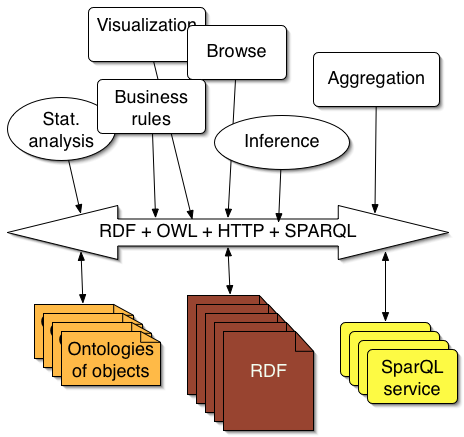
<br />Virtualization of heterogeneous data sources is only achievable if you have a dexterous data model based &quot;Bus&quot; into which the data sources are plugged. RDF has offered such a model for a long time.<br />
<br />
<br />
<br />
<img style="max-width: 800px;" src="http://www.w3.org/DesignIssues/diagrams/sw-clients.png" />
<br />
<br />
<br />
<br />When heterogeneous data sources are plugged into an RDF based integration bus e.g., customer records sourced from a variety of tables, across a plethora of databases, you can only end up with true value if the emergent entities from such an effort are coherently linked and (de)referencable; which is what <a href="http://dbpedia.org/resource/Linked_Data" id="link-id12b06e20">Linked Data</a>&#39;s fundamental preoccupation with dereferencable URIs is all about. Of course, Even when you have all of the above in place, you also need to be able to construct &quot;<a href="http://dbpedia.org/resource/Context_%28language_use%29" id="link-id103c2c80">Context</a> Lenses&quot; i.e., <a href="http://dbpedia.org/resource/Context_%28language_use%29" id="link-id1037a260">context</a> driven views of the <a href="http://dbpedia.org/resource/Linked_Data" id="link-id13e48ab8">Linked Data</a> Mesh (or <a href="http://dbpedia.org/resource/Linked_Data" id="link-id101c7718">Linked Data</a> Spaces).<br />
<br />
<br />Additional Diagrams:<br />
<br />
<br />1. <a href="http://www.w3.org/2005/Talks/1110-iswc-tbl/#%2824%29" id="link-id10808cb8">Clients of the RDF Bus</a> <br />2. <a href="http://www.w3.org/2005/Talks/1110-iswc-tbl/#%2825%29" id="link-id11e5a300">RDF Bus Server plugins: Scripts that emit RDF</a>
<br />3. <a href="http://www.w3.org/2005/Talks/1110-iswc-tbl/#%2826%29" id="link-id13ea46a0">RDF Bus Servers: RDF Data Managers (Triple or Quad Stores)</a>
<br />4. <a href="http://www.w3.org/2005/Talks/1110-iswc-tbl/#%2827%29" id="link-id101d3470">RDF Bus Servers: Relational to RDF Mappers (RDF Views, Semantic Covers etc.)</a>
<br />5. <a href="http://www.w3.org/2005/Talks/1110-iswc-tbl/#%2828%29" id="link-id1052c450">RDF Bus Server plugins: XML to RDF Mappers </a>
<br />6. <a href="http://www.w3.org/2005/Talks/1110-iswc-tbl/#%2829%29" id="link-id10281ec0">RDF Bus Server plugins: GRDDL based XSLT stylesheets that emit RDF</a>
<br />7. <a href="http://www.w3.org/2005/Talks/1110-iswc-tbl/#%2830%29" id="link-id1444faf0">RDF Bus Server plugins: Intelligent RDF Middleware</a>
<br />
<br />
<br />
<br />
<br />
<br />
<br />]]></content:encoded>
  <rss:title>Time for Context Lenses (Update)</rss:title>
  <rss:link>http://www.openlinksw.com/dataspace/kidehen@openlinksw.com/weblog/kidehen@openlinksw.com%27s%20BLOG%20%5B127%5D/1405</rss:link>
  <dc:date xmlns:dc="http://purl.org/dc/elements/1.1/">2008-08-04T15:24:50Z</dc:date>
  <dc:creator xmlns:dc="http://purl.org/dc/elements/1.1/">Kingsley Uyi Idehen &lt;kidehen@openlinksw.com&gt;</dc:creator>
 </rss:item>
 <rss:item xmlns:rss="http://purl.org/rss/1.0/" rdf:about="http://www.openlinksw.com/dataspace/kidehen@openlinksw.com/weblog/kidehen@openlinksw.com%27s%20BLOG%20%5B127%5D/1072">
  <dc:description xmlns:dc="http://purl.org/dc/elements/1.1/">Frederick Giasson continues the conversation about the Web Experience Dimensions in a new post --the first of several-- that chronicles the evolution of Pingthesemanticweb.com and Talk Digger, from Interactive-Web (Web 1.0) sites to Data-Web oriented Data Spaces: On a related front, I also came across an e-Government Data Reference Model presentation (PPT) by Mills Davis  from the Colab Wiki that  illustrates the aforementioned Web Dimensions (even though his presentation didn&#39;t have dimensionality of the Web in mind) in one of its graphics (which I&#39;ve yanked and placed into this post so that it has a URI courtesy of ODS ): Notes:===== Conceptual - Data-Web (*we are starting to comprehend and use this dimension* aka Semantic Web Layer 1) Logical Theory - To follow when we let loose the intelligent agents that enrichen the Data Web experience Philosophy - by way of Axiology (sometime in the future, but note, we are talking Internet time :-) ) I also stumbled across another graphic that actually provides visual delineation of the value propositions of XML (Structure) and RDF (Context): Notes:===== Description - XML Context - RDF Sharing - Access Points (e.g SPARQL, XMLA, GData Generic Query oriented Web Service Endpoints)</dc:description>
  <content:encoded xmlns:content="http://purl.org/rss/1.0/modules/content/"><![CDATA[
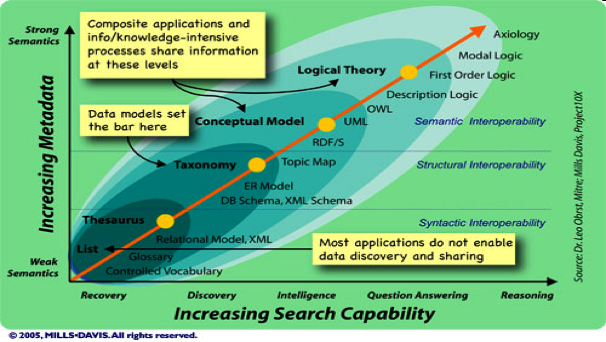
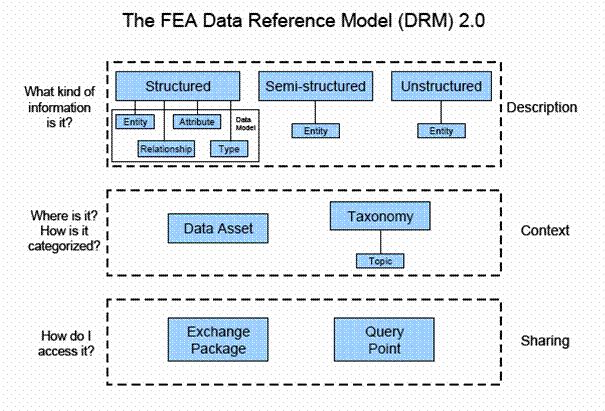
         <a href="http://fgiasson.com"> Frederick Giasson</a> continues <a href="http://fgiasson.com/blog/index.php?title=the_first_three_dimensions_of_the_web_in&amp;more=1&amp;c=1&amp;tb=1&amp;pb=1">the conversation about the Web Experience Dimensions</a> in a new post --the first of several-- that chronicles the evolution of Pingthesemanticweb.com and Talk Digger, from Interactive-Web (Web 1.0) sites to Data-Web oriented Data Spaces:<br /> <br />On a related front, I also came across an e-Government Data Reference Model presentation (<a href="http://web-services.gov/scopedrmit210172005.ppt">PPT</a>) by <a href="http://www.project10x.com/pages/team.html">Mills Davis</a>  from the <a href="http://colab.cim3.net/cgi-bin/wiki.pl?DRMImplementationThroughIterationandTestingPilotProjects">Colab Wiki</a> that  illustrates the aforementioned Web Dimensions (even though his presentation didn&#39;t have dimensionality of the Web in mind) in one of its graphics (which I&#39;ve yanked and placed into this post so that it has a URI courtesy of <a href="http://virtuoso.openlinksw.com/wiki/main/Main/OdsIndex">ODS</a> <img src="http://www.openlinksw.com/weblog/public/images/smileys/01.gif" />):<br /> <br /> <img src="http://www.openlinksw.com/blog/%7Ekidehen/briefcase/Public/graphics/drm-smart-search.png" /> <br /> <br /> Notes:<br />=====<br /> <span style="font-weight: bold;">Conceptual</span> - Data-Web (*we are starting to comprehend and use this dimension* aka Semantic Web Layer 1)<br /> <br /> <span style="font-weight: bold;">Logical Theory </span>- To follow when we let loose the intelligent agents that enrichen the Data Web experience<br /> <br /> <span style="font-weight: bold;">Philosophy</span> - by way of <a href="http://en.wikipedia.org/wiki/Axiology">Axiology </a>(sometime in the future, but note, we are talking Internet time :-) )<br /> <br />I also stumbled across another graphic that actually provides visual delineation of the value propositions of XML (Structure) and RDF (Context):<br /> <img src="http://colab.cim3.net/file/work/SICoP/EPADRM2.0/ombdrm2.gif" /> <br />Notes:<br />=====<br /> <br /> <span style="font-weight: bold;">Description</span> - <a href="http://www.w3.org/TR/xml-infoset/#intro">XML</a> <br /> <br /> <span style="font-weight: bold;">Context</span> - <a href="http://www.w3.org/TR/rdf-concepts/">RDF</a> <br /> <br /> <span style="font-weight: bold;">Sharing</span> - Access Points (e.g <a href="http://www.w3.org/TR/rdf-sparql-query/">SPARQL</a>, <a href="http://www.xmla.org/faq.asp">XMLA,</a> <a href="http://code.google.com/apis/gdata/">GData</a> Generic Query oriented Web Service Endpoints)<br />            
]]></content:encoded>
  <rss:title>Contd: Web Dimensionality</rss:title>
  <rss:link>http://www.openlinksw.com/dataspace/kidehen@openlinksw.com/weblog/kidehen@openlinksw.com%27s%20BLOG%20%5B127%5D/1072</rss:link>
  <dc:date xmlns:dc="http://purl.org/dc/elements/1.1/">2006-10-25T22:19:40Z</dc:date>
  <dc:creator xmlns:dc="http://purl.org/dc/elements/1.1/">Kingsley Uyi Idehen &lt;kidehen@openlinksw.com&gt;</dc:creator>
 </rss:item>
 <rss:item xmlns:rss="http://purl.org/rss/1.0/" rdf:about="http://www.openlinksw.com/dataspace/kidehen@openlinksw.com/weblog/kidehen@openlinksw.com%27s%20BLOG%20%5B127%5D/989">
  <dc:description xmlns:dc="http://purl.org/dc/elements/1.1/">Apple patent application for cascade feature for creating records in a database: &quot; On June 22, the US Patent &amp; Trademark Office revealed Apple’s patent application titled ‘Cascade feature for creating records in a database,’ originally filed in December 2004. The present invention relates to databases and, more particularly, to providing a cascade feature for a database program which can serve as an... [ read more ]&quot; (Via Macsimum News.) Its one thing to not know, or have any demonstrable interest in, the enterprise corporate market (the land of database technology utilization etc..), and a completely different matter when lack of technology advances in this realm amount to advertising one&#39;s ignorance about database matters so publicly. I would like to assume that this patent is dead on arrival since there should be an army of DBMS vendors Triggered by this attempt to CASCADE DELETE years of existing prior art LOL!! The attempt to use Model Independence as the patentable variation of &quot;DBMS Cascade Functionality&quot; prior art doesn&#39;t wash. CASCADE functionality is old news in the real DBMS world! What next? Patent application for mixing SQL and SPARQL in 2009? There is a gradual sense that we are now making the Conceptual View of Data Real, across the board, and obviously there would be a clear need to apply CASCADE technology in this context. But the fact that you realize this now (Apple!) simply doesn&#39;t make it novel in any shape or form.</dc:description>
  <content:encoded xmlns:content="http://purl.org/rss/1.0/modules/content/"><![CDATA[<blockquote>
<p>
  <a href="http://www.macsimumnews.com/index.php/archive/apple_patent_application_for_cascade_feature_for_creating_records_in_a_data/">Apple patent application for cascade feature for creating records in a database</a>: </p>
<p>
&quot;
On June 22, the US Patent &amp; Trademark Office revealed Apple’s patent application titled ‘Cascade feature for creating records in a database,’ originally filed in December 2004. The present invention relates to databases and, more particularly, to providing a cascade feature for a database program which can serve as an... [ <a href="http://www.macsimumnews.com/index.php/archive/13824/">
 read more</a> ]&quot;</p>

<p>(Via <a href="http://www.macsimumnews.com/index.php/main/index/">Macsimum News</a>.)</p>
</blockquote>

<p>Its one thing to not know, or have any demonstrable interest in, the enterprise corporate market (the land of database technology utilization etc..), and a completely different matter when lack of technology advances in this realm amount to advertising one&#39;s ignorance about database matters so publicly.</p>

<p>I would like to assume that this patent is dead on arrival since there should be an army of DBMS vendors Triggered by this attempt to CASCADE DELETE years of existing prior art LOL!!</p>

<p>The attempt to use Model Independence as the patentable variation of &quot;DBMS Cascade Functionality&quot; prior art doesn&#39;t wash. CASCADE functionality is old news in the real DBMS world! What next? Patent application for mixing SQL and SPARQL in 2009?</p>

<p>There is a gradual sense that we are now making the Conceptual View of Data Real, across the board, and obviously there would be a clear need to apply CASCADE technology in this context. But the fact that you realize this now (Apple!) simply doesn&#39;t make it novel in any shape or form.</p>

]]></content:encoded>
  <rss:title>Apple patent application for cascade feature for creating records in a database</rss:title>
  <rss:link>http://www.openlinksw.com/dataspace/kidehen@openlinksw.com/weblog/kidehen@openlinksw.com%27s%20BLOG%20%5B127%5D/989</rss:link>
  <dc:date xmlns:dc="http://purl.org/dc/elements/1.1/">2006-06-22T21:50:30Z</dc:date>
  <dc:creator xmlns:dc="http://purl.org/dc/elements/1.1/">Kingsley Uyi Idehen &lt;kidehen@openlinksw.com&gt;</dc:creator>
 </rss:item>
 <rss:item xmlns:rss="http://purl.org/rss/1.0/" rdf:about="http://www.openlinksw.com/dataspace/kidehen@openlinksw.com/weblog/kidehen@openlinksw.com%27s%20BLOG%20%5B127%5D/882">
  <dc:description xmlns:dc="http://purl.org/dc/elements/1.1/">Marc Canter&#39;s Breaking the Web Wide Open! article is something I found pretty late (by my normal discovery standards). This was partly due to the pre- and post- Web 2.0 event noise levels that have dumped the description of an important industry inflection into the &quot;Bozo Bin&quot; of many. Personally, I think we shouldn&#39;t confuse the Web 2.0 traditional-pitch-fest conference with an attempt to identify an important industry inflection). Anyway, Marc&#39;s article is a very refreshing read because it provides a really good insight into the general landscape of a rapidly evolving Web alongside genuine appreciation of our broader timeless pursuit of &quot;Openness&quot;. To really help this document provide additional value have scrapped the content of the original post and dumped it below so that we can appreciate the value of the links embedded within the article (note: thanks to Virtuoso I only had to paste the content into my blog, the extraction to my Linkblog and Blog Summary Pages are simply features of my Virtuoso based Blog Engine):Breaking the Web Wide Open! (complete story)Even the web giants like AOL, Google, MSN, and Yahoo need to observe these open standards, or they&#39;ll risk becoming the &quot;walled gardens&quot; of the new web and be coolio no more.Marc Canter [Broadband Mechanics, Inc.] | POSTED: 09.26.05 @12:00Editorial Note: Several months ago, AlwaysOn got a personal invitation from Yahoo founder Jerry Yang &quot;to see and give us feedback on our new social media product, y!360.&quot; We were happy to oblige and dutifully showed up, joining a conference room full of hard-core bloggers and new, new media types. The geeks gave Yahoo 360 an overwhelming thumbs down, with comments like, &quot;So the only services I can use within this new network are Yahoo services? What if I don&#39;t use Yahoo IM?&quot; In essence, the Yahoo team was booed for being &quot;closed web,&quot; and we heartily agreed. With Yahoo 360, Yahoo continues building its own &quot;walled garden&quot; to control its 135 million customersan accusation also hurled at AOL in the early 1990s, before AOL migrated its private network service onto the web. As the  Economist recently noted, &quot;Yahoo, in short, has old media plans for the new-media era.&quot;The irony to our view here is, of course, that today&#39;s AO Network is also a &quot;closed web.&quot; In the end, Mr. Yang&#39;s thoughtful invitation and our ensuing disappointment in his new service led to the assignment of this article. It also confirmed our existing plan to completely revamp the AO Network around open standards. To tie it all together, we recruited the chief architect of our new site, the notorious Marc Canter, to pen this piece. We look forward to our reader feedback.Breaking the Web Wide Open!By Marc CanterFor decades, &quot;walled gardens&quot; of proprietary standards and content have been the strategy of dominant players in mainframe computer software, wireless telecommunications services, and the World Wide Webit was their successful lock-in strategy of keeping their customers theirs. But like it or not, those walls are tumbling down. Open web standards are being adopted so widely, with such value and impact, that the web giantsAmazon, AOL, eBay, Google, Microsoft, and Yahooare facing the difficult decision of opening up to what they don&#39;t control.The online world is evolving into a new open web (sometimes called the Web 2.0), which is all about being personalized and customized for each user. Not only open source software, but open standards are becoming an essential component. Many of the web giants have been using open source software for years. Most of them use at least parts of the LAMP (Linux, Apache, MySQL, Perl/Python/PHP) stack, even if they aren&#39;t well-known for giving back to the open source community. For these incumbents that grew big on proprietary web services, the methods, practices, and applications of open source software development are difficult to fully adopt. And the next open source movementswhich will be as much about open standards as about codewill be a lot harder for the incumbents to exploit.While the incumbents use cheap open source software to run their back-ends systems, their business models largely depend on proprietary software and algorithms. But our view a new slew of open software, open protocols, and open standards will confront the incumbents with the classic Innovator&#39;s Dilemma.  Should they adopt these tools and standards, painfully cannibalizing their existing revenue for a new unproven concept, or should they stick with their currently lucrative model with the risk that eventually a bunch of upstarts eat their lunch? Credit should go to several of the web giants who have been making efforts to &quot;open up.&quot; Google, Yahoo, eBay, and Amazon all have Open APIs (Application Programming Interfaces) built into their data and systems. Any software developer can access and use them for whatever creative purposes they wish. This means that the API provider becomes an open platform for everyone to use and build on top of. This notion has expanded like wildfire throughout the blogosphere, so nowadays, Open APIs are pretty much required.Other incumbents also have open strategies. AOL has got the RSS religion, providing a feedreader and RSS search in order to escape the &quot;walled garden of content&quot; stigma. Apple now incorporates podcasts, the &quot;personal radio shows&quot; that are latest rage in audio narrowcasting, into iTunes. Even Microsoft is supporting open standards, for example by endorsing SIP (Session Initiation Protocol) for internet telephony and conferencing over Skype&#39;s proprietary format or one of its own devising.But new open standards and protocols are in use, under construction, or being proposed every day, pushing the envelope of where we are right now. Many of these standards are coming from startup companies and small groups of developers, not from the giants. Together with the Open APIs, those new standards will contribute to a new, open infrastructure. Tens of thousands of developers will use and improve this open infrastructure to create new kinds of web-based applications and services, to offer web users a highly personalized online experience.A Brief History of OpennessAt this point, I have to admit that I am not just a passive observer, full-time journalist or &quot;just some blogger&quot;but an active evangelist and developer of these standards. It&#39;s the vision of &quot;open infrastructure&quot; that&#39;s driving my company and the reason why I&#39;m writing this article. This article will give you some of the background behind on these standards, and what the evolution of the next generation of open standards will look like.Starting back in the 1980s, establishing a software standard was a key strategy for any software company. My former company, MacroMind (which became Macromedia), achieved this goal early on with Director. As Director evolved into Flash, the world saw that other companies besides Microsoft, Adobe, and Apple could establish true cross-platform, independent media standards.Then Tim Berners-Lee and Marc Andreessen came along, and changed the rules of the software business and of entrepreneurialism. No matter how entrenched and &quot;standardized&quot; software was, the rug could still get pulled out from under it. Netscape did it to Microsoft, and then Microsoft did it back  to Netscape. The web evolved, and lots of standards evolved with it. The leading open source standards (such as the LAMP stack) became widely used alternatives to proprietary closed-source offerings. Open standards are more than just technology. Open standards mean sharing, empowering, and community support. Someone floats a new idea (or meme) and the community runs with it – with each person making their own contributions to the standard – evolving it without a moment&#39;s hesitation about &quot;giving away their intellectual property.&quot;One good example of this was Dave Sifry, who built the Technorati blog-tracking technology inspired by the Blogging Ecosystem, a weekend project by young hacker Phil Pearson. Dave liked what he saw and he ran with itturning Technorati into what it is today.Dave Winer has contributed enormously to this area of open standards. He defined and personally created several open standards and protocolssuch as RSS, OPML, and XML-RPC. Dave has also helped build the blogosphere through his enthusiasm and passion.By 2003, hundreds of programmers were working on creating and establishing new standards for almost everything. The best of these new standards have evolved into compelling web services platforms – such as del.icio.us, Webjay, or Flickr. Some have even spun off formal standards – like XSPF (a standard for playlists) or instant messaging standard XMPP (also known as Jabber).Today&#39;s Open APIs are complemented by standardized Schemasthe structure of the data itself and its associated meta-data. Take for example a podcasting feed. It consists of: a) the radio show itself, b) information on who is on the show, what the show is about and how long the show is (the meta-data) and also c) API calls to retrieve a show (a single feed item) and play it from a specified server. The combination of Open APIs, standardized schemas for handling meta-data, and an industry which agrees on these standards are breaking the web wide open right now. So what new open standards should the web incumbentsand yoube watching? Keep an eye on the following developments:IdentityAttentionOpen MediaMicrocontent PublishingOpen Social NetworksTagsPinging RoutingOpen CommunicationsDevice Management and Control1. IdentityRight now, you don&#39;t really control your own online identity. At the core of just about every online piece of software is a membership system. Some systems allow you to browse a site anonymouslybut unless you register with the site you can&#39;t do things like search for an article, post a comment, buy something, or review it. The problem is that each and every site has its own membership system. So you constantly have to register with new systems, which cannot share dataeven you&#39;d want them to. By establishing a &quot;single sign-on&quot; standard, disparate sites can allow users to freely move from site to site, and let them control the movement of their personal profile data, as well as any other data they&#39;ve created. With Passport, Microsoft unsuccessfully attempted to force its proprietary standard on the industry. Instead, a world is evolving where most people assume that users want to control their own data, whether that data is their profile, their blog posts and photos, or some collection of their past interactions, purchases, and recommendations. As long as users can control their digital identity, any kind of service or interaction can be layered on top of it.Identity 2.0 is all about users controlling their own profile data and becoming their own agents. This way the users themselves, rather than other intermediaries, will profit from their ID info. Once developers start offering single sign-on to their users, and users have trusted places to store their datawhich respect the limits and provide access controls over that data, users will be able to access personalized services which will understand and use their personal data.Identity 2.0 may seem like some geeky, visionary future standard that isn&#39;t defined yet, but by putting each user&#39;s digital identity at the core of all their online experiences, Identity 2.0 is becoming the cornerstone of the new open web. The Initiatives:Right now, Identity 2.0 is under construction through various efforts from Microsoft (the &quot;InfoCard&quot; component built into the Vista operating system and its &quot;Identity Metasystem&quot;), Sxip Identity, Identity Commons, Liberty Alliance, LID (NetMesh&#39;s Lightweight ID), and SixApart&#39;s OpenID.More Movers and Shakers:Identity Commons and Kaliya Hamlin, Sxip Identity and Dick Hardt, the Identity Gang and Doc Searls, Microsoft&#39;s Kim Cameron, Craig Burton, Phil Windley, and Brad Fitzpatrick, to name a few.2. AttentionHow many readers know what their online attention is worth? If you don&#39;t, Google and Yahoo dothey make their living off our attention. They know what we&#39;re searching for, happily turn it into a keyword, and sell that keyword to advertisers. They make money off our attention. We don&#39;t. Technorati and friends proposed an attention standard, Attention.xml, designed to &quot;help you keep track of what you&#39;ve read, what you&#39;re spending time on, and what you should be paying attention to.&quot; AttentionTrust is an effort by Steve Gillmor and Seth Goldstein to standardize on how captured end-user performance, browsing, and interest data are used. Blogger Peter Caputa gives a good summary of AttentionTrust: &quot;As we use the web, we reveal lots of information about ourselves by what we pay attention to. Imagine if all of that information could be stored in a nice neat little xml file. And when we travel around the web, we can optionally share it with websites or other people. We can make them pay for it, lease it ... we get to decide who has access to it, how long they have access to it, and what we want in return. And they have to tell us what they are going to do with our Attention data.&quot;So when you give your attention to sites that adhere to the AttentionTrust, your attention rights (you own your attention, you can move your attention, you can pay attention and be paid for it,  and you can see how your attention is used) are guaranteed. Attention data is crucial to the future of the open web, and Steve and Seth are making sure that no one entity or oligopoly controls it. Movers and Shakers:Steve Gillmor, Seth Goldstein, Dave Sifry and the other Attention.xml folks. 3. Open MediaProprietary media standardsFlash, Windows Media, and QuickTime, to name a few helped liven up the web. But they are proprietary standards that try to keep us locked in, and they weren&#39;t created from scratch to handle today&#39;s online content. That&#39;s why, for many of us, an Open Media standard has been a holy grail. Yahoo&#39;s new Media RSS standard brings us one step closer to achieving open media, as do Ogg Vorbis audio codecs, XSPF playlists, or MusicBrainz. And several sites offer digital creators not only a place to store their content, but also to sell it. Media RSS (being developed by Yahoo with help from the community) extends RSS and combines it with &quot;RSS enclosures&quot; adds metadata to any media itemto create a comprehensive solution for media &quot;narrowcasters.&quot; To gain acceptance for Media RSS, Yahoo knows it has to work with the community. As an active member of this community, I can tell you that we&#39;ll create Media RSS equivalents for rdf (an alternative subscription format) and Atom (yet another  subscription format), so no one will be able to complain that Yahoo is picking sides in format wars.When Yahoo announced the purchase of Flickr, Yahoo founder Jerry Yang insinuated that Yahoo is acquiring &quot;open DNA&quot; to turn Yahoo into an open standards player. Yahoo is showing what happens when you take a multi-billion dollar company and make openness one of its core valuesso Google, beware, even if Google does have more research fellows and Ph.D.s. The open media landscape is far and wide, reaching from game machine hacks and mobile phone downloads to PC-driven bookmarklets, players, and editors, and it includes many other standardization efforts. XSPF is an open standard for playlists, and MusicBrainz is an alternative to the proprietary (and originally effectively stolen) database that Gracenote licenses. Ourmedia.org is a community front-end to Brewster Kahle&#39;s Internet Archive. Brewster has promised free bandwidth and free storage forever to any content creators who choose to share their content via the Internet Archive. Ourmedia.org is providing an easy-to-use interface and community to get content in and out of the Internet Archive, giving ourmedia.org users the ability to share their media anywhere they wish, without being locked into a particular service or tool. Ourmedia plans to offer open APIs and an open media registry that interconnects other open media repositories into a DNS-like registry (just like the www domain system), so folks can browse and discover open content across many open media services. Systems like Brightcove and Odeo support the concept of an open registry, and hope to work with digital creators to sell their work to fulfill the financial aspect of the &quot;Long Tail.&quot;More Movers and Shakers:Creative Commons, the Open Media Network, Jay Dedman, Ryanne Hodson, Michael Verdi, Eli Chapman, Kenyatta Cheese, Doug Kaye, Brad Horowitz, Lucas Gonze, Robert Kaye, Christopher Allen, Brewster Kahle, JD Lasica, and indeed, Marc Canter, among others.4. Microcontent PublishingUnstructured content is cheap to create, but hard to search through. Structured content is expensive to create, but easy to search. Microformats resolve the dilemma with simple structures that are cheap to use and easy to search.The first kind of widely adopted microcontent is blogging. Every post is an encapsulated idea, addressable via a URL called a permalink. You can syndicate or subscribe to this microcontent using RSS or an RSS equivalent, and news or blog aggregators can then display these feeds in a convenient readable fashion. But a blog post is just a block of unstructured text—not a bad thing, but just a first step for microcontent. When it comes tostructured data, such as personal identity profiles, product reviews, or calendar-type event data, RSS was not designed to maintain the integrity of the structures. Right now, blogging doesn&#39;t have the underlying structure necessary for full-fledged microcontent publishing. But that will change. Think of local information services (such as movie listings, event guides, or restaurant reviews) that any college kid can access and use in her weekend programming project to create new services and tools.Today&#39;s blogging tools will evolve into microcontent publishing systems, and will help spread the notion of structured data across the blogosphere. New ways to store, represent and produce microcontent will create new standards, such as Structured Blogging and Microformats. Microformats differ from RSS feeds in that you can&#39;t subscribe to them. Instead, Microformats are embedded into webpages and discovered by search engines like Google or Technorati. Microformats are creating common definitions for &quot;What is a review or event? What are the specific fields in the data structure?&quot; They can also specify what we can do with all this information.OPML (Outline Processor Markup Language) is a hierarchical file format for storing microcontent and structured data. It was developed by Dave Winer of RSS and podcast fame.Events are one popular type of microcontent. OpenEvents is already working to create shared databases of standardized events, which would get used by a new generation of event portals—such as Eventful/EVDB, Upcoming.org, and WhizSpark. The idea of OpenEvents is that event-oriented systems and services can work together to establish shared events databases (and associated APIs) that any developer could then use to create and offer their own new service or application. OpenReviews is still in the conceptual stage, but it would make it possible to provide open alternatives to closed systems like Epinions, and establish a shared database of local and global reviews. Its shared open servers would be filled with all sorts of reviews for anyone to access. Why is this important? Because I predict that in the future, 10 times more people will be writing reviews than maintaining their own blog. The list of possible microcontent standards goes on: OpenJobpostings, OpenRecipes, and even OpenLists. Microsoft recently revealed that it has been working on an important new kind of microcontent: Lists—so OpenLists will attempt to establish standards for the kind of lists we all use, such as lists of Links, lists of To Do Items, lists of People, Wish Lists, etc.Movers and Shakers:Tantek Çelik and Kevin Marks of Technorati, Danny Ayers, Eric Meyer, Matt Mullenweg, Rohit Khare, Adam Rifkin, Arnaud Leene, Seb Paquet, Alf Eaton, Phil Pearson, Joe Reger, Bob Wyman among others.5. Open Social NetworksI&#39;ll never forget the first time I met Jonathan Abrams, the founder of Friendster. He was arrogant and brash and he claimed he &quot;owned&quot;  all his users, and that he was going to monetize them and make a fortune off them. This attitude robbed Friendster of its momentum, letting MySpace, Facebook, and other social networks take Friendster&#39;s place.Jonathan&#39;s notion of social networks as a way to control users is typical of the Web 1.0 business model and its attitude towards users in general. Social networks have become one of the battlegrounds between old and new ways of thinking. Open standards for Social Networking will define those sides very clearly. Since meeting Jonathan, I have been working towards finding and establishing open standards for social networks. Instead of closed, centralized social networks with 10 million people in them, the goal is making it possible to have 10 million social networks that each have 10 people in them.FOAF (which stands for Friend Of A Friend, and describes people and relationships in a way that computers can parse) is a schema to represent not only your personal profile&#39;s meta-data, but your social network as well. Thousands of researchers use the FOAF schema in their &quot;Semantic Web&quot; projects to connect people in all sorts of new ways. XFN is a microformat standard for representing your social network, while vCard (long familiar to users of contact manager programs like Outlook) is a microformat that contains your profile information. Microformats are baked into any xHTML webpage, which means thatany blog, social network page, or any webpage in general can &quot;contain&quot; your social network in itand be used byany compatible tool, service or application. PeopleAggregator is an earlier project now being integrated into open content management framework Drupal. The PeopleAggregator APIs will make it possible to establish relationships, send messages, create or join groups, and post between different social networks. (Sneak preview: this technology will be available in the upcoming GoingOn Network.) All of these open social networking standards mean that inter-connected social networks will form a mesh that will parallel the blogosphere. This vibrant, distributed, decentralized world will be driven by open standards: personalized online experiences are what the new open web will be all aboutand what could be more personalized than people&#39;s networks?Movers and Shakers:Eric Sigler, Joel De Gan, Chris Schmidt, Julian Bond, Paul Martino, Mary Hodder, Drummond Reed, Dan Brickley, Randy Farmer, and Kaliya Hamlin, to name a few.6. TagsNowadays, no self-respecting tool or service can ship without tags. Tags are keywords or phrases attached to photos, blog posts, URLs, or even video clips. These user- and creator-generated tags are an open alternative to what used to be the domain of librarians and information scientists: categorizing information and content using taxonomies. Tags are instead creating &quot;folksonomies.&quot;The recently proposed OpenTags concept would be an open, community-owned version of the popular Technorati Tags service. It would aggregate the usage of tags across a wide range of services, sites, and content tools. In addition to Technorati&#39;s current tag features, OpenTags would let groups of people share their tags in &quot;TagClouds.&quot; Open tagging is likely to include some of the open identity features discussed above, to create a tag system that is resilient to spam, and yet trustable across sites all over the web.OpenTags owes a debt to earlier versions of shared tagging systems, which include Topic Exchange and something called the k-collectora knowledge management tag aggregatorfrom Italian company eVectors. Movers &amp; Shakers:Phil Pearson, Matt Mower , Paolo Valdemarin, and Mary Hodder and Drummond Reed again, among others.7. PingingWebsites used to be mostly static. Search engines that crawled (or &quot;spidered&quot;) them every so often did a good enough job to show reasonably current versions of your cousin&#39;s homepage or even Time magazine&#39;s weekly headlines. But when blogging took off, it became hard for search engines to keep up. (Google has only just managed to offer blog-search functionality, despite buying Blogger back in early 2003.)To know what was new in the blogosphere, users couldn&#39;t depend on services that spidered webpages once in a while. The solution: a way for blogs themselves to automatically notify blog-tracking sites that they&#39;d been updated. Weblogs.com was the first blog &quot;ping service&quot;: it displayed the name of a blog whenever that blog was updated. Pinging sites helped the blogosphere grow, and more tools, services, and portals started using pinging in new and different ways. Dozens of pinging services and sitesmost of which can&#39;t talk to each othersprang up. Matt Mullenweg (the creator of open source blogging software WordPress) decided that a one-stop service for pinging was needed. He created Ping-o-Maticwhich aggregates ping services and simplifies the pinging process for bloggers and tool developers. With Ping-o-Matic, any developer can alert all of the industry&#39;s blogging tools and tracking sites at once. This new kind of open standard, with shared infrastructure, is a critical to the scalability of Web 2.0 services.As Matt said:There are a number of services designed specifically for tracking and connecting blogs. However it would be expensive for all the services to crawl all the blogs in the world all the time. By sending a small ping to each service you let them know you&#39;ve updated so they can come check you out. They get the freshest data possible, you don&#39;t get a thousand robots spidering your site all the time. Everybody wins.Movers and Shakers:Matt Mullenweg, Jim Winstead, Dave Winer8. RoutingBloggers used to have to manually enter the links and content snippets of blog posts or news items they wanted to blog. Today, some RSS aggregators can send a specified post directly into an associated blogging tool: as bloggers browse through the feeds they subscribe to, they can easily specify and send any post they wish to &quot;reblog&quot; from their news aggregator or feed reader into their blogging tool. (This is usually referred to as &quot;BlogThis.&quot;) As structured blogging comes into its own (see the section on Microcontent Publishing), it will be increasingly important to maintain the structural integrity of these pieces of microcontent when reblogging them. Promising standard RedirectThis will combine a &quot;BlogThis&quot;-like capability while maintaining the integrity of the microcontent. RedirectThis will let bloggers and content developers attach a simple &quot;PostThis&quot; button to their posts. Clicking on that button will send that post to the reader/blogger&#39;s favorite blogging tool. This favorite tool is specified at the RedirectThis web service, where users register their blogging tool of choice. RedirectThis also helps maintain the integrity and structure of microcontentthen it&#39;s just up to the user to prefer a blogging tool that also attains that lofty goal of microcontent integrity. OutputThis is another nascent web services standard, to let bloggers specify what &quot;destinations&quot; they&#39;d like to have as options in their blogging tool. As new destinations are added to the service, more checkboxes would get added to their blogging toolallowing them to route their published microcontent to additional destinations.Movers and Shakers:Michael Migurski, Lucas Gonze9. Open CommunicationsLikely, you&#39;ve experienced the joys of finding friends on AIM or Yahoo Messenger, or the convenience of Skyping with someone overseas. Not that you&#39;re about to throw away your mobile phone or BlackBerry, but for many, also having access to Instant Messaging (IM) and Voice over IP (VoIP) is crucial. IM and VoIP are mainstream technologies that already enjoy the benefits of open standards. Entire industries are bornright this secondbased around these open standards. Jabber has been an open IM technology for yearsin fact, as XMPP, it was officially dubbed a standard by the IETF. Although becoming an official IETF standard is usually the kiss of death, Jabber looks like it&#39;ll be around for a while, as entire generations of collaborative, work-group applications and services have been built on top of its messaging protocol. For VoIP, Skype is clearly the leading standard todaythough one could argue just how &quot;open&quot; it is (and defenders of the IETF&#39;s SIP standard often do). But it is free and user-friendly, so there won&#39;t be much argument from users  about it being insufficiently open. Yet there may be a cloud on Skype&#39;s horizon: web behemoth Google recently released a beta of Google Talk, an IM client committed to open standards. It currently supports XMPP, and will support SIP for VoIP calls.Movers and Shakers:Jeremie Miller, Henning Schulzrinne, Jon Peterson, Jeff Pulver10. Device Management and ControlTo access online content, we&#39;re using more and more devices. BlackBerrys, iPods, Treos, you name it. As the web evolves, more and more different devices will have to communicate with each other to give us the content we want when and where we want it. No-one wants to be dependent on one vendor anymorelike, say, Sonyfor their laptop, phone, MP3 player, PDA, and digital camera, so that it all works together. We need fully interoperable devices, and the standards to make that work. And to fully make use of how content is moving online content and innovative web services, those standards need to be open.MIDI (musical instrument digital interface), one of the very first open standards in music, connected disparate vendors&#39; instruments, post-production equipment, and recording devices. But MIDI is limited, and MIDI II has been very slow to arrive. Now a new standard for controlling musical devices has emerged: OSC (Open SoundControl). This protocol is optimized for modern networking technology and inter-connects music, video and controller devices with &quot;other multimedia devices.&quot; OSC is used by a wide range of developers, and is being taken up in the mainstream MIDI marketplace.Another open-standards-based device management technology is ZigBee, for building wireless intelligence and network monitoring into all kinds of devices. ZigBee is supported by many networking, consumer electronics, and mobile device companies.      · · · · · ·     The Change to OpennessThe rise of open source software and its &quot;architecture of participation&quot; are completely shaking up the old proprietary-web-services-and-standards approach. Sun Microsystemswhose proprietary Java standard helped define the Web 1.0is opening its Solaris OS and has even announced the apparent paradox of an open-source Digital Rights Management system.Today&#39;s incumbents will have to adapt to the new openness of the Web 2.0. If they stick to their proprietary standards, code, and content, they&#39;ll become the new walled gardensplaces users visit briefly to retrieve data and content from enclosed data silos, but not where users &quot;live.&quot; The incumbents&#39; revenue models will have to change. Instead of &quot;owning&quot; their users, users will know they own themselves, and will expect a return on their valuable identity and attention. Instead of being locked into incompatible media formats, users will expect easy access to digital content across many platforms. Yesterday&#39;s web giants and tomorrow&#39;s users will need to find a mutually beneficial new balancebetween open and proprietary, developer and user, hierarchical and horizontal, owned and shared, and compatible and closed. Marc Canter is an active evangelist and developer of open standards. Early in his career, Marc founded MacroMind, which became Macromedia. These days, he is CEO of Broadband Mechanics, a founding member of the Identity Gang and of ourmedia.org. Broadband Mechanics is currently developing the GoingOn Network (with the AlwaysOn Network), as well as an open platform for social networking called the PeopleAggregator.A version of the above post appears in the Fall 2005 issue of AlwaysOn&#39;s quarterly print blogozine, and ran as a four-part series on the AlwaysOn Network website.(Via Marc&#39;s Voice.)</dc:description>
  <content:encoded xmlns:content="http://purl.org/rss/1.0/modules/content/"><![CDATA[<p><a href="http://marc.blogs.it/">Marc Canter</a>&#39;s <a href="http://marc.blogs.it/archives/2005/10/breaking_the_we.html">Breaking the Web Wide Open! </a> article is something I found pretty late (by my normal discovery standards). This was partly due to the pre- and post- Web 2.0 event noise levels that have dumped the description of an important industry inflection into the &quot;Bozo Bin&quot; of many. Personally, I think we shouldn&#39;t confuse the Web 2.0 traditional-pitch-fest conference with an attempt to identify an important industry inflection).</p><p> Anyway, Marc&#39;s article is a very refreshing read because it provides a really good insight into the general landscape of a rapidly evolving Web alongside genuine appreciation of our broader timeless pursuit of &quot;Openness&quot;. </p><p>To really help this document provide additional value have scrapped the content of the original post and dumped it below so that we can appreciate the value of the links embedded within the article (note: thanks to Virtuoso I only had to paste the content into my blog, the extraction to my <a href="http://www.openlinksw.com/blog/~kidehen/index.vspx?page=linkblog">Linkblog</a> and <a href="http://www.openlinksw.com/blog/~kidehen/index.vspx?page=summary">Blog Summary</a> Pages are simply features of my <a href="http://www.openlinksw.com/virtuos">Virtuoso </a>based Blog Engine):</p><blockquote><h3 class="hed2" style="padding-bottom: 10px">Breaking the Web Wide Open! (complete story)</h3><p>Even the web giants like AOL, Google, MSN, and Yahoo need to observe these open standards, or they&#39;ll risk becoming the &quot;walled gardens&quot; of the new web and be coolio no more.</p><p class="byline"><b><a href="http://community.alwayson-network.com/cgi-bin/WebObjects/AlwaysOn.woa/wa/display?id=9254:Person">Marc Canter</a></b> [<a href="http://community.alwayson-network.com/cgi-bin/WebObjects/AlwaysOn.woa/wa/display?id=9254:Person"><b>Broadband Mechanics, Inc.</b></a>] | POSTED: 09.26.05 @12:00</p><table width="100%" border="0" cellspacing="0" cellpadding="0"><tr><td valign="TOP" class="copy1"><img src="http://community.alwayson-network.com/ao/images/thumb/19433429363e7cd6b1ecfb7.jpg" align="LEFT" border="0" width="80" style="margin: 0px 10px 5px 0px" alt="" /><i><b>Editorial Note:</b> Several months ago, AlwaysOn got a personal invitation from Yahoo founder Jerry Yang &quot;to see and give us feedback on our new social media product, y!360.&quot; We were happy to oblige and dutifully showed up, joining a conference room full of hard-core bloggers and new, new media types. The geeks gave Yahoo 360 an overwhelming thumbs down, with comments like, &quot;So the only services I can use within this new network are Yahoo services? What if I don&#39;t use Yahoo IM?&quot; In essence, the Yahoo team was booed for being &quot;closed web,&quot; and we heartily agreed. With Yahoo 360, Yahoo continues building its own &quot;walled garden&quot; to control its 135 million customersan accusation also hurled at AOL in the early 1990s, before AOL migrated its private network service onto the web. As the</i>  <a href="http://bernardmoon.blogspot.com/2005/08/yahoos-personality-crisis.html" target="_blank">Economist<i> recently noted</i></a>, &quot;Yahoo, in short, has old media plans for the new-media era.&quot;<br /><br />The irony to our view here is, of course, that today&#39;s AO Network is also a &quot;closed web.&quot; In the end, Mr. Yang&#39;s thoughtful invitation and our ensuing disappointment in his new service led to the assignment of this article. It also confirmed our existing plan to completely revamp the AO Network around open standards. To tie it all together, we recruited the chief architect of our new site, <a href="http://www.corante.com/amateur/articles/20030211-3564.html" target="_blank">the notorious Marc Canter</a>, to pen this piece. We look forward to our reader feedback.<br /><br /><b>Breaking the Web Wide Open!</b><br />By Marc Canter<br /><br />For decades, &quot;walled gardens&quot; of proprietary standards and content have been the strategy of dominant players in mainframe computer software, wireless telecommunications services, and the World Wide Webit was their successful lock-in strategy of keeping their customers theirs. But like it or not, those walls are tumbling down. Open web standards are being adopted so widely, with such value and impact, that the web giantsAmazon, AOL, eBay, Google, Microsoft, and Yahooare facing the difficult decision of opening up to what they don&#39;t control.<br /><br />The online world is evolving into a new open web (sometimes called the Web 2.0), which is all about being personalized and customized for each user. Not only open source software, but <i>open standards</i> are becoming an essential component. <br /><br />Many of the web giants have been using open source software for years. Most of them use at least parts of the <a href="http://www.onlamp.com/pub/a/onlamp/2001/01/25/lamp.html" target="_blank">LAMP</a> (Linux, Apache, MySQL, Perl/Python/PHP) stack, even if they aren&#39;t well-known for giving back to the open source community. For these incumbents that grew big on proprietary web services, the methods, practices, and applications of open source software development are difficult to fully adopt. And the next open source movementswhich will be as much about open standards as about codewill be a lot harder for the incumbents to exploit.<br /><br />While the incumbents use cheap open source software to run their back-ends systems, their business models largely depend on proprietary software and algorithms. But our view a new slew of open software, open protocols, and open standards will confront the incumbents with the classic <i><a href="http://www.businessweek.com/chapter/christensen.htm" target="_blank">Innovator&#39;s Dilemma</a></i>.  Should they adopt these tools and standards, painfully cannibalizing their existing revenue for a new unproven concept, or should they stick with their currently lucrative model with the risk that eventually a bunch of upstarts eat their lunch? <br /><br />Credit should go to several of the web giants who have been making efforts to &quot;open up.&quot; Google, Yahoo, eBay, and Amazon all have Open APIs (Application Programming Interfaces) built into their data and systems. Any software developer can access and use them for whatever creative purposes they wish. This means that the API provider becomes an open platform for everyone to use and build on top of. This notion has expanded like wildfire throughout the blogosphere, so nowadays, Open APIs are pretty much required.<br /><br />Other incumbents also have open strategies. AOL has got the RSS religion, <a href="http://www.siliconbeat.com/entries/2005/07/27/aol_gets_rss_religion_with_my_aoland_feedsters_help.html" target="_blank">providing a feedreader and RSS search</a> in order to escape the &quot;walled garden of content&quot; stigma. <a href="http://www.apple.com/podcasting/" target="_blank">Apple now incorporates podcasts</a>, the &quot;personal radio shows&quot; that are latest rage in audio narrowcasting, into iTunes. Even Microsoft is supporting open standards, for example <a href="http://www.microsoft.com/technet/prodtechnol/winxppro/plan/rtcprot.mspx#EKAA" target="_blank">by endorsing SIP (Session Initiation Protocol) for internet telephony and conferencing</a> over Skype&#39;s proprietary format or one of its own devising.<br /><br />But new open standards and protocols are in use, under construction, or being proposed every day, pushing the envelope of where we are right now. Many of these standards are coming from startup companies and small groups of developers, not from the giants. Together with the Open APIs, those new standards will contribute to a new, open infrastructure. Tens of thousands of developers will use and improve this open infrastructure to create new kinds of web-based applications and services, to offer web users a highly personalized online experience.<br /><br /><b>A Brief History of Openness</b><br /><br />At this point, I have to admit that I am not just a passive observer, full-time journalist or &quot;just some blogger&quot;but an active evangelist and developer of these standards. It&#39;s the vision of &quot;open infrastructure&quot; that&#39;s driving <a href="http://www.broadbandmechanics.com/bbm2005.htm" target="_blank">my company </a> and the reason why I&#39;m writing this article. This article will give you some of the background behind on these standards, and what the evolution of the next generation of open standards will look like.<br /><br />Starting back in the 1980s, establishing a software standard was a key strategy for any software company. My former company, MacroMind (which became Macromedia), achieved this goal early on with Director. As <a href="http://webmonkey.wired.com/webmonkey/99/27/index3a_page6.html?tw=multimedia" target="_blank">Director evolved into Flash</a>, the world saw that other companies besides Microsoft, Adobe, and Apple could establish true cross-platform, independent media standards.<br /><br />Then <a href="http://www.w3.org/People/Berners-Lee/" target="_blank">Tim Berners-Lee</a> and <a href="http://www.ibiblio.org/pioneers/andreesen.html" target="_blank">Marc Andreessen</a> came along, and changed the rules of the software business and of entrepreneurialism. No matter how entrenched and &quot;standardized&quot; software was, the rug could still get pulled out from under it. <a href="http://geekphilosopher.com/MainPage/WebBrowserWars.htm?q=Stocks" target="_blank">Netscape did it to Microsoft, and then Microsoft did it <i>back</i>  to Netscape</a>. The web evolved, and lots of standards evolved with it. The leading open source standards (such as the LAMP stack) became widely used alternatives to proprietary closed-source offerings. <br /><br />Open standards are more than just technology. Open standards mean sharing, empowering, and community support. Someone floats a new idea (or <a href="http://en.wikipedia.org/wiki/Meme" target="_blank">meme</a>) and the community runs with it – with each person making their own contributions to the standard – evolving it without a moment&#39;s hesitation about &quot;giving away their intellectual property.&quot;<br /><br />One good example of this was <a href="http://www.sifry.com/alerts/" target="_blank">Dave Sifry</a>, who built the Technorati blog-tracking technology inspired by the <a href="http://www.myelin.co.nz/ecosystem/" target="_blank">Blogging Ecosystem</a>, a weekend project by young hacker <a href="http://marc.blogs.it/archives/2005/07/phil_pearson_jo.html" target="_blank">Phil Pearson</a>. Dave liked what he saw and he ran with itturning Technorati into what it is today.<br /><br /><a href="http://en.wikipedia.org/wiki/Dave_Winer" target="_blank">Dave Winer</a> has contributed enormously to this area of open standards. He defined and personally created several open standards and protocolssuch as RSS, OPML, and XML-RPC. Dave has also <a href="http://newhome.weblogs.com/historyOfWeblogs" target="_blank">helped build</a> the blogosphere through his enthusiasm and passion.<br /><br />By 2003, hundreds of programmers were working on creating and establishing new standards for almost everything. The best of these new standards have evolved into compelling web services platforms – such as <a href="http://del.icio.us/" target="_blank">del.icio.us</a>, <a href="http://webjay.org/about" target="_blank">Webjay</a>, or <a href="http://www.flickr.com/photos/tags/ao2005/" target="_blank">Flickr</a>. Some have even spun off formal standards – like XSPF (a standard for playlists) or instant messaging standard XMPP (also known as Jabber).<br /><br />Today&#39;s Open APIs are complemented by standardized Schemasthe structure of the data itself and its associated meta-data. Take for example a <a href="http://www.ipodder.org/whatIsPodcasting" target="_blank">podcasting feed</a>. It consists of: a) the radio show itself, b) information on who is on the show, what the show is about and how long the show is (the meta-data) and also c) API calls to retrieve a show (a single feed item) and play it from a specified server. <br /><br />The combination of Open APIs, standardized schemas for handling meta-data, and an industry which agrees on these standards are breaking the web wide open right now. So what new open standards should the web incumbentsand yoube watching? Keep an eye on the following developments:<br /><br /><b>Identity<br />Attention<br />Open Media<br />Microcontent Publishing<br />Open Social Networks<br />Tags<br />Pinging <br />Routing<br />Open Communications<br />Device Management and Control</b><br /><br /><br /><b>1.	Identity</b><br /><br />Right now, you don&#39;t really control your own online identity. At the core of just about every online piece of software is a membership system. Some systems allow you to browse a site anonymouslybut unless you register with the site you can&#39;t do things like search for an article, post a comment, buy something, or review it. The problem is that each and every site has its own membership system. So you constantly have to register with new systems, which cannot share dataeven you&#39;d want them to. By establishing a <a href="http://www.wired.com/news/privacy/0,1848,68329-2,00.html?tw=wn_story_page_next1" target="_blank">&quot;single sign-on&quot; standard</a>, disparate sites can allow users to freely move from site to site, and let them control the movement of their personal profile data, as well as any other data they&#39;ve created. <br /><br />With <a href="http://www.thehindubusinessline.com/2005/01/03/stories/2005010301440200.htm" target="_blank">Passport, Microsoft unsuccessfully attempted</a> to force its proprietary standard on the industry. Instead, a world is evolving where most people assume that users want to control their own data, whether that data is their profile, their blog posts and photos, or some collection of their past interactions, purchases, and recommendations. As long as users can control their digital identity, any kind of service or interaction can be layered on top of it.<br /><br /><a href="http://www.identity20.com/media/OSCON2005/" target="_blank">Identity 2.0</a> is all about users controlling their own profile data and becoming their own agents. This way the users themselves, rather than other intermediaries, will profit from their ID info. Once developers start offering single sign-on to their users, and users have trusted places to store their datawhich respect the limits and provide access controls over that data, users will be able to access personalized services which will understand and use their personal data.<br /><br />Identity 2.0 may seem like some geeky, visionary future standard that isn&#39;t defined yet, but by putting each user&#39;s digital identity at the core of all their online experiences, Identity 2.0 is becoming the cornerstone of the new open web. <br /><br /><b>The Initiatives:</b><br />Right now, Identity 2.0 is under construction through various efforts from Microsoft (the <a href="http://msdn.microsoft.com/webservices/webservices/understanding/advancedwebservices/default.aspx?pull=/library/en-us/dnwebsrv/html/identitymetasystem.asp" target="_blank">&quot;InfoCard&quot; component built into the Vista operating system</a> and its &quot;<a href="http://garage.docsearls.com/node/605" target="_blank">Identity Metasystem</a>&quot;), <a href="http://sxip.com" target="_blank">Sxip Identity</a>, <a href="http://www.identtycommons.net" target="_blank">Identity Commons</a>, <a href="http://www.projectliberty.org/" target="_blank">Liberty Alliance</a>, <a href="http://lid.netmesh.org/" target="_blank">LID</a> (NetMesh&#39;s Lightweight ID), and SixApart&#39;s <a href="http://openid.net/" target="_blank">OpenID</a>.<br /><br /><b>More Movers and Shakers:</b><br />Identity Commons and <a href="http://www.identitywoman.net" target="_blank">Kaliya Hamlin</a>, Sxip Identity and <a href="http://blame.ca/dick/" target="_blank">Dick Hardt</a>, the <a href="http://www.identitygang.org/" target="_blank"> Identity Gang</a> and <a href="http://www.searls.com/dochome.html#Bio" target="_blank">Doc Searls</a>, Microsoft&#39;s <a href="http://www.identityblog.com/" target="_blank">Kim Cameron</a>, <a href="http://www.craigburton.com/" target="_blank">Craig Burton</a>, <a href="http://phil.windley.org/" target="_blank">Phil Windley</a>, and <a href="http://slashdot.org/article.pl?sid=05/07/05/2020221&amp;from=rss" target="_blank">Brad Fitzpatrick</a>, to name a few.<br /><br /><br /><b>2.	Attention</b><br /><br />How many readers know what their online attention is worth? If you don&#39;t, Google and Yahoo dothey make their living off our attention. They know what we&#39;re searching for, happily turn it into a keyword, and sell that keyword to advertisers. They make money off our attention. We don&#39;t. <br /><br />Technorati and friends proposed <a href="http://blogs.zdnet.com/Gillmor/index.php?p=74" target="_blank">an attention standard, Attention.xml</a>, designed to &quot;help you keep track of what you&#39;ve read, what you&#39;re spending time on, and what you should be paying attention to.&quot; <a href="http://attentiontrust.org/" target="_blank">AttentionTrust</a> is an effort by <a href="http://blogs.zdnet.com/Gillmor/?p=132" target="_blank">Steve Gillmor</a> and <a href="http://majestic.typepad.com/seth/2005/07/attentiontrusto.html" target="_blank">Seth Goldstein </a>to standardize on how captured end-user performance, browsing, and interest data are used. <br /><br />Blogger <a href="http://worcester.typepad.com/pc4media/2005/07/attentiontrusto_1.html" target="_blank">Peter Caputa gives a good summary</a> of AttentionTrust: <blockquote>&quot;As we use the web, we reveal lots of information about ourselves by what we pay attention to. Imagine if all of that information could be stored in a nice neat little xml file. And when we travel around the web, we can optionally share it with websites or other people. We can make them pay for it, lease it ... we get to decide who has access to it, how long they have access to it, and what we want in return. And they have to tell us what they are going to do with our Attention data.&quot;</blockquote><br />So when you give your attention to sites that adhere to the AttentionTrust, your attention rights (<i>you own your attention, you can move your attention, you can pay attention and be paid for it</i>,  and <i>you can see how your attention is used</i>) are guaranteed. Attention data is crucial to the future of the open web, and Steve and Seth are making sure that no one entity or oligopoly controls it. <br /><br /><b>Movers and Shakers:</b><br /><a href="http://blogs.zdnet.com/Gillmor/" target="_blank">Steve Gillmor</a>, <a href="http://majestic.typepad.com/about.html" target="_blank">Seth Goldstein</a>, <a href="http://www.sifry.com/alerts/" target="_blank">Dave Sifry</a> and the <a href="http://developers.technorati.com/wiki/attentionxml" target="_blank">other Attention.xml folks</a>. <br /><br /><br /><b>3.	Open Media</b><br /><br />Proprietary media standardsFlash, Windows Media, and QuickTime, to name a few helped liven up the web. But they are proprietary standards that try to keep us locked in, and they weren&#39;t created from scratch to handle today&#39;s online content. That&#39;s why, for many of us, an Open Media standard has been a holy grail. Yahoo&#39;s new Media RSS standard brings us one step closer to achieving open media, as do <a href="http://www.vorbis.com/faq/#what" target="_blank">Ogg Vorbis</a> audio codecs, <a href="http://webjay.org/" target="_blank">XSPF playlists</a>, or <a href="http://musicbrainz.org/" target="_blank">MusicBrainz</a>. And several sites offer digital creators not only a place to store their content, but also to sell it. <br /><br /><a href="http://search.yahoo.com/mrss" target="_blank">Media RSS </a>(being developed by Yahoo with help from the community) extends RSS and combines it with &quot;RSS enclosures&quot; adds metadata to any media itemto create a comprehensive solution for media &quot;narrowcasters.&quot; To gain acceptance for Media RSS, Yahoo knows it has to work with the community. As an active member of this community, I can tell you that we&#39;ll create Media RSS equivalents for <a href="http://www.xml.com/pub/a/2001/01/24/rdf.html" target="_blank">rdf</a> (an alternative subscription format) and <a href="http://www.atomenabled.org/" target="_blank">Atom</a> (yet <i>another</i>  subscription format), so no one will be able to complain that Yahoo is picking sides in format wars.<br /><br />When Yahoo announced the purchase of Flickr, Yahoo founder Jerry Yang insinuated that Yahoo is acquiring &quot;open DNA&quot; to turn Yahoo into <a href="http://www.flickr.com/services/api/" target="_blank">an open standards player</a>. Yahoo is showing what happens when you take a multi-billion dollar company and make openness one of its core valuesso Google, beware, even if Google does have more research fellows and Ph.D.s. <br /><br />The open media landscape is far and wide, reaching from game machine hacks and mobile phone downloads to PC-driven bookmarklets, players, and editors, and it includes many other standardization efforts. <a href="http://www.xspf.org/" target="_blank">XSPF</a> is an open standard for playlists, and MusicBrainz is an alternative to the proprietary (and originally effectively stolen) database that <a href="http://en.wikipedia.org/wiki/Gracenote" target="_blank">Gracenote</a> licenses. <br /><br /><a href="http://www.ourmedia.org/" target="_blank">Ourmedia.org</a> is a community front-end to Brewster Kahle&#39;s <a href="http://www.archive.org" target="_blank">Internet Archive</a>. Brewster has promised free bandwidth and free storage forever to any content creators who choose to share their content via the Internet Archive. Ourmedia.org is providing an easy-to-use interface and community to get content in and out of the Internet Archive, giving ourmedia.org users the ability to share their media anywhere they wish, without being locked into a particular service or tool. Ourmedia plans to offer open APIs and an open media registry that interconnects other open media repositories into a DNS-like registry (just like the www domain system), so folks can browse and discover open content across many open media services. Systems like <a href="http://www.brightcove.com/" target="_blank">Brightcove</a> and <a href="http://www.evhead.com/2005/02/how-odeo-happened.asp" target="_blank">Odeo</a> support the concept of an open registry, and hope to work with digital creators to sell their work to fulfill the financial aspect of <a href="http://en.wikipedia.org/wiki/The_Long_Tail" target="_blank">the &quot;Long Tail.&quot;</a><br /><br /><b>More Movers and Shakers:</b><br /><a href="http://creativecommons.org/about/people" target="_blank">Creative Commons</a>, the <a href="http://www.omn.org/" target="_blank">Open Media Network</a>, <a href="http://www.momentshowing.net/about.html" target="_blank">Jay Dedman</a>, <a href="http://ryanedit.blogspot.com/" target="_blank">Ryanne Hodson</a>, <a href="http://michaelverdi.com/index.php" target="_blank">Michael Verdi</a>, <a href="http://www.chapmanlogic.com/blog/aboutEli.html" target="_blank">Eli Chapman</a>, <a href="http://www.unmediated.org/" target="_blank">Kenyatta Cheese</a>, <a href="http://www.itconversations.com/about.html" target="_blank">Doug Kaye</a>, <a href="http://www.wired.com/wired/archive/13.09/yahoo.html" target="_blank">Brad Horowitz</a>, <a href="http://webjay.org/about#colophon" target="_blank">Lucas Gonze</a>, <a href="http://musicbrainz.org/wd/MusicBrainzBio" target="_blank">Robert Kaye</a>,  <a href="http://www.lifewithalacrity.com/" target="_blank">Christopher Allen</a>, <a href="http://en.wikipedia.org/wiki/Brewster_Kahle" target="_blank">Brewster Kahle</a>, <a href="http://www.newmediamusings.com/" target="_blank">JD Lasica</a>, and indeed, <a href="http://www.corante.com/amateur/articles/20030211-3564.html" target="_blank">Marc Canter</a>, among others.<br /><br /><br /><b>4.	Microcontent Publishing</b><br /><br />Unstructured content is cheap to create, but hard to search through. Structured content is expensive to create, but easy to search. <a href="http://developers.technorati.com/wiki/MicroFormats" target="_blank">Microformats</a> resolve the dilemma with simple structures that are cheap to use and easy to search.<br /><br />The first kind of widely adopted microcontent is blogging. Every post is an encapsulated idea, addressable via a URL called a permalink. You can syndicate or subscribe to this microcontent using RSS or an RSS equivalent, and news or blog aggregators can then display these feeds in a convenient readable fashion. But a blog post is just a block of unstructured text—not a bad thing, but just a first step for microcontent. When it comes to<i>structured</i> data, such as personal identity profiles, product reviews, or calendar-type event data, RSS was not designed to maintain the integrity of the structures. <br /><br />Right now, blogging doesn&#39;t have the underlying structure necessary for full-fledged microcontent publishing. But that will change. Think of local information services (such as movie listings, event guides, or restaurant reviews) that any college kid can access and use in her weekend programming project to create new services and tools.<br /><br />Today&#39;s blogging tools will evolve into microcontent publishing systems, and will help spread the notion of structured data across the blogosphere. New ways to store, represent and produce microcontent will create new standards, such as <a href="http://structuredblogging.org/" target="_blank">Structured Blogging</a> and <a href="http://microformats.org/" target="_blank">Microformats</a>. Microformats differ from RSS feeds in that you can&#39;t subscribe to them. Instead, Microformats are embedded into webpages and discovered by search engines like Google or Technorati. Microformats are creating common definitions for &quot;What is a review or event? What are the specific fields in the data structure?&quot; They can also specify what we can do with all this information.<a href="http://www.opml.org/spec" target="_blank">OPML (Outline Processor Markup Language)</a> is a hierarchical file format for storing microcontent and structured data. It was developed by <a href="http://en.wikipedia.org/wiki/Dave_Winer" target="_blank">Dave Winer</a> of RSS and podcast fame.<br /><br />Events are one popular type of microcontent. <a href="http://www.openevents.com" target="_blank">OpenEvents</a> is already working to create shared databases of standardized events, which would get used by a new generation of event portals—such as <a href="http://eventful.com/gotevents/" target="_blank">Eventful/EVDB</a>, <a href="http://upcoming.org/" target="_blank">Upcoming.org</a>, and <a href="http://www.whizspark.com/" target="_blank">WhizSpark</a>. The idea of OpenEvents is that event-oriented systems and services can work together to establish shared events databases (and associated APIs) that any developer could then use to create and offer their own new service or application. <a href="http://marc.blogs.it/archives/2005/04/rvw_redux_openr.html" target="_blank">OpenReviews</a> is still in the conceptual stage, but it would make it possible to provide open alternatives to closed systems like Epinions, and establish a shared database of local and global reviews. Its shared open servers would be filled with all sorts of reviews for anyone to access. <br /><br />Why is this important? Because I predict that in the future, 10 times more people will be writing reviews than maintaining their own blog. The list of possible microcontent standards goes on: OpenJobpostings, OpenRecipes, and even OpenLists. Microsoft <a href="http://www.reallysimplesyndication.com/2005/06/22" target="_blank">recently revealed</a> that it has been working on an important new kind of microcontent: Lists—so OpenLists will attempt to establish standards for the <i>kind</i> of lists we all use, such as lists of Links, lists of To Do Items, lists of People, Wish Lists, etc.<br /><br /><b>Movers and Shakers:</b><br /><a href="http://tantek.com/log/2005/09.html" target="_blank">Tantek Çelik</a> and <a href="http://en.wikipedia.org/wiki/Kevin_Marks" target="_blank">Kevin Marks</a> of <a href="http://developers.technorati.com/wiki/MicroFormats" target="_blank">Technorati</a>, <a href="http://dannyayers.com/" target="_blank">Danny Ayers</a>, <a href="http://www.meyerweb.com/" target="_blank">Eric Meyer</a>, <a href="http://photomatt.net/" target="_blank">Matt Mullenweg</a>, <a href="http://zlab.commerce.net/" target="_blank">Rohit Khare</a>, <a href="http://ifindkarma.typepad.com/relax/" target="_blank">Adam Rifkin</a>, <a href="http://www.sivas.com/aleene/" target="_blank">Arnaud Leene</a>, <a href="http://radio.weblogs.com/0110772/" target="_blank">Seb Paquet</a>, <a href="http://hublog.hubmed.org/" target="_blank">Alf Eaton</a>, <a href="http://www.myelin.co.nz/post/" target="_blank">Phil Pearson</a>, <a href="http://www.joereger.com/" target="_blank">Joe Reger</a>, <a href="http://bobwyman.pubsub.com/" target="_blank">Bob Wyman</a> among others.<br /><br /><br /><b>5.	Open Social Networks</b><br /><br />I&#39;ll never forget the first time I met <a href="http://www.jabrams.com/" target="_blank">Jonathan Abrams</a>, the founder of Friendster. He was arrogant and brash and he claimed he &quot;<i>owned</i>&quot;  all his users, and that he was going to monetize them and make a fortune off them. This attitude robbed Friendster of its momentum, letting MySpace, Facebook, and other social networks take Friendster&#39;s place.<br /><br />Jonathan&#39;s notion of social networks as a way to control users is typical of the Web 1.0 business model and its attitude towards users in general. Social networks have become one of the battlegrounds between old and new ways of thinking. Open standards for Social Networking will define those sides very clearly. Since meeting Jonathan, I have been working towards finding and establishing open standards for social networks. Instead of closed, centralized social networks with 10 million people in them, the goal is making it possible to have 10 million social networks that each have 10 people in them.<br /><br />FOAF (which stands for Friend Of A Friend, and describes people and relationships in a way that computers can parse) is a schema to represent not only your personal profile&#39;s meta-data, but your social network as well. Thousands of researchers use the <a href="http://www.foaf-project.org/" target="_blank">FOAF schema</a> in their &quot;Semantic Web&quot; projects to connect people in all sorts of new ways. <a href="http://gmpg.org/xfn/" target="_blank">XFN</a> is a microformat standard for representing your social network, while <a href="http://www.imc.org/pdi/" target="_blank">vCard</a> (long familiar to users of contact manager programs like Outlook) is a microformat that contains your profile information. Microformats are baked into any xHTML webpage, which means that<i>any</i> blog, social network page, or any webpage in general can &quot;contain&quot; your social network in itand be used by<i>any</i> compatible tool, service or application. <br /><br />PeopleAggregator is an earlier project now being integrated into <a href="http://drupal.org/" target="_blank">open content management framework Drupal</a>. The <a href="http://www.broadbandmechanics.com/PeopleAggregator/" target="_blank">PeopleAggregator APIs</a> will make it possible to establish relationships, send messages, create or join groups, and post between different social networks. (Sneak preview: this technology will be available in the upcoming GoingOn Network.) <br /><br />All of these open social networking standards mean that inter-connected social networks will form a mesh that will parallel the blogosphere. This vibrant, distributed, decentralized world will be driven by open standards: personalized online experiences are what the new open web will be all aboutand what could be more personalized than people&#39;s networks?<br /><br /><b>Movers and Shakers:</b><br /><a href="http://esigler.2nw.net/" target="_blank">Eric Sigler</a>, <a href="http://lucifer.intercosmos.net/index.php?view=about" target="_blank">Joel De Gan</a>, <a href="http://crschmidt.net/" target="_blank">Chris Schmidt</a>, <a href="http://voidstar.com/" target="_blank">Julian Bond</a>, <a href="http://people.tribe.net/paul?_click_path=Application%5Btribe%5D.Person%5Bf2232c95-e123-43a3-b48d-24a5f11f09dc%5D&amp;r=10535" target="_blank">Paul Martino</a>, <a href="http://napsterization.org/stories/archives/000513.html" target="_blank">Mary Hodder</a>, <a href="http://public.2idi.com/=Drummond.Reed" target="_blank">Drummond Reed</a>, <a href="http://danbri.org/" target="_blank">Dan Brickley</a>, <a href="http://360.yahoo.com/profile-9lciejI3aafX1stHPoIRNmkmv4EowQ--" target="_blank">Randy Farmer</a>, and <a href="http://www.kaliyasblogs.net/Iwoman/" target="_blank">Kaliya Hamlin</a>, to name a few.<br /><br /><br /><b>6.	Tags</b><br /><br />Nowadays, no self-respecting tool or service can ship without <a href="http://www.salon.com/tech/feature/2005/02/08/tagging/index_np.html" target="_blank">tags</a>. Tags are keywords or phrases attached to photos, blog posts, URLs, or even video clips. These user- and creator-generated tags are an open alternative to what used to be the domain of librarians and information scientists: categorizing information and content using taxonomies. Tags are instead creating <a href="http://www.wired.com/wired/archive/13.04/view.html?pg=4" target="_blank">&quot;folksonomies.&quot;</a><br /><br />The recently proposed OpenTags concept would be an open, community-owned version of the popular <a href="http://www.technorati.com/tag/" target="_blank">Technorati Tags service</a>. It would aggregate the usage of tags across a wide range of services, sites, and content tools. In addition to Technorati&#39;s current tag features, OpenTags would let groups of people share their tags in &quot;<a href="http://www.zeldman.com/daily/0405d.shtml/" target="_blank">TagClouds</a>.&quot; Open tagging is likely to include some of the open identity features discussed above, to create a tag system that is resilient to spam, and yet trustable across sites all over the web.<br /><br />OpenTags owes a debt to earlier versions of shared tagging systems, which include <a href="http://www.topicexchange.com/" target="_blank">Topic Exchange</a> and something called the <a href="http://www.evectors.com/itkcollector/" target="_blank">k-collector</a>a knowledge management tag aggregatorfrom Italian company eVectors. <br /><br /><b>Movers &amp; Shakers:</b><br /><a href="http://www.myelin.co.nz/notes/" target="_blank">Phil Pearson</a>, <a href="http://matt.blogs.it/" target="_blank">Matt Mower </a>, <a href="http://paolo.evectors.it/" target="_blank">Paolo Valdemarin</a>, and <a href="http://marc.blogs.it/archives/2005/03/opentopics.html" target="_blank">Mary Hodder</a> and <a href="http://www.equalsdrummond.name/index.php?p=39" target="_blank"> Drummond Reed</a> again, among others.<br /><br /><br /><b>7. Pinging</b><br /><br />Websites used to be mostly static. Search engines that <a href="http://en.wikipedia.org/wiki/Web_crawler" target="_blank">crawled</a> (or &quot;spidered&quot;) them every so often did a good enough job to show reasonably current versions of your cousin&#39;s homepage or even <i>Time</i> magazine&#39;s weekly headlines. But when blogging took off, it became hard for search engines to keep up. (Google has only <a href="http://searchenginewatch.com/searchday/article.php/3548411" target="_blank">just managed</a> to offer <a href="http://www.google.com/help/about_blogsearch.html" target="_blank">blog-search functionality</a>, despite <a href="http://www.alwayson-network.com/comments.php?id=325_0_2_0_C" target="_blank">buying Blogger</a> back in early 2003.)<br /><br />To know what was new in the blogosphere, users couldn&#39;t depend on services that spidered webpages once in a while. The solution: a way for blogs themselves to automatically notify blog-tracking sites that they&#39;d been updated. <a href="http://weblogs.com/" target="_blank">Weblogs.com</a> was the first blog &quot;ping service&quot;: it displayed the name of a blog whenever that blog was updated. Pinging sites helped the blogosphere grow, and <a href="http://blo.gs/" target="_blank">more tools</a>, services, and portals started using pinging in new and different ways. Dozens of pinging services and sitesmost of which can&#39;t talk to each othersprang up. <br /><br />Matt Mullenweg (the creator of open source blogging software WordPress) decided that a one-stop service for pinging was needed. He created <a href="http://pingomatic.com/" target="_blank">Ping-o-Matic</a>which aggregates ping services and simplifies the pinging process for bloggers and tool developers. With Ping-o-Matic, any developer can alert all of the industry&#39;s blogging tools and tracking sites at once. This new kind of open standard, with shared infrastructure, is a critical to the scalability of Web 2.0 services.<br /><br />As <a href="http://pingomatic.com/about/" target="_blank">Matt said</a>:<br /><blockquote>There are a number of services designed specifically for tracking and connecting blogs. However it would be expensive for all the services to crawl all the blogs in the world all the time. By sending a small ping to each service you let them know you&#39;ve updated so they can come check you out. They get the freshest data possible, you don&#39;t get a thousand robots spidering your site all the time. Everybody wins.</blockquote><br /><b>Movers and Shakers:</b><br /><a href="http://photomatt.net/about/" target="_blank">Matt Mullenweg</a>, <a href="http://trainedmonkey.com/entry/2251" target="_blank">Jim Winstead</a>, <a href="http://newhome.weblogs.com/faq" target="_blank">Dave Winer</a><br /><br /><br /><b>8. Routing</b><br /><br />Bloggers used to have to manually enter the links and content snippets of blog posts or news items they wanted to blog. Today, some RSS aggregators can send a specified post directly into an associated blogging tool: as bloggers browse through the feeds they subscribe to, they can easily specify and send any post they wish to &quot;<a href="http://www.microsoftmonitor.com/archives/010209.html" target="_blank">reblog</a>&quot; from their news aggregator or feed reader into their blogging tool. (This is usually referred to as &quot;<a href="http://help.blogger.com/bin/answer.py?answer=152&amp;topic=17" target="_blank">BlogThis</a>.&quot;) As structured blogging comes into its own (see the section on Microcontent Publishing), it will be increasingly important to maintain the structural integrity of these pieces of microcontent when reblogging them. <br /><br />Promising standard <a href="http://redirectthis.com/" target="_blank">RedirectThis</a> will combine a &quot;BlogThis&quot;-like capability while maintaining the integrity of the microcontent. RedirectThis will let bloggers and content developers attach a simple &quot;PostThis&quot; button to their posts. Clicking on that button will send that post to the reader/blogger&#39;s favorite <a href="http://ecto.kung-foo.tv/archives/000990.php" target="_blank">blogging tool</a>. This favorite tool is specified at the RedirectThis web service, where users register their blogging tool of choice. RedirectThis also helps maintain the integrity and structure of microcontentthen it&#39;s just up to the user to prefer a blogging tool that also attains that lofty goal of microcontent integrity. <br /><br />OutputThis is another nascent web services standard, to let bloggers specify what &quot;destinations&quot; they&#39;d like to have as options in their blogging tool. As new destinations are added to the service, more checkboxes would get added to their blogging toolallowing them to route their published microcontent to additional destinations.<br /><br /><b>Movers and Shakers:</b><br /><a href="http://reblog.org/" target="_blank">Michael Migurski</a>, <a href="http://www.gonze.com/about" target="_blank">Lucas Gonze</a><br /><br /><br /><b>9. Open Communications</b><br /><br />Likely, you&#39;ve experienced the joys of finding friends on AIM or Yahoo Messenger, or the convenience of Skyping with someone overseas. Not that you&#39;re about to throw away your mobile phone or BlackBerry, but for many, also having access to Instant Messaging (IM) and Voice over IP (VoIP) is crucial. <br /><br />IM and VoIP are mainstream technologies that already enjoy the benefits of open standards. Entire industries are bornright this secondbased around these open standards. <a href="http://www.jabber.org/" target="_blank">Jabber</a> has been an open IM technology for yearsin fact, <a href="http://www.xmpp.org/history.html" target="_blank">as XMPP</a>, it was officially dubbed a standard by <a href="http://www.ietf.org/overview.html" target="_blank">the IETF</a>. Although becoming an <a href="http://en.wikipedia.org/wiki/IETF" target="_blank">official IETF standard</a> is usually the kiss of death, Jabber looks like it&#39;ll be around for a while, as entire generations of collaborative, work-group applications and services have been built on top of its messaging protocol. For VoIP, <a href="http://skype.com/helloagain.html" target="_blank">Skype</a> is clearly the leading standard todaythough one could <a href="http://socialsoftware.weblogsinc.com/entry/1234000923058521/" target="_blank">argue just how &quot;open&quot; it is</a> (and defenders of the IETF&#39;s <a href="http://www.cs.columbia.edu/sip/" target="_blank">SIP standard</a> often do). But it is free and user-friendly, so there won&#39;t be much argument from <i>users</i>  about it being insufficiently open. Yet there may be a cloud on Skype&#39;s horizon: web behemoth Google recently released a beta of <a href="http://www.google.com/talk/developer.html" target="_blank">Google Talk, an IM client committed to open standards</a>. It currently <a href="http://radar.oreilly.com/archives/2005/08/google_talk_rel.html" target="_blank">supports XMPP, and will support SIP</a> for VoIP calls.<br /><br /><b>Movers and Shakers:</b><br /><a href="http://www.jabber.org/people/jer.shtml" target="_blank">Jeremie Miller</a>, <a href="http://www.cs.columbia.edu/~hgs/" target="_blank">Henning Schulzrinne</a>, <a href="http://www.von.com/schedule_eos11114704148.html" target="_blank">Jon Peterson</a>, <a href="http://www.pulver.com/jeff/" target="_blank">Jeff Pulver</a><br /><br /><br /><b>10. Device Management and Control</b><br /><br />To access online content, we&#39;re using more and more devices. BlackBerrys, iPods, Treos, you name it. As the web evolves, more and more different devices will have to communicate with each other to give us the content we want when and where we want it. No-one wants to be dependent on one vendor anymorelike, <a href="http://www.alwayson-network.com/comments.php?id=P9409_0_6_0_C" target="_blank">say, Sony</a>for their laptop, phone, MP3 player, PDA, and digital camera, so that it all works together. We need fully interoperable devices, and the standards to make that work. And to fully make use of how content is moving online content and innovative web services, those standards need to be open.<br /><br /><a href="http://en.wikipedia.org/wiki/Midi" target="_blank">MIDI (musical instrument digital interface)</a>, one of the very first open standards in music, connected disparate vendors&#39; instruments, post-production equipment, and recording devices. But MIDI is limited, and <a href="http://www.oreillynet.com/pub/wlg/8015" target="_blank">MIDI II has been very slow to arrive</a>. Now a new standard for controlling musical devices has emerged: <a href="http://www.cnmat.berkeley.edu/OpenSoundControl/" target="_blank">OSC (Open SoundControl)</a>. This protocol is optimized for modern networking technology and inter-connects music, video and controller devices with &quot;other multimedia devices.&quot; OSC is used by a wide range of developers, and is being taken up in the mainstream MIDI marketplace.<br /><br />Another open-standards-based device management technology is <a href="http://www.zigbee.org" target="_blank">ZigBee</a>, for building wireless intelligence and network monitoring into all kinds of devices. ZigBee is supported by many networking, consumer electronics, and mobile device companies.<br /><br /><br />      · · · · · ·     <br /><br /><b>The Change to Openness</b><br /><br />The rise of open source software and its &quot;<a href="http://www.oreillynet.com/pub/a/oreilly/tim/articles/architecture_of_participation.html" target="_blank">architecture of participation</a>&quot; are completely shaking up the old proprietary-web-services-and-standards approach. Sun Microsystemswhose proprietary Java standard helped define the Web 1.0is opening its Solaris OS and has even announced the apparent paradox of an <a href="http://blogs.zdnet.com/open-source/?p=418" target="_blank">open-source Digital Rights Management</a> system.<br /><br />Today&#39;s incumbents will have to adapt to the new openness of the Web 2.0. If they stick to their <a href="http://www.gartner.com/DisplayDocument?doc_cd=131038" target="_blank">proprietary standards</a>, code, and content, they&#39;ll become the new walled gardensplaces users visit briefly to retrieve data and content from enclosed data silos, but not where users &quot;live.&quot; The incumbents&#39; revenue models will have to change. Instead of &quot;owning&quot; their users, users will know they own themselves, and will expect a return on their valuable identity and attention. Instead of being locked into incompatible media formats, users will expect easy access to digital content across many platforms. <br /><br />Yesterday&#39;s web giants and tomorrow&#39;s users will need to find a mutually beneficial new balancebetween open and proprietary, developer and user, hierarchical and horizontal, owned and shared, and compatible and closed. <br /><br /><br /><i>Marc Canter is an active evangelist and developer of open standards. Early in his career, Marc founded MacroMind, which became Macromedia. These days, he is CEO of Broadband Mechanics, a founding member of the Identity Gang and of ourmedia.org. Broadband Mechanics is currently developing the <a href="http://www.alwayson-network.com/comments.php?id=11262_0_1_0_C" target="_blank">GoingOn Network</a> (with the AlwaysOn Network), as well as an open platform for social networking called the PeopleAggregator.</i><br /><br />A version of the above post appears in the Fall 2005 issue of AlwaysOn&#39;s quarterly print blogozine, and ran as <a href="http://www.alwayson-network.com/comments.php?id=12063_0_1_0_C" target="_blank">a four-part series</a> on the AlwaysOn Network website.</td></tr></table><br /><p>(Via <a href="http://marc.blogs.it/">Marc&#39;s Voice</a>.)</p></blockquote>]]></content:encoded>
  <rss:title>Breaking the Web Wide Open! </rss:title>
  <rss:link>http://www.openlinksw.com/dataspace/kidehen@openlinksw.com/weblog/kidehen@openlinksw.com%27s%20BLOG%20%5B127%5D/882</rss:link>
  <dc:date xmlns:dc="http://purl.org/dc/elements/1.1/">2006-06-22T12:56:58Z</dc:date>
  <dc:creator xmlns:dc="http://purl.org/dc/elements/1.1/">Kingsley Uyi Idehen &lt;kidehen@openlinksw.com&gt;</dc:creator>
 </rss:item>
 <rss:item xmlns:rss="http://purl.org/rss/1.0/" rdf:about="http://www.openlinksw.com/dataspace/kidehen@openlinksw.com/weblog/kidehen@openlinksw.com%27s%20BLOG%20%5B127%5D/650">
  <dc:description xmlns:dc="http://purl.org/dc/elements/1.1/">Earlier this week, Jon Udell (view here) and Dare Obasanjo (view here) both contributed great articles covering the effect of networks. As I read these posts it got me thinking (once again) about the issue of differentiating data, information, and knowledge. I also realized during my musings that this would actually bring some clarity to technology areas that are oftenly completely misunderstood as a result of value proposition misconceptions or misunderstandings. A quick head to blog dispatch of these thoughts (while they remain fresh): Data is an expression of feedback; a statement (rightly or wrongly so) about an observation. If you think about it, didn&#39;t we used to capture observed data on paper in tabular form (row and columns which are analogous to Relational Database Tables and Columns)? Information is data in context, or as I would prefer to say: contextualized data. Thus, information provides an understanding of data (provides insight about statements of observation). I also recall a myriad of context oriented hierarchical presentation forms: taxonomies and ontologies or conceptual schemas (nowadays expressed in an hierarchical tree form called XML and persisted for future reference in an XML aware database). Knowledge isn&#39;t contextualized information, and it is certainly distinct from information (contrary to many dictionary definitions as highlighted in this post by Amy Gahran). I prefer to define knowledge as the basis of what you can, will, would, should, or might do with information. And all cases we express our levels knowledge by the way we act on the information (or lack there of) at our disposal. Think about brainstorming for a moment; you are trying to determine a path of action based on information at your disposal, a typical action would be to draw conceptual or topic relationship maps (graphing, with direction driven by the information processing action) on a whiteboard or piece of paper. Expressing, sharing, processing, and persisting these concepts and topics graphs are what the &#39;Graph Model&#39; based semantic/knowledge database is all about. Our industry has derived appropriate technology solution realms for Data, Information, and Knowledge Management (although we mix them up more often than not). Thus, there is room for Network, Hierarchical, SQL, XML (Semi-Structured Model), Object, Object-Relational, and Associative Model (graph based modeling of: source, verb, target; analogous to subject, predicate, object as per RDF). We are spawning data, databases, infobases, knowledgebases, networks, and eventually agents, that will reflect the timeless relationships that exist across; data, information, and knowledge.  </dc:description>
  <content:encoded xmlns:content="http://purl.org/rss/1.0/modules/content/"><![CDATA[<p>Earlier this week, Jon Udell (view <a href="http://weblog.infoworld.com/udell/2004/12/17.html#a1136">here</a>) and Dare Obasanjo (view <a href="http://www.25hoursaday.com/weblog/PermaLink.aspx?guid=a50a2839-0bd6-4c6f-af57-21dc99eeb756">here</a>) both contributed great articles covering the effect of networks. As I read these posts it got me thinking (once again) about the issue of differentiating data, information, and knowledge. I also realized during my musings that this would actually bring some clarity to technology areas that are oftenly completely misunderstood as a result of value proposition misconceptions or misunderstandings.</p>
<p>A quick head to blog dispatch of these thoughts (while they remain fresh):</p>
<p>Data is an expression of feedback; a statement (rightly or wrongly so) about an observation. If you think about it, didn&#39;t we used to capture observed data on paper in tabular form (row and columns which are analogous to Relational Database Tables and Columns)?</p>
<p>Information is data in context, or as I would prefer to say: contextualized data. Thus, information provides an understanding of data (provides insight about statements of observation). I also recall a myriad of context oriented hierarchical presentation forms: <a href="http://en.wikipedia.org/wiki/Taxonomy">taxonomies</a> and <a href="http://en.wikipedia.org/wiki/Ontology_%28computer_science%29">ontologies</a> or conceptual schemas (nowadays expressed in an hierarchical tree form called XML and persisted for future reference in an XML aware database). </p>
<p>Knowledge isn&#39;t contextualized information, and it is certainly distinct from information (contrary to many dictionary definitions as highlighted in this <a href="http://blog.contentious.com/archives/2004/07/29/what-do-we-know-the-great-info-knowledge-debate">post</a> by <a href="http://blog.contentious.com">Amy Gahran</a>). I prefer to define knowledge as the basis of what you can, will, would, should, or might do with information. And all cases we express our levels knowledge by the way we act on the information (or lack there of) at our disposal. Think about brainstorming for a moment; you are trying to determine a path of action based on information at your disposal, a typical action would be to draw conceptual or topic relationship maps (graphing, with direction driven by the information processing action) on a whiteboard or piece of paper. Expressing, sharing, processing, and persisting these concepts and topics graphs are what the &#39;Graph Model&#39; based semantic/knowledge database is all about.</p>
<p>Our industry has derived appropriate technology solution realms for Data, Information, and Knowledge Management (although we mix them up more often than not). Thus, there is room for Network, Hierarchical, SQL, XML (Semi-Structured Model), Object, Object-Relational, and Associative Model (graph based modeling of: source, verb, target; analogous to subject, predicate, object as per RDF).</p>
<p>We are spawning data, databases, infobases, knowledgebases, networks, and eventually agents, that will reflect the timeless relationships that exist across; data, information, and knowledge. </p>
<p> </p>]]></content:encoded>
  <rss:title>The Difference Between Information and Knowledge</rss:title>
  <rss:link>http://www.openlinksw.com/dataspace/kidehen@openlinksw.com/weblog/kidehen@openlinksw.com%27s%20BLOG%20%5B127%5D/650</rss:link>
  <dc:date xmlns:dc="http://purl.org/dc/elements/1.1/">2006-06-22T12:56:58Z</dc:date>
  <dc:creator xmlns:dc="http://purl.org/dc/elements/1.1/">Kingsley Uyi Idehen &lt;kidehen@openlinksw.com&gt;</dc:creator>
 </rss:item>
 <rss:item xmlns:rss="http://purl.org/rss/1.0/" rdf:about="http://www.openlinksw.com/dataspace/kidehen@openlinksw.com/weblog/kidehen@openlinksw.com%27s%20BLOG%20%5B127%5D/1662">
  <dc:description xmlns:dc="http://purl.org/dc/elements/1.1/">There is increasing coalescence around the idea that HTTP-based Linked Data adds a tangible dimension to the World Wide Web (Web). This Data Dimension grants end-users, power-users, integrators, and developers the ability to experience the Web not solely as a Information Space or Document Space, but now also as a Data Space. Here is a simple What and Why guide covering the essence of Data Spaces. What is a Data Space? A Data Space is a point of presence on a network, where every Data Object (item or entity) is given a Name (e.g., a URI) by which it may be Referenced or Identified. In a Data Space, every Representation of those Data Objects (i.e., every Object Representation) has an Address (e.g., a URL) from which it may be Retrieved (or &quot;gotten&quot;). In a Data Space, every Object Representation is a time variant (that is, it changes over time), streamable, and format-agnostic Resource. An Object Representation is simply a Description of that Object. It takes the form of a graph, pictorially constructed from sets of 3 elements which are themselves named Subject, Predicate, and Object (or SPO); or Entity, Attribute, and Value (or EAV). Each Entity+Attribute+Value or Subject+Predicate+Object set (or triple), is one datum, one piece of data, one persisted observation about a given Subject or Entity. The underlying Schema that defines and constrains the construction of Object Representations is based on Logic, specifically First-Order Logic. Each Object Representation is a collection of persisted observations (Data) about a given Subject, which aid observers in materializing their perception (Information), and ultimately comprehension (Knowledge), of that Subject. Why are Data Spaces important? In the real-world -- which is networked by nature -- data is heterogeneously (or &quot;differently&quot;) shaped, and disparately located. Data has been increasing at an alarming rate since the advent of computing; the interWeb simply provides context that makes this reality more palpable and more exploitable, and in the process virtuously ups the ante through increasingly exponential growth rates. We can&#39;t stop data heterogeneity; it is endemic to the nature of its producers -- humans and/or human-directed machines. What we can do, though, is create a powerful Conceptual-level &quot;bus&quot; or &quot;interface&quot; for data integration, based on Data Description oriented Logic rather than Data Representation oriented Formats. Basically, it&#39;s possible for us to use a Common Logic as the basis for expressing and blending SPO- or EAV-based Object Representations in a variety of Formats (or &quot;dialects&quot;). The roadmap boils down to: Assigning unambiguous Object Names to: Every record (or, in table terms, every row); Every record attribute (or, in table terms, every field or column); Every record relationship (that is, every relationship between one record and another); Every record container (e.g., every table or view in a relational database, every named graph, every spreadsheet, every text file, etc.); Making each Object Name resolve to an Address through which Create, Read, Update, and Delete (&quot;CRUD&quot;) operations can be performed against (can access) the associated Object Representation graph.</dc:description>
  <content:encoded xmlns:content="http://purl.org/rss/1.0/modules/content/"><![CDATA[<p>There is increasing coalescence around the idea that HTTP-based <a class="auto-href" href="http://dbpedia.org/resource/Linked_Data" id="link-id0x1e93cbd0">Linked Data</a> adds a tangible dimension to the <a class="auto-href" href="http://dbpedia.org/resource/World_Wide_Web" id="link-id0x1dfdde10">World Wide Web</a> (<a href="http://dbpedia.org/resource/World_Wide_Web">Web</a>). This <i><a href="http://dbpedia.org/resource/Data">Data</a> Dimension</i> grants end-users, power-users, integrators, and developers the ability to experience the Web not solely as a <i><a class="auto-href" href="http://dbpedia.org/resource/Information" id="link-id0x19d02b00">Information</a> Space</i> or <i>Document Space,</i> but now also as a <i><a class="auto-href" href="http://en.wikipedia.org/wiki/Data_Spaces" id="link-id0x1ac33378">Data Space</a>.</i>
</p>

<p>Here is a simple What and Why guide covering the essence of Data Spaces.</p>

<h2>What is a Data Space?</h2>

<p>A Data Space is a point of presence on a network, where every <i>Data Object</i> (item or <a class="auto-href" href="http://dbpedia.org/resource/Entity" id="link-id0x1d55f910">entity</a>) is given a <i>Name</i> (e.g., a <a class="auto-href" href="http://dbpedia.org/resource/Uniform_Resource_Identifier" id="link-id0x1736ea28">URI</a>) by which it may be Referenced or Identified. 

</p>
<p>In a Data Space, every <i>Representation</i> of those Data Objects (i.e., every <i>Object Representation</i>) has an <i>Address</i> (e.g., a <a class="auto-href" href="http://dbpedia.org/resource/Uniform_Resource_Locator" id="link-id0x1f17f5a8">URL</a>) from which it may be Retrieved (or &quot;gotten&quot;).</p>

<p>In a Data Space, every Object Representation is a time variant (that is, it changes over time), streamable, and format-agnostic <i>Resource.</i>
</p>

<p>An Object Representation is simply a Description of that Object. It takes the form of a graph, pictorially constructed from sets of 3 elements which are themselves named <i>Subject,</i> <i>Predicate,</i> and <i>Object</i> (or <i>SPO</i>); or <i>Entity,</i> <i>Attribute,</i> and <i>Value</i> (or <i>EAV</i>). Each <a class="auto-href" href="http://dbpedia.org/resource/Entity-attribute-value_model" id="link-id0x1dedcfe0">Entity</a>+Attribute+Value or Subject+Predicate+Object set (or <i>triple</i>), is one datum, one piece of data, one persisted observation about a given Subject or Entity.</p>

<p>The underlying Schema that defines and constrains the construction of Object Representations is based on Logic, specifically <i>First-Order Logic</i>. 

Each Object Representation is a collection of persisted observations (<i>Data</i>) about a given Subject, which aid observers in materializing their perception (<i>Information</i>), and ultimately comprehension (<i><a class="auto-href" href="http://dbpedia.org/resource/Knowledge" id="link-id0x1a4c7bf8">Knowledge</a></i>), of that Subject.</p>

<h2>Why are Data Spaces important?</h2>

<p>In the real-world -- which is networked by nature -- data is heterogeneously (or &quot;differently&quot;) shaped, and disparately located. </p>

<p>Data has been increasing at an alarming rate since the advent of computing; the interWeb simply provides <a class="auto-href" href="http://dbpedia.org/resource/Context_%28language_use%29" id="link-id0x1ad97358">context</a> that makes this reality more palpable and more exploitable, and in the process virtuously ups the ante through increasingly exponential growth rates.</p>

<p>We can&#39;t stop data heterogeneity; it is endemic to the nature of its producers -- humans and/or human-directed machines. What we can do, though, is create a powerful Conceptual-level &quot;bus&quot; or &quot;interface&quot; for data integration, based on <i>Data Description oriented Logic</i> rather than Data Representation oriented Formats. Basically, it&#39;s possible for us to use a <i><a href="http://en.wikipedia.org/wiki/First-order_predicate_logic" id="link-id0x1a481248">Common Logic</a></i> as the basis for expressing and blending SPO- or EAV-based Object Representations in a variety of Formats (or &quot;dialects&quot;).</p>

<p>The roadmap boils down to:</p>

<ol>
 <li>
  <p>Assigning unambiguous Object Names to:</p>

<ul>
   <li>
      <p>Every record (or, in table terms, every row); </p>
   </li>
<li>
      <p>Every record attribute (or, in table terms, every field or column);</p>
    </li>
<li>
      <p>Every record relationship (that is, every relationship between one record and another);</p>
    </li>
<li>
      <p>Every record container (e.g., every table or view in a relational database, every named graph, every spreadsheet, every text file, etc.);</p>
    </li>
</ul>
 </li>

<li>
  <p>Making each Object Name resolve to an Address through which Create, Read, Update, and Delete (&quot;CRUD&quot;) operations can be performed against (can <i>access</i>) the associated Object Representation graph.</p>
</li>
</ol>
]]></content:encoded>
  <rss:title>Data Spaces</rss:title>
  <rss:link>http://www.openlinksw.com/dataspace/kidehen@openlinksw.com/weblog/kidehen@openlinksw.com%27s%20BLOG%20%5B127%5D/1662</rss:link>
  <dc:date xmlns:dc="http://purl.org/dc/elements/1.1/">2011-03-01T22:26:15Z</dc:date>
  <dc:creator xmlns:dc="http://purl.org/dc/elements/1.1/">Kingsley Uyi Idehen &lt;kidehen@openlinksw.com&gt;</dc:creator>
 </rss:item>
 <rss:item xmlns:rss="http://purl.org/rss/1.0/" rdf:about="http://www.openlinksw.com/dataspace/kidehen@openlinksw.com/weblog/kidehen@openlinksw.com%27s%20BLOG%20%5B127%5D/1609">
  <dc:description xmlns:dc="http://purl.org/dc/elements/1.1/">Situation Analysis Since the beginning of the modern IT era, each period of innovation has inadvertently introduced its fair share of Data Silos. The driving force behind this anomaly remains an overemphasis on the role of applications when selecting problem solutions. Unfortunately, most solution selecting decision makers remain oblivious to the fact that most applications are architecturally monolithic; i.e., they fail to separate the following five layers that are critical to all solutions: Data Unit (Datum or Data Object) Identity, Data Storage/Persistence, Data Access, Data Representation, and Data Presentation/Visualization. The rise of the Internet, and its exponentially-growing user-friendly enclave known as the World Wide Web, is bringing the intrinsic costs of the monolithic application architecture anomaly to bear -- in manners unanticipated by many. For example, the emergence of network-oriented solutions across the realms of Enterprise 2.0-based Collaboration and Web 2.0-based Software-as-a-Service (SaaS), combined with the overarching influence of Social Media, are producing more heterogeneously-structured and disparately-located data sources than people can effectively process. As is often the case, a variety of problem and product monikers have emerged for the data access and integration challenges outlined above. Contemporary examples include Enterprise Information Integration, Master Data Management, and Data Virtualization. Labeling aside, the fundamental issues of the unresolved Data Integration challenge boil down to the following: Data Model Heterogeneity Data Quality (Cleanliness) Semantic Variance across Contexts (e.g., weights and measures). Effectively solving today&#39;s data integration challenges requires a move away from monolithic application architecture to loosely-coupled, network-centric application architectures. Basically, we need a ubiquitous network-centric application protocol that lends itself to loosely-coupled across-the-wire orchestration of data interactions. In short, this will be what revitalizes the art of application development and deployment. The World Wide Web is built around a network application protocol called HTTP. This protocol intrinsically separates the five layers listed earlier, thereby enabling: Use of Generic HTTP URIs as Data Object (Entity) Identifiers; Identifier Co-reference, such that multiple Data Object Identifiers may reference the same Data Object; Use of the Entity-Attribute-Value Model to describe Data Objects using real world modeling friendly conceptual graphs; Use of HTTP URLs to Identify Locations of Resources that bear (host) Data Object Descriptions (Representations); Data Access mechanism for retrieving Data Object Representations from persistent or transient storage locations. What is Virtuoso? A uniquely designed to address today&#39;s escalating Data Access and Integration challenges without compromising performance, security, or platform independence. At its core lies an unrivaled commitment to industry standards combined with unique technology innovation that transcends erstwhile distinct realms such as: Data Management (Relational, RDF Graph, or Document), Data Access Middleware, Web Application &amp; Services Deployment, Linked Data Deployment, and Messaging. When Virtuoso is installed and running, HTTP-based Data Objects are automatically created as a by-product of its powerful data virtualization, transcending data sources and data representation formats. The benefits of such power extend across profiles such as: Information &amp; Knowledge Workers, Systems Integrators &amp; Architects, Distributed Collaboration &amp; Social Media, Cloud Computing, and Application Development. Product Benefits Summary Enterprise Agility — Virtuoso lets you mix-&amp;-match best-of-class combinations of Operating Systems, Programming Environments, Database Engines and Data-Access Middleware when building or tweaking your IS infrastructure, without the typical impedance of vendor-lock-in. Data Model Dexterity — By supporting multiple protocols and data models in a single product, Virtuoso protects you against costly vulnerabilities such as: perennial acquisition and accumulation of expensive data model specific DBMS products that still operate on the fundamental principle of: proprietary technology lock-in, at a time when heterogeneity continues to intrinsically define the information technology landscape. Cost-effectiveness — By providing a single point of access (and single-sign-on, SSO) to a plethora of Web 2.0-style social networks, Web Services, and Content Management Systems, and by using Data Object Identifiers as units of Data Virtualization that become the focal points of all data access, Virtuoso lowers the cost to exploit emerging frontiers such as socially-enhanced enterprise collaboration. Speed of Exploitation — Virtuoso provides the ability to rapidly assemble 360-degree conceptual views of data, across internal line-of-business application (CRM, ERP, ECM, HR, etc.) data and/or external data sources, whether these are unstructured, semi-structured, or fully structured. Bottom line, Virtuoso delivers unrivaled flexibility and scalability, without compromising performance or security. Related HTTP URI Abstraction and Linked Data Be The Master of Your Own Search Index Who&#39;s Data Is It? MDM &amp; Linked Data What is Linked Data Oriented RDF-zation? Semantic Web: Travails to Harmony Illustrated  </dc:description>
  <content:encoded xmlns:content="http://purl.org/rss/1.0/modules/content/"><![CDATA[<h2>Situation Analysis</h2> 

<p>Since the beginning of the modern IT era, each period of innovation has inadvertently introduced its fair share of <a href="http://dbpedia.org/resource/Data">Data</a> Silos. The driving force behind this anomaly remains an overemphasis on the role of applications when selecting problem solutions. Unfortunately, most solution selecting decision makers remain oblivious to the fact that most applications are architecturally monolithic; i.e., they fail to separate the following five layers that are critical to all solutions:

</p>


<ol>

              <li>Data Unit (Datum or Data Object) Identity,</li>

              <li>Data Storage/Persistence,</li>

              <li>Data Access,</li>

              <li>Data Representation, and</li>

              <li>Data Presentation/Visualization. </li>

</ol>

            <p>The rise of the <a href="http://dbpedia.org/resource/Internet" id="link-id13fe21b0">Internet</a>, and its exponentially-growing user-friendly enclave known as the <a href="http://dbpedia.org/resource/World_Wide_Web" id="link-id1233c608">World Wide Web</a>, is bringing the intrinsic costs of the monolithic application architecture anomaly to bear -- in manners unanticipated by many. For example, the emergence of network-oriented solutions across the realms of Enterprise 2.0-based Collaboration and <a href="http://dbpedia.org/resource/World_Wide_Web">Web</a> 2.0-based Software-as-a-Service (SaaS), combined with the overarching influence of Social Media, are producing more heterogeneously-structured and disparately-located data sources than people can effectively process.</p>

            <p>As is often the case, a variety of problem and product monikers have emerged for the data access and integration challenges outlined above.  Contemporary examples include Enterprise <a href="http://dbpedia.org/resource/Information" id="link-id13f7e458">Information</a> Integration, Master Data Management, and <a href="http://dbpedia.org/resource/Federated_database_system" id="link-id13f57da0">Data Virtualization</a>. Labeling aside, the fundamental issues of the unresolved Data Integration challenge boil down to the following:</p>

            <ul>

              <li>Data Model Heterogeneity</li>

              <li>Data Quality (Cleanliness)</li>

              <li>Semantic Variance across Contexts (e.g., weights and measures).</li>

            </ul>

            <p>Effectively solving today&#39;s data integration challenges requires a move away from monolithic application architecture to loosely-coupled, network-centric application architectures.  Basically, we need a ubiquitous network-centric application protocol that lends itself to loosely-coupled across-the-wire orchestration of data interactions.  In short, this will be what revitalizes the art of application development and deployment.</p>

            <p>The World Wide Web is built around a network application protocol called HTTP. This protocol intrinsically separates the five layers listed earlier, thereby enabling:</p>

            <ul>

              <li>Use of Generic HTTP URIs as Data Object (<a href="http://dbpedia.org/resource/Entity" id="link-id113b7318">Entity</a>) Identifiers;</li>

              <li>Identifier Co-reference, such that multiple <a href="http://dbpedia.org/resource/Identity_(object-oriented_programming)" id="link-id117151d8">Data Object Identifiers</a> may reference the same Data Object;</li>

              <li>Use of the <a href="http://dbpedia.org/resource/Entity-attribute-value_model" id="link-id13fa4fa0">Entity</a>-Attribute-Value Model to describe Data Objects using real world modeling friendly conceptual graphs;</li>

              <li>Use of HTTP URLs to Identify Locations of Resources that bear (host) Data Object Descriptions (Representations);</li>

              <li>Data Access mechanism for retrieving Data Object Representations from persistent or transient storage locations.</li>

            </ul>
<h2>What is <a href="http://virtuoso.openlinksw.com" id="link-id116af950">Virtuoso</a>?</h2>

            <p>A uniquely designed to address today&#39;s escalating Data Access and Integration challenges without compromising performance, security, or platform independence. At its core lies an unrivaled commitment to industry standards combined with unique technology innovation that transcends erstwhile distinct realms such as: </p>

            <ul>

              <li>Data Management (<a href="http://blogs.usnet.private:8893/main/rdbms-engine.html" id="link-id11943dc0">Relational</a>, <a href="http://blogs.usnet.private:8893/main/rdf-quad-store.html" id="link-id12312240">RDF Graph</a>, or Document), </li>

              <li>

  <a href="http://blogs.usnet.private:8893/main/middleware.htm" id="link-id115d71c0">Data Access Middleware</a>, </li>

              <li>

  <a href="http://blogs.usnet.private:8893/main/web-application-server.html" id="link-id142ca788">Web Application &amp; Services Deployment</a>, </li>

              <li>

  <a href="http://blogs.usnet.private:8893/main/linked-data.html" id="link-id112b92c0">Linked Data Deployment</a>, and </li>

              <li>Messaging. </li>

            </ul>

            <p>When Virtuoso is installed and running, HTTP-based Data Objects are automatically created as a by-product of its powerful data virtualization, transcending data sources and data representation formats. The benefits of such power extend across profiles such as:</p>

            <ul>

              <li>

  <a href="http://blogs.usnet.private:8893/information-and-knowledge-worker-benefits" id="link-id118df198">Information &amp; Knowledge Workers</a>, </li>

              <li>

  <a href="http://blogs.usnet.private:8893/systems-integrator-benefits" id="link-id1429d178">Systems Integrators &amp; Architects</a>, </li>

              <li>

  <a href="http://blogs.usnet.private:8893/distributed-collaboration-benefits" id="link-id142fa2a0">Distributed Collaboration &amp; Social Media</a>, </li>

              <li>

  <a href="http://blogs.usnet.private:8893/cloud-computing-benefits" id="link-id11aee6b0">Cloud Computing</a>, and </li>

              <li>

  <a href="http://blogs.usnet.private:8893/application-developer-benefits" id="link-id142440b8">Application Development</a>. </li>

            </ul>

            <h2>Product Benefits Summary</h2>
            <ul>

              <li>

  <b>Enterprise Agility</b> — Virtuoso lets you mix-&amp;-match best-of-class combinations of Operating Systems, Programming Environments, Database Engines and Data-Access Middleware when building or tweaking your IS infrastructure, without the typical impedance of vendor-lock-in.</li>

              <li>

  <b>Data Model Dexterity</b> — By supporting multiple protocols and data models in a single product, Virtuoso protects you against costly vulnerabilities such as: perennial acquisition and accumulation of expensive data model specific DBMS products that still operate on the fundamental principle of: proprietary technology lock-in, at a time when heterogeneity continues to intrinsically define the information technology landscape.</li>

              <li>

  <b>Cost-effectiveness</b> — By providing a single point of access (and single-sign-on, SSO) to a plethora of Web 2.0-style social networks, Web Services, and Content Management Systems, and by using Data Object Identifiers as units of Data Virtualization that become the focal points of all data access, Virtuoso lowers the cost to exploit emerging frontiers such as socially-enhanced enterprise collaboration.</li>

              <li>

  <b>Speed of Exploitation</b> — Virtuoso provides the ability to rapidly assemble 360-degree conceptual views of data, across internal line-of-business application (CRM, ERP, ECM, HR, etc.) data and/or external data sources, whether these are unstructured, semi-structured, or fully structured.</li>

            </ul>

            <p>Bottom line, Virtuoso delivers unrivaled flexibility and scalability, without compromising performance or security.</p>

              <h2>Related</h2>

              <ul>

                <li>

  <a href="http://www.openlinksw.com/dataspace/kidehen@openlinksw.com/weblog/kidehen@openlinksw.com's BLOG [127]/1567" id="link-id13ee6840">HTTP URI Abstraction and Linked Data</a>

</li>

                <li>

  <a href="http://blog.jonudell.net/2009/09/09/talking-with-kingsley-idehen-about-mastering-your-own-search-index/" id="link-id1428b698">Be The Master of Your Own Search Index</a>

</li>

                <li>

  <a href="http://walkingoncoals.blogspot.com/2009/12/whos-data-is-it-part-1.html" id="link-id117db508">Who&#39;s Data Is It?</a>

</li>

                <li>

  <a href="http://www.openlinksw.com/dataspace/kidehen@openlinksw.com/weblog/kidehen@openlinksw.com%27s%20BLOG%20%5B127%5D/1482" id="link-id13f64d90">MDM &amp; Linked Data</a>

</li>

                <li>

  <a href="http://www.openlinksw.com/dataspace/kidehen@openlinksw.com/weblog/kidehen@openlinksw.com%27s%20BLOG%20%5B127%5D/1453" id="link-id118861d8">What is Linked Data Oriented RDF-zation?</a>

</li>
<li>
  <a href="http://www.openlinksw.com/dataspace/kidehen@openlinksw.com/weblog/kidehen@openlinksw.com%27s%20BLOG%20%5B127%5D/1444" id="link-id11820d70">Semantic Web: Travails to Harmony Illustrated</a>
</li>

              </ul>

              <p> </p>]]></content:encoded>
  <rss:title>OpenLink Virtuoso - Product Value Proposition Overiew</rss:title>
  <rss:link>http://www.openlinksw.com/dataspace/kidehen@openlinksw.com/weblog/kidehen@openlinksw.com%27s%20BLOG%20%5B127%5D/1609</rss:link>
  <dc:date xmlns:dc="http://purl.org/dc/elements/1.1/">2010-02-27T17:46:36Z</dc:date>
  <dc:creator xmlns:dc="http://purl.org/dc/elements/1.1/">Kingsley Uyi Idehen &lt;kidehen@openlinksw.com&gt;</dc:creator>
 </rss:item>
 <rss:item xmlns:rss="http://purl.org/rss/1.0/" rdf:about="http://www.openlinksw.com/dataspace/kidehen@openlinksw.com/weblog/kidehen@openlinksw.com%27s%20BLOG%20%5B127%5D/1608">
  <dc:description xmlns:dc="http://purl.org/dc/elements/1.1/">In recent times a lot of the commentary and focus re. Virtuoso has centered on the RDF Quad Store and Linked Data. What sometimes gets overlooked is the sophisticated Virtual Database Engine that provides the foundation for all of Virtuoso&#39;s data integration capabilities. In this post I provide a brief re-introduction to this essential aspect of Virtuoso. What is it? This component of Virtuoso is known as the Virtual Database Engine (VDBMS). It provides transparent high-performance and secure access to disparate data sources that are external to Virtuoso. It enables federated access and integration of data hosted by any ODBC- or JDBC-accessible RDBMS, RDF Store, XML database, or Document (Free Text)-oriented Content Management System. In addition, it facilitates integration with Web Services (SOAP-based SOA RPCs or REST-fully accessible Web Resources). Why is it important? In the most basic sense, you shouldn&#39;t need to upgrade your existing database engine version simply because your current DBMS and Data Access Driver combo isn&#39;t compatible with ODBC-compliant desktop tools such as Microsoft Access, Crystal Reports, BusinessObjects, Impromptu, or other of ODBC, JDBC, ADO.NET, or OLE DB-compliant applications. Simply place Virtuoso in front of your so-called &quot;legacy database,&quot; and let it deliver the compliance levels sought by these tools In addition, it&#39;s important to note that today&#39;s enterprise, through application evolution, company mergers, or acquisitions, is often faced with disparately-structured data residing in any number of line-of-business-oriented data silos. Compounding the problem is the exponential growth of user-generated data via new social media-oriented collaboration tools and platforms. For companies to cost-effectively harness the opportunities accorded by the increasing intersection between line-of-business applications and social media, virtualization of data silos must be achieved, and this virtualization must be delivered in a manner that doesn&#39;t prohibitively compromise performance or completely undermine security at either the enterprise or personal level. Again, this is what you get by simply installing Virtuoso. How do I use it? The VDBMS may be used in a variety of ways, depending on the data access and integration task at hand. Examples include: Relational Database Federation You can make a single ODBC, JDBC, ADO.NET, OLE DB, or XMLA connection to multiple ODBC- or JDBC-accessible RDBMS data sources, concurrently, with the ability to perform intelligent distributed joins against externally-hosted database tables. For instance, you can join internal human resources data against internal sales and external stock market data, even when the HR team uses Oracle, the Sales team uses Informix, and the Stock Market figures come from Ingres! Conceptual Level Data Access using the RDF Model You can construct RDF Model-based Conceptual Views atop Relational Data Sources. This is about generating HTTP-based Entity-Attribute-Value (E-A-V) graphs using data culled &quot;on the fly&quot; from native or external data sources (Relational Tables/Views, XML-based Web Services, or User Defined Types). You can also derive RDF Model-based Conceptual Views from Web Resource transformations &quot;on the fly&quot; -- the Virtuoso Sponger (RDFizing middleware component) enables you to generate RDF Model Linked Data via a RESTful Web Service or within the process pipeline of the SPARQL query engine (i.e., you simply use the URL of a Web Resource in the FROM clause of a SPARQL query). It&#39;s important to note that Views take the form of HTTP links that serve as both Data Source Names and Data Source Addresses. This enables you to query and explore relationships across entities (i.e., People, Places, and other Real World Things) via HTTP clients (e.g., Web Browsers) or directly via SPARQL Query Language constructs transmitted over HTTP. Conceptual Level Data Access using ADO.NET Entity Frameworks As an alternative to RDF, Virtuoso can expose ADO.NET Entity Frameworks-based Conceptual Views over Relational Data Sources. It achieves this by generating Entity Relationship graphs via its native ADO.NET Provider, exposing all externally attached ODBC- and JDBC-accessible data sources. In addition, the ADO.NET Provider supports direct access to Virtuoso&#39;s native RDF database engine, eliminating the need for resource intensive Entity Frameworks model transformations. Related Attaching ODBC or JDBC accessible Relational Tables to Virtuoso Using an HTML based Wizard to Generate RDF based Linked Views over Relational Tables Screencast Demonstrating Wizard based generation of RDF based Linked Data Views Part 1 Screencast Demonstrating Wizard based generation of RDF based Linked Data Views Part 1 Generating RDF based Linked Data from non RDF based Web Resources via the Sponger Building ADO.NET based Entity Frameworks Views over Relational Data Building Silverlight Rich Internat Applicaitons using ADO.NET, Entity Frameworks, and RDF based Linked Data.</dc:description>
  <content:encoded xmlns:content="http://purl.org/rss/1.0/modules/content/"><![CDATA[<p>In recent times a lot of the commentary and focus re. <a href="http://virtuoso.openlinksw.com" id="link-id16a22f48">Virtuoso</a> has centered on the RDF Quad Store and <a href="http://dbpedia.org/resource/Linked_Data" id="link-id112d82a0">Linked Data</a>. What sometimes gets overlooked is the sophisticated <a href="http://dbpedia.org/resource/Virtual_Database" id="link-id6493cc8">Virtual Database</a> Engine that provides the foundation for all of Virtuoso&#39;s <a href="http://dbpedia.org/resource/Data">data</a> integration capabilities.</p>

<p>In this post I provide a brief re-introduction to this essential aspect of Virtuoso.</p>

<h3>What is it?</h3>

<p>This component of Virtuoso is known as the Virtual Database Engine (VDBMS). It provides transparent high-performance and secure access to disparate data sources that are external to Virtuoso. It enables federated access and integration of data hosted by any <a href="http://dbpedia.org/resource/Open_Database_Connectivity" id="link-id13c26008">ODBC</a>- or <a href="http://dbpedia.org/resource/Java_Database_Connectivity" id="link-id166604c0">JDBC</a>-accessible <a href="http://dbpedia.org/resource/Relational_database_management_system" id="link-id139dfdb8">RDBMS</a>, RDF Store, XML database, or Document (Free Text)-oriented Content Management System. In addition, it facilitates integration with <a href="http://dbpedia.org/resource/World_Wide_Web">Web</a> Services (SOAP-based SOA RPCs or REST-fully accessible Web Resources). </p>

<h3>Why is it important?</h3>

<p>In the most basic sense, you shouldn&#39;t need to upgrade your existing database engine version simply because your current DBMS and Data Access Driver combo isn&#39;t compatible with ODBC-compliant desktop tools such as Microsoft Access, Crystal Reports, BusinessObjects, Impromptu, or other of ODBC, JDBC, <a href="http://dbpedia.org/resource/ADO.NET" id="link-id13c7ceb8">ADO</a>.NET, or OLE DB-compliant applications. Simply place Virtuoso in front of your so-called &quot;legacy database,&quot; and let it deliver the compliance levels sought by these tools</p>

<p>In addition, it&#39;s important to note that today&#39;s enterprise, through application evolution, company mergers, or acquisitions, is often faced with disparately-structured data residing in any number of line-of-business-oriented data silos. Compounding the problem is the exponential growth of user-generated data via new social media-oriented collaboration tools and platforms. For companies to cost-effectively harness the opportunities accorded by the increasing intersection between line-of-business applications and social media, virtualization of data silos must be achieved, and this virtualization must be delivered in a manner that doesn&#39;t prohibitively compromise performance or completely undermine security at either the enterprise or personal level. Again, this is what you get by simply installing Virtuoso.</p>


<h3>How do I use it?</h3>

<p>The VDBMS may be used in a variety of ways, depending on the data access and integration task at hand. Examples include: </p>

<h4>Relational Database Federation</h4>

<p>You can make a single ODBC, JDBC, ADO.NET, OLE DB, or XMLA connection to multiple ODBC- or JDBC-accessible RDBMS data sources, concurrently, with the ability to perform intelligent distributed joins against externally-hosted database tables.  For instance, you can join internal human resources data against internal sales and external stock market data, even when the HR team uses <a href="http://dbpedia.org/resource/Oracle_Database" id="link-id16706720">Oracle</a>, the Sales team uses <a href="http://dbpedia.org/resource/IBM_Informix" id="link-ide5a15c8">Informix</a>, and the Stock Market figures come from <a href="http://dbpedia.org/resource/Ingres" id="link-id13c0e138">Ingres</a>!</p>

<h4>Conceptual Level Data Access using the RDF Model</h4>

<p>You can construct RDF Model-based Conceptual Views atop Relational Data Sources. This is about generating HTTP-based <a href="http://dbpedia.org/resource/Entity-attribute-value_model" id="link-id115150f8">Entity</a>-Attribute-Value (E-A-V) graphs using data culled &quot;on the fly&quot; from native or external data sources (Relational Tables/Views, XML-based Web Services, or User Defined Types).</p>

<p>You can also derive RDF Model-based Conceptual Views from Web Resource transformations &quot;on the fly&quot; -- the Virtuoso <a href="http://virtuoso.openlinksw.com/Whitepapers/html/VirtSpongerWhitePaper.html" id="link-id1675db50">Sponger</a> (RDFizing middleware component) enables you to generate RDF Model Linked Data via a RESTful Web Service or within the process pipeline of the <a href="http://dbpedia.org/resource/SPARQL" id="link-id166b8d90">SPARQL</a> query engine (i.e., you simply use the <a href="http://dbpedia.org/resource/Uniform_Resource_Locator" id="link-id167d00c8">URL</a> of a Web Resource in the FROM clause of a SPARQL query).</p>

<p>It&#39;s important to note that Views take the form of HTTP links that serve as both Data Source Names and Data Source Addresses. This enables you to query and explore relationships across entities (i.e., People, Places, and other Real World Things) via HTTP clients (e.g., Web Browsers) or directly via SPARQL Query Language constructs transmitted over HTTP.</p>

<h4>Conceptual Level Data Access using ADO.NET <a href="http://dbpedia.org/resource/Entity" id="link-id13c6bb60">Entity</a> <a href="http://dbpedia.org/resource/ADO.NET_Entity_Framework" id="link-id16ad3f68">Frameworks</a>
</h4>

<p>As an alternative to RDF, Virtuoso can expose ADO.NET Entity Frameworks-based Conceptual Views over Relational Data Sources. It achieves this by generating Entity Relationship graphs via its native ADO.NET Provider, exposing all externally attached ODBC- and JDBC-accessible data sources. In addition, the ADO.NET Provider supports direct access to Virtuoso&#39;s native RDF database engine, eliminating the need for resource intensive Entity Frameworks model transformations.</p>

<h3>Related</h3>

<ul>
  <li>
  <a href="http://virtuoso.openlinksw.com/dataspace/dav/wiki/Main/VirtLinkRemoteTables" id="link-id1183acd8">Attaching ODBC or JDBC accessible Relational Tables to Virtuoso</a>
</li>
  <li>
  <a href="http://virtuoso.openlinksw.com/dataspace/dav/wiki/Main/VirtRdb2RDFViewsGeneration#One-Click%20Linked%20Data%20Generation%20&amp;%20Deployment" id="link-id113f2fd8">Using an HTML based Wizard to Generate RDF based Linked Views over Relational Tables</a>
</li>
  <li>
  <a href="http://www.youtube.com/watch?v=bj7AbJ0ZYCk&amp;feature=channel" id="link-id16ad4480">Screencast Demonstrating Wizard based generation of RDF based Linked Data Views Part 1</a>
</li>
  <li>
  <a href="http://www.youtube.com/watch?v=yXNlcISS0aY&amp;feature=channel" id="link-id114eb720">Screencast Demonstrating Wizard based generation of RDF based Linked Data Views Part 1</a>
</li>
  <li>
  <a href="http://virtuoso.openlinksw.com/dataspace/dav/wiki/Main/VirtSponger" id="link-id116e5810">Generating RDF based Linked Data from non RDF based Web Resources via the Sponger</a>
</li>
  <li>
  <a href="http://virtuoso.openlinksw.com/dataspace/dav/wiki/Main/VirtAdoNet35Provider" id="link-id16706118">Building ADO.NET based Entity Frameworks Views over Relational Data</a>
</li>
  <li>
  <a href="http://virtuoso.openlinksw.com/dataspace/dav/wiki/Main/VirtSilverlightSPARQLExample" id="link-id139c1278">Building Silverlight Rich Internat Applicaitons using ADO.NET, Entity Frameworks, and RDF based Linked Data</a>.</li>
</ul>

]]></content:encoded>
  <rss:title>Re-introducing the Virtuoso Virtual Database Engine </rss:title>
  <rss:link>http://www.openlinksw.com/dataspace/kidehen@openlinksw.com/weblog/kidehen@openlinksw.com%27s%20BLOG%20%5B127%5D/1608</rss:link>
  <dc:date xmlns:dc="http://purl.org/dc/elements/1.1/">2010-02-17T21:46:53Z</dc:date>
  <dc:creator xmlns:dc="http://purl.org/dc/elements/1.1/">Kingsley Uyi Idehen &lt;kidehen@openlinksw.com&gt;</dc:creator>
 </rss:item>
 <rss:item xmlns:rss="http://purl.org/rss/1.0/" rdf:about="http://www.openlinksw.com/dataspace/kidehen@openlinksw.com/weblog/kidehen@openlinksw.com%27s%20BLOG%20%5B127%5D/1592">
  <dc:description xmlns:dc="http://purl.org/dc/elements/1.1/">The recent Wikipedia imbroglio centered around DBpedia is the fundamental driver for this particular blog post. At time of writing this blog post, the DBpedia project definition in Wikipedia remains unsatisfactory due to the following shortcomings: inaccurate and incomplete definition of the Project&#39;s What, Why, Who, Where, When, and How inaccurate reflection of project essence, by skewing focus towards data extraction and data set dump production, which is at best a quarter of the project. Here are some insights on DBpedia, from the perspective of someone intimately involved with the other three-quarters of the project. What is DBpedia? A live Web accessible RDF model database (Quad Store) derived from Wikipedia content snapshots, taken periodically. The RDF database underlies a Linked Data Space comprised of: HTML (and most recently HTML+RDFa) based data browser pages and a SPARQL endpoint. Note: DBpedia 3.4 now exists in snapshot (warehouse) and Live Editions (currently being hot-staged). This post is about the snapshot (warehouse) edition, I&#39;ll drop a different post about the DBpedia Live Edition where a new Delta-Engine covers both extraction and database record replacement, in realtime. When was it Created? As an idea under the moniker &quot;DBpedia&quot; it was conceptualized in late 2006 by researchers at University of Leipzig (lead by Soren Auer) and Freie University, Berlin (lead by Chris Bizer). The first public instance of DBpedia (as described above) was released in February 2007. The official DBpedia coming out party occurred at WWW2007, Banff, during the inaugural Linked Data gathering, where it showcased the virtues and immense potential of TimBL&#39;s Linked Data meme. Who&#39;s Behind It? OpenLink Software (developers of OpenLink Virtuoso and providers of Web Hosting infrastructure), University of Leipzig, and Freie Univerity, Berlin. In addition, there is a burgeoning community of collaborators and contributors responsible DBpedia based applications, cross-linked data sets, ontologies (OpenCyc, SUMO, UMBEL, and YAGO) and other utilities. Finally, DBpedia wouldn&#39;t be possible without the global content contribution and curation efforts of Wikipedians, a point typically overlooked (albeit inadvertently). How is it Constructed? The steps are as follows: RDF data set dump preparation via Wikipedia content extraction and transformation to RDF model data, using the N3 data representation format - Java and PHP extraction code produced and maintained by the teams at Leipzig and Berlin Deployment of Linked Data that enables Data browsing and exploration using any HTTP aware user agent (e.g. basic Web Browsers) - handled by OpenLink Virtuoso (handled by Berlin via the Pubby Linked Data Server during the early months of the DBpedia project) SPARQL compliant Quad Store, enabling direct access to database records via SPARQL (Query language, REST or SOAP Web Service, plus a variety of query results serialization formats) - OpenLink Virtuoso since first public release of DBpedia In a nutshell, there are four distinct and vital components to DBpedia. Thus, DBpedia doesn&#39;t exist if all the project offered was a collection of RDF data dumps. Likewise, it doesn&#39;t exist without a fully populated SPARQL compliant Quad Store. Last but not least, it doesn&#39;t exist if you have a fully loaded SPARQL compliant Quad Store isn&#39;t up to the cocktail of challenges (query load and complexity) presented by live Web database accessibility. Why is it Important? It remains a live exemplar for any individual or organization seeking to publishing or exploit HTTP based Linked Data on the World Wide Web. Its existence continues to stimulate growth in both density and quality of the burgeoning Web of Linked Data. How Do I Use it? In the most basic sense, simply browse the HTML based resource decriptor pages en route to discovering erstwhile undiscovered relationships that exist across named entities and subject matter concepts / headings. Beyond that, simply look at DBpedia as a master lookup table in a Web hosted distributed database setup; enabling you to mesh your local domain specific details with DBpedia records via structured relations (triples or 3-tuples records), comprised of HTTP URIs from both realms e.g., via owl:sameAs relations. What Can I Use it For? Expanding on the Master-Details point above, you can use its rich URI corpus to alleviate tedium associated with activities such as: List maintenance - e.g., Countries, States, Companies, Units of Measurement, Subject Headings etc. Tagging - as a compliment to existing practices Analytical Research - you&#39;re only a LINK (URI) away from erstwhile difficult to attain research data spread across a broad range of topics Closed Vocabulary Construction - rather than commence the futile quest of building your own closed vocabulary, simply leverage Wikipedia&#39;s human curated vocabulary as our common base. Related Pre-loaded and Pre-configured instances of DBpedia 3.4 - via publicly shared Amazon Elastic Block Storage Snapshots Virtuoso &amp; DBpedia Tunning Guide What&#39;s In a Name &amp; The Linked Data Police.</dc:description>
  <content:encoded xmlns:content="http://purl.org/rss/1.0/modules/content/"><![CDATA[<p>
	The recent <a href="http://en.wikipedia.org/wiki/Talk:DBpedia" id="link-id1120a260">Wikipedia imbroglio</a> centered around <a href="http://dbpedia.org/resource/DBpedia" id="link-id14a5e588">DBpedia</a> is the fundamental driver for this particular <a href="http://dbpedia.org/resource/Blog" id="link-id113ddc10">blog</a> post. At time of writing this blog post, the <a href="http://en.wikipedia.org/wiki/DBpedia" id="link-id158edec0">DBpedia project definition in Wikipedia</a> remains unsatisfactory due to the following shortcomings:</p>
<ol>
	<li>
		inaccurate and incomplete definition of the Project&#39;s What, Why, Who, Where, When, and How</li>
	<li>
		inaccurate reflection of project essence, by skewing focus towards <a href="http://dbpedia.org/resource/Data">data</a> extraction and data set dump production, which is at best a quarter of the project.</li>
</ol>
<p>
	Here are some insights on DBpedia, from the perspective of someone intimately involved with the other three-quarters of the project.</p>
<h3>
	What is DBpedia?</h3>
<p>
	A live <a href="http://dbpedia.org/resource/World_Wide_Web">Web</a> accessible RDF model database (Quad Store) derived from Wikipedia content snapshots, taken periodically. The RDF database underlies a <a href="http://dbpedia.org/resource/Linked_Data" id="link-id11ba0ad0">Linked Data</a> <a href="http://en.wikipedia.org/wiki/Data_Spaces" id="link-id1183c978">Space</a> comprised of: HTML (and most recently HTML+<a href="http://dbpedia.org/resource/RDFa" id="link-id602eab8">RDFa</a>) based data browser pages and a <a href="http://dbpedia.org/resource/SPARQL" id="link-id11af5400">SPARQL</a> endpoint.</p>
<p>
	Note: <a href="http://blog.dbpedia.org/2009/11/11/dbpedia-34-released/" id="link-id110b8248">DBpedia 3.4</a> now exists in snapshot (warehouse) and <a href="http://dbpedia-live.openlinksw.com/stats/" id="link-id6473258">Live Editions</a> (currently being hot-staged). This post is about the snapshot (warehouse) edition, I&#39;ll drop a different post about the DBpedia Live Edition where a new Delta-Engine covers both extraction and database record replacement, in realtime.</p>
<h3>
	When was it Created?</h3>
<p>
	As an idea under the moniker &quot;DBpedia&quot; it was conceptualized in late 2006 by researchers at University of Leipzig (lead by Soren Auer) and Freie University, Berlin (lead by <a href="http://www.wiwiss.fu-berlin.de/en/institute/pwo/bizer/" id="link-id14982c78">Chris Bizer</a>). The first public instance of DBpedia (as described above) was released in February 2007. The official DBpedia coming out party occurred at <a href="http://www2007.org/" id="link-id1497c788">WWW2007</a>, Banff, during the <a href="http://esw.w3.org/topic/SweoIG/TaskForces/CommunityProjects/LinkingOpenData/BanffGathering" id="link-id1448b9e8">inaugural Linked Data gathering</a>, where it showcased the virtues and immense potential of <a href="http://www.w3.org/People/Berners-Lee/card#i" id="link-id152257e0">TimBL</a>&#39;s <a href="http://www.w3.org/DesignIssues/LinkedData.html" id="link-id111759a8">Linked Data meme</a>.</p>
<h3>
	Who&#39;s Behind It?</h3>
<p>
	<a href="http://www.openlinksw.com/dataspace/organization/openlink#this" id="link-id110e70f8">OpenLink Software</a> (developers of OpenLink <a href="http://virtuoso.openlinksw.com" id="link-id14462f60">Virtuoso</a> and providers of Web Hosting infrastructure), University of Leipzig, and Freie Univerity, Berlin. In addition, there is a burgeoning community of collaborators and contributors responsible DBpedia based applications, cross-linked data sets, ontologies (<a href="http://dbpedia.org/resource/Cyc" id="link-id11244aa0">OpenCyc</a>, <a href="http://www.ontologyportal.org/" id="link-id110e4a40">SUMO</a>, <a href="http://umbel.org/about/" id="link-id11109e48">UMBEL</a>, and <a href="http://www.mpi-inf.mpg.de/yago-naga/yago/" id="link-id10fb4218">YAGO</a>) and other utilities. Finally, DBpedia wouldn&#39;t be possible without the global content contribution and curation efforts of Wikipedians, a point typically overlooked (albeit inadvertently).</p>
<h3>
	How is it Constructed?</h3>
<p>
	The steps are as follows:</p>
<ol>
	<li>
		RDF data set dump preparation via Wikipedia content extraction and transformation to RDF model data, using the N3 data representation format - Java and <a href="http://dbpedia.org/resource/PHP" id="link-id111c93b8">PHP</a> extraction code produced and maintained by the teams at Leipzig and Berlin</li>
	<li>
		Deployment of Linked Data that enables Data browsing and exploration using any HTTP aware user agent (e.g. basic Web Browsers) - handled by OpenLink Virtuoso (handled by Berlin via the Pubby Linked Data Server during the early months of the DBpedia project)</li>
	<li>
		SPARQL compliant Quad Store, enabling direct access to database records via SPARQL (Query language, REST or SOAP Web Service, plus a variety of query results serialization formats) - OpenLink Virtuoso since first public release of DBpedia</li>
</ol>
<p>
	In a nutshell, there are four distinct and vital components to DBpedia. Thus, DBpedia doesn&#39;t exist if all the project offered was a collection of RDF data dumps. Likewise, it doesn&#39;t exist without a fully populated SPARQL compliant Quad Store. Last but not least, it doesn&#39;t exist if you have a fully loaded SPARQL compliant Quad Store isn&#39;t up to the cocktail of challenges (query load and complexity) presented by live Web database accessibility.</p>
<h3>
	Why is it Important?</h3>
<p>
	It remains a live exemplar for any individual or organization seeking to publishing or exploit HTTP based Linked Data on the <a href="http://dbpedia.org/resource/World_Wide_Web" id="link-id118e6388">World Wide Web</a>. Its existence continues to stimulate growth in both density and quality of the burgeoning Web of Linked Data.</p>
<h3>
	How Do I Use it?</h3>
<p>
	In the most basic sense, simply browse the HTML based resource decriptor pages en route to discovering erstwhile undiscovered relationships that exist across <a href="http://dbpedia.org/resource/Named_entity_recognition" id="link-id112def88">named entities</a> and <a href="http://dbpedia.org/resource/Topic" id="link-id1591c5f8">subject matter concepts</a> / headings. Beyond that, simply look at DBpedia as a master lookup table in a Web hosted <a href="http://dbpedia.org/resource/federated_database_system" id="link-id11762618">distributed database</a> setup; enabling you to mesh your local domain specific details with DBpedia records via structured relations (triples or 3-tuples records), comprised of HTTP URIs from both realms e.g., via owl:sameAs relations.</p>
<h3>
	What Can I Use it For?</h3>
<p>
	Expanding on the Master-Details point above, you can use its rich <a href="http://dbpedia.org/resource/Uniform_Resource_Identifier" id="link-id1170c000">URI</a> corpus to alleviate tedium associated with activities such as:</p>
<ol>
	<li>
		List maintenance - e.g., Countries, States, Companies, Units of Measurement, Subject Headings etc.</li>
	<li>
		Tagging - as a compliment to existing practices</li>
	<li>
		Analytical Research - you&#39;re only a LINK (URI) away from erstwhile difficult to attain research data spread across a broad range of topics</li>
	<li>
		Closed Vocabulary Construction - rather than commence the futile quest of building your own closed vocabulary, simply leverage Wikipedia&#39;s human curated vocabulary as our common base.</li>
</ol>
<h3>
	Related</h3>
<ul>
	<li>
		<a href="http://virtuoso.openlinksw.com/dataspace/dav/wiki/Main/VirtAWSDBpedia34S" id="link-id14a2e698">Pre-loaded and Pre-configured instances of DBpedia 3.4</a> - via publicly shared <a href="http://aws.amazon.com/ebs/" id="link-id1147fcf0">Amazon Elastic Block Storage</a> Snapshots</li>
	<li>
		<a href="http://docs.openlinksw.com/virtuoso/rdfperformancetuning.html#rdfperfgeneraldbpedia" id="link-id149ab528">Virtuoso &amp; DBpedia Tunning Guide</a>
</li>
	<li>
		<a href="http://dowhatimean.net/2009/11/whats-in-a-name-and-the-linked-data-police" id="link-id110cba10">What&#39;s In a Name &amp; The Linked Data Police</a>.</li>
</ul>
]]></content:encoded>
  <rss:title>What is the DBpedia Project? (Updated)</rss:title>
  <rss:link>http://www.openlinksw.com/dataspace/kidehen@openlinksw.com/weblog/kidehen@openlinksw.com%27s%20BLOG%20%5B127%5D/1592</rss:link>
  <dc:date xmlns:dc="http://purl.org/dc/elements/1.1/">2010-09-15T22:10:51Z</dc:date>
  <dc:creator xmlns:dc="http://purl.org/dc/elements/1.1/">Kingsley Uyi Idehen &lt;kidehen@openlinksw.com&gt;</dc:creator>
 </rss:item>
 <rss:item xmlns:rss="http://purl.org/rss/1.0/" rdf:about="http://www.openlinksw.com/dataspace/kidehen@openlinksw.com/weblog/kidehen@openlinksw.com%27s%20BLOG%20%5B127%5D/1590">
  <dc:description xmlns:dc="http://purl.org/dc/elements/1.1/">Here are 5 powerful benefits you can immediately derive from the combination of Virtuoso and Amazon&#39;s AWS services (specifically the EC2 and EBS components): Acquire your own personal or service specific data space in the Cloud. Think DBase, Paradox, FoxPRO, Access of yore, but with the power of Oracle, Informix, Microsoft SQL Server etc.. using a Conceptual, as opposed to solely Logical, model based DBMS (i.e., a Hybrid DBMS Engine for: SQL, RDF, XML, and Full Text) Ability to share and control access to your resources using innovations like FOAF+SSL, OpenID, and OAuth, all from one place Construction of personal or organization based FOAF profiles in a matter of minutes; by simply creating a basic DBMS (or ODS application layer) account; and then using this profile to create strong links (references) to all your Data silos (esp. those from the Web 2.0 realm) Load data sets from the LOD cloud or Sponge existing Web resources (i.e., on the fly data transformation to RDF model based Linked Data) and then use the combination to build powerful lookup services that enrich the value of URLs (think: Web addressable reports holding query results) that you publish Bind all of the above to a domain that you own (e.g. a .Name domain) so that you have an attribution-friendly &quot;authority&quot; component for resource URLs and Entity URIs published from your Personal Linked Data Space on the Web (or private HTTP network). In a nutshell, the AWS Cloud infrastructure simplifies the process of generating Federated presence on the Internet and/or World Wide Web. Remember, centralized networking models always end up creating data silos, in some context, ultimately! :-)</dc:description>
  <content:encoded xmlns:content="http://purl.org/rss/1.0/modules/content/"><![CDATA[
<p> Here are 5 powerful benefits you can immediately derive from the combination of <a href="http://virtuoso.openlinksw.com" id="link-id17eb8988">Virtuoso</a> and Amazon&#39;s AWS services (specifically the EC2 and EBS components): <br />
</p>  <ol> <li> Acquire your own personal or service specific <a href="http://en.wikipedia.org/wiki/Data_Spaces" id="link-id1423e520">data space</a> in the Cloud. Think DBase, Paradox, FoxPRO, Access of yore, but with the power of <a href="http://dbpedia.org/resource/Oracle_Database" id="link-id136c6290">Oracle</a>, <a href="http://dbpedia.org/resource/IBM_Informix" id="link-id11b269b8">Informix</a>, <a href="http://dbpedia.org/resource/Microsoft_SQL_Server" id="link-id138084b8">Microsoft SQL Server</a> etc.. using a Conceptual, as opposed to solely Logical, model based DBMS (i.e., a Hybrid DBMS Engine for: <a href="http://dbpedia.org/resource/SQL" id="link-id132a7938">SQL</a>, RDF, XML, and Full Text) </li> <li> Ability to share and control access to your resources using innovations like <a href="http://dbpedia.org/resource/Friend_of_a_friend" id="link-id17ee9d28">FOAF</a>+SSL, OpenID, and OAuth, all from one place </li> <li> Construction of personal or organization based FOAF profiles in a matter of minutes; by simply creating a basic DBMS (or <a href="http://dbpedia.org/resource/OpenLink_Data_Spaces" id="link-id14784ae0">ODS</a> application layer) account; and then using this profile to create strong links (references) to all your Data silos (esp. those from the <a href="http://dbpedia.org/resource/World_Wide_Web">Web</a> 2.0 realm) </li> <li> Load data sets from the <a href="http://community.linkeddata.org/dataspace/organization/lod#this" id="link-id17e6ac98">LOD</a> cloud or Sponge existing Web resources (i.e., on the fly data transformation to RDF model based <a href="http://dbpedia.org/resource/Linked_Data" id="link-id17e65d38">Linked Data</a>) and then use the combination to build powerful lookup services that enrich the value of URLs (think: Web addressable reports holding query results) that you publish </li> <li> Bind all of the above to a domain that you own (e.g. a .Name domain) so that you have an attribution-friendly &quot;authority&quot; component for resource URLs and <a href="http://dbpedia.org/resource/Entity" id="link-id118a08d8">Entity</a> URIs published from your Personal Linked Data Space on the Web (or private HTTP network). </li> </ol> <p> In a nutshell, the AWS Cloud infrastructure simplifies the process of generating Federated presence on the <a href="http://dbpedia.org/resource/Internet" id="link-id1380af38">Internet</a> and/or <a href="http://dbpedia.org/resource/World_Wide_Web" id="link-id11633b10">World Wide Web</a>. Remember, centralized networking models always end up creating data silos, in some <a href="http://dbpedia.org/resource/Context_%28language_use%29" id="link-id142006f0">context</a>, ultimately! :-) </p>
]]></content:encoded>
  <rss:title>5 Game Changing Things about the OpenLink Virtuoso + AWS Cloud Combo</rss:title>
  <rss:link>http://www.openlinksw.com/dataspace/kidehen@openlinksw.com/weblog/kidehen@openlinksw.com%27s%20BLOG%20%5B127%5D/1590</rss:link>
  <dc:date xmlns:dc="http://purl.org/dc/elements/1.1/">2010-02-01T13:59:36Z</dc:date>
  <dc:creator xmlns:dc="http://purl.org/dc/elements/1.1/">Kingsley Uyi Idehen &lt;kidehen@openlinksw.com&gt;</dc:creator>
 </rss:item>
 <rss:item xmlns:rss="http://purl.org/rss/1.0/" rdf:about="http://www.openlinksw.com/dataspace/kidehen@openlinksw.com/weblog/kidehen@openlinksw.com%27s%20BLOG%20%5B127%5D/1531">
  <dc:description xmlns:dc="http://purl.org/dc/elements/1.1/">Here is a tabulated &quot;compare and contrast&quot; of Web usage patterns 1.0, 2.0, and 3.0.   Web 1.0 Web 2.0 Web 3.0 Simple Definition Interactive / Visual Web Programmable Web Linked Data Web Unit of Presence Web Page Web Service Endpoint Data Space (named structured data enclave) Unit of Value Exchange Page URL Endpoint URL for API Resource / Entity / Object URI Data Granularity Low (HTML) Medium (XML) High (RDF) Defining Services Search Community (Blogs to Social Networks) Find Participation Quotient Low Medium High Serendipitous Discovery Quotient Low Medium High Data Referencability Quotient Low (Documents) Medium (Documents) High (Documents and their constituent Data) Subjectivity Quotient High Medium (from A-list bloggers to select source and partner lists) Low (everything is discovered via URIs) Transclusence Low Medium (Code driven Mashups) HIgh (Data driven Meshups) What You See Is What You Prefer (WYSIWYP) Low Medium High (negotiated representation of resource descriptions) Open Data Access (Data Accessibility) Low Medium (Silos) High (no Silos) Identity Issues Handling Low Medium (OpenID) High (FOAF+SSL) Solution Deployment Model Centralized Centralized with sprinklings of Federation Federated with function specific Centralization (e.g. Lookup hubs like LOD Cloud or DBpedia) Data Model Orientation Logical (Tree based DOM) Logical (Tree based XML) Conceptual (Graph based RDF) User Interface Issues Dynamically generated static interfaces Dyanically generated interafaces with semi-dynamic interfaces (courtesy of XSLT or XQuery/XPath) Dynamic Interfaces (pre- and post-generation) courtesy of self-describing nature of RDF Data Querying Full Text Search Full Text Search Full Text Search + Structured Graph Pattern Query Language (SPARQL) What Each Delivers Democratized Publishing Democratized Journalism &amp; Commentary (Citizen Journalists &amp; Commentators) Democratized Analysis (Citizen Data Analysts) Star Wars Edition Analogy Star Wars (original fight for decentralization via rebellion) Empire Strikes Back (centralization and data silos make comeback) Return of the JEDI (FORCE emerges and facilitates decentralization from &quot;Identity&quot; all the way to &quot;Open Data Access&quot; and &quot;Negotiable Descriptive Data Representation&quot;) Naturally, I am not expecting everyone to agree with me. I am simply making my contribution to what will remain facinating discourse for a long time to come :-) Related Web 3.0 The Best Official Definition Imaginable -- Nova Spivack&#39;s</dc:description>
  <content:encoded xmlns:content="http://purl.org/rss/1.0/modules/content/"><![CDATA[
<p>Here is a tabulated &quot;compare and contrast&quot; of <a href="http://dbpedia.org/resource/World_Wide_Web">Web</a> usage patterns 1.0, 2.0, and 3.0.</p>  <table border="1" width="715" height="286">    <tbody>
  <tr>      <td> </td>      <td><strong>Web 1.0</strong></td>      <td><strong>Web 2.0</strong></td>      <td><strong>Web 3.0</strong></td>   </tr>    <tr>      <td><strong>Simple Definition</strong></td>      <td>Interactive / Visual Web</td>      <td>Programmable Web</td>      <td><a href="http://dbpedia.org/resource/Linked_Data" id="link-id117a9a98">Linked Data</a> <a href="http://dbpedia.org/resource/Giant_Global_Graph" id="link-id146bcdb0">Web</a></td>   </tr>    <tr>      <td><strong>Unit of Presence</strong></td>      <td>Web Page</td>      <td>Web Service Endpoint</td>      <td><a href="http://en.wikipedia.org/wiki/Data_Spaces" id="link-id11a66c60">Data Space</a> (named structured data enclave)</td>   </tr>    <tr>      <td><strong>Unit of Value Exchange</strong></td>      <td>Page <a href="http://dbpedia.org/resource/Uniform_Resource_Locator" id="link-id146083f8">URL</a></td>      <td>Endpoint URL for API</td>      <td>Resource / <a href="http://dbpedia.org/resource/Entity" id="link-id121b2148">Entity</a> / Object <a href="http://dbpedia.org/resource/Uniform_Resource_Identifier" id="link-id1467ed00">URI</a></td>   </tr>    <tr>      <td><strong>Data Granularity</strong></td>      <td>Low (HTML)</td>      <td>Medium (XML)</td>      <td>High (RDF)</td>   </tr>    <tr>      <td><strong>Defining Services</strong></td>      <td>Search </td>      <td>Community (Blogs to Social Networks) </td>      <td>Find</td>   </tr>    <tr>      <td><strong>Participation Quotient</strong></td>      <td>Low</td>      <td>Medium</td>      <td>High</td>   </tr>    <tr>      <td><strong>Serendipitous Discovery Quotient </strong></td>      <td>Low</td>      <td>Medium</td>      <td>High</td>   </tr>    <tr>      <td><strong>Data Referencability Quotient </strong></td>      <td>Low (Documents)</td>      <td>Medium (Documents)</td>      <td>High (Documents and their constituent Data)</td>   </tr>    <tr>      <td><strong>Subjectivity Quotient</strong></td>      <td>High</td>      <td>Medium (from A-list bloggers to select source and partner lists)</td>      <td>Low (everything is discovered via URIs)</td>   </tr>    <tr>      <td>    <strong><a href="http://dbpedia.org/resource/Transclusion" id="link-id155308d8">Transclusence</a>    </strong></td>      <td>Low</td>      <td>Medium (Code driven Mashups)</td>      <td>HIgh (Data driven Meshups)</td>   </tr>    <tr>      <td><strong>What You See Is What You Prefer (WYSIWYP)</strong></td>      <td>Low</td>      <td>Medium </td>      <td>High (negotiated representation of resource descriptions)</td>   </tr>    <tr>      <td><strong>Open Data Access (Data Accessibility)</strong></td>      <td>Low</td>      <td>Medium (Silos)</td>      <td>High (no Silos)</td>   </tr>    <tr>      <td><strong>Identity Issues Handling</strong></td>      <td>Low</td>      <td>Medium (<a href="http://dbpedia.org/resource/OpenID" id="link-id119d77f8">OpenID</a>)</td>      <td><p>High (<a href="http://esw.w3.org/topic/foaf+ssl" id="link-id135cc348">FOAF+SSL</a>)</p></td>   </tr>    <tr>      <td><strong>Solution Deployment Model</strong></td>      <td>Centralized</td>      <td>Centralized with sprinklings of Federation</td>      <td>Federated with function specific Centralization (e.g. Lookup hubs like <a href="http://community.linkeddata.org/dataspace/organization/lod#this" id="link-id1496d1d0">LOD</a> Cloud or <a href="http://dbpedia.org/resource/DBpedia" id="link-id1571f690">DBpedia</a>)</td>   </tr>   <tr>     <td><strong>Data Model Orientation</strong></td>     <td>Logical (Tree based DOM)</td>     <td>Logical (Tree based XML)</td>     <td>Conceptual (Graph based RDF)</td>   </tr>   <tr>     <td><strong>User Interface Issues</strong></td>     <td>Dynamically generated static interfaces</td>     <td>Dyanically generated interafaces with semi-dynamic interfaces (courtesy of XSLT or <a href="http://dbpedia.org/resource/XQuery" id="link-id118399e8">XQuery</a>/<a href="http://dbpedia.org/resource/XPath" id="link-id14b00ba0">XPath</a>)</td>     <td>Dynamic Interfaces (pre- and post-generation) courtesy of self-describing nature of RDF</td>   </tr>   <tr>     <td><strong>Data Querying</strong></td>     <td><a href="http://dbpedia.org/resource/Full_text_search" id="link-id14fdd948">Full Text Search</a></td>     <td>Full Text Search</td>     <td>Full Text Search + Structured Graph Pattern Query Language (<a href="http://dbpedia.org/resource/SPARQL" id="link-id154a9368">SPARQL</a>)</td>   </tr>   <tr>     <td><strong>What Each Delivers</strong></td>     <td>Democratized Publishing</td>     <td>Democratized Journalism &amp; Commentary (Citizen Journalists &amp; Commentators)</td>     <td>Democratized Analysis (Citizen Data Analysts)</td>   </tr>     <tr>     <td>    <strong><a href="http://dbpedia.org/resource/Star_Wars" id="link-id155ce920">Star Wars Edition Analogy</a>    </strong></td>     <td>Star Wars (original fight for decentralization via rebellion)</td>     <td>Empire Strikes Back (centralization and data silos make comeback)</td>     <td>Return of the JEDI (<a href="http://www.openlinksw.com/dataspace/kidehen@openlinksw.com/weblog/kidehen@openlinksw.com%27s%20BLOG%20%5B127%5D/1474" id="link-id11706640">FORCE</a> emerges and facilitates decentralization from &quot;Identity&quot; all the way to &quot;Open Data Access&quot; and &quot;Negotiable Descriptive Data Representation&quot;)</td>   </tr> </tbody>
</table>  <p>Naturally, I am not expecting everyone to agree with <a href="http://myopenlink.net/dataspace/person/kidehen#this" id="link-id15be20c0">me</a>. I am simply making my contribution to what will remain facinating discourse for a long time to come :-)</p>  <h3>Related</h3>  <ul>    <li>    <a href="http://novaspivack.typepad.com/nova_spivacks_weblog/2007/10/web-30----the-a.html" id="link-id14a9d738">Web 3.0 The Best Official Definition Imaginable</a> -- Nova Spivack&#39;s </li>  </ul>
]]></content:encoded>
  <rss:title>Simple Compare &amp; Contrast of Web 1.0, 2.0, and 3.0 (Update 1)</rss:title>
  <rss:link>http://www.openlinksw.com/dataspace/kidehen@openlinksw.com/weblog/kidehen@openlinksw.com%27s%20BLOG%20%5B127%5D/1531</rss:link>
  <dc:date xmlns:dc="http://purl.org/dc/elements/1.1/">2009-04-29T17:21:25Z</dc:date>
  <dc:creator xmlns:dc="http://purl.org/dc/elements/1.1/">Kingsley Uyi Idehen &lt;kidehen@openlinksw.com&gt;</dc:creator>
 </rss:item>
 <rss:item xmlns:rss="http://purl.org/rss/1.0/" rdf:about="http://www.openlinksw.com/dataspace/kidehen@openlinksw.com/weblog/kidehen@openlinksw.com%27s%20BLOG%20%5B127%5D/1524">
  <dc:description xmlns:dc="http://purl.org/dc/elements/1.1/">Another post done in response to lost comments. This time, the comments relate to Robin Bloor&#39;s article titled: What is Web 3.0 and Why Should I Care? Robin: Web 3.0 is fundamentally about the World Wid Web becoming a structured database equipped with a formal data model (RDF which is a moniker for Entity-Attribute-Value with Classes &amp; Relationships based Graph Model), query language, and a protocol for handling divrerse data representational requirements via negotiation. Web 3.0 is about a Web that facilitates serendipitous discovery of relevant things; thereby making serendipitous discovery quotient (SDQ), rather than search engine optimization (SEO), the critical success factor that drives how resources get published on the Web. Personally, I believe we are on the cusp of a major industry inflection re. how we interact with data hosted in computing spaces. In a nutshell, the conceptual model interaction based on real-world entities such as people, places, and other things (including abstract subject matter) will usurp traditional logical model interaction based on rows and columns of typed and/or untyped literal values exemplified by relational data access and management systems. Labels such as &quot;Web 3.0&quot;, &quot;Linked Data&quot;, and &quot;Semantic Web&quot;, are simply about the aforementioned model transition playing out on the World Wide Web and across private Linked Data Webs such as Intranets &amp; Extranets, as exemplified emergence of the &quot;Master Data Management&quot; label/buzzword. What&#39;s the critical infrastructure supporting Web 3.0? As was the case with Web Services re. Web 2.0, there is a critical piece of infrastructure driving the evolution in question, and in this case it comes down to the evolution of Hyperlinking. We now have a new and complimentary variant of Hyperlinking commonly referred to as &quot;Hyperdata&quot; that now sits alongside &quot;Hypertext&quot;. Hyperdata when used in conjunction with HTTP based URIs as Data Source Names (or Identifiers), delivers a potent and granular data access mechanism scoped down to the datum (object or record) level; which is much different from the document (record or entity container) level linkage that Hypertext accords. In addition, the incorporation of HTTP into this new and enhanced granular Data Source Naming mechanism also addresses past challenges relating to separation of data, data representation, and data transmission protocols -- remember XDR woes familiar to all sockets level programmers -- courtesy of in-built content negotiation. Hence, via a simple HTTP GET --against a Data Source Name exposed by a Hyperdata link -- I can negotiate (from client or server sides) the exact representation of the description (entity-attribute-value graph) of an Entity / Data Object / Resource, dispatched by a data server. For example, this is how a description of entity &quot;Me&quot; ends up being available in (X)HTML or RDF document representations (as you will observe when you click on that link to my Personal URI). The foundation of what I describe above comes from: Entity-Attribute-Value &amp; Class Relationship Data Model (originating from LISP era with detours via the Object Database era. into the Triples approach in RDF) Use of HTTP based Identifiers in the Entity ID construction process SPARQL query language for the Data Model. Some live examples from DBpedia: http://dbpedia.org/resource/Linked_Data http://dbpedia.org/resource/Hyperdata http://dbpedia.org/resource/Entity-attribute-value_model http://dbpedia.org/resource/Benjamin_Franklin Related The End of RDBMS Primacy is Nigh Linking Open Data Community</dc:description>
  <content:encoded xmlns:content="http://purl.org/rss/1.0/modules/content/"><![CDATA[<p>Another post done in response to lost comments. This time, the comments relate to Robin Bloor&#39;s article titled: <a href="http://havemacwillblog.com/2008/12/16/what-is-web-30-and-why-should-i-care/" id="link-id12e79d70">What is Web 3.0 and Why Should I Care?</a>
</p>
<p>Robin:</p>

<p>
<a href="http://dbpedia.org/resource/Web_3.0" id="link-id12db8fb0">Web 3.0 </a>is fundamentally about the World Wid Web becoming a structured database equipped with a formal <a href="http://dbpedia.org/resource/Data">data</a> model (RDF which is a moniker for <a href="http://dbpedia.org/resource/Entity-attribute-value_model" id="link-id11490990">Entity-Attribute-Value</a> with Classes &amp; Relationships based Graph Model), query language, and a protocol for handling divrerse data representational requirements via negotiation</p>.

<p>Web 3.0 is about a Web that facilitates serendipitous discovery of relevant things; thereby making serendipitous discovery quotient (SDQ), rather than search engine optimization (SEO), the critical success factor that drives how resources get published on the Web.</p>

<p>Personally, I believe we are on the cusp of a major industry inflection re. how we interact with data hosted in computing spaces. In a nutshell, the conceptual model interaction based on real-world entities such as people, places, and other things (including abstract subject matter) will usurp traditional logical model interaction based on rows and columns of typed and/or untyped literal values exemplified by relational data access and management systems.</p>
<p>Labels such as &quot;Web 3.0&quot;, &quot;<a href="http://dbpedia.org/resource/Linked_Data" id="link-id13664538">Linked Data</a>&quot;, and &quot;<a href="http://dbpedia.org/resource/Semantic_Web" id="link-id157ff968">Semantic Web</a>&quot;, are simply about the aforementioned model transition playing out on the <a href="http://dbpedia.org/resource/World_Wide_Web" id="link-id114bd0e8">World Wide Web</a> and across private Linked Data Webs such as Intranets &amp; Extranets, as exemplified emergence of the &quot;Master Data Management&quot; label/buzzword.</p> 
<h3>What&#39;s the critical infrastructure supporting Web 3.0?</h3>
<p>As was the case with Web Services re. Web 2.0, there is a critical piece of infrastructure driving the evolution in question, and in this case it comes down to the evolution of Hyperlinking.</p> 
<p>We now have a new and complimentary variant of Hyperlinking commonly referred to as &quot;<a href="http://dbpedia.org/resource/Linked_Data" id="link-id152ed150">Hyperdata</a>&quot; that now sits alongside &quot;Hypertext&quot;. Hyperdata when used in conjunction with HTTP based URIs as Data Source Names (or Identifiers), delivers a potent and granular data access mechanism scoped down to  the datum (object or record) level; which is much different from the document (record or <a href="http://dbpedia.org/resource/Entity" id="link-id1141e830">entity</a> container) level linkage that Hypertext accords.</p> 
<p>In addition, the incorporation of HTTP into this new and enhanced granular Data Source Naming mechanism also addresses past challenges relating to separation of data, data representation, and data transmission protocols -- remember XDR woes familiar to all sockets level programmers -- courtesy of in-built content negotiation. Hence, via a simple HTTP GET --against a Data Source Name exposed by a Hyperdata link -- I can negotiate (from client or server sides) the exact representation of the description (entity-attribute-value graph) of an Entity / Data Object / Resource, dispatched by a data server.</p>
<blockquote>For example, this is how a description of entity &quot;<strong><a href="http://myopenlink.net/dataspace/person/kidehen#this" id="link-id141ce520">Me</a></strong>&quot; ends up being available in (X)HTML or RDF document representations (as you will observe when you click on that link to my Personal <a href="http://dbpedia.org/resource/Uniform_Resource_Identifier" id="link-id15f9fed0">URI</a>).</blockquote>

<p>
The foundation of what I describe above comes from:</p>
<ol>
<li>
Entity-Attribute-Value &amp; Class Relationship Data  Model (originating from LISP era with detours via the <a href="http://dbpedia.org/resource/Object_database" id="link-id12db8fb0">Object Database</a> era. into the Triples approach in RDF)
</li>
<li>Use of HTTP based Identifiers in the Entity <a href="http://dbpedia.org/resource/Identity_%28object-oriented_programming%29" id="link-id1193af48">ID</a> construction process</li> 
<li>
  <a href="http://dbpedia.org/resource/SPARQL" id="link-id1348f188">SPARQL</a> query language for the Data Model.</li>
</ol>

<p>Some live examples from <a href="http://dbpedia.org/resource/DBpedia" id="link-id12e62a50">DBpedia</a>:</p>
<ul>
<li>
http://dbpedia.org/resource/Linked_Data</li>
<li>http://dbpedia.org/resource/Hyperdata</li>
<li>http://dbpedia.org/resource/Entity-attribute-value_model</li>
<li>http://dbpedia.org/resource/Benjamin_Franklin</li>
</ul>

<h3>Related</h3>
<ul>
<li>
  <a href="http://www.openlinksw.com/dataspace/kidehen@openlinksw.com/weblog/kidehen@openlinksw.com%27s%20BLOG%20%5B127%5D/1519?sid=5097848d70f69738bd366e2b6374672c&amp;realm=wa" id="link-id13c31500">The End of RDBMS Primacy is Nigh</a>
</li>
<li>
  <a href="http://esw.w3.org/topic/SweoIG/TaskForces/CommunityProjects/LinkingOpenData" id="link-id1356e6a0">Linking Open Data Community</a>
</li>
</ul>

]]></content:encoded>
  <rss:title>Response to: What is Web 3.0 and Why Should I Care?</rss:title>
  <rss:link>http://www.openlinksw.com/dataspace/kidehen@openlinksw.com/weblog/kidehen@openlinksw.com%27s%20BLOG%20%5B127%5D/1524</rss:link>
  <dc:date xmlns:dc="http://purl.org/dc/elements/1.1/">2009-01-29T18:45:11Z</dc:date>
  <dc:creator xmlns:dc="http://purl.org/dc/elements/1.1/">Kingsley Uyi Idehen &lt;kidehen@openlinksw.com&gt;</dc:creator>
 </rss:item>
 <rss:item xmlns:rss="http://purl.org/rss/1.0/" rdf:about="http://www.openlinksw.com/dataspace/kidehen@openlinksw.com/weblog/kidehen@openlinksw.com%27s%20BLOG%20%5B127%5D/1520">
  <dc:description xmlns:dc="http://purl.org/dc/elements/1.1/">As the world works it way through a &quot;once in a generation&quot; economic crisis, the long overdue downgrade of the RDBMS, from its pivotal position at the apex of the data access and data management pyramid is nigh. What is the Data Access, and Data Management Value Pyramid? As depicted below, a top-down view of the data access and data management value chain. The term: apex, simply indicates value primacy, which takes the form of a data access API based entry point into a DBMS realm -- aligned to an underlying data model. Examples of data access APIs include: Native Call Level Interfaces (CLIs), ODBC, JDBC, ADO.NET, OLE-DB, XMLA, and Web Services. See: AVF Pyramid Diagram. The degree to which ad-hoc views of data managed by a DBMS can be produced and dispatched to relevant data consumers (e.g. people), without compromising concurrency, data durability, and security, collectively determine the &quot;Agility Value Factor&quot; (AVF) of a given DBMS. Remember, agility as the cornerstone of environmental adaptation is as old as the concept of evolution, and intrinsic to all pursuits of primacy. In simpler business oriented terms, look at AVF as the degree to which DBMS technology affects the ability to effectively implement &quot;Market Leadership Discipline&quot; along the following pathways: innovation, operation excellence, or customer intimacy. Why has RDBMS Primacy has Endured? Historically, at least since the late &#39;80s, the RDBMS genre of DBMS has consistently offered the highest AVF relative to other DBMS genres en route to primacy within the value pyramid. The desire to improve on paper reports and spreadsheets is basically what DBMS technology has fundamentally addressed to date, even though conceptual level interaction with data has never been its forte. See: RDBMS Primacy Diagram. For more then 10 years -- at the very least -- limitations of the traditional RDBMS in the realm of conceptual level interaction with data across diverse data sources and schemas (enterprise, Web, and Internet) has been crystal clear to many RDBMS technology practitioners, as indicated by some of the quotes excerpted below: &quot;Future of Database Research is excellent, but what is the future of data?&quot; &quot;..it is hard for me to disagree with the conclusions in this report. It captures exactly the right thoughts, and should be a must read for everyone involved in the area of databases and database research in particular.&quot; -- Dr. Anant Jingran, CTO, IBM Information Management Systems, commenting on the 2007 RDBMS technology retreat attended by a number of key DBMS technology pioneers and researchers. &quot;One size fits all: A concept whose time has come and gone They are direct descendants of System R and Ingres and were architected more than 25 years ago They are advocating &quot;one size fits all&quot;; i.e. a single engine that solves all DBMS needs. -- Prof. Michael Stonebreaker, one of the founding fathers of the RDBMS industry. Until this point in time, the requisite confluence of &quot;circumstantial pain&quot; and &quot;open standards&quot; based technology required to enable an objective &quot;compare and contrast&quot; of RDBMS engine virtues and viable alternatives hasn&#39;t occurred. Thus, the RDBMS has endured it position of primacy albeit on a &quot;one size fits all basis&quot;. Circumstantial Pain As mentioned earlier, we are in the midst of an economic crisis that is ultimately about a consistent inability to connect dots across a substrate of interlinked data sources that transcend traditional data access boundaries with high doses of schematic heterogeneity. Ironically, in a era of the dot-com, we haven&#39;t been able to make meaningful connections between relevant &quot;real-world things&quot; that extend beyond primitive data hosted database tables and content management style document containers; we&#39;ve struggled to achieve this in the most basic sense, let alone evolve our ability to connect inline with the exponential rate at which the Internet &amp; Web are spawning &quot;universes of discourse&quot; (data spaces) that emanate from user activity (within the enterprise and across the Internet &amp; Web). In a nutshell, we haven&#39;t been able to upgrade our interaction with data such that &quot;conceptual models&quot; and resulting &quot;context lenses&quot; (or facets) become concrete; by this I mean: real-world entity interaction making its way into the computer realm as opposed to the impedance we all suffer today when we transition from conceptual model interaction (real-world) to logical model interaction (when dealing with RDBMS based data access and data management). Here are some simple examples of what I can only best describe as: &quot;critical dots unconnected&quot;, resulting from an inability to interact with data conceptually: Government (Globally) - Financial regulatory bodies couldn&#39;t effectively discern that a Credit Default Swap is an Insurance policy in all but literal name. And in not doing so the cost of an unregulated insurance policy laid the foundation for exacerbating the toxicity of fatally flawed mortgage backed securities. Put simply: a flawed insurance policy was the fallback on a toxic security that financiers found exotic based on superficial packaging. Enterprises - Banks still don&#39;t understand that capital really does exists in tangible and intangible forms; with the intangible being the variant that is inherently dynamic. For example, a tech companies intellectual capital far exceeds the value of fixture, fittings, and buildings, but you be amazed to find that in most cases this vital asset has not significant value when banks get down to the nitty gritty of debt collateral; instead, a buffer of flawed securitization has occurred atop a borderline static asset class covering the aforementioned buildings, fixtures, and fittings. In the general enterprise arena, IT executives continued to &quot;rip and replace&quot; existing technology without ever effectively addressing the timeless inability to connect data across disparate data silos generated by internal enterprise applications, let alone the broader need to mesh data from the inside with external data sources. No correlations made between the growth of buzzwords and the compounding nature of data integration challenges. It&#39;s 2009 and only a miniscule number of executives dare fantasize about being anywhere within distance of the: relevant information at your fingertips vision. Looking more holistically at data interaction in general, whether you interact with data in the enterprise space (i.e., at work) or on the Internet or Web, you ultimately are delving into a mishmash of disparate computer systems, applications, service (Web or SOA), and databases (of the RDBMS variety in a majority of cases) associated with a plethora of disparate schemas. Yes, but even today &quot;rip and replace&quot; is still the norm pushed by most vendors; pitting one mono culture against another as exemplified by irrelevances such as: FOSS/LAMP vs Commercial or Web vs. Enterprise, when none of this matters if the data access and integration issues are recognized let alone addressed (see: Applications are Like Fish and Data Like Wine). Like the current credit-crunch, exponential growth of data originating from disparate application databases and associated schemas, within shrinking processing time frames, has triggered a rethinking of what defines data access and data management value today en route to an inevitable RDBMS downgrade within the value pyramid. Technology There have been many attempts to address real-world modeling requirements across the broader DBMS community from Object Databases to Object-Relational Databases, and more recently the emergence of simple Entity-Attribute-Value model DBMS engines. In all cases failure has come down to the existence of one or more of the following deficiencies, across each potential alternative: Query language standardization - nothing close to SQL standardization Data Access API standardization - nothing close to ODBC, JDBC, OLE-DB, or ADO.NET Wire protocol standardization - nothing close to HTTP Distributed Identity infrastructure - nothing close to the non-repudiatable digital Identity that foaf+ssl accords Use of Identifiers as network based pointers to data sources - nothing close to RDF based Linked Data Negotiable data representation - nothing close to Mime and HTTP based Content Negotiation Scalability especially in the era of Internet &amp; Web scale. Entity-Attribute-Value with Classes &amp; Relationships (EAV/CR) data models A common characteristic shared by all post-relational DBMS management systems (from Object Relational to pure Object) is an orientation towards variations of EAV/CR based data models. Unfortunately, all efforts in the EAV/CR realm have typically suffered from at least one of the deficiencies listed above. In addition, the same &quot;one DBMS model fits all&quot; approach that lies at the heart of the RDBMS downgrade also exists in the EAV/CR realm. What Comes Next? The RDBMS is not going away (ever), but its era of primacy -- by virtue of its placement at the apex of the data access and data management value pyramid -- is over! I make this bold claim for the following reasons: The Internet aided &quot;Global Village&quot; has brought &quot;Open World&quot; vs &quot;Closed World&quot; assumption issues to the fore e.g., the current global economic crisis remains centered on the inability to connect dots across &quot;Open World&quot; and &quot;Closed World&quot; data frontiers Entity-Attribute-Value with Classes &amp; Relationships (EAV/CR) based DBMS models are more effective when dealing with disparate data associated with disparate schemas, across disparate DBMS engines, host operating systems, and networks. Based on the above, it is crystal clear that a different kind of DBMS -- one with higher AVF relative to the RDBMS -- needs to sit atop today&#39;s data access and data management value pyramid. The characteristics of this DBMS must include the following: Every item of data (Datum/Entity/Object/Resource) has Identity Identity is achieved via Identifiers that aren&#39;t locked at the DBMS, OS, Network, or Application levels Object Identifiers and Object values are independent (extricably linked by association) Object values should be de-referencable via Object Identifier Representation of de-referenced value graph (entity, attributes, and values mesh) must be negotiable (i.e. content negotiation) Structured query language must provide mechanism for Creation, Deletion, Updates, and Querying of data objects Performance &amp; Scalability across &quot;Closed World&quot; (enterprise) and &quot;Open World&quot; (Internet &amp; Web) realms. Quick recap, I am not saying that RDBMS engine technology is dead or obsolete. I am simply stating that the era of RDBMS primacy within the data access and data management value pyramid is over. The problem domain (conceptual model views over heterogeneous data sources) at the apex of the aforementioned pyramid has simply evolved beyond the natural capabilities of the RDBMS which is rooted in &quot;Closed World&quot; assumptions re., data definition, access, and management. The need to maintain domain based conceptual interaction with data is now palpable at every echelon within our &quot;Global Village&quot; - Internet, Web, Enterprise, Government etc. It is my personal view that an EAV/CR model based DBMS, with support for the seven items enumerated above, can trigger the long anticipated RDBMS downgrade. Such a DBMS would be inherently multi-model because you would need to the best of RDBMS and EAV/CR model engines in a single product, with in-built support for HTTP and other Internet protocols in order to effectively address data representation and serialization issues. EAV/CR Oriented Data Access &amp; Management Technology Examples of contemporary EAV/CR frameworks that provide concrete conceptual layers for data access and data management currently include: Resource Description Framework (RDF) - an EAV/CR based framework RDF Linked Data - EAV/CR based framework that mandates de-referencable HTTP based Identifiers ADO.NET Entity Frameworks - Microsoft .NET based EAV/CR framework Core Data Services - Mac OS X based EAV/CR framework that evolved from NeXT&#39;s Enterprise Object Frameworks (EOF). The frameworks above provide the basis for a revised AVF pyramid, as depicted below, that reflects today&#39;s data access and management realities i.e., an Internet &amp; Web driven global village comprised of interlinked distributed data objects, compatible with &quot;Open World&quot; assumptions. See: New EAV/CR Primacy Diagram. Related How &amp; Why Glue is Using Amazon SimpleDB Object Database Manifesto (Identity excerpt) Database Models Overview Ted Nelson Explaining Irregularity and Idiosyncrasy of Data Structures - ZigZag Demo</dc:description>
  <content:encoded xmlns:content="http://purl.org/rss/1.0/modules/content/"><![CDATA[<p> As the world works it way through a &quot;once in a generation&quot; economic crisis, the long overdue downgrade of the <a href="http://dbpedia.org/resource/Relational_database_management_system" id="link-id15750540">RDBMS</a>, from its pivotal position at the apex of the <a href="http://dbpedia.org/resource/Data" id="link-id0x24ea3650">data</a> access and data management pyramid is nigh.</p> <h3>What is the Data Access, and Data Management Value Pyramid?</h3> <p> As depicted below, a top-down view of the data access and data management value chain. The term: apex, simply indicates value primacy, which takes the form of a data access API based entry point into a DBMS realm -- aligned to an underlying data model. Examples of data access APIs include: Native Call Level Interfaces (CLIs), <a href="http://dbpedia.org/resource/Open_Database_Connectivity" id="link-id11c254c0">ODBC</a>, <a href="http://dbpedia.org/resource/Java_Database_Connectivity" id="link-id149b16a8">JDBC</a>, <a href="http://dbpedia.org/resource/ADO.NET" id="link-id11451eb0">ADO</a>.NET, <a href="http://dbpedia.org/resource/OLE_DB" id="link-id15b02478">OLE-DB</a>, <a href="http://dbpedia.org/resource/XML_for_Analysis" id="link-id1181fa10">XMLA</a>, and <a href="http://dbpedia.org/resource/World_Wide_Web" id="link-id0x1f8394a8">Web</a> Services.</p> See: <a href="http://virtuoso.openlinksw.com/images/Agility_Value_Factors_Pyramid.png" id="link-id146cadd8"> AVF Pyramid Diagram.</a> <p> The degree to which ad-hoc views of data managed by a DBMS can be produced and dispatched to relevant data consumers (e.g. people), without compromising concurrency, data durability, and security, collectively determine the &quot;Agility Value Factor&quot; (AVF) of a given DBMS. Remember, agility as the cornerstone of environmental adaptation is as old as the concept of evolution, and intrinsic to all pursuits of primacy. </p> <p>In simpler business oriented terms, look at AVF as the degree to which DBMS technology affects the ability to effectively implement &quot;Market Leadership Discipline&quot; along the following pathways: innovation, operation excellence, or customer intimacy. </p> <h3>Why has RDBMS Primacy has Endured?</h3> <p> Historically, at least since the late &#39;80s, the RDBMS genre of DBMS has consistently offered the highest AVF relative to other DBMS genres en route to primacy within the value pyramid. The desire to improve on paper reports and spreadsheets is basically what DBMS technology has fundamentally addressed to date, even though conceptual level interaction with data has never been its forte.</p> See: <a href="http://virtuoso.openlinksw.com/images/Old_RDBMS_Primacy_Pyramid.png" id="link-id134dab90"> RDBMS Primacy Diagram.</a> <p> For more then 10 years -- at the very least -- limitations of the traditional RDBMS in the realm of conceptual level interaction with data across diverse data sources and schemas (enterprise, Web, and <a href="http://dbpedia.org/resource/Internet" id="link-id116001c0">Internet</a>) has been crystal clear to many RDBMS technology practitioners, as indicated by some of the quotes excerpted below:</p> <blockquote> <cite> <p> &quot;Future of Database Research is excellent, but what is the future of data?&quot; </p> &quot;..it is hard for <a href="http://myopenlink.net/dataspace/person/kidehen#this" id="link-id14932398">me</a> to disagree with the conclusions in this report. It captures exactly the right thoughts, and should be a must read for everyone involved in the area of databases and database research in particular.&quot; <p>-- <a href="http://jhingran.typepad.com/anant_jhingrans_musings/" id="link-id11334c50">Dr. Anant Jingran</a>, CTO, IBM <a href="http://dbpedia.org/resource/Information" id="link-id150c7970">Information</a> Management Systems, commenting on the <a href="http://db.cs.berkeley.edu/claremont/" id="link-id11c3b408">2007 RDBMS technology retreat</a> attended by a number of key DBMS technology pioneers and researchers.</p> </cite> </blockquote> <blockquote> <cite> <p> &quot;<a href="http://www.databasecolumn.com/2007/09/one-size-fits-all.html" id="link-id15c14f08">One size fits all: A concept whose time has come and gone</a> </p> <p> </p> <ol> <li> They are direct descendants of System R and <a href="http://dbpedia.org/resource/Ingres" id="link-id146da780">Ingres</a> and were architected more than 25 years ago</li> <li> They are advocating &quot;one size fits all&quot;; i.e. a single engine that solves all DBMS needs. </li> </ol> <p>-- Prof. <a href="http://en.wikipedia.org/wiki/Michael_Stonebraker" id="link-id145c4e28">Michael Stonebreaker</a>, one of the founding fathers of the RDBMS industry.</p> </cite> </blockquote> <p>Until this point in time, the requisite confluence of &quot;circumstantial pain&quot; and &quot;open standards&quot; based technology required to enable an objective &quot;compare and contrast&quot; of RDBMS engine virtues and viable alternatives hasn&#39;t occurred. Thus, the RDBMS has endured it position of primacy albeit on a &quot;one size fits all basis&quot;. </p> <h4>Circumstantial Pain</h4> <p> As mentioned earlier, we are in the midst of an economic crisis that is ultimately about a consistent inability to connect dots across a substrate of interlinked data sources that transcend traditional data access boundaries with high doses of schematic heterogeneity. Ironically, in a era of the dot-com, we haven&#39;t been able to make meaningful connections between relevant &quot;real-world things&quot; that extend beyond primitive data hosted database tables and content management style document containers; we&#39;ve struggled to achieve this in the most basic sense, let alone evolve our ability to connect inline with the <a href="http://www.vldb2007.org/program/slides/s1161-brodie.pdf" id="link-id11a0dcf0">exponential rate at which the Internet &amp; Web are spawning &quot;universes of discourse&quot; (data spaces) that emanate from user activity</a> (within the enterprise and across the Internet &amp; Web). In a nutshell, we haven&#39;t been able to upgrade our interaction with data such that &quot;conceptual models&quot; and resulting &quot;<a href="http://dbpedia.org/resource/Context_%28language_use%29" id="link-id12da4b00">context</a> lenses&quot; (or facets) become concrete; by this I mean: real-world <a href="http://dbpedia.org/resource/Entity" id="link-id146a48a8">entity</a> interaction making its way into the computer realm as opposed to the impedance we all suffer today when we transition from conceptual model interaction (real-world) to logical model interaction (when dealing with RDBMS based data access and data management). </p> <p>Here are some simple examples of what I can only best describe as: &quot;critical dots unconnected&quot;, resulting from an inability to interact with data conceptually:</p> <strong>Government (Globally) -</strong> <p> Financial regulatory bodies couldn&#39;t effectively discern that a <a href="http://dbpedia.org/resource/Credit_default_swap" id="link-id115ba0e0">Credit Default Swap</a> is an Insurance policy in all but literal name. And in not doing so the cost of an unregulated <a href="http://dbpedia.org/resource/Insurance" id="link-id158d4960">insurance policy</a> laid the foundation for exacerbating the toxicity of fatally flawed mortgage backed securities. Put simply: a flawed insurance policy was the fallback on a toxic security that financiers found exotic based on superficial packaging.</p> <strong>Enterprises - </strong> <p> Banks still don&#39;t understand that capital really does exists in tangible and intangible forms; with the intangible being the variant that is inherently dynamic. For example, a tech companies intellectual capital far exceeds the value of fixture, fittings, and buildings, but you be amazed to find that in most cases this vital asset has not significant value when banks get down to the nitty gritty of debt collateral; instead, a buffer of flawed securitization has occurred atop a borderline static asset class covering the aforementioned buildings, fixtures, and fittings. </p> <p> In the general enterprise arena, IT executives continued to &quot;rip and replace&quot; existing technology without ever effectively addressing the timeless inability to connect data across disparate data silos generated by internal enterprise applications, let alone the broader need to mesh data from the inside with external data sources. No correlations made between the growth of buzzwords and the compounding nature of data integration challenges. It&#39;s 2009 and only a miniscule number of executives dare fantasize about being anywhere within distance of the: relevant information at your fingertips vision. </p> <p> Looking more holistically at data interaction in general, whether you interact with data in the enterprise space (i.e., at work) or on the Internet or Web, you ultimately are delving into a mishmash of disparate computer systems, applications, service (Web or SOA), and databases (of the RDBMS variety in a majority of cases) associated with a plethora of disparate schemas. Yes, but even today &quot;rip and replace&quot; is still the norm pushed by most vendors; pitting one mono culture against another as exemplified by irrelevances such as: FOSS/LAMP vs Commercial or Web vs. Enterprise, when none of this matters if the data access and integration issues are recognized let alone addressed (see: <a href="http://www.openlinksw.com/dataspace/kidehen@openlinksw.com/weblog/kidehen@openlinksw.com%27s%20BLOG%20%5B127%5D/1497?sid=0df0294caee8b37925c6a888bbbca136&amp;realm=wa" id="link-id15c27300">Applications are Like Fish and Data Like Wine</a>). </p> <p> Like the current credit-crunch, exponential growth of data originating from disparate application databases and associated schemas, within shrinking processing time frames, has triggered a rethinking of what defines data access and data management value today en route to an inevitable RDBMS downgrade within the value pyramid.</p> <h3>Technology</h3> <p>There have been many attempts to address real-world modeling requirements across the broader DBMS community from Object Databases to Object-Relational Databases, and more recently the emergence of simple <a href="http://dbpedia.org/resource/Entity-attribute-value_model" id="link-id1128dad0">Entity</a>-Attribute-Value model DBMS engines. In all cases failure has come down to the existence of one or more of the following deficiencies, across each potential alternative:</p> <ol> <li>Query language standardization - nothing close to <a href="http://dbpedia.org/resource/SQL" id="link-id16002d60">SQL</a> standardization</li> <li>Data Access API standardization - nothing close to ODBC, JDBC, OLE-DB, or ADO.NET</li> <li>Wire protocol standardization - nothing close to HTTP</li> <li>Distributed Identity infrastructure - nothing close to the non-repudiatable digital Identity that <a href="http://dbpedia.org/resource/Friend_of_a_friend" id="link-id14926b18">foaf</a>+ssl accords</li> <li>Use of Identifiers as network based pointers to data sources - nothing close to RDF based <a href="http://dbpedia.org/resource/Linked_Data" id="link-id16180a28">Linked Data</a> </li> <li>Negotiable data representation - nothing close to Mime and HTTP based Content Negotiation</li> <li>Scalability especially in the era of Internet &amp; Web scale.</li> </ol> <h4>Entity-Attribute-Value with Classes &amp; Relationships (<a href="http://dbpedia.org/resource/Entity-attribute-value_model" id="link-id13e741b8">EAV</a>/CR) data models</h4> <p>A common characteristic shared by all post-relational DBMS management systems (from Object Relational to pure Object) is an orientation towards variations of EAV/CR based data models. Unfortunately, all efforts in the EAV/CR realm have typically suffered from at least one of the deficiencies listed above. In addition, the same &quot;one DBMS model fits all&quot; approach that lies at the heart of the RDBMS downgrade also exists in the EAV/CR realm.</p> <h3>What Comes Next?</h3> <p>The RDBMS is not going away (ever), but its era of primacy -- by virtue of its placement at the apex of the data access and data management value pyramid -- is over! I make this bold claim for the following reasons: </p> <ol> <li> The Internet aided &quot;Global Village&quot; has brought &quot;<a href="http://en.wikipedia.org/wiki/Open_World_Assumption" id="link-id1148e560">Open World</a>&quot; vs &quot;<a href="http://en.wikipedia.org/wiki/Closed_World_Assumption" id="link-id11967cd0">Closed World</a>&quot; assumption issues to the fore e.g., the current global economic crisis remains centered on the inability to connect dots across &quot;Open World&quot; and &quot;Closed World&quot; data frontiers </li> <li> Entity-Attribute-Value with Classes &amp; Relationships (EAV/CR) based DBMS models are more effective when dealing with disparate data associated with disparate schemas, across disparate DBMS engines, host operating systems, and networks. </li> </ol> <p>Based on the above, it is crystal clear that a different kind of DBMS -- one with higher AVF relative to the RDBMS -- needs to sit atop today&#39;s data access and data management value pyramid. The characteristics of this DBMS must include the following:</p> <ol> <li> Every item of data (Datum/Entity/Object/Resource) has Identity</li> <li> Identity is achieved via Identifiers that aren&#39;t locked at the DBMS, OS, Network, or Application levels</li> <li> Object Identifiers and Object values are independent (extricably linked by association)</li> <li> Object values should be de-referencable via Object Identifier</li> <li> Representation of de-referenced value graph (entity, attributes, and values mesh) must be negotiable (i.e. content negotiation)</li> <li>Structured query language must provide mechanism for Creation, Deletion, Updates, and Querying of data objects</li> <li> Performance &amp; Scalability across &quot;Closed World&quot; (enterprise) and &quot;Open World&quot; (Internet &amp; Web) realms.</li> </ol> <p>Quick recap, I am not saying that RDBMS engine technology is dead or obsolete. I am simply stating that the era of RDBMS primacy within the data access and data management value pyramid is over. </p> <p>The problem domain (conceptual model views over heterogeneous data sources) at the apex of the aforementioned pyramid has simply evolved beyond the natural capabilities of the RDBMS which is rooted in &quot;Closed World&quot; assumptions re., data definition, access, and management. The need to maintain domain based conceptual interaction with data is now palpable at every echelon within our &quot;Global Village&quot; - Internet, Web, Enterprise, Government etc.</p> <p>It is my personal view that an EAV/CR model based DBMS, with support for the seven items enumerated above, can trigger the long anticipated RDBMS downgrade. Such a DBMS would be inherently multi-model because you would need to the best of RDBMS and EAV/CR model engines in a single product, with in-built support for HTTP and other Internet protocols in order to effectively address data representation and serialization issues.</p> <h4>EAV/CR Oriented Data Access &amp; Management Technology</h4> <p>Examples of contemporary EAV/CR frameworks that provide concrete conceptual layers for data access and data management currently include:</p> <ul> <li> <a href="http://dbpedia.org/resource/Resource_Description_Framework" id="link-id115d1cb0"> Resource Description Framework</a> (RDF) - an EAV/CR based framework</li> <li> <a href="http://dbpedia.org/resource/Linked_Data" id="link-id116cf810">RDF Linked Data </a>- EAV/CR based framework that mandates de-referencable HTTP based Identifiers</li> <li> <a href="http://dbpedia.org/resource/ADO.NET_Entity_Framework" id="link-id13daa160">ADO.NET Entity Frameworks</a> - Microsoft .NET based EAV/CR framework</li> <li> <a href="http://dbpedia.org/page/Core_Data" id="link-id11111838">Core Data Services </a>- Mac OS X based EAV/CR framework that evolved from NeXT&#39;s <a href="http://dbpedia.org/resource/Enterprise_Objects_Framework" id="link-id15c27df0">Enterprise Object Frameworks</a> (EOF).</li> </ul> <p>The frameworks above provide the basis for a revised AVF pyramid, as depicted below, that reflects today&#39;s data access and management realities i.e., an Internet &amp; Web driven global village comprised of interlinked distributed data objects, compatible with &quot;Open World&quot; assumptions.</p> See: <a href="http://virtuoso.openlinksw.com/images/New_EAV_RDBMS_Pyramid.png" id="link-id158e0760">New EAV/CR Primacy Diagram.</a> <h3>Related</h3> <ul> <li> <a href="http://dynamicorange.com/2009/01/22/blueblog-how-and-why-glue-is-using-amazon-simpledb-instead-of-a-relational-database/" id="link-id15e07c10">How &amp; Why Glue is Using Amazon SimpleDB</a> </li> <li> <a href="http://www.cs.cmu.edu/afs/cs.cmu.edu/user/clamen/OODBMS/Manifesto/htManifesto/node4.html#SECTION00022000000000000000" id="link-id116cf450">Object Database Manifesto (Identity excerpt)</a> </li> <li> <a href="http://www.unixspace.com/context/databases.html" id="link-id150b2c20">Database Models Overview</a> </li>
<li>
  <a href="http://www.youtube.com/watch?v=WEj9vqVvHPc&amp;feature=related" id="link-id0x1135d978">Ted Nelson Explaining Irregularity and Idiosyncrasy of Data Structures</a> - ZigZag Demo </li> </ul>]]></content:encoded>
  <rss:title>Time for RDBMS Primacy Downgrade is Nigh! (No Embedded Images Edition - Update 1)</rss:title>
  <rss:link>http://www.openlinksw.com/dataspace/kidehen@openlinksw.com/weblog/kidehen@openlinksw.com%27s%20BLOG%20%5B127%5D/1520</rss:link>
  <dc:date xmlns:dc="http://purl.org/dc/elements/1.1/">2009-03-17T15:50:58Z</dc:date>
  <dc:creator xmlns:dc="http://purl.org/dc/elements/1.1/">Kingsley Uyi Idehen &lt;kidehen@openlinksw.com&gt;</dc:creator>
 </rss:item>
 <rss:item xmlns:rss="http://purl.org/rss/1.0/" rdf:about="http://www.openlinksw.com/dataspace/kidehen@openlinksw.com/weblog/kidehen@openlinksw.com%27s%20BLOG%20%5B127%5D/1519">
  <dc:description xmlns:dc="http://purl.org/dc/elements/1.1/">As the world works it way through a &quot;once in a generation&quot; economic crisis, the long overdue downgrade of the RDBMS, from its pivotal position at the apex of the data access and data management pyramid is nigh. What is the Data Access, and Data Management Value Pyramid? As depicted below, a top-down view of the data access and data management value chain. The term: apex, simply indicates value primacy, which takes the form of a data access API based entry point into a DBMS realm -- aligned to an underlying data model. Examples of data access APIs include: Native Call Level Interfaces (CLIs), ODBC, JDBC, ADO.NET, OLE-DB, XMLA, and Web Services. The degree to which ad-hoc views of data managed by a DBMS can be produced and dispatched to relevant data consumers (e.g. people), without compromising concurrency, data durability, and security, collectively determine the &quot;Agility Value Factor&quot; (AVF) of a given DBMS. Remember, agility as the cornerstone of environmental adaptation is as old as the concept of evolution, and intrinsic to all pursuits of primacy. In simpler business oriented terms, look at AVF as the degree to which DBMS technology affects the ability to effectively implement &quot;Market Leadership Discipline&quot; along the following pathways: innovation, operation excellence, or customer intimacy. Why has RDBMS Primacy has Endured? Historically, at least since the late &#39;80s, the RDBMS genre of DBMS has consistently offered the highest AVF relative to other DBMS genres en route to primacy within the value pyramid. The desire to improve on paper reports and spreadsheets is basically what DBMS technology has fundamentally addressed to date, even though conceptual level interaction with data has never been its forte. For more then 10 years -- at the very least -- limitations of the traditional RDBMS in the realm of conceptual level interaction with data across diverse data sources and schemas (enterprise, Web, and Internet) has been crystal clear to many RDBMS technology practitioners, as indicated by some of the quotes excerpted below: &quot;Future of Database Research is excellent, but what is the future of data?&quot; &quot;..it is hard for me to disagree with the conclusions in this report. It captures exactly the right thoughts, and should be a must read for everyone involved in the area of databases and database research in particular.&quot; -- Dr. Anant Jingran, CTO, IBM Information Management Systems, commenting on the 2007 RDBMS technology retreat attended by a number of key DBMS technology pioneers and researchers. &quot;One size fits all: A concept whose time has come and gone They are direct descendants of System R and Ingres and were architected more than 25 years ago They are advocating &quot;one size fits all&quot;; i.e. a single engine that solves all DBMS needs. -- Prof. Michael Stonebreaker, one of the founding fathers of the RDBMS industry. Until this point in time, the requisite confluence of &quot;circumstantial pain&quot; and &quot;open standards&quot; based technology required to enable an objective &quot;compare and contrast&quot; of RDBMS engine virtues and viable alternatives hasn&#39;t occurred. Thus, the RDBMS has endured it position of primacy albeit on a &quot;one size fits all basis&quot;. Circumstantial Pain As mentioned earlier, we are in the midst of an economic crisis that is ultimately about a consistent inability to connect dots across a substrate of interlinked data sources that transcend traditional data access boundaries with high doses of schematic heterogeneity. Ironically, in a era of the dot-com, we haven&#39;t been able to make meaningful connections between relevant &quot;real-world things&quot; that extend beyond primitive data hosted database tables and content management style document containers; we&#39;ve struggled to achieve this in the most basic sense, let alone evolve our ability to connect inline with the exponential rate at which the Internet &amp; Web are spawning &quot;universes of discourse&quot; (data spaces) that emanate from user activity (within the enterprise and across the Internet &amp; Web). In a nutshell, we haven&#39;t been able to upgrade our interaction with data such that &quot;conceptual models&quot; and resulting &quot;context lenses&quot; (or facets) become concrete; by this I mean: real-world entity interaction making its way into the computer realm as opposed to the impedance we all suffer today when we transition from conceptual model interaction (real-world) to logical model interaction (when dealing with RDBMS based data access and data management). Here are some simple examples of what I can only best describe as: &quot;critical dots unconnected&quot;, resulting from an inability to interact with data conceptually: Government (Globally) - Financial regulatory bodies couldn&#39;t effectively discern that a Credit Default Swap is an Insurance policy in all but literal name. And in not doing so the cost of an unregulated insurance policy laid the foundation for exacerbating the toxicity of fatally flawed mortgage backed securities. Put simply: a flawed insurance policy was the fallback on a toxic security that financiers found exotic based on superficial packaging. Enterprises - Banks still don&#39;t understand that capital really does exists in tangible and intangible forms; with the intangible being the variant that is inherently dynamic. For example, a tech companies intellectual capital far exceeds the value of fixture, fittings, and buildings, but you be amazed to find that in most cases this vital asset has not significant value when banks get down to the nitty gritty of debt collateral; instead, a buffer of flawed securitization has occurred atop a borderline static asset class covering the aforementioned buildings, fixtures, and fittings. In the general enterprise arena, IT executives continued to &quot;rip and replace&quot; existing technology without ever effectively addressing the timeless inability to connect data across disparate data silos generated by internal enterprise applications, let alone the broader need to mesh data from the inside with external data sources. No correlations made between the growth of buzzwords and the compounding nature of data integration challenges. It&#39;s 2009 and only a miniscule number of executives dare fantasize about being anywhere within distance of the: relevant information at your fingertips vision. Looking more holistically at data interaction in general, whether you interact with data in the enterprise space (i.e., at work) or on the Internet or Web, you ultimately are delving into a mishmash of disparate computer systems, applications, service (Web or SOA), and databases (of the RDBMS variety in a majority of cases) associated with a plethora of disparate schemas. Yes, but even today &quot;rip and replace&quot; is still the norm pushed by most vendors; pitting one mono culture against another as exemplified by irrelevances such as: FOSS/LAMP vs Commercial or Web vs. Enterprise, when none of this matters if the data access and integration issues are recognized let alone addressed (see: Applications are Like Fish and Data Like Wine). Like the current credit-crunch, exponential growth of data originating from disparate application databases and associated schemas, within shrinking processing time frames, has triggered a rethinking of what defines data access and data management value today en route to an inevitable RDBMS downgrade within the value pyramid. Technology There have been many attempts to address real-world modeling requirements across the broader DBMS community from Object Databases to Object-Relational Databases, and more recently the emergence of simple Entity-Attribute-Value model DBMS engines. In all cases failure has come down to the existence of one or more of the following deficiencies, across each potential alternative: Query language standardization - nothing close to SQL standardization Data Access API standardization - nothing close to ODBC, JDBC, OLE-DB, or ADO.NET Wire protocol standardization - nothing close to HTTP Distributed Identity infrastructure - nothing close to the non-repudiatable digital Identity that foaf+ssl accords Use of Identifiers as network based pointers to data sources - nothing close to RDF based Linked Data Negotiable data representation - nothing close to Mime and HTTP based Content Negotiation Scalability especially in the era of Internet &amp; Web scale. Entity-Attribute-Value with Classes &amp; Relationships (EAV/CR) data models A common characteristic shared by all post-relational DBMS management systems (from Object Relational to pure Object) is an orientation towards variations of EAV/CR based data models. Unfortunately, all efforts in the EAV/CR realm have typically suffered from at least one of the deficiencies listed above. In addition, the same &quot;one DBMS model fits all&quot; approach that lies at the heart of the RDBMS downgrade also exists in the EAV/CR realm. What Comes Next? The RDBMS is not going away (ever), but its era of primacy -- by virtue of its placement at the apex of the data access and data management value pyramid -- is over! I make this bold claim for the following reasons: The Internet aided &quot;Global Village&quot; has brought &quot;Open World&quot; vs &quot;Closed World&quot; assumption issues to the fore e.g., the current global economic crisis remains centered on the inability to connect dots across &quot;Open World&quot; and &quot;Closed World&quot; data frontiers Entity-Attribute-Value with Classes &amp; Relationships (EAV/CR) based DBMS models are more effective when dealing with disparate data associated with disparate schemas, across disparate DBMS engines, host operating systems, and networks. Based on the above, it is crystal clear that a different kind of DBMS -- one with higher AVF relative to the RDBMS -- needs to sit atop today&#39;s data access and data management value pyramid. The characteristics of this DBMS must include the following: Every item of data (Datum/Entity/Object/Resource) has Identity Identity is achieved via Identifiers that aren&#39;t locked at the DBMS, OS, Network, or Application levels Object Identifiers and Object values are independent (extricably linked by association) Object values should be de-referencable via Object Identifier Representation of de-referenced value graph (entity, attributes, and values mesh) must be negotiable (i.e. content negotiation) Structured query language must provide mechanism for Creation, Deletion, Updates, and Querying of data objects Performance &amp; Scalability across &quot;Closed World&quot; (enterprise) and &quot;Open World&quot; (Internet &amp; Web) realms. Quick recap, I am not saying that RDBMS engine technology is dead or obsolete. I am simply stating that the era of RDBMS primacy within the data access and data management value pyramid is over. The problem domain (conceptual model views over heterogeneous data sources) at the apex of the aforementioned pyramid has simply evolved beyond the natural capabilities of the RDBMS which is rooted in &quot;Closed World&quot; assumptions re., data definition, access, and management. The need to maintain domain based conceptual interaction with data is now palpable at every echelon within our &quot;Global Village&quot; - Internet, Web, Enterprise, Government etc. It is my personal view that an EAV/CR model based DBMS, with support for the seven items enumerated above, can trigger the long anticipated RDBMS downgrade. Such a DBMS would be inherently multi-model because you would need to the best of RDBMS and EAV/CR model engines in a single product, with in-built support for HTTP and other Internet protocols in order to effectively address data representation and serialization issues. EAV/CR Oriented Data Access &amp; Management Technology Examples of contemporary EAV/CR frameworks that provide concrete conceptual layers for data access and data management currently include: Resource Description Framework (RDF) - an EAV/CR based framework RDF Linked Data - EAV/CR based framework that mandates de-referencable HTTP based Identifiers ADO.NET Entity Frameworks - Microsoft .NET based EAV/CR framework Core Data Services - Mac OS X based EAV/CR framework that evolved from NeXT&#39;s Enterprise Object Frameworks (EOF). The frameworks above provide the basis for a revised AVF pyramid, as depicted below, that reflects today&#39;s data access and management realities i.e., an Internet &amp; Web driven global village comprised of interlinked distributed data objects, compatible with &quot;Open World&quot; assumptions. Related The Semantic Way - Alan Cho&#39;s Summary of PwC 2009 tech forecast report on the Semantic Web Is the RDBMS Doomed - ReadWriteWeb Article Anti-RDBMS: a list of Distributed Key-Value Stores - by Richard Jones (CTO Last.FM) How &amp; Why Glue is Using Amazon SimpleDB Object Database Manifesto (Identity excerpt) Database Models Overview Ted Nelson Explaining Irregularity and Idiosyncrasy of Data Structures - ZigZag Demo</dc:description>
  <content:encoded xmlns:content="http://purl.org/rss/1.0/modules/content/"><![CDATA[<p> As the world works it way through a &quot;once in a generation&quot; economic crisis, the long overdue downgrade of the <a href="http://dbpedia.org/resource/Relational_database_management_system" id="link-id15750540">RDBMS</a>, from its pivotal position at the apex of the <a href="http://dbpedia.org/resource/Data" id="link-id0x66a74b8">data</a> access and data management pyramid is nigh.</p> <h3>What is the Data Access, and Data Management Value Pyramid?</h3> <p> As depicted below, a top-down view of the data access and data management value chain. The term: apex, simply indicates value primacy, which takes the form of a data access API based entry point into a DBMS realm -- aligned to an underlying data model. Examples of data access APIs include: Native Call Level Interfaces (CLIs), <a href="http://dbpedia.org/resource/Open_Database_Connectivity" id="link-id11c254c0">ODBC</a>, <a href="http://dbpedia.org/resource/Java_Database_Connectivity" id="link-id149b16a8">JDBC</a>, <a href="http://dbpedia.org/resource/ADO.NET" id="link-id11451eb0">ADO</a>.NET, <a href="http://dbpedia.org/resource/OLE_DB" id="link-id15b02478">OLE-DB</a>, <a href="http://dbpedia.org/resource/XML_for_Analysis" id="link-id1181fa10">XMLA</a>, and <a href="http://dbpedia.org/resource/World_Wide_Web" id="link-id0x2fef498">Web</a> Services.</p> <div> <img alt="Image" src="http://virtuoso.openlinksw.com/images/Agility_Value_Factors_Pyramid.png" /> </div> <p> The degree to which ad-hoc views of data managed by a DBMS can be produced and dispatched to relevant data consumers (e.g. people), without compromising concurrency, data durability, and security, collectively determine the &quot;Agility Value Factor&quot; (AVF) of a given DBMS. Remember, agility as the cornerstone of environmental adaptation is as old as the concept of evolution, and intrinsic to all pursuits of primacy. </p> <p>In simpler business oriented terms, look at AVF as the degree to which DBMS technology affects the ability to effectively implement &quot;Market Leadership Discipline&quot; along the following pathways: innovation, operation excellence, or customer intimacy. </p> <h3>Why has RDBMS Primacy has Endured?</h3> <p> Historically, at least since the late &#39;80s, the RDBMS genre of DBMS has consistently offered the highest AVF relative to other DBMS genres en route to primacy within the value pyramid. The desire to improve on paper reports and spreadsheets is basically what DBMS technology has fundamentally addressed to date, even though conceptual level interaction with data has never been its forte.</p> <div> <img alt="Image" src="http://virtuoso.openlinksw.com/images/Old_RDBMS_Primacy_Pyramid.png" /> </div> <p> For more then 10 years -- at the very least -- limitations of the traditional RDBMS in the realm of conceptual level interaction with data across diverse data sources and schemas (enterprise, Web, and <a href="http://dbpedia.org/resource/Internet" id="link-id116001c0">Internet</a>) has been crystal clear to many RDBMS technology practitioners, as indicated by some of the quotes excerpted below:</p> <blockquote> <cite> <p> &quot;Future of Database Research is excellent, but what is the future of data?&quot; </p> &quot;..it is hard for <a href="http://myopenlink.net/dataspace/person/kidehen#this" id="link-id14932398">me</a> to disagree with the conclusions in this report. It captures exactly the right thoughts, and should be a must read for everyone involved in the area of databases and database research in particular.&quot; <p>-- <a href="http://jhingran.typepad.com/anant_jhingrans_musings/" id="link-id11334c50">Dr. Anant Jingran</a>, CTO, IBM <a href="http://dbpedia.org/resource/Information" id="link-id150c7970">Information</a> Management Systems, commenting on the <a href="http://db.cs.berkeley.edu/claremont/" id="link-id11c3b408">2007 RDBMS technology retreat</a> attended by a number of key DBMS technology pioneers and researchers.</p> </cite> </blockquote> <blockquote> <cite> <p> &quot;<a href="http://www.databasecolumn.com/2007/09/one-size-fits-all.html" id="link-id15c14f08">One size fits all: A concept whose time has come and gone</a> </p> <p> </p> <ol> <li> They are direct descendants of System R and <a href="http://dbpedia.org/resource/Ingres" id="link-id146da780">Ingres</a> and were architected more than 25 years ago</li> <li> They are advocating &quot;one size fits all&quot;; i.e. a single engine that solves all DBMS needs. </li> </ol> <p>-- Prof. <a href="http://en.wikipedia.org/wiki/Michael_Stonebraker" id="link-id145c4e28">Michael Stonebreaker</a>, one of the founding fathers of the RDBMS industry.</p> </cite> </blockquote> <p>Until this point in time, the requisite confluence of &quot;circumstantial pain&quot; and &quot;open standards&quot; based technology required to enable an objective &quot;compare and contrast&quot; of RDBMS engine virtues and viable alternatives hasn&#39;t occurred. Thus, the RDBMS has endured it position of primacy albeit on a &quot;one size fits all basis&quot;. </p> <h4>Circumstantial Pain</h4> <p> As mentioned earlier, we are in the midst of an economic crisis that is ultimately about a consistent inability to connect dots across a substrate of interlinked data sources that transcend traditional data access boundaries with high doses of schematic heterogeneity. Ironically, in a era of the dot-com, we haven&#39;t been able to make meaningful connections between relevant &quot;real-world things&quot; that extend beyond primitive data hosted database tables and content management style document containers; we&#39;ve struggled to achieve this in the most basic sense, let alone evolve our ability to connect inline with the <a href="http://www.vldb2007.org/program/slides/s1161-brodie.pdf" id="link-id11a0dcf0">exponential rate at which the Internet &amp; Web are spawning &quot;universes of discourse&quot; (data spaces) that emanate from user activity</a> (within the enterprise and across the Internet &amp; Web). In a nutshell, we haven&#39;t been able to upgrade our interaction with data such that &quot;conceptual models&quot; and resulting &quot;<a href="http://dbpedia.org/resource/Context_%28language_use%29" id="link-id12da4b00">context</a> lenses&quot; (or facets) become concrete; by this I mean: real-world <a href="http://dbpedia.org/resource/Entity" id="link-id146a48a8">entity</a> interaction making its way into the computer realm as opposed to the impedance we all suffer today when we transition from conceptual model interaction (real-world) to logical model interaction (when dealing with RDBMS based data access and data management). </p> <p>Here are some simple examples of what I can only best describe as: &quot;critical dots unconnected&quot;, resulting from an inability to interact with data conceptually:</p> <strong>Government (Globally) -</strong> <p> Financial regulatory bodies couldn&#39;t effectively discern that a <a href="http://dbpedia.org/resource/Credit_default_swap" id="link-id115ba0e0">Credit Default Swap</a> is an Insurance policy in all but literal name. And in not doing so the cost of an unregulated <a href="http://dbpedia.org/resource/Insurance" id="link-id158d4960">insurance policy</a> laid the foundation for exacerbating the toxicity of fatally flawed mortgage backed securities. Put simply: a flawed insurance policy was the fallback on a toxic security that financiers found exotic based on superficial packaging.</p> <strong>Enterprises - </strong> <p> Banks still don&#39;t understand that capital really does exists in tangible and intangible forms; with the intangible being the variant that is inherently dynamic. For example, a tech companies intellectual capital far exceeds the value of fixture, fittings, and buildings, but you be amazed to find that in most cases this vital asset has not significant value when banks get down to the nitty gritty of debt collateral; instead, a buffer of flawed securitization has occurred atop a borderline static asset class covering the aforementioned buildings, fixtures, and fittings. </p> <p> In the general enterprise arena, IT executives continued to &quot;rip and replace&quot; existing technology without ever effectively addressing the timeless inability to connect data across disparate data silos generated by internal enterprise applications, let alone the broader need to mesh data from the inside with external data sources. No correlations made between the growth of buzzwords and the compounding nature of data integration challenges. It&#39;s 2009 and only a miniscule number of executives dare fantasize about being anywhere within distance of the: relevant information at your fingertips vision. </p> <p> Looking more holistically at data interaction in general, whether you interact with data in the enterprise space (i.e., at work) or on the Internet or Web, you ultimately are delving into a mishmash of disparate computer systems, applications, service (Web or SOA), and databases (of the RDBMS variety in a majority of cases) associated with a plethora of disparate schemas. Yes, but even today &quot;rip and replace&quot; is still the norm pushed by most vendors; pitting one mono culture against another as exemplified by irrelevances such as: FOSS/LAMP vs Commercial or Web vs. Enterprise, when none of this matters if the data access and integration issues are recognized let alone addressed (see: <a href="http://www.openlinksw.com/dataspace/kidehen@openlinksw.com/weblog/kidehen@openlinksw.com%27s%20BLOG%20%5B127%5D/1497?sid=0df0294caee8b37925c6a888bbbca136&amp;realm=wa" id="link-id15c27300">Applications are Like Fish and Data Like Wine</a>). </p> <p> Like the current credit-crunch, exponential growth of data originating from disparate application databases and associated schemas, within shrinking processing time frames, has triggered a rethinking of what defines data access and data management value today en route to an inevitable RDBMS downgrade within the value pyramid.</p> <h3>Technology</h3> <p>There have been many attempts to address real-world modeling requirements across the broader DBMS community from Object Databases to Object-Relational Databases, and more recently the emergence of simple <a href="http://dbpedia.org/resource/Entity-attribute-value_model" id="link-id1128dad0">Entity</a>-Attribute-Value model DBMS engines. In all cases failure has come down to the existence of one or more of the following deficiencies, across each potential alternative:</p> <ol> <li>Query language standardization - nothing close to <a href="http://dbpedia.org/resource/SQL" id="link-id16002d60">SQL</a> standardization</li> <li>Data Access API standardization - nothing close to ODBC, JDBC, OLE-DB, or ADO.NET</li> <li>Wire protocol standardization - nothing close to HTTP</li> <li>Distributed Identity infrastructure - nothing close to the non-repudiatable digital Identity that <a href="http://dbpedia.org/resource/Friend_of_a_friend" id="link-id14926b18">foaf</a>+ssl accords</li> <li>Use of Identifiers as network based pointers to data sources - nothing close to RDF based <a href="http://dbpedia.org/resource/Linked_Data" id="link-id16180a28">Linked Data</a> </li> <li>Negotiable data representation - nothing close to Mime and HTTP based Content Negotiation</li> <li>Scalability especially in the era of Internet &amp; Web scale.</li> </ol> <h4>Entity-Attribute-Value with Classes &amp; Relationships (<a href="http://dbpedia.org/resource/Entity-attribute-value_model" id="link-id13e741b8">EAV</a>/CR) data models</h4> <p>A common characteristic shared by all post-relational DBMS management systems (from Object Relational to pure Object) is an orientation towards variations of EAV/CR based data models. Unfortunately, all efforts in the EAV/CR realm have typically suffered from at least one of the deficiencies listed above. In addition, the same &quot;one DBMS model fits all&quot; approach that lies at the heart of the RDBMS downgrade also exists in the EAV/CR realm.</p> <h3>What Comes Next?</h3> <p>The RDBMS is not going away (ever), but its era of primacy -- by virtue of its placement at the apex of the data access and data management value pyramid -- is over! I make this bold claim for the following reasons: </p> <ol> <li> The Internet aided &quot;Global Village&quot; has brought &quot;<a href="http://en.wikipedia.org/wiki/Open_World_Assumption" id="link-id1148e560">Open World</a>&quot; vs &quot;<a href="http://en.wikipedia.org/wiki/Closed_World_Assumption" id="link-id11967cd0">Closed World</a>&quot; assumption issues to the fore e.g., the current global economic crisis remains centered on the inability to connect dots across &quot;Open World&quot; and &quot;Closed World&quot; data frontiers </li> <li> Entity-Attribute-Value with Classes &amp; Relationships (EAV/CR) based DBMS models are more effective when dealing with disparate data associated with disparate schemas, across disparate DBMS engines, host operating systems, and networks. </li> </ol> <p>Based on the above, it is crystal clear that a different kind of DBMS -- one with higher AVF relative to the RDBMS -- needs to sit atop today&#39;s data access and data management value pyramid. The characteristics of this DBMS must include the following:</p> <ol> <li> Every item of data (Datum/Entity/Object/Resource) has Identity</li> <li> Identity is achieved via Identifiers that aren&#39;t locked at the DBMS, OS, Network, or Application levels</li> <li> Object Identifiers and Object values are independent (extricably linked by association)</li> <li> Object values should be de-referencable via Object Identifier</li> <li> Representation of de-referenced value graph (entity, attributes, and values mesh) must be negotiable (i.e. content negotiation)</li> <li>Structured query language must provide mechanism for Creation, Deletion, Updates, and Querying of data objects</li> <li> Performance &amp; Scalability across &quot;Closed World&quot; (enterprise) and &quot;Open World&quot; (Internet &amp; Web) realms.</li> </ol> <p>Quick recap, I am not saying that RDBMS engine technology is dead or obsolete. I am simply stating that the era of RDBMS primacy within the data access and data management value pyramid is over. </p> <p>The problem domain (conceptual model views over heterogeneous data sources) at the apex of the aforementioned pyramid has simply evolved beyond the natural capabilities of the RDBMS which is rooted in &quot;Closed World&quot; assumptions re., data definition, access, and management. The need to maintain domain based conceptual interaction with data is now palpable at every echelon within our &quot;Global Village&quot; - Internet, Web, Enterprise, Government etc.</p> <p>It is my personal view that an EAV/CR model based DBMS, with support for the seven items enumerated above, can trigger the long anticipated RDBMS downgrade. Such a DBMS would be inherently multi-model because you would need to the best of RDBMS and EAV/CR model engines in a single product, with in-built support for HTTP and other Internet protocols in order to effectively address data representation and serialization issues.</p> <h4>EAV/CR Oriented Data Access &amp; Management Technology</h4> <p>Examples of contemporary EAV/CR frameworks that provide concrete conceptual layers for data access and data management currently include:</p> <ul> <li> <a href="http://dbpedia.org/resource/Resource_Description_Framework" id="link-id115d1cb0"> Resource Description Framework</a> (RDF) - an EAV/CR based framework</li> <li> <a href="http://dbpedia.org/resource/Linked_Data" id="link-id116cf810">RDF Linked Data </a>- EAV/CR based framework that mandates de-referencable HTTP based Identifiers</li> <li> <a href="http://dbpedia.org/resource/ADO.NET_Entity_Framework" id="link-id13daa160">ADO.NET Entity Frameworks</a> - Microsoft .NET based EAV/CR framework</li> <li> <a href="http://dbpedia.org/page/Core_Data" id="link-id11111838">Core Data Services </a>- Mac OS X based EAV/CR framework that evolved from NeXT&#39;s <a href="http://dbpedia.org/resource/Enterprise_Objects_Framework" id="link-id15c27df0">Enterprise Object Frameworks</a> (EOF).</li> </ul> <p>The frameworks above provide the basis for a revised AVF pyramid, as depicted below, that reflects today&#39;s data access and management realities i.e., an Internet &amp; Web driven global village comprised of interlinked distributed data objects, compatible with &quot;Open World&quot; assumptions.</p> <div> <image src="http://virtuoso.openlinksw.com/images/New_EAV_RDBMS_Pyramid.png"></image> </div> <h3>Related</h3> <ul> 
<li>
  <a href="http://allanslibrary.blogspot.com/2009/06/semantic-way.html" id="link-id0xb8c5e498">The Semantic Way</a> - Alan Cho&#39;s Summary of <a href="http://www.pwc.com/extweb/home.nsf/docid/1308AF8EA7929CCA852575BA00720F26" id="link-id0xb80f5e10">PwC 2009 tech forecast report on the Semantic Web</a>
</li>
<li>
  <a href="http://www.readwriteweb.com/archives/is_the_relational_database_doomed.php" id="link-id0xb8c20658">Is the RDBMS Doomed</a> - <a href="http://www.readwriteweb.com">ReadWriteWeb</a> Article</li>
<li>
  <a href="http://www.metabrew.com/article/anti-rdbms-a-list-of-distributed-key-value-stores/" id="link-id0x1ab4778">Anti-RDBMS: a list of Distributed Key-Value Stores</a> - by <a href="http://www.last.fm/user/RJ" id="link-id0x5a968060">Richard Jones</a> (CTO Last.FM)</li>
<li> <a href="http://dynamicorange.com/2009/01/22/blueblog-how-and-why-glue-is-using-amazon-simpledb-instead-of-a-relational-database/" id="link-id15e07c10">How &amp; Why Glue is Using Amazon SimpleDB</a> </li> <li> <a href="http://www.cs.cmu.edu/afs/cs.cmu.edu/user/clamen/OODBMS/Manifesto/htManifesto/node4.html#SECTION00022000000000000000" id="link-id116cf450">Object Database Manifesto (Identity excerpt)</a> </li> <li> <a href="http://www.unixspace.com/context/databases.html" id="link-id150b2c20">Database Models Overview</a> </li> <li> <a href="http://www.youtube.com/watch?v=WEj9vqVvHPc&amp;feature=related" id="link-id0x66b0850">Ted Nelson Explaining Irregularity and Idiosyncrasy of Data Structures</a> - ZigZag Demo </li> </ul>]]></content:encoded>
  <rss:title>The Time for RDBMS Primacy Downgrade is Nigh!</rss:title>
  <rss:link>http://www.openlinksw.com/dataspace/kidehen@openlinksw.com/weblog/kidehen@openlinksw.com%27s%20BLOG%20%5B127%5D/1519</rss:link>
  <dc:date xmlns:dc="http://purl.org/dc/elements/1.1/">2009-06-03T22:09:58Z</dc:date>
  <dc:creator xmlns:dc="http://purl.org/dc/elements/1.1/">Kingsley Uyi Idehen &lt;kidehen@openlinksw.com&gt;</dc:creator>
 </rss:item>
 <rss:item xmlns:rss="http://purl.org/rss/1.0/" rdf:about="http://www.openlinksw.com/dataspace/kidehen@openlinksw.com/weblog/kidehen@openlinksw.com%27s%20BLOG%20%5B127%5D/1514">
  <dc:description xmlns:dc="http://purl.org/dc/elements/1.1/">I am pleased to announce the immediate availability of the Virtuoso ADO.NET 3.5 data provider for Microsoft&#39;s .NET platform. What is it? A data access driver/provider that provides conceptual entity oriented access to RDBMS data managed by Virtuoso. Naturally, it also uses Virtuoso&#39;s in-built virtual / federated database layer to provide access to ODBC and JDBC accessible RDBMS engines such as: Oracle (7.x to latest), SQL Server (4.2 to latest), Sybase, IBM Informix (5.x to latest), IBM DB2, Ingres (6.x to latest), Progress (7.x to OpenEdge), MySQL, PostgreSQL, Firebird, and others using our ODBC or JDBC bridge drivers. Benefits? Technical: It delivers an Entity-Attribute-Value + Classes &amp; Relationships model over disparate data sources that are materialized as .NET Entity Framework Objects, which are then consumable via ADO.NET Data Object Services, LINQ for Entities, and other ADO.NET data consumers. The provider is fully integrated into Visual Studio 2008 and delivers the same &quot;ease of use&quot; offered by Microsoft&#39;s own SQL Server provider, but across Virtuoso, Oracle, Sybase, DB2, Informix, Ingres, Progress (OpenEdge), MySQL, PostgreSQL, Firebird, and others. The same benefits also apply uniformly to Entity Frameworks compatibility. Bearing in mind that Virtuoso is a multi-model (hybrid) data manager, this also implies that you can use .NET Entity Frameworks against all data managed by Virtuoso. Remember, Virtuoso&#39;s SQL channel is a conduit to Virtuoso&#39;s core; thus, RDF (courtesy of SPASQL as already implemented re. Jena/Sesame/Redland providers), XML, and other data forms stored in Virtuoso also become accessible via .NET&#39;s Entity Frameworks. Strategic: You can choose which entity oriented data access model works best for you: RDF Linked Data &amp; SPARQL or .NET Entity Frameworks &amp; Entity SQL. Either way, Virtuoso delivers a commercial grade, high-performance, secure, and scalable solution. How do I use it? Simply follow one of guides below: Using Visual Studio 2008 &amp; Virtuoso to build an Entity Frameworks based Windows forms application Using Visual Studio 2008 &amp; Virtuoso to build an ADO.NET Data Services based application Note: When working with external or 3rd party databases, simply use the Virtuoso Conductor to link the external data source into Virtuoso. Once linked, the remote tables will simply be treated as though they are native Virtuoso tables leaving the virtual database engine to handle the rest. This is similar to the role the Microsoft JET engine played in the early days of ODBC, so if you&#39;ve ever linked an ODBC data source into Microsoft Access, you are ready to do the same using Virtuoso. Related Entity Oriented Data Access Yoda &amp; the Data FORCE.</dc:description>
  <content:encoded xmlns:content="http://purl.org/rss/1.0/modules/content/"><![CDATA[<p>I am pleased to announce the immediate availability of the <a href="http://virtuoso.openlinksw.com/dataspace/dav/wiki/Main/VirtAdoNet35Provider" id="link-id142e7390">Virtuoso ADO.NET 3.5 data provider</a> for Microsoft&#39;s .NET platform.</p>

<h3>What is it?</h3>
<p>A data access driver/provider that provides conceptual <a href="http://dbpedia.org/resource/Entity" id="link-id11c36c00">entity</a> oriented access to <a href="http://dbpedia.org/resource/Relational_database_management_system" id="link-id12fb8618">RDBMS</a> data managed by Virtuoso. Naturally, it also uses Virtuoso&#39;s in-built virtual / <a href="http://dbpedia.org/resource/federated_database_system" id="link-id115bedc8">federated database</a> layer to provide access to <a href="http://dbpedia.org/resource/Open_Database_Connectivity" id="link-id15153c08">ODBC</a> and <a href="http://dbpedia.org/resource/Java_Database_Connectivity" id="link-id13418908">JDBC</a> accessible RDBMS engines such as: <a href="http://dbpedia.org/resource/Oracle_Database" id="link-id134d72f0">Oracle</a> (7.x to latest), <a href="http://dbpedia.org/resource/SQL" id="link-id15757b88">SQL</a> Server (4.2 to latest), <a href="http://dbpedia.org/resource/Sybase" id="link-id15ef8d48">Sybase</a>, IBM <a href="http://dbpedia.org/resource/IBM_Informix" id="link-id12f56aa0">Informix</a> (5.x to latest), IBM <a href="http://dbpedia.org/resource/IBM_DB2" id="link-id119feb38">DB2</a>, <a href="http://dbpedia.org/resource/Ingres" id="link-id14e3d6c8">Ingres</a> (6.x to latest), Progress (7.x to OpenEdge), <a href="http://dbpedia.org/resource/MySQL" id="link-id11295630">MySQL</a>, PostgreSQL, <a href="http://dbpedia.org/resource/Firebird_database_server" id="link-id12f40448">Firebird</a>, and others using our ODBC or JDBC bridge drivers.</p>

<h3>Benefits?</h3>
<h4>Technical:</h4>
<p>It delivers an <a href="http://dbpedia.org/resource/Entity-attribute-value_model" id="link-id14012040">Entity-Attribute-Value + Classes &amp; Relationships model</a> over disparate data sources that are materialized as .NET Entity Framework Objects, which are then consumable via ADO.NET Data Object Services, LINQ for Entities, and other ADO.NET data consumers.</p> 

<p>The provider is fully integrated into Visual Studio 2008 and delivers the same &quot;ease of use&quot; offered by Microsoft&#39;s own SQL Server provider, but across Virtuoso, Oracle, Sybase, DB2, Informix, Ingres, <a href="http://dbpedia.org/resource/Progress_4GL" id="link-id158d1fe8">Progress (OpenEdge</a>), MySQL, PostgreSQL, Firebird, and others. The same benefits also apply uniformly to Entity Frameworks compatibility.</p>
<p>
Bearing in mind that Virtuoso is a multi-model (hybrid) data manager, this also implies that you can use .NET Entity Frameworks against all data managed by Virtuoso. Remember, Virtuoso&#39;s SQL channel is a conduit to Virtuoso&#39;s core; thus, RDF (courtesy of <a href="http://esw.w3.org/topic/SPASQL" id="link-id133c9b70">SPASQL</a> as already implemented re. <a href="http://virtuoso.openlinksw.com/dataspace/dav/wiki/Main/VirtJenaProvider" id="link-id11380b80">Jena</a>/<a href="http://virtuoso.openlinksw.com/dataspace/dav/wiki/Main/VirtSesame2Provider" id="link-id10fc0c88">Sesame</a>/<a href="http://virtuoso.openlinksw.com/dataspace/dav/wiki/Main/VirtRDFDriverRedland" id="link-id1390f730">Redland</a> providers), XML, and other data forms stored in Virtuoso also become accessible via .NET&#39;s Entity Frameworks.</p>
<br />
<h4>Strategic:</h4>
<p>You can choose which entity oriented data access model works best for you: RDF <a href="http://dbpedia.org/resource/Linked_Data" id="link-id151354f0">Linked Data</a> &amp; <a href="http://dbpedia.org/resource/SPARQL" id="link-id15dc5eb0">SPARQL</a> or .NET Entity Frameworks &amp; <a href="http://en.wikipedia.org/wiki/ADO.NET_Entity_Framework#Entity_SQL" id="link-id14404e80">Entity SQL</a>. Either way, Virtuoso delivers a commercial grade, high-performance, secure, and scalable solution.</p>
<br />
<h3>How do I use it?</h3>

Simply follow one of guides below:
<ul>
<li>
  <a href="http://virtuoso.openlinksw.com/dataspace/dav/wiki/Main/VirtEntityFrameworkSchoolDbWinFormApp" id="link-id15e5c580">Using Visual Studio 2008 &amp; Virtuoso to build an Entity Frameworks based Windows forms application</a>
</li>
<li>
  <a href="http://virtuoso.openlinksw.com/dataspace/dav/wiki/Main/VirtUsingMsAdoNetDataServicesWithVirtuoso" id="link-id157912b0">Using Visual Studio 2008 &amp; Virtuoso to build an ADO.NET Data Services based application</a>
</li>
</ul>

<p>
<b>Note:</b> When working with external or 3rd party databases, simply use the Virtuoso Conductor to link the external data source into Virtuoso. Once linked, the remote tables will simply be treated as though they are native Virtuoso tables leaving the <a href="http://dbpedia.org/resource/Virtual_Database" id="link-id15b04b18">virtual database</a> engine to handle the rest. This is similar to the role the Microsoft JET engine played in the early days of ODBC, so if you&#39;ve ever linked an ODBC data source into Microsoft Access, you are ready to do the same using Virtuoso.</p>

<h3>Related</h3>
<ul>
<li>
  <a href="http://www.openlinksw.com/dataspace/kidehen@openlinksw.com/weblog/kidehen@openlinksw.com%27s%20BLOG%20%5B127%5D/1420" id="link-id160afdd0">Entity Oriented Data Access</a>
</li>
<li>
  <a href="http://www.openlinksw.com/dataspace/kidehen@openlinksw.com/weblog/kidehen@openlinksw.com%27s%20BLOG%20%5B127%5D/1474" id="link-id113eeb50">Yoda &amp; the Data FORCE.</a>
</li>
</ul>
]]></content:encoded>
  <rss:title>New ADO.NET 3.x Provider for Virtuoso Released (Update 2)</rss:title>
  <rss:link>http://www.openlinksw.com/dataspace/kidehen@openlinksw.com/weblog/kidehen@openlinksw.com%27s%20BLOG%20%5B127%5D/1514</rss:link>
  <dc:date xmlns:dc="http://purl.org/dc/elements/1.1/">2009-01-08T14:12:50Z</dc:date>
  <dc:creator xmlns:dc="http://purl.org/dc/elements/1.1/">Kingsley Uyi Idehen &lt;kidehen@openlinksw.com&gt;</dc:creator>
 </rss:item>
 <rss:item xmlns:rss="http://purl.org/rss/1.0/" rdf:about="http://www.openlinksw.com/dataspace/kidehen@openlinksw.com/weblog/kidehen@openlinksw.com%27s%20BLOG%20%5B127%5D/1512">
  <dc:description xmlns:dc="http://purl.org/dc/elements/1.1/">Happy New Year! In 2009 I hope the following happens re. &quot;Linked Data&quot;: We realize it&#39;s a Meme We collectively connect the Meme to the concept of granular hyperlinks between data entities/objects (datum to datum linkage aka. Hyperdata Linking) We generally connect the Meme to technology ancestry such as the Entity-Attribute-Value with Classes &amp; Relationships (EAV/CR) data model (then broader commonality with erstwhile unrelated realms will be unveiled e.g., Entity Frameworks from Microsoft, Core Data from Apple, SimpleDB from Amazon, and the Freebase Graph Model DB amongst others) We instinctively connect the Meme to the concept of Entity Oriented Data Access and Management (RDF based Linked Data is basically EAV/CR scheme that uses HTTP based Pointers for Entity, Attribute, and Relationship Identifiers) We naturally connect the Meme with the notion that an identifier for a unit of data (aka. Datum) should be the conduit to a negotiable representation of said Datum&#39;s description (i.e., it&#39;s attribute and relationship properties in HTML, XHTML, RDFa, Turtle, N3, RDF/XML etc., for example) We ultimately connect the Meme with a conceptual-level approach to data integration across disparate data sources (also known as Master Data Management (MDM) ). 2009 is about a reboot on a monumental scale. We need new thinking, new technology, new approaches, and new solutions. No matter what route we take, we can&#39;t negate the importance of &quot;Data&quot;. When dealing with organic or inorganic computers systems -- Data is simply everything! The ability of individuals and enterprises to access, mesh, and disseminate data to relevant nodes across public and private networks will ultimately determine the winners and losers in the new frontier, ushered in by 2009. Do not take data access and data management technology for granted. User interfaces come and ago, application logic comes and goes, but your data stays with you forever. If you are mystified by data access technology then make 2009 the year of data access technology demystification :-) Related Linked Data &amp; The Year 2009 Various posts from my blog space</dc:description>
  <content:encoded xmlns:content="http://purl.org/rss/1.0/modules/content/"><![CDATA[<p>Happy New Year!</p>

<p>In 2009 I  hope the following happens re. &quot;<a href="http://dbpedia.org/resource/Linked_Data" id="link-id15acc7d0">Linked Data</a>&quot;:</p>
<ol>
<li>We realize it&#39;s a <a href="http://dbpedia.org/resource/Meme" id="link-id1101eb90">Meme</a>
</li>
<li>We collectively connect the Meme to the concept of granular hyperlinks between <a href="http://dbpedia.org/resource/Data">data</a> entities/objects (datum to datum linkage aka. <a href="http://dbpedia.org/resource/Linked_Data" id="link-id113d96a0">Hyperdata</a> Linking)</li>
<li>We generally connect the Meme to technology ancestry such as the <a href="http://dbpedia.org/resource/Entity-attribute-value_model" id="link-id1136d980">Entity-Attribute-Value with Classes &amp; Relationships</a> (EAV/CR) data model (then broader commonality with erstwhile unrelated realms will be unveiled e.g., <a href="http://dbpedia.org/resource/ADO.NET_Entity_Framework" id="link-id1122ab80">Entity Frameworks from Microsoft</a>, <a href="http://dbpedia.org/resource/Core_Data" id="link-id138b5b28">Core Data from Apple</a>, <a href="http://en.wikipedia.org/wiki/Simpledb" id="link-id118576d0">SimpleDB</a> from Amazon, and the <a href="http://en.wikipedia.org/wiki/Freebase_(database)" id="link-id19107a90">Freebase Graph Model DB</a> amongst others)</li>
<li>We instinctively connect the Meme to the concept of Entity Oriented Data Access and Management (RDF based Linked Data is basically EAV/CR scheme that uses HTTP based Pointers for Entity, Attribute, and Relationship Identifiers)</li>
<li>We naturally connect the Meme with the notion that an identifier for a unit of data (aka. Datum) should be the conduit to a negotiable representation of said Datum&#39;s description (i.e., it&#39;s attribute and relationship properties in HTML, XHTML, <a href="http://dbpedia.org/resource/RDFa" id="link-id151cc688">RDFa</a>, Turtle, N3, RDF/XML etc., for example)</li>
<li>We ultimately connect the Meme with a conceptual-level approach to data integration across disparate data sources (also known as <a href="http://dbpedia.org/resource/Master_Data_Management" id="link-id1596b8d8">Master Data Management</a> (MDM) ).</li>
</ol>

<p>
2009 is about a reboot on a monumental scale. We need new thinking, new technology, new approaches, and new solutions. No matter what route we take, we can&#39;t negate the importance of &quot;Data&quot;. When dealing with organic or inorganic computers systems -- Data is simply everything!</p>
<p>
The ability of individuals and enterprises to access, mesh, and disseminate data to relevant nodes across public and private networks will ultimately determine the winners and losers in the new frontier, ushered in by 2009.</p>
<p>
Do not take data access and data management technology for granted. User interfaces come and ago, application logic comes and goes, but your data stays with you forever. If you are mystified by data access technology then make 2009 the year of data access technology demystification :-)
</p>

<h3>Related</h3>
<ul>
<li>
  <a href="http://www.openlinksw.com/weblog/oerling/?id=1510" id="link-id11246da8">Linked Data &amp; The Year 2009</a>
</li>
<li>
  <a href="http://www.openlinksw.com/weblog/public/search.vspx?blogid=127&amp;q=data%20access&amp;type=text&amp;output=html" id="link-id11848a20">Various posts from my blog space</a>
</li>
</ul>]]></content:encoded>
  <rss:title>My Hopes for Linked Data in 2009 (Update #2)</rss:title>
  <rss:link>http://www.openlinksw.com/dataspace/kidehen@openlinksw.com/weblog/kidehen@openlinksw.com%27s%20BLOG%20%5B127%5D/1512</rss:link>
  <dc:date xmlns:dc="http://purl.org/dc/elements/1.1/">2009-01-07T02:35:19Z</dc:date>
  <dc:creator xmlns:dc="http://purl.org/dc/elements/1.1/">Kingsley Uyi Idehen &lt;kidehen@openlinksw.com&gt;</dc:creator>
 </rss:item>
 <rss:item xmlns:rss="http://purl.org/rss/1.0/" rdf:about="http://www.openlinksw.com/dataspace/kidehen@openlinksw.com/weblog/kidehen@openlinksw.com%27s%20BLOG%20%5B127%5D/1457">
  <dc:description xmlns:dc="http://purl.org/dc/elements/1.1/">I just stumbled across an post from ITBusines Edge titled: How Semantic Technology Can Help Companies with Integration. While reading the post I encountered the term: Master Data Manager (MDM), and wondered to myself, &quot;what&#39;s that?&quot; only to realize it&#39;s the very same thing I described as a Data Virtualization or Virtual Database technology (circa. 1998). Now, if re-labeling can confuse me when applied to a realm I&#39;ve been intimately involved with for eons (internet time). I don&#39;t want to imagine what it does for others who aren&#39;t that intimately involved with the important data access and data integration realms. On the more refreshing side, the article does shed some light on the potency of RDF and OWL when applied to the construction of conceptual views of heterogeneous data sources. &quot;How do you know that data coming from one place calculates net revenue the same way that data coming from another place does? You’ve got people using the same term for different things and different terms for the same things. How do you reconcile all of that? That’s really what semantic integration is about.&quot; BTW - I discovered this article via another titled: Understanding Integration And How It Can Help with SOA, that covers SOA and Integration matters. Again, in this piece I feel the gradual realization of the virtues that RDF, OWL, and RDF Linked Data bring to bear in the vital realm of data integration across heterogeneous data silos. Conclusion A number of events, at the micro and macro economic levels, are forcing attention back to the issue of productive use of existing IT resources. The trouble with the aforementioned quest is that it ultimately unveils the global IT affliction known as: heterogeneous data silos, and the challenges of pain alleviation, that have been ignored forever or approached inadequately as clearly shown by the rapid build up of SOA horror stories in the data integration realm. Data Integration via conceptualization of heterogenous data sources, that result in concrete conceptual layer data access and management, remains the greatest and most potent application of technologies associated with the &quot;Semantic Web&quot; and/or &quot;Linked Data&quot; monikers. Related InforWorld 2003 Innovator article 2006 Podcast Interview with Jon Udell Enterprise Information Integration One of several posts about our Virtuoso Universal Server and Conceptual Model based data integration History of Virtuoso Mike Bergman&#39;s post titled: WOA: A New Enterprise Partner for Linked Data</dc:description>
  <content:encoded xmlns:content="http://purl.org/rss/1.0/modules/content/"><![CDATA[<p>I just stumbled across an post from <a href="http://www.itbusinessedge.com" id="link-id10f82f50">ITBusines Edge</a> titled: <a href="http://www.itbusinessedge.com/item/?ci=48119" id="link-id10f37b90">How Semantic Technology Can Help Companies with Integration</a>. While reading the post I encountered the term: <a href="http://dbpedia.org/resource/Master_Data_Management" id="link-id11055eb8">Master Data Manager (MDM)</a>, and wondered to myself, &quot;what&#39;s that?&quot; only to realize it&#39;s the very same thing I described as a <a href="http://dbpedia.org/resource/Federated_database_system" id="link-id13985af0">Data Virtualization</a> or <a href="http://dbpedia.org/resource/Virtual_Database" id="link-id1167c720">Virtual Database technology</a> (circa. 1998).</p> <p>Now, if re-labeling can confuse <a href="http://myopenlink.net/dataspace/person/kidehen#this" id="link-id14aaaaf0">me</a> when applied to a realm I&#39;ve been intimately involved with for eons (<a href="http://dbpedia.org/resource/Internet" id="link-id112042f0">internet</a> time). I don&#39;t want to imagine what it does for others who aren&#39;t that intimately involved with the important data access and data integration realms.
</p>
<p>On the more refreshing side, the article does shed some light on the potency of RDF and OWL when applied to the construction of conceptual views of heterogeneous data sources.</p>
<blockquote>
<cite>&quot;How do you know that data coming from one place calculates net revenue the same way that data coming from another place does? You’ve got people using the same term for different things and different terms for the same things. How do you reconcile all of that? That’s really what semantic integration is about.&quot;
</cite>
</blockquote>
<p>BTW - I discovered this article via another titled: <a href="http://www.itbusinessedge.com/blogs/mia/?p=485" id="link-id11134098">Understanding Integration And How It Can Help with SOA</a>, that covers SOA and Integration matters. Again, in this piece I feel the gradual realization of the virtues that RDF, OWL, and RDF <a href="http://dbpedia.org/resource/Linked_Data" id="link-id11048740">Linked Data</a> bring to bear in the vital realm of data integration across heterogeneous data silos.</p>
<h3>Conclusion</h3>
<p>A number of events, at the micro and macro economic levels, are forcing attention back to the issue of productive use of existing IT resources. The trouble with the aforementioned quest is that it ultimately unveils the global IT affliction known as: heterogeneous data silos, and the challenges of pain alleviation, that have been ignored forever or approached inadequately as clearly shown by the rapid build up of SOA horror stories in the data integration realm.</p>
<p>Data Integration via conceptualization of heterogenous data sources, that result in concrete conceptual layer data access and management, remains the greatest and most potent application of technologies associated with the &quot;<a href="http://dbpedia.org/resource/Semantic_Web" id="link-id10fa5050">Semantic Web</a>&quot; and/or &quot;Linked Data&quot; monikers.</p>

<h3>Related</h3>
<ul>
<li>
  <a href="http://www.infoworld.com/article/03/05/23/21FEinnovidehen_1.html" id="link-id118c9c00">InforWorld 2003 Innovator article</a>
</li>
<li>
  <a href="http://weblog.infoworld.com/udell/2006/04/28.html" id="link-id11057298">2006 Podcast Interview with Jon Udell</a>
</li>
<li>
  <a href="http://dbpedia.org/resource/Enterprise_Information_Integration" id="link-id13f89030">Enterprise Information Integration</a>
</li>
<li>One of <a href="http://www.openlinksw.com/weblog/public/search.vspx?blogid=127&amp;q=data%20integration&amp;type=text&amp;output=html" id="link-id11048b98">several posts</a> about our <a href="http://virtuoso.openlinksw.com" id="link-id10fef0e0">Virtuoso</a> <a href="http://dbpedia.org/resource/Virtuoso_Universal_Server" id="link-id10e5a068">Universal Server</a> and <a href="http://www.openlinksw.com/dataspace/kidehen@openlinksw.com/weblog/kidehen@openlinksw.com%27s%20BLOG%20%5B127%5D/1406" id="link-id111d5aa8">Conceptual Model based data integration</a>
</li>
<li>
  <a href="http://virtuoso.openlinksw.com/wiki/main/Main/VOSHistory" id="link-id11020108">History of Virtuoso</a>
</li>
<li>
  <a href="http://www.mkbergman.com/me/" id="link-id1101e7b0">Mike Bergman</a>&#39;s post titled: <a href="http://www.mkbergman.com/?p=459" id="link-id10fdb640">WOA: A New Enterprise Partner for Linked Data</a>
</li>
</ul>
]]></content:encoded>
  <rss:title>The Trouble with Labels (Contd.): Data Integration &amp; SOA</rss:title>
  <rss:link>http://www.openlinksw.com/dataspace/kidehen@openlinksw.com/weblog/kidehen@openlinksw.com%27s%20BLOG%20%5B127%5D/1457</rss:link>
  <dc:date xmlns:dc="http://purl.org/dc/elements/1.1/">2008-10-12T22:54:22Z</dc:date>
  <dc:creator xmlns:dc="http://purl.org/dc/elements/1.1/">Kingsley Uyi Idehen &lt;kidehen@openlinksw.com&gt;</dc:creator>
 </rss:item>
 <rss:item xmlns:rss="http://purl.org/rss/1.0/" rdf:about="http://www.openlinksw.com/dataspace/kidehen@openlinksw.com/weblog/kidehen@openlinksw.com%27s%20BLOG%20%5B127%5D/1424">
  <dc:description xmlns:dc="http://purl.org/dc/elements/1.1/">After reading Bengee&#39;s interview with CrunchBase, I decided to knock up a quick interview remix as part of my usual attempt to add to the developing discourse. CrunchBase: When we released the CrunchBase API, you were one of the first developers to step up and quickly released a CrunchBase Sponger Cartridge. Can you explain what a CrunchBase Sponger Cartridge is? Me: A Sponger Cartridge is a data access driver for Web Resources that plugs into our Virtuoso Universal Server (DBMS and Linked Data Web Server combo amongst other things). It uses the internal structure of a resource and/or a web service associated with a resource, to materialize an RDF based Linked Data graph that essentially describes the resource via its properties (Attributes &amp; Relationships). CrunchBase: And what inspired you to create it? Me: Bengee built a new space with your data, and we&#39;ve built a space on the fly from your data which still resides in your domain. Either solution extols the virtues of Linked Data i.e. the ability to explore relationships across data items with high degrees of serendipity (also colloquially known as: following-your-nose pattern in Semantic Web circles). Bengee posted a notice to the Linking Open Data Community&#39;s public mailing list announcing his effort. Bearing in mind the fact that we&#39;ve been using middleware to mesh the realms of Web 2.0 and the Linked Data Web for a while, it was a no-brainer to knock something up based on the conceptual similarities between Wikicompany and CrunchBase. In a sense, a quadrant of orthogonality is what immediately came to mind re. Wikicompany, CrunchBase, Bengee&#39;s RDFization efforts, and ours. Bengee created an RDF based Linked Data warehouse based on the data exposed by your API, which is exposed via the Semantic CrunchBase data space. In our case we&#39;ve taken the &quot;RDFization on the fly&quot; approach which produces a transient Linked Data View of the CrunchBase data exposed by your APIs. Our approach is in line with our world view: all resources on the Web are data sources, and the Linked Data Web is about incorporating HTTP into the naming scheme of these data sources so that the conventional URL based hyperlinking mechanism can be used to access a structured description of a resource, which is then transmitted using a range negotiable representation formats. In addition, based on the fact that we house and publish a lot of Linked Data on the Web (e.g. DBpedia, PingTheSemanticWeb, and others), we&#39;ve also automatically meshed Crunchbase data with related data in DBpedia and Wikicompany data. CrunchBase: Do you know of any apps that are using CrunchBase Cartridge to enhance their functionality? Me: Yes, the OpenLink Data Explorer which provides CrunchBase site visitors with the option to explore the Linked Data in the CrunchBase data space. It also allows them to &quot;Mesh&quot; (rather than &quot;Mash&quot;) CrunchBase data with other Linked Data sources on the Web without writing a single line of code. CrunchBase: You have been immersed in the Semantic Web movement for a while now. How did you first get interested in the Semantic Web? Me: We saw the Semantic Web as a vehicle for standardizing conceptual views of heterogeneous data sources via context lenses (URIs). In 1998 as part of our strategy to expand our business beyond the development and deployment of ODBC, JDBC, and OLE-DB data providers, we decided to build a Virtual Database Engine (see: Virtuoso History), and in doing so we sought a standards based mechanism for the conceptual output of the data virtualization effort. As of the time of the seminal unveiling of the Semantic Web in 1998 we were clear about two things, in relation to the effects of the Web and Internet data management infrastructure inflections: 1) Existing DBMS technology had reached it limits 2) Web Servers would ultimately hit their functional limits. These fundamental realities compelled us to develop Virtuoso with an eye to leveraging the Semantic Web as a vehicle from completing its technical roadmap. CrunchBase: Can you put into layman’s terms exactly what RDF and SPARQL are and why they are important? Do they only matter for developers or will they extend past developers at some point and be used by website visitors as well? Me: RDF (Resource Description Framework) is a Graph based Data Model that facilitates resource description using the Subject, Predicate, and Object principle. Associated with the core data model, as part of the overall framework, are a number of markup languages for expressing your descriptions (just as you express presentation markup semantics in HTML or document structure semantics in XML) that include: RDFa (simple extension of HTML markup for embedding descriptions of things in a page), N3 (a human friendly markup for describing resources), RDF/XML (a machine friendly markup for describing resources). SPARQL is the query language associated with the RDF Data Model, just as SQL is a query language associated with the Relational Database Model. Thus, when you have RDF based structured and linked data on the Web, you can query against Web using SPARQL just as you would against an Oracle/SQL Server/DB2/Informix/Ingres/MySQL/etc.. DBMS using SQL. That&#39;s it in a nutshell. CrunchBase: On your website you wrote that “RDF and SPARQL as productivity boosters in everyday web development”. Can you elaborate on why you believe that to be true? Me: I think the ability to discern a formal description of anything via its discrete properties is of immense value re. productivity, especially when the capability in question results in a graph of Linked Data that isn&#39;t confined to a specific host operating system, database engine, application or service, programming language, or development framework. RDF Linked Data is about infrastructure for the true materialization of the &quot;Information at Your Fingertips&quot; vision of yore. Even though it&#39;s taken the emergence of RDF Linked Data to make the aforementioned vision tractable, the comprehension of the vision&#39;s intrinsic value have been clear for a very long time. Most organizations and/or individuals are quite familiar with the adage: Knowledge is Power, well there isn&#39;t any knowledge without accessible Information, and there isn&#39;t any accessible Information without accessible Data. The Web has always be grounded in accessibility to data (albeit via compound container documents called Web Pages). Bottom line, RDF based Linked Data is about Open Data access by reference using URIs (HTTP based Entity IDs / Data Object IDs / Data Source Names), and as I said earlier, the intrinsic value is pretty obvious bearing in mind the costs associated with integrating disparate and heterogeneous data sources -- across intranets, extranets, and the Internet. CrunchBase: In his definition of Web 3.0, Nova Spivack proposes that the Semantic Web, or Semantic Web technologies, will be force behind much of the innovation that will occur during Web 3.0. Do you agree with Nova Spivack? What role, if any, do you feel the Semantic Web will play in Web 3.0? Me: I agree with Nova. But I see Web 3.0 as a phase within the Semantic Web innovation continuum. Web 3.0 exists because Web 2.0 exists. Both of these Web versions express usage and technology focus patterns. Web 2.0 is about the use of Open Source technologies to fashion Web Services that are ultimately used to drive proprietary Software as Service (SaaS) style solutions. Web 3.0 is about the use of &quot;Smart Data Access&quot; to fashion a new generation of Linked Data aware Web Services and solutions that exploit the federated nature of the Web to maximum effect; proprietary branding will simply be conveyed via quality of data (cleanliness, context fidelity, and comprehension of privacy) exposed by URIs. Here are some examples of the CrunchBase Linked Data Space, as projected via our CruncBase Sponger Cartridge: Amazon.com Microsoft Google Apple</dc:description>
  <content:encoded xmlns:content="http://purl.org/rss/1.0/modules/content/"><![CDATA[<p>After reading <a href="http://blog.crunchbase.com/2008/08/26/building-a-semantic-web-interview-with-benjamin-nowack/" id="link-id16b8e0e0">Bengee&#39;s interview with CrunchBase</a>, I decided to knock up a quick interview remix as part of my usual attempt to add to the developing discourse.</p>
<blockquote>
<cite><a href="http://www.crunchbase.com/" id="link-id17c8e7b8">CrunchBase</a>: When we released the <a href="http://www.crunchbase.com/help/api" id="link-id16681f68">CrunchBase API</a>, you were one of the first developers to step up and quickly released a <a href="http://www.openlinksw.com/dataspace/kidehen@openlinksw.com/weblog/kidehen@openlinksw.com's%20BLOG%20%5B127%5D/1395" id="link-id1016d5f0">CrunchBase Sponger Cartridge</a>. Can you explain what a CrunchBase Sponger Cartridge is?</cite>
</blockquote>

<blockquote>
<a href="http://myopenlink.net/dataspace/person/kidehen#this" id="link-id13243300">Me</a>: A Sponger Cartridge is a <a href="http://dbpedia.org/resource/Data">data</a> access driver for <a href="http://dbpedia.org/resource/World_Wide_Web">Web</a> Resources that plugs into our <a href="http://virtuoso.openlinksw.com" id="link-id17042f08">Virtuoso</a> <a href="http://dbpedia.org/resource/Virtuoso_Universal_Server" id="link-id1399b588">Universal Server</a> (DBMS and <a href="http://dbpedia.org/resource/Linked_Data" id="link-id137fd188">Linked Data</a> <a href="http://dbpedia.org/resource/Giant_Global_Graph" id="link-id100b23d8">Web</a> Server combo amongst other things). It uses the internal structure of a resource and/or a web service associated with a resource, to materialize an RDF based <a href="http://dbpedia.org/resource/Resource_Description_Framework" id="link-id10418750">Linked Data graph</a> that essentially describes the resource via its properties (Attributes &amp; Relationships).
</blockquote>
<br />
<img src="http://virtuoso.openlinksw.com/presentations/Creating_Deploying_Exploiting_Linked_Data2/images/ldp4.png" />
<br />
<br />
<br />
<blockquote>
<cite>CrunchBase: And what inspired you to create it?</cite>
</blockquote>
<blockquote>
<a href="http://myopenlink.net/dataspace/person/kidehen#this" id="link-id12fa60c0">Me</a>: Bengee built a new space with your data, and we&#39;ve built a space on the fly from your data which still resides in your domain. Either solution extols the virtues of <a href="http://dbpedia.org/resource/Linked_Data" id="link-id101a8d28">Linked Data</a> i.e. the ability to explore relationships across data items with high degrees of serendipity (also colloquially known as: following-your-nose pattern in <a href="http://dbpedia.org/resource/Semantic_Web" id="link-id14a3ff30">Semantic Web</a> circles).</blockquote>

<blockquote>
<a href="http://cb.semsol.org/" id="link-id182a0170">Bengee</a> posted a notice to the <a href="http://esw.w3.org/topic/SweoIG/TaskForces/CommunityProjects/LinkingOpenData" id="link-id131e8d10">Linking Open Data Community</a>&#39;s public <a href="http://lists.w3.org/Archives/Public/public-lod/2008Jul/0110.html" id="link-id11dd0720">mailing list announcing his effort</a>. Bearing in mind the fact that we&#39;ve been using <a href="http://www.openlinksw.com/blog/~kidehen/?id=1144" id="link-id117cf6e8">middleware to mesh the realms of Web 2.0 and the Linked Data Web</a> for a while, it was a no-brainer to knock something up based on the conceptual similarities between <a href="http://wikicompany.org/wiki/Main_Page" id="link-id13b87a68">Wikicompany</a> and CrunchBase. In a sense, a quadrant of orthogonality is what immediately came to mind re. Wikicompany, CrunchBase, Bengee&#39;s RDFization efforts, and ours.</blockquote>

<blockquote>Bengee created an RDF based <a href="http://dbpedia.org/resource/Linked_Data" id="link-id133c8fc8">Linked Data</a> warehouse based on the data exposed by your API, which is exposed via the <a href="http://cb.semsol.org/" id="link-id1826f928">Semantic CrunchBase</a> <a href="http://en.wikipedia.org/wiki/Data_Spaces" id="link-id102d8890">data space</a>. In our case we&#39;ve taken the &quot;RDFization on the fly&quot; approach which produces a transient <a href="http://dbpedia.org/resource/Linked_Data" id="link-id16a0b8d0">Linked Data</a> View of the CrunchBase data exposed by your APIs. Our approach is in line with our world view: all resources on the Web are data sources, and the <a href="http://dbpedia.org/resource/Linked_Data" id="link-id1668e6c8">Linked Data</a> <a href="http://dbpedia.org/resource/Giant_Global_Graph" id="link-id188e7da0">Web</a> is about incorporating HTTP into the  naming scheme of these data sources so that the conventional <a href="http://dbpedia.org/resource/Uniform_Resource_Locator" id="link-id13490710">URL</a> based hyperlinking mechanism can be used to access a structured description of a resource, which is then transmitted using a range negotiable representation formats. In addition, based on the fact that we house and publish a lot of <a href="http://dbpedia.org/resource/Linked_Data" id="link-id169aa568">Linked Data</a> on the Web (e.g. <a href="http://dbpedia.org/resource/DBpedia" id="link-id10af10e8">DBpedia</a>, <a href="http://www.pingthesemanticweb.com/about/" id="link-id10a2b710">PingTheSemanticWeb</a>, and others), we&#39;ve also automatically meshed Crunchbase data with related data in <a href="http://dbpedia.org/resource/DBpedia" id="link-id1403cd40">DBpedia</a> and Wikicompany data.</blockquote> 
<br />

<blockquote>
<cite>CrunchBase: Do you know of any apps that are using CrunchBase Cartridge to enhance their functionality?</cite>
</blockquote>
<blockquote>
<a href="http://myopenlink.net/dataspace/person/kidehen#this" id="link-id177d24c8">Me</a>: Yes, the <a href="http://ode.openlinksw.com" id="link-id10725ca0">OpenLink Data Explorer</a> which provides CrunchBase site visitors with the option to explore the <a href="http://dbpedia.org/resource/Linked_Data" id="link-id17dedea8">Linked Data</a> in the CrunchBase <a href="http://en.wikipedia.org/wiki/Data_Spaces" id="link-id13f02a00">data space</a>. It also allows them to &quot;Mesh&quot; (rather than &quot;Mash&quot;) CrunchBase data with other <a href="http://dbpedia.org/resource/Linked_Data" id="link-id11fb3ba0">Linked Data</a> sources on the Web without writing a single line of code. </blockquote>
<br />

<blockquote>
<cite>CrunchBase: You have been immersed in the <a href="http://dbpedia.org/resource/Semantic_Web" id="link-id12e18a00">Semantic Web</a> movement for a while now. How did you first get interested in the <a href="http://dbpedia.org/resource/Semantic_Web" id="link-id15132110">Semantic Web</a>?</cite>
</blockquote>
<blockquote>
<a href="http://myopenlink.net/dataspace/person/kidehen#this" id="link-id0xddaa9c8">Me</a>: We saw the <a href="http://dbpedia.org/resource/Semantic_Web" id="link-id188b3330">Semantic Web</a> as a vehicle for standardizing conceptual views of heterogeneous data sources via <a href="http://dbpedia.org/resource/Context_%28language_use%29" id="link-id10350978">context</a> lenses (URIs). In 1998 as part of our strategy to expand our business beyond the development and deployment of <a href="http://dbpedia.org/resource/Open_Database_Connectivity" id="link-id171d6798">ODBC</a>, <a href="http://dbpedia.org/resource/Java_Database_Connectivity" id="link-id138120a0">JDBC</a>, and OLE-DB data providers, we decided to build a <a href="http://dbpedia.org/resource/Virtual_Database" id="link-id13ea6618">Virtual Database</a> Engine (see: <a href="http://virtuoso.openlinksw.com/dataspace/dav/wiki/Main/VOSHistory" id="link-id11a4fa30">Virtuoso History</a>), and in doing so we sought a standards based mechanism for the conceptual output of the <a href="http://dbpedia.org/resource/Federated_database_system" id="link-id101a1248">data virtualization</a> effort. As of the time of the <a href="http://www.w3.org/DesignIssues/Semantic.html" id="link-id18882cf8">seminal unveiling of the Semantic Web in 1998</a> we were clear about two things, in relation to the effects of the Web and <a href="http://dbpedia.org/resource/Internet" id="link-id12fa2c58">Internet</a> data management infrastructure inflections: 1) Existing DBMS technology had reached it limits 2) Web Servers would ultimately hit their functional limits. These fundamental realities compelled us to develop <a href="http://virtuoso.openlinksw.com" id="link-id102b09a0">Virtuoso</a> with an eye to leveraging the <a href="http://dbpedia.org/resource/Semantic_Web" id="link-id11984d98">Semantic Web</a> as a vehicle from completing its technical roadmap.</blockquote>
<br />

<blockquote>
<cite>CrunchBase: Can you put into layman’s terms exactly what RDF and <a href="http://dbpedia.org/resource/SPARQL" id="link-id1066dcf0">SPARQL</a> are and why they are important? Do they only matter for developers or will they extend past developers at some point and be used by website visitors as well?</cite>
</blockquote>
<blockquote>Me: RDF (Resource Description Framework) is a Graph based Data Model that facilitates resource description using the <a href="http://www.eslincanada.com/englishlesson2.html" id="link-id178b94a8">Subject, Predicate, and Object principle</a>. Associated with the core data model, as part of the overall framework,  are a number of markup languages for expressing your descriptions (just as you express presentation markup semantics in HTML or document structure semantics in XML) that include: <a href="http://dbpedia.org/resource/RDFa" id="link-id188db0a8">RDFa</a> (simple extension of HTML markup for embedding descriptions of things in a page), N3 (a human friendly markup for describing resources), RDF/XML (a machine friendly markup for describing resources).</blockquote> 
<blockquote>
<a href="http://dbpedia.org/resource/SPARQL" id="link-id188c2030">SPARQL</a> is the query language associated with the RDF Data Model, just as <a href="http://dbpedia.org/resource/SQL" id="link-id13f0ffe0">SQL</a> is a query language associated with the Relational Database Model. Thus, when you have RDF based structured and <a href="http://dbpedia.org/resource/Linked_Data" id="link-id166874d0">linked data</a> on the Web, you can query against Web using <a href="http://dbpedia.org/resource/SPARQL" id="link-id1016cc98">SPARQL</a> just as you would against an <a href="http://dbpedia.org/resource/Oracle_Database" id="link-id101c9708">Oracle</a>/<a href="http://dbpedia.org/resource/SQL" id="link-id11cb0b18">SQL</a> Server/<a href="http://dbpedia.org/resource/IBM_DB2" id="link-id10760ec0">DB2</a>/<a href="http://dbpedia.org/resource/IBM_Informix" id="link-id1066c8c0">Informix</a>/<a href="http://dbpedia.org/resource/Ingres" id="link-id18894f40">Ingres</a>/<a href="http://dbpedia.org/resource/MySQL" id="link-iddc9ebb0">MySQL</a>/etc.. DBMS using <a href="http://dbpedia.org/resource/SQL" id="link-id1030d120">SQL</a>. That&#39;s it in a nutshell.</blockquote>
<br />

<blockquote>
<cite>CrunchBase: On your website you wrote that “RDF and <a href="http://dbpedia.org/resource/SPARQL" id="link-id168e9ad0">SPARQL</a> as productivity boosters in everyday web development”. Can you elaborate on why you believe that to be true?</cite>
</blockquote>
<blockquote>Me: I think the ability to discern a formal description of anything via its discrete properties is of immense value re. productivity, especially when the capability in question results in a graph of <a href="http://dbpedia.org/resource/Linked_Data" id="link-id0x179f6328">Linked Data</a> that isn&#39;t confined to a specific host operating system, database engine, application or service, programming language, or development framework. RDF <a href="http://dbpedia.org/resource/Linked_Data">Linked Data</a> is about infrastructure for the true materialization of the &quot;<a href="http://dbpedia.org/resource/Information" id="link-id13e475b8">Information</a> at Your Fingertips&quot; vision of yore. Even though it&#39;s taken the emergence of RDF Linked Data to make the aforementioned vision tractable, the comprehension of the vision&#39;s intrinsic value have been clear for a very long time. Most organizations and/or individuals are quite familiar with the adage: <a href="http://dbpedia.org/resource/Knowledge" id="link-id13e38a30">Knowledge</a> is Power, well there isn&#39;t any <a href="http://dbpedia.org/resource/Knowledge" id="link-id188b7348">knowledge</a> without accessible <a href="http://dbpedia.org/resource/Information" id="link-id140415d0">Information</a>, and there isn&#39;t any accessible <a href="http://dbpedia.org/resource/Information" id="link-id11a976e8">Information</a> without accessible Data. The Web has always be grounded in accessibility to data (albeit via compound container documents called Web Pages).</blockquote> <blockquote>Bottom line, RDF based Linked Data is about Open <a href="http://dbpedia.org/resource/Reference_(computer_science)" id="link-id1206bfb8">Data access by reference</a> using URIs (HTTP based <a href="http://dbpedia.org/resource/Entity" id="link-idfaa6ce0">Entity</a> IDs / Data Object IDs / Data Source Names), and as I said earlier, the intrinsic value is pretty obvious bearing in mind the costs associated with integrating disparate and heterogeneous data sources -- across intranets, extranets, and the <a href="http://dbpedia.org/resource/Internet" id="link-id188ecc68">Internet</a>.</blockquote>
<br />

<blockquote>
<cite>CrunchBase: In his definition of Web 3.0, Nova Spivack proposes that the <a href="http://dbpedia.org/resource/Semantic_Web" id="link-id12e2d968">Semantic Web</a>, or Semanti<a href="http://dbpedia.org/resource/C_(programming_language)" id="link-id105744c0">c</a> Web technologies, will be force behind much of the innovation that will occur during Web 3.0. Do you agree with Nova Spivack? What role, if any, do you feel the <a href="http://dbpedia.org/resource/Semantic_Web" id="link-id13fa4218">Semantic Web</a> will play in Web 3.0?</cite>
</blockquote>
<blockquote>Me: I agree with Nova. But I see Web 3.0 as a phase within the <a href="http://dbpedia.org/resource/Semantic_Web" id="link-id188c9000">Semantic Web</a> innovation continuum. Web 3.0 exists because Web 2.0 exists. Both of these Web versions express usage and technology focus patterns. Web 2.0 is about the use of Open Source technologies to fashion Web Services that are ultimately used to drive proprietary Software as Service (SaaS) style solutions. Web 3.0 is about the use of &quot;Smart Data Access&quot; to fashion a new generation of Linked Data aware Web Services and solutions that exploit the federated nature of the Web to maximum effect; proprietary branding will simply be conveyed via quality of data (cleanliness, <a href="http://dbpedia.org/resource/Context_%28language_use%29" id="link-id188d2ef8">context</a> fidelity, and comprehension of privacy) exposed by URIs.</blockquote>
<p>Here are some examples of the CrunchBase Linked Data <a href="http://en.wikipedia.org/wiki/Data_Spaces" id="link-id122756f8">Space</a>, as projected via our CruncBase Sponger  Cartridge:</p>
<ol>
<li>
  <a href="http://demo.openlinksw.com/rdfbrowser2/?uri=http%3A%2F%2Fwww.crunchbase.com%2Fcompany%2Famazon" id="link-id13e0fd18">Amazon.com</a>
</li>
<li>
  <a href="http://demo.openlinksw.com/rdfbrowser2/?uri=http%3A%2F%2Fwww.crunchbase.com%2Fcompany%2Fmicrosoft" id="link-id13eef9e0">Microsoft</a>
</li>
<li>
  <a href="http://demo.openlinksw.com/rdfbrowser2/?uri=http%3A%2F%2Fwww.crunchbase.com%2Fcompany%2Fgoogle" id="link-id13fe47a0">Google</a>
</li>
<li>
  <a href="http://demo.openlinksw.com/rdfbrowser2/?uri=http%3A%2F%2Fwww.crunchbase.com%2Fcompany%2Fapple" id="link-id170c73b8">Apple</a>
</li>
</ol>
]]></content:encoded>
  <rss:title>Crunchbase &amp; Semantic Web Interview (Remix - Update 1)</rss:title>
  <rss:link>http://www.openlinksw.com/dataspace/kidehen@openlinksw.com/weblog/kidehen@openlinksw.com%27s%20BLOG%20%5B127%5D/1424</rss:link>
  <dc:date xmlns:dc="http://purl.org/dc/elements/1.1/">2008-08-28T00:35:15Z</dc:date>
  <dc:creator xmlns:dc="http://purl.org/dc/elements/1.1/">Kingsley Uyi Idehen &lt;kidehen@openlinksw.com&gt;</dc:creator>
 </rss:item>
 <rss:item xmlns:rss="http://purl.org/rss/1.0/" rdf:about="http://www.openlinksw.com/dataspace/kidehen@openlinksw.com/weblog/kidehen@openlinksw.com%27s%20BLOG%20%5B127%5D/1320">
  <dc:description xmlns:dc="http://purl.org/dc/elements/1.1/">The new RDB2RDF Incubator Group is now official. The group is sponsored by Oracle, HP, PartnersHealth, and OpenLink Software. Goals The goal of this effort is standardization of approaches (syntax and methodology) for mapping Relational Data Model instance data to RDF (Graph Data Model). Benefits Every record in a relational table/view/stored procedure (Table Valued Functions/Procedures) is declaratively morphed into an Entity (instance of a Class associated with a Schema/Ontology). The derived entities become part of a graph that exposes relationships and relationship traversal paths that have lower JOIN Costs than attempting the same thing directly via SQL. In a nutshell, you end up with a conceptual interface atop a logical data layer that enables a much more productive mechanism for exploring homogeneous and/or heterogeneous data without confinement at the DB instance, SQL DBMS type, host operating system, local area network, or wide area network levels. Just as we have to mesh the Linked Data and Document Webs, unobtrusively. It&#39;s also important that the same principles to apply to exposure of RDBMS hosted data as RDF based Linked Data. We all know that a large amount of data driving the IT engines of most enterprises resides in Relational Databases. And contrary to recent RDBMS vs RDF database misunderstandings espoused (hopefully inadvertently) by some commentators, Relational Database engines aren&#39;t going away anytime soon. Meshing Relational (logical) and Graph (conceptual) data models a natural progression along an evolutionary path towards: Analysis for All. By the way, there is a parallel evolution occurring in others realms such as Microsoft&#39;s ADO.NET&#39;s Entity Framework. How would I use RDB2RDF Mapping? To Unobtrusively expose existing data sources as RDF Linked Data. The links that follow provide examples: -- Enterprise Databases e.g. Northwind SQL Database as Linked Data (Zitgist View, OpenLink RDF Browser View, DISCO Browser View, Tabulator View) -- Content Management e.g. Drupal hosted Blog Posts as Linked Data -- Weblog Platform e.g. Wordpress hosted Blog Posts as Linked Data -- Wiki Platform e.g. MediaWiki hosted Wikiwords as Linked Data Related Virtuoso&#39;s Meta Schema Language for Declaratively generating RDF Views of SQL Data (Presentation, White Paper, Tutorial, and Online Docs) ESW Wiki&#39;s Collection of SQL-RDF Mapping Tools What the Semantic Web means for your Business</dc:description>
  <content:encoded xmlns:content="http://purl.org/rss/1.0/modules/content/"><![CDATA[<p>The new <a href="http://www.w3.org/2005/Incubator/rdb2rdf/" id="link-id17fb5440">RDB2RDF Incubator Group</a> is now official. The group is sponsored by <a href="http://dbpedia.org/resource/Oracle_Corporation" id="link-id1c93f338">Oracle</a>, <a href="http://dbpedia.org/resource/Hewlett-Packard" id="link-id18f4bce8">HP</a>, PartnersHealth, and <a href="http://www.openlinksw.com/dataspace/organization/openlink#this&gt;" id="link-id175ed3a8">OpenLink Software</a>.</p>
<h2>Goals</h2>
<p>The goal of this effort is standardization of approaches (syntax and methodology) for mapping Relational Data Model instance data to RDF (Graph Data Model).</p>
<h2>Benefits</h2>
<p>Every record in a relational table/view/stored procedure (Table Valued Functions/Procedures) is declaratively morphed into an Entity (instance of a Class associated with a Schema/Ontology). The derived entities become part of a graph that exposes relationships and relationship traversal paths that have lower JOIN Costs than attempting the same thing directly via SQL. In a nutshell, you end up with a conceptual interface atop a logical data layer that enables a much more productive mechanism for exploring homogeneous and/or heterogeneous data without confinement at the DB instance, SQL DBMS type, host operating system, local area network, or wide area network levels.</p>
<p>Just as we have to mesh the Linked Data and Document Webs, unobtrusively. It&#39;s also important that the same principles to apply to exposure of RDBMS hosted data as RDF based Linked Data.</p>
<p>We all know that a large amount of data driving the IT engines of most enterprises resides in <a href="http://dbpedia.org/resource/Relational_database" id="link-id190ee500">Relational Databases</a>. And contrary to recent <a href="http://www.readwriteweb.com/archives/semantic_web_11_things_to_know.php" id="link-id175e6c58">RDBMS vs RDF database misunderstandings</a> espoused (hopefully inadvertently) by some commentators, Relational Database engines aren&#39;t going away anytime soon. Meshing Relational (logical) and Graph (conceptual) data models a natural progression along an evolutionary path towards: <a href="http://virtuoso.openlinksw.com/presentations/RDF_Mapping_Presentation_W3C_workshop3/RDF_Mapping_Presentation_W3C_workshop3.html" id="link-id175e56c0">Analysis for All</a>. By the way, there is a parallel evolution occurring in others realms such as <a href="http://dbpedia.org/resource/ADO.NET_Entity_Framework" id="link-id13037248">Microsoft&#39;s ADO.NET&#39;s Entity Framework</a>.</p>
<h2>How would I use RDB2RDF Mapping?</h2>
<p>To Unobtrusively expose existing data sources as RDF Linked Data. The links that follow provide examples:</p>
<ul>-- Enterprise Databases e.g. Northwind SQL Database as Linked Data (<a href="http://dataviewer.zitgist.com/?uri=http%3A//demo.openlinksw.com/Northwind/Customer/ALFKI" id="link-id176c79c0">Zitgist View</a>, <a href="http://demo.openlinksw.com/Northwind/Customer/ALFKI" id="link-id175ed1b8">OpenLink RDF Browser View</a>, <a href="http://www4.wiwiss.fu-berlin.de/rdf_browser/?browse_uri=http%3A%2F%2Fdemo.openlinksw.com%2FNorthwind%2FCustomer%2FALFKI%23this" id="link-id16ee5730">DISCO Browser View</a>, <a href="http://dig.csail.mit.edu/2005/ajar/release/tabulator/0.8/tab.html?uri=http://demo.openlinksw.com/Northwind/Customer/ALFKI#this" id="link-id18e35570">Tabulator View</a>)</ul>
<ul>-- Content Management e.g. <a href="http://dbpedia.org/resource/Drupal" id="link-id17687bf0">Drupal</a> hosted <a href="http://demo.openlinksw.com/drupal/user/demo" id="link-id179ed818">Blog Posts as Linked Data</a>
</ul>
<ul>-- Weblog Platform e.g. <a href="http://dbpedia.org/resource/WordPress" id="link-id17441650">Wordpress</a> hosted <a href="http://demo.openlinksw.com/wordpress/user/demo" id="link-id18fab188">Blog Posts as Linked Data</a>
</ul>
<ul>-- Wiki Platform e.g. <a href="http://dbpedia.org/resource/MediaWiki" id="link-id1c93e1c8">MediaWiki</a> hosted <a href="http://demo.openlinksw.com/mediawiki/user/KingsleyIdehen" id="link-id17d05448">Wikiwords as Linked Data</a>
</ul> 
<h2>Related</h2>
<ol>
<li>Virtuoso&#39;s Meta Schema Language for Declaratively generating RDF Views of SQL Data (<a href="http://virtuoso.openlinksw.com/presentations/Virtuoso_RDF_Views/Virtuoso_RDF_Views_1.html#(1)" id="link-id19156058">Presentation</a>, <a href="http://virtuoso.openlinksw.com/Whitepapers/pdf/Virtuoso_SQL_to_RDF_Mapping.pdf" id="link-id18bab048">White Paper</a>, <a href="http://virtuoso.openlinksw.com/Whitepapers/html/rdf_views/virtuoso_rdf_views_example.html" id="link-id18e36480">Tutorial</a>, and <a href="http://docs.openlinksw.com/virtuoso/rdfviews.html" id="link-id18e34380">Online Docs</a>)</li>
<li>ESW Wiki&#39;s Collection of<a href="http://esw.w3.org/topic/RdfAndSql" id="link-id18d3b5d8"> SQL-RDF Mapping Tools</a>
</li>
<li>
  <a href="http://www.bitaplanet.com/article.php/3696281" id="link-id12dc20e8">What the Semantic Web means for your Business </a>
</li>
</ol>


]]></content:encoded>
  <rss:title>New W3C Incubator Group: Relational Database to RDF Mapping</rss:title>
  <rss:link>http://www.openlinksw.com/dataspace/kidehen@openlinksw.com/weblog/kidehen@openlinksw.com%27s%20BLOG%20%5B127%5D/1320</rss:link>
  <dc:date xmlns:dc="http://purl.org/dc/elements/1.1/">2008-03-11T17:58:24Z</dc:date>
  <dc:creator xmlns:dc="http://purl.org/dc/elements/1.1/">Kingsley Uyi Idehen &lt;kidehen@openlinksw.com&gt;</dc:creator>
 </rss:item>
 <rss:item xmlns:rss="http://purl.org/rss/1.0/" rdf:about="http://www.openlinksw.com/dataspace/kidehen@openlinksw.com/weblog/kidehen@openlinksw.com%27s%20BLOG%20%5B127%5D/1254">
  <dc:description xmlns:dc="http://purl.org/dc/elements/1.1/">The motivation behind this post is a response to the Read/WriteWeb post titled: Semantic Web: Difficulties with the Classic Approach. First off, I am going to focus on the Semantic Data Web aspect of the overall Semantic Web vision (a continuum) as this is what we have now. I am also writing this post as a deliberate contribution to the discourse swirling around the real topic: Semantic Web Value Proposition. Situation Analysis We are in the early stages of the long anticipated Knowledge Economy. That being the case, it would be safe to assume that information access, processing, and dissemination are of utmost importance to individuals and organizations alike. You don&#39;t produce knowledge in a vacum! Likewise, you can produce Information in a vacum, you need Data. The Semantic Data Web&#39;s value to Individuals Problem: Increasingly, Blogs, Wikis, Shared Bookmarks, Photo Galleries, Discussion Forums, Shared Calendars and the like, have become invaluable tools for individual and organizational participation in Web enabled global discourse (where a lot of knowledge is discovered). These tools, are typically associated with Web 2.0, implying Read-Write access via Web Services, centralized application hosting, and data lock-in (silos). The reality expressed above is a recipe for &quot;Information Overload&quot; and complete annihilation of ones effective pursuit and exploitation of knowledge due &quot;Time Scarcity&quot; (note: disconnecting is not an option). Information abundance is inversely related to available processing time (for humans in particular). In my case for instance, I was actively subscribed to over 500+ RSS feeds in 2003. As of today, I&#39;ve simply stopped counting, and that&#39;s just my Weblog Data Space. Then add to that, all of the Discussions I track across Blogs, wikis, message boards, mailing lists, traditional usnet discussion forumns, and the like, and I think you get the picture. Beyond information overload, Web 2.0 data is &quot;Semi-Structured&quot; by way of it&#39;s dominant data containers ((X)HTML, RSS, Atom documents and data streams etc.) lacking semantics that formally expose individual data items as distinct entities, endowed with unambiguous naming / identification, descriptive attributes (a type of property/predicate), and relationships (a type of property/predicate). Solution: Devise a standard for Structured Data Semantics that is compatible with the Web Information BUS. Produce structured data (entities, entity types, entity relationships) from Web 1.0 and Web 2.0 resources that already exists on the Web such that individual entities, their attributes, and relationships are accessible and discernible to software agents (machines). Once the entities are individually exposed, the next requirement is a mechanism for selective access to these entities i.e. a query language. Semantic Data Web Technologies that facilitate the solution described above include: Structured Data Standards: RDF - Data Model for structured data RDF/XML - A serialization format for RDF based structured data N3 / Turtle - more human friendly serialization formats for RDF based structured data Entity Exposure &amp; Generation: GRDDL - enables association between XHTML pages and XSLT stylesheets that facilitates loosely coupled &quot;on the fly&quot; extraction of RDF from non RDF documents RDFa - enables document publishers or viewers (i.e those repurposing or annotating) to embed structured data into existing XHTML documents eRDF - another option for embedding structured RDF data within (X)HTML documents RDF Middleware - typically incorporating GRDDL, RDFa, eRDF, and custom extraction and mapping as part of a structured data production pipeline. Entity Naming &amp; Identification: Use of URIs or IRIs for uniquely identifying physical (HTML Documents, Image Files, Multimedia Files etc..) and abstract (People, Places, Music, and other abstract things). Entity Access &amp; Querying: SPARQL Query Language - the SQL analog of the Semantic Data Web that enables query constructs that target named entities, entity attributes, and entity relationships SPARQL Protocol - a REST or SOAP style Web Service for transporting SPARQL Queries to Structured Data Sources. SPARQL Results Serialization Formats - query results serialization formats that includes XML(sparql+xml) and JSON. The Semantic Data Web&#39;s value to Organizations Problem: Organizations are rife with a plethora of business systems that are built atop a myriad of database engines, sourced from a variety of DBMS vendors. A typical organization would have a different database engine, from a specific DBMS vendor, underlying critical business applications such as: Human Resource Management (HR), Customer Relationship Management (CRM), Accounting, Supply Chain Management etc. In a nutshell, you have DBMS Engines, and DBMS Schema heterogeneity permeating the IT infrastructure of organizations on a global scale, making Data &amp; Information Integration the biggest headache across all IT driven organizations. Solution: Alleviation of the pain (costs) associated with Data &amp; Information Integration. Semantic Data Web offerings: A dexterous data model (RDF) that enables the construction of conceptual views of disparate data sources across an organization based on existing web architecture components such as HTTP and URIs. Existing middleware solutions that facilitate the exposure of SQL DBMS data as RDF based Structured Data include: Virtuoso&#39;s Meta Schema Language for RDF Views of SQL Data (also see the Virtuoso SQL-RDF Technical White Paper) D2RQ DataGrid Others BTW - There is an upcoming W3C Workshop covering the integration of SQL and RDF data. Conclusion The Semantic Data Web is here, it&#39;s value delivery vehicle is the URI. The URI is a conduit to Interlinked Structured Data (RDF based Linked Data) derived from existing data sources on the World Wide Web alongside data continuously injected into the Web by organizations world wide. Ironically, the Semantic Data Web only platform that crystallizes the: Information at Your Fingertips vision, without development environment, operating system, application, or database lock-in. You simply click on a Linked Data URI and the serendipitous exploration and discovery of data commences. The unobtrusive emergence of the Semantic Data Web is a reflection of the soundness of the underlying Semantic Web vision. If you are excited about Mash-ups then your are a Semantic Web enthusiast and benefactor in the making, because you only &quot;Mash&quot; (brute force data extraction and interlinking) because you can&#39;t &quot;Mesh&quot; (natural data extraction and interlinking). Likewise, if you are a social-networking, open social-graph, or portable social-network enthusiast, then you are also a Semantic Data Web benefactor and enthusiasts, because your &quot;values&quot; (yes, the values associated with the properties that define you e.g your interests etc) are the fundamental basis for portable, open, social-networking, which is what the Semantic Data Web hands to you on a platter without compromise (i.e. data lock-in or loss of data ownership). Some practical examples of Semantic Data Web prowess: Read/WriteWeb via the OpenLink Data Web Browser (click on the different viewing tabs to see what structured data exploitation in action) Read/WriteWeb via the Zitgist Data Web Browser DBpedia (*note: I deliberately use DBpedia URIs in my posts where I would otherwise have used a Wikipedia article URI*) Zitgist zLinks - Mike Bergman&#39;s Blog Post also demonstrating zLinks</dc:description>
  <content:encoded xmlns:content="http://purl.org/rss/1.0/modules/content/"><![CDATA[
<p>The motivation behind this post is a response to the <a href="http://www.readwriteweb.com">Read/WriteWeb</a> post titled: <a href="http://www.readwriteweb.com/archives/semantic_web_difficulties_with_classic_approach.php">Semantic Web: Difficulties with the Classic Approach</a>.</p>  <p>First off, I am going to focus on the Semantic Data Web aspect of the overall Semantic Web vision (a continuum) as this is what we have now. I am also writing this post as a deliberate contribution to the discourse swirling around the real topic: Semantic Web Value Proposition.</p>  <h2>Situation Analysis</h2> <p>We are in the early stages of the long anticipated<a href="http://dbpedia.org/resource/Knowledge_economy"> Knowledge Economy</a>. That being the case, it would be safe to assume that information access, processing, and dissemination are of utmost importance to individuals and organizations alike. You don&#39;t produce knowledge in a vacum! Likewise, you can produce Information in a vacum, you need Data.</p>  <h2>The Semantic Data Web&#39;s value to Individuals</h2> <b>Problem:</b> <p>Increasingly, <a href="http://dbpedia.org/resource/Blog">Blogs</a>, <a href="http://dbpedia.org/resource/Wiki">Wikis</a>, <a href="http://dbpedia.org/resource/Social_bookmarking">Shared Bookmarks</a>, Photo Galleries, Discussion Forums, Shared Calendars and the like, have become invaluable tools for individual and organizational participation in Web enabled global discourse (where a lot of knowledge is discovered). These tools, are typically associated with <a href="http://dbpedia.org/resource/Web_2">Web 2.0</a>, implying Read-Write access via <a href="http://dbpedia.org/resource/Web_service">Web Services</a>, centralized application hosting, and data lock-in (silos).</p>  <p>The reality expressed above is a recipe for &quot;<a href="http://dbpedia.org/resource/Information_overload">Information Overload</a>&quot; and complete annihilation of ones effective pursuit and exploitation of knowledge due &quot;Time Scarcity&quot; (note: disconnecting is not an option). Information abundance is inversely related to available processing time (for humans in particular). In my case for instance, I was actively subscribed to over 500+ RSS feeds in 2003. As of today, I&#39;ve simply stopped counting, and that&#39;s just my Weblog Data Space. Then add to that, all of the Discussions I track across Blogs, wikis, message boards, mailing lists, traditional usnet discussion forumns, and the like, and I think you get the picture. </p>  <p>Beyond information overload, Web 2.0 data is &quot;Semi-Structured&quot; by way of it&#39;s dominant data containers ((X)HTML, RSS, Atom documents and data streams etc.) lacking semantics that formally expose individual data items as distinct entities, endowed with unambiguous naming / identification, descriptive attributes (a type of property/predicate), and relationships (a type of property/predicate).</p>  <b>Solution:</b> <p>Devise a standard for Structured Data Semantics that is compatible with the <a href="http://www.openlinksw.com/dataspace/kidehen@openlinksw.com/weblog/kidehen@openlinksw.com%27s%20BLOG%20%5B127%5D/1231">Web Information BUS</a>.</p>  <p>Produce <a href="http://www.mkbergman.com/?p=153">structured data</a> (entities, entity types, entity relationships) from Web 1.0 and Web 2.0 resources that already exists on the Web such that individual entities, their attributes, and relationships are accessible and discernible to software agents (machines).</p>   <p>Once the entities are individually exposed, the next requirement is a mechanism for selective access to these entities i.e. a query language. </p> <p> Semantic Data Web Technologies that facilitate the solution described above include:</p>  <b>Structured Data Standards:</b> <ul> <a href="http://dbpedia.org/resource/RDF">RDF</a> - Data Model for structured data</ul> <ul>RDF/XML - A serialization format for RDF based structured data</ul> <ul> <a href="http://dbpedia.org/resource/Notation_3">N3</a> / <a href="http://dbpedia.org/resource/Turtle_%28syntax%29">Turtle</a> - more human friendly serialization formats for RDF based structured data</ul>  <b>Entity Exposure &amp; Generation:</b> <ul> <a href="http://dbpedia.org/resource/GRDDL">GRDDL</a> - enables association between XHTML pages and XSLT stylesheets that facilitates loosely coupled &quot;on the fly&quot; extraction of RDF from non RDF documents</ul> <ul> <a href="http://dbpedia.org/resource/RDFa">RDFa</a> - enables document publishers or viewers (i.e those repurposing or annotating) to embed structured data into existing XHTML documents</ul> <ul> <a href="http://research.talis.com/2005/erdf/wiki/Main/RdfInHtml">eRDF</a> - another option for embedding structured RDF data within (X)HTML documents</ul> <ul> <a href="http://www.openlinksw.com/blog/%7Ekidehen/?id=1172">RDF Middleware</a> - typically incorporating GRDDL, RDFa, eRDF, and custom extraction and mapping as part of a structured data production pipeline</ul>.  <b>Entity Naming &amp; Identification:</b> <p>Use of URIs or IRIs for uniquely identifying physical (HTML Documents, Image Files, Multimedia Files etc..) and abstract (People, Places, Music, and other abstract things). </p>  <b>Entity Access &amp; Querying:</b> <ul> <p>   <a href="http://dbpedia.org/resource/SPARQL">SPARQL</a> Query Language - the <a href="http://dbpedia.org/resource/SQL">SQL</a> analog of the Semantic Data Web that enables query constructs that target named entities, entity attributes, and entity relationships</p> </ul> <ul> <a href="http://www.w3.org/TR/rdf-sparql-protocol/">SPARQL Protocol</a> - a <a href="http://dbpedia.org/resource/Representational_State_Transfer">REST</a> or <a href="http://dbpedia.org/resource/SOAP">SOAP</a> style Web Service for transporting SPARQL Queries to Structured Data Sources.</ul> <ul> <a href="http://www.w3.org/TR/rdf-sparql-XMLres/">SPARQL Results Serialization Formats</a> - query results serialization formats that includes XML(sparql+xml) and JSON.</ul>   <h2>The Semantic Data Web&#39;s value to Organizations</h2> <b>Problem:</b> <p>Organizations are rife with a plethora of business systems that are built atop a myriad of database engines, sourced from a variety of DBMS vendors. A typical organization would have a different database engine, from a specific DBMS vendor, underlying critical business applications such as: Human Resource Management (HR), Customer Relationship Management (CRM), Accounting, Supply Chain Management etc. In a nutshell, you have DBMS Engines, and DBMS Schema heterogeneity permeating the IT infrastructure of organizations on a global scale, making Data &amp; Information Integration the biggest headache across all IT driven organizations.</p> <b>Solution:</b> <p>Alleviation of the pain (costs) associated with Data &amp; Information Integration. </p>  <b>Semantic Data Web offerings:</b> <p>A dexterous data model (RDF) that enables the construction of conceptual views of disparate data sources across an organization based on existing web architecture components such as HTTP and URIs.</p>  <p>Existing middleware solutions that facilitate the exposure of SQL DBMS data as RDF based Structured Data include:</p> <ul> <a href="http://virtuoso.openlinksw.com/wiki/main/Main/VOSSQLRDF">Virtuoso&#39;s Meta Schema Language for RDF Views of SQL Data</a> (also see the <a href="http://virtuoso.openlinksw.com/Whitepapers/pdf/Virtuoso_SQL_to_RDF_Mapping.pdf">Virtuoso SQL-RDF Technical White Paper</a>)</ul> <ul> <a href="http://sites.wiwiss.fu-berlin.de/suhl/bizer/D2RQ/">D2RQ</a> </ul> <ul> <a href="http://ccnt.zju.edu.cn/projects/dartgrid">DataGrid</a> </ul> <ul> <a href="http://esw.w3.org/topic/RdfAndSql">Others</a> </ul> <p> BTW - There is an upcoming <a href="http://www.w3.org/2007/03/RdfRDB/">W3C Workshop covering the integration of SQL and RDF data</a>.</p>  <h2>Conclusion</h2>  <p>The Semantic Data Web is here, it&#39;s value delivery vehicle is the URI. The URI is a conduit to Interlinked Structured Data (RDF based Linked Data) derived from existing data sources on the World Wide Web alongside data continuously injected into the Web by organizations world wide. Ironically, the Semantic Data Web only platform that crystallizes the: Information at Your Fingertips vision, without development environment, operating system, application, or database lock-in. You simply click on a <a href="http://dbpedia.org/resource/Linked_Data">Linked Data URI</a> and the serendipitous exploration and discovery of data commences.</p>  <p>The unobtrusive emergence of the Semantic Data Web is a reflection of the soundness of the underlying Semantic Web vision.</p>  <p>If you are excited about <a href="http://dbpedia.org/resource/Mashup_%28web_application_hybrid%29">Mash-ups</a> then your are a Semantic Web enthusiast and benefactor in the making, because you only &quot;Mash&quot; (brute force data extraction and interlinking) because you can&#39;t &quot;Mesh&quot; (natural data extraction and interlinking). Likewise, if you are a social-networking, open social-graph, or portable social-network enthusiast, then you are also a Semantic Data Web benefactor and enthusiasts, because your &quot;values&quot; (yes, the values associated with the properties that define you e.g your interests etc) are the fundamental basis for portable, open, social-networking, which is what the Semantic Data Web hands to you on a platter without compromise (i.e. data lock-in or loss of data ownership).</p>  <b>Some practical examples of Semantic Data Web prowess:</b> <ul> <a href="http://demo.openlinksw.com/DAV/JS/rdfbrowser/index.html?uri=http%3A%2F%2Fwww.readwriteweb.com%2Farchives%2Fsemantic_web_difficulties_with_classic_approach.php">Read/WriteWeb via the OpenLink Data Web Browser</a> (click on the different viewing tabs to see what structured data exploitation in action)</ul> <ul> <a href="http://browser.zitgist.com/?uri=http%3A//www.readwriteweb.com/archives/semantic_web_difficulties_with_classic_approach.php">Read/WriteWeb via the Zitgist Data Web Browser</a> </ul> <ul> <a href="http:/dbpedia.org">DBpedia</a> (*note: I deliberately use DBpedia URIs in my posts where I would otherwise have used a Wikipedia article URI*)</ul> <ul> <a href="http://wordpress.org/extend/plugins/zitgist-browser-linker/">Zitgist zLinks</a> - <a href="http://www.mkbergman.com/?p=400">Mike Bergman&#39;s Blog Post also demonstrating zLinks</a> </ul> 
]]></content:encoded>
  <rss:title>Semantic Web Value Proposition</rss:title>
  <rss:link>http://www.openlinksw.com/dataspace/kidehen@openlinksw.com/weblog/kidehen@openlinksw.com%27s%20BLOG%20%5B127%5D/1254</rss:link>
  <dc:date xmlns:dc="http://purl.org/dc/elements/1.1/">2007-09-21T12:05:07Z</dc:date>
  <dc:creator xmlns:dc="http://purl.org/dc/elements/1.1/">Kingsley Uyi Idehen &lt;kidehen@openlinksw.com&gt;</dc:creator>
 </rss:item>
 <rss:item xmlns:rss="http://purl.org/rss/1.0/" rdf:about="http://www.openlinksw.com/dataspace/kidehen@openlinksw.com/weblog/kidehen@openlinksw.com%27s%20BLOG%20%5B127%5D/1231">
  <dc:description xmlns:dc="http://purl.org/dc/elements/1.1/">Chris Bizer, Richard Cyganiak, and Tom Heath have just published a Linked Data Publishing Tutorial that provides a guide to the mechanics of Linked Data injection into the Semantic Data Web. On different, but related, thread, Mike Bergman recently penned a post titled: What is the Structured Web?. Both of these public contributions shed light on the &quot;Information BUS&quot; essence of the World Wide Web by describing the evolving nature of the payload shuttled by the BUS. What is an Information BUS? Middleware infrastructure for shuttling &quot;Information&quot; between endpoints using a messaging protocol. The Web is the dominant Information BUS within the Network Computer we know as the &quot;Internet&quot;. It uses HTTP to shuttle information payloads between &quot;Data Sources&quot; and &quot;Information Consumers&quot; - what happens when we interact with Web via User Agents / Clients (e.g Browsers). What are Web Information Payloads? HTTP transported streams of contextualized data. Hence the terms: &quot;Information Resource&quot; and &quot;Non Information&quot; when reading material related to http-range-14 and Web Architecture. For example, an (X)HTML document is a specific data context (representation) that enables us to perceive, or comprehend, a data stream originating from a Web Server as a Web Page. On the other hand, if the payload lacks contextualized data, a fundamental Web requirement, then the resource is referred to as a &quot;Non Information&quot; resource. Of course, there is really no such thing as a &quot;Non Information&quot; resource, but with regards to Web Architecture, it&#39;s the short way of saying: &quot;the Web Transmits Information only&quot;. That said, I prefer to refer to these &quot;Non Information&quot; resources as &quot;Data Sources&quot;, are term well understood in the world of Data Access Middleware (ODBC, JDBC, OLEDB, ADO.NET etc.) and Database Management Systems (Relational, Objec-Relational, Object etc). Examples of Information Resource and Data Source URIs: http://demo.openlinksw.com/Northwind/Customer/ALFKI (Information Resource) http://demo.openlinksw.com/Northwind/Customer/ALFKI#this (Data Source) Explanation: The Information Resource is a conduit to the Entity identified by Data Source (an entity in my RDF Data Space that is the Subject or Object of one of more Triple based Statements. The triples in question can that can be represented as an RDF resource when transmitted over the Web via an Information Resource that takes the form of a SPARQL REST Service URL or a Physical RDF based Information Resource URL). What about Structured Data? Prior to the emergence of the Semantic Data Web, the payloads shuttled across the Web Information BUS comprised primarily of the following: HTML - Web Resource with presentation focused structure (Web 1.0 dominant payload form) XML - Web Resource with structure that separates presentation and data (Web 2.0&#39;s dominant payload form). The Semantic Data Web simply adds RDF to the payload formats that shuttle the Web Information BUS. RDF addresses formal data structure which XML doesn&#39;t cover since it is semi-structured (distinct data entities aren&#39;t formally discernible). In a nutshell, an RDF payload is basically a conceptual model database packaged as an Information Resource. It&#39;s comprised of granular data items called &quot;Entities&quot;, that expose fine grained properties values, individual and/or group characteristics (attributes), and relationships (associations) with other Entities. Where is this all headed? The Web is in the final stages of the 3rd phase of it&#39;s evolution. A phase characterized by the shuttling of structured data payloads (RDF) alongside less data oriented payloads (HTML, XHTML, XML etc.). As you can see, Linked Data and Structured Data are both terms used to describe the addition of more data centric payloads to the Web. Thus, you could view the process of creating a Structured Web of Linked Data as follows: Identify or Create Structured Data Sources Name these Data Sources using Data Source URIs Expose Structured Data Sources to the Web as Linked Data using Information Resource (conduit) URIs Conclusions The Semantic Data Web is an evolution of the current Web (an Information Space) that adds structured data payloads (RDF) to current, less data oriented, structured payloads (HTML, XHTML, XML, and others). The Semantic Data Web is increasingly seen as an inevitability because it&#39;s rapidly reaching the point of critical mass (i.e. network effect kick-in). As a result, Data Web emphasis is moving away from: &quot;What is the Semantic Data Web?&quot; To: &quot;How will Semantic Data Web make our globally interconnected village an even better place?&quot;, relative to the contributions accrued from the Web thus far. Remember, the initial &quot;Document Web&quot; (Web 1.0) bootstrapped because of the benefits it delivered to blurb-style content publishing (remember the term electronic brochure-ware?). Likewise, in the case of the &quot;Services Web&quot; (Web 2.0), the bootstrap occurred because it delivered platform independence to Web Application Developers - enabling them to expose application logic behind Web Services. It is my expectation that the Data Integration prowess of the Data Web will create a value exchange realm for data architects and other practitioners from the database and data access realms. Related Items Mike Bergman&#39;s post about Semi-Structured Data My Posts covering Structured and Un-Structured Containers</dc:description>
  <content:encoded xmlns:content="http://purl.org/rss/1.0/modules/content/"><![CDATA[<p>
<a href="http://www.wiwiss.fu-berlin.de/suhl/ueber_uns/team/chris_bizer.htm">Chris Bizer</a>, <a href="http://richard.cyganiak.de/">Richard Cyganiak</a>, and <a href="http://kmi.open.ac.uk/people/tom/html">Tom Heath</a> have just published a <a href="http://sites.wiwiss.fu-berlin.de/suhl/bizer/pub/LinkedDataTutorial/">Linked Data Publishing Tutorial</a> that provides a guide to the mechanics of Linked Data injection into the Semantic Data Web.</p>
<p>
On different, but related, thread, <a href="http://www.mkbergman.com">Mike Bergman</a> recently penned a post titled: <a href="http://feeds.feedburner.com/~r/AI3_AdaptiveInformation/~3/134989485/">What is the Structured Web?</a>. Both of these public contributions shed light on the &quot;Information BUS&quot; essence of the World Wide Web by describing the evolving nature of the payload shuttled by the BUS. </p>

<h3>What is an Information BUS?
</h3>
<p>Middleware infrastructure for shuttling &quot;Information&quot; between endpoints using a messaging protocol.</p>

<p>The Web is the dominant Information BUS within the Network Computer we know as the &quot;Internet&quot;. It uses HTTP to shuttle information payloads between &quot;Data Sources&quot; and &quot;Information Consumers&quot; - what happens when we interact with Web via User Agents / Clients (e.g Browsers). 
</p>
<h3>What are Web Information Payloads?</h3>

<p>HTTP transported streams of contextualized data. Hence the terms: &quot;Information Resource&quot; and &quot;Non Information&quot; when reading material related to <a href="http://www.w3.org/2001/tag/doc/httpRange-14/2007-05-31/HttpRange-14#iddiv2104118728">http-range-14 and Web Architecture</a>. For example, an (X)HTML document is a specific data context (representation) that enables us to perceive, or comprehend, a data stream originating from a Web Server as a Web Page. On the other hand, if the payload lacks contextualized data, a fundamental Web requirement, then the resource is referred to as a &quot;Non Information&quot; resource. Of course, there is really no such thing as a &quot;Non Information&quot; resource, but with regards to Web Architecture, it&#39;s the short way of saying: &quot;the Web Transmits Information only&quot;. That said, I prefer to refer to these &quot;Non Information&quot; resources as &quot;Data Sources&quot;, are term well understood in the world of Data Access Middleware (ODBC, JDBC, OLEDB, ADO.NET etc.) and Database Management Systems (Relational, Objec-Relational, Object etc).</p>

<p>Examples of Information Resource and Data Source URIs:</p>

<ul>
<a href="http://demo.openlinksw.com/Northwind/Customer/ALFKI">http://demo.openlinksw.com/Northwind/Customer/ALFKI</a> (Information Resource)</ul>
<ul>
<a href="http://demo.openlinksw.com/sparql?query=CONSTRUCT+{+%3Chttp%3A//demo.openlinksw.com/Northwind/Customer/ALFKI%23this%3E+%3Fp+%3Fo+}+FROM+%3Chttp%3A//demo.openlinksw.com/Northwind%3E+WHERE+{+%3Chttp%3A//demo.openlinksw.com/Northwind/Customer/ALFKI%23this%3E+%3Fp+%3Fo+}&amp;format=application/rdf%2Bxml">http://demo.openlinksw.com/Northwind/Customer/ALFKI#this</a> (Data Source)</ul>

<p>Explanation: The Information Resource  is a conduit to the Entity identified by Data Source (an entity in my RDF Data Space that is the Subject or Object of one of more Triple based Statements. The triples in question can that can be represented as an RDF resource when transmitted over the Web via an Information Resource that takes the form of a SPARQL REST Service URL or a Physical RDF based Information Resource URL).
</p>

<h3>What about Structured Data?</h3>

<p>Prior to the emergence of the Semantic Data Web, the payloads shuttled across the Web Information BUS comprised primarily of the following:</p>

<ol>
<li>HTML - Web Resource with presentation focused structure (Web 1.0 dominant payload form)</li>
<li>XML - Web Resource with structure that separates presentation and data (Web 2.0&#39;s dominant payload form).</li>
</ol>

<p>The Semantic Data Web simply adds <a href="http://blogs.usnet.private:8893/Resource_Description_Framework">RDF</a> to the payload formats that shuttle the Web Information BUS. RDF addresses formal data structure which XML doesn&#39;t cover since it is semi-structured (distinct data entities aren&#39;t formally discernible). In a nutshell, an RDF payload is basically a conceptual model database packaged as an Information Resource. It&#39;s comprised of granular data items called &quot;Entities&quot;, that expose fine grained properties values, individual and/or group characteristics (attributes), and relationships (associations) with other Entities.</p>

<h3>Where is this all headed?
</h3>
<p>The Web is in the final stages of the 3rd phase of it&#39;s evolution. A phase characterized by the shuttling of structured data payloads (RDF) alongside less data oriented payloads (HTML, XHTML, XML etc.). 

As you can see, <a href="http://linkeddata.org">Linked Data</a> and Structured Data are both terms used to describe the addition of more data centric payloads to the Web. Thus, you could view the process of creating a Structured Web of Linked Data as follows:</p>
<ol>
<li>Identify or Create Structured Data Sources</li>
<li>Name these Data Sources using Data Source URIs</li>
<li>Expose Structured Data Sources to the Web as Linked Data using Information Resource (conduit) URIs</li>
</ol>


<h3>Conclusions</h3>
<p>The Semantic Data Web is an evolution of the current Web (an Information Space) that adds structured data payloads (RDF) to current, less data oriented, structured payloads (HTML, XHTML, XML, and others).</p>

<p>The Semantic Data Web is increasingly seen as an inevitability because it&#39;s rapidly reaching the point of critical mass (i.e. network effect kick-in). As a result, Data Web emphasis is moving away from: &quot;What is the Semantic Data Web?&quot; To: &quot;How will Semantic Data Web make our globally interconnected village an even better place?&quot;, relative to the contributions accrued from the Web thus far.  Remember, the initial &quot;Document Web&quot; (Web 1.0) bootstrapped because of the benefits it delivered to blurb-style content publishing (remember the term electronic brochure-ware?). Likewise, in the case of the &quot;Services Web&quot; (Web 2.0), the bootstrap occurred  because it delivered platform independence to Web Application Developers - enabling them to expose application logic behind Web Services. It is my expectation that the Data Integration prowess of the Data Web will create a value exchange realm for data architects and other practitioners from the database and data access realms.</p>

<h3>Related Items</h3>
<ol>
<li>
  <a href="http://www.mkbergman.com/?p=153">Mike Bergman&#39;s post about Semi-Structured Data</a>
</li>
<li>
  <a href="http://www.openlinksw.com/weblog/public/search.vspx?blogid=127&amp;q=structured%20data&amp;type=text&amp;output=html">My Posts covering Structured and Un-Structured Containers</a>
</li>
</ol>
]]></content:encoded>
  <rss:title>Linked Data &amp; The Web Information BUS</rss:title>
  <rss:link>http://www.openlinksw.com/dataspace/kidehen@openlinksw.com/weblog/kidehen@openlinksw.com%27s%20BLOG%20%5B127%5D/1231</rss:link>
  <dc:date xmlns:dc="http://purl.org/dc/elements/1.1/">2007-08-08T22:26:55Z</dc:date>
  <dc:creator xmlns:dc="http://purl.org/dc/elements/1.1/">Kingsley Uyi Idehen &lt;kidehen@openlinksw.com&gt;</dc:creator>
 </rss:item>
 <rss:item xmlns:rss="http://purl.org/rss/1.0/" rdf:about="http://www.openlinksw.com/dataspace/kidehen@openlinksw.com/weblog/kidehen@openlinksw.com%27s%20BLOG%20%5B127%5D/1224">
  <dc:description xmlns:dc="http://purl.org/dc/elements/1.1/">Last week we officially released Virtuoso 5.0.1 (in Commercial and Open Source Editions). The press release provided us with an official mechanism and timestamp for the current Virtuoso feature set. A vital component of the new Virtuoso release is the finalization of our SQL to RDF mapping functionality -- enabling the declarative mapping of SQL Data to RDF. Additional technical insight covering other new features (delivered and pending) is provided by Orri Erling, as part of a series of post-Banff posts. Why is SQL to RDF Mapping a Big Deal? A majority of the world&#39;s data (especially in the enterprise realm) resides in SQL Databases. In addition, Open Access to the data residing in said databases remains the biggest challenge to enterprises for the following reasons: SQL Data Sources are inherently heterogeneous because they are acquired with business applications that are in many cases inextricably bound to a particular DBMS engine Data is predictably dirty DBMS vendors ultimately hold the data captive and have traditionally resisted data access standards such as ODBC (*trust me they have, just look at the unprecedented bad press associated with ODBC the only truly platform independent data access API. Then look at how this bad press arose..*) Enterprises have known from the beginning of modern corporate times that data access, discovery, and manipulation capabilities are inextricably linked to the &quot;Real-time Enterprise&quot; nirvana (hence my use of 0.0 before this becomes 3.0). In my experience, as someone whose operated in the data access and data integration realms since the late &#39;80s, I&#39;ve painfully observed enterprises pursue, but unsuccessfully attain, full control over enterprise data (the prized asset of any organization) such that data-, information-, knowledge-workers are just a click away from commencing coherent platform and database independent data drill-downs and/or discovery that transcend intranet, internet, and extranet boundaries -- serendipitous interaction with relevant data, without compromise! Okay, situation analysis done, we move on.. At our most recent (12th June) monthly Semantic Web Gathering, I unveiled to TimBL and a host of other attendees a simple, but powerful, demonstration of how Linked Data, as an aspect of the Semantic Data Web, can be applied to enterprise data integration challenges. Actual SQL to RDF Mapping Demo / Experiment Hypothesis A SQL Schema can be effectively mapped declaratively to RDF such that SQL Rows morph into RDF Instance Data (Entity Sets) based on the Concepts &amp; Properties defined in a Concrete Conceptual Data Model oriented Data Dictionary (RDF Schema and/or OWL Ontology). In addition, the solution must demonstrate how &quot;Linked Data in the Web&quot; is completely different from &quot;Data on the Web&quot; or &quot;Linked Data on the Web&quot; (btw - Tom Heath eloquently unleashed this point in his recent podcast interview with Talis). Apparatus An Ontology - in this case we simply derived the Northwind Ontology from the XML Schema based CSDL (Conceptual Schema Definition Language) used by Microsoft&#39;s public Astoria demo (specifically the Northwind Data Services demo). SQL Database Schema - Northwind (comes bundled with ACCESS, SQL Server, and Virtuoso) comprised of tables such as: Customer, Employee, Product, Category, Supplier, Shipper etc. OpenLink Virtuoso - SQL DBMS Engine (although this could have been any ODBC or JDBC accessible Database), SQL-RDF Metaschema Language, HTTP URL-rewriter, WebDAV Engine, and DBMS hosted XSLT processor Client Tools - iSPARQL Query Builder, RDF Browser (which could also have been Tabulator or DISCO or a standard Web Browser) Experiment / Demo Declaratively map the Northwind SQL Schema to RDF using the Virtuoso Meta Schema Language (see: Virtuoso PL based Northwind_SQL_RDF script) Start browsing the data by clicking on the URIs that represent the RDF Data Model Entities resulting from the SQL to RDF Mapping Observations Via a single Data Link click I was able to obtain specific information about the Customer represented by the URI &quot;ALFKI&quot; (act of URI Dereferencing as you would an Object ID in an Object or Object-Relational Database) Via a Dynamic Data Page I was able to explore all the entity relationships or specific entity data (i.e Exploratory or Entity specific dereferencing) in the Northwind Data Space I was able to perform similar exploration (as per item 2) using our OpenLink Browser. Conclusions The vision of data, information, or knowledge at your fingertips is nigh! Thanks to the infrastructure provided by the Semantic Data Web (URIs, RDF Data Model, variety of RDF Serialization Formats[1][2][3], and Shared Data Dictionaries / Schemas / Ontologies [1][2][3][4][5]) it&#39;s now possible to Virtualize enterprise data from the Physical Storage Level, through the Logical Data Management Levels (Relational), up to a Concrete Conceptual Model (Graph) without operating system, development environment or framework, or database engine lock-in. Next Steps We produce a shared ontology for the CRM and Business Reporting Domains. I hope this experiment clarifies how this is quite achievable by converting XML Schemas to RDF Data Dictionaries (RDF Schemas or Ontologies). Stay tuned :-) Also watch TimBL amplify and articulate Linked Data value in a recent interview. Other Related Matters To deliver a mechanism that facilitates the crystallization of this reality is a contribution of boundless magnitude (as we shall all see in due course). Thus, it is easy to understand why even &quot;her majesty&quot;, the queen of England, simply had to get in on the act and appoint TimBL to the &quot;British Order of Merit&quot; :-) Note: All of the demos above now work with IE &amp; Safari (a &quot;remember what Virtuoso is epiphany&quot;) by simply putting Virtuoso&#39;s DBMS hosted XSLT engine to use :-) This also applies to my earlier collection of demos from the Hello Data Web and other Data Web &amp; Linked Data related demo style posts.</dc:description>
  <content:encoded xmlns:content="http://purl.org/rss/1.0/modules/content/"><![CDATA[<p>Last week we <a href="http://www.openlinksw.com/press/virt_501.htm">officially released Virtuoso 5.0.1</a> (in Commercial and Open Source Editions). The press release provided us with an official mechanism and timestamp for the current Virtuoso feature set.</p> 
<p>A vital component of the new Virtuoso release is the finalization of our SQL to RDF mapping functionality -- enabling the declarative mapping of SQL Data to RDF. Additional technical insight covering other new features (delivered and pending) is provided by <a href="http://www.openlinksw.com/weblogs/oerling/">Orri Erling</a>, as part of a series of post-Banff posts.</p>

<h2>Why is SQL to RDF Mapping a Big Deal?</h2>

<p>A majority of the world&#39;s data (especially in the enterprise realm) resides in SQL Databases. In addition, Open Access to the data residing in said databases remains the biggest challenge to enterprises for the following reasons:</p>
<ol>
<li>
SQL Data Sources are inherently heterogeneous because they are acquired with business applications that are in many cases inextricably bound to a particular DBMS engine
</li>
<li>
Data is predictably dirty
</li>
<li>
DBMS vendors ultimately hold the data captive and have traditionally resisted data access standards such as ODBC (*trust me they have, just look at the unprecedented bad press associated with ODBC the only truly platform independent data access API. Then look at how this bad press arose..*)
</li>
</ol>

<p>
Enterprises have known from the beginning of modern corporate times that data access, discovery, and manipulation capabilities are inextricably linked to the &quot;Real-time Enterprise&quot; nirvana (hence my use of 0.0 before this becomes 3.0).</p>
<p>In my experience, as someone whose operated in the data access and data integration realms since the late &#39;80s, I&#39;ve painfully observed enterprises pursue, but unsuccessfully attain, full control over enterprise data (the prized asset of any organization) such that data-, information-, knowledge-workers are just a click away from commencing coherent platform and database independent data drill-downs and/or discovery that transcend intranet, internet, and extranet boundaries -- serendipitous interaction with relevant data, without compromise!</p>

<p>Okay, situation analysis done, we move on..  </p>

<p>At our most recent (<a href="http://esw.w3.org/topic/CambridgeSemanticWebGatherings/Meeting/2007-06-12_Gathering">12th June</a>) monthly <a href="http://esw.w3.org/topic/CambridgeSemanticWebGatherings">Semantic Web Gathering</a>, I unveiled to <a href="http://www.w3.org/People/Berners-Lee/card#i">TimBL</a> and a host of other attendees a simple, but powerful, demonstration of how <a href="http://en.wikipedia.org/wiki/Linked_Data">Linked Data</a>, as an aspect of the <a href="http://www.businessweek.com/technology/content/apr2007/tc20070409_961951.htm">Semantic Data Web</a>, can be applied to enterprise data integration challenges.</p>

<h2>Actual SQL to RDF Mapping Demo / Experiment</h2>

<h4>Hypothesis</h4>
A SQL Schema can be effectively mapped declaratively to RDF such that SQL Rows morph into RDF Instance Data (Entity Sets) based on the Concepts &amp; Properties defined in a Concrete Conceptual Data Model oriented Data Dictionary (<a href="http://www.w3schools.com/rdf/rdf_schema.asp">RDF Schema</a> and/or <a href="http://www.w3schools.com/rdf/rdf_owl.asp">OWL Ontology</a>). In addition, the solution must demonstrate how &quot;Linked Data in the Web&quot; is completely different from &quot;Data on the Web&quot; or &quot;Linked Data on the Web&quot; (btw - <a href="http://kasei.us/people/Tom_Heath/">Tom Heath</a> eloquently unleashed this point in his recent <a href="http://blogs.talis.com/nodalities/2007/06/tom_heath_talks_with_talis_abo.php">podcast interview with Talis</a>).

<h4>Apparatus</h4>
An Ontology - in this case we simply derived the <a href="http://demo.openlinksw.com/DAV/home/demo/Public/Queries/SQLRDFIntegraton/Explore_Northwind_Ontology.isparql">Northwind Ontology</a> from the XML Schema based CSDL (<a href="http://blogs.msdn.com/adonet/archive/2007/01/30/entity-data-model-part-1.aspx">Conceptual Schema Definition Language</a>) used by Microsoft&#39;s public <a href="http://astoria.mslivelabs.com/Default.aspx">Astoria demo</a> (specifically the <a href="http://astoria.mslivelabs.com/termsOfUseNorthwind.aspx?returnURL=Northwind">Northwind Data Services demo</a>).  

SQL Database Schema - <a href="http://www.microsoft.com/library/media/1033/technet/images/prodtechnol/sql/2000/maintain/sscpop07_big.gif">Northwind</a> (comes bundled with ACCESS, SQL Server, and Virtuoso) comprised of tables such as: <a href="http://www.openlinksw.com/schemas/northwind#Customer">Customer</a>, <a href="http://www.openlinksw.com/schemas/northwind#Employee">Employee</a>, <a href="http://www.openlinksw.com/schemas/northwind#Product">Product</a>, <a href="http://www.openlinksw.com/schemas/northwind#Category">Category</a>, <a href="http://www.openlinksw.com/schemas/northwind#Supplier">Supplier</a>, <a href="http://www.openlinksw.com/schemas/northwind#Shipper">Shipper</a> etc.

<a href="http://www.openlinksw.com/virtuoso/">OpenLink Virtuoso</a> - SQL DBMS Engine (although this could have been any <a href="http://en.wikipedia.org/wiki/Open_Database_Connectivity">ODBC</a> or <a href="http://en.wikipedia.org/wiki/Java_Database_Connectivity">JDBC</a> accessible Database), <a href="http://www.openlinksw.com/virtuoso/Whitepapers/pdf/Virtuoso_SQL_to_RDF_Mapping.pdf">SQL-RDF Metaschema Language</a>, HTTP URL-rewriter, WebDAV Engine, and DBMS hosted XSLT processor

Client Tools -<a href="http://demo.openlinksw.com/isparql/"> iSPARQL Query Builder</a>, <a href="http://demo.openlinksw.com/DAV/JS/rdfbrowser/index.html">RDF Browser</a> (which could also have been <a href="http://www.w3.org/2005/ajar/tab">Tabulator</a> or<a href="http://sites.wiwiss.fu-berlin.de/suhl/bizer/ng4j/disco/"> DISCO</a> or a standard Web Browser)

<h4>Experiment / Demo</h4>
<ol>
<li>
Declaratively map the Northwind SQL Schema to RDF using the Virtuoso Meta Schema Language (see: <a href="http://demo.openlinksw.com/DAV/home/demo/Public/Queries/SQLRDFIntegraton/northwind_sql_rdf.sql">Virtuoso PL based Northwind_SQL_RDF script</a>)
</li>
<li>
Start browsing the data by clicking on the URIs that represent the RDF Data Model Entities resulting from the SQL to RDF Mapping 
</li>
</ol>

<h4>Observations</h4>
<ol>
<li>
Via a single Data Link click I was able to obtain specific information about the Customer represented by the URI <a href="http://demo.openlinksw.com/Northwind/Customer/ALFKI">&quot;ALFKI&quot;</a> (act of URI Dereferencing as you would an Object ID in an Object or Object-Relational Database) </li>
<li>
Via a 
<a href="http://demo.openlinksw.com/DAV/home/demo/Public/Queries/SQLRDFIntegraton/Explore_Northwind.isparql">Dynamic Data Page </a> I was able to explore all the entity relationships or specific entity data (i.e Exploratory or Entity specific dereferencing) in the Northwind Data Space
</li>
<li>
I was able to perform similar exploration (as per item 2) using our
<a href="http://demo.openlinksw.com/DAV/home/demo/Public/Queries/SQLRDFIntegraton/Explore_Northwind_Customer_ALFKI.wqx">OpenLink Browser. </a>
</li>
</ol>

<h4>Conclusions</h4>
<p>The vision of data, information, or knowledge at your fingertips is nigh! Thanks to the infrastructure provided by the Semantic Data Web (URIs, <a href="http://en.wikipedia.org/wiki/Resource_Description_Framework">RDF Data Model</a>, variety of RDF Serialization Formats[<a href="http://www.dajobe.org/2004/01/turtle/">1</a>][<a href="http://www.w3.org/DesignIssues/Notation3">2</a>][<a href="http://www.w3.org/TR/2002/WD-rdf-syntax-grammar-20020325/">3</a>], and Shared Data Dictionaries / Schemas / Ontologies [<a href="http://xmlns.com/foaf/spec/">1</a>][<a href="http://rdfs.org/sioc/spec/">2</a>][<a href="http://www.w3.org/TR/swbp-skos-core-guide/">3</a>][<a href="http://musicontology.com/">4</a>][<a href="http://bblfish.net/work/atom-owl/2006-06-06/AtomOwl.html">5</a>]) it&#39;s now possible to Virtualize enterprise data from the Physical Storage Level, through the Logical Data Management Levels (Relational), up to a Concrete Conceptual Model (Graph) without operating system, development environment or framework, or database engine lock-in.</p>

<h2>Next Steps</h2>
<p>We produce a shared ontology for the CRM and Business Reporting Domains. I hope this experiment clarifies how this is quite achievable by converting XML Schemas to RDF Data Dictionaries (RDF Schemas or Ontologies). Stay tuned :-) 
</p>
<p>Also watch <a href="http://news.com.com/1606-2-6189377.html">TimBL amplify and articulate Linked Data value</a> in a recent interview.</p>

<h2>Other Related Matters</h2>
<p>To deliver a mechanism that facilitates the crystallization of this reality is a contribution of boundless magnitude (as we shall all see in due course). Thus, it is easy to understand why even &quot;her majesty&quot;, the queen of England, simply had to get in on the act and <a href="http://www.royal.gov.uk/output/Page1880.asp">appoint TimBL to the &quot;British Order of Merit</a>&quot; :-)</p>

<p>Note: All of the demos above now work with IE &amp; Safari (a &quot;remember what Virtuoso is epiphany&quot;) by simply putting Virtuoso&#39;s DBMS hosted XSLT engine to use :-) This also applies to my earlier collection of demos from the <a href="http://www.openlinksw.com/weblog/public/search.vspx?blogid=127&amp;q=hello%20data%20web&amp;type=text&amp;output=html">Hello Data Web</a> and other <a href="http://www.openlinksw.com/weblog/public/search.vspx?blogid=127&amp;q=.isparql&amp;type=text&amp;output=html">Data Web &amp; Linked Data related demo style posts</a>.</p>]]></content:encoded>
  <rss:title>Enterprise 0.0, Linked Data, and Semantic Data Web</rss:title>
  <rss:link>http://www.openlinksw.com/dataspace/kidehen@openlinksw.com/weblog/kidehen@openlinksw.com%27s%20BLOG%20%5B127%5D/1224</rss:link>
  <dc:date xmlns:dc="http://purl.org/dc/elements/1.1/">2008-02-05T04:19:26Z</dc:date>
  <dc:creator xmlns:dc="http://purl.org/dc/elements/1.1/">Kingsley Uyi Idehen &lt;kidehen@openlinksw.com&gt;</dc:creator>
 </rss:item>
 <rss:item xmlns:rss="http://purl.org/rss/1.0/" rdf:about="http://www.openlinksw.com/dataspace/kidehen@openlinksw.com/weblog/kidehen@openlinksw.com%27s%20BLOG%20%5B127%5D/1175">
  <dc:description xmlns:dc="http://purl.org/dc/elements/1.1/">Dare Obasanjo&#39;s post about the issue of Open Data (or Open Data Access), indicates that the &quot;Open Data&quot; issue is gradually beginning to resonate across a broader audience. From my perspective on things I prefer to align my articulation of the changes that are occurring across our industry (courtesy of the Internet Inflection) to the MVC pattern. Re. the Web Versions (or Dimensions of Interaction): Web 1.0 - (V)iewer (Interactive Web experienced via Browser) Web 2.0 - (C)ontroller Web (via Web Services API) Web 3.0 - (M)odel (via the RDF Data Model as the basis for an Open and Standards based Concrete Conceptual Data Model) The same applies to evolution of Openness: Early work by Sun and other early UNIX Vendors - (V)iewer (Interaction with the same OS across different hardware platforms) Open Source Movement - (C)ontroller (Open Access to Application Source Code ) Open Data - (M)odel (*where we are now* Freeing the Date from the Applications and Services while moving the application development focus to a Concrete Conceptual Data Model focus. The Data Web is a classic example.) In the (C)ontroller realm where the focal point is Application Logic, data access issues aren&#39;t obvious (*I recall my battles with Richard Stallman re. the appropriate Open Source License variant for iODBC during the embryonic years of database and data access technology on Linux*). Data is an enigma in this realm, unfortunately. This implies that &quot;Data Lock-in&quot; occurs deliberately, but in most cases, inadvertently when we make Application Logic the focal point of everything. Another example is Web 2.0 in which the norm (unfortunately) is to suck in your data, and then refuse to give you complete ownership over how it is used (including the fact that you may want to share it elsewhere). Open Data is a really big deal which is why the SWEO supported Linking Open Data Project is a very big deal. The good news is that this movement is gathering moment at an exponential rate :-)</dc:description>
  <content:encoded xmlns:content="http://purl.org/rss/1.0/modules/content/"><![CDATA[<p>
<a href="http://www.25hoursaday.com/weblog/PermaLink.aspx?guid=69141977-7514-443d-800b-1f95c1ff8dbe">Dare Obasanjo&#39;s post about the issue of Open Data</a> (or Open Data Access), indicates that the &quot;<a href="http://en.wikipedia.org/wiki/Open_Data">Open Data</a>&quot; issue is gradually beginning to resonate across a broader audience.</p>
<p>From my perspective on things I prefer to align my articulation of the changes that are occurring across our industry (courtesy of the Internet Inflection) to the <a href="http://en.wikipedia.org/wiki/Model-view-controller">MVC pattern</a>.</p>

<p>Re. the Web Versions (or Dimensions of Interaction):</p>
<ul>
Web 1.0 - (V)iewer (Interactive Web experienced via Browser)
</ul>
<ul>
Web 2.0 - (C)ontroller Web (via Web Services API)
</ul>
<ul>
Web 3.0 - (M)odel (via the RDF Data Model as the basis for an Open and Standards based Concrete Conceptual Data Model)</ul>

<p>The same applies to evolution of Openness:</p>
<ul>
Early work by Sun and other early UNIX Vendors - (V)iewer (Interaction with the same OS across different hardware platforms)</ul>
<ul>Open Source Movement - (C)ontroller (Open Access to Application Source Code )</ul>
<ul>Open Data - (M)odel (*where we are now* Freeing the Date from the Applications and Services while moving the application development focus to a Concrete Conceptual Data Model focus. The Data Web is a classic example.)</ul>

<p>In the (C)ontroller realm where the focal point is Application Logic, data access issues aren&#39;t obvious (*I recall <a href="http://207.22.26.166/bytecols/1999-11-03.html">my battles with Richard Stallman re. the appropriate Open Source License variant for iODBC</a> during the embryonic years of database and data access technology on Linux*). Data is an enigma in this realm, unfortunately. This implies that &quot;Data Lock-in&quot; occurs deliberately, but in most cases, inadvertently when we make Application Logic the focal point of everything. Another example is Web 2.0 in which the norm (unfortunately) is to suck in your data, and then refuse to give you complete ownership over how it is used (including the fact that you may want to share it elsewhere).</p>


<a href="http://en.wikipedia.org/wiki/Open_Data">Open Data</a> is a really big deal which is why the <a href="http://www.w3.org/2001/sw/sweo/">SWEO</a> supported <a href="http://esw.w3.org/topic/SweoIG/TaskForces/CommunityProjects/LinkingOpenData">Linking Open Data Project</a> is a very big deal. The good news is that this movement is gathering moment at an exponential rate :-)]]></content:encoded>
  <rss:title>Open Source and Open Data Movements</rss:title>
  <rss:link>http://www.openlinksw.com/dataspace/kidehen@openlinksw.com/weblog/kidehen@openlinksw.com%27s%20BLOG%20%5B127%5D/1175</rss:link>
  <dc:date xmlns:dc="http://purl.org/dc/elements/1.1/">2007-04-01T21:55:55Z</dc:date>
  <dc:creator xmlns:dc="http://purl.org/dc/elements/1.1/">Kingsley Uyi Idehen &lt;kidehen@openlinksw.com&gt;</dc:creator>
 </rss:item>
 <rss:item xmlns:rss="http://purl.org/rss/1.0/" rdf:about="http://www.openlinksw.com/dataspace/kidehen@openlinksw.com/weblog/kidehen@openlinksw.com%27s%20BLOG%20%5B127%5D/1161">
  <dc:description xmlns:dc="http://purl.org/dc/elements/1.1/">(Via Read/Write Web.) Web 3.0: When Web Sites Become Web Services: &quot; ..... Conclusion As more and more of the Web is becoming remixable, the entire system is turning into both a platform and the database. Yet, such transformations are never smooth. For one, scalability is a big issue. And of course legal aspects are never simple.&#39; But it is not a question of if web sites become web services, but when and how. APIs are a more controlled, cleaner and altogether preferred way of becoming a web service. However, when APIs are not avaliable or sufficient, scraping is bound to continue and expand. As always, time will be best judge; but in the meanwhile we turn to you for feedback and stories about how your businesses are preparing for &#39;web 3.0&#39;. We are hitting a little problem re. Web 3.0 and Web 2.0, naturally :-) Web 2.0 is one of several (present and future) Dimensions of Web Interaction that turns Web Sites into Web Services Endpoints; a point I&#39;ve made repeatedly [1] [2] [3] [4] across the blogosphere, in addition to my early futile attempts to make the Wikipedia&#39;s Web 2.0 article meaningful (circa 2005), as per the Wikipedia Web 2.0 Talk Page excerpt below: Web 2.0 is a web of executable endpoints and well formed content. The executable endpoints and well formed content are accessible via URIs. Put differently, Web 2.0 is a web defined by URIs for invoking Web Services and/or consuming or syndicating well formed content. Hopefully, someone with more time on their hands will expand on this ( I am kinda busy). BTW - Web 2.0 being a platform doesn&#39;t distinguish it in anyway from Web 1.0. They are both platforms, the difference comes down to platform focus and mode of experience. Web 3.0 is about Data Spaces: Points of Semantic Web Presence that provide granular access to Data, Information, and Knowledge via Conceptual Data Model oriented Query Languages and/or APIs. The common denominator across all the current and future Web Interaction Dimensions is HTTP. While their differences are as follows: Web 1.0 - Browser (HTTP + (X)HTML) Web 2.0 - Presence (Web Service Endpoints for REST or SOAP over HTTP) Web 3.0 - Presence (Query Languages, Data Models, and HTTP based Query Oriented Web Service Endpoints) Examples of Web 3.0 Infrastructure: Query Languages: SPARQL, Googlebase Query Language, Facebook Query Language (FQL), and many others to come Query Language aligned Web Services (Query Services): SPARQL Protocol, GData, or REST style Web services such as Facebook&#39;s service for FQL. Data Models: Concrete Conceptual Data Model (which RDF happens to deliver for Web Data) Web 3.0 is not purely about Web Sites becoming Web Services endpoints. It is about the &quot;M&quot; (Data Model) taking it&#39;s place in the MVC pattern as applied to the Web Platform. I will repeat myself yet again: The Devil is in the Details of the Data Model. Data Models make or break everything. You ignore data at your own peril. No amount of money in the bank will protect you from Data Ignorance! A bad Data Model will bring down any venture or enterprise, the only variable is time (where time is directly related to your increasing need to obtain, analyze, and then act on data, over repetitive operational cycles, that have ever decreasing intervals). This applies to the Real-time enterprise of Information and/or knowledge workers and Real-time Web Users alike. BTW - Data Makes Shifts Happen (spotter: Sam Sethi).</dc:description>
  <content:encoded xmlns:content="http://purl.org/rss/1.0/modules/content/"><![CDATA[<blockquote>
<cite><p>(Via <a href="http://www.readwriteweb.com/">Read/Write Web</a>.)</p>

<p>
<a href="http://feeds.feedburner.com/~r/readwriteweb/~3/102869973/web_30_when_web_sites_become_web_services.php">Web 3.0: When Web Sites Become Web Services</a>: &quot;</p>
.....
<h2>Conclusion</h2>

<p>As more and more of the Web is becoming remixable, the entire system is turning into
both a platform and the database. Yet, such transformations are never smooth. For one,
scalability is a big issue. And of course legal aspects are never simple.&#39;</p>

<p>But it is not a question of <i>if</i> web sites become web services, but <i>when</i>
and <i>how</i>. APIs are a more controlled, cleaner and altogether preferred way of
becoming a web service. However, when APIs are not avaliable or sufficient, scraping is
bound to continue and expand. As always, time will be best judge; but in the meanwhile we
turn to you for feedback and stories about how <i>your</i> businesses are preparing for
&#39;web 3.0&#39;.</p>
</cite>
</blockquote>
<p>
We are hitting a little problem re. Web 3.0 and Web 2.0, naturally :-)

Web 2.0 is one of several (present and future) <a href="http://www.openlinksw.com/blog/~kidehen/?id=1037">Dimensions of Web Interaction</a> that turns Web Sites into Web Services Endpoints; <a href="http://www.openlinksw.com/weblog/public/search.vspx?blogid=127&amp;q=web+dimensions">a point I&#39;ve made repeatedly</a> [<a href="http://www.readwriteweb.com/archives/points_of_prese.php">1</a>] [<a href="http://www.openlinksw.com/blog/~kidehen/?date=2005-10-04">2</a>] [<a href="http://en.wikipedia.org/w/index.php?title=Web_2.0&amp;oldid=11544998">3</a>] [<a href="http://en.wikipedia.org/w/index.php?title=Web_2.0&amp;oldid=11679210">4</a>] across the blogosphere, in addition to my early futile attempts to make the <a href="http://en.wikipedia.org/wiki/Web_2">Wikipedia&#39;s Web 2.0 article</a> meaningful (circa 2005), as per the <a href="http://en.wikipedia.org/wiki/Talk:Web_2.0/Archive_1">Wikipedia Web 2.0 Talk Page </a>excerpt below:</p>

<blockquote>
 <cite><p>Web 2.0 is a web of executable endpoints and well formed content. The executable endpoints and well formed content are accessible via URIs. Put differently, Web 2.0 is a web defined by URIs for invoking Web Services and/or consuming or syndicating well formed content.</p>

<p>Hopefully, someone with more time on their hands will expand on this ( I am kinda busy)</p>.

<p>BTW - Web 2.0 being a platform doesn&#39;t distinguish it in anyway from Web 1.0. They are both platforms, the difference comes down to platform focus and mode of experience.</p>
 </cite>
</blockquote>

<p>
<a href="http://en.wikipedia.org/wiki/Web_3.0">Web 3.0</a> is about <a href="http://www.openlinksw.com/blog/~kidehen/?id=1030">Data Spaces</a>: Points of Semantic Web Presence that provide granular access to Data, Information, and Knowledge via <a href="http://en.wikipedia.org/wiki/Conceptual_schema">Conceptual Data Model</a> oriented Query Languages and/or APIs.</p>

<p>The common denominator across all the current and future Web Interaction Dimensions is HTTP. While their differences are as follows:</p>

<ul>
Web 1.0 -  Browser (HTTP + (X)HTML)
</ul>
<ul>
Web 2.0 - Presence (Web Service Endpoints for REST or SOAP over HTTP)
</ul>
<ul>Web 3.0 - Presence (Query Languages, <a href="http://en.wikipedia.org/wiki/Database_model">Data Models</a>, and HTTP based Query Oriented Web Service Endpoints)
</ul>

<p>Examples of Web 3.0 Infrastructure:</p>

<ol>
<li>Query Languages: <a href="http://www.w3.org/TR/rdf-sparql-query/">SPARQL</a>, <a href="http://code.google.com/apis/base/query-lang-spec.html">Googlebase Query Language</a>, <a href="http://developers.facebook.com/documentation.php?v=1.0&amp;doc=fql">Facebook Query Language</a> (FQL), and many others to come</li>
<li>Query Language aligned Web Services (Query Services): <a href="http://www.w3.org/TR/rdf-sparql-protocol/">SPARQL Protocol</a>, <a href="http://code.google.com/apis/gdata/overview.html#About">GData</a>, or REST style Web services such as<a href="http://developers.facebook.com/documentation.php?v=1.0&amp;method=fql.query"> Facebook&#39;s service for FQ</a>L.</li>
<li>Data Models: Concrete Conceptual Data Model (which RDF happens to deliver for Web Data)</li>
</ol>

<p>Web 3.0 is not purely about Web Sites becoming Web Services endpoints. It is about the &quot;M&quot; (Data Model) taking it&#39;s place in the <a href="http://en.wikipedia.org/wiki/Model-view-controller">MVC pattern</a> as applied to the Web Platform.</p>

<p>I will repeat myself yet again: </p>
<blockquote>
<cite>The Devil is in the Details of the Data Model. Data Models make or break everything. You ignore data at your own peril. No amount of money in the bank will protect you from Data Ignorance! A bad Data Model will bring down any venture or enterprise, the only variable is time (where time is directly related to your increasing need to obtain, analyze, and then act on data, over repetitive operational cycles, that have ever decreasing intervals). </cite>
</blockquote> <p>This applies to the Real-time enterprise of Information and/or knowledge workers and Real-time Web Users alike.</p>
<p>BTW -<a href="http://www.youtube.com/v/xHWTLA8WecI"> Data Makes Shifts Happen</a> (spotter: <a href="http://www.vecosys.com">Sam Sethi</a>). </p>
]]></content:encoded>
  <rss:title>Web 3.0: When Web Sites Become Web Services</rss:title>
  <rss:link>http://www.openlinksw.com/dataspace/kidehen@openlinksw.com/weblog/kidehen@openlinksw.com%27s%20BLOG%20%5B127%5D/1161</rss:link>
  <dc:date xmlns:dc="http://purl.org/dc/elements/1.1/">2007-03-20T12:27:37Z</dc:date>
  <dc:creator xmlns:dc="http://purl.org/dc/elements/1.1/">Kingsley Uyi Idehen &lt;kidehen@openlinksw.com&gt;</dc:creator>
 </rss:item>
 <rss:item xmlns:rss="http://purl.org/rss/1.0/" rdf:about="http://www.openlinksw.com/dataspace/kidehen@openlinksw.com/weblog/kidehen@openlinksw.com%27s%20BLOG%20%5B127%5D/1114">
  <dc:description xmlns:dc="http://purl.org/dc/elements/1.1/">Om Malik succinctly articulates how Apple and Steve Jobs have effectively orchestrated a major strategic transition. Here is an interesting sequence of events that crystalized today: Steve Jobs leaves Apple to found NeXT (collaboration and conceptual data model exploitation were very strong here from the get-go; remember NeXTSTEP&#39;s EOF?) Apple pursues the Apple Newton Apple attempts an OS revamp (Copeland) Steve Jobs returns to Apple Apple gains NeXTStep essence (a technical and visionary DNA boost of sorts) Apple starts transition process from Apple Computers to Apple, Inc (using innovation as its chosen market transition and leadership discipline) Apple doesn&#39;t build a PDA (a &#39;la Newton, Palm and others) Apple doesn&#39;t build a Tablet PC Apple delivers the iPod (salvo #1) Apple head fakes the competition (consumer electronics, PC manufacturers, and Phone Manufacturers; leaving them to focus on the iPod) via a technique akin to a &quot;cloaking mechanism&quot; (similar to Stealth mode, but at a latter stage in the product management cycle) Apple skillfully manages the complex transition from PowerPC to Intel processors (critical element of its consumer electronics transition) Apple delivers a collection of &quot;form factor sound&quot; and function specific devices that are representative of the new era of Internet enabled connectivity where Phone, PDA, and what used to be PC confined Desktop Productivity functionality converge coherently. Apple has delivered on its part with aplomb! Next stop: utilization of these new devices to effectively exploit the wealth of Data, Information, and Knowledge on the Internet in a whole new way! And by this I don&#39;t mean context-challenged keyword searching or brute force data-mashing :-)</dc:description>
  <content:encoded xmlns:content="http://purl.org/rss/1.0/modules/content/"><![CDATA[<p>
<a href="http://feeds.feedburner.com/~r/OmMalik/~3/73086659/">Om Malik succinctly articulates</a> how <a href="http://www.apple.com/quicktime/qtv/keynote/"> Apple and Steve Jobs have effectively orchestrated a major strategic transition</a>. </p>

<p>Here is an interesting sequence of events that crystalized today:</p>
<ol>
<li>
Steve Jobs leaves Apple to found NeXT (<a href="http://www.youtube.com/watch?v=j02b8Fuz73A">collaboration and conceptual data model exploitation</a> were very strong here from the get-go; remember <a href="http://en.wikipedia.org/wiki/Enterprise_Objects_Framework">NeXTSTEP&#39;s EOF</a>?)
</li>
<li>
Apple pursues the Apple Newton 
</li>
<li>
Apple attempts an OS revamp (Copeland)
</li>
<li>
<a href="http://www.youtube.com/watch?v=qJs6MB077Bw&amp;mode=related&amp;search=">Steve Jobs returns to Apple</a>
</li>
<li>
Apple gains NeXTStep essence (a technical and visionary DNA boost of sorts)
</li>
<li>
Apple starts transition process from Apple Computers to Apple, Inc (using innovation as its chosen market transition and leadership discipline)
</li>
<li>
Apple doesn&#39;t build a PDA (a &#39;la Newton, Palm and others)
</li>
<li>
Apple doesn&#39;t build a Tablet PC
</li>
<li>
<a href="http://www.youtube.com/watch?v=e84SER_IkP4&amp;mode=related&amp;search=">Apple delivers the iPod </a>(salvo #1)
</li>
<li>
Apple head fakes the competition (consumer electronics, PC manufacturers, and Phone Manufacturers; leaving them to focus on the iPod) via a technique akin to a &quot;cloaking mechanism&quot; (similar to Stealth mode, but at a latter stage in the product management cycle) 
</li>
<li>
Apple skillfully manages the complex transition from PowerPC to Intel processors (critical element of its consumer electronics transition)
</li>
<li>
<a href="http://www.apple.com/iphone/internet/">Apple delivers a collection of &quot;form factor sound&quot; and function specific devices</a> that are representative of the new era of Internet enabled connectivity where Phone, PDA, and what used to be PC confined Desktop Productivity functionality converge coherently.
</li>
</ol>

<p>Apple has delivered on its part with aplomb!</p>
<p>Next stop: utilization of these new devices to effectively exploit the wealth of Data, Information, and Knowledge on the Internet in a whole new way! And by this I don&#39;t mean context-challenged keyword searching or brute force data-mashing :-)</p>

]]></content:encoded>
  <rss:title>Apple Completes Strategic Transition</rss:title>
  <rss:link>http://www.openlinksw.com/dataspace/kidehen@openlinksw.com/weblog/kidehen@openlinksw.com%27s%20BLOG%20%5B127%5D/1114</rss:link>
  <dc:date xmlns:dc="http://purl.org/dc/elements/1.1/">2007-01-13T17:57:39Z</dc:date>
  <dc:creator xmlns:dc="http://purl.org/dc/elements/1.1/">Kingsley Uyi Idehen &lt;kidehen@openlinksw.com&gt;</dc:creator>
 </rss:item>
</rdf:RDF>