<?xml version="1.0" encoding="UTF-8" ?>
<!--RDF based XML document generated By OpenLink Virtuoso-->
<rdf:RDF xmlns:rdf="http://www.w3.org/1999/02/22-rdf-syntax-ns#">
 <rss:channel xmlns:rss="http://purl.org/rss/1.0/" rdf:about="http://www.openlinksw.com/weblog/public/search.vspx?blogid=127&amp;q=web%20dimensions&amp;type=text&amp;output=html">
  <rss:title>Kingsley Idehen&#39;s Blog Data Space</rss:title>
  <rss:link>http://www.openlinksw.com/weblog/public/search.vspx?blogid=127&amp;q=web%20dimensions&amp;type=text&amp;output=html</rss:link>
  <dc:date xmlns:dc="http://purl.org/dc/elements/1.1/">2026-10-09T10:11:32Z</dc:date>
  <dc:creator xmlns:dc="http://purl.org/dc/elements/1.1/">Kingsley Uyi Idehen&lt;kidehen@openlinksw.com&gt;</dc:creator>
  <rss:description>About web dimensions</rss:description>
  <openSearch:totalResults xmlns:openSearch="http://a9.com/-/spec/opensearchrss/1.0/">17</openSearch:totalResults>
  <openSearch:startIndex xmlns:openSearch="http://a9.com/-/spec/opensearchrss/1.0/">1</openSearch:startIndex>
  <openSearch:itemsPerPage xmlns:openSearch="http://a9.com/-/spec/opensearchrss/1.0/">10</openSearch:itemsPerPage>
  <rss:items>
   <rdf:Seq>
      <rdf:li rdf:resource="http://www.openlinksw.com/dataspace/kidehen@openlinksw.com/weblog/kidehen@openlinksw.com%27s%20BLOG%20%5B127%5D/1037" />
      <rdf:li rdf:resource="http://www.openlinksw.com/dataspace/kidehen@openlinksw.com/weblog/kidehen@openlinksw.com%27s%20BLOG%20%5B127%5D/1072" />
      <rdf:li rdf:resource="http://www.openlinksw.com/dataspace/kidehen@openlinksw.com/weblog/kidehen@openlinksw.com%27s%20BLOG%20%5B127%5D/991" />
      <rdf:li rdf:resource="http://www.openlinksw.com/dataspace/kidehen@openlinksw.com/weblog/kidehen@openlinksw.com%27s%20BLOG%20%5B127%5D/689" />
      <rdf:li rdf:resource="http://www.openlinksw.com/dataspace/kidehen@openlinksw.com/weblog/kidehen@openlinksw.com%27s%20BLOG%20%5B127%5D/1611" />
      <rdf:li rdf:resource="http://www.openlinksw.com/dataspace/kidehen@openlinksw.com/weblog/kidehen@openlinksw.com%27s%20BLOG%20%5B127%5D/1610" />
      <rdf:li rdf:resource="http://www.openlinksw.com/dataspace/kidehen@openlinksw.com/weblog/kidehen@openlinksw.com%27s%20BLOG%20%5B127%5D/1565" />
      <rdf:li rdf:resource="http://www.openlinksw.com/dataspace/kidehen@openlinksw.com/weblog/kidehen@openlinksw.com%27s%20BLOG%20%5B127%5D/1564" />
      <rdf:li rdf:resource="http://www.openlinksw.com/dataspace/kidehen@openlinksw.com/weblog/kidehen@openlinksw.com%27s%20BLOG%20%5B127%5D/1518" />
      <rdf:li rdf:resource="http://www.openlinksw.com/dataspace/kidehen@openlinksw.com/weblog/kidehen@openlinksw.com%27s%20BLOG%20%5B127%5D/1355" />
      <rdf:li rdf:resource="http://www.openlinksw.com/dataspace/kidehen@openlinksw.com/weblog/kidehen@openlinksw.com%27s%20BLOG%20%5B127%5D/1318" />
      <rdf:li rdf:resource="http://www.openlinksw.com/dataspace/kidehen@openlinksw.com/weblog/kidehen@openlinksw.com%27s%20BLOG%20%5B127%5D/1315" />
      <rdf:li rdf:resource="http://www.openlinksw.com/dataspace/kidehen@openlinksw.com/weblog/kidehen@openlinksw.com%27s%20BLOG%20%5B127%5D/1175" />
      <rdf:li rdf:resource="http://www.openlinksw.com/dataspace/kidehen@openlinksw.com/weblog/kidehen@openlinksw.com%27s%20BLOG%20%5B127%5D/1161" />
      <rdf:li rdf:resource="http://www.openlinksw.com/dataspace/kidehen@openlinksw.com/weblog/kidehen@openlinksw.com%27s%20BLOG%20%5B127%5D/1090" />
      <rdf:li rdf:resource="http://www.openlinksw.com/dataspace/kidehen@openlinksw.com/weblog/kidehen@openlinksw.com%27s%20BLOG%20%5B127%5D/1081" />
      <rdf:li rdf:resource="http://www.openlinksw.com/dataspace/kidehen@openlinksw.com/weblog/kidehen@openlinksw.com%27s%20BLOG%20%5B127%5D/1080" />
   </rdf:Seq>
  </rss:items>
 </rss:channel>
 <rss:item xmlns:rss="http://purl.org/rss/1.0/" rdf:about="http://www.openlinksw.com/dataspace/kidehen@openlinksw.com/weblog/kidehen@openlinksw.com%27s%20BLOG%20%5B127%5D/1037">
  <dc:description xmlns:dc="http://purl.org/dc/elements/1.1/">I have just watched a pretty nifty presentation (courtesy of Babelfish) about the 10 dimensions of our existence (a &#39;la String Theory) when it dawned on me that similar thinking can be applied to the Web :-) Dimension 1 = Interactive Web (Visual Web of HTML based Sites aka Web 1.0) Dimension 2 = Services Web (Presence based Web of Services; a usage pattern commonly referred to as Web 2.0) Dimension 3 = Data Web (Presence and Open Data Access based Web of Databases aka Semantic Web layer 1) Dimension 4 = Ontology Web (Intelligent Agent palatable Web aka Semantic Web layer 2) .... Hopefully, I can expand further :-)</dc:description>
  <content:encoded xmlns:content="http://purl.org/rss/1.0/modules/content/"><![CDATA[
 <p>I have just watched a pretty nifty presentation (courtesy of <a href="http://blogs.sun.com/bblfish/entry/the_10_dimensions_of_reality">Babelfish</a>) about <a href="http://www.tenthdimension.com/flash2.php">the 10 dimensions of our existence</a> (a &#39;la <a href="http://en.wikipedia.org/wiki/String_theory">String Theory</a>) when it dawned on me that similar thinking can be applied to the Web :-)</p> <il> </il> <ol> Dimension 1 = Interactive Web (Visual Web of HTML based Sites aka Web 1.0) </ol> <ol> Dimension 2 = Services Web (Presence based Web of Services; a usage pattern commonly referred to as Web 2.0) </ol> <ol> Dimension 3 = Data Web (Presence and Open Data Access based Web of Databases aka Semantic Web layer 1) </ol> <ol> Dimension 4 = Ontology Web (Intelligent Agent palatable Web aka Semantic Web layer 2)</ol> <ol> .... </ol>    <p>Hopefully, I can expand further :-)</p>  
]]></content:encoded>
  <rss:title>Dimensions of the Web</rss:title>
  <rss:link>http://www.openlinksw.com/dataspace/kidehen@openlinksw.com/weblog/kidehen@openlinksw.com%27s%20BLOG%20%5B127%5D/1037</rss:link>
  <dc:date xmlns:dc="http://purl.org/dc/elements/1.1/">2006-11-12T23:55:54Z</dc:date>
  <dc:creator xmlns:dc="http://purl.org/dc/elements/1.1/">Kingsley Uyi Idehen &lt;kidehen@openlinksw.com&gt;</dc:creator>
 </rss:item>
 <rss:item xmlns:rss="http://purl.org/rss/1.0/" rdf:about="http://www.openlinksw.com/dataspace/kidehen@openlinksw.com/weblog/kidehen@openlinksw.com%27s%20BLOG%20%5B127%5D/1072">
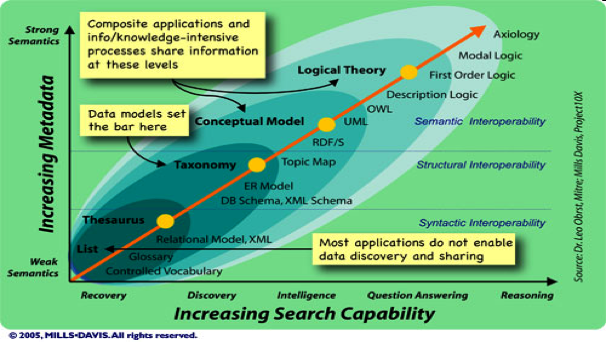
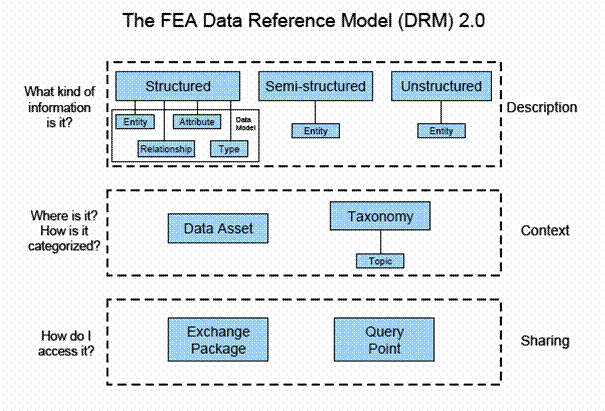
  <dc:description xmlns:dc="http://purl.org/dc/elements/1.1/">Frederick Giasson continues the conversation about the Web Experience Dimensions in a new post --the first of several-- that chronicles the evolution of Pingthesemanticweb.com and Talk Digger, from Interactive-Web (Web 1.0) sites to Data-Web oriented Data Spaces: On a related front, I also came across an e-Government Data Reference Model presentation (PPT) by Mills Davis  from the Colab Wiki that  illustrates the aforementioned Web Dimensions (even though his presentation didn&#39;t have dimensionality of the Web in mind) in one of its graphics (which I&#39;ve yanked and placed into this post so that it has a URI courtesy of ODS ): Notes:===== Conceptual - Data-Web (*we are starting to comprehend and use this dimension* aka Semantic Web Layer 1) Logical Theory - To follow when we let loose the intelligent agents that enrichen the Data Web experience Philosophy - by way of Axiology (sometime in the future, but note, we are talking Internet time :-) ) I also stumbled across another graphic that actually provides visual delineation of the value propositions of XML (Structure) and RDF (Context): Notes:===== Description - XML Context - RDF Sharing - Access Points (e.g SPARQL, XMLA, GData Generic Query oriented Web Service Endpoints)</dc:description>
  <content:encoded xmlns:content="http://purl.org/rss/1.0/modules/content/"><![CDATA[
         <a href="http://fgiasson.com"> Frederick Giasson</a> continues <a href="http://fgiasson.com/blog/index.php?title=the_first_three_dimensions_of_the_web_in&amp;more=1&amp;c=1&amp;tb=1&amp;pb=1">the conversation about the Web Experience Dimensions</a> in a new post --the first of several-- that chronicles the evolution of Pingthesemanticweb.com and Talk Digger, from Interactive-Web (Web 1.0) sites to Data-Web oriented Data Spaces:<br /> <br />On a related front, I also came across an e-Government Data Reference Model presentation (<a href="http://web-services.gov/scopedrmit210172005.ppt">PPT</a>) by <a href="http://www.project10x.com/pages/team.html">Mills Davis</a>  from the <a href="http://colab.cim3.net/cgi-bin/wiki.pl?DRMImplementationThroughIterationandTestingPilotProjects">Colab Wiki</a> that  illustrates the aforementioned Web Dimensions (even though his presentation didn&#39;t have dimensionality of the Web in mind) in one of its graphics (which I&#39;ve yanked and placed into this post so that it has a URI courtesy of <a href="http://virtuoso.openlinksw.com/wiki/main/Main/OdsIndex">ODS</a> <img src="http://www.openlinksw.com/weblog/public/images/smileys/01.gif" />):<br /> <br /> <img src="http://www.openlinksw.com/blog/%7Ekidehen/briefcase/Public/graphics/drm-smart-search.png" /> <br /> <br /> Notes:<br />=====<br /> <span style="font-weight: bold;">Conceptual</span> - Data-Web (*we are starting to comprehend and use this dimension* aka Semantic Web Layer 1)<br /> <br /> <span style="font-weight: bold;">Logical Theory </span>- To follow when we let loose the intelligent agents that enrichen the Data Web experience<br /> <br /> <span style="font-weight: bold;">Philosophy</span> - by way of <a href="http://en.wikipedia.org/wiki/Axiology">Axiology </a>(sometime in the future, but note, we are talking Internet time :-) )<br /> <br />I also stumbled across another graphic that actually provides visual delineation of the value propositions of XML (Structure) and RDF (Context):<br /> <img src="http://colab.cim3.net/file/work/SICoP/EPADRM2.0/ombdrm2.gif" /> <br />Notes:<br />=====<br /> <br /> <span style="font-weight: bold;">Description</span> - <a href="http://www.w3.org/TR/xml-infoset/#intro">XML</a> <br /> <br /> <span style="font-weight: bold;">Context</span> - <a href="http://www.w3.org/TR/rdf-concepts/">RDF</a> <br /> <br /> <span style="font-weight: bold;">Sharing</span> - Access Points (e.g <a href="http://www.w3.org/TR/rdf-sparql-query/">SPARQL</a>, <a href="http://www.xmla.org/faq.asp">XMLA,</a> <a href="http://code.google.com/apis/gdata/">GData</a> Generic Query oriented Web Service Endpoints)<br />            
]]></content:encoded>
  <rss:title>Contd: Web Dimensionality</rss:title>
  <rss:link>http://www.openlinksw.com/dataspace/kidehen@openlinksw.com/weblog/kidehen@openlinksw.com%27s%20BLOG%20%5B127%5D/1072</rss:link>
  <dc:date xmlns:dc="http://purl.org/dc/elements/1.1/">2006-10-25T22:19:40Z</dc:date>
  <dc:creator xmlns:dc="http://purl.org/dc/elements/1.1/">Kingsley Uyi Idehen &lt;kidehen@openlinksw.com&gt;</dc:creator>
 </rss:item>
 <rss:item xmlns:rss="http://purl.org/rss/1.0/" rdf:about="http://www.openlinksw.com/dataspace/kidehen@openlinksw.com/weblog/kidehen@openlinksw.com%27s%20BLOG%20%5B127%5D/991">
  <dc:description xmlns:dc="http://purl.org/dc/elements/1.1/">There is an interesting article at regdeveloper.com titled: Structured data is boring and useless.. This article provides insight into a serious point of confusion about what exactly is structured vs. unstructured data. Here is a key excerpt: &quot;We all know that structured data is boring and useless; while unstructured data is sexy and chock full of value. Well, only up to a point, Lord Copper. Genuinely unstructured data can be a real nuisance - imagine extracting the return address from an unstructured letter, without letterhead and any of the formatting usually applied to letters. A letter may be thought of as unstructured data, but most business letters are, in fact, highly-structured.&quot; .... Duncan Pauly, founder and chief technology officer of Coppereye add&#39;s eloquent insight to the conversation: &quot;The labels &quot;structured data&quot; and &quot;unstructured data&quot; are often used ambiguously by different interest groups; and often used lazily to cover multiple distinct aspects of the issue. In reality, there are at least three orthogonal aspects to structure: * The structure of the data itself. * The structure of the container that hosts the data. * The structure of the access method used to access the data. These three dimensions are largely independent and one does not need to imply another. For example, it is absolutely feasible and reasonable to store unstructured data in a structured database container and access it by unstructured search mechanisms.&quot; Data understanding and appreciation is dwindling at a time when the reverse should be happening. We are supposed to be in the throws of the &quot;Information Age&quot;, but for some reason this appears to have no correlation with data and &quot;data access&quot; in the minds of many -- as reflected in the broad contradictory positions taken re. unstructured data vs structured data, structured is boring and useless while unstructured is useful and sexy.... The difference between &quot;Structured Containers&quot; and &quot;Structured Data&quot; are clearly misunderstood by most (an unfortunate fact). For instance all DBMS products are &quot;Structured Containers&quot; aligned to one or more data models (typically one). These products have been limited by proprietary data access APIs and underlying data model specificity when used in the &quot;Open-world&quot; model that is at the core of the World Wide Web. This confusion also carries over to the misconception that Web 2.0 and the Semantic/Data Web are mutually exclusive. But things are changing fast, and the concept of multi-model DBMS products is beginning to crystalize. On our part, we have finally released the long promised &quot;OpenLink Data Spaces&quot; application layer that has been developed using our Virtuoso Universal Server. We have structured unified storage containment exposed to the data web cloud via endpoints for querying or accessing data using a variety of mechanisms that include; GData, OpenSearch, SPARQL, XQuery/XPath, SQL etc.. To be continued....</dc:description>
  <content:encoded xmlns:content="http://purl.org/rss/1.0/modules/content/"><![CDATA[
There is an interesting article at regdeveloper.com titled: <a href="http://www.regdeveloper.co.uk/2006/06/23/unstructured_data/">Structured data is boring and useless</a>.. This article provides insight into a serious point of confusion about what exactly is structured vs. unstructured data. Here is a key excerpt:  <blockquote> <cite>&quot;We all know that structured data is boring and useless; while unstructured data is sexy and chock full of value. Well, only up to a point, Lord Copper.  Genuinely unstructured data can be a real nuisance - imagine extracting the return address from an unstructured letter, without letterhead and any of the formatting usually applied to letters.  A letter may be thought of as unstructured data, but most business letters are, in fact, highly-structured.&quot;  .... </cite> </blockquote> Duncan Pauly, founder and chief technology officer of Coppereye add&#39;s eloquent insight to the conversation: <blockquote> <cite>&quot;The labels &quot;structured data&quot; and &quot;unstructured data&quot; are often used ambiguously by different interest groups; and often used lazily to cover multiple distinct aspects of the issue. In reality, there are at least three orthogonal aspects to structure:      <il></il></cite>
<ol> * The structure of the data itself.</ol>     <ol>* The structure of the container that hosts the data.</ol>     <ol>* The structure of the access method used to access the data.</ol>   These three dimensions are largely independent and one does not need to imply another. For example, it is absolutely feasible and reasonable to store unstructured data in a structured database container and access it by unstructured search mechanisms.&quot; </blockquote> <p> Data understanding and appreciation is dwindling at a time when the reverse should be happening. We are supposed to be in the throws of the  &quot;Information Age&quot;, but for some reason this appears to have no correlation with data and &quot;data access&quot; in the minds of many -- as reflected in the broad contradictory positions taken re. unstructured data vs structured data, structured is boring and useless while unstructured is useful and sexy....</p> <p> The difference between &quot;Structured Containers&quot; and &quot;Structured Data&quot; are clearly misunderstood by most (an unfortunate fact).</p> <p> For instance all DBMS products are &quot;Structured Containers&quot; aligned to one or more data models (typically one). These products have been limited by proprietary data access APIs and underlying data model specificity when used in the &quot;Open-world&quot; model that is at the core of the World Wide Web. This confusion also carries over to the misconception that Web 2.0 and the Semantic/Data Web are mutually exclusive.  </p> <p> But things are changing fast, and the concept of multi-model DBMS products is beginning to crystalize. On our part, we have finally released the long promised &quot;OpenLink Data Spaces&quot; application layer that has been developed using our <a href="http://virtuoso.openlinksw.com/wiki/main/">Virtuoso Universal Server</a>.  We have structured unified storage containment exposed to the data web cloud via endpoints for querying or accessing data using a variety of mechanisms that include; GData, OpenSearch, SPARQL, XQuery/XPath, SQL etc..  </p> <p> To  be continued.... </p> 
]]></content:encoded>
  <rss:title>Structured Data vs. Unstructured Data</rss:title>
  <rss:link>http://www.openlinksw.com/dataspace/kidehen@openlinksw.com/weblog/kidehen@openlinksw.com%27s%20BLOG%20%5B127%5D/991</rss:link>
  <dc:date xmlns:dc="http://purl.org/dc/elements/1.1/">2006-06-27T05:39:09Z</dc:date>
  <dc:creator xmlns:dc="http://purl.org/dc/elements/1.1/">Kingsley Uyi Idehen &lt;kidehen@openlinksw.com&gt;</dc:creator>
 </rss:item>
 <rss:item xmlns:rss="http://purl.org/rss/1.0/" rdf:about="http://www.openlinksw.com/dataspace/kidehen@openlinksw.com/weblog/kidehen@openlinksw.com%27s%20BLOG%20%5B127%5D/689">
  <dc:description xmlns:dc="http://purl.org/dc/elements/1.1/">T-Mobile responds to Paris Hilton Sidekick hacking [via Venture Chronicles by Jeff Nolan] This incident is an interesting one to follow as there is a little more to it than the purported T-Mobile stance: &quot;..Paris may have given out her password..&quot; . I have written about database and data access security matters on numerous occasions, and my underlying message has always been that there are many dimensions to security vulnerability that aren&#39;t catered for when the distinct functional domains of data access and data storage intersect (I am almost certain that the infrastructure at the bottom of this controversy will comprise at least one or more of the following: data access drivers (free and closed- or open source), relational database engine (closed- or open source), and a web application scripting language (closed- or open source). Here is a hypothetical situation relating to this matter. Lets assume that Paris did inadvertently give away her password, would it be too much for her to assume that T-mobile&#39;s data access infrastructure should be capable of controlling access to her data using any combination of her password and the following: Data Access Device Data Access Device host operating system Network IP or Mac Address Data Access Application If a very simple combination of the elements above formed part of the T-mobile authentication and data access security matrix, we would be looking at a much clearer picture of the vulnerability scenarios for this hack that would be confined to the following: She inadvertently gives out her password and also hands over her sidekick device to the hacker She inadvertently gives out her password and then the hacker successfully logs on to her sidekick (it does have a web browser and email implying a tcp/ip stack etc..). But I would expect Paris to be within her rights to assume some basic firewalling would be in place by default T-mobile should have a data access security infrastructure that would have a rule that restricted sidekick accounts (by default) from direct access from remote locations to address book data for instance. Account owners should be allowed to enable this feature after receiving clear notification about security implications.</dc:description>
  <content:encoded xmlns:content="http://purl.org/rss/1.0/modules/content/"><![CDATA[<blockquote dir="ltr" style="MARGIN-RIGHT: 0px">
<p><a href="http://sapventures.typepad.com/main/2005/02/tmobile_respond.html">T-Mobile responds to Paris Hilton Sidekick hacking</a> </p>
<p>[via <a href="http://sapventures.typepad.com/main/">Venture Chronicles by Jeff Nolan</a>]</p></blockquote>
<p align="left" dir="ltr">This incident is an interesting one to follow as there is a little more to it than the purported T-Mobile stance: &quot;..Paris may have given out her password..&quot; .</p>
<p align="left" dir="ltr">I have written about database and <a href="http://www.openlinksw.com/blog/search.vspx?blogid=127&amp;q=//p[contains%28.%2C%27security%27%29]&amp;type=xpath&amp;output=html">data access security matters</a> on numerous occasions, and my underlying message has always been that there are many dimensions to security vulnerability that aren&#39;t catered for when the distinct functional domains of data access and data storage intersect (I am almost certain that the infrastructure at the bottom of this controversy will comprise at least one or more of the following: data access drivers (free and closed- or open source), relational database engine (closed- or open source), and a web application scripting language (closed- or open source).</p>
<p align="left" dir="ltr">Here is a hypothetical situation relating to this matter. Lets assume that Paris did inadvertently give away her password, would it be too much for her to assume that T-mobile&#39;s data access infrastructure should be capable of controlling access to her data using any combination of her password and the following:</p>
<ol dir="ltr">
<li>
<div align="left">Data Access Device </div></li>
<li>
<div align="left">Data Access Device host operating system</div></li>
<li>
<div align="left">Network IP or Mac Address </div></li>
<li>
<div align="left">Data Access Application</div></li></ol>
<p align="left">If a very simple combination of the elements above formed part of the T-mobile authentication and data access security matrix, we would be looking at a much clearer picture of the vulnerability scenarios for this hack that would be confined to the following:</p>
<ol>
<li>
<div align="left">She inadvertently gives out her password and also hands over her sidekick device to the hacker </div></li>
<li>
<div align="left">She inadvertently gives out her password and then the hacker successfully logs on to her sidekick (it does have a <a href="http://www.t-mobile.com/products/overview.asp?phoneid=229040&amp;class=pda">web browser</a> and email implying a tcp/ip stack etc..). But I would expect Paris to be within her rights to assume some basic firewalling would be in place by default</div></li></ol>
<p align="left">T-mobile should have a data access security infrastructure that would have a rule that restricted sidekick accounts (by default) from direct access from remote locations to address book data for instance. Account owners should be allowed to enable this feature after receiving clear notification about security implications.</p>]]></content:encoded>
  <rss:title>Database &amp; Data Access Vulnerability: T-Mobile responds to Paris Hilton Sidekick hacking</rss:title>
  <rss:link>http://www.openlinksw.com/dataspace/kidehen@openlinksw.com/weblog/kidehen@openlinksw.com%27s%20BLOG%20%5B127%5D/689</rss:link>
  <dc:date xmlns:dc="http://purl.org/dc/elements/1.1/">2006-06-22T12:56:58Z</dc:date>
  <dc:creator xmlns:dc="http://purl.org/dc/elements/1.1/">Kingsley Uyi Idehen &lt;kidehen@openlinksw.com&gt;</dc:creator>
 </rss:item>
 <rss:item xmlns:rss="http://purl.org/rss/1.0/" rdf:about="http://www.openlinksw.com/dataspace/kidehen@openlinksw.com/weblog/kidehen@openlinksw.com%27s%20BLOG%20%5B127%5D/1611">
  <dc:description xmlns:dc="http://purl.org/dc/elements/1.1/">Motivation for this post arose from a series of Twitter exchanges between Tony Hirst and I, in relation to his blog post titled: So What Is It About Linked Data that Makes it Linked Data™ ? At the end of the marathon session, it was clear to me that a blog post was required for future reference, at the very least :-) What is Linked Data? &quot;Data Access by Reference&quot; mechanism for Data Objects (or Entities) on HTTP networks. It enables you to Identify a Data Object and Access its structured Data Representation via a single Generic HTTP scheme based Identifier (HTTP URI). Data Object representation formats may vary; but in all cases, they are hypermedia oriented, fully structured, and negotiable within the context of a client-server message exchange. Why is it Important? Information makes the world tick! Information doesn&#39;t exist without data to contextualize. Information is inaccessible without a projection (presentation) medium. All information (without exception, when produced by humans) is subjective. Thus, to truly maximize the innate heterogeneity of collective human intelligence, loose coupling of our information and associated data sources is imperative. How is Linked Data Delivered? Linked Data is exposed to HTTP networks (e.g. World Wide Web) via hypermedia resources bearing structured representations of data object descriptions. Remember, you have a single Identifier abstraction (generic HTTP URI) that embodies: Data Object Name and Data Representation Location (aka URL). How are Linked Data Object Representations Structured? A structured representation of data exists when an Entity (Datum), its Attributes, and its Attribute Values are clearly discernible. In the case of a Linked Data Object, structured descriptions take the form of a hypermedia based Entity-Attribute-Value (EAV) graph pictorial -- where each Entity, its Attributes, and its Attribute Values (optionally) are identified using Generic HTTP URIs. Examples of structured data representation formats (content types) associated with Linked Data Objects include: text/html text/turtle text/n3 application/json application/rdf+xml Others How Do I Create Linked Data oriented Hypermedia Resources? You markup resources by expressing distinct entity-attribute-value statements (basically these a 3-tuple records) using a variety of notations: (X)HTML+RDFa, JSON, Turtle, N3, TriX, TriG, RDF/XML, and Others (for instance you can use Atom data format extensions to model EAV graph as per OData initiative from Microsoft). You can achieve this task using any of the following approaches: Notepad WYSIWYG Editor Transformation of Database Records via Middleware Transformation of XML based Web Services output via Middleware Transformation of other Hypermedia Resources via Middleware Transformation of non Hypermedia Resources via Middleware Use a platform that delivers all of the above. Practical Examples of Linked Data Objects Enable Describe Who You Are, What You Offer, and What You Need via your structured profile, then leave your HTTP network to perform the REST (serendipitous discovery of relevant things) Identify (via map overlay) all items of interest based on a 2km+ radious of my current location (this could include vendor offerings or services sought by existing or future customers) Share the latest and greatest family photos with family members *only* without forcing them to signup for Yet Another Web 2.0 service or Social Network No repetitive signup and username and password based login sequences per Web 2.0 or Mobile Application combo Going beyond imprecise Keyword Search to the new frontier of Precision Find - Example, Find Data Objects associated with the keywords: Tiger, while enabling the seeker disambiguate across the &quot;Who&quot;, &quot;What&quot;, &quot;Where&quot;, &quot;When&quot; dimensions (with negation capability) Determine how two Data Objects are Connected - person to person, person to subject matter etc. (LinkedIn outside the walled garden) Use any resource address (e.g blog or bookmark URL) as the conduit into a Data Object mesh that exposes all associated Entities and their social network relationships Apply patterns (social dimensions) above to traditional enterprise data sources in combination (optionally) with external data without compromising security etc. How Do OpenLink Software Products Enable Linked Data Exploitation? Our data access middleware heritage (which spans 16+ years) has enabled us to assemble a rich portfolio of coherently integrated products that enable cost-effective evaluation and utilization of Linked Data, without writing a single line of code, or exposing you to the hidden, but extensive admin and configuration costs. Post installation, the benefits of Linked Data simply materialize (along the lines described above). Our main Linked Data oriented products include: OpenLink Data Explorer -- visualizes Linked Data or Linked Data transformed &quot;on the fly&quot; from hypermedia and non hypermedia data sources URIBurner -- a &quot;deceptively simple&quot; solution that enables the generation of Linked Data &quot;on the fly&quot; from a broad collection of data sources and resource types OpenLink Data Spaces -- a platform for enterprises and individuals that enhances distributed collaboration via Linked Data driven virtualization of data across its native and/or 3rd party content manager for: Blogs, Wikis, Shared Bookmarks, Discussion Forums, Social Networks etc OpenLink Virtuoso -- a secure and high-performance native hybrid data server (Relational, RDF-Graph, Document models) that includes in-built Linked Data transformation middleware (aka. Sponger). Related Hypertext Transfer Protocol 1.1 RFC Open Data Protocol Glossary Simple Explanation of RDF and Linked Data Dynamics Collection of post from the past about Linked Data Are We There Yet Re. Web++? -- includes link to podcast conversation with Jon Udell Web of Linked Data Pivoting Demo from TED -- by Microsoft&#39;s Gary Flake Microsoft Pivot atop Virtuoso Quad Store&#39;s Faceted Browser Engine-- My Demonstration of EAV model transcending data representation variations (i.e., RDF&#39;s EAV data model data served up in Microsoft CXML data representation format).</dc:description>
  <content:encoded xmlns:content="http://purl.org/rss/1.0/modules/content/"><![CDATA[<p>Motivation for this post arose from a series of Twitter exchanges between <a href="http://ouseful.wordpress.com/about/#this" id="link-id115699ae8">Tony Hirst</a> and I, in relation to his <a href="http://dbpedia.org/resource/Blog" id="link-id11a0cbc08">blog</a> post titled: <a href="http://ouseful.wordpress.com/2010/03/03/so-what-is-it-about-linked-data-that-makes-it-linked-data%e2%84%a2/" id="link-id1158f8ce8">So What Is It About Linked Data that Makes it Linked Data™ ?</a>
</p>
<p>At the end of the marathon session, it was clear to <a href="http://myopenlink.net/dataspace/person/kidehen#this" id="link-id11557da58">me</a> that a blog post was required for future reference, at the very least :-)</p>
<h3>What is <a href="http://dbpedia.org/resource/Linked_Data" id="link-id11a7ee3a8">Linked Data</a>?</h3>
<p>&quot;<a href="http://dbpedia.org/resource/Reference_(computer_science)" id="link-id11a682338">Data Access by Reference</a>&quot; mechanism for Data Objects (or Entities) on HTTP networks. It enables you to Identify a Data Object and Access its structured Data Representation via a single Generic HTTP scheme based Identifier (HTTP <a href="http://dbpedia.org/resource/Uniform_Resource_Identifier" id="link-id125037288">URI</a>). Data Object representation formats may vary; but in all cases, they are <a href="http://dbpedia.org/resource/Hypermedia" id="link-id115548f78">hypermedia</a> oriented, fully structured,  and negotiable within the <a href="http://dbpedia.org/resource/Context_%28language_use%29" id="link-id11c955888">context</a> of a client-server message exchange.</p>
<h3>Why is it Important?</h3>
<p>
<a href="http://dbpedia.org/resource/Information" id="link-id125154778">Information</a> makes the world tick!</p>
<p>Information doesn&#39;t exist without data to contextualize.</p>
<p>Information is inaccessible without a projection (presentation) medium. </p>
<p>All information (without exception, when produced by humans) is subjective. Thus, to truly maximize the innate heterogeneity of collective human intelligence, loose coupling of our information and associated data sources is imperative.</p>
<h3>How is Linked Data Delivered?</h3>
<p>Linked Data is exposed to HTTP networks (e.g. <a href="http://dbpedia.org/resource/World_Wide_Web" id="link-id125321238">World Wide Web</a>) via hypermedia resources bearing structured representations of data object descriptions. Remember, you have a single Identifier abstraction (generic HTTP URI) that embodies: Data Object Name and Data Representation Location (aka <a href="http://dbpedia.org/resource/Uniform_Resource_Locator" id="link-id1249a7a88">URL</a>).</p>
<h3>How are Linked Data Object Representations Structured?</h3>
<p>A structured representation of data exists when an <a href="http://dbpedia.org/resource/Entity" id="link-id1250630d8">Entity</a> (Datum), its Attributes, and its Attribute Values are clearly discernible. In the case of a Linked Data Object, structured descriptions take the form of a hypermedia based <a href="http://dbpedia.org/resource/Entity-attribute-value_model" id="link-id126ed7608">Entity</a>-Attribute-Value (EAV) graph pictorial -- where each Entity, its Attributes, and its Attribute Values (optionally) are identified using Generic HTTP URIs. </p>
<p>Examples of structured data representation formats (content types) associated with Linked Data Objects include:</p>
<ul>
  <li>text/html</li>
  <li>text/turtle</li>
  <li>text/n3</li>
  <li>application/json</li>
  <li>application/rdf+xml</li>
  <li>Others </li>
</ul>
<h3>How Do I Create Linked Data oriented Hypermedia Resources?</h3>
<p>You markup resources by expressing distinct entity-attribute-value statements (basically these a 3-tuple records) using a variety of notations:</p>
<ul>
  <li>(X)HTML+<a href="http://dbpedia.org/resource/RDFa" id="link-id1252975b8">RDFa</a>,</li>
  <li>
  <a href="http://n2.talis.com/wiki/RDF_JSON_Specification" id="link-id115015458">JSON</a>,</li>
  <li>
  <a href="http://www.dajobe.org/2004/01/turtle/" id="link-id116458478">Turtle</a>,</li>
  <li>
  <a href="http://www.w3.org/DesignIssues/Notation3" id="link-id11a62f9f8">N3</a>,</li>
  <li>
  <a href="http://swdev.nokia.com/trix/trix.html" id="link-id11a8f56b8">TriX</a>,</li>
  <li>
  <a href="http://www4.wiwiss.fu-berlin.de/bizer/TriG/" id="link-id117156978">TriG</a>,</li>
  <li>
  <a href="http://www.w3.org/TR/REC-rdf-syntax/" id="link-id126f52a58">RDF/XML</a>, and</li>
  <li>Others (for instance you can use Atom data format extensions to model EAV graph as per OData initiative from Microsoft).</li>
</ul>
<p>You can achieve this task using any of the following approaches:</p>
<ul>
  <li>Notepad</li>
  <li>WYSIWYG Editor </li>
  <li>Transformation of Database Records via Middleware</li>
  <li>Transformation of XML based <a href="http://dbpedia.org/resource/World_Wide_Web">Web</a> Services output via Middleware</li>
  <li>Transformation of other Hypermedia Resources via Middleware</li>
  <li>Transformation of non Hypermedia Resources via Middleware</li>
  <li>Use a platform that delivers all of the above.</li>
</ul>
<h3>Practical Examples of Linked Data Objects Enable</h3>
<ul>
  <li>Describe Who You Are, What You Offer, and What You Need via your structured profile, then leave your HTTP network to perform the REST (serendipitous discovery of relevant things)</li>
  <li>Identify (via map overlay) all items of interest based on a 2km+ radious of my current location (this could include vendor offerings or services sought by existing or future customers)</li>
  <li>Share the latest and greatest family photos with family members *only* without forcing them to signup for Yet Another Web 2.0 service or Social Network</li>
  <li>No repetitive signup and username and password based login sequences per Web 2.0 or Mobile Application combo</li>
  <li>Going beyond imprecise Keyword Search to the new frontier of Precision Find - Example, Find Data Objects associated with the keywords: Tiger, while enabling the seeker disambiguate across the &quot;Who&quot;, &quot;What&quot;, &quot;Where&quot;, &quot;When&quot; dimensions (with negation capability)</li>
  <li>Determine how two Data Objects are Connected - person to person, person to subject matter etc. (LinkedIn outside the walled garden)</li>
  <li>Use any resource address (e.g <a href="http://dbpedia.org/resource/Blog" id="link-id124fd8118">blog</a> or bookmark URL) as the conduit into a Data Object mesh that exposes all associated Entities and their social network relationships</li>
  <li>Apply patterns (social dimensions) above to traditional enterprise data sources in combination (optionally) with external data without compromising security etc.</li>
</ul>
<h3>How Do <a href="http://www.openlinksw.com/dataspace/organization/openlink#this" id="link-id124fd0d98">OpenLink Software</a> Products Enable Linked Data Exploitation?</h3>
<p>Our data access middleware heritage (which spans 16+ years) has enabled us to assemble a rich portfolio of coherently integrated products that enable cost-effective evaluation and utilization of Linked Data,	 without writing a single line of code, or exposing you to the hidden, but extensive admin and configuration costs. Post installation, the benefits of Linked Data simply materialize (along the lines described above).</p>
<p>Our main Linked Data oriented products include:</p>
<ul>
  <li>
  <a href="http://ode.openlinksw.com" id="link-id125058d68">OpenLink Data Explorer</a> -- visualizes Linked Data or Linked Data transformed &quot;on the fly&quot; from hypermedia and non hypermedia data sources </li>
  <li>
  <a href="http://uriburner.com" id="link-id1251db6a8">URIBurner</a> -- a &quot;deceptively simple&quot; solution that enables the generation of Linked Data &quot;on the fly&quot; from a broad collection of data sources and resource types</li>
  <li>
  <a href="http://ods.openlinksw.com/wiki/ODS/" id="link-id1252caae8">OpenLink Data Spaces</a> -- a platform for enterprises and individuals that enhances distributed collaboration via Linked Data driven virtualization of data across its native and/or 3rd party content manager for: Blogs, Wikis, Shared Bookmarks, Discussion Forums, Social Networks etc</li>
  <li>
  <a href="http://virtuoso.openlinksw.com/overview/index.htm" id="link-id124809b58">OpenLink Virtuoso</a> -- a secure and high-performance native hybrid data server (Relational, RDF-Graph, Document models) that includes in-built Linked Data transformation middleware (aka. Sponger). </li>
</ul>
<h3>Related</h3>
<ul>
  <li>
  <a href="http://www.ietf.org/rfc/rfc2616.txt" id="link-id125306d78">Hypertext Transfer Protocol 1.1 RFC</a>
</li>
  <li>
  <a href="http://www.odata.org/docs/%5BMC-APDSU%5D.htm#_Toc246716495" id="link-id11c948e98">Open Data Protocol Glossary</a>
</li>
  <li>
  <a href="http://www.openlinksw.com/dataspace/kidehen@openlinksw.com/weblog/kidehen@openlinksw.com%27s%20BLOG%20%5B127%5D/1543" id="link-id126fae278">Simple Explanation of RDF and Linked Data Dynamics</a>
</li>
  <li>
  <a href="http://www.openlinksw.com/weblog/public/search.vspx?blogid=127&amp;q=linked%20data%0D%0A&amp;type=text&amp;output=html" id="link-id1252e0018">Collection of post from the past about Linked Data</a>
</li>
  <li>
  <a href="http://www.openlinksw.com/dataspace/kidehen@openlinksw.com/weblog/kidehen@openlinksw.com%27s%20BLOG%20%5B127%5D/1584" id="link-id124fefea8">Are We There Yet Re. Web++?</a> -- includes link to <a href="http://itc.conversationsnetwork.org/shows/detail4233.html" id="link-id125188078">podcast conversation with Jon Udell</a>
</li>
<li>
  <a href="http://www.ted.com/talks/gary_flake_is_pivot_a_turning_point_for_web_exploration.html" id="link-id11a501c28">Web of Linked Data Pivoting Demo from TED</a> -- by Microsoft&#39;s Gary Flake
</li>
<li>
  <a href="http://www.youtube.com/watch?v=G29DBIEcIuQ" id="link-id1204fff18">Microsoft Pivot atop Virtuoso Quad Store&#39;s Faceted Browser Engine</a>-- My Demonstration of EAV model transcending data representation variations (i.e., RDF&#39;s EAV data model data served up in Microsoft CXML data representation format).
</li> 
</ul>]]></content:encoded>
  <rss:title>Revisiting HTTP based Linked Data (Update 1 - Demo Video Links Added)</rss:title>
  <rss:link>http://www.openlinksw.com/dataspace/kidehen@openlinksw.com/weblog/kidehen@openlinksw.com%27s%20BLOG%20%5B127%5D/1611</rss:link>
  <dc:date xmlns:dc="http://purl.org/dc/elements/1.1/">2010-03-08T14:59:37Z</dc:date>
  <dc:creator xmlns:dc="http://purl.org/dc/elements/1.1/">Kingsley Uyi Idehen &lt;kidehen@openlinksw.com&gt;</dc:creator>
 </rss:item>
 <rss:item xmlns:rss="http://purl.org/rss/1.0/" rdf:about="http://www.openlinksw.com/dataspace/kidehen@openlinksw.com/weblog/kidehen@openlinksw.com%27s%20BLOG%20%5B127%5D/1610">
  <dc:description xmlns:dc="http://purl.org/dc/elements/1.1/">Socially enhanced enterprise and invididual collaboration is becoming a focal point for a variety of solutions that offer erswhile distinct content managment features across the realms of Blogging, Wikis, Shared Bookmarks, Discussion Forums etc.. as part of an integrated platform suite. Recently, Socialtext has caught my attention courtesy of its nice features and benefits page . In addition, I&#39;ve also found the Mike 2.0 portal immensely interesting and valuable, for those with an enterprise collaboration bent. Anyway, Socialtext and Mike 2.0 (they aren&#39;t identical and juxtaposition isn&#39;t seeking to imply this) provide nice demonstrations of socially enhanced collaboration for individuals and/or enterprises is all about: Identifying Yourself Identifying Others (key contributors, peers, collaborators) Serendipitous Discovery of key contributors, peers, and collaborators Serendipitous Discovery by key contributors, peers, and collaborators Develop and sustain relationships via socially enhanced professional network hybrid Utilize your new &quot;trusted network&quot; (which you&#39;ve personally indexed) when seeking help or propagating a meme. As is typically the case in this emerging realm, the critical issue of discrete &quot;identifiers&quot; (record keys in sense) for data items, data containers, and data creators (individuals and groups) is overlooked albeit unintentionally. How HTTP based Linked Data Addresses the Identifier Issue Rather than using platform constrained identifiers such as: email address (a &quot;mailto&quot; scheme identifier), a dbms user account, application specific account, or OpenID. It enables you to leverage the platform independence of HTTP scheme Identifiers (Generic URIs) such that Identifiers for: You, Your Peers, Your Groups, and Your Activity Generated Data, simply become conduits into a mesh of HTTP -- referencable and accessible -- Linked Data Objects endowed with High SDQ (Serendipitious Discovery Quotient). For example my Personal WebID is all anyone needs to know if they want to explore: My Profile (which includes references to data objects associated with my interests, social-network, calendar, bookmarks etc.) Data generated by my activities across various data spaces (via data objects associated with my online accounts e.g. Del.icio.us, Twitter, Last.FM) Linked Data Meshups via URIBurner (or any other Virtuoso instance) that provide an extend view of my profile How FOAF+SSL adds Socially aware Security Even when you reach a point of equilibrium where: your daily activities trigger orchestratestration of CRUD (Create, Read, Update, Delete) operations against Linked Data Objects within your socially enhanced collaboration network, you still have to deal with the thorny issues of security, that includes the following: Single Sign On, Authentication, and Data Access Policies. FOAF+SSL, an application of HTTP based Linked Data, enables you to enhance your Personal HTTP scheme based Identifer (or WebID) via the following steps (peformed by a FOAF+SSL compliant platform): Imprint WebID within a self-signed x.509 based public key (certificate) associated with your private key (generated by FOAF+SSL platform or manually via OpenSSL) Store public key components (modulous and exponent) into your FOAF based profile document which references your Personal HTTP Identifier as its primary topic Leverage HTTP URL component of WebID for making public key components (modulous and exponent) available for x.509 certificate based authentication challenges posed by systems secured by FOAF+SSL (directly) or OpenID (indirectly via FOAF+SSL to OpenID proxy services). Contrary to conventional experiences with all things PKI (Public Key Infrastructure) related, FOAF+SSL compliant platforms typically handle the PKI issues as part of the protocol implementation; thereby protecting you from any administrative tedium without compromising security. Conclusions Understanding how new technology innovations address long standing problems, or understanding how new solutions inadvertently fail to address old problems, provides time tested mechanisms for product selection and value proposition comprehension that ultimately save scarce resources such as time and money. If you want to understand real world problem solution #1 with regards to HTTP based Linked Data look no further than the issues of secure, socially aware, and platform independent identifiers for data objects, that build bridges across erstwhile data silos. If you want to cost-effectively experience what I&#39;ve outlined in this post, take a look at OpenLink Data Spaces (ODS) which is a distributed collaboration engine (enterprise of individual) built around the Virtuoso database engines. It simply enhances existing collaboration tools via the following capabilities: Addition of Social Dimensions via HTTP based Data Object Identifiers for all Data Items (if missing) Ability to integrate across a myriad of Data Source Types rather than a select few across RDBM Engines, LDAP, Web Services, and various HTTP accessible Resources (Hypermedia or Non Hypermedia content types) Addition of FOAF+SSL based authentication Addition of FOAF+SSL based Access Control Lists (ACLs) for policy based data access. Related: Get Yourself A WebID in 5 Minutes or Less via OpenLink Data Spaces (an application layer built atop Virtuoso) How To Share Resources Securely Using FOAF+SSL FOAF+SSL &amp; WebID Demonstration OpenLink Data Spaces &amp; Data Portability.</dc:description>
  <content:encoded xmlns:content="http://purl.org/rss/1.0/modules/content/"><![CDATA[<p>Socially enhanced enterprise and invididual collaboration is becoming a focal point for a variety of solutions that offer erswhile distinct content managment features across the realms of Blogging, Wikis, Shared Bookmarks, Discussion Forums etc.. as part of an integrated platform suite. Recently, <a href="http://www.socialtext.com/" id="link-id112be850">Socialtext</a> has caught my attention courtesy of its nice <a href="http://www.socialtext.com/products/socialnetworking.php" id="link-id145d9850">features and benefits page</a> . In addition, I&#39;ve also found the <a href="http://mike2.openmethodology.org/" id="link-id14103cc8">Mike 2.0 portal</a> immensely interesting and valuable, for those with an enterprise  collaboration bent.</p>
<p>Anyway, Socialtext and Mike 2.0  (they aren&#39;t identical and juxtaposition isn&#39;t seeking to imply this) provide nice demonstrations of socially enhanced collaboration for individuals and/or enterprises is all about:</p>
<ol>
  <li>Identifying Yourself</li>
  <li>Identifying Others (key contributors, peers, collaborators)</li>
  <li>Serendipitous Discovery of key contributors, peers, and collaborators</li>
  <li>Serendipitous Discovery by key contributors, peers, and collaborators</li>
  <li>Develop and sustain relationships via socially enhanced professional network hybrid</li>
  <li>Utilize your new &quot;trusted network&quot; (which you&#39;ve personally indexed) when seeking help or propagating a <a href="http://dbpedia.org/resource/Meme" id="link-id13ad00d0">meme</a>.</li>
</ol>
<p>As is typically the case in this emerging realm, the critical issue of discrete &quot;identifiers&quot; (record keys in sense) for <a href="http://dbpedia.org/resource/Data">data</a> items, data containers, and data creators (individuals and groups) is overlooked albeit unintentionally. </p>
<h3>How HTTP based <a href="http://dbpedia.org/resource/Linked_Data" id="link-id112e1ba8">Linked Data</a> Addresses the Identifier Issue</h3>
<p>Rather than using platform constrained identifiers such as: </p>
<ul>
  <li>email address (a &quot;mailto&quot; scheme identifier), </li>
  <li>a dbms user account, </li>
  <li>application specific account, or</li>
  <li>OpenID.</li>
</ul>
<p>It enables you to leverage the platform independence of HTTP scheme Identifiers (Generic URIs) such that Identifiers for: </p>
<ol>
  <li>You, </li>
  <li>Your Peers, </li>
  <li>Your Groups, and </li>
  <li>Your Activity Generated Data, </li>
</ol>
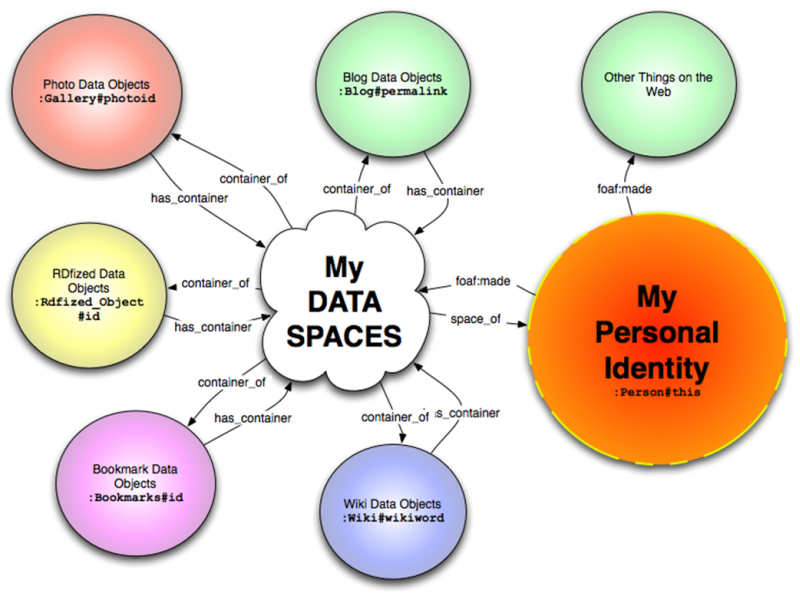
<p>simply become conduits into a mesh of <a href="http://virtuoso.openlinksw.com/presentations/Creating_Deploying_Exploiting_Linked_Data2/images/My_Data_Spaces.png" id="link-id13fe1168">HTTP -- referencable and accessible -- Linked Data Objects</a> endowed with High SDQ (Serendipitious Discovery Quotient). For example my <a href="http://kingsley.idehen.name/dataspace/person/kidehen#this" id="link-id13bdcc80">Personal WebID </a>is all anyone needs to know if they want to explore:</p>
<ol>
<li>My Profile (which includes references to data objects associated with my interests, social-network, calendar, bookmarks etc.)</li>
<li>Data generated by my activities across various data spaces (via data objects associated with my online accounts e.g. <a href="http://linkeddata.uriburner.com/about/id/entity/http/feeds.delicious.com/v2/rss/kidehen?count=15" id="link-id141cce38">Del.icio.us</a>, <a href="http://linkeddata.uriburner.com/about/id/entity/http/twitter.com/kidehen" id="link-id11802ce8">Twitter</a>, <a href="http://linkeddata.uriburner.com/about/id/entity/http/www.last.fm/user/kidehen" id="link-id118bf470">Last.FM</a>)</li>
<li>
  <a href="http://uriburner.com/fct/rdfdesc/usage.vsp?g=http%3A%2F%2Fkingsley.idehen.name%2Fdataspace%2Fperson%2Fkidehen%23this&amp;tp=4" id="link-id13c0f528">Linked Data Meshups via URIBurner</a> (or any other <a href="http://virtuoso.openlinksw.com" id="link-id11334f00">Virtuoso</a> instance) that provide an extend view of my profile</li>
</ol>
<h3>How <a href="http://dbpedia.org/resource/Friend_of_a_friend" id="link-id14324eb0">FOAF</a>+SSL adds Socially aware Security </h3>
<p>Even when you reach a point of equilibrium where: your daily activities trigger orchestratestration of CRUD (Create, Read, Update, Delete) operations against Linked Data Objects within your socially enhanced collaboration network, you still have to deal with the thorny issues of security, that includes the following: </p>
<ol>
  <li>Single Sign On, </li>
  <li>Authentication, and </li>
  <li>Data Access Policies.</li>
</ol>
<p>FOAF+SSL, an application of HTTP based Linked Data, enables you to enhance your Personal HTTP scheme based Identifer (or WebID) via the following steps (peformed by a FOAF+SSL compliant platform):</p>
<ol>
  <li>Imprint WebID within a self-signed x.509 based public key (certificate) associated with your private key (generated by FOAF+SSL platform or manually via OpenSSL)</li>
  <li>Store public key components (modulous and exponent) into your FOAF based profile document which references your Personal HTTP Identifier as its primary topic</li>
  <li>Leverage HTTP <a href="http://dbpedia.org/resource/Uniform_Resource_Locator" id="link-id141f8b30">URL</a> component of WebID for making public key components (modulous and exponent) available for x.509 certificate based authentication challenges posed by systems secured by FOAF+SSL (directly) or OpenID (indirectly via FOAF+SSL to OpenID proxy services).</li>
</ol>
<p>Contrary to conventional experiences with all things PKI (Public Key Infrastructure) related, FOAF+SSL compliant platforms typically handle the PKI issues as part of the protocol implementation; thereby protecting you from any administrative tedium without compromising security.</p>
<h3>Conclusions</h3>
<p>Understanding how new technology innovations address long standing problems, or understanding how new solutions inadvertently fail to address old problems, provides time tested mechanisms for product selection and value proposition comprehension that ultimately save scarce resources such as time and money. </p>
<p>If you want to understand real world problem solution #1 with regards to HTTP based Linked Data look no further than the issues of secure, socially aware, and platform independent identifiers for data objects, that build bridges across erstwhile data silos.</p>
<p>If you want to cost-effectively experience what I&#39;ve outlined in this post, take a look at <a href="http://ods.openlinksw.com/wiki/ODS/" id="link-id13c21220">OpenLink Data Spaces</a> (<a href="http://ods.openlinksw.com/wiki/ODS/" id="link-id1422cdd8">ODS</a>) which is a distributed collaboration engine (enterprise of individual) built around the <a href="http://virtuoso.openlinksw.com" id="link-id14211c98">Virtuoso</a> database engines. It simply enhances existing collaboration tools via the following capabilities:</p>
<p>Addition of Social Dimensions via HTTP based <a href="http://dbpedia.org/resource/Identity_(object-oriented_programming)" id="link-id116ecd88">Data Object Identifiers</a> for all Data Items (if missing)</p>
<ol>
  <li>Ability to integrate across a myriad of Data Source Types rather than a select few across RDBM Engines, LDAP, <a href="http://dbpedia.org/resource/World_Wide_Web">Web</a> Services, and various HTTP accessible Resources (Hypermedia or Non Hypermedia content types)</li>
  <li>Addition of FOAF+SSL based authentication</li>
  <li>Addition of FOAF+SSL based Access Control Lists (ACLs) for policy based data access.</li>
</ol>
<h3>Related:</h3>
<ul>
  <li>
  <a href="http://ods.openlinksw.com/dataspace/dav/wiki/ODS/GetAPersonalURIIn5MinutesOrLess" id="link-id117b2610">Get Yourself A WebID in 5 Minutes or Less</a> via OpenLink Data Spaces (an application layer built atop Virtuoso)</li>
  <li>
  <a href="http://ods.openlinksw.com/dataspace/dav/wiki/ODS/ODSBriefcaseFOAFSSL" id="link-id140311a0">How To Share Resources Securely Using FOAF+SSL</a> </li>
  <li>
  <a href="http://www.youtube.com/watch?v=CRbdeNMPCug" id="link-id11ad5448">FOAF+SSL &amp; WebID Demonstration</a>
</li>
  <li>
  <a href="http://www.slideshare.net/kidehen/linked-data-spaces-data-portability-access" id="link-id141f43a8">OpenLink Data Spaces &amp; Data Portability</a>.</li>
  
</ul>]]></content:encoded>
  <rss:title>Linked Data &amp; Socially Enhanced Collaboration (Enterprise or Individual) -- Update 1</rss:title>
  <rss:link>http://www.openlinksw.com/dataspace/kidehen@openlinksw.com/weblog/kidehen@openlinksw.com%27s%20BLOG%20%5B127%5D/1610</rss:link>
  <dc:date xmlns:dc="http://purl.org/dc/elements/1.1/">2010-03-04T00:50:37Z</dc:date>
  <dc:creator xmlns:dc="http://purl.org/dc/elements/1.1/">Kingsley Uyi Idehen &lt;kidehen@openlinksw.com&gt;</dc:creator>
 </rss:item>
 <rss:item xmlns:rss="http://purl.org/rss/1.0/" rdf:about="http://www.openlinksw.com/dataspace/kidehen@openlinksw.com/weblog/kidehen@openlinksw.com%27s%20BLOG%20%5B127%5D/1565">
  <dc:description xmlns:dc="http://purl.org/dc/elements/1.1/">What is Linked Data? The primary topic of a meme penned by TimBL in the form of a Design Issues Doc (note: this is how TimBL has shared his thoughts since the Beginning of the Web). There are a number of dimensions to the meme, but its primary purpose is the reintroduction of the HTTP URI -- a vital component of the Web&#39;s core architecture. What&#39;s Special about HTTP URIs? They possess an intrinsic duality that combines persistent and unambiguous Data Identity with platform &amp; representation format independent Data Access. Thus, you can use a string of characters that look like a contemporary Web URL to unambiguously achieve the following: Identity or Name Anything of Interest Describe Anything of Interest by associating the Description Subject&#39;s Identity with a constellation of Attribute and Value pairs (technically: an Entity-Attribute-Value or Subject-Predicate-Object graph) Make the Description of Named Things of Interest discoverable on the Web by implicitly binding the aforementioned to Documents that hold their descriptions (technically: metadata documents or information resources) What&#39;s the basic value proposition of the Linked Data meme? Enabling more productive use of the Web by users and developers alike. All of which is achieved by tweaking the Web&#39;s Hyperlinking feature such that it now includes Hypertext and Hyperdata as link types. Note: Hyperdata Linking is simply what an HTTP URI facilitates. Examples problems solved by injecting Linked Data into the Web: Federated Identity by enabling Individuals to unambiguously Identify themselves (Profiles++) courtesy of existing Internet and Web protocols (e.g., FOAF+SSL&#39;s WebIDs which combine Personal Identity with X.509 certificates and HTTPs based client side certification) Security and Privacy challenge alleviation by delivering a mechanism for policy based data access that feeds off federated individual identity and social network (graph) traversal Spam Busting via the above. Increasing the Serendipitous Discovery Quotient (SDQ) of Web accessible resources by embedding Rich Metadata into (X)HTML Documents e.g., structured descriptions of your &quot;WishLists&quot; and &quot;OfferLists&quot; via a common set of terms offered by vocabularies such as GoodRelations and SIOC Coherent integration of disparate data across the Web and/or within the Enterprise via &quot;Data Meshing&quot; rather than &quot;Data Mashing&quot; Moving beyond imprecise statistically driven &quot;Keyword Search&quot; (e.g. Page Rank) to &quot;Precision Find&quot; driven by typed link based Entity Rank plus Entity Type and Entity Property filters. Conclusion If all of the above still falls into the technical mumbo-jumbo realm, then simply consider Linked Data as delivering Open Data Access in granular form to Web accessible data -- that goes beyond data containers (documents or files). The value proposition of Linked Data is inextricably linked to the value proposition of the World Wide Web. This is true, because the Linked Data meme is ultimately about an enhancement of the current Web; achieved by reintroducing its architectural essence -- in new context -- via a new level of link abstraction, courtesy of the Identity and Access duality of HTTP URIs. As a result of Linked Data, you can now have Links on the Web for a Person, Document, Music, Consumer Electronics, Products &amp; Services, Business Opening &amp; Closing Hours, Personal &quot;WishLists&quot; and &quot;OfferList&quot;, an Idea, etc.. in addition to links for Properties (Attributes &amp; Values) of the aforementioned. Ultimately, all of these links will be indexed in a myriad of ways providing the substrate for the next major period of Internet &amp; Web driven innovation, within our larger human-ingenuity driven innovation continuum. Related Recipes for Describing Your Business and its Offerings using the GoodRelations Vocabulary / Schema Solving Real Problems with RDF based Linked Data Other Linked Data Posts from this Blog oriented Linked Data Space (goes back a few years!) Various practical Linked Data demo links from my Del.icio.us Bookmark oriented Data Space My personal WebID which is conduit to a Linked Data mesh covering vast variety of things I&#39;ve opted to share with others via the Web (best viewed using a Linked Data aware User Agent like ODE).</dc:description>
  <content:encoded xmlns:content="http://purl.org/rss/1.0/modules/content/"><![CDATA[<h3>What is <a href="http://dbpedia.org/resource/Linked_Data" id="link-id138c9aa8">Linked Data</a>?</h3>
<p>
The primary topic of a <a href="http://dbpedia.org/resource/Meme" id="link-id12f86100">meme</a> penned by <a href="http://www.w3.org/People/Berners-Lee/card#i" id="link-id115b4c98">TimBL</a> in the form of a <a href="http://www.w3.org/DesignIssues/LinkedData.html" id="link-id1333f300">Design Issues Doc</a> (note: this is how TimBL has shared his thoughts since the <a href="http://www.w3.org/DesignIssues/" id="link-id1128a1d0">Beginning of the Web</a>).
</p>
<p>
There are a number of dimensions to the meme, but its primary purpose is the reintroduction of the HTTP <a href="http://dbpedia.org/resource/Uniform_Resource_Identifier" id="link-id13c43cb8">URI</a> -- a vital component of the Web&#39;s core architecture. 
</p>
<h3>
What&#39;s Special about HTTP URIs?</h3>
<p>
They possess an intrinsic duality that combines persistent and unambiguous <a href="http://dbpedia.org/resource/Data">Data</a> Identity with platform &amp; representation format independent Data Access. Thus, you can use a string of characters that look like a contemporary Web <a href="http://dbpedia.org/resource/Uniform_Resource_Locator" id="link-id119cd8a0">URL</a> to unambiguously achieve the following:
</p>
<ol>
<li>Identity or Name Anything of Interest</li>
<li>Describe Anything of Interest by associating the Description Subject&#39;s Identity with a constellation of Attribute and Value pairs (technically: an <a href="http://dbpedia.org/resource/Entity-attribute-value_model" id="link-id1133e8a8">Entity</a>-Attribute-Value or Subject-Predicate-Object graph)</li>
<li>Make the Description of Named Things of Interest discoverable on the Web by implicitly binding the aforementioned to Documents that hold their descriptions (technically: metadata documents or <a href="http://dbpedia.org/resource/Information" id="link-id1391da40">information</a> resources)</li> 
</ol>
<h3>What&#39;s the basic value proposition of the <a href="http://www.w3.org/DesignIssues/LinkedData.html" id="link-id113bb690">Linked Data meme</a>?</h3>
<p>Enabling more productive use of the Web by users and developers alike. All of which is achieved by tweaking the Web&#39;s Hyperlinking feature such that it now includes Hypertext and <a href="http://dbpedia.org/resource/Linked_Data" id="link-id1337a3f0">Hyperdata</a> as link types.</p>
<p>Note: Hyperdata Linking is simply what an HTTP URI facilitates.</p> 
<p>Examples problems solved by injecting Linked Data into the Web:</p>
<ol>
<li>Federated Identity by enabling Individuals to unambiguously Identify themselves (Profiles++) courtesy of existing <a href="http://dbpedia.org/resource/Internet" id="link-id13926e28">Internet</a> and Web protocols (e.g., <a href="http://dbpedia.org/resource/Friend_of_a_friend" id="link-id13646ec8">FOAF</a>+SSL&#39;s WebIDs which combine Personal Identity with X.509 certificates and HTTPs based client side certification)</li>
<li>Security and Privacy challenge alleviation by delivering a mechanism for policy based data access that feeds off federated individual identity and social network (graph) traversal</li>
<li>Spam Busting via the above</li>. 
<li>
Increasing the Serendipitous Discovery Quotient (SDQ) of Web accessible resources by embedding Rich Metadata into (X)HTML Documents e.g., structured descriptions of your &quot;WishLists&quot; and &quot;OfferLists&quot; via a common set of terms offered by vocabularies such as <a href="http://www.heppnetz.de/projects/goodrelations/" id="link-id1199b4d0">GoodRelations</a> and <a href="http://dbpedia.org/resource/SIOC" id="link-id1334cfb0">SIOC</a> 
</li>
<li>Coherent integration of disparate data across the Web and/or within the Enterprise via &quot;Data Meshing&quot; rather than &quot;Data Mashing&quot;</li>
<li>Moving beyond imprecise statistically driven &quot;Keyword Search&quot; (e.g. Page Rank) to &quot;Precision Find&quot; driven by typed link based <a href="http://dbpedia.org/resource/Entity" id="link-id135f6fe8">Entity</a> Rank plus Entity Type and Entity Property filters.</li> 
</ol>
<h3>Conclusion</h3>
<p>If all of the above still falls into the technical mumbo-jumbo realm, then simply consider Linked Data as delivering Open Data Access in granular form to Web accessible data -- that goes beyond data containers (documents or files).</p> 
<p>The value proposition of Linked Data is inextricably linked to the value proposition of the <a href="http://dbpedia.org/resource/World_Wide_Web" id="link-id1356f5c0">World Wide Web</a>. This is true, because the Linked Data meme is ultimately about an enhancement of the current Web; achieved by reintroducing its architectural essence -- in new <a href="http://dbpedia.org/resource/Context_%28language_use%29" id="link-id11300828">context</a> -- via a new level of link abstraction, courtesy of the Identity and Access duality of HTTP URIs.</p> 
<p>As a result of Linked Data, you can now have Links on the Web for a Person, Document, Music, Consumer Electronics, Products &amp; Services, Business Opening &amp; Closing Hours, Personal &quot;WishLists&quot; and &quot;OfferList&quot;, an Idea, etc.. in addition to links for Properties (Attributes &amp; Values) of the aforementioned. Ultimately, all of these links will be indexed in a myriad of ways providing the substrate for the next major period of Internet &amp; Web driven innovation, within our larger human-ingenuity driven innovation continuum.</p>
<h3>Related</h3>
<ul>
<li>
  <a href="http://www.ebusiness-unibw.org/wiki/GoodRelations#Recipes_and_Examples" id="link-id11386648">Recipes for Describing Your Business and its Offerings using the GoodRelations Vocabulary / Schema</a>
</li>
<li>
  <a href="http://slidesix.com/view/SolvingRealProblemsUsingLinkedData" id="link-id13658ee0">Solving Real Problems with RDF based Linked Data</a>
</li>
<li>
  <a href="http://www.openlinksw.com/weblog/public/search.vspx?blogid=127&amp;q=linked%20data&amp;type=text&amp;output=html" id="link-id1175a650">Other Linked Data Posts from this Blog oriented Linked Data Space</a> (goes back a few years!)</li>
<li>Various practical <a href="http://delicious.com/kidehen/linked_data_demo" id="link-id13390cf8">Linked Data demo links from my Del.icio.us Bookmark oriented Data Space</a>
</li>
<li>
  <a href="http://myopenlink.net/dataspace/person/kidehen#this" id="link-id132cda80">My personal WebID</a> which is conduit to a Linked Data mesh covering vast variety of things I&#39;ve opted to share with others via the Web (best viewed using a Linked Data aware User Agent like ODE).</li>
</ul>


]]></content:encoded>
  <rss:title>Exploring the Value Proposition of Linked Data</rss:title>
  <rss:link>http://www.openlinksw.com/dataspace/kidehen@openlinksw.com/weblog/kidehen@openlinksw.com%27s%20BLOG%20%5B127%5D/1565</rss:link>
  <dc:date xmlns:dc="http://purl.org/dc/elements/1.1/">2009-07-24T12:20:01Z</dc:date>
  <dc:creator xmlns:dc="http://purl.org/dc/elements/1.1/">Kingsley Uyi Idehen &lt;kidehen@openlinksw.com&gt;</dc:creator>
 </rss:item>
 <rss:item xmlns:rss="http://purl.org/rss/1.0/" rdf:about="http://www.openlinksw.com/dataspace/kidehen@openlinksw.com/weblog/kidehen@openlinksw.com%27s%20BLOG%20%5B127%5D/1564">
  <dc:description xmlns:dc="http://purl.org/dc/elements/1.1/">Based on the prevalence of confusion re. the Linked Data meme, here are a few important points to remember about the World Wide Web. Its an HTTP based Network Cluster within the Internet (remember: Networks are about meshes of Nodes connected by Links) Its underlying data model is that of a Network (we&#39;ve had Network Data models for eons. EAV/CR is an example) Links are facilitated via URIs Until recently the granularity of Networking on the Web was scoped to Data Containers (documents) (due to prevalence of URL style links The Linked Data meme adds Data Item (Datum) level granularity to World Wide Web networking via HTTP URIs Data Items become Web Reference-able when you Identify/Name them using HTTP based URIs An HTTP URI implicitly binds a Web Reference-able Data Item (Entity, Datum, Data Object, Resource) to its Web Accessible Metadata Web Accessible Metadata resides within Data Containers (documents or information resources) The representation of a Web Accessible Metadata container is negotiable I am able to write and dispatch this blog post courtesy of the Web features listed above You are able to explore the many dimensions to data exposed by this blog should you decide to explore the Linked Data mesh exposed by this post&#39;s HTTP URI (via its permalink permalink) The HTTP URI is the secret sauce of the Web that is powerfully and unobtrusively reintroduced via the Linked Data meme (classic back to the future act). This powerful sauce possess a unique power courtesy of its inherent duality i.e., how it uniquely combines Data Item Identity (think keys in traditional DBMS parlance) with Data Access (e.g. access to negotiable representations of associated metadata). As you can see, I&#39;ve made no mention of RDF or SPARQL, and I can still articulate the inherent value of the &quot;Linked Data&quot; dimension that the &quot;Linked Data&quot; meme adds to the World Wide Web. As per usual this post is a live demonstration of Linked Data (dog-food style) :-) Related Greg Boutin&#39;s post about Linked Data Brand Management Ian Davis&#39; &quot;Linked Data Brand&quot; post Paul Miller&#39;s &quot;Does Linked Data need RDF&quot; post</dc:description>
  <content:encoded xmlns:content="http://purl.org/rss/1.0/modules/content/"><![CDATA[<p>Based on the prevalence of confusion re. the <a href="http://www.w3.org/DesignIssues/LinkedData.html" id="link-id135eee50">Linked Data meme</a>, here are a few important points to remember about the <a href="http://dbpedia.org/resource/World_Wide_Web" id="link-id1118b210">World Wide Web</a>.</p>

<ol>
<li>Its an HTTP based Network Cluster within the <a href="http://dbpedia.org/resource/Internet" id="link-id1332a6e8">Internet</a> (remember: Networks are about meshes of Nodes connected by Links)</li>
<li>Its underlying <a href="http://dbpedia.org/resource/Data">data</a> model is that of a Network (we&#39;ve had Network Data models for eons. <a href="http://dbpedia.org/resource/Entity-attribute-value_model" id="link-id13350310">EAV</a>/CR is an example)</li>
<li>Links are facilitated via URIs</li>
<li>Until recently the granularity of Networking on the <a href="http://dbpedia.org/resource/World_Wide_Web">Web</a> was scoped to Data Containers (documents) (due to prevalence of <a href="http://dbpedia.org/resource/Uniform_Resource_Locator" id="link-id12f7c078">URL</a> style links</li>
<li>The Linked Data meme adds Data Item (Datum) level granularity to World Wide Web networking via HTTP URIs</li>
<li>Data Items become Web Reference-able when you Identify/Name them using HTTP based URIs</li>
<li>An HTTP <a href="http://dbpedia.org/resource/Uniform_Resource_Identifier" id="link-id135ffdb8">URI</a> implicitly binds a Web Reference-able Data Item (<a href="http://dbpedia.org/resource/Entity" id="link-id113afb60">Entity</a>, Datum, Data Object, Resource) to its Web Accessible Metadata</li>
<li>Web Accessible Metadata resides within Data Containers (documents or <a href="http://dbpedia.org/resource/Information" id="link-id11402318">information</a> resources)</li>
<li>The representation of a Web Accessible Metadata container is negotiable</li>
<li>I am able to write and dispatch this <a href="http://dbpedia.org/resource/Blog" id="link-id0x770cbd0">blog</a> post courtesy of the Web features listed above</li>
<li>You are able to explore the many dimensions to data exposed by this blog should you decide to explore the <a href="http://dbpedia.org/resource/Linked_Data" id="link-id0x7acd540">Linked Data</a> mesh exposed by this post&#39;s HTTP URI (via its permalink permalink)</li>
</ol>

<p>The HTTP URI is the secret sauce of the Web that is powerfully and unobtrusively reintroduced via the Linked Data meme (classic back to the future act). This powerful sauce possess a unique power courtesy of its inherent duality i.e., how it uniquely combines Data Item Identity (think keys in traditional DBMS parlance) with Data Access (e.g. access to negotiable representations of associated metadata).</p>

<p>As you can see, I&#39;ve made no mention of RDF or <a href="http://dbpedia.org/resource/SPARQL" id="link-id1183bd48">SPARQL</a>, and I can still articulate the inherent value of the &quot;<a href="http://dbpedia.org/resource/Linked_Data" id="link-id132e7058">Linked Data</a>&quot; dimension that the &quot;Linked Data&quot; meme adds to the World Wide Web.</p>

<p>As per usual this post is a live demonstration of Linked Data (dog-food style) :-)</p>

<h3>Related</h3>
<ul>
<li>
  <a href="http://www.semanticsincorporated.com/2009/07/if-linked-data-is-a-brand-it-has-big-problems-to-address.html" id="link-id1171d4e8">Greg Boutin&#39;s post about Linked Data Brand Management</a>
</li>
<li>
  <a href="http://iandavis.com/blog/2009/07/the-linked-data-brand" id="link-id12db0880">Ian Davis&#39; &quot;Linked Data Brand&quot; post</a>
</li>
<li>
  <a href="http://cloudofdata.com/2009/07/does-linked-data-need-rdf/" id="link-id13537230">Paul Miller&#39;s &quot;Does Linked Data need RDF&quot; post</a>
</li>
</ul>

]]></content:encoded>
  <rss:title>Important Things to Note about the World Wide Web</rss:title>
  <rss:link>http://www.openlinksw.com/dataspace/kidehen@openlinksw.com/weblog/kidehen@openlinksw.com%27s%20BLOG%20%5B127%5D/1564</rss:link>
  <dc:date xmlns:dc="http://purl.org/dc/elements/1.1/">2009-07-23T14:33:58Z</dc:date>
  <dc:creator xmlns:dc="http://purl.org/dc/elements/1.1/">Kingsley Uyi Idehen &lt;kidehen@openlinksw.com&gt;</dc:creator>
 </rss:item>
 <rss:item xmlns:rss="http://purl.org/rss/1.0/" rdf:about="http://www.openlinksw.com/dataspace/kidehen@openlinksw.com/weblog/kidehen@openlinksw.com%27s%20BLOG%20%5B127%5D/1518">
  <dc:description xmlns:dc="http://purl.org/dc/elements/1.1/">As I cannot post directly to Glenn&#39;s blog titled: This is Not the Near Future (Either), I have to basically respond to him here, in blog post form :-( What is our &quot;Search&quot; and &quot;Find&quot; demonstration about? It is about how you use the &quot;Description&quot; of &quot;Things&quot; to unambiguously locate things in a database at Web Scale. To our perpetual chagrin, we are trying to demonstrate an engine -- not UI prowess -- but the immediate response is to jump to the UI aesthetics. Google, Yahoo etc.. offer a simple input form for full text search patterns, they have a processing window for completing full text searches across Web Content indexed on their servers. Once the search patterns are processed, you get a page ranked result set (collection of Web pages basically that claim/state: we found N pages out of a document corpus of about M indexed pages). Note: the estimate aspect of traditional search results in like &quot;advertising small print&quot; the user lives with the illusion that all possible documents on the Web (or even Internet) have been searched whereas in reality: 25% of the possible total is a major stretch; since the Web and Internet are fractal networks and scale-free, inherently growing at exponential rates &quot;ad infinitum&quot; across boundless dimensions of human comprehension. The power of Linked Data ultimately comes down to the fact that the user constructs the path to what they seek via the properties of the &quot;Things&quot; in question. The routes are not hardwired since URI de-referencing (follow your nose pattern) is available to Linked Data aware query engines and crawlers. We are simply trying to demonstrate how you can combine the best of full text search with the best of structured querying while reusing familiar interaction patterns from Google/Yahoo. Thus, you start with full text search, find get all the entities associated with the pattern, then use the entity types or entity properties to find what you seek. You state in your post: &quot;To state the obvious caveat, the claim OpenLink is making about this demo is not that it delivers better search-term relevance, therefore the ranking of searching results is not the main criteria on which it is intended to be assessed.&quot; Correct. &quot;On the other hand, one of the things they are bragging about is that their server will automatically cut off long-running queries. So how do you like your first page of results?&quot;. Not exactly correct. We are performing aggregates using a configurable interactive time factor. Example: tell me how many entities of type: Person, with interest: Semantic Web, exist in this database within 2 seconds. Also understand that you could retry the same query and get different numbers within the same interactive time factor. It isn&#39;t your basic &quot;query cut-off&quot;. &quot;And on the other other hand, the big claim OpenLink is making about this demo is that the aggregate experience of using it is better than the aggregate experience of using &quot;traditional&quot; search. So go ahead, use it. If you can.&quot; Yes, &quot;Microsoft&quot; was a poor example for sure, the example could have been pattern: &quot;glenn mcdonald&quot;, which should demonstrate the fundamental utility of what we are trying to demonstrate i.e., entity disambiguation courtesy of entity properties and/or entity type filtering. Compare Googles results for: Glenn McDonald with those from our demo (which dissambiguate &quot;Glenn McDonald&quot; via associated properties and/or types), assuming we both agree that your Web Site or Blog Home isn&#39;t the center of your entity graph or personal data space (i.e., data about you); so getting your home page at the top of the Google page rank offers limited value, in reality. What are we bragging about? A little more than what you attempt to explain. Yes, we are showing that we can find stuff within a processing window, but understand the following: Processing Time Window (or interactive time) is configurable Data Corpus is a Billion+ Triples (from Billion Triples Challenge Data Set) SPARQL doesn&#39;t have Aggregation capabilities by default (we have implemented SPARQL-BI to deliver aggregates for analytics against large data sets, we even handle the TPC-H industry standard benchmark with SPARQL-BI) Paging isn&#39;t possible without aggregates, and doing aggregates on a Billion+ triples as part of a query processing cycle isn&#39;t trivial stuff (otherwise it would be everywhere due to inherent and obvious necessity). I hope I&#39;ve clarified what&#39;s going on with our demo? If not, pose your challenge via examples and I will respond with solutions or simply cry out loud: &quot;no mas!&quot;. As for your &quot;Mac OX X Leopard&quot; comments, I can only say this: I emphasized that this is a demo, the data is pretty old, and the input data has issues (i.e. some of the input data is bad as your example shows). The purpose of this demo is not about the text per se., it&#39;s about the size of the data corpus and faceted querying. We are going to have the entire LOD Cloud loaded into the real thing, and in addition to that our Sponger Middleware will be enabled, and then you can take issue with data quality as per your reference to &quot;Cyndi Lauper&quot; (btw - it takes one property filter to find information about her quickly using &quot;dbpprop:name&quot; after filtering for properties with text values). Of all things, this demo had nothing to do with UI and Information presentation aesthetics. It was all about combining full text search and structured queries (sparql behind the scenes) against a huge data corpus en route to solving challenges associated with faceted browsing over large data sets. We have built a service that resides inside Virtuoso. The Service is naturally of the &quot;Web Service&quot; variety and can be used from any consumer / client environment that speaks HTTP (directly or indirectly). To be continued ...</dc:description>
  <content:encoded xmlns:content="http://purl.org/rss/1.0/modules/content/"><![CDATA[<p>As I cannot post directly to Glenn&#39;s <a href="http://dbpedia.org/resource/Blog" id="link-id149ad010">blog</a> titled: <a href="http://www.furia.com/page.cgi?type=log&amp;id=319" id="link-id113ed070">This is Not the Near Future (Either)</a>, I have to basically respond to him here, in blog post form :-(</p>

<p>What is our <a href="http://b3s.openlinksw.com/fct/facet.vsp" id="link-id10fbeec0">&quot;Search&quot; and &quot;Find&quot; demonstration</a> about?
It is about how you use the &quot;Description&quot; of &quot;Things&quot; to unambiguously locate things in a database at <a href="http://dbpedia.org/resource/World_Wide_Web">Web</a> Scale.</p>

<p>To our perpetual chagrin, we are trying to demonstrate an engine -- not UI prowess -- but the immediate response is to jump to the UI aesthetics.</p>

<p>Google, Yahoo etc.. offer a simple input form for <a href="http://dbpedia.org/resource/Full_text_search" id="link-id14296fb8">full text search</a> patterns, they have a processing window for completing full text searches across Web Content indexed on their servers. Once the search patterns are processed, you get a page ranked result set (collection of Web pages basically that claim/state: we found N pages out of a document corpus of about M indexed pages). </p> 

<p>
<strong>Note:</strong> the estimate aspect of traditional search results in like &quot;advertising small print&quot; the user lives with the illusion that all possible documents on the Web (or even <a href="http://dbpedia.org/resource/Internet" id="link-id13436b50">Internet</a>) have been searched whereas in reality: 25% of the possible total is a major stretch; since the Web and Internet are <a href="http://en.wikipedia.org/wiki/Fractal_dimension_on_networks" id="link-id1105ec48">fractal networks</a> and <a href="http://en.wikipedia.org/wiki/Scale-free_network" id="link-id111ad558">scale-free</a>, inherently growing at exponential rates &quot;ad infinitum&quot; across boundless dimensions of human comprehension.</p>
<p>
The power of <a href="http://dbpedia.org/resource/Linked_Data" id="link-id111dc7c8">Linked Data</a> ultimately comes down to the fact that the user constructs the path to what they seek via the properties of the &quot;Things&quot; in question. The routes are not hardwired since <a href="http://dbpedia.org/resource/Uniform_Resource_Identifier" id="link-id15cbc6f8">URI</a> de-referencing (follow your nose pattern) is available to Linked Data aware query engines and crawlers.
</p>

<p>We are simply trying to demonstrate how you can combine the best of full text search with the best of structured querying while reusing familiar interaction patterns from Google/Yahoo. Thus, you start with full text search, find get all the entities associated with the pattern, then use the <a href="http://dbpedia.org/resource/Entity" id="link-id1512c8a8">entity</a> types or entity properties to find what you seek.</p>

<p>You state in your post:</p>
<blockquote>
<cite>&quot;To state the obvious caveat, the claim OpenLink is making about this demo is not that it delivers better search-term relevance, therefore the ranking of searching results is not the main criteria on which it is intended to be assessed.&quot; </cite>
</blockquote>
<p>
Correct.
</p>
<blockquote>
<cite>
&quot;On the other hand, one of the things they are bragging about is that their server will automatically cut off long-running queries. So how do you like your first page of results?&quot;. 
</cite>
</blockquote>
<p>
Not exactly correct. We are performing aggregates using a configurable interactive time factor. Example: tell <a href="http://myopenlink.net/dataspace/person/kidehen#this" id="link-id12fb67c0">me</a> how many entities of type: Person, with interest: <a href="http://dbpedia.org/resource/Semantic_Web" id="link-id159bffc8">Semantic Web</a>, exist in this database within 2 seconds. Also understand that you could retry the same query and get different numbers within the same interactive time factor. It isn&#39;t your basic &quot;query cut-off&quot;.
</p>
<blockquote>
<cite>
&quot;And on the other other hand, the big claim OpenLink is making about this demo is that the aggregate experience of using it is better than the aggregate experience of using &quot;traditional&quot; search. So go ahead, use it. If you can.&quot;</cite> </blockquote>
<p>Yes, &quot;Microsoft&quot; was a poor example for sure, the example could have been pattern: &quot;glenn mcdonald&quot;, which should demonstrate the fundamental utility of what we are trying to demonstrate i.e., entity disambiguation courtesy of entity properties and/or entity type filtering.</p>

<p>
<a href="http://www.google.com/search?q=glenn+mcdonald" id="link-id15e4dbc8">Compare Googles results for: Glenn McDonald</a> with those from our demo (which dissambiguate &quot;Glenn McDonald&quot; via associated properties and/or types), assuming we both agree that your Web Site or Blog Home isn&#39;t the center of your entity graph or personal <a href="http://en.wikipedia.org/wiki/Data_Spaces" id="link-id15754528">data space</a> (i.e., data about you); so getting your home page at the top of the Google page rank offers limited value, in reality.</p>


<p>What are we bragging about? A little more than what you attempt to explain. Yes, we are showing that we can find stuff within a processing window, but understand the following:</p>
<ul>
<li>
Processing Time Window (or interactive time) is configurable
</li>
<li>
Data Corpus is a Billion+ Triples (from <a href="http://challenge.semanticweb.org/" id="link-id149a25e0">Billion Triples Challenge Data Set</a>)
</li>
<li>
<a href="http://dbpedia.org/resource/SPARQL" id="link-id15e13180">SPARQL</a> doesn&#39;t have Aggregation capabilities by default (we have implemented <a href="http://virtuoso.openlinksw.com/dataspace/dav/wiki/Main/VOSArticleBISPARQL2" id="link-id1593a550">SPARQL-BI</a> to deliver aggregates for analytics against large data sets, we even handle the TPC-H industry standard benchmark with SPARQL-BI)</li>
<li>
Paging isn&#39;t possible without aggregates, and doing aggregates on a Billion+ triples as part of a query processing cycle isn&#39;t trivial stuff (otherwise it would be everywhere due to inherent and obvious necessity).</li>
</ul>

<p>I hope I&#39;ve clarified what&#39;s going on with our demo? If not, pose your challenge via examples and I will respond with solutions or simply cry out loud: &quot;no mas!&quot;.</p> 


<p>As for your &quot;Mac OX X Leopard&quot; comments, I can only say this: I emphasized that this is a demo, the data is pretty old, and the input data has issues (i.e. some of the input data is bad as your example shows). The purpose of this demo is not about the text per se., it&#39;s about the size of the data corpus and faceted querying. We are going to have the entire <a href="http://community.linkeddata.org/dataspace/organization/lod#this" id="link-id15dfec08">LOD</a> Cloud loaded into the real thing, and in addition to that our Sponger Middleware will be enabled, and then you can take issue with data quality as per your reference to &quot;Cyndi Lauper&quot; (btw - it takes one property filter to find <a href="http://b3s.openlinksw.com/fct/facet.vsp?cmd=set_view&amp;sid=552&amp;type=text-properties&amp;limit=20&amp;offset=0" id="link-id1496d2a0">information about her quickly</a> using &quot;<strong>dbpprop:name</strong>&quot; after filtering for properties with text values).</p> 

<p>Of all things, this demo had nothing to do with UI and <a href="http://dbpedia.org/resource/Information" id="link-id11009090">Information</a> presentation aesthetics. It was all about combining full text search and structured queries (sparql behind the scenes) against a huge data corpus en route to solving challenges associated with faceted browsing over large data sets. We have built a service that resides inside <a href="http://virtuoso.openlinksw.com" id="link-id118b36a8">Virtuoso</a>. The Service is naturally of the &quot;Web Service&quot; variety and can be used from any consumer / client environment that speaks HTTP (directly or indirectly).</p>

<p>To be continued ...</p>
]]></content:encoded>
  <rss:title>In Response to: This is Not the Future (Update #3) </rss:title>
  <rss:link>http://www.openlinksw.com/dataspace/kidehen@openlinksw.com/weblog/kidehen@openlinksw.com%27s%20BLOG%20%5B127%5D/1518</rss:link>
  <dc:date xmlns:dc="http://purl.org/dc/elements/1.1/">2009-01-22T00:02:47Z</dc:date>
  <dc:creator xmlns:dc="http://purl.org/dc/elements/1.1/">Kingsley Uyi Idehen &lt;kidehen@openlinksw.com&gt;</dc:creator>
 </rss:item>
 <rss:item xmlns:rss="http://purl.org/rss/1.0/" rdf:about="http://www.openlinksw.com/dataspace/kidehen@openlinksw.com/weblog/kidehen@openlinksw.com%27s%20BLOG%20%5B127%5D/1355">
  <dc:description xmlns:dc="http://purl.org/dc/elements/1.1/">Courtesy a post by Chris Bizer to the LOD community mailing list, here is a list of Linked Data oriented talks at the upcoming XTech 2008 event (also see the XTech 2008 Schedule which is Linked Data friendly). Of course, I am posting this to my Blog Data Space with the sole purpose of adding data to the rapidly growing Giant Global Graph of Linked Data, basically adding to my collection of live Linked Data utility demos :-) Here is the list: Linked Data Deployment (Daniel Lewis, OpenLink Software) The Programmes Ontology (Tom Scott, BBC and all) SemWebbing the London Gazette (Jeni Tennison, The Stationery Office) Searching, publishing and remixing a Web of Semantic Data (Richard Cyganiak, DERI Galway) Building a Semantic Web Search Engine: Challenges and Solutions (Aidan Hogan, DERI Galway) &#39;That&#39;s not what you said yesterday!&#39; - evolving your Web API (Ian Davis, Talis) Representing, indexing and mining scientific data using XML and RDF: Golem and CrystalEye (Andrew Walkingshaw, University of Cambridge) For the time challenged (i.e. those unable to view this post using it&#39;s permalink / URI as a data source via the OpenLink RDF Browser, Zitgist Data Viewer, DISCO Hyperdata Browser, or Tabulator), the benefits of this post are as follows: automatic URI generation for all linked items in this post automatic propagation of tags to del.icio.us, Technorati, and PingTheSemanticWeb automatic association of formal meanings to my Tags using the MOAT Ontology automatic collation and generation of statistical data about my tags using the SCOT Ontology (*missing link is a callout to SCOT Tag Ontology folks to sort the project&#39;s home page URL at the very least*) explicit typing of my Tags as SKOS Concepts. Put differently, I cost-effectively contribute to the GGG across all Web interaction dimensions (1.0, 2.0, 3.0) :-)</dc:description>
  <content:encoded xmlns:content="http://purl.org/rss/1.0/modules/content/"><![CDATA[<p>Courtesy a post by <a href="http://community.linkeddata.org/dataspace/person/bizer#this" id="link-id10868548">Chris Bizer</a> to the <a href="http://community.linkeddata.org/dataspace/organization/lod#this" id="link-id15739748">LOD</a> community <a href="http://lists.w3.org/Archives/Public/public-lod/" id="link-id10fae0f8">mailing list</a>, here is a list of <a href="http://dbpedia.org/resource/Linked_Data" id="link-id140a0880">Linked Data</a> oriented talks at the upcoming <a href="http://2008.xtech.org" id="link-id12801f00">XTech</a> 2008 event (also see the <a href="http://2008.xtech.org/public/schedule/grid" id="link-id10f65940">XTech 2008 Schedule</a> which is <a href="http://dbpedia.org/resource/Linked_Data" id="link-id1258a4c8">Linked Data</a> friendly). Of course, I am posting this to my <a href="http://dbpedia.org/resource/Blog" id="link-id140a29c0">Blog</a> <a href="http://dbpedia.org/resource/Data" id="link-id12d5a640">Data</a> <a href="http://en.wikipedia.org/wiki/Data_Spaces" id="link-id10979b80">Space</a> with the sole purpose of adding <a href="http://dbpedia.org/resource/Data" id="link-id176be078">data</a> to the rapidly growing <a href="http://dbpedia.org/resource/Giant_Global_Graph" id="link-id1099aec8">Giant Global Graph</a> of <a href="http://dbpedia.org/resource/Linked_Data" id="link-id10d72d88">Linked Data</a>, basically adding to my collection of live <a href="http://dbpedia.org/resource/Linked_Data" id="link-id11014000">Linked Data</a> utility demos :-)</p>


<p>Here is the list:</p>


<ol>


  <li>


  <a href="http://2008.xtech.org/public/schedule/detail/561" id="link-id17df4d78">Linked Data Deployment</a> (<a href="http://myopenlink.net/dataspace/person/danieljohnlewis#this" id="link-id17c47d28">Daniel Lewis</a>, <a href="http://www.openlinksw.com/dataspace/organization/openlink#this" id="link-id108fce00">OpenLink Software</a>)</li>


  <li>


  <a href="http://2008.xtech.org/public/schedule/detail/524" id="link-id1068c0e0">The Programmes Ontology</a> (Tom Scott, <a href="http://dbpedia.org/resource/BBC" id="link-id1566da50">BBC</a> and all) </li>


  <li>


  <a href="http://2008.xtech.org/public/schedule/detail/528" id="link-id1072be40">SemWebbing the London Gazette</a> (Jeni Tennison, The Stationery Office) </li>


  <li>


  <a href="http://2008.xtech.org/public/schedule/detail/583" id="link-id1099e4e0">Searching, publishing and remixing a Web of Semantic Data</a> (<a href="http://community.linkeddata.org/dataspace/person/cygri#this" id="link-id17e25b78">Richard Cyganiak</a>,  DERI Galway) </li>


  <li>


  <a href="http://2008.xtech.org/public/schedule/detail/477" id="link-idf9764c8">Building a Semantic Web Search Engine: Challenges and Solutions</a> (Aidan Hogan, DERI Galway) </li>


  <li>&#39;<a href="http://2008.xtech.org/public/schedule/detail/550" id="link-id140a3c50">That&#39;s not what you said yesterday!</a>&#39; - evolving your <a href="http://dbpedia.org/resource/World_Wide_Web">Web</a> API (<a href="http://iandavis.com/id/me" id="link-id14f8d498">Ian Davis</a>, Talis) </li>

<li>
  <a href="http://2008.xtech.org/public/schedule/detail/527" id="link-id10c5a9c8">Representing, indexing and mining scientific data using XML and RDF: Golem and CrystalEye</a> (<a href="http://wwmm.ch.cam.ac.uk/blogs/walkingshaw/" id="link-id108c5e28">Andrew Walkingshaw</a>,
<a href="http://dbpedia.org/resource/University_of_Cambridge" id="link-id10891560">University of Cambridge</a>)</li>


</ol>


<p>For the time challenged (i.e. those unable to view this post using it&#39;s permalink / <a href="http://dbpedia.org/resource/Uniform_Resource_Identifier" id="link-id10db39f0">URI</a> as a <a href="http://dbpedia.org/resource/Data" id="link-id10f29bb8">data</a> source via the <a href="http://demo.openlinksw.com/rdfbrowser" id="link-id10f72778">OpenLink RDF Browser</a>, <a href="http://zitgist.com/about/" id="link-id107b73b0">Zitgist</a> <a href="http://dataviewer.zitgist.com" id="link-id1686d528">Data Viewer</a>, <a href="http://www4.wiwiss.fu-berlin.de/rdf_browser" id="link-id110479e8">DISCO Hyperdata Browser</a>, or <a href="http://dig.csail.mit.edu/2005/ajar/release/tabulator/0.8/tab.html" id="link-id140ba0e8">Tabulator</a>), the benefits of this post  are as follows:</p>


<ul>

  <li>automatic <a href="http://dbpedia.org/resource/Uniform_Resource_Identifier" id="link-id172d2fc8">URI</a> generation for all linked items in this post</li>

  <li>automatic propagation of tags to <a href="http://del.icio.us" id="link-id10547380">del</a>.<a href="http://del.icio.us" id="link-id1093cc10">icio</a>.<a href="http://del.icio.us" id="link-id168ce3a0">us</a>, <a href="http://www.technorati.com" id="link-id17aa8af0">Technorati</a>, and <a href="http://www.pingthesemanticweb.com/about/" id="link-id10868ad8">PingTheSemanticWeb</a> </li>

  <li>automatic association of formal meanings to my Tags using the <a href="http://moat-project.org/ontology" id="link-id10c98608">MOAT Ontology</a> </li>

  <li>automatic collation and generation of statistical <a href="http://dbpedia.org/resource/Data" id="link-id10a4d1d8">data</a> about my tags using the SCOT Ontology (*missing link is a callout to SCOT <a href="http://dbpedia.org/resource/Tag" id="link-id168b7c10">Tag</a> Ontology  folks to sort the project&#39;s home page <a href="http://dbpedia.org/resource/Uniform_Resource_Locator" id="link-id11fd4118">URL</a> at the very least*) </li>

  <li>explicit typing of my Tags as <a href="http://dbpedia.org/resource/SKOS" id="link-id10940eb8">SKOS</a> Concepts. </li>

</ul>

<p>Put differently, I cost-effectively contribute to the <a href="http://dbpedia.org/resource/Giant_Global_Graph" id="link-id10a081a8">GGG</a> across all <a href="http://www.openlinksw.com/weblog/public/search.vspx?blogid=127&amp;q=web%20dimensions&amp;type=text&amp;output=html" id="link-id10597530">Web interaction dimensions</a> (1.0, 2.0, 3.0) :-)</p>]]></content:encoded>
  <rss:title>XTech Talks covering Linked Data </rss:title>
  <rss:link>http://www.openlinksw.com/dataspace/kidehen@openlinksw.com/weblog/kidehen@openlinksw.com%27s%20BLOG%20%5B127%5D/1355</rss:link>
  <dc:date xmlns:dc="http://purl.org/dc/elements/1.1/">2008-05-05T21:07:17Z</dc:date>
  <dc:creator xmlns:dc="http://purl.org/dc/elements/1.1/">Kingsley Uyi Idehen &lt;kidehen@openlinksw.com&gt;</dc:creator>
 </rss:item>
 <rss:item xmlns:rss="http://purl.org/rss/1.0/" rdf:about="http://www.openlinksw.com/dataspace/kidehen@openlinksw.com/weblog/kidehen@openlinksw.com%27s%20BLOG%20%5B127%5D/1318">
  <dc:description xmlns:dc="http://purl.org/dc/elements/1.1/">Post absorption of Web 3G commentary emanating from the Talis blog space. Ian Davis appears to be expending energy on the definition of, and timeframes for, the next Web Frontier (which is actually here btw) :-) Daniel Lewis also penned an interesting post in response to Ian&#39;s, that actually triggered this post. I think definition time has long expired re. the Web&#39;s many interaction dimensions, evolutionary stages, and versions. On my watch it&#39;s simply demo / dog-food time. Or as Dan Brickley states: Just Show It. Below, I&#39;ve created a tabulated view of the various lanes on the Web&#39;s Information Super Highway. Of course, this is a Linked Data demo should you be interested in the universe of data exposed via the links embedded in this post :-) The Web&#39;s Information Super Highway Lanes 1.0 2.0 3.0 Desire Information Creation &amp; Retrieval Information Creation, Retrieval, and Extraction Distillation of Data from Information Meme Information Linkage (Hypertext) Information Mashing (Mash-ups) Linked Data Meshing (Hyperdata) Enabling Protocol HTTP HTTP HTTP Markup HTML (X)HTML&amp; various XML based formats (RSS, ATOM, others) Turtle, N3, RDF/XML, others Basic Data Unit Resource (Data Object) of type &quot;Document&quot; Resource (Data Object) of type &quot;Document&quot; Resource (Data Object) that may be one of a variety of Types: Person, Place, Event, Music etc. Basic Data Unit Identity Resource URL (Web Data Object Address)   Resource URL (Web Data Object Address)   Unique Identifier (URI) that is indepenent of actual Resource (Web Data Object) Address. Note: An Identifier by itself has no utility beyond Identifying a place around which actual data may be clustered.   Query or Search Full Text Search patterns Full Text Search patterns Structured Querying via SPARQL Deployment Web Server (Document Server) Web Server + Web Services Deployment modules Web Server + Linked Data Deployment modules (Data Server) Auto-discovery &lt;link rel=&quot;alternate&quot;..&gt; &lt;link rel=&quot;alternate&quot;..&gt; &lt;link rel=&quot;alternate&quot; | &quot;meta&quot;..&gt;, basic and/or transparent content negotiation Target User Humans Humans &amp; Text extraction and manipulation oriented agents (Scrappers) Agents with varying degrees of data processing intelligence and capacity Serendipitous Discovery Quotient (SDQ) Low Low High Pain Information Opacity Information Silos Data Graph Navigability (Quality)</dc:description>
  <content:encoded xmlns:content="http://purl.org/rss/1.0/modules/content/"><![CDATA[<p>Post absorption of<a href="http://blogs.talis.com/nodalities/2008/03/web_3g.php" id="link-id19156118"> Web 3G commentary</a> emanating from the <a href="http://blogs.talis.com/nodalitie" id="link-id1c37b868">Talis blog</a> space. <a href="http://iandavis.com/id/me" id="link-id1a6b3360">Ian Davis</a> appears to be expending energy on the definition of, and timeframes for, the next Web Frontier (which is actually here btw) :-)</p>
<p>
<a href="http://myopenlink.net/dataspace/person/danieljohnlewis#this" id="link-id1907f9f8">Daniel Lewis</a> also penned an <a href="http://vanirsystems.com/danielsblog/2008/03/04/web-3g/" id="link-id18f8f740">interesting post in response to Ian&#39;s</a>, that actually triggered this post.</p>
<p>I think definition time has long expired re. the Web&#39;s many <a href="http://www.openlinksw.com/weblog/public/search.vspx?blogid=127&amp;q=web%20dimensions&amp;type=text&amp;output=html" id="link-id1a41b078">interaction dimensions, evolutionary stages, and versions</a>.</p>
<p>On my watch it&#39;s simply demo / dog-food time. Or as <a href="http://danbri.org" id="link-id17847778">Dan Brickley</a> states: <a href="http://danbri.org/words/2008/03/04/288" id="link-idb4a34a8">Just Show It</a>.</p>
<p>Below, I&#39;ve created a tabulated view of the various lanes on the Web&#39;s <a href="http://dbpedia.org/resource/Information_superhighway" id="link-id17cff4c8">Information Super Highway</a>. Of course, this is a Linked Data demo should you be interested in the universe of data exposed via the links embedded in this post :-)</p>
<table border="1" cellpadding="0" cellspacing="0"> <caption>
  The <a href="http://dbpedia.org/resource/World_Wide_Web" id="link-id167bd1a8">Web</a>&#39;s Information Super Highway Lanes 
</caption>
  <tr>
    <td width="97" valign="top"></td>
    <td width="194" valign="top"></td>
    <td width="302" valign="top"></td>
    <td width="330" valign="top"></td>
  </tr>
  <tr>
    <td width="97" valign="top"><div align="center"></div></td>
    <td width="194" valign="top">
   <p align="center">
    <strong>1.0</strong>
   </p></td>
    <td width="302" valign="top">
   <p align="center">
    <strong>2.0</strong>
   </p></td>
    <td width="330" valign="top">
   <p align="center">
    <strong>3.0</strong>
   </p></td>
  </tr>
  <tr>
    <td width="97" valign="top">
   <p>
    <strong>Desire</strong>
   </p></td>
    <td width="194" valign="top"><p align="left">
    <a href="http://dbpedia.org/resource/Information" id="link-id16c0b9a0">Information</a> Creation &amp; Retrieval </p></td>
    <td width="302" valign="top"><p align="left">Information Creation, Retrieval, and Extraction </p></td>
    <td width="330" valign="top"><p align="left">Distillation of Data from Information </p></td>
  </tr>
  <tr>
    <td width="97" valign="top">
   <p>
    <a href="http://dbpedia.org/resource/Idea_virus" id="link-id17003280">Meme</a>
   </p></td>
    <td width="194" valign="top"><p align="left">Information Linkage (<a href="http://dbpedia.org/resource/Hypertext" id="link-id1b939870">Hypertext</a>) </p></td>
    <td width="302" valign="top"><p align="left">Information Mashing (<a href="http://dbpedia.org/resource/Mashup_%28web_application_hybrid%29" id="link-id18baf9e0">Mash-ups</a>)</p></td>
    <td width="330" valign="top"><p align="left">
    <a href="http://dbpedia.org/resource/Linked_Data" id="link-id18f01838">Linked Data</a> Meshing (<a href="http://dbpedia.org/resource/Hyperdata" id="link-id18a1de38">Hyperdata</a>)</p></td>
  </tr>
  <tr>
    <td width="97" valign="top">
   <p>
    <strong>Enabling Protocol</strong>
   </p></td>
    <td width="194" valign="top">
   <p align="left">
    <a href="http://dbpedia.org/resource/Hypertext_Transfer_Protocol" id="link-id190ed430">HTTP</a>
   </p></td>
    <td width="302" valign="top"><p align="left">HTTP</p></td>
    <td width="330" valign="top"><p align="left">HTTP</p></td>
  </tr>
  <tr>
    <td width="97" valign="top">
   <p>
    <strong>Markup </strong>
   </p></td>
    <td width="194" valign="top">
   <p align="left">
    <a href="http://dbpedia.org/resource/HTML" id="link-id1a41b438">HTML</a>
   </p></td>
    <td width="302" valign="top"><p align="left">
    <a href="http://dbpedia.org/resource/XHTML" id="link-id18d4a340">(X)HTML</a>&amp; various <a href="http://dbpedia.org/resource/XML" id="link-id17faf780">XML</a> based formats (RSS, <a href="http://dbpedia.org/resource/Atom_%28standard%29" id="link-id17928df0">ATOM</a>, others) </p></td>
    <td width="330" valign="top"><p align="left">
    <a href="http://dbpedia.org/resource/Turtle_(syntax)" id="link-id17b22478">Turtle</a>, <a href="http://dbpedia.org/resource/Notation_3" id="link-id1c871a58">N3</a>, <a href="http://dbpedia.org/resource/RDF/XML" id="link-id1c508bf8">RDF/XML</a>, others</p></td>
  </tr>
  <tr>
    <td valign="top"><strong>Basic Data Unit </strong></td>
    <td valign="top"><div align="left">Resource (Data Object) of type &quot;Document&quot; </div></td>
    <td valign="top"><div align="left">Resource (Data Object) of type &quot;Document&quot; </div></td>
    <td valign="top"><div align="left">Resource (Data Object) that may be one of a variety of Types: Person, Place, Event, Music etc.</div></td>
  </tr>
  <tr>
    <td width="97" height="148" valign="top">
   <p>
    <strong>Basic Data Unit Identity </strong>
   </p></td>
    <td width="194" valign="top"><p align="left">Resource <a href="http://dbpedia.org/resource/Uniform_Resource_Locator" id="link-id1bd05908">URL</a> (Web Data Object Address) </p>
        <p align="left"> </p>
    </td>
    <td width="302" valign="top"><p align="left">Resource URL (Web Data Object Address)</p>
        <p align="left"> </p>
    </td>
    <td width="330" valign="top"><p align="left">Unique Identifier (<a href="http://dbpedia.org/resource/Uniform_Resource_Identifier" id="link-id174404d8">URI</a>) that is indepenent of actual Resource (Web Data Object) Address. </p>
      <p align="left">Note: An Identifier by itself has no utility beyond Identifying a place around which actual data may be clustered. </p>
      <p align="left"> </p>
    </td>
  </tr>
  <tr>
    <td width="97" valign="top">
   <p>
    <strong>Query or Search</strong>
   </p></td>
    <td width="194" valign="top"><p align="left">
    <a href="http://dbpedia.org/resource/Full_text_search" id="link-id18d3d020">Full Text Search</a> patterns</p></td>
    <td width="302" valign="top"><p align="left">Full Text Search patterns</p></td>
    <td width="330" valign="top">
   <p align="left">Structured Querying via <a href="http://dbpedia.org/resource/SPARQL" id="link-id175ebd30">SPARQL</a>
   </p></td>
  </tr>
  <tr>
    <td width="97" valign="top">
   <p>
    <strong>Deployment</strong>
   </p></td>
    <td width="194" valign="top"><p align="left">
    <a href="http://dbpedia.org/resource/Web_server" id="link-id1a6b0b28">Web Server</a> (Document Server)</p></td>
    <td width="302" valign="top"><p align="left">Web Server + Web Services Deployment modules</p></td>
    <td width="330" valign="top"><p align="left">Web Server + Linked Data Deployment modules (Data Server)</p></td>
  </tr>
  <tr>
    <td width="97" valign="top">
   <p>
    <strong>Auto-discovery </strong>
   </p></td>
    <td width="194" valign="top"><div align="left">&lt;link rel=&quot;alternate&quot;..&gt;</div></td>
    <td width="302" valign="top"><p align="left">&lt;link rel=&quot;alternate&quot;..&gt;</p></td>
    <td width="330" valign="top"><p align="left">&lt;link rel=&quot;alternate&quot; | &quot;meta&quot;..&gt;, basic and/or transparent content negotiation</p></td>
  </tr>
  <tr>
    <td valign="top"><strong>Target User </strong></td>
    <td valign="top"><div align="left">Humans </div></td>
    <td valign="top"><div align="left">Humans &amp; Text extraction and manipulation oriented agents (Scrappers) </div></td>
    <td valign="top"><div align="left">Agents  with varying degrees of data processing intelligence and capacity </div></td>
  </tr>
  <tr>
    <td valign="top">Serendipitous Discovery Quotient (SDQ)</td>
    <td valign="top">Low</td>
    <td valign="top">Low</td>
    <td valign="top">High </td>
  </tr>
  <tr>
    <td width="97" valign="top">
   <p>
    <strong>Pain</strong>
   </p></td>
    <td width="194" valign="top"><p align="left">Information Opacity</p></td>
    <td width="302" valign="top"><p align="left">Information Silos</p></td>
    <td width="330" valign="top"><p align="left">Data Graph Navigability (Quality)</p></td>
  </tr>
</table>]]></content:encoded>
  <rss:title>Driving Lanes on the Web based Information Super Highway </rss:title>
  <rss:link>http://www.openlinksw.com/dataspace/kidehen@openlinksw.com/weblog/kidehen@openlinksw.com%27s%20BLOG%20%5B127%5D/1318</rss:link>
  <dc:date xmlns:dc="http://purl.org/dc/elements/1.1/">2008-03-04T23:17:56Z</dc:date>
  <dc:creator xmlns:dc="http://purl.org/dc/elements/1.1/">Kingsley Uyi Idehen &lt;kidehen@openlinksw.com&gt;</dc:creator>
 </rss:item>
 <rss:item xmlns:rss="http://purl.org/rss/1.0/" rdf:about="http://www.openlinksw.com/dataspace/kidehen@openlinksw.com/weblog/kidehen@openlinksw.com%27s%20BLOG%20%5B127%5D/1315">
  <dc:description xmlns:dc="http://purl.org/dc/elements/1.1/">Daniel Lewis has published another post about OpenLink Data Spaces (ODS) functionality titled:A few new features in OpenLink Data Spaces, that exposes additional features (some hot out the oven). OpenLink Data Spaces (ODS) now officially supports: Attention Profiling Markup Language (APML). Meaning of a Tag (MOAT) in conjunction with Simple Knowledge Organisation System (SKOS) and Social-Semantic Cloud of Tags (SCOT). OAuth - an Open Authentication Protocol Which means that OpenLink Data Spaces support all of the main standards being discussed in the DataPortability Interest Group! APML Example: All users of ODS automatically get a dynamically created APML file, for example: APML profile for Kingsley Idehen The URI for an APML profile is: http://myopenlink.net/dataspace/&lt;ods-username&gt;/apml.xml Meaning of a Tag Example: All users of ODS automatically have tag cloud information embedded inside their SIOC file, for example: SIOC for Kingsley Idehen on the Myopenlink.net installation of ODS. But even better, MOAT has been implemented in the ODS Tagging System. This has been demonstrated in a recent test blog post by my colleague Mitko Iliev, the blog post comes up on the tag search: http://myopenlink.net/dataspace/imitko/weblog/Mitko%27s%20Weblog/tag/paris Which can be put through the OpenLink Data Browser: OpenLink Data Browser with Mitko Iliev’s Paris Blog Tag OAuth Example: OAuth Tokens and Secrets can be created for any ODS application. To do this: you can log in to MyOpenlink.net beta service, the Live Demo ODS installation, an EC2 instance, or your local installation then go to ‘Settings’ and then you will see ‘OAuth Keys’ you will then be able to choose the applications that you have instantiated and generate the token and secret for that app. Related Document (Human) Links OpenLink Data Spaces Official Page OpenLink Software Page OpenLink Data Spaces Wikipedia Page Attention Profiling Markup Language Project Website Meaning of a Tag Project Website Simple Knowledge Organisation Systems Project Website Social-Semantic Cloud of Tags Project Website OAuth Protocol Website DataPortability.org Website Semantically Interlinked Online Communities Project Website Remember (as per my most recent post about ODS), ODS is about unobtrusive fusion of Web 1.0, 2.0, and 3.0+ usage and interaction patterns. Thanks to a lot of recent standardization in the Semantic Web realm (e.g SPARQL), we are now employ the MOAT, SKOS, and SCOT ontologies as vehicles for Structured Tagging. Structured Tagging? This is how we take a key Web 2.0 feature (think 2D in a sense), bend it over, to create a Linked Data Web (Web 3.0) experience unobtrusively (see earlier posts re. Dimensions of Web). Thus, nobody has to change how they tag or where they tag, just expose ODS to the URLs of your Web 2.0 tagged content and it will produce URIs (Structured Data Object Identifiers) and a lnked data graph for your Tags Data Space (nee. Tag Cloud). ODS will construct a graph which exposes tag subject association, tag concept alignment / intended meaning, and tag frequencies, that ultimately deliver &quot;relative disambiguation&quot; of intended Tag Meaning (i.e. you can easily discern the taggers meaning via the Tags actual Data Space which is associated with the tagger). In a nutshell, the dynamics of relevance matching, ranking, and the like, change immensely without futile timeless debates about matters such as: What&#39;s the Linked Data value proposition? What&#39;s the Linked Data business model? XML vs RDF XQuery vs SPARQL What&#39;s the Semantic Web Killer application? We can just get on with demonstrating Linked Data value using what exists on the Web today. This is the approach we are deliberately taking with ODS. Related Items Stefano Mazzocch&#39;s response to Clay Shirky&#39;s 2005 talk titled: Ontology is Overrated: Links, Tags and Post-hoc Metadata Tom Gruber&#39;s post titled: Ontology of Folksonomy: A Mash-up of Apples and Oranges . Tip: This post is best viewed via an RDF aware User Agent (e.g. a Browser or Data Viewer). I say this because the permalink of this post is a URI in a Linked Data Space (My Blog) comprised of more data than meets the eye (i.e. what you see when you read this post via a Document Web Browser) :-)</dc:description>
  <content:encoded xmlns:content="http://purl.org/rss/1.0/modules/content/"><![CDATA[<p>
<a href="http://vanirsystems.com/danielsblog" id="link-id13df7aa0">Daniel Lewis</a> has published another post about <a href="http://en.wikipedia.org/wiki/OpenLink_Data_Spaces" id="link-id170b4ce8">OpenLink Data Spaces</a> (ODS) functionality  titled:<a href="http://vanirsystems.com/danielsblog/2008/02/09/a-few-new-features-in-openlink-data-spaces/#comments" id="link-idf6ad9e8">A few new features in OpenLink Data Spaces</a>, that exposes additional features (some hot out the oven).</p>

<blockquote>
<p>
  <a href="http://dbpedia.org/resource/OpenLink_Data_Space" id="link-id16f42c90">OpenLink Data Spaces (<acronym title="OpenLink Data Spaces">ODS</acronym>)</a> now officially supports:</p>
<ul>
<li>
    <a href="http://apml.pbwiki.com/" id="link-id15baf3e0">Attention Profiling Markup Language (<acronym title="Attention Profiling Markup Language">APML</acronym>)</a>.</li>
<li>
    <a href="http://moat-project.org/" id="link-iddd45db0">Meaning of a Tag (<acronym title="Meaning of a Tag">MOAT</acronym>)</a> in conjunction with <a href="http://dbpedia.org/resource/SKOS" id="link-id14b97300">Simple Knowledge Organisation System (SKOS)</a> and <a href="http://scot-project.org/" id="link-id16e84910">Social-Semantic Cloud of Tags (<acronym title="Social-Semantic Cloud of Tags">SCOT</acronym>)</a>.</li>
<li>
    <a href="http://oauth.net/" id="link-id13e5ae50">OAuth - an Open Authentication Protocol</a>
  </li>
</ul>
<p>Which means that OpenLink Data Spaces support all of the main standards being discussed in the DataPortability Interest Group!</p>
<p>
  <strong><em>APML Example:</em>
  </strong>
</p>
<p>All users of ODS automatically get a dynamically created APML file, for example: <a href="http://myopenlink.net/dataspace/kidehen/apml.xml" id="link-id14b59220">APML profile</a> for <a href="http://myopenlink.net/dataspace/kidehen#this" id="link-id13dbb298">Kingsley Idehen</a>
</p>
<p>The URI for an APML profile is: http://myopenlink.net/dataspace/&lt;ods-username&gt;/apml.xml</p>
<p>
  <em><strong>Meaning of a Tag Example:</strong>
  </em>
</p>
<p>All users of ODS automatically have tag cloud information embedded inside their <a href="http://dbpedia.org/resource/SIOC" id="link-idf7182c8"><acronym title="Semantically Interlinked Online Communities">SIOC</acronym></a> file, for example: SIOC for Kingsley Idehen on the Myopenlink.net installation of ODS.</p>
<p>But even better, MOAT has been implemented in the ODS Tagging System. This has been demonstrated in a recent test blog post by my colleague Mitko Iliev, the blog post comes up on the tag search: <a href="http://myopenlink.net/dataspace/imitko/weblog/Mitko%27s%20Weblog/tag/paris" id="link-idfc14cf0">http://myopenlink.net/dataspace/imitko/weblog/Mitko%27s%20Weblog/tag/paris</a>
</p>
<p>Which can be put through the <a href="http://demo.openlinksw.com/rdfbrowser/" id="link-id14954fc8">OpenLink Data Browser</a>:</p>
<ul>
<li>
    <a href="http://demo.openlinksw.com/rdfbrowser/?uri=http%3A%2F%2Fmyopenlink.net%2Fdataspace%2Fimitko%2Fweblog%2FMitko%2527s%2520Weblog%2Ftag%2Fparis" id="link-id164edd88">OpenLink Data Browser with Mitko Iliev’s Paris Blog Tag</a>
  </li>
</ul>
<p>
  <strong><em>OAuth Example:</em>
  </strong>
</p>
<p>OAuth Tokens and Secrets can be created for any ODS application. To do this:</p>
<ol>
<li> you can log in to <a href="http://myopenlink.net:8890/ods/index.html" id="link-id167224c0">MyOpenlink.net</a> beta service, the <a href="http://demo.openlinksw.com/ods/index.html" id="link-id169733d8">Live Demo ODS installation</a>, an <a href="http://www.openlinksw.com/dataspace/kidehen@openlinksw.com/weblog/kidehen@openlinksw.com%27s%20BLOG%20%5B127%5D/1261" id="link-id14b2d380">EC2 instance</a>, or your local installation</li>
<li>then go to ‘Settings’</li>
<li>and then you will see ‘OAuth Keys’</li>
<li>you will then be able to choose the applications that you have instantiated and generate the token and secret for that <abbr title="application">app</abbr>.</li>
</ol>
<p>
  <strong>Related Document (Human) Links</strong>
</p>
<ul>
<li>
    <a href="http://virtuoso.openlinksw.com/wiki/main/Main/Ods" id="link-id16d1c2d8">OpenLink Data Spaces Official Page</a>
  </li>
<li>
    <a href="http://www.openlinksw.com/" id="link-id16d8c500">OpenLink Software Page</a>
  </li>
<li>
    <a href="http://en.wikipedia.org/wiki/OpenLink_Data_Spaces" id="link-idf6b05f0">OpenLink Data Spaces Wikipedia Page</a>
  </li>
<li>
    <a href="http://www.apml.org/" id="link-id12d8bbd0">Attention Profiling Markup Language Project Website</a>
  </li>
<li>
    <a href="http://moat-project.org/" id="link-id137e7108">Meaning of a Tag Project Website</a>
  </li>
<li>
    <a href="http://www.w3.org/2004/02/skos/" id="link-id110f1028">Simple Knowledge Organisation Systems Project Website</a>
  </li>
<li>
    <a href="http://scot-project.org/" id="link-id14b8d1e0">Social-Semantic Cloud of Tags Project Website</a>
  </li>
<li>
    <a href="http://oauth.net/" id="link-id12da2dd0">OAuth Protocol Website</a>
  </li>
<li>
    <a href="http://www.dataportability.org/" id="link-id13f52e08">DataPortability.org Website</a>
  </li>
<li>
    <a href="http://www.sioc-project.org/" id="link-id15ebb6a0">Semantically Interlinked Online Communities Project Website<br />
</a>
  </li>
</ul>
</blockquote>
<p>Remember (as per my <a href="http://www.openlinksw.com/dataspace/kidehen@openlinksw.com/weblog/kidehen@openlinksw.com%27s%20BLOG%20%5B127%5D/1314" id="link-id16ea8bb8">most recent post about ODS</a>), ODS is about unobtrusive fusion of Web 1.0, 2.0, and 3.0+ usage and interaction patterns. Thanks to a lot of recent standardization in the Semantic Web realm (e.g SPARQL), we are now employ the MOAT, SKOS, and SCOT ontologies as vehicles for Structured Tagging.</p>
<h2>Structured Tagging?</h2>
<p>This is how we take a key <a href="http://dbpedia.org/resource/Web_2.0" id="link-id1884ac58">Web 2.0 </a>feature (think 2D in a sense), bend it over, to create a Linked Data Web (Web 3.0) experience unobtrusively (see <a href="http://www.openlinksw.com/weblog/public/search.vspx?blogid=127&amp;q=web%20dimensions&amp;type=text&amp;output=html" id="link-id14b3d8a0">earlier posts re. Dimensions of Web</a>). Thus, nobody has to change how they tag or where they tag, just expose ODS to the URLs of your Web 2.0 tagged content and it will produce URIs (Structured Data Object Identifiers) and a lnked data graph for your Tags Data Space (nee. Tag Cloud). ODS will construct a graph which exposes tag subject association, tag concept alignment / intended meaning, and tag frequencies, that ultimately deliver &quot;relative disambiguation&quot; of intended Tag Meaning (i.e. you can easily discern the taggers meaning via the Tags actual Data Space which is associated with the tagger). In a nutshell, the dynamics of relevance matching, ranking, and the like, change immensely without futile timeless debates about matters such as: </p>
<ul>What&#39;s the Linked Data value proposition?</ul>
<ul>What&#39;s the Linked Data business model?</ul>
<ul>
<a href="http://dbpedia.org/resource/XML" id="link-id105abcb0">XML</a> vs <a href="http://dbpedia.org/resource/Resource_Description_Framework" id="link-id14b27b28">RDF</a>
</ul>
<ul>
<a href="http://dbpedia.org/resource/XQuery" id="link-id10572dd0">XQuery</a> vs <a href="http://dbpedia.org/resource/SPARQL" id="link-id1326d4c8">SPARQL</a>
</ul>
<ul>What&#39;s the Semantic Web Killer application?</ul>

<p>We can just get on with demonstrating Linked Data value using what exists on the Web today. This is the approach we are deliberately taking with ODS.</p>

<h2>Related Items</h2>
<ul>
<a href="http://www.betaversion.org/~stefano" id="link-id170849b0">Stefano Mazzocch</a>&#39;s <a href="http://blogs.usnet.private:8893/linotype/news/85/" id="link-idfde2e08"> response to Clay Shirky&#39;s 2005 talk</a> titled: <a href="http://conferences.oreillynet.com/cs/et2005/view/e_sess/6117" id="link-id13f45030">Ontology is Overrated: Links, Tags and Post-hoc Metadata</a>
</ul>
<ul>
<a href="http://tomgruber.org" id="link-id16c745b8"> Tom Gruber</a>&#39;s post titled: <a href="http://tomgruber.org/writing/ontology-of-folksonomy.htm" id="link-id13cbe7b0">Ontology of Folksonomy: A Mash-up of Apples and Oranges</a>
</ul>.
<p>
<strong>Tip:</strong> This post is best viewed via an RDF aware User Agent (e.g. a <a href="http://demo.openlinksw.com/rdfbrowser" id="link-id14b325b8">Browser</a> or <a href="http://dataviewer.zitgist.com" id="link-id164bfab0">Data Viewer</a>). I say this because the permalink of this post is a URI in a Linked Data Space (My Blog) comprised of more data than meets the eye (i.e. what you see when you read this post via a Document Web Browser) :-)</p>


]]></content:encoded>
  <rss:title>Additional OpenLink Data Spaces Features</rss:title>
  <rss:link>http://www.openlinksw.com/dataspace/kidehen@openlinksw.com/weblog/kidehen@openlinksw.com%27s%20BLOG%20%5B127%5D/1315</rss:link>
  <dc:date xmlns:dc="http://purl.org/dc/elements/1.1/">2008-02-11T16:38:03Z</dc:date>
  <dc:creator xmlns:dc="http://purl.org/dc/elements/1.1/">Kingsley Uyi Idehen &lt;kidehen@openlinksw.com&gt;</dc:creator>
 </rss:item>
 <rss:item xmlns:rss="http://purl.org/rss/1.0/" rdf:about="http://www.openlinksw.com/dataspace/kidehen@openlinksw.com/weblog/kidehen@openlinksw.com%27s%20BLOG%20%5B127%5D/1175">
  <dc:description xmlns:dc="http://purl.org/dc/elements/1.1/">Dare Obasanjo&#39;s post about the issue of Open Data (or Open Data Access), indicates that the &quot;Open Data&quot; issue is gradually beginning to resonate across a broader audience. From my perspective on things I prefer to align my articulation of the changes that are occurring across our industry (courtesy of the Internet Inflection) to the MVC pattern. Re. the Web Versions (or Dimensions of Interaction): Web 1.0 - (V)iewer (Interactive Web experienced via Browser) Web 2.0 - (C)ontroller Web (via Web Services API) Web 3.0 - (M)odel (via the RDF Data Model as the basis for an Open and Standards based Concrete Conceptual Data Model) The same applies to evolution of Openness: Early work by Sun and other early UNIX Vendors - (V)iewer (Interaction with the same OS across different hardware platforms) Open Source Movement - (C)ontroller (Open Access to Application Source Code ) Open Data - (M)odel (*where we are now* Freeing the Date from the Applications and Services while moving the application development focus to a Concrete Conceptual Data Model focus. The Data Web is a classic example.) In the (C)ontroller realm where the focal point is Application Logic, data access issues aren&#39;t obvious (*I recall my battles with Richard Stallman re. the appropriate Open Source License variant for iODBC during the embryonic years of database and data access technology on Linux*). Data is an enigma in this realm, unfortunately. This implies that &quot;Data Lock-in&quot; occurs deliberately, but in most cases, inadvertently when we make Application Logic the focal point of everything. Another example is Web 2.0 in which the norm (unfortunately) is to suck in your data, and then refuse to give you complete ownership over how it is used (including the fact that you may want to share it elsewhere). Open Data is a really big deal which is why the SWEO supported Linking Open Data Project is a very big deal. The good news is that this movement is gathering moment at an exponential rate :-)</dc:description>
  <content:encoded xmlns:content="http://purl.org/rss/1.0/modules/content/"><![CDATA[<p>
<a href="http://www.25hoursaday.com/weblog/PermaLink.aspx?guid=69141977-7514-443d-800b-1f95c1ff8dbe">Dare Obasanjo&#39;s post about the issue of Open Data</a> (or Open Data Access), indicates that the &quot;<a href="http://en.wikipedia.org/wiki/Open_Data">Open Data</a>&quot; issue is gradually beginning to resonate across a broader audience.</p>
<p>From my perspective on things I prefer to align my articulation of the changes that are occurring across our industry (courtesy of the Internet Inflection) to the <a href="http://en.wikipedia.org/wiki/Model-view-controller">MVC pattern</a>.</p>

<p>Re. the Web Versions (or Dimensions of Interaction):</p>
<ul>
Web 1.0 - (V)iewer (Interactive Web experienced via Browser)
</ul>
<ul>
Web 2.0 - (C)ontroller Web (via Web Services API)
</ul>
<ul>
Web 3.0 - (M)odel (via the RDF Data Model as the basis for an Open and Standards based Concrete Conceptual Data Model)</ul>

<p>The same applies to evolution of Openness:</p>
<ul>
Early work by Sun and other early UNIX Vendors - (V)iewer (Interaction with the same OS across different hardware platforms)</ul>
<ul>Open Source Movement - (C)ontroller (Open Access to Application Source Code )</ul>
<ul>Open Data - (M)odel (*where we are now* Freeing the Date from the Applications and Services while moving the application development focus to a Concrete Conceptual Data Model focus. The Data Web is a classic example.)</ul>

<p>In the (C)ontroller realm where the focal point is Application Logic, data access issues aren&#39;t obvious (*I recall <a href="http://207.22.26.166/bytecols/1999-11-03.html">my battles with Richard Stallman re. the appropriate Open Source License variant for iODBC</a> during the embryonic years of database and data access technology on Linux*). Data is an enigma in this realm, unfortunately. This implies that &quot;Data Lock-in&quot; occurs deliberately, but in most cases, inadvertently when we make Application Logic the focal point of everything. Another example is Web 2.0 in which the norm (unfortunately) is to suck in your data, and then refuse to give you complete ownership over how it is used (including the fact that you may want to share it elsewhere).</p>


<a href="http://en.wikipedia.org/wiki/Open_Data">Open Data</a> is a really big deal which is why the <a href="http://www.w3.org/2001/sw/sweo/">SWEO</a> supported <a href="http://esw.w3.org/topic/SweoIG/TaskForces/CommunityProjects/LinkingOpenData">Linking Open Data Project</a> is a very big deal. The good news is that this movement is gathering moment at an exponential rate :-)]]></content:encoded>
  <rss:title>Open Source and Open Data Movements</rss:title>
  <rss:link>http://www.openlinksw.com/dataspace/kidehen@openlinksw.com/weblog/kidehen@openlinksw.com%27s%20BLOG%20%5B127%5D/1175</rss:link>
  <dc:date xmlns:dc="http://purl.org/dc/elements/1.1/">2007-04-01T21:55:55Z</dc:date>
  <dc:creator xmlns:dc="http://purl.org/dc/elements/1.1/">Kingsley Uyi Idehen &lt;kidehen@openlinksw.com&gt;</dc:creator>
 </rss:item>
 <rss:item xmlns:rss="http://purl.org/rss/1.0/" rdf:about="http://www.openlinksw.com/dataspace/kidehen@openlinksw.com/weblog/kidehen@openlinksw.com%27s%20BLOG%20%5B127%5D/1161">
  <dc:description xmlns:dc="http://purl.org/dc/elements/1.1/">(Via Read/Write Web.) Web 3.0: When Web Sites Become Web Services: &quot; ..... Conclusion As more and more of the Web is becoming remixable, the entire system is turning into both a platform and the database. Yet, such transformations are never smooth. For one, scalability is a big issue. And of course legal aspects are never simple.&#39; But it is not a question of if web sites become web services, but when and how. APIs are a more controlled, cleaner and altogether preferred way of becoming a web service. However, when APIs are not avaliable or sufficient, scraping is bound to continue and expand. As always, time will be best judge; but in the meanwhile we turn to you for feedback and stories about how your businesses are preparing for &#39;web 3.0&#39;. We are hitting a little problem re. Web 3.0 and Web 2.0, naturally :-) Web 2.0 is one of several (present and future) Dimensions of Web Interaction that turns Web Sites into Web Services Endpoints; a point I&#39;ve made repeatedly [1] [2] [3] [4] across the blogosphere, in addition to my early futile attempts to make the Wikipedia&#39;s Web 2.0 article meaningful (circa 2005), as per the Wikipedia Web 2.0 Talk Page excerpt below: Web 2.0 is a web of executable endpoints and well formed content. The executable endpoints and well formed content are accessible via URIs. Put differently, Web 2.0 is a web defined by URIs for invoking Web Services and/or consuming or syndicating well formed content. Hopefully, someone with more time on their hands will expand on this ( I am kinda busy). BTW - Web 2.0 being a platform doesn&#39;t distinguish it in anyway from Web 1.0. They are both platforms, the difference comes down to platform focus and mode of experience. Web 3.0 is about Data Spaces: Points of Semantic Web Presence that provide granular access to Data, Information, and Knowledge via Conceptual Data Model oriented Query Languages and/or APIs. The common denominator across all the current and future Web Interaction Dimensions is HTTP. While their differences are as follows: Web 1.0 - Browser (HTTP + (X)HTML) Web 2.0 - Presence (Web Service Endpoints for REST or SOAP over HTTP) Web 3.0 - Presence (Query Languages, Data Models, and HTTP based Query Oriented Web Service Endpoints) Examples of Web 3.0 Infrastructure: Query Languages: SPARQL, Googlebase Query Language, Facebook Query Language (FQL), and many others to come Query Language aligned Web Services (Query Services): SPARQL Protocol, GData, or REST style Web services such as Facebook&#39;s service for FQL. Data Models: Concrete Conceptual Data Model (which RDF happens to deliver for Web Data) Web 3.0 is not purely about Web Sites becoming Web Services endpoints. It is about the &quot;M&quot; (Data Model) taking it&#39;s place in the MVC pattern as applied to the Web Platform. I will repeat myself yet again: The Devil is in the Details of the Data Model. Data Models make or break everything. You ignore data at your own peril. No amount of money in the bank will protect you from Data Ignorance! A bad Data Model will bring down any venture or enterprise, the only variable is time (where time is directly related to your increasing need to obtain, analyze, and then act on data, over repetitive operational cycles, that have ever decreasing intervals). This applies to the Real-time enterprise of Information and/or knowledge workers and Real-time Web Users alike. BTW - Data Makes Shifts Happen (spotter: Sam Sethi).</dc:description>
  <content:encoded xmlns:content="http://purl.org/rss/1.0/modules/content/"><![CDATA[<blockquote>
<cite><p>(Via <a href="http://www.readwriteweb.com/">Read/Write Web</a>.)</p>

<p>
<a href="http://feeds.feedburner.com/~r/readwriteweb/~3/102869973/web_30_when_web_sites_become_web_services.php">Web 3.0: When Web Sites Become Web Services</a>: &quot;</p>
.....
<h2>Conclusion</h2>

<p>As more and more of the Web is becoming remixable, the entire system is turning into
both a platform and the database. Yet, such transformations are never smooth. For one,
scalability is a big issue. And of course legal aspects are never simple.&#39;</p>

<p>But it is not a question of <i>if</i> web sites become web services, but <i>when</i>
and <i>how</i>. APIs are a more controlled, cleaner and altogether preferred way of
becoming a web service. However, when APIs are not avaliable or sufficient, scraping is
bound to continue and expand. As always, time will be best judge; but in the meanwhile we
turn to you for feedback and stories about how <i>your</i> businesses are preparing for
&#39;web 3.0&#39;.</p>
</cite>
</blockquote>
<p>
We are hitting a little problem re. Web 3.0 and Web 2.0, naturally :-)

Web 2.0 is one of several (present and future) <a href="http://www.openlinksw.com/blog/~kidehen/?id=1037">Dimensions of Web Interaction</a> that turns Web Sites into Web Services Endpoints; <a href="http://www.openlinksw.com/weblog/public/search.vspx?blogid=127&amp;q=web+dimensions">a point I&#39;ve made repeatedly</a> [<a href="http://www.readwriteweb.com/archives/points_of_prese.php">1</a>] [<a href="http://www.openlinksw.com/blog/~kidehen/?date=2005-10-04">2</a>] [<a href="http://en.wikipedia.org/w/index.php?title=Web_2.0&amp;oldid=11544998">3</a>] [<a href="http://en.wikipedia.org/w/index.php?title=Web_2.0&amp;oldid=11679210">4</a>] across the blogosphere, in addition to my early futile attempts to make the <a href="http://en.wikipedia.org/wiki/Web_2">Wikipedia&#39;s Web 2.0 article</a> meaningful (circa 2005), as per the <a href="http://en.wikipedia.org/wiki/Talk:Web_2.0/Archive_1">Wikipedia Web 2.0 Talk Page </a>excerpt below:</p>

<blockquote>
 <cite><p>Web 2.0 is a web of executable endpoints and well formed content. The executable endpoints and well formed content are accessible via URIs. Put differently, Web 2.0 is a web defined by URIs for invoking Web Services and/or consuming or syndicating well formed content.</p>

<p>Hopefully, someone with more time on their hands will expand on this ( I am kinda busy)</p>.

<p>BTW - Web 2.0 being a platform doesn&#39;t distinguish it in anyway from Web 1.0. They are both platforms, the difference comes down to platform focus and mode of experience.</p>
 </cite>
</blockquote>

<p>
<a href="http://en.wikipedia.org/wiki/Web_3.0">Web 3.0</a> is about <a href="http://www.openlinksw.com/blog/~kidehen/?id=1030">Data Spaces</a>: Points of Semantic Web Presence that provide granular access to Data, Information, and Knowledge via <a href="http://en.wikipedia.org/wiki/Conceptual_schema">Conceptual Data Model</a> oriented Query Languages and/or APIs.</p>

<p>The common denominator across all the current and future Web Interaction Dimensions is HTTP. While their differences are as follows:</p>

<ul>
Web 1.0 -  Browser (HTTP + (X)HTML)
</ul>
<ul>
Web 2.0 - Presence (Web Service Endpoints for REST or SOAP over HTTP)
</ul>
<ul>Web 3.0 - Presence (Query Languages, <a href="http://en.wikipedia.org/wiki/Database_model">Data Models</a>, and HTTP based Query Oriented Web Service Endpoints)
</ul>

<p>Examples of Web 3.0 Infrastructure:</p>

<ol>
<li>Query Languages: <a href="http://www.w3.org/TR/rdf-sparql-query/">SPARQL</a>, <a href="http://code.google.com/apis/base/query-lang-spec.html">Googlebase Query Language</a>, <a href="http://developers.facebook.com/documentation.php?v=1.0&amp;doc=fql">Facebook Query Language</a> (FQL), and many others to come</li>
<li>Query Language aligned Web Services (Query Services): <a href="http://www.w3.org/TR/rdf-sparql-protocol/">SPARQL Protocol</a>, <a href="http://code.google.com/apis/gdata/overview.html#About">GData</a>, or REST style Web services such as<a href="http://developers.facebook.com/documentation.php?v=1.0&amp;method=fql.query"> Facebook&#39;s service for FQ</a>L.</li>
<li>Data Models: Concrete Conceptual Data Model (which RDF happens to deliver for Web Data)</li>
</ol>

<p>Web 3.0 is not purely about Web Sites becoming Web Services endpoints. It is about the &quot;M&quot; (Data Model) taking it&#39;s place in the <a href="http://en.wikipedia.org/wiki/Model-view-controller">MVC pattern</a> as applied to the Web Platform.</p>

<p>I will repeat myself yet again: </p>
<blockquote>
<cite>The Devil is in the Details of the Data Model. Data Models make or break everything. You ignore data at your own peril. No amount of money in the bank will protect you from Data Ignorance! A bad Data Model will bring down any venture or enterprise, the only variable is time (where time is directly related to your increasing need to obtain, analyze, and then act on data, over repetitive operational cycles, that have ever decreasing intervals). </cite>
</blockquote> <p>This applies to the Real-time enterprise of Information and/or knowledge workers and Real-time Web Users alike.</p>
<p>BTW -<a href="http://www.youtube.com/v/xHWTLA8WecI"> Data Makes Shifts Happen</a> (spotter: <a href="http://www.vecosys.com">Sam Sethi</a>). </p>
]]></content:encoded>
  <rss:title>Web 3.0: When Web Sites Become Web Services</rss:title>
  <rss:link>http://www.openlinksw.com/dataspace/kidehen@openlinksw.com/weblog/kidehen@openlinksw.com%27s%20BLOG%20%5B127%5D/1161</rss:link>
  <dc:date xmlns:dc="http://purl.org/dc/elements/1.1/">2007-03-20T12:27:37Z</dc:date>
  <dc:creator xmlns:dc="http://purl.org/dc/elements/1.1/">Kingsley Uyi Idehen &lt;kidehen@openlinksw.com&gt;</dc:creator>
 </rss:item>
 <rss:item xmlns:rss="http://purl.org/rss/1.0/" rdf:about="http://www.openlinksw.com/dataspace/kidehen@openlinksw.com/weblog/kidehen@openlinksw.com%27s%20BLOG%20%5B127%5D/1090">
  <dc:description xmlns:dc="http://purl.org/dc/elements/1.1/">This post is part contribution to the general Web 3.0 / Data-Web / Semantic Web discourse, and part experiment / demonstration of the Data Web. I came across a pretty deep comments trail about the aforementioned items on Fred Wilson&#39;s blog (aptly titled: A VC) under the subject heading: Web 3.0 Is The Semantic Web. Contributions to the general Semantic Web discourse by way of responses to valuable questions and commentary contributed by a Semantic Web skeptic (Ed Addison who may be this Ed Addison according to Google): Ed, Responses to your points re. Semantic Web Matrialization: &lt;&lt; 1) ontologies can be created and maintained by text extractors and crawlers&quot; &gt;&gt; Ontologies will be developed by Humans. This process has already commenced and far more landscape has been covered that you may be aware of. For instance, there is an Ontology for Online Communities with Semantics factored in. More importantly, most Blogs, Wikis, and other &quot;points of presence&quot; on the Web are already capable of generating Instance Data for this Ontology by way of the underlying platforms that drive these things. The Ontology is called: SIOC (Semantically-Interlinked Online Communities). &lt;&lt; 2) the entire web can be marked up, semantically indexed, and maintained by spiders without human assistance &gt;&gt; Most of it can, and already is :-) Human assistance should, and would, be on an &quot;exception basis&quot; a preferred use of human time (IMHO). We do not need to annotate the Web manually when this labor intensive process can be automated (see my earlier comments). &lt;&lt; 3) inference over the semantic web does not require an extremely deep heuristic search down multiple, redundant, cyclical pathways with many islands that are disconnected &gt;&gt; When you have a foundation layer of RDF Data (generated in the manner I&#39;ve discussed above), you then have a substrate that&#39;s far more palatable to Intelligent Reasoning. Note, the Semantic Web is made of many layers. The critical layer at this juncture is the Data-Web (Web of RDF Data). Note, when I refer to RDF I am not referring to RDF/XML the serialization format, I am referring to the Data Model (a Graph). &lt;&lt; 4) the web becomes smart enough to eliminate websites or data elements that are incorrect, misleading, false, or just plain lousy &gt;&gt; The Semantic Web vision is not about eliminating Web Sites (The Hypertext-Document-Web). It is simply about adding another dimension of interaction to the Web. This is just like the Services-Web dimension as delivered by Web 2.0. We are simply evolving within an innovation continuum. There is no mutual exclusivity about any of the Web Dimensions since they collectively provide us with a more powerful infrastructure for building and exploiting &quot;collective wisdom&quot;. As for the Data-Web experiment part of this post, I would expect to see this post exposed as another contribution to the Data-Web via the PingTheSemanticWeb notification service :-) Implying, that all the relevant parts of this conversation are in a format (Instance Data for the SIOC Ontology) that is available for further use in a myriad of forms.</dc:description>
  <content:encoded xmlns:content="http://purl.org/rss/1.0/modules/content/"><![CDATA[
<p>This post is part contribution to the general Web 3.0 / Data-Web / Semantic Web discourse, and part experiment / demonstration of the Data Web.</p> <p>I came across a pretty deep comments trail about the aforementioned items on <a href="http://avc.blogs.com">Fred Wilson&#39;s blog</a> (aptly titled: A VC) under the subject heading: <a href="http://avc.blogs.com/a_vc/2006/11/web_30_is_the_s.html">Web 3.0 Is The Semantic Web.</a> </p> <p>Contributions to the general Semantic Web discourse by way of responses to valuable questions and commentary contributed by a Semantic Web skeptic (Ed Addison who may be this <a href="http://www.csee.umbc.edu/cikm/1998/addison-abstract.html">Ed Addison according to Google</a>):</p> <p></p> <blockquote>Ed,   Responses to your points re. Semantic Web Matrialization: <ul> &lt;&lt; 1) ontologies can be created and maintained by text extractors and crawlers&quot; &gt;&gt;  <p>Ontologies will be developed by Humans. This process has already commenced and far more landscape has been covered that you may be aware of. For instance, there is an Ontology for Online Communities with Semantics factored in. More importantly, most Blogs, Wikis, and other &quot;points of presence&quot; on the Web are already capable of generating Instance Data for this Ontology by way of the underlying platforms that drive these things. The Ontology is called: SIOC (<a href="http://sioc-project.org">Semantically-Interlinked Online Communities</a>).</p> </ul> <ul> &lt;&lt; 2) the entire web can be marked up, semantically indexed, and maintained by spiders without human assistance &gt;&gt;  <p>Most of it can, and already is :-)  Human assistance should, and would, be on an &quot;exception basis&quot; a preferred use of human time (IMHO). We do not need to annotate the Web manually when this labor intensive process can be automated (see my earlier comments).</p>  </ul> <ul> &lt;&lt; 3) inference over the semantic web does not require an extremely deep heuristic search down multiple, redundant, cyclical pathways with many islands that are disconnected &gt;&gt;  <p>When you have a foundation layer of RDF Data  (generated in the manner I&#39;ve discussed above), you then have a substrate that&#39;s far more palatable to Intelligent Reasoning. Note, the Semantic Web is made of many layers. The critical layer at this juncture is the Data-Web (Web of RDF Data). Note, when I refer to RDF I am not referring to RDF/XML the serialization format, I am referring to the Data Model (a Graph).</p> </ul> <ul> &lt;&lt; 4) the web becomes smart enough to eliminate websites or data elements that are incorrect, misleading, false, or just plain lousy &gt;&gt;  <p>The Semantic Web vision is not about eliminating Web Sites (The Hypertext-Document-Web). It is simply about adding another dimension of interaction to the Web. This is just like the Services-Web dimension as delivered by Web 2.0.</p>  We are simply evolving within an innovation continuum. There is no mutual exclusivity about any of the Web Dimensions since they collectively provide us with a more powerful infrastructure for building and exploiting &quot;collective wisdom&quot;. </ul> </blockquote> <p>As for the Data-Web experiment part of this post, I would expect to see this post exposed as another contribution to the Data-Web via the <a href="http://pingthesemanticweb.com">PingTheSemanticWeb</a> notification service :-) Implying, that all the relevant parts of this conversation are in a format (Instance Data for the <a href="http://rdfs.org/sioc/spec/">SIOC Ontology</a>) that is available for further use in a myriad of forms.</p> 
]]></content:encoded>
  <rss:title>Contd: Web 3.0 Commentary etc..</rss:title>
  <rss:link>http://www.openlinksw.com/dataspace/kidehen@openlinksw.com/weblog/kidehen@openlinksw.com%27s%20BLOG%20%5B127%5D/1090</rss:link>
  <dc:date xmlns:dc="http://purl.org/dc/elements/1.1/">2006-11-24T18:30:08Z</dc:date>
  <dc:creator xmlns:dc="http://purl.org/dc/elements/1.1/">Kingsley Uyi Idehen &lt;kidehen@openlinksw.com&gt;</dc:creator>
 </rss:item>
 <rss:item xmlns:rss="http://purl.org/rss/1.0/" rdf:about="http://www.openlinksw.com/dataspace/kidehen@openlinksw.com/weblog/kidehen@openlinksw.com%27s%20BLOG%20%5B127%5D/1081">
  <dc:description xmlns:dc="http://purl.org/dc/elements/1.1/">Nova Spivack provides poignant insights into the recent Web 2.0 vs Web 3.0 brouhaha which I&#39;ve excerpted below: Web Me2.0 -- Exploding the Myth of Web 2.0: &quot;Many people have told me this week that they think &#39;Web 2.0&#39; has not been very impressive so far and that they really hope for a next-generation of the Web with some more significant innovation under the hood -- regardless of what it&#39;s called. A lot of people found the Web 2.0 conference in San Francisco to be underwhelming -- there was a lot of self-congratulation by the top few brands and the companies they have recently bought, but not much else happening. Where was all the innovation? Where was the focus on what&#39;s next? It seemed to be a conference mainly about what happened in the last year, not about what will happen in the coming year. But what happened last year is already so &#39;last year.&#39; And frankly Web 2.0 still leaves a lot to be desired. The reason Tim Berners-Lee proposed the Semantic Web in the first place is that it will finally deliver on the real potential and vision of the Web. Not that today&#39;s Web 2.0 sucks completely -- it only sort of sucks. It&#39;s definitely useful and there are some nice bells and whistles we didn&#39;t have before. But it could still suck so much less!&quot; Web 2.0 is a (not was) a piece of the overall Web puzzle. The Data Web (so called Web 3.0) is another critical piece of this puzzle, especially as it provides the foundation layer (Layer 1) of the Semantic Web. Web 2.0 was never about &quot;Open Data Access&quot;, &quot;Flexible Data Models&quot;, or &quot;Open World&quot; meshing of disparate data sources built atop disparate data schemas (see: Web 2.0&#39;s Open Data Access Conundrum). It was simply about &quot;Execution and APIs&quot;. I already written about &quot;Web Interaction Dimensions&quot;, but you call also look at the relationship of the currently perceived dimensions through the M-V-C programming pattern: Viewer (V) - Web 1.0 (Interaction, Dimension 1 - Interactive-Web) Controller (C) - Web 2.0 (Services, Dimension 2 - Services-Web which is about Execution &amp; Application Logic; SOA outside/in-front-of the Firewall for Enterprise 2.0 crowd) Model (M) - Web 3.0 (Data, Dimension 3 - Data-Web which is about data model dexterity and open data access) Another point to note, Social Networking is hot, but nearly every social network that I know (and I know and use most of them) suffers from an impedance mismatch between the service(s) they provide (social networks) and their underlying data models (in many cases Relational as opposed to Graph). Networks are about Relationships (N-ary) and your cannot effectively exploit the deep potential of: &quot;Network Effects&quot; (Wisdom of Crowds, Viral Marketing etc..) without a complimentary data model, you simply can&#39;t. Finally, the Data Web is already here, I promised a long time ago (Internet Time) that the manifestation of the Semantic Web would occur unobtrusively, meaning, we will wake up one day and realize we are using critical portions of the Semantic Web (i.e. Data-Web) without even knowing it. Guess what? It&#39;s already happening. Simple case in point, you may have started to notice the emergence of SIOC gems in the same way you may have observed those RSS 2.0 gems at the dawn of Web 2.0. What I am implying here is that the real question we should be asking is: Where is the Semantic Web Data? And how easy or difficult will it be to generate? And where are the tools? My answers are presented below: Pingthesemanticweb.com - Semantic Web Data Source Lookup &amp; Tracking Service Swoogle - Semantic Web Ontology Location Service Semantic Web Solutions for Generating RDF Data from SQL Data Semantic Web Solutions Directory SIOC Project - Semantically-Interlinked Online Communities Ontology, a grassroots effort that provides a critical bridge between Web 2.0 and the Data-Web. For instance, existing Web 2.0 application profiles such as; Blogs, Wikis, Feed Aggregators, Content Managers, Discussion Forums etc.. are much closer to the Data-Web than you may think :-) Virtuoso - our Universal Server for the Data-Web OpenLink Data Spaces (ODS) - our SIOC based platform for transparent incorporation of the Data-Web into Web 1.0 and Web 2.0 Next stop, less writing, more demos, these are long overdue! At least from my side of the fence :-) I need to produce a little step-by-guide oriented screencasts that demonstrates how Web 2.0 meshes nicely with the Data-Web. Here are some (not so end-user friendly) examples of how you can use SPARQL (Data-Web&#39;s Query Language) to query Web 2.0 Instance Data projected through the SIOC Ontology: Weblog Data Query Wiki Data Query Aggregated Feeds Data Query - (RSS 1.0, RSS 2.0, Atom etc) Shared Bookmarks Data Space Web Filesystem Data Query - (Briefcase - Virtual Spotlight of sorts) Photo Gallery Data Query (this could be data from Flickr etc..) Discussion Data Query (e.g. Blog posts comments) Data Queries across different Data Spaces - combining data from Wikis, Blogs, Feeds, Photos, Bookmarks, Discussions etc.. Note: You can use the online SPARQL Query Interface at: http://demo.openlinksw.com/isparql. Other Data-Web Technology usage demos include: TimBL&#39;s Tabulator - A Data-Web Browser Semantic Web Client Library - RDF Data Drill Down Demos using SPARQL Semantic Radar - A Firefox plug-in for auto-discovering SIOC Instance Data Talk Digger - SIOC based Web Conversation Tracker</dc:description>
  <content:encoded xmlns:content="http://purl.org/rss/1.0/modules/content/"><![CDATA[<p>
<a href="http://novaspivack.typepad.com/nova_spivacks_weblog/">Nova Spivack</a> provides poignant insights into the recent Web 2.0 vs Web 3.0 brouhaha which I&#39;ve excerpted below: </p>

<blockquote>
<a href="http://novaspivack.typepad.com/nova_spivacks_weblog/2006/11/web_me20_explod.html">Web Me2.0 -- Exploding the Myth of Web 2.0</a>: <p>&quot;Many people have told me this week that they think &#39;Web 2.0&#39; has not been very impressive so far and that they really hope for a next-generation of the Web with some more significant innovation under the hood -- regardless of what it&#39;s called. A lot of people found the Web 2.0 conference in San Francisco to be underwhelming -- there was a lot of self-congratulation by the top few brands and the companies they have recently bought, but not much else happening. Where was all the innovation? Where was the focus on what&#39;s next? It seemed to be a conference mainly about what happened in the last year, not about what will happen in the coming year.

But what happened last year is already so &#39;last year.&#39; And frankly Web 2.0 still leaves a lot to be desired. The reason Tim Berners-Lee proposed the Semantic Web in the first place is that it will finally deliver on the real potential and vision of the Web. Not that today&#39;s Web 2.0 sucks completely -- it only sort of sucks. It&#39;s definitely useful and there are some nice bells and whistles we didn&#39;t have before. But it could still suck so much less!&quot;</p>
</blockquote>

<p>Web 2.0 is a (not was) a piece of the overall Web puzzle. The Data Web (so called Web 3.0) is another critical piece of this puzzle, especially as it provides the foundation layer (Layer 1) of the Semantic Web.</p>

<p>Web 2.0 was never about &quot;Open Data Access&quot;, &quot;Flexible Data Models&quot;, or &quot;Open World&quot; meshing of disparate data sources built atop disparate data schemas (see: <a href="http://www.openlinksw.com/blog/~kidehen/?id=1032">Web 2.0&#39;s Open Data Access Conundrum</a>). It was simply about &quot;Execution and APIs&quot;. I already written about &quot;Web Interaction Dimensions&quot;, but you call also look at the relationship of the currently perceived dimensions through the M-V-C programming pattern:
</p>
<ol>
<li>Viewer (V) - Web 1.0 (Interaction, Dimension 1 - Interactive-Web)</li>
<li>Controller (C) - Web 2.0 (Services, Dimension 2 - Services-Web which is about Execution &amp; Application Logic; SOA outside/in-front-of the Firewall for Enterprise 2.0 crowd)</li>
<li>Model (M) - Web 3.0 (Data, Dimension 3 - Data-Web which is about data model dexterity and open data access)</li>
</ol>

<p>Another point to note, Social Networking is hot, but nearly every social network that I know (and I know and use most of them) suffers from an impedance mismatch between the service(s) they provide (social networks) and their underlying data models (in many cases Relational as opposed to Graph). Networks are about Relationships (N-ary) and your cannot effectively exploit the deep potential of: &quot;Network Effects&quot; (Wisdom of Crowds, Viral Marketing etc..) without a complimentary data model, you simply can&#39;t.</p>
<p>Finally, the Data Web is already here, I promised a long time ago (Internet Time) that the manifestation of the Semantic Web would occur unobtrusively, meaning, we will wake up one day and realize we are using critical portions of the Semantic Web (i.e. Data-Web) without even knowing it. Guess what? It&#39;s already happening. Simple case in point, you may have started to notice the emergence of <a href="http://rdfs.org/sioc/spec/">SIOC</a> gems in the same way you may have observed those RSS 2.0 gems at the dawn of Web 2.0. What I am implying here is that the real question we should be asking is: Where is the Semantic Web Data? And how easy or difficult will it be to generate? And where are the tools? My answers are presented below:</p>
<p>
</p>
<ol>
<li>
  <a href="http://pingthesemanticweb.com/">Pingthesemanticweb.com</a> - Semantic Web Data Source Lookup &amp; Tracking Service</li>
<li>
  <a href="http://swoogle.umbc.edu/">Swoogle </a>- Semantic Web Ontology Location Service</li>
<li>
  <a href="http://esw.w3.org/topic/RdfAndSql">Semantic Web Solutions for Generating RDF Data from SQL Data</a>
</li>
<li>
  <a href="http://esw.w3.org/topic/SemanticWebTools">Semantic Web Solutions Directory</a>
</li>
<li>
  <a href="http://sioc-project.org/">SIOC Project</a> - Semantically-Interlinked Online Communities Ontology, a grassroots effort that provides a critical bridge between Web 2.0 and the Data-Web. For instance, existing Web 2.0 application profiles such as; Blogs, Wikis, Feed Aggregators, Content Managers, Discussion Forums etc.. are much closer to the Data-Web than you may think :-) </li>
<li>
  <a href="http://virtuoso.openlinksw.com/wiki/main/Main/">Virtuoso</a> - our <a href="http://en.wikipedia.org/wiki/Virtuoso_Universal_Server">Universal Server</a> for the Data-Web</li>
<li>
  <a href="http://virtuoso.openlinksw.com/wiki/main/Main/OdsIndex">OpenLink Data Spaces</a> (ODS) - our SIOC based platform for transparent incorporation of the Data-Web into Web 1.0 and Web 2.0</li>
</ol>
<p>Next stop, less writing, more demos, these are long overdue! At least from my side of the fence :-) I need to produce a little step-by-guide oriented screencasts that demonstrates how Web 2.0 meshes nicely with the Data-Web.</p>
<p>Here are some (not so end-user friendly) examples of how you can use <a href="http://www.w3.org/TR/rdf-sparql-query/">SPARQL</a> (Data-Web&#39;s Query Language) to query Web 2.0 Instance Data projected through the SIOC Ontology:</p>
<p>
</p>
<ol>
<li>
  <a href="http://virtuoso.openlinksw.com/wiki/main/Main/ODSSIOCRef#Weblog%20Data%20Space">Weblog Data Query</a>
</li>
<li>
  <a href="http://virtuoso.openlinksw.com/wiki/main/Main/ODSSIOCRef#Wiki%20Data%20Space">Wiki Data Query</a>
</li>
<li>
  <a href="http://virtuoso.openlinksw.com/wiki/main/Main/ODSSIOCRef#Feeds%20/%20Subscriptions%20Data%20Space%20(Feed%20Aggregation)">Aggregated Feeds Data Query</a> - (RSS 1.0, RSS 2.0, Atom etc)</li>
<li a="a" href="http://virtuoso.openlinksw.com/wiki/main/Main/ODSSIOCRef#Bookmarks%20Data%20Space">Shared Bookmarks Data Space</li>
<li>
  <a href="http://virtuoso.openlinksw.com/wiki/main/Main/ODSSIOCRef#Briefcase%20Applications%20Data%20Space">Web Filesystem Data Query</a> - (Briefcase - Virtual Spotlight of sorts)</li>
<li>
  <a href="http://virtuoso.openlinksw.com/wiki/main/Main/ODSSIOCRef#Photo%20Gallery%20Data%20Space">Photo Gallery Data Query</a> (this could be data from Flickr etc..)</li>
<li>
  <a href="http://virtuoso.openlinksw.com/wiki/main/Main/ODSSIOCRef#Discussion%20/%20Conversation%20Data%20Space">Discussion Data Query</a> (e.g. Blog posts comments)</li>
<li>
  <a href="http://virtuoso.openlinksw.com/wiki/main/Main/ODSSIOCRef#Generic%20Data%20Space%20Queries">Data Queries across different Data Spaces</a> - combining data from Wikis, Blogs, Feeds, Photos, Bookmarks, Discussions etc..</li>
</ol>

<p>Note: You can use the online SPARQL Query Interface at: http://demo.openlinksw.com/isparql.</p>
<p>
</p>
<p> Other Data-Web Technology usage demos include:</p>
<p> 
</p>
<ol>
<li>
  <a href="http://www.w3.org/2005/ajar/tab">TimBL&#39;s Tabulator</a> - A Data-Web Browser</li>
<li>
<a href="http://sites.wiwiss.fu-berlin.de/suhl/bizer/ng4j/semwebclient/#examples">Semantic Web Client Library</a> - <a href="http://www.w3.org/TR/rdf-concepts/">RDF</a> Data Drill Down Demos using SPARQL</li>
<li>
  <a href="http://sioc-project.org/firefox">Semantic Radar</a> - A Firefox plug-in for auto-discovering SIOC Instance Data</li>
<li>
  <a href="http://www.talkdigger.com/">Talk Digger</a> - SIOC based Web Conversation Tracker</li>
</ol>


]]></content:encoded>
  <rss:title>Web Me2.0 -- Exploding the Myth of Web 2.0</rss:title>
  <rss:link>http://www.openlinksw.com/dataspace/kidehen@openlinksw.com/weblog/kidehen@openlinksw.com%27s%20BLOG%20%5B127%5D/1081</rss:link>
  <dc:date xmlns:dc="http://purl.org/dc/elements/1.1/">2006-11-16T21:11:46Z</dc:date>
  <dc:creator xmlns:dc="http://purl.org/dc/elements/1.1/">Kingsley Uyi Idehen &lt;kidehen@openlinksw.com&gt;</dc:creator>
 </rss:item>
 <rss:item xmlns:rss="http://purl.org/rss/1.0/" rdf:about="http://www.openlinksw.com/dataspace/kidehen@openlinksw.com/weblog/kidehen@openlinksw.com%27s%20BLOG%20%5B127%5D/1080">
  <dc:description xmlns:dc="http://purl.org/dc/elements/1.1/">It&#39;s kind of ironic to see what has emerged after ISWC 2006 and the Web 2.0 Summit. From my vantage point, it appears as though the Web 2.0 event inadvertently (albeit beneficially) left its attendees looking for the next big thing re. the Web Innovation Continuum as exemplified by the &quot;Web 3.0&quot; meme from the New York Times (NYT) which triggered the current &quot;Web 2.0 vs Web 3.0 Brouhaha&quot;. Amongst the numerous comments about this subject, I felt most compelled to respond to the commentary from Tim O&#39;Reilly (based on his proximity to Web 2.0 etc..) in relation to his view that the NYT&#39;s Web 3.0 = Collective Intelligence Harnessing aspect of his Web 2.0 meme. My response is dumped semi-verbatim below: Tim, A few things: We are in an innovation continuum The Web as a medium of innovation will evolve forever Different commentators have different views about monikers associated with these innovations To say Web 3.0 (aka the Data Web or Semantic Web - Layer 1) is what Web 2.0&#39;s collective intelligence is all about is a little inaccurate (IMHO); Web 2.0 doesn&#39;t provide &quot;Open Data Access&quot; Web 2.0 is a &quot;Web of Services&quot; primarily, a dimension of &quot;Web Interaction&quot; defined by interaction with Services Web 3.0 (&quot;Data Web&quot; or &quot;Web of Databases&quot; or &quot;Semantic Web - Layer 1&quot;) is a Web dimension that provides &quot;Open Data Access&quot; that will be exemplified by the transition from &quot;Mash-ups&quot; (brute force data joining) to &quot;Mesh-ups&quot; (natural data joining) The original &quot;Web of Hypertext&quot; or &quot;Interactive Web&quot;, the current &quot;Web of Services&quot;, and the emerging &quot;Data Web&quot; or &quot;Web of Databases&quot; collectively provide dimensions of interaction in the innovation continuum called the Web. There are many more dimensions to come. Monikers come and go, but the retrospective &quot;Long Shadow&quot; of Innovation is ultimately timeless. &quot;Mutual Inclusivity&quot; is a critical requirement for truly perceiving these &quot;Web Interaction Dimensions&quot; (&quot;Participation&quot; if I recall). &quot;Mutual Exclusivity&quot; on the other hand, simpy leads to obscuring reality with Versionitis as exemplified by the ongoing: Web 1.0 vs 2.0 vs 3.0 debates. BTW - I enjoyed reading Nick Carr&#39;s take on the Web 3.0 meme, especially his &quot;tongue in cheek&quot; power-grab for the rights to all &quot;Web 3.0&quot; Conferences etc. :-)</dc:description>
  <content:encoded xmlns:content="http://purl.org/rss/1.0/modules/content/"><![CDATA[
<p>It&#39;s kind of ironic to see what has emerged after <a href="http://iswc2006.semanticweb.org/" id="link-id12171fc0">ISWC 2006</a> and the <a href="http://web2con.com/" id="link-id10fff940">Web 2.0 Summit</a>. From my vantage point, it appears as though the <a href="http://dbpedia.org/resource/World_Wide_Web">Web</a> 2.0 event inadvertently (albeit beneficially) left its attendees looking for the next big thing re. the Web Innovation Continuum as exemplified by the <a href="http://www.nytimes.com/2006/11/12/business/12web.html?ei=5094&amp;en=a34a6306f48166fb&amp;hp=&amp;ex=1163394000&amp;partner=homepage&amp;pagewanted=all" id="link-id145eb180">&quot;Web 3.0&quot; meme from the New York Times (NYT)</a> which triggered the current &quot;Web 2.0 vs Web 3.0 Brouhaha&quot;.</p>  <p>Amongst the numerous comments about this subject, I felt most compelled to respond to the commentary from Tim O&#39;Reilly (based on his proximity to Web 2.0 etc..) in relation to his view that the NYT&#39;s Web 3.0 = Collective Intelligence Harnessing aspect of his <a href="http://www.oreillynet.com/pub/a/oreilly/tim/news/2005/09/30/what-is-web-20.html" id="link-id10b00010">Web 2.0 meme</a>. </p>  <p>My response is dumped semi-verbatim below:</p> <blockquote> <p>Tim,</p> <p>A few things:</p> <ol> <li> We are in an innovation continuum </li> <li> The Web as a medium of innovation will evolve forever </li> <li> Different commentators have different views about monikers associated with these innovations</li> <li> To say Web 3.0 (aka the <a href="http://dbpedia.org/resource/Data">Data</a> Web or <a href="http://dbpedia.org/resource/Semantic_Web" id="link-id0xb1aeb88">Semantic Web</a> - Layer 1) is what Web 2.0&#39;s collective intelligence is all about is a little inaccurate (IMHO); Web 2.0 doesn&#39;t provide &quot;Open Data Access&quot; </li> <li> Web 2.0 is a &quot;Web of Services&quot; primarily, a dimension of &quot;Web Interaction&quot; defined by interaction with Services </li> <li> Web 3.0 (&quot;Data Web&quot; or &quot;Web of Databases&quot; or &quot;<a href="http://dbpedia.org/resource/Semantic_Web">Semantic Web</a> - Layer 1&quot;) is a Web dimension that provides &quot;Open Data Access&quot; that will be exemplified by the transition from &quot;Mash-ups&quot; (brute force data joining) to &quot;Mesh-ups&quot; (natural data joining) </li> </ol> <p> The original &quot;Web of Hypertext&quot; or &quot;Interactive Web&quot;, the current &quot;Web of Services&quot;, and the emerging &quot;Data Web&quot; or &quot;Web of Databases&quot; collectively provide dimensions of interaction in the innovation continuum called the Web. </p> <p> There are many more dimensions to come. Monikers come and go, but the retrospective &quot;Long Shadow&quot; of Innovation is ultimately timeless.</p>  <p> &quot;Mutual Inclusivity&quot; is a critical requirement for truly perceiving these &quot;<a href="http://www.openlinksw.com/weblog/public/search.vspx?blogid=127&amp;q=web%20dimensions&amp;type=text&amp;output=html" id="link-id10de2178">Web Interaction Dimensions</a>&quot; (&quot;Participation&quot; if I recall). &quot;Mutual Exclusivity&quot; on the other hand, simpy leads to obscuring reality with Versionitis as exemplified by the ongoing: Web 1.0 vs 2.0 vs 3.0 debates.</p> </blockquote> <p>BTW - I enjoyed reading <a href="http://www.roughtype.com/archives/2006/11/welcome_web_30.php" id="link-id1855a380">Nick Carr&#39;s take on the Web 3.0 meme</a>, especially his &quot;tongue in cheek&quot; power-grab for the rights to all &quot;Web 3.0&quot; Conferences etc. :-) </p>

]]></content:encoded>
  <rss:title>Web 2.0 vs Web 3.0 Brouhaha!</rss:title>
  <rss:link>http://www.openlinksw.com/dataspace/kidehen@openlinksw.com/weblog/kidehen@openlinksw.com%27s%20BLOG%20%5B127%5D/1080</rss:link>
  <dc:date xmlns:dc="http://purl.org/dc/elements/1.1/">2008-09-05T03:00:54Z</dc:date>
  <dc:creator xmlns:dc="http://purl.org/dc/elements/1.1/">Kingsley Uyi Idehen &lt;kidehen@openlinksw.com&gt;</dc:creator>
 </rss:item>
</rdf:RDF>