<?xml version="1.0" encoding="UTF-8" ?>
<!--RDF based XML document generated By OpenLink Virtuoso-->
<rdf:RDF xmlns:rdf="http://www.w3.org/1999/02/22-rdf-syntax-ns#">
 <rss:channel xmlns:rss="http://purl.org/rss/1.0/" rdf:about="http://www.openlinksw.com:443/blog/kidehen@openlinksw.com/blog/">
  <rss:title>Kingsley Idehen&#39;s Blog Data Space</rss:title>
  <rss:link>http://www.openlinksw.com:443/blog/kidehen@openlinksw.com/blog/</rss:link>
  <rss:description>I have seen the future and it&#39;s full of Linked Data! :-)</rss:description>
  <dc:creator xmlns:dc="http://purl.org/dc/elements/1.1/">kidehen@openlinksw.com</dc:creator>
  <dc:date xmlns:dc="http://purl.org/dc/elements/1.1/">2026-11-08T09:54:55Z</dc:date>
  <rss:items>
   <rdf:Seq>
      <rdf:li rdf:resource="http://www.openlinksw.com:443/blog/kidehen@openlinksw.com/blog/?date=2010-03-10#1613" />
      <rdf:li rdf:resource="http://www.openlinksw.com:443/blog/kidehen@openlinksw.com/blog/?date=2010-03-02#1610" />
      <rdf:li rdf:resource="http://www.openlinksw.com:443/blog/kidehen@openlinksw.com/blog/?date=2009-04-22#1542" />
      <rdf:li rdf:resource="http://www.openlinksw.com:443/blog/kidehen@openlinksw.com/blog/?date=2008-11-28#1489" />
      <rdf:li rdf:resource="http://www.openlinksw.com:443/blog/kidehen@openlinksw.com/blog/?date=2008-10-09#1454" />
      <rdf:li rdf:resource="http://www.openlinksw.com:443/blog/kidehen@openlinksw.com/blog/?date=2008-10-06#1453" />
      <rdf:li rdf:resource="http://www.openlinksw.com:443/blog/kidehen@openlinksw.com/blog/?date=2008-09-25#1442" />
      <rdf:li rdf:resource="http://www.openlinksw.com:443/blog/kidehen@openlinksw.com/blog/?date=2008-09-03#1429" />
      <rdf:li rdf:resource="http://www.openlinksw.com:443/blog/kidehen@openlinksw.com/blog/?date=2008-05-16#1362" />
      <rdf:li rdf:resource="http://www.openlinksw.com:443/blog/kidehen@openlinksw.com/blog/?date=2008-03-27#1329" />
      <rdf:li rdf:resource="http://www.openlinksw.com:443/blog/kidehen@openlinksw.com/blog/?date=2008-03-26#1328" />
      <rdf:li rdf:resource="http://www.openlinksw.com:443/blog/kidehen@openlinksw.com/blog/?date=2008-03-21#1325" />
      <rdf:li rdf:resource="http://www.openlinksw.com:443/blog/kidehen@openlinksw.com/blog/?date=2008-03-04#1318" />
      <rdf:li rdf:resource="http://www.openlinksw.com:443/blog/kidehen@openlinksw.com/blog/?date=2008-02-08#1314" />
      <rdf:li rdf:resource="http://www.openlinksw.com:443/blog/kidehen@openlinksw.com/blog/?date=2008-01-17#1300" />
      <rdf:li rdf:resource="http://www.openlinksw.com:443/blog/kidehen@openlinksw.com/blog/?date=2008-01-15#1295" />
      <rdf:li rdf:resource="http://www.openlinksw.com:443/blog/kidehen@openlinksw.com/blog/?date=2008-01-10#1293" />
      <rdf:li rdf:resource="http://www.openlinksw.com:443/blog/kidehen@openlinksw.com/blog/?date=2007-12-01#1280" />
      <rdf:li rdf:resource="http://www.openlinksw.com:443/blog/kidehen@openlinksw.com/blog/?date=2007-09-22#1261" />
      <rdf:li rdf:resource="http://www.openlinksw.com:443/blog/kidehen@openlinksw.com/blog/?date=2007-09-22#1258" />
      <rdf:li rdf:resource="http://www.openlinksw.com:443/blog/kidehen@openlinksw.com/blog/?date=2007-09-20#1254" />
      <rdf:li rdf:resource="http://www.openlinksw.com:443/blog/kidehen@openlinksw.com/blog/?date=2007-08-11#1241" />
      <rdf:li rdf:resource="http://www.openlinksw.com:443/blog/kidehen@openlinksw.com/blog/?date=2007-04-13#1185" />
      <rdf:li rdf:resource="http://www.openlinksw.com:443/blog/kidehen@openlinksw.com/blog/?date=2007-04-05#1180" />
      <rdf:li rdf:resource="http://www.openlinksw.com:443/blog/kidehen@openlinksw.com/blog/?date=2007-03-22#1165" />
      <rdf:li rdf:resource="http://www.openlinksw.com:443/blog/kidehen@openlinksw.com/blog/?date=2007-01-18#1122" />
      <rdf:li rdf:resource="http://www.openlinksw.com:443/blog/kidehen@openlinksw.com/blog/?date=2006-11-15#1081" />
      <rdf:li rdf:resource="http://www.openlinksw.com:443/blog/kidehen@openlinksw.com/blog/?date=2006-09-26#1053" />
      <rdf:li rdf:resource="http://www.openlinksw.com:443/blog/kidehen@openlinksw.com/blog/?date=2006-09-05#1034" />
      <rdf:li rdf:resource="http://www.openlinksw.com:443/blog/kidehen@openlinksw.com/blog/?date=2006-09-02#1032" />
      <rdf:li rdf:resource="http://www.openlinksw.com:443/blog/kidehen@openlinksw.com/blog/?date=2006-08-28#1030" />
      <rdf:li rdf:resource="http://www.openlinksw.com:443/blog/kidehen@openlinksw.com/blog/?date=2006-08-28#1029" />
      <rdf:li rdf:resource="http://www.openlinksw.com:443/blog/kidehen@openlinksw.com/blog/?date=2006-07-20#1018" />
      <rdf:li rdf:resource="http://www.openlinksw.com:443/blog/kidehen@openlinksw.com/blog/?date=2006-07-04#995" />
      <rdf:li rdf:resource="http://www.openlinksw.com:443/blog/kidehen@openlinksw.com/blog/?date=2006-05-25#981" />
      <rdf:li rdf:resource="http://www.openlinksw.com:443/blog/kidehen@openlinksw.com/blog/?date=2006-05-22#980" />
      <rdf:li rdf:resource="http://www.openlinksw.com:443/blog/kidehen@openlinksw.com/blog/?date=2006-05-08#969" />
      <rdf:li rdf:resource="http://www.openlinksw.com:443/blog/kidehen@openlinksw.com/blog/?date=2006-04-12#952" />
      <rdf:li rdf:resource="http://www.openlinksw.com:443/blog/kidehen@openlinksw.com/blog/?date=2006-04-11#951" />
      <rdf:li rdf:resource="http://www.openlinksw.com:443/blog/kidehen@openlinksw.com/blog/?date=2006-03-08#937" />
      <rdf:li rdf:resource="http://www.openlinksw.com:443/blog/kidehen@openlinksw.com/blog/?date=2006-02-03#930" />
      <rdf:li rdf:resource="http://www.openlinksw.com:443/blog/kidehen@openlinksw.com/blog/?date=2005-12-07#918" />
      <rdf:li rdf:resource="http://www.openlinksw.com:443/blog/kidehen@openlinksw.com/blog/?date=2005-11-18#909" />
      <rdf:li rdf:resource="http://www.openlinksw.com:443/blog/kidehen@openlinksw.com/blog/?date=2005-11-03#892" />
      <rdf:li rdf:resource="http://www.openlinksw.com:443/blog/kidehen@openlinksw.com/blog/?date=2005-10-26#882" />
      <rdf:li rdf:resource="http://www.openlinksw.com:443/blog/kidehen@openlinksw.com/blog/?date=2005-10-25#880" />
      <rdf:li rdf:resource="http://www.openlinksw.com:443/blog/kidehen@openlinksw.com/blog/?date=2005-10-20#876" />
      <rdf:li rdf:resource="http://www.openlinksw.com:443/blog/kidehen@openlinksw.com/blog/?date=2005-10-06#871" />
      <rdf:li rdf:resource="http://www.openlinksw.com:443/blog/kidehen@openlinksw.com/blog/?date=2005-10-04#870" />
      <rdf:li rdf:resource="http://www.openlinksw.com:443/blog/kidehen@openlinksw.com/blog/?date=2005-09-16#868" />
      <rdf:li rdf:resource="http://www.openlinksw.com:443/blog/kidehen@openlinksw.com/blog/?date=2005-05-24#850" />
      <rdf:li rdf:resource="http://www.openlinksw.com:443/blog/kidehen@openlinksw.com/blog/?date=2005-04-29#822" />
      <rdf:li rdf:resource="http://www.openlinksw.com:443/blog/kidehen@openlinksw.com/blog/?date=2005-04-28#816" />
      <rdf:li rdf:resource="http://www.openlinksw.com:443/blog/kidehen@openlinksw.com/blog/?date=2005-04-26#810" />
      <rdf:li rdf:resource="http://www.openlinksw.com:443/blog/kidehen@openlinksw.com/blog/?date=2005-04-22#801" />
      <rdf:li rdf:resource="http://www.openlinksw.com:443/blog/kidehen@openlinksw.com/blog/?date=2005-04-07#778" />
      <rdf:li rdf:resource="http://www.openlinksw.com:443/blog/kidehen@openlinksw.com/blog/?date=2005-03-26#766" />
      <rdf:li rdf:resource="http://www.openlinksw.com:443/blog/kidehen@openlinksw.com/blog/?date=2005-03-17#754" />
      <rdf:li rdf:resource="http://www.openlinksw.com:443/blog/kidehen@openlinksw.com/blog/?date=2005-03-07#736" />
      <rdf:li rdf:resource="http://www.openlinksw.com:443/blog/kidehen@openlinksw.com/blog/?date=2005-03-04#728" />
      <rdf:li rdf:resource="http://www.openlinksw.com:443/blog/kidehen@openlinksw.com/blog/?date=2005-03-03#720" />
      <rdf:li rdf:resource="http://www.openlinksw.com:443/blog/kidehen@openlinksw.com/blog/?date=2005-03-03#719" />
      <rdf:li rdf:resource="http://www.openlinksw.com:443/blog/kidehen@openlinksw.com/blog/?date=2005-03-02#718" />
      <rdf:li rdf:resource="http://www.openlinksw.com:443/blog/kidehen@openlinksw.com/blog/?date=2005-03-01#715" />
      <rdf:li rdf:resource="http://www.openlinksw.com:443/blog/kidehen@openlinksw.com/blog/?date=2005-03-01#710" />
      <rdf:li rdf:resource="http://www.openlinksw.com:443/blog/kidehen@openlinksw.com/blog/?date=2005-02-28#704" />
      <rdf:li rdf:resource="http://www.openlinksw.com:443/blog/kidehen@openlinksw.com/blog/?date=2005-02-28#701" />
      <rdf:li rdf:resource="http://www.openlinksw.com:443/blog/kidehen@openlinksw.com/blog/?date=2005-02-11#684" />
      <rdf:li rdf:resource="http://www.openlinksw.com:443/blog/kidehen@openlinksw.com/blog/?date=2005-01-18#666" />
      <rdf:li rdf:resource="http://www.openlinksw.com:443/blog/kidehen@openlinksw.com/blog/?date=2004-08-26#611" />
      <rdf:li rdf:resource="http://www.openlinksw.com:443/blog/kidehen@openlinksw.com/blog/?date=2004-08-05#607" />
      <rdf:li rdf:resource="http://www.openlinksw.com:443/blog/kidehen@openlinksw.com/blog/?date=2004-07-30#603" />
      <rdf:li rdf:resource="http://www.openlinksw.com:443/blog/kidehen@openlinksw.com/blog/?date=2004-07-29#601" />
      <rdf:li rdf:resource="http://www.openlinksw.com:443/blog/kidehen@openlinksw.com/blog/?date=2004-07-02#579" />
      <rdf:li rdf:resource="http://www.openlinksw.com:443/blog/kidehen@openlinksw.com/blog/?date=2004-07-02#576" />
      <rdf:li rdf:resource="http://www.openlinksw.com:443/blog/kidehen@openlinksw.com/blog/?date=2004-05-14#543" />
      <rdf:li rdf:resource="http://www.openlinksw.com:443/blog/kidehen@openlinksw.com/blog/?date=2004-05-14#542" />
      <rdf:li rdf:resource="http://www.openlinksw.com:443/blog/kidehen@openlinksw.com/blog/?date=2004-05-13#541" />
      <rdf:li rdf:resource="http://www.openlinksw.com:443/blog/kidehen@openlinksw.com/blog/?date=2004-04-20#525" />
      <rdf:li rdf:resource="http://www.openlinksw.com:443/blog/kidehen@openlinksw.com/blog/?date=2004-03-17#476" />
      <rdf:li rdf:resource="http://www.openlinksw.com:443/blog/kidehen@openlinksw.com/blog/?date=2004-01-26#455" />
      <rdf:li rdf:resource="http://www.openlinksw.com:443/blog/kidehen@openlinksw.com/blog/?date=2004-01-12#451" />
      <rdf:li rdf:resource="http://www.openlinksw.com:443/blog/kidehen@openlinksw.com/blog/?date=2004-01-09#448" />
      <rdf:li rdf:resource="http://www.openlinksw.com:443/blog/kidehen@openlinksw.com/blog/?date=2003-12-05#439" />
      <rdf:li rdf:resource="http://www.openlinksw.com:443/blog/kidehen@openlinksw.com/blog/?date=2003-12-02#432" />
      <rdf:li rdf:resource="http://www.openlinksw.com:443/blog/kidehen@openlinksw.com/blog/?date=2003-11-13#431" />
      <rdf:li rdf:resource="http://www.openlinksw.com:443/blog/kidehen@openlinksw.com/blog/?date=2003-11-11#423" />
      <rdf:li rdf:resource="http://www.openlinksw.com:443/blog/kidehen@openlinksw.com/blog/?date=2003-10-21#392" />
      <rdf:li rdf:resource="http://www.openlinksw.com:443/blog/kidehen@openlinksw.com/blog/?date=2003-10-09#389" />
      <rdf:li rdf:resource="http://www.openlinksw.com:443/blog/kidehen@openlinksw.com/blog/?date=2003-10-03#386" />
      <rdf:li rdf:resource="http://www.openlinksw.com:443/blog/kidehen@openlinksw.com/blog/?date=2003-10-02#383" />
      <rdf:li rdf:resource="http://www.openlinksw.com:443/blog/kidehen@openlinksw.com/blog/?date=2003-10-01#888" />
      <rdf:li rdf:resource="http://www.openlinksw.com:443/blog/kidehen@openlinksw.com/blog/?date=2003-09-25#373" />
      <rdf:li rdf:resource="http://www.openlinksw.com:443/blog/kidehen@openlinksw.com/blog/?date=2003-09-24#371" />
      <rdf:li rdf:resource="http://www.openlinksw.com:443/blog/kidehen@openlinksw.com/blog/?date=2003-09-24#370" />
      <rdf:li rdf:resource="http://www.openlinksw.com:443/blog/kidehen@openlinksw.com/blog/?date=2003-08-22#245" />
      <rdf:li rdf:resource="http://www.openlinksw.com:443/blog/kidehen@openlinksw.com/blog/?date=2003-08-22#244" />
      <rdf:li rdf:resource="http://www.openlinksw.com:443/blog/kidehen@openlinksw.com/blog/?date=2003-08-21#243" />
      <rdf:li rdf:resource="http://www.openlinksw.com:443/blog/kidehen@openlinksw.com/blog/?date=2003-08-21#241" />
      <rdf:li rdf:resource="http://www.openlinksw.com:443/blog/kidehen@openlinksw.com/blog/?date=2003-08-07#238" />
      <rdf:li rdf:resource="http://www.openlinksw.com:443/blog/kidehen@openlinksw.com/blog/?date=2003-07-31#223" />
      <rdf:li rdf:resource="http://www.openlinksw.com:443/blog/kidehen@openlinksw.com/blog/?date=2003-07-16#203" />
      <rdf:li rdf:resource="http://www.openlinksw.com:443/blog/kidehen@openlinksw.com/blog/?date=2003-07-07#201" />
      <rdf:li rdf:resource="http://www.openlinksw.com:443/blog/kidehen@openlinksw.com/blog/?date=2003-07-03#196" />
      <rdf:li rdf:resource="http://www.openlinksw.com:443/blog/kidehen@openlinksw.com/blog/?date=2003-06-25#181" />
      <rdf:li rdf:resource="http://www.openlinksw.com:443/blog/kidehen@openlinksw.com/blog/?date=2003-06-17#136" />
      <rdf:li rdf:resource="http://www.openlinksw.com:443/blog/kidehen@openlinksw.com/blog/?date=2003-06-10#274" />
      <rdf:li rdf:resource="http://www.openlinksw.com:443/blog/kidehen@openlinksw.com/blog/?date=2003-06-08#263" />
      <rdf:li rdf:resource="http://www.openlinksw.com:443/blog/kidehen@openlinksw.com/blog/?date=2003-06-08#259" />
      <rdf:li rdf:resource="http://www.openlinksw.com:443/blog/kidehen@openlinksw.com/blog/?date=2003-06-08#258" />
      <rdf:li rdf:resource="http://www.openlinksw.com:443/blog/kidehen@openlinksw.com/blog/?date=2003-06-05#367" />
      <rdf:li rdf:resource="http://www.openlinksw.com:443/blog/kidehen@openlinksw.com/blog/?date=2003-06-02#352" />
      <rdf:li rdf:resource="http://www.openlinksw.com:443/blog/kidehen@openlinksw.com/blog/?date=2003-06-02#351" />
      <rdf:li rdf:resource="http://www.openlinksw.com:443/blog/kidehen@openlinksw.com/blog/?date=2003-05-31#347" />
      <rdf:li rdf:resource="http://www.openlinksw.com:443/blog/kidehen@openlinksw.com/blog/?date=2003-05-31#78" />
      <rdf:li rdf:resource="http://www.openlinksw.com:443/blog/kidehen@openlinksw.com/blog/?date=2003-05-23#330" />
      <rdf:li rdf:resource="http://www.openlinksw.com:443/blog/kidehen@openlinksw.com/blog/?date=2003-05-23#59" />
      <rdf:li rdf:resource="http://www.openlinksw.com:443/blog/kidehen@openlinksw.com/blog/?date=2003-05-22#323" />
      <rdf:li rdf:resource="http://www.openlinksw.com:443/blog/kidehen@openlinksw.com/blog/?date=2003-05-21#310" />
      <rdf:li rdf:resource="http://www.openlinksw.com:443/blog/kidehen@openlinksw.com/blog/?date=2003-05-21#37" />
      <rdf:li rdf:resource="http://www.openlinksw.com:443/blog/kidehen@openlinksw.com/blog/?date=2003-05-16#299" />
      <rdf:li rdf:resource="http://www.openlinksw.com:443/blog/kidehen@openlinksw.com/blog/?date=2003-05-15#293" />
      <rdf:li rdf:resource="http://www.openlinksw.com:443/blog/kidehen@openlinksw.com/blog/?date=2003-05-14#12" />
      <rdf:li rdf:resource="http://www.openlinksw.com:443/blog/kidehen@openlinksw.com/blog/?date=2003-05-13#7" />
      <rdf:li rdf:resource="http://www.openlinksw.com:443/blog/kidehen@openlinksw.com/blog/?date=2003-05-12#3" />
   </rdf:Seq>
  </rss:items>
 </rss:channel>
 <rss:item xmlns:rss="http://purl.org/rss/1.0/" rdf:about="http://www.openlinksw.com:443/blog/kidehen@openlinksw.com/blog/?date=2010-03-10#1613">
  <rss:title>URIBurner: Painless Generation &amp; Exploitation of Linked Data (Update 1 - Demo Links Added)</rss:title>
  <dc:date xmlns:dc="http://purl.org/dc/elements/1.1/">2010-03-10T17:52:03Z</dc:date>
  <dc:description xmlns:dc="http://purl.org/dc/elements/1.1/">What is URIBurner? A service from OpenLink Software, available at: http://uriburner.com, that enables anyone to generate structured descriptions -on the fly- for resources that are already published to HTTP based networks. These descriptions exist as hypermedia resource representations where links are used to identify: the entity (data object or datum) being described, each of its attributes, and each of its attributes values (optionally). The hypermedia resource representation outlined above is what is commonly known as an Entity-Attribute-Value (EAV) Graph. The use of generic HTTP scheme based Identifiers is what distinguishes this type of hypermedia resource from others. Why is it Important? The virtues (dual pronged serendipitous discovery) of publishing HTTP based Linked Data across public (World Wide Web) or private (Intranets and/or Extranets) is rapidly becoming clearer to everyone. That said, the nuance laced nature of Linked Data publishing presents significant challenges to most. Thus, for Linked Data to really blossom the process of publishing needs to be simplified i.e., &quot;just click and go&quot; (for human interaction) or REST-ful orchestration of HTTP CRUD (Create, Read, Update, Delete) operations between Client Applications and Linked Data Servers. How Do I Use It? In similar vane to the role played by FeedBurner with regards to Atom and RSS feed generation, during the early stages of the Blogosphere, it enables anyone to publish Linked Data bearing hypermedia resources on an HTTP network. Thus, its usage covers two profiles: Content Publisher and Content Consumer. Content Publisher The steps that follow cover all you need to do: place a tag within your HTTP based hypermedia resource (e.g. within section for HTML ) use a URL via the @href attribute value to identify the location of the structured description of your resource, in this case it takes the form: http://linkeddata.uriburner.com/about/id/{scheme-or-protocol}/{your-hostname-or-authority}/{your-local-resource} for human visibility you may consider adding associating a button (as you do with Atom and RSS) with the URL above. That&#39;s it! The discoverability (SDQ) of your content has just multiplied significantly, its structured description is now part of the Linked Data Cloud with a reference back to your site (which is now a bona fide HTTP based Linked Data Space). Examples HTML+RDFa based representation of a structured resource description: &lt;link rel=&quot;describedby&quot; title=&quot;Resource Description (HTML)&quot;type=&quot;text/html&quot; href=&quot;http://linkeddata.uriburner.com/about/id/http/example.org/xyz.html&quot;/&gt; JSON based representation of a structured resource description: &lt;link rel=&quot;describedby&quot; title=&quot;Resource Description (JSON)&quot; type=&quot;application/json&quot; href=&quot;http://linkeddata.uriburner.com/about/id/http/example.org/xyz.html&quot;/&gt; N3 based representation of a structured resource description: &lt;link rel=&quot;describedby&quot; title=&quot;Resource Description (N3)&quot; type=&quot;text/n3&quot; href=&quot;http://linkeddata.uriburner.com/about/id/http/example.org/xyz.html&quot;/&gt; RDF/XML based representations of a structured resource description: &lt;link rel=&quot;describedby&quot; title=&quot;Resource Description (RDF/XML)&quot; type=&quot;application/rdf+xml&quot; href=&quot;http://linkeddata.uriburner.com/about/id/http/example.org/xyz.html&quot;/&gt; Content Consumer As an end-user, obtaining a structured description of any resource published to an HTTP network boils down to the following steps: go to: http://uriburner.com drag the Page Metadata Bookmarklet link to your Browser&#39;s toolbar whenever you encounter a resource of interest (e.g. an HTML page) simply click on the Bookmarklet you will be presented with an HTML representation of a structured resource description (i.e., identifier of the entity being described, its attributes, and its attribute values will be clearly presented). Examples Description of a Book culled from an Amazon web page Description of a product offering culled from a BestBuy web page Description of a product (a camera) culled from a CNET web page Description of the same CNET product as an Offer on eBay (exposed by the description above via seeAlso property value). If you are a developer, you can simply perform an HTTP operation request (from your development environment of choice) using any of the URL patterns presented below: HTML: curl -I -H &quot;Accept: text/html&quot; http://linkeddata.uriburner.com/about/id/{scheme}/{authority}/{local-path} JSON: curl -I -H &quot;Accept: application/json&quot; http://linkeddata.uriburner.com/about/id/{scheme}/{authority}/{local-path} curl http://linkeddata.uriburner.com/about/data/json/{scheme}/{authority}/{local-path} Notation 3 (N3): curl -I -H &quot;Accept: text/n3&quot; http://linkeddata.uriburner.com/about/id/{scheme}/{authority}/{local-path} curl http://linkeddata.uriburner.com/about/data/n3/{scheme}/{authority}/{local-path} curl -I -H &quot;Accept: text/turtle&quot; http://linkeddata.uriburner.com/about/id/{scheme}/{authority}/{local-path} curl http://linkeddata.uriburner.com/about/data/ttl/{scheme}/{authority}/{local-path} RDF/XML: curl -I -H &quot;Accept: application/rdf+xml&quot; http://linkeddata.uriburner.com/about/id/{scheme}/{authority}/{local-path} curl http://linkeddata.uriburner.com/about/data/xml/{scheme}/{authority}/{local-path} Conclusion URIBurner is a &quot;deceptively simple&quot; solution for cost-effective exploitation of HTTP based Linked Data meshes. It doesn&#39;t require any programming or customization en route to immediately realizing its virtues. If you like what URIBurner offers, but prefer to leverage its capabilities within your domain -- such that resource description URLs reside in your domain, all you have to do is perform the following steps: download a copy of Virtuoso (for local desktop, workgroup, or data center installation) or instantiate Virtuoso via the Amazon EC2 Cloud enable the Sponger Middleware component via the RDF Mapper VAD package (which includes cartridges for over 30 different resources types) When you install your own URIBurner instances, you also have the ability to perform customizations that increase resource description fidelity in line with your specific needs. All you need to do is develop a custom extractor cartridge and/or meta cartridge. Related: Virtuoso Sponger Middleware -- (technology behind URIBurner Service) Animation demonstrating how the Virtuoso Sponger works.</dc:description>
  <content:encoded xmlns:content="http://purl.org/rss/1.0/modules/content/"><![CDATA[<h2>What is URIBurner?  </h2>
<p>A service from <a href="http://www.openlinksw.com/dataspace/organization/openlink#this" id="link-id11a8a2768">OpenLink Software</a>, available at: <a href="http://uriburner.com" id="link-id11ace9988">http://uriburner.com</a>, that enables anyone to generate structured descriptions -on the fly- for resources that are already published to HTTP based networks. These descriptions exist as hypermedia resource representations where links are used to identify: </p>
<ul>
<li>
the <a href="http://dbpedia.org/resource/Entity" id="link-id11ae10768">entity</a> (<a href="http://dbpedia.org/resource/Data">data</a> object or datum) being described,</li>
<li>each of its attributes, and</li>
<li>each of its attributes values (optionally).</li>  
</ul>
<p>The hypermedia resource representation outlined above is what is commonly known as an <a href="http://dbpedia.org/resource/Entity-attribute-value_model" id="link-id121aec368">Entity</a>-Attribute-Value (EAV) Graph. The use of generic HTTP scheme based Identifiers is what distinguishes this type of hypermedia resource from others.</p>
<h2>Why is it Important?</h2>
<p>
The virtues (dual pronged serendipitous discovery) of publishing HTTP based <a href="http://dbpedia.org/resource/Linked_Data" id="link-id11f5f53e8">Linked Data</a> across public (<a href="http://dbpedia.org/resource/World_Wide_Web" id="link-id11b14e1f8">World Wide Web</a>) or private (Intranets and/or Extranets) is rapidly becoming clearer to everyone. That said, the nuance laced nature of Linked Data publishing presents significant challenges to most. Thus, for Linked Data to really blossom the process of publishing needs to be simplified i.e., &quot;just click and go&quot; (for human interaction) or REST-ful orchestration of HTTP CRUD (Create, Read, Update, Delete) operations between Client Applications and Linked Data Servers.</p>


<h2>How Do I Use It?</h2>
<p>
In similar vane to the role played by FeedBurner with regards to Atom and RSS feed generation, during the early stages of the Blogosphere, it enables anyone to publish Linked Data bearing hypermedia resources on an HTTP network. Thus, its usage covers two profiles: Content Publisher and Content Consumer.
  </p>
<h3>


</h3>
<h3>Content Publisher
  </h3>
<h3>
</h3>
<p>The steps that follow cover all you need to do:</p>

<ul>
<li>place a <link /> <a href="http://dbpedia.org/resource/Tag" id="link-id11a62f908">tag</a> within your HTTP based hypermedia resource (e.g. within  section for HTML )</li>
<li>use a <a href="http://dbpedia.org/resource/Uniform_Resource_Locator" id="link-id11e7e5228">URL</a> via the @href attribute value to identify the location of the structured description of your resource, in this case it takes the form: http://linkeddata.uriburner.com/about/id/{scheme-or-protocol}/{your-hostname-or-authority}/{your-local-resource}</li>
<li>for human visibility you may consider adding associating a button (as you do with Atom and RSS) with the URL above.</li>
</ul>
<p>
That&#39;s it! The discoverability (SDQ) of your content has just multiplied significantly, its structured description is now part of the Linked Data Cloud with a reference back to your site (which is now a bona fide HTTP based Linked Data <a href="http://en.wikipedia.org/wiki/Data_Spaces" id="link-id120a6e5c8">Space</a>).</p>
<h4>Examples</h4>

<p>
<strong>HTML+<a href="http://dbpedia.org/resource/RDFa" id="link-id11ae8fdc8">RDFa</a> based representation of a structured resource description:</strong>
</p>

<blockquote>
&lt;link rel=&quot;describedby&quot; title=&quot;Resource Description (HTML)&quot;type=&quot;text/html&quot; href=&quot;http://linkeddata.uriburner.com/about/id/http/example.org/xyz.html&quot;/&gt;</blockquote>

<p>

<strong>JSON based representation of a structured resource description:</strong>
</p>
<blockquote>&lt;link rel=&quot;describedby&quot; title=&quot;Resource Description (JSON)&quot;    type=&quot;application/json&quot;    href=&quot;http://linkeddata.uriburner.com/about/id/http/example.org/xyz.html&quot;/&gt;</blockquote>
<p>
<strong>N3 based representation of a structured resource description:</strong>
</p>

<blockquote>&lt;link rel=&quot;describedby&quot; title=&quot;Resource Description (N3)&quot; type=&quot;text/n3&quot; href=&quot;http://linkeddata.uriburner.com/about/id/http/example.org/xyz.html&quot;/&gt;</blockquote>

<p>

<strong>RDF/XML based representations of a structured resource description</strong>:

</p>

<blockquote>&lt;link rel=&quot;describedby&quot; title=&quot;Resource Description (RDF/XML)&quot; type=&quot;application/rdf+xml&quot; href=&quot;http://linkeddata.uriburner.com/about/id/http/example.org/xyz.html&quot;/&gt;</blockquote>

<h3>Content Consumer</h3>
<p>As an end-user, obtaining a structured description of any resource published to an HTTP network boils down to the following steps:</p>
<ol>
<li>go to: http://uriburner.com</li>
<li>drag the Page Metadata Bookmarklet link to your Browser&#39;s toolbar</li>
<li>whenever you encounter a resource of interest (e.g. an HTML page) simply click on the Bookmarklet</li>
<li>you will be presented with an HTML representation of a structured resource description (i.e., identifier of the entity being described, its attributes, and its attribute values will be clearly presented).</li>
</ol>
<h3>Examples</h3>
<ul>
<li>
  <a href="http://linkeddata.uriburner.com/about/id/entity/http/www.amazon.com/o/ASIN/1591842778" id="link-id11ba54a48">Description of a Book culled from an Amazon web page</a>
</li>
<li>
  <a href="http://linkeddata.uriburner.com/about/id/entity/http/www.bestbuy.com/site/Flip+Video+-+UltraHD+Camcorder+-+Black/Chrome/9281984.p?id=1218073822126&amp;skuId=9281984" id="link-id11f621848">Description of a product offering culled from a BestBuy web page</a>
</li>
<li>
  <a href="http://linkeddata.uriburner.com/about/id/entity/http/reviews.cnet.com/digital-cameras/canon-eos-5d-mark/4505-6501_7-33280763.html?tag=tpr" id="link-id115f27e08">Description of a product (a camera) culled from a CNET web page</a>
</li>
<li>
  <a href="http://linkeddata.uriburner.com/about/id/entity/http/cgi.ebay.com/23PORT-Canon-SLR-EOS-5D-Mark-II-Body-Only-New_W0QQitemZ140367785136QQcategoryZ31388QQcmdZViewItem#Offer" id="link-id120b4b258">Description of the same CNET product as an Offer on eBay</a> (exposed by the description above via seeAlso property value).</li>
</ul>
<p>If you are a developer, you can simply perform an HTTP operation request (from your development environment of choice) using any of the URL patterns presented below:</p>
<a id="HTML:"> </a><strong>HTML:

 </strong>
<ul>
   <li> <tt>curl -I -H &quot;Accept: text/html&quot; http://linkeddata.uriburner.com/about/id/{scheme}/{authority}/{local-path} </tt>
</li>
</ul>
 <h4>
<a id="JSON:"> </a>JSON:</h4>
 <ul>
   <li> <tt>curl -I -H &quot;Accept: application/json&quot; http://linkeddata.uriburner.com/about/id/{scheme}/{authority}/{local-path} </tt> </li>
   <li> <tt>curl http://linkeddata.uriburner.com/about/data/json/{scheme}/{authority}/{local-path}</tt>
</li>
 </ul>
<h4>
            <a id="Notation_3_N3:">
      </a>Notation 3 (N3):</h4>
<ul>
            <li>
              <tt>curl -I -H &quot;Accept: text/n3&quot; http://linkeddata.uriburner.com/about/id/{scheme}/{authority}/{local-path}  </tt> </li>
<li>
              <tt>curl http://linkeddata.uriburner.com/about/data/n3/{scheme}/{authority}/{local-path}</tt>
</li>
</ul>
    <ul>
            <li>
              <tt>curl -I -H &quot;Accept: text/turtle&quot; http://linkeddata.uriburner.com/about/id/{scheme}/{authority}/{local-path}</tt> </li>
<li>
              <tt>curl http://linkeddata.uriburner.com/about/data/ttl/{scheme}/{authority}/{local-path}  </tt>            </li>
</ul>
    <h4>
            <a id="RDFXML:">
      </a>RDF/XML:</h4>
<ul>
            <li>
              <tt>curl -I -H &quot;Accept: application/rdf+xml&quot; http://linkeddata.uriburner.com/about/id/{scheme}/{authority}/{local-path}  </tt> </li>
<li>
              <tt>curl http://linkeddata.uriburner.com/about/data/xml/{scheme}/{authority}/{local-path}  </tt> </li>
</ul>

<h2>Conclusion</h2>
<p>URIBurner is a &quot;deceptively simple&quot; solution for cost-effective exploitation of HTTP based Linked Data meshes. It doesn&#39;t require any programming or customization en route to immediately realizing its virtues. </p>
<p> If you like what URIBurner offers, but prefer to leverage its capabilities within your domain -- such that  resource description URLs reside in your domain, all you have to do is perform the following steps:</p>
<ol>
  <li>
  <a href="http://download.openlinksw.com/virtwiz/" id="link-id1158f8658">download a copy of Virtuoso</a> (for local desktop, workgroup,  or data center installation) or</li>
  <li>instantiate <a href="http://www.openlinksw.com/dataspace/dav/wiki/Main/VirtInstallationEC2" id="link-id11e03e558">Virtuoso via the Amazon EC2 Cloud</a> </li>
  <li>enable the Sponger Middleware component via the RDF Mapper VAD package (which includes <a href="http://www.openlinksw.com/dataspace/dav/wiki/Main/VirtSpongerCartridgeSupportedDataSources" id="link-id1205ffe78">cartridges for over 30 different resources types</a>)</li>
</ol>
<p>When you install your own URIBurner instances, you also have the ability to perform customizations that increase resource description fidelity in line with your specific needs. All you need to do is develop a custom extractor cartridge and/or meta cartridge. </p>
<h2>Related:</h2>
<ul>
<li>
<a href="http://virtuoso.openlinksw.com/dataspace/dav/wiki/Main/VirtSponger" id="link-id120582118"> Virtuoso Sponger Middleware</a> -- (technology behind <a href="http://uriburner.com" id="link-id11b634448">URIBurner Service</a>)</li>
<li>
  <a href="http://virtuoso.openlinksw.com/screencasts/virtuoso-rdf-middleware3.swf" id="link-id12082e958">Animation demonstrating how the Virtuoso Sponger works</a>.</li>

</ul>]]></content:encoded>
 </rss:item>
 <rss:item xmlns:rss="http://purl.org/rss/1.0/" rdf:about="http://www.openlinksw.com:443/blog/kidehen@openlinksw.com/blog/?date=2010-03-02#1610">
  <rss:title>Linked Data &amp; Socially Enhanced Collaboration (Enterprise or Individual) -- Update 1</rss:title>
  <dc:date xmlns:dc="http://purl.org/dc/elements/1.1/">2010-03-02T20:47:54Z</dc:date>
  <dc:description xmlns:dc="http://purl.org/dc/elements/1.1/">Socially enhanced enterprise and invididual collaboration is becoming a focal point for a variety of solutions that offer erswhile distinct content managment features across the realms of Blogging, Wikis, Shared Bookmarks, Discussion Forums etc.. as part of an integrated platform suite. Recently, Socialtext has caught my attention courtesy of its nice features and benefits page . In addition, I&#39;ve also found the Mike 2.0 portal immensely interesting and valuable, for those with an enterprise collaboration bent. Anyway, Socialtext and Mike 2.0 (they aren&#39;t identical and juxtaposition isn&#39;t seeking to imply this) provide nice demonstrations of socially enhanced collaboration for individuals and/or enterprises is all about: Identifying Yourself Identifying Others (key contributors, peers, collaborators) Serendipitous Discovery of key contributors, peers, and collaborators Serendipitous Discovery by key contributors, peers, and collaborators Develop and sustain relationships via socially enhanced professional network hybrid Utilize your new &quot;trusted network&quot; (which you&#39;ve personally indexed) when seeking help or propagating a meme. As is typically the case in this emerging realm, the critical issue of discrete &quot;identifiers&quot; (record keys in sense) for data items, data containers, and data creators (individuals and groups) is overlooked albeit unintentionally. How HTTP based Linked Data Addresses the Identifier Issue Rather than using platform constrained identifiers such as: email address (a &quot;mailto&quot; scheme identifier), a dbms user account, application specific account, or OpenID. It enables you to leverage the platform independence of HTTP scheme Identifiers (Generic URIs) such that Identifiers for: You, Your Peers, Your Groups, and Your Activity Generated Data, simply become conduits into a mesh of HTTP -- referencable and accessible -- Linked Data Objects endowed with High SDQ (Serendipitious Discovery Quotient). For example my Personal WebID is all anyone needs to know if they want to explore: My Profile (which includes references to data objects associated with my interests, social-network, calendar, bookmarks etc.) Data generated by my activities across various data spaces (via data objects associated with my online accounts e.g. Del.icio.us, Twitter, Last.FM) Linked Data Meshups via URIBurner (or any other Virtuoso instance) that provide an extend view of my profile How FOAF+SSL adds Socially aware Security Even when you reach a point of equilibrium where: your daily activities trigger orchestratestration of CRUD (Create, Read, Update, Delete) operations against Linked Data Objects within your socially enhanced collaboration network, you still have to deal with the thorny issues of security, that includes the following: Single Sign On, Authentication, and Data Access Policies. FOAF+SSL, an application of HTTP based Linked Data, enables you to enhance your Personal HTTP scheme based Identifer (or WebID) via the following steps (peformed by a FOAF+SSL compliant platform): Imprint WebID within a self-signed x.509 based public key (certificate) associated with your private key (generated by FOAF+SSL platform or manually via OpenSSL) Store public key components (modulous and exponent) into your FOAF based profile document which references your Personal HTTP Identifier as its primary topic Leverage HTTP URL component of WebID for making public key components (modulous and exponent) available for x.509 certificate based authentication challenges posed by systems secured by FOAF+SSL (directly) or OpenID (indirectly via FOAF+SSL to OpenID proxy services). Contrary to conventional experiences with all things PKI (Public Key Infrastructure) related, FOAF+SSL compliant platforms typically handle the PKI issues as part of the protocol implementation; thereby protecting you from any administrative tedium without compromising security. Conclusions Understanding how new technology innovations address long standing problems, or understanding how new solutions inadvertently fail to address old problems, provides time tested mechanisms for product selection and value proposition comprehension that ultimately save scarce resources such as time and money. If you want to understand real world problem solution #1 with regards to HTTP based Linked Data look no further than the issues of secure, socially aware, and platform independent identifiers for data objects, that build bridges across erstwhile data silos. If you want to cost-effectively experience what I&#39;ve outlined in this post, take a look at OpenLink Data Spaces (ODS) which is a distributed collaboration engine (enterprise of individual) built around the Virtuoso database engines. It simply enhances existing collaboration tools via the following capabilities: Addition of Social Dimensions via HTTP based Data Object Identifiers for all Data Items (if missing) Ability to integrate across a myriad of Data Source Types rather than a select few across RDBM Engines, LDAP, Web Services, and various HTTP accessible Resources (Hypermedia or Non Hypermedia content types) Addition of FOAF+SSL based authentication Addition of FOAF+SSL based Access Control Lists (ACLs) for policy based data access. Related: Get Yourself A WebID in 5 Minutes or Less via OpenLink Data Spaces (an application layer built atop Virtuoso) How To Share Resources Securely Using FOAF+SSL FOAF+SSL &amp; WebID Demonstration OpenLink Data Spaces &amp; Data Portability.</dc:description>
  <content:encoded xmlns:content="http://purl.org/rss/1.0/modules/content/"><![CDATA[<p>Socially enhanced enterprise and invididual collaboration is becoming a focal point for a variety of solutions that offer erswhile distinct content managment features across the realms of Blogging, Wikis, Shared Bookmarks, Discussion Forums etc.. as part of an integrated platform suite. Recently, <a href="http://www.socialtext.com/" id="link-id112be850">Socialtext</a> has caught my attention courtesy of its nice <a href="http://www.socialtext.com/products/socialnetworking.php" id="link-id145d9850">features and benefits page</a> . In addition, I&#39;ve also found the <a href="http://mike2.openmethodology.org/" id="link-id14103cc8">Mike 2.0 portal</a> immensely interesting and valuable, for those with an enterprise  collaboration bent.</p>
<p>Anyway, Socialtext and Mike 2.0  (they aren&#39;t identical and juxtaposition isn&#39;t seeking to imply this) provide nice demonstrations of socially enhanced collaboration for individuals and/or enterprises is all about:</p>
<ol>
  <li>Identifying Yourself</li>
  <li>Identifying Others (key contributors, peers, collaborators)</li>
  <li>Serendipitous Discovery of key contributors, peers, and collaborators</li>
  <li>Serendipitous Discovery by key contributors, peers, and collaborators</li>
  <li>Develop and sustain relationships via socially enhanced professional network hybrid</li>
  <li>Utilize your new &quot;trusted network&quot; (which you&#39;ve personally indexed) when seeking help or propagating a <a href="http://dbpedia.org/resource/Meme" id="link-id13ad00d0">meme</a>.</li>
</ol>
<p>As is typically the case in this emerging realm, the critical issue of discrete &quot;identifiers&quot; (record keys in sense) for <a href="http://dbpedia.org/resource/Data">data</a> items, data containers, and data creators (individuals and groups) is overlooked albeit unintentionally. </p>
<h3>How HTTP based <a href="http://dbpedia.org/resource/Linked_Data" id="link-id112e1ba8">Linked Data</a> Addresses the Identifier Issue</h3>
<p>Rather than using platform constrained identifiers such as: </p>
<ul>
  <li>email address (a &quot;mailto&quot; scheme identifier), </li>
  <li>a dbms user account, </li>
  <li>application specific account, or</li>
  <li>OpenID.</li>
</ul>
<p>It enables you to leverage the platform independence of HTTP scheme Identifiers (Generic URIs) such that Identifiers for: </p>
<ol>
  <li>You, </li>
  <li>Your Peers, </li>
  <li>Your Groups, and </li>
  <li>Your Activity Generated Data, </li>
</ol>
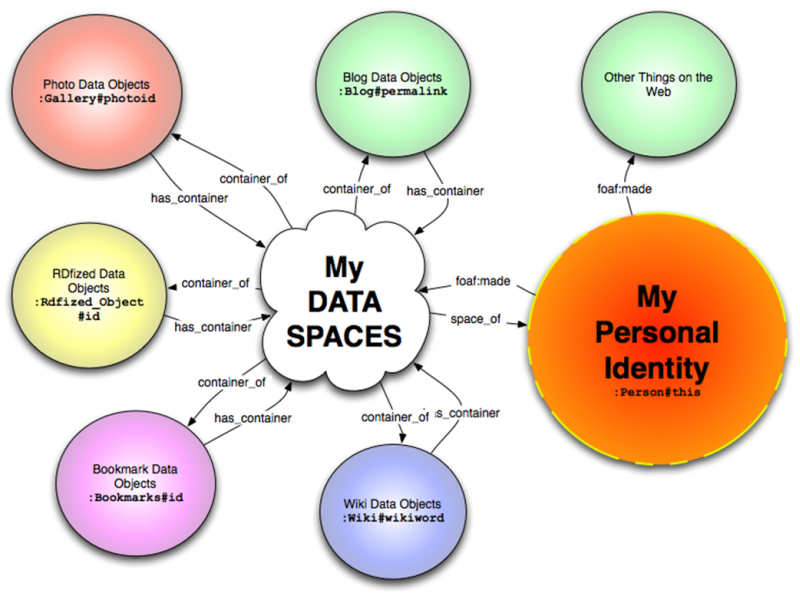
<p>simply become conduits into a mesh of <a href="http://virtuoso.openlinksw.com/presentations/Creating_Deploying_Exploiting_Linked_Data2/images/My_Data_Spaces.png" id="link-id13fe1168">HTTP -- referencable and accessible -- Linked Data Objects</a> endowed with High SDQ (Serendipitious Discovery Quotient). For example my <a href="http://kingsley.idehen.name/dataspace/person/kidehen#this" id="link-id13bdcc80">Personal WebID </a>is all anyone needs to know if they want to explore:</p>
<ol>
<li>My Profile (which includes references to data objects associated with my interests, social-network, calendar, bookmarks etc.)</li>
<li>Data generated by my activities across various data spaces (via data objects associated with my online accounts e.g. <a href="http://linkeddata.uriburner.com/about/id/entity/http/feeds.delicious.com/v2/rss/kidehen?count=15" id="link-id141cce38">Del.icio.us</a>, <a href="http://linkeddata.uriburner.com/about/id/entity/http/twitter.com/kidehen" id="link-id11802ce8">Twitter</a>, <a href="http://linkeddata.uriburner.com/about/id/entity/http/www.last.fm/user/kidehen" id="link-id118bf470">Last.FM</a>)</li>
<li>
  <a href="http://uriburner.com/fct/rdfdesc/usage.vsp?g=http%3A%2F%2Fkingsley.idehen.name%2Fdataspace%2Fperson%2Fkidehen%23this&amp;tp=4" id="link-id13c0f528">Linked Data Meshups via URIBurner</a> (or any other <a href="http://virtuoso.openlinksw.com" id="link-id11334f00">Virtuoso</a> instance) that provide an extend view of my profile</li>
</ol>
<h3>How <a href="http://dbpedia.org/resource/Friend_of_a_friend" id="link-id14324eb0">FOAF</a>+SSL adds Socially aware Security </h3>
<p>Even when you reach a point of equilibrium where: your daily activities trigger orchestratestration of CRUD (Create, Read, Update, Delete) operations against Linked Data Objects within your socially enhanced collaboration network, you still have to deal with the thorny issues of security, that includes the following: </p>
<ol>
  <li>Single Sign On, </li>
  <li>Authentication, and </li>
  <li>Data Access Policies.</li>
</ol>
<p>FOAF+SSL, an application of HTTP based Linked Data, enables you to enhance your Personal HTTP scheme based Identifer (or WebID) via the following steps (peformed by a FOAF+SSL compliant platform):</p>
<ol>
  <li>Imprint WebID within a self-signed x.509 based public key (certificate) associated with your private key (generated by FOAF+SSL platform or manually via OpenSSL)</li>
  <li>Store public key components (modulous and exponent) into your FOAF based profile document which references your Personal HTTP Identifier as its primary topic</li>
  <li>Leverage HTTP <a href="http://dbpedia.org/resource/Uniform_Resource_Locator" id="link-id141f8b30">URL</a> component of WebID for making public key components (modulous and exponent) available for x.509 certificate based authentication challenges posed by systems secured by FOAF+SSL (directly) or OpenID (indirectly via FOAF+SSL to OpenID proxy services).</li>
</ol>
<p>Contrary to conventional experiences with all things PKI (Public Key Infrastructure) related, FOAF+SSL compliant platforms typically handle the PKI issues as part of the protocol implementation; thereby protecting you from any administrative tedium without compromising security.</p>
<h3>Conclusions</h3>
<p>Understanding how new technology innovations address long standing problems, or understanding how new solutions inadvertently fail to address old problems, provides time tested mechanisms for product selection and value proposition comprehension that ultimately save scarce resources such as time and money. </p>
<p>If you want to understand real world problem solution #1 with regards to HTTP based Linked Data look no further than the issues of secure, socially aware, and platform independent identifiers for data objects, that build bridges across erstwhile data silos.</p>
<p>If you want to cost-effectively experience what I&#39;ve outlined in this post, take a look at <a href="http://ods.openlinksw.com/wiki/ODS/" id="link-id13c21220">OpenLink Data Spaces</a> (<a href="http://ods.openlinksw.com/wiki/ODS/" id="link-id1422cdd8">ODS</a>) which is a distributed collaboration engine (enterprise of individual) built around the <a href="http://virtuoso.openlinksw.com" id="link-id14211c98">Virtuoso</a> database engines. It simply enhances existing collaboration tools via the following capabilities:</p>
<p>Addition of Social Dimensions via HTTP based <a href="http://dbpedia.org/resource/Identity_(object-oriented_programming)" id="link-id116ecd88">Data Object Identifiers</a> for all Data Items (if missing)</p>
<ol>
  <li>Ability to integrate across a myriad of Data Source Types rather than a select few across RDBM Engines, LDAP, <a href="http://dbpedia.org/resource/World_Wide_Web">Web</a> Services, and various HTTP accessible Resources (Hypermedia or Non Hypermedia content types)</li>
  <li>Addition of FOAF+SSL based authentication</li>
  <li>Addition of FOAF+SSL based Access Control Lists (ACLs) for policy based data access.</li>
</ol>
<h3>Related:</h3>
<ul>
  <li>
  <a href="http://ods.openlinksw.com/dataspace/dav/wiki/ODS/GetAPersonalURIIn5MinutesOrLess" id="link-id117b2610">Get Yourself A WebID in 5 Minutes or Less</a> via OpenLink Data Spaces (an application layer built atop Virtuoso)</li>
  <li>
  <a href="http://ods.openlinksw.com/dataspace/dav/wiki/ODS/ODSBriefcaseFOAFSSL" id="link-id140311a0">How To Share Resources Securely Using FOAF+SSL</a> </li>
  <li>
  <a href="http://www.youtube.com/watch?v=CRbdeNMPCug" id="link-id11ad5448">FOAF+SSL &amp; WebID Demonstration</a>
</li>
  <li>
  <a href="http://www.slideshare.net/kidehen/linked-data-spaces-data-portability-access" id="link-id141f43a8">OpenLink Data Spaces &amp; Data Portability</a>.</li>
  
</ul>]]></content:encoded>
 </rss:item>
 <rss:item xmlns:rss="http://purl.org/rss/1.0/" rdf:about="http://www.openlinksw.com:443/blog/kidehen@openlinksw.com/blog/?date=2009-04-22#1542">
  <rss:title>Take N: Yet Another OpenLink Data Spaces Introduction</rss:title>
  <dc:date xmlns:dc="http://purl.org/dc/elements/1.1/">2009-04-22T18:46:18Z</dc:date>
  <dc:description xmlns:dc="http://purl.org/dc/elements/1.1/">Problem: Your Life, Profession, Web, and Internet do not need to become mutually exclusive due to &quot;information overload&quot;. Solution: A platform or service that delivers a point of online presence that embodies the fundamental separation of: Identity, Data Access, Data Representation, Data Presentation, by adhering to Web and Internet protocols. How: Typical post installation (Local or Cloud) task sequence: Identify myself (happens automatically by way of registration) If in an LDAP environment, import accounts or associate system with LDAP for account lookup and authentication Identify Online Accounts (by fleshing out profile) which also connects system to online accounts and their data Use Profile for granular description (Biography, Interests, WishList, OfferList, etc.) Optionally upstream or downstream data to and from my online accounts Create content Tagging Rules Create rules for associating Tags with formal URIs Create automatic Hyperlinking Rules for reuse when new content is created (e.g. Blog posts) Exploit Data Portability virtues of RSS, Atom, OPML, RDFa, RDF/XML, and other formats for imports and exports Automatically tag imported content Use function-specific helper application UIs for domain specific data generation e.g. AddressBook (optionally use vCard import), Calendar (optionally use iCalendar import), Email, File Storage (use WebDAV mount with copy and paste or HTTP GET), Feed Subscriptions (optionally import RSS/Atom/OPML feeds), Bookmarking (optionally import bookmark.html or XBEL) etc.. Optionally enable &quot;Conversation&quot; feature (today: Social Media feature) across the relevant application domains (manage conversations under covers using NNTP, the standard for this functionality realm) Generate HTTP based Entity IDs (URIs) for every piece of data in this burgeoning data space Use REST based APIs to perform CRUD tasks against my data (local and remote) (SPARQL, GData, Ubiquity Commands, Atom Publishing) Use OpenID, OAuth, FOAF+SSL, FOAF+SSL+OpenID for accessing data elsewhere Use OpenID, OAuth, FOAF+SSL, FOAF+SSL+OpenID for Controlling access to my data (Self Signed Certificate Generation, Browser Import of said Certificate &amp; associated Private Key, plus persistence of Certificate to FOAF based profile data space in &quot;one click&quot;) Have a simple UI for Entity-Attribute-Value or Subject-Predicate-Object arbitrary data annotations and creation since you can&#39;t pre model an &quot;Open World&quot; where the only constant is data flow Have my Personal URI (Web ID) as the single entry point for controlled access to my HTTP accessible data space I&#39;ve just outlined a snippet of the capabilities of the OpenLink Data Spaces platform. A platform built using OpenLink Virtuoso, architected to deliver: open, platform independent, multi-model, data access and data management across heterogeneous data sources. All you need to remember is your URI when seeking to interact with your data space. Related Get Yourself a URI (Web ID) in 5 Minutes or Less! Various posts over the years about Data Spaces Future of Desktop Post Simplify My Life Post by Bengee Nowack</dc:description>
  <content:encoded xmlns:content="http://purl.org/rss/1.0/modules/content/"><![CDATA[
<h3>Problem:</h3>
<p>Your Life, Profession, <a href="http://dbpedia.org/resource/World_Wide_Web">Web</a>, and <a href="http://dbpedia.org/resource/Internet" id="link-id0x1c6687f8">Internet</a> do not need to become mutually exclusive due to &quot;<a href="http://dbpedia.org/resource/Information" id="link-id0x1c6696e8">information</a> overload&quot;.</p>

<h3>Solution:</h3>
<p>
A platform or service that delivers a point of online presence that embodies the fundamental separation of: Identity, <a href="http://dbpedia.org/resource/Data">Data</a> Access, Data Representation, Data Presentation, by adhering to Web and Internet protocols.</p>

<h3>How:</h3>
<p>
Typical post installation (Local or Cloud) task sequence:</p>
<ol>
<li>
Identify myself (happens automatically by way of registration)</li>
<li>If in an LDAP environment, import accounts or associate system with LDAP for account lookup and authentication</li>
<li>
Identify Online Accounts (by fleshing out profile) which also connects system to online accounts and their data</li>
<li>Use Profile for granular description (Biography, Interests, WishList, OfferList, etc.)</li>
<li>Optionally upstream or downstream data to and from my online accounts</li>
<li>Create content Tagging Rules</li>
<li>Create rules for associating Tags with formal URIs</li>
<li>Create automatic Hyperlinking Rules for reuse when new content is created (e.g. <a href="http://dbpedia.org/resource/Blog" id="link-id11a7c660">Blog</a> posts)</li>
<li>Exploit Data Portability virtues of RSS, Atom, OPML, <a href="http://dbpedia.org/resource/RDFa" id="link-id13f54d50">RDFa</a>, RDF/XML, and other formats for imports and exports</li> 
<li>Automatically <a href="http://dbpedia.org/resource/Tag" id="link-id121ddff0">tag</a> imported content</li>
<li>Use function-specific helper application UIs for domain specific data generation e.g. AddressBook (optionally use vCard import), Calendar (optionally use iCalendar import), Email, File Storage (use WebDAV mount with copy and paste or HTTP GET), Feed Subscriptions (optionally import RSS/Atom/OPML feeds), Bookmarking (optionally import bookmark.html or XBEL) etc..</li>
<li>Optionally enable &quot;Conversation&quot; feature (today: Social Media feature) across the relevant application domains (manage conversations under covers using NNTP, the standard for this functionality realm)
</li>
<li>Generate HTTP based <a href="http://dbpedia.org/resource/Entity" id="link-id13d5d378">Entity</a> IDs (URIs) for every piece of data in this burgeoning <a href="http://en.wikipedia.org/wiki/Data_Spaces" id="link-id11a69670">data space</a>
</li>
<li>Use REST based APIs to perform CRUD tasks against my data (local and remote) (<a href="http://dbpedia.org/resource/SPARQL" id="link-id11a76e10">SPARQL</a>, GData, Ubiquity Commands, Atom Publishing)</li> 

<li>Use OpenID, OAuth, <a href="http://dbpedia.org/resource/Friend_of_a_friend" id="link-id11c9b3e0">FOAF</a>+SSL, FOAF+SSL+OpenID for accessing data elsewhere</li>
<li>Use OpenID, OAuth, FOAF+SSL, FOAF+SSL+OpenID for Controlling access to my data (Self Signed Certificate Generation, Browser Import of said Certificate &amp; associated Private Key, plus persistence of Certificate to FOAF based profile data space in &quot;one click&quot;)</li>
<li>Have a simple UI for <a href="http://dbpedia.org/resource/Entity-attribute-value_model" id="link-id14015bd0">Entity</a>-Attribute-Value or Subject-Predicate-Object arbitrary data annotations and creation since you can&#39;t pre model an &quot;<a href="http://dbpedia.org/resource/Open_world_assumption" id="link-id11cd8548">Open World</a>&quot; where the only constant is data flow</li>
<li>Have my Personal <a href="http://dbpedia.org/resource/Uniform_Resource_Identifier" id="link-id142beee8">URI</a> (Web ID) as the single entry point for controlled access to my HTTP accessible data space</li>
</ol>
<p>
I&#39;ve just outlined a snippet of the capabilities of the <a href="http://dbpedia.org/resource/OpenLink_Data_Spaces" id="link-id13d64740">OpenLink Data Spaces</a> platform. A platform built using OpenLink <a href="http://virtuoso.openlinksw.com" id="link-id13d74170">Virtuoso</a>, architected to deliver: open, platform independent, multi-model, data access and data management across heterogeneous data sources.
</p>
<p>
All you need to remember is your URI when seeking to interact with your data space.</p>

<h3>Related</h3>
<ol>
<li>
  <a href="http://virtuoso.openlinksw.com/dataspace/dav/wiki/Main/GetAPersonalURIIn5MinutesOrLess" id="link-id13c97948">Get Yourself a URI (Web ID) in 5 Minutes or Less!</a>
</li>
<li>
<a href="http://www.openlinksw.com/weblog/public/search.vspx?blogid=127&amp;q=%22data%20spaces%22&amp;type=text&amp;output=html" id="link-id1431e088">Various posts over the years about Data Spaces</a>
</li>
<li>
  <a href="http://www.openlinksw.com/dataspace/kidehen@openlinksw.com/weblog/kidehen@openlinksw.com%27s%20BLOG%20%5B127%5D/1415" id="link-id11f837f0">Future of Desktop Post</a>
</li>
 <li>
  <a href="http://bnode.org/blog/2009/04/22/semantic-web-apps-to-simplify-my-life" id="link-id1393f8a8">Simplify My Life Post</a> by <a href="http://bnode.org/about" id="link-id11da0cc8">Bengee Nowack</a>
 </li>
</ol>]]></content:encoded>
 </rss:item>
 <rss:item xmlns:rss="http://purl.org/rss/1.0/" rdf:about="http://www.openlinksw.com:443/blog/kidehen@openlinksw.com/blog/?date=2008-11-28#1489">
  <rss:title>Introducing Virtuoso Universal Server (Cloud Edition) for Amazon EC2</rss:title>
  <dc:date xmlns:dc="http://purl.org/dc/elements/1.1/">2008-11-28T19:27:12Z</dc:date>
  <dc:description xmlns:dc="http://purl.org/dc/elements/1.1/">What is it? A pre-installed edition of Virtuoso for Amazon&#39;s EC2 Cloud platform. What does it offer? From a Web Entrepreneur perspective it offers: Low cost entry point to a game-changing Web 3.0+ (and beyond) platform that combines SQL, RDF, XML, and Web Services functionality Flexible variable cost model (courtesy of EC2 DevPay) tightly bound to revenue generated by your services Delivers federated and/or centralized model flexibility for you SaaS based solutions Simple entry point for developing and deploying sophisticated database driven applications (SQL or RDF Linked Data Web oriented) Complete framework for exploiting OpenID, OAuth (including Role enhancements) that simplifies exploitation of these vital Identity and Data Access technologies Easily implement RDF Linked Data based Mail, Blogging, Wikis, Bookmarks, Calendaring, Discussion Forums, Tagging, Social-Networking as Data Space (data containers) features of your application or service offering Instant alleviation of challenges (e.g. service costs and agility) associated with Data Portability and Open Data Access across Web 2.0 data silos LDAP integration for Intranet / Extranet style applications. From the DBMS engine perspective it provides you with one or more pre-configured instances of Virtuoso that enable immediate exploitation of the following services: RDF Database (a Quad Store with SPARQL &amp; SPARUL Language &amp; Protocol support) SQL Database (with ODBC, JDBC, OLE-DB, ADO.NET, and XMLA driver access) XML Database (XML Schema, XQuery/Xpath, XSLT, Full Text Indexing) Full Text Indexing. From a Middleware perspective it provides: RDF Views (Wrappers / Semantic Covers) over SQL, XML, and other data sources accessible via SOAP or REST style Web Services Sponger Service for converting non RDF information resources into RDF Linked Data &quot;on the fly&quot; via a large collection of pre-installed RDFizer Cartridges. From the Web Server Platform perspective it provides an alternative to LAMP stack components such as MySQL and Apace by offering HTTP Web Server WebDAV Server Web Application Server (includes PHP runtime hosting) SOAP or REST style Web Services Deployment RDF Linked Data Deployment SPARQL (SPARQL Query Language) and SPARUL (SPARQL Update Language) endpoints Virtuoso Hosted PHP packages for MediaWiki, Drupal, Wordpress, and phpBB3 (just install the relevant Virtuoso Distro. Package). From the general System Administrator&#39;s perspective it provides: Online Backups (Backup Set dispatched to S3 buckets, FTP, or HTTP/WebDAV server locations) Synchronized Incremental Backups to Backup Set locations Backup Restore from Backup Set location (without exiting to EC2 shell). Higher level user oriented offerings include: OpenLink Data Explorer front-end for exploring the burgeoning Linked Data Web Ajax based SPARQL Query Builder (iSPARQL) that enables SPARQL Query construction by Example Ajax based SQL Query Builder (QBE) that enables SQL Query construction by Example. For Web 2.0 / 3.0 users, developers, and entrepreneurs it offers it includes Distributed Collaboration Tools &amp; Social Media realm functionality courtesy of ODS that includes: Point of presence on the Linked Data Web that meshes your Identity and your Data via URIs System generated Social Network Profile &amp; Contact Data via FOAF? System generated SIOC (Semantically Interconnected Online Community) Data Space (that includes a Social Graph) exposing all your Web data in RDF Linked Data form System generated OpenID and automatic integration with FOAF Transparent Data Integration across Facebook, Digg, LinkedIn, FriendFeed, Twitter, and any other Web 2.0 data space equipped with RSS / Atom support and/or REST style Web Services In-built support for SyncML which enables data synchronization with Mobile Phones. How Do I Get Going with It? Standard Installation Guide Personal or Service Specific DBpedia Installation Guide</dc:description>
  <content:encoded xmlns:content="http://purl.org/rss/1.0/modules/content/"><![CDATA[<h3>What is it?</h3>
<p>A pre-installed edition of <a href="http://virtuoso.openlinksw.com" id="link-id14bea838">Virtuoso</a> for Amazon&#39;s EC2 Cloud platform.</p>

<h3>What does it offer?</h3>
From a <a href="http://dbpedia.org/resource/World_Wide_Web">Web</a> Entrepreneur perspective it offers:
<ol>
<li>
Low cost entry point to a game-changing Web 3.0+ (and beyond) platform that combines <a href="http://dbpedia.org/resource/SQL" id="link-id11309b38">SQL</a>, <a href="http://dbpedia.org/resource/Resource_Description_Framework" id="link-id135f7988">RDF</a>, XML, and Web Services functionality</li>
<li>
Flexible variable cost model (courtesy of <a href="http://aws.amazon.com/devpay/" id="link-id17941018">EC2 DevPay</a>) tightly bound to revenue generated by your services</li>
<li>
Delivers federated and/or centralized model flexibility for you SaaS based solutions</li>
<li>
Simple entry point for developing and deploying sophisticated database driven applications (SQL or RDF <a href="http://dbpedia.org/resource/Linked_Data" id="link-id14ea6b10">Linked Data Web</a> oriented)</li>
<li>
Complete framework for exploiting OpenID, OAuth (including Role enhancements) that simplifies exploitation of these vital Identity and <a href="http://dbpedia.org/resource/Data">Data</a> Access technologies</li>
<li>Easily implement RDF Linked Data based Mail, Blogging, Wikis, Bookmarks, Calendaring, Discussion Forums, Tagging, Social-Networking as <a href="http://en.wikipedia.org/wiki/Data_Spaces" id="link-id11519928">Data Space</a> (data containers) features of your application or service offering</li>
<li>Instant alleviation of challenges (e.g. service costs and agility) associated with <a href="http://dbpedia.org/resource/DataPortability" id="link-id111cb610">Data Portability</a> and Open Data Access across Web 2.0 data silos</li>
<li>
LDAP integration for <a href="http://dbpedia.org/resource/Intranet" id="link-id114a8270">Intranet</a> / <a href="http://dbpedia.org/resource/Extranet" id="link-id10fe4f08">Extranet</a> style applications.</li>
</ol>
<p>From the DBMS engine perspective it provides you with one or more pre-configured instances of Virtuoso that enable immediate exploitation of the following services:</p>
<ol>
<li>
RDF Database (a Quad Store with <a href="http://dbpedia.org/resource/SPARQL" id="link-id11911bf8">SPARQL</a> &amp; SPARUL Language &amp; Protocol support)</li>
<li>
  <a href="http://dbpedia.org/resource/SQL" id="link-id110544c8">SQL</a> Database (with <a href="http://dbpedia.org/resource/Open_Database_Connectivity" id="link-id1524c7d0">ODBC</a>, <a href="http://dbpedia.org/resource/Java_Database_Connectivity" id="link-id14cfb658">JDBC</a>, OLE-DB, <a href="http://dbpedia.org/resource/ADO.NET" id="link-id110ec6c8">ADO</a>.NET, and XMLA driver access)</li>
<li>XML Database (XML Schema, <a href="http://dbpedia.org/resource/XQuery" id="link-id10ebf218">XQuery</a>/<a href="http://dbpedia.org/resource/XPath" id="link-id142a7898">Xpath</a>, XSLT, Full Text Indexing)</li>
<li>Full Text Indexing.</li>
</ol>

<p>From a Middleware perspective it provides:</p>
<ol>
<li>
RDF Views (Wrappers / Semantic Covers) over SQL, XML, and other data sources accessible via SOAP or REST style Web Services</li>
<li>
Sponger Service for converting non RDF <a href="http://dbpedia.org/resource/Information" id="link-id11931c60">information</a> resources into RDF <a href="http://dbpedia.org/resource/Linked_Data" id="link-id118f7168">Linked Data</a> &quot;on the fly&quot; via a large collection of pre-installed  RDFizer Cartridges.</li>
</ol>

<p>From the Web Server Platform perspective it provides an alternative to LAMP stack components such as <a href="http://dbpedia.org/resource/MySQL" id="link-id10f7b780">MySQL</a> and Apace by offering</p>
<ol>
<li>
HTTP Web Server</li>
<li>
WebDAV Server</li>
<li>
Web <a href="http://dbpedia.org/resource/Application_server" id="link-id1268daa8">Application Server</a> (includes <a href="http://dbpedia.org/resource/PHP" id="link-id1585d238">PHP</a> runtime hosting)</li>
<li>
SOAP or REST style Web Services Deployment</li>
<li>
RDF Linked Data Deployment</li>
<li>
SPARQL (SPARQL Query Language) and SPARUL (SPARQL Update Language) endpoints</li>
<li>Virtuoso Hosted PHP packages for <a href="http://dbpedia.org/resource/MediaWiki" id="link-id15568818">MediaWiki</a>, <a href="http://dbpedia.org/resource/Drupal" id="link-id110bd7a8">Drupal</a>, <a href="http://dbpedia.org/resource/WordPress" id="link-id10f66918">Wordpress</a>, and <a href="http://dbpedia.org/resource/PhpBB" id="link-id13fda4d0">phpBB3</a> (just install the relevant Virtuoso Distro. Package).
</li>
</ol>

<p>From the general System Administrator&#39;s perspective it provides:</p>
<ol>
<li>
Online Backups (Backup Set dispatched to S3 buckets, FTP, or HTTP/WebDAV server locations)</li>
<li>Synchronized Incremental Backups to Backup Set locations</li>
<li>Backup Restore from Backup Set location (without exiting to EC2 shell).</li>
</ol>

<p>Higher level user oriented offerings include:</p>
<ol>
<li>OpenLink Data Explorer front-end for exploring the burgeoning Linked Data <a href="http://dbpedia.org/resource/Giant_Global_Graph" id="link-id11646dc8">Web</a>
</li>
<li>
Ajax based SPARQL Query Builder (iSPARQL) that enables SPARQL Query construction by Example</li>
<li>Ajax based SQL Query Builder (QBE) that enables SQL Query construction by Example.</li>
</ol>

<p>For Web 2.0 / 3.0 users, developers, and entrepreneurs it offers it includes Distributed Collaboration Tools &amp; Social Media realm functionality courtesy of <a href="http://dbpedia.org/resource/OpenLink_Data_Spaces" id="link-id11009930">ODS</a> that includes:</p>
<ol>
<li>
Point of presence on the Linked Data Web that meshes your Identity and your Data via URIs</li>
<li>
System generated Social Network Profile &amp; Contact Data via <a href="http://dbpedia.org/resource/Friend_of_a_friend" id="link-id1185a1c0">FOAF</a>?</li>
<li>
System generated <a href="http://dbpedia.org/resource/SIOC" id="link-id14791890">SIOC</a> (Semantically Interconnected Online Community) <a href="http://en.wikipedia.org/wiki/Data_Spaces" id="link-id1577cad8">Data Space</a> (that includes a Social Graph) exposing all your Web data in RDF Linked Data form</li>
<li>
System generated OpenID and automatic integration with FOAF</li>
<li>
Transparent Data Integration across Facebook, Digg, LinkedIn, FriendFeed, Twitter, and any other Web 2.0 data space equipped with RSS / Atom support and/or REST style Web Services</li>
<li>
In-built support for SyncML which enables data synchronization with Mobile Phones.</li>
</ol>
<h3>How Do I Get Going with It?</h3>
<ul>
<li>
<a href="http://virtuoso.openlinksw.com/dataspace/dav/wiki/Main/ODSInstallationEC2" id="link-id114e1600">Standard Installation Guide</a>
</li>
<li>
<a href="http://virtuoso.openlinksw.com/dataspace/dav/wiki/Main/VirtEC2AMIDBpediaInstall" id="link-id110a98e8">Personal or Service Specific DBpedia Installation Guide</a>
</li>
</ul>]]></content:encoded>
 </rss:item>
 <rss:item xmlns:rss="http://purl.org/rss/1.0/" rdf:about="http://www.openlinksw.com:443/blog/kidehen@openlinksw.com/blog/?date=2008-10-09#1454">
  <rss:title>Dynamic Linked Data Constellation</rss:title>
  <dc:date xmlns:dc="http://purl.org/dc/elements/1.1/">2008-10-09T21:23:25Z</dc:date>
  <dc:description xmlns:dc="http://purl.org/dc/elements/1.1/">Now that the virtues of dynamic generation of RDF based Linked Data are becoming clearer, I guess it&#39;s time to unveil the Virtuoso Sponger driven Dynamic Linked Data constellation diagram. Our diagram depicts the myriad of data sources from which RDF Linked Data is generated &quot;on the fly&quot; via our data source specific RDF-zation cartridges/drivers. It also unveils how the sponger leverages the Linked Data constellations of UMBEL, DBpedia, Bio2Rdf, and others for lookups.</dc:description>
  <content:encoded xmlns:content="http://purl.org/rss/1.0/modules/content/"><![CDATA[<p>Now that the virtues of dynamic generation of RDF based <a href="http://dbpedia.org/resource/Linked_Data" id="link-id14c429a0">Linked Data</a> are becoming clearer, I guess it&#39;s time to unveil the <a href="http://virtuoso.openlinksw.com" id="link-id13d7c7e0">Virtuoso</a> <a href="http://virtuoso.openlinksw.com/Whitepapers/html/VirtSpongerWhitePaper.html" id="link-id115d0c20">Sponger</a> driven Dynamic Linked Data constellation diagram.</p>

<p>Our diagram depicts the myriad of <a href="http://dbpedia.org/resource/Data">data</a> sources from which RDF Linked Data is generated &quot;on the fly&quot; via our data source specific RDF-zation cartridges/drivers. It also unveils how the sponger leverages the Linked Data constellations of <a href="http://umbel.org/" id="link-id14bd5700">UMBEL</a>, <a href="http://dbpedia.org/resource/DBpedia" id="link-id110f5a48">DBpedia</a>, <a href="http://www.bio2rdf.org/" id="link-id11494bc0">Bio2Rdf</a>, and others for lookups.</p>

<map name="GraffleExport">
	<area shape="circle" coords="723,292,36" href="http://linkeddata.uriburner.com/about/html/http://xbel.sourceforge.net/bookmarks/xbel.xbel" />
	<area shape="circle" coords="423,309,36" href="http://linkeddata.uriburner.com/about/html/http://www.w3.org/2001/sw/grddl-wg/doc29/hotel-data.html" />
	<area shape="circle" coords="592,285,36" href="http://linkeddata.uriburner.com/about/html/http://farm4.static.flickr.com/3067/2590298570_304a594899_t.jpg" />
	<area shape="circle" coords="685,220,36" href="http://linkeddata.uriburner.com/about/html/http://microformats.org/feed/" />
	<area shape="circle" coords="817,182,36" href="http://linkeddata.uriburner.com/about/html/http://en.wikipedia.org/wiki/London" />
	<area shape="circle" coords="745,447,36" href="http://linkeddata.uriburner.com/about/http://www.sec.gov/Archives/edgar/data/51143/000110465908059468/ibm-20080429.xml" />
	<area shape="circle" coords="597,387,36" href="http://linkeddata.uriburner.com/about/html/http://www.twine.com/twine/1p2dqhdx-1jg/nova-spivack-my-public-twine" />
	<area shape="circle" coords="659,459,36" href="http://linkeddata.uriburner.com/about/html/http://www.theyworkforyou.com/mp/diane_abbott/hackney_north_and_stoke_newington" />
	<area shape="circle" coords="585,494,36" href="http://linkeddata.uriburner.com/about/html/http://www.discogs.com/release/634302" />
	<area shape="circle" coords="817,503,36" href="http://linkeddata.uriburner.com/about/html/http://getsatisfaction.com/mozilla/topics/ubiquity_mostly_fails_on_mac_ppc" />
	<area shape="circle" coords="753,563,36" href="http://linkeddata.uriburner.com/about/html/http://www.sec.gov/Archives/edgar/data/789019/000119312507259490/msft-20070930.xml" />
	<area shape="circle" coords="676,559,36" href="http://linkeddata.uriburner.com/about/html/http://twitter.com/statuses/user_timeline/633273.rss" />
	<area shape="circle" coords="845,592,36" href="http://linkeddata.uriburner.com/about/html/http://ns.hr-xml.org/2_5/HR-XML-2_5/SEP/ResumeExample.xml" />
	<area shape="circle" coords="845,431,36" href="http://linkeddata.uriburner.com/about/html/http://www.w3.org/2003/12/rdf-in-xhtml-xslts/complete-example.html" />
	<area shape="circle" coords="701,375,36" href="http://linkeddata.uriburner.com/about/html/http://www.molly.com/people.php" />
	<area shape="circle" coords="829,342,36" href="http://linkeddata.uriburner.com/about/html/http://upload.wikimedia.org/wikipedia/commons/b/b0/Hydroxide_lone_pairs-2D.svg" />
	<area shape="circle" coords="341,259,36" href="http://linkeddata.uriburner.com/about/html/http://friendfeed.com/search?q=linked+data" />
	<area shape="circle" coords="294,170,36" href="http://linkeddata.uriburner.com/about/html/http://local.yahooapis.com/MapsService/V1/trafficData?appid=Jz0wAU7V34Ff7gCzblxD.86qjGTEn._H3KA3PEajNE3xBMIbQtEZqIqHRh0G&amp;street=701+First+Street&amp;city=Sunnyvale&amp;state=CA" />
	<area shape="circle" coords="829,262,36" href="http://linkeddata.uriburner.com/about/html/http://blog.disqus.net/2008/08/25/reblog-comments-can-be-blog-posts/" />
	<area shape="circle" coords="407,526,36" href="http://linkeddata.uriburner.com/about/html/http://finance.yahoo.com/q?s=AAPL" />
	<area shape="circle" coords="503,292,36" href="http://linkeddata.uriburner.com/about/html/http://isbndb.com/d/person/berners_lee_tim.html" />
	<area shape="circle" coords="310,501,36" href="http://linkeddata.uriburner.com/about/html/http://musicbrainz.org/release/37e955d4-a53c-45aa-a812-1b23b88dbc13.html" />
	<area shape="circle" coords="413,221,36" href="http://linkeddata.uriburner.com/about/html/http://www.freebase.com/view/en/abraham_lincoln" />
	<area shape="circle" coords="553,213,36" href="http://linkeddata.uriburner.com/about/html/http://slideshow.rubyforge.org/microformats.html" />
	<area shape="circle" coords="445,93,36" href="http://linkeddata.uriburner.com/about/html/http://farm1.static.flickr.com/212/496684670_7122c831ed.jpg" />
	<area shape="circle" coords="680,663,36" href="http://linkeddata.uriburner.com/about/html/http://cgi.ebay.com/Eclipse-by-Stephenie-Meyer-2007_W0QQitemZ250283828939QQcmdZViewItem?hash=item250283828939&amp;_trkparms=240%3A1318&amp;_trksid=p4295" />
	<area shape="circle" coords="553,663,36" href="http://linkeddata.uriburner.com/about/html/http://digg.com/general_sciences/at_last-stem_cells_without_side_effects_" />
	<area shape="circle" coords="248,651,36" href="http://linkeddata.uriburner.com/about/html/http://delicious.com/popular/blog" />
	<area shape="circle" coords="158,554,36" href="http://linkeddata.uriburner.com/about/html/http://www.crunchbase.com/person/sergey-brin" />
	<area shape="circle" coords="214,477,36" href="http://linkeddata.uriburner.com/about/html/http://virtuoso.openlinksw.com/presentations/Creating_Deploying_Exploiting_Linked_Data2/Creating_Deploying_Exploiting_Linked_Data2_TimBL_v3.html" />
	<area shape="circle" coords="209,339,36" href="http://linkeddata.uriburner.com/about/html/https://bugzilla.mozilla.org/show_bug.cgi?id=251714" />
	<area shape="circle" coords="264,405,36" href="http://linkeddata.uriburner.com/about/html/http://ma.gnolia.com/rss/full/tags/microformats" />
	<area shape="circle" coords="417,663,36" href="http://linkeddata.uriburner.com/about/html/http://www.lawyer-directory.net/lawyer/Grand-Rapids-Bar-Association-Grand-Rapids-law434032.htm" />
	<area shape="circle" coords="497,733,36" href="http://linkeddata.uriburner.com/about/html/http://www.concertbuzz.net/genres/classic-rock/jethro-tull.html" />
	<area shape="circle" coords="373,437,36" href="http://linkeddata.uriburner.com/about/html/http://openmediaweb.org/index.php/2008/01/13/publishing-my-workout-music-in-haudio/" />
	<area shape="circle" coords="373,121,36" href="http://linkeddata.uriburner.com/about/html/https://apml.engagd.com/apml/danielabarbosa.myopenid.com.apml" />
	<area shape="circle" coords="245,559,36" href="http://linkeddata.uriburner.com/about/html/http://www.w3.org/2001/sw/grddl-wg/doc29/hotel-data.html" />
	<area shape="circle" coords="170,650,36" href="http://linkeddata.uriburner.com/about/html/http://www.amazon.co.uk/Owl-Representing-Information-Ontology-Language/dp/1412034485/ref=sr_1_1/203-3289794-0348766?ie=UTF8&amp;s=books&amp;qid=1177155160&amp;sr=1-1" />
	<area shape="circle" coords="327,703,36" href="http://virtuoso.openlinksw.com/dataspace/dav/wiki/Main/VirtSponger" />
	<area shape="circle" coords="481,170,36" href="http://linkeddata.uriburner.com/about/html/http://www.w3.org/2004/08/TalkFiles/iCal/TalksAll.ics" />
	<area shape="circle" coords="487,615,36" href="http://linkeddata.uriburner.com/about/html/http://openlibrary.org/b/OL7983950M" />
	<area shape="circle" coords="158,417,36" href="http://linkeddata.uriburner.com/about/html/http://xml.weather.yahoo.com/forecastrss?p=USCA1116&amp;u=f" />
	<area shape="circle" coords="608,729,36" href="http://linkeddata.uriburner.com/about/html/http://www.youtube.com" />
	<area shape="circle" coords="726,148,36" href="http://linkeddata.uriburner.com/about/html/http://www.lespetitescases.net/semantique-et-xhtml" />
	<area shape="circle" coords="773,663,36" href="http://linkeddata.uriburner.com/about/html/http://upcoming.org/event/130719/" />
	<area shape="circle" coords="553,118,36" href="http://linkeddata.uriburner.com/about/html/http://tech.yahoo.com/pr/apple-ipod-video-30gb-black-mp3-player/1992981873" />
	<area shape="circle" coords="608,609,36" href="http://linkeddata.uriburner.com/about/html/http://socialgraph.apis.google.com/otherme?pretty=1&amp;q=www.openlinksw.com/blog/~kidehen/" />
	<area shape="circle" coords="487,516,36" href="http://linkeddata.uriburner.com/about/html/oai:dcmi.ischool.washington.edu:article/8" />
	<area shape="circle" coords="635,158,36" href="http://linkeddata.uriburner.com/about/html/http://news.bbc.co.uk/rss/feeds.opml" />
	<area shape="circle" coords="256,261,36" href="http://linkeddata.uriburner.com/about/html/http://www.google.com/base/feeds/snippets?bq=%20%5bemployer:%20Hewlett-Packard%5d%20%20%5bjob%20type:full-time%5d" />
	<area shape="circle" coords="120,248,36" href="http://linkeddata.uriburner.com/about/html/http://www.apple.com/" />
	<area shape="circle" coords="120,339,36" href="http://linkeddata.uriburner.com/about/html/http://www.fileinfo.net/extension/atom" />
	<area shape="circle" coords="337,343,36" href="http://linkeddata.uriburner.com/about/html/urn:lsid:ubio.org:namebank:12292" />
	<area shape="circle" coords="340,598,36" href="http://linkeddata.uriburner.com/about/html/http://www.maine.gov/portal/government/calendar.shtml" />
	<area shape="circle" coords="337,343,36" href="http://linkeddata.uriburner.com/about/html/urn:lsid:ubio.org:namebank:12292" />
	<area shape="circle" coords="585,494,36" href="http://linkeddata.uriburner.com/about/html/http://www.discogs.com/release/634302" />
	<area shape="circle" coords="491,409,36" href="http://virtuoso.openlinksw.com/dataspace/dav/wiki/Main/VirtSponger" />
	<area shape="poly" coords="992,603,1015,557,1061,557,1100,592,1076,638,1030,638,992,603" href="http://bio2rdf.org/wiki/attach/Main/bio2rdfmap_blanc.png" />
	<area shape="poly" coords="995,454,1018,408,1064,408,1103,443,1079,489,1033,489,995,454" href="http://www4.wiwiss.fu-berlin.de/bizer/pub/lod-datasets_2008-09-18.html" />
	<area shape="poly" coords="919,117,943,71,989,71,1027,106,1004,152,958,152,919,117" href="http://umbel.org/images/081005_lod_constellation.png" />
</map>
<img border="0" src="http://virtuoso.openlinksw.com/images/sponger-cloud.png" usemap="#GraffleExport" />
]]></content:encoded>
 </rss:item>
 <rss:item xmlns:rss="http://purl.org/rss/1.0/" rdf:about="http://www.openlinksw.com:443/blog/kidehen@openlinksw.com/blog/?date=2008-10-06#1453">
  <rss:title>What is Linked Data oriented RDF-ization?</rss:title>
  <dc:date xmlns:dc="http://purl.org/dc/elements/1.1/">2008-10-06T20:14:26Z</dc:date>
  <dc:description xmlns:dc="http://purl.org/dc/elements/1.1/">RDF-ization is a term used by the Semantic Web community to describe the process of generating RDF from non RDF Data Sources such as (X)HTML, Weblogs, Shared Bookmark Collections, Photo Galleries, Calendars, Contact Managers, Feed Subscriptions, Wikis, and other information resource collections. If the RDF generated, results in an entity-to-entity level network (graph) in which each entity is endowed with a de-referencable HTTP based ID (a URI), we end up with an enhancement to the Web that adds Hyperdata linking across extracted entities, to the existing Hypertext based Web of linked documents (pages, images, and other information resource types). Thus, I can use the same URL linking mechanism to reference a broader range of &quot;Things&quot; i.e., documents, things that documents are about, or things loosely associated with documents. The Virtuoso Sponger is an example of an RDF Middleware solution from OpenLink Software. It&#39;s an in-built component of the Virtuoso Universal Server, and deployable in many forms e.g., Software as Service (SaaS) or traditional software installation. It delivers RDF-ization services via a collection of Web information resource specific Cartridges/Providers/Drivers covering Wikipedia, Freebase, CrunchBase, WikiCompany, OpenLibrary, Digg, eBay, Amazon, RSS/Atom/OPML feed sources, XBRL, and many more. RDF-ization alone doesn&#39;t ensure valuable RDF based Linked Data on the Web. The process of producing RDF Linked Data is ultimately about the art of effectively describing resources with an eye for context. RDF-ization Processing Steps Entity Extraction Vocabulary/Schema/Ontology (Data Dictionary) mapping HTTP based Proxy URI generation Linked Data Cloud Lookups (e.g., perform UMBEL lookup to add &quot;isAbout&quot; fidelity to graph and then lookup DBpedia and other LOD instance data enclaves for Identical individuals and connect via &quot;owl:sameAs&quot;) RDF Linked Data Graph projection that uses the description of the container information resource to expose the URIs of the distilled entities. The animation that follows illustrates the process (5,000 feet view), from grabbing resources via HTTP GET, to injecting RDF Linked Data back into the Web cloud: Note: the Shredder is a Generic Cartridge, so you would have one of these per data source type (information resource type).</dc:description>
  <content:encoded xmlns:content="http://purl.org/rss/1.0/modules/content/"><![CDATA[<p>RDF-ization is a term used by the <a href="http://dbpedia.org/resource/Semantic_Web" id="link-id14b4ebd0">Semantic Web</a> community to describe the process of generating RDF from non RDF <a href="http://dbpedia.org/resource/Data">Data</a> Sources such as (X)HTML, Weblogs, Shared Bookmark Collections, Photo Galleries, Calendars, Contact Managers, Feed Subscriptions, Wikis, and other <a href="http://dbpedia.org/resource/Information" id="link-id13f2a2e0">information</a> resource collections.  </p> 

<p>If the RDF generated, results in an <a href="http://dbpedia.org/resource/Entity" id="link-id11281278">entity</a>-to-entity level network (graph) in which each entity is endowed with a de-referencable HTTP based ID (a <a href="http://dbpedia.org/resource/Uniform_Resource_Identifier" id="link-id148200f0">URI</a>), we end up with an enhancement to the <a href="http://dbpedia.org/resource/World_Wide_Web">Web</a> that adds <a href="http://dbpedia.org/resource/Linked_Data" id="link-id112a5980">Hyperdata</a> linking across extracted entities, to the existing Hypertext based Web of linked documents (pages, images, and other information resource types). Thus, I can use the same <a href="http://dbpedia.org/resource/Uniform_Resource_Locator" id="link-id10ebc630">URL</a> linking mechanism to reference a broader range of &quot;Things&quot; i.e., documents, things that documents are about, or things loosely associated with documents.</p>

<p>The <a href="http://virtuoso.openlinksw.com" id="link-id144304a8">Virtuoso</a> <a href="http://virtuoso.openlinksw.com/Whitepapers/html/VirtSpongerWhitePaper.html" id="link-id14a96400">Sponger</a> is an example of an <a href="http://www.openlinksw.com/weblog/public/search.vspx?blogid=127&amp;q=rdf%20middleware&amp;type=text&amp;output=html" id="link-id14d36938">RDF Middleware</a> solution from <a href="http://www.openlinksw.com/dataspace/organization/openlink#this" id="link-id117e5c50">OpenLink Software</a>. It&#39;s an in-built component of the Virtuoso <a href="http://dbpedia.org/resource/Virtuoso_Universal_Server" id="link-id14b4d0e0">Universal Server</a>, and deployable in many forms e.g., Software as Service (SaaS) or traditional software installation. It delivers RDF-ization services via a collection of Web information resource specific Cartridges/Providers/Drivers covering Wikipedia, Freebase, CrunchBase, WikiCompany, OpenLibrary, Digg, eBay, Amazon, RSS/Atom/OPML feed sources, XBRL, and many more.</p>

<p>RDF-ization alone doesn&#39;t ensure valuable RDF based <a href="http://dbpedia.org/resource/Linked_Data" id="link-id14a75b48">Linked Data</a> on the Web. The process of producing RDF Linked Data is ultimately about the art of effectively describing resources with an eye for <a href="http://dbpedia.org/resource/Context_%28language_use%29" id="link-id1442fea0">context</a>. </p>

<h3>RDF-ization Processing Steps</h3>
<ol>
<li>
Entity Extraction</li>
<li>
Vocabulary/Schema/Ontology (Data Dictionary) mapping</li>
<li>
HTTP based Proxy URI generation</li>
<li>Linked Data Cloud Lookups (e.g., perform <a href="http://umbel.org/about/" id="link-id14432f00">UMBEL</a> lookup to add &quot;isAbout&quot; fidelity to graph and then lookup <a href="http://dbpedia.org/resource/DBpedia" id="link-id14485f40">DBpedia</a> and other <a href="http://community.linkeddata.org/dataspace/organization/lod#this" id="link-id115ea410">LOD</a> instance data enclaves for Identical individuals and connect via &quot;owl:sameAs&quot;)</li>
<li>
RDF <a href="http://dbpedia.org/resource/Resource_Description_Framework" id="link-id14ae31c0">Linked Data Graph</a> projection that uses the description of the container information resource to expose the URIs of the distilled entities.</li>
</ol>
<p>The animation that follows illustrates the process (5,000 feet view), from grabbing resources via HTTP GET, to injecting RDF Linked Data back into the Web cloud:</p>
<div>
<object>
<embed src="http://virtuoso.openlinksw.com/screencasts/virtuoso-rdf-middleware.swf" type="application/x-shockwave-flash" width="800" height="600"></embed>
</object>
</div>
<p>Note: the Shredder is a Generic Cartridge, so you would have one of these per data source type (information resource type).</p>


]]></content:encoded>
 </rss:item>
 <rss:item xmlns:rss="http://purl.org/rss/1.0/" rdf:about="http://www.openlinksw.com:443/blog/kidehen@openlinksw.com/blog/?date=2008-09-25#1442">
  <rss:title>The Linked Data Market via a BCG Matrix (Updated)</rss:title>
  <dc:date xmlns:dc="http://purl.org/dc/elements/1.1/">2008-09-25T20:42:49Z</dc:date>
  <dc:description xmlns:dc="http://purl.org/dc/elements/1.1/">The sweet spot of Web 3.0 (or any other Web.vNext moniker) is all about providing Web Users with a structured and interlinked data substrate that facilitates serendipitous discovery of relevant &quot;Things&quot; i.e., a Linked Data Web -- a Web of Linkable Entities that goes beyond documents and other information resource (data containers) types. Understanding potential Linked Data Web business models, relative to other Web based market segments, is best pursued via a BCG Matrix diagram, such as the one I&#39;ve constructed below: Notes: Link Density Web 1.0&#39;s collection of &quot;Web Sites&quot; have relatively low link density relative to Web 2.0&#39;s user-activity driven generation of semi-structured linked data spaces (e.g., Blogs, Wikis, Shared Bookmarks, RSS/Atom Feeds, Photo Galleries, Discussion Forums etc..) Semantic Technologies (i.e. &quot;Semantics Inside style solutions&quot;) which are primarily about &quot;Semantic Meaning&quot; culled from Web 1.0 Pages also have limited linked density relative to Web 2.0 The Linked Data Web, courtesy of the open-ended linking capacity of URIs, matches and ultimately exceeds Web 2.0 link density. Relevance Web 1.0 and 2.0 are low relevance realms driven by hyperlinks to information resources ((X)HTML, RSS, Atom, OPML, XML, Images, Audio files etc.) associated with Literal Labels and Tagging schemes devoid of explicit property based resource description thereby making the pursuit of relevance mercurial at best Semantic Technologies offer more relevance than Web 1.0 and 2.0 based on the increased context that semantic analysis of Web pages accords The Linked Data Web, courtesy of URIs that expose self-describing data entities, match the relevance levels attained by Semantic Technologies. Serendipity Quotient (SDQ) Web 1.0 has next to no serendipity, the closest thing is Google&#39;s &quot;I&#39;m Feeling Lucky&quot; button Web 2.0 possess higher potential for serendipitous discovery than Web 1.0, but such potential is neutralized by inherent subjectivity due to its human-interaction-focused literal foundation (e.g., tags, voting schemes, wiki editors etc.) Semantic Technologies produce islands-of-relevance with little scope for serendipitous discovery due to URI invisibility, since the prime focus is delivering more context to Web search relative to traditional Web 1.0 search engines. The Linked Data Web&#39;s use of URIs as the naming and resolution mechanism for exposing structured and interlinked resources provides the highest potential for serendipitous discovery of relevant &quot;Things&quot; To conclude, the Linked Data Web&#39;s market opportunities are all about the evolution of the Web into a powerful substrate that offers a unique intersection of &quot;Link Density&quot; and &quot;Relevance&quot;, exploitable across horizontal and vertical market segments to solutions providers. Put differently, SDQ is how you take &quot;The Ad&quot; out of &quot;Advertising&quot; when matching Web users to relevant things :-)</dc:description>
  <content:encoded xmlns:content="http://purl.org/rss/1.0/modules/content/"><![CDATA[<p>The sweet spot of <a href="http://dbpedia.org/resource/World_Wide_Web">Web</a> 3.0 (or any other Web.vNext moniker) is all about providing Web Users with a structured and interlinked <a href="http://dbpedia.org/resource/Data">data</a> substrate that facilitates serendipitous discovery of relevant &quot;Things&quot; i.e., a <a href="http://dbpedia.org/resource/Linked_Data" id="link-id10db3b48">Linked Data</a> <a href="http://dbpedia.org/resource/Giant_Global_Graph" id="link-id170db618">Web</a> -- a Web of Linkable Entities that goes beyond documents and other <a href="http://dbpedia.org/resource/Information" id="link-id110a5d30">information</a> resource (data containers) types.</p>
<p>Understanding potential <a href="http://dbpedia.org/resource/Linked_Data" id="link-id19e21c60">Linked Data</a> <a href="http://dbpedia.org/resource/Giant_Global_Graph" id="link-id16d008d0">Web</a> business models, relative to other Web based market segments, is best pursued via a<a href="http://dbpedia.org/resource/BCG_diagram" id="link-id14734148"> BCG Matrix</a> diagram, such as the one I&#39;ve constructed below:</p>
<br />
<img src="http://virtuoso.openlinksw.com/ldp_presentation/images/linked_data_sdq_quadarant.png" />
<br />

<h3>Notes:</h3>

<h4>Link Density</h4>
<ul>
<li>Web 1.0&#39;s collection of &quot;Web Sites&quot; have relatively low link density relative to Web 2.0&#39;s user-activity driven generation of semi-structured <a href="http://dbpedia.org/resource/Linked_Data" id="link-id14c302d8">linked data</a> spaces (e.g., Blogs, Wikis, Shared Bookmarks, RSS/Atom Feeds, Photo Galleries, Discussion Forums etc..)</li>
<li>Semantic Technologies (i.e. &quot;<strong>Semantics Inside</strong> style solutions&quot;) which are primarily about &quot;Semantic Meaning&quot; culled from Web 1.0 Pages also have limited linked density relative to Web 2.0</li>
<li>The <a href="http://dbpedia.org/resource/Linked_Data" id="link-id1286ab58">Linked Data</a> <a href="http://dbpedia.org/resource/Giant_Global_Graph" id="link-ide81ab20">Web</a>, courtesy of the open-ended  linking capacity of URIs, matches and ultimately exceeds Web 2.0 link density.</li>
</ul>


<h4>Relevance</h4>
<ul>
<li>Web 1.0 and 2.0 are low relevance realms driven by hyperlinks to <a href="http://dbpedia.org/resource/Information" id="link-id173db890">information</a> resources ((X)HTML, RSS, Atom, OPML, XML, Images, Audio files etc.) associated with Literal Labels and Tagging schemes devoid of explicit property based resource description thereby making the pursuit of relevance mercurial at best</li>
<li>Semantic Technologies offer more relevance than Web 1.0 and 2.0 based on the increased <a href="http://dbpedia.org/resource/Context_%28language_use%29" id="link-id124de510">context</a> that semantic analysis of Web pages accords</li>
<li>The <a href="http://dbpedia.org/resource/Linked_Data" id="link-id111c4850">Linked Data</a> <a href="http://dbpedia.org/resource/Giant_Global_Graph" id="link-id16e4e4c0">Web</a>, courtesy of URIs that expose self-describing data entities, match the relevance levels attained by Semantic Technologies.</li>
</ul>

<h4>Serendipity Quotient (SDQ)</h4>

<ul>
<li>Web 1.0 has next to no serendipity, the closest thing is <a href="http://google.com" id="link-id16dceec8">Google&#39;s &quot;I&#39;m Feeling Lucky&quot; button</a>
</li>
<li>Web 2.0 possess higher potential for serendipitous discovery than Web 1.0, but such potential is neutralized by inherent subjectivity due to its human-interaction-focused literal foundation (e.g., tags, voting schemes, wiki editors etc.)</li>
<li>Semantic Technologies produce islands-of-relevance with little scope for serendipitous discovery due to <a href="http://dbpedia.org/resource/Uniform_Resource_Identifier" id="link-id18078e60">URI</a> invisibility, since the prime focus is delivering more <a href="http://dbpedia.org/resource/Context_%28language_use%29" id="link-id1253cc38">context</a> to Web search relative to traditional Web 1.0 search engines.</li>
<li>The <a href="http://dbpedia.org/resource/Linked_Data" id="link-id0x201d0ae8">Linked Data</a> <a href="http://dbpedia.org/resource/Giant_Global_Graph" id="link-id10c7fb70">Web</a>&#39;s use of URIs as the naming and resolution mechanism for exposing structured and interlinked resources provides the highest potential for serendipitous discovery of relevant &quot;Things&quot;</li>
</ul> 
<p>To conclude, the <a href="http://dbpedia.org/resource/Linked_Data">Linked Data</a> <a href="http://dbpedia.org/resource/Giant_Global_Graph" id="link-id0x23ebbf90">Web</a>&#39;s market opportunities are all about the evolution of the Web into a powerful substrate that offers a unique intersection of &quot;Link Density&quot; and &quot;Relevance&quot;, exploitable across horizontal and vertical market segments to solutions providers. Put differently, SDQ is how you take &quot;The Ad&quot; out of &quot;Advertising&quot; when matching Web users to relevant things :-)</p>]]></content:encoded>
 </rss:item>
 <rss:item xmlns:rss="http://purl.org/rss/1.0/" rdf:about="http://www.openlinksw.com:443/blog/kidehen@openlinksw.com/blog/?date=2008-09-03#1429">
  <rss:title>What&#39;s Up with Chrome?</rss:title>
  <dc:date xmlns:dc="http://purl.org/dc/elements/1.1/">2008-09-03T20:33:32Z</dc:date>
  <dc:description xmlns:dc="http://purl.org/dc/elements/1.1/">Here are a few descriptions of pages covering Google&#39;s Chrome browser: Daniel Lewis - Comparative Analysis CrunchBase - Product Page GigaOM - Industry Analysis Wikipedia CNET - Privacy Issues Analysis ReadWriteWeb - Security Issues Analysis OakLeaf - SaaS Terms Analysis As per usual, this is part post and part Linked Data demo. This time around, I am showcasing Proxy/Wrapper based dereferencable URIs and a new &quot;Page Description&quot; feature that showcases the capabilities of Virtuoso&#39;s in-built RDFization Middleware. Also note, the resource descriptions (RDF) are presented using an HTML page.</dc:description>
  <content:encoded xmlns:content="http://purl.org/rss/1.0/modules/content/"><![CDATA[<p>Here are a few descriptions of pages covering Google&#39;s Chrome browser:</p>
<ul>
<li>
  <a href="http://demo.openlinksw.com/proxy/html/http://vanirsystems.com/danielsblog/2008/09/03/google-chrome-my-verdict/" id="link-id14b2ad20">Daniel Lewis</a> - Comparative Analysis</li>
<li>
  <a href="http://demo.openlinksw.com/proxy/html/http://demo.openlinksw.com/proxy/rdf/http://www.crunchbase.com/product/chrome%23this" id="link-id120f35d0">CrunchBase</a> - Product Page</li>
<li>
  <a href="http://demo.openlinksw.com/proxy/html/http://feeds.feedburner.com/~r/OmMalik/~3/381659273/" id="link-id13e28090">GigaOM</a> - Industry Analysis</li>
<li>
  <a href="http://demo.openlinksw.com/proxy/html/http://en.wikipedia.org/wiki/Google_Chrome" id="link-id10db3e48">Wikipedia</a>
</li>
<li>
  <a href="http://demo.openlinksw.com/proxy/html/http://news.cnet.com/8301-13860_3-10031661-56.html?part=rss&subj=news&tag=2547-1_3-0-20" id="link-id14a17f78">CNET</a> - Privacy Issues Analysis</li>
<li>
  <a href="http://demo.openlinksw.com/proxy/html/http://feedproxy.google.com/~r/readwriteweb/~3/vF9P80B90XI/security_flaw_in_google_chrome.php" id="link-id14bdf6a8">ReadWriteWeb</a> - Security Issues Analysis</li>
<li>
  <a href="http://demo.openlinksw.com/proxy/html/http://oakleafblog.blogspot.com/2008/09/chromes-evil-terms-of-service.html" id="link-id140af0a8">OakLeaf</a> - SaaS Terms Analysis</li>
</ul>
<p>As per usual, this is part post and part <a href="http://dbpedia.org/resource/Linked_Data" id="link-id140af0a8">Linked Data</a> demo. This time around,  I am showcasing Proxy/Wrapper based dereferencable URIs and a new &quot;Page Description&quot; feature that showcases the capabilities of <a href="http://virtuoso.openlinksw.com" id="link-id11291898">Virtuoso</a>&#39;s in-built RDFization Middleware. Also note, the resource descriptions (RDF) are presented using an HTML page.</p>]]></content:encoded>
 </rss:item>
 <rss:item xmlns:rss="http://purl.org/rss/1.0/" rdf:about="http://www.openlinksw.com:443/blog/kidehen@openlinksw.com/blog/?date=2008-05-16#1362">
  <rss:title>Commercializing the Semantic Web</rss:title>
  <dc:date xmlns:dc="http://purl.org/dc/elements/1.1/">2008-05-16T20:02:45Z</dc:date>
  <dc:description xmlns:dc="http://purl.org/dc/elements/1.1/">Unfortunately, I could only spend 4 days at the recent WWW2008 event in Beijing (I departed the morning following the Linked Data Workshop), so I couldn&#39;t take my slot on the &quot;Commercializing the Semantic Web panel&quot; etc.. Anyway, thanks to the Web I can still inject my points of view in the broad Web based discourse. Well so I hoped, when I attempted to post a comment to Paul Miller&#39;s ZDNet domain hosted blog thread titled: Commercialising the Semantic Web. Unfortunately, the cost of completing ZDNet&#39;s unwieldy signup process simply exceeded the benefits of dropping my comments in their particular space :-( Thus, I&#39;ll settle for a trackback ping instead. What follows is the cut and paste of my intended comment contributions to Paul&#39;s post. Paul, As discussed earlier this week during our podcast session, commercialization of Semantic Web technology shouldn&#39;t be a mercurial matter at this stage in the game :-) It&#39;s all about looking at how it provides value :-) From the Linked Data angle, the ability to produce, dispatch, and exploit &quot;Context&quot; across an array of &quot;Perspectives&quot; from a plethora of disparate data sources on the Web and/or behind corporate firewalls, offers immense commercial value. Yahoo&#39;s Searchmonkey effort will certainly bring clarity to some of the points I made during the podcast re. the role of URIs as &quot;value consumption tickets&quot; (Data Services are exposed via URIs). There has to be a trigger (in user space) that compels Web users to seek broader, or simply varied, perspectives as a response to data encountered on the Web. Yahoo! is about to put this light on in a big way (imho). The &quot;self annotating&quot; nature of the Web is what ultimately drives the manifestation of the long awaited Semantic Web. I believe I postulated about &quot;Self Annotation &amp; the Semantic Web&quot; in a number of prior posts which, by the way, should be DataRSS compatible right now due to Yahoo&#39;s support of OpenSearch Data Providers (which this Blog Space has been for eons). Today, have many communities adding strucuture to the Web (via their respective tools of preference) without explicitly realizing what they are contributing. Every RSS/Atom feed, Tag, Weblog, Shared Bookmark, Wikiword, Microformat, Microformat++ (eRDF or RDFa), GRDDL stylesheet, and RDFizer etc.. is a piece of structured data. Finally, the different communities are all finding ways to work together (thank heavens!) and the results are going to be cataclysmic when it all plays out :-) Data, Structure, and Extraction are the keys to the Semantic Life! First you get the Data in a container (information resource), and then you add Structure to the information resource (RSS, Atom, microformats, RDFa, eRDF, SIOC, FOAF, etc.), once you have Structure RDFization (i.e. transformation to Linked Data) is a synch thanks to RDF Middleware (as per earlier RDF middleware posts).</dc:description>
  <content:encoded xmlns:content="http://purl.org/rss/1.0/modules/content/"><![CDATA[<p>Unfortunately, I could only spend 4 days at the recent <a href="http://www2008.org/" id="link-id196acf60">WWW2008</a> event in <a href="http://dbpedia.org/resource/Beijing" id="link-id1974fe28">Beijing</a> (I departed the morning following the <a href="http://events.linkeddata.org/ldow2008/" id="link-id1863f858">Linked Data Workshop</a>), so I couldn&#39;t take my slot on the &quot;Commercializing the <a href="http://dbpedia.org/resource/Semantic_Web" id="link-id18990f90">Semantic Web</a> panel&quot; etc.. Anyway, thanks to the <a href="http://dbpedia.org/resource/World_Wide_Web">Web</a> I can still inject my points of view in the broad Web based discourse. Well so I hoped, when I attempted to post a comment to Paul Miller&#39;s ZDNet domain hosted <a href="http://dbpedia.org/resource/Blog" id="link-id180d6750">blog</a> thread titled: <a href="http://blogs.zdnet.com/semantic-web/?p=132" id="link-id12d206c0">Commercialising the Semantic Web</a>.</p> <p>Unfortunately, the cost of completing ZDNet&#39;s unwieldy signup process simply exceeded the benefits of dropping my comments in their particular space :-( Thus, I&#39;ll settle for a trackback ping instead.</p>
<p>What follows is the cut and paste of my intended comment contributions to Paul&#39;s post.</p> 
<p>Paul,</p>
<p>
As discussed earlier this week during <a href="http://blogs.talis.com/nodalities/2008/05/kingsley-idehen-talks-about-openlink-software-linked-data-and-the-semantic-web.php" id="link-id1332fb48">our podcast session</a>, commercialization of <a href="http://dbpedia.org/resource/Semantic_Web" id="link-id17382338">Semantic Web</a> technology shouldn&#39;t be a mercurial matter at this stage in the game :-) It&#39;s all about looking at how it provides value :-)</p>

<p>From the <a href="http://dbpedia.org/resource/Linked_Data" id="link-id10d4f4a8">Linked Data</a> angle, the ability to produce, dispatch, and exploit &quot;<a href="http://dbpedia.org/resource/Context_%28language_use%29" id="link-id13bed160">Context</a>&quot; across an array of &quot;Perspectives&quot; from a plethora of disparate <a href="http://dbpedia.org/resource/Data" id="link-id1731e5f0">data</a> sources on the Web and/or behind corporate firewalls, offers immense commercial value.</p>

<p>
<a href="http://developer.yahoo.com/searchmonkey/" id="link-id1975d248">Yahoo&#39;s Searchmonkey</a> effort will certainly bring clarity to some of the points I made during the podcast re. the role of URIs as &quot;value consumption tickets&quot; (<a href="http://dbpedia.org/resource/Data" id="link-id173eb7b0">Data</a> Services are exposed via URIs). There has to be a trigger (in user space) that compels Web users to seek broader, or simply varied, perspectives as a response to <a href="http://dbpedia.org/resource/Data" id="link-id0x1c7e7f60">data</a> encountered on the Web. Yahoo! is about to put this light on in a big way (imho).</p>

<p>The &quot;self annotating&quot; nature of the Web is what ultimately drives the manifestation of the long awaited <a href="http://dbpedia.org/resource/Semantic_Web" id="link-id0xa18a83e8">Semantic Web</a>. I believe I postulated about <a href="http://www.openlinksw.com/weblog/public/search.vspx?blogid=127&q=self%20annotation&type=text&output=html" id="link-id173d7458">&quot;Self Annotation &amp; the Semantic Web&quot; in a number of prior posts</a> which, by the way, should be <a href="http://www.openlinksw.com/weblog/public/search.vspx?blogid=127&type=text&kwds=self%20annotation&amp;OpenSearch" id="link-id10b12208">DataRSS compatible right now</a> due to Yahoo&#39;s support of OpenSearch <a href="http://dbpedia.org/resource/Data">Data</a> Providers (which this <a href="http://dbpedia.org/resource/Blog" id="link-id170b8df8">Blog</a> Space has been for eons).</p>

<p>Today, have many communities adding strucuture to the Web (via their respective tools of preference) without explicitly realizing what they are contributing.  Every RSS/Atom feed, <a href="http://dbpedia.org/resource/Tag" id="link-id183d5178">Tag</a>, Weblog, Shared Bookmark, <a href="http://dbpedia.org/resource/WikiWord" id="link-id10c5e758">Wikiword</a>, Microformat, Microformat++ (<a href="http://dbpedia.org/resource/Embedded_RDF" id="link-id16d8ee40">eRDF</a> or <a href="http://dbpedia.org/resource/RDFa" id="link-id1059a688">RDFa</a>),  <a href="http://dbpedia.org/resource/GRDDL" id="link-id1090ae10">GRDDL</a> stylesheet, and RDFizer etc.. is a piece of structured data.</p>

<p>Finally, the different communities are all finding ways to work together (thank heavens!) and the results are going to be cataclysmic when it all plays out :-)</p>

<p>Data, Structure, and Extraction are the keys to the Semantic Life! First you get the Data in a container (<a href="http://dbpedia.org/resource/Information" id="link-id180e5648">information</a> resource), and then you add Structure to the <a href="http://dbpedia.org/resource/Information" id="link-id103801e0">information</a> resource (RSS, Atom, <a href="http://dbpedia.org/resource/Microformats" id="link-id17825e40">microformats</a>, <a href="http://dbpedia.org/resource/RDFa" id="link-id189a8738">RDFa</a>, <a href="http://dbpedia.org/resource/Embedded_RDF" id="link-id1933d5c0">eRDF</a>, SIOC, FOAF,  etc.), once you have Structure RDFization (i.e. transformation to <a href="http://dbpedia.org/resource/Linked_Data" id="link-id19744878">Linked Data</a>) is a synch thanks to <a href="http://dbpedia.org/resource/Resource_Description_Framework" id="link-id180dde30">RDF</a> Middleware (as per <a href="http://www.openlinksw.com/weblog/public/search.vspx?blogid=127&type=text&kwds=self%20annotation&amp;OpenSearch" id="link-id16dc3130">earlier RDF middleware posts</a>).</p>]]></content:encoded>
 </rss:item>
 <rss:item xmlns:rss="http://purl.org/rss/1.0/" rdf:about="http://www.openlinksw.com:443/blog/kidehen@openlinksw.com/blog/?date=2008-03-27#1329">
  <rss:title>Semantic Web Patterns: A Guide to Semantic Technologies (Update 2)</rss:title>
  <dc:date xmlns:dc="http://purl.org/dc/elements/1.1/">2008-03-27T00:08:13Z</dc:date>
  <dc:description xmlns:dc="http://purl.org/dc/elements/1.1/">For all the one-way feed consumers and aggregators, and readers of the original post, here is a variant equipped hyperlinked phrases as opposed to words. As I stated in the prior post, the post (like most of my posts) was part experiment / dog-fodding of automatic tagging and hyper-linking functionality in OpenLink Data Spaces. ReadWriteWeb via Alex Iskold&#39;s post have delivered another iteration of their &quot;Guide to Semantic Technologies&quot;. If you look at the title of this post (and their article) they seem to be accurately providing a guide to Semantic Technologies, so no qualms there. If on the other hand, this is supposed to he a guide to the &quot;Semantic Web&quot; as prescribed by TimBL then they are completely missing the essence of the whole subject, and demonstrably so I may add, since the entities: &quot;ReadWriteWeb&quot; and &quot;Alex Iskold&quot; are only describable today via the attributes of the documents they publish i.e their respective blogs and hosted blog posts. Preoccupation with Literal objects as describe above, implies we can only take what &quot;ReadWriteWeb&quot; and &quot;Alex Iskold&quot; say &quot;Literally&quot; (grep, regex, and XPath/Xquery are the only tools for searching deeper in this Literal realm), we have no sense of what makes them tick or where they come from, no history (bar &quot;About Page&quot; blurb), no data connections beyond anchored text (more pointers to opaque data sources) in post and blogrolls. The only connection between this post and them is the my deliberate use of the same literal text in the Title of this post. TimBL&#39;s vision as espoused via the &quot;Semantic Web&quot; vision is about the production, consumption, and sharing of Data Objects via HTTP based Identifiers called URIs/IRIs (Hyperdata Links / Linked Data). It&#39;s how we use the Web as a Distributed Database where (as Jim Hendler once stated with immense clarity): I can point to records (entity instances) in your database (aka Data Space) from mine. Which is to say that if we can all point to data entities/objects (not just data entities of type &quot;Document&quot;) using these Location, Value, and Structure independent Object Identifiers (courtesy of HTTP) we end up with a much more powerful Web, and one that is closer to the &quot;Federated and Open&quot; nature of the Web. As I stated in a prior post, if you or your platform of choice aren&#39;t producing de-referencable URIs for your data objects, you may be Semantic (this data model predates the Web), but there is no &quot;World Wide Web&quot; in what you are doing. What are the Benefits of the Semantic Web? Consumer - &quot;Discovery of relevant things&quot; and be being &quot;Discovered by relevant things&quot; (people, places, events, and other things) Enterprise - ditto plus the addition of enterprise domain specific things such as market opportunities, product portfolios, human resources, partners, customers, competitors, co-opetitors, acquisition targets, new regulation etc..) Simple demo: I am a Kingsley Idehen, a Person who authors this weblog. I also share bookmarks gathered over the years across an array of subjects via my bookmark data space. I also subscribe to a number of RSS/Atom/RDF feeds, which I share via my feeds subscription data space. Of course, all of these data sources have Tags which are collectively exposed via my weblog tag-cloud, feeds subscriptions tag-cloud, and bookmarks tag-cloud data spaces. As I don&#39;t like repeating myself, and I hate wasting my time or the time of others, I simply share my Data Space (a collection of all of my purpose specific data spaces) via the Web so that others (friends, family, employees, partners, customers, project collaborators, competitors, co-opetitors etc.) can can intentionally or serendipitously discover relevant data en route to creating new information (perspectives) that is hopefully exposed others via the Web. Bottom-line, the Semantic Web is about adding the missing &quot;Open Data Access &amp; Connectivity&quot; feature to the current Document Web (we have to beyond regex, grep, xpath, xquery, full text search, and other literal scrapping approaches). The Linked Data Web of de-referencable data object URIs is the critical foundation layer that makes this feasible. Remember, It&#39;s not about &quot;Applications&quot; it&#39;s about Data and actually freeing Data from the &quot;tyranny of Applications&quot;. Unfortunately, application inadvertently always create silos (esp. on the Web) since entity data modeling, open data access, and other database technology realm matters, remain of secondary interest to many application developers. Final comment, RDF facilitates Linked Data on the Web, but all RDF isn&#39;t endowed with de-referencable URIs (a major source of confusion and misunderstanding). Thus, you can have RDF Data Source Providers that simply project RDF data silos via Web Services APIs if RDF output emanating from a Web Service doesn&#39;t provide out-bound pathways to other data via de-referencable URIs. Of course the same also applies to Widgets that present you with all the things they&#39;ve discovered without exposing de-referencable URIs for each item. BTW - my final comments above aren&#39;t in anyway incongruent with devising successful business models for the Web. As you may or may not know, OpenLink is not only a major platform provider for the Semantic Web (expressed in our UDA, Virtuoso, OpenLink Data Spaces, and OAT products), we are also actively seeding Semantic Web (tribe: Linked Data of course) startups. For instance, Zitgist, which now has Mike Bergman as it&#39;s CEO alongside Frederick Giasson as CTO. Of course, I cannot do Zitgist justice via a footnote in a blog post, so I will expand further in a separate post. Additional information about this blog post: I didn&#39;t spent hours looking for URIs used in my hyperlinks The post is best viewed via an RDF Linked Data aware user agents (OpenLink RDF Browser, Zitgist Data Viewer, DISCO Hyperdata Browser, Tabulator).</dc:description>
  <content:encoded xmlns:content="http://purl.org/rss/1.0/modules/content/"><![CDATA[
<p>For all the one-way feed consumers and aggregators, and readers of the original post, here is a variant equipped hyperlinked phrases as opposed to words. As I stated in the prior post, the post (like most of my posts) was part experiment / dog-fodding of automatic tagging and hyper-linking functionality in <a href="http://dbpedia.org/resource/OpenLink_Data_Spaces" id="link-id0x194f56f0">OpenLink Data Spaces</a>. </p> <p> <a href="http://www.readwriteweb.com" id="link-id0x1bddde00">ReadWriteWeb</a> via <a href="http://alexiskold.wordpress.com/" id="link-id154ae848">Alex Iskold&#39;s post</a> have delivered another iteration of their &quot;Guide to Semantic Technologies&quot;. </p>  <p>If you look at the title of this post (and <a href="http://feeds.feedburner.com/%7Er/readwriteweb/%7E3/257943334/semantic_web_patterns.php" id="link-id10a9a900">their article</a>) they seem to be accurately providing a guide to Semantic Technologies, so no qualms there. If on the other hand, this is supposed to he a guide to the &quot;<a href="http://dbpedia.org/resource/Semantic_Web" id="link-id0x15ccef28">Semantic Web</a>&quot; as prescribed by <a href="http://www.w3.org/People/Berners-Lee/card#i" id="link-id0xb94a2d40">TimBL</a> then they are completely missing the essence of the whole subject, and demonstrably so I may add, since the entities: &quot;<a href="http://www.readwriteweb.com">ReadWriteWeb</a>&quot; and &quot;<a href="http://www.linkedin.com/in/iskold" id="link-id0x19960308">Alex Iskold</a>&quot; are only describable today via the attributes of the documents they publish i.e their respective blogs and hosted <a href="http://dbpedia.org/resource/Blog" id="link-id0x1a719968">blog</a> posts.</p> <blockquote> <p>Preoccupation with Literal objects as describe above, implies we can only take what &quot;ReadWriteWeb&quot; and &quot;<a href="http://www.linkedin.com/in/iskold">Alex Iskold</a>&quot; say &quot;Literally&quot; (<a href="http://dbpedia/resource/Grep" id="link-id0xbc8568f8">grep</a>, <a href="http://dbpedia.org/resource/regular_expression" id="link-id0x1d915e70">regex</a>, and <a href="http://dbpedia.org/resource/XPath" id="link-id0xbc617820">XPath</a>/<a href="http://dbpedia.org/resource/XQuery" id="link-id0x150e1c50">Xquery</a> are the only tools for searching deeper in this Literal realm), we have no sense of what makes them tick or where they come from, no history (bar &quot;About Page&quot; blurb), no <a href="http://dbpedia.org/resource/Data">data</a> connections beyond anchored text (more pointers to opaque data sources) in post and blogrolls. The only connection between this post and them is the my deliberate use of the same literal text in the Title of this post.</p> </blockquote>  <p><a href="http://www.w3.org/People/Berners-Lee/card#i">TimBL</a>&#39;s vision as espoused via the &quot;<a href="http://dbpedia.org/resource/Semantic_Web">Semantic Web</a>&quot; vision is about the production, consumption, and sharing of Data Objects via HTTP based Identifiers called URIs/IRIs (<a href="http://dbpedia.org/resource/Linked_Data" id="link-id0xb867ced0">Hyperdata</a> Links / <a href="http://dbpedia.org/resource/Linked_Data" id="link-id0x3c8f438">Linked Data</a>). It&#39;s how we use the <a href="http://dbpedia.org/resource/World_Wide_Web">Web</a> as a <a href="http://dbpedia.org/resource/federated_database_system" id="link-id0xbcb04f20">Distributed Database</a> where (as <a href="http://www.cs.umd.edu/~hendler/2003/foaf.rdf#jhendler" id="link-id0xb8595f18">Jim Hendler</a> once stated with immense clarity): I can point to records (<a href="http://dbpedia.org/resource/Entity" id="link-id0xbc9c8ab8">entity</a> instances) in your database (aka <a href="http://en.wikipedia.org/wiki/Data_Spaces" id="link-id0x3b911c0">Data Space</a>) from mine. Which is to say that if we can all point to data entities/objects (not just data entities of type &quot;Document&quot;) using these Location, Value, and Structure independent Object Identifiers (courtesy of HTTP) we end up with a much more powerful Web, and one that is closer to the &quot;Federated and Open&quot; nature of the Web.</p>  <p>As I stated in a prior post, if you or your platform of choice aren&#39;t producing de-referencable URIs for your data objects, you may be Semantic (this data model predates the Web), but there is no &quot;<a href="http://dbpedia.org/resource/World_Wide_Web" id="link-id0xbcb968b0">World Wide Web</a>&quot; in what you are doing.</p>  <h2>What are the Benefits of the Semantic Web?</h2> <ul> <strong>Consumer</strong> - &quot;Discovery of relevant things&quot; and be being &quot;Discovered by relevant things&quot; (people, places, events, and other things)</ul> <ul> <strong>Enterprise</strong> - ditto plus the addition of enterprise domain specific things such as market opportunities, product portfolios, human resources, partners, customers, competitors, co-opetitors, acquisition targets, new regulation  etc..)</ul>  <h2>Simple demo:</h2> <blockquote> <p>I am a <a href="http://myopenlink.net/dataspace/person/kidehen#this" id="link-id0x150661b0">Kingsley Idehen</a>, a Person who authors <a href="http://www.openlinksw.com/blog/~kidehen" id="link-id0x3b956d0">this weblog</a>. I also share bookmarks gathered over the years across an array of subjects via <a href="http://myopenlink.net/dataspace/kidehen/bookmark/KingsleyBookmarks" id="link-id0x164fecb0">my bookmark data space</a>. I also subscribe to a number of RSS/Atom/RDF feeds, which I share via my feeds subscription data <a href="http://en.wikipedia.org/wiki/Data_Spaces">space</a>. Of course, all of these data sources have Tags which are collectively exposed via my <a href="http://myopenlink.net/dataspace/kidehen/weblog/MyBlogDataSpace/tagcloud" id="link-id0x15188c50">weblog tag-cloud</a>, feeds subscriptions <a href="http://dbpedia.org/resource/Tag" id="link-id0x5f38b98">tag</a>-cloud, and <a href="http://myopenlink.net/dataspace/kidehen/bookmark/KingsleyBookmarks/tagcloud" id="link-id0xb93c2a50">bookmarks tag-cloud</a> data spaces.</p>  <p>As I don&#39;t like repeating myself, and I hate wasting my time or the time of others, I simply share <a href="http://myopenlink.net/dataspace/kidehen" id="link-id0x3aeba98">my Data Space</a> (a collection of all of my purpose specific data spaces) via the Web so that others (friends, family, employees, partners, customers, project collaborators, competitors, co-opetitors etc.) can can intentionally or serendipitously discover relevant data en route to creating new <a href="http://dbpedia.org/resource/Information" id="link-id0x14e35d78">information</a> (perspectives) that is hopefully exposed others via the Web.</p> </blockquote>  <p>Bottom-line, the Semantic Web is about adding the missing &quot;Open Data Access &amp; Connectivity&quot; feature to the current Document Web (we have to beyond <a href="http://dbpedia.org/resource/regular_expression">regex</a>, <a href="http://dbpedia/resource/Grep">grep</a>, <a href="http://dbpedia.org/resource/XPath">xpath</a>, <a href="http://dbpedia.org/resource/XQuery">xquery</a>, <a href="http://dbpedia.org/resource/Full_text_search" id="link-id0x1c1bf9c8">full text search</a>, and other literal scrapping approaches). The <a href="http://dbpedia.org/resource/Linked_Data">Linked Data</a> <a href="http://dbpedia.org/resource/Giant_Global_Graph" id="link-id0x14c9e0e8">Web</a> of de-referencable data object URIs is the critical foundation layer that makes this feasible.</p> <p> Remember, It&#39;s not about &quot;Applications&quot; it&#39;s about Data and actually freeing Data from the &quot;tyranny of Applications&quot;. Unfortunately, application inadvertently always create silos (esp. on the Web) since <a href="http://dbpedia.org/resource/Entity">entity</a> data modeling, open data access, and other database technology realm matters, remain of secondary interest to many application developers.</p>  <p>Final comment, RDF facilitates Linked Data on the Web, but all RDF isn&#39;t endowed with de-referencable URIs (a major source of confusion and misunderstanding). Thus, you can have RDF Data Source Providers that simply project RDF data silos via Web Services APIs if RDF output emanating from a Web Service doesn&#39;t provide out-bound pathways to other data via de-referencable URIs. Of course the same also applies to Widgets that present you with all the things they&#39;ve discovered without exposing de-referencable URIs for each item.</p>  <p>BTW - my final comments above aren&#39;t in anyway incongruent with devising successful business models for the Web. As you may or may not know, OpenLink is not only a major platform provider for the Semantic Web (expressed in our UDA, <a href="http://virtuoso.openlinksw.com" id="link-id0xb919b098">Virtuoso</a>, OpenLink Data Spaces, and OAT products), we are also actively seeding Semantic Web (tribe: Linked Data of course) startups. For instance, <a href="http://zitgist.com/about/" id="link-id0x1481b218">Zitgist</a>, which now has <a href="http://community.linkeddata.org/dataspace/person/mkbergman#this" id="link-id0xb869bb18">Mike Bergman</a> as it&#39;s CEO alongside <a href="http://fgiasson.com/me/" id="link-id0x1d18fe50">Frederick Giasson</a> as CTO. Of course, I cannot do <a href="http://zitgist.com/about/">Zitgist</a> justice via a footnote in a <a href="http://dbpedia.org/resource/Blog">blog</a> post, so I will expand further in a separate post.</p>  <h2>Additional <a href="http://dbpedia.org/resource/Information">information</a> about this blog post: </h2> <ol> <li> I didn&#39;t spent hours looking for URIs used in my hyperlinks</li> <li> The post is best viewed via an RDF Linked Data aware user agents (<a href="http://demo.openlinksw.com/rdfbrowser" id="link-id0x19af3468">OpenLink RDF Browser</a>, Zitgist <a href="http://dataviewer.zitgist.com" id="link-id0x13b17138">Data Viewer</a>, <a href="http://www4.wiwiss.fu-berlin.de/rdf_browser" id="link-id0xbc8579e0">DISCO Hyperdata Browser</a>, <a href="http://dig.csail.mit.edu/2005/ajar/release/tabulator/0.8/tab.html" id="link-id0x18ad0ec8">Tabulator</a>).</li> </ol>
]]></content:encoded>
 </rss:item>
 <rss:item xmlns:rss="http://purl.org/rss/1.0/" rdf:about="http://www.openlinksw.com:443/blog/kidehen@openlinksw.com/blog/?date=2008-03-26#1328">
  <rss:title>Semantic Web Patterns: A Guide to Semantic Technologies (Update 1)</rss:title>
  <dc:date xmlns:dc="http://purl.org/dc/elements/1.1/">2008-03-26T22:44:00Z</dc:date>
  <dc:description xmlns:dc="http://purl.org/dc/elements/1.1/">ReadWriteWeb via Alex Iskold have delivered another iteration of their &quot;Guide to Semantic Technologies&quot;. If you look at the title of this post (and their article) they seem to be accurately providing a guide to Semantic Technologies, so no qualms there. If on the other hand, this is supposed to he a guide to the &quot;Semantic Web&quot; as prescribed by TimBL then they are completely missing the essence of the whole subject, and demonstrably so I may add, since the entities: &quot;ReadWriteWeb&quot; and &quot;Alex Iskold&quot; are only describable today via the attributes of the documents they publish i.e their respective blogs and hosted blog posts. Preoccupation with Literal objects as describe above, implies we can only take what &quot;ReadWriteWeb&quot; and &quot;Alex Iskold&quot; say &quot;Literally&quot; (grep, regex, and XPath/Xquery are the only tools for searching deeper in this Literal realm), we have no sense of what makes them tick or where they come from, no history (bar &quot;About Page&quot; blurb), no data connections beyond anchored text (more pointers to opaque data sources) in post and blogrolls. The only connection between this post and them is the my deliberate use of the same literal text in the Title of this post. TimBL&#39;s vision as espoused via the &quot;Semantic Web&quot; vision is about the production, consumption, and sharing of Data Objects via HTTP based Identifiers called URIs/IRIs (Hyperdata Links / Linked Data). It&#39;s how we use the Web as a Distributed Database where (as Jim Hendler once stated with immense clarity): I can point to records (entity instances) in your database (aka Data Space) from mine. Which is to say that if we can all point to data entities/objects (not just data entities of type &quot;Document&quot;) using these Location, Value, and Structure independent Object Identifiers (courtesy of HTTP) we end up with a much more powerful Web, and one that is closer to the &quot;Federated and Open&quot; nature of the Web. As I stated in a prior post, if you or your platform of choice aren&#39;t producing de-referencable URIs for your data objects, you may be Semantic (this data model predates the Web), but there is no &quot;World Wide Web&quot; in what you are doing. What are the Benefits of the Semantic Web? Consumer - &quot;Discovery of relevant things&quot; and be being &quot;Discovered by relevant things&quot; (people, places, events, and other things) Enterprise - ditto plus the addition of enterprise domain specific things such as market opportunities, product portfolios, human resources, partners, customers, competitors, co-opetitors, acquisition targets, new regulation etc..) Simple demo: I am a Kingsley Idehen, a Person who authors this weblog. I also share bookmarks gathered over the years across an array of subjects via my bookmark data space. I also subscribe to a number of RSS/Atom/RDF feeds, which I share via my feeds subscription data space. Of course, all of these data sources have Tags which are collectively exposed via my weblog tag-cloud, feeds subscriptions tag-cloud, and bookmarks tag-cloud data spaces. As I don&#39;t like repeating myself, and I hate wasting my time or the time of others, I simply share my Data Space (a collection of all of my purpose specific data spaces) via the Web so that others (friends, family, employees, partners, customers, project collaborators, competitors, co-opetitors etc.) can can intentionally or serendipitously discover relevant data en route to creating new information (perspectives) that is hopefully exposed others via the Web. Bottom-line, the Semantic Web is about adding the missing &quot;Open Data Access &amp; Connectivity&quot; feature to the current Document Web (we have to beyond regex, grep, xpath, xquery, full text search, and other literal scrapping approaches). The Linked Data Web of de-referencable data object URIs is the critical foundation layer that makes this feasible. Remember, It&#39;s not about &quot;Applications&quot; it&#39;s about Data and actually freeing Data from the &quot;tyranny of Applications&quot;. Unfortunately, application inadvertently always create silos (esp. on the Web) since entity data modeling, open data access, and other database technology realm matters, remain of secondary interest to many application developers. Final comment, RDF facilitates Linked Data on the Web, but all RDF isn&#39;t endowed with de-referencable URIs (a major source of confusion and misunderstanding). Thus, you can have RDF Data Source Providers that simply project RDF data silos via Web Services APIs if RDF output emanating from a Web Service doesn&#39;t provide out-bound pathways to other data via de-referencable URIs. Of course the same also applies to Widgets that present you with all the things they&#39;ve discovered without exposing de-referencable URIs for each item. BTW - my final comments above aren&#39;t in anyway incongruent with devising successful business models for the Web. As you may or may not know, OpenLink is not only a major platform provider for the Semantic Web (expressed in our UDA, Virtuoso, OpenLink Data Spaces, and OAT products), we are also actively seeding Semantic Web (tribe: Linked Data of course) startups. For instance, Zitgist, which now has Mike Bergman as it&#39;s CEO alongside Frederick Giasson as CTO. Of course, I cannot do Zitgist justice via a footnote in a blog post, so I will expand further in a separate post. Additional information about this blog post: I didn&#39;t spent hours looking for URIs used in my hyperlinks The post is best viewed via an RDF Linked Data aware user agents (OpenLink RDF Browser, Zitgist Data Viewer, DISCO Hyperdata Browser, Tabulator).</dc:description>
  <content:encoded xmlns:content="http://purl.org/rss/1.0/modules/content/"><![CDATA[
<p> <a href="http://www.readwriteweb.com" id="link-id11846528">ReadWriteWeb</a> via <a href="http://alexiskold.wordpress.com/" id="link-id154ae848">Alex Iskold</a> have delivered another iteration of their &quot;Guide to Semantic Technologies&quot;. </p>  <p>If you look at the title of this post (and <a href="http://feeds.feedburner.com/%7Er/readwriteweb/%7E3/257943334/semantic_web_patterns.php" id="link-id10a9a900">their article</a>) they seem to be accurately providing a guide to Semantic Technologies, so no qualms there. If on the other hand, this is supposed to he a guide to the &quot;<a href="http://dbpedia.org/resource/Semantic_Web" id="link-id0xbcb19320">Semantic Web</a>&quot; as prescribed by <a href="http://www.w3.org/People/Berners-Lee/card#i" id="link-id0xb8725878">TimBL</a> then they are completely missing the essence of the whole subject, and demonstrably so I may add, since the entities: &quot;<a href="http://www.readwriteweb.com" id="link-id0x16804040">ReadWriteWeb</a>&quot; and &quot;<a href="http://www.linkedin.com/in/iskold" id="link-id0x13f08538">Alex Iskold</a>&quot; are only describable today via the attributes of the documents they publish i.e their respective blogs and hosted <a href="http://dbpedia.org/resource/Blog" id="link-id0x1850ca98">blog</a> posts. </p> <blockquote> <p>Preoccupation with Literal objects as describe above, implies we can only take what &quot;<a href="http://www.readwriteweb.com">ReadWriteWeb</a>&quot; and &quot;<a href="http://www.linkedin.com/in/iskold">Alex Iskold</a>&quot; say &quot;Literally&quot; (<a href="http://dbpedia/resource/Grep" id="link-id0xb95a6a40">grep</a>, <a href="http://dbpedia.org/resource/regular_expression" id="link-id0x1a719968">regex</a>, and <a href="http://dbpedia.org/resource/XPath" id="link-id0xb89d78b8">XPath</a>/<a href="http://dbpedia.org/resource/XQuery" id="link-id0x1bddde00">Xquery</a> are the only tools for searching deeper in this Literal realm), we have no sense of what makes them tick or where they come from, no history (bar &quot;About Page&quot; blurb), no <a href="http://dbpedia.org/resource/Data">data</a> connections beyond anchored text (more pointers to opaque data sources) in post and blogrolls. The only connection between this post and them is the my deliberate use of the same literal text in the Title of this post.</p> </blockquote>  <p><a href="http://www.w3.org/People/Berners-Lee/card#i">TimBL</a>&#39;s vision as espoused via the &quot;<a href="http://dbpedia.org/resource/Semantic_Web">Semantic Web</a>&quot; vision is about the production, consumption, and sharing of Data Objects via HTTP based Identifiers called URIs/IRIs (<a href="http://dbpedia.org/resource/Linked_Data" id="link-id0x150e7be0">Hyperdata</a> Links / <a href="http://dbpedia.org/resource/Linked_Data" id="link-id0x18e50818">Linked Data</a>). It&#39;s how we use the <a href="http://dbpedia.org/resource/World_Wide_Web">Web</a> as a <a href="http://dbpedia.org/resource/federated_database_system" id="link-id0x194f56f0">Distributed Database</a> where (as <a href="http://www.cs.umd.edu/~hendler/2003/foaf.rdf#jhendler" id="link-id0x17043b38">Jim Hendler</a> once stated with immense clarity): I can point to records (<a href="http://dbpedia.org/resource/Entity" id="link-id0x1476f788">entity</a> instances) in your database (aka <a href="http://en.wikipedia.org/wiki/Data_Spaces" id="link-id0x2621140">Data Space</a>) from mine. Which is to say that if we can all point to data entities/objects (not just data entities of type &quot;Document&quot;) using these Location, Value, and Structure independent Object Identifiers (courtesy of HTTP) we end up with a much more powerful Web, and one that is closer to the &quot;Federated and Open&quot; nature of the Web.</p>  <p>As I stated in a prior post, if you or your platform of choice aren&#39;t producing de-referencable URIs for your data objects, you may be Semantic (this data model predates the Web), but there is no &quot;<a href="http://dbpedia.org/resource/World_Wide_Web" id="link-id0xb860eec8">World Wide Web</a>&quot; in what you are doing.</p>  <h2>What are the Benefits of the Semantic Web?</h2> <ul> <strong>Consumer</strong> - &quot;Discovery of relevant things&quot; and be being &quot;Discovered by relevant things&quot; (people, places, events, and other things)</ul> <ul> <strong>Enterprise</strong> - ditto plus the addition of enterprise domain specific things such as market opportunities, product portfolios, human resources, partners, customers, competitors, co-opetitors, acquisition targets, new regulation  etc..)</ul>  <h2>Simple demo:</h2> <blockquote> <p>I am a <a href="http://myopenlink.net/dataspace/person/kidehen#this" id="link-id0x15394798">Kingsley Idehen</a>, a Person who authors <a href="http://www.openlinksw.com/blog/~kidehen" id="link-id0x2556670">this weblog</a>. I also share bookmarks gathered over the years across an array of subjects via <a href="http://myopenlink.net/dataspace/kidehen/bookmark/KingsleyBookmarks" id="link-id0x142eaa10">my bookmark data space</a>. I also subscribe to a number of RSS/Atom/RDF feeds, which I share via my feeds subscription data <a href="http://en.wikipedia.org/wiki/Data_Spaces">space</a>. Of course, all of these data sources have Tags which are collectively exposed via my <a href="http://myopenlink.net/dataspace/kidehen/weblog/MyBlogDataSpace/tagcloud" id="link-id0x140b8050">weblog tag-cloud</a>, feeds subscriptions <a href="http://dbpedia.org/resource/Tag" id="link-id0x15158d60">tag</a>-cloud, and <a href="http://myopenlink.net/dataspace/kidehen/bookmark/KingsleyBookmarks/tagcloud" id="link-id0xb8652490">bookmarks tag-cloud</a> data spaces.</p>  <p>As I don&#39;t like repeating myself, and I hate wasting my time or the time of others, I simply share <a href="http://myopenlink.net/dataspace/kidehen" id="link-id0x13b63208">my Data Space</a> (a collection of all of my purpose specific data spaces) via the Web so that others (friends, family, employees, partners, customers, project collaborators, competitors, co-opetitors etc.) can can intentionally or serendipitously discover relevant data en route to creating new <a href="http://dbpedia.org/resource/Information" id="link-id0x14365150">information</a> (perspectives) that is hopefully exposed others via the Web.</p> </blockquote>  <p>Bottom-line, the Semantic Web is about adding the missing &quot;Open Data Access &amp; Connectivity&quot; feature to the current Document Web (we have to beyond <a href="http://dbpedia.org/resource/regular_expression">regex</a>, <a href="http://dbpedia/resource/Grep">grep</a>, <a href="http://dbpedia.org/resource/XPath">xpath</a>, <a href="http://dbpedia.org/resource/XQuery">xquery</a>, <a href="http://dbpedia.org/resource/Full_text_search" id="link-id0x15ccef28">full text search</a>, and other literal scrapping approaches). The <a href="http://dbpedia.org/resource/Linked_Data">Linked Data</a> <a href="http://dbpedia.org/resource/Giant_Global_Graph" id="link-id0x1a2810b8">Web</a> of de-referencable data object URIs is the critical foundation layer that makes this feasible.</p> <p> Remember, It&#39;s not about &quot;Applications&quot; it&#39;s about Data and actually freeing Data from the &quot;tyranny of Applications&quot;. Unfortunately, application inadvertently always create silos (esp. on the Web) since <a href="http://dbpedia.org/resource/Entity">entity</a> data modeling, open data access, and other database technology realm matters, remain of secondary interest to many application developers.</p>  <p>Final comment, RDF facilitates Linked Data on the Web, but all RDF isn&#39;t endowed with de-referencable URIs (a major source of confusion and misunderstanding). Thus, you can have RDF Data Source Providers that simply project RDF data silos via Web Services APIs if RDF output emanating from a Web Service doesn&#39;t provide out-bound pathways to other data via de-referencable URIs. Of course the same also applies to Widgets that present you with all the things they&#39;ve discovered without exposing de-referencable URIs for each item.</p>  <p>BTW - my final comments above aren&#39;t in anyway incongruent with devising successful business models for the Web. As you may or may not know, OpenLink is not only a major platform provider for the Semantic Web (expressed in our UDA, <a href="http://virtuoso.openlinksw.com" id="link-id0x19e44e80">Virtuoso</a>, <a href="http://dbpedia.org/resource/OpenLink_Data_Spaces" id="link-id0xb8637720">OpenLink Data Spaces</a>, and OAT products), we are also actively seeding Semantic Web (tribe: Linked Data of course) startups. For instance, <a href="http://zitgist.com/about/" id="link-id0x397b940">Zitgist</a>, which now has <a href="http://community.linkeddata.org/dataspace/person/mkbergman#this" id="link-id0x5fabcf0">Mike Bergman</a> as it&#39;s CEO alongside <a href="http://fgiasson.com/me/" id="link-id0xb84720f8">Frederick Giasson</a> as CTO. Of course, I cannot do <a href="http://zitgist.com/about/">Zitgist</a> justice via a footnote in a <a href="http://dbpedia.org/resource/Blog">blog</a> post, so I will expand further in a separate post.</p>  <h2>Additional <a href="http://dbpedia.org/resource/Information">information</a> about this blog post:</h2> <ol> <li> I didn&#39;t spent hours looking for URIs used in my hyperlinks </li> <li> The post is best viewed via an RDF Linked Data aware user agents (<a href="http://demo.openlinksw.com/rdfbrowser" id="link-id0x3ac1b68">OpenLink RDF Browser</a>, Zitgist <a href="http://dataviewer.zitgist.com" id="link-id0x1d8e7ec0">Data Viewer</a>, <a href="http://www4.wiwiss.fu-berlin.de/rdf_browser" id="link-id0x19af3468">DISCO Hyperdata Browser</a>, <a href="http://dig.csail.mit.edu/2005/ajar/release/tabulator/0.8/tab.html" id="link-id0x1532e630">Tabulator</a>).</li> </ol>
]]></content:encoded>
 </rss:item>
 <rss:item xmlns:rss="http://purl.org/rss/1.0/" rdf:about="http://www.openlinksw.com:443/blog/kidehen@openlinksw.com/blog/?date=2008-03-21#1325">
  <rss:title>Linked Data is vital to Enterprise Integration driven Agility</rss:title>
  <dc:date xmlns:dc="http://purl.org/dc/elements/1.1/">2008-03-22T01:56:00Z</dc:date>
  <dc:description xmlns:dc="http://purl.org/dc/elements/1.1/">John Schmidt, from Informatica, penned an interesting post titled: IT Doesn&#39;t Matter - Integration Does. Yes, integration is hard, but I do profoundly believe that what&#39;s been happening on the Web over the last 10 or so years also applies to the Enterprise, and by this I absolutely do not mean &quot;Enterprise 2.0&quot; since &quot;2.0&quot; and productive agility do not compute in my realm of discourse. large collections of RSS feeds, Wikiwords, Shared Bookmarks, Discussion Forums etc.. when disconnected at the data level (i.e. hosted in pages with no access to the &quot;data behind&quot;) simply offer information deluge and inertia (there are only so many hours for processing opaque information sources in a given day). Enterprises fundamentally need to process information efficiently as part of a perpetual assessment of their relative competitive Strengths, Weaknesses, Opportunities, and Threats (SWOT), in existing and/or future markets. Historically, IT acquisitions have run counter intuitively to the aforementioned quest for &quot;Ability&quot; due to the predominance of &quot;rip and replace&quot; approach technology acquisition that repeatedly creates and perpetuates information silos across Application, Database, Operating System, Development Environment boundaries. The sequence of events typically occurs as follows: applications are acquired on a problem by problem basis back-end application databases are discovered once ad-hoc information views are sought by information workers back-end database disparity across applications is discovered once holistic views are sought by knowledge workers (typically domain experts). In the early to mid 90&#39;s (pre ubiquitous Web), operating system, programming language, operating system, and development framework independence inside the enterprise was technically achievable via ODBC (due to it&#39;s platform independence). That said, DBMS specific ODBC channels alone couldn&#39;t address the holistic requirements associated with Conceptual Views of disparate data sources, hence the need for Data Access Virtualization via Virtual Database Engine technology. Just as is the case on the Web today, with the emergence of the &quot;Linked Data&quot; meme, enterprises now have a powerful mechanism for exploiting the Data Integration benefits associated with generating Data Objects from disparate data sources, endowed with HTTP based IDs (URIs). Conceptualizing access to data exposed Databases APIs, SOA based Web Services (SOAP style Web Services), Web 2.0 APIs (REST style Web Services), XML Views of SQL Data (SQLX), pure XML etc.. is problem area addressed by RDF aware middleware (RDFizers e.g Virtuoso Sponger). Here are examples of what SQL Rows exposed as RDF Data Objects (identified using HTTP based URIs) would look like outside or behind a corporate firewall: Customer - Alfreds Futterkiste Customer Contact - Maria Anders Salesrep - Nancy Davolio Customer Orders Numbers - 11084, 11011, 11078, 11085 What&#39;s Good for the Web Goose (Personal Data Space URIs) is good for the Enterprise Gander (Enterprise Data Space URIs). Related Data Access - A Cultural or Technical Challenge?</dc:description>
  <content:encoded xmlns:content="http://purl.org/rss/1.0/modules/content/"><![CDATA[
<p> <a href="http://www.linkedin.com/pub/0/207/489" id="link-id10914030">John Schmidt</a>, from Informatica, penned an interesting post titled: <a href="http://blogs.informatica.com/enterprise_data_management/2008/03/it_doesnt_matter_integration_d.html" id="link-idd6d76d8">IT Doesn&#39;t Matter - Integration Does</a>.  </p> <p>Yes, integration is hard, but I do profoundly believe that what&#39;s been happening on the Web over the last 10 or so years also applies to the Enterprise, and by this I absolutely do not mean &quot;Enterprise 2.0&quot; since &quot;2.0&quot; and productive agility do not compute in my realm of discourse. </p> <blockquote>large collections of RSS feeds, Wikiwords, Shared Bookmarks, Discussion Forums etc.. when disconnected at the data level (i.e. hosted in  pages with no access to the &quot;data behind&quot;) simply offer information deluge and inertia (there are only so many hours for processing opaque information sources in a given day).</blockquote>  <p>Enterprises fundamentally need to process information efficiently as part of a perpetual assessment of their relative competitive Strengths, Weaknesses, Opportunities, and Threats (<a href="http://dbpedia.org/resource/SWOT_analysis" id="link-id10776fe8">SWOT</a>), in existing and/or future markets. Historically, IT acquisitions have run counter intuitively to the aforementioned quest for &quot;Ability&quot; due to the predominance of &quot;rip and replace&quot; approach technology acquisition that repeatedly creates and perpetuates information silos across Application, Database, Operating System, Development Environment boundaries. The sequence of events typically occurs as follows:</p> <ol> <li> applications are acquired on a problem by problem basis</li> <li>back-end application databases are discovered once ad-hoc information views are sought by <a href="http://dbpedia.org/resource/Information_worker" id="link-id10a111c8">information workers</a> </li> <li>back-end database disparity across applications is discovered once holistic views are sought by <a href="http://dbpedia.org/resource/Knowledge_worker" id="link-id107997d8">knowledge workers</a> (typically <a href="http://dbpedia.org/resource/Domain_expert" id="link-id102ddf08">domain experts</a>).</li> </ol> <p>In the early to mid 90&#39;s (pre ubiquitous Web), operating system, programming language, operating system, and development framework independence inside the enterprise was technically achievable via ODBC (due to it&#39;s platform independence). That said, DBMS specific <a href="http://dbpedia.org/resource/Open_Database_Connectivity" id="link-id10889d20">ODBC</a> channels alone couldn&#39;t address the holistic requirements associated with Conceptual Views of disparate data sources, hence the need for Data Access Virtualization via <a href="http://dbpedia.org/resource/Federated_database_system" id="link-id10884490">Virtual Database</a> Engine technology.</p> <p>Just as is the case on the Web today, with the emergence of the &quot;Linked Data&quot; meme, enterprises now have a powerful mechanism for exploiting the Data Integration benefits associated with generating Data Objects from disparate data sources, endowed with HTTP based IDs (URIs).</p> <p>Conceptualizing access to data exposed Databases APIs, SOA based Web Services (SOAP style Web Services), Web 2.0 APIs (REST style Web Services), XML Views of <a href="http://dbpedia.org/resource/SQL" id="link-id117f8a00">SQL</a> Data (<a href="http://dbpedia.org/resource/SQL/XML" id="link-id104bb730">SQLX</a>), pure XML etc.. is problem area addressed by RDF aware middleware (<a href="http://esw.w3.org/topic/ConverterToRdf" id="link-id10a9deb8">RDFizers</a> e.g <a href="http://virtuoso.openlinksw.com/presentations/Virtuoso_Sponger_1/Virtuoso_Sponger_1.html" id="link-id10256fb0">Virtuoso Sponger</a>).</p>  <img src="http://myopenlink.net:8890/%7Ekidehen/Public/images/URI_Data_Source_Pyra_Enterp.png" /> <p>Here are examples of what <a href="http://virtuoso.openlinksw.com/presentations/RDF_Mapping_Presentation_W3C_workshop3/RDF_Mapping_Presentation_W3C_workshop3.html" id="link-id129a6a30">SQL Rows exposed as RDF Data Objects </a>(identified using HTTP based URIs) would look like outside or behind a corporate firewall:</p>  <ul> Customer - <a href="http://demo.openlinksw.com/Northwind/Customer/ALFKI#this" id="link-id1183acd8">Alfreds Futterkiste</a> </ul> <ul>Customer Contact - <a href="http://demo.openlinksw.com/Northwind/CustomerContact/ALFKI#this" id="link-id11746bb0">Maria Anders</a> </ul> <ul>Salesrep - <a href="http://demo.openlinksw.com/Northwind/Employee/NancyDavolio1#this" id="link-idff76ed8">Nancy Davolio</a> </ul> <ul>Customer Orders Numbers - <a href="http://demo.openlinksw.com/Northwind/Order/11084#this" id="link-id10ca2648">11084</a>, <a href="http://demo.openlinksw.com/Northwind/Order/11011#this" id="link-id11736160">11011</a>, <a href="http://demo.openlinksw.com/Northwind/Order/11078#this" id="link-id108156e0">11078</a>, <a href="http://demo.openlinksw.com/Northwind/Order/11088#this" id="link-id10747f30">11085</a> </ul>  <p>What&#39;s Good for the Web Goose (<a href="http://kidehen.idehen.net/dataspace/person/kidehen%23this%3E" id="link-id10a33c50">Personal Data Space URIs</a>) is good for the Enterprise Gander (<a href="http://www.openlinksw.com/dataspace/organization/openlink#this" id="link-id109fbbe0">Enterprise Data Space URIs</a>).</p>   <h2>Related</h2> <ul> <a href="http://blogs.informatica.com/enterprise_data_management/2008/02/data_access_a_cultural_or_tech.html" id="link-idffe8168">Data Access - A Cultural or Technical Challenge?</a> </ul>   
]]></content:encoded>
 </rss:item>
 <rss:item xmlns:rss="http://purl.org/rss/1.0/" rdf:about="http://www.openlinksw.com:443/blog/kidehen@openlinksw.com/blog/?date=2008-03-04#1318">
  <rss:title>Driving Lanes on the Web based Information Super Highway </rss:title>
  <dc:date xmlns:dc="http://purl.org/dc/elements/1.1/">2008-03-04T23:16:32Z</dc:date>
  <dc:description xmlns:dc="http://purl.org/dc/elements/1.1/">Post absorption of Web 3G commentary emanating from the Talis blog space. Ian Davis appears to be expending energy on the definition of, and timeframes for, the next Web Frontier (which is actually here btw) :-) Daniel Lewis also penned an interesting post in response to Ian&#39;s, that actually triggered this post. I think definition time has long expired re. the Web&#39;s many interaction dimensions, evolutionary stages, and versions. On my watch it&#39;s simply demo / dog-food time. Or as Dan Brickley states: Just Show It. Below, I&#39;ve created a tabulated view of the various lanes on the Web&#39;s Information Super Highway. Of course, this is a Linked Data demo should you be interested in the universe of data exposed via the links embedded in this post :-) The Web&#39;s Information Super Highway Lanes 1.0 2.0 3.0 Desire Information Creation &amp; Retrieval Information Creation, Retrieval, and Extraction Distillation of Data from Information Meme Information Linkage (Hypertext) Information Mashing (Mash-ups) Linked Data Meshing (Hyperdata) Enabling Protocol HTTP HTTP HTTP Markup HTML (X)HTML&amp; various XML based formats (RSS, ATOM, others) Turtle, N3, RDF/XML, others Basic Data Unit Resource (Data Object) of type &quot;Document&quot; Resource (Data Object) of type &quot;Document&quot; Resource (Data Object) that may be one of a variety of Types: Person, Place, Event, Music etc. Basic Data Unit Identity Resource URL (Web Data Object Address) Â  Resource URL (Web Data Object Address) Â  Unique Identifier (URI) that is indepenent of actual Resource (Web Data Object) Address. Note: An Identifier by itself has no utility beyond Identifying a place around which actual data may be clustered. Â  Query or Search Full Text Search patterns Full Text Search patterns Structured Querying via SPARQL Deployment Web Server (Document Server) Web Server + Web Services Deployment modules Web Server + Linked Data Deployment modules (Data Server) Auto-discovery &lt;link rel=&quot;alternate&quot;..&gt; &lt;link rel=&quot;alternate&quot;..&gt; &lt;link rel=&quot;alternate&quot; | &quot;meta&quot;..&gt;, basic and/or transparent content negotiation Target User Humans Humans &amp; Text extraction and manipulation oriented agents (Scrappers) Agents with varying degrees of data processing intelligence and capacity Serendipitous Discovery Quotient (SDQ) Low Low High Pain Information Opacity Information Silos Data Graph Navigability (Quality)</dc:description>
  <content:encoded xmlns:content="http://purl.org/rss/1.0/modules/content/"><![CDATA[<p>Post absorption of<a href="http://blogs.talis.com/nodalities/2008/03/web_3g.php" id="link-id19156118"> Web 3G commentary</a> emanating from the <a href="http://blogs.talis.com/nodalitie" id="link-id1c37b868">Talis blog</a> space. <a href="http://iandavis.com/id/me" id="link-id1a6b3360">Ian Davis</a> appears to be expending energy on the definition of, and timeframes for, the next Web Frontier (which is actually here btw) :-)</p>
<p>
<a href="http://myopenlink.net/dataspace/person/danieljohnlewis#this" id="link-id1907f9f8">Daniel Lewis</a> also penned an <a href="http://vanirsystems.com/danielsblog/2008/03/04/web-3g/" id="link-id18f8f740">interesting post in response to Ian&#39;s</a>, that actually triggered this post.</p>
<p>I think definition time has long expired re. the Web&#39;s many <a href="http://www.openlinksw.com/weblog/public/search.vspx?blogid=127&q=web%20dimensions&type=text&output=html" id="link-id1a41b078">interaction dimensions, evolutionary stages, and versions</a>.</p>
<p>On my watch it&#39;s simply demo / dog-food time. Or as <a href="http://danbri.org" id="link-id17847778">Dan Brickley</a> states: <a href="http://danbri.org/words/2008/03/04/288" id="link-idb4a34a8">Just Show It</a>.</p>
<p>Below, I&#39;ve created a tabulated view of the various lanes on the Web&#39;s <a href="http://dbpedia.org/resource/Information_superhighway" id="link-id17cff4c8">Information Super Highway</a>. Of course, this is a Linked Data demo should you be interested in the universe of data exposed via the links embedded in this post :-)</p>
<table border="1" cellpadding="0" cellspacing="0"> <caption>
  The <a href="http://dbpedia.org/resource/World_Wide_Web" id="link-id167bd1a8">Web</a>&#39;s Information Super Highway Lanes 
</caption>
  <tr>
    <td width="97" valign="top"></td>
    <td width="194" valign="top"></td>
    <td width="302" valign="top"></td>
    <td width="330" valign="top"></td>
  </tr>
  <tr>
    <td width="97" valign="top"><div align="center"></div></td>
    <td width="194" valign="top">
   <p align="center">
    <strong>1.0</strong>
   </p></td>
    <td width="302" valign="top">
   <p align="center">
    <strong>2.0</strong>
   </p></td>
    <td width="330" valign="top">
   <p align="center">
    <strong>3.0</strong>
   </p></td>
  </tr>
  <tr>
    <td width="97" valign="top">
   <p>
    <strong>Desire</strong>
   </p></td>
    <td width="194" valign="top"><p align="left">
    <a href="http://dbpedia.org/resource/Information" id="link-id16c0b9a0">Information</a> Creation &amp; Retrieval </p></td>
    <td width="302" valign="top"><p align="left">Information Creation, Retrieval, and Extraction </p></td>
    <td width="330" valign="top"><p align="left">Distillation of Data from Information </p></td>
  </tr>
  <tr>
    <td width="97" valign="top">
   <p>
    <a href="http://dbpedia.org/resource/Idea_virus" id="link-id17003280">Meme</a>
   </p></td>
    <td width="194" valign="top"><p align="left">Information Linkage (<a href="http://dbpedia.org/resource/Hypertext" id="link-id1b939870">Hypertext</a>) </p></td>
    <td width="302" valign="top"><p align="left">Information Mashing (<a href="http://dbpedia.org/resource/Mashup_%28web_application_hybrid%29" id="link-id18baf9e0">Mash-ups</a>)</p></td>
    <td width="330" valign="top"><p align="left">
    <a href="http://dbpedia.org/resource/Linked_Data" id="link-id18f01838">Linked Data</a> Meshing (<a href="http://dbpedia.org/resource/Hyperdata" id="link-id18a1de38">Hyperdata</a>)</p></td>
  </tr>
  <tr>
    <td width="97" valign="top">
   <p>
    <strong>Enabling Protocol</strong>
   </p></td>
    <td width="194" valign="top">
   <p align="left">
    <a href="http://dbpedia.org/resource/Hypertext_Transfer_Protocol" id="link-id190ed430">HTTP</a>
   </p></td>
    <td width="302" valign="top"><p align="left">HTTP</p></td>
    <td width="330" valign="top"><p align="left">HTTP</p></td>
  </tr>
  <tr>
    <td width="97" valign="top">
   <p>
    <strong>Markup </strong>
   </p></td>
    <td width="194" valign="top">
   <p align="left">
    <a href="http://dbpedia.org/resource/HTML" id="link-id1a41b438">HTML</a>
   </p></td>
    <td width="302" valign="top"><p align="left">
    <a href="http://dbpedia.org/resource/XHTML" id="link-id18d4a340">(X)HTML</a>&amp; various <a href="http://dbpedia.org/resource/XML" id="link-id17faf780">XML</a> based formats (RSS, <a href="http://dbpedia.org/resource/Atom_%28standard%29" id="link-id17928df0">ATOM</a>, others) </p></td>
    <td width="330" valign="top"><p align="left">
    <a href="http://dbpedia.org/resource/Turtle_(syntax)" id="link-id17b22478">Turtle</a>, <a href="http://dbpedia.org/resource/Notation_3" id="link-id1c871a58">N3</a>, <a href="http://dbpedia.org/resource/RDF/XML" id="link-id1c508bf8">RDF/XML</a>, others</p></td>
  </tr>
  <tr>
    <td valign="top"><strong>Basic Data Unit </strong></td>
    <td valign="top"><div align="left">Resource (Data Object) of type &quot;Document&quot; </div></td>
    <td valign="top"><div align="left">Resource (Data Object) of type &quot;Document&quot; </div></td>
    <td valign="top"><div align="left">Resource (Data Object) that may be one of a variety of Types: Person, Place, Event, Music etc.</div></td>
  </tr>
  <tr>
    <td width="97" height="148" valign="top">
   <p>
    <strong>Basic Data Unit Identity </strong>
   </p></td>
    <td width="194" valign="top"><p align="left">Resource <a href="http://dbpedia.org/resource/Uniform_Resource_Locator" id="link-id1bd05908">URL</a> (Web Data Object Address) </p>
        <p align="left">Â </p>
    </td>
    <td width="302" valign="top"><p align="left">Resource URL (Web Data Object Address)</p>
        <p align="left">Â </p>
    </td>
    <td width="330" valign="top"><p align="left">Unique Identifier (<a href="http://dbpedia.org/resource/Uniform_Resource_Identifier" id="link-id174404d8">URI</a>) that is indepenent of actual Resource (Web Data Object) Address. </p>
      <p align="left">Note: An Identifier by itself has no utility beyond Identifying a place around which actual data may be clustered. </p>
      <p align="left">Â </p>
    </td>
  </tr>
  <tr>
    <td width="97" valign="top">
   <p>
    <strong>Query or Search</strong>
   </p></td>
    <td width="194" valign="top"><p align="left">
    <a href="http://dbpedia.org/resource/Full_text_search" id="link-id18d3d020">Full Text Search</a> patterns</p></td>
    <td width="302" valign="top"><p align="left">Full Text Search patterns</p></td>
    <td width="330" valign="top">
   <p align="left">Structured Querying via <a href="http://dbpedia.org/resource/SPARQL" id="link-id175ebd30">SPARQL</a>
   </p></td>
  </tr>
  <tr>
    <td width="97" valign="top">
   <p>
    <strong>Deployment</strong>
   </p></td>
    <td width="194" valign="top"><p align="left">
    <a href="http://dbpedia.org/resource/Web_server" id="link-id1a6b0b28">Web Server</a> (Document Server)</p></td>
    <td width="302" valign="top"><p align="left">Web Server + Web Services Deployment modules</p></td>
    <td width="330" valign="top"><p align="left">Web Server + Linked Data Deployment modules (Data Server)</p></td>
  </tr>
  <tr>
    <td width="97" valign="top">
   <p>
    <strong>Auto-discovery </strong>
   </p></td>
    <td width="194" valign="top"><div align="left">&lt;link rel=&quot;alternate&quot;..&gt;</div></td>
    <td width="302" valign="top"><p align="left">&lt;link rel=&quot;alternate&quot;..&gt;</p></td>
    <td width="330" valign="top"><p align="left">&lt;link rel=&quot;alternate&quot; | &quot;meta&quot;..&gt;, basic and/or transparent content negotiation</p></td>
  </tr>
  <tr>
    <td valign="top"><strong>Target User </strong></td>
    <td valign="top"><div align="left">Humans </div></td>
    <td valign="top"><div align="left">Humans &amp; Text extraction and manipulation oriented agents (Scrappers) </div></td>
    <td valign="top"><div align="left">Agents  with varying degrees of data processing intelligence and capacity </div></td>
  </tr>
  <tr>
    <td valign="top">Serendipitous Discovery Quotient (SDQ)</td>
    <td valign="top">Low</td>
    <td valign="top">Low</td>
    <td valign="top">High </td>
  </tr>
  <tr>
    <td width="97" valign="top">
   <p>
    <strong>Pain</strong>
   </p></td>
    <td width="194" valign="top"><p align="left">Information Opacity</p></td>
    <td width="302" valign="top"><p align="left">Information Silos</p></td>
    <td width="330" valign="top"><p align="left">Data Graph Navigability (Quality)</p></td>
  </tr>
</table>]]></content:encoded>
 </rss:item>
 <rss:item xmlns:rss="http://purl.org/rss/1.0/" rdf:about="http://www.openlinksw.com:443/blog/kidehen@openlinksw.com/blog/?date=2008-02-08#1314">
  <rss:title>10 Reasons to use OpenLink Data Spaces (ODS)</rss:title>
  <dc:date xmlns:dc="http://purl.org/dc/elements/1.1/">2008-02-08T17:33:45Z</dc:date>
  <dc:description xmlns:dc="http://purl.org/dc/elements/1.1/">Via post by Daniel Lewis, titled:10 Reasons to use OpenLink Data Spaces There are quite a few reasons to use OpenLink Data Spaces (ODS). Here are 10 of the reasons why I use ODS: Its native support of DataPortability Recommendations such as RSS, Atom, APML, Yadis, OPML, Microformats, FOAF, SIOC, OpenID and OAuth. Its native support of Semantic Web Technologies such as: RDF and SPARQL/SPARUL for querying. Everything in ODS is an Object with its own URI, this is due to the underlying Object-Relational Architecture provided by Virtuoso. It has all the social media components that you could need, including: blogs, wikis, social networks, feed readers, CRM and a calendar. It is expandable by installing pre-configured components (called VADs), or by re-configuring a LAMP application to use Virtuoso. Some examples of current VADs include: MediaWiki, Wordpress and Drupal. It works with external webservices such as: Facebook, del.icio.us and Flickr. Everything within OpenLink Data Spaces is Linked Data, which provides more meaningful information than just plain structural information. This meaningful information could be used for complex inferencing systems, as ODS can be seen as a Knowledge Base. ODS builds bridges between the existing static-document based web (aka âWeb 1.0â), the more dynamic,Â  services-oriented, social and/or user-orientated webs (aka âWeb 2.0â) and the web which we are just going into, which is more data-orientated (aka âWeb 3.0â or âLinked Data Webâ). It is fully supportive of Cloud Computing, and can be installed on Amazon EC2. Its released free under the GNU General Public License (GPL). [note]However, it is technically dual licensed as it lays on top of the Virtuoso Universal Server which has both Commercial and GPL licensing[/note] The features above collectively provide users with a Linked Data Junction Box that may reside with corporate intranets or &quot;out in the clouds&quot; (Internet). You can consume, share, and publish data in a myriad of formats using a plethora of protocols, without any programming. ODS is simply about exposing the data from your Web 1.0, 2.0, 3.0 application interactions in structured from, with Linking, Sharing, and ultimately Meshing (not Mashing) in mind. Note: Although ODS is equipped with a broad array of Web 2.0 style Applications, you do not need to use native ODS apps in order to exploit it&#39;s power. It binds to anything that supports the relevant protocols and data formats.</dc:description>
  <content:encoded xmlns:content="http://purl.org/rss/1.0/modules/content/"><![CDATA[<p>Via post by <a href="http://vanirsystems.com/danielsblog" id="link-id1480d7c0">Daniel Lewis</a>, titled:<a href="http://vanirsystems.com/danielsblog/2008/02/08/10-reasons-to-use-openlink-data-spaces/#comments" id="link-id1320a618">10 Reasons to use OpenLink Data Spaces</a>
</p>
<blockquote>
<p>There are quite a few reasons to use <a href="http://en.wikipedia.org/wiki/OpenLink_Data_Space" id="link-id103eb060">OpenLink Data Spaces (ODS)</a>. Here are 10 of the reasons why I use ODS:</p>
<ol>
<li>Its native support of DataPortability Recommendations such as <a href="http://dbpedia.org/resource/RSS" id="link-id18957e88">RSS</a>, <a href="http://dbpedia.org/resource/Atom_%28standard%29" id="link-id1410a9c0">Atom</a>, <a href="http://www.apml.org/" id="link-idfde4b90">APML</a>, <a href="http://dbpedia.org/resource/Yadis" id="link-id1328c260">Yadis</a>, <a href="http://dbpedia.org/resource/OPML" id="link-id10133f70">OPML</a>, <a href="http://dbpedia.org/resource/Microformat" id="link-id16e19be0">Microformats</a>, <a href="http://dbpedia.org/resource/Friend_of_a_friend" id="link-id12deef98">FOAF</a>, <a href="http://dbpedia.org/resource/SIOC" id="link-id15fb99b0">SIOC</a>, <a href="http://dbpedia.org/resource/OpenID" id="link-id1390ae10">OpenID</a> and <a href="http://en.wikipedia.org/wiki/OAuth" id="link-id14dcce70">OAuth</a>.</li>
<li>Its native support of Semantic Web Technologies such as: <a href="http://dbpedia.org/resource/Resource_Description_Framework" id="link-id15fc75a0">RDF</a> and <a href="http://dbpedia.org/resource/SPARQL" id="link-id14255238">SPARQL</a>/<a href="http://jena.hpl.hp.com/~afs/SPARQL-Update.html" id="link-id15fe2e40">SPARUL</a> for querying.</li>
<li>Everything in ODS is an <a href="http://dbpedia.org/resource/Object_%28computer_science%29" id="link-id11c204a0">Object</a> with its own <a href="http://dbpedia.org/resource/Uniform_Resource_Identifier" id="link-id14812560">URI</a>, this is due to the underlying <a href="http://dbpedia.org/resource/Object-relational_database" id="link-idf663e08">Object-Relational</a> Architecture provided by <a href="http://dbpedia.org/resource/Virtuoso_Universal_Server" id="link-id1484e4c8">Virtuoso</a>.</li>
<li>It has all the social media components that you could need, including: <a href="http://dbpedia.org/resource/Blog" id="link-id10120b58">blogs</a>, <a href="http://dbpedia.org/resource/Wiki" id="link-id14d9a608">wikis</a>, <a href="http://dbpedia.org/resource/Social_network_service" id="link-idf0b3a30">social networks</a>, <a href="http://dbpedia.org/resource/Aggregator" id="link-id188d7c78">feed readers</a>, <a href="http://dbpedia.org/resource/Customer_relationship_management" id="link-id134a2c48">CRM</a> and a <a href="http://dbpedia.org/resource/Calendar" id="link-idf66af80">calendar</a>.</li>
<li>It is expandable by installing pre-configured components (called VADs), or by re-configuring a <a href="http://dbpedia.org/resource/LAMP_%28software_bundle%29" id="link-id102e8008">LAMP</a> application to use <a href="http://dbpedia.org/resource/Virtuoso_Universal_Server" id="link-id13fe2b68">Virtuoso</a>. Some examples of current VADs include: <a href="http://dbpedia.org/resource/MediaWiki" id="link-id1011d9f0">MediaWiki</a>, <a href="http://dbpedia.org/resource/WordPress" id="link-id13624060">Wordpress</a> and <a href="http://dbpedia.org/resource/Drupal" id="link-id100c4510">Drupal</a>.</li>
<li>It works with external webservices such as: <a href="http://dbpedia.org/resource/Facebook" id="link-id131fe6d0">Facebook</a>, <a href="http://dbpedia.org/resource/Del.icio.us" id="link-idfdd1580">del.icio.us</a> and <a href="http://dbpedia.org/resource/Flickr" id="link-id1496aff0">Flickr.</a>
  </li>
<li>Everything within OpenLink Data Spaces is <a href="http://dbpedia.org/resource/Linked_Data" id="link-id17114c00">Linked Data</a>, which provides more meaningful information than just plain structural information. This meaningful information could be used for complex inferencing systems, as ODS can be seen as a <a href="http://dbpedia.org/resource/Expert_system" id="link-id15ea4108">Knowledge Base</a>.</li>
<li>ODS builds bridges between the existing static-document based web (aka â<a href="http://dbpedia.org/resource/Web_1.0" id="link-idf08b338">Web 1.0</a>â), the more dynamic,Â  services-oriented, social and/or user-orientated webs (aka â<a href="http://dbpedia.org/resource/Web_2.0" id="link-idfde26e0">Web 2.0</a>â) and the web which we are just going into, which is more data-orientated (aka â<a href="http://dbpedia.org/resource/Web_3.0" id="link-idf9b7328">Web 3.0</a>â or âLinked Data Webâ).</li>
<li>It is fully supportive of <a href="http://dbpedia.org/resource/Cloud_computing" id="link-id189480d0">Cloud Computing</a>, and can be installed on <a href="http://dbpedia.org/resource/Amazon_Elastic_Compute_Cloud" id="link-id10026778">Amazon EC2</a>.</li>
<li>Its released free under the GNU <a href="http://dbpedia.org/resource/GNU_General_Public_License" id="link-id16002fb0">General Public License (GPL)</a>. [note]However, it is technically dual licensed as it lays on top of the <a href="http://en.wikipedia.org/wiki/Virtuoso_Universal_Server" id="link-id132d4238">Virtuoso Universal Server</a> which has both Commercial and GPL licensing[/note]</li>
</ol>
</blockquote>
<p>The features above collectively provide users with a Linked Data Junction Box that may reside with corporate intranets or &quot;out in the clouds&quot; (Internet). You can consume, share, and publish data in a myriad of formats using a plethora of protocols, without any programming. ODS is simply about exposing the data from your Web 1.0, 2.0, 3.0 application interactions in structured from, with Linking, Sharing, and ultimately Meshing (not Mashing) in mind.</p>

<p>
<strong>Note:</strong> Although ODS is equipped with a broad array of Web 2.0 style Applications, you do not need to use native ODS apps in order to exploit it&#39;s power. It binds to anything that supports the relevant protocols and data formats.</p>

]]></content:encoded>
 </rss:item>
 <rss:item xmlns:rss="http://purl.org/rss/1.0/" rdf:about="http://www.openlinksw.com:443/blog/kidehen@openlinksw.com/blog/?date=2008-01-17#1300">
  <rss:title>Semantic Data Web Epiphanies: One Node at a Time</rss:title>
  <dc:date xmlns:dc="http://purl.org/dc/elements/1.1/">2008-01-17T22:59:00Z</dc:date>
  <dc:description xmlns:dc="http://purl.org/dc/elements/1.1/">In 2006, I stumbled across Jason Kolb (online) via a 4-part series of posts titled: Reinventing the Internet. At the time, I realized that Jason was postulating about what is popularly known today as &quot;Data Portability&quot;, so I made contact with him (blogosphere style) via a post of my own titled: Data Spaces, Internet Reinvention, and the Semantic Web. Naturally, I tried to unveil to Jason the connection between his vision and the essence of the Semantic Web. Of course, he was skeptical :-) Jason recently moved to Massachusetts which lead to me pinging him about our earlier blogosphere encounter and the emergence of a Data Portability Community. I also informed him about the fact that TimBL, myself, and a number of other Semantic Web technology enthusiasts, frequently meet on the 2nd Tuesday of each month at the MIT hosted Cambridge Semantic Web Gatherings, to discuss, demonstrate, debate all aspects of the Semantic Web. Luckily (for both of us), Jason attended the last event, and we got to meet each other in person. Following our face to face meeting in Cambridge, a number of follow-on conversations ensued covering, Linked Data and practical applications of the Semantic Web vision. Jason writes about our exchanges a recent post titled: The Semantic Web. His passion for Data Portability enabled me to use OpenID and FOAF integration to connect the Semantic Web and Data Portability via the Linked Data concept. During our conversations, Jason also eluded to the fact that he had already encountered OpenLink Software while working with our ODBC Drivers (part of or UDA product family) for IBM Informix (Single-Tier or Multi-Tier Editions) a few years ago (interesting random connection). As I&#39;ve stated in the past, I&#39;ve always felt that the Semantic Web vision will materialize by way of a global epiphany. The count down to this inevitable event started at the birth of the blogosphere, ironically. And accelerated more recently, through the emergence of Web 2.0 and Social Networking, even more ironically :-) The blogosphere started the process of Data Space coalescence via RSS/Atom based semi-strucutured data enclaves, Web 2.0 RDFpropagated Web Service usage en route to creating service provider controlled, data and information silosRDF, Social NetworkingRDF brought attention to the fact that User Generated Data wasn&#39;t actually owned or controlled by the Data Creators etc. The emergence of &quot;Data Portability&quot; has created a palatable moniker for a clearly defined, and slightly easier to understand, problem: the meshing of Data and Identity in cyberspace i.e. individual points of presence in cyberspace, in the form of &quot;Personal Data Spaces in the Clouds&quot; (think: doing really powerful stuff with .name domains). In a sense, this is the critical inflection point between the document centric &quot;Web of Linked Documents&quot; and the data centric &quot;Web or Linked Data&quot;. There is absolutely no other way solve this problem in a manner that alleviates the imminent challenges presented by information overload -- resulting from the exponential growth of user generated data across the Internet and enterprise Intranets.</dc:description>
  <content:encoded xmlns:content="http://purl.org/rss/1.0/modules/content/"><![CDATA[<p>In 2006, I stumbled across <a href="http://www.jasonkolb.com" id="link-id17165b98">Jason Kolb</a> (online) via a 4-part series of posts titled: <a href="http://www.jasonkolb.com/weblog/2006/08/reinventing_the_1.html" id="link-id14204cf8">Reinventing the Internet</a>. At the time, I realized that Jason was postulating about what is popularly known today as &quot;<a href="http://en.wikipedia.org/wiki/Data_portability" id="link-id1412b280">Data Portability</a>&quot;, so I made contact with him (blogosphere style) via a post of my own titled: <a href="http://www.openlinksw.com/dataspace/kidehen@openlinksw.com/weblog/kidehen@openlinksw.com%27s%20BLOG%20%5B127%5D/1033" id="link-id13b1cb20">Data Spaces, Internet Reinvention, and the Semantic Web</a>. Naturally, I tried to unveil to Jason the connection between his vision and the essence of the <a href="http://dbpedia.org/resource/Semantic_Web" id="link-id143117f0">Semantic Web</a>. Of course, he was skeptical :-)</p>

<p>Jason recently moved to <a href="http://dbpedia.org/resource/Massachusetts" id="link-id13c4a470">Massachusetts</a> which lead to me pinging him about our earlier blogosphere encounter and the emergence of a <a href="http://dataportability.org/" id="link-id17395c60">Data Portability Community</a>. I also informed him about the fact that <a href="http://dbpedia.org/resource/Tim_Berners-Lee" id="link-id105507f0">TimBL</a>, myself, and a number of other Semantic Web technology enthusiasts, frequently meet on the 2nd Tuesday of each month at the <a href="http://dbpedia.org/resource/Massachusetts_Institute_of_Technology" id="link-id1719f798">MIT</a> hosted <a href="http://esw.w3.org/topic/CambridgeSemanticWebGatherings" id="link-id1734d460">Cambridge Semantic Web Gatherings</a>, to discuss, demonstrate, debate all aspects of the Semantic Web. Luckily (for both of us), Jason attended the last event, and we got to meet each other in person.</p>

<p>Following our face to face meeting in Cambridge,  a number of follow-on conversations ensued covering,  Linked Data and practical applications of the Semantic Web vision. Jason writes about our exchanges a recent post titled: <a href="http://www.jasonkolb.com/weblog/2008/01/the-semantic-we.html" id="link-id13be6280">The Semantic Web</a>. His passion for Data Portability enabled me to use <a href="http://esw.w3.org/topic/FoafOpenid" id="link-id141516a8">OpenID and FOAF integration</a> to connect the Semantic Web and Data Portability via the Linked Data concept.</p>

<p>During our conversations, Jason also eluded to the fact that he had already encountered <a href="http://en.wikipedia.org/wiki/OpenLink_Software" id="link-id17038218">OpenLink Software</a> while working with our <a href="http://data.openlinksw.com/oplweb/product_category/odbc#this" id="link-id14325f08">ODBC Drivers</a> (part of or <a href="http://data.openlinksw.com/oplweb/product_family/uda#this" id="link-id11ab1008">UDA product family</a>) for <a href="http://dbpedia.org/resource/Informix" id="link-id125858d0">IBM Informix</a> (<a href="http://data.openlinksw.com/oplweb/product/odbc-informix-st#this" id="link-id13b85e30">Single-Tier</a> or <a href="http://data.openlinksw.com/oplweb/product/odbc-informix-mt#this" id="link-id13edceb0">Multi-Tier</a> Editions) a few years ago (interesting random connection).</p>

<p>As I&#39;ve stated in the past, I&#39;ve always felt that the Semantic Web vision will materialize by way of a global epiphany. The count down to this inevitable event started at the birth of the blogosphere, ironically. And accelerated more recently, through the emergence of <a href="http://dbpedia.org/resource/Web_2.0" id="link-id171d4ec8">Web 2.0</a> and <a href="http://dbpedia.org/page/Social_network" id="link-id140da830">Social Networking</a>, even more ironically :-)</p>

<p>The blogosphere started the process of Data Space coalescence via RSS/Atom based semi-strucutured data enclaves, Web 2.0 RDFpropagated Web Service usage en route to creating service provider controlled, data and information silosRDF, Social NetworkingRDF brought attention to the fact that User Generated Data wasn&#39;t actually owned or controlled by the Data Creators etc.</p>

<p>The emergence of &quot;Data Portability&quot; has created a palatable moniker for a clearly defined, and slightly easier to understand, problem: the meshing of Data and Identity in cyberspace i.e. individual points of presence in cyberspace, in the form of &quot;Personal Data Spaces in the Clouds&quot; (think: doing really powerful stuff with .name domains). In a sense, this is the critical inflection point between the document centric &quot;Web of Linked Documents&quot; and the data centric &quot;Web or Linked Data&quot;.  There is absolutely no other way solve this problem in a manner that alleviates the imminent challenges presented by information overload -- resulting from the exponential growth of user generated data across the Internet and enterprise Intranets.</p>]]></content:encoded>
 </rss:item>
 <rss:item xmlns:rss="http://purl.org/rss/1.0/" rdf:about="http://www.openlinksw.com:443/blog/kidehen@openlinksw.com/blog/?date=2008-01-15#1295">
  <rss:title>W3C&#39;s SPARQLing Data Access Ingenuity</rss:title>
  <dc:date xmlns:dc="http://purl.org/dc/elements/1.1/">2008-01-15T22:58:53Z</dc:date>
  <dc:description xmlns:dc="http://purl.org/dc/elements/1.1/">The W3C officially unveiled the SPARQL Query Language today via a press release titled: W3C Opens Data on the Web with SPARQL. What is SPARQL? A query language for the burgeoning Structured &amp; Linked Data Web (aka Semantic Web / Giant Global Graph). Like SQL, for the Relational Data Model, it provides a query language for the Graph based RDF Data Model. It&#39;s also a REST or SOAP based Web Service that exposes SPARQL access to RDF Data via an endpoint. In addition, it&#39;s also a Query Results Serialization format that includes XML and JSON support. Why is it Important? It brings important clarity to the notion of the &quot;Web as a Database&quot; by transforming existing Web Sites, Portals, and Web Services into bona fide corpus of Mesh-able (rather than Mash-able) Data Sources. For instance, you can perform queries that join one or more of the aforementioned data sources in exactly the same manner (albeit different syntax) as you would one or more SQL Tables. Example: -- SPARQL equivalent of SQL SELECT * against my personal data space hosted FOAF file SELECT DISTINCT ?s ?p ?o FROM &lt;http://myopenlink.net/dataspace/person/kidehen&gt; WHERE {?s ?p ?o} -- SPARQL against my social network -- Note: My SPARQL will be beamed across all of contacts in the social networks of my contacts as long as they are all HTTP URI based within each data space PREFIX foaf: &lt;http://xmlns.com/foaf/0.1/&gt; SELECT DISTINCT ?Person FROM &lt;http://myopenlink.net/dataspace/person/kidehen&gt; WHERE {?s a foaf:Person; foaf:knows ?Person} Note: you can use the basic SPARQL Endpoint, SPARQL Query By Example, or SPARQL Query Builder Demo tool to experiment with the demonstration queries above. How Do I use It? SPARQL is implemented by RDF Data Management Systems (Triple or Quad Stores) just as SQL is implemented by Relational Database Management Systems. The aforementioned data management systems will typically expose SPARQL access via a SPARQL endpoint. Where are it&#39;s implementations? A SPARQL implementors Testimonial page accompanies the SPARQL press release. In addition the is a growing collection of implementations on the ESW Wiki Page for SPARQL compliant RDF Triple &amp; Quad Stores. Is this really a big deal? Yes! SPARQL facilitates an unobtrusive manifestation of a Linked Data Web by way of natural extension of the existing Document Web i.e these Web enclaves co-exist in symbiotic fashion. As DBpedia very clearly demonstrates, Linked Data makes the Semantic Web demonstrable and much easier to comprehend. Without SPARQL there would be no mechanism for Linked Data deployment, and without Linked Data there is no mechanism for Beaming Queries (directly or indirectly) across the Giant Global Graph of data hosted by Social Networks, Shard Bookmarks Services, Weblogs, Wikis, RSS/Atom/OPML feeds, Photo Galleries and other Web accessible Data Sources (Data Spaces). Related items Cool URIs Publishing Linked Data Tutorial Detailed SPARQL Query Examples using SIOC Data Spaces Detailed SPARQL Query Examples using FOAF Data Spaces</dc:description>
  <content:encoded xmlns:content="http://purl.org/rss/1.0/modules/content/"><![CDATA[<p>The W3C officially unveiled the SPARQL Query Language today via a press release titled: <a href="http://www.w3.org/2007/12/sparql-pressrelease" id="link-id10074ca8">W3C Opens Data on the Web with SPARQL</a>.</p>

<h2>What is <a href="http://dbpedia.org/resource/SPARQL" id="link-id10183f60">SPARQL</a>?</h2>
<p>A query language for the burgeoning Structured &amp; <a href="http://dbpedia.org/resource/Linked_Data" id="link-id10426b18">Linked Data</a> Web (aka <a href="http://dbpedia.org/resource/Semantic_Web" id="link-idffde090">Semantic Web</a> / <a href="http://en.wikipedia.org/wiki/Giant_Global_Graph" id="link-id103e3688">Giant Global Graph</a>). Like <a href="http://dbpedia.org/resource/SQL" id="link-id103365f8">SQL</a>, for the Relational Data Model, it provides a query language for the Graph based <a href="http://dbpedia.org/resource/RDF" id="link-id103e33e8">RDF</a> Data Model.</p>

<p>It&#39;s also a <a href="http://dbpedia.org/resource/Representational_State_Transfer" id="link-id1036a3d0">REST</a> or <a href="http://dbpedia.org/resource/SOAP" id="link-id103b36d8">SOAP</a> based Web Service that exposes SPARQL access to RDF Data via an endpoint.
</p>
<p>In addition, it&#39;s also a Query Results Serialization format that includes <a href="http://dbpedia.org/resource/XML" id="link-id1023bc60">XML</a> and <a href="http://dbpedia.org/resource/JSON" id="link-id102c3f88">JSON</a> support.</p>

<h2>Why is it Important?</h2>
<p>It brings important clarity to the notion of the &quot;Web as a Database&quot; by transforming existing Web Sites, Portals, and Web Services into bona fide corpus of Mesh-able (rather than Mash-able) Data Sources. For instance, you can perform queries that join one or more of the aforementioned data sources in exactly the same manner (albeit different syntax) as you would one or more SQL Tables. </p>

<h3>Example:</h3>
<p>-- SPARQL equivalent of SQL SELECT * against my personal data space hosted FOAF file</p>
<b><pre>
SELECT DISTINCT ?s ?p ?o
FROM &lt;http://myopenlink.net/dataspace/person/kidehen&gt; 
WHERE {?s ?p ?o}</pre></b>


<p>-- SPARQL against my social network
-- Note: My SPARQL will be beamed across all of contacts in the social networks of my contacts as long as they are all HTTP URI based within each data space</p>
<b><pre>PREFIX foaf: &lt;http://xmlns.com/foaf/0.1/&gt;
SELECT DISTINCT ?Person
FROM &lt;http://myopenlink.net/dataspace/person/kidehen&gt;
WHERE {?s a foaf:Person; foaf:knows ?Person}</pre></b>

<p>Note: you can use the basic <a href="http://demo.openlinksw.com/sparql" id="link-id1007d9b8">SPARQL Endpoint</a>, <a href="http://demo.openlinksw.com/isparql" id="link-id102c3e08">SPARQL Query By Example</a>, or <a href="http://demo.openlinksw.com/sparql_demo" id="link-id10201f98">SPARQL Query Builder Demo tool</a> to experiment with the demonstration queries above.</p>

<h2>How Do I use It?</h2>
<p>SPARQL is implemented by RDF Data Management Systems (Triple or Quad Stores) just as SQL is implemented by Relational Database Management Systems. The aforementioned data management systems will typically expose SPARQL access via a SPARQL endpoint.</p>

<h2>Where are it&#39;s implementations?</h2>
<p>A SPARQL implementors Testimonial page accompanies the SPARQL press release. In addition the is a growing collection of implementations on the<a href="http://esw.w3.org/topic/SparqlImplementations" id="link-id10066ca8"> ESW Wiki Page for SPARQL compliant RDF Triple &amp; Quad Stores</a>.</p>

<h2>Is this really a big deal?</h2>

<p>Yes! SPARQL facilitates an<a href="http://virtuoso.openlinksw.com/presentations/Virtuoso_Sponger_1/Virtuoso_Sponger_1.html" id="link-id101ee5b0"> unobtrusive manifestation of a Linked Data Web</a> by way of natural extension of the existing Document Web i.e these Web enclaves co-exist in symbiotic fashion. </p>

<p>As <a href="http://dbpedia.org" id="link-id1037edc0">DBpedia</a> very clearly demonstrates, Linked Data makes the Semantic Web demonstrable and much easier to comprehend. Without SPARQL there would be no mechanism for <a href="http://virtuoso.openlinksw.com/presentations/Virtuoso_Deploying_Linked_Data/Virtuoso_Deploying_Linked_Data.html" id="link-id10455da8">Linked Data deployment</a>, and without Linked Data there is no mechanism for Beaming Queries (directly or indirectly) across the Giant Global Graph of data hosted by Social Networks, Shard Bookmarks Services, Weblogs, Wikis, RSS/Atom/OPML feeds, Photo Galleries and other Web accessible Data Sources (Data Spaces).</p>

<h2>Related items</h2>
<ul>
<a href="http://www.w3.org/TR/cooluris/" id="link-id102021d8">Cool URIs</a>
</ul>
<ul>
<a href="http://sites.wiwiss.fu-berlin.de/suhl/bizer/pub/LinkedDataTutorial/" id="link-id1020d5c0">Publishing Linked Data Tutorial</a>
</ul>
<ul a="a" href="http://virtuoso.openlinksw.com/wiki/main/Main/ODSSIOCRef"> Detailed SPARQL Query Examples using SIOC Data Spaces</ul>
<ul>
<a href="http://virtuoso.openlinksw.com/wiki/main/Main/ODSFOAFRef" id="link-id102c4608">Detailed SPARQL Query Examples using FOAF Data Spaces</a>
</ul>]]></content:encoded>
 </rss:item>
 <rss:item xmlns:rss="http://purl.org/rss/1.0/" rdf:about="http://www.openlinksw.com:443/blog/kidehen@openlinksw.com/blog/?date=2008-01-10#1293">
  <rss:title>Semantic Web Killer Application?</rss:title>
  <dc:date xmlns:dc="http://purl.org/dc/elements/1.1/">2008-01-10T19:49:00Z</dc:date>
  <dc:description xmlns:dc="http://purl.org/dc/elements/1.1/">In response to the ReadWriteWeb piece titled: Semantic Web: What is the Killer App. by Alex Iskold: Information overload and Data Portability are two of the most pressing and imminent challenges affecting every individual connected to the global village exposed by the Internet and World Wide Web. I wrote an earlier post titled: Why We Need Linked Data that shed light on frequently overlooked realities about the Document Web. The real Killer application of the Semantic Web (imho) is Linked Data (or Hyperdata), just as the killer application of the Document Web was Linked Documents (Hyperlinks). Linked Data enables human users (indirectly) and software agents (directly in response to human instruction) to traverse Web Data Spaces (Linked Data enclaves within the Giant Global Graph). Semantic Web applications (conduits between humans and agents) that take advantage of Linked Data include: DBpedia - General Knowledge sourced from Wikipedia and a host of other Linked Data Spaces. Various Linked Data Browsers: Zitgist Data Viewer, OpenLink RDF Browser, DISCO Browser, and TimBL&#39;s Tabulator. zLknks - Linked Data Lookup technology for Web Content Publishing systems (note: more to come on this in a future post). OpenLink Data Spaces - a solution for Data Portability via a Linked Data Junction Box for Web 1.0 ((X)HTML Document Webs), 2.0 (XML Web Services based Content Publishing, Content Syndication, and Aggregation), and 3.0 (Linked Data) Data Spaces. Thus, via my URI (when viewed through a Linked Data Browser/Viewer) you can traverse my Data Space (i.e my Linked Data Graph) generated by the following activities: Blog Posts publishing My RSS &amp; Atom Content Subscriptions (what used to be called a &quot;Blogroll&quot;) My Bookmarks (from my Desktop and Del.icio.us) and other things I choose to share with the public via the Web Virtuoso - a Universal Server Platform that includes RDF Data Management, RDFization Middleware, SQL-RDF Mapping, RDF Linked Data Deployment, alongside a hybrid/multi-model, virtual/federated data service in a single product offering. BTW - There is a Linked Data Workshop at this years World Wide Web conference. Also note the Healthcare &amp; Life Science Workshop which is a related Linked Data technology and Semantic Web best practices realm.</dc:description>
  <content:encoded xmlns:content="http://purl.org/rss/1.0/modules/content/"><![CDATA[
<p>In response to the <a href="http://www.readwriteweb.com" id="link-id0x1f562c28">ReadWriteWeb</a> piece titled: <a href="http://www.readwriteweb.com/archives/semantic_web_what_is_the_killer_app.php" id="link-id0x16961368">Semantic Web: What is the Killer App.</a> by <a href="http://www.readwriteweb.com/about_alex.php" id="link-id0x16909678">Alex Iskold</a>:</p>
<p>Information overload and Data Portability are two of the most pressing and imminent challenges affecting every individual connected to the global village exposed by the Internet and World Wide Web. I wrote an earlier post titled: <a href="http://www.openlinksw.com/dataspace/kidehen@openlinksw.com/weblog/kidehen@openlinksw.com%27s%20BLOG%20%5B127%5D/1267" id="link-idfeb7718">Why We Need Linked Data</a> that shed light on frequently overlooked realities about the Document Web.</p>  <p>The real Killer application of the Semantic Web (imho) is <a href="http://dbpedia.org/resource/Linked_Data" id="link-id10571ef0">Linked Data</a> (or Hyperdata), just as the killer application of the <a href="http://dbpedia.org/resource/World_Wide_Web" id="link-id102be888">Document Web</a> was Linked Documents (Hyperlinks). Linked Data enables human users (indirectly) and software agents (directly in response to human instruction) to traverse Web Data Spaces (Linked Data enclaves within the <a href="http://en.wikipedia.org/wiki/Giant_Global_Graph" id="link-id10b6ba08">Giant Global Graph</a>).</p>  <p>Semantic Web applications (conduits between humans and agents) that take advantage of Linked Data include:</p>  <p> <a href="http://dbpedia.org/resource/DBpedia" id="link-id10fcc8f8">DBpedia</a> - General Knowledge sourced from <a href="http://dbpedia.org/resource/Wikipedia" id="link-id10570808">Wikipedia</a> and a host of other Linked Data Spaces.</p>  <p>Various Linked Data Browsers: <a href="http://dataviewer.zitgist.com" id="link-id139a2300">Zitgist Data Viewer</a>, <a href="http://demo.openlinksw.com/rdfbrowser" id="link-id12fb46f0">OpenLink RDF Browser</a>, <a href="http://www4.wiwiss.fu-berlin.de/rdf_browser" id="link-idff652c0">DISCO Browser</a>, and TimBL&#39;s <a href="http://dig.csail.mit.edu/2005/ajar/ajaw/tab.html" id="link-idff63998">Tabulator</a>.</p>  <p> <a href="http://zlinks.zitgist.com/" id="link-idff62b90">zLknks </a>- Linked Data Lookup technology for Web Content Publishing systems (note: more to come on this in a future post).</p>   <p> <a href="http://en.wikipedia.org/wiki/OpenLink_Data_Spaces" id="link-id1054a708">OpenLink Data Spaces</a> - a solution for Data Portability via a Linked Data Junction Box for Web 1.0 ((X)HTML Document Webs), 2.0 (XML Web Services based Content Publishing, Content Syndication, and Aggregation), and 3.0 (Linked Data) Data Spaces. Thus, via my URI (when viewed through a Linked Data Browser/Viewer) you can traverse my Data Space (i.e my Linked Data Graph) generated by the following activities:</p>  <ul>Blog Posts publishing</ul> <ul>My RSS &amp; Atom Content Subscriptions (what used to be called a &quot;Blogroll&quot;)</ul> <ul>My Bookmarks (from my Desktop and Del.icio.us)</ul> <ul>and other things I choose to share with the public via the Web</ul>  <p> <a href="http://dbpedia.org/resource/Virtuoso_Universal_Server" id="link-idff89b08">Virtuoso</a> - a Universal Server Platform that includes <a href="http://virtuoso.openlinksw.com/wiki/main/Main/VOSRDF" id="link-id12ff8810">RDF Data Management</a>, <a href="http://virtuoso.openlinksw.com/presentations/Virtuoso_Sponger_1/Virtuoso_Sponger_1.html" id="link-idf7739b8">RDFization Middleware</a>, <a href="http://virtuoso.openlinksw.com/presentations/RDF_Mapping_Presentation_W3C_workshop3/RDF_Mapping_Presentation_W3C_workshop3.html" id="link-id1025ca28">SQL-RDF Mapping</a>, <a href="http://virtuoso.openlinksw.com/presentations/Virtuoso_Deploying_Linked_Data/Virtuoso_Deploying_Linked_Data.html" id="link-id1324db10">RDF Linked Data Deployment</a>, alongside a hybrid/multi-model, virtual/federated data service in a single product offering.</p>
<p></p>BTW - There is a <a href="http://events.linkeddata.org/ldow2008/" id="link-id117a0190">Linked Data Workshop</a> at this years <a href="http://www2008.org/" id="link-id102abe28">World Wide Web conference</a>. Also note the <a href="http://esw.w3.org/topic/HCLS/WWW2008" id="link-id100c3a88">Healthcare &amp; Life Science Workshop</a> which is a related Linked Data technology and Semantic Web best practices realm. 
]]></content:encoded>
 </rss:item>
 <rss:item xmlns:rss="http://purl.org/rss/1.0/" rdf:about="http://www.openlinksw.com:443/blog/kidehen@openlinksw.com/blog/?date=2007-12-01#1280">
  <rss:title>Discussion: OpenLink Data Spaces </rss:title>
  <dc:date xmlns:dc="http://purl.org/dc/elements/1.1/">2007-12-01T15:41:56Z</dc:date>
  <dc:description xmlns:dc="http://purl.org/dc/elements/1.1/">I&#39;ve been a little busier than usual, of late. So busy, that even minimal blog based discourse participation has been a challenge. Anyway, during this quiet period, a number of interesting data streams have come my way that relate to OpenLink Data Spaces (ODS). Thus, in typical fashion, I&#39;ll use this post (via URIs) to contribute a few nodes to the Giant Global Graph that is the Web of Structured Linked Data, also known as the Data Web, Semantic Data Web, or Web of Data (also see prior Data Web posts). Here goes: Alan Wilensky recalls his early encounters with OpenLink Data Spaces (circa. 2004) Daniel Lewis shares his &quot;state of the Semantic Data Web&quot; findings Daniel Lewis experiences OpenLink Data Space first hand en route to creating Data Spaces in the Clouds (the Fourth Platform). In addition, in one week, courtesy of the Web, UK Semnantic Web Gatherings in Bristol and Oxford, I discover, interview, and employ Daniel :-) Imagine how long this would have taken to pull off via the Document Web, assuming I would even discover Daniel. As with all things these days, the Web and Internet change everything, which includes talent discovery and recruitment. A Global Social graph that is a mesh of Linked Data enables the process of recruitment, marketing, and other elements of busines management to be condensed down to a sending powerful beams across the aforementioned Graph :-) The only variable pieces are the traversal paths exposed to your beam via the beam&#39;s entry point URI. In my case, I have a single URI that exposes a Graph of critical paths for the Blogosphere (i.e data spaces of RSS Atom Feeds). Thus, I can discover if your profile matches the requirements associated with an opening at OpenLink Software (most of the time) before you do :-) BTW - I just noticed that John Breslin described ODS as social-graph++ in his recent post, titled: Tales from the SIOC-o-sphere, part 6. In a funny way, this reminds of a post from the early blogosphere days about platforms and Weblog APIs (circa. 2003) about ODS (then exposed via the Blog Platform realm of Virtuoso).</dc:description>
  <content:encoded xmlns:content="http://purl.org/rss/1.0/modules/content/"><![CDATA[<p>I&#39;ve been a little busier than usual, of late. So busy, that even minimal blog based discourse participation has been a challenge. Anyway, during this quiet period, a number of interesting data streams have come my way that relate to <a href="http://virtuoso.openlinksw.com/wiki/main/Main/OdsIndex" id="link-id142b7e40">OpenLink Data Spaces</a> (ODS). Thus, in typical fashion, I&#39;ll use this post (via <a href="http://dbpedia.org/resource/Uniform_Resource_Identifier" id="link-id1474d810">URI</a>s) to contribute a few nodes to the <a href="http://dig.csail.mit.edu/breadcrumbs/node/215" id="link-id149d8210">Giant Global Graph </a>that is the Web of Structured <a href="http://dbpedia.org/resource/Linked_Data" id="link-id139f9190">Linked Data</a>, also known as the <a href="http:dbpedia.org/resource/Semantic_Web" id="link-id1470e588">Data Web, Semantic Data Web, or Web of Data</a> (also see <a href="http://www.openlinksw.com/weblog/public/search.vspx?blogid=127&q='data%20web'&type=text&output=html" id="link-id13a4f828">prior Data Web posts</a>).</p>

<p>Here goes:</p>
<ol>
<li>
  <a href="http://bizcast.typepad.com/" id="link-id14769268">Alan Wilensky</a> recalls his <a href="http://bizcast.typepad.com/clients/2007/11/social-networks.html" id="link-id14478c48">early encounters with OpenLink Data Spaces</a> (circa. 2004)</li>
<li>
  <a href="http://www.vanirsystems.co.uk/foaf.rdf" id="link-id14516938">Daniel Lewis</a> shares his &quot;<a href="http://vanirsystems.com/danielsblog/2007/11/29/where-is-the-semantic-web-well-it-is-here-already/" id="link-id149e2518">state of the Semantic Data Web&quot;</a> findings</li>
<li>
  <a href="http://vanirsystems.com/danielsblog/2007/11/30/openlink-data-spaces/" id="link-id14cddaf0">Daniel Lewis experiences OpenLink Data Space first hand</a> en route to creating Data Spaces in the Clouds (the <a href="http://www.openlinksw.com/dataspace/kidehen@openlinksw.com/weblog/kidehen@openlinksw.com%27s%20BLOG%20%5B127%5D/1261" id="link-id146c35c8">Fourth Platform</a>).</li>
</ol>

<p>In addition, in one week, courtesy of the Web, UK Semnantic Web Gatherings in <a href="http://blogs.talis.com/nodalities/2007/11/cindy_che_and_other_interestin.php" id="link-id14304738">Bristol</a> and <a href="http://oxford.geeknights.net/2007/nov-28th/" id="link-id145589d8">Oxford</a>, I <a href="http://vanirsystems.com/danielsblog/2007/11/21/wanted-job/" id="link-id1399de08">discover</a>, interview, and employ Daniel :-) Imagine how long this would have taken to pull off via the Document Web, assuming I would even discover Daniel.</p>

<p>As with all things these days, the <a href="http://dbpedia.org/resource/World_Wide_Web" id="link-id1477a7e0">Web</a> and <a href="http://dbpedia.org/resource/Internet" id="link-id14c3f428">Internet</a> change everything, which includes talent discovery and recruitment.</p>

<p>A Global Social graph that is a mesh of Linked Data enables the process of recruitment, marketing, and other elements of busines management to be condensed down to a sending powerful beams across the aforementioned Graph :-) The only variable pieces are the traversal paths exposed to your beam via the beam&#39;s entry point URI. In my case, <a href="http://kidehen.idehen.net/dataspace/person/kidehen#this" id="link-id1395e5f0">I have a single URI</a> that exposes a Graph of critical paths for the Blogosphere (i.e data spaces of RSS  Atom Feeds). Thus, I can discover if your profile matches the requirements associated with an opening at OpenLink Software (most of the time) before you do :-)</p>

<p>BTW - I just noticed that John Breslin described ODS as social-graph++ in his recent post, titled: <a href="http://www.johnbreslin.com/blog/2007/11/30/tales-from-the-sioc-o-sphere-part-6/" id="link-id14c82bc8">Tales from the SIOC-o-sphere, part 6</a>. In a funny way, this reminds of a post from the early blogosphere days about <a href="http://www.cadenhead.org/workbench/news/1427/commercial-server-supports-four-weblog-apis" id="link-id14a24c58">platforms and Weblog APIs </a>(circa. 2003) about ODS (then exposed via the Blog Platform realm of <a href="http://dbpedia.org/resource/Virtuoso_Universal_Server" id="link-id14745100">Virtuoso</a>).</p>
]]></content:encoded>
 </rss:item>
 <rss:item xmlns:rss="http://purl.org/rss/1.0/" rdf:about="http://www.openlinksw.com:443/blog/kidehen@openlinksw.com/blog/?date=2007-09-22#1261">
  <rss:title>Fourth Platform: Data Spaces in The Cloud (Update)</rss:title>
  <dc:date xmlns:dc="http://purl.org/dc/elements/1.1/">2007-09-22T23:43:00Z</dc:date>
  <dc:description xmlns:dc="http://purl.org/dc/elements/1.1/">I&#39;ve written extensively on the subject of Data Spaces in relation to the Data Web for while. I&#39;ve also written sparingly about OpenLink Data Spaces (a Data Web Platform that build using Virtuoso). On the other hand, I haven&#39;t shed much light on installation and deployment of OpenLink Data Spaces. Jon Udell recently penned a post titled: The Fourth Platform. The post arrives at a spookily coincidental time (this happens quite often between Jon and I as demonstrated last year during our podcast; the &quot;Fourth&quot; in his Innovators Podcast series). The platform that Jon describes is &quot;Cloud Based&quot; and comprised of Storage and Computation. I would like to add Data Access and Management (native and virtual) under the fourth platform banner with the end product called: &quot;Cloud based Data Spaces&quot;. As I write, we are releasing a Virtuoso AMI (Amazon Image) labeled: virtuoso-dataspace-server. This edition of Virtuoso includes the OpenLink Data Spaces Layer and all of the OAT applications we&#39;ve been developing for a while. What Benefits Does this offer? Personal Data Spaces in the Cloud - a place where you can control and consolidate data across your Blogs, Wikis, RSS/Atom Feed Subscriptions, Shared Bookmarks, Shared Calendars, Discussion Threads, Photo Galleries etc All the data in your Data Space is SPARQL or GData accessible. All of the data in your Personal Data Space is Linked Data from the get go. Each Item of data is URI addressable SIOC support - your Blogs, Wikis, Bookmarks etc.. are based on the SIOC ontology for Semantically Interlinking Online Communities (think: Open social-graph++) FOAF support - your FOAF Profile page provides a URI that is an in-road to all Data in your Data Space. OpenID support - your Personal Data Space ID is usable wherever OpenID is supported. OpenID and FOAF are integrated as per latest FOAF specs Two Integration with Facebook - You can access your Data Space from Facebook or access Facebook from your Data Space Unified Storage - The WebDAV based filesystem provides Cloud Storage that&#39;s integrated with Amazon S3; It also exposes all of your Data Space data via a traditional filesystem UI (think virtual Spotlight); You can also mount this drive to your local filesystem via your native operating system&#39;s WebDAV support SyncML - you can sync calendar and contact details with your Data Space in the cloud from your Mobile phone. A practical Semantic Data Web solution - based on Web Infrastructure and doesn&#39;t require you to do anything beyond exposing URIs for data in your Data Spaces. EC2-AMI Details: AMI ID: ami-e2ca2f8b Manifest file: virtuoso-images/virtuoso-dataspace-server.manifest.xml Installation Guide: Get an Amazon Web Services (AWS) account Signup for S3 and EC2 services Install the EC2 plugin for Firefox Start the EC2 plugin Locate the row containingÂ ami-7c31d515Â Â ManifestÂ virtuoso-test/virtuoso-cloud-beta-9-i386.manifest.xmlÂ (sort using the AMI ID or Manifest Columns or search on pattern: virtuoso, due to name flux) Start the Virtuoso Data Space Server AMI Wait 4-5 minutes (*take a few minutes to create the pre-configured Linux Image*) Connect to http://http://your-ec2-instance-cname:8890/ Log in with user/password dba/dba Go to the Admin UI (Virtuoso Conductor) and change the PWDs for the &#39;dba&#39; and &#39;dav&#39; accounts (*Important!*) Give the &quot;SPARQL&quot; user &quot;SPARQL_UPDATE&quot; privileges (required if you want to exploit the in-built Sponger Middleware) Click on the ODS (OpenLink Data Spaces) link to start an Personal Editon of OpenLink Data Spaces (or go to: http://your-ec2-instance-cname/dataspace/ods/index.html) Log-in using the username and password credentials for the &#39;dav&#39; account (or register a new user note: OpenID is an option here also) Create an Data Space Application Instance by clicking on a Data Space App. Tab Import data from your existing Web 2.0 style applications into OpenLink Data Spaces e.g. subscribe to a few RSS/Atom feeds via the &quot;Feeds Manager&quot; application or import some Bookmarks using the &quot;Bookmarks&quot; application Then look at the imported data in Linked Data form via your ODS generated URIs based on the patterns: http://your-ec2-instance-cname/dataspace/person/your-ods-id#this (URI for You the Person), http://your-ec2-instance-cname/dataspace/person/your-ods-id (FOAF File URI), http://your-ec2-instance-cname/dataspace/your-ods-id (SIOC File URI) (OAT) from your Data Space instanceInstall the OAT VAD package via the Admin UI and then apply the URI patterns below within your browser: http://:8890/oatdemo - Entire OAT Demo Collection http://:8890/rdfbrowser - RDF Browser http://:8890/isparql - SPARQL Query Builder (iSPARQL) http://:8890/qbe - SQL Query Builder (iSQL) http://:8890/formdesigner - Forms Builder (for building Meshups based on RDF, SQL, or Web Servives Data Souces) http://:8890/dbdesigner - SQL DB Schema Designer (note a Visual SQL-RDF Mapper is also on it&#39;s way http://:8890/DAV/JS/ - To view the OAT Tree (there are some experimental demos that are missing from the main demo app etc..) There&#39;s more to come!</dc:description>
  <content:encoded xmlns:content="http://purl.org/rss/1.0/modules/content/"><![CDATA[
<p>I&#39;ve written extensively on the subject of <a href="http://www.openlinksw.com/weblog/public/search.vspx?blogid=127&amp;q=data%20spaces&amp;type=text&amp;output=html" id="link-id134c2280">Data Spaces</a> in relation to the <a href="http://www.openlinksw.com/weblog/public/search.vspx?blogid=127&amp;q=data%20web%0D%0A&amp;type=text&amp;output=html" id="link-id105aef90">Data Web</a> for while. I&#39;ve also written sparingly about <a href="http://virtuoso.openlinksw.com/wiki/main/Main/OdsIndex" id="link-id105bd100">OpenLink Data Spaces</a> (a Data Web Platform that build using Virtuoso). On the other hand, I haven&#39;t shed much light on installation and deployment of OpenLink Data Spaces.</p> <p> <a href="http://blog.jonudell.net" id="link-id14347f20">Jon Udell</a> recently penned a post titled: <a href="http://blog.jonudell.net/2007/09/21/the-fourth-platform/" id="link-id1439ed48">The Fourth Platform</a>. The post arrives at a spookily coincidental time (this happens quite often between Jon and I as demonstrated last year during our <a href="http://weblog.infoworld.com/udell/gems/ju_idehen.mp3" id="link-id107d17a8">podcast</a>; the &quot;Fourth&quot; in his Innovators Podcast series).</p> <p>The platform that Jon describes is &quot;Cloud Based&quot; and comprised of Storage and Computation. I would like to add Data Access and Management (native and virtual) under the fourth platform banner with the end product called: &quot;Cloud based Data Spaces&quot;. </p> <p>As I write, we are releasing a Virtuoso AMI (Amazon Image) labeled: virtuoso-dataspace-server. This edition of<a href="http://virtuoso.openlinksw.com" id="link-id13543210"> Virtuoso</a> includes the OpenLink Data Spaces Layer and all of the OAT applications we&#39;ve been developing for a while.</p> <h2>What Benefits Does this offer?</h2> <ol> <li>Personal Data Spaces in the Cloud - a place where you can control and consolidate data across your Blogs, Wikis, RSS/Atom Feed Subscriptions, Shared Bookmarks, Shared Calendars, Discussion Threads, Photo Galleries etc</li> <li>All the data in your Data <a href="http://en.wikipedia.org/wiki/Data_Spaces">Space</a> is <a href="http://dbpedia.org/resource/SPARQL" id="link-id1149a4f8">SPARQL</a> or <a href="http://dbpedia.org/resource/GData" id="link-id107a9f28">GData</a> accessible.</li> <li>All of the data in your Personal Data Space is <a href="http://dbpedia.org/resource/Linked_Data">Linked Data</a> from the get go. Each Item of data is <a href="http://dbpedia.org/resource/Uniform_Resource_Identifier">URI</a> addressable</li> <li> <a href="http://dbpedia.org/resource/SIOC" id="link-id104f4160">SIOC</a> support - your Blogs, Wikis, Bookmarks etc.. are based on the SIOC ontology for Semantically Interlinking Online Communities (think: Open social-graph++) </li> <li> <a href="http://dbpedia.org/resource/Friend_of_a_friend" id="link-id105beb78">FOAF</a> support - your FOAF Profile page provides a URI that is an in-road to all Data in your Data Space.</li> <li> <a href="http://dbpedia.org/resource/OpenID" id="link-id1144e138">OpenID</a> support - your Personal Data Space ID is usable wherever OpenID is supported. OpenID and FOAF are integrated as per latest FOAF specs</li> <li>Two Integration with Facebook - You can access your Data Space from Facebook or access Facebook from your Data Space</li> <li>Unified Storage - The WebDAV based filesystem provides Cloud Storage that&#39;s integrated with Amazon S3; It also exposes all of your Data Space data via a traditional filesystem UI (think virtual Spotlight); You can also mount this drive to your local filesystem via your native operating system&#39;s WebDAV support</li> <li> <a href="http://dbpedia.org/resource/SyncML" id="link-id11128f48">SyncML</a> - you can sync calendar and contact details with your Data Space in the cloud from your Mobile phone.</li> <li>A practical Semantic Data Web solution - based on Web Infrastructure and doesn&#39;t require you to do anything beyond exposing URIs for data in your Data Spaces.</li> </ol> <h2> <a href="http://dbpedia.org/resource/Amazon_Elastic_Compute_Cloud" id="link-id115d1920">EC2</a>-AMI Details:</h2> <ul>AMI ID: ami-e2ca2f8b</ul> <ul>Manifest file: virtuoso-images/virtuoso-dataspace-server.manifest.xml</ul> <h2>Installation Guide:</h2> <ol> <li>Get an Amazon Web Services (AWS) account</li> <li>Signup for S3 and EC2 services</li> <li>Install the EC2 plugin for Firefox</li> <li>Start the EC2 plugin</li> <li>Locate the row containingÂ <b>ami-7c31d515Â Â ManifestÂ virtuoso-test/virtuoso-cloud-beta-9-i386.manifest.xmlÂ </b>(sort using the AMI ID or Manifest Columns or search on pattern: virtuoso, due to name flux)</li> <li>Start the Virtuoso Data Space Server AMI</li> <li>Wait 4-5 minutes (*take a few minutes to create the pre-configured Linux Image*)</li> <li>Connect to http://<public_dns_name_of_your_instance>http://your-ec2-instance-cname:8890/ Log in with user/password dba/dba</public_dns_name_of_your_instance> </li> <li>Go to the Admin UI (Virtuoso Conductor) and change the PWDs for the &#39;dba&#39; and &#39;dav&#39; accounts (*Important!*)</li> <li>Give the &quot;SPARQL&quot; user &quot;SPARQL_UPDATE&quot; privileges (required if you want to exploit the in-built Sponger Middleware)</li> <li>Click on the <a href="http://dbpedia.org/resource/OpenLink_Data_Spaces">ODS</a> (OpenLink Data Spaces) link to start an Personal Editon of OpenLink Data Spaces (or go to: http://your-ec2-instance-cname/dataspace/ods/index.html)</li> <li>Log-in using the username and password credentials for the &#39;dav&#39; account (or register a new user note: OpenID is an option here also) Create an Data Space Application Instance by clicking on a Data Space App. Tab</li> <li>Import data from your existing Web 2.0 style applications into OpenLink Data Spaces e.g. subscribe to a few RSS/Atom feeds via the &quot;Feeds Manager&quot; application or import some Bookmarks using the &quot;Bookmarks&quot; application</li> <li>Then look at the imported data in Linked Data form via your ODS generated URIs based on the patterns: http://your-ec2-instance-cname/dataspace/person/your-ods-id#this (URI for You the Person), http://your-ec2-instance-cname/dataspace/person/your-ods-id (FOAF File URI), http://your-ec2-instance-cname/dataspace/your-ods-id (SIOC File URI)<br /> </li> </ol> <h2> (OAT) from your Data Space instance</h2>Install the OAT VAD package via the Admin UI and then apply the URI patterns below within your browser:<br /> <ol> <li>http://<public_dns_name_of_your_instance>:8890/oatdemo - Entire OAT Demo Collection</public_dns_name_of_your_instance> </li> <li>http://<public_dns_name_of_your_instance>:8890/rdfbrowser - RDF Browser</public_dns_name_of_your_instance> </li> <li>http://<public_dns_name_of_your_instance>:8890/isparql - SPARQL Query Builder (iSPARQL)</public_dns_name_of_your_instance> </li> <li>http://<public_dns_name_of_your_instance>:8890/qbe - SQL Query Builder (iSQL)</public_dns_name_of_your_instance> </li> <li>http://<public_dns_name_of_your_instance>:8890/formdesigner - Forms Builder (for building Meshups based on RDF, SQL, or Web Servives Data Souces)</public_dns_name_of_your_instance> </li> <li>http://<public_dns_name_of_your_instance>:8890/dbdesigner - SQL DB Schema Designer (note a Visual SQL-RDF Mapper is also on it&#39;s way</public_dns_name_of_your_instance> </li> <li>http://<public_dns_name_of_your_instance>:8890/DAV/JS/ - To view the OAT Tree (there are some experimental demos that are missing from the main demo app etc..) </public_dns_name_of_your_instance> </li> </ol> <p>There&#39;s more to come!</p>

]]></content:encoded>
 </rss:item>
 <rss:item xmlns:rss="http://purl.org/rss/1.0/" rdf:about="http://www.openlinksw.com:443/blog/kidehen@openlinksw.com/blog/?date=2007-09-22#1258">
  <rss:title>Nice Collection of Plain English Demos (Wikis, RSS, Social-Networking)</rss:title>
  <dc:date xmlns:dc="http://purl.org/dc/elements/1.1/">2007-09-22T20:22:11Z</dc:date>
  <dc:description xmlns:dc="http://purl.org/dc/elements/1.1/">Nice Collection of plain english demos: Wikis RSS Social-Networking The Social-Networking demo is explained using a Social-Graph visual. Interesting, the demo validates Tim Finn&#39;s point of view as expressed in his post titled: Is it a social network or a social graph :-)</dc:description>
  <content:encoded xmlns:content="http://purl.org/rss/1.0/modules/content/"><![CDATA[<p>Nice Collection of plain english demos:</p>
<ol>
<li>
  <a href="http://www.commoncraft.com/video-wikis-plain-english">Wikis</a>
</li>
<li>
  <a href="http://www.commoncraft.com/rss_show">RSS</a>
</li>
<li>
  <a href="http://www.commoncraft.com/video-social-networking">Social-Networking</a>
</li>
</ol>
<p>The Social-Networking demo is explained using a Social-Graph visual. Interesting, the demo validates <a href="http://ebiquity.umbc.edu/person/html/Tim/Finin/">Tim Finn</a>&#39;s point of view as expressed in his post titled: <a href="http://ebiquity.umbc.edu/blogger/2007/09/22/is-it-a-social-network-or-a-social-graph/#comments">Is it a social network or a social graph</a> :-)</p>]]></content:encoded>
 </rss:item>
 <rss:item xmlns:rss="http://purl.org/rss/1.0/" rdf:about="http://www.openlinksw.com:443/blog/kidehen@openlinksw.com/blog/?date=2007-09-20#1254">
  <rss:title>Semantic Web Value Proposition</rss:title>
  <dc:date xmlns:dc="http://purl.org/dc/elements/1.1/">2007-09-21T02:23:00Z</dc:date>
  <dc:description xmlns:dc="http://purl.org/dc/elements/1.1/">The motivation behind this post is a response to the Read/WriteWeb post titled: Semantic Web: Difficulties with the Classic Approach. First off, I am going to focus on the Semantic Data Web aspect of the overall Semantic Web vision (a continuum) as this is what we have now. I am also writing this post as a deliberate contribution to the discourse swirling around the real topic: Semantic Web Value Proposition. Situation Analysis We are in the early stages of the long anticipated Knowledge Economy. That being the case, it would be safe to assume that information access, processing, and dissemination are of utmost importance to individuals and organizations alike. You don&#39;t produce knowledge in a vacum! Likewise, you can produce Information in a vacum, you need Data. The Semantic Data Web&#39;s value to Individuals Problem: Increasingly, Blogs, Wikis, Shared Bookmarks, Photo Galleries, Discussion Forums, Shared Calendars and the like, have become invaluable tools for individual and organizational participation in Web enabled global discourse (where a lot of knowledge is discovered). These tools, are typically associated with Web 2.0, implying Read-Write access via Web Services, centralized application hosting, and data lock-in (silos). The reality expressed above is a recipe for &quot;Information Overload&quot; and complete annihilation of ones effective pursuit and exploitation of knowledge due &quot;Time Scarcity&quot; (note: disconnecting is not an option). Information abundance is inversely related to available processing time (for humans in particular). In my case for instance, I was actively subscribed to over 500+ RSS feeds in 2003. As of today, I&#39;ve simply stopped counting, and that&#39;s just my Weblog Data Space. Then add to that, all of the Discussions I track across Blogs, wikis, message boards, mailing lists, traditional usnet discussion forumns, and the like, and I think you get the picture. Beyond information overload, Web 2.0 data is &quot;Semi-Structured&quot; by way of it&#39;s dominant data containers ((X)HTML, RSS, Atom documents and data streams etc.) lacking semantics that formally expose individual data items as distinct entities, endowed with unambiguous naming / identification, descriptive attributes (a type of property/predicate), and relationships (a type of property/predicate). Solution: Devise a standard for Structured Data Semantics that is compatible with the Web Information BUS. Produce structured data (entities, entity types, entity relationships) from Web 1.0 and Web 2.0 resources that already exists on the Web such that individual entities, their attributes, and relationships are accessible and discernible to software agents (machines). Once the entities are individually exposed, the next requirement is a mechanism for selective access to these entities i.e. a query language. Semantic Data Web Technologies that facilitate the solution described above include: Structured Data Standards: RDF - Data Model for structured data RDF/XML - A serialization format for RDF based structured data N3 / Turtle - more human friendly serialization formats for RDF based structured data Entity Exposure &amp; Generation: GRDDL - enables association between XHTML pages and XSLT stylesheets that facilitates loosely coupled &quot;on the fly&quot; extraction of RDF from non RDF documents RDFa - enables document publishers or viewers (i.e those repurposing or annotating) to embed structured data into existing XHTML documents eRDF - another option for embedding structured RDF data within (X)HTML documents RDF Middleware - typically incorporating GRDDL, RDFa, eRDF, and custom extraction and mapping as part of a structured data production pipeline. Entity Naming &amp; Identification: Use of URIs or IRIs for uniquely identifying physical (HTML Documents, Image Files, Multimedia Files etc..) and abstract (People, Places, Music, and other abstract things). Entity Access &amp; Querying: SPARQL Query Language - the SQL analog of the Semantic Data Web that enables query constructs that target named entities, entity attributes, and entity relationships SPARQL Protocol - a REST or SOAP style Web Service for transporting SPARQL Queries to Structured Data Sources. SPARQL Results Serialization Formats - query results serialization formats that includes XML(sparql+xml) and JSON. The Semantic Data Web&#39;s value to Organizations Problem: Organizations are rife with a plethora of business systems that are built atop a myriad of database engines, sourced from a variety of DBMS vendors. A typical organization would have a different database engine, from a specific DBMS vendor, underlying critical business applications such as: Human Resource Management (HR), Customer Relationship Management (CRM), Accounting, Supply Chain Management etc. In a nutshell, you have DBMS Engines, and DBMS Schema heterogeneity permeating the IT infrastructure of organizations on a global scale, making Data &amp; Information Integration the biggest headache across all IT driven organizations. Solution: Alleviation of the pain (costs) associated with Data &amp; Information Integration. Semantic Data Web offerings: A dexterous data model (RDF) that enables the construction of conceptual views of disparate data sources across an organization based on existing web architecture components such as HTTP and URIs. Existing middleware solutions that facilitate the exposure of SQL DBMS data as RDF based Structured Data include: Virtuoso&#39;s Meta Schema Language for RDF Views of SQL Data (also see the Virtuoso SQL-RDF Technical White Paper) D2RQ DataGrid Others BTW - There is an upcoming W3C Workshop covering the integration of SQL and RDF data. Conclusion The Semantic Data Web is here, it&#39;s value delivery vehicle is the URI. The URI is a conduit to Interlinked Structured Data (RDF based Linked Data) derived from existing data sources on the World Wide Web alongside data continuously injected into the Web by organizations world wide. Ironically, the Semantic Data Web only platform that crystallizes the: Information at Your Fingertips vision, without development environment, operating system, application, or database lock-in. You simply click on a Linked Data URI and the serendipitous exploration and discovery of data commences. The unobtrusive emergence of the Semantic Data Web is a reflection of the soundness of the underlying Semantic Web vision. If you are excited about Mash-ups then your are a Semantic Web enthusiast and benefactor in the making, because you only &quot;Mash&quot; (brute force data extraction and interlinking) because you can&#39;t &quot;Mesh&quot; (natural data extraction and interlinking). Likewise, if you are a social-networking, open social-graph, or portable social-network enthusiast, then you are also a Semantic Data Web benefactor and enthusiasts, because your &quot;values&quot; (yes, the values associated with the properties that define you e.g your interests etc) are the fundamental basis for portable, open, social-networking, which is what the Semantic Data Web hands to you on a platter without compromise (i.e. data lock-in or loss of data ownership). Some practical examples of Semantic Data Web prowess: Read/WriteWeb via the OpenLink Data Web Browser (click on the different viewing tabs to see what structured data exploitation in action) Read/WriteWeb via the Zitgist Data Web Browser DBpedia (*note: I deliberately use DBpedia URIs in my posts where I would otherwise have used a Wikipedia article URI*) Zitgist zLinks - Mike Bergman&#39;s Blog Post also demonstrating zLinks</dc:description>
  <content:encoded xmlns:content="http://purl.org/rss/1.0/modules/content/"><![CDATA[
<p>The motivation behind this post is a response to the <a href="http://www.readwriteweb.com">Read/WriteWeb</a> post titled: <a href="http://www.readwriteweb.com/archives/semantic_web_difficulties_with_classic_approach.php">Semantic Web: Difficulties with the Classic Approach</a>.</p>  <p>First off, I am going to focus on the Semantic Data Web aspect of the overall Semantic Web vision (a continuum) as this is what we have now. I am also writing this post as a deliberate contribution to the discourse swirling around the real topic: Semantic Web Value Proposition.</p>  <h2>Situation Analysis</h2> <p>We are in the early stages of the long anticipated<a href="http://dbpedia.org/resource/Knowledge_economy"> Knowledge Economy</a>. That being the case, it would be safe to assume that information access, processing, and dissemination are of utmost importance to individuals and organizations alike. You don&#39;t produce knowledge in a vacum! Likewise, you can produce Information in a vacum, you need Data.</p>  <h2>The Semantic Data Web&#39;s value to Individuals</h2> <b>Problem:</b> <p>Increasingly, <a href="http://dbpedia.org/resource/Blog">Blogs</a>, <a href="http://dbpedia.org/resource/Wiki">Wikis</a>, <a href="http://dbpedia.org/resource/Social_bookmarking">Shared Bookmarks</a>, Photo Galleries, Discussion Forums, Shared Calendars and the like, have become invaluable tools for individual and organizational participation in Web enabled global discourse (where a lot of knowledge is discovered). These tools, are typically associated with <a href="http://dbpedia.org/resource/Web_2">Web 2.0</a>, implying Read-Write access via <a href="http://dbpedia.org/resource/Web_service">Web Services</a>, centralized application hosting, and data lock-in (silos).</p>  <p>The reality expressed above is a recipe for &quot;<a href="http://dbpedia.org/resource/Information_overload">Information Overload</a>&quot; and complete annihilation of ones effective pursuit and exploitation of knowledge due &quot;Time Scarcity&quot; (note: disconnecting is not an option). Information abundance is inversely related to available processing time (for humans in particular). In my case for instance, I was actively subscribed to over 500+ RSS feeds in 2003. As of today, I&#39;ve simply stopped counting, and that&#39;s just my Weblog Data Space. Then add to that, all of the Discussions I track across Blogs, wikis, message boards, mailing lists, traditional usnet discussion forumns, and the like, and I think you get the picture. </p>  <p>Beyond information overload, Web 2.0 data is &quot;Semi-Structured&quot; by way of it&#39;s dominant data containers ((X)HTML, RSS, Atom documents and data streams etc.) lacking semantics that formally expose individual data items as distinct entities, endowed with unambiguous naming / identification, descriptive attributes (a type of property/predicate), and relationships (a type of property/predicate).</p>  <b>Solution:</b> <p>Devise a standard for Structured Data Semantics that is compatible with the <a href="http://www.openlinksw.com/dataspace/kidehen@openlinksw.com/weblog/kidehen@openlinksw.com%27s%20BLOG%20%5B127%5D/1231">Web Information BUS</a>.</p>  <p>Produce <a href="http://www.mkbergman.com/?p=153">structured data</a> (entities, entity types, entity relationships) from Web 1.0 and Web 2.0 resources that already exists on the Web such that individual entities, their attributes, and relationships are accessible and discernible to software agents (machines).</p>   <p>Once the entities are individually exposed, the next requirement is a mechanism for selective access to these entities i.e. a query language. </p> <p> Semantic Data Web Technologies that facilitate the solution described above include:</p>  <b>Structured Data Standards:</b> <ul> <a href="http://dbpedia.org/resource/RDF">RDF</a> - Data Model for structured data</ul> <ul>RDF/XML - A serialization format for RDF based structured data</ul> <ul> <a href="http://dbpedia.org/resource/Notation_3">N3</a> / <a href="http://dbpedia.org/resource/Turtle_%28syntax%29">Turtle</a> - more human friendly serialization formats for RDF based structured data</ul>  <b>Entity Exposure &amp; Generation:</b> <ul> <a href="http://dbpedia.org/resource/GRDDL">GRDDL</a> - enables association between XHTML pages and XSLT stylesheets that facilitates loosely coupled &quot;on the fly&quot; extraction of RDF from non RDF documents</ul> <ul> <a href="http://dbpedia.org/resource/RDFa">RDFa</a> - enables document publishers or viewers (i.e those repurposing or annotating) to embed structured data into existing XHTML documents</ul> <ul> <a href="http://research.talis.com/2005/erdf/wiki/Main/RdfInHtml">eRDF</a> - another option for embedding structured RDF data within (X)HTML documents</ul> <ul> <a href="http://www.openlinksw.com/blog/%7Ekidehen/?id=1172">RDF Middleware</a> - typically incorporating GRDDL, RDFa, eRDF, and custom extraction and mapping as part of a structured data production pipeline</ul>.  <b>Entity Naming &amp; Identification:</b> <p>Use of URIs or IRIs for uniquely identifying physical (HTML Documents, Image Files, Multimedia Files etc..) and abstract (People, Places, Music, and other abstract things). </p>  <b>Entity Access &amp; Querying:</b> <ul> <p>   <a href="http://dbpedia.org/resource/SPARQL">SPARQL</a> Query Language - the <a href="http://dbpedia.org/resource/SQL">SQL</a> analog of the Semantic Data Web that enables query constructs that target named entities, entity attributes, and entity relationships</p> </ul> <ul> <a href="http://www.w3.org/TR/rdf-sparql-protocol/">SPARQL Protocol</a> - a <a href="http://dbpedia.org/resource/Representational_State_Transfer">REST</a> or <a href="http://dbpedia.org/resource/SOAP">SOAP</a> style Web Service for transporting SPARQL Queries to Structured Data Sources.</ul> <ul> <a href="http://www.w3.org/TR/rdf-sparql-XMLres/">SPARQL Results Serialization Formats</a> - query results serialization formats that includes XML(sparql+xml) and JSON.</ul>   <h2>The Semantic Data Web&#39;s value to Organizations</h2> <b>Problem:</b> <p>Organizations are rife with a plethora of business systems that are built atop a myriad of database engines, sourced from a variety of DBMS vendors. A typical organization would have a different database engine, from a specific DBMS vendor, underlying critical business applications such as: Human Resource Management (HR), Customer Relationship Management (CRM), Accounting, Supply Chain Management etc. In a nutshell, you have DBMS Engines, and DBMS Schema heterogeneity permeating the IT infrastructure of organizations on a global scale, making Data &amp; Information Integration the biggest headache across all IT driven organizations.</p> <b>Solution:</b> <p>Alleviation of the pain (costs) associated with Data &amp; Information Integration. </p>  <b>Semantic Data Web offerings:</b> <p>A dexterous data model (RDF) that enables the construction of conceptual views of disparate data sources across an organization based on existing web architecture components such as HTTP and URIs.</p>  <p>Existing middleware solutions that facilitate the exposure of SQL DBMS data as RDF based Structured Data include:</p> <ul> <a href="http://virtuoso.openlinksw.com/wiki/main/Main/VOSSQLRDF">Virtuoso&#39;s Meta Schema Language for RDF Views of SQL Data</a> (also see the <a href="http://virtuoso.openlinksw.com/Whitepapers/pdf/Virtuoso_SQL_to_RDF_Mapping.pdf">Virtuoso SQL-RDF Technical White Paper</a>)</ul> <ul> <a href="http://sites.wiwiss.fu-berlin.de/suhl/bizer/D2RQ/">D2RQ</a> </ul> <ul> <a href="http://ccnt.zju.edu.cn/projects/dartgrid">DataGrid</a> </ul> <ul> <a href="http://esw.w3.org/topic/RdfAndSql">Others</a> </ul> <p> BTW - There is an upcoming <a href="http://www.w3.org/2007/03/RdfRDB/">W3C Workshop covering the integration of SQL and RDF data</a>.</p>  <h2>Conclusion</h2>  <p>The Semantic Data Web is here, it&#39;s value delivery vehicle is the URI. The URI is a conduit to Interlinked Structured Data (RDF based Linked Data) derived from existing data sources on the World Wide Web alongside data continuously injected into the Web by organizations world wide. Ironically, the Semantic Data Web only platform that crystallizes the: Information at Your Fingertips vision, without development environment, operating system, application, or database lock-in. You simply click on a <a href="http://dbpedia.org/resource/Linked_Data">Linked Data URI</a> and the serendipitous exploration and discovery of data commences.</p>  <p>The unobtrusive emergence of the Semantic Data Web is a reflection of the soundness of the underlying Semantic Web vision.</p>  <p>If you are excited about <a href="http://dbpedia.org/resource/Mashup_%28web_application_hybrid%29">Mash-ups</a> then your are a Semantic Web enthusiast and benefactor in the making, because you only &quot;Mash&quot; (brute force data extraction and interlinking) because you can&#39;t &quot;Mesh&quot; (natural data extraction and interlinking). Likewise, if you are a social-networking, open social-graph, or portable social-network enthusiast, then you are also a Semantic Data Web benefactor and enthusiasts, because your &quot;values&quot; (yes, the values associated with the properties that define you e.g your interests etc) are the fundamental basis for portable, open, social-networking, which is what the Semantic Data Web hands to you on a platter without compromise (i.e. data lock-in or loss of data ownership).</p>  <b>Some practical examples of Semantic Data Web prowess:</b> <ul> <a href="http://demo.openlinksw.com/DAV/JS/rdfbrowser/index.html?uri=http%3A%2F%2Fwww.readwriteweb.com%2Farchives%2Fsemantic_web_difficulties_with_classic_approach.php">Read/WriteWeb via the OpenLink Data Web Browser</a> (click on the different viewing tabs to see what structured data exploitation in action)</ul> <ul> <a href="http://browser.zitgist.com/?uri=http%3A//www.readwriteweb.com/archives/semantic_web_difficulties_with_classic_approach.php">Read/WriteWeb via the Zitgist Data Web Browser</a> </ul> <ul> <a href="http:/dbpedia.org">DBpedia</a> (*note: I deliberately use DBpedia URIs in my posts where I would otherwise have used a Wikipedia article URI*)</ul> <ul> <a href="http://wordpress.org/extend/plugins/zitgist-browser-linker/">Zitgist zLinks</a> - <a href="http://www.mkbergman.com/?p=400">Mike Bergman&#39;s Blog Post also demonstrating zLinks</a> </ul> 
]]></content:encoded>
 </rss:item>
 <rss:item xmlns:rss="http://purl.org/rss/1.0/" rdf:about="http://www.openlinksw.com:443/blog/kidehen@openlinksw.com/blog/?date=2007-08-11#1241">
  <rss:title>Social-Networking &amp; Semantic Web (update)</rss:title>
  <dc:date xmlns:dc="http://purl.org/dc/elements/1.1/">2007-08-11T13:15:39Z</dc:date>
  <dc:description xmlns:dc="http://purl.org/dc/elements/1.1/">An update for RSS crawlers that don&#39;t have synchronization capability etc.. &quot;Reasonable Humans&quot; continue to struggle with the congruency of social-networking and the Semantic Web. Funnily enough, our less capable counterparts (in the reasoning department) don&#39;t have such struggles. Here is my little interaction with an IRC Bot called &quot;Phenny&quot; (possibly mother of the Agent Web or Web of Agents or Web 4.0): kidehen: .w web phenny: web n. 1: An intricate network suggesting something that was formed by weaving or interweaving phenny: web n. 2: An intricate trap that entangles or ensnares its victim phenny: web v. 1: Construct or form a web, as if by weaving. kidehen: .w network phenny: network n. 1: An interconnected system of things or people phenny: network n. 2: (broadcasting) a communication system consisting of a group of broadcasting stations that all transmit the same programs phenny: network v. 1: Communicate with and within a group. kidehen: .w social phenny: social n. 1: A party of people assembled to promote sociability and communal activity phenny: social a. 1: Relating to human society and its members phenny: social a. 2: Living together or enjoying life in communities or organized groups. kidehen: .w semantic phenny: semantic a. 1: Of or relating to meaning or the study of meaning. kidehen: .w graph phenny: graph n. 1: A visual representation of the relations between certain quantities plotted with reference to a set of axes phenny: graph v. 1: Represent by means of a graph phenny: graph v. 2: Plot upon a graph. Note: Wikipedia&#39;s Graph definition is the one the applies to RDF :-) To conclude, the whole Semantic Data Web vision and Open social-networking go hand-in-hand. You can&#39;t attain &quot;Open social-networking&quot; without appreciating the underlying core concepts (Structured Data, Graphs, and Triples). There is no way around the reality that all networks are graphs. Of course, this doesn&#39;t imply that solution users (end-users) have to master graph theory en route to network participation and exploitation. It simply implies that solution developers need some graph data model appreciation, or a graph data model aware platform, when developing social-networking solutions that seek to leverage the Web. Funnily enough, my session with the Phenny Bot was triggered by a prior session between Chimezie Ogbuji (who also trains a Bot called &quot;Emeka&quot; that does SPARQL) and said Bot: chimezie: .w tautology phenny: tautology n. 1: (logic) a statement that is necessarily true phenny: tautology n. 2: Useless repetition. chimezie: .ety tautology phenny: &quot;1579, from L.L. tautologia &#39;representation of the same thing&#39; (c.350), from Gk. tautologia, from tautologos &#39;repeating what has been said,&#39; from tauto &#39;the same&#39; + -logos &#39;saying,&#39; related to legein &#39;to say&#39; (see lecture).&quot; - http://etymonline.com/?term=tautology That lead me to the following sequence (preceding the initial IRC session dump in this post): kidehen: .w conflagration phenny: conflagration n. 1: A very intense and uncontrolled fire. kidehen: .w imbroglio phenny: imbroglio n. 1: An intricate and confusing interpersonal or political situation phenny: imbroglio n. 2: A very embarrassing misunderstanding. kidehen: .w buzzword phenny: buzzword n. 1: Stock phrases that have become nonsense through endless repetition. In sense, proposing the Semantic Data Web as a solution to open social-networiing challenges, more often than not results in your &quot;No Semantic Web here&quot; imbroglio. In a sense, the shortest path to a buzzword fueled conflagration :-)</dc:description>
  <content:encoded xmlns:content="http://purl.org/rss/1.0/modules/content/"><![CDATA[<p>An update for RSS crawlers that don&#39;t have synchronization capability etc..</p>
<p>&quot;Reasonable Humans&quot; continue to struggle with the congruency of social-networking and the Semantic Web. Funnily enough, our less capable counterparts (in the reasoning department) don&#39;t have such struggles. Here is my little interaction with an IRC Bot called &quot;<a href="http://inamidst.com/phenny/">Phenny</a>&quot; (possibly mother of the Agent Web or Web of Agents or Web 4.0):</p>
<blockquote>
<pre></pre><p>
  <b>kidehen:</b> .w web<br />
  <br />
  <b>phenny:</b> web n. 1: An intricate network suggesting something that was formed by weaving or interweaving<br />
  <b>phenny:</b> web n. 2: An intricate trap that entangles or ensnares its victim<br />
  <b>phenny:</b> web v. 1: Construct or form a web, as if by weaving.</p>
<b><br />kidehen:</b> .w network<br />
<p>
  <b>phenny:</b> network n. 1: An interconnected system of things or people<br />
  <b>phenny:</b> network n. 2: (broadcasting) a communication system consisting of a group of broadcasting stations that all transmit the same programs<br />
  <b>phenny:</b> network v. 1: Communicate with and within a group.</p>
<br />
<p>
  <br />  <b>kidehen:</b> .w social<br />
  <br />
  <b>phenny:</b> social n. 1: A party of people assembled to promote sociability and communal activity<br />
  <b>phenny:</b> social a. 1: Relating to human society and its members<br />
  <b>phenny:</b> social a. 2: Living together or enjoying life in communities or organized groups.</p>
 <p>
  <br />  <b>kidehen:</b> .w semantic<br />
  <br />
  <b>phenny:</b> semantic a. 1: Of or relating to meaning or the study of meaning.<br />
 </p>
<br />
<p>
  <b>kidehen:</b> .w graph<br />
  <br />
  <b>phenny:</b> graph n. 1: A visual representation of the relations between certain quantities plotted with reference to a set of axes<br />
  <b>phenny:</b> graph v. 1: Represent by means of a graph<br />
  <b>phenny:</b> graph v. 2: Plot upon a graph.</p>
<p>Note: <a href="http://en.wikipedia.org/wiki/Graph_theory">Wikipedia&#39;s Graph definition</a> is the one the applies to RDF :-)</p>
</blockquote>
<p>To conclude, the whole <a href="http://dbpedia.org/resource/Semantic_Web">Semantic Data Web</a> vision and Open <a href="http://dbpedia.org/resource/Social_Networking">social-networking</a> go hand-in-hand. You can&#39;t attain &quot;Open social-networking&quot; without appreciating the underlying <a href="http://rdfabout.com/quickintro.xpd">core concepts</a> (<a href="http://www.openlinksw.com/weblog/public/search.vspx?blogid=127&q=structured%20data&type=text&output=html">Structured Data</a>, <a href="http://www.w3.org/TR/rdf-concepts/#section-Concepts">Graphs, and Triples</a>). There is no way around the reality that all <a href="http://www.tei-c.org/P4X/GD.html">networks are graphs</a>. Of course, this doesn&#39;t imply that solution users (end-users) have to master <a href="http://dbpedia.org/resource/Graph_theory">graph theory</a> en route to network participation and exploitation. It simply implies that solution developers need some graph data model appreciation, or a graph data model aware platform, when developing social-networking solutions that seek to leverage the Web.<br />
</p>Funnily enough, my session with the Phenny Bot was triggered by a prior session between <a href="http://metacognition.info/index.html">Chimezie Ogbuji</a> (who also trains a Bot called &quot;<a href="http://metacognition.info/Emeka/index.html">Emeka</a>&quot; that does SPARQL) and said Bot:<blockquote>
<p></p>
<pre></pre>
 <p>
  <br />  <b>chimezie:</b> .w tautology<br />
  <br />
  <b>phenny:</b> tautology n. 1: (logic) a statement that is necessarily true<br />
  <b>phenny:</b> tautology n. 2: Useless repetition.<br />
 </p>
<p>
  <br />  <b>chimezie:</b> .ety tautology<br />
  <br />
  <b>phenny:</b> &quot;1579, from L.L. tautologia &#39;representation of the same thing&#39; (c.350), from Gk. tautologia, from tautologos &#39;repeating what has been said,&#39; from tauto &#39;the same&#39; + -logos &#39;saying,&#39; related to legein &#39;to say&#39; (see lecture).&quot; - http://etymonline.com/?term=tautology</p>
</blockquote>
<p>That lead me to the following sequence (preceding the initial IRC session dump in this post):</p>
<blockquote>
<pre></pre>
 <p>
  <b>kidehen:</b> .w conflagration<br />
  <br />
  <b>phenny:</b> conflagration n. 1: A very intense and uncontrolled fire.<br />
  <br />
 </p>
<b>kidehen:</b> .w imbroglio<br />
 <p>
  <b>phenny:</b> imbroglio n. 1: An intricate and confusing interpersonal or political situation<br />
  <br />
  <b>phenny:</b> imbroglio n. 2: A very embarrassing misunderstanding.<br />
 </p>
<br />
 <p>
  <b>kidehen:</b> .w buzzword<br />
  <br />
  <b>phenny:</b> buzzword n. 1: Stock phrases that have become nonsense through endless repetition.<br />
 </p>
</blockquote>
<p>In sense, proposing the Semantic Data Web as a solution to open social-networiing challenges, more often than not results in your &quot;No Semantic Web here&quot; <b>imbroglio</b>. In a sense, the shortest path to a <b>buzzword</b> fueled <b>conflagration</b> :-) </p>]]></content:encoded>
 </rss:item>
 <rss:item xmlns:rss="http://purl.org/rss/1.0/" rdf:about="http://www.openlinksw.com:443/blog/kidehen@openlinksw.com/blog/?date=2007-04-13#1185">
  <rss:title>Semantic Web Data Spaces</rss:title>
  <dc:date xmlns:dc="http://purl.org/dc/elements/1.1/">2007-04-13T21:15:54Z</dc:date>
  <dc:description xmlns:dc="http://purl.org/dc/elements/1.1/">Web Data Spaces Now that broader understanding of the Semantic Data Web is emerging, I would like to revisit the issue of &quot;Data Spaces&quot;. A Data Space is a place where Data Resides. It isn&#39;t inherently bound to a specific Data Model (Concept Oriented, Relational, Hierarchical etc..). Neither is it implicitly an access point to Data, Information, or Knowledge (the perception is purely determined through the experiences of the user agents interacting with the Data Space. A Web Data Space is a Web accessible Data Space. Real world example: Today we increasing perform one of more of the following tasks as part of our professional and personal interactions on the Web: Blog via many service providers or personally managed weblog platforms Create Event Calendars via Upcoming.com and Eventful Maintain and participate in Social Networks (e.g. Facebook, Orkut, MySpace) Create and Participate in Discussions (note: when you comment on blogs or wikis for instance, you are participating in, or creating, a conversation) Track news by subscribing to RSS 1.0, RSS 2.0, or Atom Feeds Share Bookmarks &amp; Tags via Del.icio.us and other Services Share Photos via Flickr Buy, Review, or Search for books via Amazon Participates in auctions via eBay Search for data via Google (of course!) John Breslin has nice a animation depicting the creation of Web Data Spaces that drives home the point. Web Data Space Silos Unfortunately, what isn&#39;t as obvious to many netizens, is the fact that each of the activities above results in the creation of data that is put into some context by you the user. Even worse, you eventually realize that the service providers aren&#39;t particularly willing, or capable of, giving you unfettered access to your own data. Of course, this isn&#39;t always by design as the infrastructure behind the service can make this a nightmare from security and/or load balancing perspectives. Irrespective of cause, we end up creating our own &quot;Data Spaces&quot; all over the Web without a coherent mechanism for accessing and meshing these &quot;Data Spaces&quot;. What are Semantic Web Data Spaces? Data Spaces on the Web that provide granular access to RDF Data. What&#39;s OpenLink Data Spaces (ODS) About? Short History In anticipation of this the &quot;Web Data Silo&quot; challenge (an issue that we tackled within internal enterprise networks for years) we commenced the development (circa. 2001) of a distributed collaborative application suite called OpenLink Data Spaces (ODS). The project was never released to the public since the problems associated with the deliberate or inadvertent creation of Web Data silos hadn&#39;t really materialized (silos only emerged in concreted form after the emergence of the Blogosphere and Web 2.0). In addition, there wasn&#39;t a clear standard Query Language for the RDF based Web Data Model (i.e. the SPARQL Query Language didn&#39;t exist). Today, ODS is delivered as a packaged solution (in Open Source and Commercial flavors) that alleviates the pain associated with Data Space Silos that exist on the Web and/or behind corporate firewalls. In either scenario, ODS simply allows you to create Open and Secure Data Spaces (via it&#39;s suite of applications) that expose data via SQL, RDF, XML oriented data access and data management technologies. Of course it also enables you to integrates transparently with existing 3rd party data space generators (Blogs, Wikis, Shared Bookmrks, Discussion etc. services) by supporting industry standards that cover: Content Publishing - Atom, Moveable Type, MetaWeblog, Blogger protocols Content Syndication Formats - RSS 1.0, RSS 2.0, Atom, OPML etc. Data Management - SQL, RDF, XML, Free Text Data Access - SQL, SPARQL, GData, Web Services (SOAP or REST styles), WebDAV/HTTP Semantic Data Web Middleware - GRDDL, XSLT, SPARQL, XPath/XQuery, HTTP (Content Negotiation) for producing RDF from non RDF Data ((X)HTML, Microformats, XML, Web Services Response Data etc). Thus, by installing ODS on your Desktop, Workgroup, Enterprise, or public Web Server, you end up with a very powerful solution for creating Open Data access oriented presence on the &quot;Semantic Data Web&quot; without incurring any of the typically assumed &quot;RDF Tax&quot;. Naturally, ODS is built atop Virtuoso and of course it exploits Virtuoso&#39;s feature-set to the max. It&#39;s also beginning to exploit functionality offered by the OpenLink Ajax Toolkit (OAT).</dc:description>
  <content:encoded xmlns:content="http://purl.org/rss/1.0/modules/content/"><![CDATA[<b>Web Data Spaces</b>
<p>Now that broader understanding of the Semantic Data Web is emerging, I would like to revisit the issue of &quot;<a href="http://www.openlinksw.com/weblog/public/search.vspx?blogid=127&q='data%20spaces'&type=text&output=html">Data Spaces</a>&quot;.</p>
<p>A Data Space is a place where Data Resides. It isn&#39;t inherently bound to a specific Data Model (<a href="http://en.wikipedia.org/wiki/Network_model">Concept Oriented</a>, <a href="http://en.wikipedia.org/wiki/Relational_model">Relational</a>, <a href="http://en.wikipedia.org/wiki/Hierarchical_database">Hierarchical</a> etc..). Neither is it implicitly an access point to Data, Information, or Knowledge (the perception is purely determined through the experiences of the user agents interacting with the Data Space.</p>
<p>A Web Data Space is a Web accessible Data Space.</p>
<p>Real world example:</p>
<p>Today we increasing perform one of more of the following tasks as part of our professional and personal interactions on the Web:</p>
<ol>
<li>Blog via many service providers or personally managed weblog platforms</li>
<li>Create Event Calendars via <a href="http://upcoming.com">Upcoming.com</a> and <a href="http://eventful.com">Eventful</a>
</li>
<li>Maintain and participate in Social Networks (e.g. <a href="http://facebook.com">Facebook</a>, <a href="http://orkut.com">Orkut</a>, <a href="http://myspace.com">MySpace</a>)</li>
<li>Create and Participate in Discussions (note: when you comment on blogs or wikis for instance, you are participating in, or creating, a conversation)</li>
<li>Track news by subscribing to <a href="http://web.resource.org/rss/1.0/">RSS 1.0</a>, <a href="http://cyber.law.harvard.edu/rss/rss.html">RSS 2.0</a>, or <a href="http://en.wikipedia.org/wiki/Atom_(standard)">Atom</a> Feeds</li>
<li>Share Bookmarks &amp; Tags via <a href="http://del.icio.us">Del.icio.us</a> and other Services</li>
<li>Share Photos via <a href="http://flickr.com">Flickr</a>
</li>
<li>Buy, Review, or Search for books via <a href="http://amazon.com">Amazon</a>
</li>
<li>Participates in auctions via <a href="http://ebay.com">eBay</a> </li>
<li>Search for data via <a href="http://google.com">Google</a> (of course!)</li>
</ol>
<p>
<a href="http://www.johnbreslin.com/">John Breslin</a> has nice a <a href="http://www.johnbreslin.com/blog/wp-content/20051015a.gif">animation depicting the creation of Web Data Spaces</a> that drives home the point.</p>
<b>Web Data Space Silos</b>
<p>
Unfortunately, what isn&#39;t as obvious to many netizens, is the fact that each of the activities above results in the creation of data that is put into some context by you the user. Even worse, you eventually realize that the service providers aren&#39;t particularly willing, or capable of,  giving you unfettered access to your own data. Of course, this isn&#39;t always by design as the infrastructure behind the service can make this a nightmare from security and/or load balancing perspectives. Irrespective of cause, we end up creating our own &quot;Data Spaces&quot; all over the Web without a coherent mechanism for accessing and meshing these &quot;Data Spaces&quot;.</p>
<b>What are Semantic Web Data Spaces?</b>
<p>Data Spaces on the Web that provide granular access to RDF Data.</p>
<b>What&#39;s OpenLink Data Spaces (ODS) About?</b>
<blockquote>
<p>Short History</p>
<p>In anticipation of this the &quot;Web Data Silo&quot; challenge (an issue that we tackled within internal enterprise networks for years) we commenced the development (circa. 2001) of a distributed collaborative application suite called OpenLink Data Spaces (ODS). The project was never released to the public since the problems associated with the deliberate or inadvertent creation of Web Data silos hadn&#39;t really materialized (silos only emerged  in concreted form after the emergence of the Blogosphere and Web 2.0). In addition, there wasn&#39;t a clear standard Query Language for the RDF based Web Data Model (i.e. the SPARQL Query Language didn&#39;t exist).</p>
</blockquote>

<p>
Today, ODS is delivered as a packaged solution (in Open Source and Commercial flavors) that alleviates the pain associated with Data Space Silos that exist on the Web and/or behind corporate firewalls. In either scenario, ODS simply allows you to create Open and Secure Data Spaces (via it&#39;s suite of applications) that expose data via SQL, RDF, XML oriented data access and data management technologies. Of course it also enables you to integrates transparently with existing 3rd party data space generators (Blogs, Wikis, Shared Bookmrks, Discussion etc. services) by supporting industry standards that cover:</p>
<ol>
<li>
Content Publishing - Atom, <a href="http://www.sixapart.com/developers/product_documentation/movable_type/">Moveable Type</a>, <a href="http://www.xmlrpc.com/metaWeblogApi">MetaWeblog</a>, Blogger protocols
</li>
<li>
Content Syndication Formats - RSS 1.0, RSS 2.0, Atom, OPML etc.
</li>
<li>
Data Management - <a href="http://en.wikipedia.org/wiki/SQL">SQL</a>, <a href="http://www.w3.org/RDF/">RDF</a>, XML, Free Text
</li>
<li>
Data Access - SQL, <a href="http://www.w3.org/TR/rdf-sparql-query/">SPARQL</a>, GData, Web Services (SOAP or REST styles), WebDAV/HTTP
</li>
<li>
Semantic Data Web Middleware - <a href="http://www.w3.org/2004/01/rdxh/spec">GRDDL</a>, <a href="http://www.w3.org/TR/xslt">XSLT</a>, SPARQL, XPath/XQuery, HTTP (Content Negotiation) for producing RDF from non RDF Data ((X)HTML, Microformats, XML, Web Services Response Data etc).
</li>
</ol>
<p>Thus, by installing ODS on your Desktop, Workgroup, Enterprise, or public Web Server, you end up with a very powerful solution for creating Open Data access oriented presence on the &quot;Semantic Data Web&quot; without incurring any of the typically assumed &quot;RDF Tax&quot;.</p>  
<p>Naturally, ODS is built atop <a href="http://virtuoso.openlinksw.com">Virtuoso</a> and of course it exploits Virtuoso&#39;s feature-set to the max. It&#39;s also beginning to exploit functionality offered by the OpenLink Ajax Toolkit (<a href="http://demo.openlinksw.com/DAV/JS/demo/index.html">OAT</a>).</p>


]]></content:encoded>
 </rss:item>
 <rss:item xmlns:rss="http://purl.org/rss/1.0/" rdf:about="http://www.openlinksw.com:443/blog/kidehen@openlinksw.com/blog/?date=2007-04-05#1180">
  <rss:title>Describing the Semantic Data Web (Take 3)</rss:title>
  <dc:date xmlns:dc="http://purl.org/dc/elements/1.1/">2007-04-06T00:50:00Z</dc:date>
  <dc:description xmlns:dc="http://purl.org/dc/elements/1.1/">Scobleizer&#39;s had a Semantic Web Epiphany but can&#39;t quite nail down what his discovered in laymans prose :-) Well, I&#39;ll have a crack at helping him out i.e. defining the Semantic Data Web in simple terms with linked examples :-) Tip: Watch the recent TimBL video interview re. the Semantic Data Web before, during, or after reading this post. Here goes! The popular Web is a &quot;Web of Documents&quot;. The Semantic Data Web is a &quot;Web of Data&quot;. Going down a level, the popular web connects documents across the web via hyperlinks. The Semantic Data Web connects data on the web via hyperlinks. Next level, hyperlinks on the popular web have no inherent meaning (lack context beyond: &quot;there is another document&quot;). Hyperlinks on the Semantic Data Web have inherent meaning (they possess context: &quot;there is a Book&quot; or &quot;there is a Person&quot; or &quot;this is a piece of Music&quot; etc..). Very simple example: Click the traditional web document URLs for Dan Connolly and Tim Berners-Lee. Then attempt to discern how they are connected. Of course you will see some obvious connections by reading the text, but you won&#39;t easily discern other data driven connections. Basically, this is no different to reading about either individual in a print journal, bar the ability to click on hyperlinks that open up other pages. The Data Extraction process remains labour intensive :-( Repeat the exercise using the traditional web document URLs as Data Web URIs, this time around, paste the hyperlinks above into an RDF aware Browser (in this case the OpenLink RDF Browser). Note, we are making a subtle but critical change i.e. the URLs are now being used as Semantic Data Web URIs (a small-big-deal kind of thing). If you&#39;re impatient or simply strapped for time (aren&#39;t we all these days), simply take a look at these links: Dan Connolly (DanC) RDF Browser Session permalink Tim Berners-Lee (TimBL) RDF Browser Session permalink TimBL and DanC combined RDF Browser Session permalink Note: There are other RDF Browsers out there such as: Tabulator DISCO Objectviewer All of these RDF Browsers (or User Agents) demonstrate the same core concepts in subtly different ways. If I haven&#39;t lost you, proceed to a post I wrote a few weeks ago titled: Hello Data Web (Take 3 - Feel the &quot;RDF&quot; Force). If you&#39;ve made it this far, simply head over to DBpedia for a lot of fun :-) Note Re. my demos: we make use of SVG in our RDF Browser which makes them incompatible with IE (6 or 7) and Safari. That said, Firefox (1.5+), Opera 9.x, WebKit (Open Source Safari), and Camino work fine. Note to Scoble: All the Blogs, Wikis, Shared Bookmarks, Image Galleries, Discussion Forums and the like are Semantic Web Data Spaces. The great thing about all of this is that through RSS 2.0&#39;s wild popularity, Blogosphere has done what I postulated about a while back: The Semantic Web would be self-annotating, and so it has come to be :-) To prove the point above: paste your blog&#39;s URL into the OpenLink RDF Browser and see it morph into a Semantic Data Web URI (a pointer to Web Data that&#39;s you&#39;ve created) once you click the &quot;Query&quot; button (click on the TimeLine tab for full effect). The same applies to del.icio.us, Flickr, Googlebase, and basically any REST style Web Service as per my RDF Middleware post. Lazy Semantic Web Callout: If you&#39;re a good animator (pro or hobbyist), please produce an animation of a document going through a shredder. The strips that emerge from the shredder represent the granular data that was once the whole document. The same thing is happening on the Web right now, we are putting photocopies of (X)HTML documents through the shredder (in a good way) en route to producing granular items of data that remain connected to the original copy while developing new and valuable connections to other items of Web Data. That&#39;s it!</dc:description>
  <content:encoded xmlns:content="http://purl.org/rss/1.0/modules/content/"><![CDATA[
<p> <a href="http://scobleizer.com/2007/04/05/i-finally-get-semantic-web/">Scobleizer&#39;s had a Semantic Web Epiphany</a> but can&#39;t quite nail down what his discovered in laymans prose :-)</p>

<p>Well, I&#39;ll have a crack at helping him out i.e. defining the Semantic Data Web in simple terms with linked examples :-)
</p>
<p>Tip: Watch the recent <a href="http://www.technologyreview.com/video/semantic">TimBL video interview re. the Semantic Data Web</a> before, during, or after reading this post.</p>

<p>Here goes!</p>

<p>The popular Web is a &quot;Web of Documents&quot;. The Semantic Data Web is a &quot;Web of Data&quot;.
Going down a level, the popular web connects documents across the web via hyperlinks. The Semantic Data Web connects data on the web via hyperlinks.
Next level, hyperlinks on the popular web have no inherent meaning (lack context beyond: &quot;there is another document&quot;). Hyperlinks on the Semantic Data Web have inherent meaning (they possess context: &quot;there is a Book&quot; or &quot;there is a Person&quot; or &quot;this is a piece of Music&quot; etc..).</p>

<p>Very simple example:</p>

<p>Click the traditional web document <a href="http://en.wikipedia.org/wiki/URL">URL</a>s for <a href="http://www.w3.org/People/Connolly/">Dan Connolly</a> and <a href="http://www.w3.org/People/Berners-Lee/">Tim Berners-Lee</a>. Then attempt to discern how they are connected. Of course you will see some obvious connections by reading the text, but you won&#39;t easily discern other data driven connections. Basically, this is no different to reading about either individual in a print journal, bar the ability to click on hyperlinks that open up other pages. The Data Extraction process remains labour intensive :-(</p>

<p>Repeat the exercise using the traditional web document URLs as Data Web <a href="http://en.wikipedia.org/wiki/Uniform_Resource_Identifier">URI</a>s, this time around, paste the hyperlinks above into an RDF aware Browser (in this case the <a href="http://demo.openlinksw.com/DAV/JS/rdfbrowser/index.html">OpenLink RDF Browser</a>). Note, we are making a subtle but critical change i.e. the URLs are now being used as Semantic Data Web URIs (a small-big-deal kind of thing).</p>

<p>If you&#39;re impatient or simply strapped for time (aren&#39;t we all these days), simply take a look at these links:</p>
<ol>
<li>
  <a href="http://demo.openlinksw.com/DAV/JS/rdfbrowser/index.html?uri=http%3A%2F%2Fwww.w3.org%2FPeople%2FConnolly%2F">Dan Connolly (DanC) RDF Browser Session permalink</a>
</li>
<li>
  <a href="http://demo.openlinksw.com/DAV/JS/rdfbrowser/index.html?uri=http%3A%2F%2Fwww.w3.org%2FPeople%2FBerners-Lee%2F">Tim Berners-Lee (TimBL) RDF Browser Session permalink</a>
</li>
<li>
<a href="http://demo.openlinksw.com/DAV/JS/rdfbrowser/index.html?uri[]=http%3A%2F%2Fwww.w3.org%2FPeople%2FConnolly%2F&amp;uri[]=http%3A%2F%2Fwww.w3.org%2FPeople%2FBerners-Lee%2F&amp;">TimBL and DanC combined RDF Browser Session permalink</a>
</li>
</ol>

<p>Note: There are other RDF Browsers out there such as: </p>
<ol>
<li>
<a href="http://www.w3.org/2005/ajar/tab">Tabulator</a>
</li>
<li>
<a href="http://sites.wiwiss.fu-berlin.de/suhl/bizer/ng4j/disco/">DISCO</a>
</li>
<li>
<a href="http://objectviewer.semwebcentral.org/">Objectviewer</a>
  </li> 
</ol>

<p>All of these RDF Browsers (or User Agents) demonstrate the same core concepts in subtly different ways.</p>


<p>If I haven&#39;t lost you, proceed to a post I wrote a few weeks ago titled: <a href="http://www.openlinksw.com/blog/~kidehen/?id=1144">Hello Data Web (Take 3 - Feel the &quot;RDF&quot; Force)</a>.</p>

<p>If you&#39;ve made it this far, simply head over to <a href="http://dbpedia.org">DBpedia</a> for a lot of fun :-) </p>

<p>
<b>Note Re. my demos</b>: we make use of SVG in our RDF Browser which makes them incompatible with IE (6 or 7) and Safari. That said, Firefox (1.5+), Opera 9.x, WebKit (Open Source Safari), and Camino work fine.</p>

<p>Note to Scoble: </p>
<p>All the Blogs, Wikis, Shared Bookmarks, Image Galleries, Discussion Forums and the like are Semantic Web Data Spaces. The great thing about all of this is that through RSS 2.0&#39;s wild popularity, Blogosphere has done what I postulated about a while back: <a href="http://www.openlinksw.com/blog/~kidehen/?id=887">The Semantic Web would be self-annotating</a>, and so it has come to be :-) </p>
<p>To prove the point above: paste your blog&#39;s URL into the OpenLink RDF Browser and see it morph into a Semantic Data Web URI (a pointer to Web Data that&#39;s you&#39;ve created) once you click the &quot;Query&quot; button (click on the TimeLine tab for full effect). The same applies to del.icio.us, Flickr, Googlebase, and basically any REST style Web Service as per my <a href="http://www.openlinksw.com/blog/~kidehen/index.vspx?page=&id=1172">RDF Middleware</a> post. </p>

<p>
<a href="http://www.snee.com/bobdc.blog/2007/04/semantic_web_project_ideas_num.html">Lazy Semantic Web</a> Callout:</p>
<p>If you&#39;re a good animator (pro or hobbyist), please produce an animation of a document going through a shredder. The strips that emerge from the shredder represent the granular data that was once the whole document. The same thing is happening on the Web right now, we are putting photocopies of (X)HTML documents through the shredder (in a good way) en route to producing granular items of data that remain connected to the original copy while developing new and valuable connections to other items of Web Data.
</p>
<p>That&#39;s it!</p>


]]></content:encoded>
 </rss:item>
 <rss:item xmlns:rss="http://purl.org/rss/1.0/" rdf:about="http://www.openlinksw.com:443/blog/kidehen@openlinksw.com/blog/?date=2007-03-22#1165">
  <rss:title>Data Web, Googlebase, and Yahoo!</rss:title>
  <dc:date xmlns:dc="http://purl.org/dc/elements/1.1/">2007-03-22T23:04:21Z</dc:date>
  <dc:description xmlns:dc="http://purl.org/dc/elements/1.1/">A defining characteristic of the Data Web (Context Oriented Web 3.0) is that it facilitates Meshups rather than Mashups. Quick Definitions: Mashups - Brute force joining of disparate Web Data Meshups - Natural joining of disparate Web Data Reasons for the distinction: Mashups are Data Model oblivious. Meshups are Data Model driven. Examples: Mashups are based on RSS 2.0 most of the time (RSS 2.0 is at best a Tree Structure that contains untyped or meaning challenged links. Meshups are RDF based and the data is self describing since the links are typed (posses inherent meaning thereby providing context). So what? You may be thinking. For starters, I can quite easily Mesh data from Googlebase (which emits RSS 2.0 or Atom) and other data sources with the Mapping Services from Yahoo! I can achieve this in minutes without writing a single line of code. I can do it because of the Data Model prowess of RDF (self-describing instance-data), the data interchange and transformation power of XML and XSLT respectively, the inherent power of XML based Web Services (REST or SOAP), and of course, having a Hybrid Server product like Virtuoso at my disposal that delivers a cross platform solution for exploiting all of these standards coherently. I can share the self-describing describing data source that serves my Meshup. Try reusing the data presented by a Mashup via the same URL that you used to locate Mashup to get my drift. Demo Links: Googlebase Query URL as an RDF Data Source Perform a simple Data Mesh by adding (via link copy and paste) this Upcoming.org Query Services URL for Ajax Events to the RDF Browsers list of Data Sources (paste into the Data Source URI input field). What does this all mean? &quot;Context&quot; is the catalyst of the burgeoning Data Web (Semantic Web Layer - 1). It&#39;s the emerging appreciation of &quot;Context&quot; that is driving the growing desire to increment Web versions from 2.0 to 3.0. It also the the very same &quot;Context&quot; that has been a preoccupation of Semantic Web vision since its inception. The journey towards a more Semantic Web is all inclusive (all &quot;ANDs&quot; and no &quot;ORs&quot; re. participation). The Semantic Web is self-annotating. Web 2.0 has provided a huge contribution to the self annotation effort: on the Web we now have Data Spaces for Bookmarks (e.g del.icio.us), Image Galleries ( e.g Flickr), Discussion Forums (remember those comments associated with blog posts? ditto the pingbacks and trackbacks?), People Profiles (FOAF, XFN, del.icio.us, and those crumbling walled-gardens around many Social Networks), and more.. A Web without granular access to Data is simply not a Web worth having (think about the menace of click-fraud and spam).</dc:description>
  <content:encoded xmlns:content="http://purl.org/rss/1.0/modules/content/"><![CDATA[<p>A defining characteristic of the Data Web (Context Oriented Web 3.0) is that it facilitates Meshups rather than Mashups.</p>

<p>Quick Definitions:</p>
<ul>
Mashups - Brute force joining of disparate Web Data</ul>
<ul>
Meshups - Natural joining of disparate Web Data 
</ul>
<p>
Reasons for the distinction:</p>
<ul>Mashups are Data Model oblivious.</ul>
<ul>Meshups are Data Model driven.</ul>

<p>Examples:</p>

<ul>
Mashups are based on RSS 2.0 most of the time (RSS 2.0 is at best a Tree Structure that contains untyped or meaning challenged links.</ul>
<ul>
Meshups are RDF based and the data is self describing since the links are typed (posses inherent meaning thereby providing context).</ul>

<p>So what? You may be thinking.</p>
<p>For starters, I can quite easily Mesh data from Googlebase (which emits RSS 2.0 or Atom) and other data sources with the Mapping Services from Yahoo!</p>

<p>I can achieve this in minutes without writing a single line of code. I can do it because of the Data Model prowess of RDF (self-describing instance-data), the data interchange and transformation power of XML and XSLT respectively, the inherent power of XML based Web Services (REST or SOAP), and of course, having a Hybrid Server product like <a href="http://en.wikipedia.org/wiki/Virtuoso_Universal_Server">Virtuoso</a> at my disposal that delivers a cross platform solution for exploiting all of these standards coherently.</p>

<p>I can share the self-describing describing data source that serves my Meshup. Try reusing the data presented by a Mashup via the same URL that you used to locate Mashup to get my drift.</p>

<p>Demo Links:</p>

<ol>
<li>
  <a href="http://demo.openlinksw.com/DAV/JS/rdfbrowser/index.html#http%3A%2F%2Fdemo.openlinksw.com%2FDAV%2Fhome%2Fdemo%2FPublic%2FQueries%2FDataWeb%2Fgoogle_base_jobs_dataspace.isparql">Googlebase Query URL as an RDF Data Source</a>
</li>
<li>Perform a simple Data Mesh by adding (via link copy and paste) this <a href="http://upcoming.org/search/?q=ajax&scope=allmetros&type=Events">Upcoming.org Query Services URL for Ajax Events</a> to the RDF Browsers list of Data Sources (paste into the Data Source URI input field).</li>
</ol>
<p>What does this all mean?</p>
<p>&quot;Context&quot; is the catalyst of the burgeoning Data Web (Semantic Web Layer - 1). It&#39;s the <a href="http://sramanamitra.com/blog/729">emerging appreciation of &quot;Context&quot;</a> that is driving the growing desire to increment Web versions from 2.0 to 3.0. It also the the very same &quot;Context&quot; that has been a preoccupation of <a href="http://www.w3.org/2001/sw/Activity">Semantic Web vision</a> since its inception.</p>
<p>The journey towards a more Semantic Web is all inclusive (all &quot;ANDs&quot; and no &quot;ORs&quot; re. participation).</p>
<p>The Semantic Web is <a href="http://www.openlinksw.com/blog/~kidehen/?id=887">self-annotating</a>. Web 2.0 has provided a huge contribution to the self annotation effort: on the Web we now have Data Spaces for Bookmarks (e.g del.icio.us), Image Galleries ( e.g Flickr), Discussion Forums (remember those comments associated with blog posts? ditto the pingbacks and trackbacks?), People Profiles (FOAF, XFN, del.icio.us, and those crumbling walled-gardens around many Social Networks), and more..</p>
<p>A Web without granular access to Data is simply not a Web worth having (think about the menace of click-fraud and spam).</p>

]]></content:encoded>
 </rss:item>
 <rss:item xmlns:rss="http://purl.org/rss/1.0/" rdf:about="http://www.openlinksw.com:443/blog/kidehen@openlinksw.com/blog/?date=2007-01-18#1122">
  <rss:title>Semantic Web &amp; Data Integration</rss:title>
  <dc:date xmlns:dc="http://purl.org/dc/elements/1.1/">2007-01-18T00:36:25Z</dc:date>
  <dc:description xmlns:dc="http://purl.org/dc/elements/1.1/">Stefano Mazzocchi, via his blog: Stefano&#39;s Linotype, delivers insightful contribution to the ongoing effort to recapture the essence of the original Semantic Web vision. The Semantic Web is about granular exposure of the underlying web-of-data that fuels the World Wide Web. It models &quot;Web Data&quot; using a Directed Graph Data Model (back-to-the-future: Network Model Database) called RDF. In line with contemporary database technology thinking, the Semantic Web also seeks to expose Web Data to architects, developers, and users via a concrete Conceptual Layer that is defined using RDF Schema. The abstract nature of Conceptual Models implies that actual instance data (Entities, Attributes, and Relationships/Associations) occurs by way of &quot;Logical to Conceptual&quot; schema mapping and data generation that can involve a myriad of logical data sources (SQL, XML, Object databases, traditional web content, RSS/Atom feeds etc.). Thus, by implication, it is safe assume that the Semantic Web&#39;s construction is basically a Data Integration and exposure effort. The point that Stefano alludes to in the blog post excerpts that follow: The semantic web is really just data integration at a global scale. Some of this data might end up being consistent, detailed and small enough to perform symbolic reasoning on, but even if this is the case, that would be such a small, expensive and fragile island of knowledge that it would have the same impact on the world as calculus had on deciding to invade Iraq. The biggest problem we face right now is a way to &#39;link&#39; information that comes from different sources that can scale to hundreds of millions of statements (and hundreds of thousands of equivalences). Equivalences and subclasses are the only things that we have ever needed of OWL and RDFS, we want to &#39;connect&#39; dots that otherwise would be unconnected. We want to suggest people to use whatever ontology pleases them and then think of just mapping it against existing ones later. This is easier to bootstrap than to force them to agree on a conceptualization before they even know how to start! Additional insightful material from Stefano: A No-Nonsense Guide to Semantic Web Specs for XML People [Part I] A No-nonsense Guide to Semantic Web Specs for XML People [Part II] Benjamin Nowack also chimes into this conversation via his simple guide to understanding Data, Information, and Knowledge in relation so the Semantic Web.</dc:description>
  <content:encoded xmlns:content="http://purl.org/rss/1.0/modules/content/"><![CDATA[<p>
<a href="http://www.betaversion.org/~stefano/">Stefano Mazzocchi</a>, via his blog: <a href="http://www.betaversion.org/~stefano/linotype/">Stefano&#39;s Linotype</a>, delivers <a href="http://www.betaversion.org/~stefano/linotype/news/99/">insightful contribution</a> to the ongoing effort to recapture the essence of the original <a href="http://en.wikipedia.org/wiki/Semantic_Web">Semantic Web </a>vision.</p>

<p>The Semantic Web is about granular exposure of the underlying web-of-data that fuels the World Wide Web. It models &quot;<a href="http://www.w3.org/1999/04/WebData">Web Data</a>&quot; using a <a href="http://en.wikipedia.org/wiki/Graph_(mathematics)">Directed Graph</a> Data Model (back-to-the-future: <a href="http://en.wikipedia.org/wiki/Network_model">Network Model Database</a>) called <a href="http://www.w3.org/TR/rdf-primer/">RDF</a>.</p>
<p>In line with contemporary database technology thinking, the Semantic Web also seeks to expose Web Data to architects, developers, and users via a concrete <a href="http://en.wikipedia.org/wiki/Conceptual_schema">Conceptual Layer</a> that is defined using <a href="http://www.w3.org/TR/rdf-schema/">RDF Schema</a>.</p>
<p>The abstract nature of Conceptual Models implies that actual instance data (<a href="http://en.wikipedia.org/wiki/Entity-relationship_diagrams">Entities, Attributes, and Relationships/Associations</a>) occurs by way of &quot;Logical to Conceptual&quot; schema mapping and data generation that can involve a myriad of logical data sources (SQL, XML, Object databases, traditional web content, <a href="http://en.wikipedia.org/wiki/Rss_%28file_format%29">RSS</a>/<a href="http://en.wikipedia.org/wiki/Atom_%28standard%29">Atom</a> feeds etc.). Thus, by implication, it is safe assume that the Semantic Web&#39;s construction is basically a <a href="http://en.wikipedia.org/wiki/Data_integration">Data Integration</a> and exposure effort. The point that Stefano alludes to in the blog post excerpts that follow: </p>
<blockquote>
<p>The semantic web is really just data integration at a global scale. Some of this data might end up being consistent, detailed and small enough to perform symbolic reasoning on, but even if this is the case, that would be such a small, expensive and fragile island of knowledge that it would have the same impact on the world as calculus had on deciding to invade Iraq.</p>

<p>The biggest problem we face right now is a way to &#39;link&#39; information that comes from different sources that can scale to hundreds of millions of statements (and hundreds of thousands of equivalences). Equivalences and subclasses are the only things that we have ever needed of <a href="http://www.w3.org/TR/owl-features/">OWL</a> and RDFS, we want to &#39;connect&#39; dots that otherwise would be unconnected. We want to suggest people to use whatever ontology pleases them and then think of just mapping it against existing ones later. This is easier to bootstrap than to force them to agree on a conceptualization before they even know how to start!</p>
</blockquote>

<p>Additional insightful material from Stefano:</p>
<ol>
<li>
<a href="http://www.betaversion.org/~stefano/linotype/news/57/">A No-Nonsense Guide to Semantic Web Specs for XML People [Part I]</a>
</li>
<li>
<a href="http://www.betaversion.org/~stefano/linotype/news/78/">A No-nonsense Guide to Semantic Web Specs for XML People [Part II]</a>
</li>
</ol>
<p>
<a href="http://bnode.org/blog/sw_en">Benjamin Nowack</a> also chimes into this conversation via his <a href="http://rdfer.com/swk/data-information-knowledge">simple guide to understanding Data, Information, and Knowledge</a> in relation so the Semantic Web.</p>]]></content:encoded>
 </rss:item>
 <rss:item xmlns:rss="http://purl.org/rss/1.0/" rdf:about="http://www.openlinksw.com:443/blog/kidehen@openlinksw.com/blog/?date=2006-11-15#1081">
  <rss:title>Web Me2.0 -- Exploding the Myth of Web 2.0</rss:title>
  <dc:date xmlns:dc="http://purl.org/dc/elements/1.1/">2006-11-15T23:17:36Z</dc:date>
  <dc:description xmlns:dc="http://purl.org/dc/elements/1.1/">Nova Spivack provides poignant insights into the recent Web 2.0 vs Web 3.0 brouhaha which I&#39;ve excerpted below: Web Me2.0 -- Exploding the Myth of Web 2.0: &quot;Many people have told me this week that they think &#39;Web 2.0&#39; has not been very impressive so far and that they really hope for a next-generation of the Web with some more significant innovation under the hood -- regardless of what it&#39;s called. A lot of people found the Web 2.0 conference in San Francisco to be underwhelming -- there was a lot of self-congratulation by the top few brands and the companies they have recently bought, but not much else happening. Where was all the innovation? Where was the focus on what&#39;s next? It seemed to be a conference mainly about what happened in the last year, not about what will happen in the coming year. But what happened last year is already so &#39;last year.&#39; And frankly Web 2.0 still leaves a lot to be desired. The reason Tim Berners-Lee proposed the Semantic Web in the first place is that it will finally deliver on the real potential and vision of the Web. Not that today&#39;s Web 2.0 sucks completely -- it only sort of sucks. It&#39;s definitely useful and there are some nice bells and whistles we didn&#39;t have before. But it could still suck so much less!&quot; Web 2.0 is a (not was) a piece of the overall Web puzzle. The Data Web (so called Web 3.0) is another critical piece of this puzzle, especially as it provides the foundation layer (Layer 1) of the Semantic Web. Web 2.0 was never about &quot;Open Data Access&quot;, &quot;Flexible Data Models&quot;, or &quot;Open World&quot; meshing of disparate data sources built atop disparate data schemas (see: Web 2.0&#39;s Open Data Access Conundrum). It was simply about &quot;Execution and APIs&quot;. I already written about &quot;Web Interaction Dimensions&quot;, but you call also look at the relationship of the currently perceived dimensions through the M-V-C programming pattern: Viewer (V) - Web 1.0 (Interaction, Dimension 1 - Interactive-Web) Controller (C) - Web 2.0 (Services, Dimension 2 - Services-Web which is about Execution &amp; Application Logic; SOA outside/in-front-of the Firewall for Enterprise 2.0 crowd) Model (M) - Web 3.0 (Data, Dimension 3 - Data-Web which is about data model dexterity and open data access) Another point to note, Social Networking is hot, but nearly every social network that I know (and I know and use most of them) suffers from an impedance mismatch between the service(s) they provide (social networks) and their underlying data models (in many cases Relational as opposed to Graph). Networks are about Relationships (N-ary) and your cannot effectively exploit the deep potential of: &quot;Network Effects&quot; (Wisdom of Crowds, Viral Marketing etc..) without a complimentary data model, you simply can&#39;t. Finally, the Data Web is already here, I promised a long time ago (Internet Time) that the manifestation of the Semantic Web would occur unobtrusively, meaning, we will wake up one day and realize we are using critical portions of the Semantic Web (i.e. Data-Web) without even knowing it. Guess what? It&#39;s already happening. Simple case in point, you may have started to notice the emergence of SIOC gems in the same way you may have observed those RSS 2.0 gems at the dawn of Web 2.0. What I am implying here is that the real question we should be asking is: Where is the Semantic Web Data? And how easy or difficult will it be to generate? And where are the tools? My answers are presented below: Pingthesemanticweb.com - Semantic Web Data Source Lookup &amp; Tracking Service Swoogle - Semantic Web Ontology Location Service Semantic Web Solutions for Generating RDF Data from SQL Data Semantic Web Solutions Directory SIOC Project - Semantically-Interlinked Online Communities Ontology, a grassroots effort that provides a critical bridge between Web 2.0 and the Data-Web. For instance, existing Web 2.0 application profiles such as; Blogs, Wikis, Feed Aggregators, Content Managers, Discussion Forums etc.. are much closer to the Data-Web than you may think :-) Virtuoso - our Universal Server for the Data-Web OpenLink Data Spaces (ODS) - our SIOC based platform for transparent incorporation of the Data-Web into Web 1.0 and Web 2.0 Next stop, less writing, more demos, these are long overdue! At least from my side of the fence :-) I need to produce a little step-by-guide oriented screencasts that demonstrates how Web 2.0 meshes nicely with the Data-Web. Here are some (not so end-user friendly) examples of how you can use SPARQL (Data-Web&#39;s Query Language) to query Web 2.0 Instance Data projected through the SIOC Ontology: Weblog Data Query Wiki Data Query Aggregated Feeds Data Query - (RSS 1.0, RSS 2.0, Atom etc) Shared Bookmarks Data Space Web Filesystem Data Query - (Briefcase - Virtual Spotlight of sorts) Photo Gallery Data Query (this could be data from Flickr etc..) Discussion Data Query (e.g. Blog posts comments) Data Queries across different Data Spaces - combining data from Wikis, Blogs, Feeds, Photos, Bookmarks, Discussions etc.. Note: You can use the online SPARQL Query Interface at: http://demo.openlinksw.com/isparql. Other Data-Web Technology usage demos include: TimBL&#39;s Tabulator - A Data-Web Browser Semantic Web Client Library - RDF Data Drill Down Demos using SPARQL Semantic Radar - A Firefox plug-in for auto-discovering SIOC Instance Data Talk Digger - SIOC based Web Conversation Tracker</dc:description>
  <content:encoded xmlns:content="http://purl.org/rss/1.0/modules/content/"><![CDATA[<p>
<a href="http://novaspivack.typepad.com/nova_spivacks_weblog/">Nova Spivack</a> provides poignant insights into the recent Web 2.0 vs Web 3.0 brouhaha which I&#39;ve excerpted below: </p>

<blockquote>
<a href="http://novaspivack.typepad.com/nova_spivacks_weblog/2006/11/web_me20_explod.html">Web Me2.0 -- Exploding the Myth of Web 2.0</a>: <p>&quot;Many people have told me this week that they think &#39;Web 2.0&#39; has not been very impressive so far and that they really hope for a next-generation of the Web with some more significant innovation under the hood -- regardless of what it&#39;s called. A lot of people found the Web 2.0 conference in San Francisco to be underwhelming -- there was a lot of self-congratulation by the top few brands and the companies they have recently bought, but not much else happening. Where was all the innovation? Where was the focus on what&#39;s next? It seemed to be a conference mainly about what happened in the last year, not about what will happen in the coming year.

But what happened last year is already so &#39;last year.&#39; And frankly Web 2.0 still leaves a lot to be desired. The reason Tim Berners-Lee proposed the Semantic Web in the first place is that it will finally deliver on the real potential and vision of the Web. Not that today&#39;s Web 2.0 sucks completely -- it only sort of sucks. It&#39;s definitely useful and there are some nice bells and whistles we didn&#39;t have before. But it could still suck so much less!&quot;</p>
</blockquote>

<p>Web 2.0 is a (not was) a piece of the overall Web puzzle. The Data Web (so called Web 3.0) is another critical piece of this puzzle, especially as it provides the foundation layer (Layer 1) of the Semantic Web.</p>

<p>Web 2.0 was never about &quot;Open Data Access&quot;, &quot;Flexible Data Models&quot;, or &quot;Open World&quot; meshing of disparate data sources built atop disparate data schemas (see: <a href="http://www.openlinksw.com/blog/~kidehen/?id=1032">Web 2.0&#39;s Open Data Access Conundrum</a>). It was simply about &quot;Execution and APIs&quot;. I already written about &quot;Web Interaction Dimensions&quot;, but you call also look at the relationship of the currently perceived dimensions through the M-V-C programming pattern:
</p>
<ol>
<li>Viewer (V) - Web 1.0 (Interaction, Dimension 1 - Interactive-Web)</li>
<li>Controller (C) - Web 2.0 (Services, Dimension 2 - Services-Web which is about Execution &amp; Application Logic; SOA outside/in-front-of the Firewall for Enterprise 2.0 crowd)</li>
<li>Model (M) - Web 3.0 (Data, Dimension 3 - Data-Web which is about data model dexterity and open data access)</li>
</ol>

<p>Another point to note, Social Networking is hot, but nearly every social network that I know (and I know and use most of them) suffers from an impedance mismatch between the service(s) they provide (social networks) and their underlying data models (in many cases Relational as opposed to Graph). Networks are about Relationships (N-ary) and your cannot effectively exploit the deep potential of: &quot;Network Effects&quot; (Wisdom of Crowds, Viral Marketing etc..) without a complimentary data model, you simply can&#39;t.</p>
<p>Finally, the Data Web is already here, I promised a long time ago (Internet Time) that the manifestation of the Semantic Web would occur unobtrusively, meaning, we will wake up one day and realize we are using critical portions of the Semantic Web (i.e. Data-Web) without even knowing it. Guess what? It&#39;s already happening. Simple case in point, you may have started to notice the emergence of <a href="http://rdfs.org/sioc/spec/">SIOC</a> gems in the same way you may have observed those RSS 2.0 gems at the dawn of Web 2.0. What I am implying here is that the real question we should be asking is: Where is the Semantic Web Data? And how easy or difficult will it be to generate? And where are the tools? My answers are presented below:</p>
<p>
</p>
<ol>
<li>
  <a href="http://pingthesemanticweb.com/">Pingthesemanticweb.com</a> - Semantic Web Data Source Lookup &amp; Tracking Service</li>
<li>
  <a href="http://swoogle.umbc.edu/">Swoogle </a>- Semantic Web Ontology Location Service</li>
<li>
  <a href="http://esw.w3.org/topic/RdfAndSql">Semantic Web Solutions for Generating RDF Data from SQL Data</a>
</li>
<li>
  <a href="http://esw.w3.org/topic/SemanticWebTools">Semantic Web Solutions Directory</a>
</li>
<li>
  <a href="http://sioc-project.org/">SIOC Project</a> - Semantically-Interlinked Online Communities Ontology, a grassroots effort that provides a critical bridge between Web 2.0 and the Data-Web. For instance, existing Web 2.0 application profiles such as; Blogs, Wikis, Feed Aggregators, Content Managers, Discussion Forums etc.. are much closer to the Data-Web than you may think :-) </li>
<li>
  <a href="http://virtuoso.openlinksw.com/wiki/main/Main/">Virtuoso</a> - our <a href="http://en.wikipedia.org/wiki/Virtuoso_Universal_Server">Universal Server</a> for the Data-Web</li>
<li>
  <a href="http://virtuoso.openlinksw.com/wiki/main/Main/OdsIndex">OpenLink Data Spaces</a> (ODS) - our SIOC based platform for transparent incorporation of the Data-Web into Web 1.0 and Web 2.0</li>
</ol>
<p>Next stop, less writing, more demos, these are long overdue! At least from my side of the fence :-) I need to produce a little step-by-guide oriented screencasts that demonstrates how Web 2.0 meshes nicely with the Data-Web.</p>
<p>Here are some (not so end-user friendly) examples of how you can use <a href="http://www.w3.org/TR/rdf-sparql-query/">SPARQL</a> (Data-Web&#39;s Query Language) to query Web 2.0 Instance Data projected through the SIOC Ontology:</p>
<p>
</p>
<ol>
<li>
  <a href="http://virtuoso.openlinksw.com/wiki/main/Main/ODSSIOCRef#Weblog%20Data%20Space">Weblog Data Query</a>
</li>
<li>
  <a href="http://virtuoso.openlinksw.com/wiki/main/Main/ODSSIOCRef#Wiki%20Data%20Space">Wiki Data Query</a>
</li>
<li>
  <a href="http://virtuoso.openlinksw.com/wiki/main/Main/ODSSIOCRef#Feeds%20/%20Subscriptions%20Data%20Space%20(Feed%20Aggregation)">Aggregated Feeds Data Query</a> - (RSS 1.0, RSS 2.0, Atom etc)</li>
<li a="a" href="http://virtuoso.openlinksw.com/wiki/main/Main/ODSSIOCRef#Bookmarks%20Data%20Space">Shared Bookmarks Data Space</li>
<li>
  <a href="http://virtuoso.openlinksw.com/wiki/main/Main/ODSSIOCRef#Briefcase%20Applications%20Data%20Space">Web Filesystem Data Query</a> - (Briefcase - Virtual Spotlight of sorts)</li>
<li>
  <a href="http://virtuoso.openlinksw.com/wiki/main/Main/ODSSIOCRef#Photo%20Gallery%20Data%20Space">Photo Gallery Data Query</a> (this could be data from Flickr etc..)</li>
<li>
  <a href="http://virtuoso.openlinksw.com/wiki/main/Main/ODSSIOCRef#Discussion%20/%20Conversation%20Data%20Space">Discussion Data Query</a> (e.g. Blog posts comments)</li>
<li>
  <a href="http://virtuoso.openlinksw.com/wiki/main/Main/ODSSIOCRef#Generic%20Data%20Space%20Queries">Data Queries across different Data Spaces</a> - combining data from Wikis, Blogs, Feeds, Photos, Bookmarks, Discussions etc..</li>
</ol>

<p>Note: You can use the online SPARQL Query Interface at: http://demo.openlinksw.com/isparql.</p>
<p>
</p>
<p> Other Data-Web Technology usage demos include:</p>
<p> 
</p>
<ol>
<li>
  <a href="http://www.w3.org/2005/ajar/tab">TimBL&#39;s Tabulator</a> - A Data-Web Browser</li>
<li>
<a href="http://sites.wiwiss.fu-berlin.de/suhl/bizer/ng4j/semwebclient/#examples">Semantic Web Client Library</a> - <a href="http://www.w3.org/TR/rdf-concepts/">RDF</a> Data Drill Down Demos using SPARQL</li>
<li>
  <a href="http://sioc-project.org/firefox">Semantic Radar</a> - A Firefox plug-in for auto-discovering SIOC Instance Data</li>
<li>
  <a href="http://www.talkdigger.com/">Talk Digger</a> - SIOC based Web Conversation Tracker</li>
</ol>


]]></content:encoded>
 </rss:item>
 <rss:item xmlns:rss="http://purl.org/rss/1.0/" rdf:about="http://www.openlinksw.com:443/blog/kidehen@openlinksw.com/blog/?date=2006-09-26#1053">
  <rss:title>Click Fraud</rss:title>
  <dc:date xmlns:dc="http://purl.org/dc/elements/1.1/">2006-09-26T19:38:39Z</dc:date>
  <dc:description xmlns:dc="http://purl.org/dc/elements/1.1/">Click Fraud: &quot;The dark side of online advertising For the time-challenged just watch the click fraud slide show instead. (Via BusinessWeek Online -- Magazine.)</dc:description>
  <content:encoded xmlns:content="http://purl.org/rss/1.0/modules/content/"><![CDATA[<p>
<a href="http://www.businessweek.com/magazine/content/06_40/b4003001.htm?campaign_id=rss_magzn">Click Fraud: &quot;The dark side of online advertising</a>
</p>
<p>For the time-challenged just watch the <a href="http://images.businessweek.com/ss/06/09/clickfraud/slideshow.htm">click fraud slide show</a> instead.</p>
<p>(Via <a href="http://www.businessweek.com/">BusinessWeek Online -- Magazine</a>.)</p>]]></content:encoded>
 </rss:item>
 <rss:item xmlns:rss="http://purl.org/rss/1.0/" rdf:about="http://www.openlinksw.com:443/blog/kidehen@openlinksw.com/blog/?date=2006-09-05#1034">
  <rss:title>Web 2.0&#39;s Open Data Access Conundrum (Update)</rss:title>
  <dc:date xmlns:dc="http://purl.org/dc/elements/1.1/">2006-09-05T21:02:00Z</dc:date>
  <dc:description xmlns:dc="http://purl.org/dc/elements/1.1/">Open Data Access and Web 2.0 have a very strange relationship that continues to blur the lines of demarcation between where Web 2.0 ends and where Web.Next (i.e Web 3.0, Semantic/Data Web, Web of Databases etc.) starts. But before I proceed, let me attempt to define Web 2.0 one more time: A phase in the evolution web usage patterns that emphasizes Web Services based interaction between âWeb Usersâ and âPoints of Web Presenceâ over traditional âWeb Usersâ and âWeb Sitesâ based interaction. Basically, a transition from visual site interaction to presence based interaction. BTW - Dare Obasanjo also commented about Web usage patterns in his post titled: The Two Webs. Where he concluded that we had a dichotomy along the lines of: HTTP-for-APIs (2.0) and HTTP-for-Browsers (1.0). Which Jon Udell evolved into: HTTP-Services-Web and HTTP-Intereactive-Web during our recent podcast conversation. With definitions in place, I will resume my quest to unveil the aforementioned Web 2.0 Data Access Conundrum: Emphasis on XML&#39;s prowess in the realms of Data and Protocol Modeling alongside Data Representation. Especially as SOAP or REST styles of Web Services and various XML formats (RSS 0.92/1.0/1.1/2.0, Atom, OPML, OCS etc.) collectively define the Web 2.0 infrastructure landscape Where a modicum of Data Access appreciation and comprehension does exist it is inherently compromised by business models that mandate some form of âWalled Gardensâ and âData Silosâ Mash-ups are a response to said âWalled Gardensâ and âData Silosâ . Mash-ups by definition imply combining things that were not built for recombination. As you can see from the above, Open Data access isn&#39;t genuinely compatible with Web 2.0. We can also look at the same issue by way of the popular M-V-C (Model View Controller) pattern. Web 2.0 is all about the âVâ and âCâ with a modicum of âMâ at best (data access, open data access, and flexible open data access are completely separate things). The âCâ items represent application logic exposed by SOAP or REST style web services etc. I&#39;ll return to this later in this post. What about Social Networking you must be thinking? Isn&#39;t this a Web 2.0 manifestation? Not at all (IMHO). The Web was developed / invented by Tim Berners-Lee to leverage the âNetwork Effectsâ potential of the Internet for connecting People and Data. Social Networking on the other hand, is simply one of several ways by which construct network connections. I am sure we all accept the fact that connections are built for many other reasons beyond social interaction. That said, we also know that through social interactions we actually develop some of our most valuable relationships (we are social creatures after-all). The Web 2.0 Open Data Access impedance reality is ultimately going to be the greatest piece of tutorial and usecase material for the Semantic Web. I take this position because it is human nature to seek Freedom (in unadulterated form) which implies the following: Access Data from a myriad of data sources (irrespective of structural differences at the database level) Mesh (not Mash) data in new and interesting ways Share the meshed data with as many relevant people as possible for social, professional, political, religious, and other reasons Construct valuable networks based on data oriented connections Web 2.0 by definition and use case scenarios is inherently incompatible with the above due to the lack of Flexible and Open Data Access. If we take the definition of Web 2.0 (above) and rework it with an appreciation Flexible and Open Data Access you would arrive at something like this: A phase in the evolution of the web that emphasizes interaction between âWeb Usersâ and âWeb Dataâ facilitated by Web Services based APIs and an Open &amp; Flexible Data Access Model â. In more succinct form: A pervasive network of people connected by data or data connected by people. Returning to M-V-C and looking at the definition above, you now have a complete of âMâ which is enigmatic in Web 2.0 and the essence of the Semantic Web (Data and Context). To make all of this possible a palatable Data Model is required. The model of choice is the Graph based RDF Data Model - not to be mistaken for the RDF/XML serialization which is just that, a data serialization that conforms to the aforementioned RDF data model. The Enterprise Challenge Web 2.0 cannot and will not make valuable inroads into the the enterprise because enterprises live and die by their ability to exploit data. Weblogs, Wikis, Shared Bookmarking Systems, and other Web 2.0 distributed collaborative applications profiles are only valuable if the data is available to the enterprise for meshing (not mashing). A good example of how enterprises will exploit data by leveraging networks of people and data (social networks in this case) is shown in this nice presentation by Accenture&#39;s Institute for High Performance Business titled: Visualizing Organizational Change. Web 2.0 commentators (for the most part) continue to ponder the use of Web 2.0 within the enterprise while forgetting the congruency between enterprise agility and exploitation of people &amp; data networks (The very issue emphasized in this original Web vision document by Tim Berners-Lee). Even worse, they remain challenged or spooked by the Semantic Web vision because they do not understand that Web 2.0 is fundamentally a Semantic Web precursor due to Open Data Access challenges. Web 2.0 is one of the greatest demonstrations of why we need the Semantic Web at the current time. Finally, juxtapose the items below and you may even get a clearer view of what I am an attempting to convey about the virtues of Open Data Access and the inflective role it plays as we move beyond Web 2.0: Information Management Proposal - Tim Berners-Lee Visualizing Organizational Change - Accenture Institute of High Performance Business</dc:description>
  <content:encoded xmlns:content="http://purl.org/rss/1.0/modules/content/"><![CDATA[
  <p> Open Data Access and Web 2.0 have a very strange relationship that continues to blur the lines of demarcation between where Web 2.0 ends and where Web.Next (i.e Web 3.0, Semantic/Data Web, Web of Databases etc.) starts. But before I proceed, let me attempt to define Web 2.0 one more time: </p> <p style="text-align: center;"> <em>A phase in the evolution web usage patterns that emphasizes Web Services based interaction between âWeb Usersâ and âPoints of Web Presenceâ over  traditional âWeb Usersâ and âWeb Sitesâ based interaction. Basically, a transition from visual site interaction to presence based interaction.</em> </p> <p> BTW - Dare Obasanjo also commented about Web usage patterns in his post titled: <a href="http://www.25hoursaday.com/weblog/PermaLink.aspx?guid=929a7fd6-1dfc-43f4-a549-d2c9fa873655">The Two Webs</a>. Where he concluded that we had a dichotomy along the lines of: HTTP-for-APIs (2.0) and HTTP-for-Browsers (1.0).  Which <a href="http://weblog.infoworld.com/udell">Jon Udell</a> evolved into: HTTP-Services-Web and HTTP-Intereactive-Web during our recent <a href="http://weblog.infoworld.com/udell/gems/ju_idehen.mp3">podcast conversation</a>. </p> <p> With definitions in place, I will resume my quest to unveil the aforementioned Web 2.0 Data Access Conundrum: </p> <ul> <li>Emphasis on XML&#39;s prowess in the realms of Data and Protocol Modeling alongside Data Representation. Especially as SOAP or REST styles of Web Services  and various XML formats (RSS 0.92/1.0/1.1/2.0, Atom, OPML, OCS etc.) collectively define the Web 2.0 infrastructure landscape</li> <li>Where a modicum of Data Access appreciation and comprehension does exist it is inherently compromised by business models that mandate some form of  âWalled Gardensâ and âData Silosâ</li> <li>Mash-ups are a response to said  âWalled Gardensâ and âData Silosâ . Mash-ups by definition imply combining things that were not built for recombination.</li> </ul> <p> As you can see from the above, Open Data access isn&#39;t genuinely compatible with Web 2.0.  </p> <p> We can also look at the same issue by way of the popular M-V-C (Model View Controller) pattern. Web 2.0 is all about the âVâ and âCâ with a modicum of âMâ at best (data access, open data access, and flexible open data access are completely separate things). The âCâ items represent application logic exposed by SOAP or REST style web services etc. I&#39;ll return to this later in this post. </p> <p> What about Social Networking you must be thinking? Isn&#39;t this a Web 2.0 manifestation? Not at all (IMHO). The Web was developed / invented by Tim Berners-Lee to leverage the âNetwork Effectsâ potential of the Internet for connecting <a href="http://www.w3.org/History/1989/Image1.gif">People and Data</a>. Social Networking on the other hand, is simply one of several ways by which construct network connections. I am sure we all accept the fact that connections are built for many other reasons beyond social interaction. That said, we also know that through social interactions we actually develop some of our most valuable relationships (we are social creatures after-all).   </p> <p> The Web 2.0 Open Data Access impedance reality is ultimately going to be the greatest piece of tutorial and usecase material for the Semantic Web.  I take this position because it is human nature to seek Freedom (in unadulterated form) which implies the following: </p> <ul> <li>Access Data from a myriad of data sources (irrespective of structural differences at the database level)</li> <li>Mesh (not Mash) data in new and interesting ways</li> <li>Share the meshed data with as many relevant people as possible for social, professional, political, religious, and other reasons</li> <li>Construct valuable networks based on data oriented connections</li> </ul> <p> Web 2.0 by definition and use case scenarios is inherently incompatible with the above due to the lack of Flexible and Open Data Access.  </p> <p> If we take the definition of Web 2.0 (above) and rework it with an appreciation Flexible and Open Data Access you would arrive at something like this: </p> <p style="text-align: center;"> <em>A phase in the evolution of the web that emphasizes interaction between âWeb Usersâ and âWeb Dataâ facilitated by Web Services based APIs and an Open &amp; Flexible Data Access Model â. </em> </p> <p> <em> <br /> </em>In more succinct form:  </p> <p style="text-align: center;"> <em>A pervasive network of people connected by data or data connected by people.</em> </p> <p> <em> <br /> </em>Returning to M-V-C and looking at the definition above, you now have a complete of âMâ which is enigmatic in Web 2.0 and the essence of the Semantic Web (Data and Context). </p> <p> To make all of this possible a palatable Data Model is required. The model of choice is the Graph based RDF Data Model - not to be mistaken for the RDF/XML serialization which is just that, a data serialization that conforms to the aforementioned RDF data model. </p> <p> <strong>The Enterprise Challenge</strong> </p> <p> Web 2.0 cannot and will not make valuable inroads into the the enterprise because enterprises live and die by their ability to exploit data. Weblogs, Wikis, Shared Bookmarking Systems, and other Web 2.0 distributed collaborative applications profiles are only valuable if the data is available to the enterprise for meshing (not mashing). </p> <p> A good example of how enterprises will exploit data by leveraging networks of people and data (social networks in this case) is shown in this nice presentation by Accenture&#39;s Institute for High Performance Business titled: <a href="http://www.accenture.com/xdoc/en/AccentureSNA.swf">Visualizing Organizational Change</a>. </p> <p> Web 2.0 commentators (for the most part) continue to ponder the use of Web 2.0 within the enterprise while forgetting the congruency between enterprise agility and exploitation of people &amp; data networks (The very issue emphasized in this original <a href="http://www.w3.org/History/1989/proposal.html">Web vision document by Tim Berners-Lee</a>). Even worse, they remain challenged or spooked by the Semantic Web vision because they do not understand that Web 2.0 is fundamentally a Semantic Web precursor due to Open Data Access challenges.  Web 2.0 is one of the greatest demonstrations of why we need the Semantic Web at the current time. </p> <p> Finally, juxtapose the items below and you may even get a clearer view of what I am an attempting to convey about the virtues of Open Data Access and the inflective role it plays as we move beyond Web 2.0: </p> <p> <a href="http://www.w3.org/History/1989/proposal.html">Information Management Proposal </a>- <a href="http://www.w3.org/People/Berners-Lee/">Tim Berners-Lee</a> <br /> <a href="http://www.accenture.com/xdoc/en/AccentureSNA.swf">Visualizing Organizational Change</a> - <a href="http://www.accenture.com/Global/High_Performance_Business/default.htm">Accenture Institute of High Performance Business</a> </p>  
]]></content:encoded>
 </rss:item>
 <rss:item xmlns:rss="http://purl.org/rss/1.0/" rdf:about="http://www.openlinksw.com:443/blog/kidehen@openlinksw.com/blog/?date=2006-09-02#1032">
  <rss:title>Web 2.0&#39;s Open Data Access Conundrum</rss:title>
  <dc:date xmlns:dc="http://purl.org/dc/elements/1.1/">2006-09-02T16:47:52Z</dc:date>
  <dc:description xmlns:dc="http://purl.org/dc/elements/1.1/">Open Data Access and Web 2.0 have a very strange relationship that continues to blur the lines of demarcation between where Web 2.0 ends and where Web.Next (i.e Web 3.0, Semantic/Data Web, Web of Databases etc.) starts. But before I proceed, let me attempt to define Web 2.0 one more time: A phase in the evolution web usage patterns that emphasizes Web Services based interaction between âWeb Usersâ and âPoints of Web Presenceâ over traditional âWeb Usersâ and âWeb Sitesâ based interaction. Basically, a transition from visual site interaction to presence based interaction. BTW - Dare Obasanjo also commented about Web usage patterns in his post titled: The Two Webs. Where he concluded that we had a dichotomy along the lines of: HTTP-for-APIs (2.0) and HTTP-for-Browsers (1.0). Which Jon Udell evolved into: HTTP-Services-Web and HTTP-Intereactive-Web during our recent podcast conversation. With definitions in place, I will resume my quest to unveil the aforementioned Web 2.0 Data Access Conundrum: Emphasis on XML&#39;s prowess in the realms of Data and Protocol Modeling alongside Data Representation. Especially as SOAP or REST styles of Web Services and various XML formats (RSS 0.92/1.0/1.1/2.0, Atom, OPML, OCS etc.) collectively define the Web 2.0 infrastructure landscape Where a modicum of Data Access appreciation and comprehension does exist it is inherently compromised by business models that mandate some form of âWalled Gardensâ and âData Silosâ Mash-ups are a response to said âWalled Gardensâ and âData Silosâ . Mash-ups by definition imply combining things that were not built for recombination. As you can see from the above, Open Data access isn&#39;t genuinely compatible with Web 2.0. We can also look at the same issue by way of the popular M-V-C (Model View Controller) pattern. Web 2.0 is all about the âVâ and âCâ with a modicum of âMâ at best (data access, open data access, and flexible open data access are completely separate things). The âCâ items represent application logic exposed by SOAP or REST style web services etc. I&#39;ll return to this later in this post. What about Social Networking you must be thinking? Isn&#39;t this a Web 2.0 manifestation? Not at all (IMHO). The Web was developed / invented by Tim Berners-Lee to leverage the âNetwork Effectsâ potential of the Internet for connecting People and Data. Social Networking on the other hand, is simply one of several ways by which construct network connections. I am sure we all accept the fact that connections are built for many other reasons beyond social interaction. That said, we also know that through social interactions we actually develop some of our most valuable relationships (we are social creatures after-all). The Web 2.0 Open Data Access impedance reality is ultimately going to be the greatest piece of tutorial and usecase material for the Semantic Web. I take this position because it is human nature to seek Freedom (in unadulterated form) which implies the following: Access Data from a myriad of data sources (irrespective of structural differences at the database level) Mesh (not Mash) data in new and interesting ways Share the meshed data with as many relevant people as possible for social, professional, political, religious, and other reasons Construct valuable networks based on data oriented connections Web 2.0 by definition and use case scenarios is inherently incompatible with the above due to the lack of Flexible and Open Data Access. If we take the definition of Web 2.0 (above) and rework it with an appreciation Flexible and Open Data Access you would arrive at something like this: A phase in the evolution of the web that emphasizes interaction between âWeb Usersâ and âWeb Dataâ facilitated by Web Services based APIs and an Open &amp; Flexible Data Access Model â. In more succinct form: A pervasive network of people connected by data or data connected by people. Returning to M-V-C and looking at the definition above, you now have a complete of âMâ which is enigmatic in Web 2.0 and the essence of the Semantic Web (Data and Context). To make all of this possible a palatable Data Model is required. The model of choice is the Graph based RDF Data Model - not to be mistaken for the RDF/XML serialization which is just that, a data serialization that conforms to the aforementioned RDF data model. The Enterprise Challenge Web 2.0 cannot and will not make valuable inroads into the the enterprise because enterprises live and die by their ability to exploit data. Weblogs, Wikis, Shared Bookmarking Systems, and other Web 2.0 distributed collaborative applications profiles are only valuable if the data is available to the enterprise for meshing (not mashing). A good example of how enterprises will exploit data by leveraging networks of people and data (social networks in this case) is shown in this nice presentation by Accenture&#39;s Institute for High Performance Business titled: Visualizing Organizational Change. Web 2.0 commentators (for the most part) continue to ponder the use of Web 2.0 within the enterprise while forgetting the congruency between enterprise agility and exploitation of people &amp; data networks (The very issue emphasized in this original Web vision document by Tim Berners-Lee). Even worse, they remain challenged or spooked by the Semantic Web vision because they do not understand that Web 2.0 is fundamentally a Semantic Web precursor due to Open Data Access challenges. Web 2.0 is one of the greatest demonstrations of why we need the Semantic Web at the current time. Finally, juxtapose the items below and you may even get a clearer view of what I am an attempting to convey about the virtues of Open Data Access and the inflective role it plays as we move beyond Web 2.0: Information Management Proposal - Tim Berners-Lee Visualizing Organizational Change - Accenture Institute of High Performance Business</dc:description>
  <content:encoded xmlns:content="http://purl.org/rss/1.0/modules/content/"><![CDATA[
 <p> Open Data Access and Web 2.0 have a very strange relationship that continues to blur the lines of demarcation between where Web 2.0 ends and where Web.Next (i.e Web 3.0, Semantic/Data Web, Web of Databases etc.) starts. But before I proceed, let me attempt to define Web 2.0 one more time: </p> <p style="text-align: center;"> <em>A phase in the evolution web usage patterns that emphasizes Web Services based interaction between âWeb Usersâ and âPoints of Web Presenceâ over  traditional âWeb Usersâ and âWeb Sitesâ based interaction. Basically, a transition from visual site interaction to presence based interaction.</em> </p> <p> BTW - Dare Obasanjo also commented about Web usage patterns in his post titled: <a href="http://www.25hoursaday.com/weblog/PermaLink.aspx?guid=929a7fd6-1dfc-43f4-a549-d2c9fa873655">The Two Webs</a>. Where he concluded that we had a dichotomy along the lines of: HTTP-for-APIs (2.0) and HTTP-for-Browsers (1.0).  Which <a href="http://weblog.infoworld.com/udell">Jon Udell</a> evolved into: HTTP-Services-Web and HTTP-Intereactive-Web during our recent <a href="http://weblog.infoworld.com/udell/gems/ju_idehen.mp3">podcast conversation</a>. </p> <p> With definitions in place, I will resume my quest to unveil the aforementioned Web 2.0 Data Access Conundrum: </p> <ul> <li>Emphasis on XML&#39;s prowess in the realms of Data and Protocol Modeling alongside Data Representation. Especially as SOAP or REST styles of Web Services  and various XML formats (RSS 0.92/1.0/1.1/2.0, Atom, OPML, OCS etc.) collectively define the Web 2.0 infrastructure landscape</li> <li>Where a modicum of Data Access appreciation and comprehension does exist it is inherently compromised by business models that mandate some form of  âWalled Gardensâ and âData Silosâ</li> <li>Mash-ups are a response to said  âWalled Gardensâ and âData Silosâ . Mash-ups by definition imply combining things that were not built for recombination.</li> </ul> <p> As you can see from the above, Open Data access isn&#39;t genuinely compatible with Web 2.0.  </p> <p> We can also look at the same issue by way of the popular M-V-C (Model View Controller) pattern. Web 2.0 is all about the âVâ and âCâ with a modicum of âMâ at best (data access, open data access, and flexible open data access are completely separate things). The âCâ items represent application logic exposed by SOAP or REST style web services etc. I&#39;ll return to this later in this post. </p> <p> What about Social Networking you must be thinking? Isn&#39;t this a Web 2.0 manifestation? Not at all (IMHO). The Web was developed / invented by Tim Berners-Lee to leverage the âNetwork Effectsâ potential of the Internet for connecting <a href="http://www.w3.org/History/1989/Image1.gif">People and Data</a>. Social Networking on the other hand, is simply one of several ways by which construct network connections. I am sure we all accept the fact that connections are built for many other reasons beyond social interaction. That said, we also know that through social interactions we actually develop some of our most valuable relationships (we are social creatures after-all).   </p> <p> The Web 2.0 Open Data Access impedance reality is ultimately going to be the greatest piece of tutorial and usecase material for the Semantic Web.  I take this position because it is human nature to seek Freedom (in unadulterated form) which implies the following: </p> <ul> <li>Access Data from a myriad of data sources (irrespective of structural differences at the database level)</li> <li>Mesh (not Mash) data in new and interesting ways</li> <li>Share the meshed data with as many relevant people as possible for social, professional, political, religious, and other reasons</li> <li>Construct valuable networks based on data oriented connections</li> </ul> <p> Web 2.0 by definition and use case scenarios is inherently incompatible with the above due to the lack of Flexible and Open Data Access.  </p> <p> If we take the definition of Web 2.0 (above) and rework it with an appreciation Flexible and Open Data Access you would arrive at something like this: </p> <p style="text-align: center;"> <em>A phase in the evolution of the web that emphasizes interaction between âWeb Usersâ and âWeb Dataâ facilitated by Web Services based APIs and an Open &amp; Flexible Data Access Model â. </em> </p> <p> <em> <br /> </em>In more succinct form:  </p> <p style="text-align: center;"> <em>A pervasive network of people connected by data or data connected by people.</em> </p> <p> <em> <br /> </em>Returning to M-V-C and looking at the definition above, you now have a complete of âMâ which is enigmatic in Web 2.0 and the essence of the Semantic Web (Data and Context). </p> <p> To make all of this possible a palatable Data Model is required. The model of choice is the Graph based RDF Data Model - not to be mistaken for the RDF/XML serialization which is just that, a data serialization that conforms to the aforementioned RDF data model. </p> <p> <strong>The Enterprise Challenge</strong> </p> <p> Web 2.0 cannot and will not make valuable inroads into the the enterprise because enterprises live and die by their ability to exploit data. Weblogs, Wikis, Shared Bookmarking Systems, and other Web 2.0 distributed collaborative applications profiles are only valuable if the data is available to the enterprise for meshing (not mashing). </p> <p> A good example of how enterprises will exploit data by leveraging networks of people and data (social networks in this case) is shown in this nice presentation by Accenture&#39;s Institute for High Performance Business titled: <a href="http://www.accenture.com/xdoc/en/AccentureSNA.swf">Visualizing Organizational Change</a>. </p> <p> Web 2.0 commentators (for the most part) continue to ponder the use of Web 2.0 within the enterprise while forgetting the congruency between enterprise agility and exploitation of people &amp; data networks (The very issue emphasized in this original <a href="http://www.w3.org/History/1989/proposal.html">Web vision document by Tim Berners-Lee</a>). Even worse, they remain challenged or spooked by the Semantic Web vision because they do not understand that Web 2.0 is fundamentally a Semantic Web precursor due to Open Data Access challenges.  Web 2.0 is one of the greatest demonstrations of why we need the Semantic Web at the current time. </p> <p> Finally, juxtapose the items below and you may even get a clearer view of what I am an attempting to convey about the virtues of Open Data Access and the inflective role it plays as we move beyond Web 2.0: </p> <p> <a href="http://www.w3.org/History/1989/proposal.html">Information Management Proposal </a>- <a href="http://www.w3.org/People/Berners-Lee/">Tim Berners-Lee</a> <br /> <a href="http://www.accenture.com/xdoc/en/AccentureSNA.swf">Visualizing Organizational Change</a> - <a href="http://www.accenture.com/Global/High_Performance_Business/default.htm">Accenture Institute of High Performance Business</a> </p> 
]]></content:encoded>
 </rss:item>
 <rss:item xmlns:rss="http://purl.org/rss/1.0/" rdf:about="http://www.openlinksw.com:443/blog/kidehen@openlinksw.com/blog/?date=2006-08-28#1030">
  <rss:title>Data Spaces and Web of Databases</rss:title>
  <dc:date xmlns:dc="http://purl.org/dc/elements/1.1/">2006-08-28T19:38:00Z</dc:date>
  <dc:description xmlns:dc="http://purl.org/dc/elements/1.1/">Note: An updated version of a previously unpublished blog post: Continuing from our recent Podcast conversation, Jon Udell sheds further insight into the essence of our conversation via a âStrategic Developerâ column article titled: Accessing the web of databases. Below, I present an initial dump of a DataSpace FAQ below that hopefully sheds light on the DataSpace vision espoused during my podcast conversation with Jon. What is a DataSpace? A moniker for Web-accessible atomic containers that manage and expose Data, Information, Services, Processes, and Knowledge. What would you typically find in a Data Space? Examples include: Raw Data - SQL, HTML, XML (raw), XHTML, RDF etc. Information (Data In Context) - XHTML (various microformats), Blog Posts (in RSS, Atom, RSS-RDF formats), Subscription Lists (OPML, OCS, etc), Social Networks (FOAF, XFN etc.), and many other forms of applied XML. Web Services (Application/Service Logic) - REST or SOAP based invocation of application logic for context sensitive and controlled data access and manipulation. Persisted Knowledge - Information in actionable context that is also available in transient or persistent forms expressed using a Graph Data Model. A modern knowledgebase would more than likely have RDF as its Data Language, RDFS as its Schema Language, and OWL as its DomainÂ  Definition (Ontology) Language. Actual Domain, Schema, and Instance Data would be serialized using formats such as RDF-XML, N3, Turtle etc). How do Data Spaces and Databases differ? Data Spaces are fundamentally problem-domain-specific database applications. They offer functionality that you would instinctively expect of a database (e.g. AICD data management) with the additonal benefit of being data model and query language agnostic. Data Spaces are for the most part DBMS Engine and Data Access Middleware hybrids in the sense that ownership and control of data is inherently loosely-coupled. How do Data Spaces and Content Management Systems differ?Data Spaces are inherently more flexible, they support multiple data models and data representation formats. Content management systems do not possess the same degree of data model and data representation dexterity. How do Data Spaces and Knowledgebases differ?A Data Space cannot dictate the perception of its content. For instance, what I may consider as knowledge relative to my Data Space may not be the case to a remote client that interacts with it from a distance, Thus, defining my Data Space as Knowledgebase, purely, introduces constraints that reduce its broader effectiveness to third party clients (applications, services, users etc..). A Knowledgebase is based on a Graph Data Model resulting in significant impedance for clients that are built around alternative models. To reiterate, Data Spaces support multiple data models. What Architectural Components make up a Data Space? ORDBMS Engine - for Data Modeling agility (via complex purpose specific data types and data access methods), Data Atomicity, Data Concurrency, Transaction Isolation, and Durability (aka ACID). Virtual Database Engine - for creating a single view of, and access point to, heterogeneous SQL, XML, Free Text, and other data. This is all about Virtualization at the Data Access Level. Web Services Platform - enabling controlled access and manipulation (via application, service, or protocol logic) of Virtualized or Disparate Data. This layer handles the decoupling of functionality from monolithic wholes for function specific invocation via Web Services using either the SOAP or REST approach. Where do Data Spaces fit into the Web&#39;s rapid evolution?They are an essential part of the burgeoning Data Web / Semantic Web. In short, they will take us from data âMash-upsâ (combining web accessible data that exists without integration and repurposing in mind) to âMesh-upsâ (combining web accessible data that exists with integration and repurposing in mind). Where can I see a DataSpace along the lines described, in action? Just look at my blog, and take the journey as follows: Front Door (Web 1.0) Lounge (Web 2.0) via GData or OpenSearch Floor Plan via FOAF or SIOC RDF Data Sets (Graphs) Rest of the house (beyond Web 2.0) sendingÂ  SPARQL Queries to a SPARQL Endpoint. What about other Data Spaces? There are several and I will attempt to categorize along the lines of query method available: Type 1 (Free Text Search over HTTP): Google, MSN, Yahoo!, Amazon, eBay, and most Web 2.0 plays . Type 2 (Free Text Search and XQuery/XPath over HTTP) A few blogs and Wikis (Jon Udell&#39;s and a few others)Type 3 (RDF Data Sets and SPARQL Queryable): Â Â  SIOC enabled sites (aka points of semantic web presence) Â Â  PingTheSemantic Type 4 (Generic Free Text Search, OpenSearch, GData, XQuery/XPath, and SPARQL):Points of Semantic Web presence such as the Data Spaces at: My Blog Data Space (as stated earlier in this post) My General Data Space - (ditto; note that this is currently experimental) What About Data Space aware tools? Â Â  OpenLink Ajax Toolkit - provides Javascript Control level binding to Query Services such as XMLA for SQL, GData for Free Text, OpenSearch for Free Text, SPARQL for RDF, in addition to service specific Web Services (Web 2.0 hosted solutions that expose service specific APIs) Â Â  Semantic Radar - a Firefox Extension Â Â  PingTheSemantic - the Semantic Webs equivalent of Web 2.0&#39;s weblogs.com Â Â  PiggyBank - a Firefox Extension</dc:description>
  <content:encoded xmlns:content="http://purl.org/rss/1.0/modules/content/"><![CDATA[<p>Note: An updated version of a previously unpublished blog post:</p>
    <p> Continuing from <a href="http://weblog.infoworld.com/udell/2006/04/28.html">our recent Podcast conversation</a>, Jon Udell sheds further insight into the essence of our conversation via a âStrategic Developerâ column article titled: <a href="http://www.infoworld.com/cgi-bin/redirect?source=rss&url=http://www.infoworld.com/article/06/05/03/77873_19OPstrategic_1.html">Accessing the web of databases</a>. </p> <p> Below, I present an initial dump of a DataSpace FAQ below that hopefully sheds light on the DataSpace vision espoused during my podcast conversation with Jon. </p> <p> What is a DataSpace? <br /> </p> <p>A moniker for Web-accessible atomic containers that manage and expose Data, Information, Services, Processes, and Knowledge.  </p> <p> What would you typically find in a Data Space? Examples include: </p> <ul> <li>Raw Data - SQL, HTML, XML (raw), XHTML, RDF etc.<br />   <br /> </li> <li>Information (Data In Context) - XHTML (various microformats), Blog Posts (in RSS, Atom, RSS-RDF formats), Subscription Lists (OPML, OCS, etc), Social Networks (FOAF, XFN etc.), and many other forms of applied XML.</li>  </ul> <ul> <li>Web Services (Application/Service Logic) - REST or SOAP based invocation of application logic for context sensitive and controlled data access and manipulation.</li> </ul> <ul> <li>Persisted Knowledge - Information in actionable context that is also available in transient or persistent forms expressed using a Graph Data Model. A modern knowledgebase would more than likely have RDF as its Data Language, RDFS as its Schema Language, and OWL as its DomainÂ  Definition  (Ontology) Language. Actual Domain, Schema, and  Instance Data would be serialized using formats such as RDF-XML, N3, Turtle etc).</li> </ul> <p> How do Data Spaces and Databases differ? <br />Data Spaces are fundamentally problem-domain-specific database applications. They offer functionality that you would instinctively expect of a database (e.g. AICD data management) with the additonal benefit of being data model and query language agnostic. Data Spaces are for the most part DBMS Engine and Data Access Middleware hybrids in the sense that ownership and control of data is inherently loosely-coupled. </p> <p>How do Data Spaces and Content Management Systems differ?<br />Data Spaces are inherently more flexible, they support multiple data models and data representation formats. Content management systems do not possess the same degree of data model and data representation dexterity. </p>  <p>How do Data Spaces and Knowledgebases differ?<br />A Data Space cannot dictate the perception of its content. For instance, what I may consider as knowledge relative to my Data Space may not be the case to a remote client that interacts with it from a distance, Thus, defining my Data Space as Knowledgebase, purely, introduces constraints that reduce its broader effectiveness to third party clients (applications, services, users etc..). A Knowledgebase is based on a Graph Data Model resulting in significant impedance for clients that are built around alternative models. To reiterate, Data Spaces support multiple data models.  </p> <p> What Architectural Components make up a Data Space? </p>  <ul> <li>ORDBMS Engine - for Data Modeling agility (via complex purpose specific data types and data access methods), Data Atomicity, Data Concurrency, Transaction Isolation, and Durability (aka ACID).<br />   <br /> </li> <li>Virtual Database Engine - for creating a single view of, and access point to,  heterogeneous SQL, XML, Free Text, and other data. This is all about Virtualization at the Data Access Level.</li> </ul> <ul> <li>Web Services Platform - enabling controlled access and manipulation (via application, service, or protocol logic) of Virtualized or Disparate Data. This layer handles the decoupling of functionality from monolithic wholes for function specific invocation via Web Services using either the SOAP or REST approach.</li> </ul> <br />Where do Data Spaces fit into the Web&#39;s rapid evolution?<br />They are an essential part of the burgeoning Data Web / Semantic Web. In short, they will take us from data âMash-upsâ (combining web accessible data that exists without integration and repurposing in mind) to âMesh-upsâ (combining web accessible data that exists with integration and repurposing in mind).<p> Where can I see a DataSpace along the lines described, in action? </p> <p> Just look at my blog, and take the journey as follows: </p>  <ul> <li>   <a href="http://www.openlinksw.com/blog/%7Ekidehen/">Front Door</a> (Web 1.0)</li> <li>Lounge (Web 2.0) via <a href="http://www.openlinksw.com/GData/127">GData</a> or <a href="http://www.openlinksw.com/weblog/public/search.vspx?blogid=127&type=text&kwds=%27semantic+web%27&amp;OpenSearch">OpenSearch</a> </li> <li>Floor Plan via <a href="http://www.openlinksw.com/dataspace/kidehen@openlinksw.com/about.rdf">FOAF</a> or <a href="http://www.openlinksw.com/dataspace/kidehen@openlinksw.com/sioc.rdf">SIOC</a> RDF Data Sets (Graphs)</li>  <li>Rest of the house (beyond Web 2.0) sendingÂ  <a href="http://virtuoso.openlinksw.com/wiki/main/Main/VOSODSSparqlSamples">SPARQL Queries</a> to a <a href="http://myopenlink.net:8890/sparql/">SPARQL Endpoint</a>.<br />  </li> </ul>  <p> What about other Data Spaces? </p> <p> There are several and I will attempt to categorize along the lines of query method available: <br />Type 1 (Free Text Search over HTTP): <br />Google, MSN, Yahoo!, Amazon, eBay, and most Web 2.0 plays . </p> <p> Type 2 (Free Text Search and XQuery/XPath over HTTP) <br />A few blogs and Wikis (Jon Udell&#39;s and a few others)</p>Type 3 (RDF Data Sets and SPARQL Queryable):<br /> <ul> <li>Â Â  <a href="http://esw.w3.org/topic/SIOC/EnabledSites">SIOC enabled sites</a> (aka points of semantic web presence)<br />
</li>  <li>Â Â  <a href="http://pingthesemanticweb.com/">PingTheSemantic</a> <br />  </li> </ul>Type 4 (Generic Free Text Search, OpenSearch, GData, XQuery/XPath, and SPARQL):<br />Points of Semantic Web presence such as the Data Spaces at: <br /> <ul>  <li>
  <a href="http://www.openlinksw.com/dataspace/kidehen@openlinksw.com">My Blog Data Space</a> (as stated earlier in this post)<br />  </li>  <li>
  <a href="http://myopenlink.net:8890/dataspace/kidehen@openlinksw.com">My General Data Space</a> - (ditto; note that this is currently experimental)<br />  </li> </ul> <p>What About Data Space aware tools?<br /> <br /> </p> <ul> <li>Â Â  <a href="http://demo.openlinksw.com/DAV/JS/oat/index.html/">OpenLink Ajax Toolkit </a>- provides Javascript Control level binding to Query Services such as XMLA for SQL, GData for Free Text, OpenSearch for Free Text, SPARQL for RDF, in addition to service specific Web Services (Web 2.0 hosted solutions that expose service specific APIs)</li> <li>Â Â  <a href="http://rdfs.org/sioc/firefox">Semantic Radar </a>- a Firefox Extension</li> <li>Â Â  <a href="http://pingthesemanticweb.com/">PingTheSemantic</a> - the Semantic Webs equivalent of Web 2.0&#39;s weblogs.com</li> <li>Â Â  <a href="http://simile.mit.edu/piggy-bank/">PiggyBank</a> - a Firefox Extension</li> </ul> <p> </p>    
]]></content:encoded>
 </rss:item>
 <rss:item xmlns:rss="http://purl.org/rss/1.0/" rdf:about="http://www.openlinksw.com:443/blog/kidehen@openlinksw.com/blog/?date=2006-08-28#1029">
  <rss:title>The WWW Proposal and RDF:  Then and Now (circa 1999)</rss:title>
  <dc:date xmlns:dc="http://purl.org/dc/elements/1.1/">2006-08-28T10:20:00Z</dc:date>
  <dc:description xmlns:dc="http://purl.org/dc/elements/1.1/">I&#39;ve just re-read an article penned by Dan Brickley in 1999 titled: The WWW Proposal and RDF: Then and Now, that retains its prescience to this very day. Ironically I stumbled across this timeless piece while revisiting the RSS name imbroglio that gave us a simple syndication format (RSS 2.0) that will ultimately implode (IMHO) since &quot;Simple&quot; is ultimately short lived when dealing with attention challenged end-users that are always assumed to be dumb when in fact they are simply ambivalent. I was compelled to go back to the RSS 2.0 imbroglio when I came across Dave Winer&#39;s comments re. &quot;the SEC attempting to reinvent RSS 2.0...&quot; response to Jon Udell&#39;s recent XBRL article. Although I don&#39;t believe in complex entry points into complex technology realms, I do subscribe to the approach where developers deal with the complexity associated with a problem domain while hiding said complexity from ambivalent end-users via coherent interfaces -- which does not always imply User Interface. XBRL is a great piece of work that addresses the complex problem domain of Financial Reporting. The only thing it&#39;s missing right now is an Ontology that facilitates RDF Data Model based XBRL Schema and Instance Data which ultimately makes XBRL data available to RDF query languages such as SPARQL. This line of thought implies, for instance, an XML Schema to OWL Ontology Mapping for Schema Data (as explained in a white paper by the VSIS Group at the university of Hamburg) leaving the Instance Data to be generated in a myriad of ways that includes XML to RDF and/or XML-&gt;SQL-&gt;RDF. As I stated in an earlier post: we should not mistake ambivalence to lack of intelligence. Assuming &quot;Simple&quot; is always right at all times is another way of subscribing to this profound misconception. You know, assuming the world was flat (as opposed to geoid) was quite palatable at some point in the history of mankind, I wonder what would have happened if we held on to this point of view to this day because of its &quot;Simplicity&quot;?</dc:description>
  <content:encoded xmlns:content="http://purl.org/rss/1.0/modules/content/"><![CDATA[
<p>I&#39;ve just re-read an article penned by Dan Brickley in 1999 titled: <a href="http://www.w3.org/1999/11/11-WWWProposal/thenandnow">The WWW Proposal and RDF: Then and Now</a>, that retains its prescience to this very day. Ironically I stumbled across this timeless piece while revisiting the <a href="http://diveintomark.org/archives/2002/09/06/history_of_the_rss_fork">RSS name imbroglio</a> that gave us a simple syndication format (RSS 2.0) that will ultimately implode (IMHO) since &quot;Simple&quot; is ultimately short lived when dealing with attention challenged end-users that are always assumed to be dumb when in fact they are simply ambivalent.</p>  <p>I was compelled to go back to the RSS 2.0 imbroglio when I came across <a href="http://www.scripting.com/dwiner/">Dave Winer</a>&#39;s comments re. &quot;the SEC attempting to reinvent RSS 2.0...&quot; response to <a href="http://weblog.infoworld.com/udell/2006/08/16.html">Jon Udell&#39;s recent XBRL article</a>. </p>  <p>Although I don&#39;t believe in complex entry points into complex technology realms, I do subscribe to the approach where developers deal with the complexity associated with a problem domain while hiding said complexity from ambivalent end-users via coherent interfaces -- which does not always imply User Interface.</p>  <p> <a href="http://xml.coverpages.org/xbrl.html">XBRL</a> is a great piece of work that addresses the complex problem domain of Financial Reporting. The only thing it&#39;s missing right now is an Ontology that facilitates <a href="http://www.w3.org/TR/rdf-primer/">RDF Data Model</a> based XBRL Schema and Instance Data which ultimately makes XBRL data available to RDF query languages such as <a href="http://www.w3.org/TR/rdf-sparql-query/">SPARQL</a>. This line of thought implies, for instance, an XML Schema to <a href="http://www.w3.org/TR/owl-guide/">OWL Ontology Mapping</a> for Schema Data (as explained in a <a href="http://www.google.com/url?sa=t&ct=res&cd=4&url=http%3A%2F%2Fvsis-www.informatik.uni-hamburg.de%2FgetDoc.php%2Fpublications%2F204%2Ffzt-lxs-04.pdf&ei=4lXzRPLaO8SmaJmgsLgC&sig2=INc-OyDoxj16TW8tb0pNXA#search=%22xml%20schema%20owl%20mapping%22">white paper by the VSIS Group at the university of Hamburg</a>) leaving the Instance Data to be generated in a myriad of ways that includes XML to RDF and/or XML-&gt;SQL-&gt;RDF.</p>  <p>As I stated in an earlier post: <a href="http://www.openlinksw.com/blog/%7Ekidehen/index.vspx?page=&id=1018">we should not mistake ambivalence to lack of intelligence</a>. Assuming &quot;Simple&quot; is always right at all times is another way of subscribing to this profound misconception. You know, assuming the world was flat (as opposed to geoid) was quite palatable at some point in the history of mankind, I wonder what would have happened if we held on to this point of view to this day because of its &quot;Simplicity&quot;?</p> 
]]></content:encoded>
 </rss:item>
 <rss:item xmlns:rss="http://purl.org/rss/1.0/" rdf:about="http://www.openlinksw.com:443/blog/kidehen@openlinksw.com/blog/?date=2006-07-20#1018">
  <rss:title>Google vs Semantic Web</rss:title>
  <dc:date xmlns:dc="http://purl.org/dc/elements/1.1/">2006-07-20T19:19:16Z</dc:date>
  <dc:description xmlns:dc="http://purl.org/dc/elements/1.1/">Goggle vs Semantic Web: &quot;Google exec challenges Berners-Lee &#39;At the end of the keynote, however, things took a different turn. Google Director of Search and AAAI Fellow Peter Norvig was the first to the microphone during the Q&amp;A session, and he took the opportunity to raise a few points. &#39;What I get a lot is: &#39;Why are you against the Semantic Web?&#39; I am not against the Semantic Web. But from Google&#39;s point of view, there are a few things you need to overcome, incompetence being the first,&#39; Norvig said. Norvig clarified that it was not Berners-Lee or his group that he was referring to as incompetent, but the general user.&#39; Related: Google Base -- summing up.&quot; (Via More News.) When will we drop the ill conceived notion that end-users are incompetent? Has it every occurred to software developers and technology vendors that incompetent, dumb, and other contemptuous end-user adjectives simply reflect the inability of most technology products to surmount end-user &quot;Interest Activation Thresholds&quot;? Interest Activation Threshold (IAT)? What&#39;s That? I have a fundamental personal belief that all human beings are intelligent. Our ability to demonstrate intelligence, or be perceived as intelligent, is directly proportional to our interest level in a given context. In short, we have &quot;Ambivalence Quotients&quot; (AQs) just as we have &quot;Intelligence Quotients&quot; (IQs). An interested human being is an inherently intelligent entity. The abstract nature of human intelligence also makes locating the IQ and AQ on/off buttons a mercurial quest at the best of times. Technology end-users exhibit high AQs, most of the time due to the inability of most technology products to truly engage, and ultimately stimulate genuine interest, by surmounting IAT and reducing AQ. Ironically, when a technology vendor is lagging behind its competitors in the &quot;features arms race&quot; it is common place to use the familiar excuse: &quot;our end-users aren&#39;t asking for this feature&quot;. Note To Google: Ambivalence isn&#39;t incompetence. If end-users were genuinely incompetent, how is that they run rings around your page rank algorithms by producing google-friendly content at the expense of valuable context? What about the deteriorating value of Adsense due to click fraud? Likewise, the continued erosion of the value of your once exemplary &quot;keyword based search&quot; service? As we all know, necessity is the mother of invention, so when users develop high AQs because there is nothing better, we end up with a forced breech of &quot;IAT&quot;; which is why the issues that I mention remain long term challenges for you. Ironically, the so called &quot;incompetents&quot; are already outsmarting you, and you don&#39;t seem to comprehend this reality or its inevitable consequences. Finally, how you are going to improve value without integrating the Semantic Web vision into your R&amp;D roadmap? I can tell you categorically that you have little or no wiggle room re. this matter, especially if you want to remain true to your: &quot;don&#39;t be evil&quot; mantra. My guess is that you will incorporate Semantic Web technologies sooner rather than later (Google Co-op is a big clue). I would even go as far as predicting a Google hosted SPARQL Query Endpoint alongside your GData endpints during the next 6-12 months (if even that long). I believe that your GData protocol (like the rest of Web 2.0) will ultimately accelerate your appreciation of the data model dexterity that RDF brings to loosely coupled knowledge networks espoused by the Semantic Web vision. Google &amp; Semantic Web Paradox The Semantic Web vision has the RDF graph data model at its core (and for good reason), but even more confusing for me, as I process Google sentiments about the Semantic Web, is the fact that RDF&#39;s actual creator (Ramanathan Guha aka. Guha) currently works at Google. There&#39;s a strange disconnect here IMHO. If I recall correctly, Google wants to organize the worlds data and information, leaving the knowledge organization to someone else which is absolutely fine. What is increasingly irksome, is the current tendency to use corporate stature to generate Fear, Uncertainty, and Doubt when the subject matter is the &quot;Semantic Web&quot;. BTW - I&#39;ve just read Frederick Giasson&#39;s perspective on the Google Semantic Web paradox which ultimately leads to the same conclusions regarding Google&#39;s FUD stance when dealing with matters relating to the Semantic Web. I wonder if anyone is tracking the google hits for &quot;fud google semantic web&quot;?</dc:description>
  <content:encoded xmlns:content="http://purl.org/rss/1.0/modules/content/"><![CDATA[<blockquote>
<p>
  <a href="http://morenews.blogspot.com/2006/07/goggle-vs-semantic-web.html">Goggle vs Semantic Web</a>: &quot;<a href="http://news.com.com/2100-1025_3-6095705.html?part=rss&tag=6095705&subj=news">Google exec challenges Berners-Lee</a> &#39;At the end of the keynote, however, things took a different turn. Google Director of Search and AAAI Fellow Peter Norvig was the first to the microphone during the Q&amp;A session, and he took the opportunity to raise a few points.<br />
  <br />&#39;What I get a lot is: &#39;Why are you against the Semantic Web?&#39; I am not against the Semantic Web. But from Google&#39;s point of view, there are a few things you need to overcome, incompetence being the first,&#39; Norvig said. Norvig clarified that it was not Berners-Lee or his group that he was referring to as incompetent, but the general user.&#39;<br />
  <br />Related: <a href="http://blogmatrix.semantic.blogmatrix.com/:entry:blogmatrix-2006-07-17-0005/">Google Base -- summing up</a>.&quot;</p>

<p>(Via <a href="http://morenews.blogspot.com">More News</a>.)</p>
</blockquote>
<p>When will we drop the ill conceived notion that end-users are incompetent?</p>
<p> Has it every occurred to software developers and technology vendors that incompetent, dumb, and other contemptuous end-user adjectives simply reflect the inability of most technology products to surmount end-user &quot;Interest Activation Thresholds&quot;?</p> 
<p>Interest Activation Threshold (IAT)? What&#39;s That?</p>
<p>I have a fundamental personal belief that all human beings are intelligent. Our ability to demonstrate intelligence, or be perceived as intelligent, is directly proportional to our interest level in a given context. In short, we have &quot;Ambivalence Quotients&quot; (AQs) just as we have &quot;Intelligence Quotients&quot; (IQs).</p>
<p>An interested human being is an inherently intelligent entity. The abstract nature of human intelligence also makes locating the IQ and AQ on/off buttons a mercurial quest at the best of times.</p>
<p>Technology end-users exhibit high AQs, most of the time due to the inability of most technology products to truly engage, and ultimately stimulate genuine interest, by surmounting IAT and reducing AQ.</p>
<p>Ironically, when a technology vendor is lagging behind its competitors in the &quot;features arms race&quot; it is common place to use the familiar excuse: &quot;our end-users aren&#39;t asking for this feature&quot;. </p>
<p>
<b>Note To Google:</b>
</p>
<p>Ambivalence isn&#39;t incompetence. If end-users were genuinely incompetent, how is that they run rings around your page rank algorithms by producing google-friendly content at the expense of valuable context? What about the <a href="http://ebiquity.umbc.edu/blogger/2006/07/25/revealed-how-google-manages-click-fraud/">deteriorating value of Adsense due to click fraud</a>? Likewise, the continued erosion of the value of your once exemplary &quot;keyword based search&quot; service? As we all know, necessity is the mother of invention, so when users develop high AQs because there is nothing better, we end up with a forced breech of &quot;IAT&quot;; which is why the issues that I mention remain long term challenges for you. Ironically, the so called &quot;incompetents&quot; are already outsmarting you, and you don&#39;t seem to comprehend this reality or its inevitable consequences.</p> 
<p>Finally, how you are going to improve value without integrating the Semantic Web vision into your R&amp;D roadmap? I can tell you categorically that you have little or no wiggle room re. this matter, especially if you want to remain true to your: &quot;don&#39;t be evil&quot; mantra. My guess is that you will incorporate Semantic Web technologies sooner rather than later (Google Co-op is a big clue). I would even go as far as predicting a Google hosted SPARQL Query Endpoint alongside your GData endpints during the next 6-12 months (if even that long). I believe that your GData protocol (like the rest of Web 2.0) will ultimately accelerate your appreciation of the data model dexterity that RDF brings to loosely coupled knowledge networks espoused by the Semantic Web vision.</p>


<p>
<b>Google &amp; Semantic Web Paradox</b>
</p>
<p> The Semantic Web vision has the RDF graph data model at its core (and for good reason), but even more confusing for me, as I process Google sentiments about the Semantic Web, is the fact that RDF&#39;s actual creator (Ramanathan Guha aka. Guha) currently works at Google. There&#39;s a strange disconnect here IMHO.</p>

<p>If I recall correctly, Google wants to organize the worlds data and information, leaving the knowledge organization to someone else which is absolutely fine. What is increasingly irksome, is the current tendency to use corporate stature to generate Fear, Uncertainty, and Doubt when the subject matter is the &quot;Semantic Web&quot;.</p>
<p>
BTW - I&#39;ve just read <a href="http://fgiasson.com/blog/index.php?title=norvig_and_berners_lee_on_the_semantic_w_06&more=1&c=1&tb=1&pb=1">Frederick Giasson&#39;s perspective on the Google Semantic Web paradox</a> which ultimately leads to the same conclusions regarding Google&#39;s FUD stance when dealing with matters relating to the Semantic Web. </p>
<p>I wonder if anyone is tracking the google hits for &quot;<a href="http://www.google.com/search?q=google+fud+semantic+web&start=0&ie=utf-8&oe=utf-8&client=firefox-a&rls=org.mozilla:en-US:official">fud google semantic web</a>&quot;?</p>
]]></content:encoded>
 </rss:item>
 <rss:item xmlns:rss="http://purl.org/rss/1.0/" rdf:about="http://www.openlinksw.com:443/blog/kidehen@openlinksw.com/blog/?date=2006-07-04#995">
  <rss:title>Standards as social contracts</rss:title>
  <dc:date xmlns:dc="http://purl.org/dc/elements/1.1/">2006-07-04T17:25:51Z</dc:date>
  <dc:description xmlns:dc="http://purl.org/dc/elements/1.1/">Standards as social contracts: &quot;Looking at Dave Winer&#39;s efforts in evangelizing OPML, I try to draw some rough lines into what makes a de-facto standard. De Facto standards are made and seldom happen on their own. In this entry, I look back at the history of HTML, RSS, the open source movement and try to draw some lines as to what makes a standard. &quot; (Via Tristan Louis.) I posted a comment to the Tristan Louis&#39; post along the following lines: Analysis is spot on re. the link between de facto standardization and bootstrapping. Likewise, the clear linkage between boostrapping and connected communities (a variation of the social networking paradigm). Dave built a community around a XML content syndication and subscription usecase demo that we know today as the blogosphere. Superficially, one may conclude that Semantic Web vision has suffered to date from a lack a similar bootstrap effort. Whereas in reality, we are dealing with &quot;time and context&quot; issues that are critical to the base understanding upon which a &quot;Dave Winer&quot; style bootstrap for the Semantic Web would occur. Personally, I see the emergence of Web 2.0 (esp. the mashups phenomenon) as the &quot;time and context&quot; seeds from which the Semantic Web bootstrap will sprout. I see shared ontologies such as FOAF and SIOC leading the way (they are the RSS 2.0&#39;s of the Semantic Web IMHO).</dc:description>
  <content:encoded xmlns:content="http://purl.org/rss/1.0/modules/content/"><![CDATA[<blockquote>
<p>
<a href="http://www.tnl.net/blog/2006/06/07/standards-as-social-contracts/#comments">Standards as social contracts</a>: &quot;Looking at Dave Winer&#39;s efforts in evangelizing OPML, I try to draw some rough lines into what makes a de-facto standard. De Facto standards are made and seldom happen on their own. In this entry, I look back at the history of HTML, RSS, the open source movement and try to draw some lines as to what makes a standard.
</p>
<p>
 <a href="http://feeds.tristanlouis.com/~a/TNLnet?a=nXIQUu"><img src="http://feeds.tristanlouis.com/~a/TNLnet?i=nXIQUu" border="0" />
 </a>
</p>
<div class="feedflare">
 <a href="http://feeds.tristanlouis.com/~f/TNLnet?a=dklI2jYY"><img src="http://feeds.tristanlouis.com/~f/TNLnet?i=dklI2jYY" border="0" />
 </a> <a href="http://feeds.tristanlouis.com/~f/TNLnet?a=HoauA2Ma"><img src="http://feeds.tristanlouis.com/~f/TNLnet?i=HoauA2Ma" border="0" /></a> <a href="http://feeds.tristanlouis.com/~f/TNLnet?a=DxOLN3Br"><img src="http://feeds.tristanlouis.com/~f/TNLnet?i=DxOLN3Br" border="0" /></a> <a href="http://feeds.tristanlouis.com/~f/TNLnet?a=zU2uLdOm"><img src="http://feeds.tristanlouis.com/~f/TNLnet?i=zU2uLdOm" border="0" /></a>
</div>&quot;

<p>(Via <a href="http://www.tnl.net/blog">Tristan Louis</a>.)</p>
</blockquote>
<p>I posted a comment to the Tristan Louis&#39; post along the following lines:</p>
<p>Analysis is spot on re. the link between de facto standardization and bootstrapping. Likewise, the clear linkage between boostrapping and connected communities (a variation of the social networking paradigm). </p>

<p>Dave built a community around a XML content syndication and subscription usecase demo that we know today as the blogosphere. Superficially, one may conclude that Semantic Web vision has suffered to date from a lack a similar bootstrap effort. Whereas in reality, we are dealing with &quot;time and context&quot; issues that are critical to the base understanding upon which a &quot;Dave Winer&quot; style bootstrap for the Semantic Web would occur.</p>

<p>Personally, I see the emergence of Web 2.0 (esp. the mashups phenomenon) as the &quot;time and context&quot; seeds from which the Semantic Web bootstrap will sprout. I see shared ontologies such as <a href="http://oplussol5.usnet.private:8893/foaf">FOAF</a> and <a href="http://rdfs.org/sioc/">SIOC</a> leading the way (they are the RSS 2.0&#39;s of the Semantic Web IMHO).</p>

]]></content:encoded>
 </rss:item>
 <rss:item xmlns:rss="http://purl.org/rss/1.0/" rdf:about="http://www.openlinksw.com:443/blog/kidehen@openlinksw.com/blog/?date=2006-05-25#981">
  <rss:title>A Web 2.0 Style Mash-up using the OpenLink Ajax Toolkit (OAT)</rss:title>
  <dc:date xmlns:dc="http://purl.org/dc/elements/1.1/">2006-05-25T20:47:00Z</dc:date>
  <dc:description xmlns:dc="http://purl.org/dc/elements/1.1/">We are now on the verge of finally releasing one of the many items discussed in my recent chat with Jon Udell. The item in question is the OpenLink Ajax Toolkit (OAT) that enables the rapid development of Database Independent Rich Internet Applications. My very first public screencast is deliberately silent (since its a live work in progress etc.). The screencast style demo covers the production of a map based mashup that simply unveils the national flag of each country underneath its map marker (a lookup associated with geocoded map pin). This post is also a deliberate test of the automatic production of IPod and Yahoo RSS sytle syndication gems based on the content of my blog post. Naturally, this is a demonstration of the soon to be unveiled OpenLink Data Spaces technology (the one that supports GData and SPARQL Query Services). BTW - The the Data Space that is this blog has been GData aware for a few weeks now (I digress, just watch the movie!): Note: If you are reading this post Web 1.0 style (i.e. via traditional non aggregating browser UI) then click on the &quot;enclosure&quot; link to grab the quicktime movie file. If on the other hand your are reading via a Web 2.0 aggregator, note that the Podcast Gem should alert you to the existence of the movie enclosure.</dc:description>
  <content:encoded xmlns:content="http://purl.org/rss/1.0/modules/content/"><![CDATA[
           We are now on the verge of finally releasing one of the many items discussed in my recent <a href="http://www.usnet.private:8889/weblog/kidehen@openlinksw.com/127/index.vspx?page=&id=965&sid=e295397b4a9d07fa9c12baf31569aa97&realm=wa">chat with Jon Udell</a>. The item in question is the OpenLink Ajax Toolkit (OAT) that enables the rapid development of Database Independent Rich Internet Applications. My very first public screencast is deliberately silent (since its a live work in progress etc.). <br /> <br />The screencast style demo covers the production of a map based mashup that simply unveils the national flag of each country underneath its map marker (a lookup associated with geocoded map pin).<br /> <br />This post is also a deliberate test of the automatic production of IPod and Yahoo RSS sytle syndication gems based on the content of my blog post. Naturally, this is a demonstration of the soon to be unveiled OpenLink Data Spaces technology (the one that supports GData and SPARQL Query Services).<br /> <br />BTW - The the Data Space that is this blog has been <a href="http://www.openlinksw.com/dataspace/%7Ekidehen/GData">GData</a> aware for a few weeks now (I digress, just watch the movie!):<br /> <br />Note: If you are reading this post Web 1.0 style (i.e. via traditional non aggregating browser UI) then click on the &quot;enclosure&quot; link to grab the quicktime movie file. If on the other hand your are reading via a Web 2.0 aggregator, note that the Podcast Gem should alert you to the existence of the movie enclosure.<br />             
]]></content:encoded>
 </rss:item>
 <rss:item xmlns:rss="http://purl.org/rss/1.0/" rdf:about="http://www.openlinksw.com:443/blog/kidehen@openlinksw.com/blog/?date=2006-05-22#980">
  <rss:title>Patent Office To Review Legitimacy Of Amazon&#39;s One-Click Shopping Patent</rss:title>
  <dc:date xmlns:dc="http://purl.org/dc/elements/1.1/">2006-05-22T14:22:09Z</dc:date>
  <dc:description xmlns:dc="http://purl.org/dc/elements/1.1/">Patent Office To Review Legitimacy Of Amazon&#39;s One-Click Shopping Patent: &quot;Information Week May 22 2006 8:00AM GMT&quot; (Via Moreover - E-commerce news.) Looks like the U.S. Patent Office is awakening from its sleep-beauty-like snooze!</dc:description>
  <content:encoded xmlns:content="http://purl.org/rss/1.0/modules/content/"><![CDATA[<blockquote>
<p>
  <a href="http://c.moreover.com/click/here.pl?r537369319">Patent Office To Review Legitimacy Of Amazon&#39;s One-Click Shopping Patent</a>: &quot;Information Week May 22 2006 8:00AM GMT&quot;</p>

<p>(Via <a href="http://www.moreover.com/rss">Moreover - E-commerce news</a>.)</p>
</blockquote>

<p>Looks like the U.S. Patent Office is awakening from its sleep-beauty-like snooze!</p>]]></content:encoded>
 </rss:item>
 <rss:item xmlns:rss="http://purl.org/rss/1.0/" rdf:about="http://www.openlinksw.com:443/blog/kidehen@openlinksw.com/blog/?date=2006-05-08#969">
  <rss:title>Slightly enigmatic OPML Directory Service</rss:title>
  <dc:date xmlns:dc="http://purl.org/dc/elements/1.1/">2006-05-08T15:56:30Z</dc:date>
  <dc:description xmlns:dc="http://purl.org/dc/elements/1.1/">Share Your OPML is an instant...: &quot;Share Your OPML is an instant hit. I can&#39;t believe how much traffic the server is taking, lots of new users, lists, feeds.&quot; (Via Scripting News.) Am I missing something here? Why doesn&#39;t this Data Space offer an OPML feed that aggregates the RSS links culled from the OPML content contributions of its membership? I was expecting to be able to search this Data Space / Service (at least using Free Text) over HTTP, but I am restricted to a set of canned searches offered by the system. Even so, why isn&#39;t there a subscription gem beside each of these canned queries? There could be one OPML for each query. Why doesn&#39;t this system have the ability to consume OPML feed URLs? At the current time you are limited to file uploads. I hope to receive some clarification re. my observations in due course. This Directory style Data Space could be a little more useful if it offered a tad more flexibility :-)</dc:description>
  <content:encoded xmlns:content="http://purl.org/rss/1.0/modules/content/"><![CDATA[<blockquote>
<p>
  <a href="http://share.opml.org/">Share Your OPML is an instant...</a>: &quot;<a href="http://share.opml.org/">Share Your OPML</a> is an instant hit. I can&#39;t believe how much traffic the server is taking, lots of new users, lists, feeds.&quot;</p>

<p>(Via <a href="http://www.scripting.com/">Scripting News</a>.)</p>
</blockquote>

<p>Am I missing something here? Why doesn&#39;t this Data Space offer an OPML feed that aggregates the RSS links culled from the OPML content contributions of its membership? </p>

<p>I was expecting to be able to search this Data Space / Service (at least using Free Text) over HTTP, but I am restricted to a set of canned searches offered by the system. Even so, why isn&#39;t there a subscription gem beside each of these canned  queries? There could be one OPML for each query.</p>

<p>Why doesn&#39;t this system have the ability to consume OPML feed URLs? At the current time you are limited to file uploads.</p>

<p>I hope to receive some clarification re. my observations in due course. This Directory style Data Space could be a little more useful if it offered a tad more flexibility :-)</p>]]></content:encoded>
 </rss:item>
 <rss:item xmlns:rss="http://purl.org/rss/1.0/" rdf:about="http://www.openlinksw.com:443/blog/kidehen@openlinksw.com/blog/?date=2006-04-12#952">
  <rss:title>Working Draft for XML Processing Model</rss:title>
  <dc:date xmlns:dc="http://purl.org/dc/elements/1.1/">2006-04-12T17:14:10Z</dc:date>
  <dc:description xmlns:dc="http://purl.org/dc/elements/1.1/">Working Draft for XML Processing Model: &quot;W3C Apr 12 2006 6:52AM GMT&quot; (Via Moreover - XML and metadata news.)</dc:description>
  <content:encoded xmlns:content="http://purl.org/rss/1.0/modules/content/"><![CDATA[<p>
<a href="http://c.moreover.com/click/here.pl?r507380822">Working Draft for XML Processing Model</a>: &quot;W3C Apr 12 2006 6:52AM GMT&quot;</p>

<p>(Via <a href="http://www.moreover.com/rss">Moreover - XML and metadata news</a>.)</p>]]></content:encoded>
 </rss:item>
 <rss:item xmlns:rss="http://purl.org/rss/1.0/" rdf:about="http://www.openlinksw.com:443/blog/kidehen@openlinksw.com/blog/?date=2006-04-11#951">
  <rss:title>Virtuoso is Officially Open Source!</rss:title>
  <dc:date xmlns:dc="http://purl.org/dc/elements/1.1/">2006-04-11T18:01:44Z</dc:date>
  <dc:description xmlns:dc="http://purl.org/dc/elements/1.1/">I am pleased to unveil (officially) the fact that Virtuoso is now available in Open Source form. What Is Virtuoso? A powerful next generation server product that implements otherwise distinct server functionality within a single server product. Think of Virtuoso as the server software analog of a dual core processor where each core represents a traditional server functionality realm. Where did it come from? The Virtuoso History page tells the whole story. What Functionality Does It Provide? The following: 1. Object-Relational DBMS Engine (ORDBMS like PostgreSQL and DBMS engine like MySQL) 2. XML Data Management (with support for XQuery, XPath, XSLT, and XML Schema) 3. RDF Triple Store (or Database) that supports SPARQL (Query Language, Transport Protocol, and XML Results Serialization format) 4. Service Oriented Architecture (it combines a BPEL Engine with an ESB) 5. Web Application Server (supports HTTP/WebDAV) 6. NNTP compliant Discussion Server And more. (see: Virtuoso Web Site) 90% of the aforementioned functionality has been available in Virtuoso since 2000 with the RDF Triple Store being the only 2006 item. What Platforms are Supported The Virtuoso build scripts have been successfully tested on Mac OS X (Universal Binary Target), Linux, FreeBSD, and Solaris (AIX, HP-UX, and True64 UNIX will follow soon). A Windows Visual Studio project file is also in the works (ETA some time this week). Why Open Source? Simple, there is no value in a product of this magnitude remaining the &quot;best kept secret&quot;. That status works well for our competitors, but absolutely works against the legions of new generation developers, systems integrators, and knowledge workers that need to be aware of what is actually achievable today with the right server architecture. What Open Source License is it under? GPL version 2. What&#39;s the business model? Dual licensing. The Open Source version of Virtuoso includes all of the functionality listed above. While the Virtual Database (distributed heterogeneous join engine) and Replication Engine (across heterogeneous data sources) functionality will only be available in the commercial version. Where is the Project Hosted? On SourceForge. Is there a product Blog? Of course! Up until this point, the Virtuoso Product Blog has been a covert live demonstration of some aspects of Virtuoso (Content Management). My Personal Blog and the Virtuoso Product Blog are actual Virtuoso instances, and have been so since I started blogging in 2003. Is There a product Wiki? Sure! The Virtuoso Product Wiki is also an instance of Virtuoso demonstrating another aspect of the Content Management prowess of Virtuoso. What About Online Documentation? Yep! Virtuoso Online Documentation is hosted via yet another Virtuoso instance. This particular instance also attempts to demonstrate Free Text search combined with the ability to repurpose well formed content in a myriad of forms (Atom, RSS, RDF, OPML, and OCS). What about Tutorials and Demos? The Virtuoso Online Tutorial Site has operated as a live demonstration and tutorial portal for a numbers of years. During the same timeframe (circa. 2001) we also assembled a few Screencast style demos (their look feel certainly show their age; updates are in the works). BTW - We have also updated the Virtuoso FAQ and also released a number of missing Virtuoso White Papers (amongst many long overdue action items).</dc:description>
  <content:encoded xmlns:content="http://purl.org/rss/1.0/modules/content/"><![CDATA[
<p>I am pleased to unveil (officially) the fact that <a href="http://www.prnewswire.com/cgi-bin/stories.pl?ACCT=104&STORY=/www/story/04-11-2006/0004338324&EDATE=">Virtuoso is now available in Open Source form</a>.</p> <p></p> <h4>What Is Virtuoso?</h4> <p>A powerful next generation server product that implements otherwise distinct server functionality within a single server product. Think of Virtuoso as the server software analog of a dual core processor where each core represents a traditional server functionality realm.</p> <p></p> <h4>Where did it come from?</h4> <p>The <a href="http://virtuoso.openlinksw.com/wiki/main/Main/VOSHistory">Virtuoso History page</a> tells the whole story.</p> <p></p> <h4>What Functionality Does It Provide?</h4>  The following: <ul> 1. Object-Relational DBMS Engine (ORDBMS like PostgreSQL and DBMS engine like MySQL) </ul> <ul> 2. XML Data Management (with support for XQuery, XPath, XSLT, and XML Schema) </ul> <ul> 3. RDF Triple Store (or Database) that supports SPARQL (Query Language, Transport Protocol, and XML Results Serialization format) </ul> <ul> 4. Service Oriented Architecture (it combines a BPEL Engine with an ESB) </ul> <ul> 5. Web Application Server (supports HTTP/WebDAV) </ul> <ul> 6. NNTP compliant Discussion Server </ul>  And more. (see: <a href="http://virtuoso.openlinksw.com">Virtuoso Web Site</a>) <p> 90% of the aforementioned functionality has been available in Virtuoso since 2000 with the RDF Triple Store being the only 2006 item.</p> <p></p> <h4>What Platforms are Supported</h4> <p> The Virtuoso build scripts have been successfully tested on Mac OS X (Universal Binary Target), Linux, FreeBSD, and Solaris (AIX, HP-UX, and True64 UNIX will follow soon). A Windows Visual Studio project file is also in the works (ETA some time this week).</p> <p></p> <h4>Why Open Source?</h4> <p>Simple, there is no value in a product of this magnitude remaining the &quot;best kept secret&quot;. That status works well for our competitors, but absolutely works against the legions of new generation developers, systems integrators, and knowledge workers that need to be aware of what is actually achievable today with the right server architecture.</p> <p></p> <h4>What Open Source License is it under?</h4> <p>GPL version 2.</p> <p></p> <h4>What&#39;s the business model?</h4> <p>Dual licensing.</p> <p>The Open Source version of Virtuoso includes all of the functionality listed above. While the Virtual Database (distributed heterogeneous join engine) and Replication Engine (across heterogeneous data sources) functionality will only be available in the commercial version. </p> <p></p> <h4>Where is the Project Hosted?</h4> <p>On <a href="http://sourceforge.net/projects/virtuoso">SourceForge.</a> </p> <p></p> <h4>Is there a product Blog?</h4> <p>Of course! </p> <p>Up until this point, the <a href="http://virtuoso.openlinksw.com/blog/">Virtuoso Product Blog</a> has been a covert live demonstration of some aspects of Virtuoso (Content Management). My Personal Blog and the Virtuoso Product Blog are actual Virtuoso instances, and have been so since I started blogging in 2003.</p> <p>Is There a product Wiki?</p> <p>Sure! <a href="http://virtuoso.openlinksw.com/wiki/main/">The Virtuoso Product Wiki</a> is also an instance of Virtuoso demonstrating another aspect of the Content Management prowess of Virtuoso.</p> <p></p> <h4>What About Online Documentation?</h4> <p>Yep! <a href="http://docs.openlinksw.com/virtuoso/">Virtuoso Online Documentation</a> is hosted via yet another Virtuoso instance. This particular instance also attempts to demonstrate Free Text search combined with the ability to repurpose well formed content in a myriad of forms (Atom, RSS, RDF, OPML, and OCS).</p> <p></p> <h4>What about Tutorials and Demos?</h4> <p>The <a href="http://demo.openlinksw.com/tutorial/">Virtuoso Online Tutorial</a> Site has operated as a live demonstration and tutorial portal for a numbers of years. During the same timeframe (circa. 2001) we also assembled a few Screencast style demos (their look feel certainly show their age; updates are in the works).</p> <p>BTW - We have also updated the <a href="http://virtuoso.openlinksw.com/FAQ/">Virtuoso FAQ</a> and also released a number of missing <a href="http://virtuoso.openlinksw.com/Whitepapers/">Virtuoso White Papers</a> (amongst many long overdue action items).</p>
]]></content:encoded>
 </rss:item>
 <rss:item xmlns:rss="http://purl.org/rss/1.0/" rdf:about="http://www.openlinksw.com:443/blog/kidehen@openlinksw.com/blog/?date=2006-03-08#937">
  <rss:title>Apple Patent Application: News Feed Viewer </rss:title>
  <dc:date xmlns:dc="http://purl.org/dc/elements/1.1/">2006-03-08T20:40:30Z</dc:date>
  <dc:description xmlns:dc="http://purl.org/dc/elements/1.1/">Abstract (verbatim from actual patent filing): Techniques for presenting and managing syndication XML (feeds) are disclosed. In one embodiment, a user can modify how a feed is displayed, such as which content (and how much) is displayed, in what order, and how it is formatted. In another embodiment, a modification regarding how a feed is displayed is stored so that it can be used again at a later time. In yet another embodiment, a user can create a custom feed through aggregation and/or filtering of existing feeds. Aggregation includes, for example, merging the articles of multiple feeds to form a new feed. Filtering includes, for example, selecting a subset of articles of a feed based on whether they satisfy a search query. In yet another embodiment, a user can find articles by entering a search query into a search engine that searches feeds, which will identify one or more articles that satisfy the query. Clearly Apple don&#39;t seem to understand the world of XML, so let me give them a quick recap: 1. XML enables separation of Data and Formating 2. It facilitates Data Representation, Transformation (XSLT), Exchange (syndication and subscription), and Modeling (languages, protocols, data models, amongst other things) 3. It is inherently open 4. You can&#39;t patent its essence through the back door! The Blogosphere is a Galaxy within Cyberspace comprised of Solar systems of Blogs that revolve around X-list bloggers, Topics, or more recently Tags; through the gravitational pull of links to RSS (today), Atom (in due course), and RDF (the future). Unfortunately, Apple (a major late-comer to RSS) doesn&#39;t seem to understand that &quot;RSS content search, aggregation and transformation&quot; is practically the same thing as &quot;XML search, aggregation and transformation&quot;. Subject matter covered extensively by XML based languages such as XSLT, XPath, XPointer, and XQuery. Without XML there would be no RSS (as we know it today), and without RSS there would be no Blogosphere. Repurposing Blogosphere content isn&#39;t a novel invention at all. Therefore, filing a patent along such lines is simply uncool by Apple&#39;s standards (like the inextricable binding of iWeb to .mac that was touted as innovative and open). Final note: this blog is driven by a database engine that has understood XML for a long time. This blog has been my live demo of this fact since its inception. Here are a few things that it has done for a very long time (talking prior art here): - Repurpose content on the fly from SQL and XML data sources to produce all the syndication and subscription gems you see on the Blog Home Page - Offer a search feature that enables visitors to query blog archives using Free Text, XQuery, XPath (all transformation technologies alongside XSLT). - Produce Query Results that are &quot;Open&quot; for reuse outside the domain of this blog using standard syndication formats.</dc:description>
  <content:encoded xmlns:content="http://purl.org/rss/1.0/modules/content/"><![CDATA[Abstract (verbatim from actual <a href="http://appft1.uspto.gov/netacgi/nph-Parser?Sect1=PTO2&Sect2=HITOFF&u=%2Fnetahtml%2FPTO%2Fsearch-adv.html&r=1&f=G&l=50&d=PG01&p=1&S1=20050289147.PGNR.&OS=DN/20050289147&RS=DN/20050289147">patent filing</a>):

<blockquote>
<cite>Techniques for presenting and managing syndication XML (feeds) are disclosed. In one embodiment, a user can modify how a feed is displayed, such as which content (and how much) is displayed, in what order, and how it is formatted. In another embodiment, a modification regarding how a feed is displayed is stored so that it can be used again at a later time. In yet another embodiment, a user can create a custom feed through aggregation and/or filtering of existing feeds. Aggregation includes, for example, merging the articles of multiple feeds to form a new feed. Filtering includes, for example, selecting a subset of articles of a feed based on whether they satisfy a search query. In yet another embodiment, a user can find articles by entering a search query into a search engine that searches feeds, which will identify one or more articles that satisfy the query.</cite>
</blockquote>
<p>Clearly Apple don&#39;t seem to understand the world of XML, so let me give them a quick recap:</p>
<ul>
1. XML enables separation of Data and Formating
</ul>
<ul>
2. It facilitates Data Representation, Transformation (XSLT), Exchange (syndication and subscription), and Modeling (languages, protocols, data models, amongst other things)
</ul>
<ul>
3. It is inherently open
</ul>
<ul>
4. You can&#39;t patent its essence through the back door!
</ul>
<p>The Blogosphere is a Galaxy within Cyberspace comprised of Solar systems of Blogs that revolve around X-list bloggers, Topics, or more recently Tags; through the gravitational pull of links to RSS (today), Atom (in due course), and RDF (the future). </p>
<p>Unfortunately, Apple (a major late-comer to RSS) doesn&#39;t seem to understand that &quot;RSS content search, aggregation and transformation&quot; is practically the same thing as &quot;XML search, aggregation and transformation&quot;. Subject matter covered extensively by XML based languages such as XSLT, XPath, XPointer, and XQuery.</p>
<p>Without XML there would be no RSS (as we know it today), and without RSS there would be no Blogosphere. </p>
<p>Repurposing Blogosphere content isn&#39;t a novel invention at all. Therefore, filing a patent along such lines is simply uncool by Apple&#39;s standards (like the inextricable binding of iWeb to .mac that was touted as innovative and open).</p>
<p>Final note: this blog is driven by a <a href="http://virtuoso.openlinksw.com">database engine</a> that has understood XML for a long time. This blog has been my live demo of this fact since its inception. Here are a few things that it has done for a very long time (talking prior art here):</p>
<ul>
- Repurpose content on the fly from SQL and XML data sources to produce all the syndication and subscription gems you see on the <a href="http://www.openlinksw.com/blog/~kidehen/">Blog Home Page</a>
</ul>
<ul>
- Offer a <a href="http://www.openlinksw.com/weblog/public/search.vspx?blogid=127">search feature</a> that enables visitors to query blog archives using Free Text, XQuery, XPath (all transformation technologies alongside XSLT). 
</ul>
<ul>
- <a href="http://www.openlinksw.com/weblog/public/search.vspx?blogid=127&q=apple&type=text&output=html">Produce Query Results that are &quot;Open&quot;</a> for reuse outside the domain of this blog using standard syndication formats.
</ul>]]></content:encoded>
 </rss:item>
 <rss:item xmlns:rss="http://purl.org/rss/1.0/" rdf:about="http://www.openlinksw.com:443/blog/kidehen@openlinksw.com/blog/?date=2006-02-03#930">
  <rss:title>It&#39;s a different world today</rss:title>
  <dc:date xmlns:dc="http://purl.org/dc/elements/1.1/">2006-02-03T13:26:36Z</dc:date>
  <dc:description xmlns:dc="http://purl.org/dc/elements/1.1/">Here is an accurate articulation of why &quot;Size Doesn&#39;t Matter&quot; anymore when it comes to market influence and fundamental business bootstrapping and development. It&#39;s possible, even likely that Microsoft&#39;s RSS technology will be the most-installed, and their influence on the future of the format will be considerable, and it concerns me that at some point they may throw their weight around like Apple is (I think it&#39;s pretty likely they will, if not this year, then next year, or the year after that). But none of that means that I can&#39;t find enough users for my aggregator, and you for yours, to be able to continue development and influence the market, because we don&#39;t have to convince the editors of PC Mag and PC Week that our products matter. When the big dinosaurs, Microsoft, Lotus and Ashton-Tate, and later Borland, wanted our market, the publications had little choice but to give it to them. Now I am a publication myself. I can communicate directly with users. That changes everything. But even back then, if their product wasn&#39;t up to the job, their attempts to take the market often failed. I remember when the CEO of a very large software company came to me as a friend (hah) and said I should get out of his way because he was going to take my market. His product was inadequate, and it didn&#39;t work. He tried again, and again it didn&#39;t work. And again, and again. And my product was still standing. So even in the 80s, size wasn&#39;t enough to get you a market. Microsoft took spreadsheets by being much better than Lotus on the Mac. Word emerged from the flock of word processors by being the first to make it to Windows in a usable fashion. Adam, I don&#39;t have to tell you how dBASE fell to Fox. I don&#39;t think they would have overcome any of their competitors back in the 80s, if their product had been as weak as their aggregator product is today. Same thing is true, by the way, in their competition with Netscape. Microsoft&#39;s browser probably would have won on its merits, they didn&#39;t need to use anti-competitive tactics, their product was better enough, and their development methodology strong, they would would have won anyway, imho. (And so I argued, even pleaded, at the time.) On the other hand, the aggregator developers could sure use some competition! In the last four years there really hasn&#39;t been very much improvement, in fact I think in many ways we&#39;ve lost capabilities that we once had. Maybe a little pressure from a BigCo will separate the winners from the losers in this space, and we can start thinking about a market that is, instead of a market that will be.&quot; (Via Scripting News.) The points made by Dave extend across all industries. The Internet and resultant &quot;network effects&quot; (exemplified by the Blogosphere amongst others) collectively close the door on size as the key determinant of commercial success. &quot;Size&quot; is an artifact of the &quot;Industrial Age&quot;. We are now well in the throws of the &quot;Information Age&quot;.</dc:description>
  <content:encoded xmlns:content="http://purl.org/rss/1.0/modules/content/"><![CDATA[
<p>Here is an accurate articulation of why &quot;Size Doesn&#39;t Matter&quot; anymore when it comes to market influence and fundamental business bootstrapping and development.</p>  <blockquote>
<cite></cite>
<p>It&#39;s possible, even likely that Microsoft&#39;s RSS technology will be the most-installed, and their influence on the future of the format will be considerable, and it concerns me that at some point they may throw their weight around like Apple is (I think it&#39;s pretty likely they will, if not this year, then next year, or the year after that). </p>
 <p>But none of that means that I can&#39;t find enough users for my aggregator, and you for yours, to be able to continue development and influence the market, because we don&#39;t have to convince the editors of PC Mag and PC Week that our products matter. When the big dinosaurs, Microsoft, Lotus and Ashton-Tate, and later Borland, wanted our market, the publications had little choice but to give it to them. Now I am a publication myself. I can communicate directly with users. That changes <i>everything.</i>
 </p>
<p>But even back then, if their product wasn&#39;t up to the job, their attempts to take the market often failed. I remember when the CEO of a very large software company came to me as a friend (hah) and said I should get out of his way because he was going to take my market. His product was inadequate, and it didn&#39;t work. He tried again, and again it didn&#39;t work. And again, and again. And my product was still standing. So even in the 80s, size wasn&#39;t enough to get you a market. </p>
<p>Microsoft took spreadsheets by being much better than Lotus on the Mac. Word emerged from the flock of word processors by being the first to make it to Windows in a usable fashion. Adam, I don&#39;t have to tell you how dBASE fell to Fox. I don&#39;t think they would have overcome any of their competitors back in the 80s, if their product had been as weak as their aggregator product is today. Same thing is true, by the way, in their competition with Netscape. Microsoft&#39;s browser probably would have won on its merits, they didn&#39;t need to use anti-competitive tactics, their product was better enough, and their development methodology strong, they would would have won anyway, imho. (And so I argued, even pleaded, at the time.)</p>
<p>On the other hand, the aggregator developers could sure use some competition! In the last four years there really hasn&#39;t been very much improvement, in fact I think in many ways we&#39;ve <i>lost</i> capabilities that we once had. Maybe a little pressure from a BigCo will separate the winners from the losers in this space, and we can start thinking about a market that is, instead of a market that will be.&quot;</p>
<p>(Via <a href="http://www.scripting.com/">Scripting News</a>.)</p>
</blockquote>  <p>The points made by Dave extend across all industries. The Internet and resultant &quot;network effects&quot; (exemplified by the <a href="http://en.wikipedia.org/wiki/Blogosphere">Blogosphere</a> amongst others) collectively close the door on size as the key determinant of commercial success. &quot;Size&quot; is an artifact of the &quot;Industrial Age&quot;. We are now well in the throws of the &quot;Information Age&quot;. </p>
]]></content:encoded>
 </rss:item>
 <rss:item xmlns:rss="http://purl.org/rss/1.0/" rdf:about="http://www.openlinksw.com:443/blog/kidehen@openlinksw.com/blog/?date=2005-12-07#918">
  <rss:title>RSS Feeds from PR Newswire</rss:title>
  <dc:date xmlns:dc="http://purl.org/dc/elements/1.1/">2005-12-07T15:11:56Z</dc:date>
  <dc:description xmlns:dc="http://purl.org/dc/elements/1.1/">RSS Feeds from PR Newswire: &quot;This strikes me as an obvious move on the part of PR Newswire, adding RSS feeds. I&#39;m surprised more companies have not done this with their own websites, like what Simplefeed is doing. Link: RSS Feeds from PR Newswire.&quot; (Via Venture Chronicles by Jeff Nolan.) BTW - There&#39;s a PR Newswire OPML Feed that aggregates all of their RSS feeds.</dc:description>
  <content:encoded xmlns:content="http://purl.org/rss/1.0/modules/content/"><![CDATA[<blockquote><p><a href="http://sapventures.typepad.com/main/2005/12/rss_feeds_from_.html">RSS Feeds from PR Newswire</a>: &quot;</p><p>This strikes me as an obvious move on the part of PR Newswire, adding RSS feeds. I&#39;m surprised more companies have not done this with their own websites, like what <a href="http://www.simplefeed.com/">Simplefeed</a> is doing.</p>

<p>Link: <a href="http://www.prnewswire.com/rss/main.shtml" title="RSS Feeds from PR Newswire">RSS Feeds from PR Newswire</a>.</p>&quot;

<p>(Via <a href="http://sapventures.typepad.com/main/">Venture Chronicles by Jeff Nolan</a>.)</p></blockquote>

BTW - There&#39;s a <a href="http://www.prnewswire.com/rss/prnewswire.opml">PR Newswire OPML Feed</a> that aggregates all of their RSS feeds.


]]></content:encoded>
 </rss:item>
 <rss:item xmlns:rss="http://purl.org/rss/1.0/" rdf:about="http://www.openlinksw.com:443/blog/kidehen@openlinksw.com/blog/?date=2005-11-18#909">
  <rss:title>what is web 2.0?</rss:title>
  <dc:date xmlns:dc="http://purl.org/dc/elements/1.1/">2005-11-18T21:49:15Z</dc:date>
  <dc:description xmlns:dc="http://purl.org/dc/elements/1.1/">what is web 2.0?: &quot; There has been lot of discussion about what Web 2.0 really is, so we thought weâd use the power of Web 2.0 itself to come up with the answer, and here it is:42. Just kidding. What we actually did was take a look at all the tag data going back to February 2004 (the month of the first use of Web 2.0 as a tag on del.icio.us), and analyzed all the bookmarks and tags related to the term. We can report that as of October 31, 2005 there have been over 230,000 separate bookmarks and over 7,000 unique tags associated with the term âWeb 2.0â by del.icio.us users. So for this exercise, we lopped off the really long tail and normalized some similar terms (e.g. combining blog, blogs, and blogging), and came up with this snapshot of what Web 2.0 REALLY is â at least according to del.icio.us users&#39; most popular tags through the end of October 2005: ajax9.9% blog6.1% social4.2% tools4.1% software3.3% tagging3.3% javascript2.8% internet2.6% programming2.5% rss2.5% Other notable tags included rubyonrails (1.8%), del.icio.us (1.6%), folksonomy (1.4%), community (1.1%), wiki (.9%), flickr (.8%), free (.7%), trends (.6%), flock (.4%) and googlemaps (.3%). So there you have it - interesting, but it still seems to fall short of a definitive answer. Maybe the blinding flash of the obvious is that Web 2.0 is best defined as arguing about what Web 2.0 is really about. &quot; (Via del.icio.us.)webservicesweb2.0web20ajax</dc:description>
  <content:encoded xmlns:content="http://purl.org/rss/1.0/modules/content/"><![CDATA[<p><a href="http://blog.del.icio.us/blog/2005/11/there_has_been_.html">what is web 2.0?</a>: &quot;
</p><div xmlns="http://www.w3.org/1999/xhtml"><p><a href="http://blog.del.icio.us/.shared/image.html?/photos/uncategorized/graph1.png" onclick="window.open(this.href, '_blank', 'width=600,height=463,scrollbars=no,resizable=no,toolbar=no,directories=no,location=no,menubar=no,status=no,left=0,top=0'); return false"><img height="77" border="0" alt="Graph1" width="100" src="http://blog.del.icio.us/blog/images/graph1.png" style="float: left; margin: 0px 5px 5px 0px;" title="Graph1" /></a>There has been lot of discussion about what Web 2.0 really is, so we thought weâd use the power of Web 2.0 itself to come up with the answer, and here it is:</p><p>42.</p>
<p>Just kidding. What we actually did was take a look at all the tag data going back to February 2004 (the month of the first use of Web 2.0 as a tag on del.icio.us), and analyzed all the bookmarks and tags related to the term. We can report that as of October 31, 2005 there have been over 230,000 separate bookmarks and over 7,000 unique tags associated with the term âWeb 2.0â by del.icio.us users. So for this exercise, we lopped off the really long tail and normalized some similar terms (e.g. combining blog, blogs, and blogging), and came up with this snapshot of what Web 2.0 REALLY is â at least according to del.icio.us users&#39; most popular tags through the end of October 2005:</p>
<table>
<tr><td><a href="http://del.icio.us/tag/ajax">ajax</a></td><td>9.9%</td></tr>
<tr><td><a href="http://del.icio.us/tag/blog">blog</a></td><td>6.1%</td></tr>
<tr><td><a href="http://del.icio.us/tag/social">social</a></td><td>4.2%</td></tr>
<tr><td><a href="http://del.icio.us/tag/tools">tools</a></td><td>4.1%</td></tr>
<tr><td><a href="http://del.icio.us/tag/software">software</a></td><td>3.3%</td></tr>
<tr><td><a href="http://del.icio.us/tag/tagging">tagging</a></td><td>3.3%</td></tr>
<tr><td><a href="http://del.icio.us/tag/javascript">javascript</a></td><td>2.8%</td></tr>
<tr><td><a href="http://del.icio.us/tag/internet">internet</a></td><td>2.6%</td></tr>
<tr><td><a href="http://del.icio.us/tag/programming">programming</a></td><td>2.5%</td></tr>
<tr><td><a href="http://del.icio.us/tag/rss">rss</a></td><td>2.5%</td></tr>
</table>

<p>Other notable tags included 
<a href="http://del.icio.us/tag/rubyonrails">rubyonrails</a> (1.8%),
<a href="http://del.icio.us/tag/del.icio.us">del.icio.us</a> (1.6%),
<a href="http://del.icio.us/tag/folksonomy">folksonomy</a> (1.4%),
<a href="http://del.icio.us/tag/community">community</a> (1.1%),
<a href="http://del.icio.us/tag/wiki">wiki</a> (.9%),
<a href="http://del.icio.us/tag/flickr">flickr</a> (.8%),
<a href="http://del.icio.us/tag/free">free</a> (.7%),
<a href="http://del.icio.us/tag/trends">trends</a> (.6%),
<a href="http://del.icio.us/tag/flock">flock</a> (.4%) and
<a href="http://del.icio.us/tag/googlemaps">googlemaps</a> (.3%).</p>
<p>So there you have it - interesting, but it still seems to fall short of a definitive answer. Maybe the blinding flash of the obvious is that Web 2.0 is best defined as arguing about what Web 2.0 is really about.</p></div>
&quot;

<p>(Via <a href="http://blog.del.icio.us/blog/">del.icio.us</a>.)</p><a href="index.vspx?tag=webservices" rel="tag" style="display:none;">webservices</a><a href="index.vspx?tag=web2.0" rel="tag" style="display:none;">web2.0</a><a href="index.vspx?tag=web20" rel="tag" style="display:none;">web20</a><a href="index.vspx?tag=ajax" rel="tag" style="display:none;">ajax</a>]]></content:encoded>
 </rss:item>
 <rss:item xmlns:rss="http://purl.org/rss/1.0/" rdf:about="http://www.openlinksw.com:443/blog/kidehen@openlinksw.com/blog/?date=2005-11-03#892">
  <rss:title>Clone the Google APIs: Kill That Noise</rss:title>
  <dc:date xmlns:dc="http://purl.org/dc/elements/1.1/">2005-11-03T22:44:04Z</dc:date>
  <dc:description xmlns:dc="http://purl.org/dc/elements/1.1/">I am kinda scratching my head a little re. the &quot;Clone Google APIs&quot; call; especially as Amazon&#39;s A9 already provides infrastructure for generic search. A9 is open at both ends; you can consume search services via a RESTian API or plug your search engine into A9 (playing the role of A9 search service provider). Quick Example using my blog: 1. My Blog&#39;s Search Page (note it support Full Text and XPath/XQuery)2. Search on pattern &#39;Web 2.0&#39; via my Blog&#39;s Search Engine3. Hactivism&quot; regarding this matter. Certainly worth a full-post-scrape for my ongoing content annotation efforts (see Linkblog and BlogSummary). Digest the rest of Dare&#39;s post:Clone the Google APIs: Kill That Noise: &quot; Yesterday Dave Winer wrote in a post about cloning the Google API Dave Winer wrote Let&#39;s make the Google API an open standard. Back in 2002, Google took a bold first step to enable open architecture search engines, by creating an API that allowed developers to build applications on top of their search engine. However, there were severe limits on the capacity of these applications. So we got a good demo of what might be, now three years later, it&#39;s time for the real thing.and earlier that If you didn&#39;t get a chance to hear yesterday&#39;s podcast, it recommends that Microsoft clone the Google API for search, without the keys, and without the limits. When a developer&#39;s application generates a lot of traffic, buy him a plane ticket and dinner, and ask how you both can make some money off their excellent booming application of search. This is something Google can&#39;t do, because search is their cash cow. That&#39;s why Microsoft should do it. And so should Yahoo. Also, there&#39;s no doubt Google will be competing with Apple soon, so they should be also thinking about ways to devalue Google&#39;s advantage. This doesn&#39;t seem like a great idea to me for a wide variety of reasons but first, let&#39;s start with a history lesson before I tackle this specific issue A Trip Down Memory Lane This history lesson used to be in is in a post entitled The Tragedy of the API by Evan Williams but seems to be gone now. Anyway, back in the early days of blogging the folks at Pyra [which eventually got bought by Google] created the Blogger API for their service. Since Blogspot/Blogger was a popular service, a the number of applications that used the API quickly grew. At this point Dave Winer decided that since the Blogger API was so popular he should implement it in his weblogging tools but then he decided that he didn&#39;t like some aspects of it such as application keys (sound familiar?) and did without them in his version of the API. Dave Winer&#39;s version of the Blogger API became the MetaWeblog API. These APIs became de facto standards and a number of other weblogging applications implemented them. After a while, the folks at Pyra decided that their API needed to evolve due to various flaws in its design. As Diego Doval put it in his post a review of blogging APIs, The Blogger API is a joke, and a bad one at that. This lead to the creation of the Blogger API 2.0. At this point a heated debate erupted online where Dave Winer berated the Blogger folks for deviating from an industry standard. The irony of flaming a company for coming up with a v2 of their own API seemed to be lost on many of the people who participated in the debate. Eventually the Blogger API 2.0 went nowhere. Today the blogging API world is a few de facto standards based on a hacky API created by a startup a few years ago, a number of site specific APIs (LiveJournal API, MovableType API, etc) and a number of inconsistently implemented versions of the Atom API.On Cloning the Google Search API To me the most salient point in the hijacking of the Blogger API from Pyra is that it didn&#39;t change the popularity of their service or even make Radio Userland (Dave Winer&#39;s product) catch up to them in popularity. This is important to note since this is Dave Winer&#39;s key argument for Microsoft cloning the Google API. Off the top of my head, here are my top three technical reasons for Microsoft to ignore the calls to clone the Google Search APIsDifference in Feature Set: The features exposed by the API do not run the entire gamut of features that other search engines may want to expose. Thus even if you implement something that looks a lot like the Google API, you&#39;d have to extend it to add the functionality that it doesn&#39;t provide. For example, compare the features provided by the Google API to the features provided by the Yahoo! search API. I can count about half a dozen features in the Yahoo! API that aren&#39;t in the Google API. Difference in Technology Choice: The Google API uses SOAP. This to me is a phenomenally bad technical decision because it raises the bar to performing a basic operation (data retrieval) by using a complex technology. I much prefer Yahoo!&#39;s approach of providing a RESTful API and MSN Windows Live Search&#39;s approach of providing RSS search feeds and a SOAP API for the folks who need such overkill. Unreasonable Demands: A number of Dave Winer&#39;s demands seem contradictory. He asks companies to not require application keys but then advises them to contact application developers who&#39;ve built high traffic applications about revenue sharing. Exactly how are these applications to be identified without some sort of application ID? As for removing the limits on the services? I guess Dave is ignoring the fact that providing services costs money, which I seem to remember is why he sold weblogs.com to Verisign for a few million dollars. I do agree that some of the limits on existing search APIs aren&#39;t terribly useful. The Google API limit of 1000 queries a day seems to guarantee that you won&#39;t be able to power a popular application with the service. Lack of Innovation: Copying Google sucks. (Via Dare Obasanjo aka Carnage4Life.)</dc:description>
  <content:encoded xmlns:content="http://purl.org/rss/1.0/modules/content/"><![CDATA[<p>I am kinda scratching my head a little re. the &quot;Clone Google APIs&quot; call; especially as Amazon&#39;s <a href="http://opensearch.a9.com/">A9</a> already provides <a href="http://opensearch.a9.com/docs/howto.jsp">infrastructure for generic search</a>. A9 is open at both ends; you can consume search services via a RESTian API or plug your search engine into A9 (playing the role of A9 search service provider). </p><p>Quick Example using my blog:
</p><ul>1. <a href="http://www.openlinksw.com/weblog/public/search.vspx?blogid=127">My Blog&#39;s Search Page</a> (note it support Full Text and XPath/XQuery)</ul><ul>2. <a href="http://www.openlinksw.com/weblog/public/search.vspx?blogid=127&q=#39web%202.0#39&type=text&output=html">Search on pattern &#39;Web 2.0&#39;</a> via my Blog&#39;s Search Engine</ul><ul>3. <a href="http://en.wikipedia.org/wiki/Hacktivism" xmlns:n0="http" n0:="http:" a9.com="a9.com" search="search" morecolumns.jsp="morecolumns.jsp" a="a">Hactivism</a>&quot; regarding this matter. Certainly worth a full-post-scrape for my ongoing content annotation efforts (see <a href="http://www.openlinksw.com/blog/~kidehen/index.vspx?page=linkblog">Linkblog</a> and <a href="http://www.openlinksw.com/blog/~kidehen/index.vspx?page=summary">BlogSummary</a>). <p>Digest the rest of Dare&#39;s post:</p><blockquote><p><a href="http://www.25hoursaday.com/weblog/PermaLink.aspx?guid=3faf48bb-cf43-4fad-9145-cd749bd0288e">Clone the Google APIs: Kill That Noise</a>: &quot;</p><p>
      Yesterday Dave Winer wrote in a post about <a href="http://www.scripting.com/2005/11/02.html#When:2:31:38PM">cloning
      the Google API</a> Dave Winer wrote 
   </p><blockquote><i>Let&#39;s make the <a href="http://www.clonethegoogleapi.com/">Google
   API an open standard</a>. Back in 2002, Google took a bold first step to enable open
   architecture search engines, by creating an API that allowed developers to build applications
   on top of their search engine. However, there were severe limits on the capacity of
   these applications. So we got a good demo of what might be, now three years later,
   it&#39;s time for the real thing.<br /><br /></i></blockquote>and earlier that 
   <br /><blockquote><i>If you didn&#39;t get a chance to hear <a href="http://www.scripting.com/2005/11/01.html#When:12:26:58AM">yesterday&#39;s
   podcast</a>, it recommends that Microsoft clone the <a href="http://davenet.scripting.com/2002/04/13/whatsNextAfterTheGoogleApi">Google
   API</a> for search, without the keys, and without the limits. When a developer&#39;s application
   generates a lot of traffic, buy him a plane ticket and dinner, and ask how you both
   can make some money off their excellent booming application of search. This is something
   Google can&#39;t do, because search is their cash cow. That&#39;s why Microsoft should do
   it. And so should Yahoo. Also, there&#39;s no doubt Google will be competing with Apple
   soon, so they should be also thinking about ways to devalue Google&#39;s advantage.</i></blockquote><blockquote></blockquote><p>
      This doesn&#39;t seem like a great idea to me for a wide variety of reasons but first,
      let&#39;s start with a history lesson before I tackle this specific issue 
   </p><p><b>A Trip Down Memory Lane</b><br />
      This history lesson <strike>used to be in</strike> is in a post entitled <a href="http://web.archive.org/web/20041011135623/http://www.evhead.com/archives/2003_05_10_archive_default.asp">The
      Tragedy of the API</a> by <a href="http://www.evhead.com/">Evan Williams</a> <strike>but seems
      to be gone now</strike>. Anyway, back in the early days of blogging the folks at Pyra [which
      eventually got bought by Google] created the <a href="http://www.blogger.com/developers/api/1_docs/">Blogger
      API</a> for their service. Since Blogspot/Blogger was a popular service, a the number
      of applications that used the API quickly grew. At this point Dave Winer decided that
      since the Blogger API was so popular he should implement it in his weblogging tools
      but then he decided that he didn&#39;t like some aspects of it such as application keys
      (sound familiar?) and did without them in his version of the API. Dave Winer&#39;s version
      of the Blogger API became the <a href="http://www.xmlrpc.com/metaWeblogApi">MetaWeblog
      API</a>. These APIs became de facto standards and a number of other weblogging applications
      implemented them. 
   </p><p>
      After a while, the folks at Pyra decided that their API needed to evolve due to various
      flaws in its design. As Diego Doval put it in his post <a href="http://www.dynamicobjects.com/d2r/archives/001921.html">a
      review of blogging APIs</a>, <i>The Blogger API is a joke, and a bad one at that</i>.
      This lead to the creation of the <a href="http://www.blogger.com/developers/api/documentation20.html">Blogger
      API 2.0</a>. At this point a heated debate erupted online where Dave Winer berated
      the Blogger folks for deviating from an industry standard. The irony of flaming a
      company for coming up with a v2 of their own API seemed to be lost on many of the
      people who participated in the debate. Eventually the Blogger API 2.0 went nowhere. 
   </p><p>
      Today the blogging API world is a few de facto standards based on a hacky API created
      by a startup a few years ago, a number of site specific APIs (<a href="http://www.livejournal.com/doc/server/ljp.csp.xml-rpc.protocol.html">LiveJournal
      API</a>, <a href="http://www.sixapart.com/movabletype/docs/mtmanual_programmatic.html">MovableType
      API</a>, etc) and a number of inconsistently implemented versions of the <a href="http://bitworking.org/projects/atom/">Atom
      API</a>.<br /></p><p><b>On Cloning the Google Search API</b><br />
      To me the most salient point in the hijacking of the Blogger API from Pyra is that
      it didn&#39;t change the popularity of their service or even make Radio Userland (Dave
      Winer&#39;s product) catch up to them in popularity. This is important to note since this
      is Dave Winer&#39;s key argument for Microsoft cloning the Google API. 
   </p><p>
      Off the top of my head, here are my top three technical reasons for Microsoft to ignore
      the calls to clone the Google Search APIs<br /></p><ol><li><p><u>Difference in Feature Set:</u> The features exposed by the API do not run the entire
            gamut of features that other search engines may want to expose. Thus even if you implement
            something that looks a lot like the Google API, you&#39;d have to extend it to add the
            functionality that it doesn&#39;t provide. For example, compare the <a href="http://www.google.com/apis/reference.html">features
            provided by the Google API</a> to the <a href="http://developer.yahoo.net/search/">features
            provided by the Yahoo! search API</a>. I can count about half a dozen features in
            the Yahoo! API that aren&#39;t in the Google API. 
         </p></li><li><p><u>Difference in Technology Choice:</u> The Google API uses SOAP. This to me is a
            phenomenally bad technical decision because it raises the bar to performing a basic
            operation (data retrieval) by using a complex technology. I much prefer Yahoo!&#39;s approach
            of providing a RESTful API and <strike>MSN</strike> Windows Live Search&#39;s approach
            of providing RSS search feeds and a SOAP API for the folks who need such overkill. 
            <br /></p></li><li><u>Unreasonable Demands:</u> A number of Dave Winer&#39;s demands seem contradictory.
         He asks companies to not require application keys but then advises them to contact
         application developers who&#39;ve built high traffic applications about revenue sharing.
         Exactly how are these applications to be identified without some sort of application
         ID? As for removing the limits on the services? I guess Dave is ignoring the fact
         that providing services costs money, which I seem to remember is why <a href="http://www.kottke.org/05/10/weblogscom-sold-to-verisign">he
         sold weblogs.com to Verisign for a few million dollars</a>. I do agree that some of
         the limits on existing search APIs aren&#39;t terribly useful. The Google API limit of
         1000 queries a day seems to guarantee that you won&#39;t be able to power a popular application
         with the service. 
         <br /></li><li><p><u>Lack of Innovation:</u> Copying Google sucks. 
            <br /></p></li></ol><p>(Via <a href="http://www.25hoursaday.com/weblog/">Dare Obasanjo aka Carnage4Life</a>.)</p></blockquote></ul>]]></content:encoded>
 </rss:item>
 <rss:item xmlns:rss="http://purl.org/rss/1.0/" rdf:about="http://www.openlinksw.com:443/blog/kidehen@openlinksw.com/blog/?date=2005-10-26#882">
  <rss:title>Breaking the Web Wide Open! </rss:title>
  <dc:date xmlns:dc="http://purl.org/dc/elements/1.1/">2005-10-26T19:28:47Z</dc:date>
  <dc:description xmlns:dc="http://purl.org/dc/elements/1.1/">Marc Canter&#39;s Breaking the Web Wide Open! article is something I found pretty late (by my normal discovery standards). This was partly due to the pre- and post- Web 2.0 event noise levels that have dumped the description of an important industry inflection into the &quot;Bozo Bin&quot; of many. Personally, I think we shouldn&#39;t confuse the Web 2.0 traditional-pitch-fest conference with an attempt to identify an important industry inflection). Anyway, Marc&#39;s article is a very refreshing read because it provides a really good insight into the general landscape of a rapidly evolving Web alongside genuine appreciation of our broader timeless pursuit of &quot;Openness&quot;. To really help this document provide additional value have scrapped the content of the original post and dumped it below so that we can appreciate the value of the links embedded within the article (note: thanks to Virtuoso I only had to paste the content into my blog, the extraction to my Linkblog and Blog Summary Pages are simply features of my Virtuoso based Blog Engine):Breaking the Web Wide Open! (complete story)Even the web giants like AOL, Google, MSN, and Yahoo need to observe these open standards, or they&#39;ll risk becoming the &quot;walled gardens&quot; of the new web and be coolio no more.Marc Canter [Broadband Mechanics, Inc.] | POSTED: 09.26.05 @12:00Editorial Note: Several months ago, AlwaysOn got a personal invitation from Yahoo founder Jerry Yang &quot;to see and give us feedback on our new social media product, y!360.&quot; We were happy to oblige and dutifully showed up, joining a conference room full of hard-core bloggers and new, new media types. The geeks gave Yahoo 360 an overwhelming thumbs down, with comments like, &quot;So the only services I can use within this new network are Yahoo services? What if I don&#39;t use Yahoo IM?&quot; In essence, the Yahoo team was booed for being &quot;closed web,&quot; and we heartily agreed. With Yahoo 360, Yahoo continues building its own &quot;walled garden&quot; to control its 135 million customersÂan accusation also hurled at AOL in the early 1990s, before AOL migrated its private network service onto the web. As theÂ  Economist recently noted, &quot;Yahoo, in short, has old media plans for the new-media era.&quot;The irony to our view here is, of course, that today&#39;s AO Network is also a &quot;closed web.&quot; In the end, Mr. Yang&#39;s thoughtful invitation and our ensuing disappointment in his new service led to the assignment of this article. It also confirmed our existing plan to completely revamp the AO Network around open standards. To tie it all together, we recruited the chief architect of our new site, the notorious Marc Canter, to pen this piece. We look forward to our reader feedback.Breaking the Web Wide Open!By Marc CanterFor decades, &quot;walled gardens&quot; of proprietary standards and content have been the strategy of dominant players in mainframe computer software, wireless telecommunications services, and the World Wide WebÂit was their successful lock-in strategy of keeping their customers theirs. But like it or not, those walls are tumbling down. Open web standards are being adopted so widely, with such value and impact, that the web giantsÂAmazon, AOL, eBay, Google, Microsoft, and YahooÂare facing the difficult decision of opening up to what they don&#39;t control.The online world is evolving into a new open web (sometimes called the Web 2.0), which is all about being personalized and customized for each user. Not only open source software, but open standardsÂ are becoming an essential component. Many of the web giants have been using open source software for years. Most of them use at least parts of the LAMP (Linux, Apache, MySQL, Perl/Python/PHP) stack, even if they aren&#39;t well-known for giving back to the open source community. For these incumbents that grew big on proprietary web services, the methods, practices, and applications of open source software development are difficult to fully adopt. And the next open source movementsÂwhich will be as much about open standards as about codeÂwill be a lot harder for the incumbents to exploit.While the incumbents use cheap open source software to run their back-ends systems, their business models largely depend on proprietary software and algorithms. But our view a new slew of open software, open protocols, and open standards will confront the incumbents with the classic Innovator&#39;s Dilemma.Â  Should they adopt these tools and standards, painfully cannibalizing their existing revenue for a new unproven concept, or should they stick with their currently lucrative model with the risk that eventually a bunch of upstarts eat their lunch? Credit should go to several of the web giants who have been making efforts to &quot;open up.&quot; Google, Yahoo, eBay, and Amazon all have Open APIs (Application Programming Interfaces) built into their data and systems. Any software developer can access and use them for whatever creative purposes they wish. This means that the API provider becomes an open platform for everyone to use and build on top of. This notion has expanded like wildfire throughout the blogosphere, so nowadays, Open APIs are pretty much required.Other incumbents also have open strategies. AOL has got the RSS religion, providing a feedreader and RSS search in order to escape the &quot;walled garden of content&quot; stigma. Apple now incorporates podcasts, the &quot;personal radio shows&quot; that are latest rage in audio narrowcasting, into iTunes. Even Microsoft is supporting open standards, for example by endorsing SIP (Session Initiation Protocol) for internet telephony and conferencing over Skype&#39;s proprietary format or one of its own devising.But new open standards and protocols are in use, under construction, or being proposed every day, pushing the envelope of where we are right now. Many of these standards are coming from startup companies and small groups of developers, not from the giants. Together with the Open APIs, those new standards will contribute to a new, open infrastructure. Tens of thousands of developers will use and improve this open infrastructure to create new kinds of web-based applications and services, to offer web users a highly personalized online experience.A Brief History of OpennessAt this point, I have to admit that I am not just a passive observer, full-time journalist or &quot;just some blogger&quot;Âbut an active evangelist and developer of these standards. It&#39;s the vision of &quot;open infrastructure&quot; that&#39;s driving my company and the reason why I&#39;m writing this article. This article will give you some of the background behind on these standards, and what the evolution of the next generation of open standards will look like.Starting back in the 1980s, establishing a software standard was a key strategy for any software company. My former company, MacroMind (which became Macromedia), achieved this goal early on with Director. As Director evolved into Flash, the world saw that other companies besides Microsoft, Adobe, and Apple could establish true cross-platform, independent media standards.Then Tim Berners-Lee and Marc Andreessen came along, and changed the rules of the software business and of entrepreneurialism. No matter how entrenched and &quot;standardized&quot; software was, the rug could still get pulled out from under it. Netscape did it to Microsoft, and then Microsoft did it backÂ  to Netscape. The web evolved, and lots of standards evolved with it. The leading open source standards (such as the LAMP stack) became widely used alternatives to proprietary closed-source offerings. Open standards are more than just technology. Open standards mean sharing, empowering, and community support. Someone floats a new idea (or meme) and the community runs with it â with each person making their own contributions to the standard â evolving it without a moment&#39;s hesitation about &quot;giving away their intellectual property.&quot;One good example of this was Dave Sifry, who built the Technorati blog-tracking technology inspired by the Blogging Ecosystem, a weekend project by young hacker Phil Pearson. Dave liked what he saw and he ran with itÂturning Technorati into what it is today.Dave Winer has contributed enormously to this area of open standards. He defined and personally created several open standards and protocolsÂsuch as RSS, OPML, and XML-RPC. Dave has also helped build the blogosphere through his enthusiasm and passion.By 2003, hundreds of programmers were working on creating and establishing new standards for almost everything. The best of these new standards have evolved into compelling web services platforms â such as del.icio.us, Webjay, or Flickr. Some have even spun off formal standards â like XSPF (a standard for playlists) or instant messaging standard XMPP (also known as Jabber).Today&#39;s Open APIs are complemented by standardized SchemasÂthe structure of the data itself and its associated meta-data. Take for example a podcasting feed. It consists of: a) the radio show itself, b) information on who is on the show, what the show is about and how long the show is (the meta-data) and also c) API calls to retrieve a show (a single feed item) and play it from a specified server. The combination of Open APIs, standardized schemas for handling meta-data, and an industry which agrees on these standards are breaking the web wide open right now. So what new open standards should the web incumbentsÂand youÂbe watching? Keep an eye on the following developments:IdentityAttentionOpen MediaMicrocontent PublishingOpen Social NetworksTagsPinging RoutingOpen CommunicationsDevice Management and Control1. IdentityRight now, you don&#39;t really control your own online identity. At the core of just about every online piece of software is a membership system. Some systems allow you to browse a site anonymouslyÂbut unless you register with the site you can&#39;t do things like search for an article, post a comment, buy something, or review it. The problem is that each and every site has its own membership system. So you constantly have to register with new systems, which cannot share dataÂeven you&#39;d want them to. By establishing a &quot;single sign-on&quot; standard, disparate sites can allow users to freely move from site to site, and let them control the movement of their personal profile data, as well as any other data they&#39;ve created. With Passport, Microsoft unsuccessfully attempted to force its proprietary standard on the industry. Instead, a world is evolving where most people assume that users want to control their own data, whether that data is their profile, their blog posts and photos, or some collection of their past interactions, purchases, and recommendations. As long as users can control their digital identity, any kind of service or interaction can be layered on top of it.Identity 2.0 is all about users controlling their own profile data and becoming their own agents. This way the users themselves, rather than other intermediaries, will profit from their ID info. Once developers start offering single sign-on to their users, and users have trusted places to store their dataÂwhich respect the limits and provide access controls over that data, users will be able to access personalized services which will understand and use their personal data.Identity 2.0 may seem like some geeky, visionary future standard that isn&#39;t defined yet, but by putting each user&#39;s digital identity at the core of all their online experiences, Identity 2.0 is becoming the cornerstone of the new open web. The Initiatives:Right now, Identity 2.0 is under construction through various efforts from Microsoft (the &quot;InfoCard&quot; component built into the Vista operating system and its &quot;Identity Metasystem&quot;), Sxip Identity, Identity Commons, Liberty Alliance, LID (NetMesh&#39;s Lightweight ID), and SixApart&#39;s OpenID.More Movers and Shakers:Identity Commons and Kaliya Hamlin, Sxip Identity and Dick Hardt, the Identity Gang and Doc Searls, Microsoft&#39;s Kim Cameron, Craig Burton, Phil Windley, and Brad Fitzpatrick, to name a few.2. AttentionHow many readers know what their online attention is worth? If you don&#39;t, Google and Yahoo doÂthey make their living off our attention. They know what we&#39;re searching for, happily turn it into a keyword, and sell that keyword to advertisers. They make money off our attention. We don&#39;t. Technorati and friends proposed an attention standard, Attention.xml, designed to &quot;help you keep track of what you&#39;ve read, what you&#39;re spending time on, and what you should be paying attention to.&quot; AttentionTrust is an effort by Steve Gillmor and Seth Goldstein to standardize on how captured end-user performance, browsing, and interest data are used. Blogger Peter Caputa gives a good summary of AttentionTrust: &quot;As we use the web, we reveal lots of information about ourselves by what we pay attention to. Imagine if all of that information could be stored in a nice neat little xml file. And when we travel around the web, we can optionally share it with websites or other people. We can make them pay for it, lease it ... we get to decide who has access to it, how long they have access to it, and what we want in return. And they have to tell us what they are going to do with our Attention data.&quot;So when you give your attention to sites that adhere to the AttentionTrust, your attention rights (you own your attention, you can move your attention, you can pay attention and be paid for it,Â  and you can see how your attention is used) are guaranteed. Attention data is crucial to the future of the open web, and Steve and Seth are making sure that no one entity or oligopoly controls it. Movers and Shakers:Steve Gillmor, Seth Goldstein, Dave Sifry and the other Attention.xml folks. 3. Open MediaProprietary media standardsÂFlash, Windows Media, and QuickTime, to name a few Âhelped liven up the web. But they are proprietary standards that try to keep us locked in, and they weren&#39;t created from scratch to handle today&#39;s online content. That&#39;s why, for many of us, an Open Media standard has been a holy grail. Yahoo&#39;s new Media RSS standard brings us one step closer to achieving open media, as do Ogg Vorbis audio codecs, XSPF playlists, or MusicBrainz. And several sites offer digital creators not only a place to store their content, but also to sell it. Media RSS (being developed by Yahoo with help from the community) extends RSS and combines it with &quot;RSS enclosures&quot; Âadds metadata to any media itemÂto create a comprehensive solution for media &quot;narrowcasters.&quot; To gain acceptance for Media RSS, Yahoo knows it has to work with the community. As an active member of this community, I can tell you that we&#39;ll create Media RSS equivalents for rdf (an alternative subscription format) and Atom (yet anotherÂ  subscription format), so no one will be able to complain that Yahoo is picking sides in format wars.When Yahoo announced the purchase of Flickr, Yahoo founder Jerry Yang insinuated that Yahoo is acquiring &quot;open DNA&quot; to turn Yahoo into an open standards player. Yahoo is showing what happens when you take a multi-billion dollar company and make openness one of its core valuesÂso Google, beware, even if Google does have more research fellows and Ph.D.s. The open media landscape is far and wide, reaching from game machine hacks and mobile phone downloads to PC-driven bookmarklets, players, and editors, and it includes many other standardization efforts. XSPF is an open standard for playlists, and MusicBrainz is an alternative to the proprietary (and originally effectively stolen) database that Gracenote licenses. Ourmedia.org is a community front-end to Brewster Kahle&#39;s Internet Archive. Brewster has promised free bandwidth and free storage forever to any content creators who choose to share their content via the Internet Archive. Ourmedia.org is providing an easy-to-use interface and community to get content in and out of the Internet Archive, giving ourmedia.org users the ability to share their media anywhere they wish, without being locked into a particular service or tool. Ourmedia plans to offer open APIs and an open media registry that interconnects other open media repositories into a DNS-like registry (just like the www domain system), so folks can browse and discover open content across many open media services. Systems like Brightcove and Odeo support the concept of an open registry, and hope to work with digital creators to sell their work to fulfill the financial aspect of the &quot;Long Tail.&quot;More Movers and Shakers:Creative Commons, the Open Media Network, Jay Dedman, Ryanne Hodson, Michael Verdi, Eli Chapman, Kenyatta Cheese, Doug Kaye, Brad Horowitz, Lucas Gonze, Robert Kaye, Christopher Allen, Brewster Kahle, JD Lasica, and indeed, Marc Canter, among others.4. Microcontent PublishingUnstructured content is cheap to create, but hard to search through. Structured content is expensive to create, but easy to search. Microformats resolve the dilemma with simple structures that are cheap to use and easy to search.The first kind of widely adopted microcontent is blogging. Every post is an encapsulated idea, addressable via a URL called a permalink. You can syndicate or subscribe to this microcontent using RSS or an RSS equivalent, and news or blog aggregators can then display these feeds in a convenient readable fashion. But a blog post is just a block of unstructured textânot a bad thing, but just a first step for microcontent. When it comes tostructuredÂ data, such as personal identity profiles, product reviews, or calendar-type event data, RSS was not designed to maintain the integrity of the structures. Right now, blogging doesn&#39;t have the underlying structure necessary for full-fledged microcontent publishing. But that will change. Think of local information services (such as movie listings, event guides, or restaurant reviews) that any college kid can access and use in her weekend programming project to create new services and tools.Today&#39;s blogging tools will evolve into microcontent publishing systems, and will help spread the notion of structured data across the blogosphere. New ways to store, represent and produce microcontent will create new standards, such as Structured Blogging and Microformats. Microformats differ from RSS feeds in that you can&#39;t subscribe to them. Instead, Microformats are embedded into webpages and discovered by search engines like Google or Technorati. Microformats are creating common definitions for &quot;What is a review or event? What are the specific fields in the data structure?&quot; They can also specify what we can do with all this information.OPML (Outline Processor Markup Language) is a hierarchical file format for storing microcontent and structured data. It was developed by Dave Winer of RSS and podcast fame.Events are one popular type of microcontent. OpenEvents is already working to create shared databases of standardized events, which would get used by a new generation of event portalsâsuch as Eventful/EVDB, Upcoming.org, and WhizSpark. The idea of OpenEvents is that event-oriented systems and services can work together to establish shared events databases (and associated APIs) that any developer could then use to create and offer their own new service or application. OpenReviews is still in the conceptual stage, but it would make it possible to provide open alternatives to closed systems like Epinions, and establish a shared database of local and global reviews. Its shared open servers would be filled with all sorts of reviews for anyone to access. Why is this important? Because I predict that in the future, 10 times more people will be writing reviews than maintaining their own blog. The list of possible microcontent standards goes on: OpenJobpostings, OpenRecipes, and even OpenLists. Microsoft recently revealed that it has been working on an important new kind of microcontent: Listsâso OpenLists will attempt to establish standards for the kindÂ of lists we all use, such as lists of Links, lists of To Do Items, lists of People, Wish Lists, etc.Movers and Shakers:Tantek Ãelik and Kevin Marks of Technorati, Danny Ayers, Eric Meyer, Matt Mullenweg, Rohit Khare, Adam Rifkin, Arnaud Leene, Seb Paquet, Alf Eaton, Phil Pearson, Joe Reger, Bob Wyman among others.5. Open Social NetworksI&#39;ll never forget the first time I met Jonathan Abrams, the founder of Friendster. He was arrogant and brash and he claimed he &quot;owned&quot;Â  all his users, and that he was going to monetize them and make a fortune off them. This attitude robbed Friendster of its momentum, letting MySpace, Facebook, and other social networks take Friendster&#39;s place.Jonathan&#39;s notion of social networks as a way to control users is typical of the Web 1.0 business model and its attitude towards users in general. Social networks have become one of the battlegrounds between old and new ways of thinking. Open standards for Social Networking will define those sides very clearly. Since meeting Jonathan, I have been working towards finding and establishing open standards for social networks. Instead of closed, centralized social networks with 10 million people in them, the goal is making it possible to have 10 million social networks that each have 10 people in them.FOAF (which stands for Friend Of A Friend, and describes people and relationships in a way that computers can parse) is a schema to represent not only your personal profile&#39;s meta-data, but your social network as well. Thousands of researchers use the FOAF schema in their &quot;Semantic Web&quot; projects to connect people in all sorts of new ways. XFN is a microformat standard for representing your social network, while vCard (long familiar to users of contact manager programs like Outlook) is a microformat that contains your profile information. Microformats are baked into any xHTML webpage, which means thatanyÂ blog, social network page, or any webpage in general can &quot;contain&quot; your social network in itÂand be used byanyÂ compatible tool, service or application. PeopleAggregator is an earlier project now being integrated into open content management framework Drupal. The PeopleAggregator APIs will make it possible to establish relationships, send messages, create or join groups, and post between different social networks. (Sneak preview: this technology will be available in the upcoming GoingOn Network.) All of these open social networking standards mean that inter-connected social networks will form a mesh that will parallel the blogosphere. This vibrant, distributed, decentralized world will be driven by open standards: personalized online experiences are what the new open web will be all aboutÂand what could be more personalized than people&#39;s networks?Movers and Shakers:Eric Sigler, Joel De Gan, Chris Schmidt, Julian Bond, Paul Martino, Mary Hodder, Drummond Reed, Dan Brickley, Randy Farmer, and Kaliya Hamlin, to name a few.6. TagsNowadays, no self-respecting tool or service can ship without tags. Tags are keywords or phrases attached to photos, blog posts, URLs, or even video clips. These user- and creator-generated tags are an open alternative to what used to be the domain of librarians and information scientists: categorizing information and content using taxonomies. Tags are instead creating &quot;folksonomies.&quot;The recently proposed OpenTags concept would be an open, community-owned version of the popular Technorati Tags service. It would aggregate the usage of tags across a wide range of services, sites, and content tools. In addition to Technorati&#39;s current tag features, OpenTags would let groups of people share their tags in &quot;TagClouds.&quot; Open tagging is likely to include some of the open identity features discussed above, to create a tag system that is resilient to spam, and yet trustable across sites all over the web.OpenTags owes a debt to earlier versions of shared tagging systems, which include Topic Exchange and something called the k-collectorÂa knowledge management tag aggregatorÂfrom Italian company eVectors. Movers &amp; Shakers:Phil Pearson, Matt Mower , Paolo Valdemarin, and Mary Hodder and Drummond Reed again, among others.7. PingingWebsites used to be mostly static. Search engines that crawled (or &quot;spidered&quot;) them every so often did a good enough job to show reasonably current versions of your cousin&#39;s homepage or even TimeÂ magazine&#39;s weekly headlines. But when blogging took off, it became hard for search engines to keep up. (Google has only just managed to offer blog-search functionality, despite buying Blogger back in early 2003.)To know what was new in the blogosphere, users couldn&#39;t depend on services that spidered webpages once in a while. The solution: a way for blogs themselves to automatically notify blog-tracking sites that they&#39;d been updated. Weblogs.com was the first blog &quot;ping service&quot;: it displayed the name of a blog whenever that blog was updated. Pinging sites helped the blogosphere grow, and more tools, services, and portals started using pinging in new and different ways. Dozens of pinging services and sitesÂmost of which can&#39;t talk to each otherÂsprang up. Matt Mullenweg (the creator of open source blogging software WordPress) decided that a one-stop service for pinging was needed. He created Ping-o-MaticÂwhich aggregates ping services and simplifies the pinging process for bloggers and tool developers. With Ping-o-Matic, any developer can alert all of the industry&#39;s blogging tools and tracking sites at once. This new kind of open standard, with shared infrastructure, is a critical to the scalability of Web 2.0 services.As Matt said:There are a number of services designed specifically for tracking and connecting blogs. However it would be expensive for all the services to crawl all the blogs in the world all the time. By sending a small ping to each service you let them know you&#39;ve updated so they can come check you out. They get the freshest data possible, you don&#39;t get a thousand robots spidering your site all the time. Everybody wins.Movers and Shakers:Matt Mullenweg, Jim Winstead, Dave Winer8. RoutingBloggers used to have to manually enter the links and content snippets of blog posts or news items they wanted to blog. Today, some RSS aggregators can send a specified post directly into an associated blogging tool: as bloggers browse through the feeds they subscribe to, they can easily specify and send any post they wish to &quot;reblog&quot; from their news aggregator or feed reader into their blogging tool. (This is usually referred to as &quot;BlogThis.&quot;) As structured blogging comes into its own (see the section on Microcontent Publishing), it will be increasingly important to maintain the structural integrity of these pieces of microcontent when reblogging them. Promising standard RedirectThis will combine a &quot;BlogThis&quot;-like capability while maintaining the integrity of the microcontent. RedirectThis will let bloggers and content developers attach a simple &quot;PostThis&quot; button to their posts. Clicking on that button will send that post to the reader/blogger&#39;s favorite blogging tool. This favorite tool is specified at the RedirectThis web service, where users register their blogging tool of choice. RedirectThis also helps maintain the integrity and structure of microcontentÂthen it&#39;s just up to the user to prefer a blogging tool that also attains that lofty goal of microcontent integrity. OutputThis is another nascent web services standard, to let bloggers specify what &quot;destinations&quot; they&#39;d like to have as options in their blogging tool. As new destinations are added to the service, more checkboxes would get added to their blogging toolÂallowing them to route their published microcontent to additional destinations.Movers and Shakers:Michael Migurski, Lucas Gonze9. Open CommunicationsLikely, you&#39;ve experienced the joys of finding friends on AIM or Yahoo Messenger, or the convenience of Skyping with someone overseas. Not that you&#39;re about to throw away your mobile phone or BlackBerry, but for many, also having access to Instant Messaging (IM) and Voice over IP (VoIP) is crucial. IM and VoIP are mainstream technologies that already enjoy the benefits of open standards. Entire industries are bornÂright this secondÂbased around these open standards. Jabber has been an open IM technology for yearsÂin fact, as XMPP, it was officially dubbed a standard by the IETF. Although becoming an official IETF standard is usually the kiss of death, Jabber looks like it&#39;ll be around for a while, as entire generations of collaborative, work-group applications and services have been built on top of its messaging protocol. For VoIP, Skype is clearly the leading standard todayÂthough one could argue just how &quot;open&quot; it is (and defenders of the IETF&#39;s SIP standard often do). But it is free and user-friendly, so there won&#39;t be much argument from usersÂ  about it being insufficiently open. Yet there may be a cloud on Skype&#39;s horizon: web behemoth Google recently released a beta of Google Talk, an IM client committed to open standards. It currently supports XMPP, and will support SIP for VoIP calls.Movers and Shakers:Jeremie Miller, Henning Schulzrinne, Jon Peterson, Jeff Pulver10. Device Management and ControlTo access online content, we&#39;re using more and more devices. BlackBerrys, iPods, Treos, you name it. As the web evolves, more and more different devices will have to communicate with each other to give us the content we want when and where we want it. No-one wants to be dependent on one vendor anymoreÂlike, say, SonyÂfor their laptop, phone, MP3 player, PDA, and digital camera, so that it all works together. We need fully interoperable devices, and the standards to make that work. And to fully make use of how content is moving online content and innovative web services, those standards need to be open.MIDI (musical instrument digital interface), one of the very first open standards in music, connected disparate vendors&#39; instruments, post-production equipment, and recording devices. But MIDI is limited, and MIDI II has been very slow to arrive. Now a new standard for controlling musical devices has emerged: OSC (Open SoundControl). This protocol is optimized for modern networking technology and inter-connects music, video and controller devices with &quot;other multimedia devices.&quot; OSC is used by a wide range of developers, and is being taken up in the mainstream MIDI marketplace.Another open-standards-based device management technology is ZigBee, for building wireless intelligence and network monitoring into all kinds of devices. ZigBee is supported by many networking, consumer electronics, and mobile device companies.Â  Â  Â  Â· Â· Â· Â· Â· Â· Â  Â  The Change to OpennessThe rise of open source software and its &quot;architecture of participation&quot; are completely shaking up the old proprietary-web-services-and-standards approach. Sun MicrosystemsÂwhose proprietary Java standard helped define the Web 1.0Âis opening its Solaris OS and has even announced the apparent paradox of an open-source Digital Rights Management system.Today&#39;s incumbents will have to adapt to the new openness of the Web 2.0. If they stick to their proprietary standards, code, and content, they&#39;ll become the new walled gardensÂplaces users visit briefly to retrieve data and content from enclosed data silos, but not where users &quot;live.&quot; The incumbents&#39; revenue models will have to change. Instead of &quot;owning&quot; their users, users will know they own themselves, and will expect a return on their valuable identity and attention. Instead of being locked into incompatible media formats, users will expect easy access to digital content across many platforms. Yesterday&#39;s web giants and tomorrow&#39;s users will need to find a mutually beneficial new balanceÂbetween open and proprietary, developer and user, hierarchical and horizontal, owned and shared, and compatible and closed. Marc Canter is an active evangelist and developer of open standards. Early in his career, Marc founded MacroMind, which became Macromedia. These days, he is CEO of Broadband Mechanics, a founding member of the Identity Gang and of ourmedia.org. Broadband Mechanics is currently developing the GoingOn Network (with the AlwaysOn Network), as well as an open platform for social networking called the PeopleAggregator.A version of the above post appears in the Fall 2005 issue of AlwaysOn&#39;s quarterly print blogozine, and ran as a four-part series on the AlwaysOn Network website.(Via Marc&#39;s Voice.)</dc:description>
  <content:encoded xmlns:content="http://purl.org/rss/1.0/modules/content/"><![CDATA[<p><a href="http://marc.blogs.it/">Marc Canter</a>&#39;s <a href="http://marc.blogs.it/archives/2005/10/breaking_the_we.html">Breaking the Web Wide Open! </a> article is something I found pretty late (by my normal discovery standards). This was partly due to the pre- and post- Web 2.0 event noise levels that have dumped the description of an important industry inflection into the &quot;Bozo Bin&quot; of many. Personally, I think we shouldn&#39;t confuse the Web 2.0 traditional-pitch-fest conference with an attempt to identify an important industry inflection).</p><p> Anyway, Marc&#39;s article is a very refreshing read because it provides a really good insight into the general landscape of a rapidly evolving Web alongside genuine appreciation of our broader timeless pursuit of &quot;Openness&quot;. </p><p>To really help this document provide additional value have scrapped the content of the original post and dumped it below so that we can appreciate the value of the links embedded within the article (note: thanks to Virtuoso I only had to paste the content into my blog, the extraction to my <a href="http://www.openlinksw.com/blog/~kidehen/index.vspx?page=linkblog">Linkblog</a> and <a href="http://www.openlinksw.com/blog/~kidehen/index.vspx?page=summary">Blog Summary</a> Pages are simply features of my <a href="http://www.openlinksw.com/virtuos">Virtuoso </a>based Blog Engine):</p><blockquote><h3 class="hed2" style="padding-bottom: 10px">Breaking the Web Wide Open! (complete story)</h3><p>Even the web giants like AOL, Google, MSN, and Yahoo need to observe these open standards, or they&#39;ll risk becoming the &quot;walled gardens&quot; of the new web and be coolio no more.</p><p class="byline"><b><a href="http://community.alwayson-network.com/cgi-bin/WebObjects/AlwaysOn.woa/wa/display?id=9254:Person">Marc Canter</a></b> [<a href="http://community.alwayson-network.com/cgi-bin/WebObjects/AlwaysOn.woa/wa/display?id=9254:Person"><b>Broadband Mechanics, Inc.</b></a>] | POSTED: 09.26.05 @12:00</p><table width="100%" border="0" cellspacing="0" cellpadding="0"><tr><td valign="TOP" class="copy1"><img src="http://community.alwayson-network.com/ao/images/thumb/19433429363e7cd6b1ecfb7.jpg" align="LEFT" border="0" width="80" style="margin: 0px 10px 5px 0px" alt="" /><i><b>Editorial Note:</b> Several months ago, AlwaysOn got a personal invitation from Yahoo founder Jerry Yang &quot;to see and give us feedback on our new social media product, y!360.&quot; We were happy to oblige and dutifully showed up, joining a conference room full of hard-core bloggers and new, new media types. The geeks gave Yahoo 360 an overwhelming thumbs down, with comments like, &quot;So the only services I can use within this new network are Yahoo services? What if I don&#39;t use Yahoo IM?&quot; In essence, the Yahoo team was booed for being &quot;closed web,&quot; and we heartily agreed. With Yahoo 360, Yahoo continues building its own &quot;walled garden&quot; to control its 135 million customersÂan accusation also hurled at AOL in the early 1990s, before AOL migrated its private network service onto the web. As the</i>Â  <a href="http://bernardmoon.blogspot.com/2005/08/yahoos-personality-crisis.html" target="_blank">Economist<i> recently noted</i></a>, &quot;Yahoo, in short, has old media plans for the new-media era.&quot;<br /><br />The irony to our view here is, of course, that today&#39;s AO Network is also a &quot;closed web.&quot; In the end, Mr. Yang&#39;s thoughtful invitation and our ensuing disappointment in his new service led to the assignment of this article. It also confirmed our existing plan to completely revamp the AO Network around open standards. To tie it all together, we recruited the chief architect of our new site, <a href="http://www.corante.com/amateur/articles/20030211-3564.html" target="_blank">the notorious Marc Canter</a>, to pen this piece. We look forward to our reader feedback.<br /><br /><b>Breaking the Web Wide Open!</b><br />By Marc Canter<br /><br />For decades, &quot;walled gardens&quot; of proprietary standards and content have been the strategy of dominant players in mainframe computer software, wireless telecommunications services, and the World Wide WebÂit was their successful lock-in strategy of keeping their customers theirs. But like it or not, those walls are tumbling down. Open web standards are being adopted so widely, with such value and impact, that the web giantsÂAmazon, AOL, eBay, Google, Microsoft, and YahooÂare facing the difficult decision of opening up to what they don&#39;t control.<br /><br />The online world is evolving into a new open web (sometimes called the Web 2.0), which is all about being personalized and customized for each user. Not only open source software, but <i>open standards</i>Â are becoming an essential component. <br /><br />Many of the web giants have been using open source software for years. Most of them use at least parts of the <a href="http://www.onlamp.com/pub/a/onlamp/2001/01/25/lamp.html" target="_blank">LAMP</a> (Linux, Apache, MySQL, Perl/Python/PHP) stack, even if they aren&#39;t well-known for giving back to the open source community. For these incumbents that grew big on proprietary web services, the methods, practices, and applications of open source software development are difficult to fully adopt. And the next open source movementsÂwhich will be as much about open standards as about codeÂwill be a lot harder for the incumbents to exploit.<br /><br />While the incumbents use cheap open source software to run their back-ends systems, their business models largely depend on proprietary software and algorithms. But our view a new slew of open software, open protocols, and open standards will confront the incumbents with the classic <i><a href="http://www.businessweek.com/chapter/christensen.htm" target="_blank">Innovator&#39;s Dilemma</a></i>.Â  Should they adopt these tools and standards, painfully cannibalizing their existing revenue for a new unproven concept, or should they stick with their currently lucrative model with the risk that eventually a bunch of upstarts eat their lunch? <br /><br />Credit should go to several of the web giants who have been making efforts to &quot;open up.&quot; Google, Yahoo, eBay, and Amazon all have Open APIs (Application Programming Interfaces) built into their data and systems. Any software developer can access and use them for whatever creative purposes they wish. This means that the API provider becomes an open platform for everyone to use and build on top of. This notion has expanded like wildfire throughout the blogosphere, so nowadays, Open APIs are pretty much required.<br /><br />Other incumbents also have open strategies. AOL has got the RSS religion, <a href="http://www.siliconbeat.com/entries/2005/07/27/aol_gets_rss_religion_with_my_aoland_feedsters_help.html" target="_blank">providing a feedreader and RSS search</a> in order to escape the &quot;walled garden of content&quot; stigma. <a href="http://www.apple.com/podcasting/" target="_blank">Apple now incorporates podcasts</a>, the &quot;personal radio shows&quot; that are latest rage in audio narrowcasting, into iTunes. Even Microsoft is supporting open standards, for example <a href="http://www.microsoft.com/technet/prodtechnol/winxppro/plan/rtcprot.mspx#EKAA" target="_blank">by endorsing SIP (Session Initiation Protocol) for internet telephony and conferencing</a> over Skype&#39;s proprietary format or one of its own devising.<br /><br />But new open standards and protocols are in use, under construction, or being proposed every day, pushing the envelope of where we are right now. Many of these standards are coming from startup companies and small groups of developers, not from the giants. Together with the Open APIs, those new standards will contribute to a new, open infrastructure. Tens of thousands of developers will use and improve this open infrastructure to create new kinds of web-based applications and services, to offer web users a highly personalized online experience.<br /><br /><b>A Brief History of Openness</b><br /><br />At this point, I have to admit that I am not just a passive observer, full-time journalist or &quot;just some blogger&quot;Âbut an active evangelist and developer of these standards. It&#39;s the vision of &quot;open infrastructure&quot; that&#39;s driving <a href="http://www.broadbandmechanics.com/bbm2005.htm" target="_blank">my company </a> and the reason why I&#39;m writing this article. This article will give you some of the background behind on these standards, and what the evolution of the next generation of open standards will look like.<br /><br />Starting back in the 1980s, establishing a software standard was a key strategy for any software company. My former company, MacroMind (which became Macromedia), achieved this goal early on with Director. As <a href="http://webmonkey.wired.com/webmonkey/99/27/index3a_page6.html?tw=multimedia" target="_blank">Director evolved into Flash</a>, the world saw that other companies besides Microsoft, Adobe, and Apple could establish true cross-platform, independent media standards.<br /><br />Then <a href="http://www.w3.org/People/Berners-Lee/" target="_blank">Tim Berners-Lee</a> and <a href="http://www.ibiblio.org/pioneers/andreesen.html" target="_blank">Marc Andreessen</a> came along, and changed the rules of the software business and of entrepreneurialism. No matter how entrenched and &quot;standardized&quot; software was, the rug could still get pulled out from under it. <a href="http://geekphilosopher.com/MainPage/WebBrowserWars.htm?q=Stocks" target="_blank">Netscape did it to Microsoft, and then Microsoft did it <i>back</i>Â  to Netscape</a>. The web evolved, and lots of standards evolved with it. The leading open source standards (such as the LAMP stack) became widely used alternatives to proprietary closed-source offerings. <br /><br />Open standards are more than just technology. Open standards mean sharing, empowering, and community support. Someone floats a new idea (or <a href="http://en.wikipedia.org/wiki/Meme" target="_blank">meme</a>) and the community runs with it â with each person making their own contributions to the standard â evolving it without a moment&#39;s hesitation about &quot;giving away their intellectual property.&quot;<br /><br />One good example of this was <a href="http://www.sifry.com/alerts/" target="_blank">Dave Sifry</a>, who built the Technorati blog-tracking technology inspired by the <a href="http://www.myelin.co.nz/ecosystem/" target="_blank">Blogging Ecosystem</a>, a weekend project by young hacker <a href="http://marc.blogs.it/archives/2005/07/phil_pearson_jo.html" target="_blank">Phil Pearson</a>. Dave liked what he saw and he ran with itÂturning Technorati into what it is today.<br /><br /><a href="http://en.wikipedia.org/wiki/Dave_Winer" target="_blank">Dave Winer</a> has contributed enormously to this area of open standards. He defined and personally created several open standards and protocolsÂsuch as RSS, OPML, and XML-RPC. Dave has also <a href="http://newhome.weblogs.com/historyOfWeblogs" target="_blank">helped build</a> the blogosphere through his enthusiasm and passion.<br /><br />By 2003, hundreds of programmers were working on creating and establishing new standards for almost everything. The best of these new standards have evolved into compelling web services platforms â such as <a href="http://del.icio.us/" target="_blank">del.icio.us</a>, <a href="http://webjay.org/about" target="_blank">Webjay</a>, or <a href="http://www.flickr.com/photos/tags/ao2005/" target="_blank">Flickr</a>. Some have even spun off formal standards â like XSPF (a standard for playlists) or instant messaging standard XMPP (also known as Jabber).<br /><br />Today&#39;s Open APIs are complemented by standardized SchemasÂthe structure of the data itself and its associated meta-data. Take for example a <a href="http://www.ipodder.org/whatIsPodcasting" target="_blank">podcasting feed</a>. It consists of: a) the radio show itself, b) information on who is on the show, what the show is about and how long the show is (the meta-data) and also c) API calls to retrieve a show (a single feed item) and play it from a specified server. <br /><br />The combination of Open APIs, standardized schemas for handling meta-data, and an industry which agrees on these standards are breaking the web wide open right now. So what new open standards should the web incumbentsÂand youÂbe watching? Keep an eye on the following developments:<br /><br /><b>Identity<br />Attention<br />Open Media<br />Microcontent Publishing<br />Open Social Networks<br />Tags<br />Pinging <br />Routing<br />Open Communications<br />Device Management and Control</b><br /><br /><br /><b>1.	Identity</b><br /><br />Right now, you don&#39;t really control your own online identity. At the core of just about every online piece of software is a membership system. Some systems allow you to browse a site anonymouslyÂbut unless you register with the site you can&#39;t do things like search for an article, post a comment, buy something, or review it. The problem is that each and every site has its own membership system. So you constantly have to register with new systems, which cannot share dataÂeven you&#39;d want them to. By establishing a <a href="http://www.wired.com/news/privacy/0,1848,68329-2,00.html?tw=wn_story_page_next1" target="_blank">&quot;single sign-on&quot; standard</a>, disparate sites can allow users to freely move from site to site, and let them control the movement of their personal profile data, as well as any other data they&#39;ve created. <br /><br />With <a href="http://www.thehindubusinessline.com/2005/01/03/stories/2005010301440200.htm" target="_blank">Passport, Microsoft unsuccessfully attempted</a> to force its proprietary standard on the industry. Instead, a world is evolving where most people assume that users want to control their own data, whether that data is their profile, their blog posts and photos, or some collection of their past interactions, purchases, and recommendations. As long as users can control their digital identity, any kind of service or interaction can be layered on top of it.<br /><br /><a href="http://www.identity20.com/media/OSCON2005/" target="_blank">Identity 2.0</a> is all about users controlling their own profile data and becoming their own agents. This way the users themselves, rather than other intermediaries, will profit from their ID info. Once developers start offering single sign-on to their users, and users have trusted places to store their dataÂwhich respect the limits and provide access controls over that data, users will be able to access personalized services which will understand and use their personal data.<br /><br />Identity 2.0 may seem like some geeky, visionary future standard that isn&#39;t defined yet, but by putting each user&#39;s digital identity at the core of all their online experiences, Identity 2.0 is becoming the cornerstone of the new open web. <br /><br /><b>The Initiatives:</b><br />Right now, Identity 2.0 is under construction through various efforts from Microsoft (the <a href="http://msdn.microsoft.com/webservices/webservices/understanding/advancedwebservices/default.aspx?pull=/library/en-us/dnwebsrv/html/identitymetasystem.asp" target="_blank">&quot;InfoCard&quot; component built into the Vista operating system</a> and its &quot;<a href="http://garage.docsearls.com/node/605" target="_blank">Identity Metasystem</a>&quot;), <a href="http://sxip.com" target="_blank">Sxip Identity</a>, <a href="http://www.identtycommons.net" target="_blank">Identity Commons</a>, <a href="http://www.projectliberty.org/" target="_blank">Liberty Alliance</a>, <a href="http://lid.netmesh.org/" target="_blank">LID</a> (NetMesh&#39;s Lightweight ID), and SixApart&#39;s <a href="http://openid.net/" target="_blank">OpenID</a>.<br /><br /><b>More Movers and Shakers:</b><br />Identity Commons and <a href="http://www.identitywoman.net" target="_blank">Kaliya Hamlin</a>, Sxip Identity and <a href="http://blame.ca/dick/" target="_blank">Dick Hardt</a>, the <a href="http://www.identitygang.org/" target="_blank"> Identity Gang</a> and <a href="http://www.searls.com/dochome.html#Bio" target="_blank">Doc Searls</a>, Microsoft&#39;s <a href="http://www.identityblog.com/" target="_blank">Kim Cameron</a>, <a href="http://www.craigburton.com/" target="_blank">Craig Burton</a>, <a href="http://phil.windley.org/" target="_blank">Phil Windley</a>, and <a href="http://slashdot.org/article.pl?sid=05/07/05/2020221&from=rss" target="_blank">Brad Fitzpatrick</a>, to name a few.<br /><br /><br /><b>2.	Attention</b><br /><br />How many readers know what their online attention is worth? If you don&#39;t, Google and Yahoo doÂthey make their living off our attention. They know what we&#39;re searching for, happily turn it into a keyword, and sell that keyword to advertisers. They make money off our attention. We don&#39;t. <br /><br />Technorati and friends proposed <a href="http://blogs.zdnet.com/Gillmor/index.php?p=74" target="_blank">an attention standard, Attention.xml</a>, designed to &quot;help you keep track of what you&#39;ve read, what you&#39;re spending time on, and what you should be paying attention to.&quot; <a href="http://attentiontrust.org/" target="_blank">AttentionTrust</a> is an effort by <a href="http://blogs.zdnet.com/Gillmor/?p=132" target="_blank">Steve Gillmor</a> and <a href="http://majestic.typepad.com/seth/2005/07/attentiontrusto.html" target="_blank">Seth Goldstein </a>to standardize on how captured end-user performance, browsing, and interest data are used. <br /><br />Blogger <a href="http://worcester.typepad.com/pc4media/2005/07/attentiontrusto_1.html" target="_blank">Peter Caputa gives a good summary</a> of AttentionTrust: <blockquote>&quot;As we use the web, we reveal lots of information about ourselves by what we pay attention to. Imagine if all of that information could be stored in a nice neat little xml file. And when we travel around the web, we can optionally share it with websites or other people. We can make them pay for it, lease it ... we get to decide who has access to it, how long they have access to it, and what we want in return. And they have to tell us what they are going to do with our Attention data.&quot;</blockquote><br />So when you give your attention to sites that adhere to the AttentionTrust, your attention rights (<i>you own your attention, you can move your attention, you can pay attention and be paid for it</i>,Â  and <i>you can see how your attention is used</i>) are guaranteed. Attention data is crucial to the future of the open web, and Steve and Seth are making sure that no one entity or oligopoly controls it. <br /><br /><b>Movers and Shakers:</b><br /><a href="http://blogs.zdnet.com/Gillmor/" target="_blank">Steve Gillmor</a>, <a href="http://majestic.typepad.com/about.html" target="_blank">Seth Goldstein</a>, <a href="http://www.sifry.com/alerts/" target="_blank">Dave Sifry</a> and the <a href="http://developers.technorati.com/wiki/attentionxml" target="_blank">other Attention.xml folks</a>. <br /><br /><br /><b>3.	Open Media</b><br /><br />Proprietary media standardsÂFlash, Windows Media, and QuickTime, to name a few Âhelped liven up the web. But they are proprietary standards that try to keep us locked in, and they weren&#39;t created from scratch to handle today&#39;s online content. That&#39;s why, for many of us, an Open Media standard has been a holy grail. Yahoo&#39;s new Media RSS standard brings us one step closer to achieving open media, as do <a href="http://www.vorbis.com/faq/#what" target="_blank">Ogg Vorbis</a> audio codecs, <a href="http://webjay.org/" target="_blank">XSPF playlists</a>, or <a href="http://musicbrainz.org/" target="_blank">MusicBrainz</a>. And several sites offer digital creators not only a place to store their content, but also to sell it. <br /><br /><a href="http://search.yahoo.com/mrss" target="_blank">Media RSS </a>(being developed by Yahoo with help from the community) extends RSS and combines it with &quot;RSS enclosures&quot; Âadds metadata to any media itemÂto create a comprehensive solution for media &quot;narrowcasters.&quot; To gain acceptance for Media RSS, Yahoo knows it has to work with the community. As an active member of this community, I can tell you that we&#39;ll create Media RSS equivalents for <a href="http://www.xml.com/pub/a/2001/01/24/rdf.html" target="_blank">rdf</a> (an alternative subscription format) and <a href="http://www.atomenabled.org/" target="_blank">Atom</a> (yet <i>another</i>Â  subscription format), so no one will be able to complain that Yahoo is picking sides in format wars.<br /><br />When Yahoo announced the purchase of Flickr, Yahoo founder Jerry Yang insinuated that Yahoo is acquiring &quot;open DNA&quot; to turn Yahoo into <a href="http://www.flickr.com/services/api/" target="_blank">an open standards player</a>. Yahoo is showing what happens when you take a multi-billion dollar company and make openness one of its core valuesÂso Google, beware, even if Google does have more research fellows and Ph.D.s. <br /><br />The open media landscape is far and wide, reaching from game machine hacks and mobile phone downloads to PC-driven bookmarklets, players, and editors, and it includes many other standardization efforts. <a href="http://www.xspf.org/" target="_blank">XSPF</a> is an open standard for playlists, and MusicBrainz is an alternative to the proprietary (and originally effectively stolen) database that <a href="http://en.wikipedia.org/wiki/Gracenote" target="_blank">Gracenote</a> licenses. <br /><br /><a href="http://www.ourmedia.org/" target="_blank">Ourmedia.org</a> is a community front-end to Brewster Kahle&#39;s <a href="http://www.archive.org" target="_blank">Internet Archive</a>. Brewster has promised free bandwidth and free storage forever to any content creators who choose to share their content via the Internet Archive. Ourmedia.org is providing an easy-to-use interface and community to get content in and out of the Internet Archive, giving ourmedia.org users the ability to share their media anywhere they wish, without being locked into a particular service or tool. Ourmedia plans to offer open APIs and an open media registry that interconnects other open media repositories into a DNS-like registry (just like the www domain system), so folks can browse and discover open content across many open media services. Systems like <a href="http://www.brightcove.com/" target="_blank">Brightcove</a> and <a href="http://www.evhead.com/2005/02/how-odeo-happened.asp" target="_blank">Odeo</a> support the concept of an open registry, and hope to work with digital creators to sell their work to fulfill the financial aspect of <a href="http://en.wikipedia.org/wiki/The_Long_Tail" target="_blank">the &quot;Long Tail.&quot;</a><br /><br /><b>More Movers and Shakers:</b><br /><a href="http://creativecommons.org/about/people" target="_blank">Creative Commons</a>, the <a href="http://www.omn.org/" target="_blank">Open Media Network</a>, <a href="http://www.momentshowing.net/about.html" target="_blank">Jay Dedman</a>, <a href="http://ryanedit.blogspot.com/" target="_blank">Ryanne Hodson</a>, <a href="http://michaelverdi.com/index.php" target="_blank">Michael Verdi</a>, <a href="http://www.chapmanlogic.com/blog/aboutEli.html" target="_blank">Eli Chapman</a>, <a href="http://www.unmediated.org/" target="_blank">Kenyatta Cheese</a>, <a href="http://www.itconversations.com/about.html" target="_blank">Doug Kaye</a>, <a href="http://www.wired.com/wired/archive/13.09/yahoo.html" target="_blank">Brad Horowitz</a>, <a href="http://webjay.org/about#colophon" target="_blank">Lucas Gonze</a>, <a href="http://musicbrainz.org/wd/MusicBrainzBio" target="_blank">Robert Kaye</a>,  <a href="http://www.lifewithalacrity.com/" target="_blank">Christopher Allen</a>, <a href="http://en.wikipedia.org/wiki/Brewster_Kahle" target="_blank">Brewster Kahle</a>, <a href="http://www.newmediamusings.com/" target="_blank">JD Lasica</a>, and indeed, <a href="http://www.corante.com/amateur/articles/20030211-3564.html" target="_blank">Marc Canter</a>, among others.<br /><br /><br /><b>4.	Microcontent Publishing</b><br /><br />Unstructured content is cheap to create, but hard to search through. Structured content is expensive to create, but easy to search. <a href="http://developers.technorati.com/wiki/MicroFormats" target="_blank">Microformats</a> resolve the dilemma with simple structures that are cheap to use and easy to search.<br /><br />The first kind of widely adopted microcontent is blogging. Every post is an encapsulated idea, addressable via a URL called a permalink. You can syndicate or subscribe to this microcontent using RSS or an RSS equivalent, and news or blog aggregators can then display these feeds in a convenient readable fashion. But a blog post is just a block of unstructured textânot a bad thing, but just a first step for microcontent. When it comes to<i>structured</i>Â data, such as personal identity profiles, product reviews, or calendar-type event data, RSS was not designed to maintain the integrity of the structures. <br /><br />Right now, blogging doesn&#39;t have the underlying structure necessary for full-fledged microcontent publishing. But that will change. Think of local information services (such as movie listings, event guides, or restaurant reviews) that any college kid can access and use in her weekend programming project to create new services and tools.<br /><br />Today&#39;s blogging tools will evolve into microcontent publishing systems, and will help spread the notion of structured data across the blogosphere. New ways to store, represent and produce microcontent will create new standards, such as <a href="http://structuredblogging.org/" target="_blank">Structured Blogging</a> and <a href="http://microformats.org/" target="_blank">Microformats</a>. Microformats differ from RSS feeds in that you can&#39;t subscribe to them. Instead, Microformats are embedded into webpages and discovered by search engines like Google or Technorati. Microformats are creating common definitions for &quot;What is a review or event? What are the specific fields in the data structure?&quot; They can also specify what we can do with all this information.<a href="http://www.opml.org/spec" target="_blank">OPML (Outline Processor Markup Language)</a> is a hierarchical file format for storing microcontent and structured data. It was developed by <a href="http://en.wikipedia.org/wiki/Dave_Winer" target="_blank">Dave Winer</a> of RSS and podcast fame.<br /><br />Events are one popular type of microcontent. <a href="http://www.openevents.com" target="_blank">OpenEvents</a> is already working to create shared databases of standardized events, which would get used by a new generation of event portalsâsuch as <a href="http://eventful.com/gotevents/" target="_blank">Eventful/EVDB</a>, <a href="http://upcoming.org/" target="_blank">Upcoming.org</a>, and <a href="http://www.whizspark.com/" target="_blank">WhizSpark</a>. The idea of OpenEvents is that event-oriented systems and services can work together to establish shared events databases (and associated APIs) that any developer could then use to create and offer their own new service or application. <a href="http://marc.blogs.it/archives/2005/04/rvw_redux_openr.html" target="_blank">OpenReviews</a> is still in the conceptual stage, but it would make it possible to provide open alternatives to closed systems like Epinions, and establish a shared database of local and global reviews. Its shared open servers would be filled with all sorts of reviews for anyone to access. <br /><br />Why is this important? Because I predict that in the future, 10 times more people will be writing reviews than maintaining their own blog. The list of possible microcontent standards goes on: OpenJobpostings, OpenRecipes, and even OpenLists. Microsoft <a href="http://www.reallysimplesyndication.com/2005/06/22" target="_blank">recently revealed</a> that it has been working on an important new kind of microcontent: Listsâso OpenLists will attempt to establish standards for the <i>kind</i>Â of lists we all use, such as lists of Links, lists of To Do Items, lists of People, Wish Lists, etc.<br /><br /><b>Movers and Shakers:</b><br /><a href="http://tantek.com/log/2005/09.html" target="_blank">Tantek Ãelik</a> and <a href="http://en.wikipedia.org/wiki/Kevin_Marks" target="_blank">Kevin Marks</a> of <a href="http://developers.technorati.com/wiki/MicroFormats" target="_blank">Technorati</a>, <a href="http://dannyayers.com/" target="_blank">Danny Ayers</a>, <a href="http://www.meyerweb.com/" target="_blank">Eric Meyer</a>, <a href="http://photomatt.net/" target="_blank">Matt Mullenweg</a>, <a href="http://zlab.commerce.net/" target="_blank">Rohit Khare</a>, <a href="http://ifindkarma.typepad.com/relax/" target="_blank">Adam Rifkin</a>, <a href="http://www.sivas.com/aleene/" target="_blank">Arnaud Leene</a>, <a href="http://radio.weblogs.com/0110772/" target="_blank">Seb Paquet</a>, <a href="http://hublog.hubmed.org/" target="_blank">Alf Eaton</a>, <a href="http://www.myelin.co.nz/post/" target="_blank">Phil Pearson</a>, <a href="http://www.joereger.com/" target="_blank">Joe Reger</a>, <a href="http://bobwyman.pubsub.com/" target="_blank">Bob Wyman</a> among others.<br /><br /><br /><b>5.	Open Social Networks</b><br /><br />I&#39;ll never forget the first time I met <a href="http://www.jabrams.com/" target="_blank">Jonathan Abrams</a>, the founder of Friendster. He was arrogant and brash and he claimed he &quot;<i>owned</i>&quot;Â  all his users, and that he was going to monetize them and make a fortune off them. This attitude robbed Friendster of its momentum, letting MySpace, Facebook, and other social networks take Friendster&#39;s place.<br /><br />Jonathan&#39;s notion of social networks as a way to control users is typical of the Web 1.0 business model and its attitude towards users in general. Social networks have become one of the battlegrounds between old and new ways of thinking. Open standards for Social Networking will define those sides very clearly. Since meeting Jonathan, I have been working towards finding and establishing open standards for social networks. Instead of closed, centralized social networks with 10 million people in them, the goal is making it possible to have 10 million social networks that each have 10 people in them.<br /><br />FOAF (which stands for Friend Of A Friend, and describes people and relationships in a way that computers can parse) is a schema to represent not only your personal profile&#39;s meta-data, but your social network as well. Thousands of researchers use the <a href="http://www.foaf-project.org/" target="_blank">FOAF schema</a> in their &quot;Semantic Web&quot; projects to connect people in all sorts of new ways. <a href="http://gmpg.org/xfn/" target="_blank">XFN</a> is a microformat standard for representing your social network, while <a href="http://www.imc.org/pdi/" target="_blank">vCard</a> (long familiar to users of contact manager programs like Outlook) is a microformat that contains your profile information. Microformats are baked into any xHTML webpage, which means that<i>any</i>Â blog, social network page, or any webpage in general can &quot;contain&quot; your social network in itÂand be used by<i>any</i>Â compatible tool, service or application. <br /><br />PeopleAggregator is an earlier project now being integrated into <a href="http://drupal.org/" target="_blank">open content management framework Drupal</a>. The <a href="http://www.broadbandmechanics.com/PeopleAggregator/" target="_blank">PeopleAggregator APIs</a> will make it possible to establish relationships, send messages, create or join groups, and post between different social networks. (Sneak preview: this technology will be available in the upcoming GoingOn Network.) <br /><br />All of these open social networking standards mean that inter-connected social networks will form a mesh that will parallel the blogosphere. This vibrant, distributed, decentralized world will be driven by open standards: personalized online experiences are what the new open web will be all aboutÂand what could be more personalized than people&#39;s networks?<br /><br /><b>Movers and Shakers:</b><br /><a href="http://esigler.2nw.net/" target="_blank">Eric Sigler</a>, <a href="http://lucifer.intercosmos.net/index.php?view=about" target="_blank">Joel De Gan</a>, <a href="http://crschmidt.net/" target="_blank">Chris Schmidt</a>, <a href="http://voidstar.com/" target="_blank">Julian Bond</a>, <a href="http://people.tribe.net/paul?_click_path=Application%5Btribe%5D.Person%5Bf2232c95-e123-43a3-b48d-24a5f11f09dc%5D&r=10535" target="_blank">Paul Martino</a>, <a href="http://napsterization.org/stories/archives/000513.html" target="_blank">Mary Hodder</a>, <a href="http://public.2idi.com/=Drummond.Reed" target="_blank">Drummond Reed</a>, <a href="http://danbri.org/" target="_blank">Dan Brickley</a>, <a href="http://360.yahoo.com/profile-9lciejI3aafX1stHPoIRNmkmv4EowQ--" target="_blank">Randy Farmer</a>, and <a href="http://www.kaliyasblogs.net/Iwoman/" target="_blank">Kaliya Hamlin</a>, to name a few.<br /><br /><br /><b>6.	Tags</b><br /><br />Nowadays, no self-respecting tool or service can ship without <a href="http://www.salon.com/tech/feature/2005/02/08/tagging/index_np.html" target="_blank">tags</a>. Tags are keywords or phrases attached to photos, blog posts, URLs, or even video clips. These user- and creator-generated tags are an open alternative to what used to be the domain of librarians and information scientists: categorizing information and content using taxonomies. Tags are instead creating <a href="http://www.wired.com/wired/archive/13.04/view.html?pg=4" target="_blank">&quot;folksonomies.&quot;</a><br /><br />The recently proposed OpenTags concept would be an open, community-owned version of the popular <a href="http://www.technorati.com/tag/" target="_blank">Technorati Tags service</a>. It would aggregate the usage of tags across a wide range of services, sites, and content tools. In addition to Technorati&#39;s current tag features, OpenTags would let groups of people share their tags in &quot;<a href="http://www.zeldman.com/daily/0405d.shtml/" target="_blank">TagClouds</a>.&quot; Open tagging is likely to include some of the open identity features discussed above, to create a tag system that is resilient to spam, and yet trustable across sites all over the web.<br /><br />OpenTags owes a debt to earlier versions of shared tagging systems, which include <a href="http://www.topicexchange.com/" target="_blank">Topic Exchange</a> and something called the <a href="http://www.evectors.com/itkcollector/" target="_blank">k-collector</a>Âa knowledge management tag aggregatorÂfrom Italian company eVectors. <br /><br /><b>Movers &amp; Shakers:</b><br /><a href="http://www.myelin.co.nz/notes/" target="_blank">Phil Pearson</a>, <a href="http://matt.blogs.it/" target="_blank">Matt Mower </a>, <a href="http://paolo.evectors.it/" target="_blank">Paolo Valdemarin</a>, and <a href="http://marc.blogs.it/archives/2005/03/opentopics.html" target="_blank">Mary Hodder</a> and <a href="http://www.equalsdrummond.name/index.php?p=39" target="_blank"> Drummond Reed</a> again, among others.<br /><br /><br /><b>7. Pinging</b><br /><br />Websites used to be mostly static. Search engines that <a href="http://en.wikipedia.org/wiki/Web_crawler" target="_blank">crawled</a> (or &quot;spidered&quot;) them every so often did a good enough job to show reasonably current versions of your cousin&#39;s homepage or even <i>Time</i>Â magazine&#39;s weekly headlines. But when blogging took off, it became hard for search engines to keep up. (Google has only <a href="http://searchenginewatch.com/searchday/article.php/3548411" target="_blank">just managed</a> to offer <a href="http://www.google.com/help/about_blogsearch.html" target="_blank">blog-search functionality</a>, despite <a href="http://www.alwayson-network.com/comments.php?id=325_0_2_0_C" target="_blank">buying Blogger</a> back in early 2003.)<br /><br />To know what was new in the blogosphere, users couldn&#39;t depend on services that spidered webpages once in a while. The solution: a way for blogs themselves to automatically notify blog-tracking sites that they&#39;d been updated. <a href="http://weblogs.com/" target="_blank">Weblogs.com</a> was the first blog &quot;ping service&quot;: it displayed the name of a blog whenever that blog was updated. Pinging sites helped the blogosphere grow, and <a href="http://blo.gs/" target="_blank">more tools</a>, services, and portals started using pinging in new and different ways. Dozens of pinging services and sitesÂmost of which can&#39;t talk to each otherÂsprang up. <br /><br />Matt Mullenweg (the creator of open source blogging software WordPress) decided that a one-stop service for pinging was needed. He created <a href="http://pingomatic.com/" target="_blank">Ping-o-Matic</a>Âwhich aggregates ping services and simplifies the pinging process for bloggers and tool developers. With Ping-o-Matic, any developer can alert all of the industry&#39;s blogging tools and tracking sites at once. This new kind of open standard, with shared infrastructure, is a critical to the scalability of Web 2.0 services.<br /><br />As <a href="http://pingomatic.com/about/" target="_blank">Matt said</a>:<br /><blockquote>There are a number of services designed specifically for tracking and connecting blogs. However it would be expensive for all the services to crawl all the blogs in the world all the time. By sending a small ping to each service you let them know you&#39;ve updated so they can come check you out. They get the freshest data possible, you don&#39;t get a thousand robots spidering your site all the time. Everybody wins.</blockquote><br /><b>Movers and Shakers:</b><br /><a href="http://photomatt.net/about/" target="_blank">Matt Mullenweg</a>, <a href="http://trainedmonkey.com/entry/2251" target="_blank">Jim Winstead</a>, <a href="http://newhome.weblogs.com/faq" target="_blank">Dave Winer</a><br /><br /><br /><b>8. Routing</b><br /><br />Bloggers used to have to manually enter the links and content snippets of blog posts or news items they wanted to blog. Today, some RSS aggregators can send a specified post directly into an associated blogging tool: as bloggers browse through the feeds they subscribe to, they can easily specify and send any post they wish to &quot;<a href="http://www.microsoftmonitor.com/archives/010209.html" target="_blank">reblog</a>&quot; from their news aggregator or feed reader into their blogging tool. (This is usually referred to as &quot;<a href="http://help.blogger.com/bin/answer.py?answer=152&topic=17" target="_blank">BlogThis</a>.&quot;) As structured blogging comes into its own (see the section on Microcontent Publishing), it will be increasingly important to maintain the structural integrity of these pieces of microcontent when reblogging them. <br /><br />Promising standard <a href="http://redirectthis.com/" target="_blank">RedirectThis</a> will combine a &quot;BlogThis&quot;-like capability while maintaining the integrity of the microcontent. RedirectThis will let bloggers and content developers attach a simple &quot;PostThis&quot; button to their posts. Clicking on that button will send that post to the reader/blogger&#39;s favorite <a href="http://ecto.kung-foo.tv/archives/000990.php" target="_blank">blogging tool</a>. This favorite tool is specified at the RedirectThis web service, where users register their blogging tool of choice. RedirectThis also helps maintain the integrity and structure of microcontentÂthen it&#39;s just up to the user to prefer a blogging tool that also attains that lofty goal of microcontent integrity. <br /><br />OutputThis is another nascent web services standard, to let bloggers specify what &quot;destinations&quot; they&#39;d like to have as options in their blogging tool. As new destinations are added to the service, more checkboxes would get added to their blogging toolÂallowing them to route their published microcontent to additional destinations.<br /><br /><b>Movers and Shakers:</b><br /><a href="http://reblog.org/" target="_blank">Michael Migurski</a>, <a href="http://www.gonze.com/about" target="_blank">Lucas Gonze</a><br /><br /><br /><b>9. Open Communications</b><br /><br />Likely, you&#39;ve experienced the joys of finding friends on AIM or Yahoo Messenger, or the convenience of Skyping with someone overseas. Not that you&#39;re about to throw away your mobile phone or BlackBerry, but for many, also having access to Instant Messaging (IM) and Voice over IP (VoIP) is crucial. <br /><br />IM and VoIP are mainstream technologies that already enjoy the benefits of open standards. Entire industries are bornÂright this secondÂbased around these open standards. <a href="http://www.jabber.org/" target="_blank">Jabber</a> has been an open IM technology for yearsÂin fact, <a href="http://www.xmpp.org/history.html" target="_blank">as XMPP</a>, it was officially dubbed a standard by <a href="http://www.ietf.org/overview.html" target="_blank">the IETF</a>. Although becoming an <a href="http://en.wikipedia.org/wiki/IETF" target="_blank">official IETF standard</a> is usually the kiss of death, Jabber looks like it&#39;ll be around for a while, as entire generations of collaborative, work-group applications and services have been built on top of its messaging protocol. For VoIP, <a href="http://skype.com/helloagain.html" target="_blank">Skype</a> is clearly the leading standard todayÂthough one could <a href="http://socialsoftware.weblogsinc.com/entry/1234000923058521/" target="_blank">argue just how &quot;open&quot; it is</a> (and defenders of the IETF&#39;s <a href="http://www.cs.columbia.edu/sip/" target="_blank">SIP standard</a> often do). But it is free and user-friendly, so there won&#39;t be much argument from <i>users</i>Â  about it being insufficiently open. Yet there may be a cloud on Skype&#39;s horizon: web behemoth Google recently released a beta of <a href="http://www.google.com/talk/developer.html" target="_blank">Google Talk, an IM client committed to open standards</a>. It currently <a href="http://radar.oreilly.com/archives/2005/08/google_talk_rel.html" target="_blank">supports XMPP, and will support SIP</a> for VoIP calls.<br /><br /><b>Movers and Shakers:</b><br /><a href="http://www.jabber.org/people/jer.shtml" target="_blank">Jeremie Miller</a>, <a href="http://www.cs.columbia.edu/~hgs/" target="_blank">Henning Schulzrinne</a>, <a href="http://www.von.com/schedule_eos11114704148.html" target="_blank">Jon Peterson</a>, <a href="http://www.pulver.com/jeff/" target="_blank">Jeff Pulver</a><br /><br /><br /><b>10. Device Management and Control</b><br /><br />To access online content, we&#39;re using more and more devices. BlackBerrys, iPods, Treos, you name it. As the web evolves, more and more different devices will have to communicate with each other to give us the content we want when and where we want it. No-one wants to be dependent on one vendor anymoreÂlike, <a href="http://www.alwayson-network.com/comments.php?id=P9409_0_6_0_C" target="_blank">say, Sony</a>Âfor their laptop, phone, MP3 player, PDA, and digital camera, so that it all works together. We need fully interoperable devices, and the standards to make that work. And to fully make use of how content is moving online content and innovative web services, those standards need to be open.<br /><br /><a href="http://en.wikipedia.org/wiki/Midi" target="_blank">MIDI (musical instrument digital interface)</a>, one of the very first open standards in music, connected disparate vendors&#39; instruments, post-production equipment, and recording devices. But MIDI is limited, and <a href="http://www.oreillynet.com/pub/wlg/8015" target="_blank">MIDI II has been very slow to arrive</a>. Now a new standard for controlling musical devices has emerged: <a href="http://www.cnmat.berkeley.edu/OpenSoundControl/" target="_blank">OSC (Open SoundControl)</a>. This protocol is optimized for modern networking technology and inter-connects music, video and controller devices with &quot;other multimedia devices.&quot; OSC is used by a wide range of developers, and is being taken up in the mainstream MIDI marketplace.<br /><br />Another open-standards-based device management technology is <a href="http://www.zigbee.org" target="_blank">ZigBee</a>, for building wireless intelligence and network monitoring into all kinds of devices. ZigBee is supported by many networking, consumer electronics, and mobile device companies.<br /><br /><br />Â  Â  Â  Â· Â· Â· Â· Â· Â· Â  Â  <br /><br /><b>The Change to Openness</b><br /><br />The rise of open source software and its &quot;<a href="http://www.oreillynet.com/pub/a/oreilly/tim/articles/architecture_of_participation.html" target="_blank">architecture of participation</a>&quot; are completely shaking up the old proprietary-web-services-and-standards approach. Sun MicrosystemsÂwhose proprietary Java standard helped define the Web 1.0Âis opening its Solaris OS and has even announced the apparent paradox of an <a href="http://blogs.zdnet.com/open-source/?p=418" target="_blank">open-source Digital Rights Management</a> system.<br /><br />Today&#39;s incumbents will have to adapt to the new openness of the Web 2.0. If they stick to their <a href="http://www.gartner.com/DisplayDocument?doc_cd=131038" target="_blank">proprietary standards</a>, code, and content, they&#39;ll become the new walled gardensÂplaces users visit briefly to retrieve data and content from enclosed data silos, but not where users &quot;live.&quot; The incumbents&#39; revenue models will have to change. Instead of &quot;owning&quot; their users, users will know they own themselves, and will expect a return on their valuable identity and attention. Instead of being locked into incompatible media formats, users will expect easy access to digital content across many platforms. <br /><br />Yesterday&#39;s web giants and tomorrow&#39;s users will need to find a mutually beneficial new balanceÂbetween open and proprietary, developer and user, hierarchical and horizontal, owned and shared, and compatible and closed. <br /><br /><br /><i>Marc Canter is an active evangelist and developer of open standards. Early in his career, Marc founded MacroMind, which became Macromedia. These days, he is CEO of Broadband Mechanics, a founding member of the Identity Gang and of ourmedia.org. Broadband Mechanics is currently developing the <a href="http://www.alwayson-network.com/comments.php?id=11262_0_1_0_C" target="_blank">GoingOn Network</a> (with the AlwaysOn Network), as well as an open platform for social networking called the PeopleAggregator.</i><br /><br />A version of the above post appears in the Fall 2005 issue of AlwaysOn&#39;s quarterly print blogozine, and ran as <a href="http://www.alwayson-network.com/comments.php?id=12063_0_1_0_C" target="_blank">a four-part series</a> on the AlwaysOn Network website.</td></tr></table><br /><p>(Via <a href="http://marc.blogs.it/">Marc&#39;s Voice</a>.)</p></blockquote>]]></content:encoded>
 </rss:item>
 <rss:item xmlns:rss="http://purl.org/rss/1.0/" rdf:about="http://www.openlinksw.com:443/blog/kidehen@openlinksw.com/blog/?date=2005-10-25#880">
  <rss:title>Yet Another RSS History</rss:title>
  <dc:date xmlns:dc="http://purl.org/dc/elements/1.1/">2005-10-25T22:23:48Z</dc:date>
  <dc:description xmlns:dc="http://purl.org/dc/elements/1.1/">Yet Another RSS History: &quot;[You donât expect me to work out the CSS right after making it semantic, do you?] Shift to another universe. Itâs sometime in the late 1990âs. Ramanathan Guha, Tim Bray, Dave Winer, Tantek Ãelik, Dan Libby and Dan Connolly are sharing a jacuzzi*. As they sip Marghueritas, their conversation goes like this: DanLSo, weâve got this idea for publishing content thatâs a bit like CDF, but weâve made the system more of a service than just a desktop thing.GuhaSounds cool. Might be a good fit with this RDF thing Iâve been working on.DaveHmm, Danâs stuff does sound cool, but with all due respect dude, RDF does seem a bit complicated. I really donât think the folks out in userland would get it. And they majored in graphs.TimMaybe we could make it a bit more straightforward, you know, like put pointy brackets around it?DaveStraightforwardâs good. Better still, simple. They like simple.TantekBut what about the rest of the Web, you know, like HTML?DanLHmm, but how do we do the timestamping kind of thing, and wrap it up in a âmicropostyâ way, the things that makes this distribution mode work?GuhaYeah, metadata is cool. Keep the metadata.TimNot cheap though. The Web must be cheap. Did Andreesen show you his pictures..?Daveâ¦âMicropostyâ? you mean like my newsletter thing, but on the Web?DanLYep, like Cool Diary Entry of the DayTimBut do we really need 1000 pages of spec for that?Tantekâ¦Incidentally, did you see my Box Model Hack?GuhaYup.DanLYup.TimYup.DaveYup. I explained that on DaveNet last year.MarcCHey! Iâve got it: âMyDigitalCocktailâ..?DanCHang on, that gives me an ideaâ¦There was a tangible outcome to this conversation: a document format which supports content and unambiguous, explicit, data and metadata, timestamping and much, much more. Itâs viewable in a regular browser. Can be syndicated; can be aggregated. Unlike forgetful RSS, archives are almost always retrievable using regular HTTP methods. In this universe there was no RSS. No syndication wars. No talking-at-cross-purposes conflict between docheads and dataheads, syntax fans and model fans. No-one had to publish simple data in Byzantine RDF/XML. No-one had to deal with doubly-escaped content and silent data loss. There was no need for any new format for business cards, calendars, blogs, link lists, reviews, pet profiles. XHTML with CSS was more than enough. DanL got the MyNetscape he wanted. Tim got the simple, tight format he wanted. Guha got the AI. Tantek got to do presentations in a cool black raincoat. DanC finally got his schedule on his Palm Pilot. Dave got the credit. MarcC got the parasols and a grass skirt none of the others would admit to having brought. Shift back to this universe. Check out hAtom. Itâs not finished yet, but Davidâs been methodically working through the (utterly sound) microformats process. Looks good to me. * apologies for the imagery, but how else do think Silicon Valley might seem to someone raised in the cowpat-coated hills of Derbyshire?PS. Apologies to everyone mentioned. And before you suggest it, blogging *is* therapy.&quot; (Via Raw.)</dc:description>
  <content:encoded xmlns:content="http://purl.org/rss/1.0/modules/content/"><![CDATA[<p><a href="http://dannyayers.com/archives/2005/10/24/yet-another-rss-history/">Yet Another RSS History</a>: &quot;</p><p><em>[You donât expect me to work out the CSS right after making it semantic, do you?] </em></p><p>Shift to another universe. Itâs sometime in the late 1990âs. <a href="http://www.guha.com/cv.html">Ramanathan Guha</a>, <a href="http://www.tbray.org/ongoing/">Tim Bray</a>, <a href="http://scripting.com">Dave Winer</a>, <a href="http://tantek.com">Tantek Ãelik</a>, <a href="http://dan.libby.com/">Dan Libby</a> and <a href="http://www.w3.org/People/Connolly/">Dan Connolly</a> are sharing a jacuzzi*. As they sip Marghueritas, their conversation goes like this: </p><ul><li><cite>DanL</cite><br /><blockquote><p>So, weâve got this idea for publishing content thatâs a bit like <a href="http://www.w3.org/TR/NOTE-CDFsubmit.html">CDF</a>, but weâve made the system more of a service than just a desktop thing.</p></blockquote></li><li><cite>Guha</cite><br /><blockquote><p>Sounds cool. Might be a good fit with this RDF thing Iâve been working on.</p></blockquote></li><li><cite>Dave</cite><br /><blockquote><p>Hmm, Danâs stuff does sound cool, but with all due respect dude, RDF does seem a bit complicated. I really donât think the folks out in userland would get it. And they majored in graphs.</p></blockquote></li><li><cite>Tim</cite><br /><blockquote><p>Maybe we could make it a bit more straightforward, you know, like put pointy brackets around it?</p></blockquote></li><li><cite>Dave</cite><br /><blockquote><p>Straightforwardâs good. Better still, simple. They like simple.</p></blockquote></li><li><cite>Tantek</cite><br /><blockquote><p>But what about the rest of the Web, you know, like HTML?</p></blockquote></li><li><cite>DanL</cite><br /><blockquote><p>Hmm, but how do we do the timestamping kind of thing, and wrap it up in a âmicropostyâ way, the things that makes this distribution mode work?</p></blockquote></li><li><cite>Guha</cite><br /><blockquote><p>Yeah, metadata is cool. Keep the metadata.</p></blockquote></li><li><cite>Tim</cite><br /><blockquote><p>Not cheap though. The Web must be cheap. Did Andreesen show you his pictures..?</p></blockquote></li><li><cite>Dave</cite><br /><blockquote><p>â¦âMicropostyâ? you mean like my newsletter thing, but on the Web?</p></blockquote></li><li><cite>DanL</cite><br /><blockquote><p>Yep, like Cool Diary Entry of the Day</p></blockquote></li><li><cite>Tim</cite><br /><blockquote><p>But do we really need 1000 pages of spec for that?</p></blockquote></li><li><cite>Tantek</cite><br /><blockquote><p>â¦Incidentally, did you see my <a href="http://tantek.com/CSS/Examples/boxmodelhack.html">Box Model Hack?</a></p></blockquote></li><li><cite>Guha</cite><br /><blockquote><p>Yup.</p></blockquote></li><li><cite>DanL</cite><br /><blockquote><p>Yup.</p></blockquote></li><li><cite>Tim</cite><br /><blockquote><p>Yup.</p></blockquote></li><li><cite>Dave</cite><br /><blockquote><p>Yup. I explained that on DaveNet last year.</p></blockquote></li><li><cite>MarcC</cite><br /><blockquote><p>Hey! Iâve got it: âMyDigitalCocktailâ..?</p></blockquote></li><li><cite>DanC</cite><br /><blockquote><p>Hang on, that gives me <a href="http://lists.w3.org/Archives/Public/www-rdf-interest/2000Mar/0103">an idea</a>â¦</p></blockquote></li></ul><p><em>There was a tangible outcome to this conversation: a document format which supports content and unambiguous, explicit, data and metadata, timestamping and much, much more. Itâs viewable in a regular browser. Can be syndicated; can be aggregated. Unlike forgetful RSS, archives are almost always retrievable using regular HTTP methods. In this universe there was no RSS. No syndication wars. No talking-at-cross-purposes conflict between docheads and dataheads, syntax fans and model fans. No-one had to publish simple data in Byzantine RDF/XML. No-one had to deal with doubly-escaped content and silent data loss. There was no need for any new format for business cards, calendars, blogs, link lists, reviews, pet profiles. XHTML with CSS was more than enough. DanL got the MyNetscape he wanted. Tim got the simple, tight format he wanted. Guha got the AI. Tantek got to do presentations in a cool black raincoat. DanC finally got his schedule on his Palm Pilot. Dave got the credit. MarcC got the parasols and a grass skirt none of the others would admit to having brought. </em></p><p>Shift back to this universe. Check out <a href="http://microformats.org/wiki/hatom">hAtom</a>. Itâs not finished yet, but <a href="http://blogmatrix.com">David</a>âs been methodically working through the (utterly sound) <a href="http://microformats.org/wiki/process">microformats process</a>. Looks good to me. </p><p><em>* apologies for the imagery, but how else do think Silicon Valley might seem to someone raised in the cowpat-coated hills of Derbyshire?</em></p><p>PS. Apologies to everyone mentioned. And before you suggest it, blogging *is* therapy.</p>&quot;

<p>(Via <a href="http://dannyayers.com">Raw</a>.)</p>]]></content:encoded>
 </rss:item>
 <rss:item xmlns:rss="http://purl.org/rss/1.0/" rdf:about="http://www.openlinksw.com:443/blog/kidehen@openlinksw.com/blog/?date=2005-10-20#876">
  <rss:title>TechCrunch Top Web 2.0 VCs</rss:title>
  <dc:date xmlns:dc="http://purl.org/dc/elements/1.1/">2005-10-20T03:50:55Z</dc:date>
  <dc:description xmlns:dc="http://purl.org/dc/elements/1.1/">By way of the upcoming TechCrunch âun-conferenceâ style demo-brainstorm-fest Wiki I came across a blog post by Michael Arrington titled: Top 5 Web 2.0 VCs. Here is the entire list (Top 5, Notables, and Up and Coming) extracted from the post (see my linkblog page to get some insight into the motivation behind this post): David Cowan is a partner at Bessemer Venture Partners and writes a blog called Who Has Time For This. Heâs on this list partially because he incubated the hottest and most anticipated company on the web right now, Flock. Tim Draper invested in Skype. Done. He also sits on the board of SocialText, and his fund was in Baidu. David Hornik is is a General Partner at August Capital and writes a blog that has over 10,000 RSS readers. Josh Kopelman, through FirstRoundCapital, is quietly filtering through just about every young web 2.0 company, and investing in many of them. Fred Wilson is a founding partner of Union Square Ventures and writes the extremely popular A VC. If you are new to web 2.0, start with his Blogging 1.0 post. Jeff Clavier - Jeff is a former VC and still makes the odd angel investment (Feedster, Truveo, and a few others). His new venture allows him to work with pre-funding companies and get them ready for prime time. Brad Feld - Brad is a managing director at Mobius Venture Capital and writes a must-read web 2.0 blog called Feld Thoughts. Read his posts on Term Sheets if you are in the process of raising capital. OâReilly AlphaTech Ventures - This is the only non-person on here. OATV just closed a $50 million fund to invest in young companies. Given the incredible access Tim OâReilly has to these companies, OATV could quickly become an important fund in the web 2.0 space. Pierre Omidyar - Pierre founded ebay and is the Co-founder of Omidyar Network, where heâs invested in a number of interesting companies including EVDB, SocialText and Feedster, and others. Peter Rip - Peter is a founding partner of Leapfrog Ventures, a $100 million fund. Peter also writes Early Stage VC, another must-read blog. His investments include ojos, an incredible new photo-metadata service that is going to be extremely disruptive (and useful). Peter Thiel - Peter, the former CEO of paypal, has invested in LinkedIn, Friendster, LinkedIn and other web 2.0 companies. Heâs just created the Founders Fund. Thomas Ball - Tom is a Venture Partner at Austin Ventures, a fund with $3 billion under management. Heâs their consumer and web 2.0 guy and seems to be spending a lot of time in Silicon Valley and at web 2.0 event. Dan Grossman - Dan is a principal at Venrock Associates and has recently started a great blog called A Venture Forth (where he wrote a much bookmarked post on Ajax). Jason Pressman - Jason is a principal at Shasta Ventures, a young $200 million fund that has a deep commitment to and expertise in consumer-focused businesses.</dc:description>
  <content:encoded xmlns:content="http://purl.org/rss/1.0/modules/content/"><![CDATA[<p><span style="font-family:Verdana;font-size:10pt;">
By way of the upcoming <a href="http://wiki.techcrunch.com/third_meetup">TechCrunch âun-conferenceâ style demo-brainstorm-fest Wiki</a> I came across a blog post by <a href="http://www.techcrunch.com/">Michael Arrington</a> titled: <a href="http://www.techcrunch.com/2005/10/19/top-five-web-20-venture-capitalists/">Top 5 Web 2.0 VCs</a>. Here is the entire list (Top 5, Notables, and Up and Coming) extracted from the post (see <a href="http://www.openlinksw.com/blog/~kidehen/index.vspx?page=linkblog">my linkblog page</a> to get some insight into the motivation behind this post): </span>
</p><blockquote><span style="font-family:Verdana;font-size:9pt;"><a href="http://www.bvp.com/about/bio.asp?id=7" id="7">David Cowan</a></span><span style="font-family:Verdana;font-size:9pt;"> is a partner at </span><span style="font-family:Verdana;font-size:9pt;"><a href="http://www.bvp.com/">Bessemer Venture Partners</a></span><span style="font-family:Verdana;font-size:9pt;"> and writes a blog called </span><span style="font-family:Verdana;font-size:9pt;"><a href="http://whohastimeforthis.blogspot.com/">Who Has Time For This</a></span><span style="font-family:Verdana;font-size:9pt;">. Heâs on this list partially because he incubated the hottest and most anticipated company on the web right now, Flock.
<br /><br /></span><span style="font-family:Verdana;font-size:9pt;"><a href="http://www.dfj.com/team/tim_bio.shtml">Tim Draper</a></span><span style="font-family:Verdana;font-size:9pt;"> invested in Skype. Done. He also sits on the board of SocialText, and his fund was in Baidu.
<br /><br /></span><span style="font-family:Verdana;font-size:9pt;"><a href="http://www.augustcap.com/team/dh.shtml">David Hornik</a></span><span style="font-family:Verdana;font-size:9pt;"> is is a General Partner at August Capital and writes a </span><span style="font-family:Verdana;font-size:9pt;"><a href="http://www.ventureblog.com/">blog</a></span><span style="font-family:Verdana;font-size:9pt;"> that has over 10,000 RSS readers.
<br />Josh Kopelman, through </span><span style="font-family:Verdana;font-size:9pt;"><a href="http://www.firstroundcapital.com/">FirstRoundCapital</a></span><span style="font-family:Verdana;font-size:9pt;">, is quietly filtering through just about every young web 2.0 company, and investing in many of them.
<br /><br />Fred Wilson is a founding partner of </span><span style="font-family:Verdana;font-size:9pt;"><a href="http://www.unionsquareventures.com/">Union Square Ventures</a></span><span style="font-family:Verdana;font-size:9pt;"> and writes the extremely popular </span><span style="font-family:Verdana;font-size:9pt;"><a href="http://avc.blogs.com/a_vc/">A VC</a></span><span style="font-family:Verdana;font-size:9pt;">. If you are new to web 2.0, start with his </span><span style="font-family:Verdana;font-size:9pt;"><a href="http://avc.blogs.com/a_vc/2005/02/blogging_10.html">Blogging 1.0</a></span><span style="font-family:Verdana;font-size:9pt;"> post.
<br /><br /></span><span style="font-family:Verdana;font-size:9pt;"><a href="http://softtechvc.blogs.com">Jeff Clavier</a></span><span style="font-family:Verdana;font-size:9pt;"> - </span><span style="font-family:Verdana;font-size:9pt;"><a href="http://softtechvc.blogs.com/about.html">Jeff</a></span><span style="font-family:Verdana;font-size:9pt;"> is a former VC and still makes the odd angel investment (Feedster, Truveo, and a few others). His </span><span style="font-family:Verdana;font-size:9pt;"><a href="http://www.softtechvc.com/">new venture</a></span><span style="font-family:Verdana;font-size:9pt;"> allows him to work with pre-funding companies and get them ready for prime time.
<br /><br /></span><span style="font-family:Verdana;font-size:9pt;"><a href="http://www.feld.com/blog/">Brad Feld</a></span><span style="font-family:Verdana;font-size:9pt;"> - Brad is a managing director at </span><span style="font-family:Verdana;font-size:9pt;"><a href="http://www.mobiusvc.com/index.php">Mobius Venture Capital</a></span><span style="font-family:Verdana;font-size:9pt;"> and writes a must-read web 2.0 blog called Feld Thoughts. Read his </span><span style="font-family:Verdana;font-size:9pt;"><a href="http://www.feld.com/blog/archives/term_sheet/index.html">posts on Term Sheets</a></span><span style="font-family:Verdana;font-size:9pt;"> if you are in the process of raising capital. 
<br /><br /></span><span style="font-family:Verdana;font-size:9pt;"><a href="http://www.oatv.com/">OâReilly AlphaTech Ventures</a></span><span style="font-size:9pt;"></span><span style="font-family:Verdana;font-size:9pt;"> - This is the only non-person on here. </span><span style="font-family:Verdana;font-size:9pt;"><a href="http://www.oatv.com/">OATV</a></span><span style="font-family:Verdana;font-size:9pt;"> just closed a $50 million fund to invest in young companies. Given the incredible access Tim OâReilly has to these companies, OATV could quickly become an important fund in the web 2.0 space.
<br /><br /></span><span style="font-family:Verdana;font-size:9pt;"><a href="http://pierre.typepad.com/">Pierre Omidyar</a></span><span style="font-family:Verdana;font-size:9pt;"> - </span><span style="font-family:Verdana;font-size:9pt;"><a href="http://pierre.typepad.com/">Pierre</a></span><span style="font-family:Verdana;font-size:9pt;"> founded ebay and is the Co-founder of </span><span style="font-family:Verdana;font-size:9pt;"><a href="http://www.omidyar.net/index.html">Omidyar Network</a></span><span style="font-family:Verdana;font-size:9pt;">, where heâs invested in a number of interesting companies including EVDB, SocialText and Feedster, and others.
<br /><br /></span><span style="font-family:Verdana;font-size:9pt;"><a href="http://earlystagevc.typepad.com/">Peter Rip</a></span><span style="font-family:Verdana;font-size:9pt;"> - Peter is a founding partner of </span><span style="font-family:Verdana;font-size:9pt;"><a href="http://www.leapfrogventures.com/">Leapfrog Ventures</a></span><span style="font-family:Verdana;font-size:9pt;">, a $100 million fund. Peter also writes </span><span style="font-family:Verdana;font-size:9pt;"><a href="http://earlystagevc.typepad.com/">Early Stage VC</a></span><span style="font-family:Verdana;font-size:9pt;">, another must-read blog. His investments include ojos, an incredible new photo-metadata service that is going to be extremely disruptive (and useful).
<br /><br /></span><span style="font-family:Verdana;font-size:9pt;"><a href="http://www.thefoundersfund.com/index.html">Peter Thiel</a></span><span style="font-family:Verdana;font-size:9pt;"> - Peter, the former CEO of paypal, has invested in LinkedIn, Friendster, LinkedIn and other web 2.0 companies. Heâs just created the </span><span style="font-family:Verdana;font-size:9pt;"><a href="http://www.thefoundersfund.com/index.html">Founders Fund</a></span><span style="font-size:9pt;">.
<br /></span><span style="font-family:Verdana;color:#51796f;font-size:9pt;"><br /></span><span style="font-family:Verdana;font-size:9pt;"><a href="http://www.austinventures.com/team/teammember.asp?id=81" id="81">Thomas Ball</a></span><span style="font-family:Verdana;font-size:9pt;"> - </span><span style="font-family:Verdana;font-size:9pt;"><a href="http://www.austinventures.com/team/teammember.asp?id=81" id="81">Tom</a></span><span style="font-family:Verdana;font-size:9pt;"> is a Venture Partner at Austin Ventures, a fund with $3 billion under management. Heâs their consumer and web 2.0 guy and seems to be spending a lot of time in Silicon Valley and at web 2.0 event.
<br /><br /></span><span style="font-family:Verdana;font-size:9pt;"><a href="http://www.venrock.com/bio_deg.html">Dan Grossman</a></span><span style="font-family:Verdana;font-size:9pt;"> - </span><span style="font-family:Verdana;font-size:9pt;"><a href="http://www.venrock.com/bio_deg.html">Dan</a></span><span style="font-family:Verdana;font-size:9pt;"> is a principal at Venrock Associates and has recently started a great blog called </span><span style="font-family:Verdana;font-size:9pt;"><a href="http://www.aventureforth.com/">A Venture Forth</a></span><span style="font-family:Verdana;font-size:9pt;"> (where he wrote a much bookmarked post on </span><span style="font-family:Verdana;font-size:9pt;"><a href="http://www.aventureforth.com/2005/09/06/top-10-ajax-applications/">Ajax</a></span><span style="font-family:Verdana;font-size:9pt;">).
<br /><br /></span><span style="font-family:Verdana;font-size:9pt;"><a href="http://www.shastaventures.com/pressman.htm">Jason Pressman</a></span><span style="font-family:Verdana;font-size:9pt;"> - </span><span style="font-family:Verdana;font-size:9pt;"><a href="http://www.shastaventures.com/pressman.htm">Jason</a></span><span style="font-family:Verdana;font-size:9pt;"> is a principal at Shasta Ventures, a young $200 million fund that has a deep commitment to and expertise in consumer-focused businesses.
<br /></span></blockquote>]]></content:encoded>
 </rss:item>
 <rss:item xmlns:rss="http://purl.org/rss/1.0/" rdf:about="http://www.openlinksw.com:443/blog/kidehen@openlinksw.com/blog/?date=2005-10-06#871">
  <rss:title>Web 2.0 Conference Trip Report: Mash-ups 2.0 - Where#39s the Business Model?</rss:title>
  <dc:date xmlns:dc="http://purl.org/dc/elements/1.1/">2005-10-06T18:43:31Z</dc:date>
  <dc:description xmlns:dc="http://purl.org/dc/elements/1.1/">Great report from Dare as usual :-) Beyond the obvious value of the post (information wise), I am also using the post placement here as a simple demonstration of what Blogs can offer (if driven or built atop a Web 2.0+ platform like Virtuoso). See the post that follows...Web 2.0 Conference Trip Report: Mash-ups 2.0 - Where&#39;s the Business Model?: &quot; I attended the panel on business models for mash-ups hosted by DaveÂ McClure,JeffreyÂ McManus,Â PaulÂ Rademacher, and AdamÂ Trachtenberg. A mash up used to mean remixing two songs into something new and cool but now the term has been hijacked by geeks to means mixing two or more web-based data sources and/or services. Paul Rademacher is theÂ author ofÂ the Housing Maps mash-up which he usedÂ as a way to find a house using Craig&#39;sList + Google Maps. The data obtained from Craig&#39;s List is fetched via screen scraping. AlthoughÂ Craig&#39;s List has RSS feeds, they didn&#39;t meet his needs. Paul also talked about some of the issues he had with building the site such as the fact that since most browsers block cross-site scripting using XMLHttpRequest then a server needs to be set up to aggregate the data instead of all the code running in the browser. The site has been very popular and has garnered over 900,000 unique visitors based solely on word-of-mouth. The question was asked as to whyÂ he didn&#39;t make this a businessÂ but instead took a job atÂ Google. HeÂ listed a number of very good reasons He did not own the data that was powering the application. The barrier to entry for such an application was low since there was no unique intellectual property or user interface design to his application I asked whether he&#39;d gotten any angry letters from the legal department at Craig&#39;s List and he said they seem to be tolerating him because he drives traffic to their site and caches a bunch of data on his servers so as not to hit their servers with a lot of traffic.Â  A related mash-up site which scrapes real estate websites called Trulia was then demoed. A member of the audience askedÂ whether Paul thoughtÂ the complexity of mash-ups using more than two data sources and/or services increased in a linear or exponential fashion. Paul saidÂ he felt it increased in a linear fashion.Â This segued into a demo of SimplyHired with integrates with a number of sites including PayScale, LinkedIn, Job databases, etc. At this point I asked whether they would have service providers giving their perspective on making money from mash-ups since they are the gating factor because they own the data and/or services mash-ups are built on.Â TheÂ reply was that the eBay &amp; Yahoo folks would give their perspective later. Then we get a demo of aÂ Google Maps &amp; eBay Motors mash-up. Unlike the Housing Maps mash-up, all the data is queried live instead of cached on the server. eBay has dozens of APis that encourage people to build against their platform and they have an affiliates program so people can make money from building on their API. We also got showed Unwired BuyerÂ which is a site that enables you to bid on eBay using your cell phone and even calls you just beforeÂ anÂ auction is about to close. Adam Trachtenberg pointed out that since there is a Skype API perhaps some enterprising soul could mash-up eBay &amp; Skype. Jeffrey McManus of Yahoo! pointed out that you don&#39;t even need coding skills to build a Yahoo! Maps mash-up since all it takes is specifying your RSS feed with longitude and latitude elements on each item to have it embedded in the map. I asked why unlike Google Maps and MSN Virtual Earth, Yahoo! Maps doesn&#39;t allow users to host the maps on their page nor does there seem to be an avenue for revenue sharing with mash-up authors via syndicated advertising. The response I got was that they polled various developers and there wasn&#39;t significant interest in embedding the maps on developer&#39;s sites especially when this would require paying for hosting. We then got showed a number mapping mashups includingÂ a mashup of the London bombings which used Google Maps, Flickr &amp; RSS feeds of news (the presenter had the poor taste to point out opportunities to place ads on the site),Â a mashup from alkemis which mashes Google Maps, A9.com street level photos and traffic cams, and a mash-up from Analygis which integrates census data with Google Maps data. The following items were then listed as the critical components of mash-ups Â - AJAX (Jeffrey McManusÂ said it isn&#39;t key but a few of the guys on the panel felt that at least dynamic UIs are better) Â - APIs Â - Advertising Â - Payment Â - Identity/Acct mgmt Â - Mapping Services Â - Content Hosting Â - Other? On the topic of identity and account management, the problem of how mash-ups handle user passwords came up as a problem. If a website is password protected then user&#39;s often have to enter their usernames and passwords into third party sites. An example of this was the fact that PayPal used to store lots of username/password information of eBay users which caused the company some consternation since eBay went through a lot of trouble to protect their sensitive data only to have a lot of it being stored on Paypal servers. eBay&#39;s current solution is similar to that used by Microsoft Passport in that applications are expected to have user&#39;s login via the eBay website then the user is redirected to the originating website with a ticket indicating they have been authenticated. I pointed out that although this works fine for websites, it offers no solution for people trying to build desktop applications that are not browser based. The response I got indicated that eBay hasn&#39;t solved this problem. My main comment about this panel is that it didn&#39;t meet expectations. I&#39;d expected to hear a discussion about turning mashups [and maybe the web platforms they are built on] into money making businesses. What I got was a show-and-tell of various mapping mashups. Disappointing. &quot; (Via Dare Obasanjo aka Carnage4Life.)</dc:description>
  <content:encoded xmlns:content="http://purl.org/rss/1.0/modules/content/"><![CDATA[<p>Great report from Dare as usual :-) 
Beyond the obvious value of the post (information wise), I am also using the post placement here as a simple demonstration of what Blogs can offer (if driven or built atop a Web 2.0+ platform like<a href="http://www.openlinksw.com/virtuoso"> Virtuoso</a>). See the post that follows...</p><blockquote><p><a href="http://www.25hoursaday.com/weblog/PermaLink.aspx?guid=fe52dada-78e0-4508-80c2-8764d9668651">Web 2.0 Conference Trip Report: Mash-ups 2.0 - Where&#39;s the Business Model?</a>: &quot;</p><p>
      I attended the panel on business models for mash-ups hosted by <a href="http://www.web2con.com/cs/web2005/view/e_spkr/2453">DaveÂ McClure</a>,<br /><a href="http://www.web2con.com/cs/web2005/view/e_spkr/1637">JeffreyÂ McManus</a>,Â <a href="http://www.web2con.com/cs/web2005/view/e_spkr/2277">PaulÂ Rademacher</a>,
      and <a href="http://www.web2con.com/cs/web2005/view/e_spkr/1518">AdamÂ Trachtenberg</a>.
   </p><p>
      A mash up used to mean remixing two songs into something new and cool but now the
      term has been hijacked by geeks to means mixing two or more web-based data sources
      and/or services.
   </p><p>
      Paul Rademacher is theÂ author ofÂ the <a href="http://www.housingmaps.com/">Housing
      Maps mash-up</a> which he usedÂ as a way to find a house using Craig&#39;sList + Google
      Maps. The data obtained from Craig&#39;s List is fetched via screen scraping. AlthoughÂ Craig&#39;s
      List has RSS feeds, they didn&#39;t meet his needs. Paul also talked about some of the
      issues he had with building the site such as the fact that since most browsers block
      cross-site scripting using XMLHttpRequest then a server needs to be set up to aggregate
      the data instead of all the code running in the browser. The site has been very popular
      and has garnered over 900,000 unique visitors based solely on word-of-mouth. 
   </p><p>
      The question was asked as to whyÂ he didn&#39;t make this a businessÂ but instead
      took a job atÂ Google. HeÂ listed a number of very good reasons 
   </p><ol><li>
         He did not own the data that was powering the application.</li><li>
         The barrier to entry for such an application was low since there was no unique intellectual
         property or user interface design to his application 
      </li></ol><p>
      I asked whether he&#39;d gotten any angry letters from the legal department at Craig&#39;s
      List and he said they seem to be tolerating him because he drives traffic to their
      site and caches a bunch of data on his servers so as not to hit their servers with
      a lot of traffic.Â 
   </p><p>
      A related mash-up site which scrapes real estate websites called <a href="http://www.trulia.com/">Trulia</a> was
      then demoed. A member of the audience askedÂ whether Paul thoughtÂ the complexity
      of mash-ups using more than two data sources and/or services increased in a linear
      or exponential fashion. Paul saidÂ he felt it increased in a linear fashion.Â This
      segued into a demo of <a href="http://www.simplyhired.com/">SimplyHired</a> with integrates
      with a number of sites including <a href="http://www.payscale.com/">PayScale</a>, <a href="http://www.linkedin.com/">LinkedIn</a>,
      Job databases, etc. 
   </p><p>
      At this point I asked whether they would have service providers giving their perspective
      on making money from mash-ups since they are the gating factor because they own the
      data and/or services mash-ups are built on.Â TheÂ reply was that the eBay
      &amp; Yahoo folks would give their perspective later. 
   </p><p>
      Then we get a demo of aÂ <a href="http://www.trachtenberg.com/emgm/">Google Maps
      &amp; eBay Motors mash-up</a>. Unlike the <a href="http://www.housingmaps.com/">Housing
      Maps mash-up</a>, all the data is queried live instead of cached on the server. eBay
      has dozens of APis that encourage people to build against their platform and they
      have an affiliates program so people can make money from building on their API. We
      also got showed <a href="http://www.unwiredbuyer.com/">Unwired Buyer</a>Â which
      is a site that enables you to bid on eBay using your cell phone and even calls you
      just beforeÂ anÂ auction is about to close. Adam Trachtenberg pointed out
      that since there is a <a href="http://share.skype.com/sdp">Skype API</a> perhaps some
      enterprising soul could mash-up eBay &amp; Skype. 
   </p><p>
      Jeffrey McManus of Yahoo! pointed out that you don&#39;t even need coding skills to build
      a Yahoo! Maps mash-up since all it takes is specifying your RSS feed with longitude
      and latitude elements on each item to have it embedded in the map. I asked why unlike
      Google Maps and MSN Virtual Earth, Yahoo! Maps doesn&#39;t allow users to host the maps
      on their page nor does there seem to be an avenue for revenue sharing with mash-up
      authors via syndicated advertising. The response I got was that they polled various
      developers and there wasn&#39;t significant interest in embedding the maps on developer&#39;s
      sites especially when this would require paying for hosting. 
   </p><p>
      We then got showed a number mapping mashups includingÂ a mashup of the <a href="http://geepster.com/london.php">London
      bombings which used Google Maps, Flickr &amp; RSS feeds of news</a> (the presenter
      had the poor taste to point out opportunities to place ads on the site),Â a mashup
      from alkemis which <a href="http://www.alkemis.com/default.php?pID=laboratory&pID2=googleMapA">mashes
      Google Maps, A9.com street level photos and traffic cams</a>, and a mash-up from Analygis
      which <a href="http://www.analygis.com/products/google_api.htm">integrates census
      data with Google Maps data</a>. 
   </p><p>
      The following items were then listed as the critical components of mash-ups<br />
      Â - AJAX (Jeffrey McManusÂ said it isn&#39;t key but a few of the guys on the
      panel felt that at least dynamic UIs are better) 
      <br />
      Â - APIs<br />
      Â - Advertising<br />
      Â - Payment<br />
      Â - Identity/Acct mgmt<br />
      Â - Mapping Services<br />
      Â - Content Hosting<br />
      Â - Other?
   </p><p>
      On the topic of identity and account management, the problem of how mash-ups handle
      user passwords came up as a problem. If a website is password protected then user&#39;s
      often have to enter their usernames and passwords into third party sites. An example
      of this was the fact that PayPal used to store lots of username/password information
      of eBay users which caused the company some consternation since eBay went through
      a lot of trouble to protect their sensitive data only to have a lot of it being stored
      on Paypal servers. 
   </p><p>
      eBay&#39;s current solution is similar to that used by <a href="http://www.passport.net">Microsoft
      Passport</a> in that applications are expected to have user&#39;s login via the eBay website
      then the user is redirected to the originating website with a ticket indicating they
      have been authenticated. I pointed out that although this works fine for websites,
      it offers no solution for people trying to build desktop applications that are not
      browser based. The response I got indicated that eBay hasn&#39;t solved this problem. 
   </p><p>
      My main comment about this panel is that it didn&#39;t meet expectations. I&#39;d expected
      to hear a discussion about turning mashups [and maybe the web platforms they are built
      on] into money making businesses. What I got was a show-and-tell of various mapping
      mashups. Disappointing. 
   </p>&quot;

<p>(Via <a href="http://www.25hoursaday.com/weblog/">Dare Obasanjo aka Carnage4Life</a>.)</p></blockquote>]]></content:encoded>
 </rss:item>
 <rss:item xmlns:rss="http://purl.org/rss/1.0/" rdf:about="http://www.openlinksw.com:443/blog/kidehen@openlinksw.com/blog/?date=2005-10-04#870">
  <rss:title>The Web 2.0 Litmus Test</rss:title>
  <dc:date xmlns:dc="http://purl.org/dc/elements/1.1/">2005-10-04T19:52:58Z</dc:date>
  <dc:description xmlns:dc="http://purl.org/dc/elements/1.1/">I have just read Dare Obasanjo&#39;s recent contribution to the Web 2.0 clarification effort. His post-processing of the Web 2.0 treatise by Tim O&#39;Reilly certainly got me thinking about the thorny issue of attempting to define Web 2.0. As most already know, the subject of Web 2.0 definition has been contentious from the onset (unfortunately for the wrong reasons: hype over substance): just take a look at the oxymoronic Wikipedia 2.0 imbroglio to get my drift. In retrospect, I should have called on Esquire magazine to get the Web 2.0 article going :-) ). Anyway, back to Dare&#39;s analysis of Tim&#39;s 7 Web 2.0 litmus test items listed below: Services, not packaged software, with cost-effective scalability Control over unique, hard-to-recreate data sources that get richer as more people use them Trusting users as co-developers Harnessing collective intelligence Leveraging the long tail through customer self-service Software above the level of a single device Lightweight user interfaces, development models, AND business models And trimmed down to 3 by Dare: Exposes Web services that can be accessed on any device or platform by any developer or user. RSS feeds, RESTful APIs and SOAP APIs are all examples of Web services. Harnesses the collective knowledge of its user base to benefit users Leverages the long tail through customer self-service Well, I would like to summarize this a little further using a few excerpts from my numerous contributions to the Web 2.0 talk page on Wikipedia (albeit mildly revised; see strikeouts etc.): Web 2.0 is a web of executable service invocation endpoints (those Web Services URIs) and well-formed content (all of that RSS, Atom, RDF, XHTML, etc. based Web Content out on the NET). The executable service invocation endpoints and well-formed content are accessible via URIs. Put in even simpler terms, Web 2.0 is an incarnation of the web defined by URIs for invoking Web Services and/or consuming or syndicating well-formed content.Looks like I&#39;ve self edited my own definition in the process. :-)If you don&#39;t grok this definition then consider using it as a trigger for taking a closer look at the dynamics that genuinely differentiate Web 1.0 and Web 2.0. In another Wikipedia &quot;talk page&quot; contribution (regarding &quot;Web 2.0 Business Impact&quot;) I attempt to answer the question posed here, which should also shed light on the premise of my definition above: Web 1.0 was about web sites geared towards an interaction with human beings as opposed to computers. In a sense this mirrors the difference between HTML and XML.A simple example (purchasing a book):amazon.com provides value to you by enabling you to search and purchase the desired book online via the site http://www.amazon.com.In the Web 1.0 era the process of searching for your desired book, and then eventually purchasing the book in question, required visible interaction with the site http://www.amazon.com. In today&#39;s Web 2.0 based Web the process of discovering a catalog of books, searching for your particular book of interest, and eventually purchasing the book, occurs via Web Services which amazon has chosen to expose via an executable endpoint (the Web point of presence for exposing its Web Services).Direct interaction via http://www.amazon.com is no longer required. A weblog can quite easily associate keywords, tags, and post categories with items in amazon.com&#39;s catalogs. In addition, weblogs can also act as entry points for consuming the amazon.com value proposition (making books available for purchase online), by enabling you to purchase a book directly from the weblog (assuming the blog owner is an amazon associate etc..). Now compare the impact of this kind of value discovery and consumption cycle driven by software to the same process driven by humans interaction with a static or dynamic HTML page (Web 1.0 site). To surmise, Web 2.0 is a reflection of the potential of XML expressed through the collective impact of Web Services (XML based distributed computing) and Well-formed Content (Blogosphere, Wikisphere, XHTML micro content etc.). The potential simply comes down to the ability to ultimately connect events, triggers, impulses (chatter, conversation, etc.), and data in general via URIs.Let&#39;s never forget that XML is the reason why we have a blogosphere (RSS/Atom/RDF are applications of XML). Likewise, XML is also the reason why we have Web Services (doesn&#39;t matter what format).As I have stated in the past, we must go by Web 2.0 en route what is popularly referred to as the Semantic Web (it will be known by another name by the time we get there; 3.0 or 4.0, who knows or cares?). At the current time, the prerequisite activity of self annotation is in full swing on the current Web, thanks to the inflective effects of Web 2.0.BTW - Would this URI to all Semantic Web related posts on my blog pass the Web 2.0 litmus test? Likewise, this URI to all Web 2.0 related posts? I wonder :-)</dc:description>
  <content:encoded xmlns:content="http://purl.org/rss/1.0/modules/content/"><![CDATA[I have just read <a href="http://www.25hoursaday.com/weblog/PermaLink.aspx?guid=e481327e-5e8b-4b93-982e-db206222a2cf">Dare Obasanjo&#39;s recent contribution to the Web 2.0 clarification effort</a>. His post-processing of the <a href="http://www.oreillynet.com/pub/a/oreilly/tim/news/2005/09/30/what-is-web-20.html?page=1">Web 2.0 treatise by Tim O&#39;Reilly</a> certainly got me thinking about the thorny issue of attempting to define Web 2.0. As most already know, the subject of Web 2.0 definition has been contentious from the onset (unfortunately for the wrong reasons: hype over substance):
<cite><blockquote>just take a look at the <a href="http://en.wikipedia.org/wiki/Talk:Web_2.0">oxymoronic Wikipedia 2.0 imbroglio</a> to get my drift. In retrospect, I should have called on <a href="http://news.com.com/Esquire+wikis+article+on+Wikipedia/2100-1038_3-5885171.html">Esquire magazine</a> to get the Web 2.0 article going :-) ).</blockquote></cite> Anyway, back to Dare&#39;s analysis of Tim&#39;s 7 Web 2.0 litmus test items listed below: 
<blockquote><cite><ul><li>
         Services, not packaged software, with cost-effective scalability 
      </li><li>
         Control over unique, hard-to-recreate data sources that get richer as more people
         use them 
      </li><li>
         Trusting users as co-developers 
      </li><li>
         Harnessing collective intelligence 
      </li><li>
         Leveraging the long tail through customer self-service 
      </li><li>
         Software above the level of a single device 
      </li><li>
         Lightweight user interfaces, development models, AND business models 
      </li></ul></cite></blockquote>
And trimmed down to 3 by Dare:
<blockquote><cite><ul dir="ltr"><li><div>Exposes Web services that can be accessed on any device or platform by any developer
            or user. RSS feeds, RESTful APIs and SOAP APIs are all examples of Web services. 
         </div></li><li><div>Harnesses the collective knowledge of its user
            base to benefit users
         </div></li><li><div>Leverages the long tail through customer self-service 
         </div></li></ul></cite></blockquote>

Well, I would like to summarize this a little further using a few excerpts from my numerous contributions to the Web 2.0 talk page on Wikipedia (albeit mildly revised; see strikeouts etc.):
<blockquote><cite>Web 2.0 is a web of <strike>executable</strike> service invocation endpoints (those Web Services URIs) and well-formed content (all of that RSS, Atom, RDF, XHTML, etc. based Web Content out on the NET). The <strike>executable</strike> service invocation endpoints and well-formed content are accessible via URIs. <p>Put in even simpler terms, Web 2.0 is an incarnation of the web defined by URIs for invoking Web Services and/or consuming or syndicating well-formed content.</p></cite><p>Looks like I&#39;ve self edited my own definition in the process. :-)</p></blockquote><p>If you don&#39;t grok this definition then consider using it as a trigger for taking a closer look at the dynamics that genuinely differentiate Web 1.0 and Web 2.0.</p> 

In another Wikipedia &quot;talk page&quot; contribution (regarding &quot;Web 2.0 Business Impact&quot;) I attempt to answer the question posed <a href="http://en.wikipedia.org/wiki/Talk:Web_2.0#Business_Impact">here</a>, which should also shed light on the premise of my definition above:
<blockquote><cite><p>Web 1.0 was about web sites geared towards an interaction with human beings as opposed to computers. In a sense this mirrors the difference between HTML and XML.</p><p>A simple example (purchasing a book):</p><p>amazon.com provides value to you by enabling you to search and purchase the desired book online via the site http://www.amazon.com.</p><p>In the Web 1.0 era the process of searching for your desired book, and then eventually purchasing the book in question, required visible interaction with the site http://www.amazon.com. In today&#39;s Web 2.0 based Web the process of discovering a catalog of books, searching for your particular book of interest, and eventually purchasing the book, occurs via Web Services which amazon has chosen to expose via an executable endpoint (<i>the Web point of presence for exposing its Web Services</i>).</p><p>Direct interaction via http://www.amazon.com is no longer required. A weblog can quite easily associate keywords, tags, and post categories with items in amazon.com&#39;s catalogs. In addition, weblogs can also act as entry points for consuming the amazon.com value proposition (making books available for purchase online), by enabling you to purchase a book directly from the weblog (assuming the blog owner is an amazon associate etc..). Now compare the impact of this kind of value discovery and consumption cycle driven by software to the same process driven by humans interaction with a static or dynamic HTML page (Web 1.0 site). </p></cite></blockquote><p>To surmise, Web 2.0 is a reflection of the potential of XML expressed through the collective impact of  Web Services (XML based distributed computing) and Well-formed Content (Blogosphere, Wikisphere, XHTML micro content etc.). The potential simply comes down to the ability to ultimately connect events, triggers, impulses (chatter, conversation, etc.), and data in general via URIs.</p><p>Let&#39;s never forget that XML is the reason why we have a blogosphere (RSS/Atom/RDF are applications of XML). Likewise, XML is also the reason why we have Web Services (doesn&#39;t matter what format).</p><p>As I have stated in the past, we must go by Web 2.0 en route what is popularly referred to as the Semantic Web (it will be known by another name by the time we get there; 3.0 or 4.0, who knows or cares?). At the current time, the prerequisite activity of self annotation is in full swing on the current Web, thanks to the inflective effects of Web 2.0.</p><p>BTW - Would this <a href="http://www.openlinksw.com/weblog/public/search.vspx?blogid=127&q=semantic%20web&type=text&output=html">URI</a> to <a href="http://www.openlinksw.com/weblog/public/search.vspx?blogid=127&q=semantic%20web&type=text&output=html">all Semantic Web related posts on my blog</a> pass the Web 2.0 litmus test? Likewise, this <a href="http://www.openlinksw.com/weblog/public/search.vspx?blogid=127&q=web%202.0&type=text&output=html">URI</a> to all <a href="http://www.openlinksw.com/weblog/public/search.vspx?blogid=127&q=web%202.0&type=text&output=html">Web 2.0 related posts</a>? I wonder :-)</p>]]></content:encoded>
 </rss:item>
 <rss:item xmlns:rss="http://purl.org/rss/1.0/" rdf:about="http://www.openlinksw.com:443/blog/kidehen@openlinksw.com/blog/?date=2005-09-16#868">
  <rss:title>Microsoft Gadgets, Start.com and Innovation</rss:title>
  <dc:date xmlns:dc="http://purl.org/dc/elements/1.1/">2005-09-16T17:54:52Z</dc:date>
  <dc:description xmlns:dc="http://purl.org/dc/elements/1.1/">Microsoft Gadgets, Start.com and Innovation: &quot; A lot of the comments in the initial post on the Microsoft Gadgets blog are complaints that the Microsoft is copying ideas from Apple&#39;s dashboard. First of all, people should give credit where it is due and acknowledge that Konfabulator is the real pioneer when it comes to desktop widgets. More importantly, the core ideas in Microsoft Gadgets were pioneered by Microsoft not Apple or Konfabulator. From the post A Brief History of Windows Sidebar by Sean Alexander Microsoft &#39;Sideshow*&#39; Research Project (2000-2001)While work started prior, in September 2001, a team of Microsoft researchers published a paper entitled, &#39;Sideshow: Providing peripheral awareness of important information&#39; including findings of their project. ...The research paper provides screenshots that bear a striking resemblance to the Windows Sidebar. The paper is a good read for anyone thinking about Gadget development. For folks who have visited Microsoft campuses, you may recall the posters in elevator hallways and Sidebar running on many employees desktops. Technically one of the first teams to implement this concept *Internal code-name, not directly related to the official, Ã¢ÂÂWindows SideShowÃ¢ÂÂ¢Ã¢ÂÂ auxiliary display feature in Windows Vista.&gt;Microsoft Ã¢ÂÂLonghornÃ¢ÂÂ Alpha Release (2003) In 2003, Microsoft unveiled a new feature called, &#39;Sidebar&#39; at the Microsoft Professional DeveloperÃ¢ÂÂs Conference. This feature took the best concepts from Microsoft Research and applied them to a new platform code-named, &#39;Avalon&#39;, now formally known as Windows Presentation Foundation... Microsoft Windows Vista PDC Release (2005)While removed from public eye during the Longhorn plan change in 2004, a small team was formed to continue to incubate Windows Sidebar as a concept, dating back to its roots in 2000/2001 as a research exercise. Now Windows Sidebar will be a feature of Windows Vista. Feedback from customers and hardware industry dynamics are being taken into account, particularly adding support for DHTML-based Gadgets to support a broader range of developer and designer, enhanced security infrastructure, and better support for Widescreen (16:10, 16:9) displays. Additionally a new feature in Windows Sidebar is support for hosting of Web Gadgets which can be hosted on sites such as Start.com or run locally. Gadgets that run on the Windows desktop will also be available for Windows XP customers Ã¢ÂÂ more details to be shared here in the future.So the desktop version of &#39;Microsoft Gadgets&#39; is the shipping version of Microsoft Research&#39;s &#39;Sideshow&#39; project. Since the research paper was published a number of parties have shipped products inspired by that research including MSN Dashboard, Google Desktop and Desktop Sidebar but this doesn&#39;t change the fact that the Microsoft is the pioneer in this space. From the post Gadgets and Start.com by Sanaz Ahari Start.com was initially released on February 2005, on start.com/1 Ã¢ÂÂ since then weÃ¢ÂÂve been innovating regularly (start.com/2, start.com/3, start.com and start.com/pdc) working towards accomplishing our goals: To bring the webÃ¢ÂÂs content to users through: Rich DHTML components (Gadgets) RSS and behaviors associated with RSS High customizability and personalization To enable developers to extend their start experience by building their own Gadgets Yesterday marked a humble yet significant milestone for us Ã¢ÂÂ we opened our &#39;Atlas&#39; framework enabling developers to extend their start.com experience. You can read more it here: http://start.com/developer. The key differentiators about our Gadgets are: Most web applications were designed as closed systems rather than as a web platform. For example, most customizable &#39;aggregator&#39; web-sites consume feeds and provide a fair amount of layout customization. However, the systems were not extensible by developers. With start.com, the experience is now an integrated and extensible application platform. We will be enriching the gadgets experience even further, enabling these gadgets to seamlessly work on Windows SidebarThe Start.com stuff is really cool. Currently with traditional portal sites like MyMSN or MyYahoo, I can customize my data sources by subscribing to RSS feeds but not how they look. Instead all my RSS feeds always look like a list of headlines. These portal sites usually use different widgets for display richer data like stock quotes or weather reports but there is no way for me to subscribe to a stock quote or weather report feed and have it look the same as the one provided by the site. Start.com fundamentally changes this model by turning it on its head. I can create a custom RSS feed and specify how it should render in Start.com using JavaScript which basically makes it a Start.com gadget, no different from the default ones provided by the site. From my perspective, we&#39;re shipping really innovative stuff but because of branding that has attempted to cash in on the &#39;widgets&#39; hype, we end up looking like followers and copycats. Marketing sucks. &quot; (Via Dare Obasanjo aka Carnage4Life.) Posted for historic annotation purposes (re. Widgets as Microsoft didn&#39;t copy Apple here at all; Apple just packaged this better at the expense of Konfabulator as already noted above). And yes, Marketing sucks big time!!</dc:description>
  <content:encoded xmlns:content="http://purl.org/rss/1.0/modules/content/"><![CDATA[<blockquote><p><a href="http://www.25hoursaday.com/weblog/PermaLink.aspx?guid=88270766-b9e1-407b-937f-ab41edce97de">Microsoft Gadgets, Start.com and Innovation</a>: &quot;</p><p>
   A lot of <a href="http://microsoftgadgets.com/blogs/gadgetnews/archive/2005/09/13/3.aspx#comments">the
   comments in the initial post on the Microsoft Gadgets blog</a> are complaints
   that the Microsoft is copying ideas from <a href="http://www.apple.com/macosx/features/dashboard/">Apple&#39;s
   dashboard</a>. First of all, people should give credit where it is due and acknowledge
   that <a href="http://www.konfabulator.com/">Konfabulator</a> is the real pioneer
   when it comes to desktop widgets. More importantly, the core ideas in Microsoft Gadgets
   were pioneered by Microsoft not Apple or Konfabulator. 
</p><p>
   From the post <a href="http://microsoftgadgets.com/blogs/gadgetnews/archive/2005/09/15/181.aspx">A
   Brief History of Windows Sidebar</a> by Sean Alexander
</p><blockquote dir="ltr" style="MARGIN-RIGHT: 0px"><p class="MsoNormal"><b><span><?XML:NAMESPACE PREFIX = O ?>Microsoft &#39;Sideshow*&#39; Research Project (2000-2001)</span></b></p><p xmlns="o"></p><p class="MsoNormal"><span>While work started prior, in September 2001, a team of Microsoft researchers <a href="http://research.microsoft.com/research/pubs/view.aspx?tr_id=488">published
   a paper</a> entitled, &#39;Sideshow: Providing peripheral awareness of important information&#39;
   including findings of their project.  </span><br />
   ...<br /><span>The research paper provides screenshots that bear a striking resemblance to
   the Windows Sidebar.  The paper is a good read for anyone thinking about Gadget
   development.  For folks who have visited Microsoft campuses, you may recall the
   posters in elevator hallways and Sidebar running on many employees desktops. 
   Technically one of the first teams to implement this concept </span></p><span><p class="MsoNormal"><i><span>*Internal code-name, not directly related to the official, Ã¢ÂÂWindows SideShowÃ¢ÂÂ¢Ã¢ÂÂ
   auxiliary display feature in Windows Vista.</span></i>&gt;</p><p class="MsoNormal"><b><span>Microsoft Ã¢ÂÂLonghornÃ¢ÂÂ Alpha Release (2003) 
   </span></b></p><p xmlns="o"></p></span><p class="MsoNormal"><span>In 2003, Microsoft unveiled a new feature called, &#39;Sidebar&#39; at the Microsoft
   Professional DeveloperÃ¢ÂÂs Conference.  This feature took the best concepts from
   Microsoft Research and applied them to a new platform code-named, &#39;Avalon&#39;, now formally
   known as Windows Presentation Foundation... 
   </span></p><p xmlns="o"></p><p class="MsoNormal"><span></span></p><p xmlns="o"> </p><b><span>Microsoft Windows Vista PDC Release (2005)<p xmlns="o"></p></span></b><p class="MsoNormal"><span>While removed from public eye during the Longhorn plan change in 2004, a small
   team was formed to continue to incubate Windows Sidebar as a concept, dating back
   to its roots in 2000/2001 as a research exercise. Now Windows Sidebar will be a feature
   of Windows Vista.  Feedback from customers and hardware industry dynamics are
   being taken into account, particularly adding support for DHTML-based Gadgets to support
   a broader range of developer and designer, enhanced security infrastructure, and better
   support for Widescreen (16:10, 16:9) displays.  Additionally a new feature in
   Windows Sidebar is support for hosting of Web Gadgets which can be hosted on sites
   such as Start.com or run locally.  Gadgets that run on the Windows desktop will
   also be available for Windows XP customers Ã¢ÂÂ more details to be shared here in the
   future.</span></p></blockquote><p class="MsoNormal" dir="ltr"><span>So the desktop version of &#39;Microsoft Gadgets&#39; is the shipping version of Microsoft
   Research&#39;s &#39;Sideshow&#39; project. Since the research paper was published a number
   of parties have shipped products inspired by that research including <a href="http://www.activewin.com/reviews/software/apps/msn/msn8/interface.shtml">MSN
   Dashboard</a>, <a href="http://desktop.google.com/features.html#sidebar">Google Desktop</a> and <a href="http://www.desktopsidebar.com/">Desktop
   Sidebar</a> but this doesn&#39;t change the fact that the Microsoft is the pioneer in
   this space. </span></p><p class="MsoNormal" dir="ltr"><span>From the post <a href="http://microsoftgadgets.com/blogs/gadgetnews/archive/2005/09/15/177.aspx">Gadgets
   and Start.com</a> by Sanaz Ahari </span></p><blockquote dir="ltr" style="MARGIN-RIGHT: 0px"><span><p><a href="http://start.com/">Start.com </a>was initially released on February 2005,
   on <a href="http://start.com/1">start.com/1</a> Ã¢ÂÂ since then weÃ¢ÂÂve been innovating
   regularly (<a href="http://start.com/2">start.com/2</a>, <a href="http://start.com/3">start.com/3</a>, <a href="http://start.com/">start.com </a>and <a href="http://start.com/pdc">start.com/pdc</a>)
   working towards accomplishing our goals:
</p><ul><li>
      To bring the webÃ¢ÂÂs content to users through: 
      <ul><li>
            Rich DHTML components (Gadgets) 
         </li><li>
            RSS and behaviors associated with RSS 
         </li><li>
            High customizability and personalization</li></ul></li><li>
      To enable developers to extend their start experience by building their own Gadgets</li></ul><p>
   Yesterday marked a humble yet significant milestone for us Ã¢ÂÂ we opened our &#39;Atlas&#39;
   framework enabling developers to extend their start.com experience. You can read more
   it here: <a href="http://start.com/developer">http://start.com/developer</a>. The
   key differentiators about our Gadgets are: 
</p><ul><li>
      Most web applications were designed as closed systems rather than as a web platform.
      For example, most customizable &#39;aggregator&#39; web-sites consume feeds and provide a
      fair amount of layout customization. However, the systems were not extensible by developers.
      With start.com, the experience is now an integrated and extensible application platform. 
   </li><li>
      We will be enriching the gadgets experience even further, enabling these gadgets
      to seamlessly work on Windows Sidebar</li></ul></span></blockquote><p class="MsoNormal" dir="ltr"><span>The Start.com stuff is really cool. Currently with traditional portal sites
   like <a href="http://my.msn.com/">MyMSN</a> or <a href="http://my.yahoo.com/">MyYahoo</a>,
   I can customize my data sources by subscribing to RSS feeds but not how they look.
   Instead all my RSS feeds always look like a list of headlines. These portal sites
   usually use different widgets for display richer data like stock quotes or weather
   reports but there is no way for me to subscribe to a stock quote or weather report
   feed and have it look the same as the one provided by the site. <a href="http://www.start.com/developer">Start.com</a> fundamentally
   changes this model by turning it on its head. I can create a custom RSS feed
   and specify how it should render in <a href="http://www.start.com/">Start.com</a> using
   JavaScript which basically makes it a <a href="http://www.start.com/">Start.com</a> gadget,
   no different from the default ones provided by the site. </span></p><p class="MsoNormal" dir="ltr"><span>From my perspective, we&#39;re shipping really innovative stuff but because of branding
   that has attempted to cash in on the &#39;widgets&#39; hype, we end up looking like followers
   and copycats. </span></p><p class="MsoNormal" dir="ltr"><span>Marketing sucks. </span></p>&quot;

<p>(Via <a href="http://www.25hoursaday.com/weblog/">Dare Obasanjo aka Carnage4Life</a>.)</p></blockquote>

Posted for historic annotation purposes (re. Widgets as Microsoft didn&#39;t copy Apple here at all; Apple just packaged this better at the expense of Konfabulator as already noted above). And yes, Marketing sucks big time!!]]></content:encoded>
 </rss:item>
 <rss:item xmlns:rss="http://purl.org/rss/1.0/" rdf:about="http://www.openlinksw.com:443/blog/kidehen@openlinksw.com/blog/?date=2005-05-24#850">
  <rss:title>FireFox Semantic Web Extension: Piggy Bank 2.0 Beta</rss:title>
  <dc:date xmlns:dc="http://purl.org/dc/elements/1.1/">2005-05-24T18:37:20Z</dc:date>
  <dc:description xmlns:dc="http://purl.org/dc/elements/1.1/">I just found this interesting Semantic Web effort via &#39;Danny Ayers&#39; blog. Here is the synopsis from his post: Piggy Bank 2.0 Beta New release of Piggy Bank, the Semantic Web extension for Firefox. It harvests data as you browse (when you click a status bar indicator), which can later be searched and viewed in a facetted browser. The docs have come along some too - Piggy Bank can collect pure information in the following cases: 1. The web page has invisible link(s) to RDF data (encoded in RDF/XML or N3 formats).2. The web page exports an RSS feeds.3. The address of the web page is a file:/ URL pointing to a directory.4. Piggy Bank has a &quot;screen scraper&quot; [XSLT or Javascript] that can re-structure the web page HTML code into RDF data. There&#39;s a tutorial on writing Javascript screenscrapers on the site, nice touch. I have also added an architecture diagram to accelerate comprehension (a picture speaks a thousand words...): The infrastructure for tier-3 is an aspect of Virtuoso&#39;s functionality pool; combining Database &amp; Web Application Server functionality amongst other things, as a single product offering.</dc:description>
  <content:encoded xmlns:content="http://purl.org/rss/1.0/modules/content/"><![CDATA[
   <div align="left">I just found this interesting Semantic Web effort via &#39;<a href="http://dannyayers.com/">Danny Ayers</a>&#39; blog. Here is the synopsis from his post:</div> <blockquote style="margin-right: 0px;" dir="ltr"> <p><a href="http://dannyayers.com/archives/2005/05/24/piggy-bank-20-beta/">Piggy Bank 2.0 Beta</a> </p> <p>New release of <a href="http://simile.mit.edu/piggy-bank/">Piggy Bank</a>, the Semantic Web extension for Firefox. It harvests data as you browse (when you click a status bar indicator), which can later be searched and viewed in a facetted browser. </p> <p>The docs have come along some too -</p> <blockquote> <p>Piggy Bank can collect pure information in the following cases:</p> <p>1. The web page has invisible link(s) to RDF data (encoded in RDF/XML or N3 formats).<br />2. The web page exports an RSS feeds.<br />3. The address of the web page is a file:/ URL pointing to a directory.<br />4. Piggy Bank has a &quot;screen scraper&quot; <em>[XSLT or Javascript]</em> that can re-structure the web page HTML code into RDF data. </p></blockquote> <p>There&#39;s a <a href="http://simile.mit.edu/piggy-bank/screen-scrapers-howto.html">tutorial</a> on writing Javascript screenscrapers on the site, nice touch.</p></blockquote> <p dir="ltr" align="left">I have also added an architecture diagram to accelerate comprehension (a picture speaks a thousand words...):</p> <p dir="ltr" align="left"><img alt="" src="http://simile.mit.edu/piggy-bank/images/architecture.png" align="bottom" border="0" hspace="0" /></p>  <div align="left">The infrastructure for tier-3 is an aspect of <a href="http://virtuoso.openlinksw.com">Virtuoso&#39;s</a> functionality pool; combining Database &amp; Web Application Server functionality amongst other things, as a single product offering.<br />  </div>    
]]></content:encoded>
 </rss:item>
 <rss:item xmlns:rss="http://purl.org/rss/1.0/" rdf:about="http://www.openlinksw.com:443/blog/kidehen@openlinksw.com/blog/?date=2005-04-29#822">
  <rss:title>Microsoft: Longhorn Is Great, XP Is Lame</rss:title>
  <dc:date xmlns:dc="http://purl.org/dc/elements/1.1/">2005-04-29T16:11:01Z</dc:date>
  <dc:description xmlns:dc="http://purl.org/dc/elements/1.1/">Microsoft: Longhorn Is Great, XP Is Lame Software vendors walk a fine line when pushing upgrades -- tout the new version without slamming the old one. Microsoft threw that strategy aside in pumping Longhorn to the WinHEC faithful, as execs &gt;belittled Windows XP in the process. One VP said that XP hadn&#39;t been thought through and at times &quot;failed to deliver.&quot; The surprising part is not that XP has major shortcomings -- early on its enhancements were recognized as little more than href=&quot;http://www.techdirt.com/articles/20010824/0856205_F.shtml&quot;&gt;improved stability and href=&quot;http://www.techdirt.com/articles/20011008/0111217_F.shtml&quot;&gt;a bunch of bug fixes. Rather, the interesting part is Microsoft actually admitting to drawbacks at all, even several years late. But Longhorn, now there&#39;s a &gt;real operating system! align=&quot;right&quot;&gt;[via href=&quot;http://www.techdirt.com/&quot;&gt;Techdirt]</dc:description>
  <content:encoded xmlns:content="http://purl.org/rss/1.0/modules/content/"><![CDATA[<a href="http://techdirt.com/articles/20050428/1051254_F.shtml">Microsoft: Longhorn Is Great, XP Is Lame</a> Software vendors walk a fine line when pushing upgrades -- tout the new version without slamming the old one. Microsoft threw that strategy aside in pumping Longhorn to the WinHEC faithful, as execs <a href="http://www.pcadvisor.co.uk/index.cfm?RSS&moreover&go=news.view&news=4701">belittled Windows XP in the process</a>. One VP said that XP hadn't been thought through and at times "failed to deliver." The surprising part is not that XP has major shortcomings -- early on its enhancements were recognized as little more than <a href="http://www.techdirt.com/articles/20010824/0856205_F.shtml">improved stability</a> and <a href="http://www.techdirt.com/articles/20011008/0111217_F.shtml">a bunch of bug fixes</a>. Rather, the interesting part is Microsoft actually admitting to drawbacks at all, even several years late. But Longhorn, now there's a <i>real</i> operating system! 
<div align="right">[via <a href="http://www.techdirt.com/">Techdirt</a>]</div>]]></content:encoded>
 </rss:item>
 <rss:item xmlns:rss="http://purl.org/rss/1.0/" rdf:about="http://www.openlinksw.com:443/blog/kidehen@openlinksw.com/blog/?date=2005-04-28#816">
  <rss:title>Advertising In RSS</rss:title>
  <dc:date xmlns:dc="http://purl.org/dc/elements/1.1/">2005-04-28T19:56:05Z</dc:date>
  <dc:description xmlns:dc="http://purl.org/dc/elements/1.1/">Advertising in RSS is just starting now, for all practical purposes. If we wanted to, as an industry, reject the idea, we could. [via Scripting News]   When XSL stylesheet integration becomes a standard feature across a majority of RSS readers the issue becomes moot. There is no need for industry wide rejection as this will ultimately come down to choice:  &quot;To Filter&quot; or &quot;Not To Filter&quot;.   Adsense based RSS Advertising as currently implemented (bearing in mind the fundamental intent to perpetuate obtrusive advertising in a popular new realm) is hillarious when you really come to think about it.   XML and Obtrusiveness are mutually exclusive. This attempt to inject advertising into RSS may go down as one of the greatest pieces of XML tutorial material of all time. It could also serve as yet another example of how Web 2.0 is fundamentally different from Web 1.0.   Will we ever truly comprehend the unadulterated meaning of: &quot;Free Will&quot; ?</dc:description>
  <content:encoded xmlns:content="http://purl.org/rss/1.0/modules/content/"><![CDATA[<blockquote dir="ltr" style="MARGIN-RIGHT: 0px">
<p><a href="http://www.reallysimplesyndication.com/2005/04/28#a487">Advertising in RSS</a> is just starting now, for all practical purposes. If we wanted to, as an industry, reject the idea, we could. </p></blockquote>
<div align="right">[via <a href="http://www.scripting.com/">Scripting News</a>]</div>
<div align="left">&nbsp;</div>
<div align="left">When XSL stylesheet integration&nbsp;becomes a&nbsp;standard feature&nbsp;across&nbsp;a majority of&nbsp;RSS readers&nbsp;the issue becomes moot. There is no need for industry wide&nbsp;rejection&nbsp;as this will ultimately come down to choice: &nbsp;"To Filter" or "Not To Filter".</div>
<div align="left">&nbsp;</div>
<div align="left">Adsense based&nbsp;RSS Advertising as currently&nbsp;implemented (bearing in mind the fundamental intent to perpetuate obtrusive advertising in a popular new realm) is hillarious when you really come to think about it. </div>
<div align="left">&nbsp;</div>
<div align="left">XML and Obtrusiveness are mutually exclusive. This attempt to inject advertising into RSS may go down as one of the greatest pieces of XML tutorial material of all time. It could also serve as yet another example of how Web 2.0 is fundamentally different from Web 1.0.</div>
<div align="left">&nbsp;</div>
<div align="left">Will we ever truly comprehend the unadulterated meaning of: "Free Will" ?</div>]]></content:encoded>
 </rss:item>
 <rss:item xmlns:rss="http://purl.org/rss/1.0/" rdf:about="http://www.openlinksw.com:443/blog/kidehen@openlinksw.com/blog/?date=2005-04-26#810">
  <rss:title>WebDAV, SQLX, and my Weblog</rss:title>
  <dc:date xmlns:dc="http://purl.org/dc/elements/1.1/">2005-04-26T03:54:43Z</dc:date>
  <dc:description xmlns:dc="http://purl.org/dc/elements/1.1/">Uche Ogbuji comments in his blog about the use of WebDAV and SQLX in my blog as part of his commentary about Pyblosxom &amp; WebDAV. To provide some clarity about Virtuoso and Blogging I have decided to put out this quick step by guide to the workings of my blog (there is a long overdue technical white paper nearing completion that address this subject in more detail). Here goes: Blog Editing I can use any editor that supports the following Blog Post APIs: - Moveable Type - Meta Weblog - Blogger Typically I use Virtuoso (which has an unreleased WYSIWYG blog post editor), Newzcrawler, ecto, Zempt, or w.bloggar for my posts. If a post is of interest to me, or relevant to our company or customers I tend to perform one of the following tasks: - Generate a post using the &quot;Blog This&quot; feature of my blog editor - Write a new post that was triggered by a previously read post etc. Either way, the posts end up in our company wide blog server that is Virtuoso based (more about this below). The internal blog server automatically categorizes my blog posts, and automagically determines which posts to upstream to other public blogs that I author (e.g http://kidehen.typepad.com ) or co-author (e.g http://www.openlinksw.com/weblogs/uda and http://www.openlinksw.com/weblogs/virtuoso ). I write once and my posts are dispatched conditionally to multiple outlets. RSS/Atom/RDF Aggregation &amp; Reading I discover, subscribe to, and view blog feeds using Newzcrawler (primarily), and from time to time for experimentation and evaluation purposes I use RSS Bandit, FeedDemon, and Bloglines. I am in the process of moving this activity over to Virtuoso completely due to the large number of feeds that I consume on a daily basis (scalability is a bit of a problem with current aggregators). Blog Publishing When you visit my blog you are experiencing the  soon to be released Virtuoso Blog Publishing engine first hand, which is how WebDAV, SQLX, XQuery/XPath, and Free Text etc. come into the mix. Each time I create a post internally, or subscribe to an external feed, the data ends up in Virtuoso&#39;s SQL Engine (this is how we handle some of the obvious scalability challenges associated with large subscription counts). This engine is SQL2000N based, which implies that it can transform SQL to XML on the fly using recent extensions to SQL in the form of SQLX (prior to the emergence of this standard we used the FOR XML SQL syntax extensions for the same result). It also has its own in-built XSLT processor (DB Engine resident), and validating XML parser (with support for XML Schema).  Thus, my RSS/RDF/Atom archives, FOAF, BlogRoll, OPML, and OCS blog syndication gems are all live examples of SQLX documents that leverage Virtuoso&#39;s WebDAV engine for exposure to Blog Clients. Blog Search When you search for blog posts using the basic or advanced search features of my blog, you end up interacting with one of the following methods of querying data hosted in Virtuoso: Free Text Search, XPath, or XQuery. The result sets produced by the search feature uses SQLX to produce subscription gems (RSS/Atom/RDF/ blog home page exists as a result of Virtuoso&#39;s Virtual Domain / Multi-Homing Web Server functionality. The entire site resides in an Object Relational DBMS, and I can take my DB file across Windows, Solaris, Linux, Mac OS X, FreeBSD, AIX, HP-UX, IRIX, and SCO UnixWare without missing a single beat! All I have to do is instantiate my Virtuoso server and my weblog is live.</dc:description>
  <content:encoded xmlns:content="http://purl.org/rss/1.0/modules/content/"><![CDATA[<p>Uche Ogbuji <a href="http://copia.ogbuji.net/blog/2005/04/24#Posting_to">comments</a> in his <a href="http://copia.ogbuji.net/blog">blog</a> about the use of WebDAV and <a href="http://www.tbradford.org/2005/02/xml-with-virtuoso-and-sqlx_02.html">SQLX </a>in my blog as part of his commentary about <a href="http://egaumer.pagecache.org/PyBlosxom/pyblosxom-webdav.html">Pyblosxom &amp; WebDAV</a>. To provide some clarity about Virtuoso and Blogging I have decided to put out this quick step by guide to the workings of my blog (there is a long overdue technical white paper nearing completion that address this subject in more detail).</p>
<p>Here goes:</p>
<p><u><strong>Blog Editing</strong></u></p>
<p>I can use any editor that supports the following Blog Post APIs:</p>
<p>- Moveable Type</p>
<p>- Meta Weblog</p>
<p>- Blogger</p>
<p>Typically I use Virtuoso (which has an unreleased&nbsp;WYSIWYG blog post editor), <a href="http://www.newzcrawler.com/">Newzcrawler</a>, <a href="http://ecto.kung-foo.tv/">ecto</a>, <a href="http://zempt.com/">Zempt</a>, or <a href="http://www.wbloggar.com/">w.bloggar</a> for my posts. If a post is of interest to me, or relevant to our company or customers&nbsp;I tend to perform one of the following tasks:</p>
<p>- Generate a post using the "Blog This" feature of my blog editor</p>
<p>-&nbsp;Write a new post that was triggered by a previously read post etc.</p>
<p>Either way, the posts end up in our company wide blog server that is Virtuoso based (more about this below). The internal blog server automatically categorizes my blog posts, and automagically determines which posts to upstream to other public blogs that I author (e.g <a href="http://kidehen.typepad.com/">http://kidehen.typepad.com</a> ) or co-author (e.g <a href="http://www.openlinksw.com/weblogs/uda">http://www.openlinksw.com/weblogs/uda</a> and <a href="http://www.openlinksw.com/weblogs/virtuoso">http://www.openlinksw.com/weblogs/virtuoso</a> ). I write once and my posts are dispatched conditionally to multiple outlets.</p>
<p><strong><u>RSS/Atom/RDF Aggregation &amp; Reading</u></strong></p>
<p>I discover, subscribe to, and&nbsp;view blog feeds using <a href="http://www.newzcrawler.com/">Newzcrawler</a> (primarily), and from time to time for experimentation and evaluation purposes I use <a href="http://www.rssbandit.org/">RSS Bandit</a>,&nbsp;<a href="http://www.bradsoft.com/feeddemon/">FeedDemon</a>, and <a href="http://www.bloglines.com/">Bloglines</a>. I am in the process of moving this activity over to Virtuoso completely due to the large number of feeds that I consume on a daily basis (scalability is a bit of a problem with current aggregators).</p>
<p><u><strong>Blog Publishing</strong></u></p>
<p>When you visit my blog you are experiencing the&nbsp; soon to be released Virtuoso Blog Publishing engine first hand, which is how&nbsp;WebDAV, SQLX, XQuery/XPath, and Free Text etc. come into the mix.</p>
<p>Each time I create a post internally, or subscribe to an external feed, the data ends up in Virtuoso's SQL Engine (this is how we handle some of the obvious scalability challenges associated with large subscription counts). This engine is SQL2000N based, which implies that it can transform SQL to XML on the fly using recent extensions to SQL in the form of SQLX (prior to the emergence of this standard we used the FOR XML SQL syntax extensions for the same result). It also has its own in-built XSLT processor (DB Engine&nbsp;resident), and validating XML parser (with support for XML Schema).&nbsp; Thus, my <a href="http://www.openlinksw.com/blog/~kidehen/gems/">RSS/RDF/Atom archives, FOAF, BlogRoll, OPML, and OCS</a> blog syndication gems are all live examples of SQLX documents that leverage Virtuoso's WebDAV engine for exposure to&nbsp;Blog Clients.</p>
<p><strong><u>Blog Search</u></strong></p>
<p>When you search for blog posts using the basic or <a href="http://www.openlinksw.com/blog/search.vspx?blogid=127">advanced search</a> features of my blog, you end up interacting with one of the following methods of querying data hosted in Virtuoso: Free Text Search, XPath, or XQuery. The <a href="http://www.openlinksw.com/blog/search.vspx?blogid=127&q=virtuoso&type=text&output=html">result sets</a> produced by the search feature uses SQLX to produce subscription gems (<a href="http://www.openlinksw.com/blog/search.vspx?blogid=127&q=virtuoso&type=text&output=xml">RSS</a>/<a href="http://www.openlinksw.com/blog/search.vspx?blogid=127&q=virtuoso&type=text&output=atom">Atom</a>/<a href="http://www.openlinksw.com/blog/search.vspx?blogid=127&q=virtuoso&type=text&output=rdf">RDF</a>/<a href="http://www.openlinksw.com/blog/search.vspx?blogid=127&type=text&kwds=virtuoso&OpenSearch">OpenSearch</a>) and <a href="http://www.openlinksw.com/blog/search.vspx?blogid=127&q=virtuoso&type=text&output=html">URIs</a> that enable dynamic tracking of my posts using your search keywords.</p>
<p>BTW - the <a href="http://www.openlinksw.com/blog/~kidehen">http://www.openlinksw.com/blog/~kidehen</a> blog home page exists as a result of Virtuoso's Virtual Domain / Multi-Homing Web Server functionality. The entire site resides in an Object Relational DBMS, and I can take my DB file across Windows, Solaris, Linux, Mac OS X, FreeBSD, AIX, HP-UX, IRIX, and SCO UnixWare without missing a single beat! All I have to do is instantiate my Virtuoso server and my weblog is live.</p>]]></content:encoded>
 </rss:item>
 <rss:item xmlns:rss="http://purl.org/rss/1.0/" rdf:about="http://www.openlinksw.com:443/blog/kidehen@openlinksw.com/blog/?date=2005-04-22#801">
  <rss:title>Blogs Will Change Your Business</rss:title>
  <dc:date xmlns:dc="http://purl.org/dc/elements/1.1/">2005-04-22T13:37:47Z</dc:date>
  <dc:description xmlns:dc="http://purl.org/dc/elements/1.1/">Blogs Will Change Your Business Look past the yakkers, hobbyists, and political mobs. Your customers and rivals are figuring blogs out. Our advice: Catch up...or catch you later [via BusinessWeek Online -- Magazine]</dc:description>
  <content:encoded xmlns:content="http://purl.org/rss/1.0/modules/content/"><![CDATA[<a href="http://www.businessweek.com/magazine/content/05_18/b3931001_mz001.htm?campaign_id=rss_magzn">Blogs Will Change Your Business</a> Look past the yakkers, hobbyists, and political mobs. Your customers and rivals are figuring blogs out. Our advice: Catch up...or catch you later 
<div align="right">[via <a href="http://www.businessweek.com/">BusinessWeek Online -- Magazine</a>]</div>]]></content:encoded>
 </rss:item>
 <rss:item xmlns:rss="http://purl.org/rss/1.0/" rdf:about="http://www.openlinksw.com:443/blog/kidehen@openlinksw.com/blog/?date=2005-04-07#778">
  <rss:title>The mother of all BBC Feeds</rss:title>
  <dc:date xmlns:dc="http://purl.org/dc/elements/1.1/">2005-04-07T15:55:21Z</dc:date>
  <dc:description xmlns:dc="http://purl.org/dc/elements/1.1/">The mother of all BBC Feeds Well, if you like your BBC News RSS feeds ( I know I do), then I think you&#39;ll rather like this lovely long Opml file listing all of the BBC RSS feeds.Here you go: http://news.bbc.co.uk/rss/feeds.opmlNice. [via news]</dc:description>
  <content:encoded xmlns:content="http://purl.org/rss/1.0/modules/content/"><![CDATA[<a href="http://news.bbc.co.uk/rss/feeds.opml">The mother of all BBC Feeds</a> Well, if you like your BBC News RSS feeds ( I know I do), then I think you'll rather like this lovely long <a href="http://www.opml.org/">Opml</a> file listing all of the <a href="http://news.bbc.co.uk/1/hi/help/3223484.stm">BBC RSS feeds</a>.<br><br>Here you go: <a href="http://news.bbc.co.uk/rss/feeds.opml">http://news.bbc.co.uk/rss/feeds.opml</a><br><br>Nice.<br>
<div align="right">[via <a href="http://blugg.opml.org/">news</a>]</div>]]></content:encoded>
 </rss:item>
 <rss:item xmlns:rss="http://purl.org/rss/1.0/" rdf:about="http://www.openlinksw.com:443/blog/kidehen@openlinksw.com/blog/?date=2005-03-26#766">
  <rss:title>Back To The Future: Hypermedia</rss:title>
  <dc:date xmlns:dc="http://purl.org/dc/elements/1.1/">2005-03-26T20:24:30Z</dc:date>
  <dc:description xmlns:dc="http://purl.org/dc/elements/1.1/">If a picture speaks a thousand words, I sometimes wonder how many words we attribute to a multimedia clip? Especially one that is now openly accessible to many who don&#39;t quite understand the high degree of: &quot;Back To The Future&quot; quotient of most of what we see today. The Internet Archive initiative is building up an amazing collection of content that includes this &quot;must watch&quot; movie about the somewhat forgotten hypercard development environment. As I watched the hypercard movie I obtained clear reassurance that my vision of Web 2.0 as critical infrastructure for a future Semantic Web isn&#39;t unfounded. The solution building methodology espoused by hypercard is exactly how Semantic Web applications will be built, and this will be done by orchestrating the componentary of Web 2.0. When watching this clip make the following mental adjustments: Swap hypercard stacks for discrete and/or composite services that have published endpoints exposed by Web 2.0 points of presence Think of information taking the form of XML based content e.g. RSS, Atom, RDF, FOAF, XFN, and other future XML based data contextualization formats; all accessible via URIs When the Apple Mac operating system is mentioned (or infered) think of the Internet (you don&#39;t need Windows, Mac OS, Linux, UNIX etc. to realize the vision, the network provided by the Internet is the Operating System) When the Apple computer is mentioned simply think about a plethora of function specific devices (computers, mobile phones, PDAs etc.) that overtly or covertly provide conduits to the new operating environment (the Internet) As you hear term &quot;whole new body of people that are non programmers contributing there ideas&quot; think about yourself and the increasing ease of participation that&#39;s beginning to take shape in this emerging frontier! As for &quot;Whole Earth Catalog&quot;, think Wikipedia or more recent efforts such as Answers.com. Web 2.0 is a reflection of the web taking its first major step out of the technology stone age (certainly the case relative to the hypercard movie and &quot;pre web&quot; application development in general).  </dc:description>
  <content:encoded xmlns:content="http://purl.org/rss/1.0/modules/content/"><![CDATA[<p>If a picture speaks a thousand words, I sometimes wonder how many words we attribute to a multimedia clip? Especially one that is now openly accessible to many who don't quite understand the high degree of: "Back To The Future" quotient of most of what we see today.</p>
<p>The Internet&nbsp;Archive initiative is building up an amazing&nbsp;collection of content&nbsp;that includes this <a href="http://www.archive.org/movies/details-db.php?collection=computerchronicles&collectionid=CC501_hypercard">"must watch" movie</a> about the somewhat forgotten <a href="http://en.wikipedia.org/wiki/Hypercard">hypercard</a> development environment.</p>
<p>As I watched the hypercard movie I obtained clear reassurance that my vision of <a href="http://en.wikipedia.org/wiki/Web_2.0">Web 2.0</a> as critical infrastructure for a future Semantic Web isn't unfounded. The solution building methodology espoused by hypercard is exactly how Semantic Web applications will be built, and this will be done by orchestrating&nbsp;the componentary of Web 2.0.</p>
<p>When watching this clip make the following mental adjustments:</p>
<ol>
<li>Swap hypercard stacks for discrete and/or composite services that have published endpoints exposed by Web 2.0 points of presence<br><br></li>
<li>Think of information taking the form of XML based content e.g. RSS, Atom, RDF, FOAF, XFN, and other future&nbsp;XML based data contextualization&nbsp;formats; all accessible via URIs<br><br></li>
<li>When the Apple Mac operating system is mentioned (or infered) think of the Internet&nbsp;(you don't need Windows, Mac OS, Linux,&nbsp;UNIX etc.&nbsp;to realize the vision, the network provided by the Internet&nbsp;is the Operating System)<br><br></li>
<li>When the Apple computer is mentioned simply think about a plethora of function specific devices (computers, mobile phones, PDAs etc.) that overtly or covertly provide conduits to the new operating environment (the Internet)<br><br></li>
<li>As you hear term "whole new body of people that are non programmers contributing there ideas" think about yourself and the increasing ease of participation&nbsp;that's beginning to take shape in this&nbsp;emerging frontier!<br><br></li>
<li>As for "<a href="http://www.wholeearthmag.com/about.html">Whole Earth Catalog", </a>think <a href="http://en.wikipedia.org">Wikipedia</a>&nbsp;or more recent efforts such as <a href="http://www.answers.com">Answers.com</a>.</li></ol>
<p>Web 2.0 is a reflection of the web taking its first major step out of the technology stone age (certainly the case relative to the hypercard movie and "pre web" application development in general). </p>
<p>&nbsp;</p>]]></content:encoded>
 </rss:item>
 <rss:item xmlns:rss="http://purl.org/rss/1.0/" rdf:about="http://www.openlinksw.com:443/blog/kidehen@openlinksw.com/blog/?date=2005-03-17#754">
  <rss:title>OpenSearch &amp; Potential Patent Abuse?</rss:title>
  <dc:date xmlns:dc="http://purl.org/dc/elements/1.1/">2005-03-17T22:47:49Z</dc:date>
  <dc:description xmlns:dc="http://purl.org/dc/elements/1.1/">It finally dawned on me what OpenSearch does. Basically you tell it about different search engines by showing it how to query something in each, and get back an RSS return. Then when you search for some term, say foo+bar, it performs the search in all the engines you have configured it for. So it&#39;s a way to group a bunch of search engines together and command them all to look for the same thing. It is clever. It is something that hasn&#39;t been done before, to my knowledge. That&#39;s the good news. The bad news is that Amazon is a leading patent abuser. So as good as this idea is, it&#39;s bad for all the rest of us, unless they tell us that they&#39;re granting us some kind of license to use the idea. [via Scripting News]   I am no fan of Amazon&#39;s moves in the patent arena. At the same time I am very confident that OpenSearch isn&#39;t headed down this part. Virtualization isn&#39;t new or unique (irrespective of context), and the prior art defense should be pretty trivial.   For now, I like what OpenSearch offers, and would continue do so as long as there is no patent abuse associated with this (I certainly understand Dave Winer&#39;s concern; their track record isn&#39;t great re. this matter).   I should have an OpenSearch variant of this dynamic collection of Amazon and patents related blog posts in the coming days (you will see a new OpenSearch gem alongside RSS/Atom/RDF).   BTW - Here is the dynamic collection of all my Amazon.com posts to date.    </dc:description>
  <content:encoded xmlns:content="http://purl.org/rss/1.0/modules/content/"><![CDATA[<blockquote dir="ltr" style="MARGIN-RIGHT: 0px">
<p>It finally dawned on me what <a href="http://www.reallysimplesyndication.com/2005/03/15#a379">OpenSearch</a> does. Basically you tell it about different search engines by showing it how to query something in each, and get back an RSS return. Then when you search for some term, say foo+bar, it performs the search in all the engines you have configured it for. So it's a way to group a bunch of search engines together and command them all to look for the same thing. It is clever. It is something that hasn't been done before, to my knowledge. That's the good news. The bad news is that Amazon is a leading patent abuser. So as good as this idea is, it's bad for all the rest of us, unless they tell us that they're granting us some kind of license to use the idea. [via <a href="http://www.scripting.com/">Scripting News</a>]</p></blockquote>
<div align="right">&nbsp;</div>
<div align="left">I am no fan of Amazon's moves in the patent arena. At the same time I am very confident that OpenSearch isn't headed down this part. Virtualization isn't new or unique (irrespective of context), and the prior art defense should be pretty trivial. </div>
<div align="left">&nbsp;</div>
<div align="left">For now, I like what OpenSearch offers, and would continue do so as long as there is no&nbsp;patent abuse associated with this (I certainly understand Dave Winer's concern; their track record isn't great re. this matter). </div>
<div align="left">&nbsp;</div>
<div align="left">I should have an OpenSearch variant of this dynamic <a href="http://www.openlinksw.com/blog/search.vspx?blogid=127&q=amazon+patent%0D%0A&type=text&output=html">collection</a> of Amazon and patents&nbsp;related blog posts in the coming days (you will see a new OpenSearch gem alongside RSS/Atom/RDF).</div>
<div align="left">&nbsp;</div>
<div align="left">BTW - <a href="http://www.openlinksw.com/blog/search.vspx?blogid=127&q=amazon%0D%0A&type=text&output=html">Here</a> is the dynamic collection of all my Amazon.com posts to date.</div>
<div align="left">&nbsp;</div>
<div align="left">&nbsp;</div>]]></content:encoded>
 </rss:item>
 <rss:item xmlns:rss="http://purl.org/rss/1.0/" rdf:about="http://www.openlinksw.com:443/blog/kidehen@openlinksw.com/blog/?date=2005-03-07#736">
  <rss:title>Virtualization: AMD set to detail multi-OS plan</rss:title>
  <dc:date xmlns:dc="http://purl.org/dc/elements/1.1/">2005-03-07T16:51:41Z</dc:date>
  <dc:description xmlns:dc="http://purl.org/dc/elements/1.1/">AMD set to detail multi-OS plan Will its &quot;Pacifica&quot; virtualization technology be compatible with Intel&#39;s? If not, that&#39;s a potential headache for some software makers. [via CNET News.com]   Virtualization is clearly in the air! We are seeing it at the file storage, operating system, and processor layers. I can only assume the Virtualization at database layer is imiment. Of course we know it has been around in the database realm for a while (see the original Virtuoso 1.0 white paper). Today, most EII products pitch the essence of &quot;Virtual Databases&quot; as their value proposition while strategically staying away from the use the dreaded &quot;V&quot; word.</dc:description>
  <content:encoded xmlns:content="http://purl.org/rss/1.0/modules/content/"><![CDATA[<blockquote dir="ltr" style="MARGIN-RIGHT: 0px">
<p><a href="http://news.com.com/AMD+set+to+detail+multi-OS+plan/2100-1012_3-5600552.html?part=rss&tag=5600533&subj=news">AMD set to detail multi-OS plan</a> Will its "Pacifica" virtualization technology be compatible with Intel's? If not, that's a potential headache for some software makers. </p></blockquote>
<div align="right">[via <a href="http://news.com.com/">CNET News.com</a>]</div>
<div align="left">&nbsp;</div>
<div align="left">Virtualization is clearly in the air! We are seeing it at the file storage, operating system, and processor layers. I can only assume the Virtualization at database layer is imiment. Of course we know it has been around in the database realm for a while (see the original&nbsp;<a href="http://virtuoso.openlinksw.com/whitepapers/vdb/html/virt10/">Virtuoso 1.0 white paper</a>). Today, most <a href="http://en.wikipedia.org/wiki/EII">EII</a> products&nbsp;pitch the essence of "Virtual Databases" as their value proposition while strategically&nbsp;staying away from the&nbsp;use the dreaded "V" word. </div>]]></content:encoded>
 </rss:item>
 <rss:item xmlns:rss="http://purl.org/rss/1.0/" rdf:about="http://www.openlinksw.com:443/blog/kidehen@openlinksw.com/blog/?date=2005-03-04#728">
  <rss:title>Udell to event promoters on leveraging folksonomy: &#39;Pick a tag&#39;</rss:title>
  <dc:date xmlns:dc="http://purl.org/dc/elements/1.1/">2005-03-04T15:57:28Z</dc:date>
  <dc:description xmlns:dc="http://purl.org/dc/elements/1.1/">Udell to event promoters on leveraging folksonomy: &#39;Pick a tag&#39; I&#39;m now trying to figure out why InfoWorld&#39;s Jon Udell is a journalist and not a millionaire technologist (or maybe he is). Udell keeps coming up with one brilliant idea after another. The first of these -- which I thought was just plain obvious -- was Udell&#39;s idea for vendors ... [via Berlind&#39;s Midnight Oil]   I prefer to describe Jon Udell as a Technologist Type 3 (according to Tom Bradford&#39;s Technology Types nomenclature) who is also a journalist. His insights, thought stimulation/leadership, and power of articulation defy monetization. I do know Jon (albeit primarily via emails and phone interviews), he even put me forward for an innovators award in 2003 re. Virtuoso etc. Full disclosure aside,  you only need to trace back in time to see that he has been a Type 3 Technologist for a very long time. When I read one of Jon&#39;s articles I always sense that they are the end product of the following steps:   1. Hypothesis Development 2. Hands on Experimentation  3. Experiment Obersvation 3. Conclusion Attainment 4. Report / Article generation 5. Share findings with interested parties    On the subject of &quot;sharing his findings&quot;, the blogosphere has become a very effective dispatch outlet. He starts conversations about Google Maps, Querying Web Data via XQuery/XPath for instance, that stimulate further discussion (in the form of related blog posts of varying relationship density which might discern from these posts by Tom and myself for instance ).   Blog conversation replaces the need for a &quot;Jon here is our take on this...&quot; or &quot;Jon here is our implementation of what you demonstrated&quot; phone call or email (you know he sees the discussion threads coalescing around his origninal post exprimentation conversation; most of the time setting up the next batch of experiments).   To conclude, Jon is more than likely a tech Thrillionaire  :-)   </dc:description>
  <content:encoded xmlns:content="http://purl.org/rss/1.0/modules/content/"><![CDATA[<blockquote dir="ltr" style="MARGIN-RIGHT: 0px">
<p><a href="http://blogs.zdnet.com/Berlind/index.php?p=31&part=rss&tag=feed&subj=zdblog">Udell to event promoters on leveraging folksonomy: 'Pick a tag'</a> I'm now trying to figure out why InfoWorld's Jon Udell is a journalist and not a millionaire technologist (or maybe he is). Udell keeps coming up with one brilliant idea after another. The first of these -- which I thought was just plain obvious -- was Udell's idea for vendors ... </p></blockquote>
<div align="right">[via <a href="http://blogs.zdnet.com/Berlind&part=rss&tag=feed&subj=zdblog">Berlind's Midnight Oil</a>]</div>
<div align="left">&nbsp;</div>
<div align="left" dir="ltr">I prefer to describe <a href="http://weblog.infoworld.com/udell/">Jon Udell</a> as a Technologist Type 3&nbsp;(according to <a href="http://www.tbradford.org">Tom Bradford</a>'s <a href="http://www.tbradford.org/2005/03/web-20-its-all-about-content-and-users.html">Technology Types</a> nomenclature) who is also a&nbsp;journalist. His insights, thought stimulation/leadership, and power of articulation defy monetization. </div>
<blockquote dir="ltr" style="MARGIN-RIGHT: 0px">
<div align="left">I do know Jon (albeit primarily via emails and phone interviews),&nbsp;he even put me forward for an <a href="http://www.infoworld.com/article/03/05/23/21FEinnovidehen_1.html?s=feature">innovators award</a> in 2003 re. <a href="http://virtuoso.openlinksw.com/">Virtuoso </a>etc.</div></blockquote>
<div align="left" dir="ltr">Full disclosure aside,&nbsp; you only need to trace back in time to see that he has been a Type 3 Technologist for a very long time. When I read one of&nbsp;Jon's articles I always sense that they are the end product of the following&nbsp;steps:</div>
<div align="left">&nbsp;</div>
<div align="left">1. Hypothesis Development</div>
<div align="left">2. Hands on Experimentation&nbsp;</div>
<div align="left">3. Experiment Obersvation</div>
<div align="left">3. Conclusion Attainment</div>
<div align="left">4. Report / Article generation </div>
<div align="left">5. Share findings with interested parties&nbsp;</div>
<div align="left">&nbsp;</div>
<div align="left">On the subject of "sharing his findings",&nbsp;the blogosphere has become a very effective dispatch outlet. He starts conversations&nbsp;about <a href="http://weblog.infoworld.com/udell/2005/02/23.html#a1184">Google Maps</a>, <a href="http://weblog.infoworld.com/udell/2005/02/22.html#a1183">Querying Web Data</a> via XQuery/XPath&nbsp;for instance, that stimulate&nbsp;further discussion (in the form of related blog posts&nbsp;of varying relationship density which might discern from these posts by&nbsp;<a href="http://www.tbradford.org/2005/03/web-20-its-all-about-content-and-users.html">Tom</a> and&nbsp;<a href="http://www.openlinksw.com/blog/~kidehen/index.vspx?date=2005-03-02">myself</a>&nbsp;for instance&nbsp;). </div>
<div align="left">&nbsp;</div>
<div align="left">Blog conversation replaces the need for a "Jon&nbsp;here is our take on this..." or "Jon here is our implementation of what you demonstrated" phone call or email (you know he sees the discussion threads coalescing around his origninal post exprimentation conversation; most of the time setting up the next batch of experiments). </div>
<div align="left">&nbsp;</div>
<div align="left">To conclude, Jon is more than likely a tech&nbsp;<a href="http://www.morethanmoney.org/articles/mtm33_thrill.htm">Thrillionaire </a>&nbsp;:-)&nbsp;</div>
<div align="left">&nbsp;</div>]]></content:encoded>
 </rss:item>
 <rss:item xmlns:rss="http://purl.org/rss/1.0/" rdf:about="http://www.openlinksw.com:443/blog/kidehen@openlinksw.com/blog/?date=2005-03-03#720">
  <rss:title>Friendster befriends blogs--and fees</rss:title>
  <dc:date xmlns:dc="http://purl.org/dc/elements/1.1/">2005-03-03T14:58:28Z</dc:date>
  <dc:description xmlns:dc="http://purl.org/dc/elements/1.1/">Friendster befriends blogs--and fees Two Web trends converge as the social networking site prepares to launch blogs through partnership with Six Apart. [via CNET News.com]   We are finally beginning to understand that Social Networking (YASN - Yet Another Social Network), Blogs, Wikis, and more.. go hand in hand. There are profound implications here for vendors in the Blog and Wiki hosting business, the same applies to end users who increasingly own a myriad of disparately hosted Blogs/Wikis/Social Networking Zones etc.   Does this look at all familiar? By this I mean the imminent integration challenges and issues relating to vendor lock-in etc.. Our Virtuoso technology evangelist Tom Bradford wrote an insightful post about these issues a few weeks ago.   I also know that we have been working on resolving these issues since 2003 (as part of the Virtuoso Blog/Wiki/YASN Platform effort), and like our initial Virtual Database work (making disparate SQL/XML databases appear as one), expect to see single solution that brings Blogs/Wikis/YASNs together also.      </dc:description>
  <content:encoded xmlns:content="http://purl.org/rss/1.0/modules/content/"><![CDATA[<blockquote dir="ltr" style="MARGIN-RIGHT: 0px">
<p><a href="http://news.com.com/Friendster+befriends+blogs--and+fees/2100-1038_3-5597073.html?part=rss&tag=5596640&subj=news">Friendster befriends blogs--and fees</a> Two Web trends converge as the social networking site prepares to launch blogs through partnership with Six Apart. </p></blockquote>
<div align="right">[via <a href="http://news.com.com/">CNET News.com</a>]</div>
<div align="right">&nbsp;</div>
<div align="left">We are finally beginning to understand that Social Networking (YASN - Yet Another Social Network), Blogs, Wikis, and more.. go hand in hand. There are profound implications here for vendors in the Blog and Wiki hosting business, the same applies to&nbsp;end users who increasingly own a myriad of disparately hosted Blogs/Wikis/Social Networking Zones etc.</div>
<div align="left">&nbsp;</div>
<div align="left">Does this look at all familiar? By this I mean the imminent&nbsp;integration challenges and issues relating to vendor lock-in etc.. Our <a href="http://virtuoso.openlinksw.com">Virtuoso</a> technology evangelist <a href="http://www.tbradford.org/">Tom Bradford</a> wrote an <a href="http://www.tbradford.org/2005/02/content-content-and-more-content.html">insightful post</a> about these issues&nbsp;a few weeks ago. </div>
<div align="left">&nbsp;</div>
<div align="left">I also know that we have been working on resolving these issues since 2003 (as part of the Virtuoso Blog/Wiki/YASN Platform effort), and&nbsp;like our initial Virtual Database&nbsp;work (making disparate SQL/XML databases appear as one), expect to see single solution that brings Blogs/Wikis/YASNs together also.</div>
<div align="left">&nbsp;</div>
<div align="left">&nbsp;</div>]]></content:encoded>
 </rss:item>
 <rss:item xmlns:rss="http://purl.org/rss/1.0/" rdf:about="http://www.openlinksw.com:443/blog/kidehen@openlinksw.com/blog/?date=2005-03-03#719">
  <rss:title>The coming crackdown on blogging</rss:title>
  <dc:date xmlns:dc="http://purl.org/dc/elements/1.1/">2005-03-03T14:35:22Z</dc:date>
  <dc:description xmlns:dc="http://purl.org/dc/elements/1.1/">The coming crackdown on blogging Federal Election Commissioner Bradley Smith says that the freewheeling days of political expression on the Internet may be about to end. [via CNET News.com]   Note, this post is strictly under my Humour category!</dc:description>
  <content:encoded xmlns:content="http://purl.org/rss/1.0/modules/content/"><![CDATA[<blockquote dir="ltr" style="MARGIN-RIGHT: 0px">
<p><a href="http://news.com.com/The+coming+crackdown+on+blogging/2008-1028_3-5597079.html?part=rss&tag=5596640&subj=news">The coming crackdown on blogging</a> Federal Election Commissioner Bradley Smith says that the freewheeling days of political expression on the Internet may be about to end. </p></blockquote>
<div align="right">[via <a href="http://news.com.com/">CNET News.com</a>]</div>
<div align="left">&nbsp;</div>
<div align="left">Note, this post is strictly under my Humour category!</div>]]></content:encoded>
 </rss:item>
 <rss:item xmlns:rss="http://purl.org/rss/1.0/" rdf:about="http://www.openlinksw.com:443/blog/kidehen@openlinksw.com/blog/?date=2005-03-02#718">
  <rss:title>Yahoo! Web Services</rss:title>
  <dc:date xmlns:dc="http://purl.org/dc/elements/1.1/">2005-03-02T03:35:05Z</dc:date>
  <dc:description xmlns:dc="http://purl.org/dc/elements/1.1/">Today is one of those days where one topic appears to be on the mind of many across cyberspace. You guessed right! Its that Web 2.0 thing again.   Paul Bausch brings Yahoo!&#39;s most recent Web 2.0 contribution to our broader attention in this excerpt from his O&#39;Reilly Network article: I browse news, check stock prices, and get movie times with Yahoo! Even though I interact with Yahoo! technology on a regular basis, I&#39;ve never thought of Yahoo! as a technology company. Now that Yahoo! has released a Web Services interface, my perception of them is changing. Suddenly having programmatic access to a good portion of their data has me seeing Yahoo! through the eyes of a developer rather than a user. The great thing about this move by Yahoo! is two fold (IMHO): It certainly makes Yahoo! a little more interesting of late. And it will certainly helps to distinguish Yahoo! from Google. Of course these companies overlap somewhat, but they are also pretty different in focus. I see Yahoo! increasingly as a portal platform play providing content access via syndication, publishing, and web services. It will impact their bottom line pretty rapidly, and I hope they realize the impact of Web 2.0 when trying to explain the growth increments whenever they next report to their investors :-) In a previous post I expressed my sense of some confusion on the part of Jeff Bezos regarding the total contribution of AWS to Amazon&#39;s growth (BTW - my articles to date re. Amazon and Web 2.0 are available from here in a variety of XML syndication formats: Atom, RSS 2.0, RDF). The great thing about the Platform oriented Web 2.0 is the ability to syndicate your value proposition (aka products and services) instead of pursuing fallable email campaigns. It enables the auto-discovery of products and services by user agents (the content aspect). Web 2.0 also provides an infrastructure for user agents to enter into a consumptive interactions with discrete or composite Web Services via published endpoints exposed by a platform (the execution aspect). A scenario example: You can obtain RSS feeds (electronic product catalogs) from Amazon today, although you have to explicitly locate these catalog-feeds since Amazon doesn&#39;t exploit feed auto-discovery within their domain. If you use Firefox or another auto-discovery supporting RSS/Atom/RDF user agent; visit this URL; Firefox users should simply click on the little orange icon bottom right of the browser&#39;s window to its RSS feed auto-discovery in action. Anyway, once you have the feeds the next step is execution endpoints discovery within the Amazon domain (the conduits to Amazon&#39;s order processing system in this example). At the current time there isn&#39;t broad standardization of Web Services auto-discovery but it&#39;s certainly coming; WSIL is a potential front runner for small scale discovery while UDDI provides a heavier duty equivalent for larger scale tasks that includes discovery and other related functionality realms. Back to the example trail, by having the RSS/Atom/RDF feed data within the confines of a user agent (an Internet Application to be precise) nothing stops the extraction of key purchasing data from these feeds, plus your consumer data en route to assembling an execution message (as prescribed by the schema of the service in question)for Amazon&#39;s order processing/ shopping cart service.  All of this happens without ever seeing/eye-balling the Amazon site (a prerequisite of Web 1.0 hence the dated term: Web Site). To summarize: Web 2.0 enables you to syndicate your value proposition and then have it consumed via Web Services, leveraging computer, as opposed to human interaction cycles. This is how I believe Web 2.0 will ultimately impact the growth rates (in most cases exponentially) of those companies that comprehend its potential. </dc:description>
  <content:encoded xmlns:content="http://purl.org/rss/1.0/modules/content/"><![CDATA[<font size="2">
<p dir="ltr">Today is one of those days where one topic appears to be on the mind of many across cyberspace.&nbsp;You guessed right!&nbsp;Its that&nbsp;Web&nbsp;2.0 thing again. &nbsp;</p>
<p dir="ltr"><a href="http://www.oreillynet.com/pub/au/1200">Paul Bausch</a>&nbsp;brings Yahoo!'s most&nbsp;recent Web 2.0 contribution to our broader attention in this excerpt from his <font size="2"><a href="http://www.oreillynet.com/pub/a/network/2005/02/28/yahoo.html">O'Reilly Network article</a></font>:</p>
<blockquote dir="ltr" style="MARGIN-RIGHT: 0px">
<p>I browse news, check stock prices, and get movie times with Yahoo! Even though I interact with Yahoo! technology on a regular basis, I've never thought of Yahoo! as a technology company. Now that Yahoo! has released a <a href="http://developer.yahoo.net/faq/">Web Services interface</a>, my perception of them is changing. Suddenly having programmatic access to a good portion of their data has me seeing Yahoo! through the eyes of a developer rather than a user.</p></blockquote>
<p dir="ltr">The great thing about this move by Yahoo! is two fold (<a href="http://www.answers.com/main/ntquery?s=imho&method=2&gwp=13">IMHO</a>):</p>
<ol dir="ltr">
<li>
<div>It certainly makes Yahoo! a little more interesting of late. And it will certainly&nbsp;helps to distinguish Yahoo! from Google. Of course these companies overlap somewhat, but they are also pretty different in focus. I see Yahoo! increasingly as a portal platform play providing content access via syndication, publishing, and web services.<br><br></div></li>
<li>
<div>It will impact their bottom line pretty rapidly, and I hope they realize the impact of Web 2.0 when trying to explain the growth increments whenever they next report to their investors :-) In a <a href="http://www.openlinksw.com/blog/kidehen@openlinksw.com/blog/index.vspx?id=637">previous post</a>&nbsp;I expressed my sense of some confusion on the part of&nbsp;Jeff Bezos regarding the&nbsp;total contribution of AWS to Amazon's growth (<a href="http://www.answers.com/main/ntquery?s=btw&method=2&gwp=13">BTW</a> - my articles to date re. Amazon and Web 2.0 are available from <a href="http://www.openlinksw.com/blog/search.vspx?blogid=127&q=amazon+web+2.0&type=text&output=html">here</a>&nbsp;in a variety of XML syndication formats:&nbsp;<a href="http://www.openlinksw.com/blog/search.vspx?blogid=127&q=amazon+web+2.0&type=text&output=atom">Atom</a>, <a href="http://www.openlinksw.com/blog/search.vspx?blogid=127&q=amazon+web+2.0&type=text&output=atom">RSS 2.0</a>, <a href="http://www.openlinksw.com/blog/search.vspx?blogid=127&q=amazon+web+2.0&type=text&output=rdf">RDF</a>).<br></div></li></ol>
<p>The great thing about the Platform oriented Web 2.0 is the ability to syndicate your value proposition (aka products and services)&nbsp;instead of pursuing&nbsp;fallable email campaigns. It enables the auto-discovery of products and services&nbsp;by user agents (the content&nbsp;aspect). Web 2.0 also provides an infrastructure for user agents to enter into a&nbsp;consumptive&nbsp;interactions with&nbsp;discrete or composite Web Services via published&nbsp;endpoints exposed by&nbsp;a platform (the execution aspect). </p>
<p>A scenario example: </p>
<p>You can obtain RSS feeds (electronic product catalogs) from Amazon today, although you have to explicitly locate these catalog-feeds since Amazon doesn't exploit <a href="http://jeremy.zawodny.com/blog/archives/000967.html">feed auto-discovery</a>&nbsp;within their&nbsp;domain. </p>
<blockquote dir="ltr" style="MARGIN-RIGHT: 0px">
<p><em>If you use Firefox or another auto-discovery supporting RSS/Atom/RDF user agent; visit </em><a href="http://virtuoso.openlinksw.com/"><em>this&nbsp;URL</em></a><em>; Firefox&nbsp;users should simply click on the little orange icon bottom right of the browser's window to&nbsp;its RSS feed auto-discovery in action. </em></p>
<p><em>Anyway, once you have the feeds the next step is&nbsp;execution endpoints discovery within the Amazon&nbsp;domain (the conduits to Amazon's order processing system in this example).&nbsp;At the current time&nbsp;there isn't broad standardization of Web Services auto-discovery but it's certainly coming; </em><a href="http://xml.coverpages.org/wsil.html"><em>WSIL</em></a><em> is a potential front runner for small scale discovery while&nbsp;UDDI provides a heavier duty equivalent for larger scale tasks that includes discovery and other related functionality realms.</em> </p></blockquote>
<p>Back to the example trail, by&nbsp;having the RSS/Atom/RDF feed data within the confines of a user agent (an <a href="http://internet-apps.blogspot.com/2004/08/internet-application-manifesto.html">Internet Application</a> to be precise) nothing stops the extraction of key purchasing data from these feeds, plus your consumer data en route to assembling an execution message&nbsp;(as prescribed by the schema of the service in question)for&nbsp;Amazon's order&nbsp;processing/ shopping cart&nbsp;service.&nbsp;&nbsp;All of this happens without ever seeing/eye-balling the Amazon site (a prerequisite of Web 1.0 hence the dated term: Web Site).</p>
<p>To summarize: Web 2.0 enables you to syndicate your value proposition&nbsp;and then have it consumed via Web Services, leveraging computer, as opposed to human interaction cycles.&nbsp;This&nbsp;is how I believe Web 2.0&nbsp;will ultimately&nbsp;impact the growth rates (in most cases exponentially)&nbsp;of those companies that comprehend its potential.&nbsp;</font></p>]]></content:encoded>
 </rss:item>
 <rss:item xmlns:rss="http://purl.org/rss/1.0/" rdf:about="http://www.openlinksw.com:443/blog/kidehen@openlinksw.com/blog/?date=2005-03-01#715">
  <rss:title>Payroll hole exposes dozens of companies</rss:title>
  <dc:date xmlns:dc="http://purl.org/dc/elements/1.1/">2005-03-01T23:24:24Z</dc:date>
  <dc:description xmlns:dc="http://purl.org/dc/elements/1.1/">Payroll hole exposes dozens of companies Flaw in PayMaxx Web site exposed the financial information of customers&#39; workers, the payroll-services firm acknowledges. [via CNET News.com]   Unfortunately we have more of this come! The combinaton of backend Database Engine and Application Layer Data Access technology choices play a major role in these kinds of security vulnerabilities . Databases used to confined to access from dumb terminals and PCs within the enterprise. Today, these same databases are exposed to the Internet in a myriad of ways, and a physical firewall and password protection alone one cut it, not in an increasingly social oriented cyberspace. Social Engineering is a major aspect of hacking!   Hosted applications are currently the rage; there are many benefits, but there are also some serious security vulnerabilties that will &quot;dope slap&quot; those organizations that carelessly head down this route. You have to take a look at the underlying architecture driving the systems in question.   Anyway, you can track past and future commentary relating to databases, data access, and security using this dynamic blog query. Naturally, I expect content exposed from the query URI to grow, and to ultimately integrate content from other sources around the blogosphere.</dc:description>
  <content:encoded xmlns:content="http://purl.org/rss/1.0/modules/content/"><![CDATA[<blockquote dir="ltr" style="MARGIN-RIGHT: 0px">
<p><a href="http://news.com.com/Payroll+hole+exposes+dozens+of+companies/2100-1029_3-5591029.html?part=rss&tag=5587315&subj=news">Payroll hole exposes dozens of companies</a> Flaw in PayMaxx Web site exposed the financial information of customers' workers, the payroll-services firm acknowledges. </p></blockquote>
<div align="right">[via <a href="http://news.com.com/">CNET News.com</a>]</div>
<div align="left">&nbsp;</div>
<div align="left">Unfortunately we have more of this come! The combinaton of&nbsp;backend Database Engine&nbsp;and Application Layer Data Access technology&nbsp;choices play a major role in these kinds of security vulnerabilities . Databases used to confined to access from dumb terminals and PCs within the enterprise. Today, these same databases are exposed to the Internet in a myriad of ways, and a physical firewall and password protection alone one cut it, not in an increasingly social oriented cyberspace. Social Engineering is a major aspect of hacking!</div>
<div align="left">&nbsp;</div>
<div align="left">Hosted applications are currently the rage; there are many benefits, but there are also some serious security vulnerabilties that will "dope slap" those organizations&nbsp;that carelessly head down this route. You have to take a look at the underlying architecture driving the systems in question. </div>
<div align="left">&nbsp;</div>
<div align="left">Anyway, you can track past and future commentary relating to databases, data access, and security&nbsp;using <a href="http://www.openlinksw.com/blog/search.vspx?blogid=127&q=security&type=text&output=html">this&nbsp;dynamic blog&nbsp;query</a>. Naturally, I expect content exposed from the query URI to grow, and to ultimately integrate content from other sources around the blogosphere.</div>]]></content:encoded>
 </rss:item>
 <rss:item xmlns:rss="http://purl.org/rss/1.0/" rdf:about="http://www.openlinksw.com:443/blog/kidehen@openlinksw.com/blog/?date=2005-03-01#710">
  <rss:title>The Future of Search: Perspectives</rss:title>
  <dc:date xmlns:dc="http://purl.org/dc/elements/1.1/">2005-03-01T21:08:00Z</dc:date>
  <dc:description xmlns:dc="http://purl.org/dc/elements/1.1/">I have yanked out a key segment from the TECH TALK: The Future of Search: Perspectives post that I find really poignant regarding the changing shape and form of the Web: It is clear that in comparison to the Web of the last century, the nature of data on the Web later in this decade will be very different in the following aspects: Volume of data is growing by orders of magnitudes every yearMultimedia and sensor data are becoming more and more common. Spatio-temporal attributes of data are important. Different data sources provide information to form the holistic picture. Users are not concerned with the location of data source, as long as its quality and credibility is assured. They want to know the result of the data assimilation (the big picture of the event). Real-time data processing is the only way to extract meaningful informationExploration, not querying, is the predominant mode of interaction, which makes context and state critical. The user is interested in experience and information, independent of the medium and the source. Effectively, the nature of the knowledge on the Web is changing very fast. It used to be mostly static text documents; now it will be a combination of live and static multimedia, including text, data and documents with spatio-temporal attributes. Considering these changes, can the search engines developed for static text documents be able to deal with the needs of the Web? [via E M E R G I C . o r g] No, but this doesn&#39;t render them useless since we wouldn&#39;t be at this point without the likes of Google, Yahoo! et al. But building upon the data substrate that web data oriented search engines provide is where the next batch of Information access and Knowledge discovery solutions will carve out their space. The symbiotic relationship between Google (data) and Gurunet&#39;s Answers.com (Information and Knowledge) is one interesting example. The Web is a distributed collection of databases that implement variety of data storage models but are commonly accessible via protocols that rely on HTTP for transport (in-bound and out-bound messages) services. These databases increasingly using well-formed XML for query result (data contextualization) persistence and URIs for permenant reference. &#39;What Database?&quot; you might ask, &quot;What you once called your Web Site, Blog, Wiki, etc..&quot; my time-less reply. When you have the database that I describe above, and a collection of entry points from which discrete or composite Web Services can be invoked available from one or more internet domains, you end up with what I prefer to call &quot;Web 2.0&quot; presence, or what Richard McManus describes as: &quot;The Web as a Platform&quot;. Here is a collection of posts I have made in the past relating to Web 2.0, note that this list is dynamic since this blog is Virtuoso based (predictably): Free Text Search with XHTML results page (with Virtuoso generated URIs for RSS, Atom, and RDF): http://www.openlinksw.com/blog/search.vspx?blogid=127&amp;q=web+2.0&amp;type=text&amp;output=html  It&#39;s also no secret that I believe that Virtuoso is a bleeding edge Web 2.0 technology platform (and more..). The URIs that I am exposing provide the foundation layer for other complimentary Web initiatives such as the Semantic Web (Web 2.0 provides infrastructure for the Semantic Web as time will show). They are also completely usable outside the realm of this blog. BTW - Jon Udell is writing, experimenting with, and demonstrating similar concepts across feeds within his Web 2.0 domain. These are indeed fun times!</dc:description>
  <content:encoded xmlns:content="http://purl.org/rss/1.0/modules/content/"><![CDATA[<p dir="ltr">I have yanked out a key segment from the <a href="http://www.emergic.org/archives/2005/03/01/index.html#tech_talk_the_future_of_search_perspectives">TECH TALK: The Future of Search: Perspectives</a> post that I find really poignant&nbsp;regarding the changing shape and form of the Web:</p>
<blockquote dir="ltr" style="MARGIN-RIGHT: 0px">
<p></p>
<p dir="ltr">It is clear that in comparison to the Web of the last century, the nature of data on the Web later in this decade will be very different in the following aspects:</p>
<ul>
<li dir="ltr">Volume of data is growing by orders of magnitudes every year<br>Multimedia and sensor data are becoming more and more common.<br><br></li>
<li dir="ltr">Spatio-temporal attributes of data are important.<br><br></li>
<li dir="ltr">Different data sources provide information to form the holistic picture.<br><br></li>
<li dir="ltr">Users are not concerned with the location of data source, as long as its quality and credibility is assured. They want to know the result of the data assimilation (the big picture of the event).<br><br></li>
<li dir="ltr">Real-time data processing is the only way to extract meaningful information<br>Exploration, not querying, is the predominant mode of interaction, which makes context and state critical.<br><br></li>
<li dir="ltr">The user is interested in experience and information, independent of the medium and the source.<br></li></ul>
<p>Effectively, the nature of the knowledge on the Web is changing very fast. It used to be mostly static text documents; now it will be a combination of live and static multimedia, including text, data and documents with spatio-temporal attributes. Considering these changes, can the search engines developed for static text documents be able to deal with the needs of the Web? [via <a href="http://www.emergic.org/">E M E R G I C . o r g</a>]</p></blockquote>
<p dir="ltr">No, but this&nbsp;doesn't render them useless&nbsp;since we wouldn't be at this point without the likes of Google, Yahoo! et al. But building upon the data substrate that web data oriented search engines provide is where the next batch of Information access and Knowledge&nbsp;discovery solutions will carve out their space. The symbiotic relationship between <a href="http://google.com/">Google </a>(data)&nbsp;and Gurunet's <a href="http://answers.com/">Answers.com</a> (Information and Knowledge) is one interesting example.</p>
<p dir="ltr" style="MARGIN-RIGHT: 0px">The Web is a distributed collection of databases that implement variety of data storage models but are commonly accessible via protocols that rely on HTTP for transport (in-bound and out-bound messages) services.&nbsp;These databases&nbsp;increasingly using well-formed XML for query result (data contextualization) persistence and URIs for permenant reference. 'What Database?" you might ask, "What you once called your Web Site, Blog, Wiki, etc.." my time-less reply.</p>
<p dir="ltr" style="MARGIN-RIGHT: 0px">When you have the database that I describe above, and a collection of entry points from which discrete or composite Web Services can be invoked available from one or more internet domains, you end up with what I prefer to call "<a href="http://en.wikipedia.org/wiki/Web_2.0">Web 2.0</a>" presence, or what <a href="http://www.readwriteweb.com/archives/002645.php">Richard McManus</a> describes as: "The Web as a Platform".</p>
<p dir="ltr" style="MARGIN-RIGHT: 0px">Here is a collection of posts I have made in the past relating to Web 2.0, note that this list is dynamic since this blog is Virtuoso based (predictably):</p>
<p dir="ltr" style="MARGIN-RIGHT: 0px">Free Text Search with XHTML results page (with Virtuoso generated URIs for RSS, Atom, and RDF): <a href="http://www.openlinksw.com/blog/search.vspx?blogid=127&q=web+2.0&type=text&output=html">http://www.openlinksw.com/blog/search.vspx?blogid=127&amp;q=web+2.0&amp;type=text&amp;output=html</a>&nbsp;</p>
<p dir="ltr" style="MARGIN-RIGHT: 0px">It's also no secret that I believe that <a href="http://virtuoso.openlinksw.com/">Virtuoso</a> is a bleeding edge Web 2.0 technology platform (and more..). The URIs that I am exposing provide the foundation layer for other complimentary Web initiatives such as the <a href="http://www.openlinksw.com/blog/search.vspx?blogid=127&q=semantic+web&type=text&output=html">Semantic Web </a>(Web 2.0 provides infrastructure for the Semantic Web as time will show). They are also completely usable outside the realm of this blog.</p>
<p dir="ltr" style="MARGIN-RIGHT: 0px">BTW - <a href="http://weblog.infoworld.com/udell/">Jon Udell</a> is writing, experimenting with, and demonstrating <a href="http://weblog.infoworld.com/udell/2005/03/01.html#a1187">similar&nbsp;concepts</a> across feeds within his Web 2.0 domain.</p>
<p dir="ltr" style="MARGIN-RIGHT: 0px">These are indeed fun times!</p>]]></content:encoded>
 </rss:item>
 <rss:item xmlns:rss="http://purl.org/rss/1.0/" rdf:about="http://www.openlinksw.com:443/blog/kidehen@openlinksw.com/blog/?date=2005-02-28#704">
  <rss:title>Have RSS feeds killed the email star?</rss:title>
  <dc:date xmlns:dc="http://purl.org/dc/elements/1.1/">2005-02-28T20:36:19Z</dc:date>
  <dc:description xmlns:dc="http://purl.org/dc/elements/1.1/">Have RSS feeds killed the email star? silicon.com Feb 28 2005 12:58PM GMT [via Moreover - XML and metadata news]   RSS and other XML based syndication formats (RDF, Atom, etc.) allow organizations to syndicate their value propositions via feeds. Thus, instead of, depending solely on sending out HTML based advertorial emails (which end up in Spam Folders 75% of the time anyhow) to targets such as; suspects, leads, and customers. You can rely on the Web 2.0 fabric for auto-discovery of syndicated feeds covering marketing collateral such as; features &amp; benefits data, product documentation (ODBC/JDBC Multi-Tier, ODBC/JDBC Single-Tier, and Virtuoso ), product functionality tutorials, and screencasts (UDA , Virtuoso, and ODBC Benchmark &amp; Troubleshooting Utilities) etc.</dc:description>
  <content:encoded xmlns:content="http://purl.org/rss/1.0/modules/content/"><![CDATA[<blockquote dir="ltr" style="MARGIN-RIGHT: 0px">
<p><a href="http://networks.silicon.com/webwatch/0,39024667,39128215,00.htm">Have RSS feeds killed the email star? </a>silicon.com Feb 28 2005 12:58PM GMT </p></blockquote>
<div align="right">[via <a href="http://www.moreover.com/rss">Moreover - XML and metadata news</a>]</div>
<div align="left">&nbsp;</div>
<div align="left"><a href="http://www.answers.com/topic/rss-protocol">RSS</a> and other <a href="http://www.answers.com/main/ntquery?s=xml&method=2&gwp=13">XML</a> based syndication formats (<a href="http://www.answers.com/main/ntquery?method=4&dsid=2222&dekey=Resource+Description+Framework&gwp=8&curtab=2222_1">RDF</a>, <a href="http://www.answers.com/topic/atom-standard?hl=atom&hl=syndication">Atom</a>, etc.)&nbsp;allow organizations to syndicate their value propositions via feeds. Thus,&nbsp;instead of,&nbsp;depending solely on&nbsp;sending out HTML based advertorial emails (which end up in Spam Folders 75% of the time anyhow) to targets such as; suspects, leads, and customers. You&nbsp;can rely on the <a href="http://en.wikipedia.org/wiki/Web_2.0">Web 2.0 </a>fabric for <a href="http://diveintomark.org/archives/2002/06/02/important_change_to_the_link_tag">auto-discovery</a> of syndicated feeds covering marketing collateral such as;&nbsp;<a href="http://rss.openlinksw.com/uda.xml">features &amp; benefits data</a>, product documentation (ODBC/JDBC <a href="http://docs.openlinksw.com/mt/mtdocs.opml">Multi-Tier</a>,&nbsp;ODBC/JDBC <a href="http://docs.openlinksw.com/st/litedocs.opml">Single-Tier</a>,&nbsp;and <a href="http://docs.openlinksw.com/virtuoso/virtdocs.opml">Virtuoso</a> ), <a href="http://demo.openlinksw.com/tutorial/rss.vsp">product functionality tutorials</a>, and screencasts (<a href="http://support.openlinksw.com/viewlets/uda_viewlets_rss.vsp">UDA </a>, <a href="http://support.openlinksw.com/viewlets/virtuoso_viewlets_rss.vsp">Virtuoso</a>, and <a href="http://support.openlinksw.com/viewlets/utilities_viewlets_rss.vsp">ODBC Benchmark &amp; Troubleshooting&nbsp;Utilities</a>) etc. </div>]]></content:encoded>
 </rss:item>
 <rss:item xmlns:rss="http://purl.org/rss/1.0/" rdf:about="http://www.openlinksw.com:443/blog/kidehen@openlinksw.com/blog/?date=2005-02-28#701">
  <rss:title>Creator of first Apple Mac dies</rss:title>
  <dc:date xmlns:dc="http://purl.org/dc/elements/1.1/">2005-02-28T17:50:03Z</dc:date>
  <dc:description xmlns:dc="http://purl.org/dc/elements/1.1/">Creator of first Apple Mac dies Jef Raskin, who led the design team that created the Macintosh has died, aged 61. [via BBC News | Technology | UK Edition]</dc:description>
  <content:encoded xmlns:content="http://purl.org/rss/1.0/modules/content/"><![CDATA[<a href="http://news.bbc.co.uk/go/click/rss/0.91/public/-/1/hi/technology/4303961.stm">Creator of first Apple Mac dies</a> Jef Raskin, who led the design team that created the Macintosh has died, aged 61. 
<div align="right">[via <a href="http://news.bbc.co.uk/go/click/rss/0.91/public/-/1/hi/technology/default.stm">BBC News | Technology | UK Edition</a>]</div>]]></content:encoded>
 </rss:item>
 <rss:item xmlns:rss="http://purl.org/rss/1.0/" rdf:about="http://www.openlinksw.com:443/blog/kidehen@openlinksw.com/blog/?date=2005-02-11#684">
  <rss:title>Avoid Reinventing Wheels: Look Up for XML Schemata and Web Services</rss:title>
  <dc:date xmlns:dc="http://purl.org/dc/elements/1.1/">2005-02-11T22:00:04Z</dc:date>
  <dc:description xmlns:dc="http://purl.org/dc/elements/1.1/">By Uche Ogbuji, IBM developerWorks The world of XML and Web services is huge, and growing. developerWorks does much to map it out for you, but when you&#39;re looking for a schema or a public Web service to meet some pressing need, it&#39;s useful to have handy several key resources. This tip shows you how to comb through the enormous variety of Internet resources to find schemata and Web services using common search criteria. The best known source for finding public SOAP Web services is XMethods. It has a comprehensive list of SOAP services that you can sort by several criteria. It also provides a demo client so you can try out the services right from the index site. You can also keep track of the listings on XMethods programmatically using UDDI, RSS, and other means.sites that provide directories of Web services include RemoteMethods.com and Web Service List. A chronicle of interesting Web services is Web service of the Day. One resource that straddles the Web services/Semantic Web is WSindex.org, a directory of Web services, XML, SOAP, UDDI, WSDL, and Semantic Web resources. This site is a hierarchical and searchable directory. http://www-106.ibm.com/developerworks/xml/library/x-tiplkws.html</dc:description>
  <content:encoded xmlns:content="http://purl.org/rss/1.0/modules/content/"><![CDATA[<font size="2">
<p>By Uche Ogbuji, IBM developerWorks</p>
<p>The world of XML and Web services is huge, and growing. developerWorks does much to map it out for you, but when you're looking for a schema or a public Web service to meet some pressing need, it's useful to have handy several key resources. This tip shows you how to comb through the enormous variety of Internet resources to find schemata and Web services using common search criteria. The best known source for finding public SOAP Web services is XMethods. It has a comprehensive list of SOAP services that you can sort by several criteria. It also provides a demo client so you can try out the services right from the index site. You can also keep track of the listings on XMethods programmatically using UDDI, RSS, and other means.sites that provide directories of Web services include RemoteMethods.com and Web Service List. A chronicle of interesting Web services is Web service of the Day.</p>
<p>One resource that straddles the Web services/Semantic Web is WSindex.org, a directory of Web services, XML, SOAP, UDDI, WSDL, and Semantic Web resources. This site is a hierarchical and searchable directory. </p>
<p></font><a href="http://www-106.ibm.com/developerworks/xml/library/x-tiplkws.html"><u><font color="#0000ff" size="2">http://www-106.ibm.com/developerworks/xml/library/x-tiplkws.html</u></font></a></p>]]></content:encoded>
 </rss:item>
 <rss:item xmlns:rss="http://purl.org/rss/1.0/" rdf:about="http://www.openlinksw.com:443/blog/kidehen@openlinksw.com/blog/?date=2005-01-18#666">
  <rss:title>VC firm finds Joy</rss:title>
  <dc:date xmlns:dc="http://purl.org/dc/elements/1.1/">2005-01-18T21:51:56Z</dc:date>
  <dc:description xmlns:dc="http://purl.org/dc/elements/1.1/">VC firm finds Joy Tech industry evangelist and Sun co-founder Bill Joy becomes a partner in Kleiner Perkins Caufield &amp; Byers. [via CNET News.com]</dc:description>
  <content:encoded xmlns:content="http://purl.org/rss/1.0/modules/content/"><![CDATA[<a href="http://news.com.com/VC+firm+finds+Joy/2100-7341_3-5539942.html?part=rss&tag=5539942&subj=news.7341.20">VC firm finds Joy</a> Tech industry evangelist and Sun co-founder Bill Joy becomes a partner in Kleiner Perkins Caufield &amp; Byers. 
<div align="right">[via <a href="http://news.com.com/">CNET News.com</a>]</div>]]></content:encoded>
 </rss:item>
 <rss:item xmlns:rss="http://purl.org/rss/1.0/" rdf:about="http://www.openlinksw.com:443/blog/kidehen@openlinksw.com/blog/?date=2004-08-26#611">
  <rss:title>Is Google Web 2.0&#39;s Netscape?</rss:title>
  <dc:date xmlns:dc="http://purl.org/dc/elements/1.1/">2004-08-26T21:52:30Z</dc:date>
  <dc:description xmlns:dc="http://purl.org/dc/elements/1.1/">I put this piece together in response to another stimulating post by Dare Obasanjo titled &quot;Is Google the Next Microsoft or the Next Netscape?&quot;. I changed the title of this post to project the fact that Web 2.0 provides the appropriate context (IMHO) for Dare&#39;s point re. &quot;Web Site Stickiness&quot;. Stickiness is a defining characteristic of Web 1.0 . It&#39;s all about eyeballs (site visitors) which implied ultimately that all early Web business models ended up down the advertising route. I always felt that Web 1.0 was akin to having a crowd of people at your reception area seeking a look at your corporate brochures, and then someone realizes that you could start selling AD space in these brochures in response to the growing crowd size and frequency of congregation. The long-term folly of this approach is now obvious, as many organizations forgot their core value propositions (expressed via product offerings) in the process and wandered blindly down the AD model cul-de-sac, and we all know what happened down there.. Web 2.0 is taking shape (the inflection is in its latter stages), and the defining characteristics of Web 2.0 are: Fabric of Executable Endpoints Semantic Content (the RSS/RDF/Atom/FOAF semantic crumbs emerging from the Blogosphere are great examples of things to come re. XQuery queries over HTTP for instance) Migration from the Web Site (defined by static or dynamic HTML page generation) concept, to that of a &quot;Web Point of Presence&quot; (I don&#39;t know if this term will catch on, but the conceptual essence here is factual) that enables an organization to achieve the following: Package/catalog value proposition (product and services) using RSS/RDF/Atom Provide SOAP compliant Executable Endpoints (Web Services) for consuming value proposition (as opposed to being distracted by the AD model) Provide Web Services for consummating contracts associated with core value proposition Identification of internal efficiencies, new products/services that leverage Semantic Content and Web Services, and tangibly exploit: Composite Web Services construction from legacy monolithic application pools Standards based (e.g. BPEL) orchestration and integration of disparate composite services (across the Fabric referred to above) When you factor in all of the above, the real question is whether Google and others are equipped to exploit Web 2.0?  To some degree, is the best answer at the current time as they have commenced the transition from &quot;content only&quot; web site to web platform (via the many Web Services initiatives that expose SOAP and REST interfaces to various services), but there is much more to this journey, and that&#39;s the devil in the &quot;competitive landscape details&quot;. From my obviously biased perspective, I think Virtuoso and Yukon+WinFS provide the server models for driving Web 2.0 points of presence (single server instances that implement multiple protocols). Thus, if Google, Yahoo! et al. aren&#39;t exploiting these or similar products, then they will be vulnerable over the long term to the competitve challenges that a Web 2.0 landscape will present.</dc:description>
  <content:encoded xmlns:content="http://purl.org/rss/1.0/modules/content/"><![CDATA[<p>I put this piece together in response to another <a href="http://www.25hoursaday.com/weblog/CommentView.aspx?guid=5ab1ca87-b0df-4dd0-99b6-7730955620ab">stimulating post</a> by Dare Obasanjo titled "Is Google the Next Microsoft or the Next Netscape?". I changed the title of this post to project the fact that Web 2.0 provides the appropriate context (IMHO) for Dare's point re. "Web Site Stickiness". </p>
<p>Stickiness is a defining characteristic of Web 1.0 . It's all about eyeballs (site visitors) which implied ultimately that all early Web business models ended up down the advertising route. </p>
<p>I always felt that Web 1.0 was akin to having a crowd of people at your reception area seeking a look at your corporate brochures, and then someone realizes that you could start selling AD space in these brochures in response to the growing crowd size and frequency of congregation. The long-term folly of this approach is now obvious, as many organizations forgot their core value propositions (expressed via product offerings) in the process and wandered blindly down the AD model cul-de-sac, and we all know what happened down there.. </p>
<p>Web 2.0 is taking shape (the inflection is in its latter stages), and the defining characteristics of Web 2.0 are: </p>
<ol>
<li>Fabric of Executable Endpoints <br></li>
<li>Semantic Content (the RSS/RDF/Atom/FOAF semantic crumbs emerging from the Blogosphere are great examples of things to come re. XQuery queries over HTTP for instance) Migration from the Web Site (defined by static or dynamic HTML page generation) concept, to that of a "Web Point of Presence" (I don't know if this term will catch on, but the conceptual essence here is factual) that enables an organization to achieve the following: <br></li>
<ul>
<li>Package/catalog value proposition (product and services) using RSS/RDF/Atom <br></li>
<li>Provide SOAP compliant Executable Endpoints (Web Services) for consuming value proposition (as opposed to being distracted by the AD model) <br></li>
<li>Provide Web Services for consummating contracts associated with core value proposition Identification of internal efficiencies, new products/services that leverage Semantic Content and Web Services, and tangibly exploit: <br></li>
<ul>
<li>Composite Web Services construction from legacy monolithic application pools <br></li>
<li>Standards based (e.g. BPEL) orchestration and integration of disparate composite services (across the Fabric referred to above) </li></ul></ul></ol>
<p>When you factor in all of the above, the real question is whether Google and others are equipped to exploit Web 2.0? &nbsp;To some degree, is the best answer at the current time as&nbsp;they have commenced the transition from&nbsp;"content only" web site&nbsp;to web platform (via the many Web Services initiatives that expose SOAP and REST interfaces to various services), but there is much more to this journey, and that's the devil in the "competitive landscape details". </p>
<p>From my obviously biased perspective, I think <a href="http://virtuoso.openlinksw.com/">Virtuoso</a> and <a href="http://www.midrangeserver.com/two/two042804-story02.html">Yukon+WinFS</a> provide the server models for driving Web 2.0 points of presence (single server instances that&nbsp;implement multiple protocols). Thus,&nbsp;if Google, Yahoo! et al.&nbsp;aren't exploiting these or similar products, then they will be vulnerable over the long term to the competitve&nbsp;challenges that a Web 2.0&nbsp;landscape will present. </p>]]></content:encoded>
 </rss:item>
 <rss:item xmlns:rss="http://purl.org/rss/1.0/" rdf:about="http://www.openlinksw.com:443/blog/kidehen@openlinksw.com/blog/?date=2004-08-05#607">
  <rss:title>Interesting Intersection of Technology and Politics</rss:title>
  <dc:date xmlns:dc="http://purl.org/dc/elements/1.1/">2004-08-05T18:09:14Z</dc:date>
  <dc:description xmlns:dc="http://purl.org/dc/elements/1.1/">The Electoral Vote Predictor is a great example of a site aligning the bottom-line political issue of the moment: the U.S. presidential elections, with the bottom line data representation technology of the moment: XML. The site has an RSS Feed (but not RSS auto-discovery), its data is available in Excel format (why not XML? This is really a &quot;Save As&quot; issue these days from Excel). Great site! But it could even be better if XML was used as the data format as opposed to Excel. It would then become a major data source for a myriad of innovative XML data consumption and repurposing demos etc.</dc:description>
  <content:encoded xmlns:content="http://purl.org/rss/1.0/modules/content/"><![CDATA[<p>The <a href="http://www.electoral-vote.com/index.html">Electoral Vote Predictor</a> is a great example of a site aligning the bottom-line political issue of the moment: the U.S. presidential elections, with the bottom line data representation technology of the moment: XML.</p>
<p>The site has an <a href="http://www.electoral-vote.com/index.rss">RSS</a> Feed (but not RSS auto-discovery), its data is <a href="http://www.electoral-vote.com/aug/aug05.xls">available</a> in Excel format (why not XML? This is really a &quot;Save As&quot; issue these days from Excel). </p>
<p>Great site! But it could even be better if XML was used as the data format as opposed to Excel. It would then become a major data source for a myriad of innovative XML data consumption and repurposing demos etc.</p>]]></content:encoded>
 </rss:item>
 <rss:item xmlns:rss="http://purl.org/rss/1.0/" rdf:about="http://www.openlinksw.com:443/blog/kidehen@openlinksw.com/blog/?date=2004-07-30#603">
  <rss:title>Web luminaries hand $60 million to Tulane</rss:title>
  <dc:date xmlns:dc="http://purl.org/dc/elements/1.1/">2004-07-30T23:35:16Z</dc:date>
  <dc:description xmlns:dc="http://purl.org/dc/elements/1.1/">Web luminaries hand $60 million to Tulane Netscape co-founder Jim Clark and Yahoo co-founder David Filo dig deep for their alma mater. [via CNET News.com] Great Stuff!</dc:description>
  <content:encoded xmlns:content="http://purl.org/rss/1.0/modules/content/"><![CDATA[<blockquote dir="ltr" style="MARGIN-RIGHT: 0px">
<p><a href="http://news.com.com/Web+luminaries+hand+%2460+million+to+Tulane/2100-1023_3-5290723.html?part=rss&tag=5290723&subj=news.1023.20">Web luminaries hand $60 million to Tulane</a> Netscape co-founder Jim Clark and Yahoo co-founder David Filo dig deep for their alma mater. </p></blockquote>
<div align="right">[via <a href="http://news.com.com/">CNET News.com</a>]</div>
<div align="left">Great Stuff! </div>]]></content:encoded>
 </rss:item>
 <rss:item xmlns:rss="http://purl.org/rss/1.0/" rdf:about="http://www.openlinksw.com:443/blog/kidehen@openlinksw.com/blog/?date=2004-07-29#601">
  <rss:title>&#39;Stunned&#39; Apple rails against Real&#39;s iPod move</rss:title>
  <dc:date xmlns:dc="http://purl.org/dc/elements/1.1/">2004-07-29T20:30:11Z</dc:date>
  <dc:description xmlns:dc="http://purl.org/dc/elements/1.1/">&#39;Stunned&#39; Apple rails against Real&#39;s iPod move Threatens to silence attempts to play music on the iPod using RealNetworks&#39; Harmony software. [via CNET News.com]</dc:description>
  <content:encoded xmlns:content="http://purl.org/rss/1.0/modules/content/"><![CDATA[<blockquote dir="ltr" style="MARGIN-RIGHT: 0px">
<p><a href="http://news.com.com/%27Stunned%27+Apple+rails+against+Real%27s+iPod+move/2100-1041_3-5288378.html?part=rss&tag=5288378&subj=news.1041.20">&#39;Stunned&#39; Apple rails against Real&#39;s iPod move</a> Threatens to silence attempts to play music on the iPod using RealNetworks&#39; Harmony software. </p></blockquote>
<div align="right">[via <a href="http://news.com.com/">CNET News.com</a>]</div>
<div align="left"></div>]]></content:encoded>
 </rss:item>
 <rss:item xmlns:rss="http://purl.org/rss/1.0/" rdf:about="http://www.openlinksw.com:443/blog/kidehen@openlinksw.com/blog/?date=2004-07-02#579">
  <rss:title>ListGarden 1.0 released</rss:title>
  <dc:date xmlns:dc="http://purl.org/dc/elements/1.1/">2004-07-02T22:06:02Z</dc:date>
  <dc:description xmlns:dc="http://purl.org/dc/elements/1.1/">ListGarden 1.0 released I&#39;ve just posted the 1.0 version of my ListGarden™ RSS Generator Program. The source code has been released under the GNU GPL license, and it is available for Microsoft Windows, Mac OS X, generic Perl, and server-CGI use. A new feature has been added since the beta release: In addition to creating the XML RSS file, it can also produce an HTML file with the same information as the XML. I discuss RSS feeds in general in this weblog post, as well as the issue of private RSS feeds. [via Dan Bricklin&#39;s Log] Here&#39;s how it works:</dc:description>
  <content:encoded xmlns:content="http://purl.org/rss/1.0/modules/content/"><![CDATA[<blockquote dir="ltr" style="MARGIN-RIGHT: 0px">
<p><a href="http://danbricklin.com/log/2004_06_29.htm#listgarden1">ListGarden 1.0 released</a> I&#39;ve just posted the 1.0 version of my ListGarden&#8482; RSS Generator Program. The source code has been released under the GNU GPL license, and it is available for Microsoft Windows, Mac OS X, generic Perl, and server-CGI use. A new feature has been added since the beta release: In addition to creating the XML RSS file, it can also produce an HTML file with the same information as the XML. I discuss RSS feeds in general in this weblog post, as well as the issue of private RSS feeds. </p></blockquote>
<div align="right">[via <a href="http://danbricklin.com/log">Dan Bricklin&#39;s Log</a>]</div>
<div align="left">Here&#39;s how it works:</div>
<div align="left"></div>]]></content:encoded>
 </rss:item>
 <rss:item xmlns:rss="http://purl.org/rss/1.0/" rdf:about="http://www.openlinksw.com:443/blog/kidehen@openlinksw.com/blog/?date=2004-07-02#576">
  <rss:title>Internet Explorer Frame Injection Vulnerability</rss:title>
  <dc:date xmlns:dc="http://purl.org/dc/elements/1.1/">2004-07-02T16:54:24Z</dc:date>
  <dc:description xmlns:dc="http://purl.org/dc/elements/1.1/">All I want to know is why we have to get this far in order to understand the incoherence of technology vendor monoculture? I still don&#39;t even understand why any productivity seeking web user would have IE as their desktop browser (at all, bar the littany of ill served IE only sites, Yuck!). Mozilla, FireFox, Opera et al. are all viable alternatives. Even better, get with the Web 2.0 program using the emerging pool of RSS Readers / Web Browser hybrids (note: unfortunately many sill use IE for browsing by default). What really gets to me is that the fact that once the ill perceived destruction of Netscape was achieved, Microsoft went into predictable mode mode with IE (nothing to kill so why innovate, I mean we only innovate to kill products that potentially re-route users away from the Windows Lock-in / technology cul-de-sac etc..). Internet Explorer Frame Injection Vulnerability âMark Laurence has discovered a 6 year old vulnerability in Microsoft Internet Explorer, allowing malicious people to spoof the content of websites. The problem is that Internet Explorer doesnât check if a target frame belongs to a website containing a malicious link, which therefore doesnât prevent one browser window from loading content in a named frame in another window. Successful exploitation allows a malicious website to load arbitrary content in an arbitrary frame in another browser window owned by e.g. a trusted site. Secunia has constructed a test, which can be used to check if your browser is affected by this issue. This vulnerability is similar to an old vulnerability fixed by MS98-020 in Internet Explorer version 3 and 4. The vulnerability has been confirmed in a fully patched Internet Explorer 6 running on Microsoft Windows XP. Other versions of Internet Explorer may also be affected. Solution: Disable the following security setting: âNavigate sub-frames across different domainsâ. [Tools/Internet Options/Security tab in an Internet Explorer windows or Internet Options/Security tab from Control Panel.] Do not visit or follow links from untrusted websites.â [via Lockergnome&#39;s Tech News Watch]</dc:description>
  <content:encoded xmlns:content="http://purl.org/rss/1.0/modules/content/"><![CDATA[<p dir="ltr">All I want to know is why we have to get this far in order to understand the incoherence of technology vendor monoculture? I still don&#39;t even understand why any productivity seeking web user would have IE as their desktop browser (at all, bar the littany of ill served IE only sites, Yuck!).</p>
<p dir="ltr"><a href="http://www.mozilla.org">Mozilla,</a> <a href="http://www.mozilla.org">FireFox</a>, <a href="http://www.opera.com">Opera</a> et al. are all viable alternatives. Even better, get with the Web 2.0 program using the emerging pool of <a href="http://www.lights.com/weblogs/rss.html">RSS Readers / Web Browser hybrids </a>(note: unfortunately many sill use IE for browsing by default).</p>
<p dir="ltr">What really gets to me is that the fact that once the ill perceived destruction of Netscape was achieved, Microsoft went into predictable mode mode with IE (nothing to kill so why innovate, I mean we only innovate to kill products that potentially re-route users away from the Windows Lock-in / technology cul-de-sac etc..).</p>
<blockquote dir="ltr" style="MARGIN-RIGHT: 0px">
<p><a href="http://channels.lockergnome.com/news/archives/20040702_internet_explorer_frame_injection_vulnerability.phtml">Internet Explorer Frame Injection Vulnerability</a> âMark Laurence has discovered a 6 year old vulnerability in Microsoft Internet Explorer, allowing malicious people to spoof the content of websites. The problem is that Internet Explorer doesnât check if a target frame belongs to a website containing a malicious link, which therefore doesnât prevent one browser window from loading content in a named frame in another window. Successful exploitation allows a malicious website to load arbitrary content in an arbitrary frame in another browser window owned by e.g. a trusted site. Secunia has constructed a test, which can be used to check if your browser is affected by this issue. This vulnerability is similar to an old vulnerability fixed by MS98-020 in Internet Explorer version 3 and 4. The vulnerability has been confirmed in a fully patched Internet Explorer 6 running on Microsoft Windows XP. Other versions of Internet Explorer may also be affected. Solution: Disable the following security setting: âNavigate sub-frames across different domainsâ. [Tools/Internet Options/Security tab in an Internet Explorer windows or Internet Options/Security tab from Control Panel.] Do not visit or follow links from untrusted websites.â </p></blockquote>
<div align="right">[via <a href="http://channels.lockergnome.com/news/">Lockergnome&#39;s Tech News Watch</a>]</div>]]></content:encoded>
 </rss:item>
 <rss:item xmlns:rss="http://purl.org/rss/1.0/" rdf:about="http://www.openlinksw.com:443/blog/kidehen@openlinksw.com/blog/?date=2004-05-14#543">
  <rss:title>Collaboration Software</rss:title>
  <dc:date xmlns:dc="http://purl.org/dc/elements/1.1/">2004-05-14T23:39:35Z</dc:date>
  <dc:description xmlns:dc="http://purl.org/dc/elements/1.1/">Dare Obasanjo points out that Microsoft Sharepoint offers &quot;by reference&quot; as opposed to &quot;by value&quot; mail attachment capability that Jon UdellÂ reviewedÂ in a recent blog post,Â true! So does Virtuoso in a number of ways (most importantly independent ofÂ client or serverÂ operating system). This issue really brings WebDAV into scope as this is the protocol that enables this capability (as covered by Jon&#39;s piece), and it is one of the many client and server side protocols implemented by OpenLink VirtuosoÂ (the key to how Virtuoso delivers URI based SQL-XML, XQuery, XPathÂ services). When you install Virtuoso you simply have to start the Virtuoso server instanceÂ to the get WebDAV functionality going. All of Virtuoso&#39;s services are advertised at ports, and in the case of WebDAV you will find this at port 8890 if you start the demo database. To exploit the Virtuoso/WebDAV server from any WebDAV client (or point urls at WebDAV hosted resources) simply do the following: Install Virtuoso and depending on your OS do the following: Windows - create a Web Folder that points to a WebDAV server Mac OS X - mount a WebDAV folder Linux - mount a WebDAV directoryÂ (also see the Davfs2 Open Source project) You can also make WebDAV client calls from Virtuoso&#39;s Stored Procedure Language (Virtuoso PL) or use WebDAV implementations in any development environment of your choice (.NET, Java, . Place content that you want to reference in your mails in your WebDAV repository via any of the client side mechanisms described in step 1. You can see the results of this in my earlier blog post, even better pass the url on in an email! Or browse the WebDAV folder (there are some nuggets deliberately left in place :-) ) You could simply save an Office Doc (powerpoint, excel, word etc)Â to this location and the circulate urls in your mails (this has been standard practice at OpenLink for many years; we even have a full blown portal server that would soon be available as a public service to sharing anything via DAV and as usual some more... stay tuned) That&#39;s it for any platform (Windows, Linux, Mac OS X, FreeBSD, Solaris, AIX, HP-UX etc.) once you install Virtuoso! BTW - This blog is WebDAV based (it&#39;s a live instance of Virtuoso doing many things; WebDAV, HTTP, SQL-XML based feed generation for ATOM, RSS, Blog Post APIs support (Moveable Type, Metaweblog, Blogger, ATOM), Free Text, XPath, XQuery, and more).Â </dc:description>
  <content:encoded xmlns:content="http://purl.org/rss/1.0/modules/content/"><![CDATA[<p dir="ltr"><a href="http://www.25hoursaday.com/weblog/PermaLink.aspx?guid=d2312299-0c0d-497b-9268-4b124f61f801">Dare Obasanjo</a> points out that Microsoft Sharepoint offers &quot;by reference&quot; as opposed to &quot;by value&quot; mail attachment capability that <a href="http://www.infoworld.com/article/04/02/27/09TCxythos_1.html">Jon UdellÂ reviewedÂ </a>in a recent blog post,Â true! So does Virtuoso in a number of ways (most importantly independent ofÂ client or serverÂ operating system).</p>
<p dir="ltr">This issue really brings WebDAV into scope as this is the protocol that enables this capability (as covered by Jon&#39;s piece), and it is one of the many client and server side protocols implemented by <a href="http://www.openlinksw.com/virtuoso/whatis.htm">OpenLink Virtuoso</a>Â (the key to how Virtuoso delivers URI based SQL-XML, XQuery, XPathÂ services). </p>
<p dir="ltr">When you install Virtuoso you simply have to start the Virtuoso server instanceÂ to the get WebDAV functionality going. All of Virtuoso&#39;s services are advertised at ports, and in the case of WebDAV you will find this at port 8890 if you start the demo database. </p>
<p dir="ltr">To exploit the Virtuoso/WebDAV server from any WebDAV client (or point urls at WebDAV hosted resources) simply do the following:</p>
<ol dir="ltr">
<li>
<div>Install Virtuoso and depending on your OS do the following:</div></li>
<ul>
<li>
<div>Windows - create a <a href="http://support.openlinksw.com/support/tutorials.vsp?c=Web+Server">Web Folder </a>that points to a WebDAV server</div></li>
<li>
<div>Mac OS X - <a href="http://developer.apple.com/technotes/tn/tn2043.html">mount a WebDAV</a> folder</div></li>
<li>
<div>Linux - mount a <a href="http://www.sfu.ca/acs/linux/webdav-linux.html">WebDAV directory</a>Â (also see the <a href="http://dav.sourceforge.net/">Davfs2</a> Open Source project)</div></li>
<li>
<div>You can also make WebDAV client calls from Virtuoso&#39;s Stored Procedure Language (Virtuoso PL) or use WebDAV implementations in any development environment of your choice (<a href="http://www.independentsoft.de/webdav/">.NET</a>, <a href="http://sourceforge.net/projects/skunkdav/">Java</a>, .<br /></div></li></ul>
<li>
<div>Place content that you want to reference in your mails in your WebDAV repository via any of the client side mechanisms described in step 1. You can see the results of this in my earlier <a href="http://www.openlinksw.com/weblogs/virtuoso/index.vspx?id=505">blog post</a>, even better pass the <a href="http://kingsleydemo.openlinksw.com:8890/rtmhosting/99bottles.php">url </a>on in an email! Or browse the <a href="http://kingsleydemo.openlinksw.com:8890/rtmhosting/">WebDAV folder </a>(there are some nuggets deliberately left in place :-) )<br /></div></li>
<ul>
<li>
<div>You could simply save an Office Doc (<a href="http://kingsleydemo.openlinksw.com:8890/rtmhosting/webDADWWW2004.ppt">powerpoint</a>, excel, word etc)Â to this location and the circulate urls in your mails (this has been standard practice at OpenLink for many years; we even have a full blown portal server that would soon be available as a public service to sharing anything via DAV and as usual some more... stay tuned)<br /></div></li></ul>
<li>
<div>That&#39;s it for any platform (Windows, Linux, Mac OS X, FreeBSD, Solaris, AIX, HP-UX etc.) once you install Virtuoso!</div></li></ol>
<p>BTW - This blog is WebDAV based (it&#39;s a live instance of Virtuoso doing many things; WebDAV, HTTP, SQL-XML based feed generation for ATOM, RSS, Blog Post APIs support (Moveable Type, Metaweblog, Blogger, ATOM), Free Text, XPath, XQuery, and more).Â  </p>]]></content:encoded>
 </rss:item>
 <rss:item xmlns:rss="http://purl.org/rss/1.0/" rdf:about="http://www.openlinksw.com:443/blog/kidehen@openlinksw.com/blog/?date=2004-05-14#542">
  <rss:title>News Aggregators As Denial of Service Clients</rss:title>
  <dc:date xmlns:dc="http://purl.org/dc/elements/1.1/">2004-05-14T21:50:58Z</dc:date>
  <dc:description xmlns:dc="http://purl.org/dc/elements/1.1/">News Aggregators As Denial of Service Clients Every once in a while I see a developer of a news aggregator that decides to add a &#39;feature&#39; that unnecessarily chomps down the bandwidth of a web server in a manner one could classify as rude. The first I remember was Syndirella which had a feature that allowed you to syndicate an HTML page then specify regular expressions for what parts of the feed you wanted it to treat as titles and content. There are three reasons I consider this rude, If a site hasn&#39;t put up an RSS feed it may be because they don&#39;t want to deal with the bandwidth costs of clients repeatedly hitting their sites on behalf of a few users An HTML page is often larger than the corresponding RSS feed. The Slashdot RSS feed is about 2K while just the raw HTML of the front page of slashdot is about 40K An HTML page could change a lot more often than the RSS feed [e.g. rotating ads, trackback links in blogs, etc] in situations where an RSS feed would not</dc:description>
  <content:encoded xmlns:content="http://purl.org/rss/1.0/modules/content/"><![CDATA[<a href="http://www.25hoursaday.com/weblog/PermaLink.aspx?guid=847d181c-7b28-4863-9317-52f2940fd162">News Aggregators As Denial of Service Clients</a> 
<p>Every once in a while I see a developer of a news aggregator that decides to add a &#39;feature&#39; that unnecessarily chomps down the bandwidth of a web server in a manner one could classify as rude. The first I remember was <a href="http://www.yole.ru/projects/syndirella/">Syndirella</a> which had a feature that allowed you to syndicate an HTML page then specify regular expressions for what parts of the feed you wanted it to treat as titles and content. There are three reasons I consider this rude, </p>
<ul>
<li>If a site hasn&#39;t put up an RSS feed it may be because they don&#39;t want to deal with the bandwidth costs of clients repeatedly hitting their sites on behalf of a few users</li>
<li>An HTML page is often larger than the corresponding RSS feed. The <a href="http://www.slahsdot.org/index.rdf">Slashdot RSS feed</a> is about 2K while just the raw HTML of the front page of slashdot is about 40K </li>
<li>An HTML page could change a lot more often than the RSS feed [e.g. rotating ads, trackback links in blogs, etc] in situations where an RSS feed would not</li></ul>]]></content:encoded>
 </rss:item>
 <rss:item xmlns:rss="http://purl.org/rss/1.0/" rdf:about="http://www.openlinksw.com:443/blog/kidehen@openlinksw.com/blog/?date=2004-05-13#541">
  <rss:title>South Korea&#39;s house of the future</rss:title>
  <dc:date xmlns:dc="http://purl.org/dc/elements/1.1/">2004-05-13T17:09:07Z</dc:date>
  <dc:description xmlns:dc="http://purl.org/dc/elements/1.1/">South Korea&#39;s house of the future Even with the privacy fears, the home-networking technology South Korea is promoting is hard to resist, CNET News.com&#39;s Michael Kanellos says. In a ubiquitous computing demonstration set up by South Korea&#39;s Ministry of Information and Communication (MIC), large-screen TVs served up virtual versions of the morning newspaper. A system using radio frequency identification (RFID) tags, meanwhile, tabulated grocery items in a cart and sent the bill to a cell phone account. In the wired car, a liquid-crystal display panel/computer in the back seat could play music or video from a home hard drive, find parking spaces, pay bridge tolls, or conduct a video conference with people back at the office. [via CNET News.com]</dc:description>
  <content:encoded xmlns:content="http://purl.org/rss/1.0/modules/content/"><![CDATA[<p><a href="http://news.com.com/2010-1040_3-5211422.html?part=rss&tag=feed&subj=news">South Korea&#39;s house of the future</a> Even with the privacy fears, the home-networking technology South Korea is promoting is hard to resist, CNET News.com&#39;s Michael Kanellos says. </p>
<blockquote dir="ltr" style="MARGIN-RIGHT: 0px">
<p>In a ubiquitous computing demonstration set up by South Korea&#39;s Ministry of Information and Communication (<a href="http://dw.com.com/redir?destUrl=http%3A%2F%2Fwww.mic.go.kr%2Feng%2Findex.jsp&siteId=3&oId=2010-1040-5211422&ontId=1040&lop=nl_ex">MIC</a>), large-screen TVs served up virtual versions of the morning newspaper. A system using radio frequency identification (RFID) tags, meanwhile, tabulated grocery items in a cart and sent the bill to a cell phone account. </p>
<p>In the wired car, a liquid-crystal display panel/computer in the back seat could play music or video from a home hard drive, find parking spaces, pay bridge tolls, or conduct a video conference with people back at the office. </p>
<p>[via <a href="http://news.com.com/">CNET News.com</a>]</p></blockquote>]]></content:encoded>
 </rss:item>
 <rss:item xmlns:rss="http://purl.org/rss/1.0/" rdf:about="http://www.openlinksw.com:443/blog/kidehen@openlinksw.com/blog/?date=2004-04-20#525">
  <rss:title>The Silicon Valley Diaspora</rss:title>
  <dc:date xmlns:dc="http://purl.org/dc/elements/1.1/">2004-04-20T15:21:28Z</dc:date>
  <dc:description xmlns:dc="http://purl.org/dc/elements/1.1/">The Silicon Valley Diaspora Silicon Valley is suffering a brain drain that is just going to keep getting worse. Historically the valley has been the beneficiary of brain drains from around the world. The diasporas of China, India, Russia, and others all came to sunny California to start their companies and make their fortunes. Companies like Juniper, QLogic, Exodus, and Silicon Labs are among the hundreds of companies that have generated billions in sales and wealth started by the best and brightest from around the... [via AlwaysOn Network]</dc:description>
  <content:encoded xmlns:content="http://purl.org/rss/1.0/modules/content/"><![CDATA[<a href="http://www.alwayson-network.com/comments.php?id=P3763_0_6_0_C">The Silicon Valley Diaspora</a> Silicon Valley is suffering a brain drain that is just going to keep getting worse. Historically the valley has been the beneficiary of brain drains from around the world. The diasporas of China, India, Russia, and others all came to sunny California to start their companies and make their fortunes. Companies like Juniper, QLogic, Exodus, and Silicon Labs are among the hundreds of companies that have generated billions in sales and wealth started by the best and brightest from around the... 
<div align="right">[via <a href="http://www.alwayson-network.com/rss/2_0.xml">AlwaysOn Network</a>]</div>]]></content:encoded>
 </rss:item>
 <rss:item xmlns:rss="http://purl.org/rss/1.0/" rdf:about="http://www.openlinksw.com:443/blog/kidehen@openlinksw.com/blog/?date=2004-03-17#476">
  <rss:title>Moving to XML: Does it Mean Throwing Out Your RDB Queries?</rss:title>
  <dc:date xmlns:dc="http://purl.org/dc/elements/1.1/">2004-03-17T16:04:22Z</dc:date>
  <dc:description xmlns:dc="http://purl.org/dc/elements/1.1/">By Jack Vaughan, Application Development Trends XML has clear benefits as a lingua franca for integration, but it must co-exist with a well-established body of relational DB know-how. More than a few architects are concerned that they will soon have to throw a slew of finely tuned relational queries out the window and start over. JNetDirect recently unveiled software to address RDB-to-XML data mapping. JSQLMapper is a bidirectional data-mapping tool that cuts requirements for custom coding to bring relational data into XML format. With JSQLMapper, developers can create data mappings from existing relational data stores to XML documents. http://www.adtmag.com/article.asp?id=9092 See also XML and Databases: http://xml.coverpages.org/xmlAndDatabases.html Why on earth does XML&#39;s emergence somehow imply dumping existing investement in relational database queries? XML provides an alternative, uniform, and widely adopted mechanism for exploiting existing relational data. The emergence of the recent SQL/XML (SQLX) standard should at least bring this into clearer perspective. Obviously the lack of practical SQLX tutorial material may be the source of some of the confusion about this subject matter, so here are a few urls: Generating RSS from SQL Data - http://www.openlinksw.com/articles/rssvirtsqlx.htm (this is one of many ways that this can be achieved using OpenLink Virtuoso). SQLX Tutorials and online demos - http://demo.openlinksw.com:8890/tutorial/xml/index.vsp?f=1    </dc:description>
  <content:encoded xmlns:content="http://purl.org/rss/1.0/modules/content/"><![CDATA[<font size="2">
<blockquote dir="ltr" style="MARGIN-RIGHT: 0px">
<p>By Jack Vaughan, Application Development Trends</p>
<p>XML has clear benefits as a lingua franca for integration, but it must co-exist with a well-established body of relational DB know-how. More than a few architects are concerned that they will soon have to throw a slew of finely tuned relational queries out the window and start over. JNetDirect recently unveiled software to address RDB-to-XML data mapping. JSQLMapper is a bidirectional data-mapping tool that cuts requirements for custom coding to bring relational data into XML format. With JSQLMapper, developers can create data mappings from existing relational data stores to XML documents.</p>
<p></font><a href="http://www.adtmag.com/article.asp?id=9092"><u><font color="#0000ff" size="2">http://www.adtmag.com/article.asp?id=9092</u></font></a></p><font size="2">
<p>See also XML and Databases: </font><a href="http://xml.coverpages.org/xmlAndDatabases.html"><u><font color="#0000ff" size="2">http://xml.coverpages.org/xmlAndDatabases.html</u></font></a></p></blockquote>
<p dir="ltr">Why on earth does XML's emergence somehow imply dumping existing investement in relational database queries? </p>
<p dir="ltr">XML provides an alternative, uniform, and widely adopted mechanism for exploiting existing relational data. The emergence of the recent SQL/XML (SQLX) standard should at least bring this into clearer perspective.</p>
<p dir="ltr">Obviously the lack of practical SQLX tutorial material may be the source of some of the confusion about this subject matter, so here are a few urls:</p>
<p dir="ltr">Generating RSS from SQL Data - <a href="http://www.openlinksw.com/articles/rssvirtsqlx.htm">http://www.openlinksw.com/articles/rssvirtsqlx.htm</a>&nbsp;(this is one of many ways that this can be achieved using <a href="http://www.openlinksw.com/virtuoso/whatis.htm">OpenLink Virtuoso</a>).</p>
<p dir="ltr">SQLX Tutorials and online demos - <br><a href="http://demo.openlinksw.com:8890/tutorial/xml/index.vsp?f=1">http://demo.openlinksw.com:8890/tutorial/xml/index.vsp?f=1</a></p>
<p dir="ltr">&nbsp;</p>
<p dir="ltr">&nbsp;</p>]]></content:encoded>
 </rss:item>
 <rss:item xmlns:rss="http://purl.org/rss/1.0/" rdf:about="http://www.openlinksw.com:443/blog/kidehen@openlinksw.com/blog/?date=2004-01-26#455">
  <rss:title>Esther has new blog and it has RSS</rss:title>
  <dc:date xmlns:dc="http://purl.org/dc/elements/1.1/">2004-01-26T16:15:35Z</dc:date>
  <dc:description xmlns:dc="http://purl.org/dc/elements/1.1/">Esther has new blog, but where&#39;s the RSS? Esther Dyson has a new weblog. Esther, you really are blowing it by not having an RSS feed. At least I couldn&#39;t find it. [via The Scobleizer -- Geek Aggregator] Hmm. I found Esther&#39;s RSS feed, and she hasn&#39;t blown anything, she has simply gone one step further with RSS Autodiscovery (that&#39;s how I found her RSS feed</dc:description>
  <content:encoded xmlns:content="http://purl.org/rss/1.0/modules/content/"><![CDATA[<blockquote dir="ltr" style="MARGIN-RIGHT: 0px">
<p><a href="http://radio.weblogs.com/0001011/2004/01/23.html#a6332">Esther has new blog, but where&#39;s the RSS?</a> </p>
<p><a href="http://weblog.edventure.com/">Esther Dyson has a new weblog</a>. Esther, you really are blowing it by not having an RSS feed. At least I couldn&#39;t find it.</p>
<div align="right">[via <a href="http://radio.weblogs.com/0001011/">The Scobleizer -- Geek Aggregator</a>]</div></blockquote>
<div dir="ltr" align="left">Hmm.</div>
<div dir="ltr" align="left">I found Esther&#39;s RSS feed, and she hasn&#39;t blown anything, she has simply gone one step further with <a href="http://diveintomark.org/archives/2002/05/30/rss_autodiscovery">RSS Autodiscovery</a> (that&#39;s how I found her RSS feed</div>]]></content:encoded>
 </rss:item>
 <rss:item xmlns:rss="http://purl.org/rss/1.0/" rdf:about="http://www.openlinksw.com:443/blog/kidehen@openlinksw.com/blog/?date=2004-01-12#451">
  <rss:title>No Remote XQuery Concerns Here</rss:title>
  <dc:date xmlns:dc="http://purl.org/dc/elements/1.1/">2004-01-12T17:35:52Z</dc:date>
  <dc:description xmlns:dc="http://purl.org/dc/elements/1.1/">A very interesting exchange that came through my RSS feeds this morning - starting with Jon&#39;s piece</dc:description>
  <content:encoded xmlns:content="http://purl.org/rss/1.0/modules/content/"><![CDATA[<p dir="ltr">A very interesting exchange that came through my RSS feeds this morning - starting with <a href="http://weblog.infoworld.com/udell/2004/01/12.html#a884">Jon&#39;s piece</a></p>]]></content:encoded>
 </rss:item>
 <rss:item xmlns:rss="http://purl.org/rss/1.0/" rdf:about="http://www.openlinksw.com:443/blog/kidehen@openlinksw.com/blog/?date=2004-01-09#448">
  <rss:title>Planet RDF Community Weblog</rss:title>
  <dc:date xmlns:dc="http://purl.org/dc/elements/1.1/">2004-01-09T23:24:04Z</dc:date>
  <dc:description xmlns:dc="http://purl.org/dc/elements/1.1/">http://planetrdf.com/ Planet RDF is an aggregate of the weblogs of software developers in and around the semantic web community. We hope both to take advantage of the community that exists, and also to foster more collaboration between independent developers. Although by nature not always 100% focused on semantic web content, it provides a great snapshot of the work being done and new web sites of interest to those working on the semantic web. The participant weblogs are sourced from Dave Beckett&#39;s Semantic Web bloggers list, http://journal.dajobe.org/journal/2003/07/semblogs/, with a bit of additional editorial control to keep the web site focused loosely on topic. Send mail to Dave, dave.beckett@bristol.ac.uk, if you think you have a blog (with a valid RSS 1.0 feed, naturally) that we&#39;d be interested in, and we&#39;ll check it out. For the technically curious: web standards are used as much as possible and the usual electically invalid input of HTML from weblogs has been cleaned up to be as near XHTML-valid as we could muster, both in the web page and the aggregated RDF, http://planetrdf.com/index.rdf Planet RDF was developed by Matt Biddulph, Dave Beckett and Phil McCarthy.</dc:description>
  <content:encoded xmlns:content="http://purl.org/rss/1.0/modules/content/"><![CDATA[<FONT size=2>
<P></FONT><A href="http://planetrdf.com/"><U><FONT color=#0000ff size=2>http://planetrdf.com/</U></FONT></A></P><FONT size=2>
<P>Planet RDF is an aggregate of the weblogs of software developers in and around the semantic web community. We hope both to take advantage of the community that exists, and also to foster more collaboration between independent developers.</P>
<P>Although by nature not always 100% focused on semantic web content, it provides a great snapshot of the work being done and new web sites of interest to those working on the semantic web.</P>
<P>The participant weblogs are sourced from Dave Beckett's Semantic Web bloggers list, </FONT><A href="http://journal.dajobe.org/journal/2003/07/semblogs/"><U><FONT color=#0000ff size=2>http://journal.dajobe.org/journal/2003/07/semblogs/</U></FONT></A><FONT size=2>, with a bit of additional editorial control to keep the web site focused loosely on topic. Send mail to Dave, dave.beckett@bristol.ac.uk, if you think you have a blog (with a valid RSS 1.0 feed, naturally) that we'd be interested in, and we'll check it out.</P>
<P>For the technically curious: web standards are used as much as possible and the usual electically invalid input of HTML from weblogs has been cleaned up to be as near XHTML-valid as we could muster, both in the web page and the aggregated RDF, </FONT><A href="http://planetrdf.com/index.rdf"><U><FONT color=#0000ff size=2>http://planetrdf.com/index.rdf</U></FONT></A></P><FONT size=2>
<P>Planet RDF was developed by Matt Biddulph, Dave Beckett and Phil McCarthy.</P></FONT>]]></content:encoded>
 </rss:item>
 <rss:item xmlns:rss="http://purl.org/rss/1.0/" rdf:about="http://www.openlinksw.com:443/blog/kidehen@openlinksw.com/blog/?date=2003-12-05#439">
  <rss:title>Free XForms and RELAX NG  Documentation</rss:title>
  <dc:date xmlns:dc="http://purl.org/dc/elements/1.1/">2003-12-05T21:45:14Z</dc:date>
  <dc:description xmlns:dc="http://purl.org/dc/elements/1.1/">Interesting developments on the documentation front. I can now look at integrating either one of these books into the OpenLink Online Documentation database (which is XML, RSS, and OPML in action), but more importantly help to spread the good work of these authors, which will potentially generate revenue for them on a variety of fronts (the good work isn&#39;t going to be in vain). XForms Freebie First Eric van der Vlist makes his RELAX NG book freely available, and now Micah Dubinko has done the same re XForms. RELAX NG is a book in progress written by Eric van der Vlist for O&#39;Reilly and submitted to an open review process. The result of this work will be freely available on the World Wide Web under a Free Documentation Licence (FDL). The subject of this book, RELAX NG (http://relaxng.org), is a XML schema language developped by the OASIS RELAX NG Technical Committee and recently accepted as Draft International Standard 19757-2 by the Document Description and Processing Languages subcommittee (DSDL) of the ISO/IEC Joint Technical Committee 1 (ISO/IEC JTC 1/SC 34/WG 1). [via Lost Boy]</dc:description>
  <content:encoded xmlns:content="http://purl.org/rss/1.0/modules/content/"><![CDATA[<P dir=ltr>Interesting developments on the documentation front. I can now look at integrating either one of these books into the <A href="http://docs.openlinksw.com">OpenLink Online Documentation </A>database (which is XML, RSS, and OPML in action), but more importantly help to spread the good work of these authors, which will potentially generate revenue for them on a variety of fronts (the good work isn't going to be in vain). </P>
<BLOCKQUOTE dir=ltr style="MARGIN-RIGHT: 0px">
<P><A href="http://www.ldodds.com/blog/archives/000094.html">XForms Freebie</A> First Eric van der Vlist makes his RELAX NG book freely available, and now Micah Dubinko has done the same re <A href="http://dubinko.info/writing/xforms/book.html">XForms</A>.</P>
<P>RELAX NG is a <A href="http://books.xmlschemata.org/relaxng/page2.html">book</A> in progress written by Eric van der Vlist for O'Reilly and submitted to an open review process. The result of this work will be freely available on the World Wide Web under a <A href="http://www.gnu.org/copyleft/fdl.html">Free Documentation Licence</A> (FDL).</P>
<P>The subject of this book, RELAX NG (<A href="http://relaxng.org/">http://relaxng.org</A>), is a XML schema language developped by the OASIS RELAX NG Technical Committee and recently accepted as Draft International Standard 19757-2 by the Document Description and Processing Languages subcommittee (<A href="http://dsdl.org/">DSDL</A>) of the ISO/IEC Joint Technical Committee 1 (ISO/IEC JTC 1/SC 34/WG 1).</P>
<P>[via <A href="http://www.ldodds.com/blog/">Lost Boy</A>]</P></BLOCKQUOTE>]]></content:encoded>
 </rss:item>
 <rss:item xmlns:rss="http://purl.org/rss/1.0/" rdf:about="http://www.openlinksw.com:443/blog/kidehen@openlinksw.com/blog/?date=2003-12-02#432">
  <rss:title>Look  Out, Outlook: RSS Ahead in 2004</rss:title>
  <dc:date xmlns:dc="http://purl.org/dc/elements/1.1/">2003-12-02T23:10:02Z</dc:date>
  <dc:description xmlns:dc="http://purl.org/dc/elements/1.1/">An interesting piece by Steve Gillmor, especially as we entering the 2004 prediction season. Here are some of his predictions (Web 2.0 content related details in my parlance): RSS information routers will emerge in 2004 with the following characteristics: ? Persistent storage of XHTML full-text/graphics/audio/video of RSS feeds ? XPATH search across local and Net stores ? Self-forming and reordering subscriptions lists based on the aggregated priorities of user-chosen domain experts ? Use of IM notification for post notification to aggregate affinity groups and active conversations ? Integration of Hydra-like collaborative tools for multi-author conference transcripts ? Videoconferencing routing and broadcast/recording tools ? Integration of speech recognition and real-time indexing to allow quoting of linear audio and video streams ? Mesh networked peer-to-peer synchronization engine for item propagation across shared spaces on multiple clients, including phones; iPods; and eventually Longhorn PDAs (circa 2006). Armed with these tools, new industries will emerge in rapid succession: ? Metadata-driven directories that dynamically create RSS feeds based on affinity ? Virtual conferences ? IM/RSS presence networks for rich collaboration and e-mail replacement ? Content-generation tools based on small, routable XHTML objects ? A DRM network with enough creative and hardware support to blunt the Microsoft/RIAA DRM threat to peer-to-peer port hijacking. [via eWeek.com - Steve Gillmor&#39;s Collaboration and Messaging Topic Center]</dc:description>
  <content:encoded xmlns:content="http://purl.org/rss/1.0/modules/content/"><![CDATA[<p dir="ltr">An <a href="http://www.eweek.com/article2/0,3959,1399365,00.asp?kc=EWRSS03119TX1K0000594">interesting piece by Steve Gillmor</a>, especially as we entering the 2004 prediction season. Here are some of his predictions (Web 2.0 content related details in my parlance):</p>
<blockquote dir="ltr" style="MARGIN-RIGHT: 0px">
<p>RSS information routers will emerge in 2004 with the following characteristics: </p>
<p>? Persistent storage of XHTML full-text/graphics/audio/video of RSS feeds <br />? XPATH search across local and Net stores <br />? Self-forming and reordering subscriptions lists based on the aggregated priorities of user-chosen domain experts <br />? Use of IM notification for post notification to aggregate affinity groups and active conversations <br />? Integration of Hydra-like collaborative tools for multi-author conference transcripts <br />? Videoconferencing routing and broadcast/recording tools <br />? Integration of speech recognition and real-time indexing to allow quoting of linear audio and video streams <br />? Mesh networked peer-to-peer synchronization engine for item propagation across shared spaces on multiple clients, including phones; iPods; and eventually Longhorn PDAs (circa 2006). </p>
<p>Armed with these tools, new industries will emerge in rapid succession: </p>
<p>? Metadata-driven directories that dynamically create RSS feeds based on affinity <br />? Virtual conferences <br />? IM/RSS presence networks for rich collaboration and e-mail replacement <br />? Content-generation tools based on small, routable XHTML objects <br />? A DRM network with enough creative and hardware support to blunt the Microsoft/RIAA DRM threat to peer-to-peer port hijacking. </p></blockquote>
<div align="right">[via <a href="http://www.eweek.com/">eWeek.com - Steve Gillmor&#39;s Collaboration and Messaging Topic Center</a>]</div>]]></content:encoded>
 </rss:item>
 <rss:item xmlns:rss="http://purl.org/rss/1.0/" rdf:about="http://www.openlinksw.com:443/blog/kidehen@openlinksw.com/blog/?date=2003-11-13#431">
  <rss:title>Microsoft Killing the Web ?</rss:title>
  <dc:date xmlns:dc="http://purl.org/dc/elements/1.1/">2003-11-13T21:26:34Z</dc:date>
  <dc:description xmlns:dc="http://purl.org/dc/elements/1.1/">This is a really interesting collection of Blogobillia! It starts here with one of many excerpts from Scoble&#39;s blog: Dave Winer, Jon Udell, and now Gerald Bauer says that Microsoft is killing the Web. Or trying to. The guys above are pretty seasoned individuals (they save me a lot of writing too amongst other things). Now here is a response from Microsoft?s Blog evangelist supremo Scoble to their comments and genuine concerns. OK, let&#39;s assume that&#39;s true. Microsoft has 55,000 employees. $50 billion or so in the bank. Yet what has gotten me to use the Web less and less lately? RSS 2.0. Seriously. I rarely use the browser anymore (except to post my weblog since I use Radio UserLand). See the irony there? Dave Winer (who at minimum popularized RSS 2.0) has done more to get me to move away from the Web than a huge international corporation that&#39;s supposedly focused on killing the Web. Now, let&#39;s look at what&#39;s really going on here. We&#39;re going back to being a great platform company. We&#39;re trying to provide a platform that lets developers build new applications that are impossible to build on other platforms. At the PDC you saw some of that. New kinds of forms. New kinds of games. New kinds of business apps. New kinds of experiences. But, we also are looking for ways to make the Web better too. Now, we haven&#39;t talked about what we&#39;re doing with the browser. I hear that&#39;ll come later. Astute Longhorn testers have already seen that we snuck a pop-up ad blocker into the browser without telling anyone about it. Whoa. That means we&#39;re gonna turn off MSN&#39;s capabilities of selling popup ads. I hear there&#39;s more coming too. But, why should we do it all? Wasn&#39;t the point of the past four years to get Microsoft to stop trying to do it all? The DOJ and now the European Union are still after us cause we tried to do it all. Instead, let&#39;s just go back and be a great platform company. We just gave you a great foundation for a killer new kind of application. One that goes FAR beyond HTML. And, even if you stick with Mozilla, your experiences on Longhorn will get better. For instance, fonts are being rendered in the GPU now on Longhorn. Your Web pages will look better and behave better on Longhorn than they will on any other platform. Period. And wait until Mozilla&#39;s and other developers start exploiting things like WinFS to give you new features that display Internet-based information in whole new ways. If Microsoft really wants to create a better platform shouldn?t this be truly futuristic? If so, then it should issue the first major salvo by dropping the restrictions on Rotor? We are moving into the distributed component based computing age where runtime environments (.NET CLR, Mono, J2EE, and others) act a Component Execution Junction boxes (instead of the Monolithic Operating Systems of today) in a continuum of services orchestrated by messages in response to events emanating from value consumption requests (what we call application behviour today) from a myriad of value consumers (application users). There is no need for covert and protracted protection of an obsolete Windows Operating System (the underlying fear that keeps Rotor shackled in my opinion), since its obsolescence is in full motion as Longhorn clearly demonstrates. Imagine a fusion of sorts across Microsoft .NET, Mono, and Rotor, with a single portable runtime as the end product (slotting nicely into its place in the imminent distributed component and services era). All the benefits of programming language independence in true glory - the ECMA-CLI is all about programming language independence. Now that would be unequivocally revolutionary, and Microsoft would actually be doing what I think it has been desperately trying to achieve for a long time; the delivery of really cool technology that seriously impact us all in a positive way without the usual World Domination Concerns.  Anyway, back to the current reality where we have covert attempts to lock us all into Windows getting more and more transparent per technology release cycle. The very antithesis of what I espoused in the last paragraph (or dream). I believe that Scoble&#39;s instincts lie in this realm too, and you never know this evangelist may turn Messiah :-) Here&#39;s the final excerpt from Scoble?s post: There&#39;s a whole lot of more useful stuff coming. Both for the Web and for newer Internet-centric rich-client approaches. Personally, it&#39;s about time. I&#39;m already using the Web less and less thanks to things like RSS 2.0. I&#39;m watching 636 sites every day. Try to do THAT in your Web browser. So, yes, blame it on me. I&#39;m trying to kill the Web. Isn&#39;t it time to move on? Didn&#39;t we move on from the Apple II? Didn&#39;t we move on from DOS? Didn&#39;t we move on from Windows 3.11? Can&#39;t you see a day when we move on from the Web and get something even more fantastic? I can. Dave Winer can. Why not you? [via The Scobleizer Weblog] If you kill the Web en route to getting us a Portable Execution Junction box from Microsoft, I think you would have served mankind pretty damned well. We won&#39;t have to gripe about Web 1.0 (Browser Driven Web) because we would be well into Web 2.0 and beyond (which doesn?t define the Web experience predominantly via browsing).  </dc:description>
  <content:encoded xmlns:content="http://purl.org/rss/1.0/modules/content/"><![CDATA[<P><SPAN style="FONT-SIZE: 10pt; FONT-FAMILY: Arial">This is a really interesting collection of </SPAN><FONT face="Times New Roman" size=3><EM>Blogobillia</EM></FONT><SPAN style="FONT-SIZE: 10pt; FONT-FAMILY: Arial">!</SPAN></P>
<P><SPAN style="FONT-SIZE: 10pt; FONT-FAMILY: Arial">It starts here with one of many excerpts from <A href="http://radio.weblogs.com/0001011/">Scoble's blog</A>:<?xml:namespace prefix = o ns = "urn:schemas-microsoft-com:office:office" /><o:p></o:p></SPAN></P>
<P style="MARGIN-LEFT: 0.5in"><SPAN style="FONT-SIZE: 10pt; FONT-FAMILY: Arial"><A href="http://blogs.law.harvard.edu/scriptingArchive/2003/11/12#When:9:47:09AM">Dave Winer</A>, <A href="http://weblog.infoworld.com/udell/2003/11/11.html#a844">Jon Udell</A>, and now <A href="http://lists.xml.org/archives/xml-dev/200311/msg00500.html">Gerald Bauer </A>says that Microsoft is killing the Web. Or trying to.<o:p></o:p></SPAN></P>
<P><SPAN style="FONT-SIZE: 10pt; FONT-FAMILY: Arial">The guys above are pretty seasoned individuals (they save me a lot of writing too amongst other things).<o:p></o:p></SPAN></P>
<P><SPAN style="FONT-SIZE: 10pt; FONT-FAMILY: Arial">Now here is a response from Microsoft?s Blog evangelist supremo Scoble to their comments and genuine concerns.<o:p></o:p></SPAN></P>
<P style="MARGIN-LEFT: 0.5in"><SPAN style="FONT-SIZE: 10pt; FONT-FAMILY: Arial">OK, let's assume that's true.<o:p></o:p></SPAN></P>
<P style="MARGIN-LEFT: 0.5in"><SPAN style="FONT-SIZE: 10pt; FONT-FAMILY: Arial">Microsoft has 55,000 employees. $50 billion or so in the bank.<o:p></o:p></SPAN></P>
<P style="MARGIN-LEFT: 0.5in"><SPAN style="FONT-SIZE: 10pt; FONT-FAMILY: Arial">Yet what has gotten me to use the Web less and less lately? RSS 2.0.<o:p></o:p></SPAN></P>
<P style="MARGIN-LEFT: 0.5in"><SPAN style="FONT-SIZE: 10pt; FONT-FAMILY: Arial">Seriously. I rarely use the browser anymore (except to post my weblog since I use Radio UserLand).<o:p></o:p></SPAN></P>
<P style="MARGIN-LEFT: 0.5in"><SPAN style="FONT-SIZE: 10pt; FONT-FAMILY: Arial">See the irony there? Dave Winer (who at minimum popularized RSS 2.0) has done more to get me to move away from the Web than a huge international corporation that's supposedly focused on killing the Web.<o:p></o:p></SPAN></P>
<P style="MARGIN-LEFT: 0.5in"><SPAN style="FONT-SIZE: 10pt; FONT-FAMILY: Arial">Now, let's look at what's really going on here. We're going back to being a great platform company. We're trying to provide a platform that lets developers build new applications that are impossible to build on other platforms. At the PDC you saw some of that. New kinds of forms. New kinds of games. New kinds of business apps. New kinds of experiences.<o:p></o:p></SPAN></P>
<P style="MARGIN-LEFT: 0.5in"><SPAN style="FONT-SIZE: 10pt; FONT-FAMILY: Arial">But, we also are looking for ways to make the Web better too. Now, we haven't talked about what we're doing with the browser. I hear that'll come later. Astute Longhorn testers have already seen that we snuck a pop-up ad blocker into the browser without telling anyone about it. Whoa. That means we're gonna turn off MSN's capabilities of selling popup ads.<o:p></o:p></SPAN></P>
<P style="MARGIN-LEFT: 0.5in"><SPAN style="FONT-SIZE: 10pt; FONT-FAMILY: Arial">I hear there's more coming too. But, why should we do it all? Wasn't the point of the past four years to get Microsoft to stop trying to do it all? The DOJ and now the European Union are still after us cause we tried to do it all. Instead, let's just go back and be a great platform company.<o:p></o:p></SPAN></P>
<P style="MARGIN-LEFT: 0.5in"><SPAN style="FONT-SIZE: 10pt; FONT-FAMILY: Arial">We just gave you a great foundation for a killer new kind of application. One that goes FAR beyond HTML. And, even if you stick with Mozilla, your experiences on Longhorn will get better. For instance, fonts are being rendered in the GPU now on Longhorn. Your Web pages will look better and behave better on Longhorn than they will on any other platform. Period.<o:p></o:p></SPAN></P>
<P style="MARGIN-LEFT: 0.5in"><SPAN style="FONT-SIZE: 10pt; FONT-FAMILY: Arial">And wait until Mozilla's and other developers start exploiting things like WinFS to give you new features that display Internet-based information in whole new ways.<o:p></o:p></SPAN></P>
<P><SPAN style="FONT-SIZE: 10pt; FONT-FAMILY: Arial">If Microsoft really wants to create a better platform shouldn?t this be truly futuristic? If so, then it should issue the first major salvo by&nbsp;dropping the restrictions on <A href="http://research.microsoft.com/Collaboration/University/Europe/RFP/Rotor/">Rotor</A>? <o:p></o:p></SPAN></P>
<P><SPAN style="FONT-SIZE: 10pt; FONT-FAMILY: Arial">We are moving into the distributed component based computing age where runtime environments (.NET CLR, Mono, J2EE, and others) act a&nbsp;Component Execution Junction&nbsp;boxes (instead of the Monolithic Operating Systems of today)&nbsp;in&nbsp;a continuum of services orchestrated by messages&nbsp;in response to events emanating from value consumption requests (what we call application behviour today) from a myriad of value consumers (application users). <o:p></o:p></SPAN></P>
<P><SPAN style="FONT-SIZE: 10pt; FONT-FAMILY: Arial">There is no need for covert and protracted&nbsp;protection of an obsolete Windows Operating System (the underlying fear that keeps Rotor shackled in my opinion), since&nbsp;its obsolescence is in full motion as Longhorn clearly demonstrates. <o:p></o:p></SPAN></P>
<P><SPAN style="FONT-SIZE: 10pt; FONT-FAMILY: Arial">Imagine a <U>fusion of sorts across Microsoft .NET, Mono, and Rotor</U>, with a single portable runtime as the end product (slotting nicely into its place in the imminent distributed component and services era). All the benefits of&nbsp;programming language independence in&nbsp;true glory - the ECMA-CLI is all about programming language independence. Now that would be unequivocally revolutionary, and Microsoft would actually be doing what I think it has been desperately trying to achieve for a long time; the delivery of really cool technology that seriously impact us all in a positive way without the usual&nbsp;World Domination Concerns.&nbsp;<o:p></o:p></SPAN></P>
<P><SPAN style="FONT-SIZE: 10pt; FONT-FAMILY: Arial">Anyway, back to the current reality where we have covert attempts to lock us all into Windows getting more and more&nbsp;transparent per technology release cycle. The very antithesis of what I espoused in the last paragraph (or dream). I believe that Scoble's instincts lie in this realm too, and you never know this evangelist may turn Messiah :-) </SPAN></P>
<P><SPAN style="FONT-SIZE: 10pt; FONT-FAMILY: Arial">Here's the final excerpt from Scoble?s post:<o:p></o:p></SPAN></P>
<P style="MARGIN-LEFT: 0.5in"><SPAN style="FONT-SIZE: 10pt; FONT-FAMILY: Arial">There's a whole lot of more useful stuff coming. Both for the Web and for newer Internet-centric rich-client approaches. Personally, it's about time. I'm already using the Web less and less thanks to things like RSS 2.0.<o:p></o:p></SPAN></P>
<P style="MARGIN-LEFT: 0.5in"><SPAN style="FONT-SIZE: 10pt; FONT-FAMILY: Arial">I'm watching 636 sites every day. Try to do THAT in your Web browser.<o:p></o:p></SPAN></P>
<P style="MARGIN-LEFT: 0.5in"><SPAN style="FONT-SIZE: 10pt; FONT-FAMILY: Arial">So, yes, blame it on me. I'm trying to kill the Web. Isn't it time to move on? Didn't we move on from the Apple II? Didn't we move on from DOS? Didn't we move on from Windows 3.11? Can't you see a day when we move on from the Web and get something even more fantastic? I can. Dave Winer can. Why not you? [via <A href="http://radio.weblogs.com/0001011/">The Scobleizer Weblog</A>]<o:p></o:p></SPAN></P>
<P><SPAN style="FONT-SIZE: 10pt; FONT-FAMILY: Arial">If you kill the Web en route to getting us a Portable Execution Junction box from Microsoft, I think you would have served mankind pretty damned well. We won't have to gripe about Web 1.0 (Browser Driven Web) because we would be well into Web 2.0 and beyond (which doesn?t define the Web experience predominantly via browsing).<o:p></o:p></SPAN></P>
<P>&nbsp;</P>]]></content:encoded>
 </rss:item>
 <rss:item xmlns:rss="http://purl.org/rss/1.0/" rdf:about="http://www.openlinksw.com:443/blog/kidehen@openlinksw.com/blog/?date=2003-11-11#423">
  <rss:title>Creating RSS Using SQLX</rss:title>
  <dc:date xmlns:dc="http://purl.org/dc/elements/1.1/">2003-11-11T23:33:50Z</dc:date>
  <dc:description xmlns:dc="http://purl.org/dc/elements/1.1/">Here is a practical example of how to create RSS on the fly from SQL data sources leveraging Virtuoso 3.2&#39;s SQLX implementation. This is further illuminates the content of my earlier post on this subject.  </dc:description>
  <content:encoded xmlns:content="http://purl.org/rss/1.0/modules/content/"><![CDATA[<P>Here is a <A href="http://www.openlinksw.com/articles/rssvirtsqlx.htm">practical example of how to create RSS on the fly from SQL </A>data sources leveraging Virtuoso 3.2's SQLX implementation.</P>
<P>This is further illuminates the content of my <A href="http://www.openlinksw.com/weblogs/virtuoso/index.vspx?id=426">earlier post</A> on this subject.</P>
<P>&nbsp;</P>]]></content:encoded>
 </rss:item>
 <rss:item xmlns:rss="http://purl.org/rss/1.0/" rdf:about="http://www.openlinksw.com:443/blog/kidehen@openlinksw.com/blog/?date=2003-10-21#392">
  <rss:title>Using SQL-XML Based RSS Feeds to Syndicate Documentation, Tutorials, and Demos</rss:title>
  <dc:date xmlns:dc="http://purl.org/dc/elements/1.1/">2003-10-21T13:41:15Z</dc:date>
  <dc:description xmlns:dc="http://purl.org/dc/elements/1.1/">I have embellished a number of weblogs that I oversee (Personal, Virtuoso, and UDA) as part of an OpenLink technology &quot;dog-fooding&quot; effort. We now have SQL-XML based RSS 2.0 feeds that make an array of content available for RSS Aggregators as well as ad hoc XQuery and XPath queries over HTTP/WebDAV. Feed Description Virtuoso Documentation Product documentation available as a collection RSS feeds per chapter with a feed catalog in an OPML file. Data Access Driver Suite Documentation</dc:description>
  <content:encoded xmlns:content="http://purl.org/rss/1.0/modules/content/"><![CDATA[<p><font size="2">I have embellished a number of weblogs that I oversee (<a href="http://www.openlinksw.com/blog/~kidehen">Personal</a>, <a href="http://www.openlinksw.com/weblogs/virtuoso">Virtuoso</a>, and <a href="http://www.openlinksw.com/weblogs/uda">UDA</a>) as part of an OpenLink technology &quot;dog-fooding&quot; effort. We now have SQL-XML based RSS 2.0 feeds that make an array of content available for RSS Aggregators as well as ad hoc <a href="http://www.w3.org/TR/xquery/">XQuery</a> and <a href="http://www.w3.org/TR/xpath">XPath</a> queries over <a href="http://en.wikipedia.org/wiki/WebDAV">HTTP/WebDAV</a>.</font></p><br />

<table id="table1" width="74%" border="1">
<tbody>
<tr>
<td width="236"><font size="2"><strong>Feed</strong></font></td>
<td width="336"><font size="2"><strong>Description</strong></font></td></tr>
<tr>
<td width="236"><a href="http://docs.openlinksw.com/virtuoso/"><font size="2">Virtuoso Documentation</font></a></td>
<td width="336"><font size="2">Product documentation available as a collection RSS feeds per chapter with a feed catalog in an <a href="http://docs.openlinksw.com/virtuoso/virtdocs.opml">OPML file</a>.</font></td></tr>
<tr>
<td width="236"><font size="2">Data Access Driver Suite Documentation</font></td></tr></tbody></table>]]></content:encoded>
 </rss:item>
 <rss:item xmlns:rss="http://purl.org/rss/1.0/" rdf:about="http://www.openlinksw.com:443/blog/kidehen@openlinksw.com/blog/?date=2003-10-09#389">
  <rss:title>Commercial Server Supports Four Weblog APIs</rss:title>
  <dc:date xmlns:dc="http://purl.org/dc/elements/1.1/">2003-10-09T18:33:00Z</dc:date>
  <dc:description xmlns:dc="http://purl.org/dc/elements/1.1/">Just came across this interesting post by Rogers Cadenhead which shed&#39;s light on Virtuoso&#39;s xmlStorageSystemAPI() implementation which is available as a live demonstration on our demo server machine (alongside many other demos -- there are OPML, OCS, and RSS feeds for these funcitonality demos/tutorials). Commercial Server Supports Four Weblog APIs Virtuoso 3.2 will be released in beta form latter this week or early next week, and it extends the Weblog Functionality aspect of Virtuoso to include the following: Tracbacks and Pingbacks CommentAPI Subscription Harmonization Atom The new release will include an Weblog Platform module that offers the Virtuoso equivalent of Moveable Type or pMachine, the fundamental difference being that Virtuoso&#39;s storage is database independent and the application layer is developed using the Virtuoso&#39;s web application development languages (VSP and VSPX).</dc:description>
  <content:encoded xmlns:content="http://purl.org/rss/1.0/modules/content/"><![CDATA[Just came across this interesting post by <a href="http://www.cadenhead.org/workbench">Rogers Cadenhead</a> which shed&#39;s light on Virtuoso&#39;s xmlStorageSystemAPI() implementation which is available as a live demonstration on our <a href="http://demo.openlinksw.com:8890/tutorial">demo server</a> machine (alongside many other demos -- there are <a href="http://demo.openlinksw.com:8890/tutorial/opml.vsp">OPML</a>, <a href="http://demo.openlinksw.com:8890/tutorial/ocs.vsp">OCS</a>, and <a href="http://demo.openlinksw.com:8890/tutorial/rss.vsp">RSS</a> feeds for these funcitonality demos/tutorials).

<a href="http://www.cadenhead.org/workbench/categories/javaTips/2003/10/09.html#a949" title="Workbench: Thursday, October 09, 2003">Commercial Server Supports Four Weblog APIs</a> 

Virtuoso 3.2 will be released in beta form latter this week or early next week, and it extends the Weblog Functionality aspect of Virtuoso to include the following:
Tracbacks and Pingbacks
CommentAPI 
Subscription Harmonization
Atom

The new release will include an Weblog Platform module that offers the Virtuoso equivalent of Moveable Type or pMachine, the fundamental difference being that Virtuoso&#39;s storage is database independent and the application layer is developed using the Virtuoso&#39;s web application development languages (<a href="http://demo.openlinksw.com:8890/tutorial/web/index.vsp?f=1">VSP and VSPX</a>).

]]></content:encoded>
 </rss:item>
 <rss:item xmlns:rss="http://purl.org/rss/1.0/" rdf:about="http://www.openlinksw.com:443/blog/kidehen@openlinksw.com/blog/?date=2003-10-03#386">
  <rss:title>What&#39;s Up with Feedster?</rss:title>
  <dc:date xmlns:dc="http://purl.org/dc/elements/1.1/">2003-10-03T13:29:00Z</dc:date>
  <dc:description xmlns:dc="http://purl.org/dc/elements/1.1/">I have been trying to get Feedster to index my blog correctly and no matter what I do I get the same result -- neither my main blog nor any of my other non Radio Userland blogs ever get presented on the search results page. Strangely enough, when there is a reference to my blog the urls are broken because they actually point to articles from my internal blog (which is part of a private net behind a firewall). Now, I do actually blog behind my corporate or home firewall (depending on my location at time of blogging), and I when I blog the actual typing and editing occurs within a single Blog Editor (typically using Zempt, w.bloggar, or Newzcrawler). My blog posts are propagated (conditionally using upstream rules via the Virtuoso Blog Engine) to many surrogate blogs such as the ones listed above which may or may not be Virtuoso based, they just need to support Blog Post APIs such as Moveable Type, Meta-Weblog, or Blogger. Anyway, I need to know if there is something about this blog site that is tripping up Feedster.</dc:description>
  <content:encoded xmlns:content="http://purl.org/rss/1.0/modules/content/"><![CDATA[<P>I have been trying to get <A href="http://feedster.com">Feedster</A> to index my blog correctly and no matter what I do I get the same result -- neither my <A href="http://www.openlinksw.com/blog/~kidehen">main blog </A>nor any of my other <A href="http://kidehen.typepad.com">non Radio Userland blogs&nbsp;</A>ever get presented on the search <A href="http://feedster.com/search.php?q=kingsley+idehen&amp;sort=date&amp;ie=UTF-8&amp;limit=15&amp;type=rss">results page</A>.</P>
<P>Strangely enough, when there is a reference to my blog the urls are broken because they actually point to articles from my internal blog (which is part of a private net behind a firewall). Now, I do actually blog behind my corporate or home firewall (depending on my location at time of blogging), and I when I blog&nbsp;the&nbsp;actual typing and editing occurs within a single Blog Editor&nbsp;(typically using Zempt, w.bloggar, or&nbsp;Newzcrawler). My blog posts are propagated (conditionally using upstream rules via the <A href="http://www.openlinksw.com/virtuoso">Virtuoso</A> Blog Engine) to many <A href="http://www.openlinksw.com/weblogs">surrogate blogs&nbsp;</A>such as the ones listed above which may or may not be Virtuoso based, they just need to support Blog Post APIs&nbsp;such as Moveable Type, Meta-Weblog, or Blogger. </P>
<P>Anyway, I need to know if there is something about this blog site that is tripping up Feedster.</P>]]></content:encoded>
 </rss:item>
 <rss:item xmlns:rss="http://purl.org/rss/1.0/" rdf:about="http://www.openlinksw.com:443/blog/kidehen@openlinksw.com/blog/?date=2003-10-02#383">
  <rss:title>RSS: The Best Of All Possible Worlds</rss:title>
  <dc:date xmlns:dc="http://purl.org/dc/elements/1.1/">2003-10-03T02:37:52Z</dc:date>
  <dc:description xmlns:dc="http://purl.org/dc/elements/1.1/">RSS: The Best Of All Possible Worlds The thing that most surprised me today in the SoftEdge panel on Social Software was the reaction to RSS. I should be clear that I am an RSS true believer. It seems to me that metadata as a byproduct of social software engines (be it blogging or social networking or whatever) is not only enviable, it is inevitable. RSS and FOAF and other yet-to-be-determined social software data protocols will become standards because it simply makes good sense for them to be standardized. Anyone paying attention to the unbelievable development and adoption curve of wireless can appreciate the immense value driven by standards -- and, in particular, standards that are truly standard. So it came as a bit of a shock to me that when I questioned the panelists on the implications of RSS and the Semantic Web, they were less sold on the inevitability of it all. When asked the question of whether the proliferation of RSS and FOAF might make it possible for reader technology to be the next killer application in knowledge management, I got very strong reactions from both Reid Hoffman and Meg Hourihan. Reid stated that he did not believe that RSS was sufficiently robust to provide significant value an any level. Meg followed up with a general indictment of the semantic web, which she views merely as a geek utopia. I will admit that I&#39;m a fan of Candide (particularly at the hands of Bernstein), but I hardly view myself as Panglos. One need look no further than, for example, the tools that Oddpost has incorporated into its web email client to allow an integrated email and blog experience. Better yet, through a relatively simple web service, Oddpost can deliver an RSS feed of a particular Google News search so that you can keep track of keywords that are of interest to you without having to visit Google repeatedly to find out if your company or candidate or favorite band has been mentioned in today&#39;s news. The same is true of watch lists on Technorati. Rather than periodically check to see if someone has linked to your blog, Technorati will do the work for you and deliver the info to your inbox only when there is information to be delivered. These examples are just the tip of the iceberg but the demonstrate the nascent power of RSS and related standards. I&#39;ll have to wait for another panel to have that argument with Reid and Meg. [via VentureBlog]</dc:description>
  <content:encoded xmlns:content="http://purl.org/rss/1.0/modules/content/"><![CDATA[<A href="http://www.ventureblog.com/articles/indiv/2003/000192.html">RSS: The Best Of All Possible Worlds</A> 
<P>The thing that most surprised me today in the <A href="http://www.pulver.com/rvc2003/">SoftEdge</A> panel on Social Software was the reaction to RSS. I should be clear that I am an RSS true believer. It seems to me that metadata as a byproduct of social software engines (be it blogging or social networking or whatever) is not only enviable, it is inevitable. <A href="http://www.oreillynet.com/rss/">RSS</A> and <A href="http://www.foaf-project.org/">FOAF</A> and other yet-to-be-determined social software data protocols will become standards because it simply makes good sense for them to be standardized. Anyone paying attention to the unbelievable development and adoption curve of wireless can appreciate the immense value driven by standards -- and, in particular, standards that are truly standard. So it came as a bit of a shock to me that when I questioned the panelists on the implications of RSS and the Semantic Web, they were less sold on the inevitability of it all. </P>
<P>When asked the question of whether the proliferation of RSS and FOAF might make it possible for reader technology to be the next killer application in knowledge management, I got very strong reactions from both Reid Hoffman and Meg Hourihan. Reid stated that he did not believe that RSS was sufficiently robust to provide significant value an any level. Meg followed up with a general indictment of the semantic web, which she views merely as a geek utopia. I will admit that I'm a fan of Candide (particularly at the hands of <A href="http://www.leonardbernstein.com/">Bernstein</A>), but I hardly view myself as Panglos. One need look no further than, for example, the tools that <A href="http://www.oddpost.com/learnmore.html">Oddpost</A> has incorporated into its web email client to allow an integrated email and blog experience. Better yet, through a relatively simple web service, Oddpost can deliver an RSS feed of a particular Google News search so that you can keep track of keywords that are of interest to you without having to visit Google repeatedly to find out if your company or candidate or favorite band has been mentioned in today's news. The same is true of watch lists on <A href="http://www.technorati.com/watchlists/index.html">Technorati</A>. Rather than periodically check to see if someone has linked to your blog, Technorati will do the work for you and deliver the info to your inbox only when there is information to be delivered. These examples are just the tip of the iceberg but the demonstrate the nascent power of RSS and related standards. I'll have to wait for another panel to have that argument with Reid and Meg. </P>
<DIV align=right>[via <A href="http://www.ventureblog.com/">VentureBlog</A>]
<DIV></DIV></DIV>]]></content:encoded>
 </rss:item>
 <rss:item xmlns:rss="http://purl.org/rss/1.0/" rdf:about="http://www.openlinksw.com:443/blog/kidehen@openlinksw.com/blog/?date=2003-10-01#888">
  <rss:title>The Nigerian SCO Connection</rss:title>
  <dc:date xmlns:dc="http://purl.org/dc/elements/1.1/">2003-10-01T22:44:03Z</dc:date>
  <dc:description xmlns:dc="http://purl.org/dc/elements/1.1/">I am a Nigerian reminiscing as my countryÂ that turns 43 today (as a post-colonial independent nation). October the 1st is an emotional day for many Nigerians, especially those of us in the Diaspora. Our country remains a paradox as the excerpts below attest: The more popular view of Nigerians as a result of the proliferation of 419 scams (the mangled by-productÂ of misdirected intellectual prowess and the boundless depths of greed --Â which applies to perpetrators and victims alike). The Nigerian SCO Connection &quot;I AM MR. DARL MCBRIDE CURRENTLY SERVING AS THE PRESIDENT AND CHIEF EXECUTIVE OFFICER OF THE SCO GROUP ...&quot; [via Be Blogging] Funny! But many a truth is told in jest (I think that&#39;s how the quote goes); this one is pretty damned poignant. Unbeknownst to many, there are other views of Nigeria (unfortunately these aren&#39;t the norm). The call for optimism by our president (he doesn&#39;t support or condone the 419 nonsense): Â  President Olusegun Obasanjo urged Nigerians to change their ways and be optimistic about the future as Nigeria marks its 43rd Independence anniversary.Â  Read on [via Odili.net ï¿½ this site desperately needs RSS!] Â  There is an increasing pool of key high-tech players of Nigerian decent (and nationality)Â making constructive impact on the high-tech industry (making it less lonely for myself and other Nigerians in the high-tech arena): Â  Dare Obasanjo is a member of Microsoft&#39;s WebData team, which among other things develops the components within the System.Xml and System.Data namespace of the .NET Framework, Microsoft XML Core Services (MSXML), and Microsoft Data Access Components (MDAC). More of Dare&#39;s writings on XML can be found on his Extreme XML column on MSDN. Â  Uche Ogbuji is a consultant and co-founder of Fourthought Inc., a consulting firm specializing in XML solutions for enterprise knowledge management applications. Fourthought develops 4Suite, the open source platform for XML middleware. Mr. Ogbuji is a Computer Engineer and writer born in Nigeria, living and working in Boulder, Colorado, USA. Website:Â http://www.fourthought.com/ Â  Philip Emeagwali, a computer scientist, is one of the fathers of the Internet and a trailblazer in petroleum extraction,&quot; as quoted by CNN.Â  Â  Philip leavesÂ all NigeriansÂ withÂ this important message on this special day (key excerpt below): &quot;Our investments in education and technology will be our legacy to our children. They are investments that will bring the best out of the next generation of Nigerians and enable us to reach our potential as individuals, as communities, as a nation.&quot; Happy Birthday dear motherland! AfricaNigeriaxml</dc:description>
  <content:encoded xmlns:content="http://purl.org/rss/1.0/modules/content/"><![CDATA[
<p><span style="font-size: 10pt; font-family: Arial;"><span style="font-size: 10pt; font-family: Arial;">I am a Nigerian reminiscing as my countryÂ that turns 43 today (as a post-colonial independent nation). </span></span></p><p xmlns="o"></p><p xmlns="o"></p> <p><span style="font-size: 10pt; font-family: Arial;">October the 1st is an emotional day for many Nigerians, especially those of us in the Diaspora. Our country remains a paradox as the excerpts below attest:</span></p><p xmlns="o"></p> <p><span style="font-size: 10pt; font-family: Arial;">The more popular view of Nigerians as a result of the proliferation of 419 scams (the mangled by-productÂ of misdirected intellectual prowess and the boundless depths of greed --Â which applies to perpetrators and victims alike).</span></p><p xmlns="o"></p> <p style="margin-left: 0.5in;"><span style="font-size: 10pt; font-family: Arial;"><a href="http://www.beblogging.com/blog/20031001-214515"><span style="font-size: 12pt; font-family: 'Times New Roman';"><font face="Arial" size="2">The Nigerian SCO Connection</font></span></a> &quot;I AM MR. DARL MCBRIDE CURRENTLY SERVING AS THE PRESIDENT AND CHIEF EXECUTIVE OFFICER OF THE SCO GROUP ...&quot; [via <a href="http://www.beblogging.com/blog/"><span style="font-size: 12pt; font-family: 'Times New Roman';"><font face="Arial" size="2">Be Blogging</font></span></a>]</span></p><p xmlns="o"></p> <p><span style="font-size: 10pt; font-family: Arial;">Funny! But many a truth is told in jest (I think that&#39;s how the quote goes); this one is pretty damned poignant. </span></p> <p><span style="font-size: 10pt; font-family: Arial;">Unbeknownst to many, there are other views of Nigeria (unfortunately these aren&#39;t the norm).</span></p> <p class="MsoNormal" style="margin: 0in 0in 0pt;"><span style="font-size: 10pt; font-family: Arial;">The call for optimism by our president (he doesn&#39;t support or condone the 419 nonsense):</span></p><p xmlns="o"></p> <p class="MsoNormal" style="margin: 0in 0in 0pt 0.5in;"><span style="font-size: 10pt; font-family: Arial;"></span></p><p xmlns="o">Â </p> <p class="MsoNormal" style="margin: 0in 0in 0pt 0.5in;"><span style="font-size: 10pt; font-family: Arial;">President Olusegun Obasanjo urged Nigerians <a href="http://odili.net/news/source/2003/oct/1/40.html">to change their ways and be optimistic about the future</a> as <country-region xmlns="st1" xmlns:n0="w" n0:st="on">Nigeria</country-region> marks its 43rd <place xmlns="st1" xmlns:n0="w" n0:st="on"><city n0:st="on">Independence</city></place> anniversary.Â  Read on </span></p><p xmlns="o"></p> <p class="MsoNormal" style="margin: 0in 0in 0pt 0.5in;"><span style="font-size: 10pt; font-family: Arial;">[via <a href="http://nigeriaworld.com/"><span style="font-size: 12pt; font-family: 'Times New Roman';"><font face="Arial" size="2">Odili.net </font></span></a>ï¿½ this site desperately needs RSS!]</span></p><p xmlns="o"></p> <p class="MsoNormal" style="margin: 0in 0in 0pt;"><span style="font-size: 10pt; font-family: Arial;"></span></p><p xmlns="o">Â </p> <p class="MsoNormal" style="margin: 0in 0in 0pt;"><span style="font-size: 10pt; font-family: Arial;">There is an increasing pool of key high-tech players of Nigerian decent (and nationality)Â making constructive impact on the high-tech industry (making it <span style="font-size: 12pt; font-family: 'Times New Roman';"><font face="Arial" size="2"><a href="http://www.infoworld.com/article/03/05/23/21FEinnovidehen_1.html">less lonely for myself</a> </font></span>and other Nigerians in the high-tech arena):</span></p><p xmlns="o"></p> <p class="MsoNormal" style="margin: 0in 0in 0pt;"><span style="font-size: 10pt; font-family: Arial;"></span></p><p xmlns="o">Â </p> <p class="MsoNormal" style="margin: 0in 0in 0pt 0.5in;"><span style="font-size: 10pt; font-family: Arial;"><a href="http://www.kuro5hin.org/user/Carnage4Life/diary"><span style="font-size: 12pt; font-family: 'Times New Roman';"><font face="Arial" size="2">Dare Obasanjo</font></span></a> is a member of Microsoft&#39;s WebData team, which among other things develops the components within the System.Xml and System.Data namespace of the .NET Framework, Microsoft XML Core Services (MSXML), and Microsoft Data Access Components (MDAC). More of Dare&#39;s writings on XML can be found on his <a href="http://msdn.microsoft.com/voices/xml.asp"><span style="font-size: 12pt; font-family: 'Times New Roman';"><font face="Arial" size="2">Extreme XML column</font></span></a> on MSDN. </span></p><p xmlns="o"></p> <p class="MsoNormal" style="margin: 0in 0in 0pt;"><span style="font-size: 10pt; font-family: Arial;">Â </span></p><p xmlns="o"></p> <p class="MsoNormal" style="margin: 0in 0in 0pt 0.5in;"><span style="font-size: 10pt; font-family: Arial;"><a href="http://uche.ogbuji.net/uche.ogbuji.net/caramusis/"><!--StartFragment --><span style="font-size: 12pt; font-family: 'Times New Roman';"><font face="Arial" size="2">Uche Ogbuji</font></span></a> is a consultant and co-founder of Fourthought Inc., a consulting firm specializing in XML solutions for enterprise knowledge management applications. Fourthought develops 4Suite, the open source platform for XML middleware. Mr. Ogbuji is a Computer Engineer and writer born in <country-region xmlns="st1" xmlns:n0="w" n0:st="on">Nigeria</country-region>, living and working in <place xmlns="st1" xmlns:n0="w" n0:st="on"><city n0:st="on">Boulder</city>, <state n0:st="on">Colorado</state>, <country-region n0:st="on">USA</country-region></place>. <br /><b>Website</b>:Â <a href="http://www.fourthought.com/"><span style="font-size: 12pt; font-family: 'Times New Roman';"><font face="Arial" size="2">http://www.fourthought.com/</font></span></a> </span></p><p xmlns="o"></p> <p class="MsoNormal" style="margin: 0in 0in 0pt;"><span style="font-size: 10pt; font-family: Arial;">Â </span></p><p xmlns="o"></p> <p class="MsoNormal" style="margin: 0in 0in 0pt 0.5in;"><span style="font-size: 10pt; font-family: Arial;"><a href="http://www.emeagwali.com/index.shtml"><!--StartFragment --><!--StartFragment --><span style="font-size: 12pt; font-family: 'Times New Roman';"><font face="Arial" size="2">Philip Emeagwali</font></span></a>, a computer scientist, is one of the <a href="http://emeagwali.com/history/internet/index.html" _base_href="http://radioafrica.biz"><span style="font-size: 12pt; font-family: 'Times New Roman';"><font face="Arial" size="2">fathers of the Internet</font></span></a> and a <a href="http://www.emeagwali.com/printed-articles/upstream/natures-own-numbers-man_upstream_january-27-1997.html" target="new" _base_href="http://radioafrica.biz"><span style="font-size: 12pt; font-family: 'Times New Roman';"><font face="Arial" size="2">trailblazer in petroleum extraction</font></span></a>,&quot; as quoted by <a href="http://fyi.cnn.com/fyi/interactive/specials/bhm/story/black.innovators.html" target="new" _base_href="http://radioafrica.biz"><i><span style="font-size: 12pt; font-family: 'Times New Roman';"><font face="Arial" size="2">CNN</font></span></i></a>.Â </span></p><p xmlns="o"></p> <p class="MsoNormal" style="margin: 0in 0in 0pt;"><span style="font-size: 10pt; font-family: Arial;"></span></p><p xmlns="o">Â </p> <p class="MsoNormal" style="margin: 0in 0in 0pt;"><span style="font-size: 10pt; font-family: Arial;">Philip leavesÂ all NigeriansÂ withÂ this <a href="http://emeagwali.com/speeches/nigeria/43rd-independence-anniversary-message/index.html">important message</a> on this special day (key excerpt below):</span></p><p xmlns="o"></p> <p style="margin-left: 0.5in;"><span style="font-size: 10pt; font-family: Arial;">&quot;Our investments in education and technology will be our legacy to our children. They are investments that will bring the best out of the next generation of Nigerians and enable us to reach our potential as individuals, as communities, as a nation.&quot; </span></p><p xmlns="o"></p> <p class="MsoNormal" style="margin: 0in 0in 0pt;"><span style="font-size: 10pt; font-family: Arial;">Happy Birthday dear motherland!</span></p>
<a href="index.vspx?tag=Africa" rel="tag" style="display:none;">Africa</a><a href="index.vspx?tag=Nigeria" rel="tag" style="display:none;">Nigeria</a><a href="index.vspx?tag=xml" rel="tag" style="display:none;">xml</a>]]></content:encoded>
 </rss:item>
 <rss:item xmlns:rss="http://purl.org/rss/1.0/" rdf:about="http://www.openlinksw.com:443/blog/kidehen@openlinksw.com/blog/?date=2003-09-25#373">
  <rss:title>Jeff Bezos Comments about Web Services</rss:title>
  <dc:date xmlns:dc="http://purl.org/dc/elements/1.1/">2003-09-25T18:48:00Z</dc:date>
  <dc:description xmlns:dc="http://purl.org/dc/elements/1.1/">The following excerpt from a recent BusinessWeek interview with Jeff Bezos demonstrates how important the &quot;Executable Web&quot; aspect of Web 2.0 (next generation Web comprising two complimentary tracks: Executable Web of Web Services and Syndicated Web or XML based content such as RSS, RDF, OPML, OCS, FOAF etc.). Q: Amazon.com now runs sites and on-line operations for retailers such as Target and Toys &#39;R&#39; Us. What&#39;s the future for that services business? A: It&#39;s a rapidly growing part of our business. And that goes from [large] companies that are customers of that all the way down to individuals using our Web services to tap into the fundamental platform that is Amazon.com. They can build their own applications very effectively. It&#39;s almost closer to an ecosystem. Q: So Amazon is becoming a kind of software platform a bit like Microsoft (MSFT )? A: People are building stuff that surprises us. That&#39;s what&#39;s so interesting about this. We&#39;ve built this big base of technology to serve ourselves, and now we&#39;re opening it up and letting people access it. They&#39;re taking these fundamental pieces and building completely new things that not only would we have never gotten around to but in some cases maybe never even have thought of. There are thousands of developers who are building applications using Amazon Web services. The sky&#39;s the limit on their creativity. Q: What arises from all those efforts? A: People will be able to build very powerful applications by hooking together a whole bunch of Web services from a whole bunch of different companies. Q: What benefit is Amazon.com getting from this? A: It&#39;s too early to say. It&#39;s certainly not a major source of revenue for us. But when people use our Web services, they give us credit for that. That turns out to be very helpful. A few years ago the race was on to simply have a Web Site, then this requirement evolved into a requirement for a database driven site. Today we are seeing the final stages of the Web 2.0 inflection which will inevitably change the focus toward the need for a Point of Presence on the Web for exposing or invoking Web Services and/or Syndicating or Subscribing to XML based content.</dc:description>
  <content:encoded xmlns:content="http://purl.org/rss/1.0/modules/content/"><![CDATA[The following excerpt from a recent <a href="http://yahoo.businessweek.com/magazine/content/03_39/b3851607.htm">BusinessWeek interview with Jeff Bezos</a> demonstrates how important the "Executable Web" aspect of Web 2.0 (next generation Web comprising two complimentary tracks: Executable Web of Web Services and Syndicated Web or XML based content such as <a href="http://blogs.law.harvard.edu/tech/rss">RSS</a>, <a href="http://www.w3.org/RDF/">RDF</a>, <a href="http://www.opml.org/">OPML</a>, <a href="http://internetalchemy.org/ocs/">OCS</a>, <a href="http://www.foaf-project.org/">FOAF</a> etc.).
<blockquote>Q: Amazon.com now runs sites and on-line operations for retailers such as Target and Toys 'R' Us. What's the future for that services business?
A: It's a rapidly growing part of our business. And that goes from [large] companies that are customers of that all the way down to individuals using our Web services to tap into the fundamental platform that is Amazon.com. They can build their own applications very effectively. It's almost closer to an ecosystem.

Q: So Amazon is becoming a kind of software platform a bit like Microsoft (MSFT )?
A: People are building stuff that surprises us. That's what's so interesting about this. We've built this big base of technology to serve ourselves, and now we're opening it up and letting people access it.

They're taking these fundamental pieces and building completely new things that not only would we have never gotten around to but in some cases maybe never even have thought of. There are thousands of developers who are building applications using Amazon Web services. The sky's the limit on their creativity.

Q: What arises from all those efforts?
A: People will be able to build very powerful applications by hooking together a whole bunch of Web services from a whole bunch of different companies.

Q: What benefit is Amazon.com getting from this?
A: It's too early to say. It's certainly not a major source of revenue for us. But when people use our Web services, they give us credit for that. That turns out to be very helpful.
</blockquote>
A few years ago the race was on to simply have a Web Site, then this requirement evolved into a requirement for a database driven site. Today we are seeing the final stages of the Web 2.0 inflection which will inevitably change the focus toward the need for a Point of Presence on the Web for exposing or invoking Web Services and/or Syndicating or Subscribing to XML based content.
]]></content:encoded>
 </rss:item>
 <rss:item xmlns:rss="http://purl.org/rss/1.0/" rdf:about="http://www.openlinksw.com:443/blog/kidehen@openlinksw.com/blog/?date=2003-09-24#371">
  <rss:title>The future of instant messaging</rss:title>
  <dc:date xmlns:dc="http://purl.org/dc/elements/1.1/">2003-09-24T20:27:50Z</dc:date>
  <dc:description xmlns:dc="http://purl.org/dc/elements/1.1/">A pretty verbose (on the marketing front) article and interview that dances around the real issue! The future of instant messaging Reuters&#39; IM boss David Gurle says instant messaging could turn MSN, Yahoo and AOL into the equivalent of phone companies. [via CNET News.com - Front Door] When will IM get standardized via the common adoption of interoperable IM standards? That&#39;s the crux of the matter.</dc:description>
  <content:encoded xmlns:content="http://purl.org/rss/1.0/modules/content/"><![CDATA[<P>A pretty verbose (on the marketing front) article and interview that dances around the real issue! </P>
<BLOCKQUOTE dir=ltr style="MARGIN-RIGHT: 0px">
<P><A href="http://rss.com.com/2008-1032_3-5081443.html?part=rss&amp;tag=feed&amp;subj=news">The future of instant messaging</A> Reuters' IM boss David Gurle says instant messaging could turn MSN, Yahoo and AOL into the equivalent of phone companies. [via <A href="http://www.news.com/">CNET News.com - Front Door</A>]</P></BLOCKQUOTE>
<P>When will IM get standardized via the common adoption of interoperable&nbsp;IM standards? That's the crux of the matter.</P>]]></content:encoded>
 </rss:item>
 <rss:item xmlns:rss="http://purl.org/rss/1.0/" rdf:about="http://www.openlinksw.com:443/blog/kidehen@openlinksw.com/blog/?date=2003-09-24#370">
  <rss:title>MedicineNet.com Announces Free RSS News Syndication Service</rss:title>
  <dc:date xmlns:dc="http://purl.org/dc/elements/1.1/">2003-09-24T18:34:23Z</dc:date>
  <dc:description xmlns:dc="http://purl.org/dc/elements/1.1/">More nuggets for the burgeoning semantic web. It&#39;s amazing how quickly things are taking shape. Here is one the latest additions to this effort: MedicineNet.com Announces Free RSS News Syndication Service URLwire Sep 24 2003 10:50AM ET [via Moreover - XML and metadata news]</dc:description>
  <content:encoded xmlns:content="http://purl.org/rss/1.0/modules/content/"><![CDATA[<P>More nuggets for the burgeoning semantic web. It's amazing how quickly things are taking shape. Here is one the latest additions to this effort:</P>
<BLOCKQUOTE dir=ltr style="MARGIN-RIGHT: 0px">
<P><A href="http://c.moreover.com/click/here.pl?r91468125">MedicineNet.com Announces Free RSS News Syndication Service</A> URLwire Sep 24 2003 10:50AM ET </P></BLOCKQUOTE>
<DIV align=right>[via <A href="http://www.moreover.com/">Moreover - XML and metadata news</A>]</DIV>
<DIV align=right></DIV>]]></content:encoded>
 </rss:item>
 <rss:item xmlns:rss="http://purl.org/rss/1.0/" rdf:about="http://www.openlinksw.com:443/blog/kidehen@openlinksw.com/blog/?date=2003-08-22#245">
  <rss:title>The Well-Formed Web </rss:title>
  <dc:date xmlns:dc="http://purl.org/dc/elements/1.1/">2003-08-22T18:32:02Z</dc:date>
  <dc:description xmlns:dc="http://purl.org/dc/elements/1.1/">I just came across this article while brainstorming about the Comment API and it&#39;s potential use (subject of another post as this is being implemented as I write) within Blog Clients (RSS Aggregators and Readers). Back to the article. This is an essay by George Gregorio who is so into auto discovery that he deliberately stuffed his contact details in an FOAF file that you need to auto discover using a FOAF auto discovery aware client (e.g. FOAFnaut or the human brain for instance :-) ) . Anyway, he is an excerpt from his essay (a very good read). Over a month ago Paul Ford published a great essay entitled How Google beat Amazon and Ebay to the Semantic Web. After reading it the first time I thought it was a great introduction to the Semantic Web, an idea I had been trying to wrap my head around even since encountering RDF as it is baked into RSS 1.0. I had seen the light and bought into the promise of the Semantic Web. Time passes... With Dave Winer&#39;s floating of the idea of RSS 2.0 discussions ensue about the RDF in RSS 1.0. After spending some time badgering poor Bill Kearney for a concrete benefit of having RDF in RSS 1.0 and not getting a really satisfactory answer I went back and read Paul Ford&#39;s essay again. I wanted to get that old religious feeling back again. It didn&#39;t work. The magic was gone. Read on...  </dc:description>
  <content:encoded xmlns:content="http://purl.org/rss/1.0/modules/content/"><![CDATA[<P>I just came across this article while brainstorming about the <A href="http://wellformedweb.org/story/9/#auto">Comment API</A> and it's potential use (subject of another post as this is being implemented as I write) within Blog Clients (RSS Aggregators and Readers).</P>
<P>Back to the article. This is an essay by <A href="http://bitworking.org/foaf.rdf">George Gregorio </A>who is so into auto discovery that he deliberately stuffed his contact details in an FOAF file that you need to auto discover using a FOAF auto discovery aware client&nbsp;(e.g. FOAFnaut&nbsp;or the human brain&nbsp;for instance :-) ) . Anyway, he is an excerpt from his essay (a very good read).</P>
<BLOCKQUOTE dir=ltr style="MARGIN-RIGHT: 0px">
<P>Over a month ago <A href="http://www.ftrain.com/">Paul Ford</A> published a great essay entitled <A href="http://www.ftrain.com/google_takes_all.html">How Google beat Amazon and Ebay to the Semantic Web</A>. After reading it the first time I thought it was a great introduction to the <A href="http://www.w3.org/2001/sw/">Semantic Web</A>, an idea I had been trying to wrap my head around even since encountering RDF as it is baked into <A title="RDF Site Summary" href="http://www.purl.org/rss/1.0/spec">RSS 1.0</A>. I had seen the light and bought into the promise of the Semantic Web. </P>
<P>Time passes...</P>
<P><!--StartFragment -->With Dave Winer's floating of the idea of <A href="http://backend.userland.com/rss">RSS 2.0</A> discussions ensue about the RDF in RSS 1.0. After spending some time badgering poor Bill Kearney for a <A href="http://burningbird.net/cgi-bin/mt-comments.cgi?entry_id=528">concrete benefit of having RDF in RSS 1.0</A> and not getting a really satisfactory answer I went back and read Paul Ford's essay again. I wanted to get that old religious feeling back again. It didn't work. The magic was gone. </P></BLOCKQUOTE>
<P dir=ltr><A href="http://wellformedweb.org/story/1">Read on...</A></P>
<P>&nbsp;</P>]]></content:encoded>
 </rss:item>
 <rss:item xmlns:rss="http://purl.org/rss/1.0/" rdf:about="http://www.openlinksw.com:443/blog/kidehen@openlinksw.com/blog/?date=2003-08-22#244">
  <rss:title>Cool XSL-T Tutorial</rss:title>
  <dc:date xmlns:dc="http://purl.org/dc/elements/1.1/">2003-08-22T04:07:59Z</dc:date>
  <dc:description xmlns:dc="http://purl.org/dc/elements/1.1/">XSLT is one of the most powerful aspects of the entire XML value proposition (this weblog site is an example of what XML and XSLT can deliver), but is also one of the more daunting aspects (both hands-on and getting your brain wrapped around the syntax). Here is a really nice XSLT tutorial site. Demystify XSLT, and the world of XML&#39;s potential really opens up. It certainly accelerates the comprehension to the concept of generating RSS from internal data sources - bearing in mind that in the case of Virtuoso we use our in-built XSLT processor for facilitate XML-RPC to SOAP bridging, SQL-XML, RSS, OPML, RDF, FOAF, Atom|Echo, OCS feed generation amongst other things.</dc:description>
  <content:encoded xmlns:content="http://purl.org/rss/1.0/modules/content/"><![CDATA[XSLT is one of the most powerful aspects of the entire XML value proposition (this weblog site is an example of what XML and XSLT can deliver), but is also one of the more daunting aspects (both hands-on and getting your brain wrapped around the syntax).  Here is a really nice <a href="http://www.zvon.org/xxl/XSLTutorial/Books/Output/example1_ch1.html">XSLT tutorial</a> site.

Demystify XSLT, and the world of XML's potential really opens up. It certainly accelerates the comprehension to the concept of <a href="http://jena.hpl.hp.com:3030/blojsom-hp/blog/technologies/blogging/metadata/?">generating RSS from internal data sources</a> - bearing in mind that in the case of <a href="http://www.openlinksw.com/virtuoso">Virtuoso</a> we use our in-built XSLT processor for facilitate XML-RPC to SOAP bridging, SQL-XML, RSS, OPML, RDF, FOAF, Atom|Echo, OCS feed generation amongst other things.]]></content:encoded>
 </rss:item>
 <rss:item xmlns:rss="http://purl.org/rss/1.0/" rdf:about="http://www.openlinksw.com:443/blog/kidehen@openlinksw.com/blog/?date=2003-08-21#243">
  <rss:title>&lt;a href=&quot;http://services.devx.com/feeds.cfm&quot;&gt;DevX RSS Feeds&lt;/a&gt;</rss:title>
  <dc:date xmlns:dc="http://purl.org/dc/elements/1.1/">2003-08-21T23:17:04Z</dc:date>
  <dc:description xmlns:dc="http://purl.org/dc/elements/1.1/">Ah! DevX have got it re. RSS! They have responded positively to the obvious disruptive effects of RSS on the Web 1.0 portal model. Good stuff! Welcome to Web 2.0&#39;s RSS Syndication Model. Now all they need is RSS Auto Discovery, and an OPML and.or OCS file and things really get rolling (Virtuoso 3.2 will give to them out of the box! Or should I say post-installation :-) ) They also have a good article/page that lists a collection of RSS Readers, Aggregrators, and related technologies .</dc:description>
  <content:encoded xmlns:content="http://purl.org/rss/1.0/modules/content/"><![CDATA[Ah! DevX have got it re. <a href="http://services.devx.com/feeds.cfm">RSS!</a> They have responded positively to the obvious disruptive effects of RSS on the Web 1.0 portal model. 

Good stuff! Welcome to Web 2.0's RSS Syndication Model. Now all they need is RSS Auto Discovery, and an OPML and.or OCS file and things really get rolling (<a href="http://www.openlinksw.com/virtuoso/whatis.htm">Virtuoso 3.2</a> will give to them out of the box! Or should I say post-installation :-) )

They also have a good article/page that lists a collection of <a href="http://www.devx.com/DevX/Article/16190">RSS Readers, Aggregrators, and related technologies</a> .]]></content:encoded>
 </rss:item>
 <rss:item xmlns:rss="http://purl.org/rss/1.0/" rdf:about="http://www.openlinksw.com:443/blog/kidehen@openlinksw.com/blog/?date=2003-08-21#241">
  <rss:title>RSS: INJAN (It&#39;s not just about news)</rss:title>
  <dc:date xmlns:dc="http://purl.org/dc/elements/1.1/">2003-08-21T15:41:25Z</dc:date>
  <dc:description xmlns:dc="http://purl.org/dc/elements/1.1/">When Virtuoso first unleashed support for XML (in-built XSL, Native XML Storage, Validating XML Parser, XPath, and XQuery) the core message was the delivery of a single server solution that would address the challenges of creating XML data. In the year 2000 the question of the shape and form of XML data was unclear to many, and reading the article below basically took me back in time to when we released Virtuoso 2.0 (we are now at release 3.0 commercially with a 3.2 beta dropping any minute). RSS is a great XML application, and it does a great job ofÂ demonstrating howÂ XML --the new data access foundation layer-- will galvanize the next generation Web (I refer to this as Web 2.0.). RSS: INJAN (It&#39;s not just about news) RSS is not just about news, according to Ian Davis on rss-dev.He presents a nice list of alternatives, which I reproduce here (and to which Iï¿½d add, of course, bibliography management) Sitemaps: one of the Sï¿½s in RSS stands for summary. A sitemap is a summary of the content on a site, the items are pages or content areas. This is clearly a non-chronological ordering of items. Is a hierarchy of RSS sitemaps implied here ï¿½ how would the linking between them work? How hard would it be to hack a web browser to pick up the RSS sitemap and display it in a sidebar when you visit the site? Small ads: also known as classifieds. These expire so thereï¿½s some kind of dynamic going on here but the ordering of items isnï¿½t necessarily chronological. How to describe the location of the seller, or the condition of the item or even the price. Not every ad is selling something ï¿½ perhaps itï¿½s to rent out a room. Personals: similar model to the small ads. No prices though (I hope). Comes with a ready made vocabulary of terms that could be converted to an RDF schema. Probably should do that just for the hell of it anyway ï¿½ gsoh Weather reports: how about a weekï¿½s worth of weather in an RSS channel. If an item is dated in the future, should an aggregator display it before time? Alternate representations include maps of temperature and pressure etc. Auctions: again, related to small ads, but these are much more time limited since there is a hard cutoff after which the auction is closed. The sequence of bids could be interesting ï¿½ would it make sense to thread them like a discussion so you can see the tactics? TV listings: this is definitely chronological but with a twist ï¿½ the items have durations. They also have other metadata such as cast lists, classification ratings, widescreen, stereo, program type. Some types have additional information such as director and production year. Top ten listings: top ten singles, books, dvds, richest people, ugliest, rear of the year etc. Not chronological, but has definate order. May update from day to day or even more often. Sales reporting: imagine if every department of a company reported their sales figures via RSS. Then the divisions aggregate the departmental figures and republish to the regional offices, who aggregate and add value up the chain. The chairman of the company subscribes to one super-aggregate feed. Membership lists / buddy lists: could I publish my buddy list from Jabber or other instant messengers? Maybe as an interchange format or perhaps could be used to look for shared contacts. Lots of potential overlap with FOAF here. Mailing lists: or in fact any messaging system such as usenet. There are some efforts at doing this already (e.g. yahoogroups) but we need more information ï¿½ threads; references; headers; links into archives. Price lists / inventory: the items here are products or services. No particular ordering but itï¿½d be nice to be able to subscribe to a catalog of products and prices from a company. The aggregator should be able to pick out price rises or bargains given enough history. [via Semantic Blogging Demonstrator] Thus, if we can comprehend RSS (the blog article below does a great job) we should be able to see the fundamental challenges that are before any organization seeking to exploit the potential of the imminent Web 2.0 inflection; how will you cost-effectively create XML data from existing data sources? Without upgrading or switching database engines, operating systems, programming languages? Put differently how can you exploit this phenomenonÂ without losing your ever dwindling technology choices (believe me choices are dwindling fast but most are oblivious to this fact). Â  xmlrsssyndication</dc:description>
  <content:encoded xmlns:content="http://purl.org/rss/1.0/modules/content/"><![CDATA[
<p><span style="font-size: 10pt; font-family: Arial;">When Virtuoso first unleashed support for XML (in-built XSL, Native XML Storage, Validating XML Parser, XPath, and XQuery) the core message was the delivery of a single server solution that would address the challenges of creating XML data.</span></p><p xmlns="o"></p> <p><span style="font-size: 10pt; font-family: Arial;">In the year 2000 the question of the shape and form of XML data was unclear to many, and reading the article below basically took me back in time to when we released <a href="http://www.it-director.com/article.php?articleid=916">Virtuoso 2.0</a> (we are now at <a href="http://www.openlinksw.com/virtuoso">release 3.0</a> commercially with a <a href="http://www.openlinksw.com/press/virt32_wwdc1.htm">3.2 beta </a>dropping any minute).</span></p><p xmlns="o"></p> <p><span style="font-size: 10pt; font-family: Arial;">RSS is a great XML application, and it does a great job ofÂ demonstrating howÂ XML --the new data access foundation layer-- will galvanize the next generation Web (I refer to this as Web 2.0.). </span></p> <blockquote dir="ltr" style="margin-right: 0px;"><span style="font-size: 10pt; font-family: Arial;"> <p><a href="http://jena.hpl.hp.com:3030/blojsom-hp/blog/technologies/blogging/metadata/?permalink=1214847A10C1966396472E816A7A4243.textile">RSS: INJAN (It&#39;s not just about news)</a> </p> <p><span class="caps">RSS</span> is not just about news, according to <a href="http://groups.yahoo.com/group/rss-dev/message/5764">Ian Davis on rss-dev</a>.<br />He presents a nice list of alternatives, which I reproduce here (and to which Iï¿½d add, of course, bibliography management)</p> <ul> <li>Sitemaps: one of the Sï¿½s in <span class="caps">RSS</span> stands for summary. A sitemap is a summary of the content on a site, the items are pages or content areas. This is clearly a non-chronological ordering of items. Is a hierarchy of <span class="caps">RSS</span> sitemaps implied here ï¿½ how would the linking between them work? How hard would it be to hack a web browser to pick up the <span class="caps">RSS</span> sitemap and display it in a sidebar when you visit the site?</li> <li>Small ads: also known as classifieds. These expire so thereï¿½s some kind of dynamic going on here but the ordering of items isnï¿½t necessarily chronological. How to describe the location of the seller, or the condition of the item or even the price. Not every ad is selling something ï¿½ perhaps itï¿½s to rent out a room.</li> <li>Personals: similar model to the small ads. No prices though (I hope). Comes with a ready made vocabulary of terms that could be converted to an <span class="caps">RDF</span> schema. Probably should do that just for the hell of it anyway ï¿½ gsoh</li> <li>Weather reports: how about a weekï¿½s worth of weather in an <span class="caps">RSS</span> channel. If an item is dated in the future, should an aggregator display it before time? Alternate representations include maps of temperature and pressure etc.</li> <li>Auctions: again, related to small ads, but these are much more time limited since there is a hard cutoff after which the auction is closed. The sequence of bids could be interesting ï¿½ would it make sense to thread them like a discussion so you can see the tactics?</li> <li>TV listings: this is definitely chronological but with a twist ï¿½ the items have durations. They also have other metadata such as cast lists, classification ratings, widescreen, stereo, program type. Some types have additional information such as director and production year.</li> <li>Top ten listings: top ten singles, books, dvds, richest people, ugliest, rear of the year etc. Not chronological, but has definate order. May update from day to day or even more often.</li> <li>Sales reporting: imagine if every department of a company reported their sales figures via <span class="caps">RSS</span>. Then the divisions aggregate the departmental figures and republish to the regional offices, who aggregate and add value up the chain. The chairman of the company subscribes to one super-aggregate feed.</li> <li>Membership lists / buddy lists: could I publish my buddy list from Jabber or other instant messengers? Maybe as an interchange format or perhaps could be used to look for shared contacts. Lots of potential overlap with <span class="caps">FOAF</span> here.</li> <li>Mailing lists: or in fact any messaging system such as usenet. There are some efforts at doing this already (e.g. yahoogroups) but we need more information ï¿½ threads; references; headers; links into archives.</li> <li>Price lists / inventory: the items here are products or services. No particular ordering but itï¿½d be nice to be able to subscribe to a catalog of products and prices from a company. The aggregator should be able to pick out price rises or bargains given enough history.</li> <div align="right">[via <a href="http://jena.hpl.hp.com:3030/blojsom-hp/blog/">Semantic Blogging Demonstrator</a>] </div></ul></span></blockquote> <p><span style="font-size: 10pt; font-family: Arial;">Thus, if we can comprehend RSS (the blog article below does a great job) we should be able to see the fundamental challenges that are before any organization seeking to exploit the potential of the imminent Web 2.0 inflection; how will you cost-effectively create XML data from existing data sources? Without upgrading or switching database engines, operating systems, programming languages? Put differently how can you exploit this phenomenonÂ without losing your ever dwindling technology choices (believe me choices are dwindling fast but most are oblivious to this fact).</span></p><p xmlns="o"></p> <p>Â </p>
<a href="index.vspx?tag=xml" rel="tag" style="display:none;">xml</a><a href="index.vspx?tag=rss" rel="tag" style="display:none;">rss</a><a href="index.vspx?tag=syndication" rel="tag" style="display:none;">syndication</a>]]></content:encoded>
 </rss:item>
 <rss:item xmlns:rss="http://purl.org/rss/1.0/" rdf:about="http://www.openlinksw.com:443/blog/kidehen@openlinksw.com/blog/?date=2003-08-07#238">
  <rss:title>RSS is a Billion Dollar Format</rss:title>
  <dc:date xmlns:dc="http://purl.org/dc/elements/1.1/">2003-08-07T04:17:41Z</dc:date>
  <dc:description xmlns:dc="http://purl.org/dc/elements/1.1/">Essay: &quot;RSS is a billion-dollar format. If you objectively look at all the content that flows through it you&#39;ll see that, like Apple in 1983, it can&#39;t be stopped. It doesn&#39;t matter who wants to stop it.&quot; [via Scripting News]</dc:description>
  <content:encoded xmlns:content="http://purl.org/rss/1.0/modules/content/"><![CDATA[<a href="http://scriptingnews.userland.com/stories/storyReader$2140">Essay</a>: "RSS is a billion-dollar format. If you objectively look at all the content that flows through it you'll see that, like Apple in 1983, it can't be stopped. It doesn't matter who wants to stop it." 
<div align="right">[via <a href="http://www.scripting.com/">Scripting News</a>]
<div></div></div>]]></content:encoded>
 </rss:item>
 <rss:item xmlns:rss="http://purl.org/rss/1.0/" rdf:about="http://www.openlinksw.com:443/blog/kidehen@openlinksw.com/blog/?date=2003-07-31#223">
  <rss:title>Newspaper Web Sites Struggle To Attract Younger Readers</rss:title>
  <dc:date xmlns:dc="http://purl.org/dc/elements/1.1/">2003-07-31T16:13:27Z</dc:date>
  <dc:description xmlns:dc="http://purl.org/dc/elements/1.1/">I think all news papers need to get with the program re. RSS content syndication for starters. It really isn&#39;t that complex a business model to figure out. Newspaper Web Sites Struggle To Attract Younger Readers Younger people today simply don&#39;t subscribe to paper newspapers. When you grow up with the internet at your fingertips, there just doesn&#39;t seem to be a reason to subscribe to a print publication. Newspapers know that the younger generation is going online, but they&#39;re having even more trouble getting teens and young adults to visit their websites. The simple stuff that they used to rely on - classifieds, movies and entertainment listings aren&#39;t doing the trick. People are just going to sites like eBay and Yahoo to get all that info. However, a few newspapers are starting to figure out what works to attract a younger audience, and it isn&#39;t that surprising when you think about it. They&#39;re taking the one advantage they have (being local) and combining it with the major advantage of the internet (interactivity). Thus, they&#39;re building localized community sites, focused on local events: local sports, local reviews, local dating. The sites that do that well seem to be attracting their fair share of younger surfers. [via Techdirt]</dc:description>
  <content:encoded xmlns:content="http://purl.org/rss/1.0/modules/content/"><![CDATA[<p dir="ltr">I think all news papers need to get with the program re. RSS content syndication for starters. It really isn't that complex a business model to figure out.</p>
<blockquote dir="ltr" style="MARGIN-RIGHT: 0px">
<p><a href="http://techdirt.com/articles/20030731/0213215.shtml">Newspaper Web Sites Struggle To Attract Younger Readers</a> Younger people today simply don't subscribe to paper newspapers. When you grow up with the internet at your fingertips, there just doesn't seem to be a reason to subscribe to a print publication. Newspapers know that the younger generation is going online, but they're <a href="http://www.ojr.org/ojr/business/1059602230.php">having even more trouble getting teens and young adults to visit their websites</a>. The simple stuff that they used to rely on - classifieds, movies and entertainment listings aren't doing the trick. People are just going to sites like eBay and Yahoo to get all that info. However, a few newspapers are starting to figure out what works to attract a younger audience, and it isn't that surprising when you think about it. They're taking the one advantage they have (being local) and combining it with the major advantage of the internet (interactivity). Thus, they're building localized community sites, focused on local events: local sports, local reviews, local dating. The sites that do that well seem to be attracting their fair share of younger surfers. </p></blockquote>
<div align="right">[via <a href="http://www.techdirt.com/">Techdirt</a>]</div>
<div align="right"></div>]]></content:encoded>
 </rss:item>
 <rss:item xmlns:rss="http://purl.org/rss/1.0/" rdf:about="http://www.openlinksw.com:443/blog/kidehen@openlinksw.com/blog/?date=2003-07-16#203">
  <rss:title>New Bugzilla RSS Feeds</rss:title>
  <dc:date xmlns:dc="http://purl.org/dc/elements/1.1/">2003-07-16T15:37:19Z</dc:date>
  <dc:description xmlns:dc="http://purl.org/dc/elements/1.1/">Please take a look at the new Channel Roll Gems (on the Blog Home of the insternal community blog) that provide RSS feeds from our internal bugzilla database. You should be able to simply drag and drop these gems on to your Newzcrawler channels pane.</dc:description>
  <content:encoded xmlns:content="http://purl.org/rss/1.0/modules/content/"><![CDATA[Please take a look at the new Channel Roll Gems (on the Blog Home of the insternal community blog) that provide RSS feeds from our internal bugzilla database.

You should be able to simply drag and drop these gems  on to your Newzcrawler channels pane. ]]></content:encoded>
 </rss:item>
 <rss:item xmlns:rss="http://purl.org/rss/1.0/" rdf:about="http://www.openlinksw.com:443/blog/kidehen@openlinksw.com/blog/?date=2003-07-07#201">
  <rss:title>Tim O&#39;Reilly about network aware software</rss:title>
  <dc:date xmlns:dc="http://purl.org/dc/elements/1.1/">2003-07-07T20:51:35Z</dc:date>
  <dc:description xmlns:dc="http://purl.org/dc/elements/1.1/">Tim O&#39;Reilly about network aware software Tim O&#39;Reilly wrote some thoughts about network aware software. Good sumup and nice ideas, why not only blogs should be net-aware (and where even blogs can be improved ;) ) &quot;For the desktop, my personal vision is to see existing software instrumented to become increasingly web aware. It seems that Apple are doing a good job with this. (What does web aware mean for me? Being able to grok URIs, speaking WebDAV, and using open standard data formats.)&quot; -- Edd Dumbill [via Bitflux Blog] I agree, but you do have to add Open Data Access formats (such as ODBC and to some degree JDBC) to this mix otherwise the you will need to create data for Open Standard Data Formats from sratch (tough for any enterprise irrespective of size). Tim O&#39;Reilly added the following items to Edd&#39;s list: Rendezvous-like functionality for automatic discovery of and potential synchronization with other instances of the application on other computers. Apple is showing the power of this idea with iChat and iTunes, but it really could be applied in so many other places. For example, if every PIM supported this functionality, we could have the equivalent of &quot;phonester&quot; where you could automatically ask peers for contact information. Of course, that leads to guideline 2. Another application is discovery of ODBC data sources, and database servers. Rendezvous can also simply security and administration of data sources accessible by either one of these standards data access mechanisms. It can also apply to XML databases and data sources exposed by XML Databases. If you assume ad-hoc networking, you have to automatically define levels of access. I&#39;ve always thought that the old Unix ugo (user, group, other) three-level permission system was simple and elegant, and if you replace the somewhat arbitrary &quot;group&quot; with &quot;on my buddy list&quot;, you get something quite powerful. Which leads me to... Buddy lists ought to be supported as a standard feature of many apps, and in a consistent way. What&#39;s more, our address books really ought to make it easy to indicate who is in a &quot;buddy list&quot; and support numerous overlapping lists for different purposes. Every application ought to expose some version of its data as an XML feed via some well-defined and standard access mechanism. It strikes me that one of the really big wins that fueled the early web was a simple naming scheme: you could go to a site called www.foo.com, and you&#39;d find a web server there. While it wasn&#39;t required, it made web addresses eminently guessable. We missed the opportunity for xml.foo.com to mean &quot;this is where you get the data feed&quot; but it&#39;s probably still possible to come up with a simple, consistent naming scheme. And of course, if we can do it for web sites, we also need to think about how to do it for local applications, since... The very point I continue to make about Internet Points of Presence beingactual data acces points, in short these end points should be served by database serverprocesses. This is the very basis of Virtuoso, the inevitability of this realization remains the undepinings of this product. There are other products out there that have some sense of this vision too, but there is a little snag (at least so far in my research efforts), and that is the tendency to create dedicated independent server per protocol (an ultimate integration, administration, and maintenance nightmare). We ought to be able to have the expectation that all applications, whether local or remote (web) will be set up for two-way interactions. That is, they can be either a source or sink of online data. So, for example, the natural complement to amazon&#39;s web services data feeds is data input (for example, the ability to comment on a book on your local blog, and syndicate the review via RSS to amazon&#39;s detail page for the book.) And that leads to: We really need to understand who owns what, and come up with mechanisms that protect the legitimate rights of individuals and businesses to their own data, while creating the &quot;liquidity&quot; and free movement of data that will fuel the next great revolution in computer functionality. (I&#39;m doing a panel on this subject at next week&#39;s Open Source Convention, entitled &quot;We Need a Bill of Rights for Web Services.&quot;) We need easy gateways between different application domains. I was recently in Finland at a Nokia retreat, and we used camera-enabled cell phones to create a mobile photoblog. That was great. But even more exciting was the ease with which I could send a photo from the phone not just to another phone but also to an email address. This is the functionality that enabled the blog gateway, but it also made it trivial to send photos home to my family and friends. Similarly, I often blog things that I hear on mailing lists, and read many web sites via screen-scraping enabled email lists. It would be nice to have cross-application gateways be a routine part of software, rather than something that has to be hacked on after the fact. The wish list is pretty much a clear articulation of key items that should matter most to decision makers (CTOs and CIOs) ; in particular those that continue to wrestle with the identification and isolation of relevantcomponentsfor their enterprisearchitectures.</dc:description>
  <content:encoded xmlns:content="http://purl.org/rss/1.0/modules/content/"><![CDATA[<p><a href="http://blog.bitflux.ch/p1077.html">Tim O'Reilly about network aware software</a> </p>
<p>Tim O'Reilly wrote some thoughts about network aware software. Good sumup and nice ideas, why not only blogs should be net-aware (and where even blogs can be improved ;) ) </p>
<blockquote dir="ltr" style="MARGIN-RIGHT: 0px">
<div align="left">"<i>For the desktop, my personal vision is to see existing software instrumented to become increasingly web aware. It seems that Apple are doing a good job with this. (What does web aware mean for me? Being able to grok URIs, speaking WebDAV, and using open standard data formats.)</i>" -- <strong>Edd Dumbill</strong> </div>
<div align="left"></div>
<div align="left">[via <a href="http://blog.bitflux.ch/">Bitflux Blog</a>]</div></blockquote>
<div align="left">I agree, but you do have to add Open Data Access formats (such as ODBC and to some degree JDBC) to this mix otherwise the you will need to create data for Open Standard Data Formats from sratch (tough for any enterprise irrespective of size).</div>
<div align="left"></div>
<div align="left">Tim O'Reilly added the following items to Edd's list:</div>
<div align="left">
<ul>
<li>
<p>Rendezvous-like functionality for automatic discovery of and potential synchronization with other instances of the application on other computers. Apple is showing the power of this idea with iChat and iTunes, but it really could be applied in so many other places. For example, if every PIM supported this functionality, we could have the equivalent of "phonester" where you could automatically ask peers for contact information. Of course, that leads to guideline 2. </p></li></ul></div>
<p>Another application is discovery of <a href="http://www.openlinksw.com/info/docs/uda50/mt/features.html#features">ODBC data sources</a>, and database servers. Rendezvous can also simply security and administration of data sources accessible by either one of these standards data access mechanisms. It can also apply to XML databases and data sources exposed by <a href="http://www.openlinksw.com/virtuoso/whatis.htm">XML Databases</a>.</p>
<p></p>
<p></p>
<ul>
<li>If you assume ad-hoc networking, you have to automatically define levels of access. I've always thought that the old Unix ugo (user, group, other) three-level permission system was simple and elegant, and if you replace the somewhat arbitrary "group" with "on my buddy list", you get something quite powerful. Which leads me to... 
<p></p>
<p></p></li>
<ul>
<li>Buddy lists ought to be supported as a standard feature of many apps, and in a consistent way. What's more, our address books really ought to make it easy to indicate who is in a "buddy list" and support numerous overlapping lists for different purposes. <br></li></ul>
<li>Every application ought to expose some version of its data as an XML feed via some well-defined and standard access mechanism. It strikes me that one of the really big wins that fueled the early web was a simple naming scheme: you could go to a site called www.foo.com, and you'd find a web server there. While it wasn't required, it made web addresses eminently guessable. We missed the opportunity for xml.foo.com to mean "this is where you get the data feed" but it's probably still possible to come up with a simple, consistent naming scheme. And of course, if we can do it for web sites, we also need to think about how to do it for local applications, since... </li></ul>
<p>The very point I continue to make about Internet Points of Presence beingactual data acces points, in short these end points should be served by database serverprocesses. This is the very basis of <a href="http://www.openlinksw.com/virtuoso">Virtuoso</a>, the inevitability of this realization remains the undepinings of this product. There are other products out there that have some sense of this vision too, but there is a little snag (at least so far in my research efforts), and that is the tendency to create dedicated independent server per protocol (an ultimate integration, administration, and maintenance nightmare).</p>
<ul>
<li>We ought to be able to have the expectation that all applications, whether local or remote (web) will be set up for two-way interactions. That is, they can be either a source or sink of online data. So, for example, the natural complement to amazon's web services data feeds is data input (for example, the ability to comment on a book on your local blog, and syndicate the review via RSS to amazon's detail page for the book.) And that leads to: 
<p></p>
<p></p></li>
<li>We really need to understand who owns what, and come up with mechanisms that protect the legitimate rights of individuals and businesses to their own data, while creating the "liquidity" and free movement of data that will fuel the next great revolution in computer functionality. (I'm doing a panel on this subject at next week's Open Source Convention, entitled "<a href="http://conferences.oreillynet.com/cs/os2003/view/e_sess/4526">We Need a Bill of Rights for Web Services</a>.") 
<p></p>
<p></p></li>
<li>We need easy gateways between different application domains. I was recently in Finland at a Nokia retreat, and we used camera-enabled cell phones to create a mobile photoblog. That was great. But even more exciting was the ease with which I could send a photo from the phone not just to another phone but also to an email address. This is the functionality that enabled the blog gateway, but it also made it trivial to send photos home to my family and friends. Similarly, I often blog things that I hear on mailing lists, and read many web sites via screen-scraping enabled email lists. It would be nice to have cross-application gateways be a routine part of software, rather than something that has to be hacked on after the fact.</li></ul>
<div align="left">The wish list is pretty much a clear articulation of key items that should matter most to decision makers (CTOs and CIOs) ; in particular those that continue to wrestle with the identification and isolation of relevantcomponentsfor their enterprisearchitectures. </div>]]></content:encoded>
 </rss:item>
 <rss:item xmlns:rss="http://purl.org/rss/1.0/" rdf:about="http://www.openlinksw.com:443/blog/kidehen@openlinksw.com/blog/?date=2003-07-03#196">
  <rss:title>Impact of RSS on Information Overload</rss:title>
  <dc:date xmlns:dc="http://purl.org/dc/elements/1.1/">2003-07-03T22:37:26Z</dc:date>
  <dc:description xmlns:dc="http://purl.org/dc/elements/1.1/">0</dc:description>
  <content:encoded xmlns:content="http://purl.org/rss/1.0/modules/content/"><![CDATA[0]]></content:encoded>
 </rss:item>
 <rss:item xmlns:rss="http://purl.org/rss/1.0/" rdf:about="http://www.openlinksw.com:443/blog/kidehen@openlinksw.com/blog/?date=2003-06-25#181">
  <rss:title>Amazon.com RSS Feeds</rss:title>
  <dc:date xmlns:dc="http://purl.org/dc/elements/1.1/">2003-06-25T13:27:02Z</dc:date>
  <dc:description xmlns:dc="http://purl.org/dc/elements/1.1/">Amazon RSS Feeds RSS feeds are everywhere, and they are changing the Web landscape fast. The Web is shifting from distributed freeform database, to distributed semi-structured database. Amazon.com RSS Feeds They never got around to it, so we set up 160+ separate RSS channels for darn near every type of product on Amazon.com for you. If you have any feedback for this new (free) service, please let us know immediately! We&#39;re looking to make it an outstanding and permanent part to your collection. Enjoy! (Chris) [via Lockergnome&#39;s Bits and Bytes] Your Web Site is gradually becoming a database (what?). Yes, your Web Site needs to be driven by database software that can rapidly create RSS feeds for your organizations non XML and XML data sources. Your web site needs to provide direct data access to  users, bots, Web Services. Here is my blog database for instance, you can query the XML data in this database using XQuery, XPath, and Web Services (if I decide to publish any of my XML Query Templates as Web Services). Note the teaser here, each XML document is zero bytes! This is becuase these are live Virtuoso SQL-XML documents that are producing a variety of XML documents on the fly, which means that they retain a high degree of sensitivity to changes in the underlying databases supplying the data.  I could have chosen to make these persistent XML docs with interval based synchronization with the backen data sources (but I chose not to for maximum effect). As you can see SQL and XML (Relational and Hierarchical Models) engines can co-exist in a single server, ditto Object-Relational (which might be hidden from view but could be used in the SQL that serves the SQL-XML docs), ditto Full Text (see the search feature of this blog) and finally, ditto directed graph model for accessing my RDF data.(more on this as the RDF data pool increases).</dc:description>
  <content:encoded xmlns:content="http://purl.org/rss/1.0/modules/content/"><![CDATA[<P><A href="http://www.lockergnome.com/update/archives/week_2003_06_22.html#005997">Amazon RSS Feeds</A></P>
<P>RSS feeds&nbsp;are everywhere, and they are changing the Web landscape fast. The Web is shifting from distributed freeform database, to distributed semi-structured database. </P>
<BLOCKQUOTE dir=ltr style="MARGIN-RIGHT: 0px">
<P><A href="http://www.lockergnome.com/update/archives/week_2003_06_22.html#005997">Amazon.com RSS Feeds</A> They never got around to it, so we set up <A href="http://www.lockergnome.com/amazon/" target=_blank>160+ separate RSS channels</A> for darn near every type of product on Amazon.com for you. If you have any feedback for this new (free) service, please let us know immediately! We're looking to make it an outstanding and permanent part to your <A href="http://chris.pirillo.com/MySubscriptions.opml" target=_blank>collection</A>. Enjoy! (Chris) [via <A href="http://update.lockergnome.com/">Lockergnome's Bits and Bytes</A>]</P></BLOCKQUOTE>
<P>Your Web Site is gradually becoming a database (what?). Yes, your Web Site needs to be driven by database software that can rapidly create RSS feeds for your organizations non XML and XML data sources. Your web site needs to provide direct data access to&nbsp; users, bots, Web Services.</P>
<P>Here is my <A href="http://kidehen.com:8890/blogdb/">blog database </A>for instance, you can query the XML data in this database using XQuery, XPath, and Web Services (if I decide to publish any of my XML Query Templates as Web Services). </P>
<P>Note the teaser here, each XML document is zero bytes! This is becuase these are live <A href="http://www.openlinksw.com/virtuoso/whatis.htm">Virtuoso SQL-XML </A>documents that are producing a variety of XML documents on the fly, which means that they retain a high degree of sensitivity to changes in the underlying databases supplying the data.&nbsp; I could have chosen to make these persistent XML docs with interval based synchronization with the backen data sources (but I chose not to for maximum effect).</P>
<P>As you can see SQL and XML (Relational and Hierarchical Models) engines can co-exist in a single server, ditto Object-Relational (which might be hidden from view but could be used in the SQL that serves the SQL-XML docs), ditto Full Text (see the search feature of this blog) and finally, ditto directed graph model for accessing my RDF data.(more on this as the RDF data pool increases).</P>
<DIV></DIV>]]></content:encoded>
 </rss:item>
 <rss:item xmlns:rss="http://purl.org/rss/1.0/" rdf:about="http://www.openlinksw.com:443/blog/kidehen@openlinksw.com/blog/?date=2003-06-17#136">
  <rss:title>RSS --- The Next Killer Application</rss:title>
  <dc:date xmlns:dc="http://purl.org/dc/elements/1.1/">2003-06-17T21:07:33Z</dc:date>
  <dc:description xmlns:dc="http://purl.org/dc/elements/1.1/">Mary Harrsch: RSS -- The Next Killer App for Education. [via Scripting News]</dc:description>
  <content:encoded xmlns:content="http://purl.org/rss/1.0/modules/content/"><![CDATA[Mary Harrsch: <a href="http://ts.mivu.org/default.asp?show=article&id=2010">RSS -- The Next Killer App for Education</a>. 
<div align="right">[via <a href="http://www.scripting.com/">Scripting News</a>]
<div></div></div>]]></content:encoded>
 </rss:item>
 <rss:item xmlns:rss="http://purl.org/rss/1.0/" rdf:about="http://www.openlinksw.com:443/blog/kidehen@openlinksw.com/blog/?date=2003-06-10#274">
  <rss:title>RSS Behind the Firewall</rss:title>
  <dc:date xmlns:dc="http://purl.org/dc/elements/1.1/">2003-06-11T03:49:21Z</dc:date>
  <dc:description xmlns:dc="http://purl.org/dc/elements/1.1/">RSS Behind the Firewall I knew this day would come, but I&#39;ve been trying to avoid it. For roughly a year now, I&#39;ve been happily reading various news source by using RSS aggregators of various form and function. Some were desktop apps and others were server-side. Some for Windows, some for Linux, and some for OS X. In recent months, there&#39;s been growing talk about RSS at work. And I don&#39;t mean things like the Finance, Ask, or Buzz RSS stuff. There&#39;s been talk of using it internally. We have a growing number of internal weblogs (or people looking to experiment with them) and some in-house tools that now generate RSS. This is great. But it&#39;s going to suck too. The honeymoon is over. Now I need to have two aggregators: one at home and one at work. I&#39;m used to doing this for e-mail, but that doesn&#39;t mean I like it. I suppose I could start taking my laptop to work every day, but then I&#39;d have to take my laptop to work everyday. I&#39;ve been thinking about this for a while and haven&#39;t come up with any good solution. I suppose that someone could work on synchronizing aggregators. Then I could sync up my home and work aggregators somehow. Maybe that&#39;ll happen? I wonder if is going to become a more common problem as RSS picks up steam in various companies.[via Jeremy Zawodny&#39;s blog]</dc:description>
  <content:encoded xmlns:content="http://purl.org/rss/1.0/modules/content/"><![CDATA[<A href="http://jeremy.zawodny.com/blog/archives/000782.html">RSS Behind the Firewall</A> 
<P>I knew this day would come, but I've been trying to avoid it. For roughly a year now, I've been happily reading various news source by using RSS aggregators of various form and function. Some were desktop apps and others were server-side. Some for Windows, some for Linux, and some for OS X.</P>
<P>In recent months, there's been growing <A href="http://jeremy.zawodny.com/blog/archives/000421.html">talk</A> about RSS at work. And I don't mean things like the <A href="http://jeremy.zawodny.com/mt/mt-search.cgi?search=finance+rss&amp;IncludeBlogs=1">Finance</A>, <A href="http://ask.yahoo.com/ask/index.xml">Ask</A>, or <A href="http://jeremy.zawodny.com/blog/archives/000774.html">Buzz RSS</A> stuff. There's been talk of using it <EM>internally</EM>. We have a growing number of internal weblogs (or people looking to experiment with them) and some in-house tools that now generate RSS.</P>
<P>This is great.</P>
<P>But it's going to suck too.</P>
<P>The honeymoon is over. Now I need to have <EM>two</EM> aggregators: one at home and one at work.</P>
<P>I'm used to doing this for e-mail, but that doesn't mean I like it. I suppose I could start taking my laptop to work every day, but then I'd have to take my laptop to work everyday.</P>
<P>I've been thinking about this for a while and haven't come up with any good solution. I suppose that someone could work on synchronizing aggregators. Then I could sync up my home and work aggregators somehow. Maybe that'll happen?</P>
<P>I wonder if is going to become a more common problem as RSS picks up steam in various companies.[via <A href="http://jeremy.zawodny.com/blog/">Jeremy Zawodny's blog</A>]</P>
<DIV></DIV>]]></content:encoded>
 </rss:item>
 <rss:item xmlns:rss="http://purl.org/rss/1.0/" rdf:about="http://www.openlinksw.com:443/blog/kidehen@openlinksw.com/blog/?date=2003-06-08#263">
  <rss:title>&lt;a href=&quot;http://fishbowl.pastiche.org/archives/001132.html&quot;&gt;HTTP Conditional Get for RSS Hackers&lt;/a&gt;</rss:title>
  <dc:date xmlns:dc="http://purl.org/dc/elements/1.1/">2003-06-08T20:57:28Z</dc:date>
  <dc:description xmlns:dc="http://purl.org/dc/elements/1.1/">HTTP Conditional Get for RSS Hackers What is a conditional get? My full-length RSS feed is about 24,000 bytes long. It probably gets updated on average twice a day, but given the current tools, people still download the whole thing every hour to see if it&#39;s changed yet. This is obviously a waste of bandwidth. What they really should do, is first ask whether it&#39;s changed or not, and only download it if it has. The people who invented HTTP came up with something even better. HTTP allows you to say to a server in a single query: ?If this document has changed since I last looked at it, give me the new version. If it hasn&#39;t just tell me it hasn&#39;t changed and give me nothing.? This mechanism is called ?Conditional GET?, and it would reduce 90% of those significant 24,000 byte queries into really trivial 200 byte queries. [From FishBowl Blog] [via Kingsley Idehen&#39;s Weblog]</dc:description>
  <content:encoded xmlns:content="http://purl.org/rss/1.0/modules/content/"><![CDATA[<P><SPAN class=title><A href="http://fishbowl.pastiche.org/archives/001132.html">HTTP Conditional Get for RSS Hackers</A></SPAN></P><SPAN class=title>
<H3>What is a conditional get?</H3>
<P>My <A href="http://fishbowl.pastiche.org/nerdfull.xml"><FONT color=#cccc66>full-length RSS feed</FONT></A> is about 24,000 bytes long. It probably gets updated on average twice a day, but given the current tools, people still download the whole thing every hour to see if it's changed yet. This is obviously a waste of bandwidth. What they really <EM>should</EM> do, is first ask whether it's changed or not, and only download it if it has.</P>
<P>The people who invented <A title="RFC2616: The HyperText Transfer Protocol" href="http://www.w3.org/Protocols/rfc2616/rfc2616.html"><FONT color=#cccc66>HTTP</FONT></A> came up with something even better. HTTP allows you to say to a server in a single query: ?If this document has changed since I last looked at it, give me the new version. If it hasn't just tell me it hasn't changed and give me nothing.? This mechanism is called ?Conditional GET?, and it would reduce 90% of those significant 24,000 byte queries into really trivial 200 byte queries. [From FishBowl <A href="http://fishbowl.pastiche.org/archives/001132.html">Blog</A>]</P></SPAN>
<DIV align=right>[via <A href="http://demo2.usnet.private:8890/blog/kidehen@openlinksw.com/blog">Kingsley Idehen's Weblog</A>]
<DIV></DIV></DIV>]]></content:encoded>
 </rss:item>
 <rss:item xmlns:rss="http://purl.org/rss/1.0/" rdf:about="http://www.openlinksw.com:443/blog/kidehen@openlinksw.com/blog/?date=2003-06-08#259">
  <rss:title>Anatomy of an India success story</rss:title>
  <dc:date xmlns:dc="http://purl.org/dc/elements/1.1/">2003-06-08T17:08:55Z</dc:date>
  <dc:description xmlns:dc="http://purl.org/dc/elements/1.1/">Anatomy of an India success story Raman Roy assisted AmEx and GE in setting up service centers in India long before overseas outsourcing became fashionable. Wharton speaks with the man known as the father of Indian BPO. [via CNET News.com]</dc:description>
  <content:encoded xmlns:content="http://purl.org/rss/1.0/modules/content/"><![CDATA[<A href="http://rss.com.com/2009-1086_3-1013842.html?type=pt&amp;part=rss&amp;tag=feed&amp;subj=news">Anatomy of an India success story</A> <B>Raman Roy</B> assisted AmEx and GE in setting up service centers in India long before overseas outsourcing became fashionable. Wharton speaks with the man known as the father of Indian BPO. 
<DIV align=right>[via <A href="http://www.news.com/">CNET News.com</A>]
<DIV></DIV></DIV>]]></content:encoded>
 </rss:item>
 <rss:item xmlns:rss="http://purl.org/rss/1.0/" rdf:about="http://www.openlinksw.com:443/blog/kidehen@openlinksw.com/blog/?date=2003-06-08#258">
  <rss:title>Merrill Lynch: Linux saves money</rss:title>
  <dc:date xmlns:dc="http://purl.org/dc/elements/1.1/">2003-06-08T17:05:58Z</dc:date>
  <dc:description xmlns:dc="http://purl.org/dc/elements/1.1/">Merrill Lynch: Linux saves money An executive at the investment banker says research shows that deploying Linux internally that could save the company millions of dollars. [via CNET News.com] &lt;exception/&gt;</dc:description>
  <content:encoded xmlns:content="http://purl.org/rss/1.0/modules/content/"><![CDATA[<A href="http://rss.com.com/2100-1016_3-1014287.html?type=pt&amp;part=rss&amp;tag=feed&amp;subj=news">Merrill Lynch: Linux saves money</A> An executive at the investment banker says research shows that deploying Linux internally that could save the company millions of dollars. [via <A href="http://www.news.com/">CNET News.com</A>]
<DIV>&lt;exception/&gt;</DIV>]]></content:encoded>
 </rss:item>
 <rss:item xmlns:rss="http://purl.org/rss/1.0/" rdf:about="http://www.openlinksw.com:443/blog/kidehen@openlinksw.com/blog/?date=2003-06-05#367">
  <rss:title>Microsoft&#39;s Faustian bargains</rss:title>
  <dc:date xmlns:dc="http://purl.org/dc/elements/1.1/">2003-06-05T15:53:41Z</dc:date>
  <dc:description xmlns:dc="http://purl.org/dc/elements/1.1/">Microsoft&#39;s Faustian bargains The secret of the software giant&#39;s success lies not in its ability to innovate, but in its negotiating skills, says CNET News.com&#39;s Michael Kanellos. [via CNET News.com]   Key Excerpt: There are few, if any, organizations in the world today with the same prowess in drafting contracts as the Redmond, Wash.-based behemoth. Time and time again, Microsoft manages to craft cagey deals that make friends out of enemies--or that compel friends to engage in alliances they might not otherwise want to make. Founder Bill Gates isn&#39;t evil, as conspiracy theorists like to allege--he&#39;s just the Otto von Bismarck of his day. True! But some of his employees are a little evil (just a tad).</dc:description>
  <content:encoded xmlns:content="http://purl.org/rss/1.0/modules/content/"><![CDATA[<A href="http://rss.com.com/2010-1071_3-1013311.html?type=pt&amp;part=rss&amp;tag=feed&amp;subj=news">Microsoft's Faustian bargains</A> The secret of the software giant's success lies not in its ability to innovate, but in its negotiating skills, says CNET News.com's <B>Michael Kanellos</B>. [via <A href="http://www.news.com/">CNET News.com</A>]
<DIV>&nbsp;</DIV>
<DIV><EM>Key Excerpt:</EM></DIV>
<DIV>
<P>There are few, if any, organizations in the world today with the same prowess in drafting contracts as the Redmond, Wash.-based behemoth. Time and time again, Microsoft manages to craft cagey deals that make friends out of enemies--or that compel friends to engage in alliances they might not otherwise want to make. </P>
<P>Founder Bill Gates isn't evil, as conspiracy theorists like to allege--he's just the Otto von Bismarck of his day. </P>
<P><EM>True! But some of his employees are a little evil (just a tad). </EM></P></DIV>]]></content:encoded>
 </rss:item>
 <rss:item xmlns:rss="http://purl.org/rss/1.0/" rdf:about="http://www.openlinksw.com:443/blog/kidehen@openlinksw.com/blog/?date=2003-06-02#352">
  <rss:title>Borland, Microsoft Move Closer on Databases</rss:title>
  <dc:date xmlns:dc="http://purl.org/dc/elements/1.1/">2003-06-02T23:49:19Z</dc:date>
  <dc:description xmlns:dc="http://purl.org/dc/elements/1.1/">Borland, Microsoft Move Closer on Databases Borland, Microsoft Move Closer on Databases The two competitors put differences aside to push a new environment on the .NET Framework. [via Internet Product News] Ah! Now I get it, let&#39;s be database specific by bundling developer copies of all the supported databases. So we get one really huge product simply becuase we don&#39;t realize that ADO.NET pretty much ensures some degree of DB independence (ODBC delivers the real thing for SQL. but that&#39;s old hat! Not!).     [via Kingsley Idehen&#39;s Weblog]</dc:description>
  <content:encoded xmlns:content="http://purl.org/rss/1.0/modules/content/"><![CDATA[<A href="http://demo2.usnet.private:8890/blog/kidehen@openlinksw.com/blog/index.vsp?date=2003-06-02#81">Borland, Microsoft Move Closer on Databases</A> 
<P><A href="http://redir.internet.com/rss/prod-news/www.internetnews.com/infra/article.php/2215361">Borland, Microsoft Move Closer on Databases</A> The two competitors put differences aside to push a new environment on the .NET Framework. [via <A href="http://ipw.internet.com/news.html">Internet Product News</A>]</P>
<P><EM>Ah! Now I get it, let's be database specific by bundling developer copies of all the supported databases. So we get one really huge product simply becuase we don't realize that ADO.NET pretty much ensures some degree of DB independence (ODBC delivers the real thing for SQL. but that's old hat! Not!).</EM></P>
<P><EM></EM>&nbsp;</P>
<P>&nbsp;</P>
<DIV></DIV>
<DIV align=right>[via <A href="http://demo2.usnet.private:8890/blog/kidehen@openlinksw.com/blog">Kingsley Idehen's Weblog</A>]
<DIV></DIV></DIV>]]></content:encoded>
 </rss:item>
 <rss:item xmlns:rss="http://purl.org/rss/1.0/" rdf:about="http://www.openlinksw.com:443/blog/kidehen@openlinksw.com/blog/?date=2003-06-02#351">
  <rss:title>Borland, Microsoft Move Closer on Databases</rss:title>
  <dc:date xmlns:dc="http://purl.org/dc/elements/1.1/">2003-06-02T17:37:45Z</dc:date>
  <dc:description xmlns:dc="http://purl.org/dc/elements/1.1/">Borland, Microsoft Move Closer on Databases The two competitors put differences aside to push a new environment on the .NET Framework. [via Internet Product News] Ah! Now I get it, let&#39;s be database specific by bundling developer copies of all the supported databases. So we get one really huge product simply becuase we don&#39;t realize that ADO.NET pretty much ensure some degree of DB independence (ODBC delivers the real thing for SQL. but that&#39;s old hat! Not).    </dc:description>
  <content:encoded xmlns:content="http://purl.org/rss/1.0/modules/content/"><![CDATA[<P><A href="http://redir.internet.com/rss/prod-news/www.internetnews.com/infra/article.php/2215361">Borland, Microsoft Move Closer on Databases</A> The two competitors put differences aside to push a new environment on the .NET Framework. [via <A href="http://ipw.internet.com/news.html">Internet Product News</A>]</P>
<P><EM>Ah! Now I get it, let's be database specific by bundling developer copies of all the supported databases. So we get one really huge product simply becuase we don't realize that ADO.NET pretty much ensure some degree of DB independence (ODBC delivers the real thing for SQL. but that's old hat! Not).</EM></P>
<P><EM></EM>&nbsp;</P>
<P>&nbsp;</P>
<DIV></DIV>]]></content:encoded>
 </rss:item>
 <rss:item xmlns:rss="http://purl.org/rss/1.0/" rdf:about="http://www.openlinksw.com:443/blog/kidehen@openlinksw.com/blog/?date=2003-05-31#347">
  <rss:title>Semantic Web Client UI Diagram</rss:title>
  <dc:date xmlns:dc="http://purl.org/dc/elements/1.1/">2003-05-31T22:08:00Z</dc:date>
  <dc:description xmlns:dc="http://purl.org/dc/elements/1.1/">Semantic Web Client UI Diagram I&#39;m getting really excited by this Semantic Web stuff I&#39;m doing. here&#39;s a screenshot / diagram of how it works to display some dynamic UI based on FOAF, RSS, and some movie information. The UI is written using a number of small (less than 1K) XUL and XBL files, although any kind of XML file can theoretically be used. [via Neil&#39;s Place] This is simply cool!</dc:description>
  <content:encoded xmlns:content="http://purl.org/rss/1.0/modules/content/"><![CDATA[<a href="http://www.xulplanet.com/cgi-bin/ndeakin/homeN.cgi?ai=136">Semantic Web Client UI Diagram</a> I&#39;m getting really excited by this Semantic Web stuff I&#39;m doing. here&#39;s a screenshot / diagram of how it works to display some dynamic UI based on FOAF, RSS, and some movie information. The UI is written using a number of small (less than 1K) XUL and XBL files, although any kind of XML file can theoretically be used. 
<div align="right">[via <a href="http://www.xulplanet.com/ndeakin/">Neil&#39;s Place</a>]
<div></div></div><em>This is simply cool!</em>]]></content:encoded>
 </rss:item>
 <rss:item xmlns:rss="http://purl.org/rss/1.0/" rdf:about="http://www.openlinksw.com:443/blog/kidehen@openlinksw.com/blog/?date=2003-05-31#78">
  <rss:title>Semantic Web Client UI Diagram</rss:title>
  <dc:date xmlns:dc="http://purl.org/dc/elements/1.1/">2003-05-31T22:08:00Z</dc:date>
  <dc:description xmlns:dc="http://purl.org/dc/elements/1.1/">Semantic Web Client UI Diagram I&#39;m getting really excited by this Semantic Web stuff I&#39;m doing. here&#39;s a screenshot / diagram of how it works to display some dynamic UI based on FOAF, RSS, and some movie information. The UI is written using a number of small (less than 1K) XUL and XBL files, although any kind of XML file can theoretically be used. [via Neil&#39;s Place] This is simply cool!</dc:description>
  <content:encoded xmlns:content="http://purl.org/rss/1.0/modules/content/"><![CDATA[<A href="http://www.xulplanet.com/cgi-bin/ndeakin/homeN.cgi?ai=136">Semantic Web Client UI Diagram</A> I'm getting really excited by this Semantic Web stuff I'm doing. here's a screenshot / diagram of how it works to display some dynamic UI based on FOAF, RSS, and some movie information. The UI is written using a number of small (less than 1K) XUL and XBL files, although any kind of XML file can theoretically be used. 
<DIV align=right>[via <A href="http://www.xulplanet.com/ndeakin/">Neil's Place</A>]
<DIV></DIV></DIV><EM>This is simply cool!</EM>]]></content:encoded>
 </rss:item>
 <rss:item xmlns:rss="http://purl.org/rss/1.0/" rdf:about="http://www.openlinksw.com:443/blog/kidehen@openlinksw.com/blog/?date=2003-05-23#330">
  <rss:title>&lt;a href=&quot;http://www.xulplanet.com/cgi-bin/ndeakin/homeN.cgi?ai=133&quot;&gt;Data Structures and RDF&lt;/a&gt;</rss:title>
  <dc:date xmlns:dc="http://purl.org/dc/elements/1.1/">2003-05-24T02:27:45Z</dc:date>
  <dc:description xmlns:dc="http://purl.org/dc/elements/1.1/">Data Structures and RDF Time to chime in on the RDF debate. There are four general ways of storing information: A list, in which one has a number of items, which may or not be related to one another. A table, in which one has a number of items (records), each with a distinct set of properties or columns. A tree, in which one has a hierarchy of items. A graph, in which one has a number of items (nodes), with the nodes connected to each other in some way. There are others, but they are more or less just variations of the same. There are examples all over of each type. Arrays are examples of lists. Of course, they are used all over the place. Relational databases typically store all of their data in tables. So do spreadsheets. Trees are used for mail or news messages and your bookmarks. XML is a syntax for specifying trees of information. The Windows and Classic Macintosh file systems are presented and/or stored as a tree. The Unix file system however isn&#39;t a tree. It&#39;s a graph. RDF is a graph. The Web is also a graph -- it&#39;s a bunch of pages connected via links. Each of the four storage methods, lists, tables, trees, and graphs, increase in complexity as you go up. Lists are simple to store. Graphs are the most difficult. Actually, that doesn&#39;t need to be the case. But, very few programming languages come with any kind of Graph structure ready to use. Due to the complexity, you should probably store data in the lowest type possible, depending on the kind of data you have. You can always use one of the structures higher than what is necessary. A list could be stored in a table with only one column, a table can be stored in a tree, where a root node has a set of records, each with a set of properties, and a tree is really a specialized form of graph. However, the reverse is not true. You can&#39;t store a graph in a tree, you can&#39;t store a tree in a table, and you can&#39;t store a table in a list. Any place where you see someone trying to is a hack. Many people don&#39;t know this though. So they just store everything in a tabular database or in XML, regardless of what it is. This has two problems. First, you get data that can be stored in a simpler format, stored in some more complex format. So you get people passing lists of things around using XML. Or, configuration files stored in XML. Second, you get people trying to coerce more complex data into a simpler format, so you might see people trying to shove trees of data into a database. Or you get serialized RDF written as XML. Many people think that XML is the ultimate format for storing data. It isn&#39;t. It can represent trees nicely, and it can do tables and lists if you really wanted it to, but it can&#39;t represent graphs, not cleanly anyway. Perhaps what is needed is an eXtensible Graph Language, which represents graphs of data. There is RDF-XML, and XGMML but both use a language for describing trees. Actually, it shouldn&#39;t be called the eXtensible Graph Language, because then people will get confused thinking it&#39;s like XML. Because a tree can be represented as a graph, all data could be represented in the Graph Language (not that it should be, of course), unlike XML which can&#39;t. Of course, this assumes there isn&#39;t some higher level structure above the graph. Long, long ago, people stored data in lists, because that was all that was available. Then, someone came up with the idea of storing data in tables. So relational databases came along and people moved up the ladder to tables. A few years ago, XML came along so data moved up again to trees. Can you guess what will happen next? The Semantic Web folks want us to move to using graphs. Should we move to graphs? Seems to be the next logical step in information evolution. What&#39;s holding us back? Well, it&#39;s probably too soon. The world is still in the tree phase. One day, graphs will start to become more popular -- it will just take time. In 30 years, someone might come up with something beyond graphs, and we&#39;ll all slowly switch to it as well. There&#39;s also the RSS in RDF debate. Many people don&#39;t see the value in storing RSS data in RDF. This is because the information stored in a single RSS file isn&#39;t a graph -- it&#39;s a tree, so plain-old XML actually makes more sense. Of course, the Semantic Web folks don&#39;t agree. Why? Because they aren&#39;t thinking in terms of a single RSS file - they are thinking of building giant collections of RSS data, all linked together so that it forms one giant - hey, it&#39;s not a tree - it&#39;s a graph. Then, you can search and navigate it like you can with the existing Web. But of course, the Semantic Web lets the servers and the software you&#39;re using, know more about what you&#39;re talking about. This is unlike current popular search engines like Google which are pretty much just guessing. You can make it better, sure, but the best way to acheive accuracy is if someone tells it the answer to begin with.</dc:description>
  <content:encoded xmlns:content="http://purl.org/rss/1.0/modules/content/"><![CDATA[<a href="http://www.xulplanet.com/cgi-bin/ndeakin/homeN.cgi?ai=133">Data Structures and RDF</a> Time to chime in on the RDF debate. There are four general ways of storing information: A list, in which one has a number of items, which may or not be related to one another. A table, in which one has a number of items (records), each with a distinct set of properties or columns. A tree, in which one has a hierarchy of items. A graph, in which one has a number of items (nodes), with the nodes connected to each other in some way. There are others, but they are more or less just variations of the same. There are examples all over of each type. Arrays are examples of lists. Of course, they are used all over the place. Relational databases typically store all of their data in tables. So do spreadsheets. Trees are used for mail or news messages and your bookmarks. XML is a syntax for specifying trees of information. The Windows and Classic Macintosh file systems are presented and/or stored as a tree. The Unix file system however isn&#39;t a tree. It&#39;s a graph. RDF is a graph. The Web is also a graph -- it&#39;s a bunch of pages connected via links. Each of the four storage methods, lists, tables, trees, and graphs, increase in complexity as you go up. Lists are simple to store. Graphs are the most difficult. Actually, that doesn&#39;t need to be the case. But, very few programming languages come with any kind of Graph structure ready to use. Due to the complexity, you should probably store data in the lowest type possible, depending on the kind of data you have. You can always use one of the structures higher than what is necessary. A list could be stored in a table with only one column, a table can be stored in a tree, where a root node has a set of records, each with a set of properties, and a tree is really a specialized form of graph. However, the reverse is not true. You can&#39;t store a graph in a tree, you can&#39;t store a tree in a table, and you can&#39;t store a table in a list. Any place where you see someone trying to is a hack. Many people don&#39;t know this though. So they just store everything in a tabular database or in XML, regardless of what it is. This has two problems. First, you get data that can be stored in a simpler format, stored in some more complex format. So you get people passing lists of things around using XML. Or, configuration files stored in XML. Second, you get people trying to coerce more complex data into a simpler format, so you might see people trying to shove trees of data into a database. Or you get serialized RDF written as XML. Many people think that XML is the ultimate format for storing data. It isn&#39;t. It can represent trees nicely, and it can do tables and lists if you really wanted it to, but it can&#39;t represent graphs, not cleanly anyway. Perhaps what is needed is an eXtensible Graph Language, which represents graphs of data. There is RDF-XML, and XGMML but both use a language for describing trees. Actually, it shouldn&#39;t be called the eXtensible Graph Language, because then people will get confused thinking it&#39;s like XML. Because a tree can be represented as a graph, all data could be represented in the Graph Language (not that it should be, of course), unlike XML which can&#39;t. Of course, this assumes there isn&#39;t some higher level structure above the graph. Long, long ago, people stored data in lists, because that was all that was available. Then, someone came up with the idea of storing data in tables. So relational databases came along and people moved up the ladder to tables. A few years ago, XML came along so data moved up again to trees. Can you guess what will happen next? The Semantic Web folks want us to move to using graphs. Should we move to graphs? Seems to be the next logical step in information evolution. What&#39;s holding us back? Well, it&#39;s probably too soon. The world is still in the tree phase. One day, graphs will start to become more popular -- it will just take time. In 30 years, someone might come up with something beyond graphs, and we&#39;ll all slowly switch to it as well. There&#39;s also the RSS in RDF debate. Many people don&#39;t see the value in storing RSS data in RDF. This is because the information stored in a single RSS file isn&#39;t a graph -- it&#39;s a tree, so plain-old XML actually makes more sense. Of course, the Semantic Web folks don&#39;t agree. Why? Because they aren&#39;t thinking in terms of a single RSS file - they are thinking of building giant collections of RSS data, all linked together so that it forms one giant - hey, it&#39;s not a tree - it&#39;s a graph. Then, you can search and navigate it like you can with the existing Web. But of course, the Semantic Web lets the servers and the software you&#39;re using, know more about what you&#39;re talking about. This is unlike current popular search engines like Google which are pretty much just guessing. You can make it better, sure, but the best way to acheive accuracy is if someone tells it the answer to begin with.]]></content:encoded>
 </rss:item>
 <rss:item xmlns:rss="http://purl.org/rss/1.0/" rdf:about="http://www.openlinksw.com:443/blog/kidehen@openlinksw.com/blog/?date=2003-05-23#59">
  <rss:title>&lt;a href=&quot;http://www.xulplanet.com/cgi-bin/ndeakin/homeN.cgi?ai=133&quot;&gt;Data Structures and RDF&lt;/a&gt;</rss:title>
  <dc:date xmlns:dc="http://purl.org/dc/elements/1.1/">2003-05-24T02:27:45Z</dc:date>
  <dc:description xmlns:dc="http://purl.org/dc/elements/1.1/">Data Structures and RDF Time to chime in on the RDF debate. There are four general ways of storing information: A list, in which one has a number of items, which may or not be related to one another. A table, in which one has a number of items (records), each with a distinct set of properties or columns. A tree, in which one has a hierarchy of items. A graph, in which one has a number of items (nodes), with the nodes connected to each other in some way. There are others, but they are more or less just variations of the same. There are examples all over of each type. Arrays are examples of lists. Of course, they are used all over the place. Relational databases typically store all of their data in tables. So do spreadsheets. Trees are used for mail or news messages and your bookmarks. XML is a syntax for specifying trees of information. The Windows and Classic Macintosh file systems are presented and/or stored as a tree. The Unix file system however isn&#39;t a tree. It&#39;s a graph. RDF is a graph. The Web is also a graph -- it&#39;s a bunch of pages connected via links. Each of the four storage methods, lists, tables, trees, and graphs, increase in complexity as you go up. Lists are simple to store. Graphs are the most difficult. Actually, that doesn&#39;t need to be the case. But, very few programming languages come with any kind of Graph structure ready to use. Due to the complexity, you should probably store data in the lowest type possible, depending on the kind of data you have. You can always use one of the structures higher than what is necessary. A list could be stored in a table with only one column, a table can be stored in a tree, where a root node has a set of records, each with a set of properties, and a tree is really a specialized form of graph. However, the reverse is not true. You can&#39;t store a graph in a tree, you can&#39;t store a tree in a table, and you can&#39;t store a table in a list. Any place where you see someone trying to is a hack. Many people don&#39;t know this though. So they just store everything in a tabular database or in XML, regardless of what it is. This has two problems. First, you get data that can be stored in a simpler format, stored in some more complex format. So you get people passing lists of things around using XML. Or, configuration files stored in XML. Second, you get people trying to coerce more complex data into a simpler format, so you might see people trying to shove trees of data into a database. Or you get serialized RDF written as XML. Many people think that XML is the ultimate format for storing data. It isn&#39;t. It can represent trees nicely, and it can do tables and lists if you really wanted it to, but it can&#39;t represent graphs, not cleanly anyway. Perhaps what is needed is an eXtensible Graph Language, which represents graphs of data. There is RDF-XML, and XGMML but both use a language for describing trees. Actually, it shouldn&#39;t be called the eXtensible Graph Language, because then people will get confused thinking it&#39;s like XML. Because a tree can be represented as a graph, all data could be represented in the Graph Language (not that it should be, of course), unlike XML which can&#39;t. Of course, this assumes there isn&#39;t some higher level structure above the graph. Long, long ago, people stored data in lists, because that was all that was available. Then, someone came up with the idea of storing data in tables. So relational databases came along and people moved up the ladder to tables. A few years ago, XML came along so data moved up again to trees. Can you guess what will happen next? The Semantic Web folks want us to move to using graphs. Should we move to graphs? Seems to be the next logical step in information evolution. What&#39;s holding us back? Well, it&#39;s probably too soon. The world is still in the tree phase. One day, graphs will start to become more popular -- it will just take time. In 30 years, someone might come up with something beyond graphs, and we&#39;ll all slowly switch to it as well. There&#39;s also the RSS in RDF debate. Many people don&#39;t see the value in storing RSS data in RDF. This is because the information stored in a single RSS file isn&#39;t a graph -- it&#39;s a tree, so plain-old XML actually makes more sense. Of course, the Semantic Web folks don&#39;t agree. Why? Because they aren&#39;t thinking in terms of a single RSS file - they are thinking of building giant collections of RSS data, all linked together so that it forms one giant - hey, it&#39;s not a tree - it&#39;s a graph. Then, you can search and navigate it like you can with the existing Web. But of course, the Semantic Web lets the servers and the software you&#39;re using, know more about what you&#39;re talking about. This is unlike current popular search engines like Google which are pretty much just guessing. You can make it better, sure, but the best way to acheive accuracy is if someone tells it the answer to begin with.</dc:description>
  <content:encoded xmlns:content="http://purl.org/rss/1.0/modules/content/"><![CDATA[<a href="http://www.xulplanet.com/cgi-bin/ndeakin/homeN.cgi?ai=133">Data Structures and RDF</a> Time to chime in on the RDF debate. There are four general ways of storing information: A list, in which one has a number of items, which may or not be related to one another. A table, in which one has a number of items (records), each with a distinct set of properties or columns. A tree, in which one has a hierarchy of items. A graph, in which one has a number of items (nodes), with the nodes connected to each other in some way. There are others, but they are more or less just variations of the same. There are examples all over of each type. Arrays are examples of lists. Of course, they are used all over the place. Relational databases typically store all of their data in tables. So do spreadsheets. Trees are used for mail or news messages and your bookmarks. XML is a syntax for specifying trees of information. The Windows and Classic Macintosh file systems are presented and/or stored as a tree. The Unix file system however isn&#39;t a tree. It&#39;s a graph. RDF is a graph. The Web is also a graph -- it&#39;s a bunch of pages connected via links. Each of the four storage methods, lists, tables, trees, and graphs, increase in complexity as you go up. Lists are simple to store. Graphs are the most difficult. Actually, that doesn&#39;t need to be the case. But, very few programming languages come with any kind of Graph structure ready to use. Due to the complexity, you should probably store data in the lowest type possible, depending on the kind of data you have. You can always use one of the structures higher than what is necessary. A list could be stored in a table with only one column, a table can be stored in a tree, where a root node has a set of records, each with a set of properties, and a tree is really a specialized form of graph. However, the reverse is not true. You can&#39;t store a graph in a tree, you can&#39;t store a tree in a table, and you can&#39;t store a table in a list. Any place where you see someone trying to is a hack. Many people don&#39;t know this though. So they just store everything in a tabular database or in XML, regardless of what it is. This has two problems. First, you get data that can be stored in a simpler format, stored in some more complex format. So you get people passing lists of things around using XML. Or, configuration files stored in XML. Second, you get people trying to coerce more complex data into a simpler format, so you might see people trying to shove trees of data into a database. Or you get serialized RDF written as XML. Many people think that XML is the ultimate format for storing data. It isn&#39;t. It can represent trees nicely, and it can do tables and lists if you really wanted it to, but it can&#39;t represent graphs, not cleanly anyway. Perhaps what is needed is an eXtensible Graph Language, which represents graphs of data. There is RDF-XML, and XGMML but both use a language for describing trees. Actually, it shouldn&#39;t be called the eXtensible Graph Language, because then people will get confused thinking it&#39;s like XML. Because a tree can be represented as a graph, all data could be represented in the Graph Language (not that it should be, of course), unlike XML which can&#39;t. Of course, this assumes there isn&#39;t some higher level structure above the graph. Long, long ago, people stored data in lists, because that was all that was available. Then, someone came up with the idea of storing data in tables. So relational databases came along and people moved up the ladder to tables. A few years ago, XML came along so data moved up again to trees. Can you guess what will happen next? The Semantic Web folks want us to move to using graphs. Should we move to graphs? Seems to be the next logical step in information evolution. What&#39;s holding us back? Well, it&#39;s probably too soon. The world is still in the tree phase. One day, graphs will start to become more popular -- it will just take time. In 30 years, someone might come up with something beyond graphs, and we&#39;ll all slowly switch to it as well. There&#39;s also the RSS in RDF debate. Many people don&#39;t see the value in storing RSS data in RDF. This is because the information stored in a single RSS file isn&#39;t a graph -- it&#39;s a tree, so plain-old XML actually makes more sense. Of course, the Semantic Web folks don&#39;t agree. Why? Because they aren&#39;t thinking in terms of a single RSS file - they are thinking of building giant collections of RSS data, all linked together so that it forms one giant - hey, it&#39;s not a tree - it&#39;s a graph. Then, you can search and navigate it like you can with the existing Web. But of course, the Semantic Web lets the servers and the software you&#39;re using, know more about what you&#39;re talking about. This is unlike current popular search engines like Google which are pretty much just guessing. You can make it better, sure, but the best way to acheive accuracy is if someone tells it the answer to begin with.]]></content:encoded>
 </rss:item>
 <rss:item xmlns:rss="http://purl.org/rss/1.0/" rdf:about="http://www.openlinksw.com:443/blog/kidehen@openlinksw.com/blog/?date=2003-05-22#323">
  <rss:title>&lt;title&gt;Hosted RSS Content Creation Utility&lt;/title&gt;</rss:title>
  <dc:date xmlns:dc="http://purl.org/dc/elements/1.1/">2003-05-22T18:41:47Z</dc:date>
  <dc:description xmlns:dc="http://purl.org/dc/elements/1.1/">Hosted RSS Content Creation UtilityMyRSS.COM is a cool hosted service for generating RSS from HTML content! I found this just as I was about to commence attempts to convince the likes of Forbes and Fortune magazine to produce RSS feeds</dc:description>
  <content:encoded xmlns:content="http://purl.org/rss/1.0/modules/content/"><![CDATA[<title>Hosted RSS Content Creation Utility</title><a href="http://myrss.com/">MyRSS.COM</a> is a cool hosted service for generating RSS from HTML content!

I found this just as I was about to commence attempts to convince the likes of Forbes and Fortune magazine to produce RSS feeds]]></content:encoded>
 </rss:item>
 <rss:item xmlns:rss="http://purl.org/rss/1.0/" rdf:about="http://www.openlinksw.com:443/blog/kidehen@openlinksw.com/blog/?date=2003-05-21#310">
  <rss:title>&lt;a href=&quot;http://rss.com.com/2100-1012_3-1008588.html?type=pt&amp;amp;part=rss&amp;amp;tag=feed&amp;amp;subj=news&quot;&gt;Microsoft makes gains in database arena&lt;/a&gt;</rss:title>
  <dc:date xmlns:dc="http://purl.org/dc/elements/1.1/">2003-05-21T15:16:12Z</dc:date>
  <dc:description xmlns:dc="http://purl.org/dc/elements/1.1/">Microsoft makes gains in database arena Cost-conscious buyers help boost Microsoft&#39;s database revenue last year, despite a 7 percent slide in the overall market, a new study says. [via CNET News.com]</dc:description>
  <content:encoded xmlns:content="http://purl.org/rss/1.0/modules/content/"><![CDATA[<A href="http://rss.com.com/2100-1012_3-1008588.html?type=pt&amp;part=rss&amp;tag=feed&amp;subj=news">Microsoft makes gains in database arena</A> Cost-conscious buyers help boost Microsoft's database revenue last year, despite a 7 percent slide in the overall market, a new study says. [via <A href="http://www.news.com/">CNET News.com</A>]
<DIV></DIV>]]></content:encoded>
 </rss:item>
 <rss:item xmlns:rss="http://purl.org/rss/1.0/" rdf:about="http://www.openlinksw.com:443/blog/kidehen@openlinksw.com/blog/?date=2003-05-21#37">
  <rss:title>&lt;a href=&quot;http://rss.com.com/2100-1012_3-1008588.html?type=pt&amp;amp;part=rss&amp;amp;tag=feed&amp;amp;subj=news&quot;&gt;Microsoft makes gains in database arena&lt;/a&gt;</rss:title>
  <dc:date xmlns:dc="http://purl.org/dc/elements/1.1/">2003-05-21T15:16:12Z</dc:date>
  <dc:description xmlns:dc="http://purl.org/dc/elements/1.1/">Microsoft makes gains in database arena Cost-conscious buyers help boost Microsoft&#39;s database revenue last year, despite a 7 percent slide in the overall market, a new study says. [via CNET News.com]</dc:description>
  <content:encoded xmlns:content="http://purl.org/rss/1.0/modules/content/"><![CDATA[<A href="http://rss.com.com/2100-1012_3-1008588.html?type=pt&amp;part=rss&amp;tag=feed&amp;subj=news">Microsoft makes gains in database arena</A> Cost-conscious buyers help boost Microsoft's database revenue last year, despite a 7 percent slide in the overall market, a new study says. [via <A href="http://www.news.com/">CNET News.com</A>]
<DIV></DIV>]]></content:encoded>
 </rss:item>
 <rss:item xmlns:rss="http://purl.org/rss/1.0/" rdf:about="http://www.openlinksw.com:443/blog/kidehen@openlinksw.com/blog/?date=2003-05-16#299">
  <rss:title>&lt;a href=&quot;http://www.businessweek.com/1999/99_17/b3626167.htm&quot;&gt;Remember Pointcast? Smells like RSS spirit...&lt;/a&gt;</rss:title>
  <dc:date xmlns:dc="http://purl.org/dc/elements/1.1/">2003-05-16T09:56:28Z</dc:date>
  <dc:description xmlns:dc="http://purl.org/dc/elements/1.1/">Remember Pointcast? Smells like RSS spirit... I find myself explaining Blogging, RSS, News Aggregation, Radio, etc. to a lot of folks lately.</dc:description>
  <content:encoded xmlns:content="http://purl.org/rss/1.0/modules/content/"><![CDATA[<a href="http://www.businessweek.com/1999/99_17/b3626167.htm">Remember Pointcast? Smells like RSS spirit...</a> 
<p><img src="http://webserver.cpg.com/features/cover/3.4/pointcast.gif" align="right" />I find myself explaining Blogging, RSS, News Aggregation, Radio, etc. to a lot of folks lately.</p>]]></content:encoded>
 </rss:item>
 <rss:item xmlns:rss="http://purl.org/rss/1.0/" rdf:about="http://www.openlinksw.com:443/blog/kidehen@openlinksw.com/blog/?date=2003-05-15#293">
  <rss:title>&lt;a href=&quot;http://www.gotdotnet.com/team/dbox/default.aspx?key=2003-05-11T06:04:08Z&quot;&gt;Don Box is proposing moving to XHTML for RSS&lt;/a&gt;</rss:title>
  <dc:date xmlns:dc="http://purl.org/dc/elements/1.1/">2003-05-15T16:12:26Z</dc:date>
  <dc:description xmlns:dc="http://purl.org/dc/elements/1.1/">Don Box is proposing moving to XHTML for RSS. [via The Scobleizer Weblog] Very interesting, especially as a top Microsoft Architect acknowledges XUL (this isn&#39;t a XUL article).  </dc:description>
  <content:encoded xmlns:content="http://purl.org/rss/1.0/modules/content/"><![CDATA[<P><A href="http://www.gotdotnet.com/team/dbox/default.aspx?key=2003-05-11T06:04:08Z">Don Box is proposing moving to XHTML for RSS</A>. [via <A href="http://radio.weblogs.com/0001011/">The Scobleizer Weblog</A>]</P>
<P><EM>Very interesting, especially as a top Microsoft Architect acknowledges XUL (this isn't a XUL article).</EM></P>
<DIV>&nbsp;</DIV>]]></content:encoded>
 </rss:item>
 <rss:item xmlns:rss="http://purl.org/rss/1.0/" rdf:about="http://www.openlinksw.com:443/blog/kidehen@openlinksw.com/blog/?date=2003-05-14#12">
  <rss:title>&lt;a href=&quot;http://radio.weblogs.com/0100059/stories/2002/04/05/howToBackupImportantRadioFiles.html&quot;&gt;backup Radio&lt;/a&gt;</rss:title>
  <dc:date xmlns:dc="http://purl.org/dc/elements/1.1/">2003-05-14T18:18:06Z</dc:date>
  <dc:description xmlns:dc="http://purl.org/dc/elements/1.1/">What&#39;s the best way to move Radio UserLand over to a new computer? Without breaking anything. Yeah, I&#39;ve read the &quot;backup Radio&quot; site, but that&#39;s not what I want to do. I want to move my entire Radio license, copy, and all the data contained therein, to a newly-setup computer. I can&#39;t get it to work. Any tips?[via The Scobleizer Weblog] Well what I wanted to do, and have successfully achieved, is as follows (this isn&#39;t to knock Radio Userland which in my opinion is a fabulous piece of pioneering work in the weblog space): Migrate my Radio Blog Web to a Virtuoso Blog Server (it is a  Web Log server that supports; Blogger API 1.0/2.0, Meta-Weblog API, Moveable Type, and xmlStorageSystem) Continue to use Radio as my desktop blogging tool, but also as the local blog server gateway for other tools that I use such as w.bloggar, FM Radio and Newzcrawler How was this acheived? I had to reconfigure the Radio #upstream.xml file so that it points to my Virtuoso Server for xmlStorageSystem Web Publishing This is my modified version of #upstream.xml&lt;!-- edited with XMLSPY v5 rel. 3 U (http://www.xmlspy.com) by Kingsley Idehen (OpenLink Software) --&gt;&lt;upstream type=&quot;xmlStorageSystem&quot; version=&quot;1.0&quot;&gt;  &lt;!--This is my Virtuoso WebDAV account--&gt;  &lt;usernum&gt;kingsley&lt;/usernum&gt;  &lt;name&gt;Kingsley Idehen&lt;/name&gt;  &lt;!--This is my Radio Password Name Reference--&gt;  &lt;passwordName&gt;default&lt;/passwordName&gt;  &lt;!--This is the Virtuoso instance reference--&gt;  &lt;server&gt;demo2.usnet.private&lt;/server&gt;  &lt;!--Virtuoso HTTP Server Instance Port Number--&gt;  &lt;port&gt;8890&lt;/port&gt;  &lt;protocol&gt;soap&lt;/protocol&gt;  &lt;!--Virtuoso XML-RPC or SOAP Endpoint--&gt;  &lt;rpcPath&gt;/xmlStorageSystem&lt;/rpcPath&gt;  &lt;soapAction&gt;/xmlStorageSystem&lt;/soapAction&gt;&lt;/upstream&gt; You also have to make the following change via the following Userland Radio menu path &quot;Radio&quot;-&gt;Window-&gt;Radio.root-&gt;user-&gt;radio-&gt;prefs-&gt;upstream-&gt;servers:&#39;serverCapabilities&#39;-&gt;flError = true; Publish my local Radio site, this time to Virtuoso rather than the Userland Community Server destination New Architecture ----------------------| Blogging Clients---------------------      |------------| Local Radio Userland Web Server --------------------------------      |-----------| Virtuoso Server (RSS, RDF, XML, SQL etc.. in one place for further use)---------------------- End result is productive blogging, and reusable content storage in my Virtuoso knowledgebase.  </dc:description>
  <content:encoded xmlns:content="http://purl.org/rss/1.0/modules/content/"><![CDATA[<P>What's the best way to move Radio UserLand over to a new computer? Without breaking anything. Yeah, I've read the "<A href="http://radio.weblogs.com/0100059/stories/2002/04/05/howToBackupImportantRadioFiles.html">backup Radio</A>" site, but that's not what I want to do. I want to move my entire Radio license, copy, and all the data contained therein, to a newly-setup computer. I can't get it to work. Any tips?[via <A href="http://radio.weblogs.com/0001011/">The Scobleizer Weblog</A>]</P>
<DIV>Well what I wanted to do, and have successfully achieved, is as follows (this isn't to knock Radio Userland which in my opinion is a fabulous piece of pioneering work in the weblog space):</DIV>
<OL>
<LI>Migrate my Radio Blog Web to a <A href="http://www.openlinksw.com/virtuoso">Virtuoso</A> Blog Server (it is a &nbsp;Web Log server that supports; Blogger API 1.0/2.0, Meta-Weblog API, Moveable Type, and xmlStorageSystem)</LI>
<LI>Continue to use Radio as my desktop blogging tool, but also as the local blog server&nbsp;gateway&nbsp;for other tools that I use such as w.bloggar, FM Radio and Newzcrawler</LI></OL>
<P>How was this acheived?</P>
<OL>
<LI>I had to reconfigure the Radio #upstream.xml file so that it points to my Virtuoso Server for xmlStorageSystem Web Publishing</LI>
<UL>
<LI><FONT color=#0000ff size=1>
<P>This is my modified version of #upstream.xml<BR>&lt;!--</FONT><FONT color=#808080 size=1> edited with XMLSPY v5 rel. 3 U (http://www.xmlspy.com) by Kingsley Idehen (OpenLink Software) </FONT><FONT color=#0000ff size=1>--&gt;<BR>&lt;</FONT><FONT color=#800000 size=1>upstream</FONT><FONT color=#ff0000 size=1> type</FONT><FONT color=#0000ff size=1>="</FONT><FONT size=1>xmlStorageSystem</FONT><FONT color=#0000ff size=1>"</FONT><FONT color=#ff0000 size=1> version</FONT><FONT color=#0000ff size=1>="</FONT><FONT size=1>1.0</FONT><FONT color=#0000ff size=1>"&gt;<BR></FONT><FONT color=#0000ff size=1>&nbsp; &lt;!--</FONT><FONT color=#808080 size=1>This is my Virtuoso WebDAV account</FONT><FONT color=#0000ff size=1>--&gt;<BR></FONT><FONT color=#0000ff size=1>&nbsp; &lt;</FONT><FONT color=#800000 size=1>usernum</FONT><FONT color=#0000ff size=1>&gt;</FONT><FONT size=1>kingsley</FONT><FONT color=#0000ff size=1>&lt;/</FONT><FONT color=#800000 size=1>usernum</FONT><FONT color=#0000ff size=1>&gt;<BR></FONT><FONT color=#0000ff size=1>&nbsp; &lt;</FONT><FONT color=#800000 size=1>name</FONT><FONT color=#0000ff size=1>&gt;</FONT><FONT size=1>Kingsley Idehen</FONT><FONT color=#0000ff size=1>&lt;/</FONT><FONT color=#800000 size=1>name</FONT><FONT color=#0000ff size=1>&gt;<BR></FONT><FONT color=#0000ff size=1>&nbsp; &lt;!--</FONT><FONT color=#808080 size=1>This is my Radio Password Name Reference</FONT><FONT color=#0000ff size=1>--&gt;<BR></FONT><FONT color=#0000ff size=1>&nbsp; &lt;</FONT><FONT color=#800000 size=1>passwordName</FONT><FONT color=#0000ff size=1>&gt;</FONT><FONT size=1>default</FONT><FONT color=#0000ff size=1>&lt;/</FONT><FONT color=#800000 size=1>passwordName</FONT><FONT color=#0000ff size=1>&gt;<BR></FONT><FONT color=#0000ff size=1>&nbsp; &lt;!--</FONT><FONT color=#808080 size=1>This is the Virtuoso instance reference</FONT><FONT color=#0000ff size=1>--&gt;<BR></FONT><FONT color=#0000ff size=1>&nbsp; &lt;</FONT><FONT color=#800000 size=1>server</FONT><FONT color=#0000ff size=1>&gt;</FONT><FONT size=1>demo2.usnet.private</FONT><FONT color=#0000ff size=1>&lt;/</FONT><FONT color=#800000 size=1>server</FONT><FONT color=#0000ff size=1>&gt;<BR></FONT><FONT color=#0000ff size=1>&nbsp; &lt;!--</FONT><FONT color=#808080 size=1>Virtuoso HTTP Server Instance Port Number</FONT><FONT color=#0000ff size=1>--&gt;<BR></FONT><FONT color=#0000ff size=1>&nbsp; &lt;</FONT><FONT color=#800000 size=1>port</FONT><FONT color=#0000ff size=1>&gt;</FONT><FONT size=1>8890</FONT><FONT color=#0000ff size=1>&lt;/</FONT><FONT color=#800000 size=1>port</FONT><FONT color=#0000ff size=1>&gt;<BR></FONT><FONT color=#0000ff size=1>&nbsp; &lt;</FONT><FONT color=#800000 size=1>protocol</FONT><FONT color=#0000ff size=1>&gt;</FONT><FONT size=1>soap</FONT><FONT color=#0000ff size=1>&lt;/</FONT><FONT color=#800000 size=1>protocol</FONT><FONT color=#0000ff size=1>&gt;<BR></FONT><FONT color=#0000ff size=1>&nbsp; &lt;!--</FONT><FONT color=#808080 size=1>Virtuoso XML-RPC or SOAP Endpoint</FONT><FONT color=#0000ff size=1>--&gt;<BR></FONT><FONT color=#0000ff size=1>&nbsp; &lt;</FONT><FONT color=#800000 size=1>rpcPath</FONT><FONT color=#0000ff size=1>&gt;</FONT><FONT size=1>/xmlStorageSystem</FONT><FONT color=#0000ff size=1>&lt;/</FONT><FONT color=#800000 size=1>rpcPath</FONT><FONT color=#0000ff size=1>&gt;<BR></FONT><FONT color=#0000ff size=1>&nbsp; &lt;</FONT><FONT color=#800000 size=1>soapAction</FONT><FONT color=#0000ff size=1>&gt;</FONT><FONT size=1>/xmlStorageSystem</FONT><FONT color=#0000ff size=1>&lt;/</FONT><FONT color=#800000 size=1>soapAction</FONT><FONT color=#0000ff size=1>&gt;<BR>&lt;/</FONT><FONT color=#800000 size=1>upstream</FONT><FONT color=#0000ff size=1>&gt;</FONT></P></LI>
<LI>
<P><FONT color=#0000ff size=1><FONT color=#000000 size=2>You also have to make the following change via the following Userland Radio menu path <FONT size=2>"Radio"-&gt;Window-&gt;Radio.root-&gt;user-&gt;radio-&gt;prefs-&gt;upstream-&gt;servers:<BR><FONT size=2><STRONG>'serverCapabilities'-&gt;flError = true;</STRONG></P></FONT></FONT></FONT></FONT></LI></UL>
<LI>Publish my local Radio site, this time to Virtuoso rather than the Userland Community Server destination</LI></OL>
<P>New Architecture</P>
<P>----------------------<BR>| Blogging Clients<BR>---------------------<BR>&nbsp;&nbsp;&nbsp;&nbsp;&nbsp; |<BR>------------<BR>| Local Radio Userland Web Server <BR>--------------------------------<BR>&nbsp;&nbsp;&nbsp;&nbsp;&nbsp; |<BR>-----------<BR>| Virtuoso Server (RSS, RDF, XML, SQL etc.. in one place for further use)<BR>----------------------</P>
<P>End result is productive blogging, and reusable content storage in my Virtuoso knowledgebase.</P>
<P>&nbsp;</P>]]></content:encoded>
 </rss:item>
 <rss:item xmlns:rss="http://purl.org/rss/1.0/" rdf:about="http://www.openlinksw.com:443/blog/kidehen@openlinksw.com/blog/?date=2003-05-13#7">
  <rss:title>LAMP Post, by Jeremy Zawodny</rss:title>
  <dc:date xmlns:dc="http://purl.org/dc/elements/1.1/">2003-05-14T01:29:58Z</dc:date>
  <dc:description xmlns:dc="http://purl.org/dc/elements/1.1/">VC watch: Crossbeam Systems grabs $18 million The security software company&#39;s investors include Matrix Partners and Intel Capital...Teros gets $12 million...OSA Technologies raises more than $9 million. [via CNET News.com]</dc:description>
  <content:encoded xmlns:content="http://purl.org/rss/1.0/modules/content/"><![CDATA[<A href="http://rss.com.com/2100-1021_3-1000851.html?type=pt&amp;part=rss&amp;tag=feed&amp;subj=news">VC watch: Crossbeam Systems grabs $18 million</A> The security software company's investors include Matrix Partners and Intel Capital...Teros gets $12 million...OSA Technologies raises more than $9 million. 
<DIV align=right>[via <A href="http://www.news.com/">CNET News.com</A>] 
<DIV></DIV></DIV>]]></content:encoded>
 </rss:item>
 <rss:item xmlns:rss="http://purl.org/rss/1.0/" rdf:about="http://www.openlinksw.com:443/blog/kidehen@openlinksw.com/blog/?date=2003-05-12#3">
  <rss:title>&lt;a href=&quot;http://rss.com.com/2100-1027_3-1001121.html?type=pt&amp;amp;part=rss&amp;amp;tag=feed&amp;amp;subj=news&quot;&gt;Apple&amp;#39;s iTunes spurs Net music sharing&lt;/a&gt;</rss:title>
  <dc:date xmlns:dc="http://purl.org/dc/elements/1.1/">2003-05-13T03:10:02Z</dc:date>
  <dc:description xmlns:dc="http://purl.org/dc/elements/1.1/">Apple&#39;s iTunes spurs Net music sharing. The software is opening up a new way for Mac owners to share their music on the Net--threatening to put iTunes in the center of a controversy the company had hoped to avoid. [CNET News.com]</dc:description>
  <content:encoded xmlns:content="http://purl.org/rss/1.0/modules/content/"><![CDATA[<A href="http://rss.com.com/2100-1027_3-1001121.html?type=pt&amp;part=rss&amp;tag=feed&amp;subj=news">Apple's iTunes spurs Net music sharing</A>. The software is opening up a new way for Mac owners to share their music on the Net--threatening to put iTunes in the center of a controversy the company had hoped to avoid. [<A href="http://www.news.com/">CNET News.com</A>]]]></content:encoded>
 </rss:item>
</rdf:RDF>