<?xml version="1.0" encoding="UTF-8" ?>
<!--RDF based XML document generated By OpenLink Virtuoso-->
<rdf:RDF xmlns:rdf="http://www.w3.org/1999/02/22-rdf-syntax-ns#">
 <rss:channel xmlns:rss="http://purl.org/rss/1.0/" rdf:about="http://www.openlinksw.com:443/blog/kidehen@openlinksw.com/blog/">
  <rss:title>Kingsley Idehen&#39;s Blog Data Space</rss:title>
  <rss:link>http://www.openlinksw.com:443/blog/kidehen@openlinksw.com/blog/</rss:link>
  <rss:description>I have seen the future and it&#39;s full of Linked Data! :-)</rss:description>
  <dc:creator xmlns:dc="http://purl.org/dc/elements/1.1/">kidehen@openlinksw.com</dc:creator>
  <dc:date xmlns:dc="http://purl.org/dc/elements/1.1/">2026-09-06T11:13:54Z</dc:date>
  <rss:items>
   <rdf:Seq>
      <rdf:li rdf:resource="http://www.openlinksw.com:443/blog/kidehen@openlinksw.com/blog/?date=2010-10-29#1642" />
      <rdf:li rdf:resource="http://www.openlinksw.com:443/blog/kidehen@openlinksw.com/blog/?date=2009-03-14#1531" />
      <rdf:li rdf:resource="http://www.openlinksw.com:443/blog/kidehen@openlinksw.com/blog/?date=2008-11-28#1489" />
      <rdf:li rdf:resource="http://www.openlinksw.com:443/blog/kidehen@openlinksw.com/blog/?date=2008-08-02#1405" />
      <rdf:li rdf:resource="http://www.openlinksw.com:443/blog/kidehen@openlinksw.com/blog/?date=2007-09-20#1254" />
      <rdf:li rdf:resource="http://www.openlinksw.com:443/blog/kidehen@openlinksw.com/blog/?date=2007-08-01#1238" />
      <rdf:li rdf:resource="http://www.openlinksw.com:443/blog/kidehen@openlinksw.com/blog/?date=2007-06-14#1224" />
      <rdf:li rdf:resource="http://www.openlinksw.com:443/blog/kidehen@openlinksw.com/blog/?date=2007-04-13#1185" />
      <rdf:li rdf:resource="http://www.openlinksw.com:443/blog/kidehen@openlinksw.com/blog/?date=2007-03-28#1172" />
      <rdf:li rdf:resource="http://www.openlinksw.com:443/blog/kidehen@openlinksw.com/blog/?date=2007-03-22#1165" />
      <rdf:li rdf:resource="http://www.openlinksw.com:443/blog/kidehen@openlinksw.com/blog/?date=2006-04-11#951" />
      <rdf:li rdf:resource="http://www.openlinksw.com:443/blog/kidehen@openlinksw.com/blog/?date=2006-03-08#937" />
      <rdf:li rdf:resource="http://www.openlinksw.com:443/blog/kidehen@openlinksw.com/blog/?date=2005-05-24#850" />
      <rdf:li rdf:resource="http://www.openlinksw.com:443/blog/kidehen@openlinksw.com/blog/?date=2005-04-26#810" />
      <rdf:li rdf:resource="http://www.openlinksw.com:443/blog/kidehen@openlinksw.com/blog/?date=2005-01-27#668" />
      <rdf:li rdf:resource="http://www.openlinksw.com:443/blog/kidehen@openlinksw.com/blog/?date=2003-08-22#244" />
      <rdf:li rdf:resource="http://www.openlinksw.com:443/blog/kidehen@openlinksw.com/blog/?date=2003-06-19#283" />
      <rdf:li rdf:resource="http://www.openlinksw.com:443/blog/kidehen@openlinksw.com/blog/?date=2003-06-10#271" />
      <rdf:li rdf:resource="http://www.openlinksw.com:443/blog/kidehen@openlinksw.com/blog/?date=2003-06-09#267" />
      <rdf:li rdf:resource="http://www.openlinksw.com:443/blog/kidehen@openlinksw.com/blog/?date=2003-05-30#345" />
      <rdf:li rdf:resource="http://www.openlinksw.com:443/blog/kidehen@openlinksw.com/blog/?date=2003-05-27#333" />
      <rdf:li rdf:resource="http://www.openlinksw.com:443/blog/kidehen@openlinksw.com/blog/?date=2003-05-27#61" />
      <rdf:li rdf:resource="http://www.openlinksw.com:443/blog/kidehen@openlinksw.com/blog/?date=2003-05-15#296" />
   </rdf:Seq>
  </rss:items>
 </rss:channel>
 <rss:item xmlns:rss="http://purl.org/rss/1.0/" rdf:about="http://www.openlinksw.com:443/blog/kidehen@openlinksw.com/blog/?date=2010-10-29#1642">
  <rss:title>Virtuoso Linked Data Deployment In 3 Simple Steps</rss:title>
  <dc:date xmlns:dc="http://purl.org/dc/elements/1.1/">2010-10-29T22:54:32Z</dc:date>
  <dc:description xmlns:dc="http://purl.org/dc/elements/1.1/">Injecting Linked Data into the Web has been a major pain point for those who seek personal, service, or organization-specific variants of DBpedia. Basically, the sequence goes something like this: You encounter DBpedia or the LOD Cloud Pictorial. You look around (typically following your nose from link to link). You attempt to publish your own stuff. You get stuck. The problems typically take the following form: Functionality confusion about the complementary Name and Address functionality of a single URI abstraction Terminology confusion due to conflation and over-loading of terms such as Resource, URL, Representation, Document, etc. Inability to find robust tools with which to generate Linked Data from existing data sources such as relational databases, CSV files, XML, Web Services, etc. To start addressing these problems, here is a simple guide for generating and publishing Linked Data using Virtuoso. Step 1 - RDF Data Generation Existing RDF data can be added to the Virtuoso RDF Quad Store via a variety of built-in data loader utilities. Many options allow you to easily and quickly generate RDF data from other data sources: Install the Sponger Bookmarklet for the URIBurner service. Bind this to your own SPARQL-compliant backend RDF database (in this scenario, your local Virtuoso instance), and then Sponge some HTTP-accessible resources. Convert relational DBMS data to RDF using the Virtuoso RDF Views Wizard. Starting with CSV files, you can Place them at an HTTP-accessible location, and use the Virtuoso Sponger to convert them to RDF or; Use the CVS import feature to import their content into Virtuoso&#39;s relational data engine; then use the built-in RDF Views Wizard as with other RDBMS data. Starting from XML files, you can Use Virtuoso&#39;s inbuilt XSLT-Processor for manual XML to RDF/XML transformation or; Leverage the Sponger Cartridge for GRDDL, if there is a transformation service associated with your XML data source, or; Let the Sponger analyze the XML data source and make a best-effort transformation to RDF. Step 2 - Linked Data Deployment Install the Faceted Browser VAD package (fct_dav.vad) which delivers the following: Faceted Browser Engine UI Dynamic Hypermedia Resource Generator delivers descriptor resources for every entity (data object) in the Native or Virtual Quad Stores supports a broad array of output formats, including HTML+RDFa, RDF/XML, N3/Turtle, NTriples, RDF-JSON, OData+Atom, and OData+JSON. Step 3 - Linked Data Consumption &amp; Exploitation Three simple steps allow you, your enterprise, and your customers to consume and exploit your newly deployed Linked Data -- Load a page like this in your browser: http://&lt;cname&gt;[:&lt;port&gt;]/describe/?uri=&lt;entity-uri&gt; &lt;cname&gt;[:&lt;port&gt;] gets replaced by the host and port of your Virtuoso instance &lt;entity-uri&gt; gets replaced by the URI you want to see described -- for instance, the URI of one of the resources you let the Sponger handle. Follow the links presented in the descriptor page. If you ever see a blank page with a hyperlink subject name in the About: section at the top of the page, simply add the parameter &quot;&amp;sp=1&quot; to the URL in the browser&#39;s Address box, and hit [ENTER]. This will result in an &quot;on the fly&quot; resource retrieval, transformation, and descriptor page generation. Use the navigator controls to page up and down the data associated with the &quot;in scope&quot; resource descriptor. Related Sample Descriptor Page (what you see post completion of the steps in this post) What is Linked Data, really? Painless Linked Data Generation via URIBurner How To Load RDF Data Into Virtuoso (various methods) Virtuoso Bulk Loader Script for RDF Bulk Loader Script for CSV Wizard based generation of RDF based Linked Data from ODBC accessible Relational Databases</dc:description>
  <content:encoded xmlns:content="http://purl.org/rss/1.0/modules/content/"><![CDATA[<p>Injecting <a class="auto-href" href="http://dbpedia.org/resource/Linked_Data" id="link-id0x17012e18">Linked Data</a> into the <a href="http://dbpedia.org/resource/World_Wide_Web">Web</a> has been a major pain point for those who seek personal, service, or organization-specific variants of <a class="auto-href" href="http://dbpedia.org/resource/DBpedia" id="link-id0x196518a8">DBpedia</a>. Basically, the sequence goes something like this: </p>
<ol>
<li>
You encounter DBpedia or the <a class="auto-href" href="http://community.linkeddata.org/dataspace/organization/lod#this" id="link-id0x1b26d008">LOD</a> Cloud Pictorial.</li>
<li>
You look around (typically following your nose from link to link).
</li>
<li>
You attempt to publish your own stuff.
</li>
<li>
You get stuck.
</li>
</ol>

<p>The problems typically take the following form:</p>
<ol>
<li>
Functionality confusion about the complementary Name and Address functionality of a single <a class="auto-href" href="http://dbpedia.org/resource/Uniform_Resource_Identifier" id="link-id0xa108a00">URI</a> abstraction
</li>
<li>
Terminology confusion due to conflation and over-loading of terms such as Resource, <a class="auto-href" href="http://dbpedia.org/resource/Uniform_Resource_Locator" id="link-id0x1b3d08f8">URL</a>, Representation, Document, etc.
</li>
<li>
Inability to find robust tools with which to generate Linked Data from existing <a href="http://dbpedia.org/resource/Data">data</a> sources such as relational databases, CSV files, XML, Web Services, etc.
</li>
</ol>

<p>To start addressing these problems, here is a simple guide for generating and publishing Linked Data using <a class="auto-href" href="http://virtuoso.openlinksw.com" id="link-id0x1a7841e0">Virtuoso</a>.</p>

<h3>Step 1 - RDF Data Generation</h3>

<p>Existing RDF data can be added to the Virtuoso RDF Quad Store via a variety of built-in data loader utilities.</p>

<p>Many options allow you to easily and quickly generate RDF data from other data sources:</p>
<ul>
<li>
Install the Sponger Bookmarklet for the <a href="http://uriburner.com" id="link-id0x1aa50800">URIBurner service</a>. Bind this to your own <a class="auto-href" href="http://dbpedia.org/resource/SPARQL" id="link-id0x1a4255e0">SPARQL</a>-compliant backend RDF database (in this scenario, your local Virtuoso instance), and then Sponge some HTTP-accessible resources.
</li>
<li>
Convert relational DBMS data to RDF using the Virtuoso RDF Views Wizard.
</li>
<li>
Starting with CSV files, you can
<ul>
    <li>Place them at an HTTP-accessible location, and use the Virtuoso <a class="auto-href" href="http://virtuoso.openlinksw.com/Whitepapers/html/VirtSpongerWhitePaper.html" id="link-id0x16f7ba58">Sponger</a> to convert them to RDF or;
</li>
<li>
Use the CVS import feature to import their content into Virtuoso&#39;s relational data engine; then use the built-in RDF Views Wizard as with other <a class="auto-href" href="http://dbpedia.org/resource/Relational_database_management_system" id="link-id0x1982ea80">RDBMS</a> data.
</li>
  </ul>
</li>
<li>
Starting from XML files, you can
<ul>
    <li>
Use Virtuoso&#39;s inbuilt XSLT-Processor for manual XML to RDF/XML transformation or;</li>
<li>Leverage the Sponger Cartridge for <a class="auto-href" href="http://dbpedia.org/resource/GRDDL" id="link-id0x1b350968">GRDDL</a>, if there is a transformation service associated with your XML data source, or;</li>
<li>Let the Sponger analyze the XML data source and make a best-effort transformation to RDF.</li>
</ul>
</li>
</ul>


<h3>Step 2 - Linked Data Deployment</h3>
<p>
Install the <a href="http://download.openlinksw.com/packages/6.2/virtuoso/fct_dav.vad" id="link-id0x19845ad0">Faceted Browser VAD package (<code>fct_dav.vad</code>)</a> which delivers the following:</p>
<ol>
<li>
Faceted Browser Engine UI</li>
<li>
Dynamic Hypermedia Resource Generator
<ul>
    <li>delivers descriptor resources for every <a class="auto-href" href="http://dbpedia.org/resource/Entity" id="link-id0x1b3a69f0">entity</a> (data object) in the Native or Virtual Quad Stores</li>
<li>supports a broad array of output formats, including HTML+<a class="auto-href" href="http://dbpedia.org/resource/RDFa" id="link-id0x1a92d2f8">RDFa</a>, RDF/XML, N3/Turtle, NTriples, RDF-JSON, OData+Atom, and OData+JSON.
</li>
  </ul>
</li>
</ol>


<h3>Step 3 - Linked Data Consumption &amp; Exploitation</h3>
<p>
Three simple steps allow you, your enterprise, and your customers to consume and exploit your newly deployed Linked Data --
</p>
<ol>
<li>
Load a page like this in your browser: <code>http://&lt;cname&gt;[:&lt;port&gt;]/describe/?uri=&lt;entity-uri&gt;</code>
<ul>
    <li>
      <code>&lt;cname&gt;[:&lt;port&gt;]</code> gets replaced by the host and port of your Virtuoso instance</li>
<li>
<code>&lt;entity-uri&gt;</code> gets replaced by the URI you want to see described -- for instance, the URI of one of the resources you let the Sponger handle.
</li>
  </ul>
</li>
<li>
Follow the links presented in the descriptor page.
</li>
<li>If you ever see a blank page with a hyperlink subject name in the About: section at the top of the page, simply add the parameter &quot;&amp;sp=1&quot; to the URL in the browser&#39;s Address box, and hit [ENTER].  This will result in an &quot;on the fly&quot; resource retrieval, transformation, and descriptor page generation.</li> 
<li>
Use the navigator controls to page up and down the data associated with the &quot;in scope&quot; resource descriptor.
</li>
</ol>
<h3>Related</h3>
<ul>
<li>
  <a href="http://linkeddata.uriburner.com/describe/?url=http%3A%2F%2Flinkeddata.uriburner.com%2Fabout%2Fid%2Fentity%2Fhttp%2Fwww.amazon.com%2Fo%2FASIN%2F006251587X" id="link-id0x1a8aeaf8">Sample Descriptor Page</a> (what you see post completion of the steps in this post)
</li>
<li>
<a href="http://www.openlinksw.com/dataspace/kidehen@openlinksw.com/weblog/kidehen@openlinksw.com%27s%20BLOG%20%5B127%5D/1639" id="link-id0x1af66f38">What is Linked Data, really?</a>
</li>
<li>
<a href="http://www.openlinksw.com/dataspace/kidehen@openlinksw.com/weblog/kidehen@openlinksw.com%27s%20BLOG%20%5B127%5D/1613" id="link-id0x1acdbc58">Painless Linked Data Generation via URIBurner</a>
</li>
<li>
  <a href="http://www.openlinksw.com/dataspace/dav/wiki/Main/VirtRDFInsert" id="link-id0x1abe3b18">How To Load RDF Data Into Virtuoso</a> (various methods)</li>
<li>
  <a href="http://www.openlinksw.com/dataspace/dav/wiki/Main/VirtBulkRDFLoader" id="link-id0x1a441ff0">Virtuoso Bulk Loader Script for RDF</a>
</li>
<li>
  <a href="http://www.openlinksw.com/dataspace/dav/wiki/Main/VirtCsvFileBulkLoader" id="link-id0x190382e8">Bulk Loader Script for CSV</a>
</li>
<li>
  <a href="http://virtuoso.openlinksw.com/dataspace/dav/wiki/Main/VirtRdb2RDFViewsGeneration#OneClickLinkedDataGenerationAndDemployment" id="link-id0x1ac9c9c0">Wizard based generation of RDF based Linked Data from ODBC accessible Relational Databases </a>
</li>
</ul>]]></content:encoded>
 </rss:item>
 <rss:item xmlns:rss="http://purl.org/rss/1.0/" rdf:about="http://www.openlinksw.com:443/blog/kidehen@openlinksw.com/blog/?date=2009-03-14#1531">
  <rss:title>Simple Compare &amp; Contrast of Web 1.0, 2.0, and 3.0 (Update 1)</rss:title>
  <dc:date xmlns:dc="http://purl.org/dc/elements/1.1/">2009-03-14T18:20:00Z</dc:date>
  <dc:description xmlns:dc="http://purl.org/dc/elements/1.1/">Here is a tabulated &quot;compare and contrast&quot; of Web usage patterns 1.0, 2.0, and 3.0. Â  Web 1.0 Web 2.0 Web 3.0 Simple Definition Interactive / Visual Web Programmable Web Linked Data Web Unit of Presence Web Page Web Service Endpoint Data Space (named structured data enclave) Unit of Value Exchange Page URL Endpoint URL for API Resource / Entity / Object URI Data Granularity Low (HTML) Medium (XML) High (RDF) Defining Services Search Community (Blogs to Social Networks) Find Participation Quotient Low Medium High Serendipitous Discovery Quotient Low Medium High Data Referencability Quotient Low (Documents) Medium (Documents) High (Documents and their constituent Data) Subjectivity Quotient High Medium (from A-list bloggers to select source and partner lists) Low (everything is discovered via URIs) Transclusence Low Medium (Code driven Mashups) HIgh (Data driven Meshups) What You See Is What You Prefer (WYSIWYP) Low Medium High (negotiated representation of resource descriptions) Open Data Access (Data Accessibility) Low Medium (Silos) High (no Silos) Identity Issues Handling Low Medium (OpenID) High (FOAF+SSL) Solution Deployment Model Centralized Centralized with sprinklings of Federation Federated with function specific Centralization (e.g. Lookup hubs like LOD Cloud or DBpedia) Data Model Orientation Logical (Tree based DOM) Logical (Tree based XML) Conceptual (Graph based RDF) User Interface Issues Dynamically generated static interfaces Dyanically generated interafaces with semi-dynamic interfaces (courtesy of XSLT or XQuery/XPath) Dynamic Interfaces (pre- and post-generation) courtesy of self-describing nature of RDF Data Querying Full Text Search Full Text Search Full Text Search + Structured Graph Pattern Query Language (SPARQL) What Each Delivers Democratized Publishing Democratized Journalism &amp; Commentary (Citizen Journalists &amp; Commentators) Democratized Analysis (Citizen Data Analysts) Star Wars Edition Analogy Star Wars (original fight for decentralization via rebellion) Empire Strikes Back (centralization and data silos make comeback) Return of the JEDI (FORCE emerges and facilitates decentralization from &quot;Identity&quot; all the way to &quot;Open Data Access&quot; and &quot;Negotiable Descriptive Data Representation&quot;) Naturally, I am not expecting everyone to agree with me. I am simply making my contribution to what will remain facinating discourse for a long time to come :-) Related Web 3.0 The Best Official Definition Imaginable -- Nova Spivack&#39;s</dc:description>
  <content:encoded xmlns:content="http://purl.org/rss/1.0/modules/content/"><![CDATA[
<p>Here is a tabulated &quot;compare and contrast&quot; of <a href="http://dbpedia.org/resource/World_Wide_Web">Web</a> usage patterns 1.0, 2.0, and 3.0.</p>  <table border="1" width="715" height="286">    <tbody>
  <tr>      <td>Â </td>      <td><strong>Web 1.0</strong></td>      <td><strong>Web 2.0</strong></td>      <td><strong>Web 3.0</strong></td>   </tr>    <tr>      <td><strong>Simple Definition</strong></td>      <td>Interactive / Visual Web</td>      <td>Programmable Web</td>      <td><a href="http://dbpedia.org/resource/Linked_Data" id="link-id117a9a98">Linked Data</a> <a href="http://dbpedia.org/resource/Giant_Global_Graph" id="link-id146bcdb0">Web</a></td>   </tr>    <tr>      <td><strong>Unit of Presence</strong></td>      <td>Web Page</td>      <td>Web Service Endpoint</td>      <td><a href="http://en.wikipedia.org/wiki/Data_Spaces" id="link-id11a66c60">Data Space</a> (named structured data enclave)</td>   </tr>    <tr>      <td><strong>Unit of Value Exchange</strong></td>      <td>Page <a href="http://dbpedia.org/resource/Uniform_Resource_Locator" id="link-id146083f8">URL</a></td>      <td>Endpoint URL for API</td>      <td>Resource / <a href="http://dbpedia.org/resource/Entity" id="link-id121b2148">Entity</a> / Object <a href="http://dbpedia.org/resource/Uniform_Resource_Identifier" id="link-id1467ed00">URI</a></td>   </tr>    <tr>      <td><strong>Data Granularity</strong></td>      <td>Low (HTML)</td>      <td>Medium (XML)</td>      <td>High (RDF)</td>   </tr>    <tr>      <td><strong>Defining Services</strong></td>      <td>Search </td>      <td>Community (Blogs to Social Networks) </td>      <td>Find</td>   </tr>    <tr>      <td><strong>Participation Quotient</strong></td>      <td>Low</td>      <td>Medium</td>      <td>High</td>   </tr>    <tr>      <td><strong>Serendipitous Discovery Quotient </strong></td>      <td>Low</td>      <td>Medium</td>      <td>High</td>   </tr>    <tr>      <td><strong>Data Referencability Quotient </strong></td>      <td>Low (Documents)</td>      <td>Medium (Documents)</td>      <td>High (Documents and their constituent Data)</td>   </tr>    <tr>      <td><strong>Subjectivity Quotient</strong></td>      <td>High</td>      <td>Medium (from A-list bloggers to select source and partner lists)</td>      <td>Low (everything is discovered via URIs)</td>   </tr>    <tr>      <td>    <strong><a href="http://dbpedia.org/resource/Transclusion" id="link-id155308d8">Transclusence</a>    </strong></td>      <td>Low</td>      <td>Medium (Code driven Mashups)</td>      <td>HIgh (Data driven Meshups)</td>   </tr>    <tr>      <td><strong>What You See Is What You Prefer (WYSIWYP)</strong></td>      <td>Low</td>      <td>Medium </td>      <td>High (negotiated representation of resource descriptions)</td>   </tr>    <tr>      <td><strong>Open Data Access (Data Accessibility)</strong></td>      <td>Low</td>      <td>Medium (Silos)</td>      <td>High (no Silos)</td>   </tr>    <tr>      <td><strong>Identity Issues Handling</strong></td>      <td>Low</td>      <td>Medium (<a href="http://dbpedia.org/resource/OpenID" id="link-id119d77f8">OpenID</a>)</td>      <td><p>High (<a href="http://esw.w3.org/topic/foaf+ssl" id="link-id135cc348">FOAF+SSL</a>)</p></td>   </tr>    <tr>      <td><strong>Solution Deployment Model</strong></td>      <td>Centralized</td>      <td>Centralized with sprinklings of Federation</td>      <td>Federated with function specific Centralization (e.g. Lookup hubs like <a href="http://community.linkeddata.org/dataspace/organization/lod#this" id="link-id1496d1d0">LOD</a> Cloud or <a href="http://dbpedia.org/resource/DBpedia" id="link-id1571f690">DBpedia</a>)</td>   </tr>   <tr>     <td><strong>Data Model Orientation</strong></td>     <td>Logical (Tree based DOM)</td>     <td>Logical (Tree based XML)</td>     <td>Conceptual (Graph based RDF)</td>   </tr>   <tr>     <td><strong>User Interface Issues</strong></td>     <td>Dynamically generated static interfaces</td>     <td>Dyanically generated interafaces with semi-dynamic interfaces (courtesy of XSLT or <a href="http://dbpedia.org/resource/XQuery" id="link-id118399e8">XQuery</a>/<a href="http://dbpedia.org/resource/XPath" id="link-id14b00ba0">XPath</a>)</td>     <td>Dynamic Interfaces (pre- and post-generation) courtesy of self-describing nature of RDF</td>   </tr>   <tr>     <td><strong>Data Querying</strong></td>     <td><a href="http://dbpedia.org/resource/Full_text_search" id="link-id14fdd948">Full Text Search</a></td>     <td>Full Text Search</td>     <td>Full Text Search + Structured Graph Pattern Query Language (<a href="http://dbpedia.org/resource/SPARQL" id="link-id154a9368">SPARQL</a>)</td>   </tr>   <tr>     <td><strong>What Each Delivers</strong></td>     <td>Democratized Publishing</td>     <td>Democratized Journalism &amp; Commentary (Citizen Journalists &amp; Commentators)</td>     <td>Democratized Analysis (Citizen Data Analysts)</td>   </tr>     <tr>     <td>    <strong><a href="http://dbpedia.org/resource/Star_Wars" id="link-id155ce920">Star Wars Edition Analogy</a>    </strong></td>     <td>Star Wars (original fight for decentralization via rebellion)</td>     <td>Empire Strikes Back (centralization and data silos make comeback)</td>     <td>Return of the JEDI (<a href="http://www.openlinksw.com/dataspace/kidehen@openlinksw.com/weblog/kidehen@openlinksw.com%27s%20BLOG%20%5B127%5D/1474" id="link-id11706640">FORCE</a> emerges and facilitates decentralization from &quot;Identity&quot; all the way to &quot;Open Data Access&quot; and &quot;Negotiable Descriptive Data Representation&quot;)</td>   </tr> </tbody>
</table>  <p>Naturally, I am not expecting everyone to agree with <a href="http://myopenlink.net/dataspace/person/kidehen#this" id="link-id15be20c0">me</a>. I am simply making my contribution to what will remain facinating discourse for a long time to come :-)</p>  <h3>Related</h3>  <ul>    <li>    <a href="http://novaspivack.typepad.com/nova_spivacks_weblog/2007/10/web-30----the-a.html" id="link-id14a9d738">Web 3.0 The Best Official Definition Imaginable</a> -- Nova Spivack&#39;s </li>  </ul>
]]></content:encoded>
 </rss:item>
 <rss:item xmlns:rss="http://purl.org/rss/1.0/" rdf:about="http://www.openlinksw.com:443/blog/kidehen@openlinksw.com/blog/?date=2008-11-28#1489">
  <rss:title>Introducing Virtuoso Universal Server (Cloud Edition) for Amazon EC2</rss:title>
  <dc:date xmlns:dc="http://purl.org/dc/elements/1.1/">2008-11-28T19:27:12Z</dc:date>
  <dc:description xmlns:dc="http://purl.org/dc/elements/1.1/">What is it? A pre-installed edition of Virtuoso for Amazon&#39;s EC2 Cloud platform. What does it offer? From a Web Entrepreneur perspective it offers: Low cost entry point to a game-changing Web 3.0+ (and beyond) platform that combines SQL, RDF, XML, and Web Services functionality Flexible variable cost model (courtesy of EC2 DevPay) tightly bound to revenue generated by your services Delivers federated and/or centralized model flexibility for you SaaS based solutions Simple entry point for developing and deploying sophisticated database driven applications (SQL or RDF Linked Data Web oriented) Complete framework for exploiting OpenID, OAuth (including Role enhancements) that simplifies exploitation of these vital Identity and Data Access technologies Easily implement RDF Linked Data based Mail, Blogging, Wikis, Bookmarks, Calendaring, Discussion Forums, Tagging, Social-Networking as Data Space (data containers) features of your application or service offering Instant alleviation of challenges (e.g. service costs and agility) associated with Data Portability and Open Data Access across Web 2.0 data silos LDAP integration for Intranet / Extranet style applications. From the DBMS engine perspective it provides you with one or more pre-configured instances of Virtuoso that enable immediate exploitation of the following services: RDF Database (a Quad Store with SPARQL &amp; SPARUL Language &amp; Protocol support) SQL Database (with ODBC, JDBC, OLE-DB, ADO.NET, and XMLA driver access) XML Database (XML Schema, XQuery/Xpath, XSLT, Full Text Indexing) Full Text Indexing. From a Middleware perspective it provides: RDF Views (Wrappers / Semantic Covers) over SQL, XML, and other data sources accessible via SOAP or REST style Web Services Sponger Service for converting non RDF information resources into RDF Linked Data &quot;on the fly&quot; via a large collection of pre-installed RDFizer Cartridges. From the Web Server Platform perspective it provides an alternative to LAMP stack components such as MySQL and Apace by offering HTTP Web Server WebDAV Server Web Application Server (includes PHP runtime hosting) SOAP or REST style Web Services Deployment RDF Linked Data Deployment SPARQL (SPARQL Query Language) and SPARUL (SPARQL Update Language) endpoints Virtuoso Hosted PHP packages for MediaWiki, Drupal, Wordpress, and phpBB3 (just install the relevant Virtuoso Distro. Package). From the general System Administrator&#39;s perspective it provides: Online Backups (Backup Set dispatched to S3 buckets, FTP, or HTTP/WebDAV server locations) Synchronized Incremental Backups to Backup Set locations Backup Restore from Backup Set location (without exiting to EC2 shell). Higher level user oriented offerings include: OpenLink Data Explorer front-end for exploring the burgeoning Linked Data Web Ajax based SPARQL Query Builder (iSPARQL) that enables SPARQL Query construction by Example Ajax based SQL Query Builder (QBE) that enables SQL Query construction by Example. For Web 2.0 / 3.0 users, developers, and entrepreneurs it offers it includes Distributed Collaboration Tools &amp; Social Media realm functionality courtesy of ODS that includes: Point of presence on the Linked Data Web that meshes your Identity and your Data via URIs System generated Social Network Profile &amp; Contact Data via FOAF? System generated SIOC (Semantically Interconnected Online Community) Data Space (that includes a Social Graph) exposing all your Web data in RDF Linked Data form System generated OpenID and automatic integration with FOAF Transparent Data Integration across Facebook, Digg, LinkedIn, FriendFeed, Twitter, and any other Web 2.0 data space equipped with RSS / Atom support and/or REST style Web Services In-built support for SyncML which enables data synchronization with Mobile Phones. How Do I Get Going with It? Standard Installation Guide Personal or Service Specific DBpedia Installation Guide</dc:description>
  <content:encoded xmlns:content="http://purl.org/rss/1.0/modules/content/"><![CDATA[<h3>What is it?</h3>
<p>A pre-installed edition of <a href="http://virtuoso.openlinksw.com" id="link-id14bea838">Virtuoso</a> for Amazon&#39;s EC2 Cloud platform.</p>

<h3>What does it offer?</h3>
From a <a href="http://dbpedia.org/resource/World_Wide_Web">Web</a> Entrepreneur perspective it offers:
<ol>
<li>
Low cost entry point to a game-changing Web 3.0+ (and beyond) platform that combines <a href="http://dbpedia.org/resource/SQL" id="link-id11309b38">SQL</a>, <a href="http://dbpedia.org/resource/Resource_Description_Framework" id="link-id135f7988">RDF</a>, XML, and Web Services functionality</li>
<li>
Flexible variable cost model (courtesy of <a href="http://aws.amazon.com/devpay/" id="link-id17941018">EC2 DevPay</a>) tightly bound to revenue generated by your services</li>
<li>
Delivers federated and/or centralized model flexibility for you SaaS based solutions</li>
<li>
Simple entry point for developing and deploying sophisticated database driven applications (SQL or RDF <a href="http://dbpedia.org/resource/Linked_Data" id="link-id14ea6b10">Linked Data Web</a> oriented)</li>
<li>
Complete framework for exploiting OpenID, OAuth (including Role enhancements) that simplifies exploitation of these vital Identity and <a href="http://dbpedia.org/resource/Data">Data</a> Access technologies</li>
<li>Easily implement RDF Linked Data based Mail, Blogging, Wikis, Bookmarks, Calendaring, Discussion Forums, Tagging, Social-Networking as <a href="http://en.wikipedia.org/wiki/Data_Spaces" id="link-id11519928">Data Space</a> (data containers) features of your application or service offering</li>
<li>Instant alleviation of challenges (e.g. service costs and agility) associated with <a href="http://dbpedia.org/resource/DataPortability" id="link-id111cb610">Data Portability</a> and Open Data Access across Web 2.0 data silos</li>
<li>
LDAP integration for <a href="http://dbpedia.org/resource/Intranet" id="link-id114a8270">Intranet</a> / <a href="http://dbpedia.org/resource/Extranet" id="link-id10fe4f08">Extranet</a> style applications.</li>
</ol>
<p>From the DBMS engine perspective it provides you with one or more pre-configured instances of Virtuoso that enable immediate exploitation of the following services:</p>
<ol>
<li>
RDF Database (a Quad Store with <a href="http://dbpedia.org/resource/SPARQL" id="link-id11911bf8">SPARQL</a> &amp; SPARUL Language &amp; Protocol support)</li>
<li>
  <a href="http://dbpedia.org/resource/SQL" id="link-id110544c8">SQL</a> Database (with <a href="http://dbpedia.org/resource/Open_Database_Connectivity" id="link-id1524c7d0">ODBC</a>, <a href="http://dbpedia.org/resource/Java_Database_Connectivity" id="link-id14cfb658">JDBC</a>, OLE-DB, <a href="http://dbpedia.org/resource/ADO.NET" id="link-id110ec6c8">ADO</a>.NET, and XMLA driver access)</li>
<li>XML Database (XML Schema, <a href="http://dbpedia.org/resource/XQuery" id="link-id10ebf218">XQuery</a>/<a href="http://dbpedia.org/resource/XPath" id="link-id142a7898">Xpath</a>, XSLT, Full Text Indexing)</li>
<li>Full Text Indexing.</li>
</ol>

<p>From a Middleware perspective it provides:</p>
<ol>
<li>
RDF Views (Wrappers / Semantic Covers) over SQL, XML, and other data sources accessible via SOAP or REST style Web Services</li>
<li>
Sponger Service for converting non RDF <a href="http://dbpedia.org/resource/Information" id="link-id11931c60">information</a> resources into RDF <a href="http://dbpedia.org/resource/Linked_Data" id="link-id118f7168">Linked Data</a> &quot;on the fly&quot; via a large collection of pre-installed  RDFizer Cartridges.</li>
</ol>

<p>From the Web Server Platform perspective it provides an alternative to LAMP stack components such as <a href="http://dbpedia.org/resource/MySQL" id="link-id10f7b780">MySQL</a> and Apace by offering</p>
<ol>
<li>
HTTP Web Server</li>
<li>
WebDAV Server</li>
<li>
Web <a href="http://dbpedia.org/resource/Application_server" id="link-id1268daa8">Application Server</a> (includes <a href="http://dbpedia.org/resource/PHP" id="link-id1585d238">PHP</a> runtime hosting)</li>
<li>
SOAP or REST style Web Services Deployment</li>
<li>
RDF Linked Data Deployment</li>
<li>
SPARQL (SPARQL Query Language) and SPARUL (SPARQL Update Language) endpoints</li>
<li>Virtuoso Hosted PHP packages for <a href="http://dbpedia.org/resource/MediaWiki" id="link-id15568818">MediaWiki</a>, <a href="http://dbpedia.org/resource/Drupal" id="link-id110bd7a8">Drupal</a>, <a href="http://dbpedia.org/resource/WordPress" id="link-id10f66918">Wordpress</a>, and <a href="http://dbpedia.org/resource/PhpBB" id="link-id13fda4d0">phpBB3</a> (just install the relevant Virtuoso Distro. Package).
</li>
</ol>

<p>From the general System Administrator&#39;s perspective it provides:</p>
<ol>
<li>
Online Backups (Backup Set dispatched to S3 buckets, FTP, or HTTP/WebDAV server locations)</li>
<li>Synchronized Incremental Backups to Backup Set locations</li>
<li>Backup Restore from Backup Set location (without exiting to EC2 shell).</li>
</ol>

<p>Higher level user oriented offerings include:</p>
<ol>
<li>OpenLink Data Explorer front-end for exploring the burgeoning Linked Data <a href="http://dbpedia.org/resource/Giant_Global_Graph" id="link-id11646dc8">Web</a>
</li>
<li>
Ajax based SPARQL Query Builder (iSPARQL) that enables SPARQL Query construction by Example</li>
<li>Ajax based SQL Query Builder (QBE) that enables SQL Query construction by Example.</li>
</ol>

<p>For Web 2.0 / 3.0 users, developers, and entrepreneurs it offers it includes Distributed Collaboration Tools &amp; Social Media realm functionality courtesy of <a href="http://dbpedia.org/resource/OpenLink_Data_Spaces" id="link-id11009930">ODS</a> that includes:</p>
<ol>
<li>
Point of presence on the Linked Data Web that meshes your Identity and your Data via URIs</li>
<li>
System generated Social Network Profile &amp; Contact Data via <a href="http://dbpedia.org/resource/Friend_of_a_friend" id="link-id1185a1c0">FOAF</a>?</li>
<li>
System generated <a href="http://dbpedia.org/resource/SIOC" id="link-id14791890">SIOC</a> (Semantically Interconnected Online Community) <a href="http://en.wikipedia.org/wiki/Data_Spaces" id="link-id1577cad8">Data Space</a> (that includes a Social Graph) exposing all your Web data in RDF Linked Data form</li>
<li>
System generated OpenID and automatic integration with FOAF</li>
<li>
Transparent Data Integration across Facebook, Digg, LinkedIn, FriendFeed, Twitter, and any other Web 2.0 data space equipped with RSS / Atom support and/or REST style Web Services</li>
<li>
In-built support for SyncML which enables data synchronization with Mobile Phones.</li>
</ol>
<h3>How Do I Get Going with It?</h3>
<ul>
<li>
<a href="http://virtuoso.openlinksw.com/dataspace/dav/wiki/Main/ODSInstallationEC2" id="link-id114e1600">Standard Installation Guide</a>
</li>
<li>
<a href="http://virtuoso.openlinksw.com/dataspace/dav/wiki/Main/VirtEC2AMIDBpediaInstall" id="link-id110a98e8">Personal or Service Specific DBpedia Installation Guide</a>
</li>
</ul>]]></content:encoded>
 </rss:item>
 <rss:item xmlns:rss="http://purl.org/rss/1.0/" rdf:about="http://www.openlinksw.com:443/blog/kidehen@openlinksw.com/blog/?date=2008-08-02#1405">
  <rss:title>Time for Context Lenses (Update)</rss:title>
  <dc:date xmlns:dc="http://purl.org/dc/elements/1.1/">2008-08-02T19:06:57Z</dc:date>
  <dc:description xmlns:dc="http://purl.org/dc/elements/1.1/">As the Linked Data meme continues on it&#39;s quest to unravel the mysteries of the Semantic Web vision, it&#39;s quite gratifying to see that data virtualization comprehension: creating &quot;Conceptual Views&quot; into logically organized &quot;Disparate &amp; Heterogeneous Data Sources&quot; via &quot;Context Lenses&quot; is taking shape, as illustrated in the &quot;note-to-self&quot; post by David Provost. Virtualization of heterogeneous data sources is only achievable if you have a dexterous data model based &quot;Bus&quot; into which the data sources are plugged. RDF has offered such a model for a long time. When heterogeneous data sources are plugged into an RDF based integration bus e.g., customer records sourced from a variety of tables, across a plethora of databases, you can only end up with true value if the emergent entities from such an effort are coherently linked and (de)referencable; which is what Linked Data&#39;s fundamental preoccupation with dereferencable URIs is all about. Of course, Even when you have all of the above in place, you also need to be able to construct &quot;Context Lenses&quot; i.e., context driven views of the Linked Data Mesh (or Linked Data Spaces). Additional Diagrams: 1. Clients of the RDF Bus 2. RDF Bus Server plugins: Scripts that emit RDF 3. RDF Bus Servers: RDF Data Managers (Triple or Quad Stores) 4. RDF Bus Servers: Relational to RDF Mappers (RDF Views, Semantic Covers etc.) 5. RDF Bus Server plugins: XML to RDF Mappers 6. RDF Bus Server plugins: GRDDL based XSLT stylesheets that emit RDF 7. RDF Bus Server plugins: Intelligent RDF Middleware</dc:description>
  <content:encoded xmlns:content="http://purl.org/rss/1.0/modules/content/"><![CDATA[As the <a href="http://www.w3.org/DesignIssues/LinkedData.html" id="link-id13dfe618">Linked Data meme</a> continues on it&#39;s quest to unravel the mysteries of the <a href="http://dbpedia.org/resource/Semantic_Web" id="link-id10527b30">Semantic Web</a> vision, it&#39;s quite gratifying to see that <a href="http://dbpedia.org/resource/Federated_database_system" id="link-id104f58b0">data virtualization</a> comprehension: creating &quot;Conceptual Views&quot; into logically organized &quot;Disparate &amp; Heterogeneous <a href="http://dbpedia.org/resource/Data">Data</a> Sources&quot; via &quot;<a href="http://dbpedia.org/resource/Context_%28language_use%29" id="link-id14a46998">Context</a> Lenses&quot; is taking shape, as illustrated in the &quot;<a href="http://feeds.feedburner.com/%7Er/SemanticBusiness/%7E3/353668031/note-to-self-virtualconceptual-as-wwwsw.html" id="link-id13179dd8">note-to-self</a>&quot; post by <a href="http://www.linkedin.com/in/davidprovost" id="link-id1403dc88">David Provost</a>.<br />
<br />
<br />
<br />
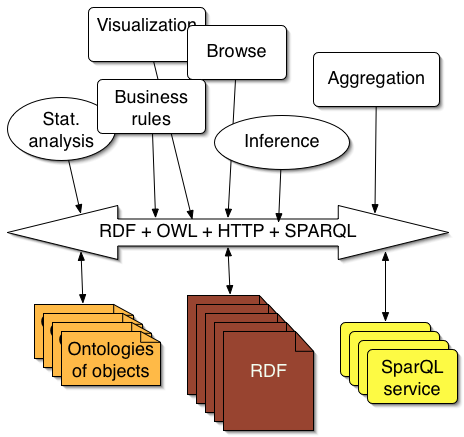
<br />Virtualization of heterogeneous data sources is only achievable if you have a dexterous data model based &quot;Bus&quot; into which the data sources are plugged. RDF has offered such a model for a long time.<br />
<br />
<br />
<br />
<img style="max-width: 800px;" src="http://www.w3.org/DesignIssues/diagrams/sw-clients.png" />
<br />
<br />
<br />
<br />When heterogeneous data sources are plugged into an RDF based integration bus e.g., customer records sourced from a variety of tables, across a plethora of databases, you can only end up with true value if the emergent entities from such an effort are coherently linked and (de)referencable; which is what <a href="http://dbpedia.org/resource/Linked_Data" id="link-id12b06e20">Linked Data</a>&#39;s fundamental preoccupation with dereferencable URIs is all about. Of course, Even when you have all of the above in place, you also need to be able to construct &quot;<a href="http://dbpedia.org/resource/Context_%28language_use%29" id="link-id103c2c80">Context</a> Lenses&quot; i.e., <a href="http://dbpedia.org/resource/Context_%28language_use%29" id="link-id1037a260">context</a> driven views of the <a href="http://dbpedia.org/resource/Linked_Data" id="link-id13e48ab8">Linked Data</a> Mesh (or <a href="http://dbpedia.org/resource/Linked_Data" id="link-id101c7718">Linked Data</a> Spaces).<br />
<br />
<br />Additional Diagrams:<br />
<br />
<br />1. <a href="http://www.w3.org/2005/Talks/1110-iswc-tbl/#%2824%29" id="link-id10808cb8">Clients of the RDF Bus</a> <br />2. <a href="http://www.w3.org/2005/Talks/1110-iswc-tbl/#%2825%29" id="link-id11e5a300">RDF Bus Server plugins: Scripts that emit RDF</a>
<br />3. <a href="http://www.w3.org/2005/Talks/1110-iswc-tbl/#%2826%29" id="link-id13ea46a0">RDF Bus Servers: RDF Data Managers (Triple or Quad Stores)</a>
<br />4. <a href="http://www.w3.org/2005/Talks/1110-iswc-tbl/#%2827%29" id="link-id101d3470">RDF Bus Servers: Relational to RDF Mappers (RDF Views, Semantic Covers etc.)</a>
<br />5. <a href="http://www.w3.org/2005/Talks/1110-iswc-tbl/#%2828%29" id="link-id1052c450">RDF Bus Server plugins: XML to RDF Mappers </a>
<br />6. <a href="http://www.w3.org/2005/Talks/1110-iswc-tbl/#%2829%29" id="link-id10281ec0">RDF Bus Server plugins: GRDDL based XSLT stylesheets that emit RDF</a>
<br />7. <a href="http://www.w3.org/2005/Talks/1110-iswc-tbl/#%2830%29" id="link-id1444faf0">RDF Bus Server plugins: Intelligent RDF Middleware</a>
<br />
<br />
<br />
<br />
<br />
<br />
<br />]]></content:encoded>
 </rss:item>
 <rss:item xmlns:rss="http://purl.org/rss/1.0/" rdf:about="http://www.openlinksw.com:443/blog/kidehen@openlinksw.com/blog/?date=2007-09-20#1254">
  <rss:title>Semantic Web Value Proposition</rss:title>
  <dc:date xmlns:dc="http://purl.org/dc/elements/1.1/">2007-09-21T02:23:00Z</dc:date>
  <dc:description xmlns:dc="http://purl.org/dc/elements/1.1/">The motivation behind this post is a response to the Read/WriteWeb post titled: Semantic Web: Difficulties with the Classic Approach. First off, I am going to focus on the Semantic Data Web aspect of the overall Semantic Web vision (a continuum) as this is what we have now. I am also writing this post as a deliberate contribution to the discourse swirling around the real topic: Semantic Web Value Proposition. Situation Analysis We are in the early stages of the long anticipated Knowledge Economy. That being the case, it would be safe to assume that information access, processing, and dissemination are of utmost importance to individuals and organizations alike. You don&#39;t produce knowledge in a vacum! Likewise, you can produce Information in a vacum, you need Data. The Semantic Data Web&#39;s value to Individuals Problem: Increasingly, Blogs, Wikis, Shared Bookmarks, Photo Galleries, Discussion Forums, Shared Calendars and the like, have become invaluable tools for individual and organizational participation in Web enabled global discourse (where a lot of knowledge is discovered). These tools, are typically associated with Web 2.0, implying Read-Write access via Web Services, centralized application hosting, and data lock-in (silos). The reality expressed above is a recipe for &quot;Information Overload&quot; and complete annihilation of ones effective pursuit and exploitation of knowledge due &quot;Time Scarcity&quot; (note: disconnecting is not an option). Information abundance is inversely related to available processing time (for humans in particular). In my case for instance, I was actively subscribed to over 500+ RSS feeds in 2003. As of today, I&#39;ve simply stopped counting, and that&#39;s just my Weblog Data Space. Then add to that, all of the Discussions I track across Blogs, wikis, message boards, mailing lists, traditional usnet discussion forumns, and the like, and I think you get the picture. Beyond information overload, Web 2.0 data is &quot;Semi-Structured&quot; by way of it&#39;s dominant data containers ((X)HTML, RSS, Atom documents and data streams etc.) lacking semantics that formally expose individual data items as distinct entities, endowed with unambiguous naming / identification, descriptive attributes (a type of property/predicate), and relationships (a type of property/predicate). Solution: Devise a standard for Structured Data Semantics that is compatible with the Web Information BUS. Produce structured data (entities, entity types, entity relationships) from Web 1.0 and Web 2.0 resources that already exists on the Web such that individual entities, their attributes, and relationships are accessible and discernible to software agents (machines). Once the entities are individually exposed, the next requirement is a mechanism for selective access to these entities i.e. a query language. Semantic Data Web Technologies that facilitate the solution described above include: Structured Data Standards: RDF - Data Model for structured data RDF/XML - A serialization format for RDF based structured data N3 / Turtle - more human friendly serialization formats for RDF based structured data Entity Exposure &amp; Generation: GRDDL - enables association between XHTML pages and XSLT stylesheets that facilitates loosely coupled &quot;on the fly&quot; extraction of RDF from non RDF documents RDFa - enables document publishers or viewers (i.e those repurposing or annotating) to embed structured data into existing XHTML documents eRDF - another option for embedding structured RDF data within (X)HTML documents RDF Middleware - typically incorporating GRDDL, RDFa, eRDF, and custom extraction and mapping as part of a structured data production pipeline. Entity Naming &amp; Identification: Use of URIs or IRIs for uniquely identifying physical (HTML Documents, Image Files, Multimedia Files etc..) and abstract (People, Places, Music, and other abstract things). Entity Access &amp; Querying: SPARQL Query Language - the SQL analog of the Semantic Data Web that enables query constructs that target named entities, entity attributes, and entity relationships SPARQL Protocol - a REST or SOAP style Web Service for transporting SPARQL Queries to Structured Data Sources. SPARQL Results Serialization Formats - query results serialization formats that includes XML(sparql+xml) and JSON. The Semantic Data Web&#39;s value to Organizations Problem: Organizations are rife with a plethora of business systems that are built atop a myriad of database engines, sourced from a variety of DBMS vendors. A typical organization would have a different database engine, from a specific DBMS vendor, underlying critical business applications such as: Human Resource Management (HR), Customer Relationship Management (CRM), Accounting, Supply Chain Management etc. In a nutshell, you have DBMS Engines, and DBMS Schema heterogeneity permeating the IT infrastructure of organizations on a global scale, making Data &amp; Information Integration the biggest headache across all IT driven organizations. Solution: Alleviation of the pain (costs) associated with Data &amp; Information Integration. Semantic Data Web offerings: A dexterous data model (RDF) that enables the construction of conceptual views of disparate data sources across an organization based on existing web architecture components such as HTTP and URIs. Existing middleware solutions that facilitate the exposure of SQL DBMS data as RDF based Structured Data include: Virtuoso&#39;s Meta Schema Language for RDF Views of SQL Data (also see the Virtuoso SQL-RDF Technical White Paper) D2RQ DataGrid Others BTW - There is an upcoming W3C Workshop covering the integration of SQL and RDF data. Conclusion The Semantic Data Web is here, it&#39;s value delivery vehicle is the URI. The URI is a conduit to Interlinked Structured Data (RDF based Linked Data) derived from existing data sources on the World Wide Web alongside data continuously injected into the Web by organizations world wide. Ironically, the Semantic Data Web only platform that crystallizes the: Information at Your Fingertips vision, without development environment, operating system, application, or database lock-in. You simply click on a Linked Data URI and the serendipitous exploration and discovery of data commences. The unobtrusive emergence of the Semantic Data Web is a reflection of the soundness of the underlying Semantic Web vision. If you are excited about Mash-ups then your are a Semantic Web enthusiast and benefactor in the making, because you only &quot;Mash&quot; (brute force data extraction and interlinking) because you can&#39;t &quot;Mesh&quot; (natural data extraction and interlinking). Likewise, if you are a social-networking, open social-graph, or portable social-network enthusiast, then you are also a Semantic Data Web benefactor and enthusiasts, because your &quot;values&quot; (yes, the values associated with the properties that define you e.g your interests etc) are the fundamental basis for portable, open, social-networking, which is what the Semantic Data Web hands to you on a platter without compromise (i.e. data lock-in or loss of data ownership). Some practical examples of Semantic Data Web prowess: Read/WriteWeb via the OpenLink Data Web Browser (click on the different viewing tabs to see what structured data exploitation in action) Read/WriteWeb via the Zitgist Data Web Browser DBpedia (*note: I deliberately use DBpedia URIs in my posts where I would otherwise have used a Wikipedia article URI*) Zitgist zLinks - Mike Bergman&#39;s Blog Post also demonstrating zLinks</dc:description>
  <content:encoded xmlns:content="http://purl.org/rss/1.0/modules/content/"><![CDATA[
<p>The motivation behind this post is a response to the <a href="http://www.readwriteweb.com">Read/WriteWeb</a> post titled: <a href="http://www.readwriteweb.com/archives/semantic_web_difficulties_with_classic_approach.php">Semantic Web: Difficulties with the Classic Approach</a>.</p>  <p>First off, I am going to focus on the Semantic Data Web aspect of the overall Semantic Web vision (a continuum) as this is what we have now. I am also writing this post as a deliberate contribution to the discourse swirling around the real topic: Semantic Web Value Proposition.</p>  <h2>Situation Analysis</h2> <p>We are in the early stages of the long anticipated<a href="http://dbpedia.org/resource/Knowledge_economy"> Knowledge Economy</a>. That being the case, it would be safe to assume that information access, processing, and dissemination are of utmost importance to individuals and organizations alike. You don&#39;t produce knowledge in a vacum! Likewise, you can produce Information in a vacum, you need Data.</p>  <h2>The Semantic Data Web&#39;s value to Individuals</h2> <b>Problem:</b> <p>Increasingly, <a href="http://dbpedia.org/resource/Blog">Blogs</a>, <a href="http://dbpedia.org/resource/Wiki">Wikis</a>, <a href="http://dbpedia.org/resource/Social_bookmarking">Shared Bookmarks</a>, Photo Galleries, Discussion Forums, Shared Calendars and the like, have become invaluable tools for individual and organizational participation in Web enabled global discourse (where a lot of knowledge is discovered). These tools, are typically associated with <a href="http://dbpedia.org/resource/Web_2">Web 2.0</a>, implying Read-Write access via <a href="http://dbpedia.org/resource/Web_service">Web Services</a>, centralized application hosting, and data lock-in (silos).</p>  <p>The reality expressed above is a recipe for &quot;<a href="http://dbpedia.org/resource/Information_overload">Information Overload</a>&quot; and complete annihilation of ones effective pursuit and exploitation of knowledge due &quot;Time Scarcity&quot; (note: disconnecting is not an option). Information abundance is inversely related to available processing time (for humans in particular). In my case for instance, I was actively subscribed to over 500+ RSS feeds in 2003. As of today, I&#39;ve simply stopped counting, and that&#39;s just my Weblog Data Space. Then add to that, all of the Discussions I track across Blogs, wikis, message boards, mailing lists, traditional usnet discussion forumns, and the like, and I think you get the picture. </p>  <p>Beyond information overload, Web 2.0 data is &quot;Semi-Structured&quot; by way of it&#39;s dominant data containers ((X)HTML, RSS, Atom documents and data streams etc.) lacking semantics that formally expose individual data items as distinct entities, endowed with unambiguous naming / identification, descriptive attributes (a type of property/predicate), and relationships (a type of property/predicate).</p>  <b>Solution:</b> <p>Devise a standard for Structured Data Semantics that is compatible with the <a href="http://www.openlinksw.com/dataspace/kidehen@openlinksw.com/weblog/kidehen@openlinksw.com%27s%20BLOG%20%5B127%5D/1231">Web Information BUS</a>.</p>  <p>Produce <a href="http://www.mkbergman.com/?p=153">structured data</a> (entities, entity types, entity relationships) from Web 1.0 and Web 2.0 resources that already exists on the Web such that individual entities, their attributes, and relationships are accessible and discernible to software agents (machines).</p>   <p>Once the entities are individually exposed, the next requirement is a mechanism for selective access to these entities i.e. a query language. </p> <p> Semantic Data Web Technologies that facilitate the solution described above include:</p>  <b>Structured Data Standards:</b> <ul> <a href="http://dbpedia.org/resource/RDF">RDF</a> - Data Model for structured data</ul> <ul>RDF/XML - A serialization format for RDF based structured data</ul> <ul> <a href="http://dbpedia.org/resource/Notation_3">N3</a> / <a href="http://dbpedia.org/resource/Turtle_%28syntax%29">Turtle</a> - more human friendly serialization formats for RDF based structured data</ul>  <b>Entity Exposure &amp; Generation:</b> <ul> <a href="http://dbpedia.org/resource/GRDDL">GRDDL</a> - enables association between XHTML pages and XSLT stylesheets that facilitates loosely coupled &quot;on the fly&quot; extraction of RDF from non RDF documents</ul> <ul> <a href="http://dbpedia.org/resource/RDFa">RDFa</a> - enables document publishers or viewers (i.e those repurposing or annotating) to embed structured data into existing XHTML documents</ul> <ul> <a href="http://research.talis.com/2005/erdf/wiki/Main/RdfInHtml">eRDF</a> - another option for embedding structured RDF data within (X)HTML documents</ul> <ul> <a href="http://www.openlinksw.com/blog/%7Ekidehen/?id=1172">RDF Middleware</a> - typically incorporating GRDDL, RDFa, eRDF, and custom extraction and mapping as part of a structured data production pipeline</ul>.  <b>Entity Naming &amp; Identification:</b> <p>Use of URIs or IRIs for uniquely identifying physical (HTML Documents, Image Files, Multimedia Files etc..) and abstract (People, Places, Music, and other abstract things). </p>  <b>Entity Access &amp; Querying:</b> <ul> <p>   <a href="http://dbpedia.org/resource/SPARQL">SPARQL</a> Query Language - the <a href="http://dbpedia.org/resource/SQL">SQL</a> analog of the Semantic Data Web that enables query constructs that target named entities, entity attributes, and entity relationships</p> </ul> <ul> <a href="http://www.w3.org/TR/rdf-sparql-protocol/">SPARQL Protocol</a> - a <a href="http://dbpedia.org/resource/Representational_State_Transfer">REST</a> or <a href="http://dbpedia.org/resource/SOAP">SOAP</a> style Web Service for transporting SPARQL Queries to Structured Data Sources.</ul> <ul> <a href="http://www.w3.org/TR/rdf-sparql-XMLres/">SPARQL Results Serialization Formats</a> - query results serialization formats that includes XML(sparql+xml) and JSON.</ul>   <h2>The Semantic Data Web&#39;s value to Organizations</h2> <b>Problem:</b> <p>Organizations are rife with a plethora of business systems that are built atop a myriad of database engines, sourced from a variety of DBMS vendors. A typical organization would have a different database engine, from a specific DBMS vendor, underlying critical business applications such as: Human Resource Management (HR), Customer Relationship Management (CRM), Accounting, Supply Chain Management etc. In a nutshell, you have DBMS Engines, and DBMS Schema heterogeneity permeating the IT infrastructure of organizations on a global scale, making Data &amp; Information Integration the biggest headache across all IT driven organizations.</p> <b>Solution:</b> <p>Alleviation of the pain (costs) associated with Data &amp; Information Integration. </p>  <b>Semantic Data Web offerings:</b> <p>A dexterous data model (RDF) that enables the construction of conceptual views of disparate data sources across an organization based on existing web architecture components such as HTTP and URIs.</p>  <p>Existing middleware solutions that facilitate the exposure of SQL DBMS data as RDF based Structured Data include:</p> <ul> <a href="http://virtuoso.openlinksw.com/wiki/main/Main/VOSSQLRDF">Virtuoso&#39;s Meta Schema Language for RDF Views of SQL Data</a> (also see the <a href="http://virtuoso.openlinksw.com/Whitepapers/pdf/Virtuoso_SQL_to_RDF_Mapping.pdf">Virtuoso SQL-RDF Technical White Paper</a>)</ul> <ul> <a href="http://sites.wiwiss.fu-berlin.de/suhl/bizer/D2RQ/">D2RQ</a> </ul> <ul> <a href="http://ccnt.zju.edu.cn/projects/dartgrid">DataGrid</a> </ul> <ul> <a href="http://esw.w3.org/topic/RdfAndSql">Others</a> </ul> <p> BTW - There is an upcoming <a href="http://www.w3.org/2007/03/RdfRDB/">W3C Workshop covering the integration of SQL and RDF data</a>.</p>  <h2>Conclusion</h2>  <p>The Semantic Data Web is here, it&#39;s value delivery vehicle is the URI. The URI is a conduit to Interlinked Structured Data (RDF based Linked Data) derived from existing data sources on the World Wide Web alongside data continuously injected into the Web by organizations world wide. Ironically, the Semantic Data Web only platform that crystallizes the: Information at Your Fingertips vision, without development environment, operating system, application, or database lock-in. You simply click on a <a href="http://dbpedia.org/resource/Linked_Data">Linked Data URI</a> and the serendipitous exploration and discovery of data commences.</p>  <p>The unobtrusive emergence of the Semantic Data Web is a reflection of the soundness of the underlying Semantic Web vision.</p>  <p>If you are excited about <a href="http://dbpedia.org/resource/Mashup_%28web_application_hybrid%29">Mash-ups</a> then your are a Semantic Web enthusiast and benefactor in the making, because you only &quot;Mash&quot; (brute force data extraction and interlinking) because you can&#39;t &quot;Mesh&quot; (natural data extraction and interlinking). Likewise, if you are a social-networking, open social-graph, or portable social-network enthusiast, then you are also a Semantic Data Web benefactor and enthusiasts, because your &quot;values&quot; (yes, the values associated with the properties that define you e.g your interests etc) are the fundamental basis for portable, open, social-networking, which is what the Semantic Data Web hands to you on a platter without compromise (i.e. data lock-in or loss of data ownership).</p>  <b>Some practical examples of Semantic Data Web prowess:</b> <ul> <a href="http://demo.openlinksw.com/DAV/JS/rdfbrowser/index.html?uri=http%3A%2F%2Fwww.readwriteweb.com%2Farchives%2Fsemantic_web_difficulties_with_classic_approach.php">Read/WriteWeb via the OpenLink Data Web Browser</a> (click on the different viewing tabs to see what structured data exploitation in action)</ul> <ul> <a href="http://browser.zitgist.com/?uri=http%3A//www.readwriteweb.com/archives/semantic_web_difficulties_with_classic_approach.php">Read/WriteWeb via the Zitgist Data Web Browser</a> </ul> <ul> <a href="http:/dbpedia.org">DBpedia</a> (*note: I deliberately use DBpedia URIs in my posts where I would otherwise have used a Wikipedia article URI*)</ul> <ul> <a href="http://wordpress.org/extend/plugins/zitgist-browser-linker/">Zitgist zLinks</a> - <a href="http://www.mkbergman.com/?p=400">Mike Bergman&#39;s Blog Post also demonstrating zLinks</a> </ul> 
]]></content:encoded>
 </rss:item>
 <rss:item xmlns:rss="http://purl.org/rss/1.0/" rdf:about="http://www.openlinksw.com:443/blog/kidehen@openlinksw.com/blog/?date=2007-08-01#1238">
  <rss:title>OpenLink Ajax Toolkit (OAT) 2.6 Released!</rss:title>
  <dc:date xmlns:dc="http://purl.org/dc/elements/1.1/">2007-08-01T18:34:07Z</dc:date>
  <dc:description xmlns:dc="http://purl.org/dc/elements/1.1/">OpenLink Software are pleased to announce release 2.6 of the OpenLink AJAX Toolkit (OAT). New Semantic Data Web related features and enhancements include: * A Javascript-based Fresnel processor enabling declarative RDF-based display templates for RDF Data Sources * An XSLT template for generating HTML pages from the Fresnel processor&#39;s XML output * Interactive Query Builder for SPARQL (iSPARQL). This version of the iSPARQL application includes support for INSERTs and DELETEs * Enhanced Javascript-based N3/Turtle parser * New Navigator viewer panel for RDF Browser. Related Items: *Project Home Page *Source Code *Live Features Demonstrations.</dc:description>
  <content:encoded xmlns:content="http://purl.org/rss/1.0/modules/content/"><![CDATA[<p>
<a href="http://www.openlinksw.com">OpenLink Software</a> are pleased to announce release 2.6 of the <a href="http://oat.openlinksw.com">OpenLink AJAX
Toolkit</a> (OAT).</p>
<p>
New Semantic Data Web related features and enhancements include:</p>
<ul>
* A Javascript-based <a href="http://www.w3.org/2005/04/fresnel-info/">Fresnel</a> processor enabling declarative RDF-based display templates for RDF Data Sources</ul>  
<ul>* An XSLT template for generating HTML pages from the Fresnel processor&#39;s
XML output</ul>
<ul>* <a href="http://demo.openlinksw.com/DAV/JS/isparql/index.html">Interactive Query Builder for SPARQL</a> (iSPARQL). This version of the
iSPARQL application includes support for INSERTs and DELETEs</ul>
<ul>* Enhanced Javascript-based N3/Turtle parser</ul>
<ul>* New Navigator viewer panel for <a href="http://demo.openlinksw.com/DAV/JS/rdfbrowser/index.html">RDF Browser</a>.</ul>

Related Items:

<ul>*<a href="http://sourceforge.net/projects/oat">Project Home Page</a>
</ul>

<ul>*<a href="http://sourceforge.net/projects/oat/files">Source Code</a>
</ul>

<ul>*<a href="http://demo.openlinksw.com/DAV/JS/demo/index.html">Live Features Demonstrations</a>.</ul>
]]></content:encoded>
 </rss:item>
 <rss:item xmlns:rss="http://purl.org/rss/1.0/" rdf:about="http://www.openlinksw.com:443/blog/kidehen@openlinksw.com/blog/?date=2007-06-14#1224">
  <rss:title>Enterprise 0.0, Linked Data, and Semantic Data Web</rss:title>
  <dc:date xmlns:dc="http://purl.org/dc/elements/1.1/">2007-06-14T15:28:26Z</dc:date>
  <dc:description xmlns:dc="http://purl.org/dc/elements/1.1/">Last week we officially released Virtuoso 5.0.1 (in Commercial and Open Source Editions). The press release provided us with an official mechanism and timestamp for the current Virtuoso feature set. A vital component of the new Virtuoso release is the finalization of our SQL to RDF mapping functionality -- enabling the declarative mapping of SQL Data to RDF. Additional technical insight covering other new features (delivered and pending) is provided by Orri Erling, as part of a series of post-Banff posts. Why is SQL to RDF Mapping a Big Deal? A majority of the world&#39;s data (especially in the enterprise realm) resides in SQL Databases. In addition, Open Access to the data residing in said databases remains the biggest challenge to enterprises for the following reasons: SQL Data Sources are inherently heterogeneous because they are acquired with business applications that are in many cases inextricably bound to a particular DBMS engine Data is predictably dirty DBMS vendors ultimately hold the data captive and have traditionally resisted data access standards such as ODBC (*trust me they have, just look at the unprecedented bad press associated with ODBC the only truly platform independent data access API. Then look at how this bad press arose..*) Enterprises have known from the beginning of modern corporate times that data access, discovery, and manipulation capabilities are inextricably linked to the &quot;Real-time Enterprise&quot; nirvana (hence my use of 0.0 before this becomes 3.0). In my experience, as someone whose operated in the data access and data integration realms since the late &#39;80s, I&#39;ve painfully observed enterprises pursue, but unsuccessfully attain, full control over enterprise data (the prized asset of any organization) such that data-, information-, knowledge-workers are just a click away from commencing coherent platform and database independent data drill-downs and/or discovery that transcend intranet, internet, and extranet boundaries -- serendipitous interaction with relevant data, without compromise! Okay, situation analysis done, we move on.. At our most recent (12th June) monthly Semantic Web Gathering, I unveiled to TimBL and a host of other attendees a simple, but powerful, demonstration of how Linked Data, as an aspect of the Semantic Data Web, can be applied to enterprise data integration challenges. Actual SQL to RDF Mapping Demo / Experiment Hypothesis A SQL Schema can be effectively mapped declaratively to RDF such that SQL Rows morph into RDF Instance Data (Entity Sets) based on the Concepts &amp; Properties defined in a Concrete Conceptual Data Model oriented Data Dictionary (RDF Schema and/or OWL Ontology). In addition, the solution must demonstrate how &quot;Linked Data in the Web&quot; is completely different from &quot;Data on the Web&quot; or &quot;Linked Data on the Web&quot; (btw - Tom Heath eloquently unleashed this point in his recent podcast interview with Talis). Apparatus An Ontology - in this case we simply derived the Northwind Ontology from the XML Schema based CSDL (Conceptual Schema Definition Language) used by Microsoft&#39;s public Astoria demo (specifically the Northwind Data Services demo). SQL Database Schema - Northwind (comes bundled with ACCESS, SQL Server, and Virtuoso) comprised of tables such as: Customer, Employee, Product, Category, Supplier, Shipper etc. OpenLink Virtuoso - SQL DBMS Engine (although this could have been any ODBC or JDBC accessible Database), SQL-RDF Metaschema Language, HTTP URL-rewriter, WebDAV Engine, and DBMS hosted XSLT processor Client Tools - iSPARQL Query Builder, RDF Browser (which could also have been Tabulator or DISCO or a standard Web Browser) Experiment / Demo Declaratively map the Northwind SQL Schema to RDF using the Virtuoso Meta Schema Language (see: Virtuoso PL based Northwind_SQL_RDF script) Start browsing the data by clicking on the URIs that represent the RDF Data Model Entities resulting from the SQL to RDF Mapping Observations Via a single Data Link click I was able to obtain specific information about the Customer represented by the URI &quot;ALFKI&quot; (act of URI Dereferencing as you would an Object ID in an Object or Object-Relational Database) Via a Dynamic Data Page I was able to explore all the entity relationships or specific entity data (i.e Exploratory or Entity specific dereferencing) in the Northwind Data Space I was able to perform similar exploration (as per item 2) using our OpenLink Browser. Conclusions The vision of data, information, or knowledge at your fingertips is nigh! Thanks to the infrastructure provided by the Semantic Data Web (URIs, RDF Data Model, variety of RDF Serialization Formats[1][2][3], and Shared Data Dictionaries / Schemas / Ontologies [1][2][3][4][5]) it&#39;s now possible to Virtualize enterprise data from the Physical Storage Level, through the Logical Data Management Levels (Relational), up to a Concrete Conceptual Model (Graph) without operating system, development environment or framework, or database engine lock-in. Next Steps We produce a shared ontology for the CRM and Business Reporting Domains. I hope this experiment clarifies how this is quite achievable by converting XML Schemas to RDF Data Dictionaries (RDF Schemas or Ontologies). Stay tuned :-) Also watch TimBL amplify and articulate Linked Data value in a recent interview. Other Related Matters To deliver a mechanism that facilitates the crystallization of this reality is a contribution of boundless magnitude (as we shall all see in due course). Thus, it is easy to understand why even &quot;her majesty&quot;, the queen of England, simply had to get in on the act and appoint TimBL to the &quot;British Order of Merit&quot; :-) Note: All of the demos above now work with IE &amp; Safari (a &quot;remember what Virtuoso is epiphany&quot;) by simply putting Virtuoso&#39;s DBMS hosted XSLT engine to use :-) This also applies to my earlier collection of demos from the Hello Data Web and other Data Web &amp; Linked Data related demo style posts.</dc:description>
  <content:encoded xmlns:content="http://purl.org/rss/1.0/modules/content/"><![CDATA[<p>Last week we <a href="http://www.openlinksw.com/press/virt_501.htm">officially released Virtuoso 5.0.1</a> (in Commercial and Open Source Editions). The press release provided us with an official mechanism and timestamp for the current Virtuoso feature set.</p> 
<p>A vital component of the new Virtuoso release is the finalization of our SQL to RDF mapping functionality -- enabling the declarative mapping of SQL Data to RDF. Additional technical insight covering other new features (delivered and pending) is provided by <a href="http://www.openlinksw.com/weblogs/oerling/">Orri Erling</a>, as part of a series of post-Banff posts.</p>

<h2>Why is SQL to RDF Mapping a Big Deal?</h2>

<p>A majority of the world&#39;s data (especially in the enterprise realm) resides in SQL Databases. In addition, Open Access to the data residing in said databases remains the biggest challenge to enterprises for the following reasons:</p>
<ol>
<li>
SQL Data Sources are inherently heterogeneous because they are acquired with business applications that are in many cases inextricably bound to a particular DBMS engine
</li>
<li>
Data is predictably dirty
</li>
<li>
DBMS vendors ultimately hold the data captive and have traditionally resisted data access standards such as ODBC (*trust me they have, just look at the unprecedented bad press associated with ODBC the only truly platform independent data access API. Then look at how this bad press arose..*)
</li>
</ol>

<p>
Enterprises have known from the beginning of modern corporate times that data access, discovery, and manipulation capabilities are inextricably linked to the &quot;Real-time Enterprise&quot; nirvana (hence my use of 0.0 before this becomes 3.0).</p>
<p>In my experience, as someone whose operated in the data access and data integration realms since the late &#39;80s, I&#39;ve painfully observed enterprises pursue, but unsuccessfully attain, full control over enterprise data (the prized asset of any organization) such that data-, information-, knowledge-workers are just a click away from commencing coherent platform and database independent data drill-downs and/or discovery that transcend intranet, internet, and extranet boundaries -- serendipitous interaction with relevant data, without compromise!</p>

<p>Okay, situation analysis done, we move on..  </p>

<p>At our most recent (<a href="http://esw.w3.org/topic/CambridgeSemanticWebGatherings/Meeting/2007-06-12_Gathering">12th June</a>) monthly <a href="http://esw.w3.org/topic/CambridgeSemanticWebGatherings">Semantic Web Gathering</a>, I unveiled to <a href="http://www.w3.org/People/Berners-Lee/card#i">TimBL</a> and a host of other attendees a simple, but powerful, demonstration of how <a href="http://en.wikipedia.org/wiki/Linked_Data">Linked Data</a>, as an aspect of the <a href="http://www.businessweek.com/technology/content/apr2007/tc20070409_961951.htm">Semantic Data Web</a>, can be applied to enterprise data integration challenges.</p>

<h2>Actual SQL to RDF Mapping Demo / Experiment</h2>

<h4>Hypothesis</h4>
A SQL Schema can be effectively mapped declaratively to RDF such that SQL Rows morph into RDF Instance Data (Entity Sets) based on the Concepts &amp; Properties defined in a Concrete Conceptual Data Model oriented Data Dictionary (<a href="http://www.w3schools.com/rdf/rdf_schema.asp">RDF Schema</a> and/or <a href="http://www.w3schools.com/rdf/rdf_owl.asp">OWL Ontology</a>). In addition, the solution must demonstrate how &quot;Linked Data in the Web&quot; is completely different from &quot;Data on the Web&quot; or &quot;Linked Data on the Web&quot; (btw - <a href="http://kasei.us/people/Tom_Heath/">Tom Heath</a> eloquently unleashed this point in his recent <a href="http://blogs.talis.com/nodalities/2007/06/tom_heath_talks_with_talis_abo.php">podcast interview with Talis</a>).

<h4>Apparatus</h4>
An Ontology - in this case we simply derived the <a href="http://demo.openlinksw.com/DAV/home/demo/Public/Queries/SQLRDFIntegraton/Explore_Northwind_Ontology.isparql">Northwind Ontology</a> from the XML Schema based CSDL (<a href="http://blogs.msdn.com/adonet/archive/2007/01/30/entity-data-model-part-1.aspx">Conceptual Schema Definition Language</a>) used by Microsoft&#39;s public <a href="http://astoria.mslivelabs.com/Default.aspx">Astoria demo</a> (specifically the <a href="http://astoria.mslivelabs.com/termsOfUseNorthwind.aspx?returnURL=Northwind">Northwind Data Services demo</a>).  

SQL Database Schema - <a href="http://www.microsoft.com/library/media/1033/technet/images/prodtechnol/sql/2000/maintain/sscpop07_big.gif">Northwind</a> (comes bundled with ACCESS, SQL Server, and Virtuoso) comprised of tables such as: <a href="http://www.openlinksw.com/schemas/northwind#Customer">Customer</a>, <a href="http://www.openlinksw.com/schemas/northwind#Employee">Employee</a>, <a href="http://www.openlinksw.com/schemas/northwind#Product">Product</a>, <a href="http://www.openlinksw.com/schemas/northwind#Category">Category</a>, <a href="http://www.openlinksw.com/schemas/northwind#Supplier">Supplier</a>, <a href="http://www.openlinksw.com/schemas/northwind#Shipper">Shipper</a> etc.

<a href="http://www.openlinksw.com/virtuoso/">OpenLink Virtuoso</a> - SQL DBMS Engine (although this could have been any <a href="http://en.wikipedia.org/wiki/Open_Database_Connectivity">ODBC</a> or <a href="http://en.wikipedia.org/wiki/Java_Database_Connectivity">JDBC</a> accessible Database), <a href="http://www.openlinksw.com/virtuoso/Whitepapers/pdf/Virtuoso_SQL_to_RDF_Mapping.pdf">SQL-RDF Metaschema Language</a>, HTTP URL-rewriter, WebDAV Engine, and DBMS hosted XSLT processor

Client Tools -<a href="http://demo.openlinksw.com/isparql/"> iSPARQL Query Builder</a>, <a href="http://demo.openlinksw.com/DAV/JS/rdfbrowser/index.html">RDF Browser</a> (which could also have been <a href="http://www.w3.org/2005/ajar/tab">Tabulator</a> or<a href="http://sites.wiwiss.fu-berlin.de/suhl/bizer/ng4j/disco/"> DISCO</a> or a standard Web Browser)

<h4>Experiment / Demo</h4>
<ol>
<li>
Declaratively map the Northwind SQL Schema to RDF using the Virtuoso Meta Schema Language (see: <a href="http://demo.openlinksw.com/DAV/home/demo/Public/Queries/SQLRDFIntegraton/northwind_sql_rdf.sql">Virtuoso PL based Northwind_SQL_RDF script</a>)
</li>
<li>
Start browsing the data by clicking on the URIs that represent the RDF Data Model Entities resulting from the SQL to RDF Mapping 
</li>
</ol>

<h4>Observations</h4>
<ol>
<li>
Via a single Data Link click I was able to obtain specific information about the Customer represented by the URI <a href="http://demo.openlinksw.com/Northwind/Customer/ALFKI">&quot;ALFKI&quot;</a> (act of URI Dereferencing as you would an Object ID in an Object or Object-Relational Database) </li>
<li>
Via a 
<a href="http://demo.openlinksw.com/DAV/home/demo/Public/Queries/SQLRDFIntegraton/Explore_Northwind.isparql">Dynamic Data Page </a> I was able to explore all the entity relationships or specific entity data (i.e Exploratory or Entity specific dereferencing) in the Northwind Data Space
</li>
<li>
I was able to perform similar exploration (as per item 2) using our
<a href="http://demo.openlinksw.com/DAV/home/demo/Public/Queries/SQLRDFIntegraton/Explore_Northwind_Customer_ALFKI.wqx">OpenLink Browser. </a>
</li>
</ol>

<h4>Conclusions</h4>
<p>The vision of data, information, or knowledge at your fingertips is nigh! Thanks to the infrastructure provided by the Semantic Data Web (URIs, <a href="http://en.wikipedia.org/wiki/Resource_Description_Framework">RDF Data Model</a>, variety of RDF Serialization Formats[<a href="http://www.dajobe.org/2004/01/turtle/">1</a>][<a href="http://www.w3.org/DesignIssues/Notation3">2</a>][<a href="http://www.w3.org/TR/2002/WD-rdf-syntax-grammar-20020325/">3</a>], and Shared Data Dictionaries / Schemas / Ontologies [<a href="http://xmlns.com/foaf/spec/">1</a>][<a href="http://rdfs.org/sioc/spec/">2</a>][<a href="http://www.w3.org/TR/swbp-skos-core-guide/">3</a>][<a href="http://musicontology.com/">4</a>][<a href="http://bblfish.net/work/atom-owl/2006-06-06/AtomOwl.html">5</a>]) it&#39;s now possible to Virtualize enterprise data from the Physical Storage Level, through the Logical Data Management Levels (Relational), up to a Concrete Conceptual Model (Graph) without operating system, development environment or framework, or database engine lock-in.</p>

<h2>Next Steps</h2>
<p>We produce a shared ontology for the CRM and Business Reporting Domains. I hope this experiment clarifies how this is quite achievable by converting XML Schemas to RDF Data Dictionaries (RDF Schemas or Ontologies). Stay tuned :-) 
</p>
<p>Also watch <a href="http://news.com.com/1606-2-6189377.html">TimBL amplify and articulate Linked Data value</a> in a recent interview.</p>

<h2>Other Related Matters</h2>
<p>To deliver a mechanism that facilitates the crystallization of this reality is a contribution of boundless magnitude (as we shall all see in due course). Thus, it is easy to understand why even &quot;her majesty&quot;, the queen of England, simply had to get in on the act and <a href="http://www.royal.gov.uk/output/Page1880.asp">appoint TimBL to the &quot;British Order of Merit</a>&quot; :-)</p>

<p>Note: All of the demos above now work with IE &amp; Safari (a &quot;remember what Virtuoso is epiphany&quot;) by simply putting Virtuoso&#39;s DBMS hosted XSLT engine to use :-) This also applies to my earlier collection of demos from the <a href="http://www.openlinksw.com/weblog/public/search.vspx?blogid=127&q=hello%20data%20web&type=text&output=html">Hello Data Web</a> and other <a href="http://www.openlinksw.com/weblog/public/search.vspx?blogid=127&q=.isparql&type=text&output=html">Data Web &amp; Linked Data related demo style posts</a>.</p>]]></content:encoded>
 </rss:item>
 <rss:item xmlns:rss="http://purl.org/rss/1.0/" rdf:about="http://www.openlinksw.com:443/blog/kidehen@openlinksw.com/blog/?date=2007-04-13#1185">
  <rss:title>Semantic Web Data Spaces</rss:title>
  <dc:date xmlns:dc="http://purl.org/dc/elements/1.1/">2007-04-13T21:15:54Z</dc:date>
  <dc:description xmlns:dc="http://purl.org/dc/elements/1.1/">Web Data Spaces Now that broader understanding of the Semantic Data Web is emerging, I would like to revisit the issue of &quot;Data Spaces&quot;. A Data Space is a place where Data Resides. It isn&#39;t inherently bound to a specific Data Model (Concept Oriented, Relational, Hierarchical etc..). Neither is it implicitly an access point to Data, Information, or Knowledge (the perception is purely determined through the experiences of the user agents interacting with the Data Space. A Web Data Space is a Web accessible Data Space. Real world example: Today we increasing perform one of more of the following tasks as part of our professional and personal interactions on the Web: Blog via many service providers or personally managed weblog platforms Create Event Calendars via Upcoming.com and Eventful Maintain and participate in Social Networks (e.g. Facebook, Orkut, MySpace) Create and Participate in Discussions (note: when you comment on blogs or wikis for instance, you are participating in, or creating, a conversation) Track news by subscribing to RSS 1.0, RSS 2.0, or Atom Feeds Share Bookmarks &amp; Tags via Del.icio.us and other Services Share Photos via Flickr Buy, Review, or Search for books via Amazon Participates in auctions via eBay Search for data via Google (of course!) John Breslin has nice a animation depicting the creation of Web Data Spaces that drives home the point. Web Data Space Silos Unfortunately, what isn&#39;t as obvious to many netizens, is the fact that each of the activities above results in the creation of data that is put into some context by you the user. Even worse, you eventually realize that the service providers aren&#39;t particularly willing, or capable of, giving you unfettered access to your own data. Of course, this isn&#39;t always by design as the infrastructure behind the service can make this a nightmare from security and/or load balancing perspectives. Irrespective of cause, we end up creating our own &quot;Data Spaces&quot; all over the Web without a coherent mechanism for accessing and meshing these &quot;Data Spaces&quot;. What are Semantic Web Data Spaces? Data Spaces on the Web that provide granular access to RDF Data. What&#39;s OpenLink Data Spaces (ODS) About? Short History In anticipation of this the &quot;Web Data Silo&quot; challenge (an issue that we tackled within internal enterprise networks for years) we commenced the development (circa. 2001) of a distributed collaborative application suite called OpenLink Data Spaces (ODS). The project was never released to the public since the problems associated with the deliberate or inadvertent creation of Web Data silos hadn&#39;t really materialized (silos only emerged in concreted form after the emergence of the Blogosphere and Web 2.0). In addition, there wasn&#39;t a clear standard Query Language for the RDF based Web Data Model (i.e. the SPARQL Query Language didn&#39;t exist). Today, ODS is delivered as a packaged solution (in Open Source and Commercial flavors) that alleviates the pain associated with Data Space Silos that exist on the Web and/or behind corporate firewalls. In either scenario, ODS simply allows you to create Open and Secure Data Spaces (via it&#39;s suite of applications) that expose data via SQL, RDF, XML oriented data access and data management technologies. Of course it also enables you to integrates transparently with existing 3rd party data space generators (Blogs, Wikis, Shared Bookmrks, Discussion etc. services) by supporting industry standards that cover: Content Publishing - Atom, Moveable Type, MetaWeblog, Blogger protocols Content Syndication Formats - RSS 1.0, RSS 2.0, Atom, OPML etc. Data Management - SQL, RDF, XML, Free Text Data Access - SQL, SPARQL, GData, Web Services (SOAP or REST styles), WebDAV/HTTP Semantic Data Web Middleware - GRDDL, XSLT, SPARQL, XPath/XQuery, HTTP (Content Negotiation) for producing RDF from non RDF Data ((X)HTML, Microformats, XML, Web Services Response Data etc). Thus, by installing ODS on your Desktop, Workgroup, Enterprise, or public Web Server, you end up with a very powerful solution for creating Open Data access oriented presence on the &quot;Semantic Data Web&quot; without incurring any of the typically assumed &quot;RDF Tax&quot;. Naturally, ODS is built atop Virtuoso and of course it exploits Virtuoso&#39;s feature-set to the max. It&#39;s also beginning to exploit functionality offered by the OpenLink Ajax Toolkit (OAT).</dc:description>
  <content:encoded xmlns:content="http://purl.org/rss/1.0/modules/content/"><![CDATA[<b>Web Data Spaces</b>
<p>Now that broader understanding of the Semantic Data Web is emerging, I would like to revisit the issue of &quot;<a href="http://www.openlinksw.com/weblog/public/search.vspx?blogid=127&q='data%20spaces'&type=text&output=html">Data Spaces</a>&quot;.</p>
<p>A Data Space is a place where Data Resides. It isn&#39;t inherently bound to a specific Data Model (<a href="http://en.wikipedia.org/wiki/Network_model">Concept Oriented</a>, <a href="http://en.wikipedia.org/wiki/Relational_model">Relational</a>, <a href="http://en.wikipedia.org/wiki/Hierarchical_database">Hierarchical</a> etc..). Neither is it implicitly an access point to Data, Information, or Knowledge (the perception is purely determined through the experiences of the user agents interacting with the Data Space.</p>
<p>A Web Data Space is a Web accessible Data Space.</p>
<p>Real world example:</p>
<p>Today we increasing perform one of more of the following tasks as part of our professional and personal interactions on the Web:</p>
<ol>
<li>Blog via many service providers or personally managed weblog platforms</li>
<li>Create Event Calendars via <a href="http://upcoming.com">Upcoming.com</a> and <a href="http://eventful.com">Eventful</a>
</li>
<li>Maintain and participate in Social Networks (e.g. <a href="http://facebook.com">Facebook</a>, <a href="http://orkut.com">Orkut</a>, <a href="http://myspace.com">MySpace</a>)</li>
<li>Create and Participate in Discussions (note: when you comment on blogs or wikis for instance, you are participating in, or creating, a conversation)</li>
<li>Track news by subscribing to <a href="http://web.resource.org/rss/1.0/">RSS 1.0</a>, <a href="http://cyber.law.harvard.edu/rss/rss.html">RSS 2.0</a>, or <a href="http://en.wikipedia.org/wiki/Atom_(standard)">Atom</a> Feeds</li>
<li>Share Bookmarks &amp; Tags via <a href="http://del.icio.us">Del.icio.us</a> and other Services</li>
<li>Share Photos via <a href="http://flickr.com">Flickr</a>
</li>
<li>Buy, Review, or Search for books via <a href="http://amazon.com">Amazon</a>
</li>
<li>Participates in auctions via <a href="http://ebay.com">eBay</a> </li>
<li>Search for data via <a href="http://google.com">Google</a> (of course!)</li>
</ol>
<p>
<a href="http://www.johnbreslin.com/">John Breslin</a> has nice a <a href="http://www.johnbreslin.com/blog/wp-content/20051015a.gif">animation depicting the creation of Web Data Spaces</a> that drives home the point.</p>
<b>Web Data Space Silos</b>
<p>
Unfortunately, what isn&#39;t as obvious to many netizens, is the fact that each of the activities above results in the creation of data that is put into some context by you the user. Even worse, you eventually realize that the service providers aren&#39;t particularly willing, or capable of,  giving you unfettered access to your own data. Of course, this isn&#39;t always by design as the infrastructure behind the service can make this a nightmare from security and/or load balancing perspectives. Irrespective of cause, we end up creating our own &quot;Data Spaces&quot; all over the Web without a coherent mechanism for accessing and meshing these &quot;Data Spaces&quot;.</p>
<b>What are Semantic Web Data Spaces?</b>
<p>Data Spaces on the Web that provide granular access to RDF Data.</p>
<b>What&#39;s OpenLink Data Spaces (ODS) About?</b>
<blockquote>
<p>Short History</p>
<p>In anticipation of this the &quot;Web Data Silo&quot; challenge (an issue that we tackled within internal enterprise networks for years) we commenced the development (circa. 2001) of a distributed collaborative application suite called OpenLink Data Spaces (ODS). The project was never released to the public since the problems associated with the deliberate or inadvertent creation of Web Data silos hadn&#39;t really materialized (silos only emerged  in concreted form after the emergence of the Blogosphere and Web 2.0). In addition, there wasn&#39;t a clear standard Query Language for the RDF based Web Data Model (i.e. the SPARQL Query Language didn&#39;t exist).</p>
</blockquote>

<p>
Today, ODS is delivered as a packaged solution (in Open Source and Commercial flavors) that alleviates the pain associated with Data Space Silos that exist on the Web and/or behind corporate firewalls. In either scenario, ODS simply allows you to create Open and Secure Data Spaces (via it&#39;s suite of applications) that expose data via SQL, RDF, XML oriented data access and data management technologies. Of course it also enables you to integrates transparently with existing 3rd party data space generators (Blogs, Wikis, Shared Bookmrks, Discussion etc. services) by supporting industry standards that cover:</p>
<ol>
<li>
Content Publishing - Atom, <a href="http://www.sixapart.com/developers/product_documentation/movable_type/">Moveable Type</a>, <a href="http://www.xmlrpc.com/metaWeblogApi">MetaWeblog</a>, Blogger protocols
</li>
<li>
Content Syndication Formats - RSS 1.0, RSS 2.0, Atom, OPML etc.
</li>
<li>
Data Management - <a href="http://en.wikipedia.org/wiki/SQL">SQL</a>, <a href="http://www.w3.org/RDF/">RDF</a>, XML, Free Text
</li>
<li>
Data Access - SQL, <a href="http://www.w3.org/TR/rdf-sparql-query/">SPARQL</a>, GData, Web Services (SOAP or REST styles), WebDAV/HTTP
</li>
<li>
Semantic Data Web Middleware - <a href="http://www.w3.org/2004/01/rdxh/spec">GRDDL</a>, <a href="http://www.w3.org/TR/xslt">XSLT</a>, SPARQL, XPath/XQuery, HTTP (Content Negotiation) for producing RDF from non RDF Data ((X)HTML, Microformats, XML, Web Services Response Data etc).
</li>
</ol>
<p>Thus, by installing ODS on your Desktop, Workgroup, Enterprise, or public Web Server, you end up with a very powerful solution for creating Open Data access oriented presence on the &quot;Semantic Data Web&quot; without incurring any of the typically assumed &quot;RDF Tax&quot;.</p>  
<p>Naturally, ODS is built atop <a href="http://virtuoso.openlinksw.com">Virtuoso</a> and of course it exploits Virtuoso&#39;s feature-set to the max. It&#39;s also beginning to exploit functionality offered by the OpenLink Ajax Toolkit (<a href="http://demo.openlinksw.com/DAV/JS/demo/index.html">OAT</a>).</p>


]]></content:encoded>
 </rss:item>
 <rss:item xmlns:rss="http://purl.org/rss/1.0/" rdf:about="http://www.openlinksw.com:443/blog/kidehen@openlinksw.com/blog/?date=2007-03-28#1172">
  <rss:title>RDF Browsers &amp; RDF Data Middleware</rss:title>
  <dc:date xmlns:dc="http://purl.org/dc/elements/1.1/">2007-03-28T23:17:00Z</dc:date>
  <dc:description xmlns:dc="http://purl.org/dc/elements/1.1/">Frederick Giasson penned an interesting post earlier today that highlighted the RDF Middleware services offered by Triplr and the Virtuoso Sponger Some Definitions (as per usual): RDF Middleware (as defined in this context) is about producing RDF from non RDF Data Sources. This implies that you can use non RDF Data Sources (e.g. (X)HTML Web Pages, (X)HTML Web Pages hosting Microformats, and even Web Services such as those from Google, Del.icio.us, Flickr etc..) as Semantic Web Data Source URIs (pointers to RDF Data). In this post I would like to provide a similar perspective on this ability to treat non RDF as RDF from RDF Browser perspective. First off, what&#39;s an RDF Browser? An RDF Browser is a piece of technology that enables you to Browse RDF Data Sources by way of Data Link Traversal. The key difference between this approach and traditional browsing is that Data Links are typed (they possess inherent meaning and context) whereas traditional links are untyped (although universally we have been trained to type them as links to Blurb in the form of (X)HTML pages or what is popularly called &quot;Web Content&quot;.). There are a number of RDF Browsers that I am aware off (note: pop me a message directly of by way of a comment to this post if you have a browser that I am unaware of), and they include (in order of creation and availability): Tabulator DISCO - Hyperdata Browser OpenLink Ajax Toolkit&#39;s RDF Browser (a component of the OAT Javascript Toolkit) Each of the browsers above can consume the services of Triplr or the Virtuoso Sponger en route to unveiling a RDF Data that is traversable via URI dereferencing (HTTP GETing the data exposed by the Data Pointer). Thus you can cut&amp;paste the following into each of the aforementioned RDF Browsers: Triplr&#39;s RDF Data (Triples) extractions from Dan Connolly&#39;s Home Page The Virtuoso Sponger&#39;s RDF Data (Triples) extractions from Dan Connolly&#39;s Home Page Since we are all time challenged (naturally!) you can also just click on these permalinks for the OAT RDF Browser demos: Permalink for Triplr&#39;s RDF Data (Triples) extractions from Dan Connolly&#39;s Home Page Permalink for the Virtuoso Sponger&#39;s RDF Data (Triples) extractions from Dan Connolly&#39;s Home Page</dc:description>
  <content:encoded xmlns:content="http://purl.org/rss/1.0/modules/content/"><![CDATA[<p> <a href="http://fgiasson.com/blog">Frederick Giasson</a> penned an interesting post earlier today that highlighted the RDF Middleware services offered by  <a href="http://fgiasson.com/blog/index.php/2007/03/28/making-the-bridge-between-the-web-and-the-semantic-web/#comments">Triplr and the Virtuoso Sponger</a> </p> <p>Some Definitions (as per usual):</p> <p>RDF Middleware (as defined in this context) is about producing RDF from non RDF Data Sources. This implies that you can use non RDF Data Sources (e.g. (X)HTML Web Pages, (X)HTML Web Pages hosting Microformats, and even Web Services such as those from Google, Del.icio.us, Flickr etc..) as Semantic Web Data Source URIs (pointers to RDF Data).</p> <p>In this post I would like to provide a similar perspective on this ability to treat non RDF as RDF from RDF Browser perspective.</p> <p>First off, what&#39;s an RDF Browser?</p> <p>An RDF Browser is a piece of technology that enables you to Browse <a href="http://esw.w3.org/topic/SweoIG/TaskForces/CommunityProjects/LinkingOpenData">RDF Data Sources</a> by way of Data Link Traversal. The key difference between this approach and traditional browsing is that Data Links are typed (they possess inherent meaning and context) whereas traditional links are untyped (although universally we have been trained to type them as links to Blurb in the form of (X)HTML pages or what is popularly called &quot;Web Content&quot;.).</p> <p>There are a number of RDF Browsers that I am aware off (note: pop me a message directly of by way of a comment to this post if you have a browser that I am unaware of), and they include (in order of creation and availability):</p> <ol> <li>   <a href="http://www.w3.org/2005/ajar/tab">Tabulator</a> </li> <li>   <a href="http://sites.wiwiss.fu-berlin.de/suhl/bizer/ng4j/disco/">DISCO - Hyperdata Browser</a> </li> <li>   <a href="http://demo.openlinksw.com/DAV/JS/rdfbrowser/index.html">OpenLink Ajax Toolkit&#39;s  RDF Browser</a> (a component of the <a href="http://demo.openlinksw.com/DAV/JS/demo/index.html">OAT Javascript Toolkit</a>)</li> </ol> <p>Each of the browsers above can consume the services of Triplr or the Virtuoso Sponger en route to unveiling a RDF Data that is traversable via <a href="http://www.w3.org/TR/2004/REC-webarch-20041215/#dereference-uri">URI dereferencing</a> (HTTP GETing the data exposed by the Data Pointer). Thus you can cut&amp;paste the following into each of the aforementioned RDF Browsers:</p> <ol> <li>   <a href="http://triplr.org/rdf/http://www.w3.org/People/Connolly/">Triplr&#39;s RDF Data (Triples) extractions from Dan Connolly&#39;s Home Page</a> </li> <li>   <a href="http://demo.openlinksw.com/proxy?url=http://www.w3.org/People/Connolly/&force=rdf">The Virtuoso Sponger&#39;s RDF Data (Triples) extractions from Dan Connolly&#39;s Home Page</a> </li> </ol> <p>Since we are all time challenged (naturally!) you can also just click on these permalinks for the OAT RDF Browser demos:</p> 
<ol> 
<li> <a href="http://demo.openlinksw.com/DAV/JS/rdfbrowser/index.html?uri[]=http%3A%2F%2Ftriplr.org%2Frdf%2Fhttp%3A%2F%2Fwww.w3.org%2FPeople%2FConnolly%2F&amp;&quot;">Permalink for Triplr&#39;s RDF Data (Triples) extractions from Dan Connolly&#39;s Home Page</a> 
</li> 
<li>
  <a href="http://demo.openlinksw.com/DAV/JS/rdfbrowser/index.html?uri=http%3A%2F%2Fwww.w3.org%2FPeople%2FConnolly%2F%23me">Permalink for the Virtuoso Sponger&#39;s RDF Data (Triples) extractions from Dan Connolly&#39;s Home Page</a>
</li>
</ol>]]></content:encoded>
 </rss:item>
 <rss:item xmlns:rss="http://purl.org/rss/1.0/" rdf:about="http://www.openlinksw.com:443/blog/kidehen@openlinksw.com/blog/?date=2007-03-22#1165">
  <rss:title>Data Web, Googlebase, and Yahoo!</rss:title>
  <dc:date xmlns:dc="http://purl.org/dc/elements/1.1/">2007-03-22T23:04:21Z</dc:date>
  <dc:description xmlns:dc="http://purl.org/dc/elements/1.1/">A defining characteristic of the Data Web (Context Oriented Web 3.0) is that it facilitates Meshups rather than Mashups. Quick Definitions: Mashups - Brute force joining of disparate Web Data Meshups - Natural joining of disparate Web Data Reasons for the distinction: Mashups are Data Model oblivious. Meshups are Data Model driven. Examples: Mashups are based on RSS 2.0 most of the time (RSS 2.0 is at best a Tree Structure that contains untyped or meaning challenged links. Meshups are RDF based and the data is self describing since the links are typed (posses inherent meaning thereby providing context). So what? You may be thinking. For starters, I can quite easily Mesh data from Googlebase (which emits RSS 2.0 or Atom) and other data sources with the Mapping Services from Yahoo! I can achieve this in minutes without writing a single line of code. I can do it because of the Data Model prowess of RDF (self-describing instance-data), the data interchange and transformation power of XML and XSLT respectively, the inherent power of XML based Web Services (REST or SOAP), and of course, having a Hybrid Server product like Virtuoso at my disposal that delivers a cross platform solution for exploiting all of these standards coherently. I can share the self-describing describing data source that serves my Meshup. Try reusing the data presented by a Mashup via the same URL that you used to locate Mashup to get my drift. Demo Links: Googlebase Query URL as an RDF Data Source Perform a simple Data Mesh by adding (via link copy and paste) this Upcoming.org Query Services URL for Ajax Events to the RDF Browsers list of Data Sources (paste into the Data Source URI input field). What does this all mean? &quot;Context&quot; is the catalyst of the burgeoning Data Web (Semantic Web Layer - 1). It&#39;s the emerging appreciation of &quot;Context&quot; that is driving the growing desire to increment Web versions from 2.0 to 3.0. It also the the very same &quot;Context&quot; that has been a preoccupation of Semantic Web vision since its inception. The journey towards a more Semantic Web is all inclusive (all &quot;ANDs&quot; and no &quot;ORs&quot; re. participation). The Semantic Web is self-annotating. Web 2.0 has provided a huge contribution to the self annotation effort: on the Web we now have Data Spaces for Bookmarks (e.g del.icio.us), Image Galleries ( e.g Flickr), Discussion Forums (remember those comments associated with blog posts? ditto the pingbacks and trackbacks?), People Profiles (FOAF, XFN, del.icio.us, and those crumbling walled-gardens around many Social Networks), and more.. A Web without granular access to Data is simply not a Web worth having (think about the menace of click-fraud and spam).</dc:description>
  <content:encoded xmlns:content="http://purl.org/rss/1.0/modules/content/"><![CDATA[<p>A defining characteristic of the Data Web (Context Oriented Web 3.0) is that it facilitates Meshups rather than Mashups.</p>

<p>Quick Definitions:</p>
<ul>
Mashups - Brute force joining of disparate Web Data</ul>
<ul>
Meshups - Natural joining of disparate Web Data 
</ul>
<p>
Reasons for the distinction:</p>
<ul>Mashups are Data Model oblivious.</ul>
<ul>Meshups are Data Model driven.</ul>

<p>Examples:</p>

<ul>
Mashups are based on RSS 2.0 most of the time (RSS 2.0 is at best a Tree Structure that contains untyped or meaning challenged links.</ul>
<ul>
Meshups are RDF based and the data is self describing since the links are typed (posses inherent meaning thereby providing context).</ul>

<p>So what? You may be thinking.</p>
<p>For starters, I can quite easily Mesh data from Googlebase (which emits RSS 2.0 or Atom) and other data sources with the Mapping Services from Yahoo!</p>

<p>I can achieve this in minutes without writing a single line of code. I can do it because of the Data Model prowess of RDF (self-describing instance-data), the data interchange and transformation power of XML and XSLT respectively, the inherent power of XML based Web Services (REST or SOAP), and of course, having a Hybrid Server product like <a href="http://en.wikipedia.org/wiki/Virtuoso_Universal_Server">Virtuoso</a> at my disposal that delivers a cross platform solution for exploiting all of these standards coherently.</p>

<p>I can share the self-describing describing data source that serves my Meshup. Try reusing the data presented by a Mashup via the same URL that you used to locate Mashup to get my drift.</p>

<p>Demo Links:</p>

<ol>
<li>
  <a href="http://demo.openlinksw.com/DAV/JS/rdfbrowser/index.html#http%3A%2F%2Fdemo.openlinksw.com%2FDAV%2Fhome%2Fdemo%2FPublic%2FQueries%2FDataWeb%2Fgoogle_base_jobs_dataspace.isparql">Googlebase Query URL as an RDF Data Source</a>
</li>
<li>Perform a simple Data Mesh by adding (via link copy and paste) this <a href="http://upcoming.org/search/?q=ajax&scope=allmetros&type=Events">Upcoming.org Query Services URL for Ajax Events</a> to the RDF Browsers list of Data Sources (paste into the Data Source URI input field).</li>
</ol>
<p>What does this all mean?</p>
<p>&quot;Context&quot; is the catalyst of the burgeoning Data Web (Semantic Web Layer - 1). It&#39;s the <a href="http://sramanamitra.com/blog/729">emerging appreciation of &quot;Context&quot;</a> that is driving the growing desire to increment Web versions from 2.0 to 3.0. It also the the very same &quot;Context&quot; that has been a preoccupation of <a href="http://www.w3.org/2001/sw/Activity">Semantic Web vision</a> since its inception.</p>
<p>The journey towards a more Semantic Web is all inclusive (all &quot;ANDs&quot; and no &quot;ORs&quot; re. participation).</p>
<p>The Semantic Web is <a href="http://www.openlinksw.com/blog/~kidehen/?id=887">self-annotating</a>. Web 2.0 has provided a huge contribution to the self annotation effort: on the Web we now have Data Spaces for Bookmarks (e.g del.icio.us), Image Galleries ( e.g Flickr), Discussion Forums (remember those comments associated with blog posts? ditto the pingbacks and trackbacks?), People Profiles (FOAF, XFN, del.icio.us, and those crumbling walled-gardens around many Social Networks), and more..</p>
<p>A Web without granular access to Data is simply not a Web worth having (think about the menace of click-fraud and spam).</p>

]]></content:encoded>
 </rss:item>
 <rss:item xmlns:rss="http://purl.org/rss/1.0/" rdf:about="http://www.openlinksw.com:443/blog/kidehen@openlinksw.com/blog/?date=2006-04-11#951">
  <rss:title>Virtuoso is Officially Open Source!</rss:title>
  <dc:date xmlns:dc="http://purl.org/dc/elements/1.1/">2006-04-11T18:01:44Z</dc:date>
  <dc:description xmlns:dc="http://purl.org/dc/elements/1.1/">I am pleased to unveil (officially) the fact that Virtuoso is now available in Open Source form. What Is Virtuoso? A powerful next generation server product that implements otherwise distinct server functionality within a single server product. Think of Virtuoso as the server software analog of a dual core processor where each core represents a traditional server functionality realm. Where did it come from? The Virtuoso History page tells the whole story. What Functionality Does It Provide? The following: 1. Object-Relational DBMS Engine (ORDBMS like PostgreSQL and DBMS engine like MySQL) 2. XML Data Management (with support for XQuery, XPath, XSLT, and XML Schema) 3. RDF Triple Store (or Database) that supports SPARQL (Query Language, Transport Protocol, and XML Results Serialization format) 4. Service Oriented Architecture (it combines a BPEL Engine with an ESB) 5. Web Application Server (supports HTTP/WebDAV) 6. NNTP compliant Discussion Server And more. (see: Virtuoso Web Site) 90% of the aforementioned functionality has been available in Virtuoso since 2000 with the RDF Triple Store being the only 2006 item. What Platforms are Supported The Virtuoso build scripts have been successfully tested on Mac OS X (Universal Binary Target), Linux, FreeBSD, and Solaris (AIX, HP-UX, and True64 UNIX will follow soon). A Windows Visual Studio project file is also in the works (ETA some time this week). Why Open Source? Simple, there is no value in a product of this magnitude remaining the &quot;best kept secret&quot;. That status works well for our competitors, but absolutely works against the legions of new generation developers, systems integrators, and knowledge workers that need to be aware of what is actually achievable today with the right server architecture. What Open Source License is it under? GPL version 2. What&#39;s the business model? Dual licensing. The Open Source version of Virtuoso includes all of the functionality listed above. While the Virtual Database (distributed heterogeneous join engine) and Replication Engine (across heterogeneous data sources) functionality will only be available in the commercial version. Where is the Project Hosted? On SourceForge. Is there a product Blog? Of course! Up until this point, the Virtuoso Product Blog has been a covert live demonstration of some aspects of Virtuoso (Content Management). My Personal Blog and the Virtuoso Product Blog are actual Virtuoso instances, and have been so since I started blogging in 2003. Is There a product Wiki? Sure! The Virtuoso Product Wiki is also an instance of Virtuoso demonstrating another aspect of the Content Management prowess of Virtuoso. What About Online Documentation? Yep! Virtuoso Online Documentation is hosted via yet another Virtuoso instance. This particular instance also attempts to demonstrate Free Text search combined with the ability to repurpose well formed content in a myriad of forms (Atom, RSS, RDF, OPML, and OCS). What about Tutorials and Demos? The Virtuoso Online Tutorial Site has operated as a live demonstration and tutorial portal for a numbers of years. During the same timeframe (circa. 2001) we also assembled a few Screencast style demos (their look feel certainly show their age; updates are in the works). BTW - We have also updated the Virtuoso FAQ and also released a number of missing Virtuoso White Papers (amongst many long overdue action items).</dc:description>
  <content:encoded xmlns:content="http://purl.org/rss/1.0/modules/content/"><![CDATA[
<p>I am pleased to unveil (officially) the fact that <a href="http://www.prnewswire.com/cgi-bin/stories.pl?ACCT=104&STORY=/www/story/04-11-2006/0004338324&EDATE=">Virtuoso is now available in Open Source form</a>.</p> <p></p> <h4>What Is Virtuoso?</h4> <p>A powerful next generation server product that implements otherwise distinct server functionality within a single server product. Think of Virtuoso as the server software analog of a dual core processor where each core represents a traditional server functionality realm.</p> <p></p> <h4>Where did it come from?</h4> <p>The <a href="http://virtuoso.openlinksw.com/wiki/main/Main/VOSHistory">Virtuoso History page</a> tells the whole story.</p> <p></p> <h4>What Functionality Does It Provide?</h4>  The following: <ul> 1. Object-Relational DBMS Engine (ORDBMS like PostgreSQL and DBMS engine like MySQL) </ul> <ul> 2. XML Data Management (with support for XQuery, XPath, XSLT, and XML Schema) </ul> <ul> 3. RDF Triple Store (or Database) that supports SPARQL (Query Language, Transport Protocol, and XML Results Serialization format) </ul> <ul> 4. Service Oriented Architecture (it combines a BPEL Engine with an ESB) </ul> <ul> 5. Web Application Server (supports HTTP/WebDAV) </ul> <ul> 6. NNTP compliant Discussion Server </ul>  And more. (see: <a href="http://virtuoso.openlinksw.com">Virtuoso Web Site</a>) <p> 90% of the aforementioned functionality has been available in Virtuoso since 2000 with the RDF Triple Store being the only 2006 item.</p> <p></p> <h4>What Platforms are Supported</h4> <p> The Virtuoso build scripts have been successfully tested on Mac OS X (Universal Binary Target), Linux, FreeBSD, and Solaris (AIX, HP-UX, and True64 UNIX will follow soon). A Windows Visual Studio project file is also in the works (ETA some time this week).</p> <p></p> <h4>Why Open Source?</h4> <p>Simple, there is no value in a product of this magnitude remaining the &quot;best kept secret&quot;. That status works well for our competitors, but absolutely works against the legions of new generation developers, systems integrators, and knowledge workers that need to be aware of what is actually achievable today with the right server architecture.</p> <p></p> <h4>What Open Source License is it under?</h4> <p>GPL version 2.</p> <p></p> <h4>What&#39;s the business model?</h4> <p>Dual licensing.</p> <p>The Open Source version of Virtuoso includes all of the functionality listed above. While the Virtual Database (distributed heterogeneous join engine) and Replication Engine (across heterogeneous data sources) functionality will only be available in the commercial version. </p> <p></p> <h4>Where is the Project Hosted?</h4> <p>On <a href="http://sourceforge.net/projects/virtuoso">SourceForge.</a> </p> <p></p> <h4>Is there a product Blog?</h4> <p>Of course! </p> <p>Up until this point, the <a href="http://virtuoso.openlinksw.com/blog/">Virtuoso Product Blog</a> has been a covert live demonstration of some aspects of Virtuoso (Content Management). My Personal Blog and the Virtuoso Product Blog are actual Virtuoso instances, and have been so since I started blogging in 2003.</p> <p>Is There a product Wiki?</p> <p>Sure! <a href="http://virtuoso.openlinksw.com/wiki/main/">The Virtuoso Product Wiki</a> is also an instance of Virtuoso demonstrating another aspect of the Content Management prowess of Virtuoso.</p> <p></p> <h4>What About Online Documentation?</h4> <p>Yep! <a href="http://docs.openlinksw.com/virtuoso/">Virtuoso Online Documentation</a> is hosted via yet another Virtuoso instance. This particular instance also attempts to demonstrate Free Text search combined with the ability to repurpose well formed content in a myriad of forms (Atom, RSS, RDF, OPML, and OCS).</p> <p></p> <h4>What about Tutorials and Demos?</h4> <p>The <a href="http://demo.openlinksw.com/tutorial/">Virtuoso Online Tutorial</a> Site has operated as a live demonstration and tutorial portal for a numbers of years. During the same timeframe (circa. 2001) we also assembled a few Screencast style demos (their look feel certainly show their age; updates are in the works).</p> <p>BTW - We have also updated the <a href="http://virtuoso.openlinksw.com/FAQ/">Virtuoso FAQ</a> and also released a number of missing <a href="http://virtuoso.openlinksw.com/Whitepapers/">Virtuoso White Papers</a> (amongst many long overdue action items).</p>
]]></content:encoded>
 </rss:item>
 <rss:item xmlns:rss="http://purl.org/rss/1.0/" rdf:about="http://www.openlinksw.com:443/blog/kidehen@openlinksw.com/blog/?date=2006-03-08#937">
  <rss:title>Apple Patent Application: News Feed Viewer </rss:title>
  <dc:date xmlns:dc="http://purl.org/dc/elements/1.1/">2006-03-08T20:40:30Z</dc:date>
  <dc:description xmlns:dc="http://purl.org/dc/elements/1.1/">Abstract (verbatim from actual patent filing): Techniques for presenting and managing syndication XML (feeds) are disclosed. In one embodiment, a user can modify how a feed is displayed, such as which content (and how much) is displayed, in what order, and how it is formatted. In another embodiment, a modification regarding how a feed is displayed is stored so that it can be used again at a later time. In yet another embodiment, a user can create a custom feed through aggregation and/or filtering of existing feeds. Aggregation includes, for example, merging the articles of multiple feeds to form a new feed. Filtering includes, for example, selecting a subset of articles of a feed based on whether they satisfy a search query. In yet another embodiment, a user can find articles by entering a search query into a search engine that searches feeds, which will identify one or more articles that satisfy the query. Clearly Apple don&#39;t seem to understand the world of XML, so let me give them a quick recap: 1. XML enables separation of Data and Formating 2. It facilitates Data Representation, Transformation (XSLT), Exchange (syndication and subscription), and Modeling (languages, protocols, data models, amongst other things) 3. It is inherently open 4. You can&#39;t patent its essence through the back door! The Blogosphere is a Galaxy within Cyberspace comprised of Solar systems of Blogs that revolve around X-list bloggers, Topics, or more recently Tags; through the gravitational pull of links to RSS (today), Atom (in due course), and RDF (the future). Unfortunately, Apple (a major late-comer to RSS) doesn&#39;t seem to understand that &quot;RSS content search, aggregation and transformation&quot; is practically the same thing as &quot;XML search, aggregation and transformation&quot;. Subject matter covered extensively by XML based languages such as XSLT, XPath, XPointer, and XQuery. Without XML there would be no RSS (as we know it today), and without RSS there would be no Blogosphere. Repurposing Blogosphere content isn&#39;t a novel invention at all. Therefore, filing a patent along such lines is simply uncool by Apple&#39;s standards (like the inextricable binding of iWeb to .mac that was touted as innovative and open). Final note: this blog is driven by a database engine that has understood XML for a long time. This blog has been my live demo of this fact since its inception. Here are a few things that it has done for a very long time (talking prior art here): - Repurpose content on the fly from SQL and XML data sources to produce all the syndication and subscription gems you see on the Blog Home Page - Offer a search feature that enables visitors to query blog archives using Free Text, XQuery, XPath (all transformation technologies alongside XSLT). - Produce Query Results that are &quot;Open&quot; for reuse outside the domain of this blog using standard syndication formats.</dc:description>
  <content:encoded xmlns:content="http://purl.org/rss/1.0/modules/content/"><![CDATA[Abstract (verbatim from actual <a href="http://appft1.uspto.gov/netacgi/nph-Parser?Sect1=PTO2&Sect2=HITOFF&u=%2Fnetahtml%2FPTO%2Fsearch-adv.html&r=1&f=G&l=50&d=PG01&p=1&S1=20050289147.PGNR.&OS=DN/20050289147&RS=DN/20050289147">patent filing</a>):

<blockquote>
<cite>Techniques for presenting and managing syndication XML (feeds) are disclosed. In one embodiment, a user can modify how a feed is displayed, such as which content (and how much) is displayed, in what order, and how it is formatted. In another embodiment, a modification regarding how a feed is displayed is stored so that it can be used again at a later time. In yet another embodiment, a user can create a custom feed through aggregation and/or filtering of existing feeds. Aggregation includes, for example, merging the articles of multiple feeds to form a new feed. Filtering includes, for example, selecting a subset of articles of a feed based on whether they satisfy a search query. In yet another embodiment, a user can find articles by entering a search query into a search engine that searches feeds, which will identify one or more articles that satisfy the query.</cite>
</blockquote>
<p>Clearly Apple don&#39;t seem to understand the world of XML, so let me give them a quick recap:</p>
<ul>
1. XML enables separation of Data and Formating
</ul>
<ul>
2. It facilitates Data Representation, Transformation (XSLT), Exchange (syndication and subscription), and Modeling (languages, protocols, data models, amongst other things)
</ul>
<ul>
3. It is inherently open
</ul>
<ul>
4. You can&#39;t patent its essence through the back door!
</ul>
<p>The Blogosphere is a Galaxy within Cyberspace comprised of Solar systems of Blogs that revolve around X-list bloggers, Topics, or more recently Tags; through the gravitational pull of links to RSS (today), Atom (in due course), and RDF (the future). </p>
<p>Unfortunately, Apple (a major late-comer to RSS) doesn&#39;t seem to understand that &quot;RSS content search, aggregation and transformation&quot; is practically the same thing as &quot;XML search, aggregation and transformation&quot;. Subject matter covered extensively by XML based languages such as XSLT, XPath, XPointer, and XQuery.</p>
<p>Without XML there would be no RSS (as we know it today), and without RSS there would be no Blogosphere. </p>
<p>Repurposing Blogosphere content isn&#39;t a novel invention at all. Therefore, filing a patent along such lines is simply uncool by Apple&#39;s standards (like the inextricable binding of iWeb to .mac that was touted as innovative and open).</p>
<p>Final note: this blog is driven by a <a href="http://virtuoso.openlinksw.com">database engine</a> that has understood XML for a long time. This blog has been my live demo of this fact since its inception. Here are a few things that it has done for a very long time (talking prior art here):</p>
<ul>
- Repurpose content on the fly from SQL and XML data sources to produce all the syndication and subscription gems you see on the <a href="http://www.openlinksw.com/blog/~kidehen/">Blog Home Page</a>
</ul>
<ul>
- Offer a <a href="http://www.openlinksw.com/weblog/public/search.vspx?blogid=127">search feature</a> that enables visitors to query blog archives using Free Text, XQuery, XPath (all transformation technologies alongside XSLT). 
</ul>
<ul>
- <a href="http://www.openlinksw.com/weblog/public/search.vspx?blogid=127&q=apple&type=text&output=html">Produce Query Results that are &quot;Open&quot;</a> for reuse outside the domain of this blog using standard syndication formats.
</ul>]]></content:encoded>
 </rss:item>
 <rss:item xmlns:rss="http://purl.org/rss/1.0/" rdf:about="http://www.openlinksw.com:443/blog/kidehen@openlinksw.com/blog/?date=2005-05-24#850">
  <rss:title>FireFox Semantic Web Extension: Piggy Bank 2.0 Beta</rss:title>
  <dc:date xmlns:dc="http://purl.org/dc/elements/1.1/">2005-05-24T18:37:20Z</dc:date>
  <dc:description xmlns:dc="http://purl.org/dc/elements/1.1/">I just found this interesting Semantic Web effort via &#39;Danny Ayers&#39; blog. Here is the synopsis from his post: Piggy Bank 2.0 Beta New release of Piggy Bank, the Semantic Web extension for Firefox. It harvests data as you browse (when you click a status bar indicator), which can later be searched and viewed in a facetted browser. The docs have come along some too - Piggy Bank can collect pure information in the following cases: 1. The web page has invisible link(s) to RDF data (encoded in RDF/XML or N3 formats).2. The web page exports an RSS feeds.3. The address of the web page is a file:/ URL pointing to a directory.4. Piggy Bank has a &quot;screen scraper&quot; [XSLT or Javascript] that can re-structure the web page HTML code into RDF data. There&#39;s a tutorial on writing Javascript screenscrapers on the site, nice touch. I have also added an architecture diagram to accelerate comprehension (a picture speaks a thousand words...): The infrastructure for tier-3 is an aspect of Virtuoso&#39;s functionality pool; combining Database &amp; Web Application Server functionality amongst other things, as a single product offering.</dc:description>
  <content:encoded xmlns:content="http://purl.org/rss/1.0/modules/content/"><![CDATA[
   <div align="left">I just found this interesting Semantic Web effort via &#39;<a href="http://dannyayers.com/">Danny Ayers</a>&#39; blog. Here is the synopsis from his post:</div> <blockquote style="margin-right: 0px;" dir="ltr"> <p><a href="http://dannyayers.com/archives/2005/05/24/piggy-bank-20-beta/">Piggy Bank 2.0 Beta</a> </p> <p>New release of <a href="http://simile.mit.edu/piggy-bank/">Piggy Bank</a>, the Semantic Web extension for Firefox. It harvests data as you browse (when you click a status bar indicator), which can later be searched and viewed in a facetted browser. </p> <p>The docs have come along some too -</p> <blockquote> <p>Piggy Bank can collect pure information in the following cases:</p> <p>1. The web page has invisible link(s) to RDF data (encoded in RDF/XML or N3 formats).<br />2. The web page exports an RSS feeds.<br />3. The address of the web page is a file:/ URL pointing to a directory.<br />4. Piggy Bank has a &quot;screen scraper&quot; <em>[XSLT or Javascript]</em> that can re-structure the web page HTML code into RDF data. </p></blockquote> <p>There&#39;s a <a href="http://simile.mit.edu/piggy-bank/screen-scrapers-howto.html">tutorial</a> on writing Javascript screenscrapers on the site, nice touch.</p></blockquote> <p dir="ltr" align="left">I have also added an architecture diagram to accelerate comprehension (a picture speaks a thousand words...):</p> <p dir="ltr" align="left"><img alt="" src="http://simile.mit.edu/piggy-bank/images/architecture.png" align="bottom" border="0" hspace="0" /></p>  <div align="left">The infrastructure for tier-3 is an aspect of <a href="http://virtuoso.openlinksw.com">Virtuoso&#39;s</a> functionality pool; combining Database &amp; Web Application Server functionality amongst other things, as a single product offering.<br />  </div>    
]]></content:encoded>
 </rss:item>
 <rss:item xmlns:rss="http://purl.org/rss/1.0/" rdf:about="http://www.openlinksw.com:443/blog/kidehen@openlinksw.com/blog/?date=2005-04-26#810">
  <rss:title>WebDAV, SQLX, and my Weblog</rss:title>
  <dc:date xmlns:dc="http://purl.org/dc/elements/1.1/">2005-04-26T03:54:43Z</dc:date>
  <dc:description xmlns:dc="http://purl.org/dc/elements/1.1/">Uche Ogbuji comments in his blog about the use of WebDAV and SQLX in my blog as part of his commentary about Pyblosxom &amp; WebDAV. To provide some clarity about Virtuoso and Blogging I have decided to put out this quick step by guide to the workings of my blog (there is a long overdue technical white paper nearing completion that address this subject in more detail). Here goes: Blog Editing I can use any editor that supports the following Blog Post APIs: - Moveable Type - Meta Weblog - Blogger Typically I use Virtuoso (which has an unreleased WYSIWYG blog post editor), Newzcrawler, ecto, Zempt, or w.bloggar for my posts. If a post is of interest to me, or relevant to our company or customers I tend to perform one of the following tasks: - Generate a post using the &quot;Blog This&quot; feature of my blog editor - Write a new post that was triggered by a previously read post etc. Either way, the posts end up in our company wide blog server that is Virtuoso based (more about this below). The internal blog server automatically categorizes my blog posts, and automagically determines which posts to upstream to other public blogs that I author (e.g http://kidehen.typepad.com ) or co-author (e.g http://www.openlinksw.com/weblogs/uda and http://www.openlinksw.com/weblogs/virtuoso ). I write once and my posts are dispatched conditionally to multiple outlets. RSS/Atom/RDF Aggregation &amp; Reading I discover, subscribe to, and view blog feeds using Newzcrawler (primarily), and from time to time for experimentation and evaluation purposes I use RSS Bandit, FeedDemon, and Bloglines. I am in the process of moving this activity over to Virtuoso completely due to the large number of feeds that I consume on a daily basis (scalability is a bit of a problem with current aggregators). Blog Publishing When you visit my blog you are experiencing the  soon to be released Virtuoso Blog Publishing engine first hand, which is how WebDAV, SQLX, XQuery/XPath, and Free Text etc. come into the mix. Each time I create a post internally, or subscribe to an external feed, the data ends up in Virtuoso&#39;s SQL Engine (this is how we handle some of the obvious scalability challenges associated with large subscription counts). This engine is SQL2000N based, which implies that it can transform SQL to XML on the fly using recent extensions to SQL in the form of SQLX (prior to the emergence of this standard we used the FOR XML SQL syntax extensions for the same result). It also has its own in-built XSLT processor (DB Engine resident), and validating XML parser (with support for XML Schema).  Thus, my RSS/RDF/Atom archives, FOAF, BlogRoll, OPML, and OCS blog syndication gems are all live examples of SQLX documents that leverage Virtuoso&#39;s WebDAV engine for exposure to Blog Clients. Blog Search When you search for blog posts using the basic or advanced search features of my blog, you end up interacting with one of the following methods of querying data hosted in Virtuoso: Free Text Search, XPath, or XQuery. The result sets produced by the search feature uses SQLX to produce subscription gems (RSS/Atom/RDF/ blog home page exists as a result of Virtuoso&#39;s Virtual Domain / Multi-Homing Web Server functionality. The entire site resides in an Object Relational DBMS, and I can take my DB file across Windows, Solaris, Linux, Mac OS X, FreeBSD, AIX, HP-UX, IRIX, and SCO UnixWare without missing a single beat! All I have to do is instantiate my Virtuoso server and my weblog is live.</dc:description>
  <content:encoded xmlns:content="http://purl.org/rss/1.0/modules/content/"><![CDATA[<p>Uche Ogbuji <a href="http://copia.ogbuji.net/blog/2005/04/24#Posting_to">comments</a> in his <a href="http://copia.ogbuji.net/blog">blog</a> about the use of WebDAV and <a href="http://www.tbradford.org/2005/02/xml-with-virtuoso-and-sqlx_02.html">SQLX </a>in my blog as part of his commentary about <a href="http://egaumer.pagecache.org/PyBlosxom/pyblosxom-webdav.html">Pyblosxom &amp; WebDAV</a>. To provide some clarity about Virtuoso and Blogging I have decided to put out this quick step by guide to the workings of my blog (there is a long overdue technical white paper nearing completion that address this subject in more detail).</p>
<p>Here goes:</p>
<p><u><strong>Blog Editing</strong></u></p>
<p>I can use any editor that supports the following Blog Post APIs:</p>
<p>- Moveable Type</p>
<p>- Meta Weblog</p>
<p>- Blogger</p>
<p>Typically I use Virtuoso (which has an unreleased&nbsp;WYSIWYG blog post editor), <a href="http://www.newzcrawler.com/">Newzcrawler</a>, <a href="http://ecto.kung-foo.tv/">ecto</a>, <a href="http://zempt.com/">Zempt</a>, or <a href="http://www.wbloggar.com/">w.bloggar</a> for my posts. If a post is of interest to me, or relevant to our company or customers&nbsp;I tend to perform one of the following tasks:</p>
<p>- Generate a post using the "Blog This" feature of my blog editor</p>
<p>-&nbsp;Write a new post that was triggered by a previously read post etc.</p>
<p>Either way, the posts end up in our company wide blog server that is Virtuoso based (more about this below). The internal blog server automatically categorizes my blog posts, and automagically determines which posts to upstream to other public blogs that I author (e.g <a href="http://kidehen.typepad.com/">http://kidehen.typepad.com</a> ) or co-author (e.g <a href="http://www.openlinksw.com/weblogs/uda">http://www.openlinksw.com/weblogs/uda</a> and <a href="http://www.openlinksw.com/weblogs/virtuoso">http://www.openlinksw.com/weblogs/virtuoso</a> ). I write once and my posts are dispatched conditionally to multiple outlets.</p>
<p><strong><u>RSS/Atom/RDF Aggregation &amp; Reading</u></strong></p>
<p>I discover, subscribe to, and&nbsp;view blog feeds using <a href="http://www.newzcrawler.com/">Newzcrawler</a> (primarily), and from time to time for experimentation and evaluation purposes I use <a href="http://www.rssbandit.org/">RSS Bandit</a>,&nbsp;<a href="http://www.bradsoft.com/feeddemon/">FeedDemon</a>, and <a href="http://www.bloglines.com/">Bloglines</a>. I am in the process of moving this activity over to Virtuoso completely due to the large number of feeds that I consume on a daily basis (scalability is a bit of a problem with current aggregators).</p>
<p><u><strong>Blog Publishing</strong></u></p>
<p>When you visit my blog you are experiencing the&nbsp; soon to be released Virtuoso Blog Publishing engine first hand, which is how&nbsp;WebDAV, SQLX, XQuery/XPath, and Free Text etc. come into the mix.</p>
<p>Each time I create a post internally, or subscribe to an external feed, the data ends up in Virtuoso's SQL Engine (this is how we handle some of the obvious scalability challenges associated with large subscription counts). This engine is SQL2000N based, which implies that it can transform SQL to XML on the fly using recent extensions to SQL in the form of SQLX (prior to the emergence of this standard we used the FOR XML SQL syntax extensions for the same result). It also has its own in-built XSLT processor (DB Engine&nbsp;resident), and validating XML parser (with support for XML Schema).&nbsp; Thus, my <a href="http://www.openlinksw.com/blog/~kidehen/gems/">RSS/RDF/Atom archives, FOAF, BlogRoll, OPML, and OCS</a> blog syndication gems are all live examples of SQLX documents that leverage Virtuoso's WebDAV engine for exposure to&nbsp;Blog Clients.</p>
<p><strong><u>Blog Search</u></strong></p>
<p>When you search for blog posts using the basic or <a href="http://www.openlinksw.com/blog/search.vspx?blogid=127">advanced search</a> features of my blog, you end up interacting with one of the following methods of querying data hosted in Virtuoso: Free Text Search, XPath, or XQuery. The <a href="http://www.openlinksw.com/blog/search.vspx?blogid=127&q=virtuoso&type=text&output=html">result sets</a> produced by the search feature uses SQLX to produce subscription gems (<a href="http://www.openlinksw.com/blog/search.vspx?blogid=127&q=virtuoso&type=text&output=xml">RSS</a>/<a href="http://www.openlinksw.com/blog/search.vspx?blogid=127&q=virtuoso&type=text&output=atom">Atom</a>/<a href="http://www.openlinksw.com/blog/search.vspx?blogid=127&q=virtuoso&type=text&output=rdf">RDF</a>/<a href="http://www.openlinksw.com/blog/search.vspx?blogid=127&type=text&kwds=virtuoso&OpenSearch">OpenSearch</a>) and <a href="http://www.openlinksw.com/blog/search.vspx?blogid=127&q=virtuoso&type=text&output=html">URIs</a> that enable dynamic tracking of my posts using your search keywords.</p>
<p>BTW - the <a href="http://www.openlinksw.com/blog/~kidehen">http://www.openlinksw.com/blog/~kidehen</a> blog home page exists as a result of Virtuoso's Virtual Domain / Multi-Homing Web Server functionality. The entire site resides in an Object Relational DBMS, and I can take my DB file across Windows, Solaris, Linux, Mac OS X, FreeBSD, AIX, HP-UX, IRIX, and SCO UnixWare without missing a single beat! All I have to do is instantiate my Virtuoso server and my weblog is live.</p>]]></content:encoded>
 </rss:item>
 <rss:item xmlns:rss="http://purl.org/rss/1.0/" rdf:about="http://www.openlinksw.com:443/blog/kidehen@openlinksw.com/blog/?date=2005-01-27#668">
  <rss:title>Hacking Open Office</rss:title>
  <dc:date xmlns:dc="http://purl.org/dc/elements/1.1/">2005-01-27T14:46:02Z</dc:date>
  <dc:description xmlns:dc="http://purl.org/dc/elements/1.1/">By Peter Sefton, XML.org The author explores some of the ways that OpenOffice.org&#39;s Writer application is open to customization and configuration. He coveres a few techniques that will be of interest to template maintainers working with OpenOffice.org writer: how to crack open the file format, how to maintain large sets of styles, and how to customize menus and macros, all without using anything except standard tools, zip, an XSLT processor, and a text editor. All this can, of course, be further automated with a programming language of some kind, even a batch file. There are some changes coming in version 2 of OpenOffice.org, but all these techniques will be forwards compatible, although some things like the location and name of the menu-bar files look like they will change. If you are also trying to store and manipulate content in XML but want to use a word processing environment for authoring, then well-crafted templates are even more important. http://www.xml.com/pub/a/2005/01/26/hacking-ooo.html See also the OpenDocument 1.0 CD: http://xml.coverpages.org/ni2005-01-04-a.html</dc:description>
  <content:encoded xmlns:content="http://purl.org/rss/1.0/modules/content/"><![CDATA[<font size="2">
<p>By Peter Sefton, XML.org</p>
<p>The author explores some of the ways that OpenOffice.org's Writer application is open to customization and configuration. He coveres a few techniques that will be of interest to template maintainers working with OpenOffice.org writer: how to crack open the file format, how to maintain large sets of styles, and how to customize menus and macros, all without using anything except standard tools, zip, an XSLT processor, and a text editor. All this can, of course, be further automated with a programming language of some kind, even a batch file.</p>
<p>There are some changes coming in version 2 of OpenOffice.org, but all these techniques will be forwards compatible, although some things like the location and name of the menu-bar files look like they will change. If you are also trying to store and manipulate content in XML but want to use a word processing environment for authoring, then well-crafted templates are even more important.</p>
<p></font><a href="http://www.xml.com/pub/a/2005/01/26/hacking-ooo.html"><u><font color="#0000ff" size="2">http://www.xml.com/pub/a/2005/01/26/hacking-ooo.html</u></font></a></p><font size="2">
<p>See also the OpenDocument 1.0 CD: </font><a href="http://xml.coverpages.org/ni2005-01-04-a.html"><u><font color="#0000ff" size="2">http://xml.coverpages.org/ni2005-01-04-a.html</u></font></a></p><font size="2"></font>]]></content:encoded>
 </rss:item>
 <rss:item xmlns:rss="http://purl.org/rss/1.0/" rdf:about="http://www.openlinksw.com:443/blog/kidehen@openlinksw.com/blog/?date=2003-08-22#244">
  <rss:title>Cool XSL-T Tutorial</rss:title>
  <dc:date xmlns:dc="http://purl.org/dc/elements/1.1/">2003-08-22T04:07:59Z</dc:date>
  <dc:description xmlns:dc="http://purl.org/dc/elements/1.1/">XSLT is one of the most powerful aspects of the entire XML value proposition (this weblog site is an example of what XML and XSLT can deliver), but is also one of the more daunting aspects (both hands-on and getting your brain wrapped around the syntax). Here is a really nice XSLT tutorial site. Demystify XSLT, and the world of XML&#39;s potential really opens up. It certainly accelerates the comprehension to the concept of generating RSS from internal data sources - bearing in mind that in the case of Virtuoso we use our in-built XSLT processor for facilitate XML-RPC to SOAP bridging, SQL-XML, RSS, OPML, RDF, FOAF, Atom|Echo, OCS feed generation amongst other things.</dc:description>
  <content:encoded xmlns:content="http://purl.org/rss/1.0/modules/content/"><![CDATA[XSLT is one of the most powerful aspects of the entire XML value proposition (this weblog site is an example of what XML and XSLT can deliver), but is also one of the more daunting aspects (both hands-on and getting your brain wrapped around the syntax).  Here is a really nice <a href="http://www.zvon.org/xxl/XSLTutorial/Books/Output/example1_ch1.html">XSLT tutorial</a> site.

Demystify XSLT, and the world of XML's potential really opens up. It certainly accelerates the comprehension to the concept of <a href="http://jena.hpl.hp.com:3030/blojsom-hp/blog/technologies/blogging/metadata/?">generating RSS from internal data sources</a> - bearing in mind that in the case of <a href="http://www.openlinksw.com/virtuoso">Virtuoso</a> we use our in-built XSLT processor for facilitate XML-RPC to SOAP bridging, SQL-XML, RSS, OPML, RDF, FOAF, Atom|Echo, OCS feed generation amongst other things.]]></content:encoded>
 </rss:item>
 <rss:item xmlns:rss="http://purl.org/rss/1.0/" rdf:about="http://www.openlinksw.com:443/blog/kidehen@openlinksw.com/blog/?date=2003-06-19#283">
  <rss:title>&lt;a href=&quot;&lt;a href=&quot;http://msdn.microsoft.com/msdnmag/issues/03/07/XPathandXSLT/default.aspx&quot;&gt;Real-World XML&lt;/a&gt;&quot;&gt;Manipulate XML Data Easily with the XPath and XSLT APIs in the .NET Framework&lt;/a</rss:title>
  <dc:date xmlns:dc="http://purl.org/dc/elements/1.1/">2003-06-19T15:06:51Z</dc:date>
  <dc:description xmlns:dc="http://purl.org/dc/elements/1.1/">From MSDN: Download the code for this article: XPathandXSLT.exe (166KB) SUMMARY XPath is emerging as a universal query language. With XPath, you can identify and process a group of related nodes in XML-based data sources. XPath provides an infrastructure that is integral to XML support in the .NET Framework. The XPath navigation model is even used under the hood of the XSLT processor. In this article, the author reviews the implementation details of the XPath navigator and the XSLT processor and includes practical examples such as asynchronous transformations, sorted node-sets, and ASP.NET server-side transformations.</dc:description>
  <content:encoded xmlns:content="http://purl.org/rss/1.0/modules/content/"><![CDATA[From MSDN:

Download the code for this article: <a href="http://download.microsoft.com/download/A/F/7/AF737510-D281-49DE-A1EE-5DDF696625AF/XPathandXSLT.exe">XPathandXSLT.exe</a> (166KB)
SUMMARY XPath is emerging as a universal query language. With XPath, you can identify and process a group of related nodes in XML-based data sources. XPath provides an infrastructure that is integral to XML support in the .NET Framework. The XPath navigation model is even used under the hood of the XSLT processor. In this article, the author reviews the implementation details of the XPath navigator and the XSLT processor and includes practical examples such as asynchronous transformations, sorted node-sets, and ASP.NET server-side transformations.]]></content:encoded>
 </rss:item>
 <rss:item xmlns:rss="http://purl.org/rss/1.0/" rdf:about="http://www.openlinksw.com:443/blog/kidehen@openlinksw.com/blog/?date=2003-06-10#271">
  <rss:title>Microsoft Reinvents FrontPage, Tapping Into the Power of XMLTo Build Live Data-Driven Web Sites</rss:title>
  <dc:date xmlns:dc="http://purl.org/dc/elements/1.1/">2003-06-10T18:29:32Z</dc:date>
  <dc:description xmlns:dc="http://purl.org/dc/elements/1.1/">Microsoft Reinvents FrontPage, Tapping Into the Power of XMLTo Build Live Data-Driven Web Sites Microsoft Corp. today announced that Microsoft Office FrontPage 2003, part of the Microsoft Office System, has been reinvented to support a wide range of capabilities for building dynamic, Extensible Markup Language (XML)-based, data-driven Web sites, while retaining the ease of use that has helped make it one of the most popular Web site design tools on the market today. FrontPage 2003 will be the first commercially available, fully WYSIWYG Extensible Stylesheet Language Transformation (XSLT) editor in which users can work with live data to create interactive and dynamic Web sites, streamlining the process of sharing information on the Web. [via Loosely Coupled news releases live feed] This also includes Weblog Editing and Posting I believe.</dc:description>
  <content:encoded xmlns:content="http://purl.org/rss/1.0/modules/content/"><![CDATA[<P><A href="http://www.microsoft.com/presspass/press/2003/jun03/06-10FrontPage2003XMLPR.asp">Microsoft Reinvents FrontPage, Tapping Into the Power of XMLTo Build Live Data-Driven Web Sites</A> Microsoft Corp. today announced that Microsoft Office FrontPage 2003, part of the Microsoft Office System, has been reinvented to support a wide range of capabilities for building dynamic, Extensible Markup Language (XML)-based, data-driven Web sites, while retaining the ease of use that has helped make it one of the most popular Web site design tools on the market today. FrontPage 2003 will be the first commercially available, fully WYSIWYG Extensible Stylesheet Language Transformation (XSLT) editor in which users can work with live data to create interactive and dynamic Web sites, streamlining the process of sharing information on the Web. [via <A href="http://www.looselycoupled.com/news/releases.html">Loosely Coupled news releases live feed</A>]</P>
<P><EM>This also includes Weblog Editing and Posting I believe.</EM></P>
<DIV></DIV>]]></content:encoded>
 </rss:item>
 <rss:item xmlns:rss="http://purl.org/rss/1.0/" rdf:about="http://www.openlinksw.com:443/blog/kidehen@openlinksw.com/blog/?date=2003-06-09#267">
  <rss:title>&lt;a href=&quot;http://www.xml.com/pub/a/2003/06/04/xslt-svg.html&quot;&gt;Visualizing XSLT in SVG&lt;/a&gt;</rss:title>
  <dc:date xmlns:dc="http://purl.org/dc/elements/1.1/">2003-06-09T16:58:44Z</dc:date>
  <dc:description xmlns:dc="http://purl.org/dc/elements/1.1/">Visualizing XSLT in SVG by Chimezie Ogbuji June 04, 2003 There are a number of visual tools employed by XML editors and viewers which make verbose XML documents easier to browse and manipulate. XML Spy is, for example, such a tool. This article will introduce how SVG can be used to create a visual representation of an XSLT stylesheet. This will be done through a XSLT stylesheet which will transform an arbitrary stylesheet into an SVG document.</dc:description>
  <content:encoded xmlns:content="http://purl.org/rss/1.0/modules/content/"><![CDATA[<b><a href="http://www.xml.com/pub/a/2003/06/04/xslt-svg.html">Visualizing XSLT in SVG</a></b>
by <a href="http://www.xml.com/pub/au/89">Chimezie Ogbuji
</a>June 04, 2003

 
There are a number of visual tools employed by XML editors and viewers which make verbose XML documents easier to browse and manipulate. XML Spy is, for example, such a tool. This article will introduce how <a href="http://www.google.com/search?sourceid=navclient&q=svg">SVG</a> can be used to create a visual representation of an <a href="http://www.google.com/search?sourceid=navclient&q=xslt">XSLT</a> stylesheet. This will be done through a XSLT stylesheet which will transform an arbitrary stylesheet into an SVG document.

]]></content:encoded>
 </rss:item>
 <rss:item xmlns:rss="http://purl.org/rss/1.0/" rdf:about="http://www.openlinksw.com:443/blog/kidehen@openlinksw.com/blog/?date=2003-05-30#345">
  <rss:title>OpenGIS Consortium Publishes Web Map Server Cookbook</rss:title>
  <dc:date xmlns:dc="http://purl.org/dc/elements/1.1/">2003-05-30T20:34:47Z</dc:date>
  <dc:description xmlns:dc="http://purl.org/dc/elements/1.1/">OpenGIS Consortium Publishes Web Map Server Cookbook. The OpenGIS Consortium (OGC) has released a draft Version 1.0 Web Map Server Cookbook as &quot;the first in a planned series of books detailing the implementation and use of OpenGIS Specifications.&quot; This Cookbook covers the XML-based Web Map Server (WMS) interface implementation specification. WMS &quot;defines interfaces for Web-based software to learn about, retrieve, merge and query maps. The Cookbook provides the basic understanding and steps needed for implementing and exploiting the WMS interface and related technologies. Chapter 1 establishes the background and context of the WMS interface implementation specification including a discussion of WMS client and server development technologies (XML, XSL/XSLT, ASP/JSP, etc.). More. Full Spec</dc:description>
  <content:encoded xmlns:content="http://purl.org/rss/1.0/modules/content/"><![CDATA[<P>OpenGIS Consortium Publishes Web Map Server Cookbook. The OpenGIS Consortium (OGC) has released a draft Version 1.0 Web Map Server Cookbook as "the first in a planned series of books detailing the implementation and use of OpenGIS Specifications." This Cookbook covers the XML-based Web Map Server (WMS) interface implementation specification. WMS "defines interfaces for Web-based software to learn about, retrieve, merge and query maps. The Cookbook provides the basic understanding and steps needed for implementing and exploiting the WMS interface and related technologies. Chapter 1 establishes the background and context of the WMS interface implementation specification including a discussion of WMS client and server development technologies (XML, XSL/XSLT, ASP/JSP, etc.). <A href="http://xml.coverpages.org/ni2003-05-30-b.html">More. </A></P>
<P><A href="http://www.ogcnetwork.org/docs/03-050.pdf">Full Spec</A></P>]]></content:encoded>
 </rss:item>
 <rss:item xmlns:rss="http://purl.org/rss/1.0/" rdf:about="http://www.openlinksw.com:443/blog/kidehen@openlinksw.com/blog/?date=2003-05-27#333">
  <rss:title>The Harry Tuttle award</rss:title>
  <dc:date xmlns:dc="http://purl.org/dc/elements/1.1/">2003-05-27T13:06:02Z</dc:date>
  <dc:description xmlns:dc="http://purl.org/dc/elements/1.1/">The Harry Tuttle award The weekend&#39;s Harry Tuttle award goes to Robert Ivanc. On Friday he wrote to inform me that my weblog was interfering with an otherwise painless visit to the dentist: A few days ago, I was waiting at a dentist and trying to kill the time thought of using my Nokia 3650 (with Doris HTML browser) to have a look at your site, to see if there&#39;s anything there that might put my mind on other matters than the precarious closeness of the dentist drilling machines! And what I found out was how hard it was to get to the actual content on your site...I had to scroll through all of what is usually hidden...after about 10 minutes or so I finally got to the content. Any way to redesign it, so that content gets loaded first or putting up a mobile lightweight version? Excellent point. I thought about this for five seconds and realized that Rob could solve this problem for himself -- and for others -- in a very simple way. I pointed him at the solution, and he picked up the ball and ran with it. ... My blog is currently available in two XML flavors: the standard feed and the extended feed. My suggestion to Rob was to write an XSLT transform for one or the other, and pipe the XML content through it (using the W3C&#39;s public XSLT transformation service) to create a lightweight HTML rendering. Here is the XSLT file Rob wrote. Here&#39;s how it renders my standard feed. Here&#39;s how it renders my extended feed. As Rob notes in his writeup, there was a problem with the extended feed, so originally he was only able to pipe the standard feed to his Nokia. But that was my fault, not his. I kicked my setup and it seems to be working properly now. Rob&#39;s conclusion: Wow, that was pretty simple and quite powerful. The power of this kind of ad hoc scripting never ceases to amaze me! [Clarity&#39;s Blog] [via Jon&#39;s Radio] Very cool! The power of XSLT! Now I am sure we can see how Virtuoso would extend this further? In short I will try to have this become an attribute of my Blog. Virtuoso could enable this site to automatically determine what type of User Agent (clients such as Web Browsers)</dc:description>
  <content:encoded xmlns:content="http://purl.org/rss/1.0/modules/content/"><![CDATA[<a href="http://weblog.infoworld.com/udell/2003/05/27.html#a704">The Harry Tuttle award</a> The weekend&#39;s Harry Tuttle award goes to <a href="http://clarity.awakeheart.net/">Robert Ivanc</a>. On Friday he wrote to inform me that my weblog was interfering with an otherwise painless visit to the dentist: 
<blockquote><i>A few days ago, I was waiting at a dentist and trying to kill the time thought of using my Nokia 3650 (with Doris HTML browser) to have a look at your site, to see if there&#39;s anything there that might put my mind on other matters than the precarious closeness of the dentist drilling machines! And what I found out was how hard it was to get to the actual content on your site...I had to scroll through all of what is usually hidden...after about 10 minutes or so I finally got to the content. Any way to redesign it, so that content gets loaded first or putting up a mobile lightweight version? </i></blockquote>
<p>Excellent point. I thought about this for five seconds and realized that Rob could solve this problem for himself -- and for others -- in a very simple way. I pointed him at the solution, and he picked up the ball and ran with it. <b>...</b> </p>
<p><!--StartFragment --> </p>
<p>My blog is currently available in two XML flavors: the <a href="http://weblog.infoworld.com/udell/rss.xml">standard feed</a> and the <a href="http://weblog.infoworld.com/udell/gems/longDescriptionFeed.xml">extended feed</a>. My suggestion to Rob was to write an XSLT transform for one or the other, and pipe the XML content through it (using the W3C&#39;s public XSLT transformation service) to create a lightweight HTML rendering. </p>
<p>Here is the <a href="http://awakeheart.net/rss2html.xsl">XSLT file</a> Rob wrote. Here&#39;s how <a href="http://www.w3.org/2000/06/webdata/xslt?xslfile=http%3A%2F%2Fawakeheart.net%2Frss2html.xsl&xmlfile=http%3A%2F%2Fweblog.infoworld.com%2Fudell%2Frss.xml&transform=Submit">it renders</a> my standard feed. Here&#39;s how <a href="http://www.w3.org/2000/06/webdata/xslt?xslfile=http%3A%2F%2Fawakeheart.net%2Frss2html.xsl&xmlfile=http%3A%2F%2Fweblog.infoworld.com%2Fudell%2Fgems%2FlongDescriptionFeed.xml&transform=Submit">it renders</a> my extended feed. </p>
<p>As Rob notes in <a href="http://clarity.awakeheart.net/archives/000233.html#000233">his writeup</a>, there was a problem with the extended feed, so originally he was only able to pipe the standard feed to his Nokia. But that was my fault, not his. I kicked my setup and it seems to be working properly now. Rob&#39;s conclusion: </p>
<blockquote><i>Wow, that was pretty simple and quite powerful. The power of this kind of ad hoc scripting never ceases to amaze me! [<a href="http://clarity.awakeheart.net/">Clarity&#39;s Blog</a>] </i></blockquote>
<p>[via <a href="http://weblog.infoworld.com/udell/">Jon&#39;s Radio</a>]</p>
<p><em>Very cool! The power of XSLT! Now I am sure we can see how Virtuoso would extend this further? In short I will try to have this become an attribute of my Blog. </em></p>
<p><em>Virtuoso could enable this site to automatically determine what type of User Agent (clients such as Web Browsers)</em></p>]]></content:encoded>
 </rss:item>
 <rss:item xmlns:rss="http://purl.org/rss/1.0/" rdf:about="http://www.openlinksw.com:443/blog/kidehen@openlinksw.com/blog/?date=2003-05-27#61">
  <rss:title>The Harry Tuttle award</rss:title>
  <dc:date xmlns:dc="http://purl.org/dc/elements/1.1/">2003-05-27T13:06:02Z</dc:date>
  <dc:description xmlns:dc="http://purl.org/dc/elements/1.1/">The Harry Tuttle award The weekend&#39;s Harry Tuttle award goes to Robert Ivanc. On Friday he wrote to inform me that my weblog was interfering with an otherwise painless visit to the dentist: A few days ago, I was waiting at a dentist and trying to kill the time thought of using my Nokia 3650 (with Doris HTML browser) to have a look at your site, to see if there&#39;s anything there that might put my mind on other matters than the precarious closeness of the dentist drilling machines! And what I found out was how hard it was to get to the actual content on your site...I had to scroll through all of what is usually hidden...after about 10 minutes or so I finally got to the content. Any way to redesign it, so that content gets loaded first or putting up a mobile lightweight version? Excellent point. I thought about this for five seconds and realized that Rob could solve this problem for himself -- and for others -- in a very simple way. I pointed him at the solution, and he picked up the ball and ran with it. ... My blog is currently available in two XML flavors: the standard feed and the extended feed. My suggestion to Rob was to write an XSLT transform for one or the other, and pipe the XML content through it (using the W3C&#39;s public XSLT transformation service) to create a lightweight HTML rendering. Here is the XSLT file Rob wrote. Here&#39;s how it renders my standard feed. Here&#39;s how it renders my extended feed. As Rob notes in his writeup, there was a problem with the extended feed, so originally he was only able to pipe the standard feed to his Nokia. But that was my fault, not his. I kicked my setup and it seems to be working properly now. Rob&#39;s conclusion: Wow, that was pretty simple and quite powerful. The power of this kind of ad hoc scripting never ceases to amaze me! [Clarity&#39;s Blog] [via Jon&#39;s Radio] Very cool! The power of XSLT! Now I am sure we can see how Virtuoso would extend this further? In short I will try to have this become an attribute of my Blog. Virtuoso could enable this site to automatically determine what type of User Agent (clients such as Web Browsers) is being used by the visitor and then automatically associated the required XSTL stylesheet for the User Agent. This was one of the very basic Virtuoso XML and XSLT demos (circa 2000-2001). Blogging is going to provide a very fluid demo canvas for Virtuoso as this article demonstrates.</dc:description>
  <content:encoded xmlns:content="http://purl.org/rss/1.0/modules/content/"><![CDATA[<A href="http://weblog.infoworld.com/udell/2003/05/27.html#a704">The Harry Tuttle award</A> The weekend's Harry Tuttle award goes to <A href="http://clarity.awakeheart.net/">Robert Ivanc</A>. On Friday he wrote to inform me that my weblog was interfering with an otherwise painless visit to the dentist: 
<BLOCKQUOTE><I>A few days ago, I was waiting at a dentist and trying to kill the time thought of using my Nokia 3650 (with Doris HTML browser) to have a look at your site, to see if there's anything there that might put my mind on other matters than the precarious closeness of the dentist drilling machines! And what I found out was how hard it was to get to the actual content on your site...I had to scroll through all of what is usually hidden...after about 10 minutes or so I finally got to the content. Any way to redesign it, so that content gets loaded first or putting up a mobile lightweight version? </I></BLOCKQUOTE>
<P>Excellent point. I thought about this for five seconds and realized that Rob could solve this problem for himself -- and for others -- in a very simple way. I pointed him at the solution, and he picked up the ball and ran with it. <B>...</B> </P>
<P><!--StartFragment --> </P>
<P>My blog is currently available in two XML flavors: the <A href="http://weblog.infoworld.com/udell/rss.xml">standard feed</A> and the <A href="http://weblog.infoworld.com/udell/gems/longDescriptionFeed.xml">extended feed</A>. My suggestion to Rob was to write an XSLT transform for one or the other, and pipe the XML content through it (using the W3C's public XSLT transformation service) to create a lightweight HTML rendering. </P>
<P>Here is the <A href="http://awakeheart.net/rss2html.xsl">XSLT file</A> Rob wrote. Here's how <A href="http://www.w3.org/2000/06/webdata/xslt?xslfile=http%3A%2F%2Fawakeheart.net%2Frss2html.xsl&amp;xmlfile=http%3A%2F%2Fweblog.infoworld.com%2Fudell%2Frss.xml&amp;transform=Submit">it renders</A> my standard feed. Here's how <A href="http://www.w3.org/2000/06/webdata/xslt?xslfile=http%3A%2F%2Fawakeheart.net%2Frss2html.xsl&amp;xmlfile=http%3A%2F%2Fweblog.infoworld.com%2Fudell%2Fgems%2FlongDescriptionFeed.xml&amp;transform=Submit">it renders</A> my extended feed. </P>
<P>As Rob notes in <A href="http://clarity.awakeheart.net/archives/000233.html#000233">his writeup</A>, there was a problem with the extended feed, so originally he was only able to pipe the standard feed to his Nokia. But that was my fault, not his. I kicked my setup and it seems to be working properly now. Rob's conclusion: </P>
<BLOCKQUOTE><I>Wow, that was pretty simple and quite powerful. The power of this kind of ad hoc scripting never ceases to amaze me! [<A href="http://clarity.awakeheart.net/">Clarity's Blog</A>] </I></BLOCKQUOTE>
<P>[via <A href="http://weblog.infoworld.com/udell/">Jon's Radio</A>]</P>
<P><EM>Very cool! The power of XSLT! Now I am sure we can see how Virtuoso would extend this further? In short I will try to have this become an attribute of my Blog. </EM></P>
<P><EM>Virtuoso could enable this site to automatically determine what type of User Agent (clients such as Web Browsers)&nbsp;is being used by the visitor and then automatically associated the required XSTL stylesheet for the User Agent.</EM></P>
<P><EM>This was one of the very basic Virtuoso XML and XSLT demos (circa 2000-2001).</EM></P>
<P><EM>Blogging is going to provide a very fluid demo canvas for Virtuoso as this article demonstrates.</EM></P>
<DIV></DIV>]]></content:encoded>
 </rss:item>
 <rss:item xmlns:rss="http://purl.org/rss/1.0/" rdf:about="http://www.openlinksw.com:443/blog/kidehen@openlinksw.com/blog/?date=2003-05-15#296">
  <rss:title>&lt;font size=&quot;+1&quot;&gt;XML Features of Oracle 8i and 9i&lt;/font&gt;</rss:title>
  <dc:date xmlns:dc="http://purl.org/dc/elements/1.1/">2003-05-15T21:16:32Z</dc:date>
  <dc:description xmlns:dc="http://purl.org/dc/elements/1.1/">XML Features of Oracle 8i and 9i XML and relational databases are both technologies for structuring, cataloguing and processing data. If data has a regular and atomic structure, it is more appropriate and efficient to use a database than XML. Databases store data, XML is not a storage mechanism, it is a storage format (amongst its many capabilities). In this case, why would you wish to go to the trouble of converting such data from a database into XML and vice versa? Reasons include: XML is easy to convert further into different formats as required: e.g HTML, PDF, and plain text. This gives a flexibility to web applications where data can be searched for and accessed from the database, and then formatted for output in different formats using e.g XSL. XML seperates data from formatting (and programming logic). XSL is now broken down into two parts; XSLT</dc:description>
  <content:encoded xmlns:content="http://purl.org/rss/1.0/modules/content/"><![CDATA[<p class="sitetext"><font face="arial,helvetica" size="3"><b><font size="+1">XML Features of Oracle 8i and 9i</font></b><br />
</font></p><p>
</p><p>XML and relational databases are both technologies for structuring, cataloguing and processing data. If data has a regular and atomic structure, it is more appropriate and efficient to use a database than XML. </p>
<p><em>Databases store data, XML is not a storage mechanism, it is a storage format (amongst its many capabilities).</em></p>
<p>In this case, why would you wish to go to the trouble of converting such data from a database into XML and vice versa? Reasons include: </p>
<ul>
<li>XML is easy to convert further into different formats as required: e.g HTML, PDF, and plain text. This gives a flexibility to web applications where data can be searched for and accessed from the database, and then formatted for output in different formats using e.g XSL. </li></ul>
<p><em>XML seperates data from formatting (and programming logic). XSL is now broken down into two parts; XSLT</em></p>]]></content:encoded>
 </rss:item>
</rdf:RDF>