Announcing DBpedia Release 2025-06
A major evolution for the nucleus of the Linked Open Data Cloud, empowering the next generation of AI and data-driven applications.
The 2025-06 Release at a Glance
Triples
A massive increase in interconnected facts.
Distinct Subjects
More focused and consistent entity representation.
sameAs Links
Connecting entities across the web.
Distinct Properties
Richer, more descriptive relationships.
Powering the Future of Artificial Intelligence
As AI systems evolve, they need more than just text—they need context. DBpedia provides the structured, verifiable knowledge backbone that grounds AI in reality.
The Problem: Ungrounded AI
Large Language Models (LLMs) trained on text alone can hallucinate, misunderstand context, and lack factual continuity. Ambiguous terms like "Jaguar" (the car, the animal, the OS?) create confusion and unreliable outputs.
The Solution: DBpedia's Context
DBpedia provides precise, dereferenceable IRIs for entities, allowing an AI to distinguish between `dbo:Automobile`, `dbo:Animal`, and `dbo:Software`. This enables entity grounding, context enrichment, and multi-hop reasoning.
From Nucleus to Galaxy: The Growth of DBpedia
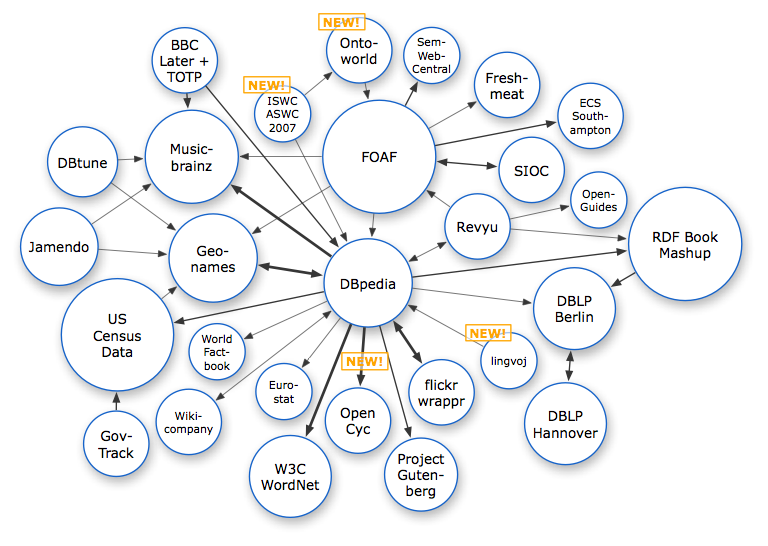
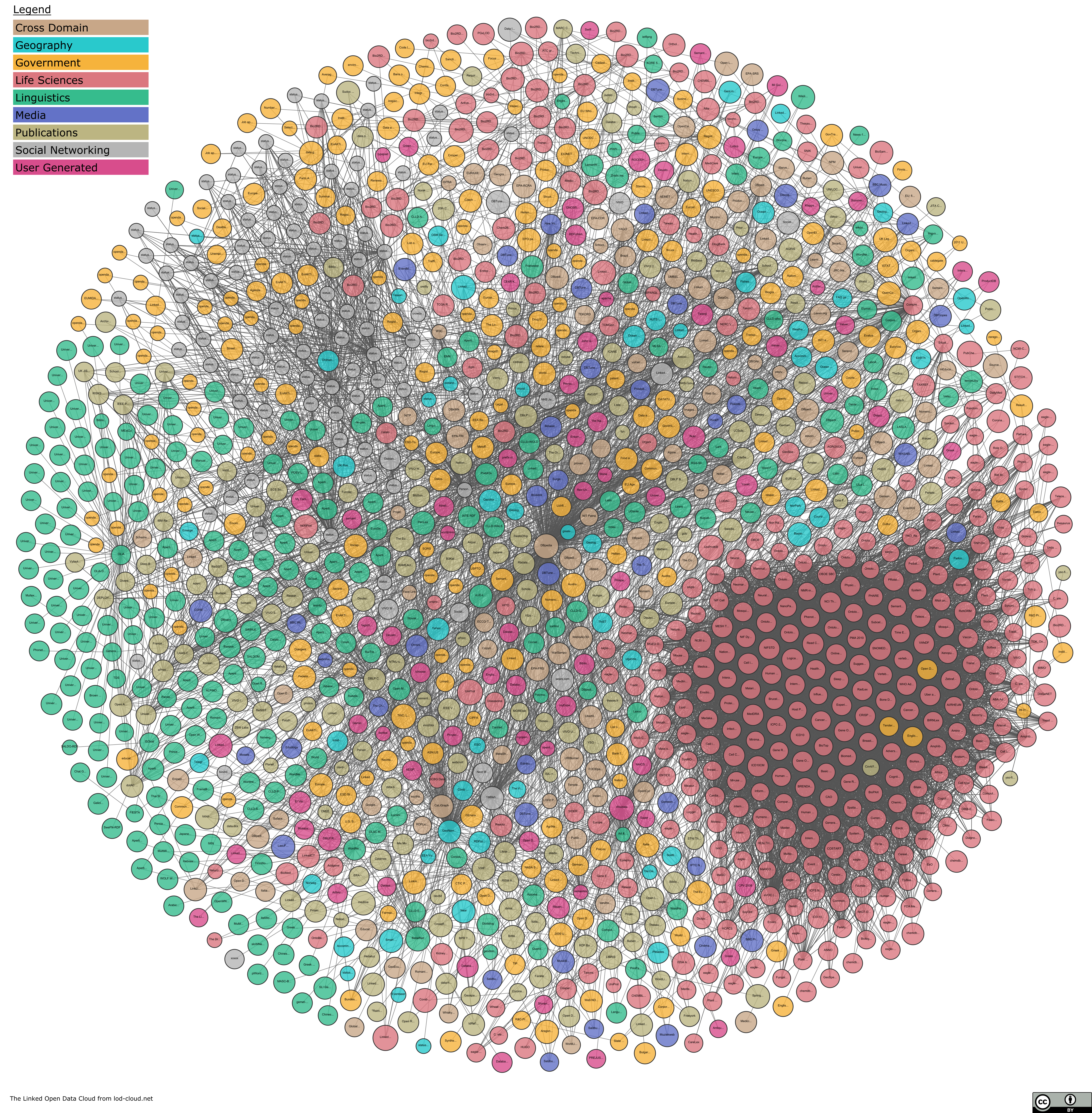
Since its launch in 2007, DBpedia has catalyzed the explosion of the Linked Open Data ecosystem. What began as a single hub has evolved into a thriving interconnected network spanning hundreds of datasets across every domain of human knowledge.
2007: The Beginning
DBpedia's launch marked the genesis of the Linked Open Data Cloud at the World Wide Web Conference in Banff.
2025: A Thriving Ecosystem
Nearly two decades later, the LOD Cloud encompasses hundreds of interconnected datasets, with DBpedia remaining a central hub.
The Exponential Impact
DBpedia Evolution
- ✓ 2007: First release with millions of triples extracted from Wikipedia
- ✓ 2022-12: 1.1B+ triples, 4.5M+ distinct subjects
- ✓ 2025-06: 1.32B+ triples, 49.7M+ distinct subjects
- ✓ 136.7M sameAs links connecting to Wikidata and other KGs
LOD Cloud Growth
- ✓ Started with DBpedia, WordNet, and a few datasets
- ✓ Grew to 50+ linked datasets by 2012
- ✓ Now encompasses 500+ interconnected open data sources
- ✓ Trillions of triples across all datasets combined
AI & Search Giants
Apple (Siri), Google (Knowledge Graph), IBM (Watson), and others have leveraged DBpedia's structured knowledge for AI applications.
Academic Research
DBpedia has become a foundational resource for NLP, machine learning, and knowledge graph research worldwide.
Enterprise Integration
Organizations use DBpedia for entity resolution, semantic search, recommendation systems, and knowledge base integration.
Why the Growth Matters Now
For AI & LLMs: As language models grow more sophisticated, they require ever-richer, interconnected knowledge contexts. DBpedia's 18-year evolution provides a proven, battle-tested foundation for grounding AI in factual, verifiable information.
For Data Integration: The explosion of the LOD Cloud means enterprises can now federate data across siloed systems using standardized semantic technologies. DBpedia's central role ensures interoperability across these domains.
For Innovation: The 2025-06 release reflects decades of refinement. With 56K+ distinct properties and improved schema alignment, DBpedia now supports use cases that were impossible in 2007—from multimodal AI agents to real-time knowledge graph reasoning.
The 3 Pillars of Linked Open Data
1. Identify with Hyperlinks
Use HTTP URIs as unique, universal names for your entities. This makes them addressable and linkable on the web, just like a webpage.
2. Describe with RDF
Use the Resource Description Framework (RDF) to create statements in the form of subject-predicate-object "triples." This builds a graph of relationships.
3. Publish to the Web
Make the RDF data available over HTTP in standard formats like JSON-LD, Turtle, or RDF/XML, so that both humans and machines can access it.
Explore the Knowledge Graph: Tools & Endpoints
SPARQL Query Service
Direct, ad-hoc query access to the entire dataset using the powerful SPARQL language.
Launch Editor →Faceted Browsing
Intuitively search and filter entities using a human-friendly interface.
Start Browsing →Entity Description Service
Get a detailed, human-readable page for any entity by its IRI.
View Example →Frequently Asked Questions
What is being announced in this post?
The post announces the release of a new DBpedia Knowledge Graph instance, version 2025-06.
How does the 2025-06 release improve upon the previous 2022-12 dataset?
The 2025-06 release offers improved data consistency, richer entity descriptions, and tighter schema alignment across multiple domains.
How do I get started querying the DBpedia 2025-06 dataset?
Visit https://dbpedia.org/sparql to access the web-based SPARQL editor with live autocompletion and example queries. For programmatic access, query the SPARQL endpoint directly via HTTP. We provide code examples in Python, JavaScript, Java, and cURL. Start with: SELECT * WHERE { ?subject ?predicate ?object } LIMIT 10
What are some service endpoints available for this new DBpedia release?
Available endpoints include a SPARQL Query Service, a Faceted Browsing Service, and an Entity Description Service.
What programming languages and tools are supported?
DBpedia supports any HTTP client and SPARQL library. Popular options: Python (SPARQLWrapper, RDFLib), JavaScript (comunica, sparql-engine), Java (Apache Jena), Go (knakk), PHP, Ruby, and cURL. Most AI frameworks (LangChain, LlamaIndex, semantic-kernel) have built-in DBpedia integration. Results are available in JSON, XML, CSV, and RDF formats.
Why is DBpedia considered critical in the age of AI?
DBpedia serves as a crucial context provider for AI systems, offering entity grounding, context enrichment, multimodal integration, and interoperability to ground LLMs and AI Agents.
How does DBpedia integrate with LLMs and AI Agents?
DBpedia grounds LLMs by mapping ambiguous natural language to dereferenceable entity IRIs. Common patterns: (1) Named Entity Recognition → lookup entity in DBpedia → retrieve dbo:* properties for context enrichment, (2) Semantic linking using sameAs bridges to Wikidata/other KGs, (3) Multi-hop reasoning via SPARQL queries, (4) Retrieval-Augmented Generation (RAG) using DBpedia as the knowledge base. Integrate via SPARQL endpoint queries or embed vector representations of entities.
How does DBpedia help AI Agents with ambiguous terms like 'Jaguar'?
It allows AI Agents to map ambiguous natural language terms to precise, dereferenceable DBpedia IRIs, ensuring reasoning operations reference real-world entities instead of vague text tokens.
How does DBpedia compare to Wikidata and other knowledge graphs?
DBpedia and Wikidata are complementary. DBpedia extracts structured data from Wikipedia with mature SPARQL infrastructure optimized for performance. Wikidata is collaboratively edited with broader language coverage. The 2025-06 release includes 136.7M sameAs links connecting DBpedia entities to Wikidata, enabling seamless federation. Choose DBpedia for historical data stability and proven AI integration; choose Wikidata for real-time crowdsourced updates.
Can I use DBpedia for commercial applications?
Yes. DBpedia is published under the Creative Commons Attribution-ShareAlike 3.0 license (CC-BY-SA 3.0), which permits commercial use with attribution. Data extracted from Wikipedia inherits this license. Ensure your application complies with the share-alike clause if you redistribute or modify the data.
What are the data sources and how is quality maintained?
DBpedia 2025-06 is extracted from Wikipedia using the DBpedia Extraction Framework and the DBpedia Databus System. Data quality is maintained through: (1) automated schema alignment with the DBpedia Ontology, (2) cross-validation against Wikipedia's structured and unstructured content, (3) community feedback mechanisms via the DBpedia Association, and (4) version control via the Databus—allowing you to compare dataset versions and trace data lineage.
How many triples does the DBpedia 2025-06 release contain?
The DBpedia 2025-06 release contains 1,320,461,984 triples.
How many sameAs links are present in the DBpedia 2025-06 release?
The DBpedia 2025-06 release contains 136,721,988 sameAs links.
What standards does DBpedia adhere to for interoperability with AI systems?
DBpedia adheres to W3C and LOD standards, allowing it to be seamlessly incorporated into AI Agent architectures.
What is the benefit of DBpedia's semantic links for LLMs?
DBpedia's semantic links supply contextual edges that enable LLMs to infer meaning beyond text, supporting multi-hop reasoning and improved summarization or dialogue coherence.
What are the performance characteristics and SLAs?
The DBpedia SPARQL endpoint is hosted on OpenLink Virtuoso infrastructure. Typical query latency is sub-second for simple queries; complex joins may take 1-5 seconds depending on result set size. The service is publicly available with best-effort uptime. For production AI integrations requiring guaranteed SLAs and higher throughput, contact OpenLink Software for enterprise hosting options or deploy Virtuoso privately on your infrastructure.
How frequently is DBpedia updated?
DBpedia releases follow a quarterly cadence, with major releases (e.g., 2025-06) published twice yearly. Each release incorporates Wikipedia updates from the prior 3-6 months. The DBpedia Databus System enables you to subscribe to specific dataset updates and version your data dependencies. Check https://wiki.dbpedia.org/releases for the roadmap.
How do I contribute to DBpedia or report data errors?
Report issues or suggest improvements through the DBpedia Association's GitHub repository or community forums at https://wiki.dbpedia.org/join/get-in-touch. You can also contribute by improving Wikipedia source articles—DBpedia automatically extracts changes in the next release cycle. For technical contributions to the extraction framework or ontology, visit the DBpedia GitHub organization.
Is there community support or documentation available?
Yes. Resources include: (1) Official wiki at https://wiki.dbpedia.org with tutorials and API docs, (2) Community forum at https://community.openlinksw.com for peer support, (3) DBpedia Association at http://wiki.dbpedia.org/dbpedia-association for governance and announcements, (4) OpenLink Software technical support for enterprise deployments. GitHub issues and discussions are monitored by the community.
What is the VoID-based Metadata Graph?
The VoID (Vocabulary of Interlinked Datasets) graph provides metadata about the DBpedia dataset, such as the number of triples and distinct subjects, for dataset discovery and assessment.
What system is the DBpedia 2025-06 release based on?
It is based on the DBpedia Databus System, which was developed by the DBpedia Association and deployed using a live Virtuoso multi-model DBMS instance provided by OpenLink Software.
Who is announcing this new release?
OpenLink Software is pleased to announce this release.
Where can users share feedback about the new DBpedia Knowledge Graph?
Users are invited to explore the new knowledge graph and share feedback through the DBpedia Association's communication channels.
Glossary of Key Terms
Authors & Related Information
Explore Further
Dive deeper into the data with this SPARQL query results visualization page.
Explore Knowledge Graph →