<?xml version="1.0" encoding="UTF-8" ?>
<!--RDF based XML document generated By OpenLink Virtuoso-->
<rdf:RDF xmlns:rdf="http://www.w3.org/1999/02/22-rdf-syntax-ns#">
 <rss:channel xmlns:rss="http://purl.org/rss/1.0/" rdf:about="http://www.openlinksw.com:443/weblog/uda/135/">
  <rss:title>Universal Data Access Technology Blog</rss:title>
  <rss:link>http://www.openlinksw.com:443/weblog/uda/135/</rss:link>
  <rss:description />
  <dc:creator xmlns:dc="http://purl.org/dc/elements/1.1/">hwilliams@openlinksw.com</dc:creator>
  <dc:date xmlns:dc="http://purl.org/dc/elements/1.1/">2026-11-16T20:47:43Z</dc:date>
  <rss:items>
   <rdf:Seq>
      <rdf:li rdf:resource="http://www.openlinksw.com:443/weblog/uda/135/?date=2015-06-04#1840" />
      <rdf:li rdf:resource="http://www.openlinksw.com:443/weblog/uda/135/?date=2015-06-04#1840" />
   </rdf:Seq>
  </rss:items>
 </rss:channel>
 <rss:item xmlns:rss="http://purl.org/rss/1.0/" rdf:about="http://www.openlinksw.com:443/weblog/uda/135/?date=2015-06-04#1840">
  <rss:title>Life after sun.jdbc.odbc.JdbcOdbcDriver</rss:title>
  <dc:date xmlns:dc="http://purl.org/dc/elements/1.1/">2015-06-04T21:12:19Z</dc:date>
  <dc:description xmlns:dc="http://purl.org/dc/elements/1.1/">In the beginning... When Sun originally released Java 1.0, there were no JDBC drivers -- there wasn&#39;t even a JDBC. Data access came in Java 2.0, as JDBC 1.0, but there were very few JDBC drivers from any source, as would be expected with any new technology -- but the ODBC ecosystem (itself then at only v2.0) was going strong. Sun recognized that Java wouldn&#39;t have as much uptake without a functional data access solution -- so they produced and bundled the original Type 1 JDBC-ODBC Bridge Driver, sun.jdbc.odbc.JdbcOdbcDriver, but from the very beginning, they warned that users &quot;should use the JDBC-ODBC Bridge only for experimental prototyping or when you have no other driver available.&quot; That bundled JDBC-ODBC Bridge was (and always remained) single-threaded, and though it received some other updates along the way, it only ever supported a subset of JDBC 2.0 and later. Sun (and later Oracle) recommended that users employ &quot;a pure Java JDBC technology-enabled driver, type 3 or 4, in order to get all of the benefits of the Java programming language and the JDBC API.&quot; Where does OpenLink Software come in? Even in the early days of JDBC, we saw that there would not always be an available JDBC driver for a given target data source -- but the numbers of ODBC drivers were rapidly increasing, supporting every major and many minor DBMS and other data sources. We saw a need for an enterprise-grade, non-experimental Bridge solution, with full support for the JDBC API. We delivered this first as our Type 3 Multi-Tier solution, bridging from JDBC in one environment (typically a UNIX-like OS) to ODBC in another (most often, Microsoft Windows). Type 3 Enterprise Edition (Multi-Tier) Architecture Diagram (click to enlarge) Soon afterward, we released our first Type 1 Single-Tier solution, first for Windows, but quickly also supporting Linux, Mac OS X, Solaris, AIX, HP-UX, and other UNIX-like OS, through our own iODBC driver manager -- which was itself helping to expand the ODBC ecosystem far beyond its birthplace on Windows. Type 1 Lite Edition (Single-Tier) Architecture Diagram (click to enlarge) Why is Java 8 so special? Sun long warned that the JRE-bundled Bridge was transitional, and Oracle confirmed immediately upon acquisition that it would &quot;be removed in JDK 8. In addition, Oracle does not support the JDBC-ODBC Bridge.&quot; Java 8 is now in full release, and indeed, the venerable sun.jdbc.odbc.JdbcOdbcDriver is no longer present, as evidenced by the scary looking error -- java.lang.ClassNotFoundException: sun.jdbc.odbc.JdbcOdbcDriver at java.net.URLClassLoader$1.run(URLClassLoader.java:372) at java.net.URLClassLoader$1.run(URLClassLoader.java:361) at java.security.AccessController.doPrivileged(Native Method) at java.net.URLClassLoader.findClass(URLClassLoader.java:360) at java.lang.ClassLoader.loadClass(ClassLoader.java:424) at sun.misc.Launcher$AppClassLoader.loadClass(Launcher.java:30 at java.lang.ClassLoader.loadClass(ClassLoader.java:357) at java.lang.Class.forName0(Native Method) at java.lang.Class.forName(Class.java:259) Any Java users or applications relying on ODBC connections and also needing the security and other improvements found in Java 8 are left high and dry... Or would be, but for OpenLink Software. Our JDBC-to-ODBC Bridge, in both Type 1 and Type 3 forms, has been available and regularly updated since its original release for JDBC 1. Fully multi-threaded since Java Runtime Environments (JREs) could handle such, we have also kept pace with the JDBC API -- now at JDBC 4.2, in 2015&#39;s Java 8 a/k/a JDK/JVM/JRE 1.8 -- and maintained compatibility with the also-evolving ODBC API, now at 3.8. Especially important for the modern world, our solutions support both 64-bit and 32-bit environments, including both 64-bit JVMs and ODBC drivers, and our Type 3 solutions can even bridge between these, whether you have a 64-bit JVM and need to connect to a 32-bit ODBC driver, or you have a 32-bit JVM and need to connect to a 64-bit ODBC driver. As always, our solutions are available for immediate download, with a free two-week trial license provided alongside. We encourage pre-purchase installation, configuration, and testing, with support provided through our web-based Support Forums and even free up-and-running Support Cases. Once you&#39;ve confirmed the driver works for you, entry level and special offer licenses may be purchased online or through our Sales Team; these as well as custom license configurations or partnership (IBP, ISV, VAR, OEM, etc.) arrangements are always available by direct contact.</dc:description>
  <content:encoded xmlns:content="http://purl.org/rss/1.0/modules/content/"><![CDATA[<h2>In the beginning...</h2>

<p>When Sun originally released Java 1.0, there were no JDBC drivers -- there wasn&#39;t even a JDBC.</p>

<p>Data access came in Java 2.0, as <a href="http://www.oracle.com/technetwork/java/overview-141217.html" id="link-id0x2aab5b257518">JDBC 1.0</a>, but there were very few JDBC drivers from any source, as would be expected with any new technology -- but the ODBC ecosystem (itself then at only v2.0) was going strong.</p>

<p>Sun recognized that Java wouldn&#39;t have as much uptake without a functional data access solution -- so they produced and bundled the original Type 1 JDBC-ODBC Bridge Driver, <code>sun.jdbc.odbc.JdbcOdbcDriver</code>, but from the very beginning, they warned that users &quot;should use the JDBC-ODBC Bridge only for experimental prototyping or when you have no other driver available.&quot;</p>

<p>That bundled JDBC-ODBC Bridge was (and always remained) single-threaded, and though it received some other updates along the way, it only ever supported a subset of JDBC 2.0 and later.  Sun (and later Oracle) recommended that users employ &quot;a pure Java JDBC technology-enabled driver, type 3 or 4, in order to get all of the benefits of the Java programming language and the JDBC API.&quot;</p>

<h2>Where does OpenLink Software come in?</h2>

<p>Even in the early days of JDBC, we saw that there would not always be an available JDBC driver for a given target data source -- but the numbers of ODBC drivers were rapidly increasing, supporting every major and many minor DBMS and other data sources.  We saw a need for an enterprise-grade, non-experimental Bridge solution, with full support for the JDBC API.</p>

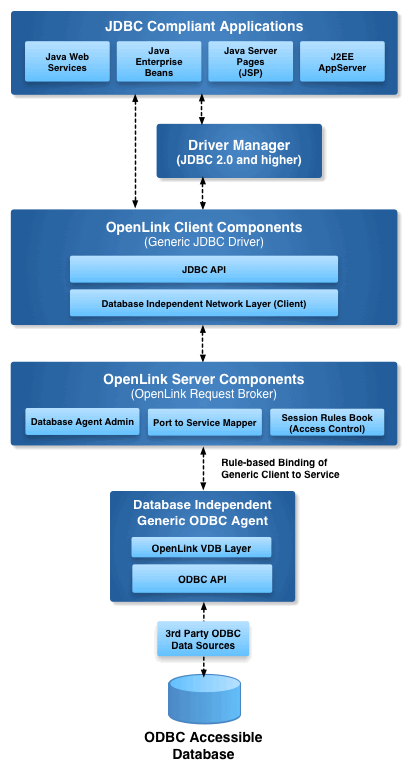
<p>We delivered this first as our <a href="http://uda.openlinksw.com/jdbc-odbc-mt/" id="link-id0x2aab5bf439b8">Type 3 Multi-Tier solution</a>, bridging from JDBC in one environment (typically a UNIX-like OS) to ODBC in another (most often, Microsoft Windows). </p>

<p style="text-align:center">
 <a href="http://uda.openlinksw.com/images/jdbcodbcmt.gif" target="_blank" id="link-id0x7fe32e904c08"><img src="http://uda.openlinksw.com/images/jdbcodbcmt.gif" alt="Type 3 Enterprise Edition (Multi-Tier) Architecture Diagram" title="Type 3 Enterprise Edition (Multi-Tier) Architecture Diagram" style="max-width: 300px; height: auto" />
 </a> <br /> Type 3 Enterprise Edition (Multi-Tier) Architecture Diagram <br /> <i>(click to enlarge)</i>
</p>

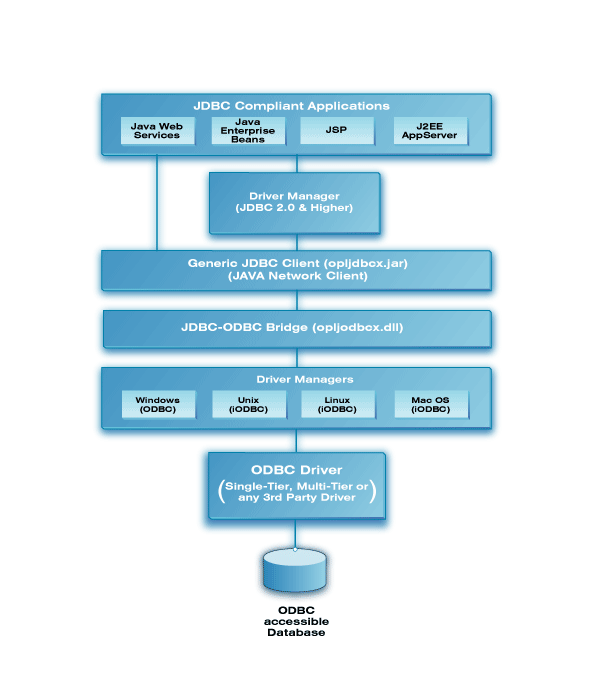
Soon afterward, we released our first <a href="http://uda.openlinksw.com/jdbc-odbc-st/" id="link-id0x2aab5b257628">Type 1 Single-Tier solution</a>, first for Windows, but quickly also supporting Linux, Mac OS X, Solaris, AIX, HP-UX, and other UNIX-like OS, through our own <a href="http://www.iodbc.org/dataspace/iodbc/wiki/iODBC/" id="link-id0x2aab5b0cbc48">iODBC driver manager</a> -- which was itself helping to expand the ODBC ecosystem far beyond its birthplace on Windows.

<p style="text-align:center">
 <a href="http://uda.openlinksw.com/images/jdbcodbcst.gif" target="_blank" id="link-id0x7fe32e385fe8"><img src="http://uda.openlinksw.com/images/jdbcodbcst.gif" alt="Type 1 Lite Edition (Single-Tier) Architecture Diagram" title="Type 1 Lite Edition (Single-Tier) Architecture Diagram" style="max-width: 300px; height: auto" />
 </a> <br /> Type 1 Lite Edition (Single-Tier) Architecture Diagram <br /> <i>(click to enlarge)</i>
</p>


<h2>Why is Java 8 so special?</h2>

<p>Sun long warned that the JRE-bundled Bridge was transitional, and Oracle confirmed immediately upon acquisition that it would &quot;be removed in JDK 8. In addition, Oracle does not support the JDBC-ODBC Bridge.&quot;  Java 8 is now in full release, and indeed, the venerable <code>sun.jdbc.odbc.JdbcOdbcDriver</code> is no longer present, as evidenced by the scary looking error --</p>

<blockquote>
 <code><pre>java.lang.ClassNotFoundException: sun.jdbc.odbc.JdbcOdbcDriver
    at java.net.URLClassLoader$1.run(URLClassLoader.java:372)
    at java.net.URLClassLoader$1.run(URLClassLoader.java:361)
    at java.security.AccessController.doPrivileged(Native Method)
    at java.net.URLClassLoader.findClass(URLClassLoader.java:360)
    at java.lang.ClassLoader.loadClass(ClassLoader.java:424)
    at sun.misc.Launcher$AppClassLoader.loadClass(Launcher.java:30
    at java.lang.ClassLoader.loadClass(ClassLoader.java:357)
    at java.lang.Class.forName0(Native Method)
    at java.lang.Class.forName(Class.java:259)
</pre>
 </code>
</blockquote>

<p>Any Java users or applications relying on ODBC connections and also needing the security and other improvements found in Java 8 are left high and dry...  Or would be, but for OpenLink Software.</p>

<p>Our JDBC-to-ODBC Bridge, in both <a href="http://uda.openlinksw.com/jdbc-odbc-st/" id="link-id0x2aab5b0cc1f8">Type 1</a> and <a href="http://uda.openlinksw.com/jdbc-odbc-mt/" id="link-id0x2aab5b0cc308">Type 3</a> forms, has been available and regularly updated since its original release for JDBC 1.  Fully multi-threaded since Java Runtime Environments (JREs) could handle such, we have also kept pace with the JDBC API -- now at <a href="http://docs.oracle.com/javase/8/docs/technotes/guides/jdbc/jdbc_42.html" id="link-id0x2aab5b0cc548">JDBC 4.2, in 2015&#39;s Java 8 a/k/a JDK/JVM/JRE 1.8</a> -- and maintained compatibility with the also-evolving <a href="https://msdn.microsoft.com/library/ee388580.aspx" id="link-id0x2aab5b0cc6a8">ODBC API, now at 3.8</a>.</p>

<p>Especially important for the modern world, our solutions support both 64-bit and 32-bit environments, including both 64-bit JVMs and ODBC drivers, and our <a href="http://uda.openlinksw.com/jdbc-odbc-mt/" id="link-id0x7fe35a5e2168">Type 3 solutions</a> can even bridge between these, whether you have a 64-bit JVM and need to connect to a 32-bit ODBC driver, or you have a 32-bit JVM and need to connect to a 64-bit ODBC driver.</p>

<p>As always, our solutions are <a href="http://download.openlinksw.com/solwiz/" id="link-id0x2aab5b0cc0e8">available for immediate download</a>, with a free two-week trial license provided alongside.  We encourage pre-purchase installation, configuration, and testing, with support provided through our <a href="http://boards.openlinksw.com/support/index.php" id="link-id0x2aab5b0cc9a8">web-based Support Forums</a> and even <a href="http://support.openlinksw.com/support/online-support.vsp" id="link-id0x2aab5b0ccaa8">free up-and-running Support Cases</a>.  Once you&#39;ve confirmed the driver works for you, <a href="http://uda.openlinksw.com/offers/" id="link-id0x2aab5b255fc8">entry level and special offer licenses</a> may be purchased online or through our Sales Team; these as well as custom license configurations or <a href="http://www.openlinksw.com/partners/" id="link-id0x2aab5b256168">partnership (IBP, ISV, VAR, OEM, etc.) arrangements</a> are always available by <a href="http://www.openlinksw.com/contact/" id="link-id0x2aab5b256288">direct contact</a>.</p>]]></content:encoded>
 </rss:item>
 <rss:item xmlns:rss="http://purl.org/rss/1.0/" rdf:about="http://www.openlinksw.com:443/weblog/uda/135/?date=2015-06-04#1840">
  <rss:title>Life after sun.jdbc.odbc.JdbcOdbcDriver</rss:title>
  <dc:date xmlns:dc="http://purl.org/dc/elements/1.1/">2015-06-04T21:12:19Z</dc:date>
  <dc:description xmlns:dc="http://purl.org/dc/elements/1.1/">In the beginning... When Sun originally released Java 1.0, there were no JDBC drivers -- there wasn&#39;t even a JDBC. Data access came in Java 2.0, as JDBC 1.0, but there were very few JDBC drivers from any source, as would be expected with any new technology -- but the ODBC ecosystem (itself then at only v2.0) was going strong. Sun recognized that Java wouldn&#39;t have as much uptake without a functional data access solution -- so they produced and bundled the original Type 1 JDBC-ODBC Bridge Driver, sun.jdbc.odbc.JdbcOdbcDriver, but from the very beginning, they warned that users &quot;should use the JDBC-ODBC Bridge only for experimental prototyping or when you have no other driver available.&quot; That bundled JDBC-ODBC Bridge was (and always remained) single-threaded, and though it received some other updates along the way, it only ever supported a subset of JDBC 2.0 and later. Sun (and later Oracle) recommended that users employ &quot;a pure Java JDBC technology-enabled driver, type 3 or 4, in order to get all of the benefits of the Java programming language and the JDBC API.&quot; Where does OpenLink Software come in? Even in the early days of JDBC, we saw that there would not always be an available JDBC driver for a given target data source -- but the numbers of ODBC drivers were rapidly increasing, supporting every major and many minor DBMS and other data sources. We saw a need for an enterprise-grade, non-experimental Bridge solution, with full support for the JDBC API. We delivered this first as our Type 3 Multi-Tier solution, bridging from JDBC in one environment (typically a UNIX-like OS) to ODBC in another (most often, Microsoft Windows). Type 3 Enterprise Edition (Multi-Tier) Architecture Diagram (click to enlarge) Soon afterward, we released our first Type 1 Single-Tier solution, first for Windows, but quickly also supporting Linux, Mac OS X, Solaris, AIX, HP-UX, and other UNIX-like OS, through our own iODBC driver manager -- which was itself helping to expand the ODBC ecosystem far beyond its birthplace on Windows. Type 1 Lite Edition (Single-Tier) Architecture Diagram (click to enlarge) Why is Java 8 so special? Sun long warned that the JRE-bundled Bridge was transitional, and Oracle confirmed immediately upon acquisition that it would &quot;be removed in JDK 8. In addition, Oracle does not support the JDBC-ODBC Bridge.&quot; Java 8 is now in full release, and indeed, the venerable sun.jdbc.odbc.JdbcOdbcDriver is no longer present, as evidenced by the scary looking error -- java.lang.ClassNotFoundException: sun.jdbc.odbc.JdbcOdbcDriver at java.net.URLClassLoader$1.run(URLClassLoader.java:372) at java.net.URLClassLoader$1.run(URLClassLoader.java:361) at java.security.AccessController.doPrivileged(Native Method) at java.net.URLClassLoader.findClass(URLClassLoader.java:360) at java.lang.ClassLoader.loadClass(ClassLoader.java:424) at sun.misc.Launcher$AppClassLoader.loadClass(Launcher.java:30 at java.lang.ClassLoader.loadClass(ClassLoader.java:357) at java.lang.Class.forName0(Native Method) at java.lang.Class.forName(Class.java:259) Any Java users or applications relying on ODBC connections and also needing the security and other improvements found in Java 8 are left high and dry... Or would be, but for OpenLink Software. Our JDBC-to-ODBC Bridge, in both Type 1 and Type 3 forms, has been available and regularly updated since its original release for JDBC 1. Fully multi-threaded since Java Runtime Environments (JREs) could handle such, we have also kept pace with the JDBC API -- now at JDBC 4.2, in 2015&#39;s Java 8 a/k/a JDK/JVM/JRE 1.8 -- and maintained compatibility with the also-evolving ODBC API, now at 3.8. Especially important for the modern world, our solutions support both 64-bit and 32-bit environments, including both 64-bit JVMs and ODBC drivers, and our Type 3 solutions can even bridge between these, whether you have a 64-bit JVM and need to connect to a 32-bit ODBC driver, or you have a 32-bit JVM and need to connect to a 64-bit ODBC driver. As always, our solutions are available for immediate download, with a free two-week trial license provided alongside. We encourage pre-purchase installation, configuration, and testing, with support provided through our web-based Support Forums and even free up-and-running Support Cases. Once you&#39;ve confirmed the driver works for you, entry level and special offer licenses may be purchased online or through our Sales Team; these as well as custom license configurations or partnership (IBP, ISV, VAR, OEM, etc.) arrangements are always available by direct contact.</dc:description>
  <content:encoded xmlns:content="http://purl.org/rss/1.0/modules/content/"><![CDATA[<h2>In the beginning...</h2>

<p>When Sun originally released Java 1.0, there were no JDBC drivers -- there wasn&#39;t even a JDBC.</p>

<p>Data access came in Java 2.0, as <a href="http://www.oracle.com/technetwork/java/overview-141217.html" id="link-id0x2aab5b257518">JDBC 1.0</a>, but there were very few JDBC drivers from any source, as would be expected with any new technology -- but the ODBC ecosystem (itself then at only v2.0) was going strong.</p>

<p>Sun recognized that Java wouldn&#39;t have as much uptake without a functional data access solution -- so they produced and bundled the original Type 1 JDBC-ODBC Bridge Driver, <code>sun.jdbc.odbc.JdbcOdbcDriver</code>, but from the very beginning, they warned that users &quot;should use the JDBC-ODBC Bridge only for experimental prototyping or when you have no other driver available.&quot;</p>

<p>That bundled JDBC-ODBC Bridge was (and always remained) single-threaded, and though it received some other updates along the way, it only ever supported a subset of JDBC 2.0 and later.  Sun (and later Oracle) recommended that users employ &quot;a pure Java JDBC technology-enabled driver, type 3 or 4, in order to get all of the benefits of the Java programming language and the JDBC API.&quot;</p>

<h2>Where does OpenLink Software come in?</h2>

<p>Even in the early days of JDBC, we saw that there would not always be an available JDBC driver for a given target data source -- but the numbers of ODBC drivers were rapidly increasing, supporting every major and many minor DBMS and other data sources.  We saw a need for an enterprise-grade, non-experimental Bridge solution, with full support for the JDBC API.</p>

<p>We delivered this first as our <a href="http://uda.openlinksw.com/jdbc-odbc-mt/" id="link-id0x2aab5bf439b8">Type 3 Multi-Tier solution</a>, bridging from JDBC in one environment (typically a UNIX-like OS) to ODBC in another (most often, Microsoft Windows). </p>

<p style="text-align:center">
 <a href="http://uda.openlinksw.com/images/jdbcodbcmt.gif" target="_blank" id="link-id0x7fe32e904c08"><img src="http://uda.openlinksw.com/images/jdbcodbcmt.gif" alt="Type 3 Enterprise Edition (Multi-Tier) Architecture Diagram" title="Type 3 Enterprise Edition (Multi-Tier) Architecture Diagram" style="max-width: 300px; height: auto" />
 </a> <br /> Type 3 Enterprise Edition (Multi-Tier) Architecture Diagram <br /> <i>(click to enlarge)</i>
</p>

Soon afterward, we released our first <a href="http://uda.openlinksw.com/jdbc-odbc-st/" id="link-id0x2aab5b257628">Type 1 Single-Tier solution</a>, first for Windows, but quickly also supporting Linux, Mac OS X, Solaris, AIX, HP-UX, and other UNIX-like OS, through our own <a href="http://www.iodbc.org/dataspace/iodbc/wiki/iODBC/" id="link-id0x2aab5b0cbc48">iODBC driver manager</a> -- which was itself helping to expand the ODBC ecosystem far beyond its birthplace on Windows.

<p style="text-align:center">
 <a href="http://uda.openlinksw.com/images/jdbcodbcst.gif" target="_blank" id="link-id0x7fe32e385fe8"><img src="http://uda.openlinksw.com/images/jdbcodbcst.gif" alt="Type 1 Lite Edition (Single-Tier) Architecture Diagram" title="Type 1 Lite Edition (Single-Tier) Architecture Diagram" style="max-width: 300px; height: auto" />
 </a> <br /> Type 1 Lite Edition (Single-Tier) Architecture Diagram <br /> <i>(click to enlarge)</i>
</p>


<h2>Why is Java 8 so special?</h2>

<p>Sun long warned that the JRE-bundled Bridge was transitional, and Oracle confirmed immediately upon acquisition that it would &quot;be removed in JDK 8. In addition, Oracle does not support the JDBC-ODBC Bridge.&quot;  Java 8 is now in full release, and indeed, the venerable <code>sun.jdbc.odbc.JdbcOdbcDriver</code> is no longer present, as evidenced by the scary looking error --</p>

<blockquote>
 <code><pre>java.lang.ClassNotFoundException: sun.jdbc.odbc.JdbcOdbcDriver
    at java.net.URLClassLoader$1.run(URLClassLoader.java:372)
    at java.net.URLClassLoader$1.run(URLClassLoader.java:361)
    at java.security.AccessController.doPrivileged(Native Method)
    at java.net.URLClassLoader.findClass(URLClassLoader.java:360)
    at java.lang.ClassLoader.loadClass(ClassLoader.java:424)
    at sun.misc.Launcher$AppClassLoader.loadClass(Launcher.java:30
    at java.lang.ClassLoader.loadClass(ClassLoader.java:357)
    at java.lang.Class.forName0(Native Method)
    at java.lang.Class.forName(Class.java:259)
</pre>
 </code>
</blockquote>

<p>Any Java users or applications relying on ODBC connections and also needing the security and other improvements found in Java 8 are left high and dry...  Or would be, but for OpenLink Software.</p>

<p>Our JDBC-to-ODBC Bridge, in both <a href="http://uda.openlinksw.com/jdbc-odbc-st/" id="link-id0x2aab5b0cc1f8">Type 1</a> and <a href="http://uda.openlinksw.com/jdbc-odbc-mt/" id="link-id0x2aab5b0cc308">Type 3</a> forms, has been available and regularly updated since its original release for JDBC 1.  Fully multi-threaded since Java Runtime Environments (JREs) could handle such, we have also kept pace with the JDBC API -- now at <a href="http://docs.oracle.com/javase/8/docs/technotes/guides/jdbc/jdbc_42.html" id="link-id0x2aab5b0cc548">JDBC 4.2, in 2015&#39;s Java 8 a/k/a JDK/JVM/JRE 1.8</a> -- and maintained compatibility with the also-evolving <a href="https://msdn.microsoft.com/library/ee388580.aspx" id="link-id0x2aab5b0cc6a8">ODBC API, now at 3.8</a>.</p>

<p>Especially important for the modern world, our solutions support both 64-bit and 32-bit environments, including both 64-bit JVMs and ODBC drivers, and our <a href="http://uda.openlinksw.com/jdbc-odbc-mt/" id="link-id0x7fe35a5e2168">Type 3 solutions</a> can even bridge between these, whether you have a 64-bit JVM and need to connect to a 32-bit ODBC driver, or you have a 32-bit JVM and need to connect to a 64-bit ODBC driver.</p>

<p>As always, our solutions are <a href="http://download.openlinksw.com/solwiz/" id="link-id0x2aab5b0cc0e8">available for immediate download</a>, with a free two-week trial license provided alongside.  We encourage pre-purchase installation, configuration, and testing, with support provided through our <a href="http://boards.openlinksw.com/support/index.php" id="link-id0x2aab5b0cc9a8">web-based Support Forums</a> and even <a href="http://support.openlinksw.com/support/online-support.vsp" id="link-id0x2aab5b0ccaa8">free up-and-running Support Cases</a>.  Once you&#39;ve confirmed the driver works for you, <a href="http://uda.openlinksw.com/offers/" id="link-id0x2aab5b255fc8">entry level and special offer licenses</a> may be purchased online or through our Sales Team; these as well as custom license configurations or <a href="http://www.openlinksw.com/partners/" id="link-id0x2aab5b256168">partnership (IBP, ISV, VAR, OEM, etc.) arrangements</a> are always available by <a href="http://www.openlinksw.com/contact/" id="link-id0x2aab5b256288">direct contact</a>.</p>]]></content:encoded>
 </rss:item>
</rdf:RDF>