<?xml version="1.0" encoding="UTF-8" ?>
<!--RDF based XML document generated By OpenLink Virtuoso-->
<rdf:RDF xmlns:rdf="http://www.w3.org/1999/02/22-rdf-syntax-ns#">
 <rss:channel xmlns:rss="http://purl.org/rss/1.0/" rdf:about="http://www.openlinksw.com:443/blog/kidehen@openlinksw.com/blog/">
  <rss:title>Kingsley Idehen&#39;s Blog Data Space</rss:title>
  <rss:link>http://www.openlinksw.com:443/blog/kidehen@openlinksw.com/blog/</rss:link>
  <rss:description>I have seen the future and it&#39;s full of Linked Data! :-)</rss:description>
  <dc:creator xmlns:dc="http://purl.org/dc/elements/1.1/">kidehen@openlinksw.com</dc:creator>
  <dc:date xmlns:dc="http://purl.org/dc/elements/1.1/">2026-03-10T01:51:12Z</dc:date>
  <rss:items>
   <rdf:Seq>
      <rdf:li rdf:resource="http://www.openlinksw.com:443/blog/kidehen@openlinksw.com/blog/?date=2009-03-14#1531" />
      <rdf:li rdf:resource="http://www.openlinksw.com:443/blog/kidehen@openlinksw.com/blog/?date=2009-01-29#1524" />
      <rdf:li rdf:resource="http://www.openlinksw.com:443/blog/kidehen@openlinksw.com/blog/?date=2008-11-28#1489" />
      <rdf:li rdf:resource="http://www.openlinksw.com:443/blog/kidehen@openlinksw.com/blog/?date=2008-10-24#1463" />
      <rdf:li rdf:resource="http://www.openlinksw.com:443/blog/kidehen@openlinksw.com/blog/?date=2008-10-21#1458" />
      <rdf:li rdf:resource="http://www.openlinksw.com:443/blog/kidehen@openlinksw.com/blog/?date=2008-09-25#1442" />
      <rdf:li rdf:resource="http://www.openlinksw.com:443/blog/kidehen@openlinksw.com/blog/?date=2008-08-27#1424" />
      <rdf:li rdf:resource="http://www.openlinksw.com:443/blog/kidehen@openlinksw.com/blog/?date=2008-08-21#1415" />
      <rdf:li rdf:resource="http://www.openlinksw.com:443/blog/kidehen@openlinksw.com/blog/?date=2008-05-20#1364" />
      <rdf:li rdf:resource="http://www.openlinksw.com:443/blog/kidehen@openlinksw.com/blog/?date=2008-03-20#1324" />
      <rdf:li rdf:resource="http://www.openlinksw.com:443/blog/kidehen@openlinksw.com/blog/?date=2008-03-05#1319" />
      <rdf:li rdf:resource="http://www.openlinksw.com:443/blog/kidehen@openlinksw.com/blog/?date=2008-02-09#1315" />
      <rdf:li rdf:resource="http://www.openlinksw.com:443/blog/kidehen@openlinksw.com/blog/?date=2008-02-08#1314" />
      <rdf:li rdf:resource="http://www.openlinksw.com:443/blog/kidehen@openlinksw.com/blog/?date=2008-01-05#1289" />
      <rdf:li rdf:resource="http://www.openlinksw.com:443/blog/kidehen@openlinksw.com/blog/?date=2007-04-01#1175" />
      <rdf:li rdf:resource="http://www.openlinksw.com:443/blog/kidehen@openlinksw.com/blog/?date=2007-03-22#1165" />
      <rdf:li rdf:resource="http://www.openlinksw.com:443/blog/kidehen@openlinksw.com/blog/?date=2007-03-22#1164" />
      <rdf:li rdf:resource="http://www.openlinksw.com:443/blog/kidehen@openlinksw.com/blog/?date=2007-03-19#1161" />
      <rdf:li rdf:resource="http://www.openlinksw.com:443/blog/kidehen@openlinksw.com/blog/?date=2007-03-09#1152" />
      <rdf:li rdf:resource="http://www.openlinksw.com:443/blog/kidehen@openlinksw.com/blog/?date=2007-02-24#1143" />
      <rdf:li rdf:resource="http://www.openlinksw.com:443/blog/kidehen@openlinksw.com/blog/?date=2006-11-24#1090" />
      <rdf:li rdf:resource="http://www.openlinksw.com:443/blog/kidehen@openlinksw.com/blog/?date=2006-11-15#1081" />
      <rdf:li rdf:resource="http://www.openlinksw.com:443/blog/kidehen@openlinksw.com/blog/?date=2006-11-14#1080" />
      <rdf:li rdf:resource="http://www.openlinksw.com:443/blog/kidehen@openlinksw.com/blog/?date=2006-09-05#1034" />
      <rdf:li rdf:resource="http://www.openlinksw.com:443/blog/kidehen@openlinksw.com/blog/?date=2006-09-02#1032" />
      <rdf:li rdf:resource="http://www.openlinksw.com:443/blog/kidehen@openlinksw.com/blog/?date=2006-07-17#1009" />
   </rdf:Seq>
  </rss:items>
 </rss:channel>
 <rss:item xmlns:rss="http://purl.org/rss/1.0/" rdf:about="http://www.openlinksw.com:443/blog/kidehen@openlinksw.com/blog/?date=2009-03-14#1531">
  <rss:title>Simple Compare &amp; Contrast of Web 1.0, 2.0, and 3.0 (Update 1)</rss:title>
  <dc:date xmlns:dc="http://purl.org/dc/elements/1.1/">2009-03-14T18:20:00Z</dc:date>
  <dc:description xmlns:dc="http://purl.org/dc/elements/1.1/">Here is a tabulated &quot;compare and contrast&quot; of Web usage patterns 1.0, 2.0, and 3.0. Â  Web 1.0 Web 2.0 Web 3.0 Simple Definition Interactive / Visual Web Programmable Web Linked Data Web Unit of Presence Web Page Web Service Endpoint Data Space (named structured data enclave) Unit of Value Exchange Page URL Endpoint URL for API Resource / Entity / Object URI Data Granularity Low (HTML) Medium (XML) High (RDF) Defining Services Search Community (Blogs to Social Networks) Find Participation Quotient Low Medium High Serendipitous Discovery Quotient Low Medium High Data Referencability Quotient Low (Documents) Medium (Documents) High (Documents and their constituent Data) Subjectivity Quotient High Medium (from A-list bloggers to select source and partner lists) Low (everything is discovered via URIs) Transclusence Low Medium (Code driven Mashups) HIgh (Data driven Meshups) What You See Is What You Prefer (WYSIWYP) Low Medium High (negotiated representation of resource descriptions) Open Data Access (Data Accessibility) Low Medium (Silos) High (no Silos) Identity Issues Handling Low Medium (OpenID) High (FOAF+SSL) Solution Deployment Model Centralized Centralized with sprinklings of Federation Federated with function specific Centralization (e.g. Lookup hubs like LOD Cloud or DBpedia) Data Model Orientation Logical (Tree based DOM) Logical (Tree based XML) Conceptual (Graph based RDF) User Interface Issues Dynamically generated static interfaces Dyanically generated interafaces with semi-dynamic interfaces (courtesy of XSLT or XQuery/XPath) Dynamic Interfaces (pre- and post-generation) courtesy of self-describing nature of RDF Data Querying Full Text Search Full Text Search Full Text Search + Structured Graph Pattern Query Language (SPARQL) What Each Delivers Democratized Publishing Democratized Journalism &amp; Commentary (Citizen Journalists &amp; Commentators) Democratized Analysis (Citizen Data Analysts) Star Wars Edition Analogy Star Wars (original fight for decentralization via rebellion) Empire Strikes Back (centralization and data silos make comeback) Return of the JEDI (FORCE emerges and facilitates decentralization from &quot;Identity&quot; all the way to &quot;Open Data Access&quot; and &quot;Negotiable Descriptive Data Representation&quot;) Naturally, I am not expecting everyone to agree with me. I am simply making my contribution to what will remain facinating discourse for a long time to come :-) Related Web 3.0 The Best Official Definition Imaginable -- Nova Spivack&#39;s</dc:description>
  <content:encoded xmlns:content="http://purl.org/rss/1.0/modules/content/"><![CDATA[
<p>Here is a tabulated &quot;compare and contrast&quot; of <a href="http://dbpedia.org/resource/World_Wide_Web">Web</a> usage patterns 1.0, 2.0, and 3.0.</p>  <table border="1" width="715" height="286">    <tbody>
  <tr>      <td>Â </td>      <td><strong>Web 1.0</strong></td>      <td><strong>Web 2.0</strong></td>      <td><strong>Web 3.0</strong></td>   </tr>    <tr>      <td><strong>Simple Definition</strong></td>      <td>Interactive / Visual Web</td>      <td>Programmable Web</td>      <td><a href="http://dbpedia.org/resource/Linked_Data" id="link-id117a9a98">Linked Data</a> <a href="http://dbpedia.org/resource/Giant_Global_Graph" id="link-id146bcdb0">Web</a></td>   </tr>    <tr>      <td><strong>Unit of Presence</strong></td>      <td>Web Page</td>      <td>Web Service Endpoint</td>      <td><a href="http://en.wikipedia.org/wiki/Data_Spaces" id="link-id11a66c60">Data Space</a> (named structured data enclave)</td>   </tr>    <tr>      <td><strong>Unit of Value Exchange</strong></td>      <td>Page <a href="http://dbpedia.org/resource/Uniform_Resource_Locator" id="link-id146083f8">URL</a></td>      <td>Endpoint URL for API</td>      <td>Resource / <a href="http://dbpedia.org/resource/Entity" id="link-id121b2148">Entity</a> / Object <a href="http://dbpedia.org/resource/Uniform_Resource_Identifier" id="link-id1467ed00">URI</a></td>   </tr>    <tr>      <td><strong>Data Granularity</strong></td>      <td>Low (HTML)</td>      <td>Medium (XML)</td>      <td>High (RDF)</td>   </tr>    <tr>      <td><strong>Defining Services</strong></td>      <td>Search </td>      <td>Community (Blogs to Social Networks) </td>      <td>Find</td>   </tr>    <tr>      <td><strong>Participation Quotient</strong></td>      <td>Low</td>      <td>Medium</td>      <td>High</td>   </tr>    <tr>      <td><strong>Serendipitous Discovery Quotient </strong></td>      <td>Low</td>      <td>Medium</td>      <td>High</td>   </tr>    <tr>      <td><strong>Data Referencability Quotient </strong></td>      <td>Low (Documents)</td>      <td>Medium (Documents)</td>      <td>High (Documents and their constituent Data)</td>   </tr>    <tr>      <td><strong>Subjectivity Quotient</strong></td>      <td>High</td>      <td>Medium (from A-list bloggers to select source and partner lists)</td>      <td>Low (everything is discovered via URIs)</td>   </tr>    <tr>      <td>    <strong><a href="http://dbpedia.org/resource/Transclusion" id="link-id155308d8">Transclusence</a>    </strong></td>      <td>Low</td>      <td>Medium (Code driven Mashups)</td>      <td>HIgh (Data driven Meshups)</td>   </tr>    <tr>      <td><strong>What You See Is What You Prefer (WYSIWYP)</strong></td>      <td>Low</td>      <td>Medium </td>      <td>High (negotiated representation of resource descriptions)</td>   </tr>    <tr>      <td><strong>Open Data Access (Data Accessibility)</strong></td>      <td>Low</td>      <td>Medium (Silos)</td>      <td>High (no Silos)</td>   </tr>    <tr>      <td><strong>Identity Issues Handling</strong></td>      <td>Low</td>      <td>Medium (<a href="http://dbpedia.org/resource/OpenID" id="link-id119d77f8">OpenID</a>)</td>      <td><p>High (<a href="http://esw.w3.org/topic/foaf+ssl" id="link-id135cc348">FOAF+SSL</a>)</p></td>   </tr>    <tr>      <td><strong>Solution Deployment Model</strong></td>      <td>Centralized</td>      <td>Centralized with sprinklings of Federation</td>      <td>Federated with function specific Centralization (e.g. Lookup hubs like <a href="http://community.linkeddata.org/dataspace/organization/lod#this" id="link-id1496d1d0">LOD</a> Cloud or <a href="http://dbpedia.org/resource/DBpedia" id="link-id1571f690">DBpedia</a>)</td>   </tr>   <tr>     <td><strong>Data Model Orientation</strong></td>     <td>Logical (Tree based DOM)</td>     <td>Logical (Tree based XML)</td>     <td>Conceptual (Graph based RDF)</td>   </tr>   <tr>     <td><strong>User Interface Issues</strong></td>     <td>Dynamically generated static interfaces</td>     <td>Dyanically generated interafaces with semi-dynamic interfaces (courtesy of XSLT or <a href="http://dbpedia.org/resource/XQuery" id="link-id118399e8">XQuery</a>/<a href="http://dbpedia.org/resource/XPath" id="link-id14b00ba0">XPath</a>)</td>     <td>Dynamic Interfaces (pre- and post-generation) courtesy of self-describing nature of RDF</td>   </tr>   <tr>     <td><strong>Data Querying</strong></td>     <td><a href="http://dbpedia.org/resource/Full_text_search" id="link-id14fdd948">Full Text Search</a></td>     <td>Full Text Search</td>     <td>Full Text Search + Structured Graph Pattern Query Language (<a href="http://dbpedia.org/resource/SPARQL" id="link-id154a9368">SPARQL</a>)</td>   </tr>   <tr>     <td><strong>What Each Delivers</strong></td>     <td>Democratized Publishing</td>     <td>Democratized Journalism &amp; Commentary (Citizen Journalists &amp; Commentators)</td>     <td>Democratized Analysis (Citizen Data Analysts)</td>   </tr>     <tr>     <td>    <strong><a href="http://dbpedia.org/resource/Star_Wars" id="link-id155ce920">Star Wars Edition Analogy</a>    </strong></td>     <td>Star Wars (original fight for decentralization via rebellion)</td>     <td>Empire Strikes Back (centralization and data silos make comeback)</td>     <td>Return of the JEDI (<a href="http://www.openlinksw.com/dataspace/kidehen@openlinksw.com/weblog/kidehen@openlinksw.com%27s%20BLOG%20%5B127%5D/1474" id="link-id11706640">FORCE</a> emerges and facilitates decentralization from &quot;Identity&quot; all the way to &quot;Open Data Access&quot; and &quot;Negotiable Descriptive Data Representation&quot;)</td>   </tr> </tbody>
</table>  <p>Naturally, I am not expecting everyone to agree with <a href="http://myopenlink.net/dataspace/person/kidehen#this" id="link-id15be20c0">me</a>. I am simply making my contribution to what will remain facinating discourse for a long time to come :-)</p>  <h3>Related</h3>  <ul>    <li>    <a href="http://novaspivack.typepad.com/nova_spivacks_weblog/2007/10/web-30----the-a.html" id="link-id14a9d738">Web 3.0 The Best Official Definition Imaginable</a> -- Nova Spivack&#39;s </li>  </ul>
]]></content:encoded>
 </rss:item>
 <rss:item xmlns:rss="http://purl.org/rss/1.0/" rdf:about="http://www.openlinksw.com:443/blog/kidehen@openlinksw.com/blog/?date=2009-01-29#1524">
  <rss:title>Response to: What is Web 3.0 and Why Should I Care?</rss:title>
  <dc:date xmlns:dc="http://purl.org/dc/elements/1.1/">2009-01-29T18:16:44Z</dc:date>
  <dc:description xmlns:dc="http://purl.org/dc/elements/1.1/">Another post done in response to lost comments. This time, the comments relate to Robin Bloor&#39;s article titled: What is Web 3.0 and Why Should I Care? Robin: Web 3.0 is fundamentally about the World Wid Web becoming a structured database equipped with a formal data model (RDF which is a moniker for Entity-Attribute-Value with Classes &amp; Relationships based Graph Model), query language, and a protocol for handling divrerse data representational requirements via negotiation. Web 3.0 is about a Web that facilitates serendipitous discovery of relevant things; thereby making serendipitous discovery quotient (SDQ), rather than search engine optimization (SEO), the critical success factor that drives how resources get published on the Web. Personally, I believe we are on the cusp of a major industry inflection re. how we interact with data hosted in computing spaces. In a nutshell, the conceptual model interaction based on real-world entities such as people, places, and other things (including abstract subject matter) will usurp traditional logical model interaction based on rows and columns of typed and/or untyped literal values exemplified by relational data access and management systems. Labels such as &quot;Web 3.0&quot;, &quot;Linked Data&quot;, and &quot;Semantic Web&quot;, are simply about the aforementioned model transition playing out on the World Wide Web and across private Linked Data Webs such as Intranets &amp; Extranets, as exemplified emergence of the &quot;Master Data Management&quot; label/buzzword. What&#39;s the critical infrastructure supporting Web 3.0? As was the case with Web Services re. Web 2.0, there is a critical piece of infrastructure driving the evolution in question, and in this case it comes down to the evolution of Hyperlinking. We now have a new and complimentary variant of Hyperlinking commonly referred to as &quot;Hyperdata&quot; that now sits alongside &quot;Hypertext&quot;. Hyperdata when used in conjunction with HTTP based URIs as Data Source Names (or Identifiers), delivers a potent and granular data access mechanism scoped down to the datum (object or record) level; which is much different from the document (record or entity container) level linkage that Hypertext accords. In addition, the incorporation of HTTP into this new and enhanced granular Data Source Naming mechanism also addresses past challenges relating to separation of data, data representation, and data transmission protocols -- remember XDR woes familiar to all sockets level programmers -- courtesy of in-built content negotiation. Hence, via a simple HTTP GET --against a Data Source Name exposed by a Hyperdata link -- I can negotiate (from client or server sides) the exact representation of the description (entity-attribute-value graph) of an Entity / Data Object / Resource, dispatched by a data server. For example, this is how a description of entity &quot;Me&quot; ends up being available in (X)HTML or RDF document representations (as you will observe when you click on that link to my Personal URI). The foundation of what I describe above comes from: Entity-Attribute-Value &amp; Class Relationship Data Model (originating from LISP era with detours via the Object Database era. into the Triples approach in RDF) Use of HTTP based Identifiers in the Entity ID construction process SPARQL query language for the Data Model. Some live examples from DBpedia: http://dbpedia.org/resource/Linked_Data http://dbpedia.org/resource/Hyperdata http://dbpedia.org/resource/Entity-attribute-value_model http://dbpedia.org/resource/Benjamin_Franklin Related The End of RDBMS Primacy is Nigh Linking Open Data Community</dc:description>
  <content:encoded xmlns:content="http://purl.org/rss/1.0/modules/content/"><![CDATA[<p>Another post done in response to lost comments. This time, the comments relate to Robin Bloor&#39;s article titled: <a href="http://havemacwillblog.com/2008/12/16/what-is-web-30-and-why-should-i-care/" id="link-id12e79d70">What is Web 3.0 and Why Should I Care?</a>
</p>
<p>Robin:</p>

<p>
<a href="http://dbpedia.org/resource/Web_3.0" id="link-id12db8fb0">Web 3.0 </a>is fundamentally about the World Wid Web becoming a structured database equipped with a formal <a href="http://dbpedia.org/resource/Data">data</a> model (RDF which is a moniker for <a href="http://dbpedia.org/resource/Entity-attribute-value_model" id="link-id11490990">Entity-Attribute-Value</a> with Classes &amp; Relationships based Graph Model), query language, and a protocol for handling divrerse data representational requirements via negotiation</p>.

<p>Web 3.0 is about a Web that facilitates serendipitous discovery of relevant things; thereby making serendipitous discovery quotient (SDQ), rather than search engine optimization (SEO), the critical success factor that drives how resources get published on the Web.</p>

<p>Personally, I believe we are on the cusp of a major industry inflection re. how we interact with data hosted in computing spaces. In a nutshell, the conceptual model interaction based on real-world entities such as people, places, and other things (including abstract subject matter) will usurp traditional logical model interaction based on rows and columns of typed and/or untyped literal values exemplified by relational data access and management systems.</p>
<p>Labels such as &quot;Web 3.0&quot;, &quot;<a href="http://dbpedia.org/resource/Linked_Data" id="link-id13664538">Linked Data</a>&quot;, and &quot;<a href="http://dbpedia.org/resource/Semantic_Web" id="link-id157ff968">Semantic Web</a>&quot;, are simply about the aforementioned model transition playing out on the <a href="http://dbpedia.org/resource/World_Wide_Web" id="link-id114bd0e8">World Wide Web</a> and across private Linked Data Webs such as Intranets &amp; Extranets, as exemplified emergence of the &quot;Master Data Management&quot; label/buzzword.</p> 
<h3>What&#39;s the critical infrastructure supporting Web 3.0?</h3>
<p>As was the case with Web Services re. Web 2.0, there is a critical piece of infrastructure driving the evolution in question, and in this case it comes down to the evolution of Hyperlinking.</p> 
<p>We now have a new and complimentary variant of Hyperlinking commonly referred to as &quot;<a href="http://dbpedia.org/resource/Linked_Data" id="link-id152ed150">Hyperdata</a>&quot; that now sits alongside &quot;Hypertext&quot;. Hyperdata when used in conjunction with HTTP based URIs as Data Source Names (or Identifiers), delivers a potent and granular data access mechanism scoped down to  the datum (object or record) level; which is much different from the document (record or <a href="http://dbpedia.org/resource/Entity" id="link-id1141e830">entity</a> container) level linkage that Hypertext accords.</p> 
<p>In addition, the incorporation of HTTP into this new and enhanced granular Data Source Naming mechanism also addresses past challenges relating to separation of data, data representation, and data transmission protocols -- remember XDR woes familiar to all sockets level programmers -- courtesy of in-built content negotiation. Hence, via a simple HTTP GET --against a Data Source Name exposed by a Hyperdata link -- I can negotiate (from client or server sides) the exact representation of the description (entity-attribute-value graph) of an Entity / Data Object / Resource, dispatched by a data server.</p>
<blockquote>For example, this is how a description of entity &quot;<strong><a href="http://myopenlink.net/dataspace/person/kidehen#this" id="link-id141ce520">Me</a></strong>&quot; ends up being available in (X)HTML or RDF document representations (as you will observe when you click on that link to my Personal <a href="http://dbpedia.org/resource/Uniform_Resource_Identifier" id="link-id15f9fed0">URI</a>).</blockquote>

<p>
The foundation of what I describe above comes from:</p>
<ol>
<li>
Entity-Attribute-Value &amp; Class Relationship Data  Model (originating from LISP era with detours via the <a href="http://dbpedia.org/resource/Object_database" id="link-id12db8fb0">Object Database</a> era. into the Triples approach in RDF)
</li>
<li>Use of HTTP based Identifiers in the Entity <a href="http://dbpedia.org/resource/Identity_%28object-oriented_programming%29" id="link-id1193af48">ID</a> construction process</li> 
<li>
  <a href="http://dbpedia.org/resource/SPARQL" id="link-id1348f188">SPARQL</a> query language for the Data Model.</li>
</ol>

<p>Some live examples from <a href="http://dbpedia.org/resource/DBpedia" id="link-id12e62a50">DBpedia</a>:</p>
<ul>
<li>
http://dbpedia.org/resource/Linked_Data</li>
<li>http://dbpedia.org/resource/Hyperdata</li>
<li>http://dbpedia.org/resource/Entity-attribute-value_model</li>
<li>http://dbpedia.org/resource/Benjamin_Franklin</li>
</ul>

<h3>Related</h3>
<ul>
<li>
  <a href="http://www.openlinksw.com/dataspace/kidehen@openlinksw.com/weblog/kidehen@openlinksw.com%27s%20BLOG%20%5B127%5D/1519?sid=5097848d70f69738bd366e2b6374672c&amp;realm=wa" id="link-id13c31500">The End of RDBMS Primacy is Nigh</a>
</li>
<li>
  <a href="http://esw.w3.org/topic/SweoIG/TaskForces/CommunityProjects/LinkingOpenData" id="link-id1356e6a0">Linking Open Data Community</a>
</li>
</ul>

]]></content:encoded>
 </rss:item>
 <rss:item xmlns:rss="http://purl.org/rss/1.0/" rdf:about="http://www.openlinksw.com:443/blog/kidehen@openlinksw.com/blog/?date=2008-11-28#1489">
  <rss:title>Introducing Virtuoso Universal Server (Cloud Edition) for Amazon EC2</rss:title>
  <dc:date xmlns:dc="http://purl.org/dc/elements/1.1/">2008-11-28T19:27:12Z</dc:date>
  <dc:description xmlns:dc="http://purl.org/dc/elements/1.1/">What is it? A pre-installed edition of Virtuoso for Amazon&#39;s EC2 Cloud platform. What does it offer? From a Web Entrepreneur perspective it offers: Low cost entry point to a game-changing Web 3.0+ (and beyond) platform that combines SQL, RDF, XML, and Web Services functionality Flexible variable cost model (courtesy of EC2 DevPay) tightly bound to revenue generated by your services Delivers federated and/or centralized model flexibility for you SaaS based solutions Simple entry point for developing and deploying sophisticated database driven applications (SQL or RDF Linked Data Web oriented) Complete framework for exploiting OpenID, OAuth (including Role enhancements) that simplifies exploitation of these vital Identity and Data Access technologies Easily implement RDF Linked Data based Mail, Blogging, Wikis, Bookmarks, Calendaring, Discussion Forums, Tagging, Social-Networking as Data Space (data containers) features of your application or service offering Instant alleviation of challenges (e.g. service costs and agility) associated with Data Portability and Open Data Access across Web 2.0 data silos LDAP integration for Intranet / Extranet style applications. From the DBMS engine perspective it provides you with one or more pre-configured instances of Virtuoso that enable immediate exploitation of the following services: RDF Database (a Quad Store with SPARQL &amp; SPARUL Language &amp; Protocol support) SQL Database (with ODBC, JDBC, OLE-DB, ADO.NET, and XMLA driver access) XML Database (XML Schema, XQuery/Xpath, XSLT, Full Text Indexing) Full Text Indexing. From a Middleware perspective it provides: RDF Views (Wrappers / Semantic Covers) over SQL, XML, and other data sources accessible via SOAP or REST style Web Services Sponger Service for converting non RDF information resources into RDF Linked Data &quot;on the fly&quot; via a large collection of pre-installed RDFizer Cartridges. From the Web Server Platform perspective it provides an alternative to LAMP stack components such as MySQL and Apace by offering HTTP Web Server WebDAV Server Web Application Server (includes PHP runtime hosting) SOAP or REST style Web Services Deployment RDF Linked Data Deployment SPARQL (SPARQL Query Language) and SPARUL (SPARQL Update Language) endpoints Virtuoso Hosted PHP packages for MediaWiki, Drupal, Wordpress, and phpBB3 (just install the relevant Virtuoso Distro. Package). From the general System Administrator&#39;s perspective it provides: Online Backups (Backup Set dispatched to S3 buckets, FTP, or HTTP/WebDAV server locations) Synchronized Incremental Backups to Backup Set locations Backup Restore from Backup Set location (without exiting to EC2 shell). Higher level user oriented offerings include: OpenLink Data Explorer front-end for exploring the burgeoning Linked Data Web Ajax based SPARQL Query Builder (iSPARQL) that enables SPARQL Query construction by Example Ajax based SQL Query Builder (QBE) that enables SQL Query construction by Example. For Web 2.0 / 3.0 users, developers, and entrepreneurs it offers it includes Distributed Collaboration Tools &amp; Social Media realm functionality courtesy of ODS that includes: Point of presence on the Linked Data Web that meshes your Identity and your Data via URIs System generated Social Network Profile &amp; Contact Data via FOAF? System generated SIOC (Semantically Interconnected Online Community) Data Space (that includes a Social Graph) exposing all your Web data in RDF Linked Data form System generated OpenID and automatic integration with FOAF Transparent Data Integration across Facebook, Digg, LinkedIn, FriendFeed, Twitter, and any other Web 2.0 data space equipped with RSS / Atom support and/or REST style Web Services In-built support for SyncML which enables data synchronization with Mobile Phones. How Do I Get Going with It? Standard Installation Guide Personal or Service Specific DBpedia Installation Guide</dc:description>
  <content:encoded xmlns:content="http://purl.org/rss/1.0/modules/content/"><![CDATA[<h3>What is it?</h3>
<p>A pre-installed edition of <a href="http://virtuoso.openlinksw.com" id="link-id14bea838">Virtuoso</a> for Amazon&#39;s EC2 Cloud platform.</p>

<h3>What does it offer?</h3>
From a <a href="http://dbpedia.org/resource/World_Wide_Web">Web</a> Entrepreneur perspective it offers:
<ol>
<li>
Low cost entry point to a game-changing Web 3.0+ (and beyond) platform that combines <a href="http://dbpedia.org/resource/SQL" id="link-id11309b38">SQL</a>, <a href="http://dbpedia.org/resource/Resource_Description_Framework" id="link-id135f7988">RDF</a>, XML, and Web Services functionality</li>
<li>
Flexible variable cost model (courtesy of <a href="http://aws.amazon.com/devpay/" id="link-id17941018">EC2 DevPay</a>) tightly bound to revenue generated by your services</li>
<li>
Delivers federated and/or centralized model flexibility for you SaaS based solutions</li>
<li>
Simple entry point for developing and deploying sophisticated database driven applications (SQL or RDF <a href="http://dbpedia.org/resource/Linked_Data" id="link-id14ea6b10">Linked Data Web</a> oriented)</li>
<li>
Complete framework for exploiting OpenID, OAuth (including Role enhancements) that simplifies exploitation of these vital Identity and <a href="http://dbpedia.org/resource/Data">Data</a> Access technologies</li>
<li>Easily implement RDF Linked Data based Mail, Blogging, Wikis, Bookmarks, Calendaring, Discussion Forums, Tagging, Social-Networking as <a href="http://en.wikipedia.org/wiki/Data_Spaces" id="link-id11519928">Data Space</a> (data containers) features of your application or service offering</li>
<li>Instant alleviation of challenges (e.g. service costs and agility) associated with <a href="http://dbpedia.org/resource/DataPortability" id="link-id111cb610">Data Portability</a> and Open Data Access across Web 2.0 data silos</li>
<li>
LDAP integration for <a href="http://dbpedia.org/resource/Intranet" id="link-id114a8270">Intranet</a> / <a href="http://dbpedia.org/resource/Extranet" id="link-id10fe4f08">Extranet</a> style applications.</li>
</ol>
<p>From the DBMS engine perspective it provides you with one or more pre-configured instances of Virtuoso that enable immediate exploitation of the following services:</p>
<ol>
<li>
RDF Database (a Quad Store with <a href="http://dbpedia.org/resource/SPARQL" id="link-id11911bf8">SPARQL</a> &amp; SPARUL Language &amp; Protocol support)</li>
<li>
  <a href="http://dbpedia.org/resource/SQL" id="link-id110544c8">SQL</a> Database (with <a href="http://dbpedia.org/resource/Open_Database_Connectivity" id="link-id1524c7d0">ODBC</a>, <a href="http://dbpedia.org/resource/Java_Database_Connectivity" id="link-id14cfb658">JDBC</a>, OLE-DB, <a href="http://dbpedia.org/resource/ADO.NET" id="link-id110ec6c8">ADO</a>.NET, and XMLA driver access)</li>
<li>XML Database (XML Schema, <a href="http://dbpedia.org/resource/XQuery" id="link-id10ebf218">XQuery</a>/<a href="http://dbpedia.org/resource/XPath" id="link-id142a7898">Xpath</a>, XSLT, Full Text Indexing)</li>
<li>Full Text Indexing.</li>
</ol>

<p>From a Middleware perspective it provides:</p>
<ol>
<li>
RDF Views (Wrappers / Semantic Covers) over SQL, XML, and other data sources accessible via SOAP or REST style Web Services</li>
<li>
Sponger Service for converting non RDF <a href="http://dbpedia.org/resource/Information" id="link-id11931c60">information</a> resources into RDF <a href="http://dbpedia.org/resource/Linked_Data" id="link-id118f7168">Linked Data</a> &quot;on the fly&quot; via a large collection of pre-installed  RDFizer Cartridges.</li>
</ol>

<p>From the Web Server Platform perspective it provides an alternative to LAMP stack components such as <a href="http://dbpedia.org/resource/MySQL" id="link-id10f7b780">MySQL</a> and Apace by offering</p>
<ol>
<li>
HTTP Web Server</li>
<li>
WebDAV Server</li>
<li>
Web <a href="http://dbpedia.org/resource/Application_server" id="link-id1268daa8">Application Server</a> (includes <a href="http://dbpedia.org/resource/PHP" id="link-id1585d238">PHP</a> runtime hosting)</li>
<li>
SOAP or REST style Web Services Deployment</li>
<li>
RDF Linked Data Deployment</li>
<li>
SPARQL (SPARQL Query Language) and SPARUL (SPARQL Update Language) endpoints</li>
<li>Virtuoso Hosted PHP packages for <a href="http://dbpedia.org/resource/MediaWiki" id="link-id15568818">MediaWiki</a>, <a href="http://dbpedia.org/resource/Drupal" id="link-id110bd7a8">Drupal</a>, <a href="http://dbpedia.org/resource/WordPress" id="link-id10f66918">Wordpress</a>, and <a href="http://dbpedia.org/resource/PhpBB" id="link-id13fda4d0">phpBB3</a> (just install the relevant Virtuoso Distro. Package).
</li>
</ol>

<p>From the general System Administrator&#39;s perspective it provides:</p>
<ol>
<li>
Online Backups (Backup Set dispatched to S3 buckets, FTP, or HTTP/WebDAV server locations)</li>
<li>Synchronized Incremental Backups to Backup Set locations</li>
<li>Backup Restore from Backup Set location (without exiting to EC2 shell).</li>
</ol>

<p>Higher level user oriented offerings include:</p>
<ol>
<li>OpenLink Data Explorer front-end for exploring the burgeoning Linked Data <a href="http://dbpedia.org/resource/Giant_Global_Graph" id="link-id11646dc8">Web</a>
</li>
<li>
Ajax based SPARQL Query Builder (iSPARQL) that enables SPARQL Query construction by Example</li>
<li>Ajax based SQL Query Builder (QBE) that enables SQL Query construction by Example.</li>
</ol>

<p>For Web 2.0 / 3.0 users, developers, and entrepreneurs it offers it includes Distributed Collaboration Tools &amp; Social Media realm functionality courtesy of <a href="http://dbpedia.org/resource/OpenLink_Data_Spaces" id="link-id11009930">ODS</a> that includes:</p>
<ol>
<li>
Point of presence on the Linked Data Web that meshes your Identity and your Data via URIs</li>
<li>
System generated Social Network Profile &amp; Contact Data via <a href="http://dbpedia.org/resource/Friend_of_a_friend" id="link-id1185a1c0">FOAF</a>?</li>
<li>
System generated <a href="http://dbpedia.org/resource/SIOC" id="link-id14791890">SIOC</a> (Semantically Interconnected Online Community) <a href="http://en.wikipedia.org/wiki/Data_Spaces" id="link-id1577cad8">Data Space</a> (that includes a Social Graph) exposing all your Web data in RDF Linked Data form</li>
<li>
System generated OpenID and automatic integration with FOAF</li>
<li>
Transparent Data Integration across Facebook, Digg, LinkedIn, FriendFeed, Twitter, and any other Web 2.0 data space equipped with RSS / Atom support and/or REST style Web Services</li>
<li>
In-built support for SyncML which enables data synchronization with Mobile Phones.</li>
</ol>
<h3>How Do I Get Going with It?</h3>
<ul>
<li>
<a href="http://virtuoso.openlinksw.com/dataspace/dav/wiki/Main/ODSInstallationEC2" id="link-id114e1600">Standard Installation Guide</a>
</li>
<li>
<a href="http://virtuoso.openlinksw.com/dataspace/dav/wiki/Main/VirtEC2AMIDBpediaInstall" id="link-id110a98e8">Personal or Service Specific DBpedia Installation Guide</a>
</li>
</ul>]]></content:encoded>
 </rss:item>
 <rss:item xmlns:rss="http://purl.org/rss/1.0/" rdf:about="http://www.openlinksw.com:443/blog/kidehen@openlinksw.com/blog/?date=2008-10-24#1463">
  <rss:title>Dog-fooding: Linked Data and OpenLink Product Portfolio</rss:title>
  <dc:date xmlns:dc="http://purl.org/dc/elements/1.1/">2008-10-24T22:05:42Z</dc:date>
  <dc:description xmlns:dc="http://purl.org/dc/elements/1.1/">Thanks to RDF and Linked Data, it&#39;s becoming a lot easier for us to explain and reveal the depth of the OpenLink technology portfolio. Here is a look at our offerings by product family: Universal Data Access Drivers Virtuoso Distributed Collaborative Applications (DCA) Developer Kits &amp; Frameworks Benchamark &amp; Diagnostic Utilities As you explore the Linked Data graph exposed via our product portfolio, I expect you to experience, or at least spot, the virtuous potential of high SDQ (Serendipitous Discovery Quotient) courtesy of Linked Data, which is Web 3.0&#39;s answer to SEO. For instance, how Database, Operating System, and Processor family paths in the product portfolio graph (data network) unveil a lot more about OpenLink Software than meets the proverbial &quot;eye&quot; :-)</dc:description>
  <content:encoded xmlns:content="http://purl.org/rss/1.0/modules/content/"><![CDATA[<p>Thanks to RDF and <a href="http://dbpedia.org/resource/Linked_Data" id="link-id1cf5c700">Linked Data</a>, it&#39;s becoming a lot easier for us to explain and reveal the depth of the OpenLink technology portfolio.</p>
<p>Here is a look at our offerings by product family:</p>
<ul>
<li>
  <a href="http://data.openlinksw.com/about/html/http://data.openlinksw.com/oplweb/product_family/uda" id="link-id1161c6d0">Universal Data Access Drivers</a>
</li>
<li>
  <a href="http://data.openlinksw.com/about/html/http://data.openlinksw.com/oplweb/product_family/virtuoso" id="link-id17945fc8">Virtuoso</a>
</li>
<li>
  <a href="http://data.openlinksw.com/about/html/http://data.openlinksw.com/oplweb/product_family/dca" id="link-id10f899c0">Distributed Collaborative Applications</a> (DCA)</li>
<li>
  <a href="http://data.openlinksw.com/oplweb/product_family/development" id="link-id1c55ac70">Developer Kits &amp; Frameworks</a>
</li>
<li>
  <a href="http://data.openlinksw.com/oplweb/product_family/utilities" id="link-id1a735e50">Benchamark &amp; Diagnostic Utilities</a>
</li>
</ul>
<p>As you explore the <a href="http://dbpedia.org/resource/Resource_Description_Framework" id="link-id10fc4af8">Linked Data graph</a> exposed via our product portfolio, I expect you to experience, or at least spot, the virtuous potential of high SDQ (<a href="http://www.openlinksw.com/dataspace/kidehen@openlinksw.com/weblog/kidehen@openlinksw.com%27s%20BLOG%20%5B127%5D/1442" id="link-id13847698">Serendipitous Discovery Quotient</a>) courtesy of Linked Data, which is <a href="http://dbpedia.org/resource/World_Wide_Web">Web</a> 3.0&#39;s answer to <a href="http://dbpedia.org/resource/Search_engine_optimization" id="link-id115ad4f0">SEO</a>. For instance, how <a href="http://linkeddata.uriburner.com/about/html/http://data.openlinksw.com/oplweb/dbms_family/Oracle" id="link-id1cda63c8">Database</a>, <a href="http://data.openlinksw.com/oplweb/opsys_family/Windows" id="link-id1a803f18">Operating System</a>, and <a href="http://data.openlinksw.com/oplweb/processor/universal_1" id="link-id19cbaba0">Processor</a> family paths in the product portfolio graph (data network) unveil a lot more about <a href="http://linkeddata.uriburner.com/about/html/http://www.openlinksw.com/dataspace/organization/openlink%23this" id="link-ide9b7070">OpenLink Software</a> than meets the proverbial &quot;eye&quot; :-)</p>]]></content:encoded>
 </rss:item>
 <rss:item xmlns:rss="http://purl.org/rss/1.0/" rdf:about="http://www.openlinksw.com:443/blog/kidehen@openlinksw.com/blog/?date=2008-10-21#1458">
  <rss:title>The Numerati &amp; The Magic of You!</rss:title>
  <dc:date xmlns:dc="http://purl.org/dc/elements/1.1/">2008-10-21T15:42:52Z</dc:date>
  <dc:description xmlns:dc="http://purl.org/dc/elements/1.1/">In response to ReadWriteWeb&#39;s post titled: Who will own your Data in Web 3.0 World?. My simple answer: You! You will control your data in the Web 3.0 realm. If somehow this remains somewhat incomprehensible and nebulous (as is typical in this emerging realm) then simply think about this as: The Magic of You! Remember, &quot;You&quot; was the Times person of the year as an acknowledgement of the Web 2.0 phenomenon, and maybe this time next year it would simply be the &quot;Magic of Being You&quot; that&#39;s the person of the year :-) Web 3.0 brings databasing to the Web (as a feature). The single most important action item at this stage is the act of creating a record for yourself, in this new distributed database held together by an HTTP based Network (e.g., the World Wide Web). Related: Get yourself a Web Database ID in 5 minutes or less 2006 Callout from TimBL: Get Yourself a URI Just watch the Numerati Video</dc:description>
  <content:encoded xmlns:content="http://purl.org/rss/1.0/modules/content/"><![CDATA[
<p>In response to <a href="http://www.readwriteweb.com" id="link-id111d6ae8">ReadWriteWeb</a>&#39;s post titled: <a href="http://www.readwriteweb.com/archives/who_will_control_your_data_web30.php" id="link-id113c27e0">Who will own your Data in Web 3.0 World?</a>. My simple answer: You!</p>  <p>You will control your data in the Web 3.0 realm. If somehow this remains somewhat incomprehensible and nebulous (as is typical in this emerging realm) then simply think about this as: The Magic of You!</p>  <p>Remember, &quot;You&quot; was the <a href="http://en.wikipedia.org/wiki/Time_Magazine" id="link-id144c52a8">Times</a> person of the year as an acknowledgement of the Web 2.0 phenomenon, and maybe this time next year it would simply be the &quot;Magic of Being You&quot; that&#39;s the person of the year :-)</p>  <p>Web 3.0 brings databasing to the Web (as a feature). The single most important action item at this stage is the act of creating a record for yourself, in this new <a href="http://dbpedia.org/resource/federated_database_system" id="link-id11540b50">distributed database</a> held together by an HTTP based Network (e.g., the <a href="http://dbpedia.org/resource/World_Wide_Web" id="link-id115a02f8">World Wide Web</a>).</p>  <h3>Related:</h3> <ol> <li> <a href="http://virtuoso.openlinksw.com/dataspace/dav/wiki/Main/GetAPersonalURIIn5MinutesOrLess" id="link-id113aead0">Get yourself a Web Database ID in 5 minutes or less</a> </li> <li> 2006 Callout from <a href="http://www.w3.org/People/Berners-Lee/card#i" id="link-id118acdd8">TimBL</a>: <a href="http://dig.csail.mit.edu/breadcrumbs/node/71" id="link-id11126580">Get Yourself a URI</a> </li> <li> Just watch the <a href="http://www.youtube.com/watch?v=jBqByfoLGdU" id="link-id13d19568">Numerati Video</a> </li> </ol> 
]]></content:encoded>
 </rss:item>
 <rss:item xmlns:rss="http://purl.org/rss/1.0/" rdf:about="http://www.openlinksw.com:443/blog/kidehen@openlinksw.com/blog/?date=2008-09-25#1442">
  <rss:title>The Linked Data Market via a BCG Matrix (Updated)</rss:title>
  <dc:date xmlns:dc="http://purl.org/dc/elements/1.1/">2008-09-25T20:42:49Z</dc:date>
  <dc:description xmlns:dc="http://purl.org/dc/elements/1.1/">The sweet spot of Web 3.0 (or any other Web.vNext moniker) is all about providing Web Users with a structured and interlinked data substrate that facilitates serendipitous discovery of relevant &quot;Things&quot; i.e., a Linked Data Web -- a Web of Linkable Entities that goes beyond documents and other information resource (data containers) types. Understanding potential Linked Data Web business models, relative to other Web based market segments, is best pursued via a BCG Matrix diagram, such as the one I&#39;ve constructed below: Notes: Link Density Web 1.0&#39;s collection of &quot;Web Sites&quot; have relatively low link density relative to Web 2.0&#39;s user-activity driven generation of semi-structured linked data spaces (e.g., Blogs, Wikis, Shared Bookmarks, RSS/Atom Feeds, Photo Galleries, Discussion Forums etc..) Semantic Technologies (i.e. &quot;Semantics Inside style solutions&quot;) which are primarily about &quot;Semantic Meaning&quot; culled from Web 1.0 Pages also have limited linked density relative to Web 2.0 The Linked Data Web, courtesy of the open-ended linking capacity of URIs, matches and ultimately exceeds Web 2.0 link density. Relevance Web 1.0 and 2.0 are low relevance realms driven by hyperlinks to information resources ((X)HTML, RSS, Atom, OPML, XML, Images, Audio files etc.) associated with Literal Labels and Tagging schemes devoid of explicit property based resource description thereby making the pursuit of relevance mercurial at best Semantic Technologies offer more relevance than Web 1.0 and 2.0 based on the increased context that semantic analysis of Web pages accords The Linked Data Web, courtesy of URIs that expose self-describing data entities, match the relevance levels attained by Semantic Technologies. Serendipity Quotient (SDQ) Web 1.0 has next to no serendipity, the closest thing is Google&#39;s &quot;I&#39;m Feeling Lucky&quot; button Web 2.0 possess higher potential for serendipitous discovery than Web 1.0, but such potential is neutralized by inherent subjectivity due to its human-interaction-focused literal foundation (e.g., tags, voting schemes, wiki editors etc.) Semantic Technologies produce islands-of-relevance with little scope for serendipitous discovery due to URI invisibility, since the prime focus is delivering more context to Web search relative to traditional Web 1.0 search engines. The Linked Data Web&#39;s use of URIs as the naming and resolution mechanism for exposing structured and interlinked resources provides the highest potential for serendipitous discovery of relevant &quot;Things&quot; To conclude, the Linked Data Web&#39;s market opportunities are all about the evolution of the Web into a powerful substrate that offers a unique intersection of &quot;Link Density&quot; and &quot;Relevance&quot;, exploitable across horizontal and vertical market segments to solutions providers. Put differently, SDQ is how you take &quot;The Ad&quot; out of &quot;Advertising&quot; when matching Web users to relevant things :-)</dc:description>
  <content:encoded xmlns:content="http://purl.org/rss/1.0/modules/content/"><![CDATA[<p>The sweet spot of <a href="http://dbpedia.org/resource/World_Wide_Web">Web</a> 3.0 (or any other Web.vNext moniker) is all about providing Web Users with a structured and interlinked <a href="http://dbpedia.org/resource/Data">data</a> substrate that facilitates serendipitous discovery of relevant &quot;Things&quot; i.e., a <a href="http://dbpedia.org/resource/Linked_Data" id="link-id10db3b48">Linked Data</a> <a href="http://dbpedia.org/resource/Giant_Global_Graph" id="link-id170db618">Web</a> -- a Web of Linkable Entities that goes beyond documents and other <a href="http://dbpedia.org/resource/Information" id="link-id110a5d30">information</a> resource (data containers) types.</p>
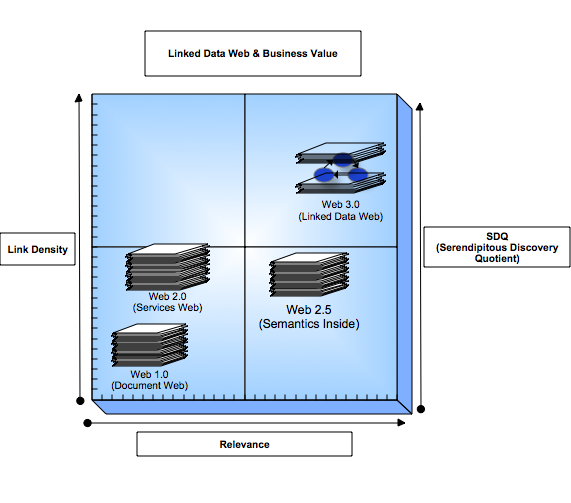
<p>Understanding potential <a href="http://dbpedia.org/resource/Linked_Data" id="link-id19e21c60">Linked Data</a> <a href="http://dbpedia.org/resource/Giant_Global_Graph" id="link-id16d008d0">Web</a> business models, relative to other Web based market segments, is best pursued via a<a href="http://dbpedia.org/resource/BCG_diagram" id="link-id14734148"> BCG Matrix</a> diagram, such as the one I&#39;ve constructed below:</p>
<br />
<img src="http://virtuoso.openlinksw.com/ldp_presentation/images/linked_data_sdq_quadarant.png" />
<br />

<h3>Notes:</h3>

<h4>Link Density</h4>
<ul>
<li>Web 1.0&#39;s collection of &quot;Web Sites&quot; have relatively low link density relative to Web 2.0&#39;s user-activity driven generation of semi-structured <a href="http://dbpedia.org/resource/Linked_Data" id="link-id14c302d8">linked data</a> spaces (e.g., Blogs, Wikis, Shared Bookmarks, RSS/Atom Feeds, Photo Galleries, Discussion Forums etc..)</li>
<li>Semantic Technologies (i.e. &quot;<strong>Semantics Inside</strong> style solutions&quot;) which are primarily about &quot;Semantic Meaning&quot; culled from Web 1.0 Pages also have limited linked density relative to Web 2.0</li>
<li>The <a href="http://dbpedia.org/resource/Linked_Data" id="link-id1286ab58">Linked Data</a> <a href="http://dbpedia.org/resource/Giant_Global_Graph" id="link-ide81ab20">Web</a>, courtesy of the open-ended  linking capacity of URIs, matches and ultimately exceeds Web 2.0 link density.</li>
</ul>


<h4>Relevance</h4>
<ul>
<li>Web 1.0 and 2.0 are low relevance realms driven by hyperlinks to <a href="http://dbpedia.org/resource/Information" id="link-id173db890">information</a> resources ((X)HTML, RSS, Atom, OPML, XML, Images, Audio files etc.) associated with Literal Labels and Tagging schemes devoid of explicit property based resource description thereby making the pursuit of relevance mercurial at best</li>
<li>Semantic Technologies offer more relevance than Web 1.0 and 2.0 based on the increased <a href="http://dbpedia.org/resource/Context_%28language_use%29" id="link-id124de510">context</a> that semantic analysis of Web pages accords</li>
<li>The <a href="http://dbpedia.org/resource/Linked_Data" id="link-id111c4850">Linked Data</a> <a href="http://dbpedia.org/resource/Giant_Global_Graph" id="link-id16e4e4c0">Web</a>, courtesy of URIs that expose self-describing data entities, match the relevance levels attained by Semantic Technologies.</li>
</ul>

<h4>Serendipity Quotient (SDQ)</h4>

<ul>
<li>Web 1.0 has next to no serendipity, the closest thing is <a href="http://google.com" id="link-id16dceec8">Google&#39;s &quot;I&#39;m Feeling Lucky&quot; button</a>
</li>
<li>Web 2.0 possess higher potential for serendipitous discovery than Web 1.0, but such potential is neutralized by inherent subjectivity due to its human-interaction-focused literal foundation (e.g., tags, voting schemes, wiki editors etc.)</li>
<li>Semantic Technologies produce islands-of-relevance with little scope for serendipitous discovery due to <a href="http://dbpedia.org/resource/Uniform_Resource_Identifier" id="link-id18078e60">URI</a> invisibility, since the prime focus is delivering more <a href="http://dbpedia.org/resource/Context_%28language_use%29" id="link-id1253cc38">context</a> to Web search relative to traditional Web 1.0 search engines.</li>
<li>The <a href="http://dbpedia.org/resource/Linked_Data" id="link-id0x201d0ae8">Linked Data</a> <a href="http://dbpedia.org/resource/Giant_Global_Graph" id="link-id10c7fb70">Web</a>&#39;s use of URIs as the naming and resolution mechanism for exposing structured and interlinked resources provides the highest potential for serendipitous discovery of relevant &quot;Things&quot;</li>
</ul> 
<p>To conclude, the <a href="http://dbpedia.org/resource/Linked_Data">Linked Data</a> <a href="http://dbpedia.org/resource/Giant_Global_Graph" id="link-id0x23ebbf90">Web</a>&#39;s market opportunities are all about the evolution of the Web into a powerful substrate that offers a unique intersection of &quot;Link Density&quot; and &quot;Relevance&quot;, exploitable across horizontal and vertical market segments to solutions providers. Put differently, SDQ is how you take &quot;The Ad&quot; out of &quot;Advertising&quot; when matching Web users to relevant things :-)</p>]]></content:encoded>
 </rss:item>
 <rss:item xmlns:rss="http://purl.org/rss/1.0/" rdf:about="http://www.openlinksw.com:443/blog/kidehen@openlinksw.com/blog/?date=2008-08-27#1424">
  <rss:title>Crunchbase &amp; Semantic Web Interview (Remix - Update 1)</rss:title>
  <dc:date xmlns:dc="http://purl.org/dc/elements/1.1/">2008-08-27T18:16:37Z</dc:date>
  <dc:description xmlns:dc="http://purl.org/dc/elements/1.1/">After reading Bengee&#39;s interview with CrunchBase, I decided to knock up a quick interview remix as part of my usual attempt to add to the developing discourse. CrunchBase: When we released the CrunchBase API, you were one of the first developers to step up and quickly released a CrunchBase Sponger Cartridge. Can you explain what a CrunchBase Sponger Cartridge is? Me: A Sponger Cartridge is a data access driver for Web Resources that plugs into our Virtuoso Universal Server (DBMS and Linked Data Web Server combo amongst other things). It uses the internal structure of a resource and/or a web service associated with a resource, to materialize an RDF based Linked Data graph that essentially describes the resource via its properties (Attributes &amp; Relationships). CrunchBase: And what inspired you to create it? Me: Bengee built a new space with your data, and we&#39;ve built a space on the fly from your data which still resides in your domain. Either solution extols the virtues of Linked Data i.e. the ability to explore relationships across data items with high degrees of serendipity (also colloquially known as: following-your-nose pattern in Semantic Web circles). Bengee posted a notice to the Linking Open Data Community&#39;s public mailing list announcing his effort. Bearing in mind the fact that we&#39;ve been using middleware to mesh the realms of Web 2.0 and the Linked Data Web for a while, it was a no-brainer to knock something up based on the conceptual similarities between Wikicompany and CrunchBase. In a sense, a quadrant of orthogonality is what immediately came to mind re. Wikicompany, CrunchBase, Bengee&#39;s RDFization efforts, and ours. Bengee created an RDF based Linked Data warehouse based on the data exposed by your API, which is exposed via the Semantic CrunchBase data space. In our case we&#39;ve taken the &quot;RDFization on the fly&quot; approach which produces a transient Linked Data View of the CrunchBase data exposed by your APIs. Our approach is in line with our world view: all resources on the Web are data sources, and the Linked Data Web is about incorporating HTTP into the naming scheme of these data sources so that the conventional URL based hyperlinking mechanism can be used to access a structured description of a resource, which is then transmitted using a range negotiable representation formats. In addition, based on the fact that we house and publish a lot of Linked Data on the Web (e.g. DBpedia, PingTheSemanticWeb, and others), we&#39;ve also automatically meshed Crunchbase data with related data in DBpedia and Wikicompany data. CrunchBase: Do you know of any apps that are using CrunchBase Cartridge to enhance their functionality? Me: Yes, the OpenLink Data Explorer which provides CrunchBase site visitors with the option to explore the Linked Data in the CrunchBase data space. It also allows them to &quot;Mesh&quot; (rather than &quot;Mash&quot;) CrunchBase data with other Linked Data sources on the Web without writing a single line of code. CrunchBase: You have been immersed in the Semantic Web movement for a while now. How did you first get interested in the Semantic Web? Me: We saw the Semantic Web as a vehicle for standardizing conceptual views of heterogeneous data sources via context lenses (URIs). In 1998 as part of our strategy to expand our business beyond the development and deployment of ODBC, JDBC, and OLE-DB data providers, we decided to build a Virtual Database Engine (see: Virtuoso History), and in doing so we sought a standards based mechanism for the conceptual output of the data virtualization effort. As of the time of the seminal unveiling of the Semantic Web in 1998 we were clear about two things, in relation to the effects of the Web and Internet data management infrastructure inflections: 1) Existing DBMS technology had reached it limits 2) Web Servers would ultimately hit their functional limits. These fundamental realities compelled us to develop Virtuoso with an eye to leveraging the Semantic Web as a vehicle from completing its technical roadmap. CrunchBase: Can you put into laymanâs terms exactly what RDF and SPARQL are and why they are important? Do they only matter for developers or will they extend past developers at some point and be used by website visitors as well? Me: RDF (Resource Description Framework) is a Graph based Data Model that facilitates resource description using the Subject, Predicate, and Object principle. Associated with the core data model, as part of the overall framework, are a number of markup languages for expressing your descriptions (just as you express presentation markup semantics in HTML or document structure semantics in XML) that include: RDFa (simple extension of HTML markup for embedding descriptions of things in a page), N3 (a human friendly markup for describing resources), RDF/XML (a machine friendly markup for describing resources). SPARQL is the query language associated with the RDF Data Model, just as SQL is a query language associated with the Relational Database Model. Thus, when you have RDF based structured and linked data on the Web, you can query against Web using SPARQL just as you would against an Oracle/SQL Server/DB2/Informix/Ingres/MySQL/etc.. DBMS using SQL. That&#39;s it in a nutshell. CrunchBase: On your website you wrote that âRDF and SPARQL as productivity boosters in everyday web developmentâ. Can you elaborate on why you believe that to be true? Me: I think the ability to discern a formal description of anything via its discrete properties is of immense value re. productivity, especially when the capability in question results in a graph of Linked Data that isn&#39;t confined to a specific host operating system, database engine, application or service, programming language, or development framework. RDF Linked Data is about infrastructure for the true materialization of the &quot;Information at Your Fingertips&quot; vision of yore. Even though it&#39;s taken the emergence of RDF Linked Data to make the aforementioned vision tractable, the comprehension of the vision&#39;s intrinsic value have been clear for a very long time. Most organizations and/or individuals are quite familiar with the adage: Knowledge is Power, well there isn&#39;t any knowledge without accessible Information, and there isn&#39;t any accessible Information without accessible Data. The Web has always be grounded in accessibility to data (albeit via compound container documents called Web Pages). Bottom line, RDF based Linked Data is about Open Data access by reference using URIs (HTTP based Entity IDs / Data Object IDs / Data Source Names), and as I said earlier, the intrinsic value is pretty obvious bearing in mind the costs associated with integrating disparate and heterogeneous data sources -- across intranets, extranets, and the Internet. CrunchBase: In his definition of Web 3.0, Nova Spivack proposes that the Semantic Web, or Semantic Web technologies, will be force behind much of the innovation that will occur during Web 3.0. Do you agree with Nova Spivack? What role, if any, do you feel the Semantic Web will play in Web 3.0? Me: I agree with Nova. But I see Web 3.0 as a phase within the Semantic Web innovation continuum. Web 3.0 exists because Web 2.0 exists. Both of these Web versions express usage and technology focus patterns. Web 2.0 is about the use of Open Source technologies to fashion Web Services that are ultimately used to drive proprietary Software as Service (SaaS) style solutions. Web 3.0 is about the use of &quot;Smart Data Access&quot; to fashion a new generation of Linked Data aware Web Services and solutions that exploit the federated nature of the Web to maximum effect; proprietary branding will simply be conveyed via quality of data (cleanliness, context fidelity, and comprehension of privacy) exposed by URIs. Here are some examples of the CrunchBase Linked Data Space, as projected via our CruncBase Sponger Cartridge: Amazon.com Microsoft Google Apple</dc:description>
  <content:encoded xmlns:content="http://purl.org/rss/1.0/modules/content/"><![CDATA[<p>After reading <a href="http://blog.crunchbase.com/2008/08/26/building-a-semantic-web-interview-with-benjamin-nowack/" id="link-id16b8e0e0">Bengee&#39;s interview with CrunchBase</a>, I decided to knock up a quick interview remix as part of my usual attempt to add to the developing discourse.</p>
<blockquote>
<cite><a href="http://www.crunchbase.com/" id="link-id17c8e7b8">CrunchBase</a>: When we released the <a href="http://www.crunchbase.com/help/api" id="link-id16681f68">CrunchBase API</a>, you were one of the first developers to step up and quickly released a <a href="http://www.openlinksw.com/dataspace/kidehen@openlinksw.com/weblog/kidehen@openlinksw.com's%20BLOG%20%5B127%5D/1395" id="link-id1016d5f0">CrunchBase Sponger Cartridge</a>. Can you explain what a CrunchBase Sponger Cartridge is?</cite>
</blockquote>

<blockquote>
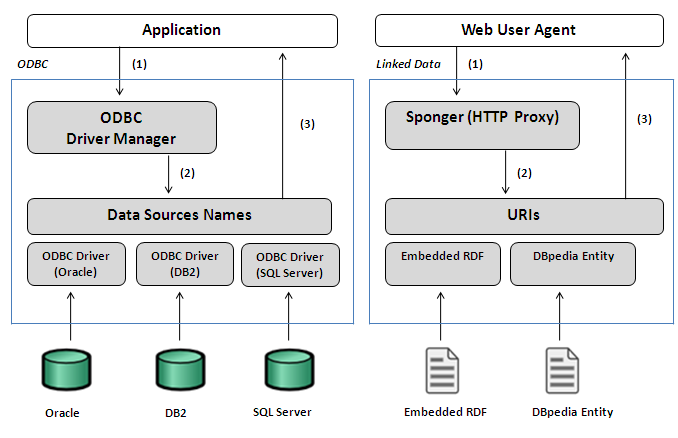
<a href="http://myopenlink.net/dataspace/person/kidehen#this" id="link-id13243300">Me</a>: A Sponger Cartridge is a <a href="http://dbpedia.org/resource/Data">data</a> access driver for <a href="http://dbpedia.org/resource/World_Wide_Web">Web</a> Resources that plugs into our <a href="http://virtuoso.openlinksw.com" id="link-id17042f08">Virtuoso</a> <a href="http://dbpedia.org/resource/Virtuoso_Universal_Server" id="link-id1399b588">Universal Server</a> (DBMS and <a href="http://dbpedia.org/resource/Linked_Data" id="link-id137fd188">Linked Data</a> <a href="http://dbpedia.org/resource/Giant_Global_Graph" id="link-id100b23d8">Web</a> Server combo amongst other things). It uses the internal structure of a resource and/or a web service associated with a resource, to materialize an RDF based <a href="http://dbpedia.org/resource/Resource_Description_Framework" id="link-id10418750">Linked Data graph</a> that essentially describes the resource via its properties (Attributes &amp; Relationships).
</blockquote>
<br />
<img src="http://virtuoso.openlinksw.com/presentations/Creating_Deploying_Exploiting_Linked_Data2/images/ldp4.png" />
<br />
<br />
<br />
<blockquote>
<cite>CrunchBase: And what inspired you to create it?</cite>
</blockquote>
<blockquote>
<a href="http://myopenlink.net/dataspace/person/kidehen#this" id="link-id12fa60c0">Me</a>: Bengee built a new space with your data, and we&#39;ve built a space on the fly from your data which still resides in your domain. Either solution extols the virtues of <a href="http://dbpedia.org/resource/Linked_Data" id="link-id101a8d28">Linked Data</a> i.e. the ability to explore relationships across data items with high degrees of serendipity (also colloquially known as: following-your-nose pattern in <a href="http://dbpedia.org/resource/Semantic_Web" id="link-id14a3ff30">Semantic Web</a> circles).</blockquote>

<blockquote>
<a href="http://cb.semsol.org/" id="link-id182a0170">Bengee</a> posted a notice to the <a href="http://esw.w3.org/topic/SweoIG/TaskForces/CommunityProjects/LinkingOpenData" id="link-id131e8d10">Linking Open Data Community</a>&#39;s public <a href="http://lists.w3.org/Archives/Public/public-lod/2008Jul/0110.html" id="link-id11dd0720">mailing list announcing his effort</a>. Bearing in mind the fact that we&#39;ve been using <a href="http://www.openlinksw.com/blog/~kidehen/?id=1144" id="link-id117cf6e8">middleware to mesh the realms of Web 2.0 and the Linked Data Web</a> for a while, it was a no-brainer to knock something up based on the conceptual similarities between <a href="http://wikicompany.org/wiki/Main_Page" id="link-id13b87a68">Wikicompany</a> and CrunchBase. In a sense, a quadrant of orthogonality is what immediately came to mind re. Wikicompany, CrunchBase, Bengee&#39;s RDFization efforts, and ours.</blockquote>

<blockquote>Bengee created an RDF based <a href="http://dbpedia.org/resource/Linked_Data" id="link-id133c8fc8">Linked Data</a> warehouse based on the data exposed by your API, which is exposed via the <a href="http://cb.semsol.org/" id="link-id1826f928">Semantic CrunchBase</a> <a href="http://en.wikipedia.org/wiki/Data_Spaces" id="link-id102d8890">data space</a>. In our case we&#39;ve taken the &quot;RDFization on the fly&quot; approach which produces a transient <a href="http://dbpedia.org/resource/Linked_Data" id="link-id16a0b8d0">Linked Data</a> View of the CrunchBase data exposed by your APIs. Our approach is in line with our world view: all resources on the Web are data sources, and the <a href="http://dbpedia.org/resource/Linked_Data" id="link-id1668e6c8">Linked Data</a> <a href="http://dbpedia.org/resource/Giant_Global_Graph" id="link-id188e7da0">Web</a> is about incorporating HTTP into the  naming scheme of these data sources so that the conventional <a href="http://dbpedia.org/resource/Uniform_Resource_Locator" id="link-id13490710">URL</a> based hyperlinking mechanism can be used to access a structured description of a resource, which is then transmitted using a range negotiable representation formats. In addition, based on the fact that we house and publish a lot of <a href="http://dbpedia.org/resource/Linked_Data" id="link-id169aa568">Linked Data</a> on the Web (e.g. <a href="http://dbpedia.org/resource/DBpedia" id="link-id10af10e8">DBpedia</a>, <a href="http://www.pingthesemanticweb.com/about/" id="link-id10a2b710">PingTheSemanticWeb</a>, and others), we&#39;ve also automatically meshed Crunchbase data with related data in <a href="http://dbpedia.org/resource/DBpedia" id="link-id1403cd40">DBpedia</a> and Wikicompany data.</blockquote> 
<br />

<blockquote>
<cite>CrunchBase: Do you know of any apps that are using CrunchBase Cartridge to enhance their functionality?</cite>
</blockquote>
<blockquote>
<a href="http://myopenlink.net/dataspace/person/kidehen#this" id="link-id177d24c8">Me</a>: Yes, the <a href="http://ode.openlinksw.com" id="link-id10725ca0">OpenLink Data Explorer</a> which provides CrunchBase site visitors with the option to explore the <a href="http://dbpedia.org/resource/Linked_Data" id="link-id17dedea8">Linked Data</a> in the CrunchBase <a href="http://en.wikipedia.org/wiki/Data_Spaces" id="link-id13f02a00">data space</a>. It also allows them to &quot;Mesh&quot; (rather than &quot;Mash&quot;) CrunchBase data with other <a href="http://dbpedia.org/resource/Linked_Data" id="link-id11fb3ba0">Linked Data</a> sources on the Web without writing a single line of code. </blockquote>
<br />

<blockquote>
<cite>CrunchBase: You have been immersed in the <a href="http://dbpedia.org/resource/Semantic_Web" id="link-id12e18a00">Semantic Web</a> movement for a while now. How did you first get interested in the <a href="http://dbpedia.org/resource/Semantic_Web" id="link-id15132110">Semantic Web</a>?</cite>
</blockquote>
<blockquote>
<a href="http://myopenlink.net/dataspace/person/kidehen#this" id="link-id0xddaa9c8">Me</a>: We saw the <a href="http://dbpedia.org/resource/Semantic_Web" id="link-id188b3330">Semantic Web</a> as a vehicle for standardizing conceptual views of heterogeneous data sources via <a href="http://dbpedia.org/resource/Context_%28language_use%29" id="link-id10350978">context</a> lenses (URIs). In 1998 as part of our strategy to expand our business beyond the development and deployment of <a href="http://dbpedia.org/resource/Open_Database_Connectivity" id="link-id171d6798">ODBC</a>, <a href="http://dbpedia.org/resource/Java_Database_Connectivity" id="link-id138120a0">JDBC</a>, and OLE-DB data providers, we decided to build a <a href="http://dbpedia.org/resource/Virtual_Database" id="link-id13ea6618">Virtual Database</a> Engine (see: <a href="http://virtuoso.openlinksw.com/dataspace/dav/wiki/Main/VOSHistory" id="link-id11a4fa30">Virtuoso History</a>), and in doing so we sought a standards based mechanism for the conceptual output of the <a href="http://dbpedia.org/resource/Federated_database_system" id="link-id101a1248">data virtualization</a> effort. As of the time of the <a href="http://www.w3.org/DesignIssues/Semantic.html" id="link-id18882cf8">seminal unveiling of the Semantic Web in 1998</a> we were clear about two things, in relation to the effects of the Web and <a href="http://dbpedia.org/resource/Internet" id="link-id12fa2c58">Internet</a> data management infrastructure inflections: 1) Existing DBMS technology had reached it limits 2) Web Servers would ultimately hit their functional limits. These fundamental realities compelled us to develop <a href="http://virtuoso.openlinksw.com" id="link-id102b09a0">Virtuoso</a> with an eye to leveraging the <a href="http://dbpedia.org/resource/Semantic_Web" id="link-id11984d98">Semantic Web</a> as a vehicle from completing its technical roadmap.</blockquote>
<br />

<blockquote>
<cite>CrunchBase: Can you put into laymanâs terms exactly what RDF and <a href="http://dbpedia.org/resource/SPARQL" id="link-id1066dcf0">SPARQL</a> are and why they are important? Do they only matter for developers or will they extend past developers at some point and be used by website visitors as well?</cite>
</blockquote>
<blockquote>Me: RDF (Resource Description Framework) is a Graph based Data Model that facilitates resource description using the <a href="http://www.eslincanada.com/englishlesson2.html" id="link-id178b94a8">Subject, Predicate, and Object principle</a>. Associated with the core data model, as part of the overall framework,  are a number of markup languages for expressing your descriptions (just as you express presentation markup semantics in HTML or document structure semantics in XML) that include: <a href="http://dbpedia.org/resource/RDFa" id="link-id188db0a8">RDFa</a> (simple extension of HTML markup for embedding descriptions of things in a page), N3 (a human friendly markup for describing resources), RDF/XML (a machine friendly markup for describing resources).</blockquote> 
<blockquote>
<a href="http://dbpedia.org/resource/SPARQL" id="link-id188c2030">SPARQL</a> is the query language associated with the RDF Data Model, just as <a href="http://dbpedia.org/resource/SQL" id="link-id13f0ffe0">SQL</a> is a query language associated with the Relational Database Model. Thus, when you have RDF based structured and <a href="http://dbpedia.org/resource/Linked_Data" id="link-id166874d0">linked data</a> on the Web, you can query against Web using <a href="http://dbpedia.org/resource/SPARQL" id="link-id1016cc98">SPARQL</a> just as you would against an <a href="http://dbpedia.org/resource/Oracle_Database" id="link-id101c9708">Oracle</a>/<a href="http://dbpedia.org/resource/SQL" id="link-id11cb0b18">SQL</a> Server/<a href="http://dbpedia.org/resource/IBM_DB2" id="link-id10760ec0">DB2</a>/<a href="http://dbpedia.org/resource/IBM_Informix" id="link-id1066c8c0">Informix</a>/<a href="http://dbpedia.org/resource/Ingres" id="link-id18894f40">Ingres</a>/<a href="http://dbpedia.org/resource/MySQL" id="link-iddc9ebb0">MySQL</a>/etc.. DBMS using <a href="http://dbpedia.org/resource/SQL" id="link-id1030d120">SQL</a>. That&#39;s it in a nutshell.</blockquote>
<br />

<blockquote>
<cite>CrunchBase: On your website you wrote that âRDF and <a href="http://dbpedia.org/resource/SPARQL" id="link-id168e9ad0">SPARQL</a> as productivity boosters in everyday web developmentâ. Can you elaborate on why you believe that to be true?</cite>
</blockquote>
<blockquote>Me: I think the ability to discern a formal description of anything via its discrete properties is of immense value re. productivity, especially when the capability in question results in a graph of <a href="http://dbpedia.org/resource/Linked_Data" id="link-id0x179f6328">Linked Data</a> that isn&#39;t confined to a specific host operating system, database engine, application or service, programming language, or development framework. RDF <a href="http://dbpedia.org/resource/Linked_Data">Linked Data</a> is about infrastructure for the true materialization of the &quot;<a href="http://dbpedia.org/resource/Information" id="link-id13e475b8">Information</a> at Your Fingertips&quot; vision of yore. Even though it&#39;s taken the emergence of RDF Linked Data to make the aforementioned vision tractable, the comprehension of the vision&#39;s intrinsic value have been clear for a very long time. Most organizations and/or individuals are quite familiar with the adage: <a href="http://dbpedia.org/resource/Knowledge" id="link-id13e38a30">Knowledge</a> is Power, well there isn&#39;t any <a href="http://dbpedia.org/resource/Knowledge" id="link-id188b7348">knowledge</a> without accessible <a href="http://dbpedia.org/resource/Information" id="link-id140415d0">Information</a>, and there isn&#39;t any accessible <a href="http://dbpedia.org/resource/Information" id="link-id11a976e8">Information</a> without accessible Data. The Web has always be grounded in accessibility to data (albeit via compound container documents called Web Pages).</blockquote> <blockquote>Bottom line, RDF based Linked Data is about Open <a href="http://dbpedia.org/resource/Reference_(computer_science)" id="link-id1206bfb8">Data access by reference</a> using URIs (HTTP based <a href="http://dbpedia.org/resource/Entity" id="link-idfaa6ce0">Entity</a> IDs / Data Object IDs / Data Source Names), and as I said earlier, the intrinsic value is pretty obvious bearing in mind the costs associated with integrating disparate and heterogeneous data sources -- across intranets, extranets, and the <a href="http://dbpedia.org/resource/Internet" id="link-id188ecc68">Internet</a>.</blockquote>
<br />

<blockquote>
<cite>CrunchBase: In his definition of Web 3.0, Nova Spivack proposes that the <a href="http://dbpedia.org/resource/Semantic_Web" id="link-id12e2d968">Semantic Web</a>, or Semanti<a href="http://dbpedia.org/resource/C_(programming_language)" id="link-id105744c0">c</a> Web technologies, will be force behind much of the innovation that will occur during Web 3.0. Do you agree with Nova Spivack? What role, if any, do you feel the <a href="http://dbpedia.org/resource/Semantic_Web" id="link-id13fa4218">Semantic Web</a> will play in Web 3.0?</cite>
</blockquote>
<blockquote>Me: I agree with Nova. But I see Web 3.0 as a phase within the <a href="http://dbpedia.org/resource/Semantic_Web" id="link-id188c9000">Semantic Web</a> innovation continuum. Web 3.0 exists because Web 2.0 exists. Both of these Web versions express usage and technology focus patterns. Web 2.0 is about the use of Open Source technologies to fashion Web Services that are ultimately used to drive proprietary Software as Service (SaaS) style solutions. Web 3.0 is about the use of &quot;Smart Data Access&quot; to fashion a new generation of Linked Data aware Web Services and solutions that exploit the federated nature of the Web to maximum effect; proprietary branding will simply be conveyed via quality of data (cleanliness, <a href="http://dbpedia.org/resource/Context_%28language_use%29" id="link-id188d2ef8">context</a> fidelity, and comprehension of privacy) exposed by URIs.</blockquote>
<p>Here are some examples of the CrunchBase Linked Data <a href="http://en.wikipedia.org/wiki/Data_Spaces" id="link-id122756f8">Space</a>, as projected via our CruncBase Sponger  Cartridge:</p>
<ol>
<li>
  <a href="http://demo.openlinksw.com/rdfbrowser2/?uri=http%3A%2F%2Fwww.crunchbase.com%2Fcompany%2Famazon" id="link-id13e0fd18">Amazon.com</a>
</li>
<li>
  <a href="http://demo.openlinksw.com/rdfbrowser2/?uri=http%3A%2F%2Fwww.crunchbase.com%2Fcompany%2Fmicrosoft" id="link-id13eef9e0">Microsoft</a>
</li>
<li>
  <a href="http://demo.openlinksw.com/rdfbrowser2/?uri=http%3A%2F%2Fwww.crunchbase.com%2Fcompany%2Fgoogle" id="link-id13fe47a0">Google</a>
</li>
<li>
  <a href="http://demo.openlinksw.com/rdfbrowser2/?uri=http%3A%2F%2Fwww.crunchbase.com%2Fcompany%2Fapple" id="link-id170c73b8">Apple</a>
</li>
</ol>
]]></content:encoded>
 </rss:item>
 <rss:item xmlns:rss="http://purl.org/rss/1.0/" rdf:about="http://www.openlinksw.com:443/blog/kidehen@openlinksw.com/blog/?date=2008-08-21#1415">
  <rss:title>The Future of the Desktop</rss:title>
  <dc:date xmlns:dc="http://purl.org/dc/elements/1.1/">2008-08-21T15:26:18Z</dc:date>
  <dc:description xmlns:dc="http://purl.org/dc/elements/1.1/">Jason Kolb (who initially nudged me to chime in), and then ReadWriteWeb, and of course Nova&#39;s Twine about the topic, have collectively started an interesting discussion about Web.vNext (3.0 and beyond) under the heading: The Future of the Desktop. My contribution to the developing discourse takes the form of a Q&amp;A session. I&#39;ve taken the questions posed and provided answers that express my particular points of view: Q: Is the desktop of the future going to just be a web-hosted version of the same old-fashioned desktop metaphors we have today? A: No, it&#39;s going to be a more Web Architecture aware and compliant variant exposed by appropriate metaphors. Q: The desktop of the future is going to be a hosted web service A: A vessel for exploiting the virtues of the Linked Data Web. Q: The Browser is Going to Swallow Up the Desktop A: Literally, of course not! Metaphorically, of course! And then the Browser metaphor will decomposes into function specific bits of Web interaction amenable to orchestration by its users. Q: The focus of the desktop will shift from information to attention A: No! Knowledge, Information, and Data sharing courtesy of Hyperdata &amp; Hypertext Linking. Q: Users are going to shift from acting as librarians to acting as daytraders A: They were Librarians at Web 1.0, Journalist at Web 2.0, and Analysts in Web 3.0 (i.e, analyze structured and interlinked data), and CEOs in Web 4.0 (i.e. get Agents to do stuff intelligently en route to making decisions). Q: The Webtop will be more social and will leverage and integrate collective intelligence A: The Linked Data Web vessel will only require you to fill in your profile (once) and then serendipitous discovery and meshing of relevant data will simply happen (the serendipity quotient will grow in line with Linked Data Web density). Q: The desktop of the future is going to have powerful semantic search and social search capabilities built-in A: It is going to be able to &quot;Find&quot; rather than &quot;Search&quot; for stuff courtesy of the Linked Data Web. Q: Interactive shared spaces will replace folders A: Data Spaces and their URIs (Data Source Names) replace everything. You simply choose the exploration metaphor that best suits you space interaction needs. Q: The Portable Desktop A: Ubiquitous Desktop i.e. do the same thing (all answers above) on any device connected to the Web. Q: The Smart Desktop A: Vessels with access to Smart Data (Linked Data + Action driven Context sprinklings). Q: Federated, open policies and permissions A: More federation for sure, XMPP will become a lot more important, and OAuth will enable resurgence of the federated aspects of the Web and Internet. Q: The personal cloud A: Personal Data Spaces plugged into Clouds (Intranet, Extranet, Internet). Q: The WebOS A: An operating system endowed with traditional Database and Host Operating system functionality such as: RDF Data Model, SPARQL Query Language, URI based Pointer mechanism, and HTTP based message Bus. Q: Who is most likely to own the future desktop? A: You! And all you need is a URI (an ID or Data Source Name for &quot;Entity You&quot;) and a Profile Page (a place where &quot;Entity You&quot; is Describe by You). One Last Thing You can get a feel for the future desktop by downloading and then installing the OpenLink Data Explorer plugin for Firefox, which allows you to switch viewing modes between Web Page and Linked Data behind the page. :-) Related OpenLink Data Spaces Get Yourself a URI in 5 Minutes or Less Linked Data Spaces &amp; Data Portability Linked Data Conference Keynote (RDFa based remix edition that includes vital bits from TimBL&#39;s Linked Data Planet presentation).</dc:description>
  <content:encoded xmlns:content="http://purl.org/rss/1.0/modules/content/"><![CDATA[<p>
<a href="http://www.jasonkolb.com/" id="link-id13ba6d90">Jason Kolb</a> (who <a href="http://www.jasonkolb.com/weblog/2008/08/the-future-of-t.html" id="link-id1524e210">initially</a> nudged me to chime in), and then <a href="http://www.readwriteweb.com/archives/future_of_the_desktop.php" id="link-id13a182c0">ReadWriteWeb</a>, and of course <a href="http://www.twine.com/item/11bshgkbr-1k5/the-future-of-the-desktop" id="link-id13f1e1f0">Nova&#39;s Twine about the topic</a>, have collectively started an interesting discussion about <a href="http://dbpedia.org/resource/World_Wide_Web">Web</a>.vNext (3.0 and beyond) under the heading: The Future of the Desktop.</p>

<p>My contribution to the developing discourse takes the form of a Q&amp;A session. I&#39;ve taken the questions posed and provided answers that express my particular points of view:
</p>
<blockquote>
<cite>Q: Is the desktop of the future going to just be a web-hosted version of the same old-fashioned desktop metaphors we have today?</cite>
</blockquote>
<blockquote>A: No, it&#39;s going to be a more <a href="http://www.w3.org/TR/webarch/" id="link-id1524d4a0">Web Architecture</a> aware and compliant variant exposed by appropriate metaphors.</blockquote>
<br />

<blockquote>
<cite>Q: The desktop of the future is going to be a hosted web service</cite>
</blockquote>
<blockquote>A: A vessel for exploiting the virtues of the <a href="http://dbpedia.org/resource/Linked_Data" id="link-id10827ad0">Linked Data</a> <a href="http://dbpedia.org/resource/Giant_Global_Graph" id="link-id155bc698">Web</a>.</blockquote>
<br />
<blockquote>
<cite>Q: The Browser is Going to Swallow Up the Desktop</cite>
</blockquote>
<blockquote>A: Literally, of course not! Metaphorically, of course! And then the Browser metaphor will decomposes into function specific bits of Web interaction amenable to orchestration by its users.</blockquote>
<br />
<blockquote>
<cite>Q: The focus of the desktop will shift from <a href="http://dbpedia.org/resource/Information" id="link-id1667e2e0">information</a> to attention</cite>
</blockquote>
<blockquote>A: No! <a href="http://dbpedia.org/resource/Knowledge" id="link-id104bb9c8">Knowledge</a>, <a href="http://dbpedia.org/resource/Information" id="link-id1524dd48">Information</a>, and <a href="http://dbpedia.org/resource/Data">Data</a> sharing courtesy of <a href="http://dbpedia.org/resource/Linked_Data" id="link-id10723640">Hyperdata</a> &amp; Hypertext Linking.</blockquote>
<br />
<blockquote>
<cite>Q: Users are going to shift from acting as librarians to acting as daytraders</cite>
</blockquote>
<blockquote>A: They were Librarians at Web 1.0, Journalist at Web 2.0, and Analysts in Web 3.0 (i.e, analyze structured and interlinked data), and CEOs in Web 4.0 (i.e. get Agents to do stuff intelligently en route to making decisions).</blockquote>
<blockquote>
<br />
<cite>Q: The Webtop will be more social and will leverage and integrate collective intelligence</cite>
</blockquote>
<blockquote>A: The <a href="http://dbpedia.org/resource/Linked_Data" id="link-id13a01ed0">Linked Data</a> <a href="http://dbpedia.org/resource/Giant_Global_Graph" id="link-id106343a8">Web</a> vessel will only require you to fill in your profile (once) and then serendipitous discovery and meshing of relevant data will simply happen (the serendipity quotient will grow in line with <a href="http://dbpedia.org/resource/Linked_Data" id="link-id10560050">Linked Data</a> <a href="http://dbpedia.org/resource/Giant_Global_Graph" id="link-id100f4940">Web</a> density).</blockquote>
<br />
<blockquote>
<cite>Q: The desktop of the future is going to have powerful semantic search and social search capabilities built-in</cite>
</blockquote>
<blockquote>A: It is going to be able to &quot;Find&quot; rather than &quot;Search&quot; for stuff courtesy of the <a href="http://dbpedia.org/resource/Linked_Data" id="link-id10a18a70">Linked Data</a> <a href="http://dbpedia.org/resource/Giant_Global_Graph" id="link-id10a976f0">Web</a>.</blockquote>
<br />
<blockquote>
<cite>
Q: Interactive shared spaces will replace folders</cite>
</blockquote>
<blockquote>A: Data Spaces and their URIs (Data Source Names) replace everything. You simply choose the exploration metaphor that best suits you space interaction needs.</blockquote>
<br />
<blockquote>
<cite>Q: The Portable Desktop</cite>
</blockquote>
<blockquote>A: Ubiquitous Desktop i.e. do the same thing (all answers above) on any device connected to the Web.</blockquote>
<br />
<blockquote>
<cite>Q: The Smart Desktop</cite>
</blockquote>
<blockquote>A: Vessels with access to Smart Data (<a href="http://dbpedia.org/resource/Linked_Data" id="link-id1666e4e8">Linked Data</a> + Action driven <a href="http://dbpedia.org/resource/Context_%28language_use%29" id="link-id171d1ff0">Context</a> sprinklings).</blockquote>
<br />
<blockquote>
<cite>Q: Federated, open policies and permissions</cite>
</blockquote>
<blockquote>A: More federation for sure, XMPP will become a lot more important, and OAuth will enable resurgence of the federated aspects of the Web and <a href="http://dbpedia.org/resource/Internet" id="link-id100a66a8">Internet</a>.</blockquote>
<br />
<blockquote>
<cite>Q: The personal cloud</cite>
</blockquote>
<blockquote>A: <a href="http://dbpedia.org/resource/OpenLink_Data_Spaces" id="link-id104ba580">Personal Data Spaces</a> plugged into Clouds (<a href="http://dbpedia.org/resource/Intranet" id="link-id15bbb970">Intranet</a>, <a href="http://dbpedia.org/resource/Extranet" id="link-id1026d6b0">Extranet</a>, <a href="http://dbpedia.org/resource/Internet" id="link-id140508c8">Internet</a>).</blockquote>
<br />
<blockquote>
<cite>Q: The WebOS</cite>
</blockquote>
<blockquote>A: An operating system endowed with traditional Database and Host Operating system functionality such as: RDF Data Model, <a href="http://dbpedia.org/resource/SPARQL" id="link-idd86f48">SPARQL</a> Query Language, <a href="http://dbpedia.org/resource/Uniform_Resource_Identifier" id="link-id13f47268">URI</a> based <a href="http://en.wikipedia.org/wiki/Pointer" id="link-id1055bc78">Pointer mechanism</a>, and HTTP based message Bus.</blockquote>
<br />
<blockquote>
<cite>Q: Who is most likely to own the future desktop?</cite>
</blockquote>
<blockquote>A: You! And all you need is a <a href="http://dbpedia.org/resource/Uniform_Resource_Identifier" id="link-id106b79e8">URI</a> (an ID or Data Source Name for &quot;<a href="http://dbpedia.org/resource/Entity" id="link-id133c88a0">Entity</a> You&quot;) and a Profile Page (a place where &quot;<a href="http://dbpedia.org/resource/Entity" id="link-id15fa8060">Entity</a> You&quot; is Describe by You).</blockquote>
<h3>One Last Thing</h3>
<p>You can get a feel for the future desktop by <a href="http://ode.openlinksw.com/#Download" id="link-id165ec048">downloading</a> and then installing the <a href="http://ode.openlinksw.com/" id="link-id13baba38">OpenLink Data Explorer</a> plugin for Firefox, which allows you to switch viewing modes between Web Page and <a href="http://dbpedia.org/resource/Linked_Data" id="link-id13f12410">Linked Data</a> behind the page. :-)</p>
<h3>Related</h3>
<ul>
<li>
  <a href="http://en.wikipedia.org/wiki/OpenLink_Data_Spaces" id="link-id12496e48">OpenLink Data Spaces</a>
</li>
<li>
  <a href="http://virtuoso.openlinksw.com/dataspace/dav/wiki/Main/GetAPersonalURIIn5MinutesOrLess" id="link-id1027f060">Get Yourself a URI in 5 Minutes or Less</a>
</li>
<li>
  <a href="http://virtuoso.openlinksw.com/presentations/DataPortability_and_DataSpaces/DataPortability_and_DataSpaces.html" id="link-id10890f70">Linked Data Spaces &amp; Data Portability</a>
</li>
<li>
  <a href="http://virtuoso.openlinksw.com/presentations/Creating_Deploying_Exploiting_Linked_Data2/Creating_Deploying_Exploiting_Linked_Data2_TimBL_v3.html" id="link-id137efdf8">Linked Data Conference Keynote</a> (<a href="http://dbpedia.org/resource/RDFa" id="link-id1239d300">RDFa</a> based remix edition that includes vital bits from <a href="http://www.w3.org/People/Berners-Lee/card#i" id="link-id1317a048">TimBL</a>&#39;s <a href="http://www.linkeddataplanet.com/" id="link-id165f57c8">Linked Data Planet presentation</a>).</li>
</ul>
]]></content:encoded>
 </rss:item>
 <rss:item xmlns:rss="http://purl.org/rss/1.0/" rdf:about="http://www.openlinksw.com:443/blog/kidehen@openlinksw.com/blog/?date=2008-05-20#1364">
  <rss:title>ODBC &amp; WODBC Comparison</rss:title>
  <dc:date xmlns:dc="http://purl.org/dc/elements/1.1/">2008-05-20T19:37:53Z</dc:date>
  <dc:description xmlns:dc="http://purl.org/dc/elements/1.1/">ODBC delivers open data access (by reference) to a broad range of enterprise databases via a &#39;C&#39; based API. Thanks to the iODBC and unixODBC projects, ODBC is available across broad range of platforms beyond Windows. ODBC identifies data sources using Data Source Names (DSNs). WODBC (Web Open Database Connectivity) delivers open data access to Web Databases / Data Spaces. The Data Source Naming scheme: URI or IRI, is HTTP based thereby enabling data access by reference via the Web. ODBC DSNs bind ODBC client applications to Tables, Views, Stored Procedures. WODBC DSNs bind you to a Data Space (e.g. my FOAF based Profile Page where you can use the &quot;Explore Data Tab&quot; to look around if you are a human visitor) or a specific Entity within a Data Space (i.e Person Entity Me). ODBC Drivers are built using APIs (DBMS Call Level Interfaces) provided by DBMS vendors. Thus, a DBMS vendor can chose not to release an API, or do so selectivity, for competitive advantage or market disruption purposes (it&#39;s happened!). WODBC Drivers are also built using APIs (Web Services associated with a Web Data Space). These drivers are also referred to as RDF Middleware or RDFizers. The &quot;Web&quot; component of WODBC ensures openness, you publish Data with URIs from your Linked Data Server and that&#39;s it; your data space or specific data entities are live and accessible (by reference) over the Web! So we have come full circle (or cycle), the Web is becoming more of a structured database everyday! What&#39;s new is old, and what&#39;s old is new! Data Access is everything, without &quot;Data&quot; there is no information or knowledge. Without &quot;Data&quot; there&#39;s not notion of vitality, purpose, or value. URIs make or break everything in the Linked Data Web just as ODBC DSNs do within the enterprise. I&#39;ve deliberately left JDBC, ADO.NET, and OLE-DB out of this piece due to their respective programming languages and frameworks specificity. None of these mechanisms match the platform availability breadth of ODBC. The Web as a true M-V-C pattern is now crystalizing. The &quot;M&quot; (Model) component of M-V-C is finally rising to the realm of broad attention courtesy of the &quot;Linked Data&quot; meme and &quot;Semantic Web&quot; vision. By the way, M-V-C lines up nicely with Web 1.0 (Web Forms / Pages), Web 2.0 (Web Services based APIs), and Web 3.0 (Data Web, Web of Data, or Linked Data Web) :-)</dc:description>
  <content:encoded xmlns:content="http://purl.org/rss/1.0/modules/content/"><![CDATA[<p>
<a href="http://dbpedia.org/resource/Open_Database_Connectivity" id="link-id100eb550">ODBC</a> delivers open <a href="http://dbpedia.org/resource/Data" id="link-idffd2338">data</a> access (by reference) to a broad range of enterprise databases via  a &#39;<a href="http://dbpedia.org/resource/C_(programming_language)" id="link-id104fd1d8">C</a>&#39; based API. Thanks to the <a href="http://www.iodbc.org" id="link-id104721b0">iODBC</a> and <a href="http://www.unixodbc.org" id="link-id10954990">unixODBC</a> projects, <a href="http://dbpedia.org/resource/Open_Database_Connectivity" id="link-id10494670">ODBC</a> is available across broad range of platforms beyond Windows.</p>

<p>
<a href="http://dbpedia.org/resource/Open_Database_Connectivity" id="link-id0xc900928">ODBC</a> identifies <a href="http://dbpedia.org/resource/Data" id="link-id10f82200">data</a> sources using <a href="http://dbpedia.org/resource/Data" id="link-id0xcaad080">Data</a> Source Names (DSNs). </p>
<p>
WODBC (<a href="http://dbpedia.org/resource/World_Wide_Web">Web</a> Open Database Connectivity) delivers open <a href="http://dbpedia.org/resource/Data">data</a> access to Web Databases / Data Spaces. The Data Source Naming scheme: <a href="http://dbpedia.org/resource/Uniform_Resource_Identifier" id="link-id1009ce40">URI</a> or IRI,  is <a href="http://dbpedia.org/resource/Hypertext_Transfer_Protocol" id="link-id101fc1b0">HTTP</a> based thereby enabling data access by reference via the Web. </p>

<p><a href="http://dbpedia.org/resource/Open_Database_Connectivity">ODBC</a> DSNs bind ODBC client applications to Tables, Views, Stored Procedures. </p>

<p>WODBC DSNs bind you to a Data <a href="http://en.wikipedia.org/wiki/Data_Spaces" id="link-id10182a88">Space</a> (e.g. my <a href="http://myopenlink.net/dataspace/person/kidehen" id="link-id105a7858">FOAF based Profile Page</a> where you can use the &quot;Explore Data Tab&quot; to look around if you are a human visitor) or a specific <a href="http://dbpedia.org/resource/Entity" id="link-id10bd8578">Entity</a> within a Data <a href="http://en.wikipedia.org/wiki/Data_Spaces" id="link-id10780dc0">Space</a> (i.e <a href="http://myopenlink.net/dataspace/person/kidehen#this" id="link-id10848e08">Person Entity Me</a>).</p>

<p>ODBC Drivers are built using APIs (DBMS Call Level Interfaces) provided by DBMS vendors. Thus, a DBMS vendor can chose not to release an API, or do so selectivity, for competitive advantage or market disruption purposes (it&#39;s happened!).</p>

<p>WODBC Drivers are also built using APIs (Web Services associated with a Web Data <a href="http://en.wikipedia.org/wiki/Data_Spaces" id="link-id0xcbe6348">Space</a>). These drivers are also referred to as <a href="http://www.openlinksw.com/weblog/public/search.vspx?blogid=127&q=rdf%20middleware&type=text&output=html" id="link-id16564058">RDF Middleware</a> or RDFizers. The &quot;Web&quot; component of WODBC ensures openness, you publish Data with URIs from your <a href="http://dbpedia.org/resource/Linked_Data" id="link-id1064a768">Linked Data</a> Server and that&#39;s it; your data <a href="http://en.wikipedia.org/wiki/Data_Spaces">space</a> or specific data entities are live and accessible (by reference) over the Web!</p>

<p>So we have come full circle (or cycle), the Web is becoming more of a structured database everyday! What&#39;s new is old, and what&#39;s old is new! </p>

<p>Data Access is everything, without &quot;Data&quot; there is no <a href="http://dbpedia.org/resource/Information" id="link-id100a9de8">information</a> or <a href="http://dbpedia.org/resource/Knowledge" id="link-id10bb67e8">knowledge</a>. Without &quot;Data&quot; there&#39;s not notion of vitality, purpose, or value.</p>

<p>URIs make or break everything in the <a href="http://dbpedia.org/resource/Linked_Data" id="link-id10a71638">Linked Data</a> <a href="http://dbpedia.org/resource/Giant_Global_Graph" id="link-id10494400">Web</a> just as ODBC DSNs do within the enterprise.
</p>
<p>I&#39;ve deliberately left <a href="http://dbpedia.org/resource/Java_Database_Connectivity" id="link-id10a05280">JDBC</a>, <a href="http://dbpedia.org/resource/ADO.NET" id="link-id104e4a70">ADO</a>.<a href="http://dbpedia.org/resource/ADO.NET" id="link-id10215668">NET</a>, and OLE-DB out of this piece due to their respective programming languages and frameworks specificity. None of these mechanisms match the platform availability breadth of ODBC.</p>

<p>The Web as a true <a href="http://dbpedia.org/resource/Model-view-controller" id="link-id108ee598">M</a>-<a href="http://dbpedia.org/resource/Model-view-controller" id="link-id0xcda5e90">V</a>-C pattern is now crystalizing. The &quot;M&quot; (Model) component of M-V-C is finally rising to the realm of broad attention courtesy of the &quot;<a href="http://www.w3.org/DesignIssues/LinkedData.html" id="link-id1024ff08">Linked Data&quot; meme</a> and &quot;<a href="http://dbpedia.org/resource/Semantic_Web" id="link-id1831b418">Semantic Web</a>&quot; vision.</p>

<p>By the way, M-V-C lines up nicely with Web 1.0 (Web Forms / Pages), Web 2.0 (Web Services based APIs), and Web 3.0 (Data Web, Web of Data, or <a href="http://dbpedia.org/resource/Linked_Data" id="link-id0xb6d0e90">Linked Data</a> <a href="http://dbpedia.org/resource/Giant_Global_Graph" id="link-id0xb22a158">Web</a>) :-)</p>]]></content:encoded>
 </rss:item>
 <rss:item xmlns:rss="http://purl.org/rss/1.0/" rdf:about="http://www.openlinksw.com:443/blog/kidehen@openlinksw.com/blog/?date=2008-03-20#1324">
  <rss:title>Semantic Web Advocate of Tribe Linked Data! (Updated)</rss:title>
  <dc:date xmlns:dc="http://purl.org/dc/elements/1.1/">2008-03-20T16:03:35Z</dc:date>
  <dc:description xmlns:dc="http://purl.org/dc/elements/1.1/">These days I increasingly qualify myself and my Semantic Web advocacy as falling under the realm Linked Data. Thus, I tend to use the following introduction: I am Kingsley Idehen, of the Tribe Linked Data. The aforementioned qualification is increasingly necessary for the following reasons: The Semantic Web vision is broad and comprised of many layers A new era of confusion is taking shape just as we thought we had quelled the prior AI dominated realm of confusion None of the Semantic Web vision layers are comprehensible in practical ways without a basic foundation Open Data Access is the foundation of the Semantic Web (in prior post I used the term: Semantic Web Layer 1) URIs units of Open Data Access in Semantic Web parlance i.e.. each datum on the Web must have an ID (minted by the host Data Space). The terms GGG, Linked Data, Data Web, Web of Data, and Web 3.0 (when I use this term) all imply URI driven Open Data Access for the Web Database (maybe call this ODBC for the Web) -- ability to point to records across data spaces without any adverse effect to the remote data spaces. It&#39;s really important to note that none of the aforementioned terms have nothing to do with the &quot;Linguistic Meaning of blurb&quot;. Building a smarter document exposed via a URL without exposing descriptive data links doesn&#39;t provide open access to information data sources. As human beings we are all endowed with reasoning capability. But we can&#39;t reason without access to data. Dearth of openly accessible structured data is the source of many ills in cyberspace and across society in general. Today we still have Subjectivity reigning over Objectivity due to the prohibitive costs of open data access. We can&#39;t cost-effectively pursue objectivity without cost-effective infrastructure for creating alternative views of the data behind information sources (e.g. Web Pages). More Objectivity and less Subjectivity is what the next Web Frontier is about. At OpenLink we simply use the moniker: Analysis for All! Everyone becomes a data analyst in some form, and even better, the analysis are easily accessible to anyone connected to the Web. Of course, you will be able to share special analysis with your private network of friends and family, or if you so choose, not at all :-) Recap, it&#39;s important to note that Linked Data is the foundation layer of the Semantic Web vision. It&#39;s not only facilitates open data access, it also enables data integration (Meshing as opposed to Mashing) across disparate data schemas As demonstrated by DBpedia and the Linked Data Solar system emerging around it, if you URI everything, then everything is Cool. Linked Data and Information Silos are mutually exclusive concepts. Thus, you cannot produce a web accessible Information Silo and then refer to it as &quot;Semantic Web&quot; technology. Of course, it might be very Semantic, but it&#39;s fundamentally devoid of critical &quot;Semantic Web&quot; essence (DNA). My acid test for any Semantic Web solution is simply this (using a Web User Agent or Client): go to the profile page of the service ask for an RDF representation of my profile (by this I mean &quot;get me the raw data in structured form&quot;) attempt to traverse the structured data graph (RDF) that the service provides via live de-referncable URIs. Here is the Acid test against my Data Space: My Profile Page (HTML representation dispatched via an instance of OpenLink Data Spaces) Click on the &quot;Linked Data Tab&quot; (HTML representation endowed with Data Links the link to information resources containing other structured descriptions of things).</dc:description>
  <content:encoded xmlns:content="http://purl.org/rss/1.0/modules/content/"><![CDATA[<p>These days I increasingly qualify myself and my Semantic Web advocacy as falling under the realm Linked Data. Thus, I tend to use the following introduction: I am <a href="http://kidehen.idehen.net/dataspace/person/kidehen%23this" id="link-idfd257f0">Kingsley Idehen</a>, of the Tribe <a href="http://dbpedia.org/resource/Linked_Data" id="link-idfec62f8">Linked Data</a>.</p>

<p>The aforementioned qualification is increasingly necessary for the following reasons:</p>

<ol>
<li>The Semantic Web vision is broad and comprised of many layers</li>
<li>A new era of confusion is taking shape just as we thought we had quelled the prior AI dominated realm of confusion</li>
<li>None of the Semantic Web vision layers are comprehensible in practical ways without a basic foundation</li>
<li>Open Data Access is the foundation of the Semantic Web (in prior post I used the term: <a href="http://www.openlinksw.com/dataspace/kidehen@openlinksw.com/weblog/kidehen@openlinksw.com%27s%20BLOG%20%5B127%5D/1037" id="link-idfe71640">Semantic Web Layer 1</a>)</li>
<li>URIs units of Open Data Access in Semantic Web parlance i.e.. each datum on the Web must have an ID (minted by the host Data Space).</li>
</ol>

<p>The terms <a href="http://dbpedia.org/resource/Giant_Global_Graph" id="link-id1224e020">GGG</a>, Linked Data, Data Web, Web of Data, and Web 3.0 (when I use this term) all imply URI driven Open Data Access for the Web Database (maybe call this <a href="http://dbpedia.org/resource/Open_Database_Connectivity" id="link-idfeb86e8">ODBC</a> for the Web) -- ability to point to records across data spaces without any adverse effect to the remote data spaces. It&#39;s really important to note that none of the aforementioned terms have nothing to do with the &quot;Linguistic Meaning of blurb&quot;.  Building a smarter document exposed via a URL without exposing descriptive data links doesn&#39;t provide open access to information data sources. </p>

<p>As human beings we are all endowed with reasoning capability. But we can&#39;t reason without access to data. Dearth of openly accessible structured data is the source of many ills in cyberspace and across society in general. Today we still have Subjectivity reigning over Objectivity due to the prohibitive costs of open data access.</p>

<p>We can&#39;t cost-effectively pursue objectivity without cost-effective infrastructure for creating alternative views of the data behind information sources (e.g. Web Pages). More Objectivity and less Subjectivity is what the next Web Frontier is about. At OpenLink we simply use the moniker: Analysis for All! Everyone becomes a data analyst in some form, and even better, the analysis are easily accessible to anyone connected to the Web. Of course, you will be able to share special analysis with your private network of friends and family, or if you so choose, not at all :-)</p>

<p>Recap, it&#39;s important to note that Linked Data is the foundation layer of the Semantic Web vision. It&#39;s not only facilitates open data access, it also enables data integration (Meshing as opposed to Mashing) across disparate data schemas</p>

<p>As demonstrated by <a href="http://dbpedia.org/about" id="link-idfe37fd8">DBpedia</a> and the <a href="http://richard.cyganiak.de/2007/10/lod/" id="link-idfeeef40">Linked Data Solar system</a> emerging around it, if you <a href="http://www.w3.org/Provider/Style/URI" id="link-idee98310">URI everything, then everything is Cool</a>.</p>

<p>Linked Data and <a href="http://dbpedia.org/resource/Information_silo" id="link-idfcae4a0">Information Silos</a> are mutually exclusive concepts. Thus, you cannot produce a web accessible Information Silo and then refer to it as &quot;Semantic Web&quot; technology. Of course, it might be very Semantic, but it&#39;s fundamentally devoid of critical &quot;Semantic Web&quot; essence (<a href="http://dbpedia.org/resource/DNA" id="link-id10dddd08">DNA</a>).</p>

<p>My acid test for any Semantic Web solution is simply this (using a <a href="http://dbpedia.org/resource/User_agent" id="link-idff7b4e8">Web User Agent or Client</a>):</p>
<ol>
<li>go to the profile page of the service</li>
<li>ask for an RDF representation of my profile (by this I mean &quot;get me the raw data in structured form&quot;)</li>
<li>attempt to traverse the structured data graph (RDF) that the service provides via live de-referncable URIs.</li>
</ol>
<p>Here is the Acid test against my Data Space:</p>
<ol>
<li>
  <a href="http://kidehen.idehen.net/dataspace/person/kidehen" id="link-idfd2e5c8">My Profile Page</a> (HTML representation dispatched via an instance of <a href="http://en.wikipedia.org/wiki/OpenLink_Data_Spaces" id="link-id10d3d0f8">OpenLink Data Spaces</a>)</li>
<li>Click on the &quot;Linked Data Tab&quot; (HTML representation endowed with Data Links the link to information resources containing other structured descriptions of things).</li>
</ol>

]]></content:encoded>
 </rss:item>
 <rss:item xmlns:rss="http://purl.org/rss/1.0/" rdf:about="http://www.openlinksw.com:443/blog/kidehen@openlinksw.com/blog/?date=2008-03-05#1319">
  <rss:title>My 5 Favorite Things about Linked Data on the Web</rss:title>
  <dc:date xmlns:dc="http://purl.org/dc/elements/1.1/">2008-03-05T04:49:10Z</dc:date>
  <dc:description xmlns:dc="http://purl.org/dc/elements/1.1/">End to Buzzword Blur - how buzzwords are used to obscure comprehension of core concepts. Let SKOS, MOAT, SCOT reign! End of Data Silos - you don&#39;t own me, my data, my data&#39;s mobility (import/export), or accessibility (by reference) just because I signed up for Yet Another Software as Service (ySaaS) End of Misinformation - Sins of omission will no longer go unpunished the era of self induced amnesia due to competitive concerns is over, Co-opetition shall reign (Ray Noorda always envisoned this reality) Serendipitous information and data discovery gets cheaper by the second - you&#39;re only a link away for a universe of relevant and accessible data Rise of Quality - Contrary to historic president (due to all of the above) well engineered solutions will no longer be sure indicators of commercial failure BTW - Benjamin Nowack penned an interesting post titled: Semantic Web Aliases, that covers a variety of labels used to describe the Semantic Web. The great thing about this post is that it provides yet another demonstration-in-the-making for the virtues of Linked Data :-) Labels are harmless when their sole purpose is the creation of routes of comprehension for concepts. Unfortunately, Labels aren&#39;t always constructed with concept comprehension in mind, most of the time they are artificial inflectors and deflectors servicing marketing communications goals. Anyway, irrespective of actual intent, I&#39;ve endowed all of the labels from Bengee&#39;s post with URIs as my contribution important disambiguation effort re. the Semantic Web: Semantic Web (timbl) Web of Data (timbl) lowercase semantic [wW]eb (tantek) Semantic Web 2.0 (by stefandecker, IIRC) Web 3.0 (by nova and others) Semantic Graph (by nova and others) Hyperdata (by danja) Linked Data (by timbl, and implemented by the Chris Bizer and Richard Cyganiak inspired, Linking Open Data Community and it&#39;s poster project DBpedia) Linked Data Web (by kidehen) Structured Web (by mkbergman) Semantic Data Web (by kidehen) SemWeb (by the developer community) GGG - The Giant Global Graph (by timbl) Web 3G (by iand) As per usual this post is best appreciated when processed via an Linked Data aware user agent.</dc:description>
  <content:encoded xmlns:content="http://purl.org/rss/1.0/modules/content/"><![CDATA[<ol>
  <li>End to <a href="http://dbpedia.org/resource/Buzzword" id="link-id17844268">Buzzword</a> Blur - how buzzwords are used to obscure comprehension of core concepts. Let <a href="http://dbpedia.org/resource/SKOS" id="link-id17445960">SKOS</a>, <a href="http://moat-project.org/" id="link-id175e6d80">MOAT</a>, <a href="http://scot-project.org/2007/04/03/scot-ontology-model/" id="link-id17fb2440">SCOT</a> reign! </li>
  <li>End of Data Silos - you don&#39;t own me, my data, my data&#39;s mobility (import/export), or accessibility (by reference) just because I signed up for Yet Another Software as Service (ySaaS)</li>
  <li>End of <a href="http://dbpedia.org/resource/Misinformation" id="link-id17fb02d0">Misinformation</a> - Sins of omission will no longer go unpunished the era of self induced amnesia due to competitive concerns is over, <a href="http://dbpedia.org/resource/Coopetition" id="link-id18f01838">Co-opetition</a> shall reign (<a href="http://dbpedia.org/page/Raymond_Noorda" id="link-id176cdb28">Ray Noorda</a> always envisoned this reality)</li>
  <li>Serendipitous information and data discovery gets cheaper by the second - you&#39;re only a link away for a universe of relevant and accessible data </li>
  <li>Rise of Quality - Contrary to historic president (due to all of the above) well engineered solutions will no longer be sure indicators of commercial failure</li>
</ol>
<p>BTW -  <a href="http://bnode.org/about" id="link-id18d3eb20">Benjamin Nowack</a> penned an interesting post titled: <a href="http://bnode.org/blog/2008/03/04/semantic-web-aliases" id="link-id17fafc20">Semantic Web Aliases</a>, that covers a variety of labels used to describe the Semantic Web. The great thing about this post is that it provides yet another demonstration-in-the-making for the virtues of Linked Data :-)</p>
<p>Labels are harmless when their sole purpose is the creation of routes of comprehension for concepts. Unfortunately, Labels aren&#39;t always constructed with concept comprehension in mind, most of the time they are artificial inflectors and deflectors servicing marketing communications goals.</p>
<p>Anyway, irrespective of actual intent, I&#39;ve endowed all of the labels from Bengee&#39;s post with URIs as my contribution important disambiguation effort re. the Semantic Web: </p>
<ul>
  <li>
  <a href="http://dbpedia.org/resource/Semantic_Web" id="link-id18e476d8">Semantic Web</a> (timbl) </li>
  <li>
  <a href="http://www.w3.org/1999/04/WebData" id="link-id17fb2ca0">Web of Data</a> (timbl) </li>
  <li>
  <a href="http://tantek.com/presentations/2004etech/realworldsemanticspres.html" id="link-id1bd0a110">lowercase semantic [wW]eb </a>(tantek) </li>
  <li>
  <a href="http://www.stefandecker.org/blog/archives/7-Semantic-Web-2.0....html" id="link-id1bd08808">Semantic Web 2.0</a> (by stefandecker, IIRC) </li>
  <li>
  <a href="http://dbpedia.org/resource/Web_3.0" id="link-id175e7098">Web 3.0</a> (by <a href="http://novaspivack.typepad.com/about.html" id="link-id19202cb8">nova</a> and others) </li>
  <li>
  <a href="http://en.wikipedia.org/wiki/Semantic_network" id="link-id1bd097f8">Semantic Graph</a> (by nova and others) </li>
  <li>
  <a href="http://dbpedia.org/resource/Hyperdata" id="link-id177a5b58">Hyperdata</a> (by <a href="http://dannyayers.com/" id="link-id178fdfc0">danja</a>) <a href="http://dbpedia.org/resource/Linked_Data" id="link-id17442ce8">Linked Data</a> (by timbl, and implemented by the <a href="http://www.wiwiss.fu-berlin.de/institute/pwo/suhl/mitarbeiter/BizerChristian.html" id="link-id174431f8">Chris Bizer</a> and <a href="http://richard.cyganiak.de/foaf.rdf%23cygri" id="link-id1c37a478">Richard Cyganiak</a> inspired, <a href="http://esw.w3.org/topic/SweoIG/TaskForces/CommunityProjects/LinkingOpenData" id="link-id1b93c368">Linking Open Data Community</a> and it&#39;s poster project <a href="http://dbpedia.org" id="link-id18d399f0">DBpedia</a>) </li>
  <li>
  <a href="http://www.openlinksw.com/weblog/public/search.vspx?blogid=127&q=linked%20data%20web&type=text&output=html" id="link-id18e344f0">Linked Data Web</a> (by <a href="http://community.linkeddata.org/dataspace/person/kidehen2#this" id="link-id1c853578">kidehen</a>) </li>
  <li>
  <a href="http://www.mkbergman.com/?p=390" id="link-id16c0e998">Structured Web</a> (by <a href="http://www.mkbergman.com" id="link-id18f4bd28">mkbergman</a>)</li>
  <li> <a href="http://www.openlinksw.com/weblog/public/search.vspx?blogid=127&q=semantic%20data%20web&type=text&output=html" id="link-id1a4284d8">Semantic Data Web</a> (by <a href="http://myopenlink.net/dataspace/person/kidehen%23this" id="link-id16ce8888">kidehen</a>) </li>
  <li>SemWeb (by the developer community) </li>
  <li>GGG - <a href="http://dig.csail.mit.edu/breadcrumbs/node/215" id="link-id17687f18">The Giant Global Graph</a> (by <a href="http://www.w3.org/People/Berners-Lee/card#i" id="link-id1916f8d0">timbl</a>) <a href="http://blogs.talis.com/nodalities/2008/03/web_3g.php" id="link-id198c2938">Web 3G</a> (by <a href="http://iandavis.com/id/me" id="link-id17fb3d78">iand</a>) </li>
</ul>
<p>As per usual this post is best appreciated when processed via an Linked Data aware user agent.</p>]]></content:encoded>
 </rss:item>
 <rss:item xmlns:rss="http://purl.org/rss/1.0/" rdf:about="http://www.openlinksw.com:443/blog/kidehen@openlinksw.com/blog/?date=2008-02-09#1315">
  <rss:title>Additional OpenLink Data Spaces Features</rss:title>
  <dc:date xmlns:dc="http://purl.org/dc/elements/1.1/">2008-02-09T17:54:35Z</dc:date>
  <dc:description xmlns:dc="http://purl.org/dc/elements/1.1/">Daniel Lewis has published another post about OpenLink Data Spaces (ODS) functionality titled:A few new features in OpenLink Data Spaces, that exposes additional features (some hot out the oven). OpenLink Data Spaces (ODS) now officially supports: Attention Profiling Markup Language (APML). Meaning of a Tag (MOAT) in conjunction with Simple Knowledge Organisation System (SKOS) and Social-Semantic Cloud of Tags (SCOT). OAuth - an Open Authentication Protocol Which means that OpenLink Data Spaces support all of the main standards being discussed in the DataPortability Interest Group! APML Example: All users of ODS automatically get a dynamically created APML file, for example: APML profile for Kingsley Idehen The URI for an APML profile is: http://myopenlink.net/dataspace/&lt;ods-username&gt;/apml.xml Meaning of a Tag Example: All users of ODS automatically have tag cloud information embedded inside their SIOC file, for example: SIOC for Kingsley Idehen on the Myopenlink.net installation of ODS. But even better, MOAT has been implemented in the ODS Tagging System. This has been demonstrated in a recent test blog post by my colleague Mitko Iliev, the blog post comes up on the tag search: http://myopenlink.net/dataspace/imitko/weblog/Mitko%27s%20Weblog/tag/paris Which can be put through the OpenLink Data Browser: OpenLink Data Browser with Mitko Ilievâs Paris Blog Tag OAuth Example: OAuth Tokens and Secrets can be created for any ODS application. To do this: you can log in to MyOpenlink.net beta service, the Live Demo ODS installation, an EC2 instance, or your local installation then go to âSettingsâ and then you will see âOAuth Keysâ you will then be able to choose the applications that you have instantiated and generate the token and secret for that app. Related Document (Human) Links OpenLink Data Spaces Official Page OpenLink Software Page OpenLink Data Spaces Wikipedia Page Attention Profiling Markup Language Project Website Meaning of a Tag Project Website Simple Knowledge Organisation Systems Project Website Social-Semantic Cloud of Tags Project Website OAuth Protocol Website DataPortability.org Website Semantically Interlinked Online Communities Project Website Remember (as per my most recent post about ODS), ODS is about unobtrusive fusion of Web 1.0, 2.0, and 3.0+ usage and interaction patterns. Thanks to a lot of recent standardization in the Semantic Web realm (e.g SPARQL), we are now employ the MOAT, SKOS, and SCOT ontologies as vehicles for Structured Tagging. Structured Tagging? This is how we take a key Web 2.0 feature (think 2D in a sense), bend it over, to create a Linked Data Web (Web 3.0) experience unobtrusively (see earlier posts re. Dimensions of Web). Thus, nobody has to change how they tag or where they tag, just expose ODS to the URLs of your Web 2.0 tagged content and it will produce URIs (Structured Data Object Identifiers) and a lnked data graph for your Tags Data Space (nee. Tag Cloud). ODS will construct a graph which exposes tag subject association, tag concept alignment / intended meaning, and tag frequencies, that ultimately deliver &quot;relative disambiguation&quot; of intended Tag Meaning (i.e. you can easily discern the taggers meaning via the Tags actual Data Space which is associated with the tagger). In a nutshell, the dynamics of relevance matching, ranking, and the like, change immensely without futile timeless debates about matters such as: What&#39;s the Linked Data value proposition? What&#39;s the Linked Data business model? XML vs RDF XQuery vs SPARQL What&#39;s the Semantic Web Killer application? We can just get on with demonstrating Linked Data value using what exists on the Web today. This is the approach we are deliberately taking with ODS. Related Items Stefano Mazzocch&#39;s response to Clay Shirky&#39;s 2005 talk titled: Ontology is Overrated: Links, Tags and Post-hoc Metadata Tom Gruber&#39;s post titled: Ontology of Folksonomy: A Mash-up of Apples and Oranges . Tip: This post is best viewed via an RDF aware User Agent (e.g. a Browser or Data Viewer). I say this because the permalink of this post is a URI in a Linked Data Space (My Blog) comprised of more data than meets the eye (i.e. what you see when you read this post via a Document Web Browser) :-)</dc:description>
  <content:encoded xmlns:content="http://purl.org/rss/1.0/modules/content/"><![CDATA[<p>
<a href="http://vanirsystems.com/danielsblog" id="link-id13df7aa0">Daniel Lewis</a> has published another post about <a href="http://en.wikipedia.org/wiki/OpenLink_Data_Spaces" id="link-id170b4ce8">OpenLink Data Spaces</a> (ODS) functionality  titled:<a href="http://vanirsystems.com/danielsblog/2008/02/09/a-few-new-features-in-openlink-data-spaces/#comments" id="link-idf6ad9e8">A few new features in OpenLink Data Spaces</a>, that exposes additional features (some hot out the oven).</p>

<blockquote>
<p>
  <a href="http://dbpedia.org/resource/OpenLink_Data_Space" id="link-id16f42c90">OpenLink Data Spaces (<acronym title="OpenLink Data Spaces">ODS</acronym>)</a> now officially supports:</p>
<ul>
<li>
    <a href="http://apml.pbwiki.com/" id="link-id15baf3e0">Attention Profiling Markup Language (<acronym title="Attention Profiling Markup Language">APML</acronym>)</a>.</li>
<li>
    <a href="http://moat-project.org/" id="link-iddd45db0">Meaning of a Tag (<acronym title="Meaning of a Tag">MOAT</acronym>)</a> in conjunction with <a href="http://dbpedia.org/resource/SKOS" id="link-id14b97300">Simple Knowledge Organisation System (SKOS)</a> and <a href="http://scot-project.org/" id="link-id16e84910">Social-Semantic Cloud of Tags (<acronym title="Social-Semantic Cloud of Tags">SCOT</acronym>)</a>.</li>
<li>
    <a href="http://oauth.net/" id="link-id13e5ae50">OAuth - an Open Authentication Protocol</a>
  </li>
</ul>
<p>Which means that OpenLink Data Spaces support all of the main standards being discussed in the DataPortability Interest Group!</p>
<p>
  <strong><em>APML Example:</em>
  </strong>
</p>
<p>All users of ODS automatically get a dynamically created APML file, for example: <a href="http://myopenlink.net/dataspace/kidehen/apml.xml" id="link-id14b59220">APML profile</a> for <a href="http://myopenlink.net/dataspace/kidehen#this" id="link-id13dbb298">Kingsley Idehen</a>
</p>
<p>The URI for an APML profile is: http://myopenlink.net/dataspace/&lt;ods-username&gt;/apml.xml</p>
<p>
  <em><strong>Meaning of a Tag Example:</strong>
  </em>
</p>
<p>All users of ODS automatically have tag cloud information embedded inside their <a href="http://dbpedia.org/resource/SIOC" id="link-idf7182c8"><acronym title="Semantically Interlinked Online Communities">SIOC</acronym></a> file, for example: SIOC for Kingsley Idehen on the Myopenlink.net installation of ODS.</p>
<p>But even better, MOAT has been implemented in the ODS Tagging System. This has been demonstrated in a recent test blog post by my colleague Mitko Iliev, the blog post comes up on the tag search: <a href="http://myopenlink.net/dataspace/imitko/weblog/Mitko%27s%20Weblog/tag/paris" id="link-idfc14cf0">http://myopenlink.net/dataspace/imitko/weblog/Mitko%27s%20Weblog/tag/paris</a>
</p>
<p>Which can be put through the <a href="http://demo.openlinksw.com/rdfbrowser/" id="link-id14954fc8">OpenLink Data Browser</a>:</p>
<ul>
<li>
    <a href="http://demo.openlinksw.com/rdfbrowser/?uri=http%3A%2F%2Fmyopenlink.net%2Fdataspace%2Fimitko%2Fweblog%2FMitko%2527s%2520Weblog%2Ftag%2Fparis" id="link-id164edd88">OpenLink Data Browser with Mitko Ilievâs Paris Blog Tag</a>
  </li>
</ul>
<p>
  <strong><em>OAuth Example:</em>
  </strong>
</p>
<p>OAuth Tokens and Secrets can be created for any ODS application. To do this:</p>
<ol>
<li> you can log in to <a href="http://myopenlink.net:8890/ods/index.html" id="link-id167224c0">MyOpenlink.net</a> beta service, the <a href="http://demo.openlinksw.com/ods/index.html" id="link-id169733d8">Live Demo ODS installation</a>, an <a href="http://www.openlinksw.com/dataspace/kidehen@openlinksw.com/weblog/kidehen@openlinksw.com%27s%20BLOG%20%5B127%5D/1261" id="link-id14b2d380">EC2 instance</a>, or your local installation</li>
<li>then go to âSettingsâ</li>
<li>and then you will see âOAuth Keysâ</li>
<li>you will then be able to choose the applications that you have instantiated and generate the token and secret for that <abbr title="application">app</abbr>.</li>
</ol>
<p>
  <strong>Related Document (Human) Links</strong>
</p>
<ul>
<li>
    <a href="http://virtuoso.openlinksw.com/wiki/main/Main/Ods" id="link-id16d1c2d8">OpenLink Data Spaces Official Page</a>
  </li>
<li>
    <a href="http://www.openlinksw.com/" id="link-id16d8c500">OpenLink Software Page</a>
  </li>
<li>
    <a href="http://en.wikipedia.org/wiki/OpenLink_Data_Spaces" id="link-idf6b05f0">OpenLink Data Spaces Wikipedia Page</a>
  </li>
<li>
    <a href="http://www.apml.org/" id="link-id12d8bbd0">Attention Profiling Markup Language Project Website</a>
  </li>
<li>
    <a href="http://moat-project.org/" id="link-id137e7108">Meaning of a Tag Project Website</a>
  </li>
<li>
    <a href="http://www.w3.org/2004/02/skos/" id="link-id110f1028">Simple Knowledge Organisation Systems Project Website</a>
  </li>
<li>
    <a href="http://scot-project.org/" id="link-id14b8d1e0">Social-Semantic Cloud of Tags Project Website</a>
  </li>
<li>
    <a href="http://oauth.net/" id="link-id12da2dd0">OAuth Protocol Website</a>
  </li>
<li>
    <a href="http://www.dataportability.org/" id="link-id13f52e08">DataPortability.org Website</a>
  </li>
<li>
    <a href="http://www.sioc-project.org/" id="link-id15ebb6a0">Semantically Interlinked Online Communities Project Website<br />
</a>
  </li>
</ul>
</blockquote>
<p>Remember (as per my <a href="http://www.openlinksw.com/dataspace/kidehen@openlinksw.com/weblog/kidehen@openlinksw.com%27s%20BLOG%20%5B127%5D/1314" id="link-id16ea8bb8">most recent post about ODS</a>), ODS is about unobtrusive fusion of Web 1.0, 2.0, and 3.0+ usage and interaction patterns. Thanks to a lot of recent standardization in the Semantic Web realm (e.g SPARQL), we are now employ the MOAT, SKOS, and SCOT ontologies as vehicles for Structured Tagging.</p>
<h2>Structured Tagging?</h2>
<p>This is how we take a key <a href="http://dbpedia.org/resource/Web_2.0" id="link-id1884ac58">Web 2.0 </a>feature (think 2D in a sense), bend it over, to create a Linked Data Web (Web 3.0) experience unobtrusively (see <a href="http://www.openlinksw.com/weblog/public/search.vspx?blogid=127&q=web%20dimensions&type=text&output=html" id="link-id14b3d8a0">earlier posts re. Dimensions of Web</a>). Thus, nobody has to change how they tag or where they tag, just expose ODS to the URLs of your Web 2.0 tagged content and it will produce URIs (Structured Data Object Identifiers) and a lnked data graph for your Tags Data Space (nee. Tag Cloud). ODS will construct a graph which exposes tag subject association, tag concept alignment / intended meaning, and tag frequencies, that ultimately deliver &quot;relative disambiguation&quot; of intended Tag Meaning (i.e. you can easily discern the taggers meaning via the Tags actual Data Space which is associated with the tagger). In a nutshell, the dynamics of relevance matching, ranking, and the like, change immensely without futile timeless debates about matters such as: </p>
<ul>What&#39;s the Linked Data value proposition?</ul>
<ul>What&#39;s the Linked Data business model?</ul>
<ul>
<a href="http://dbpedia.org/resource/XML" id="link-id105abcb0">XML</a> vs <a href="http://dbpedia.org/resource/Resource_Description_Framework" id="link-id14b27b28">RDF</a>
</ul>
<ul>
<a href="http://dbpedia.org/resource/XQuery" id="link-id10572dd0">XQuery</a> vs <a href="http://dbpedia.org/resource/SPARQL" id="link-id1326d4c8">SPARQL</a>
</ul>
<ul>What&#39;s the Semantic Web Killer application?</ul>

<p>We can just get on with demonstrating Linked Data value using what exists on the Web today. This is the approach we are deliberately taking with ODS.</p>

<h2>Related Items</h2>
<ul>
<a href="http://www.betaversion.org/~stefano" id="link-id170849b0">Stefano Mazzocch</a>&#39;s <a href="http://blogs.usnet.private:8893/linotype/news/85/" id="link-idfde2e08"> response to Clay Shirky&#39;s 2005 talk</a> titled: <a href="http://conferences.oreillynet.com/cs/et2005/view/e_sess/6117" id="link-id13f45030">Ontology is Overrated: Links, Tags and Post-hoc Metadata</a>
</ul>
<ul>
<a href="http://tomgruber.org" id="link-id16c745b8"> Tom Gruber</a>&#39;s post titled: <a href="http://tomgruber.org/writing/ontology-of-folksonomy.htm" id="link-id13cbe7b0">Ontology of Folksonomy: A Mash-up of Apples and Oranges</a>
</ul>.
<p>
<strong>Tip:</strong> This post is best viewed via an RDF aware User Agent (e.g. a <a href="http://demo.openlinksw.com/rdfbrowser" id="link-id14b325b8">Browser</a> or <a href="http://dataviewer.zitgist.com" id="link-id164bfab0">Data Viewer</a>). I say this because the permalink of this post is a URI in a Linked Data Space (My Blog) comprised of more data than meets the eye (i.e. what you see when you read this post via a Document Web Browser) :-)</p>


]]></content:encoded>
 </rss:item>
 <rss:item xmlns:rss="http://purl.org/rss/1.0/" rdf:about="http://www.openlinksw.com:443/blog/kidehen@openlinksw.com/blog/?date=2008-02-08#1314">
  <rss:title>10 Reasons to use OpenLink Data Spaces (ODS)</rss:title>
  <dc:date xmlns:dc="http://purl.org/dc/elements/1.1/">2008-02-08T17:33:45Z</dc:date>
  <dc:description xmlns:dc="http://purl.org/dc/elements/1.1/">Via post by Daniel Lewis, titled:10 Reasons to use OpenLink Data Spaces There are quite a few reasons to use OpenLink Data Spaces (ODS). Here are 10 of the reasons why I use ODS: Its native support of DataPortability Recommendations such as RSS, Atom, APML, Yadis, OPML, Microformats, FOAF, SIOC, OpenID and OAuth. Its native support of Semantic Web Technologies such as: RDF and SPARQL/SPARUL for querying. Everything in ODS is an Object with its own URI, this is due to the underlying Object-Relational Architecture provided by Virtuoso. It has all the social media components that you could need, including: blogs, wikis, social networks, feed readers, CRM and a calendar. It is expandable by installing pre-configured components (called VADs), or by re-configuring a LAMP application to use Virtuoso. Some examples of current VADs include: MediaWiki, Wordpress and Drupal. It works with external webservices such as: Facebook, del.icio.us and Flickr. Everything within OpenLink Data Spaces is Linked Data, which provides more meaningful information than just plain structural information. This meaningful information could be used for complex inferencing systems, as ODS can be seen as a Knowledge Base. ODS builds bridges between the existing static-document based web (aka âWeb 1.0â), the more dynamic,Â  services-oriented, social and/or user-orientated webs (aka âWeb 2.0â) and the web which we are just going into, which is more data-orientated (aka âWeb 3.0â or âLinked Data Webâ). It is fully supportive of Cloud Computing, and can be installed on Amazon EC2. Its released free under the GNU General Public License (GPL). [note]However, it is technically dual licensed as it lays on top of the Virtuoso Universal Server which has both Commercial and GPL licensing[/note] The features above collectively provide users with a Linked Data Junction Box that may reside with corporate intranets or &quot;out in the clouds&quot; (Internet). You can consume, share, and publish data in a myriad of formats using a plethora of protocols, without any programming. ODS is simply about exposing the data from your Web 1.0, 2.0, 3.0 application interactions in structured from, with Linking, Sharing, and ultimately Meshing (not Mashing) in mind. Note: Although ODS is equipped with a broad array of Web 2.0 style Applications, you do not need to use native ODS apps in order to exploit it&#39;s power. It binds to anything that supports the relevant protocols and data formats.</dc:description>
  <content:encoded xmlns:content="http://purl.org/rss/1.0/modules/content/"><![CDATA[<p>Via post by <a href="http://vanirsystems.com/danielsblog" id="link-id1480d7c0">Daniel Lewis</a>, titled:<a href="http://vanirsystems.com/danielsblog/2008/02/08/10-reasons-to-use-openlink-data-spaces/#comments" id="link-id1320a618">10 Reasons to use OpenLink Data Spaces</a>
</p>
<blockquote>
<p>There are quite a few reasons to use <a href="http://en.wikipedia.org/wiki/OpenLink_Data_Space" id="link-id103eb060">OpenLink Data Spaces (ODS)</a>. Here are 10 of the reasons why I use ODS:</p>
<ol>
<li>Its native support of DataPortability Recommendations such as <a href="http://dbpedia.org/resource/RSS" id="link-id18957e88">RSS</a>, <a href="http://dbpedia.org/resource/Atom_%28standard%29" id="link-id1410a9c0">Atom</a>, <a href="http://www.apml.org/" id="link-idfde4b90">APML</a>, <a href="http://dbpedia.org/resource/Yadis" id="link-id1328c260">Yadis</a>, <a href="http://dbpedia.org/resource/OPML" id="link-id10133f70">OPML</a>, <a href="http://dbpedia.org/resource/Microformat" id="link-id16e19be0">Microformats</a>, <a href="http://dbpedia.org/resource/Friend_of_a_friend" id="link-id12deef98">FOAF</a>, <a href="http://dbpedia.org/resource/SIOC" id="link-id15fb99b0">SIOC</a>, <a href="http://dbpedia.org/resource/OpenID" id="link-id1390ae10">OpenID</a> and <a href="http://en.wikipedia.org/wiki/OAuth" id="link-id14dcce70">OAuth</a>.</li>
<li>Its native support of Semantic Web Technologies such as: <a href="http://dbpedia.org/resource/Resource_Description_Framework" id="link-id15fc75a0">RDF</a> and <a href="http://dbpedia.org/resource/SPARQL" id="link-id14255238">SPARQL</a>/<a href="http://jena.hpl.hp.com/~afs/SPARQL-Update.html" id="link-id15fe2e40">SPARUL</a> for querying.</li>
<li>Everything in ODS is an <a href="http://dbpedia.org/resource/Object_%28computer_science%29" id="link-id11c204a0">Object</a> with its own <a href="http://dbpedia.org/resource/Uniform_Resource_Identifier" id="link-id14812560">URI</a>, this is due to the underlying <a href="http://dbpedia.org/resource/Object-relational_database" id="link-idf663e08">Object-Relational</a> Architecture provided by <a href="http://dbpedia.org/resource/Virtuoso_Universal_Server" id="link-id1484e4c8">Virtuoso</a>.</li>
<li>It has all the social media components that you could need, including: <a href="http://dbpedia.org/resource/Blog" id="link-id10120b58">blogs</a>, <a href="http://dbpedia.org/resource/Wiki" id="link-id14d9a608">wikis</a>, <a href="http://dbpedia.org/resource/Social_network_service" id="link-idf0b3a30">social networks</a>, <a href="http://dbpedia.org/resource/Aggregator" id="link-id188d7c78">feed readers</a>, <a href="http://dbpedia.org/resource/Customer_relationship_management" id="link-id134a2c48">CRM</a> and a <a href="http://dbpedia.org/resource/Calendar" id="link-idf66af80">calendar</a>.</li>
<li>It is expandable by installing pre-configured components (called VADs), or by re-configuring a <a href="http://dbpedia.org/resource/LAMP_%28software_bundle%29" id="link-id102e8008">LAMP</a> application to use <a href="http://dbpedia.org/resource/Virtuoso_Universal_Server" id="link-id13fe2b68">Virtuoso</a>. Some examples of current VADs include: <a href="http://dbpedia.org/resource/MediaWiki" id="link-id1011d9f0">MediaWiki</a>, <a href="http://dbpedia.org/resource/WordPress" id="link-id13624060">Wordpress</a> and <a href="http://dbpedia.org/resource/Drupal" id="link-id100c4510">Drupal</a>.</li>
<li>It works with external webservices such as: <a href="http://dbpedia.org/resource/Facebook" id="link-id131fe6d0">Facebook</a>, <a href="http://dbpedia.org/resource/Del.icio.us" id="link-idfdd1580">del.icio.us</a> and <a href="http://dbpedia.org/resource/Flickr" id="link-id1496aff0">Flickr.</a>
  </li>
<li>Everything within OpenLink Data Spaces is <a href="http://dbpedia.org/resource/Linked_Data" id="link-id17114c00">Linked Data</a>, which provides more meaningful information than just plain structural information. This meaningful information could be used for complex inferencing systems, as ODS can be seen as a <a href="http://dbpedia.org/resource/Expert_system" id="link-id15ea4108">Knowledge Base</a>.</li>
<li>ODS builds bridges between the existing static-document based web (aka â<a href="http://dbpedia.org/resource/Web_1.0" id="link-idf08b338">Web 1.0</a>â), the more dynamic,Â  services-oriented, social and/or user-orientated webs (aka â<a href="http://dbpedia.org/resource/Web_2.0" id="link-idfde26e0">Web 2.0</a>â) and the web which we are just going into, which is more data-orientated (aka â<a href="http://dbpedia.org/resource/Web_3.0" id="link-idf9b7328">Web 3.0</a>â or âLinked Data Webâ).</li>
<li>It is fully supportive of <a href="http://dbpedia.org/resource/Cloud_computing" id="link-id189480d0">Cloud Computing</a>, and can be installed on <a href="http://dbpedia.org/resource/Amazon_Elastic_Compute_Cloud" id="link-id10026778">Amazon EC2</a>.</li>
<li>Its released free under the GNU <a href="http://dbpedia.org/resource/GNU_General_Public_License" id="link-id16002fb0">General Public License (GPL)</a>. [note]However, it is technically dual licensed as it lays on top of the <a href="http://en.wikipedia.org/wiki/Virtuoso_Universal_Server" id="link-id132d4238">Virtuoso Universal Server</a> which has both Commercial and GPL licensing[/note]</li>
</ol>
</blockquote>
<p>The features above collectively provide users with a Linked Data Junction Box that may reside with corporate intranets or &quot;out in the clouds&quot; (Internet). You can consume, share, and publish data in a myriad of formats using a plethora of protocols, without any programming. ODS is simply about exposing the data from your Web 1.0, 2.0, 3.0 application interactions in structured from, with Linking, Sharing, and ultimately Meshing (not Mashing) in mind.</p>

<p>
<strong>Note:</strong> Although ODS is equipped with a broad array of Web 2.0 style Applications, you do not need to use native ODS apps in order to exploit it&#39;s power. It binds to anything that supports the relevant protocols and data formats.</p>

]]></content:encoded>
 </rss:item>
 <rss:item xmlns:rss="http://purl.org/rss/1.0/" rdf:about="http://www.openlinksw.com:443/blog/kidehen@openlinksw.com/blog/?date=2008-01-05#1289">
  <rss:title>2008, Facebook Data Portability, and the Giant Global Graph of Linked Data</rss:title>
  <dc:date xmlns:dc="http://purl.org/dc/elements/1.1/">2008-01-05T17:11:55Z</dc:date>
  <dc:description xmlns:dc="http://purl.org/dc/elements/1.1/">As 2007 came to a close I repeatedly mulled over the idea of putting together a usual &quot;year in review&quot; and a set of predictions for the coming year etc. Anyway, the more I pondered, the smaller the list became. While pondering (as 2008 rolled around), the Blogosphere was set ablaze with the Robert Scoble&#39;s announcement of his account suspension by Facebook. Of course, many chimed in expressing views either side of the ensuing debate: Who is right -- Scoble or Facebook. The more I assimilated the views expressed about this event, the more ironic I found the general discourse, for the following reasons: Web 2.0 is fundamentally about Web Services as the prime vehicle for interactions across &quot;points of Web presence&quot; Facebook is a Web 2.0 hosted service for social networking that provides Web Services APIs for accessing data in the Facebook data space. You have to do so &quot;on the fly&quot; within clearly defined constraints i.e you can interact with data across your social network via Facebook APIs, but you cannot cache the data (perform an export style dump of the data) Facebook is a main driver of the term: &quot;social graph&quot;, but their underlying data model is relational and the Web Services response (data you get back) doesn&#39;t return a data graph, instead it returns an tree (i.e XML) Scoble&#39;s had a number of close encounters with Linked Data Web | Semantic Data Web | Web 3.0 aficionados in various forms throughout 2007, but still doesn&#39;t quite make the connection between Web Services APIs as part of a processing pipeline that includes structured data extraction from XML data en route to producing Data Graphs comprised of Data Objects (Entities) endowed with: Unique Identifiers, Classification or Categorization schemes, Attributes, and Relationships prescribed by one or more shared Data Dictionaries/Schemas/Ontologies A global information bus that exposes a Linked Data mesh comprised of Data Objects, Object Attributes, and Object Relationships across &quot;points of Web presence&quot; is what TimBL described in 1998 (Semantic Web Roadmap) and more recently in 2007 (Giant Global Graph) The Linked Data mesh (i.e Linked Data Web or GGG) is anchored by the use of HTTP to mint Location, Structure, and Value independent Object Identifiers called URIs or IRIs. In addition, the Linked Data Web is also equipped with a query language, protocol, and results serialization format for XML and JSON called: SPARQL. So, unlike Scoble, I am able to make my Facebook Data portable without violating Facebook rules (no data caching outside Facebook realm) by doing the following: Use an RDFizer for Facebook to convert XML response data from Facebook Web Services into RDF &quot;on the fly&quot; Ensure that my RDF is comprised of Object Identifiers that are HTTP based and thereby dereferencable (i.e. I can use SPARQL to unravel the Linked Data Graph in my Facebook data space) The act of data dereferencing enables me to expose my Facebook Data as Linked Data associated with my Personal URI This interaction only occurs via my data space and in all cases the interactions with data work via my RDFizer middleware (e.g the Virtuoso Sponger) that talks directly to Facebook Web Services. In a nutshell, my Linked Data Space enables you to reference data in my data space via Object Identifiers (URIs), and some cases the Object IDs and Graphs are constructed on the fly via RDFization middleware. Here are my URIs that provide different paths to my Facebook Data Space: Personal URI My Facebook Data Space (best viewed via a Linked Data Browser/Viewer session) My Facebook Photo Gallery -- WWW2007 Photo Collection (also best viewed via a Linked Data Browser/Viewer session) To conclude, 2008 is clearly the inflection year during which we will final unshackle Data and Identity from the confines of &quot;Web Data Silos&quot; by leveraging the HTTP, SPARQL, and RDF induced virtues of Linked Data. Related Posts: 2008 and the Rise of Linked Data Scoble Right, Wrong, and Beyond Scoble interviewing TimBL (note to Scoble: re-watch your interview since he made some specific points about Linked Data and URIs that you need to grasp) Prior Blog posts my this Blog Data Space that include the literal patterns: Scoble Semantic Web</dc:description>
  <content:encoded xmlns:content="http://purl.org/rss/1.0/modules/content/"><![CDATA[<p>As 2007 came to a close I repeatedly mulled over the idea of putting together a usual &quot;year in review&quot; and a set of predictions for the coming year etc. Anyway, the more I pondered, the smaller the list became. While pondering (as 2008 rolled around), the <a href="http://www.techmeme.com/080103/p154#a080103p154" id="link-id113db9a0">Blogosphere was set ablaze with the <a href="http://dbpedia.org/resource/Robert_Scoble" id="link-idfe12a58">Robert Scoble</a>&#39;s announcement of his account suspension by Facebook</a>. Of course, many chimed in expressing views either side of the ensuing debate: <a href="http://www.scripting.com/stories/2008/01/03/scobleAndHisFacebookData.html" id="link-id161e7c48">Who is right -- Scoble or Facebook</a>. The more I assimilated the views expressed about this event, the more ironic I found the general discourse, for the following reasons:</p>

<ol>
<li>
<a href="http://dbpedia.org/resource/Web_2.0" id="link-id16f6f3e0">Web 2.0</a> is fundamentally about <a href="http://dbpedia.org/resource/Web_service" id="link-id1770f3c0">Web Services</a> as the prime vehicle for interactions across &quot;points of Web presence&quot;</li>
<li>
<a href="http://dbpedia.org/resource/Facebook" id="link-id162f3f60">Facebook</a> is a Web 2.0 hosted service for <a href="http://dbpedia.org/resource/Social_Networking" id="link-id16e1dfc8">social networking</a> that provides Web Services APIs for accessing data in the Facebook data space. You have to do so &quot;on the fly&quot; within clearly defined constraints i.e you can interact with data across your social network via Facebook APIs, but you cannot cache the data (perform an export style dump of the data)</li>
<li>
Facebook is a main driver of the term: &quot;social graph&quot;, but their underlying data model is relational and the Web Services response (data you get back) doesn&#39;t return a data graph, instead it returns an tree (i.e XML)</li>
<li>
<a href="http://blogsearch.google.com/blogsearch?hl=en&q=scoble+semantic+web&btnG=Search+Blogs" id="link-id16680d08">Scoble&#39;s had a number of close encounters with Linked Data Web | Semantic Data Web | Web 3.0 aficionados</a> in various forms throughout 2007, but still doesn&#39;t quite make the connection between Web Services APIs as part of a processing pipeline that includes structured data extraction from XML data en route to producing Data Graphs comprised of Data Objects (Entities) endowed with: <a href="http://dbpedia.org/resource/Identity_%28object-oriented_programming%29" id="link-id16af1f98">Unique Identifiers</a>, Classification or Categorization schemes, Attributes, and Relationships prescribed by one or more shared Data Dictionaries/Schemas/Ontologies</li>
<li>
A global information bus that exposes a <a href="http://dbpedia.org/resource/Linked_Data" id="link-id16ce7c68">Linked Data</a> mesh comprised of Data Objects, Object Attributes, and Object Relationships across &quot;points of Web presence&quot; is what <a href="http://www.w3.org/People/Berners-Lee/card#i" id="link-id1aa304e0">TimBL</a> described in 1998 (<a href="http://www.w3.org/DesignIssues/Semantic.html" id="link-id1a822db0">Semantic Web Roadmap</a>) and more recently in 2007 (<a href="http://dig.csail.mit.edu/breadcrumbs/node/215" id="link-id181e5998">Giant Global Graph</a>)</li>
<li>
The Linked Data mesh (i.e Linked Data Web or GGG) is anchored by the use of HTTP to mint Location, Structure, and Value independent Object Identifiers called <a href="http://dbpedia.org/resource/Uniform_Resource_Identifier" id="link-id16eae370">URI</a>s or <a href="http://dbpedia.org/resource/IRI" id="link-idffe16b8">IRI</a>s. In addition, the Linked Data Web is also equipped with a query language, protocol, and results serialization format for XML and JSON called: SPARQL.
</li>
</ol>

<p>So, unlike Scoble, I am able to make my Facebook Data portable without violating Facebook rules (no data caching outside Facebook realm) by doing the following:</p>
<ol>
<li>
Use an RDFizer for Facebook to convert XML response data from Facebook Web Services into RDF &quot;on the fly&quot;
Ensure that my RDF is comprised of Object Identifiers that are HTTP based and thereby dereferencable (i.e. I can use SPARQL to unravel the Linked Data Graph in my Facebook data space)</li>
<li>
The act of data dereferencing enables me to expose my Facebook Data as Linked Data associated with my <a href="http://myopenlink.net/dataspace/person/kidehen#this" id="link-id16b3e9d0">Personal URI</a> 
</li>
<li>
This interaction only occurs via my data space and in all cases the interactions with data work via my <a href="http://www.openlinksw.com/dataspace/kidehen@openlinksw.com/weblog/kidehen@openlinksw.com%27s%20BLOG%20%5B127%5D/1172" id="link-id16c628b8">RDFizer middleware</a> (e.g the <a href="http://virtuoso.openlinksw.com/presentations/Virtuoso_Sponger_1/Virtuoso_Sponger_1.html" id="link-id1572fb28">Virtuoso Sponger</a>) that talks directly to Facebook Web Services.
</li>
</ol>

<p>In a nutshell, my Linked Data Space enables you to reference data in my data space via Object Identifiers (URIs), and some cases the Object IDs and Graphs are constructed on the fly via RDFization middleware.</p>

<p>Here are my URIs that provide different paths to my Facebook Data Space:</p>
<ul>
<a href="http://myopenlink.net/dataspace/person/kidehen#this" id="link-id16f817a8">
Personal URI</a>
</ul>
<ul>
<a href="http://myopenlink.net/proxy?url=http%3A//www.facebook.com/people/Kingsley_Idehen/605980750&force=rdf&login=kidehen" id="link-id1a8e5950">My Facebook Data Space</a> (best viewed via a <a href="http://demo.openlinksw.com/rdfbrowser/?uri=http%3A%2F%2Fmyopenlink.net%2Fproxy%3Furl%3Dhttp%253A%2F%2Fwww.facebook.com%2Fpeople%2FKingsley_Idehen%2F605980750%26force%3Drdf%26login%3Dkidehen" id="link-id15476588">Linked Data Browser/Viewer</a> session)
</ul>
<ul>
<a href="http://myopenlink.net/proxy?url=http%3A//www.facebook.com/album.php%3Faid%3D14768%26id%3D605980750&force=rdf&login=kidehen" id="link-id16e3bcf0">My Facebook Photo Gallery -- WWW2007 Photo Collection</a> (also best viewed via a <a href="http://demo.openlinksw.com/rdfbrowser/?uri=http%3A%2F%2Fmyopenlink.net%2Fproxy%3Furl%3Dhttp%253A%2F%2Fwww.facebook.com%2Falbum.php%253Faid%253D14768%2526id%253D605980750%26force%3Drdf%26login%3Dkidehen" id="link-id16e10270">Linked Data Browser/Viewer</a> session)
</ul>

<p>To conclude, 2008 is clearly the inflection year during which we will final unshackle Data and Identity from the confines of &quot;Web Data Silos&quot; by leveraging the HTTP, SPARQL, and RDF induced virtues of Linked Data. </p>

<p>Related Posts:</p>
<ol>
<li>
  <a href="http://blogs.sun.com/bblfish/entry/2008_the_rise_of_linked" id="link-id156baac0">2008 and the Rise of Linked Data</a>
</li>
<li>
  <a href="http://blogs.sun.com/bblfish/entry/data_portability_scoble_explains" id="link-id16291310">Scoble Right, Wrong, and Beyond</a>
</li>
<li>
  <a href="http://scobleizer.com/2007/11/30/talking-with-tim-berners-lee-inventor-of-the-web/" id="link-id163c9c38">Scoble  interviewing TimBL</a> (note to Scoble: re-watch your interview since he made some specific points about Linked Data and URIs that you need to grasp)</li>
<li>Prior Blog posts my this Blog Data Space that include the literal patterns: <a href="http://www.openlinksw.com/weblog/public/search.vspx?blogid=127&q=scoble%20semantic%20web&type=text&output=html" id="link-id163e6cd0">Scoble Semantic Web</a>
</li>
</ol>]]></content:encoded>
 </rss:item>
 <rss:item xmlns:rss="http://purl.org/rss/1.0/" rdf:about="http://www.openlinksw.com:443/blog/kidehen@openlinksw.com/blog/?date=2007-04-01#1175">
  <rss:title>Open Source and Open Data Movements</rss:title>
  <dc:date xmlns:dc="http://purl.org/dc/elements/1.1/">2007-04-01T22:02:15Z</dc:date>
  <dc:description xmlns:dc="http://purl.org/dc/elements/1.1/">Dare Obasanjo&#39;s post about the issue of Open Data (or Open Data Access), indicates that the &quot;Open Data&quot; issue is gradually beginning to resonate across a broader audience. From my perspective on things I prefer to align my articulation of the changes that are occurring across our industry (courtesy of the Internet Inflection) to the MVC pattern. Re. the Web Versions (or Dimensions of Interaction): Web 1.0 - (V)iewer (Interactive Web experienced via Browser) Web 2.0 - (C)ontroller Web (via Web Services API) Web 3.0 - (M)odel (via the RDF Data Model as the basis for an Open and Standards based Concrete Conceptual Data Model) The same applies to evolution of Openness: Early work by Sun and other early UNIX Vendors - (V)iewer (Interaction with the same OS across different hardware platforms) Open Source Movement - (C)ontroller (Open Access to Application Source Code ) Open Data - (M)odel (*where we are now* Freeing the Date from the Applications and Services while moving the application development focus to a Concrete Conceptual Data Model focus. The Data Web is a classic example.) In the (C)ontroller realm where the focal point is Application Logic, data access issues aren&#39;t obvious (*I recall my battles with Richard Stallman re. the appropriate Open Source License variant for iODBC during the embryonic years of database and data access technology on Linux*). Data is an enigma in this realm, unfortunately. This implies that &quot;Data Lock-in&quot; occurs deliberately, but in most cases, inadvertently when we make Application Logic the focal point of everything. Another example is Web 2.0 in which the norm (unfortunately) is to suck in your data, and then refuse to give you complete ownership over how it is used (including the fact that you may want to share it elsewhere). Open Data is a really big deal which is why the SWEO supported Linking Open Data Project is a very big deal. The good news is that this movement is gathering moment at an exponential rate :-)</dc:description>
  <content:encoded xmlns:content="http://purl.org/rss/1.0/modules/content/"><![CDATA[<p>
<a href="http://www.25hoursaday.com/weblog/PermaLink.aspx?guid=69141977-7514-443d-800b-1f95c1ff8dbe">Dare Obasanjo&#39;s post about the issue of Open Data</a> (or Open Data Access), indicates that the &quot;<a href="http://en.wikipedia.org/wiki/Open_Data">Open Data</a>&quot; issue is gradually beginning to resonate across a broader audience.</p>
<p>From my perspective on things I prefer to align my articulation of the changes that are occurring across our industry (courtesy of the Internet Inflection) to the <a href="http://en.wikipedia.org/wiki/Model-view-controller">MVC pattern</a>.</p>

<p>Re. the Web Versions (or Dimensions of Interaction):</p>
<ul>
Web 1.0 - (V)iewer (Interactive Web experienced via Browser)
</ul>
<ul>
Web 2.0 - (C)ontroller Web (via Web Services API)
</ul>
<ul>
Web 3.0 - (M)odel (via the RDF Data Model as the basis for an Open and Standards based Concrete Conceptual Data Model)</ul>

<p>The same applies to evolution of Openness:</p>
<ul>
Early work by Sun and other early UNIX Vendors - (V)iewer (Interaction with the same OS across different hardware platforms)</ul>
<ul>Open Source Movement - (C)ontroller (Open Access to Application Source Code )</ul>
<ul>Open Data - (M)odel (*where we are now* Freeing the Date from the Applications and Services while moving the application development focus to a Concrete Conceptual Data Model focus. The Data Web is a classic example.)</ul>

<p>In the (C)ontroller realm where the focal point is Application Logic, data access issues aren&#39;t obvious (*I recall <a href="http://207.22.26.166/bytecols/1999-11-03.html">my battles with Richard Stallman re. the appropriate Open Source License variant for iODBC</a> during the embryonic years of database and data access technology on Linux*). Data is an enigma in this realm, unfortunately. This implies that &quot;Data Lock-in&quot; occurs deliberately, but in most cases, inadvertently when we make Application Logic the focal point of everything. Another example is Web 2.0 in which the norm (unfortunately) is to suck in your data, and then refuse to give you complete ownership over how it is used (including the fact that you may want to share it elsewhere).</p>


<a href="http://en.wikipedia.org/wiki/Open_Data">Open Data</a> is a really big deal which is why the <a href="http://www.w3.org/2001/sw/sweo/">SWEO</a> supported <a href="http://esw.w3.org/topic/SweoIG/TaskForces/CommunityProjects/LinkingOpenData">Linking Open Data Project</a> is a very big deal. The good news is that this movement is gathering moment at an exponential rate :-)]]></content:encoded>
 </rss:item>
 <rss:item xmlns:rss="http://purl.org/rss/1.0/" rdf:about="http://www.openlinksw.com:443/blog/kidehen@openlinksw.com/blog/?date=2007-03-22#1165">
  <rss:title>Data Web, Googlebase, and Yahoo!</rss:title>
  <dc:date xmlns:dc="http://purl.org/dc/elements/1.1/">2007-03-22T23:04:21Z</dc:date>
  <dc:description xmlns:dc="http://purl.org/dc/elements/1.1/">A defining characteristic of the Data Web (Context Oriented Web 3.0) is that it facilitates Meshups rather than Mashups. Quick Definitions: Mashups - Brute force joining of disparate Web Data Meshups - Natural joining of disparate Web Data Reasons for the distinction: Mashups are Data Model oblivious. Meshups are Data Model driven. Examples: Mashups are based on RSS 2.0 most of the time (RSS 2.0 is at best a Tree Structure that contains untyped or meaning challenged links. Meshups are RDF based and the data is self describing since the links are typed (posses inherent meaning thereby providing context). So what? You may be thinking. For starters, I can quite easily Mesh data from Googlebase (which emits RSS 2.0 or Atom) and other data sources with the Mapping Services from Yahoo! I can achieve this in minutes without writing a single line of code. I can do it because of the Data Model prowess of RDF (self-describing instance-data), the data interchange and transformation power of XML and XSLT respectively, the inherent power of XML based Web Services (REST or SOAP), and of course, having a Hybrid Server product like Virtuoso at my disposal that delivers a cross platform solution for exploiting all of these standards coherently. I can share the self-describing describing data source that serves my Meshup. Try reusing the data presented by a Mashup via the same URL that you used to locate Mashup to get my drift. Demo Links: Googlebase Query URL as an RDF Data Source Perform a simple Data Mesh by adding (via link copy and paste) this Upcoming.org Query Services URL for Ajax Events to the RDF Browsers list of Data Sources (paste into the Data Source URI input field). What does this all mean? &quot;Context&quot; is the catalyst of the burgeoning Data Web (Semantic Web Layer - 1). It&#39;s the emerging appreciation of &quot;Context&quot; that is driving the growing desire to increment Web versions from 2.0 to 3.0. It also the the very same &quot;Context&quot; that has been a preoccupation of Semantic Web vision since its inception. The journey towards a more Semantic Web is all inclusive (all &quot;ANDs&quot; and no &quot;ORs&quot; re. participation). The Semantic Web is self-annotating. Web 2.0 has provided a huge contribution to the self annotation effort: on the Web we now have Data Spaces for Bookmarks (e.g del.icio.us), Image Galleries ( e.g Flickr), Discussion Forums (remember those comments associated with blog posts? ditto the pingbacks and trackbacks?), People Profiles (FOAF, XFN, del.icio.us, and those crumbling walled-gardens around many Social Networks), and more.. A Web without granular access to Data is simply not a Web worth having (think about the menace of click-fraud and spam).</dc:description>
  <content:encoded xmlns:content="http://purl.org/rss/1.0/modules/content/"><![CDATA[<p>A defining characteristic of the Data Web (Context Oriented Web 3.0) is that it facilitates Meshups rather than Mashups.</p>

<p>Quick Definitions:</p>
<ul>
Mashups - Brute force joining of disparate Web Data</ul>
<ul>
Meshups - Natural joining of disparate Web Data 
</ul>
<p>
Reasons for the distinction:</p>
<ul>Mashups are Data Model oblivious.</ul>
<ul>Meshups are Data Model driven.</ul>

<p>Examples:</p>

<ul>
Mashups are based on RSS 2.0 most of the time (RSS 2.0 is at best a Tree Structure that contains untyped or meaning challenged links.</ul>
<ul>
Meshups are RDF based and the data is self describing since the links are typed (posses inherent meaning thereby providing context).</ul>

<p>So what? You may be thinking.</p>
<p>For starters, I can quite easily Mesh data from Googlebase (which emits RSS 2.0 or Atom) and other data sources with the Mapping Services from Yahoo!</p>

<p>I can achieve this in minutes without writing a single line of code. I can do it because of the Data Model prowess of RDF (self-describing instance-data), the data interchange and transformation power of XML and XSLT respectively, the inherent power of XML based Web Services (REST or SOAP), and of course, having a Hybrid Server product like <a href="http://en.wikipedia.org/wiki/Virtuoso_Universal_Server">Virtuoso</a> at my disposal that delivers a cross platform solution for exploiting all of these standards coherently.</p>

<p>I can share the self-describing describing data source that serves my Meshup. Try reusing the data presented by a Mashup via the same URL that you used to locate Mashup to get my drift.</p>

<p>Demo Links:</p>

<ol>
<li>
  <a href="http://demo.openlinksw.com/DAV/JS/rdfbrowser/index.html#http%3A%2F%2Fdemo.openlinksw.com%2FDAV%2Fhome%2Fdemo%2FPublic%2FQueries%2FDataWeb%2Fgoogle_base_jobs_dataspace.isparql">Googlebase Query URL as an RDF Data Source</a>
</li>
<li>Perform a simple Data Mesh by adding (via link copy and paste) this <a href="http://upcoming.org/search/?q=ajax&scope=allmetros&type=Events">Upcoming.org Query Services URL for Ajax Events</a> to the RDF Browsers list of Data Sources (paste into the Data Source URI input field).</li>
</ol>
<p>What does this all mean?</p>
<p>&quot;Context&quot; is the catalyst of the burgeoning Data Web (Semantic Web Layer - 1). It&#39;s the <a href="http://sramanamitra.com/blog/729">emerging appreciation of &quot;Context&quot;</a> that is driving the growing desire to increment Web versions from 2.0 to 3.0. It also the the very same &quot;Context&quot; that has been a preoccupation of <a href="http://www.w3.org/2001/sw/Activity">Semantic Web vision</a> since its inception.</p>
<p>The journey towards a more Semantic Web is all inclusive (all &quot;ANDs&quot; and no &quot;ORs&quot; re. participation).</p>
<p>The Semantic Web is <a href="http://www.openlinksw.com/blog/~kidehen/?id=887">self-annotating</a>. Web 2.0 has provided a huge contribution to the self annotation effort: on the Web we now have Data Spaces for Bookmarks (e.g del.icio.us), Image Galleries ( e.g Flickr), Discussion Forums (remember those comments associated with blog posts? ditto the pingbacks and trackbacks?), People Profiles (FOAF, XFN, del.icio.us, and those crumbling walled-gardens around many Social Networks), and more..</p>
<p>A Web without granular access to Data is simply not a Web worth having (think about the menace of click-fraud and spam).</p>

]]></content:encoded>
 </rss:item>
 <rss:item xmlns:rss="http://purl.org/rss/1.0/" rdf:about="http://www.openlinksw.com:443/blog/kidehen@openlinksw.com/blog/?date=2007-03-22#1164">
  <rss:title>Web 3.0 &amp; Marketwatch</rss:title>
  <dc:date xmlns:dc="http://purl.org/dc/elements/1.1/">2007-03-22T18:42:31Z</dc:date>
  <dc:description xmlns:dc="http://purl.org/dc/elements/1.1/">(Via Sramana Mitra on Strategy.) Web 3.0 &amp; Marketwatch. Excerpted below: In Web 3.0, I predict, we are going to start seeing roll-ups. We will see a trunk that emerges from the Context, be it film (Netflix), music (iTunes), cooking / food, working women, single parents, … and assembles the Web 3.0 formula that addresses the whole set of needs of a consumer in that Context. Imagine: -I am a petite woman, dark skinned, dark haired, brown eyed. I have a distinct personal style, and only certain designers resonate with it (Context). -I want my personal SAKS Fifth Avenue which carries clothes by those designers, in my size (Commerce). -I want my personal Vogue, which covers articles about that Style, those Designers, and other emerging ones like them (Content). I want to exchange notes with others of my size-shape-style-psychographic and discover what else looks good. I also want the recommendation system tell me what they’re buying (Community) There’s also some basic principles of what looks good based on skin tone, body shape, hair color, eye color … I want the search engine to be able to filter and match based on an algorithm that builds in this knowledge base (Personalization, Vertical Search). Now, imagine the same for a short, fat man, who doesn’t really have a sense of what to wear. And he doesn’t have a wife or a girl-friend. Before Web 3.0, he could go to the personal shopper at Nordstrom. With Web 3.0, the internet will be his Personal Shopper.</dc:description>
  <content:encoded xmlns:content="http://purl.org/rss/1.0/modules/content/"><![CDATA[<p>(Via <a href="http://sramanamitra.com">Sramana Mitra on Strategy</a>.)</p>
<p>
<a href="http://sramanamitra.com/blog/729#comments">Web 3.0 &amp; Marketwatch</a>. Excerpted below: </p>
<blockquote>
 <cite>In Web 3.0, I predict, we are going to start seeing roll-ups. We will see a trunk that emerges from the Context, be it film (Netflix), music (iTunes), cooking / food, working women, single parents, … and assembles the Web 3.0 formula that addresses the whole set of needs of a consumer in that Context.

Imagine:

<ul>-I am a petite woman, dark skinned, dark haired, brown eyed. I have a distinct personal style, and only certain designers resonate with it (Context).</ul>

<ul>-I want my personal SAKS Fifth Avenue which carries clothes by those designers, in my size (Commerce).</ul>

<ul>-I want my personal Vogue, which covers articles about that Style, those Designers, and other emerging ones like them (Content).</ul>

<ul>I want to exchange notes with others of my size-shape-style-psychographic and discover what else looks good. I also want the recommendation system tell me what they’re buying (Community)</ul>

<ul>There’s also some basic principles of what looks good based on skin tone, body shape, hair color, eye color … I want the search engine to be able to filter and match based on an algorithm that builds in this knowledge base (Personalization, Vertical Search).</ul>

<ul>
Now, imagine the same for a short, fat man, who doesn’t really have a sense of what to wear. And he doesn’t have a wife or a girl-friend. Before Web 3.0, he could go to the personal shopper at Nordstrom.</ul>

<p>With Web 3.0, the internet will be his Personal Shopper.</p>
 </cite>
</blockquote>
]]></content:encoded>
 </rss:item>
 <rss:item xmlns:rss="http://purl.org/rss/1.0/" rdf:about="http://www.openlinksw.com:443/blog/kidehen@openlinksw.com/blog/?date=2007-03-19#1161">
  <rss:title>Web 3.0: When Web Sites Become Web Services</rss:title>
  <dc:date xmlns:dc="http://purl.org/dc/elements/1.1/">2007-03-20T01:44:00Z</dc:date>
  <dc:description xmlns:dc="http://purl.org/dc/elements/1.1/">(Via Read/Write Web.) Web 3.0: When Web Sites Become Web Services: &quot; ..... Conclusion As more and more of the Web is becoming remixable, the entire system is turning into both a platform and the database. Yet, such transformations are never smooth. For one, scalability is a big issue. And of course legal aspects are never simple.&#39; But it is not a question of if web sites become web services, but when and how. APIs are a more controlled, cleaner and altogether preferred way of becoming a web service. However, when APIs are not avaliable or sufficient, scraping is bound to continue and expand. As always, time will be best judge; but in the meanwhile we turn to you for feedback and stories about how your businesses are preparing for &#39;web 3.0&#39;. We are hitting a little problem re. Web 3.0 and Web 2.0, naturally :-) Web 2.0 is one of several (present and future) Dimensions of Web Interaction that turns Web Sites into Web Services Endpoints; a point I&#39;ve made repeatedly [1] [2] [3] [4] across the blogosphere, in addition to my early futile attempts to make the Wikipedia&#39;s Web 2.0 article meaningful (circa 2005), as per the Wikipedia Web 2.0 Talk Page excerpt below: Web 2.0 is a web of executable endpoints and well formed content. The executable endpoints and well formed content are accessible via URIs. Put differently, Web 2.0 is a web defined by URIs for invoking Web Services and/or consuming or syndicating well formed content. Hopefully, someone with more time on their hands will expand on this ( I am kinda busy). BTW - Web 2.0 being a platform doesn&#39;t distinguish it in anyway from Web 1.0. They are both platforms, the difference comes down to platform focus and mode of experience. Web 3.0 is about Data Spaces: Points of Semantic Web Presence that provide granular access to Data, Information, and Knowledge via Conceptual Data Model oriented Query Languages and/or APIs. The common denominator across all the current and future Web Interaction Dimensions is HTTP. While their differences are as follows: Web 1.0 - Browser (HTTP + (X)HTML) Web 2.0 - Presence (Web Service Endpoints for REST or SOAP over HTTP) Web 3.0 - Presence (Query Languages, Data Models, and HTTP based Query Oriented Web Service Endpoints) Examples of Web 3.0 Infrastructure: Query Languages: SPARQL, Googlebase Query Language, Facebook Query Language (FQL), and many others to come Query Language aligned Web Services (Query Services): SPARQL Protocol, GData, or REST style Web services such as Facebook&#39;s service for FQL. Data Models: Concrete Conceptual Data Model (which RDF happens to deliver for Web Data) Web 3.0 is not purely about Web Sites becoming Web Services endpoints. It is about the &quot;M&quot; (Data Model) taking it&#39;s place in the MVC pattern as applied to the Web Platform. I will repeat myself yet again: The Devil is in the Details of the Data Model. Data Models make or break everything. You ignore data at your own peril. No amount of money in the bank will protect you from Data Ignorance! A bad Data Model will bring down any venture or enterprise, the only variable is time (where time is directly related to your increasing need to obtain, analyze, and then act on data, over repetitive operational cycles, that have ever decreasing intervals). This applies to the Real-time enterprise of Information and/or knowledge workers and Real-time Web Users alike. BTW - Data Makes Shifts Happen (spotter: Sam Sethi).</dc:description>
  <content:encoded xmlns:content="http://purl.org/rss/1.0/modules/content/"><![CDATA[<blockquote>
<cite><p>(Via <a href="http://www.readwriteweb.com/">Read/Write Web</a>.)</p>

<p>
<a href="http://feeds.feedburner.com/~r/readwriteweb/~3/102869973/web_30_when_web_sites_become_web_services.php">Web 3.0: When Web Sites Become Web Services</a>: &quot;</p>
.....
<h2>Conclusion</h2>

<p>As more and more of the Web is becoming remixable, the entire system is turning into
both a platform and the database. Yet, such transformations are never smooth. For one,
scalability is a big issue. And of course legal aspects are never simple.&#39;</p>

<p>But it is not a question of <i>if</i> web sites become web services, but <i>when</i>
and <i>how</i>. APIs are a more controlled, cleaner and altogether preferred way of
becoming a web service. However, when APIs are not avaliable or sufficient, scraping is
bound to continue and expand. As always, time will be best judge; but in the meanwhile we
turn to you for feedback and stories about how <i>your</i> businesses are preparing for
&#39;web 3.0&#39;.</p>
</cite>
</blockquote>
<p>
We are hitting a little problem re. Web 3.0 and Web 2.0, naturally :-)

Web 2.0 is one of several (present and future) <a href="http://www.openlinksw.com/blog/~kidehen/?id=1037">Dimensions of Web Interaction</a> that turns Web Sites into Web Services Endpoints; <a href="http://www.openlinksw.com/weblog/public/search.vspx?blogid=127&q=web+dimensions">a point I&#39;ve made repeatedly</a> [<a href="http://www.readwriteweb.com/archives/points_of_prese.php">1</a>] [<a href="http://www.openlinksw.com/blog/~kidehen/?date=2005-10-04">2</a>] [<a href="http://en.wikipedia.org/w/index.php?title=Web_2.0&oldid=11544998">3</a>] [<a href="http://en.wikipedia.org/w/index.php?title=Web_2.0&oldid=11679210">4</a>] across the blogosphere, in addition to my early futile attempts to make the <a href="http://en.wikipedia.org/wiki/Web_2">Wikipedia&#39;s Web 2.0 article</a> meaningful (circa 2005), as per the <a href="http://en.wikipedia.org/wiki/Talk:Web_2.0/Archive_1">Wikipedia Web 2.0 Talk Page </a>excerpt below:</p>

<blockquote>
 <cite><p>Web 2.0 is a web of executable endpoints and well formed content. The executable endpoints and well formed content are accessible via URIs. Put differently, Web 2.0 is a web defined by URIs for invoking Web Services and/or consuming or syndicating well formed content.</p>

<p>Hopefully, someone with more time on their hands will expand on this ( I am kinda busy)</p>.

<p>BTW - Web 2.0 being a platform doesn&#39;t distinguish it in anyway from Web 1.0. They are both platforms, the difference comes down to platform focus and mode of experience.</p>
 </cite>
</blockquote>

<p>
<a href="http://en.wikipedia.org/wiki/Web_3.0">Web 3.0</a> is about <a href="http://www.openlinksw.com/blog/~kidehen/?id=1030">Data Spaces</a>: Points of Semantic Web Presence that provide granular access to Data, Information, and Knowledge via <a href="http://en.wikipedia.org/wiki/Conceptual_schema">Conceptual Data Model</a> oriented Query Languages and/or APIs.</p>

<p>The common denominator across all the current and future Web Interaction Dimensions is HTTP. While their differences are as follows:</p>

<ul>
Web 1.0 -  Browser (HTTP + (X)HTML)
</ul>
<ul>
Web 2.0 - Presence (Web Service Endpoints for REST or SOAP over HTTP)
</ul>
<ul>Web 3.0 - Presence (Query Languages, <a href="http://en.wikipedia.org/wiki/Database_model">Data Models</a>, and HTTP based Query Oriented Web Service Endpoints)
</ul>

<p>Examples of Web 3.0 Infrastructure:</p>

<ol>
<li>Query Languages: <a href="http://www.w3.org/TR/rdf-sparql-query/">SPARQL</a>, <a href="http://code.google.com/apis/base/query-lang-spec.html">Googlebase Query Language</a>, <a href="http://developers.facebook.com/documentation.php?v=1.0&doc=fql">Facebook Query Language</a> (FQL), and many others to come</li>
<li>Query Language aligned Web Services (Query Services): <a href="http://www.w3.org/TR/rdf-sparql-protocol/">SPARQL Protocol</a>, <a href="http://code.google.com/apis/gdata/overview.html#About">GData</a>, or REST style Web services such as<a href="http://developers.facebook.com/documentation.php?v=1.0&method=fql.query"> Facebook&#39;s service for FQ</a>L.</li>
<li>Data Models: Concrete Conceptual Data Model (which RDF happens to deliver for Web Data)</li>
</ol>

<p>Web 3.0 is not purely about Web Sites becoming Web Services endpoints. It is about the &quot;M&quot; (Data Model) taking it&#39;s place in the <a href="http://en.wikipedia.org/wiki/Model-view-controller">MVC pattern</a> as applied to the Web Platform.</p>

<p>I will repeat myself yet again: </p>
<blockquote>
<cite>The Devil is in the Details of the Data Model. Data Models make or break everything. You ignore data at your own peril. No amount of money in the bank will protect you from Data Ignorance! A bad Data Model will bring down any venture or enterprise, the only variable is time (where time is directly related to your increasing need to obtain, analyze, and then act on data, over repetitive operational cycles, that have ever decreasing intervals). </cite>
</blockquote> <p>This applies to the Real-time enterprise of Information and/or knowledge workers and Real-time Web Users alike.</p>
<p>BTW -<a href="http://www.youtube.com/v/xHWTLA8WecI"> Data Makes Shifts Happen</a> (spotter: <a href="http://www.vecosys.com">Sam Sethi</a>). </p>
]]></content:encoded>
 </rss:item>
 <rss:item xmlns:rss="http://purl.org/rss/1.0/" rdf:about="http://www.openlinksw.com:443/blog/kidehen@openlinksw.com/blog/?date=2007-03-09#1152">
  <rss:title>Web Databases on the rise</rss:title>
  <dc:date xmlns:dc="http://purl.org/dc/elements/1.1/">2007-03-09T18:07:43Z</dc:date>
  <dc:description xmlns:dc="http://purl.org/dc/elements/1.1/">Courtesy of Henry Story&#39;s post: O&#39;Reilly groks the Semantic Web. Web 2.0 commentators such as Mike Arrington, and as mentioned above,Tim O&#39;Reilly, both blogged about the imminent release of Freebase earlier today. Although I haven&#39;t looked at this database yet, it is crystal clear to me that it is one of many Web Databases to come. Others that I am personally familiar with, and involved in, include: DBpedia (Wikipedia as a true Database) and Zitgist (soon to be unveiled). All of these databases mark the crystallization of the &quot;Data Web&quot; and the imminence of what is increasingly referred to as Web 3.0. I certainly hope that all web 3.0 Database Providers keep the data Open, adhere to Web Best Practice recipes for sharing and publishing data, and generally make the process of data, information, and knowledge discovery via the Web much easier.</dc:description>
  <content:encoded xmlns:content="http://purl.org/rss/1.0/modules/content/"><![CDATA[<p>Courtesy of <a href="http://blogs.sun.com/bblfish/">Henry Story</a>&#39;s post: <a href="http://blogs.sun.com/bblfish/entry/metaweb_a_semantic_wiki">O&#39;Reilly groks the Semantic Web</a>.</p>
<p> Web 2.0 commentators such as <a href="http://www.techcrunch.com/2007/03/09/this-is-cool-unless-it-achieves-consciousness-and-kills-us-all">Mike Arrington</a>, and as mentioned above,<a href="http://radar.oreilly.com/archives/2007/03/freebase_will_p_1.html">Tim O&#39;Reilly</a>, both blogged about the imminent release of <a href="http://www.freebase.com">Freebase</a> earlier today. Although I haven&#39;t looked at this database yet, it is crystal clear to me that it is one of many Web Databases to come. Others that I am personally familiar with, and involved in, include: <a href="http://dbpedia.org">DBpedia</a> (Wikipedia as a true Database) and Zitgist (soon to be unveiled).</p>
<p>All of these databases mark the crystallization of the &quot;<a href="http://www.openlinksw.com/weblog/public/search.vspx?blogid=127&q='data%20web'&type=text&output=html">Data Web</a>&quot; and the imminence of what is increasingly referred to as Web 3.0.</p>
<p>I certainly hope that all web 3.0 Database Providers keep the data Open, adhere to <a href="http://esw.w3.org/topic/SweoIG/TaskForces/CommunityProjects/LinkingOpenData">Web Best Practice recipes for sharing and publishing data</a>, and generally make the process of data, information, and knowledge discovery via the Web much easier.</p>]]></content:encoded>
 </rss:item>
 <rss:item xmlns:rss="http://purl.org/rss/1.0/" rdf:about="http://www.openlinksw.com:443/blog/kidehen@openlinksw.com/blog/?date=2007-02-24#1143">
  <rss:title>Our Basic Human Instincts</rss:title>
  <dc:date xmlns:dc="http://purl.org/dc/elements/1.1/">2007-02-24T01:03:38Z</dc:date>
  <dc:description xmlns:dc="http://purl.org/dc/elements/1.1/">I just overheard the following dialog between my six year old son and his play date: Play Date: What is that thing on the Wall? My Son: Security Alarm Play Date: How does it work My Son: If you click on that top button and then open the door, I will have to enter a code when we come back in or the alarm will go off Play Date: What is the code? My Son: I can&#39;t tell you that! Play Date: Why not? My Son: You might come and steal something from our house! Play Date: No I won&#39;t! My Son: Well, you might tell someone that might come and steal something from our house! or that person could tell someone who could tell someone that would steal from our house LOL!! of course! At the same time wondering, how come a majority of adults don&#39;t quite see the need for granular access to Web Data in a manner that enables computers and humans to collectively arrive at similar decisions? Putting Data in context en route to producing actionable knowledge is a transient endeavor that engages a myriad of human senses. We demonstrate comprehension of this fact in our daily existence as social creatures (at a very early age as depicted above). That said, we seem to forget this fact when engaging the Web: If we can&#39;t see it then it can&#39;t be valuable. BTW - I just received a ping about the &quot;Sensory Web&quot; (which is just another way of describing a Data Driven Web experience from my vantage point.) In the popular M-V-C pattern you don&#39;t see the &quot;M&quot;, but the &quot;M&quot; will kill you if you get it wrong (it is the FORCE)! Coming to think about it, the pattern could have been coined: V-C-M or C-M-V, but isn&#39;t for obvious reasons :-) RDF is the vehicle that enables us tap into the Data aspect of the Web. We started off with pages of blurb linked via hypertext (Web 1.0) and then looked to &quot;Keywords&quot; for some kind of data access; we then isolated some &quot;Verbs&quot; and discovered another dimension of Web Interaction (Web 2.0) but looked to these &quot;Verbs&quot; for data access which left us with Mashups; and now we are starting to extract &quot;Nouns&quot; and &quot;Adjectives&quot; from sentences (Subject, Predicate, Object - Triples) associated with resources on the Web (Data Web / Web 3.0 / Semantic Web Layer 1) which provides a natural data access substrate for Meshups (natural joining of disparate data from a plethora of data sources) while providing the foundation layer for the Semantic Web. For those who need use-cases that demonstrate tangible value re. the Semantic Web, here are some projects to note courtesy of the Semantic Web Education and Outreach (SWEO) interest group: FOAF based White-lists - Attacking SPAM Open Data Access and Linking for the Data Web - Data Integration and Generation effort that creates a cluster of RDF instance data from a myriad of data sources relating to every day things such as: People, Places, Events, Projects, Discussions, Music, Books, and other things Content Labeling - Protecting our kids on the Web amongst other matters relating to knowledge about data sources Others.. Related posts: Data Web and Global Data Integration &amp; Generation Effort Previous Data Web posts.</dc:description>
  <content:encoded xmlns:content="http://purl.org/rss/1.0/modules/content/"><![CDATA[<p>I just overheard the following dialog between my six year old son and his play date:</p>

<blockquote> <pre>
Play Date: What is that thing on the Wall?
My Son: Security Alarm
Play Date: How does it work
My Son: If you click on that top button and then open the door, I will have to enter a code when we come back in or the alarm will go off
Play Date: What is the code?
My Son: I can&#39;t tell you that!
Play Date: Why not?
My Son: You might come and steal something from our house!
Play Date: No I won&#39;t!
My Son: Well, you might tell someone that might come and steal something from our house! or that person could tell someone who could tell someone that would steal from our house</pre></blockquote>

<p>LOL!! of course! At the same time wondering, how come a majority of adults don&#39;t quite see the need for granular access to Web Data in a manner that enables computers and humans to collectively arrive at similar decisions? </p>

<p>Putting Data in context en route to producing actionable knowledge is a transient endeavor that engages a myriad of human senses. We demonstrate comprehension of this fact in our daily existence as social creatures (at a very early age as depicted above). That said, we seem to forget this fact when engaging the Web: If we can&#39;t see it then it can&#39;t be valuable.</p>
<blockquote>
<p>BTW - I just received a ping about the &quot;<a href="http://www.flickr.com/photos/route79/399029535/">Sensory Web</a>&quot; (which is just another way of describing a Data Driven Web experience from my vantage point.)</p>
</blockquote>
<p>In the popular M-V-C pattern you don&#39;t see the &quot;M&quot;, but the &quot;M&quot; will kill you if you get it wrong (it is the FORCE)! Coming to think about it, the pattern could have been coined: V-C-M or C-M-V, but isn&#39;t for obvious reasons :-)</p>
<p>RDF is the vehicle that enables us tap into the Data aspect of the Web. We started off with pages of blurb linked via hypertext (Web 1.0) and then looked to &quot;Keywords&quot; for some kind of data access; we then isolated some &quot;Verbs&quot; and discovered another dimension of Web Interaction (Web 2.0) but looked to these &quot;Verbs&quot; for data access which left us with Mashups;  and now we are starting to extract &quot;Nouns&quot; and &quot;Adjectives&quot; from sentences (Subject, Predicate, Object - Triples) associated with resources on the Web (Data Web / Web 3.0 / Semantic Web Layer 1) which provides a natural data access substrate for <a href="http://www.openlinksw.com/weblog/public/search.vspx?blogid=127&q=meshups&type=text&output=html">Meshups</a> (natural joining of disparate data from a plethora of data sources) while providing the foundation layer for the <a href="http://en.wikipedia.org/wiki/Semantic_Web">Semantic Web</a>.</p> 
<p>For those who need use-cases that demonstrate tangible value re. the Semantic Web, here are some projects to note courtesy of the <a href="http://www.w3.org/2001/sw/sweo/">Semantic Web Education and Outreach</a> (SWEO) interest group: </p>
<ol>
<li>
<a href="http://esw.w3.org/topic/SweoIG/TaskForces/CommunityProjects/FOAFWhitelisting">FOAF based White-lists</a> - Attacking SPAM 
</li>
<li>
<a href="http://esw.w3.org/topic/SweoIG/TaskForces/CommunityProjects/LinkingOpenData">Open Data Access and Linking for the Data Web</a> - Data Integration and Generation effort that creates a cluster of RDF instance data from a myriad of data sources relating to every day things such as: People, Places, Events, Projects, Discussions, Music, Books, and other things 
</li>
<li>
<a href="http://esw.w3.org/topic/SweoIG/TaskForces/CommunityProjects/PowderExtension">Content Labeling</a> - Protecting our kids on the Web amongst other matters relating to knowledge about data sources
</li>
<li>
<a href="http://esw.w3.org/topic/SweoIG/TaskForces/CommunityProjects">Others..</a>
</li>
</ol>

Related posts:
<ol>
<li>
  <a href="http://www.openlinksw.com/weblog/public/search.vspx?blogid=127&q=rdf%20data%20integration&type=text&output=html">Data Web and Global Data Integration &amp; Generation Effort</a>
</li>
<li>
  <a href="http://www.openlinksw.com/weblog/public/search.vspx?blogid=127&q='data%20web'&type=text&output=html">Previous Data Web posts</a>.</li>
</ol>]]></content:encoded>
 </rss:item>
 <rss:item xmlns:rss="http://purl.org/rss/1.0/" rdf:about="http://www.openlinksw.com:443/blog/kidehen@openlinksw.com/blog/?date=2006-11-24#1090">
  <rss:title>Contd: Web 3.0 Commentary etc..</rss:title>
  <dc:date xmlns:dc="http://purl.org/dc/elements/1.1/">2006-11-24T15:55:21Z</dc:date>
  <dc:description xmlns:dc="http://purl.org/dc/elements/1.1/">This post is part contribution to the general Web 3.0 / Data-Web / Semantic Web discourse, and part experiment / demonstration of the Data Web. I came across a pretty deep comments trail about the aforementioned items on Fred Wilson&#39;s blog (aptly titled: A VC) under the subject heading: Web 3.0 Is The Semantic Web. Contributions to the general Semantic Web discourse by way of responses to valuable questions and commentary contributed by a Semantic Web skeptic (Ed Addison who may be this Ed Addison according to Google): Ed, Responses to your points re. Semantic Web Matrialization: &lt;&lt; 1) ontologies can be created and maintained by text extractors and crawlers&quot; &gt;&gt; Ontologies will be developed by Humans. This process has already commenced and far more landscape has been covered that you may be aware of. For instance, there is an Ontology for Online Communities with Semantics factored in. More importantly, most Blogs, Wikis, and other &quot;points of presence&quot; on the Web are already capable of generating Instance Data for this Ontology by way of the underlying platforms that drive these things. The Ontology is called: SIOC (Semantically-Interlinked Online Communities). &lt;&lt; 2) the entire web can be marked up, semantically indexed, and maintained by spiders without human assistance &gt;&gt; Most of it can, and already is :-) Human assistance should, and would, be on an &quot;exception basis&quot; a preferred use of human time (IMHO). We do not need to annotate the Web manually when this labor intensive process can be automated (see my earlier comments). &lt;&lt; 3) inference over the semantic web does not require an extremely deep heuristic search down multiple, redundant, cyclical pathways with many islands that are disconnected &gt;&gt; When you have a foundation layer of RDF Data (generated in the manner I&#39;ve discussed above), you then have a substrate that&#39;s far more palatable to Intelligent Reasoning. Note, the Semantic Web is made of many layers. The critical layer at this juncture is the Data-Web (Web of RDF Data). Note, when I refer to RDF I am not referring to RDF/XML the serialization format, I am referring to the Data Model (a Graph). &lt;&lt; 4) the web becomes smart enough to eliminate websites or data elements that are incorrect, misleading, false, or just plain lousy &gt;&gt; The Semantic Web vision is not about eliminating Web Sites (The Hypertext-Document-Web). It is simply about adding another dimension of interaction to the Web. This is just like the Services-Web dimension as delivered by Web 2.0. We are simply evolving within an innovation continuum. There is no mutual exclusivity about any of the Web Dimensions since they collectively provide us with a more powerful infrastructure for building and exploiting &quot;collective wisdom&quot;. As for the Data-Web experiment part of this post, I would expect to see this post exposed as another contribution to the Data-Web via the PingTheSemanticWeb notification service :-) Implying, that all the relevant parts of this conversation are in a format (Instance Data for the SIOC Ontology) that is available for further use in a myriad of forms.</dc:description>
  <content:encoded xmlns:content="http://purl.org/rss/1.0/modules/content/"><![CDATA[
<p>This post is part contribution to the general Web 3.0 / Data-Web / Semantic Web discourse, and part experiment / demonstration of the Data Web.</p> <p>I came across a pretty deep comments trail about the aforementioned items on <a href="http://avc.blogs.com">Fred Wilson&#39;s blog</a> (aptly titled: A VC) under the subject heading: <a href="http://avc.blogs.com/a_vc/2006/11/web_30_is_the_s.html">Web 3.0 Is The Semantic Web.</a> </p> <p>Contributions to the general Semantic Web discourse by way of responses to valuable questions and commentary contributed by a Semantic Web skeptic (Ed Addison who may be this <a href="http://www.csee.umbc.edu/cikm/1998/addison-abstract.html">Ed Addison according to Google</a>):</p> <p></p> <blockquote>Ed,   Responses to your points re. Semantic Web Matrialization: <ul> &lt;&lt; 1) ontologies can be created and maintained by text extractors and crawlers&quot; &gt;&gt;  <p>Ontologies will be developed by Humans. This process has already commenced and far more landscape has been covered that you may be aware of. For instance, there is an Ontology for Online Communities with Semantics factored in. More importantly, most Blogs, Wikis, and other &quot;points of presence&quot; on the Web are already capable of generating Instance Data for this Ontology by way of the underlying platforms that drive these things. The Ontology is called: SIOC (<a href="http://sioc-project.org">Semantically-Interlinked Online Communities</a>).</p> </ul> <ul> &lt;&lt; 2) the entire web can be marked up, semantically indexed, and maintained by spiders without human assistance &gt;&gt;  <p>Most of it can, and already is :-)  Human assistance should, and would, be on an &quot;exception basis&quot; a preferred use of human time (IMHO). We do not need to annotate the Web manually when this labor intensive process can be automated (see my earlier comments).</p>  </ul> <ul> &lt;&lt; 3) inference over the semantic web does not require an extremely deep heuristic search down multiple, redundant, cyclical pathways with many islands that are disconnected &gt;&gt;  <p>When you have a foundation layer of RDF Data  (generated in the manner I&#39;ve discussed above), you then have a substrate that&#39;s far more palatable to Intelligent Reasoning. Note, the Semantic Web is made of many layers. The critical layer at this juncture is the Data-Web (Web of RDF Data). Note, when I refer to RDF I am not referring to RDF/XML the serialization format, I am referring to the Data Model (a Graph).</p> </ul> <ul> &lt;&lt; 4) the web becomes smart enough to eliminate websites or data elements that are incorrect, misleading, false, or just plain lousy &gt;&gt;  <p>The Semantic Web vision is not about eliminating Web Sites (The Hypertext-Document-Web). It is simply about adding another dimension of interaction to the Web. This is just like the Services-Web dimension as delivered by Web 2.0.</p>  We are simply evolving within an innovation continuum. There is no mutual exclusivity about any of the Web Dimensions since they collectively provide us with a more powerful infrastructure for building and exploiting &quot;collective wisdom&quot;. </ul> </blockquote> <p>As for the Data-Web experiment part of this post, I would expect to see this post exposed as another contribution to the Data-Web via the <a href="http://pingthesemanticweb.com">PingTheSemanticWeb</a> notification service :-) Implying, that all the relevant parts of this conversation are in a format (Instance Data for the <a href="http://rdfs.org/sioc/spec/">SIOC Ontology</a>) that is available for further use in a myriad of forms.</p> 
]]></content:encoded>
 </rss:item>
 <rss:item xmlns:rss="http://purl.org/rss/1.0/" rdf:about="http://www.openlinksw.com:443/blog/kidehen@openlinksw.com/blog/?date=2006-11-15#1081">
  <rss:title>Web Me2.0 -- Exploding the Myth of Web 2.0</rss:title>
  <dc:date xmlns:dc="http://purl.org/dc/elements/1.1/">2006-11-15T23:17:36Z</dc:date>
  <dc:description xmlns:dc="http://purl.org/dc/elements/1.1/">Nova Spivack provides poignant insights into the recent Web 2.0 vs Web 3.0 brouhaha which I&#39;ve excerpted below: Web Me2.0 -- Exploding the Myth of Web 2.0: &quot;Many people have told me this week that they think &#39;Web 2.0&#39; has not been very impressive so far and that they really hope for a next-generation of the Web with some more significant innovation under the hood -- regardless of what it&#39;s called. A lot of people found the Web 2.0 conference in San Francisco to be underwhelming -- there was a lot of self-congratulation by the top few brands and the companies they have recently bought, but not much else happening. Where was all the innovation? Where was the focus on what&#39;s next? It seemed to be a conference mainly about what happened in the last year, not about what will happen in the coming year. But what happened last year is already so &#39;last year.&#39; And frankly Web 2.0 still leaves a lot to be desired. The reason Tim Berners-Lee proposed the Semantic Web in the first place is that it will finally deliver on the real potential and vision of the Web. Not that today&#39;s Web 2.0 sucks completely -- it only sort of sucks. It&#39;s definitely useful and there are some nice bells and whistles we didn&#39;t have before. But it could still suck so much less!&quot; Web 2.0 is a (not was) a piece of the overall Web puzzle. The Data Web (so called Web 3.0) is another critical piece of this puzzle, especially as it provides the foundation layer (Layer 1) of the Semantic Web. Web 2.0 was never about &quot;Open Data Access&quot;, &quot;Flexible Data Models&quot;, or &quot;Open World&quot; meshing of disparate data sources built atop disparate data schemas (see: Web 2.0&#39;s Open Data Access Conundrum). It was simply about &quot;Execution and APIs&quot;. I already written about &quot;Web Interaction Dimensions&quot;, but you call also look at the relationship of the currently perceived dimensions through the M-V-C programming pattern: Viewer (V) - Web 1.0 (Interaction, Dimension 1 - Interactive-Web) Controller (C) - Web 2.0 (Services, Dimension 2 - Services-Web which is about Execution &amp; Application Logic; SOA outside/in-front-of the Firewall for Enterprise 2.0 crowd) Model (M) - Web 3.0 (Data, Dimension 3 - Data-Web which is about data model dexterity and open data access) Another point to note, Social Networking is hot, but nearly every social network that I know (and I know and use most of them) suffers from an impedance mismatch between the service(s) they provide (social networks) and their underlying data models (in many cases Relational as opposed to Graph). Networks are about Relationships (N-ary) and your cannot effectively exploit the deep potential of: &quot;Network Effects&quot; (Wisdom of Crowds, Viral Marketing etc..) without a complimentary data model, you simply can&#39;t. Finally, the Data Web is already here, I promised a long time ago (Internet Time) that the manifestation of the Semantic Web would occur unobtrusively, meaning, we will wake up one day and realize we are using critical portions of the Semantic Web (i.e. Data-Web) without even knowing it. Guess what? It&#39;s already happening. Simple case in point, you may have started to notice the emergence of SIOC gems in the same way you may have observed those RSS 2.0 gems at the dawn of Web 2.0. What I am implying here is that the real question we should be asking is: Where is the Semantic Web Data? And how easy or difficult will it be to generate? And where are the tools? My answers are presented below: Pingthesemanticweb.com - Semantic Web Data Source Lookup &amp; Tracking Service Swoogle - Semantic Web Ontology Location Service Semantic Web Solutions for Generating RDF Data from SQL Data Semantic Web Solutions Directory SIOC Project - Semantically-Interlinked Online Communities Ontology, a grassroots effort that provides a critical bridge between Web 2.0 and the Data-Web. For instance, existing Web 2.0 application profiles such as; Blogs, Wikis, Feed Aggregators, Content Managers, Discussion Forums etc.. are much closer to the Data-Web than you may think :-) Virtuoso - our Universal Server for the Data-Web OpenLink Data Spaces (ODS) - our SIOC based platform for transparent incorporation of the Data-Web into Web 1.0 and Web 2.0 Next stop, less writing, more demos, these are long overdue! At least from my side of the fence :-) I need to produce a little step-by-guide oriented screencasts that demonstrates how Web 2.0 meshes nicely with the Data-Web. Here are some (not so end-user friendly) examples of how you can use SPARQL (Data-Web&#39;s Query Language) to query Web 2.0 Instance Data projected through the SIOC Ontology: Weblog Data Query Wiki Data Query Aggregated Feeds Data Query - (RSS 1.0, RSS 2.0, Atom etc) Shared Bookmarks Data Space Web Filesystem Data Query - (Briefcase - Virtual Spotlight of sorts) Photo Gallery Data Query (this could be data from Flickr etc..) Discussion Data Query (e.g. Blog posts comments) Data Queries across different Data Spaces - combining data from Wikis, Blogs, Feeds, Photos, Bookmarks, Discussions etc.. Note: You can use the online SPARQL Query Interface at: http://demo.openlinksw.com/isparql. Other Data-Web Technology usage demos include: TimBL&#39;s Tabulator - A Data-Web Browser Semantic Web Client Library - RDF Data Drill Down Demos using SPARQL Semantic Radar - A Firefox plug-in for auto-discovering SIOC Instance Data Talk Digger - SIOC based Web Conversation Tracker</dc:description>
  <content:encoded xmlns:content="http://purl.org/rss/1.0/modules/content/"><![CDATA[<p>
<a href="http://novaspivack.typepad.com/nova_spivacks_weblog/">Nova Spivack</a> provides poignant insights into the recent Web 2.0 vs Web 3.0 brouhaha which I&#39;ve excerpted below: </p>

<blockquote>
<a href="http://novaspivack.typepad.com/nova_spivacks_weblog/2006/11/web_me20_explod.html">Web Me2.0 -- Exploding the Myth of Web 2.0</a>: <p>&quot;Many people have told me this week that they think &#39;Web 2.0&#39; has not been very impressive so far and that they really hope for a next-generation of the Web with some more significant innovation under the hood -- regardless of what it&#39;s called. A lot of people found the Web 2.0 conference in San Francisco to be underwhelming -- there was a lot of self-congratulation by the top few brands and the companies they have recently bought, but not much else happening. Where was all the innovation? Where was the focus on what&#39;s next? It seemed to be a conference mainly about what happened in the last year, not about what will happen in the coming year.

But what happened last year is already so &#39;last year.&#39; And frankly Web 2.0 still leaves a lot to be desired. The reason Tim Berners-Lee proposed the Semantic Web in the first place is that it will finally deliver on the real potential and vision of the Web. Not that today&#39;s Web 2.0 sucks completely -- it only sort of sucks. It&#39;s definitely useful and there are some nice bells and whistles we didn&#39;t have before. But it could still suck so much less!&quot;</p>
</blockquote>

<p>Web 2.0 is a (not was) a piece of the overall Web puzzle. The Data Web (so called Web 3.0) is another critical piece of this puzzle, especially as it provides the foundation layer (Layer 1) of the Semantic Web.</p>

<p>Web 2.0 was never about &quot;Open Data Access&quot;, &quot;Flexible Data Models&quot;, or &quot;Open World&quot; meshing of disparate data sources built atop disparate data schemas (see: <a href="http://www.openlinksw.com/blog/~kidehen/?id=1032">Web 2.0&#39;s Open Data Access Conundrum</a>). It was simply about &quot;Execution and APIs&quot;. I already written about &quot;Web Interaction Dimensions&quot;, but you call also look at the relationship of the currently perceived dimensions through the M-V-C programming pattern:
</p>
<ol>
<li>Viewer (V) - Web 1.0 (Interaction, Dimension 1 - Interactive-Web)</li>
<li>Controller (C) - Web 2.0 (Services, Dimension 2 - Services-Web which is about Execution &amp; Application Logic; SOA outside/in-front-of the Firewall for Enterprise 2.0 crowd)</li>
<li>Model (M) - Web 3.0 (Data, Dimension 3 - Data-Web which is about data model dexterity and open data access)</li>
</ol>

<p>Another point to note, Social Networking is hot, but nearly every social network that I know (and I know and use most of them) suffers from an impedance mismatch between the service(s) they provide (social networks) and their underlying data models (in many cases Relational as opposed to Graph). Networks are about Relationships (N-ary) and your cannot effectively exploit the deep potential of: &quot;Network Effects&quot; (Wisdom of Crowds, Viral Marketing etc..) without a complimentary data model, you simply can&#39;t.</p>
<p>Finally, the Data Web is already here, I promised a long time ago (Internet Time) that the manifestation of the Semantic Web would occur unobtrusively, meaning, we will wake up one day and realize we are using critical portions of the Semantic Web (i.e. Data-Web) without even knowing it. Guess what? It&#39;s already happening. Simple case in point, you may have started to notice the emergence of <a href="http://rdfs.org/sioc/spec/">SIOC</a> gems in the same way you may have observed those RSS 2.0 gems at the dawn of Web 2.0. What I am implying here is that the real question we should be asking is: Where is the Semantic Web Data? And how easy or difficult will it be to generate? And where are the tools? My answers are presented below:</p>
<p>
</p>
<ol>
<li>
  <a href="http://pingthesemanticweb.com/">Pingthesemanticweb.com</a> - Semantic Web Data Source Lookup &amp; Tracking Service</li>
<li>
  <a href="http://swoogle.umbc.edu/">Swoogle </a>- Semantic Web Ontology Location Service</li>
<li>
  <a href="http://esw.w3.org/topic/RdfAndSql">Semantic Web Solutions for Generating RDF Data from SQL Data</a>
</li>
<li>
  <a href="http://esw.w3.org/topic/SemanticWebTools">Semantic Web Solutions Directory</a>
</li>
<li>
  <a href="http://sioc-project.org/">SIOC Project</a> - Semantically-Interlinked Online Communities Ontology, a grassroots effort that provides a critical bridge between Web 2.0 and the Data-Web. For instance, existing Web 2.0 application profiles such as; Blogs, Wikis, Feed Aggregators, Content Managers, Discussion Forums etc.. are much closer to the Data-Web than you may think :-) </li>
<li>
  <a href="http://virtuoso.openlinksw.com/wiki/main/Main/">Virtuoso</a> - our <a href="http://en.wikipedia.org/wiki/Virtuoso_Universal_Server">Universal Server</a> for the Data-Web</li>
<li>
  <a href="http://virtuoso.openlinksw.com/wiki/main/Main/OdsIndex">OpenLink Data Spaces</a> (ODS) - our SIOC based platform for transparent incorporation of the Data-Web into Web 1.0 and Web 2.0</li>
</ol>
<p>Next stop, less writing, more demos, these are long overdue! At least from my side of the fence :-) I need to produce a little step-by-guide oriented screencasts that demonstrates how Web 2.0 meshes nicely with the Data-Web.</p>
<p>Here are some (not so end-user friendly) examples of how you can use <a href="http://www.w3.org/TR/rdf-sparql-query/">SPARQL</a> (Data-Web&#39;s Query Language) to query Web 2.0 Instance Data projected through the SIOC Ontology:</p>
<p>
</p>
<ol>
<li>
  <a href="http://virtuoso.openlinksw.com/wiki/main/Main/ODSSIOCRef#Weblog%20Data%20Space">Weblog Data Query</a>
</li>
<li>
  <a href="http://virtuoso.openlinksw.com/wiki/main/Main/ODSSIOCRef#Wiki%20Data%20Space">Wiki Data Query</a>
</li>
<li>
  <a href="http://virtuoso.openlinksw.com/wiki/main/Main/ODSSIOCRef#Feeds%20/%20Subscriptions%20Data%20Space%20(Feed%20Aggregation)">Aggregated Feeds Data Query</a> - (RSS 1.0, RSS 2.0, Atom etc)</li>
<li a="a" href="http://virtuoso.openlinksw.com/wiki/main/Main/ODSSIOCRef#Bookmarks%20Data%20Space">Shared Bookmarks Data Space</li>
<li>
  <a href="http://virtuoso.openlinksw.com/wiki/main/Main/ODSSIOCRef#Briefcase%20Applications%20Data%20Space">Web Filesystem Data Query</a> - (Briefcase - Virtual Spotlight of sorts)</li>
<li>
  <a href="http://virtuoso.openlinksw.com/wiki/main/Main/ODSSIOCRef#Photo%20Gallery%20Data%20Space">Photo Gallery Data Query</a> (this could be data from Flickr etc..)</li>
<li>
  <a href="http://virtuoso.openlinksw.com/wiki/main/Main/ODSSIOCRef#Discussion%20/%20Conversation%20Data%20Space">Discussion Data Query</a> (e.g. Blog posts comments)</li>
<li>
  <a href="http://virtuoso.openlinksw.com/wiki/main/Main/ODSSIOCRef#Generic%20Data%20Space%20Queries">Data Queries across different Data Spaces</a> - combining data from Wikis, Blogs, Feeds, Photos, Bookmarks, Discussions etc..</li>
</ol>

<p>Note: You can use the online SPARQL Query Interface at: http://demo.openlinksw.com/isparql.</p>
<p>
</p>
<p> Other Data-Web Technology usage demos include:</p>
<p> 
</p>
<ol>
<li>
  <a href="http://www.w3.org/2005/ajar/tab">TimBL&#39;s Tabulator</a> - A Data-Web Browser</li>
<li>
<a href="http://sites.wiwiss.fu-berlin.de/suhl/bizer/ng4j/semwebclient/#examples">Semantic Web Client Library</a> - <a href="http://www.w3.org/TR/rdf-concepts/">RDF</a> Data Drill Down Demos using SPARQL</li>
<li>
  <a href="http://sioc-project.org/firefox">Semantic Radar</a> - A Firefox plug-in for auto-discovering SIOC Instance Data</li>
<li>
  <a href="http://www.talkdigger.com/">Talk Digger</a> - SIOC based Web Conversation Tracker</li>
</ol>


]]></content:encoded>
 </rss:item>
 <rss:item xmlns:rss="http://purl.org/rss/1.0/" rdf:about="http://www.openlinksw.com:443/blog/kidehen@openlinksw.com/blog/?date=2006-11-14#1080">
  <rss:title>Web 2.0 vs Web 3.0 Brouhaha!</rss:title>
  <dc:date xmlns:dc="http://purl.org/dc/elements/1.1/">2006-11-14T00:35:12Z</dc:date>
  <dc:description xmlns:dc="http://purl.org/dc/elements/1.1/">It&#39;s kind of ironic to see what has emerged after ISWC 2006 and the Web 2.0 Summit. From my vantage point, it appears as though the Web 2.0 event inadvertently (albeit beneficially) left its attendees looking for the next big thing re. the Web Innovation Continuum as exemplified by the &quot;Web 3.0&quot; meme from the New York Times (NYT) which triggered the current &quot;Web 2.0 vs Web 3.0 Brouhaha&quot;. Amongst the numerous comments about this subject, I felt most compelled to respond to the commentary from Tim O&#39;Reilly (based on his proximity to Web 2.0 etc..) in relation to his view that the NYT&#39;s Web 3.0 = Collective Intelligence Harnessing aspect of his Web 2.0 meme. My response is dumped semi-verbatim below: Tim, A few things: We are in an innovation continuum The Web as a medium of innovation will evolve forever Different commentators have different views about monikers associated with these innovations To say Web 3.0 (aka the Data Web or Semantic Web - Layer 1) is what Web 2.0&#39;s collective intelligence is all about is a little inaccurate (IMHO); Web 2.0 doesn&#39;t provide &quot;Open Data Access&quot; Web 2.0 is a &quot;Web of Services&quot; primarily, a dimension of &quot;Web Interaction&quot; defined by interaction with Services Web 3.0 (&quot;Data Web&quot; or &quot;Web of Databases&quot; or &quot;Semantic Web - Layer 1&quot;) is a Web dimension that provides &quot;Open Data Access&quot; that will be exemplified by the transition from &quot;Mash-ups&quot; (brute force data joining) to &quot;Mesh-ups&quot; (natural data joining) The original &quot;Web of Hypertext&quot; or &quot;Interactive Web&quot;, the current &quot;Web of Services&quot;, and the emerging &quot;Data Web&quot; or &quot;Web of Databases&quot; collectively provide dimensions of interaction in the innovation continuum called the Web. There are many more dimensions to come. Monikers come and go, but the retrospective &quot;Long Shadow&quot; of Innovation is ultimately timeless. &quot;Mutual Inclusivity&quot; is a critical requirement for truly perceiving these &quot;Web Interaction Dimensions&quot; (&quot;Participation&quot; if I recall). &quot;Mutual Exclusivity&quot; on the other hand, simpy leads to obscuring reality with Versionitis as exemplified by the ongoing: Web 1.0 vs 2.0 vs 3.0 debates. BTW - I enjoyed reading Nick Carr&#39;s take on the Web 3.0 meme, especially his &quot;tongue in cheek&quot; power-grab for the rights to all &quot;Web 3.0&quot; Conferences etc. :-)</dc:description>
  <content:encoded xmlns:content="http://purl.org/rss/1.0/modules/content/"><![CDATA[
<p>It&#39;s kind of ironic to see what has emerged after <a href="http://iswc2006.semanticweb.org/" id="link-id12171fc0">ISWC 2006</a> and the <a href="http://web2con.com/" id="link-id10fff940">Web 2.0 Summit</a>. From my vantage point, it appears as though the <a href="http://dbpedia.org/resource/World_Wide_Web">Web</a> 2.0 event inadvertently (albeit beneficially) left its attendees looking for the next big thing re. the Web Innovation Continuum as exemplified by the <a href="http://www.nytimes.com/2006/11/12/business/12web.html?ei=5094&en=a34a6306f48166fb&hp=&ex=1163394000&partner=homepage&pagewanted=all" id="link-id145eb180">&quot;Web 3.0&quot; meme from the New York Times (NYT)</a> which triggered the current &quot;Web 2.0 vs Web 3.0 Brouhaha&quot;.</p>  <p>Amongst the numerous comments about this subject, I felt most compelled to respond to the commentary from Tim O&#39;Reilly (based on his proximity to Web 2.0 etc..) in relation to his view that the NYT&#39;s Web 3.0 = Collective Intelligence Harnessing aspect of his <a href="http://www.oreillynet.com/pub/a/oreilly/tim/news/2005/09/30/what-is-web-20.html" id="link-id10b00010">Web 2.0 meme</a>. </p>  <p>My response is dumped semi-verbatim below:</p> <blockquote> <p>Tim,</p> <p>A few things:</p> <ol> <li> We are in an innovation continuum </li> <li> The Web as a medium of innovation will evolve forever </li> <li> Different commentators have different views about monikers associated with these innovations</li> <li> To say Web 3.0 (aka the <a href="http://dbpedia.org/resource/Data">Data</a> Web or <a href="http://dbpedia.org/resource/Semantic_Web" id="link-id0xb1aeb88">Semantic Web</a> - Layer 1) is what Web 2.0&#39;s collective intelligence is all about is a little inaccurate (IMHO); Web 2.0 doesn&#39;t provide &quot;Open Data Access&quot; </li> <li> Web 2.0 is a &quot;Web of Services&quot; primarily, a dimension of &quot;Web Interaction&quot; defined by interaction with Services </li> <li> Web 3.0 (&quot;Data Web&quot; or &quot;Web of Databases&quot; or &quot;<a href="http://dbpedia.org/resource/Semantic_Web">Semantic Web</a> - Layer 1&quot;) is a Web dimension that provides &quot;Open Data Access&quot; that will be exemplified by the transition from &quot;Mash-ups&quot; (brute force data joining) to &quot;Mesh-ups&quot; (natural data joining) </li> </ol> <p> The original &quot;Web of Hypertext&quot; or &quot;Interactive Web&quot;, the current &quot;Web of Services&quot;, and the emerging &quot;Data Web&quot; or &quot;Web of Databases&quot; collectively provide dimensions of interaction in the innovation continuum called the Web. </p> <p> There are many more dimensions to come. Monikers come and go, but the retrospective &quot;Long Shadow&quot; of Innovation is ultimately timeless.</p>  <p> &quot;Mutual Inclusivity&quot; is a critical requirement for truly perceiving these &quot;<a href="http://www.openlinksw.com/weblog/public/search.vspx?blogid=127&q=web%20dimensions&type=text&output=html" id="link-id10de2178">Web Interaction Dimensions</a>&quot; (&quot;Participation&quot; if I recall). &quot;Mutual Exclusivity&quot; on the other hand, simpy leads to obscuring reality with Versionitis as exemplified by the ongoing: Web 1.0 vs 2.0 vs 3.0 debates.</p> </blockquote> <p>BTW - I enjoyed reading <a href="http://www.roughtype.com/archives/2006/11/welcome_web_30.php" id="link-id1855a380">Nick Carr&#39;s take on the Web 3.0 meme</a>, especially his &quot;tongue in cheek&quot; power-grab for the rights to all &quot;Web 3.0&quot; Conferences etc. :-) </p>

]]></content:encoded>
 </rss:item>
 <rss:item xmlns:rss="http://purl.org/rss/1.0/" rdf:about="http://www.openlinksw.com:443/blog/kidehen@openlinksw.com/blog/?date=2006-09-05#1034">
  <rss:title>Web 2.0&#39;s Open Data Access Conundrum (Update)</rss:title>
  <dc:date xmlns:dc="http://purl.org/dc/elements/1.1/">2006-09-05T21:02:00Z</dc:date>
  <dc:description xmlns:dc="http://purl.org/dc/elements/1.1/">Open Data Access and Web 2.0 have a very strange relationship that continues to blur the lines of demarcation between where Web 2.0 ends and where Web.Next (i.e Web 3.0, Semantic/Data Web, Web of Databases etc.) starts. But before I proceed, let me attempt to define Web 2.0 one more time: A phase in the evolution web usage patterns that emphasizes Web Services based interaction between âWeb Usersâ and âPoints of Web Presenceâ over traditional âWeb Usersâ and âWeb Sitesâ based interaction. Basically, a transition from visual site interaction to presence based interaction. BTW - Dare Obasanjo also commented about Web usage patterns in his post titled: The Two Webs. Where he concluded that we had a dichotomy along the lines of: HTTP-for-APIs (2.0) and HTTP-for-Browsers (1.0). Which Jon Udell evolved into: HTTP-Services-Web and HTTP-Intereactive-Web during our recent podcast conversation. With definitions in place, I will resume my quest to unveil the aforementioned Web 2.0 Data Access Conundrum: Emphasis on XML&#39;s prowess in the realms of Data and Protocol Modeling alongside Data Representation. Especially as SOAP or REST styles of Web Services and various XML formats (RSS 0.92/1.0/1.1/2.0, Atom, OPML, OCS etc.) collectively define the Web 2.0 infrastructure landscape Where a modicum of Data Access appreciation and comprehension does exist it is inherently compromised by business models that mandate some form of âWalled Gardensâ and âData Silosâ Mash-ups are a response to said âWalled Gardensâ and âData Silosâ . Mash-ups by definition imply combining things that were not built for recombination. As you can see from the above, Open Data access isn&#39;t genuinely compatible with Web 2.0. We can also look at the same issue by way of the popular M-V-C (Model View Controller) pattern. Web 2.0 is all about the âVâ and âCâ with a modicum of âMâ at best (data access, open data access, and flexible open data access are completely separate things). The âCâ items represent application logic exposed by SOAP or REST style web services etc. I&#39;ll return to this later in this post. What about Social Networking you must be thinking? Isn&#39;t this a Web 2.0 manifestation? Not at all (IMHO). The Web was developed / invented by Tim Berners-Lee to leverage the âNetwork Effectsâ potential of the Internet for connecting People and Data. Social Networking on the other hand, is simply one of several ways by which construct network connections. I am sure we all accept the fact that connections are built for many other reasons beyond social interaction. That said, we also know that through social interactions we actually develop some of our most valuable relationships (we are social creatures after-all). The Web 2.0 Open Data Access impedance reality is ultimately going to be the greatest piece of tutorial and usecase material for the Semantic Web. I take this position because it is human nature to seek Freedom (in unadulterated form) which implies the following: Access Data from a myriad of data sources (irrespective of structural differences at the database level) Mesh (not Mash) data in new and interesting ways Share the meshed data with as many relevant people as possible for social, professional, political, religious, and other reasons Construct valuable networks based on data oriented connections Web 2.0 by definition and use case scenarios is inherently incompatible with the above due to the lack of Flexible and Open Data Access. If we take the definition of Web 2.0 (above) and rework it with an appreciation Flexible and Open Data Access you would arrive at something like this: A phase in the evolution of the web that emphasizes interaction between âWeb Usersâ and âWeb Dataâ facilitated by Web Services based APIs and an Open &amp; Flexible Data Access Model â. In more succinct form: A pervasive network of people connected by data or data connected by people. Returning to M-V-C and looking at the definition above, you now have a complete of âMâ which is enigmatic in Web 2.0 and the essence of the Semantic Web (Data and Context). To make all of this possible a palatable Data Model is required. The model of choice is the Graph based RDF Data Model - not to be mistaken for the RDF/XML serialization which is just that, a data serialization that conforms to the aforementioned RDF data model. The Enterprise Challenge Web 2.0 cannot and will not make valuable inroads into the the enterprise because enterprises live and die by their ability to exploit data. Weblogs, Wikis, Shared Bookmarking Systems, and other Web 2.0 distributed collaborative applications profiles are only valuable if the data is available to the enterprise for meshing (not mashing). A good example of how enterprises will exploit data by leveraging networks of people and data (social networks in this case) is shown in this nice presentation by Accenture&#39;s Institute for High Performance Business titled: Visualizing Organizational Change. Web 2.0 commentators (for the most part) continue to ponder the use of Web 2.0 within the enterprise while forgetting the congruency between enterprise agility and exploitation of people &amp; data networks (The very issue emphasized in this original Web vision document by Tim Berners-Lee). Even worse, they remain challenged or spooked by the Semantic Web vision because they do not understand that Web 2.0 is fundamentally a Semantic Web precursor due to Open Data Access challenges. Web 2.0 is one of the greatest demonstrations of why we need the Semantic Web at the current time. Finally, juxtapose the items below and you may even get a clearer view of what I am an attempting to convey about the virtues of Open Data Access and the inflective role it plays as we move beyond Web 2.0: Information Management Proposal - Tim Berners-Lee Visualizing Organizational Change - Accenture Institute of High Performance Business</dc:description>
  <content:encoded xmlns:content="http://purl.org/rss/1.0/modules/content/"><![CDATA[
  <p> Open Data Access and Web 2.0 have a very strange relationship that continues to blur the lines of demarcation between where Web 2.0 ends and where Web.Next (i.e Web 3.0, Semantic/Data Web, Web of Databases etc.) starts. But before I proceed, let me attempt to define Web 2.0 one more time: </p> <p style="text-align: center;"> <em>A phase in the evolution web usage patterns that emphasizes Web Services based interaction between âWeb Usersâ and âPoints of Web Presenceâ over  traditional âWeb Usersâ and âWeb Sitesâ based interaction. Basically, a transition from visual site interaction to presence based interaction.</em> </p> <p> BTW - Dare Obasanjo also commented about Web usage patterns in his post titled: <a href="http://www.25hoursaday.com/weblog/PermaLink.aspx?guid=929a7fd6-1dfc-43f4-a549-d2c9fa873655">The Two Webs</a>. Where he concluded that we had a dichotomy along the lines of: HTTP-for-APIs (2.0) and HTTP-for-Browsers (1.0).  Which <a href="http://weblog.infoworld.com/udell">Jon Udell</a> evolved into: HTTP-Services-Web and HTTP-Intereactive-Web during our recent <a href="http://weblog.infoworld.com/udell/gems/ju_idehen.mp3">podcast conversation</a>. </p> <p> With definitions in place, I will resume my quest to unveil the aforementioned Web 2.0 Data Access Conundrum: </p> <ul> <li>Emphasis on XML&#39;s prowess in the realms of Data and Protocol Modeling alongside Data Representation. Especially as SOAP or REST styles of Web Services  and various XML formats (RSS 0.92/1.0/1.1/2.0, Atom, OPML, OCS etc.) collectively define the Web 2.0 infrastructure landscape</li> <li>Where a modicum of Data Access appreciation and comprehension does exist it is inherently compromised by business models that mandate some form of  âWalled Gardensâ and âData Silosâ</li> <li>Mash-ups are a response to said  âWalled Gardensâ and âData Silosâ . Mash-ups by definition imply combining things that were not built for recombination.</li> </ul> <p> As you can see from the above, Open Data access isn&#39;t genuinely compatible with Web 2.0.  </p> <p> We can also look at the same issue by way of the popular M-V-C (Model View Controller) pattern. Web 2.0 is all about the âVâ and âCâ with a modicum of âMâ at best (data access, open data access, and flexible open data access are completely separate things). The âCâ items represent application logic exposed by SOAP or REST style web services etc. I&#39;ll return to this later in this post. </p> <p> What about Social Networking you must be thinking? Isn&#39;t this a Web 2.0 manifestation? Not at all (IMHO). The Web was developed / invented by Tim Berners-Lee to leverage the âNetwork Effectsâ potential of the Internet for connecting <a href="http://www.w3.org/History/1989/Image1.gif">People and Data</a>. Social Networking on the other hand, is simply one of several ways by which construct network connections. I am sure we all accept the fact that connections are built for many other reasons beyond social interaction. That said, we also know that through social interactions we actually develop some of our most valuable relationships (we are social creatures after-all).   </p> <p> The Web 2.0 Open Data Access impedance reality is ultimately going to be the greatest piece of tutorial and usecase material for the Semantic Web.  I take this position because it is human nature to seek Freedom (in unadulterated form) which implies the following: </p> <ul> <li>Access Data from a myriad of data sources (irrespective of structural differences at the database level)</li> <li>Mesh (not Mash) data in new and interesting ways</li> <li>Share the meshed data with as many relevant people as possible for social, professional, political, religious, and other reasons</li> <li>Construct valuable networks based on data oriented connections</li> </ul> <p> Web 2.0 by definition and use case scenarios is inherently incompatible with the above due to the lack of Flexible and Open Data Access.  </p> <p> If we take the definition of Web 2.0 (above) and rework it with an appreciation Flexible and Open Data Access you would arrive at something like this: </p> <p style="text-align: center;"> <em>A phase in the evolution of the web that emphasizes interaction between âWeb Usersâ and âWeb Dataâ facilitated by Web Services based APIs and an Open &amp; Flexible Data Access Model â. </em> </p> <p> <em> <br /> </em>In more succinct form:  </p> <p style="text-align: center;"> <em>A pervasive network of people connected by data or data connected by people.</em> </p> <p> <em> <br /> </em>Returning to M-V-C and looking at the definition above, you now have a complete of âMâ which is enigmatic in Web 2.0 and the essence of the Semantic Web (Data and Context). </p> <p> To make all of this possible a palatable Data Model is required. The model of choice is the Graph based RDF Data Model - not to be mistaken for the RDF/XML serialization which is just that, a data serialization that conforms to the aforementioned RDF data model. </p> <p> <strong>The Enterprise Challenge</strong> </p> <p> Web 2.0 cannot and will not make valuable inroads into the the enterprise because enterprises live and die by their ability to exploit data. Weblogs, Wikis, Shared Bookmarking Systems, and other Web 2.0 distributed collaborative applications profiles are only valuable if the data is available to the enterprise for meshing (not mashing). </p> <p> A good example of how enterprises will exploit data by leveraging networks of people and data (social networks in this case) is shown in this nice presentation by Accenture&#39;s Institute for High Performance Business titled: <a href="http://www.accenture.com/xdoc/en/AccentureSNA.swf">Visualizing Organizational Change</a>. </p> <p> Web 2.0 commentators (for the most part) continue to ponder the use of Web 2.0 within the enterprise while forgetting the congruency between enterprise agility and exploitation of people &amp; data networks (The very issue emphasized in this original <a href="http://www.w3.org/History/1989/proposal.html">Web vision document by Tim Berners-Lee</a>). Even worse, they remain challenged or spooked by the Semantic Web vision because they do not understand that Web 2.0 is fundamentally a Semantic Web precursor due to Open Data Access challenges.  Web 2.0 is one of the greatest demonstrations of why we need the Semantic Web at the current time. </p> <p> Finally, juxtapose the items below and you may even get a clearer view of what I am an attempting to convey about the virtues of Open Data Access and the inflective role it plays as we move beyond Web 2.0: </p> <p> <a href="http://www.w3.org/History/1989/proposal.html">Information Management Proposal </a>- <a href="http://www.w3.org/People/Berners-Lee/">Tim Berners-Lee</a> <br /> <a href="http://www.accenture.com/xdoc/en/AccentureSNA.swf">Visualizing Organizational Change</a> - <a href="http://www.accenture.com/Global/High_Performance_Business/default.htm">Accenture Institute of High Performance Business</a> </p>  
]]></content:encoded>
 </rss:item>
 <rss:item xmlns:rss="http://purl.org/rss/1.0/" rdf:about="http://www.openlinksw.com:443/blog/kidehen@openlinksw.com/blog/?date=2006-09-02#1032">
  <rss:title>Web 2.0&#39;s Open Data Access Conundrum</rss:title>
  <dc:date xmlns:dc="http://purl.org/dc/elements/1.1/">2006-09-02T16:47:52Z</dc:date>
  <dc:description xmlns:dc="http://purl.org/dc/elements/1.1/">Open Data Access and Web 2.0 have a very strange relationship that continues to blur the lines of demarcation between where Web 2.0 ends and where Web.Next (i.e Web 3.0, Semantic/Data Web, Web of Databases etc.) starts. But before I proceed, let me attempt to define Web 2.0 one more time: A phase in the evolution web usage patterns that emphasizes Web Services based interaction between âWeb Usersâ and âPoints of Web Presenceâ over traditional âWeb Usersâ and âWeb Sitesâ based interaction. Basically, a transition from visual site interaction to presence based interaction. BTW - Dare Obasanjo also commented about Web usage patterns in his post titled: The Two Webs. Where he concluded that we had a dichotomy along the lines of: HTTP-for-APIs (2.0) and HTTP-for-Browsers (1.0). Which Jon Udell evolved into: HTTP-Services-Web and HTTP-Intereactive-Web during our recent podcast conversation. With definitions in place, I will resume my quest to unveil the aforementioned Web 2.0 Data Access Conundrum: Emphasis on XML&#39;s prowess in the realms of Data and Protocol Modeling alongside Data Representation. Especially as SOAP or REST styles of Web Services and various XML formats (RSS 0.92/1.0/1.1/2.0, Atom, OPML, OCS etc.) collectively define the Web 2.0 infrastructure landscape Where a modicum of Data Access appreciation and comprehension does exist it is inherently compromised by business models that mandate some form of âWalled Gardensâ and âData Silosâ Mash-ups are a response to said âWalled Gardensâ and âData Silosâ . Mash-ups by definition imply combining things that were not built for recombination. As you can see from the above, Open Data access isn&#39;t genuinely compatible with Web 2.0. We can also look at the same issue by way of the popular M-V-C (Model View Controller) pattern. Web 2.0 is all about the âVâ and âCâ with a modicum of âMâ at best (data access, open data access, and flexible open data access are completely separate things). The âCâ items represent application logic exposed by SOAP or REST style web services etc. I&#39;ll return to this later in this post. What about Social Networking you must be thinking? Isn&#39;t this a Web 2.0 manifestation? Not at all (IMHO). The Web was developed / invented by Tim Berners-Lee to leverage the âNetwork Effectsâ potential of the Internet for connecting People and Data. Social Networking on the other hand, is simply one of several ways by which construct network connections. I am sure we all accept the fact that connections are built for many other reasons beyond social interaction. That said, we also know that through social interactions we actually develop some of our most valuable relationships (we are social creatures after-all). The Web 2.0 Open Data Access impedance reality is ultimately going to be the greatest piece of tutorial and usecase material for the Semantic Web. I take this position because it is human nature to seek Freedom (in unadulterated form) which implies the following: Access Data from a myriad of data sources (irrespective of structural differences at the database level) Mesh (not Mash) data in new and interesting ways Share the meshed data with as many relevant people as possible for social, professional, political, religious, and other reasons Construct valuable networks based on data oriented connections Web 2.0 by definition and use case scenarios is inherently incompatible with the above due to the lack of Flexible and Open Data Access. If we take the definition of Web 2.0 (above) and rework it with an appreciation Flexible and Open Data Access you would arrive at something like this: A phase in the evolution of the web that emphasizes interaction between âWeb Usersâ and âWeb Dataâ facilitated by Web Services based APIs and an Open &amp; Flexible Data Access Model â. In more succinct form: A pervasive network of people connected by data or data connected by people. Returning to M-V-C and looking at the definition above, you now have a complete of âMâ which is enigmatic in Web 2.0 and the essence of the Semantic Web (Data and Context). To make all of this possible a palatable Data Model is required. The model of choice is the Graph based RDF Data Model - not to be mistaken for the RDF/XML serialization which is just that, a data serialization that conforms to the aforementioned RDF data model. The Enterprise Challenge Web 2.0 cannot and will not make valuable inroads into the the enterprise because enterprises live and die by their ability to exploit data. Weblogs, Wikis, Shared Bookmarking Systems, and other Web 2.0 distributed collaborative applications profiles are only valuable if the data is available to the enterprise for meshing (not mashing). A good example of how enterprises will exploit data by leveraging networks of people and data (social networks in this case) is shown in this nice presentation by Accenture&#39;s Institute for High Performance Business titled: Visualizing Organizational Change. Web 2.0 commentators (for the most part) continue to ponder the use of Web 2.0 within the enterprise while forgetting the congruency between enterprise agility and exploitation of people &amp; data networks (The very issue emphasized in this original Web vision document by Tim Berners-Lee). Even worse, they remain challenged or spooked by the Semantic Web vision because they do not understand that Web 2.0 is fundamentally a Semantic Web precursor due to Open Data Access challenges. Web 2.0 is one of the greatest demonstrations of why we need the Semantic Web at the current time. Finally, juxtapose the items below and you may even get a clearer view of what I am an attempting to convey about the virtues of Open Data Access and the inflective role it plays as we move beyond Web 2.0: Information Management Proposal - Tim Berners-Lee Visualizing Organizational Change - Accenture Institute of High Performance Business</dc:description>
  <content:encoded xmlns:content="http://purl.org/rss/1.0/modules/content/"><![CDATA[
 <p> Open Data Access and Web 2.0 have a very strange relationship that continues to blur the lines of demarcation between where Web 2.0 ends and where Web.Next (i.e Web 3.0, Semantic/Data Web, Web of Databases etc.) starts. But before I proceed, let me attempt to define Web 2.0 one more time: </p> <p style="text-align: center;"> <em>A phase in the evolution web usage patterns that emphasizes Web Services based interaction between âWeb Usersâ and âPoints of Web Presenceâ over  traditional âWeb Usersâ and âWeb Sitesâ based interaction. Basically, a transition from visual site interaction to presence based interaction.</em> </p> <p> BTW - Dare Obasanjo also commented about Web usage patterns in his post titled: <a href="http://www.25hoursaday.com/weblog/PermaLink.aspx?guid=929a7fd6-1dfc-43f4-a549-d2c9fa873655">The Two Webs</a>. Where he concluded that we had a dichotomy along the lines of: HTTP-for-APIs (2.0) and HTTP-for-Browsers (1.0).  Which <a href="http://weblog.infoworld.com/udell">Jon Udell</a> evolved into: HTTP-Services-Web and HTTP-Intereactive-Web during our recent <a href="http://weblog.infoworld.com/udell/gems/ju_idehen.mp3">podcast conversation</a>. </p> <p> With definitions in place, I will resume my quest to unveil the aforementioned Web 2.0 Data Access Conundrum: </p> <ul> <li>Emphasis on XML&#39;s prowess in the realms of Data and Protocol Modeling alongside Data Representation. Especially as SOAP or REST styles of Web Services  and various XML formats (RSS 0.92/1.0/1.1/2.0, Atom, OPML, OCS etc.) collectively define the Web 2.0 infrastructure landscape</li> <li>Where a modicum of Data Access appreciation and comprehension does exist it is inherently compromised by business models that mandate some form of  âWalled Gardensâ and âData Silosâ</li> <li>Mash-ups are a response to said  âWalled Gardensâ and âData Silosâ . Mash-ups by definition imply combining things that were not built for recombination.</li> </ul> <p> As you can see from the above, Open Data access isn&#39;t genuinely compatible with Web 2.0.  </p> <p> We can also look at the same issue by way of the popular M-V-C (Model View Controller) pattern. Web 2.0 is all about the âVâ and âCâ with a modicum of âMâ at best (data access, open data access, and flexible open data access are completely separate things). The âCâ items represent application logic exposed by SOAP or REST style web services etc. I&#39;ll return to this later in this post. </p> <p> What about Social Networking you must be thinking? Isn&#39;t this a Web 2.0 manifestation? Not at all (IMHO). The Web was developed / invented by Tim Berners-Lee to leverage the âNetwork Effectsâ potential of the Internet for connecting <a href="http://www.w3.org/History/1989/Image1.gif">People and Data</a>. Social Networking on the other hand, is simply one of several ways by which construct network connections. I am sure we all accept the fact that connections are built for many other reasons beyond social interaction. That said, we also know that through social interactions we actually develop some of our most valuable relationships (we are social creatures after-all).   </p> <p> The Web 2.0 Open Data Access impedance reality is ultimately going to be the greatest piece of tutorial and usecase material for the Semantic Web.  I take this position because it is human nature to seek Freedom (in unadulterated form) which implies the following: </p> <ul> <li>Access Data from a myriad of data sources (irrespective of structural differences at the database level)</li> <li>Mesh (not Mash) data in new and interesting ways</li> <li>Share the meshed data with as many relevant people as possible for social, professional, political, religious, and other reasons</li> <li>Construct valuable networks based on data oriented connections</li> </ul> <p> Web 2.0 by definition and use case scenarios is inherently incompatible with the above due to the lack of Flexible and Open Data Access.  </p> <p> If we take the definition of Web 2.0 (above) and rework it with an appreciation Flexible and Open Data Access you would arrive at something like this: </p> <p style="text-align: center;"> <em>A phase in the evolution of the web that emphasizes interaction between âWeb Usersâ and âWeb Dataâ facilitated by Web Services based APIs and an Open &amp; Flexible Data Access Model â. </em> </p> <p> <em> <br /> </em>In more succinct form:  </p> <p style="text-align: center;"> <em>A pervasive network of people connected by data or data connected by people.</em> </p> <p> <em> <br /> </em>Returning to M-V-C and looking at the definition above, you now have a complete of âMâ which is enigmatic in Web 2.0 and the essence of the Semantic Web (Data and Context). </p> <p> To make all of this possible a palatable Data Model is required. The model of choice is the Graph based RDF Data Model - not to be mistaken for the RDF/XML serialization which is just that, a data serialization that conforms to the aforementioned RDF data model. </p> <p> <strong>The Enterprise Challenge</strong> </p> <p> Web 2.0 cannot and will not make valuable inroads into the the enterprise because enterprises live and die by their ability to exploit data. Weblogs, Wikis, Shared Bookmarking Systems, and other Web 2.0 distributed collaborative applications profiles are only valuable if the data is available to the enterprise for meshing (not mashing). </p> <p> A good example of how enterprises will exploit data by leveraging networks of people and data (social networks in this case) is shown in this nice presentation by Accenture&#39;s Institute for High Performance Business titled: <a href="http://www.accenture.com/xdoc/en/AccentureSNA.swf">Visualizing Organizational Change</a>. </p> <p> Web 2.0 commentators (for the most part) continue to ponder the use of Web 2.0 within the enterprise while forgetting the congruency between enterprise agility and exploitation of people &amp; data networks (The very issue emphasized in this original <a href="http://www.w3.org/History/1989/proposal.html">Web vision document by Tim Berners-Lee</a>). Even worse, they remain challenged or spooked by the Semantic Web vision because they do not understand that Web 2.0 is fundamentally a Semantic Web precursor due to Open Data Access challenges.  Web 2.0 is one of the greatest demonstrations of why we need the Semantic Web at the current time. </p> <p> Finally, juxtapose the items below and you may even get a clearer view of what I am an attempting to convey about the virtues of Open Data Access and the inflective role it plays as we move beyond Web 2.0: </p> <p> <a href="http://www.w3.org/History/1989/proposal.html">Information Management Proposal </a>- <a href="http://www.w3.org/People/Berners-Lee/">Tim Berners-Lee</a> <br /> <a href="http://www.accenture.com/xdoc/en/AccentureSNA.swf">Visualizing Organizational Change</a> - <a href="http://www.accenture.com/Global/High_Performance_Business/default.htm">Accenture Institute of High Performance Business</a> </p> 
]]></content:encoded>
 </rss:item>
 <rss:item xmlns:rss="http://purl.org/rss/1.0/" rdf:about="http://www.openlinksw.com:443/blog/kidehen@openlinksw.com/blog/?date=2006-07-17#1009">
  <rss:title>Web 2.0 Self-Experiment aids Web 3.0 comprehension</rss:title>
  <dc:date xmlns:dc="http://purl.org/dc/elements/1.1/">2006-07-17T21:46:42Z</dc:date>
  <dc:description xmlns:dc="http://purl.org/dc/elements/1.1/">Web 2.0 Self-Experiment: &quot; I shopped for everything except food on eBay. When working with foreign-language documents, I used translations from Babel Fish. (This worked only so well. After a Babel Fish round-trip through Italian, the preceding sentence reads, &#39;That one has only worked therefore well.&#39;) Why use up space storing files on my own hard drive when, thanks to certain free utilities, I can store them on Gmail&#39;s servers? I saved, sorted, and browsed photos I uploaded to Flickr. I used Skype for my phone calls, decided on books using Amazon&#39;s recommendations rather than &#39;expert&#39; reviews, killed time with videos at YouTube, and listened to music through customizable sites like Pandora and Musicmatch. I kept my schedule on Google Calendar, my to-do list on Voo2do, and my outlines on iOutliner. I voyeured my neighborhood&#39;s home values via Zillow. I even used an online service for each stage of the production of this article, culminating in my typing right now in Writely rather than Word. (Being only so confident that Writely wouldn&#39;t somehow lose my work -- or as Babel Fish might put it, &#39;only confident therefore&#39; -- I backed it up into Gmail files. Interesting article, Tim O&#39;Reilly&#39;s response is here&quot; (Via Valentin Zacharias (Student).) Tim O&#39;Reilly&#39;s response provides the following hierarchy for Web 2.0 based on The what he calls: &quot;Web 2.0-ness&quot;: level 3: The application could ONLY exist on the net, and draws its essential power from the network and the connections it makes possible between people or applications. These are applications that harness network effects to get better the more people use them. EBay, craigslist, Wikipedia, del.icio.us, Skype, (and yes, Dodgeball) meet this test. They are fundamentally driven by shared online activity. The web itself has this character, which Google and other search engines have then leveraged. (You can search on the desktop, but without link activity, many of the techniques that make web search work so well are not available to you.) Web crawling is one of the fundamental Web 2.0 activities, and search applications like Adsense for Content also clearly have Web 2.0 at their heart. I had a conversation with Eric Schmidt, the CEO of Google, the other day, and he summed up his philosophy and strategy as &quot;Don&#39;t fight the internet.&quot; In the hierarchy of web 2.0 applications, the highest level is to embrace the network, to understand what creates network effects, and then to harness them in everything you do. Level 2: The application could exist offline, but it is uniquely advantaged by being online. Flickr is a great example. You can have a local photo management application (like iPhoto) but the application gains remarkable power by leveraging an online community. In fact, the shared photo database, the online community, and the artifacts it creates (like the tag database) is central to what distinguishes Flickr from its offline counterparts. And its fuller embrace of the internet (for example, that the default state of uploaded photos is &quot;public&quot;) is what distinguishes it from its online predecessors. Level 1: The application can and does exist successfully offline, but it gains additional features by being online. Writely is a great example. If you want to do collaborative editing, its online component is terrific, but if you want to write alone, as Fallows did, it gives you little benefit (other than availability from computers other than your own.) Level 0: The application has primarily taken hold online, but it would work just as well offline if you had all the data in a local cache. MapQuest, Yahoo! Local, and Google Maps are all in this category (but mashups like housingmaps.com are at Level 3.) To the extent that online mapping applications harness user contributions, they jump to Level 2. So, in a sense we have near conclusive confirmation that Web 2.0 is simply about APIs (typically service specific Data Silos or Walled-gardens) with little concern, understanding, or interest in truly open data access across the burgeoning &quot;Web of Databases&quot;. Or the Web of &quot;Databases and Programs&quot; that I prefer to describe as &quot;Data Spaces&quot; Thus, we can truly begin to conclude that Web 3.0 (Data Web) is the addition of Flexible and Open Data Access to Web 2.0; where the Open Data Access is achieved by leveraging Semantic Web deliverables such as the RDF Data Model and the SPARQL Query Language :-)</dc:description>
  <content:encoded xmlns:content="http://purl.org/rss/1.0/modules/content/"><![CDATA[<blockquote>
<p>
  <a href="http://vzach.blogspot.com/2006/07/web-20-self-experiment.html">Web 2.0 Self-Experiment</a>: &quot;</p>
<blockquote>I shopped for everything except food on eBay. When working with foreign-language documents, I used translations from Babel Fish. (This worked only so well. After a Babel Fish round-trip through Italian, the preceding sentence reads, &#39;That one has only worked therefore well.&#39;) Why use up space storing files on my own hard drive when, thanks to certain free utilities, I can store them on Gmail&#39;s servers? I saved, sorted, and browsed photos I uploaded to Flickr. I used Skype for my phone calls, decided on books using Amazon&#39;s recommendations rather than &#39;expert&#39; reviews, killed time with videos at YouTube, and listened to music through customizable sites like Pandora and Musicmatch. I kept my schedule on Google Calendar, my to-do list on Voo2do, and my outlines on iOutliner. I voyeured my neighborhood&#39;s home values via Zillow. I even used an online service for each stage of the production of this article, culminating in my typing right now in Writely rather than Word. (Being only so confident that Writely wouldn&#39;t somehow lose my work -- or as Babel Fish might put it, &#39;only confident therefore&#39; -- I backed it up into Gmail files.</blockquote>
<a href="http://www.technologyreview.com/read_article.aspx?id=17061&ch=infotech">Interesting   article</a>, Tim O&#39;Reilly&#39;s response is <a href="http://radar.oreilly.com/archives/2006/07/levels_of_the_game.html">here</a>&quot;

<p>(Via <a href="http://vzach.blogspot.com">Valentin Zacharias (Student)</a>.)</p>
</blockquote>

<p>Tim O&#39;Reilly&#39;s response provides the following hierarchy for Web 2.0 based on The what he calls: &quot;Web 2.0-ness&quot;:</p>
<blockquote>
<p>level 3: The application could ONLY exist on the net, and draws its essential power from the network and the connections it makes possible between people or applications. These are applications that harness network effects to get better the more people use them. EBay, craigslist, Wikipedia, del.icio.us, Skype, (and yes, Dodgeball) meet this test. They are fundamentally driven by shared online activity. The web itself has this character, which Google and other search engines have then leveraged. (You can search on the desktop, but without link activity, many of the techniques that make web search work so well are not available to you.) Web crawling is one of the fundamental Web 2.0 activities, and search applications like Adsense for Content also clearly have Web 2.0 at their heart. I had a conversation with Eric Schmidt, the CEO of Google, the other day, and he summed up his philosophy and strategy as &quot;Don&#39;t fight the internet.&quot; In the hierarchy of web 2.0 applications, the highest level is to embrace the network, to understand what creates network effects, and then to harness them in everything you do.</p>
<p>
Level 2: The application could exist offline, but it is uniquely advantaged by being online. Flickr is a great example. You can have a local photo management application (like iPhoto) but the application gains remarkable power by leveraging an online community. In fact, the shared photo database, the online community, and the artifacts it creates (like the tag database) is central to what distinguishes Flickr from its offline counterparts. And its fuller embrace of the internet (for example, that the default state of uploaded photos is &quot;public&quot;) is what distinguishes it from its online predecessors.</p>
<p>
Level 1: The application can and does exist successfully offline, but it gains additional features by being online. Writely is a great example. If you want to do collaborative editing, its online component is terrific, but if you want to write alone, as Fallows did, it gives you little benefit (other than availability from computers other than your own.)
</p>
<p>
Level 0: The application has primarily taken hold online, but it would work just as well offline if you had all the data in a local cache. MapQuest, Yahoo! Local, and Google Maps are all in this category (but mashups like housingmaps.com are at Level 3.) To the extent that online mapping applications harness user contributions, they jump to Level 2.</p>
</blockquote>

<p>So, in a sense we have near conclusive confirmation that Web 2.0 is simply about APIs (typically service specific Data Silos or Walled-gardens) with little concern, understanding, or interest in truly open data access across the burgeoning &quot;<a href="http://www.infoworld.com/article/06/05/03/77873_19OPstrategic_1.html">Web of Databases</a>&quot;. Or the<a href="http://www.w3.org/2005/Talks/0623-sb-IEEEStorConf/"> Web of &quot;Databases and Programs&quot;</a> that I prefer to describe as &quot;<a href="http://virtuoso.openlinksw.com/wiki/main/Main/DataSpaceFAQ">Data Spaces</a>&quot;</p>

<p>Thus, we can truly begin to conclude that Web 3.0 (Data Web) is the addition of Flexible and Open Data Access to Web 2.0; where the Open Data Access is achieved by leveraging Semantic Web deliverables such as the RDF Data Model and the SPARQL Query Language :-)</p>]]></content:encoded>
 </rss:item>
</rdf:RDF>