<?xml version="1.0" encoding="UTF-8" ?>
<!--RDF based XML document generated By OpenLink Virtuoso-->
<rdf:RDF xmlns:rdf="http://www.w3.org/1999/02/22-rdf-syntax-ns#">
 <rss:channel xmlns:rss="http://purl.org/rss/1.0/" rdf:about="http://www.openlinksw.com:443/blog/kidehen@openlinksw.com/blog/">
  <rss:title>Kingsley Idehen&#39;s Blog Data Space</rss:title>
  <rss:link>http://www.openlinksw.com:443/blog/kidehen@openlinksw.com/blog/</rss:link>
  <rss:description>I have seen the future and it&#39;s full of Linked Data! :-)</rss:description>
  <dc:creator xmlns:dc="http://purl.org/dc/elements/1.1/">kidehen@openlinksw.com</dc:creator>
  <dc:date xmlns:dc="http://purl.org/dc/elements/1.1/">2026-04-21T09:24:48Z</dc:date>
  <rss:items>
   <rdf:Seq>
      <rdf:li rdf:resource="http://www.openlinksw.com:443/blog/kidehen@openlinksw.com/blog/?date=2011-03-01#1662" />
      <rdf:li rdf:resource="http://www.openlinksw.com:443/blog/kidehen@openlinksw.com/blog/?date=2011-02-18#1657" />
      <rdf:li rdf:resource="http://www.openlinksw.com:443/blog/kidehen@openlinksw.com/blog/?date=2011-02-17#1656" />
      <rdf:li rdf:resource="http://www.openlinksw.com:443/blog/kidehen@openlinksw.com/blog/?date=2011-01-25#1655" />
      <rdf:li rdf:resource="http://www.openlinksw.com:443/blog/kidehen@openlinksw.com/blog/?date=2011-01-24#1654" />
      <rdf:li rdf:resource="http://www.openlinksw.com:443/blog/kidehen@openlinksw.com/blog/?date=2011-01-21#1653" />
      <rdf:li rdf:resource="http://www.openlinksw.com:443/blog/kidehen@openlinksw.com/blog/?date=2011-01-20#1652" />
      <rdf:li rdf:resource="http://www.openlinksw.com:443/blog/kidehen@openlinksw.com/blog/?date=2011-01-19#1651" />
      <rdf:li rdf:resource="http://www.openlinksw.com:443/blog/kidehen@openlinksw.com/blog/?date=2011-01-18#1648" />
      <rdf:li rdf:resource="http://www.openlinksw.com:443/blog/kidehen@openlinksw.com/blog/?date=2011-01-16#1647" />
      <rdf:li rdf:resource="http://www.openlinksw.com:443/blog/kidehen@openlinksw.com/blog/?date=2010-11-08#1644" />
      <rdf:li rdf:resource="http://www.openlinksw.com:443/blog/kidehen@openlinksw.com/blog/?date=2010-10-29#1642" />
      <rdf:li rdf:resource="http://www.openlinksw.com:443/blog/kidehen@openlinksw.com/blog/?date=2010-10-25#1640" />
      <rdf:li rdf:resource="http://www.openlinksw.com:443/blog/kidehen@openlinksw.com/blog/?date=2010-10-14#1645" />
      <rdf:li rdf:resource="http://www.openlinksw.com:443/blog/kidehen@openlinksw.com/blog/?date=2010-10-14#1639" />
      <rdf:li rdf:resource="http://www.openlinksw.com:443/blog/kidehen@openlinksw.com/blog/?date=2010-04-16#1624" />
      <rdf:li rdf:resource="http://www.openlinksw.com:443/blog/kidehen@openlinksw.com/blog/?date=2010-03-10#1613" />
      <rdf:li rdf:resource="http://www.openlinksw.com:443/blog/kidehen@openlinksw.com/blog/?date=2010-03-06#1612" />
      <rdf:li rdf:resource="http://www.openlinksw.com:443/blog/kidehen@openlinksw.com/blog/?date=2010-03-04#1611" />
      <rdf:li rdf:resource="http://www.openlinksw.com:443/blog/kidehen@openlinksw.com/blog/?date=2010-03-02#1610" />
      <rdf:li rdf:resource="http://www.openlinksw.com:443/blog/kidehen@openlinksw.com/blog/?date=2010-02-26#1609" />
      <rdf:li rdf:resource="http://www.openlinksw.com:443/blog/kidehen@openlinksw.com/blog/?date=2010-02-17#1608" />
      <rdf:li rdf:resource="http://www.openlinksw.com:443/blog/kidehen@openlinksw.com/blog/?date=2010-01-31#1594" />
      <rdf:li rdf:resource="http://www.openlinksw.com:443/blog/kidehen@openlinksw.com/blog/?date=2010-01-31#1593" />
      <rdf:li rdf:resource="http://www.openlinksw.com:443/blog/kidehen@openlinksw.com/blog/?date=2010-01-31#1592" />
      <rdf:li rdf:resource="http://www.openlinksw.com:443/blog/kidehen@openlinksw.com/blog/?date=2010-01-31#1591" />
      <rdf:li rdf:resource="http://www.openlinksw.com:443/blog/kidehen@openlinksw.com/blog/?date=2010-01-31#1590" />
      <rdf:li rdf:resource="http://www.openlinksw.com:443/blog/kidehen@openlinksw.com/blog/?date=2010-01-28#1602" />
      <rdf:li rdf:resource="http://www.openlinksw.com:443/blog/kidehen@openlinksw.com/blog/?date=2010-01-02#1601" />
      <rdf:li rdf:resource="http://www.openlinksw.com:443/blog/kidehen@openlinksw.com/blog/?date=2009-11-16#1589" />
      <rdf:li rdf:resource="http://www.openlinksw.com:443/blog/kidehen@openlinksw.com/blog/?date=2009-11-16#1599" />
      <rdf:li rdf:resource="http://www.openlinksw.com:443/blog/kidehen@openlinksw.com/blog/?date=2009-09-10#1584" />
      <rdf:li rdf:resource="http://www.openlinksw.com:443/blog/kidehen@openlinksw.com/blog/?date=2009-08-07#1567" />
      <rdf:li rdf:resource="http://www.openlinksw.com:443/blog/kidehen@openlinksw.com/blog/?date=2009-07-24#1566" />
      <rdf:li rdf:resource="http://www.openlinksw.com:443/blog/kidehen@openlinksw.com/blog/?date=2009-07-23#1565" />
      <rdf:li rdf:resource="http://www.openlinksw.com:443/blog/kidehen@openlinksw.com/blog/?date=2009-06-26#1561" />
      <rdf:li rdf:resource="http://www.openlinksw.com:443/blog/kidehen@openlinksw.com/blog/?date=2009-06-12#1560" />
      <rdf:li rdf:resource="http://www.openlinksw.com:443/blog/kidehen@openlinksw.com/blog/?date=2009-06-11#1559" />
      <rdf:li rdf:resource="http://www.openlinksw.com:443/blog/kidehen@openlinksw.com/blog/?date=2009-05-05#1556" />
      <rdf:li rdf:resource="http://www.openlinksw.com:443/blog/kidehen@openlinksw.com/blog/?date=2009-04-29#1547" />
      <rdf:li rdf:resource="http://www.openlinksw.com:443/blog/kidehen@openlinksw.com/blog/?date=2009-04-29#1546" />
      <rdf:li rdf:resource="http://www.openlinksw.com:443/blog/kidehen@openlinksw.com/blog/?date=2009-04-22#1542" />
      <rdf:li rdf:resource="http://www.openlinksw.com:443/blog/kidehen@openlinksw.com/blog/?date=2009-03-30#1539" />
      <rdf:li rdf:resource="http://www.openlinksw.com:443/blog/kidehen@openlinksw.com/blog/?date=2009-03-22#1534" />
      <rdf:li rdf:resource="http://www.openlinksw.com:443/blog/kidehen@openlinksw.com/blog/?date=2009-03-14#1531" />
      <rdf:li rdf:resource="http://www.openlinksw.com:443/blog/kidehen@openlinksw.com/blog/?date=2009-01-29#1524" />
      <rdf:li rdf:resource="http://www.openlinksw.com:443/blog/kidehen@openlinksw.com/blog/?date=2009-01-29#1522" />
      <rdf:li rdf:resource="http://www.openlinksw.com:443/blog/kidehen@openlinksw.com/blog/?date=2009-01-27#1520" />
      <rdf:li rdf:resource="http://www.openlinksw.com:443/blog/kidehen@openlinksw.com/blog/?date=2009-01-24#1519" />
      <rdf:li rdf:resource="http://www.openlinksw.com:443/blog/kidehen@openlinksw.com/blog/?date=2009-01-13#1518" />
      <rdf:li rdf:resource="http://www.openlinksw.com:443/blog/kidehen@openlinksw.com/blog/?date=2009-01-09#1517" />
      <rdf:li rdf:resource="http://www.openlinksw.com:443/blog/kidehen@openlinksw.com/blog/?date=2009-01-08#1514" />
      <rdf:li rdf:resource="http://www.openlinksw.com:443/blog/kidehen@openlinksw.com/blog/?date=2009-01-03#1513" />
      <rdf:li rdf:resource="http://www.openlinksw.com:443/blog/kidehen@openlinksw.com/blog/?date=2008-12-29#1509" />
      <rdf:li rdf:resource="http://www.openlinksw.com:443/blog/kidehen@openlinksw.com/blog/?date=2008-12-23#1508" />
      <rdf:li rdf:resource="http://www.openlinksw.com:443/blog/kidehen@openlinksw.com/blog/?date=2008-12-12#1497" />
      <rdf:li rdf:resource="http://www.openlinksw.com:443/blog/kidehen@openlinksw.com/blog/?date=2008-12-08#1491" />
      <rdf:li rdf:resource="http://www.openlinksw.com:443/blog/kidehen@openlinksw.com/blog/?date=2008-12-01#1490" />
      <rdf:li rdf:resource="http://www.openlinksw.com:443/blog/kidehen@openlinksw.com/blog/?date=2008-11-28#1489" />
      <rdf:li rdf:resource="http://www.openlinksw.com:443/blog/kidehen@openlinksw.com/blog/?date=2008-11-25#1486" />
      <rdf:li rdf:resource="http://www.openlinksw.com:443/blog/kidehen@openlinksw.com/blog/?date=2008-11-03#1474" />
      <rdf:li rdf:resource="http://www.openlinksw.com:443/blog/kidehen@openlinksw.com/blog/?date=2008-11-03#1475" />
      <rdf:li rdf:resource="http://www.openlinksw.com:443/blog/kidehen@openlinksw.com/blog/?date=2008-11-02#1469" />
      <rdf:li rdf:resource="http://www.openlinksw.com:443/blog/kidehen@openlinksw.com/blog/?date=2008-10-31#1468" />
      <rdf:li rdf:resource="http://www.openlinksw.com:443/blog/kidehen@openlinksw.com/blog/?date=2008-10-24#1463" />
      <rdf:li rdf:resource="http://www.openlinksw.com:443/blog/kidehen@openlinksw.com/blog/?date=2008-10-24#1461" />
      <rdf:li rdf:resource="http://www.openlinksw.com:443/blog/kidehen@openlinksw.com/blog/?date=2008-10-21#1458" />
      <rdf:li rdf:resource="http://www.openlinksw.com:443/blog/kidehen@openlinksw.com/blog/?date=2008-10-12#1457" />
      <rdf:li rdf:resource="http://www.openlinksw.com:443/blog/kidehen@openlinksw.com/blog/?date=2008-10-10#1456" />
      <rdf:li rdf:resource="http://www.openlinksw.com:443/blog/kidehen@openlinksw.com/blog/?date=2008-10-10#1455" />
      <rdf:li rdf:resource="http://www.openlinksw.com:443/blog/kidehen@openlinksw.com/blog/?date=2008-10-09#1454" />
      <rdf:li rdf:resource="http://www.openlinksw.com:443/blog/kidehen@openlinksw.com/blog/?date=2008-10-06#1453" />
      <rdf:li rdf:resource="http://www.openlinksw.com:443/blog/kidehen@openlinksw.com/blog/?date=2008-10-01#1447" />
      <rdf:li rdf:resource="http://www.openlinksw.com:443/blog/kidehen@openlinksw.com/blog/?date=2008-09-27#1444" />
      <rdf:li rdf:resource="http://www.openlinksw.com:443/blog/kidehen@openlinksw.com/blog/?date=2008-09-17#1441" />
      <rdf:li rdf:resource="http://www.openlinksw.com:443/blog/kidehen@openlinksw.com/blog/?date=2008-09-11#1437" />
      <rdf:li rdf:resource="http://www.openlinksw.com:443/blog/kidehen@openlinksw.com/blog/?date=2008-09-02#1428" />
      <rdf:li rdf:resource="http://www.openlinksw.com:443/blog/kidehen@openlinksw.com/blog/?date=2008-08-29#1426" />
      <rdf:li rdf:resource="http://www.openlinksw.com:443/blog/kidehen@openlinksw.com/blog/?date=2008-08-27#1424" />
      <rdf:li rdf:resource="http://www.openlinksw.com:443/blog/kidehen@openlinksw.com/blog/?date=2008-08-21#1415" />
      <rdf:li rdf:resource="http://www.openlinksw.com:443/blog/kidehen@openlinksw.com/blog/?date=2008-08-03#1406" />
      <rdf:li rdf:resource="http://www.openlinksw.com:443/blog/kidehen@openlinksw.com/blog/?date=2008-08-02#1405" />
      <rdf:li rdf:resource="http://www.openlinksw.com:443/blog/kidehen@openlinksw.com/blog/?date=2008-07-25#1395" />
      <rdf:li rdf:resource="http://www.openlinksw.com:443/blog/kidehen@openlinksw.com/blog/?date=2008-06-26#1391" />
      <rdf:li rdf:resource="http://www.openlinksw.com:443/blog/kidehen@openlinksw.com/blog/?date=2008-06-23#1390" />
      <rdf:li rdf:resource="http://www.openlinksw.com:443/blog/kidehen@openlinksw.com/blog/?date=2008-06-23#1389" />
      <rdf:li rdf:resource="http://www.openlinksw.com:443/blog/kidehen@openlinksw.com/blog/?date=2008-06-19#1387" />
      <rdf:li rdf:resource="http://www.openlinksw.com:443/blog/kidehen@openlinksw.com/blog/?date=2008-06-13#1386" />
      <rdf:li rdf:resource="http://www.openlinksw.com:443/blog/kidehen@openlinksw.com/blog/?date=2008-06-12#1385" />
      <rdf:li rdf:resource="http://www.openlinksw.com:443/blog/kidehen@openlinksw.com/blog/?date=2008-06-11#1384" />
      <rdf:li rdf:resource="http://www.openlinksw.com:443/blog/kidehen@openlinksw.com/blog/?date=2008-06-06#1373" />
      <rdf:li rdf:resource="http://www.openlinksw.com:443/blog/kidehen@openlinksw.com/blog/?date=2008-06-05#1372" />
      <rdf:li rdf:resource="http://www.openlinksw.com:443/blog/kidehen@openlinksw.com/blog/?date=2008-05-22#1365" />
      <rdf:li rdf:resource="http://www.openlinksw.com:443/blog/kidehen@openlinksw.com/blog/?date=2008-05-22#1366" />
      <rdf:li rdf:resource="http://www.openlinksw.com:443/blog/kidehen@openlinksw.com/blog/?date=2008-05-20#1364" />
      <rdf:li rdf:resource="http://www.openlinksw.com:443/blog/kidehen@openlinksw.com/blog/?date=2008-05-16#1361" />
      <rdf:li rdf:resource="http://www.openlinksw.com:443/blog/kidehen@openlinksw.com/blog/?date=2008-05-15#1360" />
      <rdf:li rdf:resource="http://www.openlinksw.com:443/blog/kidehen@openlinksw.com/blog/?date=2008-05-02#1357" />
      <rdf:li rdf:resource="http://www.openlinksw.com:443/blog/kidehen@openlinksw.com/blog/?date=2008-05-02#1355" />
      <rdf:li rdf:resource="http://www.openlinksw.com:443/blog/kidehen@openlinksw.com/blog/?date=2008-04-30#1352" />
      <rdf:li rdf:resource="http://www.openlinksw.com:443/blog/kidehen@openlinksw.com/blog/?date=2008-04-29#1351" />
      <rdf:li rdf:resource="http://www.openlinksw.com:443/blog/kidehen@openlinksw.com/blog/?date=2008-04-28#1343" />
      <rdf:li rdf:resource="http://www.openlinksw.com:443/blog/kidehen@openlinksw.com/blog/?date=2008-04-28#1342" />
      <rdf:li rdf:resource="http://www.openlinksw.com:443/blog/kidehen@openlinksw.com/blog/?date=2008-04-15#1341" />
      <rdf:li rdf:resource="http://www.openlinksw.com:443/blog/kidehen@openlinksw.com/blog/?date=2008-04-10#1334" />
      <rdf:li rdf:resource="http://www.openlinksw.com:443/blog/kidehen@openlinksw.com/blog/?date=2008-04-09#1333" />
      <rdf:li rdf:resource="http://www.openlinksw.com:443/blog/kidehen@openlinksw.com/blog/?date=2008-03-27#1330" />
      <rdf:li rdf:resource="http://www.openlinksw.com:443/blog/kidehen@openlinksw.com/blog/?date=2008-03-27#1329" />
      <rdf:li rdf:resource="http://www.openlinksw.com:443/blog/kidehen@openlinksw.com/blog/?date=2008-03-26#1328" />
      <rdf:li rdf:resource="http://www.openlinksw.com:443/blog/kidehen@openlinksw.com/blog/?date=2008-03-21#1325" />
      <rdf:li rdf:resource="http://www.openlinksw.com:443/blog/kidehen@openlinksw.com/blog/?date=2008-03-20#1324" />
      <rdf:li rdf:resource="http://www.openlinksw.com:443/blog/kidehen@openlinksw.com/blog/?date=2008-03-12#1323" />
      <rdf:li rdf:resource="http://www.openlinksw.com:443/blog/kidehen@openlinksw.com/blog/?date=2008-03-05#1320" />
      <rdf:li rdf:resource="http://www.openlinksw.com:443/blog/kidehen@openlinksw.com/blog/?date=2008-03-05#1319" />
      <rdf:li rdf:resource="http://www.openlinksw.com:443/blog/kidehen@openlinksw.com/blog/?date=2008-03-04#1318" />
      <rdf:li rdf:resource="http://www.openlinksw.com:443/blog/kidehen@openlinksw.com/blog/?date=2008-02-11#1316" />
      <rdf:li rdf:resource="http://www.openlinksw.com:443/blog/kidehen@openlinksw.com/blog/?date=2008-02-09#1315" />
      <rdf:li rdf:resource="http://www.openlinksw.com:443/blog/kidehen@openlinksw.com/blog/?date=2008-02-08#1314" />
      <rdf:li rdf:resource="http://www.openlinksw.com:443/blog/kidehen@openlinksw.com/blog/?date=2008-02-04#1311" />
      <rdf:li rdf:resource="http://www.openlinksw.com:443/blog/kidehen@openlinksw.com/blog/?date=2008-01-31#1306" />
      <rdf:li rdf:resource="http://www.openlinksw.com:443/blog/kidehen@openlinksw.com/blog/?date=2008-01-17#1300" />
      <rdf:li rdf:resource="http://www.openlinksw.com:443/blog/kidehen@openlinksw.com/blog/?date=2008-01-15#1295" />
      <rdf:li rdf:resource="http://www.openlinksw.com:443/blog/kidehen@openlinksw.com/blog/?date=2008-01-10#1293" />
      <rdf:li rdf:resource="http://www.openlinksw.com:443/blog/kidehen@openlinksw.com/blog/?date=2008-01-07#1290" />
      <rdf:li rdf:resource="http://www.openlinksw.com:443/blog/kidehen@openlinksw.com/blog/?date=2008-01-05#1289" />
      <rdf:li rdf:resource="http://www.openlinksw.com:443/blog/kidehen@openlinksw.com/blog/?date=2008-01-04#1288" />
      <rdf:li rdf:resource="http://www.openlinksw.com:443/blog/kidehen@openlinksw.com/blog/?date=2007-12-01#1280" />
      <rdf:li rdf:resource="http://www.openlinksw.com:443/blog/kidehen@openlinksw.com/blog/?date=2007-11-02#1267" />
      <rdf:li rdf:resource="http://www.openlinksw.com:443/blog/kidehen@openlinksw.com/blog/?date=2007-09-22#1261" />
      <rdf:li rdf:resource="http://www.openlinksw.com:443/blog/kidehen@openlinksw.com/blog/?date=2007-09-20#1254" />
      <rdf:li rdf:resource="http://www.openlinksw.com:443/blog/kidehen@openlinksw.com/blog/?date=2007-09-19#1253" />
      <rdf:li rdf:resource="http://www.openlinksw.com:443/blog/kidehen@openlinksw.com/blog/?date=2007-09-03#1249" />
      <rdf:li rdf:resource="http://www.openlinksw.com:443/blog/kidehen@openlinksw.com/blog/?date=2007-07-25#1236" />
      <rdf:li rdf:resource="http://www.openlinksw.com:443/blog/kidehen@openlinksw.com/blog/?date=2007-07-20#1232" />
      <rdf:li rdf:resource="http://www.openlinksw.com:443/blog/kidehen@openlinksw.com/blog/?date=2007-07-20#1231" />
      <rdf:li rdf:resource="http://www.openlinksw.com:443/blog/kidehen@openlinksw.com/blog/?date=2007-06-14#1224" />
      <rdf:li rdf:resource="http://www.openlinksw.com:443/blog/kidehen@openlinksw.com/blog/?date=2007-05-25#1204" />
      <rdf:li rdf:resource="http://www.openlinksw.com:443/blog/kidehen@openlinksw.com/blog/?date=2007-05-25#1203" />
      <rdf:li rdf:resource="http://www.openlinksw.com:443/blog/kidehen@openlinksw.com/blog/?date=2007-04-13#1185" />
      <rdf:li rdf:resource="http://www.openlinksw.com:443/blog/kidehen@openlinksw.com/blog/?date=2007-04-04#1177" />
      <rdf:li rdf:resource="http://www.openlinksw.com:443/blog/kidehen@openlinksw.com/blog/?date=2007-03-30#1174" />
      <rdf:li rdf:resource="http://www.openlinksw.com:443/blog/kidehen@openlinksw.com/blog/?date=2007-03-01#1148" />
      <rdf:li rdf:resource="http://www.openlinksw.com:443/blog/kidehen@openlinksw.com/blog/?date=2007-02-25#1145" />
      <rdf:li rdf:resource="http://www.openlinksw.com:443/blog/kidehen@openlinksw.com/blog/?date=2006-12-07#1095" />
      <rdf:li rdf:resource="http://www.openlinksw.com:443/blog/kidehen@openlinksw.com/blog/?date=2006-11-15#1081" />
      <rdf:li rdf:resource="http://www.openlinksw.com:443/blog/kidehen@openlinksw.com/blog/?date=2006-10-18#1064" />
      <rdf:li rdf:resource="http://www.openlinksw.com:443/blog/kidehen@openlinksw.com/blog/?date=2006-09-20#1048" />
      <rdf:li rdf:resource="http://www.openlinksw.com:443/blog/kidehen@openlinksw.com/blog/?date=2006-09-07#1036" />
      <rdf:li rdf:resource="http://www.openlinksw.com:443/blog/kidehen@openlinksw.com/blog/?date=2006-09-05#1035" />
      <rdf:li rdf:resource="http://www.openlinksw.com:443/blog/kidehen@openlinksw.com/blog/?date=2006-09-04#1033" />
      <rdf:li rdf:resource="http://www.openlinksw.com:443/blog/kidehen@openlinksw.com/blog/?date=2006-08-28#1030" />
      <rdf:li rdf:resource="http://www.openlinksw.com:443/blog/kidehen@openlinksw.com/blog/?date=2006-06-26#990" />
      <rdf:li rdf:resource="http://www.openlinksw.com:443/blog/kidehen@openlinksw.com/blog/?date=2006-05-26#985" />
      <rdf:li rdf:resource="http://www.openlinksw.com:443/blog/kidehen@openlinksw.com/blog/?date=2006-05-25#981" />
      <rdf:li rdf:resource="http://www.openlinksw.com:443/blog/kidehen@openlinksw.com/blog/?date=2006-05-08#969" />
      <rdf:li rdf:resource="http://www.openlinksw.com:443/blog/kidehen@openlinksw.com/blog/?date=2006-05-05#968" />
      <rdf:li rdf:resource="http://www.openlinksw.com:443/blog/kidehen@openlinksw.com/blog/?date=2006-04-28#965" />
      <rdf:li rdf:resource="http://www.openlinksw.com:443/blog/kidehen@openlinksw.com/blog/?date=2006-04-28#993" />
   </rdf:Seq>
  </rss:items>
 </rss:channel>
 <rss:item xmlns:rss="http://purl.org/rss/1.0/" rdf:about="http://www.openlinksw.com:443/blog/kidehen@openlinksw.com/blog/?date=2011-03-01#1662">
  <rss:title>Data Spaces</rss:title>
  <dc:date xmlns:dc="http://purl.org/dc/elements/1.1/">2011-03-01T23:49:26Z</dc:date>
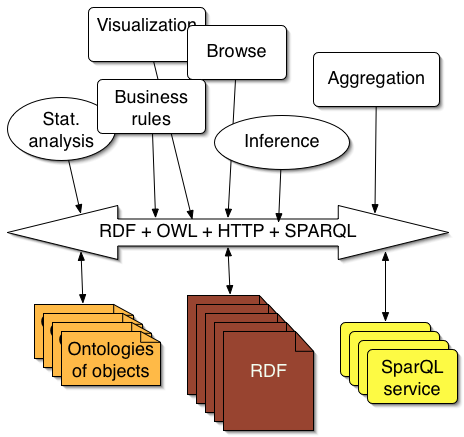
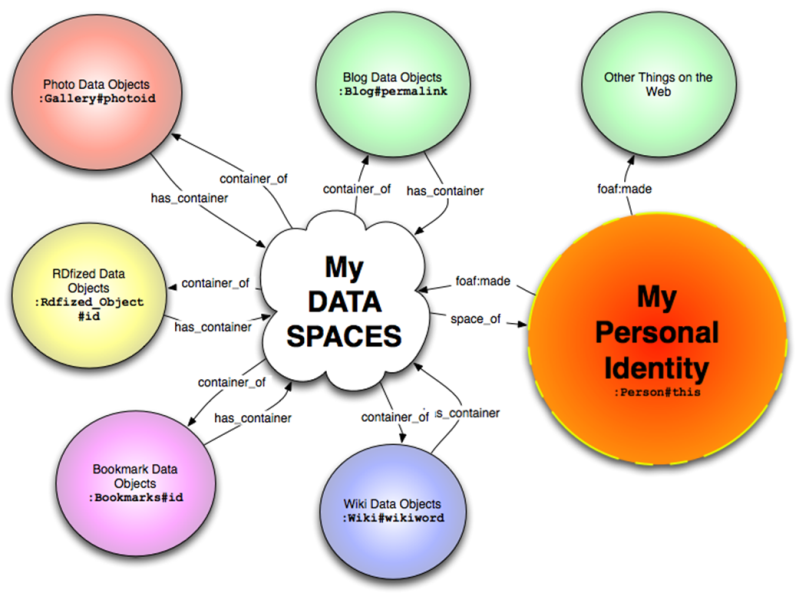
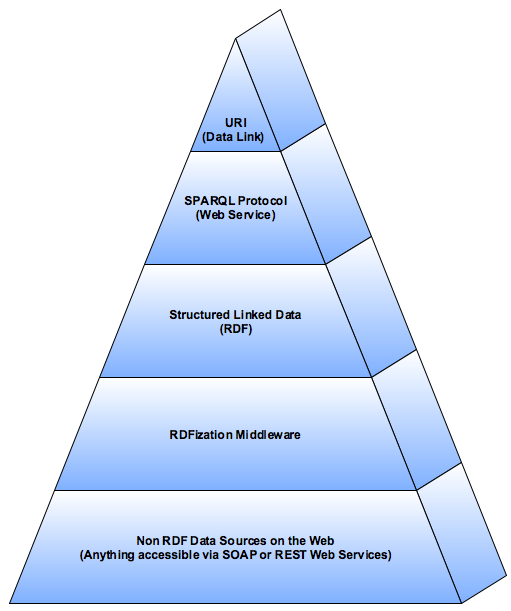
  <dc:description xmlns:dc="http://purl.org/dc/elements/1.1/">There is increasing coalescence around the idea that HTTP-based Linked Data adds a tangible dimension to the World Wide Web (Web). This Data Dimension grants end-users, power-users, integrators, and developers the ability to experience the Web not solely as a Information Space or Document Space, but now also as a Data Space. Here is a simple What and Why guide covering the essence of Data Spaces. What is a Data Space? A Data Space is a point of presence on a network, where every Data Object (item or entity) is given a Name (e.g., a URI) by which it may be Referenced or Identified. In a Data Space, every Representation of those Data Objects (i.e., every Object Representation) has an Address (e.g., a URL) from which it may be Retrieved (or &quot;gotten&quot;). In a Data Space, every Object Representation is a time variant (that is, it changes over time), streamable, and format-agnostic Resource. An Object Representation is simply a Description of that Object. It takes the form of a graph, pictorially constructed from sets of 3 elements which are themselves named Subject, Predicate, and Object (or SPO); or Entity, Attribute, and Value (or EAV). Each Entity+Attribute+Value or Subject+Predicate+Object set (or triple), is one datum, one piece of data, one persisted observation about a given Subject or Entity. The underlying Schema that defines and constrains the construction of Object Representations is based on Logic, specifically First-Order Logic. Each Object Representation is a collection of persisted observations (Data) about a given Subject, which aid observers in materializing their perception (Information), and ultimately comprehension (Knowledge), of that Subject. Why are Data Spaces important? In the real-world -- which is networked by nature -- data is heterogeneously (or &quot;differently&quot;) shaped, and disparately located. Data has been increasing at an alarming rate since the advent of computing; the interWeb simply provides context that makes this reality more palpable and more exploitable, and in the process virtuously ups the ante through increasingly exponential growth rates. We can&#39;t stop data heterogeneity; it is endemic to the nature of its producers -- humans and/or human-directed machines. What we can do, though, is create a powerful Conceptual-level &quot;bus&quot; or &quot;interface&quot; for data integration, based on Data Description oriented Logic rather than Data Representation oriented Formats. Basically, it&#39;s possible for us to use a Common Logic as the basis for expressing and blending SPO- or EAV-based Object Representations in a variety of Formats (or &quot;dialects&quot;). The roadmap boils down to: Assigning unambiguous Object Names to: Every record (or, in table terms, every row); Every record attribute (or, in table terms, every field or column); Every record relationship (that is, every relationship between one record and another); Every record container (e.g., every table or view in a relational database, every named graph, every spreadsheet, every text file, etc.); Making each Object Name resolve to an Address through which Create, Read, Update, and Delete (&quot;CRUD&quot;) operations can be performed against (can access) the associated Object Representation graph.</dc:description>
  <content:encoded xmlns:content="http://purl.org/rss/1.0/modules/content/"><![CDATA[<p>There is increasing coalescence around the idea that HTTP-based <a class="auto-href" href="http://dbpedia.org/resource/Linked_Data" id="link-id0x1e93cbd0">Linked Data</a> adds a tangible dimension to the <a class="auto-href" href="http://dbpedia.org/resource/World_Wide_Web" id="link-id0x1dfdde10">World Wide Web</a> (<a href="http://dbpedia.org/resource/World_Wide_Web">Web</a>). This <i><a href="http://dbpedia.org/resource/Data">Data</a> Dimension</i> grants end-users, power-users, integrators, and developers the ability to experience the Web not solely as a <i><a class="auto-href" href="http://dbpedia.org/resource/Information" id="link-id0x19d02b00">Information</a> Space</i> or <i>Document Space,</i> but now also as a <i><a class="auto-href" href="http://en.wikipedia.org/wiki/Data_Spaces" id="link-id0x1ac33378">Data Space</a>.</i>
</p>

<p>Here is a simple What and Why guide covering the essence of Data Spaces.</p>

<h2>What is a Data Space?</h2>

<p>A Data Space is a point of presence on a network, where every <i>Data Object</i> (item or <a class="auto-href" href="http://dbpedia.org/resource/Entity" id="link-id0x1d55f910">entity</a>) is given a <i>Name</i> (e.g., a <a class="auto-href" href="http://dbpedia.org/resource/Uniform_Resource_Identifier" id="link-id0x1736ea28">URI</a>) by which it may be Referenced or Identified. 

</p>
<p>In a Data Space, every <i>Representation</i> of those Data Objects (i.e., every <i>Object Representation</i>) has an <i>Address</i> (e.g., a <a class="auto-href" href="http://dbpedia.org/resource/Uniform_Resource_Locator" id="link-id0x1f17f5a8">URL</a>) from which it may be Retrieved (or &quot;gotten&quot;).</p>

<p>In a Data Space, every Object Representation is a time variant (that is, it changes over time), streamable, and format-agnostic <i>Resource.</i>
</p>

<p>An Object Representation is simply a Description of that Object. It takes the form of a graph, pictorially constructed from sets of 3 elements which are themselves named <i>Subject,</i> <i>Predicate,</i> and <i>Object</i> (or <i>SPO</i>); or <i>Entity,</i> <i>Attribute,</i> and <i>Value</i> (or <i>EAV</i>). Each <a class="auto-href" href="http://dbpedia.org/resource/Entity-attribute-value_model" id="link-id0x1dedcfe0">Entity</a>+Attribute+Value or Subject+Predicate+Object set (or <i>triple</i>), is one datum, one piece of data, one persisted observation about a given Subject or Entity.</p>

<p>The underlying Schema that defines and constrains the construction of Object Representations is based on Logic, specifically <i>First-Order Logic</i>. 

Each Object Representation is a collection of persisted observations (<i>Data</i>) about a given Subject, which aid observers in materializing their perception (<i>Information</i>), and ultimately comprehension (<i><a class="auto-href" href="http://dbpedia.org/resource/Knowledge" id="link-id0x1a4c7bf8">Knowledge</a></i>), of that Subject.</p>

<h2>Why are Data Spaces important?</h2>

<p>In the real-world -- which is networked by nature -- data is heterogeneously (or &quot;differently&quot;) shaped, and disparately located. </p>

<p>Data has been increasing at an alarming rate since the advent of computing; the interWeb simply provides <a class="auto-href" href="http://dbpedia.org/resource/Context_%28language_use%29" id="link-id0x1ad97358">context</a> that makes this reality more palpable and more exploitable, and in the process virtuously ups the ante through increasingly exponential growth rates.</p>

<p>We can&#39;t stop data heterogeneity; it is endemic to the nature of its producers -- humans and/or human-directed machines. What we can do, though, is create a powerful Conceptual-level &quot;bus&quot; or &quot;interface&quot; for data integration, based on <i>Data Description oriented Logic</i> rather than Data Representation oriented Formats. Basically, it&#39;s possible for us to use a <i><a href="http://en.wikipedia.org/wiki/First-order_predicate_logic" id="link-id0x1a481248">Common Logic</a></i> as the basis for expressing and blending SPO- or EAV-based Object Representations in a variety of Formats (or &quot;dialects&quot;).</p>

<p>The roadmap boils down to:</p>

<ol>
 <li>
  <p>Assigning unambiguous Object Names to:</p>

<ul>
   <li>
      <p>Every record (or, in table terms, every row); </p>
   </li>
<li>
      <p>Every record attribute (or, in table terms, every field or column);</p>
    </li>
<li>
      <p>Every record relationship (that is, every relationship between one record and another);</p>
    </li>
<li>
      <p>Every record container (e.g., every table or view in a relational database, every named graph, every spreadsheet, every text file, etc.);</p>
    </li>
</ul>
 </li>

<li>
  <p>Making each Object Name resolve to an Address through which Create, Read, Update, and Delete (&quot;CRUD&quot;) operations can be performed against (can <i>access</i>) the associated Object Representation graph.</p>
</li>
</ol>
]]></content:encoded>
 </rss:item>
 <rss:item xmlns:rss="http://purl.org/rss/1.0/" rdf:about="http://www.openlinksw.com:443/blog/kidehen@openlinksw.com/blog/?date=2011-02-18#1657">
  <rss:title>New Preconfigured Virtuoso AMI for Amazon EC2 Cloud comprised of Linked Data from BBC &amp; DBpedia</rss:title>
  <dc:date xmlns:dc="http://purl.org/dc/elements/1.1/">2011-02-19T01:20:30Z</dc:date>
  <dc:description xmlns:dc="http://purl.org/dc/elements/1.1/">What? Introducing a new preloaded and preconfigured Virtuoso (Cluster Edition) AMI for the Amazon EC2 Cloud that hosts combined Linked Datasets from: DBpedia 3.6 BBC Programmes BBC Music BBC Nature BBC Food Recipes Why? Predictably instantiate a powerful database with high quality data and cross links within minutes, for personal or service specific use. How? Simply follow the instructions in our Amazon EC2 guide for the BBC + DBpedia 3.6 Linked Dataset guide. Your installation steps are as follows: Instantiate a Virtuoso EC2 AMI Mount the Amazon Elastic Block Storage (EBS) snapshot that hosts the preloaded Virtuoso Database. Related BBC Linked Data Spaces Presentation BBC Music Linked Dataset Snapshot -- PivotViewer Page Screenshot BBC Programmes Linked Dataset Snapshot -- -- PivotViewer Page Screenshot BBC Nature Linked Dataset Snapshot -- PivotViewer Page Screenshot BBC Food Recipes Snapshot -- PivotViewer Page Screenshot My Del.icio.us bookmark collection re. BBC Linked Data Demos Amazon EC2 Snapshots for DBpedia 3.6 + BBC combo -- delivers the BBC and DBpedia dataset combo via a mountable Elastic Block Storage (EBS) device usable with an Amazon Machine Image (AMI) Amazon EC2 Snapshots for DBpedia 3.6 &amp; 3.5 Virtuoso Commercial Edition Download Page Virtuoso Cluster Edition Guide</dc:description>
  <content:encoded xmlns:content="http://purl.org/rss/1.0/modules/content/"><![CDATA[
<h2>What?</h2>
<p>Introducing a new preloaded and preconfigured <a class="auto-href" href="http://virtuoso.openlinksw.com" id="link-id0x1bbe32d8">Virtuoso</a> (Cluster Edition) AMI for the Amazon EC2 Cloud that hosts combined Linked Datasets from: </p>
<ul>
<li>
  <a href="http://dbpedia.org/About" id="link-id0x1d21e780">DBpedia 3.6</a>
</li>
<li>
  <a href="http://www.bbc.co.uk/programmes" id="link-id0x1e1e0b10">BBC Programmes</a>
</li>
<li>
  <a href="http://www.bbc.co.uk/music" id="link-id0x1db12bd0">BBC Music</a>
</li>
<li>
  <a href="http://www.bbc.co.uk/nature/" id="link-id0x1bd46450">BBC Nature</a>
</li>
<li>
  <a href="http://www.bbc.co.uk/food/recipes/" id="link-id0x1d1b2468">BBC Food Recipes</a>
</li>
</ul>


<h2>Why?</h2>
<p>
Predictably instantiate a powerful database with high quality <a href="http://dbpedia.org/resource/Data">data</a> and cross links within minutes, for personal or service specific use.  </p>

<h2>How?</h2>

<p>Simply follow the instructions in our <a href="http://virtuoso.openlinksw.com/dataspace/dav/wiki/Main/VirtAWSBBCMusicProgNatureFoodAndDBpedia36" id="link-id0x1d4f3210">Amazon EC2 guide for the BBC + DBpedia 3.6 Linked Dataset</a> guide.</p>
<p>Your installation steps are as follows:</p>
<ol>
<li>
Instantiate a Virtuoso EC2 AMI
</li>
<li>
Mount the Amazon Elastic Block Storage (EBS) snapshot that hosts the preloaded Virtuoso Database.
</li>
</ol>
<h2>Related</h2>
<ul>
<li>
<a href="http://www.slideshare.net/reduxd/beyond-the-polar-bear" id="link-id0x1b384af0">BBC Linked Data Spaces Presentation</a>
</li>
<li>
  <a href="http://kidehen-images.s3.amazonaws.com/bbc_music_solo_artists_snapshot.png" id="link-id0x1a7a5ae0">BBC Music Linked Dataset Snapshot</a> -- PivotViewer Page Screenshot
</li>
<li>
  <a href="http://kidehen-images.s3.amazonaws.com/bbc_programmes_snapshot_sorted_by_genre.png" id="link-id0x1c2022a8">BBC Programmes Linked Dataset Snapshot</a> -- -- PivotViewer Page Screenshot
</li>
<li>
  <a href="http://kidehen-images.s3.amazonaws.com/bbc_nature_snapshot_sorted_by_adaptation.png" id="link-id0x1e138ac0">BBC Nature Linked Dataset Snapshot</a> -- PivotViewer Page Screenshot
</li>
<li>
  <a href="http://kidehen-images.s3.amazonaws.com/bbc_recipes_snapshot.png" id="link-id0x1b795100">BBC Food Recipes Snapshot </a> -- PivotViewer Page Screenshot
</li>
<li>
  <a href="http://www.delicious.com/kidehen/bbc_linkeddata" id="link-id0x1a581cf8">My Del.icio.us bookmark collection re. BBC Linked Data Demos</a>
</li>
<li>
  <a href="http://www.openlinksw.com/dataspace/dav/wiki/Main/VirtAWSDBpediaBBC" id="link-id0x1dc0cc08">Amazon EC2 Snapshots for DBpedia 3.6 + BBC combo</a> -- delivers the BBC and DBpedia dataset combo via a mountable Elastic Block Storage (EBS) device usable with an Amazon Machine Image (AMI)
</li>
<li>
  <a href="http://www.openlinksw.com/dataspace/dav/wiki/Main/VirtAWSDBpedia351C" id="link-id0x1de33b50">Amazon EC2 Snapshots for DBpedia 3.6 &amp; 3.5</a>
</li>
<li>
  <a href="http://virtuoso.openlinksw.com/download/" id="link-id0x1c3e27c8">Virtuoso Commercial Edition Download Page</a>
</li>
<li>
  <a href="http://docs.openlinksw.com/virtuoso/clusterstcnf.html" id="link-id0x1d0ff170">Virtuoso Cluster Edition Guide</a>
</li>
</ul>]]></content:encoded>
 </rss:item>
 <rss:item xmlns:rss="http://purl.org/rss/1.0/" rdf:about="http://www.openlinksw.com:443/blog/kidehen@openlinksw.com/blog/?date=2011-02-17#1656">
  <rss:title>DBpedia + BBC (combined) Linked Data Space Installation Guide</rss:title>
  <dc:date xmlns:dc="http://purl.org/dc/elements/1.1/">2011-02-17T22:15:41Z</dc:date>
  <dc:description xmlns:dc="http://purl.org/dc/elements/1.1/">What? The DBpedia + BBC Combo Linked Dataset is a preconfigured Virtuoso Cluster (4 Virtuoso Cluster Nodes, each comprised of one Virtuoso Instance; initial deployment is to a single Cluster Host, but license may be converted for physically distributed deployment), available via the Amazon EC2 Cloud, preloaded with the following datasets: DBpedia 3.6 BBC Programmes BBC Music BBC Nature BBC Food Recipes Why? The BBC has been publishing Linked Data from its Web Data Space for a number of years. In line with best practices for injecting Linked Data into the World Wide Web (Web), the BBC datasets are interlinked with other datasets such as DBpedia and MusicBrainz. Typical follow-your-nose exploration using a Web Browser (or even via sophisticated SPARQL query crawls) isn&#39;t always practical once you get past the initial euphoria that comes from comprehending the Linked Data concept. As your queries get more complex, the overhead of remote sub-queries increases its impact, until query results take so long to return that you simply give up. Thus, maximizing the effects of the BBC&#39;s efforts requires Linked Data that shares locality in a Web-accessible Data Space â i.e., where all Linked Data sets have been loaded into the same data store or warehouse. This holds true even when leveraging SPARQL-FED style virtualization â there&#39;s always a need to localize data as part of any marginally-decent locality-aware cost-optimization algorithm. This DBpedia + BBC dataset, exposed via a preloaded and preconfigured Virtuoso Cluster, delivers a practical point of presence on the Web for immediate and cost-effective exploitation of Linked Data at the individual and/or service specific levels. How? To work through this guide, you&#39;ll need to start with 90 GB of free disk space. (Only 41 GB will be consumed after you delete the installer archives, but starting with 90+ GB ensures enough work space for the installation.) Install Virtuoso Download Virtuoso installer archive(s). You must deploy the Personal or Enterprise Edition; the Open Source Edition does not support Shared-Nothing Cluster Deployment. Obtain a Virtuoso Cluster license. Install Virtuoso. Set key environment variables and start the OpenLink License Manager, using command (this may vary depending on your shell and install directory): . /opt/virtuoso/virtuoso-enterprise.sh Optional: To keep the default single-server configuration file and demo database intact, set the VIRTUOSO_HOME environment variable to a different directory, e.g., export VIRTUOSO_HOME=/opt/virtuoso/cluster-home/ Note: You will have to adjust this setting every time you shift between this cluster setup and your single-server setup. Either may be made your environment&#39;s default through the virtuoso-enterprise.sh and related scripts. Set up your cluster by running the mkcluster.sh script. Note that initial deployment of the DBpedia + BBC Combo requires a 4 node cluster, which is the default for this script. Start the Virtuoso Cluster with this command: virtuoso-start.sh Stop the Virtuoso Cluster with this command: virtuoso-stop.sh Using the DBpedia + BBC Combo dataset Navigate to your installation directory. Download the combo dataset installer script â bbc-dbpedia-install.sh. For best results, set the downloaded script to fully executable using this command: chmod 755 bbc-dbpedia-install.sh Shut down any Virtuoso instances that may be currently running. Optional: As above, if you have decided to keep the default single-server configuration file and demo database intact, set the VIRTUOSO_HOME environment variable appropriately, e.g., export VIRTUOSO_HOME=/opt/virtuoso/cluster-home/ Run the combo dataset installer script with this command: sh bbc-dbpedia-install.sh Verify installation The combo dataset typically deploys to EC2 virtual machines in under 90 minutes; your time will vary depending on your network connection speed, machine speed, and other variables. Once the script completes, perform the following steps: Verify that the Virtuoso Conductor (HTTP-based Admin UI) is in place via: http://localhost:[port]/conductor Verify that the Virtuoso SPARQL endpoint is in place via: http://localhost:[port]/sparql Verify that the Precision Search &amp; Find UI is in place via: http://localhost:[port]/fct Verify that the Virtuoso hosted PivotViewer is in place via: http://localhost:[port]/PivotViewer Related BBC Linked Data Spaces Presentation BBC Music Linked Dataset Snapshot -- PivotViewer Page Screenshot BBC Programmes Linked Dataset Snapshot -- -- PivotViewer Page Screenshot BBC Nature Linked Dataset Snapshot -- PivotViewer Page Screenshot BBC Food Recipes Snapshot -- PivotViewer Page Screenshot My Del.icio.us bookmark collection re. BBC Linked Data Demos Amazon EC2 Snapshots for DBpedia 3.6 + BBC combo -- delivers the BBC and DBpedia dataset combo via a mountable Elastic Block Storage (EBS) device usable with an Amazon Machine Image (AMI) Amazon EC2 Snapshots for DBpedia 3.6 &amp; 3.5 Virtuoso Commercial Edition Download Page Virtuoso Cluster Edition Guide</dc:description>
  <content:encoded xmlns:content="http://purl.org/rss/1.0/modules/content/"><![CDATA[<h2>What? </h2>

<p>
The <i><a class="auto-href" href="http://dbpedia.org/resource/DBpedia" id="link-id0x1c489cc8">DBpedia</a> + <a class="auto-href" href="http://dbpedia.org/resource/BBC" id="link-id0x1bf12698">BBC</a> Combo Linked Dataset </i> is a preconfigured <a class="auto-href" href="http://virtuoso.openlinksw.com" id="link-id0x1b16cbb0">Virtuoso</a> Cluster (4 Virtuoso Cluster Nodes, each comprised of one Virtuoso Instance; initial deployment is to a single Cluster Host, but license may be converted for physically distributed deployment), available via the Amazon EC2 Cloud, preloaded with the following datasets:
</p>

<ul>
<li>
  <a href="http://dbpedia.org/About" id="link-id0x1d21e780">DBpedia 3.6</a>
</li>
<li>
  <a href="http://www.bbc.co.uk/programmes" id="link-id0x1e1e0b10">BBC Programmes</a>
</li>
<li>
  <a href="http://www.bbc.co.uk/music" id="link-id0x1db12bd0">BBC Music</a>
</li>
<li>
  <a href="http://www.bbc.co.uk/nature/" id="link-id0x1bd46450">BBC Nature</a>
</li>
<li>
  <a href="http://www.bbc.co.uk/food/recipes/" id="link-id0x1d1b2468">BBC Food Recipes</a>
</li>
</ul>

<h2>Why?</h2>
<p>The BBC has been publishing <a class="auto-href" href="http://dbpedia.org/resource/Linked_Data" id="link-id0x1b15eb60">Linked Data</a> from its <a href="http://dbpedia.org/resource/World_Wide_Web">Web</a> <a class="auto-href" href="http://en.wikipedia.org/wiki/Data_Spaces" id="link-id0x1c4c38a8">Data Space</a> for a number of years. In line with best practices for injecting Linked Data into the <a class="auto-href" href="http://dbpedia.org/resource/World_Wide_Web" id="link-id0x1e5acda0">World Wide Web</a> (Web), the BBC datasets are interlinked with other datasets such as DBpedia and MusicBrainz. </p>

<p>Typical follow-your-nose exploration using a Web Browser (or even via sophisticated <a class="auto-href" href="http://dbpedia.org/resource/SPARQL" id="link-id0x1d21e728">SPARQL</a> query crawls) isn&#39;t always practical once you get past the initial euphoria that comes from comprehending the Linked Data concept. As your queries get more complex, the overhead of remote sub-queries increases its impact, until query results take so long to return that you simply give up.</p>

<p>Thus, maximizing the effects of the BBC&#39;s efforts requires Linked Data that shares locality in a Web-accessible Data Space â i.e., where all Linked Data sets have been loaded into the same data store or warehouse. This holds true even when leveraging SPARQL-FED style virtualization â there&#39;s always a need to localize data as part of any marginally-decent locality-aware cost-optimization algorithm.</p>

<p>This DBpedia + BBC dataset, exposed via a preloaded and preconfigured Virtuoso Cluster, delivers a practical point of presence on the Web for immediate and cost-effective exploitation of Linked Data at the individual and/or service specific levels.</p>

<h2>How?</h2>

To work through this guide, you&#39;ll need to start with 90 GB of free disk space.  (Only 41 GB will be consumed after you delete the installer archives, but starting with 90+ GB ensures enough work space for the installation.)


<h3>Install Virtuoso</h3>
<ol>
<li>
  <p>
    <a href="http://virtuoso.openlinksw.com/download/" id="link-id0x1af0d230">Download Virtuoso installer archive(s)</a>.  You must deploy the Personal or Enterprise Edition; the Open Source Edition does not support Shared-Nothing Cluster Deployment.</p>
</li>

<li>
  <p>
    <a href="http://virtuoso.openlinksw.com/pricing/" id="link-id0x1e089f40">Obtain a Virtuoso Cluster license</a>.</p>
</li>

<li>
  <p>
    <a href="http://wikis.openlinksw.com/dataspace/owiki/wiki/VirtuosoWikiWeb/VirtuosoInstallDocs" id="link-id0x1e86d060">Install Virtuoso</a>.</p>
</li>

<li>
  <p>Set key environment variables and start the OpenLink License Manager, using command (this may vary depending on your shell and install directory): </p>
<blockquote>
    <code>. /opt/virtuoso/virtuoso-enterprise.sh</code>
  </blockquote>
</li>

<li>
  <p>
    <i>Optional:</i> To keep the default single-server configuration file and demo database intact, set the <code>VIRTUOSO_HOME</code> environment variable to a different directory, e.g., </p>
<blockquote>
    <code>export VIRTUOSO_HOME=/opt/virtuoso/cluster-home/</code>
  </blockquote>
<p>
    <i><b>Note:</b> You will have to adjust this setting every time you shift between this cluster setup and your single-server setup.  Either may be made your environment&#39;s default through the <code>virtuoso-enterprise.sh</code> and related scripts.</i>
  </p>
</li>

<li>
  <p>
    <a href="http://docs.openlinksw.com/virtuoso/clusterstcnf.html" id="link-id0x1e184dc0">Set up your cluster</a> by running the <code>mkcluster.sh</code> script.  Note that initial deployment of the <i>DBpedia + BBC Combo</i> requires a 4 node cluster, which is the default for this script.</p>
</li>

<li>
  <p>Start the Virtuoso Cluster with this command:</p>
<blockquote>
    <code>virtuoso-start.sh</code>
  </blockquote>
</li>

<li>
  <p>Stop the Virtuoso Cluster with this command:</p>
<blockquote>
    <code>virtuoso-stop.sh</code>
  </blockquote>
</li>

</ol>


<h3>Using the DBpedia + BBC Combo dataset</h3>

<ol>
<li>
  <p>Navigate to your installation directory.</p>
</li>

<li>
  <p>Download the combo dataset installer script â <code><a href="https://s3.amazonaws.com/bbc-dbpedia-36-usa/bbc-dbpedia-install.sh" id="link-id0x195d7940">bbc-dbpedia-install.sh</a></code>.</p>
</li>

<li>
  <p>For best results, set the downloaded script to fully executable using this command:</p>
  <blockquote>
    <code>chmod 755 bbc-dbpedia-install.sh </code>
  </blockquote>
</li>

<li>
  <p>Shut down any Virtuoso instances that may be currently running.</p>
</li>

<li>
  <p>
    <i>Optional:</i> As above, if you have decided to keep the default single-server configuration file and demo database intact, set the <code>VIRTUOSO_HOME</code> environment variable appropriately, e.g., </p>
<blockquote>
    <code>export VIRTUOSO_HOME=/opt/virtuoso/cluster-home/</code>
  </blockquote>
</li>

<li>
  <p>Run the combo dataset installer script with this command:</p>
  <blockquote>
    <code>sh bbc-dbpedia-install.sh</code>
  </blockquote>
</li>

</ol>

<h3>Verify installation</h3>
<p>The combo dataset typically deploys to EC2 virtual machines in under 90 minutes; your time will vary depending on your network connection speed, machine speed, and other variables.</p>

<p>Once the script completes, perform the following steps:</p>

<ol>
<li>
  <p>Verify that the Virtuoso Conductor (HTTP-based Admin UI) is in place via:</p>
<blockquote>
    <code>http://localhost:[port]/conductor</code>
  </blockquote>
</li>
<li>
  <p>Verify that the Virtuoso SPARQL endpoint is in place via:</p> <blockquote>
    <code>http://localhost:[port]/sparql</code>
  </blockquote>
</li>
<li>
  <p>Verify that the Precision Search &amp; Find UI is in place via:</p>
<blockquote>
    <code>http://localhost:[port]/fct</code>
  </blockquote>
</li>
<li>
  <p>Verify that the Virtuoso hosted PivotViewer is in place via:</p> <blockquote>
    <code>http://localhost:[port]/PivotViewer</code>
  </blockquote>
</li>
</ol>

<h2>Related</h2>
<ul>
<li>
<a href="http://www.slideshare.net/reduxd/beyond-the-polar-bear" id="link-id0x1bd43bf0">BBC Linked Data Spaces Presentation</a>
</li>
<li>
  <a href="http://kidehen-images.s3.amazonaws.com/bbc_music_solo_artists_snapshot.png" id="link-id0x1a7a5ae0">BBC Music Linked Dataset Snapshot</a> -- PivotViewer Page Screenshot
</li>
<li>
  <a href="http://kidehen-images.s3.amazonaws.com/bbc_programmes_snapshot_sorted_by_genre.png" id="link-id0x1c2022a8">BBC Programmes Linked Dataset Snapshot</a> -- -- PivotViewer Page Screenshot
</li>
<li>
  <a href="http://kidehen-images.s3.amazonaws.com/bbc_nature_snapshot_sorted_by_adaptation.png" id="link-id0x1e138ac0">BBC Nature Linked Dataset Snapshot</a> -- PivotViewer Page Screenshot
</li>
<li>
  <a href="http://kidehen-images.s3.amazonaws.com/bbc_recipes_snapshot.png" id="link-id0x1b795100">BBC Food Recipes Snapshot </a> -- PivotViewer Page Screenshot
</li>
<li>
  <a href="http://www.delicious.com/kidehen/bbc_linkeddata" id="link-id0x1c0ffcc8">My Del.icio.us bookmark collection re. BBC Linked Data Demos</a>
</li>
<li>
  <a href="http://www.openlinksw.com/dataspace/dav/wiki/Main/VirtAWSDBpediaBBC" id="link-id0x1dc0cc08">Amazon EC2 Snapshots for DBpedia 3.6 + BBC combo</a> -- delivers the BBC and DBpedia dataset combo via a mountable Elasti<a class="auto-href" href="http://dbpedia.org/resource/C%2B%2B" id="link-id0x1c2ad728">c</a> Block Storage (EBS) device usable with an Amazon Machine Image (AMI)
</li>
<li>
  <a href="http://www.openlinksw.com/dataspace/dav/wiki/Main/VirtAWSDBpedia351C" id="link-id0x1de33b50">Amazon EC2 Snapshots for DBpedia 3.6 &amp; 3.5</a>
</li>
<li>
  <a href="http://virtuoso.openlinksw.com/download/" id="link-id0x1c3e27c8">Virtuoso Commercial Edition Download Page</a>
</li>
<li>
  <a href="http://docs.openlinksw.com/virtuoso/clusterstcnf.html" id="link-id0x1d0ff170">Virtuoso Cluster Edition Guide</a>
</li>
</ul>
]]></content:encoded>
 </rss:item>
 <rss:item xmlns:rss="http://purl.org/rss/1.0/" rdf:about="http://www.openlinksw.com:443/blog/kidehen@openlinksw.com/blog/?date=2011-01-25#1655">
  <rss:title>SPARQL Guide for the Perl Developer</rss:title>
  <dc:date xmlns:dc="http://purl.org/dc/elements/1.1/">2011-01-25T16:05:17Z</dc:date>
  <dc:description xmlns:dc="http://purl.org/dc/elements/1.1/">What? A simple guide usable by any Perl developer seeking to exploit SPARQL without hassles. Why? SPARQL is a powerful query language, results serialization format, and an HTTP based data access protocol from the W3C. It provides a mechanism for accessing and integrating data across Deductive Database Systems (colloquially referred to as triple or quad stores in Semantic Web and Linked Data circles) -- database systems (or data spaces) that manage proposition oriented records in 3-tuple (triples) or 4-tuple (quads) form. How? SPARQL queries are actually HTTP payloads (typically). Thus, using a RESTful client-server interaction pattern, you can dispatch calls to a SPARQL compliant data server and receive a payload for local processing. Steps: Determine which SPARQL endpoint you want to access e.g. DBpedia or a local Virtuoso instance (typically: http://localhost:8890/sparql). If using Virtuoso, and you want to populate its quad store using SPARQL, assign &quot;SPARQL_SPONGE&quot; privileges to user &quot;SPARQL&quot; (this is basic control, more sophisticated WebID based ACLs are available for controlling SPARQL access). Script: # # Demonstrating use of a single query to populate a # Virtuoso Quad Store via Perl. # # # HTTP URL is constructed accordingly with CSV query results format as the default via mime type. # use CGI qw/:standard/; use LWP::UserAgent; use Data::Dumper; use Text::CSV_XS; sub sparqlQuery(@args) { my $query=shift; my $baseURL=shift; my $format=shift; %params=( &quot;default-graph&quot; =&gt; &quot;&quot;, &quot;should-sponge&quot; =&gt; &quot;soft&quot;, &quot;query&quot; =&gt; $query, &quot;debug&quot; =&gt; &quot;on&quot;, &quot;timeout&quot; =&gt; &quot;&quot;, &quot;format&quot; =&gt; $format, &quot;save&quot; =&gt; &quot;display&quot;, &quot;fname&quot; =&gt; &quot;&quot; ); @fragments=(); foreach $k (keys %params) { $fragment=&quot;$k=&quot;.CGI::escape($params{$k}); push(@fragments,$fragment); } $query=join(&quot;&amp;&quot;, @fragments); $sparqlURL=&quot;${baseURL}?$query&quot;; my $ua = LWP::UserAgent-&gt;new; $ua-&gt;agent(&quot;MyApp/0.1 &quot;); my $req = HTTP::Request-&gt;new(GET =&gt; $sparqlURL); my $res = $ua-&gt;request($req); $str=$res-&gt;content; $csv = Text::CSV_XS-&gt;new(); foreach $line ( split(/^/, $str) ) { $csv-&gt;parse($line); @bits=$csv-&gt;fields(); push(@rows, [ @bits ] ); } return \@rows; } # Setting Data Source Name (DSN) $dsn=&quot;http://dbpedia.org/resource/DBpedia&quot;; # Virtuoso pragmas for instructing SPARQL engine to perform an HTTP GET using the IRI in # FROM clause as Data Source URL en route to DBMS # record Inserts. $query=&quot;DEFINE get:soft \&quot;replace\&quot;\n # Generic (non Virtuoso specific SPARQL # Note: this will not add records to the # DBMS SELECT DISTINCT * FROM &lt;$dsn&gt; WHERE {?s ?p ?o}&quot;; $data=sparqlQuery($query, &quot;http://localhost:8890/sparql/&quot;, &quot;text/csv&quot;); print &quot;Retrieved data:\n&quot;; print Dumper($data); Output Retrieved data: $VAR1 = [ [ &#39;s&#39;, &#39;p&#39;, &#39;o&#39; ], [ &#39;http://dbpedia.org/resource/DBpedia&#39;, &#39;http://www.w3.org/1999/02/22-rdf-syntax-ns#type&#39;, &#39;http://www.w3.org/2002/07/owl#Thing&#39; ], [ &#39;http://dbpedia.org/resource/DBpedia&#39;, &#39;http://www.w3.org/1999/02/22-rdf-syntax-ns#type&#39;, &#39;http://dbpedia.org/ontology/Work&#39; ], [ &#39;http://dbpedia.org/resource/DBpedia&#39;, &#39;http://www.w3.org/1999/02/22-rdf-syntax-ns#type&#39;, &#39;http://dbpedia.org/class/yago/Software106566077&#39; ], ... Conclusion CSV was chosen over XML (re. output format) since this is about a &quot;no-brainer installation and utilization&quot; guide for a Perl developer that already knows how to use Perl for HTTP based data access within HTML. SPARQL just provides an added bonus to URL dexterity (delivered via URI abstraction) with regards to constructing Data Source Names or Addresses. Related RDF::Query::Client Guide SPARQL Guide for the Perl Developer SPARQL Guide for the PHP Developer SPARQL Guide for the Python Developer SPARQL Guide for the Ruby Developer Simple Guide for using SPARQL with Virtuoso General SPARQL Tutorial Collection Virtuoso Specific SPARQL Tutorial Collection The URI, URL, and Linked Data Meme&#39;s Generic HTTP URI.</dc:description>
  <content:encoded xmlns:content="http://purl.org/rss/1.0/modules/content/"><![CDATA[<h3>What?</h3> 
<p>A simple guide usable by any <a class="auto-href" href="http://dbpedia.org/resource/Perl" id="link-id0x1bdcab80">Perl</a> developer seeking to exploit <a class="auto-href" href="http://dbpedia.org/resource/SPARQL" id="link-id0x17b447e8">SPARQL</a> without hassles.</p>

<h3>Why?</h3>
<p>SPARQL is a powerful query language, results serialization format, and an HTTP based <a href="http://dbpedia.org/resource/Data">data</a> access protocol from the W3C. It provides a mechanism for accessing and integrating data across <a href="http://en.wikipedia.org/wiki/Deductive_database" id="link-id0x1cc76540">Deductive Database Systems</a> (colloquially referred to as triple or quad stores in <a class="auto-href" href="http://dbpedia.org/resource/Semantic_Web" id="link-id0x1d944d78">Semantic Web</a> and <a class="auto-href" href="http://dbpedia.org/resource/Linked_Data" id="link-id0x1c7a87c8">Linked Data</a> circles) -- database systems (or data spaces) that manage proposition oriented records in 3-tuple (triples) or 4-tuple (quads) form. </p>

<h3>How?</h3>
<p>SPARQL queries are actually HTTP payloads (typically). Thus, using a RESTful client-server interaction pattern, you can dispatch calls to a SPARQL compliant data server and receive a payload for local processing.</p>

<h4>Steps:</h4>
<ol>
<li>Determine which SPARQL endpoint you want to access e.g. <a href="http://dbpedia.org/sparql" id="link-id0x1d476520">DBpedia</a> or a local <a class="auto-href" href="http://virtuoso.openlinksw.com" id="link-id0x1bcfe140">Virtuoso</a> instance (typically: http://localhost:8890/sparql).
</li>
<li>If using Virtuoso, and you want to populate its quad store using SPARQL, assign &quot;<a href="http://docs.openlinksw.com/virtuoso/rdfsparql.html#rdfsupportedprotocolendpointuri" id="link-id0x1c7630b8">SPARQL_SPONGE</a>&quot; privileges to user &quot;SPARQL&quot; (this is basic control, more sophisticated WebID based ACLs are available for controlling SPARQL access).</li>
</ol>

<h4>Script:</h4>

<pre>
#
# Demonstrating use of a single query to populate a 
# Virtuoso Quad Store via Perl. 
#

# 
# HTTP <a href="http://dbpedia.org/resource/Uniform_Resource_Locator" id="link-id0x1d6465e8">URL</a> is constructed accordingly with CSV query results format as the default via mime type.
#

use CGI qw/:standard/;
use LWP::UserAgent;
use Data::Dumper;
use Text::CSV_XS;

sub sparqlQuery(@args) {
  my $query=shift;
  my $baseURL=shift;
  my $format=shift;
	
	%params=(
		&quot;default-graph&quot; =&gt; &quot;&quot;, &quot;should-sponge&quot; =&gt; &quot;soft&quot;, &quot;query&quot; =&gt; $query,
		&quot;debug&quot; =&gt; &quot;on&quot;, &quot;timeout&quot; =&gt; &quot;&quot;, &quot;format&quot; =&gt; $format,
		&quot;save&quot; =&gt; &quot;display&quot;, &quot;fname&quot; =&gt; &quot;&quot;
	);
	
	@fragments=();
	foreach $k (keys %params) {
		$fragment=&quot;$k=&quot;.CGI::escape($params{$k});
		push(@fragments,$fragment);
	}
	$query=join(&quot;&amp;&quot;, @fragments);
	
	$sparqlURL=&quot;${baseURL}?$query&quot;;
	
	my $ua = LWP::UserAgent-&gt;new;
	$ua-&gt;agent(&quot;MyApp/0.1 &quot;);
	my $req = HTTP::Request-&gt;new(GET =&gt; $sparqlURL);
	my $res = $ua-&gt;request($req);
	$str=$res-&gt;content;
	
	$csv = Text::CSV_XS-&gt;new();
	
	foreach $line ( split(/^/, $str) ) {
		$csv-&gt;parse($line);
		@bits=$csv-&gt;fields();
	  push(@rows, [ @bits ] );
	}
	return \@rows;
}


# Setting Data Source Name (DSN)

$dsn=&quot;http://dbpedia.org/resource/DBpedia&quot;;

# Virtuoso pragmas for instructing SPARQL engine to perform an HTTP GET using the IRI in
# FROM clause as Data Source URL en route to DBMS
# record Inserts.

$query=&quot;DEFINE get:soft \&quot;replace\&quot;\n

# Generic (non Virtuoso specific SPARQL
# Note: this will not add records to the 
# DBMS 

SELECT DISTINCT * FROM &lt;$dsn&gt; WHERE {?s ?p ?o}&quot;; 

$data=sparqlQuery($query, &quot;http://localhost:8890/sparql/&quot;, &quot;text/csv&quot;);

print &quot;Retrieved data:\n&quot;;
print Dumper($data);
</pre>
<h4>Output</h4>
<pre>
Retrieved data:
$VAR1 = [
          [
            &#39;s&#39;,
            &#39;p&#39;,
            &#39;o&#39;
          ],
          [
            &#39;http://dbpedia.org/resource/DBpedia&#39;,
            &#39;http://www.w3.org/1999/02/22-rdf-syntax-ns#type&#39;,
            &#39;http://www.w3.org/2002/07/owl#Thing&#39;
          ],
          [
            &#39;http://dbpedia.org/resource/DBpedia&#39;,
            &#39;http://www.w3.org/1999/02/22-rdf-syntax-ns#type&#39;,
            &#39;http://dbpedia.org/ontology/Work&#39;
          ],
          [
            &#39;http://dbpedia.org/resource/DBpedia&#39;,
            &#39;http://www.w3.org/1999/02/22-rdf-syntax-ns#type&#39;,
            &#39;http://dbpedia.org/class/yago/Software106566077&#39;
          ],
...
</pre>
<h3>Conclusion</h3>
<p>
CSV was chosen over XML (re. output format) since this is about a &quot;no-brainer installation and utilization&quot; guide for a Perl developer that already knows how to use Perl for HTTP based data access within HTML. SPARQL just provides an added bonus to URL dexterity (delivered via <a class="auto-href" href="http://dbpedia.org/resource/Uniform_Resource_Identifier" id="link-id0x1d29da98">URI</a> abstraction) with regards to constructing Data Source Names or Addresses.</p>
<h3>Related</h3>
<ul>
<li>
  <a href="http://cpansearch.perl.org/src/TOBYINK/RDF-Query-Client-0.103/README" id="link-id0x1c279130">RDF::Query::Client Guide</a>
</li>
<li>
<a href="http://www.openlinksw.com/dataspace/kidehen@openlinksw.com/weblog/kidehen@openlinksw.com%27s%20BLOG%20%5B127%5D/1653" id="link-id0x1cf307f0">SPARQL Guide for the Perl Developer</a>
</li>
<li>
<a href="http://www.openlinksw.com/dataspace/kidehen@openlinksw.com/weblog/kidehen@openlinksw.com%27s%20BLOG%20%5B127%5D/1652" id="link-id0x1b0ffb28">SPARQL Guide for the PHP Developer</a>
</li>
<li>
<a href="http://www.openlinksw.com/dataspace/kidehen@openlinksw.com/weblog/kidehen@openlinksw.com%27s%20BLOG%20%5B127%5D/1651" id="link-id0x1a8c5ae0">SPARQL Guide for the Python Developer</a>
</li>
<li>
<a href="http://www.openlinksw.com/dataspace/kidehen@openlinksw.com/weblog/kidehen@openlinksw.com%27s%20BLOG%20%5B127%5D/1648" id="link-id0x1b86ad28">SPARQL Guide for the Ruby Developer</a>
</li>
<li>
<a href="http://www.openlinksw.com/dataspace/kidehen@openlinksw.com/weblog/kidehen@openlinksw.com%27s%20BLOG%20%5B127%5D/1646" id="link-id0x1c7af188">Simple Guide for using SPARQL with Virtuoso</a> 
</li>
<li>
  <a href="http://www.delicious.com/kidehen/sparql_tutorial" id="link-id0x1ac1ba48">General SPARQL Tutorial Collection</a> </li>
<li>
  <a href="http://www.delicious.com/kidehen/virtuoso_sparql_tutorial" id="link-id0x1c7be660">Virtuoso Specific SPARQL Tutorial Collection</a>
</li>
<li>
<a href="http://www.openlinksw.com/dataspace/kidehen@openlinksw.com/weblog/kidehen@openlinksw.com%27s%20BLOG%20%5B127%5D/1567" id="link-id0x1c52b438">The URI, URL, and Linked Data Meme&#39;s Generic HTTP URI</a>.
</li>
</ul>]]></content:encoded>
 </rss:item>
 <rss:item xmlns:rss="http://purl.org/rss/1.0/" rdf:about="http://www.openlinksw.com:443/blog/kidehen@openlinksw.com/blog/?date=2011-01-24#1654">
  <rss:title>Virtuoso + DBpedia 3.6 Installation Guide (Update 1)</rss:title>
  <dc:date xmlns:dc="http://purl.org/dc/elements/1.1/">2011-01-25T01:08:55Z</dc:date>
  <dc:description xmlns:dc="http://purl.org/dc/elements/1.1/">What is DBpedia? DBpedia is a community effort to provide a contemporary deductive database derived from Wikipedia content. Project contributions can be partitioned as follows: Ontology Construction and Maintenance Dataset Generation via Wikipedia Content Extraction &amp; Transformation Live Database Maintenance &amp; Administration -- includes actual Linked Data loading and publishing, provision of SPARQL endpoint, and traditional DBA activity Internationalization. Why is DBpedia important? Comprising the nucleus of the Linked Open Data effort, DBpedia also serves as a fulcrum for the burgeoning Web of Linked Data by delivering a dense and highly-interlinked lookup database. In its most basic form, DBpedia is a great source of strong and resolvable identifiers for People, Places, Organizations, Subject Matter, and many other data items of interest. Naturally, it provides a fantastic starting point for comprehending the fundamental concepts underlying TimBL&#39;s initial Linked Data meme. How do I use DBpedia? Depending on your particular requirements, whether personal or service-specific, DBpedia offers the following: Datasets that can be loaded on your deductive database (also known as triple or quad stores) platform of choice Live browsable HTML+RDFa based entity description pages A wide variety of data formats for importing entity description data into a broad range of existing applications and services A SPARQL endpoint allowing ad-hoc querying over HTTP using the SPARQL query language, and delivering results serialized in a variety of formats A broad variety of tools covering query by example, faceted browsing, full text search, entity name lookups, etc. What is the DBpedia 3.6 + Virtuoso Cluster Edition Combo? OpenLink Software has preloaded the DBpedia 3.6 datasets into a preconfigured Virtuoso Cluster Edition database, and made the package available for easy installation. Why is the DBpedia+Virtuoso package important? The DBpedia+Virtuoso package provides a cost-effective option for personal or service-specific incarnations of DBpedia. For instance, you may have a service that isn&#39;t best-served by competing with the rest of the world for ad-hoc query time and resources on the live instance, which itself operates under various restrictions which enable this ad-hoc query service to be provided at Web Scale. Now you can easily commission your own instance and quickly exploit DBpedia and Virtuoso&#39;s database feature set to the max, powered by your own hardware and network infrastructure. How do I use the DBpedia+Virtuoso package? Pre-requisites are simply: Functional Virtuoso Cluster Edition installation. Virtuoso Cluster Edition License. 90 GB of free disk space -- you ultimately only need 43 gigs, but this our recommended free disk space size pre installation completion. To install the Virtuoso Cluster Edition simply perform the following steps: Download Software. Run installer Set key environment variables and start the OpenLink License Manager, using command (this may vary depending on your shell): . /opt/virtuoso/virtuoso-enterprise.sh Run the mkcluster.sh script which defaults to a 4 node cluster Set VIRTUOSO_HOME environment variable -- if you want to start cluster databases distinct from single server databases via distinct root directory for database files (one that isn&#39;t adjacent to single-server database directories) Start Virtuoso Cluster Edition instances using command: virtuoso-start.sh Stop Virtuoso Cluster Edition instances using command: virtuoso-stop.sh To install your personal or service specific edition of DBpedia simply perform the following steps: Navigate to your installation directory Download Installer script (dbpedia-install.sh) Set execution mode on script using command: chmod 755 dbpedia-install.sh Shutdown any Virtuoso instances that may be currently running Set your VIRTUOSO_HOME environment variable, e.g., to the current directory, via command (this may vary depending on your shell): export VIRTUOSO_HOME=`pwd` Run script using command: sh dbpedia-install.sh Once the installation completes (approximately 1 hour and 30 minutes from start time), perform the following steps: Verify that the Virtuoso Conductor (HTML based Admin UI) is in place via: http://localhost:[port]/conductor Verify that the Precision Search &amp; Find UI is in place via: http://localhost:[port]/fct Verify that DBpedia&#39;s Green Entity Description Pages are in place via: http://localhost:[port]/resource/DBpedia Related Amazon EC2 Snapshots for DBpedia 3.6 &amp; 3.5 Virtuoso Commercial Edition Download Page Virtuoso Cluster Edition Guide What is the DBpedia Project?</dc:description>
  <content:encoded xmlns:content="http://purl.org/rss/1.0/modules/content/"><![CDATA[<h3>What is <a class="auto-href" href="http://dbpedia.org/resource/DBpedia" id="link-id0x1d8b5df0">DBpedia</a>?</h3>
<p>
DBpedia is a community effort to provide a contemporary deductive database derived from Wikipedia content. Project contributions can be partitioned as follows:
</p>

<ol>
<li>
Ontology Construction and Maintenance
</li>
<li>
Dataset Generation via Wikipedia Content Extraction &amp; Transformation 
</li>
<li>
Live Database Maintenance &amp; Administration -- includes actual <a class="auto-href" href="http://dbpedia.org/resource/Linked_Data" id="link-id0x1ba81190">Linked Data</a> loading and publishing, provision of <a class="auto-href" href="http://dbpedia.org/resource/SPARQL" id="link-id0x1d8af808">SPARQL</a> endpoint, and traditional DBA activity
</li>
<li>
Internationalization.
</li>
</ol>

<h3>Why is DBpedia important?</h3>
<p>
Comprising the nucleus of the Linked Open <a href="http://dbpedia.org/resource/Data">Data</a> effort, DBpedia also serves as a fulcrum for the burgeoning <a href="http://dbpedia.org/resource/World_Wide_Web">Web</a> of Linked Data by delivering a dense and highly-interlinked lookup database. In its most basic form, DBpedia is a great source of strong and resolvable identifiers for People, Places, Organizations, Subject Matter, and many other data items of interest. Naturally, it provides a fantastic starting point for comprehending the fundamental concepts underlying <a class="auto-href" href="http://www.w3.org/People/Berners-Lee/card#i" id="link-id0x1a8cc3d0">TimBL</a>&#39;s initial <a href="http://blogs.usnet.private:8893/www.w3.org/DesignIssues/LinkedData.html" id="link-id0x1cbbaf50">Linked Data</a> meme.
</p>

<h3>How do I use DBpedia?</h3>
<p>
Depending on your particular requirements, whether personal or service-specific, DBpedia offers the following:
</p>
<ul>
<li>
Datasets that can be loaded on your deductive database (also known as triple or quad stores) platform of choice
</li>
<li>
Live browsable HTML+<a class="auto-href" href="http://dbpedia.org/resource/RDFa" id="link-id0x1d6b2148">RDFa</a> based <a class="auto-href" href="http://dbpedia.org/resource/Entity" id="link-id0x1d766a98">entity</a> description pages 
</li>
<li>
A wide variety of data formats for importing entity description data into a broad range of existing applications and services
</li>
<li>
A SPARQL endpoint allowing ad-hoc querying over HTTP using the SPARQL query language, and delivering results serialized in a variety of formats
</li>
<li>
A broad variety of tools covering query by example, faceted browsing, <a class="auto-href" href="http://dbpedia.org/resource/Full_text_search" id="link-id0x1b330ff8">full text search</a>, entity name lookups, etc.
</li>
</ul>

<h3>What is the DBpedia 3.6 + <a class="auto-href" href="http://virtuoso.openlinksw.com" id="link-id0x1d705780">Virtuoso</a> Cluster Edition Combo?</h3>
<p>
<a class="auto-href" href="http://www.openlinksw.com/dataspace/organization/openlink#this" id="link-id0x1c894338">OpenLink Software</a> has preloaded the DBpedia 3.6 datasets into a preconfigured Virtuoso Cluster Edition database, and made the package available for easy installation.</p> 

<h3>Why is the DBpedia+Virtuoso package important?</h3>
<p>
The DBpedia+Virtuoso package provides a cost-effective option for personal or service-specific incarnations of DBpedia. </p>

<p>For instance, you may have a service that isn&#39;t best-served by competing with the rest of the world for ad-hoc query time and resources on the live instance, which itself operates under various restrictions which enable this ad-hoc query service to be provided at Web Scale.</p>

<p>Now you can easily commission your own instance and quickly exploit DBpedia and Virtuoso&#39;s database feature set to the max, powered by your own hardware and network infrastructure. 
</p>
 
<h3>How do I use the DBpedia+Virtuoso package?</h3>

<p>Pre-requisites are simply:</p>
<ol>
<li>
<a href="http://wikis.openlinksw.com/dataspace/owiki/wiki/VirtuosoWikiWeb/VirtuosoInstallConfig" id="link-id0x19e3e450">Functional Virtuoso Cluster Edition installation</a>.
</li>
<li>
<a href="http://virtuoso.openlinksw.com/pricing/" id="link-id0x1b703ad8">Virtuoso Cluster Edition License</a>.
</li>
<li>90 GB of free disk space -- you ultimately only need 43 gigs, but this our recommended free disk space size pre installation completion.</li>
</ol>
<p>
To install the Virtuoso Cluster Edition simply perform the following steps:
</p>
<ol>
<li>
<a href="http://virtuoso.openlinksw.com/download/" id="link-id0x17b41648">Download Software</a>.
</li>
<li>
Run installer
</li>
<li>
<p>Set key environment variables and start the OpenLink License Manager, using command (this may vary depending on your shell): </p>
<blockquote>
    <code>. /opt/virtuoso/virtuoso-enterprise.sh</code>
  </blockquote>
</li>
<li>
Run the <code>mkcluster.sh</code> script which defaults to a 4 node cluster 
</li>
<li>
Set <code>VIRTUOSO_HOME</code> environment variable -- if you want to start cluster databases distinct from single server databases via distinct root directory for database files (one that isn&#39;t adjacent to single-server database directories) 
</li>
<li>
Start Virtuoso Cluster Edition instances using command: 
<blockquote>
    <code>virtuoso-start.sh</code>
  </blockquote>
</li>
<li>
Stop Virtuoso Cluster Edition instances using command: 
<blockquote>
    <code>virtuoso-stop.sh</code>
  </blockquote>
</li>
</ol>

<p>To install your personal or service specific edition of DBpedia simply perform the following steps:</p>
<ol>
<li>
Navigate to your installation directory
</li>
<li>
Download Installer script (<code><a href="https://s3.amazonaws.com/dbpedia-36-usa/dbpedia-install.sh" id="link-id0x1da0c978">dbpedia-install.sh</a></code>)
</li>
<li>
Set execution mode on script using command: 
<blockquote>
    <code>chmod 755 dbpedia-install.sh </code>
  </blockquote>
</li>
<li>
Shutdown any Virtuoso instances that may be currently running
</li>
<li>
Set your <code>VIRTUOSO_HOME</code> environment variable, e.g., to the current directory, via command (this may vary depending on your shell): 
<blockquote>
    <code>export VIRTUOSO_HOME=`pwd`</code>
  </blockquote>
</li>
<li>
Run script using command: 
<blockquote>
    <code>sh dbpedia-install.sh</code>
  </blockquote>
</li>
</ol>
<p>
Once the installation completes (approximately 1 hour and 30 minutes from start time), perform the following steps:
</p>
<ol>
<li>
Verify that the Virtuoso Conductor (HTML based Admin UI) is in place via: 
<blockquote>
    <code>http://localhost:[port]/conductor</code>
  </blockquote>
</li>
<li>
Verify that the Precision Search &amp; Find UI is in place via: 
<blockquote>
    <code>http://localhost:[port]/fct</code>
  </blockquote>
</li>
<li>Verify that DBpedia&#39;s Green Entity Description Pages are in place via: 
<blockquote>
    <code>http://localhost:[port]/resource/DBpedia</code>
  </blockquote>
</li>
</ol>

<h3>Related</h3>
<ul>
<li>
  <a href="http://www.openlinksw.com/dataspace/dav/wiki/Main/VirtAWSDBpedia351C" id="link-id0x1d819b90">Amazon EC2 Snapshots for DBpedia 3.6 &amp; 3.5</a>
</li>
<li>
<a href="http://virtuoso.openlinksw.com/download/" id="link-id0x1c3e27c8">Virtuoso Commercial Edition Download Page</a>
</li>
<li>
<a href="http://docs.openlinksw.com/virtuoso/clusterstcnf.html" id="link-id0x1d0ff170">Virtuoso Cluster Edition Guide</a>
</li>
<li>
  <a href="http://www.openlinksw.com/dataspace/kidehen@openlinksw.com/weblog/kidehen@openlinksw.com%27s%20BLOG%20%5B127%5D/1594" id="link-id0x1c891cf8">What is the DBpedia Project?</a>
</li>
</ul>


]]></content:encoded>
 </rss:item>
 <rss:item xmlns:rss="http://purl.org/rss/1.0/" rdf:about="http://www.openlinksw.com:443/blog/kidehen@openlinksw.com/blog/?date=2011-01-21#1653">
  <rss:title>SPARQL Guide for the Javascript Developer </rss:title>
  <dc:date xmlns:dc="http://purl.org/dc/elements/1.1/">2011-01-21T19:59:49Z</dc:date>
  <dc:description xmlns:dc="http://purl.org/dc/elements/1.1/">What? A simple guide usable by any Javascript developer seeking to exploit SPARQL without hassles. Why? SPARQL is a powerful query language, results serialization format, and an HTTP based data access protocol from the W3C. It provides a mechanism for accessing and integrating data across Deductive Database Systems (colloquially referred to as triple or quad stores in Semantic Web and Linked Data circles) -- database systems (or data spaces) that manage proposition oriented records in 3-tuple (triples) or 4-tuple (quads) form. How? SPARQL queries are actually HTTP payloads (typically). Thus, using a RESTful client-server interaction pattern, you can dispatch calls to a SPARQL compliant data server and receive a payload for local processing. Steps: Determine which SPARQL endpoint you want to access e.g. DBpedia or a local Virtuoso instance (typically: http://localhost:8890/sparql). If using Virtuoso, and you want to populate its quad store using SPARQL, assign &quot;SPARQL_SPONGE&quot; privileges to user &quot;SPARQL&quot; (this is basic control, more sophisticated WebID based ACLs are available for controlling SPARQL access). Script: /* Demonstrating use of a single query to populate a # Virtuoso Quad Store via Javascript. */ /* HTTP URL is constructed accordingly with JSON query results format as the default via mime type. */ function sparqlQuery(query, baseURL, format) { if(!format) format=&quot;application/json&quot;; var params={ &quot;default-graph&quot;: &quot;&quot;, &quot;should-sponge&quot;: &quot;soft&quot;, &quot;query&quot;: query, &quot;debug&quot;: &quot;on&quot;, &quot;timeout&quot;: &quot;&quot;, &quot;format&quot;: format, &quot;save&quot;: &quot;display&quot;, &quot;fname&quot;: &quot;&quot; }; var querypart=&quot;&quot;; for(var k in params) { querypart+=k+&quot;=&quot;+encodeURIComponent(params[k])+&quot;&amp;&quot;; } var queryURL=baseURL + &#39;?&#39; + querypart; if (window.XMLHttpRequest) { xmlhttp=new XMLHttpRequest(); } else { xmlhttp=new ActiveXObject(&quot;Microsoft.XMLHTTP&quot;); } xmlhttp.open(&quot;GET&quot;,queryURL,false); xmlhttp.send(); return JSON.parse(xmlhttp.responseText); } /* setting Data Source Name (DSN) */ var dsn=&quot;http://dbpedia.org/resource/DBpedia&quot;; /* Virtuoso pragma &quot;DEFINE get:soft &quot;replace&quot; instructs Virtuoso SPARQL engine to perform an HTTP GET using the IRI in FROM clause as Data Source URL with regards to DBMS record inserts */ var query=&quot;DEFINE get:soft \&quot;replace\&quot;\nSELECT DISTINCT * FROM &lt;&quot;+dsn+&quot;&gt; WHERE {?s ?p ?o}&quot;; var data=sparqlQuery(query, &quot;/sparql/&quot;); Output Place the snippet above into the &lt;script/&gt; section of an HTML document to see the query result. Conclusion JSON was chosen over XML (re. output format) since this is about a &quot;no-brainer installation and utilization&quot; guide for a Javascript developer that already knows how to use Javascript for HTTP based data access within HTML. SPARQL just provides an added bonus to URL dexterity (delivered via URI abstraction) with regards to constructing Data Source Names or Addresses. Related SPARQL Guide for the PHP Developer SPARQL Guide for the Python Developer SPARQL Guide for the Ruby Developer Simple Guide for using SPARQL with Virtuoso General SPARQL Tutorial Collection Virtuoso Specific SPARQL Tutorial Collection The URI, URL, and Linked Data Meme&#39;s Generic HTTP URI.</dc:description>
  <content:encoded xmlns:content="http://purl.org/rss/1.0/modules/content/"><![CDATA[<h3>What?</h3> 
<p>A simple guide usable by any Javascript developer seeking to exploit <a class="auto-href" href="http://dbpedia.org/resource/SPARQL" id="link-id0x17b447e8">SPARQL</a> without hassles.</p>

<h3>Why?</h3>
<p>SPARQL is a powerful query language, results serialization format, and an HTTP based <a href="http://dbpedia.org/resource/Data">data</a> access protocol from the W3C. It provides a mechanism for accessing and integrating data across <a href="http://en.wikipedia.org/wiki/Deductive_database" id="link-id0x1cc76540">Deductive Database Systems</a> (colloquially referred to as triple or quad stores in <a class="auto-href" href="http://dbpedia.org/resource/Semantic_Web" id="link-id0x1d944d78">Semantic Web</a> and <a class="auto-href" href="http://dbpedia.org/resource/Linked_Data" id="link-id0x1c7a87c8">Linked Data</a> circles) -- database systems (or data spaces) that manage proposition oriented records in 3-tuple (triples) or 4-tuple (quads) form. </p>

<h3>How?</h3>
<p>SPARQL queries are actually HTTP payloads (typically). Thus, using a RESTful client-server interaction pattern, you can dispatch calls to a SPARQL compliant data server and receive a payload for local processing.</p>

<h4>Steps:</h4>
<ol>
<li>Determine which SPARQL endpoint you want to access e.g. <a href="http://dbpedia.org/sparql" id="link-id0x1d476520">DBpedia</a> or a local <a class="auto-href" href="http://virtuoso.openlinksw.com" id="link-id0x1bcfe140">Virtuoso</a> instance (typically: http://localhost:8890/sparql).
</li>
<li>If using Virtuoso, and you want to populate its quad store using SPARQL, assign &quot;<a href="http://docs.openlinksw.com/virtuoso/rdfsparql.html#rdfsupportedprotocolendpointuri" id="link-id0x1c7630b8">SPARQL_SPONGE</a>&quot; privileges to user &quot;SPARQL&quot; (this is basic control, more sophisticated WebID based ACLs are available for controlling SPARQL access).</li>
</ol>

<h4>Script:</h4>

<pre>
/*
Demonstrating use of a single query to populate a # Virtuoso Quad Store via Javascript. 
*/

/* 
HTTP <a href="http://dbpedia.org/resource/Uniform_Resource_Locator" id="link-id0x1bc27a18">URL</a> is constructed accordingly with JSON query results format as the default via mime type.
*/

function sparqlQuery(query, baseURL, format) {
	if(!format)
		format=&quot;application/json&quot;;
	var params={
		&quot;default-graph&quot;: &quot;&quot;, &quot;should-sponge&quot;: &quot;soft&quot;, &quot;query&quot;: query,
		&quot;debug&quot;: &quot;on&quot;, &quot;timeout&quot;: &quot;&quot;, &quot;format&quot;: format,
		&quot;save&quot;: &quot;display&quot;, &quot;fname&quot;: &quot;&quot;
	};
	
	var querypart=&quot;&quot;;
	for(var k in params) {
		querypart+=k+&quot;=&quot;+encodeURIComponent(params[k])+&quot;&amp;&quot;;
	}
	var queryURL=baseURL + &#39;?&#39; + querypart;
	if (window.XMLHttpRequest) {
  	xmlhttp=new XMLHttpRequest();
  }
  else {
  	xmlhttp=new ActiveXObject(&quot;Microsoft.XMLHTTP&quot;);
  }
  xmlhttp.open(&quot;GET&quot;,queryURL,false);
  xmlhttp.send();
  return JSON.parse(xmlhttp.responseText);
}

/*
setting Data Source Name (DSN)
*/

var dsn=&quot;http://dbpedia.org/resource/DBpedia&quot;;

/*
Virtuoso pragma &quot;DEFINE get:soft &quot;replace&quot; instructs Virtuoso SPARQL engine to perform an HTTP GET using the IRI in FROM clause as Data Source URL with regards to 
DBMS record inserts
*/

var query=&quot;DEFINE get:soft \&quot;replace\&quot;\nSELECT DISTINCT * FROM &lt;&quot;+dsn+&quot;&gt; WHERE {?s ?p ?o}&quot;; 
var data=sparqlQuery(query, &quot;/sparql/&quot;);
</pre>
<h4>Output</h4>
<p>
Place the snippet above into the &lt;script/&gt; section of an HTML document to see the <a href="http://twitpic.com/3s2vs3/full" id="link-id0x1cff2288">query result</a>.
</p>
<h3>Conclusion</h3>
<p>
JSON was chosen over XML (re. output format) since this is about a &quot;no-brainer installation and utilization&quot; guide for a Javascript developer that already knows how to use Javascript for HTTP based data access within HTML. SPARQL just provides an added bonus to URL dexterity (delivered via <a class="auto-href" href="http://dbpedia.org/resource/Uniform_Resource_Identifier" id="link-id0x1d29da98">URI</a> abstraction) with regards to constructing Data Source Names or Addresses.</p>
<h3>Related</h3>
<ul>
<li>
<a href="http://www.openlinksw.com/dataspace/kidehen@openlinksw.com/weblog/kidehen@openlinksw.com%27s%20BLOG%20%5B127%5D/1652" id="link-id0x1b0ffb28">SPARQL Guide for the PHP Developer</a>
</li>
<li>
<a href="http://www.openlinksw.com/dataspace/kidehen@openlinksw.com/weblog/kidehen@openlinksw.com%27s%20BLOG%20%5B127%5D/1651" id="link-id0x1a8c5ae0">SPARQL Guide for the Python Developer</a>
</li>
<li>
<a href="http://www.openlinksw.com/dataspace/kidehen@openlinksw.com/weblog/kidehen@openlinksw.com%27s%20BLOG%20%5B127%5D/1648" id="link-id0x1b86ad28">SPARQL Guide for the Ruby Developer</a>
</li>
<li>
<a href="http://www.openlinksw.com/dataspace/kidehen@openlinksw.com/weblog/kidehen@openlinksw.com%27s%20BLOG%20%5B127%5D/1646" id="link-id0x1c7af188">Simple Guide for using SPARQL with Virtuoso</a> 
</li>
<li>
  <a href="http://www.delicious.com/kidehen/sparql_tutorial" id="link-id0x1ac1ba48">General SPARQL Tutorial Collection</a> </li>
<li>
  <a href="http://www.delicious.com/kidehen/virtuoso_sparql_tutorial" id="link-id0x1c7be660">Virtuoso Specific SPARQL Tutorial Collection</a>
</li>
<li>
<a href="http://www.openlinksw.com/dataspace/kidehen@openlinksw.com/weblog/kidehen@openlinksw.com%27s%20BLOG%20%5B127%5D/1567" id="link-id0x1c52b438">The URI, URL, and Linked Data Meme&#39;s Generic HTTP URI</a>.
</li>
</ul>]]></content:encoded>
 </rss:item>
 <rss:item xmlns:rss="http://purl.org/rss/1.0/" rdf:about="http://www.openlinksw.com:443/blog/kidehen@openlinksw.com/blog/?date=2011-01-20#1652">
  <rss:title>SPARQL Guide for the PHP Developer</rss:title>
  <dc:date xmlns:dc="http://purl.org/dc/elements/1.1/">2011-01-20T21:25:49Z</dc:date>
  <dc:description xmlns:dc="http://purl.org/dc/elements/1.1/">What? A simple guide usable by any PHP developer seeking to exploit SPARQL without hassles. Why? SPARQL is a powerful query language, results serialization format, and an HTTP based data access protocol from the W3C. It provides a mechanism for accessing and integrating data across Deductive Database Systems (colloquially referred to as triple or quad stores in Semantic Web and Linked Data circles) -- database systems (or data spaces) that manage proposition oriented records in 3-tuple (triples) or 4-tuple (quads) form. How? SPARQL queries are actually HTTP payloads (typically). Thus, using a RESTful client-server interaction pattern, you can dispatch calls to a SPARQL compliant data server and receive a payload for local processing e.g. local object binding re. PHP. Steps: From your command line execute: aptitude search &#39;^PHP26&#39;, to verify PHP is in place Determine which SPARQL endpoint you want to access e.g. DBpedia or a local Virtuoso instance (typically: http://localhost:8890/sparql). If using Virtuoso, and you want to populate its quad store using SPARQL, assign &quot;SPARQL_SPONGE&quot; privileges to user &quot;SPARQL&quot; (this is basic control, more sophisticated WebID based ACLs are available for controlling SPARQL access). Script: #!/usr/bin/env php &lt;?php # # Demonstrating use of a single query to populate a # Virtuoso Quad Store via PHP. # # HTTP URL is constructed accordingly with JSON query results format in mind. function sparqlQuery($query, $baseURL, $format=&quot;application/json&quot;) { $params=array( &quot;default-graph&quot; =&gt; &quot;&quot;, &quot;should-sponge&quot; =&gt; &quot;soft&quot;, &quot;query&quot; =&gt; $query, &quot;debug&quot; =&gt; &quot;on&quot;, &quot;timeout&quot; =&gt; &quot;&quot;, &quot;format&quot; =&gt; $format, &quot;save&quot; =&gt; &quot;display&quot;, &quot;fname&quot; =&gt; &quot;&quot; ); $querypart=&quot;?&quot;; foreach($params as $name =&gt; $value) { $querypart=$querypart . $name . &#39;=&#39; . urlencode($value) . &quot;&amp;&quot;; } $sparqlURL=$baseURL . $querypart; return json_decode(file_get_contents($sparqlURL)); }; # Setting Data Source Name (DSN) $dsn=&quot;http://dbpedia.org/resource/DBpedia&quot;; #Virtuoso pragmas for instructing SPARQL engine to perform an HTTP GET #using the IRI in FROM clause as Data Source URL $query=&quot;DEFINE get:soft \&quot;replace\&quot; SELECT DISTINCT * FROM &lt;$dsn&gt; WHERE {?s ?p ?o}&quot;; $data=sparqlQuery($query, &quot;http://localhost:8890/sparql/&quot;); print &quot;Retrieved data:\n&quot; . json_encode($data); ?&gt; Output Retrieved data: {&quot;head&quot;: {&quot;link&quot;:[],&quot;vars&quot;:[&quot;s&quot;,&quot;p&quot;,&quot;o&quot;]}, &quot;results&quot;: {&quot;distinct&quot;:false,&quot;ordered&quot;:true, &quot;bindings&quot;:[ {&quot;s&quot;: {&quot;type&quot;:&quot;uri&quot;,&quot;value&quot;:&quot;http:\/\/dbpedia.org\/resource\/DBpedia&quot;},&quot;p&quot;: {&quot;type&quot;:&quot;uri&quot;,&quot;value&quot;:&quot;http:\/\/www.w3.org\/1999\/02\/22-rdf-syntax-ns#type&quot;},&quot;o&quot;: {&quot;type&quot;:&quot;uri&quot;,&quot;value&quot;:&quot;http:\/\/www.w3.org\/2002\/07\/owl#Thing&quot;}}, {&quot;s&quot;: {&quot;type&quot;:&quot;uri&quot;,&quot;value&quot;:&quot;http:\/\/dbpedia.org\/resource\/DBpedia&quot;},&quot;p&quot;: {&quot;type&quot;:&quot;uri&quot;,&quot;value&quot;:&quot;http:\/\/www.w3.org\/1999\/02\/22-rdf-syntax-ns#type&quot;},&quot;o&quot;: {&quot;type&quot;:&quot;uri&quot;,&quot;value&quot;:&quot;http:\/\/dbpedia.org\/ontology\/Work&quot;}}, {&quot;s&quot;: {&quot;type&quot;:&quot;uri&quot;,&quot;value&quot;:&quot;http:\/\/dbpedia.org\/resource\/DBpedia&quot;},&quot;p&quot;: {&quot;type&quot;:&quot;uri&quot;,&quot;value&quot;:&quot;http:\/\/www.w3.org\/1999\/02\/22-rdf-syntax-ns#type&quot;},&quot;o&quot;: {&quot;type&quot;:&quot;uri&quot;,&quot;value&quot;:&quot;http:\/\/dbpedia.org\/class\/yago\/Software106566077&quot;}}, ... Conclusion JSON was chosen over XML (re. output format) since this is about a &quot;no-brainer installation and utilization&quot; guide for a PHP developer that already knows how to use PHP for HTTP based data access. SPARQL just provides an added bonus to URL dexterity (delivered via URI abstraction) with regards to constructing Data Source Names or Addresses. Related SPARQL Guide for the Python Developer SPARQL Guide for the Ruby Developer Simple Guide for using SPARQL with Virtuoso General SPARQL Tutorial Collection Virtuoso Specific SPARQL Tutorial Collection The URI, URL, and Linked Data Meme&#39;s Generic HTTP URI.</dc:description>
  <content:encoded xmlns:content="http://purl.org/rss/1.0/modules/content/"><![CDATA[<h3>What?</h3> 
<p>A simple guide usable by any <a class="auto-href" href="http://dbpedia.org/resource/PHP_programming_language" id="link-id0x1bdca7b8">PHP</a> developer seeking to exploit <a class="auto-href" href="http://dbpedia.org/resource/SPARQL" id="link-id0x1c894338">SPARQL</a> without hassles.</p>

<h3>Why?</h3>
<p>SPARQL is a powerful query language, results serialization format, and an HTTP based <a href="http://dbpedia.org/resource/Data">data</a> access protocol from the W3C. It provides a mechanism for accessing and integrating data across <a href="http://en.wikipedia.org/wiki/Deductive_database" id="link-id0x1c319af0">Deductive Database Systems</a> (colloquially referred to as triple or quad stores in <a class="auto-href" href="http://dbpedia.org/resource/Semantic_Web" id="link-id0x1d944d78">Semantic Web</a> and <a class="auto-href" href="http://dbpedia.org/resource/Linked_Data" id="link-id0x1c7a87c8">Linked Data</a> circles) -- database systems (or data spaces) that manage proposition oriented records in 3-tuple (triples) or 4-tuple (quads) form. </p>

<h3>How?</h3>
<p>SPARQL queries are actually HTTP payloads (typically). Thus, using a RESTful client-server interaction pattern, you can dispatch calls to a SPARQL compliant data server and receive a payload for local processing e.g. local object binding re. PHP.</p>

<h4>Steps:</h4>
<ol>
<li>
From your command line execute: aptitude search &#39;^PHP26&#39;, to verify PHP is in place
</li>
<li>Determine which SPARQL endpoint you want to access e.g. <a href="http://dbpedia.org/sparql" id="link-id0x1d476520">DBpedia</a> or a local <a class="auto-href" href="http://virtuoso.openlinksw.com" id="link-id0x1bcfe140">Virtuoso</a> instance (typically: http://localhost:8890/sparql).
</li>
<li>If using Virtuoso, and you want to populate its quad store using SPARQL, assign &quot;<a href="http://docs.openlinksw.com/virtuoso/rdfsparql.html#rdfsupportedprotocolendpointuri" id="link-id0x1c7630b8">SPARQL_SPONGE</a>&quot; privileges to user &quot;SPARQL&quot; (this is basic control, more sophisticated WebID based ACLs are available for controlling SPARQL access).</li>
</ol>

<h4>Script:</h4>

<pre>
#!/usr/bin/env php
&lt;?php
#
# Demonstrating use of a single query to populate a # Virtuoso Quad Store via PHP. 
#

# HTTP <a href="http://dbpedia.org/resource/Uniform_Resource_Locator" id="link-id0x1ce1d6d8">URL</a> is constructed accordingly with JSON query results format in mind.

function sparqlQuery($query, $baseURL, $format=&quot;application/json&quot;)

  {
	$params=array(
		&quot;default-graph&quot; =&gt;  &quot;&quot;,
		&quot;should-sponge&quot; =&gt;  &quot;soft&quot;,
		&quot;query&quot; =&gt;  $query,
		&quot;debug&quot; =&gt;  &quot;on&quot;,
		&quot;timeout&quot; =&gt;  &quot;&quot;,
		&quot;format&quot; =&gt;  $format,
		&quot;save&quot; =&gt;  &quot;display&quot;,
		&quot;fname&quot; =&gt;  &quot;&quot;
	);

	$querypart=&quot;?&quot;;	
	foreach($params as $name =&gt; $value) 
  {
		$querypart=$querypart . $name . &#39;=&#39; . urlencode($value) . &quot;&amp;&quot;;
	}
	
	$sparqlURL=$baseURL . $querypart;
	
	return json_decode(file_get_contents($sparqlURL));
};


# Setting Data Source Name (DSN)
$dsn=&quot;http://dbpedia.org/resource/DBpedia&quot;;

#Virtuoso pragmas for instructing SPARQL engine to perform an HTTP GET
#using the IRI in FROM clause as Data Source URL

$query=&quot;DEFINE get:soft \&quot;replace\&quot;
SELECT DISTINCT * FROM &lt;$dsn&gt; WHERE {?s ?p ?o}&quot;; 

$data=sparqlQuery($query, &quot;http://localhost:8890/sparql/&quot;);

print &quot;Retrieved data:\n&quot; . json_encode($data);

?&gt;
</pre>
<h4>Output</h4>
<pre>
Retrieved data:
  {&quot;head&quot;:
  {&quot;link&quot;:[],&quot;vars&quot;:[&quot;s&quot;,&quot;p&quot;,&quot;o&quot;]},
  &quot;results&quot;:
		{&quot;distinct&quot;:false,&quot;ordered&quot;:true,
		&quot;bindings&quot;:[
			{&quot;s&quot;:
			{&quot;type&quot;:&quot;<a class="auto-href" href="http://dbpedia.org/resource/Uniform_Resource_Identifier" id="link-id0x1ca44a98">uri</a>&quot;,&quot;value&quot;:&quot;http:\/\/dbpedia.org\/resource\/DBpedia&quot;},&quot;p&quot;:
			{&quot;type&quot;:&quot;uri&quot;,&quot;value&quot;:&quot;http:\/\/www.w3.org\/1999\/02\/22-rdf-syntax-ns#type&quot;},&quot;o&quot;:
			{&quot;type&quot;:&quot;uri&quot;,&quot;value&quot;:&quot;http:\/\/www.w3.org\/2002\/07\/owl#Thing&quot;}},
			{&quot;s&quot;:
			{&quot;type&quot;:&quot;uri&quot;,&quot;value&quot;:&quot;http:\/\/dbpedia.org\/resource\/DBpedia&quot;},&quot;p&quot;:
			{&quot;type&quot;:&quot;uri&quot;,&quot;value&quot;:&quot;http:\/\/www.w3.org\/1999\/02\/22-rdf-syntax-ns#type&quot;},&quot;o&quot;:
			{&quot;type&quot;:&quot;uri&quot;,&quot;value&quot;:&quot;http:\/\/dbpedia.org\/ontology\/Work&quot;}},
			{&quot;s&quot;:
			{&quot;type&quot;:&quot;uri&quot;,&quot;value&quot;:&quot;http:\/\/dbpedia.org\/resource\/DBpedia&quot;},&quot;p&quot;:
			{&quot;type&quot;:&quot;uri&quot;,&quot;value&quot;:&quot;http:\/\/www.w3.org\/1999\/02\/22-rdf-syntax-ns#type&quot;},&quot;o&quot;:
			{&quot;type&quot;:&quot;uri&quot;,&quot;value&quot;:&quot;http:\/\/dbpedia.org\/class\/yago\/Software106566077&quot;}},
...
</pre>
<h3>Conclusion</h3>
<p>
JSON was chosen over XML (re. output format) since this is about a &quot;no-brainer installation and utilization&quot; guide for a PHP developer that already knows how to use PHP for HTTP based data access. SPARQL just provides an added bonus to URL dexterity (delivered via URI abstraction) with regards to constructing Data Source Names or Addresses.</p>
<h3>Related</h3>
<ul>
<li>
<a href="http://www.openlinksw.com/dataspace/kidehen@openlinksw.com/weblog/kidehen@openlinksw.com%27s%20BLOG%20%5B127%5D/1651" id="link-id0x1a8c5ae0">SPARQL Guide for the Python Developer</a>
</li>
<li>
<a href="http://www.openlinksw.com/dataspace/kidehen@openlinksw.com/weblog/kidehen@openlinksw.com%27s%20BLOG%20%5B127%5D/1648" id="link-id0x1b86ad28">SPARQL Guide for the Ruby Developer</a>
</li>
<li>
<a href="http://www.openlinksw.com/dataspace/kidehen@openlinksw.com/weblog/kidehen@openlinksw.com%27s%20BLOG%20%5B127%5D/1646" id="link-id0x1c7af188">Simple Guide for using SPARQL with Virtuoso</a> 
</li>
<li>
  <a href="http://www.delicious.com/kidehen/sparql_tutorial" id="link-id0x1ac1ba48">General SPARQL Tutorial Collection</a> </li>
<li>
  <a href="http://www.delicious.com/kidehen/virtuoso_sparql_tutorial" id="link-id0x1c7be660">Virtuoso Specific SPARQL Tutorial Collection</a>
</li>
<li>
<a href="http://www.openlinksw.com/dataspace/kidehen@openlinksw.com/weblog/kidehen@openlinksw.com%27s%20BLOG%20%5B127%5D/1567" id="link-id0x1c52b438">The URI, URL, and Linked Data Meme&#39;s Generic HTTP URI</a>.
</li>
</ul>]]></content:encoded>
 </rss:item>
 <rss:item xmlns:rss="http://purl.org/rss/1.0/" rdf:about="http://www.openlinksw.com:443/blog/kidehen@openlinksw.com/blog/?date=2011-01-19#1651">
  <rss:title>SPARQL Guide for Python Developer</rss:title>
  <dc:date xmlns:dc="http://purl.org/dc/elements/1.1/">2011-01-19T17:13:30Z</dc:date>
  <dc:description xmlns:dc="http://purl.org/dc/elements/1.1/">What? A simple guide usable by any Python developer seeking to exploit SPARQL without hassles. Why? SPARQL is a powerful query language, results serialization format, and an HTTP based data access protocol from the W3C. It provides a mechanism for accessing and integrating data across Deductive Database Systems (colloquially referred to as triple or quad stores in Semantic Web and Linked Data circles) -- database systems (or data spaces) that manage proposition oriented records in 3-tuple (triples) or 4-tuple (quads) form. How? SPARQL queries are actually HTTP payloads (typically). Thus, using a RESTful client-server interaction pattern, you can dispatch calls to a SPARQL compliant data server and receive a payload for local processing e.g. local object binding re. Python. Steps: From your command line execute: aptitude search &#39;^python26&#39;, to verify Python is in place Determine which SPARQL endpoint you want to access e.g. DBpedia or a local Virtuoso instance (typically: http://localhost:8890/sparql). If using Virtuoso, and you want to populate its quad store using SPARQL, assign &quot;SPARQL_SPONGE&quot; privileges to user &quot;SPARQL&quot; (this is basic control, more sophisticated WebID based ACLs are available for controlling SPARQL access). Script: #!/usr/bin/env python # # Demonstrating use of a single query to populate a # Virtuoso Quad Store via Python. # import urllib, json # HTTP URL is constructed accordingly with JSON query results format in mind. def sparqlQuery(query, baseURL, format=&quot;application/json&quot;): params={ &quot;default-graph&quot;: &quot;&quot;, &quot;should-sponge&quot;: &quot;soft&quot;, &quot;query&quot;: query, &quot;debug&quot;: &quot;on&quot;, &quot;timeout&quot;: &quot;&quot;, &quot;format&quot;: format, &quot;save&quot;: &quot;display&quot;, &quot;fname&quot;: &quot;&quot; } querypart=urllib.urlencode(params) response = urllib.urlopen(baseURL,querypart).read() return json.loads(response) # Setting Data Source Name (DSN) dsn=&quot;http://dbpedia.org/resource/DBpedia&quot; # Virtuoso pragmas for instructing SPARQL engine to perform an HTTP GET # using the IRI in FROM clause as Data Source URL query=&quot;&quot;&quot;DEFINE get:soft &quot;replace&quot; SELECT DISTINCT * FROM &lt;%s&gt; WHERE {?s ?p ?o}&quot;&quot;&quot; % dsn data=sparqlQuery(query, &quot;http://localhost:8890/sparql/&quot;) print &quot;Retrieved data:\n&quot; + json.dumps(data, sort_keys=True, indent=4) # # End Output Retrieved data: { &quot;head&quot;: { &quot;link&quot;: [], &quot;vars&quot;: [ &quot;s&quot;, &quot;p&quot;, &quot;o&quot; ] }, &quot;results&quot;: { &quot;bindings&quot;: [ { &quot;o&quot;: { &quot;type&quot;: &quot;uri&quot;, &quot;value&quot;: &quot;http://www.w3.org/2002/07/owl#Thing&quot; }, &quot;p&quot;: { &quot;type&quot;: &quot;uri&quot;, &quot;value&quot;: &quot;http://www.w3.org/1999/02/22-rdf-syntax-ns#type&quot; }, &quot;s&quot;: { &quot;type&quot;: &quot;uri&quot;, &quot;value&quot;: &quot;http://dbpedia.org/resource/DBpedia&quot; } }, ... Conclusion JSON was chosen over XML (re. output format) since this is about a &quot;no-brainer installation and utilization&quot; guide for a Python developer that already knows how to use Python for HTTP based data access. SPARQL just provides an added bonus to URL dexterity (delivered via URI abstraction) with regards to constructing Data Source Names or Addresses. Related SPARQL Guide for the Ruby Developer Simple Guide for using SPARQL with Virtuoso General SPARQL Tutorial Collection Virtuoso Specific SPARQL Tutorial Collection The URI, URL, and Linked Data Meme&#39;s Generic HTTP URI.</dc:description>
  <content:encoded xmlns:content="http://purl.org/rss/1.0/modules/content/"><![CDATA[<h3>What?</h3> 
<p>A simple guide usable by any <a class="auto-href" href="http://dbpedia.org/resource/Python_programming_language" id="link-id0x1bdca7b8">Python</a> developer seeking to exploit <a class="auto-href" href="http://dbpedia.org/resource/SPARQL" id="link-id0x1c894338">SPARQL</a> without hassles.</p>

<h3>Why?</h3>
<p>SPARQL is a powerful query language, results serialization format, and an HTTP based <a href="http://dbpedia.org/resource/Data">data</a> access protocol from the W3C. It provides a mechanism for accessing and integrating data across <a href="http://en.wikipedia.org/wiki/Deductive_database" id="link-id0x1c319af0">Deductive Database Systems</a> (colloquially referred to as triple or quad stores in <a class="auto-href" href="http://dbpedia.org/resource/Semantic_Web" id="link-id0x1d944d78">Semantic Web</a> and <a class="auto-href" href="http://dbpedia.org/resource/Linked_Data" id="link-id0x1c7a87c8">Linked Data</a> circles) -- database systems (or data spaces) that manage proposition oriented records in 3-tuple (triples) or 4-tuple (quads) form. </p>

<h3>How?</h3>
<p>SPARQL queries are actually HTTP payloads (typically). Thus, using a RESTful client-server interaction pattern, you can dispatch calls to a SPARQL compliant data server and receive a payload for local processing e.g. local object binding re. Python.</p>

<h4>Steps:</h4>
<ol>
<li>
From your command line execute: aptitude search &#39;^python26&#39;, to verify Python is in place
</li>
<li>Determine which SPARQL endpoint you want to access e.g. <a href="http://dbpedia.org/sparql" id="link-id0x1d476520">DBpedia</a> or a local <a class="auto-href" href="http://virtuoso.openlinksw.com" id="link-id0x1bcfe140">Virtuoso</a> instance (typically: http://localhost:8890/sparql).
</li>
<li>If using Virtuoso, and you want to populate its quad store using SPARQL, assign &quot;<a href="http://docs.openlinksw.com/virtuoso/rdfsparql.html#rdfsupportedprotocolendpointuri" id="link-id0x1c7630b8">SPARQL_SPONGE</a>&quot; privileges to user &quot;SPARQL&quot; (this is basic control, more sophisticated WebID based ACLs are available for controlling SPARQL access).</li>
</ol>

<h4>Script:</h4>

<pre>
#!/usr/bin/env python
#
# Demonstrating use of a single query to populate a # Virtuoso Quad Store via Python. 
#

import urllib, json

# HTTP <a class="auto-href" href="http://dbpedia.org/resource/Uniform_Resource_Locator" id="link-id0x1bd91cf0">URL</a> is constructed accordingly with JSON query results format in mind.

def sparqlQuery(query, baseURL, format=&quot;application/json&quot;):
	params={
		&quot;default-graph&quot;: &quot;&quot;,
		&quot;should-sponge&quot;: &quot;soft&quot;,
		&quot;query&quot;: query,
		&quot;debug&quot;: &quot;on&quot;,
		&quot;timeout&quot;: &quot;&quot;,
		&quot;format&quot;: format,
		&quot;save&quot;: &quot;display&quot;,
		&quot;fname&quot;: &quot;&quot;
	}
	querypart=urllib.urlencode(params)
	response = urllib.urlopen(baseURL,querypart).read()
	return json.loads(response)

# Setting Data Source Name (DSN)
dsn=&quot;http://dbpedia.org/resource/DBpedia&quot;

# Virtuoso pragmas for instructing SPARQL engine to perform an HTTP GET
# using the IRI in FROM clause as Data Source URL

query=&quot;&quot;&quot;DEFINE get:soft &quot;replace&quot;
SELECT DISTINCT * FROM &lt;%s&gt; WHERE {?s ?p ?o}&quot;&quot;&quot; % dsn 

data=sparqlQuery(query, &quot;http://localhost:8890/sparql/&quot;)

print &quot;Retrieved data:\n&quot; + json.dumps(data, sort_keys=True, indent=4)

#
# End
</pre>
<h4>Output</h4>
<pre>
Retrieved data:
{
    &quot;head&quot;: {
        &quot;link&quot;: [], 
        &quot;vars&quot;: [
            &quot;s&quot;, 
            &quot;p&quot;, 
            &quot;o&quot;
        ]
    }, 
    &quot;results&quot;: {
        &quot;bindings&quot;: [
            {
                &quot;o&quot;: {
                    &quot;type&quot;: &quot;<a class="auto-href" href="http://dbpedia.org/resource/Uniform_Resource_Identifier" id="link-id0x1b1470b8">uri</a>&quot;, 
                    &quot;value&quot;: &quot;http://www.w3.org/2002/07/owl#Thing&quot;
                }, 
                &quot;p&quot;: {
                    &quot;type&quot;: &quot;uri&quot;, 
                    &quot;value&quot;: &quot;http://www.w3.org/1999/02/22-rdf-syntax-ns#type&quot;
                }, 
                &quot;s&quot;: {
                    &quot;type&quot;: &quot;uri&quot;, 
                    &quot;value&quot;: &quot;http://dbpedia.org/resource/DBpedia&quot;
                }
            }, 
...
</pre>
<h3>Conclusion</h3>
<p>
JSON was chosen over XML (re. output format) since this is about a &quot;no-brainer installation and utilization&quot; guide for a Python developer that already knows how to use Python for HTTP based data access. SPARQL just provides an added bonus to URL dexterity (delivered via URI abstraction) with regards to constructing Data Source Names or Addresses.</p>
<h3>Related</h3>
<ul>
<li>
<a href="http://www.openlinksw.com/dataspace/kidehen@openlinksw.com/weblog/kidehen@openlinksw.com%27s%20BLOG%20%5B127%5D/1648" id="link-id0x1c9e26b0">SPARQL Guide for the Ruby Developer</a>
</li>
<li>
<a href="http://www.openlinksw.com/dataspace/kidehen@openlinksw.com/weblog/kidehen@openlinksw.com%27s%20BLOG%20%5B127%5D/1646" id="link-id0x1c7af188">Simple Guide for using SPARQL with Virtuoso</a> 
</li>
<li>
  <a href="http://www.delicious.com/kidehen/sparql_tutorial" id="link-id0x1ac1ba48">General SPARQL Tutorial Collection</a> </li>
<li>
  <a href="http://www.delicious.com/kidehen/virtuoso_sparql_tutorial" id="link-id0x1c7be660">Virtuoso Specific SPARQL Tutorial Collection</a>
</li>
<li>
<a href="http://www.openlinksw.com/dataspace/kidehen@openlinksw.com/weblog/kidehen@openlinksw.com%27s%20BLOG%20%5B127%5D/1567" id="link-id0x1c52b438">The URI, URL, and Linked Data Meme&#39;s Generic HTTP URI</a>.
</li>
</ul>]]></content:encoded>
 </rss:item>
 <rss:item xmlns:rss="http://purl.org/rss/1.0/" rdf:about="http://www.openlinksw.com:443/blog/kidehen@openlinksw.com/blog/?date=2011-01-18#1648">
  <rss:title>SPARQL for the Ruby Developer</rss:title>
  <dc:date xmlns:dc="http://purl.org/dc/elements/1.1/">2011-01-18T19:48:34Z</dc:date>
  <dc:description xmlns:dc="http://purl.org/dc/elements/1.1/">What? A simple guide usable by any Ruby developer seeking to exploit SPARQL without hassles. Why? SPARQL is a powerful query language, results serialization format, and an HTTP based data access protocol from the W3C. It provides a mechanism for accessing and integrating data across Deductive Database Systems (colloquially referred to as triple or quad stores in Semantic Web and Linked Data circles) -- database systems (or data spaces) that manage proposition oriented records in 3-tuple (triples) or 4-tuple (quads) form. How? SPARQL queries are actually HTTP payloads (typically). Thus, using a RESTful client-server interaction pattern, you can dispatch calls to a SPARQL compliant data server and receive a payload for local processing e.g. local object binding re. Ruby. Steps: From your command line execute: aptitude search &#39;^ruby&#39;, to verify Ruby is in place Determine which SPARQL endpoint you want to access e.g. DBpedia or a local Virtuoso instance (typically: http://localhost:8890/sparql). If using Virtuoso, and you want to populate its quad store using SPARQL, assign &quot;SPARQL_SPONGE&quot; privileges to user &quot;SPARQL&quot; (this is basic control, more sophisticated WebID based ACLs are available for controlling SPARQL access). Script: #!/usr/bin/env ruby # # Demonstrating use of a single query to populate a # Virtuoso Quad Store. # require &#39;net/http&#39; require &#39;cgi&#39; require &#39;csv&#39; # # We opt for CSV based output since handling this format is straightforward in Ruby, by default. # HTTP URL is constructed accordingly with CSV as query results format in mind. def sparqlQuery(query, baseURL, format=&quot;text/csv&quot;) params={ &quot;default-graph&quot; =&gt; &quot;&quot;, &quot;should-sponge&quot; =&gt; &quot;soft&quot;, &quot;query&quot; =&gt; query, &quot;debug&quot; =&gt; &quot;on&quot;, &quot;timeout&quot; =&gt; &quot;&quot;, &quot;format&quot; =&gt; format, &quot;save&quot; =&gt; &quot;display&quot;, &quot;fname&quot; =&gt; &quot;&quot; } querypart=&quot;&quot; params.each { |k,v| querypart+=&quot;#{k}=#{CGI.escape(v)}&amp;&quot; } sparqlURL=baseURL+&quot;?#{querypart}&quot; response = Net::HTTP.get_response(URI.parse(sparqlURL)) return CSV::parse(response.body) end # Setting Data Source Name (DSN) dsn=&quot;http://dbpedia.org/resource/DBpedia&quot; #Virtuoso pragmas for instructing SPARQL engine to perform an HTTP GET #using the IRI in FROM clause as Data Source URL query=&quot;DEFINE get:soft \&quot;replace\&quot; SELECT DISTINCT * FROM &lt;#{dsn}&gt; WHERE {?s ?p ?o} &quot; #Assume use of local installation of Virtuoso #otherwise you can change URL to that of a public endpoint #for example DBpedia: http://dbpedia.org/sparql data=sparqlQuery(query, &quot;http://localhost:8890/sparql/&quot;) puts &quot;Got data:&quot; p data # # End Output Got data: [[&quot;s&quot;, &quot;p&quot;, &quot;o&quot;], [&quot;http://dbpedia.org/resource/DBpedia&quot;, &quot;http://www.w3.org/1999/02/22-rdf-syntax-ns#type&quot;, &quot;http://www.w3.org/2002/07/owl#Thing&quot;], [&quot;http://dbpedia.org/resource/DBpedia&quot;, &quot;http://www.w3.org/1999/02/22-rdf-syntax-ns#type&quot;, &quot;http://dbpedia.org/ontology/Work&quot;], [&quot;http://dbpedia.org/resource/DBpedia&quot;, &quot;http://www.w3.org/1999/02/22-rdf-syntax-ns#type&quot;, &quot;http://dbpedia.org/class/yago/Software106566077&quot;], ... Conclusion CSV was chosen over XML (re. output format) since this is about a &quot;no-brainer installation and utilization&quot; guide for a Ruby developer that already knows how to use Ruby for HTTP based data access. SPARQL just provides an added bonus to URL dexterity (delivered via URI abstraction) with regards to constructing Data Source Names or Addresses. Related SPARQL and Ruby SPARQL Client Library Example Simple Guide for using SPARQL with Virtuoso General SPARQL Tutorial Collection Virtuoso Specific SPARQL Tutorial Collection The URI, URL, and Linked Data Meme&#39;s Generic HTTP URI.</dc:description>
  <content:encoded xmlns:content="http://purl.org/rss/1.0/modules/content/"><![CDATA[<h3>What?</h3> 
<p>A simple guide usable by any <a class="auto-href" href="http://dbpedia.org/resource/Ruby_programming_language" id="link-id0x1bb88908">Ruby</a> developer seeking to exploit <a class="auto-href" href="http://dbpedia.org/resource/SPARQL" id="link-id0x1ae67500">SPARQL</a> without hassles.</p>

<h3>Why?</h3>
<p>SPARQL is a powerful query language, results serialization format, and an HTTP based <a href="http://dbpedia.org/resource/Data">data</a> access protocol from the W3C. It provides a mechanism for accessing and integrating data across <a href="http://en.wikipedia.org/wiki/Deductive_database" id="link-id0x1bc61d88">Deductive Database Systems</a> (colloquially referred to as triple or quad stores in <a class="auto-href" href="http://dbpedia.org/resource/Semantic_Web" id="link-id0x1cc11420">Semantic Web</a> and <a class="auto-href" href="http://dbpedia.org/resource/Linked_Data" id="link-id0x1b2e7780">Linked Data</a> circles) -- database systems (or data spaces) that manage proposition oriented records in 3-tuple (triples) or 4-tuple (quads) form. </p>

<h3>How?</h3>
<p>SPARQL queries are actually HTTP payloads (typically). Thus, using a RESTful client-server interaction pattern, you can dispatch calls to a SPARQL compliant data server and receive a payload for local processing e.g. local object binding re. Ruby. </p>

<h4>Steps:</h4>
<ol>
<li>
From your command line execute: aptitude search &#39;^ruby&#39;, to verify Ruby is in place
</li>
<li>Determine which SPARQL endpoint you want to access e.g. <a href="http://dbpedia.org/sparql" id="link-id0x1d476520">DBpedia</a> or a local <a class="auto-href" href="http://virtuoso.openlinksw.com" id="link-id0x1bcfe140">Virtuoso</a> instance (typically: http://localhost:8890/sparql).
</li>
<li>If using Virtuoso, and you want to populate its quad store using SPARQL, assign &quot;<a href="http://docs.openlinksw.com/virtuoso/rdfsparql.html#rdfsupportedprotocolendpointuri" id="link-id0x1c7630b8">SPARQL_SPONGE</a>&quot; privileges to user &quot;SPARQL&quot; (this is basic control, more sophisticated WebID based ACLs are available for controlling SPARQL access).</li>
</ol>

<h4>Script:</h4>

<pre>
#!/usr/bin/env ruby
#
# Demonstrating use of a single query to populate a # Virtuoso Quad Store. 
#

require &#39;net/http&#39;
require &#39;cgi&#39;
require &#39;csv&#39;

#
# We opt for CSV based output since handling this format is straightforward in Ruby, by default.
# HTTP <a class="auto-href" href="http://dbpedia.org/resource/Uniform_Resource_Locator" id="link-id0x1acee348">URL</a> is constructed accordingly with CSV as query results format in mind.

def sparqlQuery(query, baseURL, format=&quot;text/csv&quot;)
	params={
		&quot;default-graph&quot; =&gt; &quot;&quot;,
		&quot;should-sponge&quot; =&gt; &quot;soft&quot;,
		&quot;query&quot; =&gt; query,
		&quot;debug&quot; =&gt; &quot;on&quot;,
		&quot;timeout&quot; =&gt; &quot;&quot;,
		&quot;format&quot; =&gt; format,
		&quot;save&quot; =&gt; &quot;display&quot;,
		&quot;fname&quot; =&gt; &quot;&quot;
	}
	querypart=&quot;&quot;
	params.each { |k,v|
		querypart+=&quot;#{k}=#{CGI.escape(v)}&amp;&quot;
	}
  
	sparqlURL=baseURL+&quot;?#{querypart}&quot;
	
	response = Net::HTTP.get_response(<a class="auto-href" href="http://dbpedia.org/resource/Uniform_Resource_Identifier" id="link-id0x1d24dfd8">URI</a>.parse(sparqlURL))

	return CSV::parse(response.body)
	
end

# Setting Data Source Name (DSN)

dsn=&quot;http://dbpedia.org/resource/DBpedia&quot;

#Virtuoso pragmas for instructing SPARQL engine to perform an HTTP GET
#using the IRI in FROM clause as Data Source URL

query=&quot;DEFINE get:soft \&quot;replace\&quot;
SELECT DISTINCT * FROM &lt;#{dsn}&gt; WHERE {?s ?p ?o} &quot;

#Assume use of local installation of Virtuoso 
#otherwise you can change URL to that of a public endpoint
#for example DBpedia: http://dbpedia.org/sparql

data=sparqlQuery(query, &quot;http://localhost:8890/sparql/&quot;)

puts &quot;Got data:&quot;
p data

#
# End
</pre><h4>Output</h4>
<pre>
Got data:
[[&quot;s&quot;, &quot;p&quot;, &quot;o&quot;], 
  [&quot;http://dbpedia.org/resource/DBpedia&quot;, 
   &quot;http://www.w3.org/1999/02/22-rdf-syntax-ns#type&quot;, 
   &quot;http://www.w3.org/2002/07/owl#Thing&quot;], 
  [&quot;http://dbpedia.org/resource/DBpedia&quot;, 
   &quot;http://www.w3.org/1999/02/22-rdf-syntax-ns#type&quot;, 
   &quot;http://dbpedia.org/ontology/Work&quot;], 
  [&quot;http://dbpedia.org/resource/DBpedia&quot;, 
   &quot;http://www.w3.org/1999/02/22-rdf-syntax-ns#type&quot;, 
   &quot;http://dbpedia.org/class/yago/Software106566077&quot;],
...
</pre>
<h3>Conclusion</h3>
<p>
<a href="http://en.wikipedia.org/wiki/Comma-separated_values" id="link-id0x1cac8420">CSV</a> was chosen over XML (re. output format) since this is about a &quot;no-brainer installation and utilization&quot; guide for a Ruby developer that already knows how to use Ruby for HTTP based data access. SPARQL just provides an added bonus to URL dexterity (delivered via URI abstraction) with regards to constructing Data Source Names or Addresses.</p>
<h3>Related</h3>
<ul>
<li>
  <a href="http://www.taxonconcept.org/how-to/ruby-code-examples/how-do-i-use-ruby-to-query-a-sparql-endpoint.html" id="link-id0x1aa83678">SPARQL and Ruby SPARQL Client Library Example</a>
</li> 
<li>
<a href="http://www.openlinksw.com/dataspace/kidehen@openlinksw.com/weblog/kidehen@openlinksw.com%27s%20BLOG%20%5B127%5D/1646" id="link-id0x1c7af188">Simple Guide for using SPARQL with Virtuoso</a> 
</li>
<li>
  <a href="http://www.delicious.com/kidehen/sparql_tutorial" id="link-id0x1ac1ba48">General SPARQL Tutorial Collection</a> </li>
<li>
  <a href="http://www.delicious.com/kidehen/virtuoso_sparql_tutorial" id="link-id0x1c7be660">Virtuoso Specific SPARQL Tutorial Collection</a>
</li>
<li>
<a href="http://www.openlinksw.com/dataspace/kidehen@openlinksw.com/weblog/kidehen@openlinksw.com%27s%20BLOG%20%5B127%5D/1567" id="link-id0x1c52b438">The URI, URL, and Linked Data Meme&#39;s Generic HTTP URI</a>.
</li>
</ul>]]></content:encoded>
 </rss:item>
 <rss:item xmlns:rss="http://purl.org/rss/1.0/" rdf:about="http://www.openlinksw.com:443/blog/kidehen@openlinksw.com/blog/?date=2011-01-16#1647">
  <rss:title>Simple Virtuoso Installation &amp; Utilization Guide for SPARQL Users (Update 5)</rss:title>
  <dc:date xmlns:dc="http://purl.org/dc/elements/1.1/">2011-01-16T07:06:21Z</dc:date>
  <dc:description xmlns:dc="http://purl.org/dc/elements/1.1/">What is SPARQL? A declarative query language from the W3C for querying structured propositional data (in the form of 3-tuple [triples] or 4-tuple [quads] records) stored in a deductive database (colloquially referred to as triple or quad stores in Semantic Web and Linked Data parlance). SPARQL is inherently platform independent. Like SQL, the query language and the backend database engine are distinct. Database clients capture SPARQL queries which are then passed on to compliant backend databases. Why is it important? Like SQL for relational databases, it provides a powerful mechanism for accessing and joining data across one or more data partitions (named graphs identified by IRIs). The aforementioned capability also enables the construction of sophisticated Views, Reports (HTML or those produced in native form by desktop productivity tools), and data streams for other services. Unlike SQL, SPARQL includes result serialization formats and an HTTP based wire protocol. Thus, the ubiquity and sophistication of HTTP is integral to SPARQL i.e., client side applications (user agents) only need to be able to perform an HTTP GET against a URL en route to exploiting the power of SPARQL. How do I use it, generally? Locate a SPARQL endpoint (DBpedia, LOD Cloud Cache, Data.Gov, URIBurner, others), or; Install a SPARQL compliant database server (quad or triple store) on your desktop, workgroup server, data center, or cloud (e.g., Amazon EC2 AMI) Start the database server Execute SPARQL Queries via the SPARQL endpoint. How do I use SPARQL with Virtuoso? What follows is a very simple guide for using SPARQL against your own instance of Virtuoso: Software Download and Installation Data Loading from Data Sources exposed at Network Addresses (e.g. HTTP URLs) using very simple methods Actual SPARQL query execution via SPARQL endpoint. Installation Steps Download Virtuoso Open Source or Virtuoso Commercial Editions Run installer (if using Commercial edition of Windows Open Source Edition, otherwise follow build guide) Follow post-installation guide and verify installation by typing in the command: virtuoso -? (if this fails check you&#39;ve followed installation and setup steps, then verify environment variables have been set) Start the Virtuoso server using the command: virtuoso-start.sh Verify you have a connection to the Virtuoso Server via the command: isql localhost (assuming you&#39;re using default DB settings) or the command: isql localhost:1112 (assuming demo database) or goto your browser and type in: http://&lt;virtuoso-server-host-name&gt;:[port]/conductor (e.g. http://localhost:8889/conductor for default DB or http://localhost:8890/conductor if using Demo DB) Go to SPARQL endpoint which is typically -- http://&lt;virtuoso-server-host-name&gt;:[port]/sparql Run a quick sample query (since the database always has system data in place): select distinct * where {?s ?p ?o} limit 50 . Troubleshooting Ensure environment settings are set and functional -- if using Mac OS X or Windows, so you don&#39;t have to worry about this, just start and stop your Virtuoso server using native OS services applets If using the Open Source Edition, follow the getting started guide -- it covers PATH and startup directory location re. starting and stopping Virtuoso servers. Sponging (HTTP GETs against external Data Sources) within SPARQL queries is disabled by default. You can enable this feature by assigning &quot;SPARQL_SPONGE&quot; privileges to user &quot;SPARQL&quot;. Note, more sophisticated security exists via WebID based ACLs. Data Loading Steps Identify an RDF based structured data source of interest -- a file that contains 3-tuple / triples available at an address on a public or private HTTP based network Determine the Address (URL) of the RDF data source Go to your Virtuoso SPARQL endpoint and type in the following SPARQL query: DEFINE GET:SOFT &quot;replace&quot; SELECT DISTINCT * FROM &lt;RDFDataSourceURL&gt; WHERE {?s ?p ?o} All the triples in the RDF resource (data source accessed via URL) will be loaded into the Virtuoso Quad Store (using RDF Data Source URL as the internal quad store Named Graph IRI) as part of the SPARQL query processing pipeline. Note: the data source URL doesn&#39;t even have to be RDF based -- which is where the Virtuoso Sponger Middleware comes into play (download and install the VAD installer package first) since it delivers the following features to Virtuoso&#39;s SPARQL engine: Transformation of data from non RDF data sources (file content, hypermedia resources, web services output etc..) into RDF based 3-tuples (triples) Cache Invalidation Scheme Construction -- thus, subsequent queries (without the define get:soft &quot;replace&quot; pragma will not be required bar when you forcefully want to override cache). If you have very large data sources like DBpedia etc. from CKAN, simply use our bulk loader . SPARQL Endpoint Discovery Public SPARQL endpoints are emerging at an ever increasing rate. Thus, we&#39;ve setup up a DNS lookup service that provides access to a large number of SPARQL endpoints. Of course, this doesn&#39;t cover all existing endpoints, so if our endpoint is missing please ping me. Here are a collection of commands for using DNS-SD to discover SPARQL endpoints: dns-sd -B _sparql._tcp sparql.openlinksw.com -- browse for services instances dns-sd -Z _sparql._tcp sparql.openlinksw.com -- output results in Zone File format Related Using HTTP from Ruby -- you can just make SPARQL Protocol URLs re. SPARQL Using SPARQL Endpoints via Ruby -- Ruby example using DBpedia endpoint Interactive SPARQL Query By Example (QBE) tool -- provides a graphical user interface (as is common in SQL realm re. query building against RDBMS engines) that works with any SPARQL endpoint Other methods of loading RDF data into Virtuoso Virtuoso Sponger -- architecture and how it turns a wide variety of non RDF data sources into SPARQL accessible data Using OpenLink Data Explorer (ODE) to populate Virtuoso -- locate a resource of interest; click on a bookmarklet or use context menus (if using ODE extensions for Firefox, Safari, or Chrome); and you&#39;ll have SPARQL accessible data automatically inserted into your Virtuoso instance. W3C&#39;s SPARQLing Data Access Ingenuity -- an older generic SPARQL introduction post Collection of SPARQL Query Examples -- GoodRelations (Product Offers), FOAF (Profiles), SIOC (Data Spaces -- Blogs, Wikis, Bookmarks, Feed Collections, Photo Galleries, Briefcase/DropBox, AddressBook, Calendars, Discussion Forums) Collection of Live SPARQL Queries against LOD Cloud Cache -- simple and advanced queries.</dc:description>
  <content:encoded xmlns:content="http://purl.org/rss/1.0/modules/content/"><![CDATA[<h3>What is <a class="auto-href" href="http://dbpedia.org/resource/SPARQL" id="link-id0x1ab60ac0">SPARQL</a>?</h3>
<p>A declarative query language from the W3C for querying structured propositional <a href="http://dbpedia.org/resource/Data">data</a> (in the form of 3-<a href="http://en.wikipedia.org/wiki/Tuple" id="link-id0x1b1e0010">tuple</a> [triples] or 4-tuple [quads] records) stored in a <a href="http://en.wikipedia.org/wiki/Deductive_database" id="link-id0x1cf8af98">deductive database</a> (colloquially referred to as triple or quad stores in <a class="auto-href" href="http://dbpedia.org/resource/Semantic_Web" id="link-id0x1caf5050">Semantic Web</a> and <a class="auto-href" href="http://dbpedia.org/resource/Linked_Data" id="link-id0x19d781b8">Linked Data</a> parlance).</p>
<p>SPARQL is inherently platform independent. Like <a class="auto-href" href="http://dbpedia.org/resource/SQL" id="link-id0x1b879140">SQL</a>, the query language and the backend database engine are distinct. Database clients capture SPARQL queries which are then passed on to compliant backend databases.</p>
<h3>Why is it important?</h3>
<p>Like SQL for relational databases, it provides a powerful mechanism for accessing and joining data across one or more data partitions (named graphs identified by IRIs). The aforementioned capability also enables the construction of sophisticated Views, Reports (HTML or those produced in native form by desktop productivity tools), and data streams for other services.</p>
<p>Unlike SQL, SPARQL includes result serialization formats and an HTTP based wire protocol. Thus, the ubiquity and sophistication of HTTP is integral to SPARQL i.e., client side applications (user agents) only need to be able to perform an HTTP GET against a <a class="auto-href" href="http://dbpedia.org/resource/Uniform_Resource_Locator" id="link-id0x1ba287e8">URL</a> en route to exploiting the power of SPARQL.</p>
<h3>How do I use it, generally?</h3>
<ol>
<li>Locate a SPARQL endpoint (<a href="http://dbpedia.org/sparql" id="link-id0x1d7436b0">DBpedia</a>, <a href="http://lod.openlinksw.com/sparql" id="link-id0x1bf20690">LOD Cloud Cache</a>, <a href="http://semantic.data.gov" id="link-id0x1a8ebc28">Data.Gov</a>, <a href="http://linkeddata.uriburner.com/sparql" id="link-id0x1be93070">URIBurner</a>, <a href="http://www.delicious.com/kidehen/sparql_endpoint" id="link-id0x1cce9b40">others</a>),  or;</li>
<li>Install a SPARQL compliant database server (quad or triple store) on your desktop, workgroup server, data center, or cloud (e.g., <a href="http://virtuoso.openlinksw.com/dataspace/dav/wiki/Main/VirtuosoEC2AMI" id="link-id0x1cd697a0">Amazon EC2 AMI</a>)</li>
<li>Start the database server</li>
<li>Execute SPARQL Queries via the <a href="http://lod.openlinksw.com/sparql" id="link-id0x1b99d790">SPARQL endpoint.</a>
</li>
</ol>
<h3>How do I use SPARQL with <a class="auto-href" href="http://virtuoso.openlinksw.com" id="link-id0x1c9adc80">Virtuoso</a>?</h3>
<p>What follows is a very simple guide for using SPARQL against your own instance of Virtuoso:</p>
<ol>
<li>Software Download and Installation</li>
<li>Data Loading from Data Sources exposed at Network Addresses (e.g. HTTP URLs) using very simple methods</li>
<li>Actual SPARQL query execution via SPARQL endpoint.</li>
</ol>
<h3>Installation Steps</h3>
<ol>
<li>
Download <a href="http://virtuoso.openlinksw.com/dataspace/dav/wiki/Main/VOSDownload" id="link-id0x1b795100">Virtuoso Open Source</a> or <a href="http://download.openlinksw.com/virtwiz/virtuoso.php" id="link-id0x1cce46f0">Virtuoso Commercial</a> Editions
</li>
<li>
Run installer (if using Commercial edition of Windows Open Source Edition, otherwise follow build guide) 
</li>
<li>
Follow post-installation guide and verify installation by typing in the command: virtuoso -? (if this fails check you&#39;ve followed installation and setup steps, then verify environment variables have been set)
</li>
<li>
Start the Virtuoso server using the command: virtuoso-start.sh
</li>
<li> 
Verify you have a connection to the Virtuoso Server via the command: isql localhost (assuming you&#39;re using default DB settings) or the command: isql localhost:1112 (assuming demo database) or goto your browser and type in: http://&lt;virtuoso-server-host-name&gt;:[port]/conductor (e.g. http://localhost:8889/conductor for default DB or http://localhost:8890/conductor if using Demo DB)
</li>
<li>
Go to SPARQL endpoint which is typically -- http://&lt;virtuoso-server-host-name&gt;:[port]/sparql
</li>
<li>
Run a quick sample query (since the database always has system data in place): select distinct * where {?s ?p ?o} limit 50 .</li>
</ol>
<h3>Troubleshooting</h3>
<ol>
<li>Ensure environment settings are set and functional -- if using Mac OS X or Windows, so you don&#39;t have to worry about this, just start and stop your Virtuoso server using native OS services applets</li>
<li>If using the Open Source Edition, follow the <a href="http://virtuoso.openlinksw.com/dataspace/dav/wiki/Main/VOSMake#Getting%20Started" id="link-id0x1bfa7548">getting started guide</a> -- it covers PATH and startup directory location re. starting and stopping Virtuoso servers.</li>
<li>Sponging (HTTP GETs against external Data Sources) within SPARQL queries is disabled by default. You can enable this feature by assigning &quot;<a href="http://docs.openlinksw.com/virtuoso/rdfsparql.html#rdfsupportedprotocolendpointuri" id="link-id0x1d566270">SPARQL_SPONGE</a>&quot; privileges to user &quot;SPARQL&quot;. Note, more sophisticated security exists via <a href="http://virtuoso.openlinksw.com/dataspace/dav/wiki/Main/VirtAuthPolicyFOAFSSL" id="link-id0x1a3c9eb8">WebID based ACLs</a>.
</li>
</ol>

<h3>Data Loading Steps</h3>
<ol>
<li>
Identify an RDF based structured data source of interest -- a file that contains 3-tuple / triples available at an address on a public or private HTTP based network
</li>
<li>Determine the Address (URL) of the RDF data source</li>
<li>Go to your Virtuoso SPARQL endpoint and type in the following SPARQL query: DEFINE GET:SOFT &quot;replace&quot; SELECT DISTINCT * FROM &lt;RDFDataSourceURL&gt; WHERE {?s ?p ?o}
</li>
<li>
All the triples in the RDF resource (data source accessed via URL) will be loaded into the Virtuoso Quad Store (using RDF Data Source URL as the internal quad store Named Graph IRI) as part of the SPARQL query processing pipeline.
</li>
</ol>
<p>
Note: the data source URL doesn&#39;t even have to be RDF based -- which is where the Virtuoso <a class="auto-href" href="http://virtuoso.openlinksw.com/Whitepapers/html/VirtSpongerWhitePaper.html" id="link-id0x1d1a0978">Sponger</a> Middleware comes into play (download and install the <a href="http://s3.amazonaws.com/opldownload/uda/vad-packages/6.1/virtuoso/rdf_mappers_dav.vad" id="link-id0x1d0e1530">VAD installer package</a> first) since it delivers the following features to Virtuoso&#39;s SPARQL engine:
</p>
<ol>
<li>
Transformation of data from non RDF data sources (file content, hypermedia resources, <a href="http://dbpedia.org/resource/World_Wide_Web">web</a> services output etc..) into RDF based 3-tuples (triples)</li>
<li>
Cache Invalidation Scheme Construction -- thus, subsequent queries (without the define get:soft &quot;replace&quot; pragma will not be required bar when you forcefully want to override cache).</li>
<li>
If you have very large data sources like DBpedia etc. from CKAN, simply use our <a href="http://www.openlinksw.com/dataspace/dav/wiki/Main/VirtBulkRDFLoader" id="link-id0x1d19b4b0">bulk loader</a> .
</li>
</ol>
<h3>SPARQL Endpoint Discovery</h3>
<p>Public SPARQL endpoints are emerging at an ever increasing rate. Thus, we&#39;ve setup up a DNS lookup service that provides access to a large number of SPARQL endpoints. Of course, this doesn&#39;t cover all existing endpoints, so if our endpoint is missing please ping <a class="auto-href" href="http://myopenlink.net/dataspace/person/kidehen#this" id="link-id0x1d634848">me</a>.</p>
<p>Here are a collection of commands for using DNS-SD to discover SPARQL endpoints:</p>
<ol>
<li>dns-sd -B _sparql._tcp sparql.openlinksw.com -- browse for services instances</li>
<li>dns-sd -Z _sparql._tcp sparql.openlinksw.com -- output results in Zone File format</li>
<li></li>
</ol>

<h3>Related</h3>
<ol>
<li>
  <a href="http://www.ensta.fr/~diam/ruby/online/ruby-doc-stdlib/libdoc/net/http/rdoc/index.html" id="link-id0x1b156610">Using HTTP from Ruby</a> -- you can just make <a href="http://virtuoso.openlinksw.com/dataspace/dav/wiki/Main/VOSSparqlProtocol" id="link-id0x1d024d60">SPARQL Protocol URLs</a> re. SPARQL</li>
<li>
  <a href="http://sparql.rubyforge.org/client/" id="link-id0x1cd43a48">Using SPARQL Endpoints via Ruby</a> -- Ruby example using DBpedia endpoint</li>
<li>
  <a href="http://wikis.openlinksw.com/dataspace/owiki/wiki/OATWikiWeb/InteractiveSparqlQueryBuilder" id="link-id0x1b9d2190">Interactive SPARQL Query By Example (QBE) tool</a> -- provides a graphical user interface (as is common in SQL realm re. query building against <a class="auto-href" href="http://dbpedia.org/resource/Relational_database_management_system" id="link-id0x1bfffb70">RDBMS</a> engines) that works with any SPARQL endpoint
</li>
<li>
<a href="http://www.openlinksw.com/dataspace/dav/wiki/Main/VirtRDFInsert" id="link-id0x1ab63de0">Other methods of loading RDF data into Virtuoso</a>
</li>
<li>
<a href="http://virtuoso.openlinksw.com/dataspace/dav/wiki/Main/VirtSponger" id="link-id0x1ca248e0">Virtuoso Sponger</a> -- architecture and how it turns a wide variety of non RDF data sources into SPARQL accessible data
</li>
<li>
<a href="http://ode.openlinksw.com/example.html" id="link-id0x1be34758">Using OpenLink Data Explorer</a> (ODE) to populate Virtuoso -- locate a resource of interest; click on a bookmarklet or use <a class="auto-href" href="http://dbpedia.org/resource/Context_%28language_use%29" id="link-id0x1ca84af0">context</a> menus (if using ODE extensions for Firefox, Safari, or Chrome); and you&#39;ll have SPARQL accessible data automatically inserted into your Virtuoso instance.
</li>
<li>
  <a href="http://www.openlinksw.com/dataspace/kidehen@openlinksw.com/weblog/kidehen@openlinksw.com%27s%20BLOG%20%5B127%5D/1295" id="link-id0x1c9060f0">W3C&#39;s SPARQLing Data Access Ingenuity</a> -- an older generic SPARQL introduction post
</li>
<li>
<a href="http://virtuoso.openlinksw.com/dataspace/dav/wiki/Main/VirtSPARQLRef" id="link-id0x1cf1e298">Collection of SPARQL Query Examples </a>-- GoodRelations (Product Offers), <a class="auto-href" href="http://dbpedia.org/resource/Friend_of_a_friend" id="link-id0x1c0445d0">FOAF</a> (Profiles), <a class="auto-href" href="http://dbpedia.org/resource/SIOC" id="link-id0x1b785e48">SIOC</a> (Data Spaces -- <a href="http://ods.openlinksw.com/dataspace/dav/wiki/ODS/ODSAtomOWLRefExampleBlog" id="link-id0x1b6c9f78">Blogs</a>, <a href="http://ods.openlinksw.com/dataspace/dav/wiki/ODS/ODSAtomOWLRefExampleWiki" id="link-id0x1c188280">Wikis</a>, <a href="http://ods.openlinksw.com/dataspace/dav/wiki/ODS/ODSAtomOWLRefExampleBookmarks" id="link-id0x1a9a8f98">Bookmarks</a>, <a href="http://ods.openlinksw.com/dataspace/dav/wiki/ODS/ODSAtomOWLRefExampleFeeds" id="link-id0x1720c658">Feed Collections</a>, <a href="http://ods.openlinksw.com/dataspace/dav/wiki/ODS/ODSAtomOWLRefExampleGallery" id="link-id0x1cdba348">Photo Galleries</a>, <a href="http://ods.openlinksw.com/dataspace/dav/wiki/ODS/ODSAtomOWLRefExampleBriefcase" id="link-id0x1c8f1148">Briefcase/DropBox</a>, <a href="http://ods.openlinksw.com/dataspace/dav/wiki/ODS/ODSAtomOWLRefExampleAddressbook" id="link-id0x1b5eb7e0">AddressBook</a>, <a href="http://ods.openlinksw.com/dataspace/dav/wiki/ODS/ODSAtomOWLRefExampleCalendar" id="link-id0x1c575120">Calendars</a>, <a href="http://ods.openlinksw.com/dataspace/dav/wiki/ODS/ODSAtomOWLRefExampleDiscussions" id="link-id0x1c73be98">Discussion Forums</a>)
</li>
<li>
<a href="http://lod.openlinksw.com/demo_queries/" id="link-id0x1b08aa00">Collection of Live SPARQL Queries against LOD Cloud Cache</a> -- simple and advanced queries.
</li>
</ol>]]></content:encoded>
 </rss:item>
 <rss:item xmlns:rss="http://purl.org/rss/1.0/" rdf:about="http://www.openlinksw.com:443/blog/kidehen@openlinksw.com/blog/?date=2010-11-08#1644">
  <rss:title>7 Things Brought to You by HTTP-based Hypermedia</rss:title>
  <dc:date xmlns:dc="http://purl.org/dc/elements/1.1/">2010-11-08T21:43:28Z</dc:date>
  <dc:description xmlns:dc="http://purl.org/dc/elements/1.1/">There are some very powerful benefits that accrue from the use of HTTP based Hypermedia. 7 that come to mind immediately include: Structured &amp; Platform Independent Enterprise Data Virtualization -- concrete conceptual level access and provisioning of abstract domain entities such as Customers, Orders, Employees, Products, Countries, Competitors etc. Distributed Application State (REST) -- application state transitions via links Structured Data Representation (Linked Data) -- whole data data representation via links Structured Identity (WebID) -- verifiable distributed identity Structured Profiles (FOAF) -- platform independent profiles for people and organizations Articulation of Structured Value Propositions (GoodRelations) -- Product &amp; Service Offers, Business Entities, Locations, Business Hours, etc. Structured Collaboration Spaces (SIOC) -- Blogs, Wikis, File Sharing, Discussion Forums, Aggregated Feeds, Statuses, Photo Galleries, Polls etc.</dc:description>
  <content:encoded xmlns:content="http://purl.org/rss/1.0/modules/content/"><![CDATA[<p>There are some very powerful benefits that accrue from the use of <a href="http://dbpedia.org/resource/Hypertext_Transfer_Protocol" id="link-id0x1b498648">HTTP</a> based <a href="http://dbpedia.org/resource/Hypermedia" id="link-id0x1be1e208">Hypermedia</a>. 7 that come to mind immediately include:
</p>
<ol>
<li>Structured &amp; Platform Independent Enterprise <a class="auto-href" href="http://dbpedia.org/resource/Federated_database_system" id="link-id0x1ab5d6c8">Data Virtualization</a> -- concrete conceptual level access and provisioning of abstract domain entities such as Customers, Orders, Employees, Products, Countries, Competitors etc.</li>
<li>Distributed Application State (<a href="http://dbpedia.org/resource/Representational_State_Transfer" id="link-id0x1a8a0e38">REST</a>) -- application state transitions via links</li>
<li>
Structured Data Representation (<a class="auto-href" href="http://dbpedia.org/resource/Linked_Data" id="link-id0x1acf1aa0">Linked Data</a>) -- whole data data representation via links
</li>
<li>
Structured Identity (<a href="http://esw.w3.org/WebID" id="link-id0x1a484548">WebID</a>) -- verifiable distributed identity 
</li>
<li>
Structured Profiles (<a class="auto-href" href="http://dbpedia.org/resource/Friend_of_a_friend" id="link-id0xa00bca8">FOAF</a>) -- platform independent profiles for people and organizations
</li>
<li>
Articulation of Structured Value Propositions (<a href="http://www.heppnetz.de/projects/goodrelations/" id="link-id0x1a4793d0">GoodRelations</a>) -- Product &amp; Service Offers, Business Entities, Locations, Business Hours, etc.
</li>
<li>
Structured Collaboration Spaces (<a href="http://rdfs.org/sioc/spec/" id="link-id0x1afb8b40">SIOC</a>) -- Blogs, Wikis, File Sharing, Discussion Forums, Aggregated Feeds, Statuses, Photo Galleries, Polls etc.</li>

</ol>]]></content:encoded>
 </rss:item>
 <rss:item xmlns:rss="http://purl.org/rss/1.0/" rdf:about="http://www.openlinksw.com:443/blog/kidehen@openlinksw.com/blog/?date=2010-10-29#1642">
  <rss:title>Virtuoso Linked Data Deployment In 3 Simple Steps</rss:title>
  <dc:date xmlns:dc="http://purl.org/dc/elements/1.1/">2010-10-29T22:54:32Z</dc:date>
  <dc:description xmlns:dc="http://purl.org/dc/elements/1.1/">Injecting Linked Data into the Web has been a major pain point for those who seek personal, service, or organization-specific variants of DBpedia. Basically, the sequence goes something like this: You encounter DBpedia or the LOD Cloud Pictorial. You look around (typically following your nose from link to link). You attempt to publish your own stuff. You get stuck. The problems typically take the following form: Functionality confusion about the complementary Name and Address functionality of a single URI abstraction Terminology confusion due to conflation and over-loading of terms such as Resource, URL, Representation, Document, etc. Inability to find robust tools with which to generate Linked Data from existing data sources such as relational databases, CSV files, XML, Web Services, etc. To start addressing these problems, here is a simple guide for generating and publishing Linked Data using Virtuoso. Step 1 - RDF Data Generation Existing RDF data can be added to the Virtuoso RDF Quad Store via a variety of built-in data loader utilities. Many options allow you to easily and quickly generate RDF data from other data sources: Install the Sponger Bookmarklet for the URIBurner service. Bind this to your own SPARQL-compliant backend RDF database (in this scenario, your local Virtuoso instance), and then Sponge some HTTP-accessible resources. Convert relational DBMS data to RDF using the Virtuoso RDF Views Wizard. Starting with CSV files, you can Place them at an HTTP-accessible location, and use the Virtuoso Sponger to convert them to RDF or; Use the CVS import feature to import their content into Virtuoso&#39;s relational data engine; then use the built-in RDF Views Wizard as with other RDBMS data. Starting from XML files, you can Use Virtuoso&#39;s inbuilt XSLT-Processor for manual XML to RDF/XML transformation or; Leverage the Sponger Cartridge for GRDDL, if there is a transformation service associated with your XML data source, or; Let the Sponger analyze the XML data source and make a best-effort transformation to RDF. Step 2 - Linked Data Deployment Install the Faceted Browser VAD package (fct_dav.vad) which delivers the following: Faceted Browser Engine UI Dynamic Hypermedia Resource Generator delivers descriptor resources for every entity (data object) in the Native or Virtual Quad Stores supports a broad array of output formats, including HTML+RDFa, RDF/XML, N3/Turtle, NTriples, RDF-JSON, OData+Atom, and OData+JSON. Step 3 - Linked Data Consumption &amp; Exploitation Three simple steps allow you, your enterprise, and your customers to consume and exploit your newly deployed Linked Data -- Load a page like this in your browser: http://&lt;cname&gt;[:&lt;port&gt;]/describe/?uri=&lt;entity-uri&gt; &lt;cname&gt;[:&lt;port&gt;] gets replaced by the host and port of your Virtuoso instance &lt;entity-uri&gt; gets replaced by the URI you want to see described -- for instance, the URI of one of the resources you let the Sponger handle. Follow the links presented in the descriptor page. If you ever see a blank page with a hyperlink subject name in the About: section at the top of the page, simply add the parameter &quot;&amp;sp=1&quot; to the URL in the browser&#39;s Address box, and hit [ENTER]. This will result in an &quot;on the fly&quot; resource retrieval, transformation, and descriptor page generation. Use the navigator controls to page up and down the data associated with the &quot;in scope&quot; resource descriptor. Related Sample Descriptor Page (what you see post completion of the steps in this post) What is Linked Data, really? Painless Linked Data Generation via URIBurner How To Load RDF Data Into Virtuoso (various methods) Virtuoso Bulk Loader Script for RDF Bulk Loader Script for CSV Wizard based generation of RDF based Linked Data from ODBC accessible Relational Databases</dc:description>
  <content:encoded xmlns:content="http://purl.org/rss/1.0/modules/content/"><![CDATA[<p>Injecting <a class="auto-href" href="http://dbpedia.org/resource/Linked_Data" id="link-id0x17012e18">Linked Data</a> into the <a href="http://dbpedia.org/resource/World_Wide_Web">Web</a> has been a major pain point for those who seek personal, service, or organization-specific variants of <a class="auto-href" href="http://dbpedia.org/resource/DBpedia" id="link-id0x196518a8">DBpedia</a>. Basically, the sequence goes something like this: </p>
<ol>
<li>
You encounter DBpedia or the <a class="auto-href" href="http://community.linkeddata.org/dataspace/organization/lod#this" id="link-id0x1b26d008">LOD</a> Cloud Pictorial.</li>
<li>
You look around (typically following your nose from link to link).
</li>
<li>
You attempt to publish your own stuff.
</li>
<li>
You get stuck.
</li>
</ol>

<p>The problems typically take the following form:</p>
<ol>
<li>
Functionality confusion about the complementary Name and Address functionality of a single <a class="auto-href" href="http://dbpedia.org/resource/Uniform_Resource_Identifier" id="link-id0xa108a00">URI</a> abstraction
</li>
<li>
Terminology confusion due to conflation and over-loading of terms such as Resource, <a class="auto-href" href="http://dbpedia.org/resource/Uniform_Resource_Locator" id="link-id0x1b3d08f8">URL</a>, Representation, Document, etc.
</li>
<li>
Inability to find robust tools with which to generate Linked Data from existing <a href="http://dbpedia.org/resource/Data">data</a> sources such as relational databases, CSV files, XML, Web Services, etc.
</li>
</ol>

<p>To start addressing these problems, here is a simple guide for generating and publishing Linked Data using <a class="auto-href" href="http://virtuoso.openlinksw.com" id="link-id0x1a7841e0">Virtuoso</a>.</p>

<h3>Step 1 - RDF Data Generation</h3>

<p>Existing RDF data can be added to the Virtuoso RDF Quad Store via a variety of built-in data loader utilities.</p>

<p>Many options allow you to easily and quickly generate RDF data from other data sources:</p>
<ul>
<li>
Install the Sponger Bookmarklet for the <a href="http://uriburner.com" id="link-id0x1aa50800">URIBurner service</a>. Bind this to your own <a class="auto-href" href="http://dbpedia.org/resource/SPARQL" id="link-id0x1a4255e0">SPARQL</a>-compliant backend RDF database (in this scenario, your local Virtuoso instance), and then Sponge some HTTP-accessible resources.
</li>
<li>
Convert relational DBMS data to RDF using the Virtuoso RDF Views Wizard.
</li>
<li>
Starting with CSV files, you can
<ul>
    <li>Place them at an HTTP-accessible location, and use the Virtuoso <a class="auto-href" href="http://virtuoso.openlinksw.com/Whitepapers/html/VirtSpongerWhitePaper.html" id="link-id0x16f7ba58">Sponger</a> to convert them to RDF or;
</li>
<li>
Use the CVS import feature to import their content into Virtuoso&#39;s relational data engine; then use the built-in RDF Views Wizard as with other <a class="auto-href" href="http://dbpedia.org/resource/Relational_database_management_system" id="link-id0x1982ea80">RDBMS</a> data.
</li>
  </ul>
</li>
<li>
Starting from XML files, you can
<ul>
    <li>
Use Virtuoso&#39;s inbuilt XSLT-Processor for manual XML to RDF/XML transformation or;</li>
<li>Leverage the Sponger Cartridge for <a class="auto-href" href="http://dbpedia.org/resource/GRDDL" id="link-id0x1b350968">GRDDL</a>, if there is a transformation service associated with your XML data source, or;</li>
<li>Let the Sponger analyze the XML data source and make a best-effort transformation to RDF.</li>
</ul>
</li>
</ul>


<h3>Step 2 - Linked Data Deployment</h3>
<p>
Install the <a href="http://download.openlinksw.com/packages/6.2/virtuoso/fct_dav.vad" id="link-id0x19845ad0">Faceted Browser VAD package (<code>fct_dav.vad</code>)</a> which delivers the following:</p>
<ol>
<li>
Faceted Browser Engine UI</li>
<li>
Dynamic Hypermedia Resource Generator
<ul>
    <li>delivers descriptor resources for every <a class="auto-href" href="http://dbpedia.org/resource/Entity" id="link-id0x1b3a69f0">entity</a> (data object) in the Native or Virtual Quad Stores</li>
<li>supports a broad array of output formats, including HTML+<a class="auto-href" href="http://dbpedia.org/resource/RDFa" id="link-id0x1a92d2f8">RDFa</a>, RDF/XML, N3/Turtle, NTriples, RDF-JSON, OData+Atom, and OData+JSON.
</li>
  </ul>
</li>
</ol>


<h3>Step 3 - Linked Data Consumption &amp; Exploitation</h3>
<p>
Three simple steps allow you, your enterprise, and your customers to consume and exploit your newly deployed Linked Data --
</p>
<ol>
<li>
Load a page like this in your browser: <code>http://&lt;cname&gt;[:&lt;port&gt;]/describe/?uri=&lt;entity-uri&gt;</code>
<ul>
    <li>
      <code>&lt;cname&gt;[:&lt;port&gt;]</code> gets replaced by the host and port of your Virtuoso instance</li>
<li>
<code>&lt;entity-uri&gt;</code> gets replaced by the URI you want to see described -- for instance, the URI of one of the resources you let the Sponger handle.
</li>
  </ul>
</li>
<li>
Follow the links presented in the descriptor page.
</li>
<li>If you ever see a blank page with a hyperlink subject name in the About: section at the top of the page, simply add the parameter &quot;&amp;sp=1&quot; to the URL in the browser&#39;s Address box, and hit [ENTER].  This will result in an &quot;on the fly&quot; resource retrieval, transformation, and descriptor page generation.</li> 
<li>
Use the navigator controls to page up and down the data associated with the &quot;in scope&quot; resource descriptor.
</li>
</ol>
<h3>Related</h3>
<ul>
<li>
  <a href="http://linkeddata.uriburner.com/describe/?url=http%3A%2F%2Flinkeddata.uriburner.com%2Fabout%2Fid%2Fentity%2Fhttp%2Fwww.amazon.com%2Fo%2FASIN%2F006251587X" id="link-id0x1a8aeaf8">Sample Descriptor Page</a> (what you see post completion of the steps in this post)
</li>
<li>
<a href="http://www.openlinksw.com/dataspace/kidehen@openlinksw.com/weblog/kidehen@openlinksw.com%27s%20BLOG%20%5B127%5D/1639" id="link-id0x1af66f38">What is Linked Data, really?</a>
</li>
<li>
<a href="http://www.openlinksw.com/dataspace/kidehen@openlinksw.com/weblog/kidehen@openlinksw.com%27s%20BLOG%20%5B127%5D/1613" id="link-id0x1acdbc58">Painless Linked Data Generation via URIBurner</a>
</li>
<li>
  <a href="http://www.openlinksw.com/dataspace/dav/wiki/Main/VirtRDFInsert" id="link-id0x1abe3b18">How To Load RDF Data Into Virtuoso</a> (various methods)</li>
<li>
  <a href="http://www.openlinksw.com/dataspace/dav/wiki/Main/VirtBulkRDFLoader" id="link-id0x1a441ff0">Virtuoso Bulk Loader Script for RDF</a>
</li>
<li>
  <a href="http://www.openlinksw.com/dataspace/dav/wiki/Main/VirtCsvFileBulkLoader" id="link-id0x190382e8">Bulk Loader Script for CSV</a>
</li>
<li>
  <a href="http://virtuoso.openlinksw.com/dataspace/dav/wiki/Main/VirtRdb2RDFViewsGeneration#OneClickLinkedDataGenerationAndDemployment" id="link-id0x1ac9c9c0">Wizard based generation of RDF based Linked Data from ODBC accessible Relational Databases </a>
</li>
</ul>]]></content:encoded>
 </rss:item>
 <rss:item xmlns:rss="http://purl.org/rss/1.0/" rdf:about="http://www.openlinksw.com:443/blog/kidehen@openlinksw.com/blog/?date=2010-10-25#1640">
  <rss:title>Business Of Linked Data: Data Quality Factors</rss:title>
  <dc:date xmlns:dc="http://purl.org/dc/elements/1.1/">2010-10-25T17:50:23Z</dc:date>
  <dc:description xmlns:dc="http://purl.org/dc/elements/1.1/">Via my &quot;context lenses&quot; (i.e., my subjective view of the world) a unit of Data (or Datum) is like a cube of sugar, each side representing a value factor along the following dimensions: Identity -- via Resolvable URIs based Names for everything Data Representation Format Dexterity -- e.g., HTTP based Content Negotiation which loosens the coupling between Data Model Semantics and actual Data Representation (Syntax/Markup) Platform Agnostic Data Access -- e.g. via ubiquitous HTTP Change Sensitivity -- data warehouses are like real-world warehouses, goods rot and perish overtime Provenance -- data about the data (metadata) that helps establish &quot;Who&quot;, &quot;What&quot;, &quot;When&quot;, &quot;Where&quot;, and at least approximate or guesstimate &quot;Why&quot; Data Mesh Navigability -- delivered via inference rules. The quality of service factors above nullify many of the typical concerns associated data driven business models, such as: Wholesale Imports (crawls) - where your data is crawled and/or imported wholesale into a new data space with zero attribution to the source Lossy Attribution -- attribution is delivered in literal form which doesn&#39;t deliver branding fidelity across many value chain layers or entire life cycle of a given data item Service Provisioning -- effectively build any business model if you can align services with unambiguously identifiable consumers with actual data items or across entire data spaces.</dc:description>
  <content:encoded xmlns:content="http://purl.org/rss/1.0/modules/content/"><![CDATA[<p>Via my &quot;<a class="auto-href" href="http://dbpedia.org/resource/Context_%28language_use%29" id="link-id0x1a39dd88">context</a> lenses&quot; (i.e., my subjective view of the world) a unit of <a href="http://dbpedia.org/resource/Data">Data</a> (or Datum) is like a cube of sugar, each side representing a value factor along the following dimensions:</p>
<ol>
<li>
Identity -- via Resolvable URIs based Names for everything
</li>
<li>
Data Representation Format Dexterity -- e.g., HTTP based Content Negotiation which loosens the coupling between Data Model Semantics and actual Data Representation (Syntax/Markup)
</li>
<li>
Platform Agnostic Data Access -- e.g. via ubiquitous HTTP
</li>
<li>
Change Sensitivity -- data warehouses are like real-world warehouses, goods rot and perish overtime
</li>
<li>Provenance -- data about the data (metadata) that helps establish &quot;Who&quot;, &quot;What&quot;, &quot;When&quot;, &quot;Where&quot;, and at least approximate or guesstimate &quot;Why&quot;
</li>
<li>
Data Mesh Navigability  -- delivered via inference rules.</li>
</ol>

<p>The quality of service factors above nullify many of the typical concerns associated data driven business models, such as:</p>
<ul>
<li>
Wholesale Imports (crawls) - where your data is crawled and/or imported wholesale into a new <a class="auto-href" href="http://en.wikipedia.org/wiki/Data_Spaces" id="link-id0x1b1aaa98">data space</a> with zero attribution to the source
</li>
<li>
Lossy Attribution -- attribution is delivered in literal form which doesn&#39;t deliver branding fidelity across many value chain layers or entire life cycle of a given data item
</li>
<li>
Service Provisioning -- effectively build any business model if you can align services with unambiguously identifiable consumers with actual data items or across entire data spaces.
</li>
</ul>]]></content:encoded>
 </rss:item>
 <rss:item xmlns:rss="http://purl.org/rss/1.0/" rdf:about="http://www.openlinksw.com:443/blog/kidehen@openlinksw.com/blog/?date=2010-10-14#1645">
  <rss:title>What is Linked Data, really?</rss:title>
  <dc:date xmlns:dc="http://purl.org/dc/elements/1.1/">2010-10-14T23:10:26Z</dc:date>
  <dc:description xmlns:dc="http://purl.org/dc/elements/1.1/">Linked Data is simply hypermedia-based structured data. Linked Data offers everyone a Web-scale, Enterprise-grade mechanism for platform-independent creation, curation, access, and integration of data. The fundamental steps to creating Linked Data are as follows: Choose a Name Reference Mechanism â i.e., URIs. Choose a Data Model with which to Structure your Data â minimally, you need a model which clearly distinguishes Subjects (also known as Entities) Subject Attributes (also known as Entity Attributes), and Attribute Values (also known as Subject Attribute Values or Entity Attribute Values). Choose one or more Data Representation Syntaxes (also called Markup Languages or Data Formats) to use when creating Resources with Content based on your chosen Data Model. Some Syntaxes in common use today are HTML+RDFa, N3, Turtle, RDF/XML, TriX, XRDS, GData, OData, OpenGraph, and many others. Choose a URI Scheme that facilitates binding Referenced Names to the Resources which will carry your Content -- your Structured Data. Create Structured Data by using your chosen Name Reference Mechanism, your chosen Data Model, and your chosen Data Representation Syntax, as follows: Identify Subject(s) using Resolvable URI(s). Identify Subject Attribute(s) using Resolvable URI(s). Assign Attribute Values to Subject Attributes. These Values may be either Literals (e.g., STRINGs, BLOBs) or Resolvable URIs. You can create Linked Data (hypermedia-based data representations) Resources from or for many things. Examples include: personal profiles, calendars, address books, blogs, photo albums; there are many, many more. Related Linked Data an Introduction -- simple introduction to Linked Data and its virtues How Data Makes Corporations Dumb -- Jeff Jonas (IBM) interview Hypermedia Types -- evolving information portal covering different aspects of Hypermedia resource types URIBurner -- service that generates Linked Data from a plethora of heterogeneous data sources Linked Data Meme -- TimbL design issues note about Linked Data Data 3.0 Manifesto -- note about format agnostic Linked Data DBpedia -- large Linked Data Hub Linked Open Data Cloud -- collection of Linked Data Spaces Linked Open Commerce Cloud -- commerce (clicks &amp; mortar and/or clicks &amp; clicks) oriented Linked Data Space LOD Cloud Cache -- massive Linked Data Space hosting most of the LOD Cloud Datasets LOD2 Initiative -- EU Co-Funded Project to develop global knowledge space from LOD.</dc:description>
  <content:encoded xmlns:content="http://purl.org/rss/1.0/modules/content/"><![CDATA[<p>
 <b>
  <i><a class="auto-href" href="http://dbpedia.org/resource/Linked_Data" id="link-id0x1e81beb0">Linked Data</a>
  </i>
 </b> is simply <i><a href="http://dbpedia.org/resource/Hypermedia" id="link-id0x1d9d5e30">hypermedia</a>-based 
structured <a href="http://dbpedia.org/resource/Data">data</a>.</i>
</p>

<p>Linked Data offers everyone a <a href="http://dbpedia.org/resource/World_Wide_Web">Web</a>-scale, Enterprise-grade mechanism for platform-independent creation, curation, access, and integration of data.</p>

<p>The fundamental steps to creating Linked Data are as follows:</p>

<ol>
 <li>
  <p>Choose a <i>Name Reference Mechanism</i> â i.e., URIs.</p>
 </li>

<li>
  <p>Choose a <i>Data Model</i> with which to Structure your Data â minimally, you need a model which clearly distinguishes</p>
<ol type="a">
    <li>
      <i>Subjects</i> (also known as <i>Entities</i>)</li>
<li>
      <i>Subject Attributes</i> (also known as <i><a class="auto-href" href="http://dbpedia.org/resource/Entity" id="link-id0x171a1808">Entity</a> Attributes</i>), and</li>
<li>
      <i>Attribute Values</i> (also known as <i>Subject Attribute Values</i> or <i>Entity Attribute Values</i>).</li>
  </ol>
</li>

<li>
  <p>Choose one or more <i>Data Representation Syntaxes</i> (also called <i>Markup Languages</i> or <i>Data Formats</i>) to use when creating <i>Resources</i> with <i>Content</i> based on your chosen <i>Data Model.</i>  Some Syntaxes in common use today are HTML+<a class="auto-href" href="http://dbpedia.org/resource/RDFa" id="link-id0x1a95cc58">RDFa</a>, <a href="http://www.w3.org/DesignIssues/Notation3" id="link-id0x1f596330">N3</a>, <a href="http://www.w3.org/TeamSubmission/turtle/" id="link-id0x16fdca68">Turtle</a>, <a href="http://www.w3.org/TR/REC-rdf-syntax/" id="link-id0x1d7cf0c0">RDF/XML</a>, <a href="http://sw.nokia.com/trix/TriX.html" id="link-id0x19690b60">TriX</a>, <a href="http://dbpedia.org/resource/Extensible_Resource_Descriptor" id="link-id0x1bb46968">XRDS</a>, <a href="http://code.google.com/apis/gdata/index.html" id="link-id0x18f63f20">GData</a>, <a href="http://odata.org" id="link-id0x19aee1e0">OData</a>, <a href="http://opengraphprotocol.org/" id="link-id0x1a43eb78">OpenGraph</a>, and many others.</p>
</li>

<li>
  <p>Choose a <i><a class="auto-href" href="http://dbpedia.org/resource/Uniform_Resource_Identifier" id="link-id0x19aa3900">URI</a> Scheme</i> that facilitates binding <i>Referenced Names</i> to the <i>Resources</i> which will carry your <i>Content</i> -- your <i>Structured Data.</i>
  </p>
</li>

<li>
  <p>Create <i>Structured Data</i> by using your chosen <i>Name Reference Mechanism,</i> your chosen <i>Data Model,</i> and your chosen <i>Data Representation Syntax,</i> as follows:</p>

<ol type="a">
   <li>Identify <i>Subject(s)</i> using <i>Resolvable URI(s).</i>
   </li>
<li>Identify <i>Subject Attribute(s)</i> using <i>Resolvable URI(s).</i>
    </li>
<li>Assign <i>Attribute Values</i> to <i>Subject Attributes.</i>  These <i>Values</i> may be either 
      <i>Literals</i> (e.g., STRINGs, BLOBs) or <i>Resolvable URIs.</i>
</li>
  </ol>
</li>
</ol>

<p>You can create Linked Data (hypermedia-based data representations) Resources from or for many things. Examples include: personal profiles, calendars, address books, blogs, photo albums; there are many, many more.</p>

<h3>Related</h3>
<ol>
<li>
  <a href="http://socialmedia.net/linked-data-introduction" id="link-id0x1bb13d50">Linked Data an Introduction</a> -- simple introduction to Linked Data and its virtues</li>
<li>
  <a href="http://gigaom.com/2010/10/11/jeff-jonas-big-data/" id="link-id0xa00d7e8">How Data Makes Corporations Dumb</a> -- Jeff Jonas (IBM) interview</li>
<li>
  <a href="http://www.amundsen.com/hypermedia/" id="link-id0x18f64958">Hypermedia Types</a> -- evolving <a class="auto-href" href="http://dbpedia.org/resource/Information" id="link-id0x1903b880">information</a> portal covering different aspects of Hypermedia resource types</li>
<li>
  <a href="http://linkeddata.uriburner.com" id="link-id0x18af0cf8">URIBurner </a>-- service that generates Linked Data from a plethora of heterogeneous data sources</li>
<li>
  <a href="http://www.w3.org/DesignIssues/LinkedData.html" id="link-id0x1929eea0">Linked Data Meme</a> -- <a class="auto-href" href="http://www.w3.org/People/Berners-Lee/card#i" id="link-id0x1e8127c8">TimbL</a> design issues note about Linked Data</li>
<li>
  <a href="http://www.openlinksw.com/dataspace/kidehen@openlinksw.com/weblog/kidehen@openlinksw.com%27s%20BLOG%20%5B127%5D/1624" id="link-id0x18a5b768">Data 3.0 Manifesto</a> -- note about format agnostic Linked Data</li>
<li>
  <a href="http://dbpedia.org/About" id="link-id0x19ae9338">DBpedia</a> -- large Linked Data Hub</li>
<li>
  <a href="http://richard.cyganiak.de/2007/10/lod/" id="link-id0x14d677f8">Linked Open Data Cloud</a> -- collection of Linked Data Spaces</li>
<li>
  <a href="http://linkedopencommerce.com" id="link-id0x17c6dbf8">Linked Open Commerce Cloud </a>-- commerce (clicks &amp; mortar and/or clicks &amp; clicks) oriented <a class="auto-href" href="http://en.wikipedia.org/wiki/Data_Spaces" id="link-id0x13959308">Linked Data Space</a> </li>
<li>
  <a href="http://lod.openlinksw.com" id="link-id0x18ccb9e8">LOD Cloud Cache </a>-- massive Linked Data Space hosting most of the LOD Cloud Datasets</li>
<li>
  <a href="http://lod2.eu" id="link-id0x1a472c20">LOD2 Initiative</a> -- EU Co-Funded Project to develop global <a class="auto-href" href="http://dbpedia.org/resource/Knowledge" id="link-id0x1c0ae7d0">knowledge</a> space from LOD</li>.
</ol>
]]></content:encoded>
 </rss:item>
 <rss:item xmlns:rss="http://purl.org/rss/1.0/" rdf:about="http://www.openlinksw.com:443/blog/kidehen@openlinksw.com/blog/?date=2010-10-14#1639">
  <rss:title>What is Linked Data, really?</rss:title>
  <dc:date xmlns:dc="http://purl.org/dc/elements/1.1/">2010-10-14T21:54:31Z</dc:date>
  <dc:description xmlns:dc="http://purl.org/dc/elements/1.1/">Linked Data is simply hypermedia-based structured data. Linked Data offers everyone a Web-scale, Enterprise-grade mechanism for platform-independent creation, curation, access, and integration of data. The fundamental steps to creating Linked Data are as follows: Choose a Name Reference Mechanism â i.e., URIs. Choose a Data Model with which to Structure your Data â minimally, you need a model which clearly distinguishes Subjects (also known as Entities) Subject Attributes (also known as Entity Attributes), and Attribute Values (also known as Subject Attribute Values or Entity Attribute Values). Choose one or more Data Representation Syntaxes (also called Markup Languages or Data Formats) to use when creating Resources with Content based on your chosen Data Model. Some Syntaxes in common use today are HTML+RDFa, N3, Turtle, RDF/XML, TriX, XRDS, GData, and OData; there are many others. Choose a URI Scheme that facilitates binding Referenced Names to the Resources which will carry your Content -- your Structured Data. Create Structured Data by using your chosen Name Reference Mechanism, your chosen Data Model, and your chosen Data Representation Syntax, as follows: Identify Subject(s) using Resolvable URI(s). Identify Subject Attribute(s) using Resolvable URI(s). Assign Attribute Values to Subject Attributes. These Values may be either Literals (e.g., STRINGs, BLOBs) or Resolvable URIs. You can create Linked Data (hypermedia-based data representations) Resources from or for many things. Examples include: personal profiles, calendars, address books, blogs, photo albums; there are many, many more. Related Hypermedia Types -- evolving information portal covering different aspects of Hypermedia resource types URIBurner -- service that generates Linked Data from a plethora of heterogeneous data sources Linked Data Meme -- TimbL design issues note about Linked Data Data 3.0 Manifesto -- note about format agnostic Linked Data DBpedia -- large Linked Data Hub Linked Open Data Cloud -- collection of Linked Data Spaces Linked Open Commerce Cloud -- commerce (clicks &amp; mortar and/or clicks &amp; clicks) oriented Linked Data Space LOD Cloud Cache -- massive Linked Data Space hosting most of the LOD Cloud Datasets LOD2 Initiative -- EU Co-Funded Project to develop global knowledge space from LOD.</dc:description>
  <content:encoded xmlns:content="http://purl.org/rss/1.0/modules/content/"><![CDATA[<p>
 <b>
  <i><a class="auto-href" href="http://dbpedia.org/resource/Linked_Data" id="link-id0x1e81beb0">Linked Data</a>
  </i>
 </b> is simply <i><a href="http://dbpedia.org/resource/Hypermedia" id="link-id0x1d9d5e30">hypermedia</a>-based 
structured <a href="http://dbpedia.org/resource/Data">data</a>.</i>
</p>

<p>Linked Data offers everyone a <a href="http://dbpedia.org/resource/World_Wide_Web">Web</a>-scale, Enterprise-grade mechanism for platform-independent creation, curation, access, and integration of data.</p>

<p>The fundamental steps to creating Linked Data are as follows:</p>

<ol>
 <li>
  <p>Choose a <i>Name Reference Mechanism</i> â i.e., URIs.</p>
 </li>

<li>
  <p>Choose a <i>Data Model</i> with which to Structure your Data â minimally, you need a model which clearly distinguishes</p>
<ol type="a">
    <li>
      <i>Subjects</i> (also known as <i>Entities</i>)</li>
<li>
      <i>Subject Attributes</i> (also known as <i><a class="auto-href" href="http://dbpedia.org/resource/Entity" id="link-id0x171a1808">Entity</a> Attributes</i>), and</li>
<li>
      <i>Attribute Values</i> (also known as <i>Subject Attribute Values</i> or <i>Entity Attribute Values</i>).</li>
  </ol>
</li>

<li>
  <p>Choose one or more <i>Data Representation Syntaxes</i> (also called <i>Markup Languages</i> or <i>Data Formats</i>) to use when creating <i>Resources</i> with <i>Content</i> based on your chosen <i>Data Model.</i>  Some Syntaxes in common use today are HTML+<a class="auto-href" href="http://dbpedia.org/resource/RDFa" id="link-id0x1a95cc58">RDFa</a>, <a href="http://www.w3.org/DesignIssues/Notation3" id="link-id0x1f596330">N3</a>, <a href="http://www.w3.org/TeamSubmission/turtle/" id="link-id0x16fdca68">Turtle</a>, <a href="http://www.w3.org/TR/REC-rdf-syntax/" id="link-id0x1d7cf0c0">RDF/XML</a>, <a href="http://sw.nokia.com/trix/TriX.html" id="link-id0x19690b60">TriX</a>, <a href="http://dbpedia.org/resource/Extensible_Resource_Descriptor" id="link-id0x1bb46968">XRDS</a>, <a href="http://code.google.com/apis/gdata/index.html" id="link-id0x18f63f20">GData</a>, and <a href="http://odata.org" id="link-id0x19aee1e0">OData</a>; there are many others.</p>
</li>

<li>
  <p>Choose a <i><a class="auto-href" href="http://dbpedia.org/resource/Uniform_Resource_Identifier" id="link-id0x19aa3900">URI</a> Scheme</i> that facilitates binding <i>Referenced Names</i> to the <i>Resources</i> which will carry your <i>Content</i> -- your <i>Structured Data.</i>
  </p>
</li>

<li>
  <p>Create <i>Structured Data</i> by using your chosen <i>Name Reference Mechanism,</i> your chosen <i>Data Model,</i> and your chosen <i>Data Representation Syntax,</i> as follows:</p>

<ol type="a">
   <li>Identify <i>Subject(s)</i> using <i>Resolvable URI(s).</i>
   </li>
<li>Identify <i>Subject Attribute(s)</i> using <i>Resolvable URI(s).</i>
    </li>
<li>Assign <i>Attribute Values</i> to <i>Subject Attributes.</i>  These <i>Values</i> may be either 
      <i>Literals</i> (e.g., STRINGs, BLOBs) or <i>Resolvable URIs.</i>
</li>
  </ol>
</li>
</ol>

<p>You can create Linked Data (hypermedia-based data representations) Resources from or for many things. Examples include: personal profiles, calendars, address books, blogs, photo albums; there are many, many more.</p>

<h3>Related</h3>
<ol>
<li>
  <a href="http://www.amundsen.com/hypermedia/" id="link-id0x18f64958">Hypermedia Types</a> -- evolving <a class="auto-href" href="http://dbpedia.org/resource/Information" id="link-id0x1903b880">information</a> portal covering different aspects of Hypermedia resource types</li>
<li>
  <a href="http://linkeddata.uriburner.com" id="link-id0x18af0cf8">URIBurner </a>-- service that generates Linked Data from a plethora of heterogeneous data sources</li>
<li>
  <a href="http://www.w3.org/DesignIssues/LinkedData.html" id="link-id0x1929eea0">Linked Data Meme</a> -- <a class="auto-href" href="http://www.w3.org/People/Berners-Lee/card#i" id="link-id0x1e8127c8">TimbL</a> design issues note about Linked Data</li>
<li>
  <a href="http://www.openlinksw.com/dataspace/kidehen@openlinksw.com/weblog/kidehen@openlinksw.com%27s%20BLOG%20%5B127%5D/1624" id="link-id0x18a5b768">Data 3.0 Manifesto</a> -- note about format agnostic Linked Data</li>
<li>
  <a href="http://dbpedia.org/About" id="link-id0x19ae9338">DBpedia</a> -- large Linked Data Hub</li>
<li>
  <a href="http://richard.cyganiak.de/2007/10/lod/" id="link-id0x14d677f8">Linked Open Data Cloud</a> -- collection of Linked Data Spaces</li>
<li>
  <a href="http://linkedopencommerce.com" id="link-id0x17c6dbf8">Linked Open Commerce Cloud </a>-- commerce (clicks &amp; mortar and/or clicks &amp; clicks) oriented <a class="auto-href" href="http://en.wikipedia.org/wiki/Data_Spaces" id="link-id0x13959308">Linked Data Space</a> </li>
<li>
  <a href="http://lod.openlinksw.com" id="link-id0x18ccb9e8">LOD Cloud Cache </a>-- massive Linked Data Space hosting most of the LOD Cloud Datasets</li>
<li>
  <a href="http://lod2.eu" id="link-id0x1a472c20">LOD2 Initiative</a> -- EU Co-Funded Project to develop global <a class="auto-href" href="http://dbpedia.org/resource/Knowledge" id="link-id0x1c0ae7d0">knowledge</a> space from LOD</li>.
</ol>
]]></content:encoded>
 </rss:item>
 <rss:item xmlns:rss="http://purl.org/rss/1.0/" rdf:about="http://www.openlinksw.com:443/blog/kidehen@openlinksw.com/blog/?date=2010-04-16#1624">
  <rss:title>Data 3.0 (a Manifesto for Platform Agnostic Structured Data) Update 5</rss:title>
  <dc:date xmlns:dc="http://purl.org/dc/elements/1.1/">2010-04-16T21:09:05Z</dc:date>
  <dc:description xmlns:dc="http://purl.org/dc/elements/1.1/">After a long period of trying to demystify and unravel the wonders of standards compliant structured data access, combined with protocols (e.g., HTTP) that separate: Identity, Access, Storage, Representation, and Presentation. I ended up with what I can best describe as the Data 3.0 Manifesto. A manifesto for standards complaint access to structured data object (or entity) descriptors. Some Related Work Alex James (Program Manager Entity Frameworks at Microsoft), put together something quite similar to this via his Base4 blog (around the Web 2.0 bootstrap time), sadly -- quoting Alex -- that post has gone where discontinued blogs and their host platforms go (deep deep irony here). It&#39;s also important to note that this manifesto is also a variant of the TimBL&#39;s Linked Data Design Issues meme re. Linked Data, but totally decoupled from RDF (data representation formats aspect) and SPARQL which -- in my world view -- remain implementation details. Data 3.0 manifesto An &quot;Entity&quot; is the &quot;Referent&quot; of an &quot;Identifier.&quot; An &quot;Identifier&quot; SHOULD provide a global, unambiguous, and unchanging (though it MAY be opaque!) &quot;Name&quot; for its &quot;Referent&quot;. A &quot;Referent&quot; MAY have many &quot;Identifiers&quot; (Names), but each &quot;Identifier&quot; MUST have only one &quot;Referent&quot;. Structured Entity Descriptions SHOULD be based on the Entity-Attribute-Value (EAV) Data Model, and SHOULD therefore take the form of one or more 3-tuples (triples), each comprised of: an &quot;Identifier&quot; that names an &quot;Entity&quot; (i.e., Entity Name), an &quot;Identifier&quot; that names an &quot;Attribute&quot; (i.e., Attribute Name), and an &quot;Attribute Value&quot;, which may be an &quot;Identifier&quot; or a &quot;Literal&quot;. Structured Descriptions SHOULD be CARRIED by &quot;Descriptor Documents&quot; (i.e., purpose specific documents where Entity Identifiers, Attribute Identifiers, and Attribute Values are clearly discernible by the document&#39;s intended consumers, e.g., humans or machines). Structured Descriptor Documents can contain (carry) several Structured Entity Descriptions Stuctured Descriptor Documents SHOULD be network accessible via network addresses (e.g., HTTP URLs when dealing with HTTP-based Networks). An Identifier SHOULD resolve (de-reference) to a Structured Representation of the Referent&#39;s Structured Description. Related Referent, Identifier, and Descriptor/Sense (The Data Perception Trinity) illustration Referent, Identifier, and Descriptor/Sense Trinity (as exploited in FOAF+SSL based Secure WebIDs) illustration Demystifying Linked Data via EAV Model based Structured Descriptions What do people have against URIs and URLs? The URI, URL, and Linked Data Meme&#39;s Generic HTTP URI Simple Explanation of RDF and Linked Data Dynamics Linked Data and Identity FOAF+SSL FAQ LOD Community Thread (showing evolution of this manifesto based on feedback from members such as Richard Cyganiak). Googlebase Data API Docs Google Data Protocol (GData) Microsoft&#39;s OData Protocol Magic of De-referencable Names and actual Data via Binky Video Social Objects Presentation (aka. Social Linked Data Objects) - by Jyri EngestrÃ¶m What&#39;s a Reference?</dc:description>
  <content:encoded xmlns:content="http://purl.org/rss/1.0/modules/content/"><![CDATA[<p>After a long period of trying to demystify and unravel the wonders of standards compliant structured <a href="http://dbpedia.org/resource/Data">data</a> access, combined with protocols (e.g., HTTP) that separate: </p>


<ol>


<li>Identity,</li>


<li>Access,</li> 


<li>Storage,</li> 


<li>Representation, and</li> 


<li>Presentation.</li>


</ol> 


<p>I ended up with what I can best describe as the Data 3.0 Manifesto. A manifesto for standards complaint access to structured data object (or <a href="http://dbpedia.org/resource/Entity" id="link-id0x1a0bc238">entity</a>) descriptors.</p>


<h3>Some Related Work</h3>


<p>


<a href="http://blogs.msdn.com/alexj/" id="link-id0x1a3c5b70">Alex James</a> (Program Manager <a href="http://blogs.msdn.com/efdesign/" id="link-id0x1a3c5bd8">Entity Frameworks</a> at Microsoft), put together something quite similar to this via his Base4 <a href="http://dbpedia.org/resource/Blog" id="link-id0x13c374c8">blog</a> (around the <a href="http://dbpedia.org/resource/World_Wide_Web">Web</a> 2.0 bootstrap time), sadly -- quoting Alex -- that post has gone where discontinued blogs and their host platforms go (deep deep irony here). 


</p>


<p>It&#39;s also important to note that this manifesto is also a variant of the <a href="http://www.w3.org/People/Berners-Lee/card#i" id="link-id0x1a29f338">TimBL</a>&#39;s <a href="http://www.w3.org/DesignIssues/LinkedData.html" id="link-id0x1a4e8580">Linked Data Design Issues</a> <a href="http://dbpedia.org/resource/Meme" id="link-id0x199efc30">meme</a> re. Linked Data, but totally decoupled from RDF (data representation formats aspect) and <a href="http://dbpedia.org/resource/SPARQL" id="link-id0x199efc58">SPARQL</a> which -- in my world view -- remain implementation details.</p>


<h3>Data 3.0 manifesto</h3>

<ul>


  <li>An &quot;Entity&quot; is the &quot;Referent&quot; of an &quot;Identifier.&quot;</li>


  <li>An &quot;Identifier&quot; SHOULD provide a global, unambiguous, and unchanging (though it MAY be opaque!) &quot;Name&quot; for its &quot;Referent&quot;.</li>


  <li>A &quot;Referent&quot; MAY have many &quot;Identifiers&quot; (Names), but each &quot;Identifier&quot; MUST have only one &quot;Referent&quot;.</li>


  <li>Structured Entity Descriptions SHOULD be based on the <a href="http://dbpedia.org/resource/Entity-attribute-value_model" id="link-id0x1a2a15c0">Entity-Attribute-Value (EAV) Data Model</a>, and SHOULD therefore take the form of one or more 3-tuples (triples), each comprised of:


    <ul>


      <li>an &quot;Identifier&quot; that names an &quot;Entity&quot; (i.e., Entity Name),</li>


      <li>an &quot;Identifier&quot; that names an &quot;Attribute&quot; (i.e., Attribute Name), and</li>


      <li>an &quot;Attribute Value&quot;, which may be an &quot;Identifier&quot; or a &quot;Literal&quot;.</li>


    </ul>


  </li>


  <li>Structured Descriptions SHOULD be CARRIED by &quot;Descriptor Documents&quot; (i.e., purpose specific documents where Entity Identifiers, Attribute Identifiers, and Attribute Values are clearly discernible by the document&#39;s intended consumers, e.g., humans or machines).</li>


  <li>Structured Descriptor Documents can contain (carry) several Structured Entity Descriptions</li>


  <li>Stuctured Descriptor Documents SHOULD be network accessible via network addresses (e.g., HTTP URLs when dealing with HTTP-based Networks).</li>


  <li>An Identifier SHOULD resolve (de-reference) to a Structured Representation of the Referent&#39;s Structured Description.</li>


</ul>


<h3>Related</h3>


<ul>


<li>


  <a href="http://twitpic.com/1g02q8/full" id="link-id0x1a3d1428">Referent, Identifier, and Descriptor/Sense (The Data Perception Trinity)</a> illustration</li>


<li>


  <a href="http://twitpic.com/1g03vo/full" id="link-id0x1a353a20">Referent, Identifier, and Descriptor/Sense Trinity</a> (as exploited in <a href="http://esw.w3.org/Foaf%2Bssl" id="link-id0x135ed828">FOAF+SSL</a> based Secure WebIDs) illustration</li>


<li>


  <a href="http://www.slideshare.net/kidehen/understanding-linked-data-via-eav-model-based-structured-descriptions" id="link-id0x1961ae30">Demystifying Linked Data via EAV Model based Structured Descriptions</a>

</li>


<li>


  <a href="http://www.openlinksw.com/dataspace/kidehen@openlinksw.com/weblog/kidehen@openlinksw.com%27s%20BLOG%20%5B127%5D/1388" id="link-id0x1a28db38">What do people have against URIs and URLs?</a>

</li>


<li>


  <a href="http://www.openlinksw.com/dataspace/kidehen@openlinksw.com/weblog/kidehen@openlinksw.com%27s%20BLOG%20%5B127%5D/1567" id="link-id0x1a4cedc8">The URI, URL, and Linked Data Meme&#39;s Generic HTTP URI</a>

</li>


<li>


  <a href="http://www.openlinksw.com/dataspace/kidehen@openlinksw.com/weblog/kidehen@openlinksw.com%27s%20BLOG%20%5B127%5D/1543" id="link-id0x19ac04c8">Simple Explanation of RDF and Linked Data Dynamics</a>

</li>


<li>


  <a href="http://www.openlinksw.com/dataspace/kidehen@openlinksw.com/weblog/kidehen@openlinksw.com%27s%20BLOG%20%5B127%5D/1547" id="link-id0x13c24748">Linked Data and Identity</a>

</li>


<li>


  <a href="http://esw.w3.org/Foaf%2Bssl/FAQ" id="link-id0x199ef720">FOAF+SSL FAQ</a>

</li>


<li>

  <a href="http://lists.w3.org/Archives/Public/public-lod/2010Apr/0278.html" id="link-id0x1a361640">LOD Community Thread</a> (showing evolution of this manifesto based on feedback from members such as <a href="http://richard.cyganiak.de/foaf.rdf#cygri" id="link-id0x1a361668">Richard Cyganiak</a>).</li>

<li>
  <a href="http://code.google.com/apis/base/starting-out.html#terms" id="link-id0x18e0b578">Googlebase Data API Docs</a>
</li>

<li>
  <a href="http://code.google.com/apis/gdata/docs/2.0/basics.html" id="link-id0x199c77b0">Google Data Protocol</a> (GData)</li>

<li>
  <a href="http://odata.org" id="link-id0x19d1e578">Microsoft&#39;s OData Protocol</a>
</li>

<li>

  <a href="http://www.youtube.com/watch?v=6pmWojisM_E" id="link-id0x1a40a998">Magic of De-referencable Names and actual Data via Binky Video</a>

</li>
<li>
  <a href="http://www.slideshare.net/jyri/building-sites-around-social-objects-web-20-expo-sf-2009" id="link-id0x19ad7e70">Social Objects Presentation</a> (aka. Social Linked Data Objects) - by <a href="http://www.slideshare.net/jyri" id="link-id0x19e71700">Jyri EngestrÃ¶m</a>
</li>

<li>
  <a href="http://en.wikipedia.org/wiki/Reference_%28computer_science%29" id="link-id0x199c6178">What&#39;s a Reference?</a>
</li>

</ul>]]></content:encoded>
 </rss:item>
 <rss:item xmlns:rss="http://purl.org/rss/1.0/" rdf:about="http://www.openlinksw.com:443/blog/kidehen@openlinksw.com/blog/?date=2010-03-10#1613">
  <rss:title>URIBurner: Painless Generation &amp; Exploitation of Linked Data (Update 1 - Demo Links Added)</rss:title>
  <dc:date xmlns:dc="http://purl.org/dc/elements/1.1/">2010-03-10T17:52:03Z</dc:date>
  <dc:description xmlns:dc="http://purl.org/dc/elements/1.1/">What is URIBurner? A service from OpenLink Software, available at: http://uriburner.com, that enables anyone to generate structured descriptions -on the fly- for resources that are already published to HTTP based networks. These descriptions exist as hypermedia resource representations where links are used to identify: the entity (data object or datum) being described, each of its attributes, and each of its attributes values (optionally). The hypermedia resource representation outlined above is what is commonly known as an Entity-Attribute-Value (EAV) Graph. The use of generic HTTP scheme based Identifiers is what distinguishes this type of hypermedia resource from others. Why is it Important? The virtues (dual pronged serendipitous discovery) of publishing HTTP based Linked Data across public (World Wide Web) or private (Intranets and/or Extranets) is rapidly becoming clearer to everyone. That said, the nuance laced nature of Linked Data publishing presents significant challenges to most. Thus, for Linked Data to really blossom the process of publishing needs to be simplified i.e., &quot;just click and go&quot; (for human interaction) or REST-ful orchestration of HTTP CRUD (Create, Read, Update, Delete) operations between Client Applications and Linked Data Servers. How Do I Use It? In similar vane to the role played by FeedBurner with regards to Atom and RSS feed generation, during the early stages of the Blogosphere, it enables anyone to publish Linked Data bearing hypermedia resources on an HTTP network. Thus, its usage covers two profiles: Content Publisher and Content Consumer. Content Publisher The steps that follow cover all you need to do: place a tag within your HTTP based hypermedia resource (e.g. within section for HTML ) use a URL via the @href attribute value to identify the location of the structured description of your resource, in this case it takes the form: http://linkeddata.uriburner.com/about/id/{scheme-or-protocol}/{your-hostname-or-authority}/{your-local-resource} for human visibility you may consider adding associating a button (as you do with Atom and RSS) with the URL above. That&#39;s it! The discoverability (SDQ) of your content has just multiplied significantly, its structured description is now part of the Linked Data Cloud with a reference back to your site (which is now a bona fide HTTP based Linked Data Space). Examples HTML+RDFa based representation of a structured resource description: &lt;link rel=&quot;describedby&quot; title=&quot;Resource Description (HTML)&quot;type=&quot;text/html&quot; href=&quot;http://linkeddata.uriburner.com/about/id/http/example.org/xyz.html&quot;/&gt; JSON based representation of a structured resource description: &lt;link rel=&quot;describedby&quot; title=&quot;Resource Description (JSON)&quot; type=&quot;application/json&quot; href=&quot;http://linkeddata.uriburner.com/about/id/http/example.org/xyz.html&quot;/&gt; N3 based representation of a structured resource description: &lt;link rel=&quot;describedby&quot; title=&quot;Resource Description (N3)&quot; type=&quot;text/n3&quot; href=&quot;http://linkeddata.uriburner.com/about/id/http/example.org/xyz.html&quot;/&gt; RDF/XML based representations of a structured resource description: &lt;link rel=&quot;describedby&quot; title=&quot;Resource Description (RDF/XML)&quot; type=&quot;application/rdf+xml&quot; href=&quot;http://linkeddata.uriburner.com/about/id/http/example.org/xyz.html&quot;/&gt; Content Consumer As an end-user, obtaining a structured description of any resource published to an HTTP network boils down to the following steps: go to: http://uriburner.com drag the Page Metadata Bookmarklet link to your Browser&#39;s toolbar whenever you encounter a resource of interest (e.g. an HTML page) simply click on the Bookmarklet you will be presented with an HTML representation of a structured resource description (i.e., identifier of the entity being described, its attributes, and its attribute values will be clearly presented). Examples Description of a Book culled from an Amazon web page Description of a product offering culled from a BestBuy web page Description of a product (a camera) culled from a CNET web page Description of the same CNET product as an Offer on eBay (exposed by the description above via seeAlso property value). If you are a developer, you can simply perform an HTTP operation request (from your development environment of choice) using any of the URL patterns presented below: HTML: curl -I -H &quot;Accept: text/html&quot; http://linkeddata.uriburner.com/about/id/{scheme}/{authority}/{local-path} JSON: curl -I -H &quot;Accept: application/json&quot; http://linkeddata.uriburner.com/about/id/{scheme}/{authority}/{local-path} curl http://linkeddata.uriburner.com/about/data/json/{scheme}/{authority}/{local-path} Notation 3 (N3): curl -I -H &quot;Accept: text/n3&quot; http://linkeddata.uriburner.com/about/id/{scheme}/{authority}/{local-path} curl http://linkeddata.uriburner.com/about/data/n3/{scheme}/{authority}/{local-path} curl -I -H &quot;Accept: text/turtle&quot; http://linkeddata.uriburner.com/about/id/{scheme}/{authority}/{local-path} curl http://linkeddata.uriburner.com/about/data/ttl/{scheme}/{authority}/{local-path} RDF/XML: curl -I -H &quot;Accept: application/rdf+xml&quot; http://linkeddata.uriburner.com/about/id/{scheme}/{authority}/{local-path} curl http://linkeddata.uriburner.com/about/data/xml/{scheme}/{authority}/{local-path} Conclusion URIBurner is a &quot;deceptively simple&quot; solution for cost-effective exploitation of HTTP based Linked Data meshes. It doesn&#39;t require any programming or customization en route to immediately realizing its virtues. If you like what URIBurner offers, but prefer to leverage its capabilities within your domain -- such that resource description URLs reside in your domain, all you have to do is perform the following steps: download a copy of Virtuoso (for local desktop, workgroup, or data center installation) or instantiate Virtuoso via the Amazon EC2 Cloud enable the Sponger Middleware component via the RDF Mapper VAD package (which includes cartridges for over 30 different resources types) When you install your own URIBurner instances, you also have the ability to perform customizations that increase resource description fidelity in line with your specific needs. All you need to do is develop a custom extractor cartridge and/or meta cartridge. Related: Virtuoso Sponger Middleware -- (technology behind URIBurner Service) Animation demonstrating how the Virtuoso Sponger works.</dc:description>
  <content:encoded xmlns:content="http://purl.org/rss/1.0/modules/content/"><![CDATA[<h2>What is URIBurner?  </h2>
<p>A service from <a href="http://www.openlinksw.com/dataspace/organization/openlink#this" id="link-id11a8a2768">OpenLink Software</a>, available at: <a href="http://uriburner.com" id="link-id11ace9988">http://uriburner.com</a>, that enables anyone to generate structured descriptions -on the fly- for resources that are already published to HTTP based networks. These descriptions exist as hypermedia resource representations where links are used to identify: </p>
<ul>
<li>
the <a href="http://dbpedia.org/resource/Entity" id="link-id11ae10768">entity</a> (<a href="http://dbpedia.org/resource/Data">data</a> object or datum) being described,</li>
<li>each of its attributes, and</li>
<li>each of its attributes values (optionally).</li>  
</ul>
<p>The hypermedia resource representation outlined above is what is commonly known as an <a href="http://dbpedia.org/resource/Entity-attribute-value_model" id="link-id121aec368">Entity</a>-Attribute-Value (EAV) Graph. The use of generic HTTP scheme based Identifiers is what distinguishes this type of hypermedia resource from others.</p>
<h2>Why is it Important?</h2>
<p>
The virtues (dual pronged serendipitous discovery) of publishing HTTP based <a href="http://dbpedia.org/resource/Linked_Data" id="link-id11f5f53e8">Linked Data</a> across public (<a href="http://dbpedia.org/resource/World_Wide_Web" id="link-id11b14e1f8">World Wide Web</a>) or private (Intranets and/or Extranets) is rapidly becoming clearer to everyone. That said, the nuance laced nature of Linked Data publishing presents significant challenges to most. Thus, for Linked Data to really blossom the process of publishing needs to be simplified i.e., &quot;just click and go&quot; (for human interaction) or REST-ful orchestration of HTTP CRUD (Create, Read, Update, Delete) operations between Client Applications and Linked Data Servers.</p>


<h2>How Do I Use It?</h2>
<p>
In similar vane to the role played by FeedBurner with regards to Atom and RSS feed generation, during the early stages of the Blogosphere, it enables anyone to publish Linked Data bearing hypermedia resources on an HTTP network. Thus, its usage covers two profiles: Content Publisher and Content Consumer.
  </p>
<h3>


</h3>
<h3>Content Publisher
  </h3>
<h3>
</h3>
<p>The steps that follow cover all you need to do:</p>

<ul>
<li>place a <link /> <a href="http://dbpedia.org/resource/Tag" id="link-id11a62f908">tag</a> within your HTTP based hypermedia resource (e.g. within  section for HTML )</li>
<li>use a <a href="http://dbpedia.org/resource/Uniform_Resource_Locator" id="link-id11e7e5228">URL</a> via the @href attribute value to identify the location of the structured description of your resource, in this case it takes the form: http://linkeddata.uriburner.com/about/id/{scheme-or-protocol}/{your-hostname-or-authority}/{your-local-resource}</li>
<li>for human visibility you may consider adding associating a button (as you do with Atom and RSS) with the URL above.</li>
</ul>
<p>
That&#39;s it! The discoverability (SDQ) of your content has just multiplied significantly, its structured description is now part of the Linked Data Cloud with a reference back to your site (which is now a bona fide HTTP based Linked Data <a href="http://en.wikipedia.org/wiki/Data_Spaces" id="link-id120a6e5c8">Space</a>).</p>
<h4>Examples</h4>

<p>
<strong>HTML+<a href="http://dbpedia.org/resource/RDFa" id="link-id11ae8fdc8">RDFa</a> based representation of a structured resource description:</strong>
</p>

<blockquote>
&lt;link rel=&quot;describedby&quot; title=&quot;Resource Description (HTML)&quot;type=&quot;text/html&quot; href=&quot;http://linkeddata.uriburner.com/about/id/http/example.org/xyz.html&quot;/&gt;</blockquote>

<p>

<strong>JSON based representation of a structured resource description:</strong>
</p>
<blockquote>&lt;link rel=&quot;describedby&quot; title=&quot;Resource Description (JSON)&quot;    type=&quot;application/json&quot;    href=&quot;http://linkeddata.uriburner.com/about/id/http/example.org/xyz.html&quot;/&gt;</blockquote>
<p>
<strong>N3 based representation of a structured resource description:</strong>
</p>

<blockquote>&lt;link rel=&quot;describedby&quot; title=&quot;Resource Description (N3)&quot; type=&quot;text/n3&quot; href=&quot;http://linkeddata.uriburner.com/about/id/http/example.org/xyz.html&quot;/&gt;</blockquote>

<p>

<strong>RDF/XML based representations of a structured resource description</strong>:

</p>

<blockquote>&lt;link rel=&quot;describedby&quot; title=&quot;Resource Description (RDF/XML)&quot; type=&quot;application/rdf+xml&quot; href=&quot;http://linkeddata.uriburner.com/about/id/http/example.org/xyz.html&quot;/&gt;</blockquote>

<h3>Content Consumer</h3>
<p>As an end-user, obtaining a structured description of any resource published to an HTTP network boils down to the following steps:</p>
<ol>
<li>go to: http://uriburner.com</li>
<li>drag the Page Metadata Bookmarklet link to your Browser&#39;s toolbar</li>
<li>whenever you encounter a resource of interest (e.g. an HTML page) simply click on the Bookmarklet</li>
<li>you will be presented with an HTML representation of a structured resource description (i.e., identifier of the entity being described, its attributes, and its attribute values will be clearly presented).</li>
</ol>
<h3>Examples</h3>
<ul>
<li>
  <a href="http://linkeddata.uriburner.com/about/id/entity/http/www.amazon.com/o/ASIN/1591842778" id="link-id11ba54a48">Description of a Book culled from an Amazon web page</a>
</li>
<li>
  <a href="http://linkeddata.uriburner.com/about/id/entity/http/www.bestbuy.com/site/Flip+Video+-+UltraHD+Camcorder+-+Black/Chrome/9281984.p?id=1218073822126&amp;skuId=9281984" id="link-id11f621848">Description of a product offering culled from a BestBuy web page</a>
</li>
<li>
  <a href="http://linkeddata.uriburner.com/about/id/entity/http/reviews.cnet.com/digital-cameras/canon-eos-5d-mark/4505-6501_7-33280763.html?tag=tpr" id="link-id115f27e08">Description of a product (a camera) culled from a CNET web page</a>
</li>
<li>
  <a href="http://linkeddata.uriburner.com/about/id/entity/http/cgi.ebay.com/23PORT-Canon-SLR-EOS-5D-Mark-II-Body-Only-New_W0QQitemZ140367785136QQcategoryZ31388QQcmdZViewItem#Offer" id="link-id120b4b258">Description of the same CNET product as an Offer on eBay</a> (exposed by the description above via seeAlso property value).</li>
</ul>
<p>If you are a developer, you can simply perform an HTTP operation request (from your development environment of choice) using any of the URL patterns presented below:</p>
<a id="HTML:"> </a><strong>HTML:

 </strong>
<ul>
   <li> <tt>curl -I -H &quot;Accept: text/html&quot; http://linkeddata.uriburner.com/about/id/{scheme}/{authority}/{local-path} </tt>
</li>
</ul>
 <h4>
<a id="JSON:"> </a>JSON:</h4>
 <ul>
   <li> <tt>curl -I -H &quot;Accept: application/json&quot; http://linkeddata.uriburner.com/about/id/{scheme}/{authority}/{local-path} </tt> </li>
   <li> <tt>curl http://linkeddata.uriburner.com/about/data/json/{scheme}/{authority}/{local-path}</tt>
</li>
 </ul>
<h4>
            <a id="Notation_3_N3:">
      </a>Notation 3 (N3):</h4>
<ul>
            <li>
              <tt>curl -I -H &quot;Accept: text/n3&quot; http://linkeddata.uriburner.com/about/id/{scheme}/{authority}/{local-path}  </tt> </li>
<li>
              <tt>curl http://linkeddata.uriburner.com/about/data/n3/{scheme}/{authority}/{local-path}</tt>
</li>
</ul>
    <ul>
            <li>
              <tt>curl -I -H &quot;Accept: text/turtle&quot; http://linkeddata.uriburner.com/about/id/{scheme}/{authority}/{local-path}</tt> </li>
<li>
              <tt>curl http://linkeddata.uriburner.com/about/data/ttl/{scheme}/{authority}/{local-path}  </tt>            </li>
</ul>
    <h4>
            <a id="RDFXML:">
      </a>RDF/XML:</h4>
<ul>
            <li>
              <tt>curl -I -H &quot;Accept: application/rdf+xml&quot; http://linkeddata.uriburner.com/about/id/{scheme}/{authority}/{local-path}  </tt> </li>
<li>
              <tt>curl http://linkeddata.uriburner.com/about/data/xml/{scheme}/{authority}/{local-path}  </tt> </li>
</ul>

<h2>Conclusion</h2>
<p>URIBurner is a &quot;deceptively simple&quot; solution for cost-effective exploitation of HTTP based Linked Data meshes. It doesn&#39;t require any programming or customization en route to immediately realizing its virtues. </p>
<p> If you like what URIBurner offers, but prefer to leverage its capabilities within your domain -- such that  resource description URLs reside in your domain, all you have to do is perform the following steps:</p>
<ol>
  <li>
  <a href="http://download.openlinksw.com/virtwiz/" id="link-id1158f8658">download a copy of Virtuoso</a> (for local desktop, workgroup,  or data center installation) or</li>
  <li>instantiate <a href="http://www.openlinksw.com/dataspace/dav/wiki/Main/VirtInstallationEC2" id="link-id11e03e558">Virtuoso via the Amazon EC2 Cloud</a> </li>
  <li>enable the Sponger Middleware component via the RDF Mapper VAD package (which includes <a href="http://www.openlinksw.com/dataspace/dav/wiki/Main/VirtSpongerCartridgeSupportedDataSources" id="link-id1205ffe78">cartridges for over 30 different resources types</a>)</li>
</ol>
<p>When you install your own URIBurner instances, you also have the ability to perform customizations that increase resource description fidelity in line with your specific needs. All you need to do is develop a custom extractor cartridge and/or meta cartridge. </p>
<h2>Related:</h2>
<ul>
<li>
<a href="http://virtuoso.openlinksw.com/dataspace/dav/wiki/Main/VirtSponger" id="link-id120582118"> Virtuoso Sponger Middleware</a> -- (technology behind <a href="http://uriburner.com" id="link-id11b634448">URIBurner Service</a>)</li>
<li>
  <a href="http://virtuoso.openlinksw.com/screencasts/virtuoso-rdf-middleware3.swf" id="link-id12082e958">Animation demonstrating how the Virtuoso Sponger works</a>.</li>

</ul>]]></content:encoded>
 </rss:item>
 <rss:item xmlns:rss="http://purl.org/rss/1.0/" rdf:about="http://www.openlinksw.com:443/blog/kidehen@openlinksw.com/blog/?date=2010-03-06#1612">
  <rss:title>Meshups Demonstrating How SPARQL-GEO Enhances Linked Data Exploitation (Update 2)</rss:title>
  <dc:date xmlns:dc="http://purl.org/dc/elements/1.1/">2010-03-06T22:43:49Z</dc:date>
  <dc:description xmlns:dc="http://purl.org/dc/elements/1.1/">Deceptively simple demonstrations of how Virtuoso&#39;s SPARQL-GEO extensions to SPARQL lay critical foundation for Geo Spatial solutions that seek to leverage the burgeoning Web of Linked Data. Setup Information SPARQL Endpoint: Linked Open Data Cache (8.5 Billion+ Quad Store which includes data from Geonames and the Linked GeoData Project Data Sets) . Live Linked Data Meshup Links: LinkedGeoData things within 2km ORDER BY Dist LIMIT 10 (Use from iPhone only since its an iPhone oriented Linked Data driven application) LinkedGeoData things within 2km of Trafalgar Square | ORDER By Distance - closest first | ORDER By Distance - most distant first . Related Collection of Live Linked Data Demos Virtuoso&#39;s SPARQL-GEO Extensions</dc:description>
  <content:encoded xmlns:content="http://purl.org/rss/1.0/modules/content/"><![CDATA[<p>Deceptively simple demonstrations of how <a href="http://virtuoso.openlinksw.com" id="link-id11dfe45b8">Virtuoso</a>&#39;s <a href="http://dbpedia.org/resource/SPARQL" id="link-id11a3d8968">SPARQL</a>-GEO extensions to SPARQL lay critical foundation for Geo Spatial solutions that seek to leverage the burgeoning <a href="http://dbpedia.org/resource/World_Wide_Web">Web</a> of <a href="http://dbpedia.org/resource/Linked_Data" id="link-id11ae855b8">Linked Data</a>. </p>
  <h3>Setup <a href="http://dbpedia.org/resource/Information" id="link-id120a6f478">Information</a>
</h3>
  <p>SPARQL Endpoint: <a href="http://lod.openlinksw.com/sparql" id="link-id120401958">Linked Open Data Cache</a> (8.5 Billion+ Quad Store which includes data from Geonames and the <a href="http://dl-learner.org/Projects/LinkedGeoData" id="link-id11b8f31d8">Linked GeoData Project</a> Data Sets) .</p>
  <h3>Live Linked Data Meshup Links:</h3>
  <ul>
    <li>
        <a href="http://bit.ly/cyJjwo" id="link-id120396168">LinkedGeoData things within 2km ORDER BY Dist LIMIT 10 </a>(Use from <strong>iPhone</strong> only since its an iPhone oriented Linked Data driven application)</li>
    <li>
        <a href="http://uriburner.com/isparql/view/?query=PREFIX%20foaf%3A%20%3Chttp%3A%2F%2Fxmlns.com%2Ffoaf%2F0.1%2F%3E%0APREFIX%20lgv%3A%20%3Chttp%3A%2F%2Flinkedgeodata.org%2Fvocabulary%23%3E%0Aconstruct%20%7B%3Fthing%20a%20%3Ftype%3B%0A%20geo%3Ageometry%20%3Fgeo%3B%0A%20foaf%3Aname%20%3Fname%7D%0Awhere%20%7B%0A%3Fthing%20geo%3Ageometry%20%3Fgeo%20.%0A%3Fthing%20lgv%3Aname%20%3Fname%20.%0A%3Fthing%20a%20%3Ftype.%0AFILTER%20%28bif%3Ast_intersects%20%28%3Fgeo%2C%20bif%3Ast_point%20%28-0.128056%2C%2051.508057%29%2C%202%29%29%0A%7D%0ALIMIT%20100&amp;endpoint=http://lod.openlinksw.com/sparql&amp;resultview=map&amp;maxrows=50" id="link-id1209a6f38">LinkedGeoData things within 2km of Trafalgar Square</a> | 
        <a href="http://uriburner.com/isparql/view/?query=PREFIX%20foaf%3A%20%3Chttp%3A%2F%2Fxmlns.com%2Ffoaf%2F0.1%2F%3E%0APREFIX%20lgv%3A%20%3Chttp%3A%2F%2Flinkedgeodata.org%2Fvocabulary%23%3E%0Aconstruct%20%7B%0A%20%3Fthing%20rdfs%3Atype%20%3Ftype%3B%0A%20geo%3Ageometry%20%3Fgeo%3B%0A%20foaf%3Aname%20%3Fname%7D%0Awhere%20%7B%0A%20%3Fthing%20geo%3Ageometry%20%3Fgeo%20.%0A%20%3Fthing%20lgv%3Aname%20%3Fname%20.%0A%20%3Fthing%20a%20%3Ftype.%0AFILTER%20(bif%3Ast_intersects%20(%3Fgeo%2C%20bif%3Ast_point%20(-0.128056%2C%2051.508057)%2C%202))%0A%7D%0Aorder%20by%20asc%20(bif%3Ast_distance%20(%3Fgeo%2C%20bif%3Ast_point%20(-0.128056%2C%2051.508057)))%0ALIMIT%20100&amp;endpoint=http://lod.openlinksw.com/sparql&amp;resultview=map&amp;maxrows=50" id="link-id11ebb07f8">ORDER By Distance - closest first</a> | 
        <a href="http://uriburner.com/isparql/view/?query=PREFIX%20foaf%3A%20%3Chttp%3A%2F%2Fxmlns.com%2Ffoaf%2F0.1%2F%3E%0APREFIX%20lgv%3A%20%3Chttp%3A%2F%2Flinkedgeodata.org%2Fvocabulary%23%3E%0Aconstruct%20%7B%0A%20%3Fthing%20rdfs%3Atype%20%3Ftype%3B%0A%20geo%3Ageometry%20%3Fgeo%3B%0A%20foaf%3Aname%20%3Fname%7D%0Awhere%20%7B%0A%20%3Fthing%20geo%3Ageometry%20%3Fgeo%20.%0A%20%3Fthing%20lgv%3Aname%20%3Fname%20.%0A%20%3Fthing%20a%20%3Ftype.%0AFILTER%20(bif%3Ast_intersects%20(%3Fgeo%2C%20bif%3Ast_point%20(-0.128056%2C%2051.508057)%2C%202))%0A%7D%0Aorder%20by%20desc%20(bif%3Ast_distance%20(%3Fgeo%2C%20bif%3Ast_point%20(-0.128056%2C%2051.508057)))%0ALIMIT%20100&amp;endpoint=http://lod.openlinksw.com/sparql&amp;resultview=map&amp;maxrows=50" id="link-id1207a27e8">ORDER By Distance - most distant first</a> .</li>
  </ul>
  <h3>Related</h3>
  <ul>
    <li>
  <a href="http://delicious.com/kidehen/linked_data_demo" id="link-id11ac9a2a8">Collection of Live Linked Data Demos</a> </li>
    <li>
  <a href="http://www.openlinksw.com/dataspace/oerling/weblog/Orri%20Erling%27s%20Blog/1587" id="link-id11aca1d68">Virtuoso&#39;s SPARQL-GEO Extensions</a>
</li>
  </ul>]]></content:encoded>
 </rss:item>
 <rss:item xmlns:rss="http://purl.org/rss/1.0/" rdf:about="http://www.openlinksw.com:443/blog/kidehen@openlinksw.com/blog/?date=2010-03-04#1611">
  <rss:title>Revisiting HTTP based Linked Data (Update 1 - Demo Video Links Added)</rss:title>
  <dc:date xmlns:dc="http://purl.org/dc/elements/1.1/">2010-03-04T15:16:14Z</dc:date>
  <dc:description xmlns:dc="http://purl.org/dc/elements/1.1/">Motivation for this post arose from a series of Twitter exchanges between Tony Hirst and I, in relation to his blog post titled: So What Is It About Linked Data that Makes it Linked Dataâ¢ ? At the end of the marathon session, it was clear to me that a blog post was required for future reference, at the very least :-) What is Linked Data? &quot;Data Access by Reference&quot; mechanism for Data Objects (or Entities) on HTTP networks. It enables you to Identify a Data Object and Access its structured Data Representation via a single Generic HTTP scheme based Identifier (HTTP URI). Data Object representation formats may vary; but in all cases, they are hypermedia oriented, fully structured, and negotiable within the context of a client-server message exchange. Why is it Important? Information makes the world tick! Information doesn&#39;t exist without data to contextualize. Information is inaccessible without a projection (presentation) medium. All information (without exception, when produced by humans) is subjective. Thus, to truly maximize the innate heterogeneity of collective human intelligence, loose coupling of our information and associated data sources is imperative. How is Linked Data Delivered? Linked Data is exposed to HTTP networks (e.g. World Wide Web) via hypermedia resources bearing structured representations of data object descriptions. Remember, you have a single Identifier abstraction (generic HTTP URI) that embodies: Data Object Name and Data Representation Location (aka URL). How are Linked Data Object Representations Structured? A structured representation of data exists when an Entity (Datum), its Attributes, and its Attribute Values are clearly discernible. In the case of a Linked Data Object, structured descriptions take the form of a hypermedia based Entity-Attribute-Value (EAV) graph pictorial -- where each Entity, its Attributes, and its Attribute Values (optionally) are identified using Generic HTTP URIs. Examples of structured data representation formats (content types) associated with Linked Data Objects include: text/html text/turtle text/n3 application/json application/rdf+xml Others How Do I Create Linked Data oriented Hypermedia Resources? You markup resources by expressing distinct entity-attribute-value statements (basically these a 3-tuple records) using a variety of notations: (X)HTML+RDFa, JSON, Turtle, N3, TriX, TriG, RDF/XML, and Others (for instance you can use Atom data format extensions to model EAV graph as per OData initiative from Microsoft). You can achieve this task using any of the following approaches: Notepad WYSIWYG Editor Transformation of Database Records via Middleware Transformation of XML based Web Services output via Middleware Transformation of other Hypermedia Resources via Middleware Transformation of non Hypermedia Resources via Middleware Use a platform that delivers all of the above. Practical Examples of Linked Data Objects Enable Describe Who You Are, What You Offer, and What You Need via your structured profile, then leave your HTTP network to perform the REST (serendipitous discovery of relevant things) Identify (via map overlay) all items of interest based on a 2km+ radious of my current location (this could include vendor offerings or services sought by existing or future customers) Share the latest and greatest family photos with family members *only* without forcing them to signup for Yet Another Web 2.0 service or Social Network No repetitive signup and username and password based login sequences per Web 2.0 or Mobile Application combo Going beyond imprecise Keyword Search to the new frontier of Precision Find - Example, Find Data Objects associated with the keywords: Tiger, while enabling the seeker disambiguate across the &quot;Who&quot;, &quot;What&quot;, &quot;Where&quot;, &quot;When&quot; dimensions (with negation capability) Determine how two Data Objects are Connected - person to person, person to subject matter etc. (LinkedIn outside the walled garden) Use any resource address (e.g blog or bookmark URL) as the conduit into a Data Object mesh that exposes all associated Entities and their social network relationships Apply patterns (social dimensions) above to traditional enterprise data sources in combination (optionally) with external data without compromising security etc. How Do OpenLink Software Products Enable Linked Data Exploitation? Our data access middleware heritage (which spans 16+ years) has enabled us to assemble a rich portfolio of coherently integrated products that enable cost-effective evaluation and utilization of Linked Data, without writing a single line of code, or exposing you to the hidden, but extensive admin and configuration costs. Post installation, the benefits of Linked Data simply materialize (along the lines described above). Our main Linked Data oriented products include: OpenLink Data Explorer -- visualizes Linked Data or Linked Data transformed &quot;on the fly&quot; from hypermedia and non hypermedia data sources URIBurner -- a &quot;deceptively simple&quot; solution that enables the generation of Linked Data &quot;on the fly&quot; from a broad collection of data sources and resource types OpenLink Data Spaces -- a platform for enterprises and individuals that enhances distributed collaboration via Linked Data driven virtualization of data across its native and/or 3rd party content manager for: Blogs, Wikis, Shared Bookmarks, Discussion Forums, Social Networks etc OpenLink Virtuoso -- a secure and high-performance native hybrid data server (Relational, RDF-Graph, Document models) that includes in-built Linked Data transformation middleware (aka. Sponger). Related Hypertext Transfer Protocol 1.1 RFC Open Data Protocol Glossary Simple Explanation of RDF and Linked Data Dynamics Collection of post from the past about Linked Data Are We There Yet Re. Web++? -- includes link to podcast conversation with Jon Udell Web of Linked Data Pivoting Demo from TED -- by Microsoft&#39;s Gary Flake Microsoft Pivot atop Virtuoso Quad Store&#39;s Faceted Browser Engine-- My Demonstration of EAV model transcending data representation variations (i.e., RDF&#39;s EAV data model data served up in Microsoft CXML data representation format).</dc:description>
  <content:encoded xmlns:content="http://purl.org/rss/1.0/modules/content/"><![CDATA[<p>Motivation for this post arose from a series of Twitter exchanges between <a href="http://ouseful.wordpress.com/about/#this" id="link-id115699ae8">Tony Hirst</a> and I, in relation to his <a href="http://dbpedia.org/resource/Blog" id="link-id11a0cbc08">blog</a> post titled: <a href="http://ouseful.wordpress.com/2010/03/03/so-what-is-it-about-linked-data-that-makes-it-linked-data%e2%84%a2/" id="link-id1158f8ce8">So What Is It About Linked Data that Makes it Linked Dataâ¢ ?</a>
</p>
<p>At the end of the marathon session, it was clear to <a href="http://myopenlink.net/dataspace/person/kidehen#this" id="link-id11557da58">me</a> that a blog post was required for future reference, at the very least :-)</p>
<h3>What is <a href="http://dbpedia.org/resource/Linked_Data" id="link-id11a7ee3a8">Linked Data</a>?</h3>
<p>&quot;<a href="http://dbpedia.org/resource/Reference_(computer_science)" id="link-id11a682338">Data Access by Reference</a>&quot; mechanism for Data Objects (or Entities) on HTTP networks. It enables you to Identify a Data Object and Access its structured Data Representation via a single Generic HTTP scheme based Identifier (HTTP <a href="http://dbpedia.org/resource/Uniform_Resource_Identifier" id="link-id125037288">URI</a>). Data Object representation formats may vary; but in all cases, they are <a href="http://dbpedia.org/resource/Hypermedia" id="link-id115548f78">hypermedia</a> oriented, fully structured,  and negotiable within the <a href="http://dbpedia.org/resource/Context_%28language_use%29" id="link-id11c955888">context</a> of a client-server message exchange.</p>
<h3>Why is it Important?</h3>
<p>
<a href="http://dbpedia.org/resource/Information" id="link-id125154778">Information</a> makes the world tick!</p>
<p>Information doesn&#39;t exist without data to contextualize.</p>
<p>Information is inaccessible without a projection (presentation) medium. </p>
<p>All information (without exception, when produced by humans) is subjective. Thus, to truly maximize the innate heterogeneity of collective human intelligence, loose coupling of our information and associated data sources is imperative.</p>
<h3>How is Linked Data Delivered?</h3>
<p>Linked Data is exposed to HTTP networks (e.g. <a href="http://dbpedia.org/resource/World_Wide_Web" id="link-id125321238">World Wide Web</a>) via hypermedia resources bearing structured representations of data object descriptions. Remember, you have a single Identifier abstraction (generic HTTP URI) that embodies: Data Object Name and Data Representation Location (aka <a href="http://dbpedia.org/resource/Uniform_Resource_Locator" id="link-id1249a7a88">URL</a>).</p>
<h3>How are Linked Data Object Representations Structured?</h3>
<p>A structured representation of data exists when an <a href="http://dbpedia.org/resource/Entity" id="link-id1250630d8">Entity</a> (Datum), its Attributes, and its Attribute Values are clearly discernible. In the case of a Linked Data Object, structured descriptions take the form of a hypermedia based <a href="http://dbpedia.org/resource/Entity-attribute-value_model" id="link-id126ed7608">Entity</a>-Attribute-Value (EAV) graph pictorial -- where each Entity, its Attributes, and its Attribute Values (optionally) are identified using Generic HTTP URIs. </p>
<p>Examples of structured data representation formats (content types) associated with Linked Data Objects include:</p>
<ul>
  <li>text/html</li>
  <li>text/turtle</li>
  <li>text/n3</li>
  <li>application/json</li>
  <li>application/rdf+xml</li>
  <li>Others </li>
</ul>
<h3>How Do I Create Linked Data oriented Hypermedia Resources?</h3>
<p>You markup resources by expressing distinct entity-attribute-value statements (basically these a 3-tuple records) using a variety of notations:</p>
<ul>
  <li>(X)HTML+<a href="http://dbpedia.org/resource/RDFa" id="link-id1252975b8">RDFa</a>,</li>
  <li>
  <a href="http://n2.talis.com/wiki/RDF_JSON_Specification" id="link-id115015458">JSON</a>,</li>
  <li>
  <a href="http://www.dajobe.org/2004/01/turtle/" id="link-id116458478">Turtle</a>,</li>
  <li>
  <a href="http://www.w3.org/DesignIssues/Notation3" id="link-id11a62f9f8">N3</a>,</li>
  <li>
  <a href="http://swdev.nokia.com/trix/trix.html" id="link-id11a8f56b8">TriX</a>,</li>
  <li>
  <a href="http://www4.wiwiss.fu-berlin.de/bizer/TriG/" id="link-id117156978">TriG</a>,</li>
  <li>
  <a href="http://www.w3.org/TR/REC-rdf-syntax/" id="link-id126f52a58">RDF/XML</a>, and</li>
  <li>Others (for instance you can use Atom data format extensions to model EAV graph as per OData initiative from Microsoft).</li>
</ul>
<p>You can achieve this task using any of the following approaches:</p>
<ul>
  <li>Notepad</li>
  <li>WYSIWYG Editor </li>
  <li>Transformation of Database Records via Middleware</li>
  <li>Transformation of XML based <a href="http://dbpedia.org/resource/World_Wide_Web">Web</a> Services output via Middleware</li>
  <li>Transformation of other Hypermedia Resources via Middleware</li>
  <li>Transformation of non Hypermedia Resources via Middleware</li>
  <li>Use a platform that delivers all of the above.</li>
</ul>
<h3>Practical Examples of Linked Data Objects Enable</h3>
<ul>
  <li>Describe Who You Are, What You Offer, and What You Need via your structured profile, then leave your HTTP network to perform the REST (serendipitous discovery of relevant things)</li>
  <li>Identify (via map overlay) all items of interest based on a 2km+ radious of my current location (this could include vendor offerings or services sought by existing or future customers)</li>
  <li>Share the latest and greatest family photos with family members *only* without forcing them to signup for Yet Another Web 2.0 service or Social Network</li>
  <li>No repetitive signup and username and password based login sequences per Web 2.0 or Mobile Application combo</li>
  <li>Going beyond imprecise Keyword Search to the new frontier of Precision Find - Example, Find Data Objects associated with the keywords: Tiger, while enabling the seeker disambiguate across the &quot;Who&quot;, &quot;What&quot;, &quot;Where&quot;, &quot;When&quot; dimensions (with negation capability)</li>
  <li>Determine how two Data Objects are Connected - person to person, person to subject matter etc. (LinkedIn outside the walled garden)</li>
  <li>Use any resource address (e.g <a href="http://dbpedia.org/resource/Blog" id="link-id124fd8118">blog</a> or bookmark URL) as the conduit into a Data Object mesh that exposes all associated Entities and their social network relationships</li>
  <li>Apply patterns (social dimensions) above to traditional enterprise data sources in combination (optionally) with external data without compromising security etc.</li>
</ul>
<h3>How Do <a href="http://www.openlinksw.com/dataspace/organization/openlink#this" id="link-id124fd0d98">OpenLink Software</a> Products Enable Linked Data Exploitation?</h3>
<p>Our data access middleware heritage (which spans 16+ years) has enabled us to assemble a rich portfolio of coherently integrated products that enable cost-effective evaluation and utilization of Linked Data,	 without writing a single line of code, or exposing you to the hidden, but extensive admin and configuration costs. Post installation, the benefits of Linked Data simply materialize (along the lines described above).</p>
<p>Our main Linked Data oriented products include:</p>
<ul>
  <li>
  <a href="http://ode.openlinksw.com" id="link-id125058d68">OpenLink Data Explorer</a> -- visualizes Linked Data or Linked Data transformed &quot;on the fly&quot; from hypermedia and non hypermedia data sources </li>
  <li>
  <a href="http://uriburner.com" id="link-id1251db6a8">URIBurner</a> -- a &quot;deceptively simple&quot; solution that enables the generation of Linked Data &quot;on the fly&quot; from a broad collection of data sources and resource types</li>
  <li>
  <a href="http://ods.openlinksw.com/wiki/ODS/" id="link-id1252caae8">OpenLink Data Spaces</a> -- a platform for enterprises and individuals that enhances distributed collaboration via Linked Data driven virtualization of data across its native and/or 3rd party content manager for: Blogs, Wikis, Shared Bookmarks, Discussion Forums, Social Networks etc</li>
  <li>
  <a href="http://virtuoso.openlinksw.com/overview/index.htm" id="link-id124809b58">OpenLink Virtuoso</a> -- a secure and high-performance native hybrid data server (Relational, RDF-Graph, Document models) that includes in-built Linked Data transformation middleware (aka. Sponger). </li>
</ul>
<h3>Related</h3>
<ul>
  <li>
  <a href="http://www.ietf.org/rfc/rfc2616.txt" id="link-id125306d78">Hypertext Transfer Protocol 1.1 RFC</a>
</li>
  <li>
  <a href="http://www.odata.org/docs/%5BMC-APDSU%5D.htm#_Toc246716495" id="link-id11c948e98">Open Data Protocol Glossary</a>
</li>
  <li>
  <a href="http://www.openlinksw.com/dataspace/kidehen@openlinksw.com/weblog/kidehen@openlinksw.com%27s%20BLOG%20%5B127%5D/1543" id="link-id126fae278">Simple Explanation of RDF and Linked Data Dynamics</a>
</li>
  <li>
  <a href="http://www.openlinksw.com/weblog/public/search.vspx?blogid=127&amp;q=linked%20data%0D%0A&amp;type=text&amp;output=html" id="link-id1252e0018">Collection of post from the past about Linked Data</a>
</li>
  <li>
  <a href="http://www.openlinksw.com/dataspace/kidehen@openlinksw.com/weblog/kidehen@openlinksw.com%27s%20BLOG%20%5B127%5D/1584" id="link-id124fefea8">Are We There Yet Re. Web++?</a> -- includes link to <a href="http://itc.conversationsnetwork.org/shows/detail4233.html" id="link-id125188078">podcast conversation with Jon Udell</a>
</li>
<li>
  <a href="http://www.ted.com/talks/gary_flake_is_pivot_a_turning_point_for_web_exploration.html" id="link-id11a501c28">Web of Linked Data Pivoting Demo from TED</a> -- by Microsoft&#39;s Gary Flake
</li>
<li>
  <a href="http://www.youtube.com/watch?v=G29DBIEcIuQ" id="link-id1204fff18">Microsoft Pivot atop Virtuoso Quad Store&#39;s Faceted Browser Engine</a>-- My Demonstration of EAV model transcending data representation variations (i.e., RDF&#39;s EAV data model data served up in Microsoft CXML data representation format).
</li> 
</ul>]]></content:encoded>
 </rss:item>
 <rss:item xmlns:rss="http://purl.org/rss/1.0/" rdf:about="http://www.openlinksw.com:443/blog/kidehen@openlinksw.com/blog/?date=2010-03-02#1610">
  <rss:title>Linked Data &amp; Socially Enhanced Collaboration (Enterprise or Individual) -- Update 1</rss:title>
  <dc:date xmlns:dc="http://purl.org/dc/elements/1.1/">2010-03-02T20:47:54Z</dc:date>
  <dc:description xmlns:dc="http://purl.org/dc/elements/1.1/">Socially enhanced enterprise and invididual collaboration is becoming a focal point for a variety of solutions that offer erswhile distinct content managment features across the realms of Blogging, Wikis, Shared Bookmarks, Discussion Forums etc.. as part of an integrated platform suite. Recently, Socialtext has caught my attention courtesy of its nice features and benefits page . In addition, I&#39;ve also found the Mike 2.0 portal immensely interesting and valuable, for those with an enterprise collaboration bent. Anyway, Socialtext and Mike 2.0 (they aren&#39;t identical and juxtaposition isn&#39;t seeking to imply this) provide nice demonstrations of socially enhanced collaboration for individuals and/or enterprises is all about: Identifying Yourself Identifying Others (key contributors, peers, collaborators) Serendipitous Discovery of key contributors, peers, and collaborators Serendipitous Discovery by key contributors, peers, and collaborators Develop and sustain relationships via socially enhanced professional network hybrid Utilize your new &quot;trusted network&quot; (which you&#39;ve personally indexed) when seeking help or propagating a meme. As is typically the case in this emerging realm, the critical issue of discrete &quot;identifiers&quot; (record keys in sense) for data items, data containers, and data creators (individuals and groups) is overlooked albeit unintentionally. How HTTP based Linked Data Addresses the Identifier Issue Rather than using platform constrained identifiers such as: email address (a &quot;mailto&quot; scheme identifier), a dbms user account, application specific account, or OpenID. It enables you to leverage the platform independence of HTTP scheme Identifiers (Generic URIs) such that Identifiers for: You, Your Peers, Your Groups, and Your Activity Generated Data, simply become conduits into a mesh of HTTP -- referencable and accessible -- Linked Data Objects endowed with High SDQ (Serendipitious Discovery Quotient). For example my Personal WebID is all anyone needs to know if they want to explore: My Profile (which includes references to data objects associated with my interests, social-network, calendar, bookmarks etc.) Data generated by my activities across various data spaces (via data objects associated with my online accounts e.g. Del.icio.us, Twitter, Last.FM) Linked Data Meshups via URIBurner (or any other Virtuoso instance) that provide an extend view of my profile How FOAF+SSL adds Socially aware Security Even when you reach a point of equilibrium where: your daily activities trigger orchestratestration of CRUD (Create, Read, Update, Delete) operations against Linked Data Objects within your socially enhanced collaboration network, you still have to deal with the thorny issues of security, that includes the following: Single Sign On, Authentication, and Data Access Policies. FOAF+SSL, an application of HTTP based Linked Data, enables you to enhance your Personal HTTP scheme based Identifer (or WebID) via the following steps (peformed by a FOAF+SSL compliant platform): Imprint WebID within a self-signed x.509 based public key (certificate) associated with your private key (generated by FOAF+SSL platform or manually via OpenSSL) Store public key components (modulous and exponent) into your FOAF based profile document which references your Personal HTTP Identifier as its primary topic Leverage HTTP URL component of WebID for making public key components (modulous and exponent) available for x.509 certificate based authentication challenges posed by systems secured by FOAF+SSL (directly) or OpenID (indirectly via FOAF+SSL to OpenID proxy services). Contrary to conventional experiences with all things PKI (Public Key Infrastructure) related, FOAF+SSL compliant platforms typically handle the PKI issues as part of the protocol implementation; thereby protecting you from any administrative tedium without compromising security. Conclusions Understanding how new technology innovations address long standing problems, or understanding how new solutions inadvertently fail to address old problems, provides time tested mechanisms for product selection and value proposition comprehension that ultimately save scarce resources such as time and money. If you want to understand real world problem solution #1 with regards to HTTP based Linked Data look no further than the issues of secure, socially aware, and platform independent identifiers for data objects, that build bridges across erstwhile data silos. If you want to cost-effectively experience what I&#39;ve outlined in this post, take a look at OpenLink Data Spaces (ODS) which is a distributed collaboration engine (enterprise of individual) built around the Virtuoso database engines. It simply enhances existing collaboration tools via the following capabilities: Addition of Social Dimensions via HTTP based Data Object Identifiers for all Data Items (if missing) Ability to integrate across a myriad of Data Source Types rather than a select few across RDBM Engines, LDAP, Web Services, and various HTTP accessible Resources (Hypermedia or Non Hypermedia content types) Addition of FOAF+SSL based authentication Addition of FOAF+SSL based Access Control Lists (ACLs) for policy based data access. Related: Get Yourself A WebID in 5 Minutes or Less via OpenLink Data Spaces (an application layer built atop Virtuoso) How To Share Resources Securely Using FOAF+SSL FOAF+SSL &amp; WebID Demonstration OpenLink Data Spaces &amp; Data Portability.</dc:description>
  <content:encoded xmlns:content="http://purl.org/rss/1.0/modules/content/"><![CDATA[<p>Socially enhanced enterprise and invididual collaboration is becoming a focal point for a variety of solutions that offer erswhile distinct content managment features across the realms of Blogging, Wikis, Shared Bookmarks, Discussion Forums etc.. as part of an integrated platform suite. Recently, <a href="http://www.socialtext.com/" id="link-id112be850">Socialtext</a> has caught my attention courtesy of its nice <a href="http://www.socialtext.com/products/socialnetworking.php" id="link-id145d9850">features and benefits page</a> . In addition, I&#39;ve also found the <a href="http://mike2.openmethodology.org/" id="link-id14103cc8">Mike 2.0 portal</a> immensely interesting and valuable, for those with an enterprise  collaboration bent.</p>
<p>Anyway, Socialtext and Mike 2.0  (they aren&#39;t identical and juxtaposition isn&#39;t seeking to imply this) provide nice demonstrations of socially enhanced collaboration for individuals and/or enterprises is all about:</p>
<ol>
  <li>Identifying Yourself</li>
  <li>Identifying Others (key contributors, peers, collaborators)</li>
  <li>Serendipitous Discovery of key contributors, peers, and collaborators</li>
  <li>Serendipitous Discovery by key contributors, peers, and collaborators</li>
  <li>Develop and sustain relationships via socially enhanced professional network hybrid</li>
  <li>Utilize your new &quot;trusted network&quot; (which you&#39;ve personally indexed) when seeking help or propagating a <a href="http://dbpedia.org/resource/Meme" id="link-id13ad00d0">meme</a>.</li>
</ol>
<p>As is typically the case in this emerging realm, the critical issue of discrete &quot;identifiers&quot; (record keys in sense) for <a href="http://dbpedia.org/resource/Data">data</a> items, data containers, and data creators (individuals and groups) is overlooked albeit unintentionally. </p>
<h3>How HTTP based <a href="http://dbpedia.org/resource/Linked_Data" id="link-id112e1ba8">Linked Data</a> Addresses the Identifier Issue</h3>
<p>Rather than using platform constrained identifiers such as: </p>
<ul>
  <li>email address (a &quot;mailto&quot; scheme identifier), </li>
  <li>a dbms user account, </li>
  <li>application specific account, or</li>
  <li>OpenID.</li>
</ul>
<p>It enables you to leverage the platform independence of HTTP scheme Identifiers (Generic URIs) such that Identifiers for: </p>
<ol>
  <li>You, </li>
  <li>Your Peers, </li>
  <li>Your Groups, and </li>
  <li>Your Activity Generated Data, </li>
</ol>
<p>simply become conduits into a mesh of <a href="http://virtuoso.openlinksw.com/presentations/Creating_Deploying_Exploiting_Linked_Data2/images/My_Data_Spaces.png" id="link-id13fe1168">HTTP -- referencable and accessible -- Linked Data Objects</a> endowed with High SDQ (Serendipitious Discovery Quotient). For example my <a href="http://kingsley.idehen.name/dataspace/person/kidehen#this" id="link-id13bdcc80">Personal WebID </a>is all anyone needs to know if they want to explore:</p>
<ol>
<li>My Profile (which includes references to data objects associated with my interests, social-network, calendar, bookmarks etc.)</li>
<li>Data generated by my activities across various data spaces (via data objects associated with my online accounts e.g. <a href="http://linkeddata.uriburner.com/about/id/entity/http/feeds.delicious.com/v2/rss/kidehen?count=15" id="link-id141cce38">Del.icio.us</a>, <a href="http://linkeddata.uriburner.com/about/id/entity/http/twitter.com/kidehen" id="link-id11802ce8">Twitter</a>, <a href="http://linkeddata.uriburner.com/about/id/entity/http/www.last.fm/user/kidehen" id="link-id118bf470">Last.FM</a>)</li>
<li>
  <a href="http://uriburner.com/fct/rdfdesc/usage.vsp?g=http%3A%2F%2Fkingsley.idehen.name%2Fdataspace%2Fperson%2Fkidehen%23this&amp;tp=4" id="link-id13c0f528">Linked Data Meshups via URIBurner</a> (or any other <a href="http://virtuoso.openlinksw.com" id="link-id11334f00">Virtuoso</a> instance) that provide an extend view of my profile</li>
</ol>
<h3>How <a href="http://dbpedia.org/resource/Friend_of_a_friend" id="link-id14324eb0">FOAF</a>+SSL adds Socially aware Security </h3>
<p>Even when you reach a point of equilibrium where: your daily activities trigger orchestratestration of CRUD (Create, Read, Update, Delete) operations against Linked Data Objects within your socially enhanced collaboration network, you still have to deal with the thorny issues of security, that includes the following: </p>
<ol>
  <li>Single Sign On, </li>
  <li>Authentication, and </li>
  <li>Data Access Policies.</li>
</ol>
<p>FOAF+SSL, an application of HTTP based Linked Data, enables you to enhance your Personal HTTP scheme based Identifer (or WebID) via the following steps (peformed by a FOAF+SSL compliant platform):</p>
<ol>
  <li>Imprint WebID within a self-signed x.509 based public key (certificate) associated with your private key (generated by FOAF+SSL platform or manually via OpenSSL)</li>
  <li>Store public key components (modulous and exponent) into your FOAF based profile document which references your Personal HTTP Identifier as its primary topic</li>
  <li>Leverage HTTP <a href="http://dbpedia.org/resource/Uniform_Resource_Locator" id="link-id141f8b30">URL</a> component of WebID for making public key components (modulous and exponent) available for x.509 certificate based authentication challenges posed by systems secured by FOAF+SSL (directly) or OpenID (indirectly via FOAF+SSL to OpenID proxy services).</li>
</ol>
<p>Contrary to conventional experiences with all things PKI (Public Key Infrastructure) related, FOAF+SSL compliant platforms typically handle the PKI issues as part of the protocol implementation; thereby protecting you from any administrative tedium without compromising security.</p>
<h3>Conclusions</h3>
<p>Understanding how new technology innovations address long standing problems, or understanding how new solutions inadvertently fail to address old problems, provides time tested mechanisms for product selection and value proposition comprehension that ultimately save scarce resources such as time and money. </p>
<p>If you want to understand real world problem solution #1 with regards to HTTP based Linked Data look no further than the issues of secure, socially aware, and platform independent identifiers for data objects, that build bridges across erstwhile data silos.</p>
<p>If you want to cost-effectively experience what I&#39;ve outlined in this post, take a look at <a href="http://ods.openlinksw.com/wiki/ODS/" id="link-id13c21220">OpenLink Data Spaces</a> (<a href="http://ods.openlinksw.com/wiki/ODS/" id="link-id1422cdd8">ODS</a>) which is a distributed collaboration engine (enterprise of individual) built around the <a href="http://virtuoso.openlinksw.com" id="link-id14211c98">Virtuoso</a> database engines. It simply enhances existing collaboration tools via the following capabilities:</p>
<p>Addition of Social Dimensions via HTTP based <a href="http://dbpedia.org/resource/Identity_(object-oriented_programming)" id="link-id116ecd88">Data Object Identifiers</a> for all Data Items (if missing)</p>
<ol>
  <li>Ability to integrate across a myriad of Data Source Types rather than a select few across RDBM Engines, LDAP, <a href="http://dbpedia.org/resource/World_Wide_Web">Web</a> Services, and various HTTP accessible Resources (Hypermedia or Non Hypermedia content types)</li>
  <li>Addition of FOAF+SSL based authentication</li>
  <li>Addition of FOAF+SSL based Access Control Lists (ACLs) for policy based data access.</li>
</ol>
<h3>Related:</h3>
<ul>
  <li>
  <a href="http://ods.openlinksw.com/dataspace/dav/wiki/ODS/GetAPersonalURIIn5MinutesOrLess" id="link-id117b2610">Get Yourself A WebID in 5 Minutes or Less</a> via OpenLink Data Spaces (an application layer built atop Virtuoso)</li>
  <li>
  <a href="http://ods.openlinksw.com/dataspace/dav/wiki/ODS/ODSBriefcaseFOAFSSL" id="link-id140311a0">How To Share Resources Securely Using FOAF+SSL</a> </li>
  <li>
  <a href="http://www.youtube.com/watch?v=CRbdeNMPCug" id="link-id11ad5448">FOAF+SSL &amp; WebID Demonstration</a>
</li>
  <li>
  <a href="http://www.slideshare.net/kidehen/linked-data-spaces-data-portability-access" id="link-id141f43a8">OpenLink Data Spaces &amp; Data Portability</a>.</li>
  
</ul>]]></content:encoded>
 </rss:item>
 <rss:item xmlns:rss="http://purl.org/rss/1.0/" rdf:about="http://www.openlinksw.com:443/blog/kidehen@openlinksw.com/blog/?date=2010-02-26#1609">
  <rss:title>OpenLink Virtuoso - Product Value Proposition Overiew</rss:title>
  <dc:date xmlns:dc="http://purl.org/dc/elements/1.1/">2010-02-26T19:12:32Z</dc:date>
  <dc:description xmlns:dc="http://purl.org/dc/elements/1.1/">Situation Analysis Since the beginning of the modern IT era, each period of innovation has inadvertently introduced its fair share of Data Silos. The driving force behind this anomaly remains an overemphasis on the role of applications when selecting problem solutions. Unfortunately, most solution selecting decision makers remain oblivious to the fact that most applications are architecturally monolithic; i.e., they fail to separate the following five layers that are critical to all solutions: Data Unit (Datum or Data Object) Identity, Data Storage/Persistence, Data Access, Data Representation, and Data Presentation/Visualization. The rise of the Internet, and its exponentially-growing user-friendly enclave known as the World Wide Web, is bringing the intrinsic costs of the monolithic application architecture anomaly to bear -- in manners unanticipated by many. For example, the emergence of network-oriented solutions across the realms of Enterprise 2.0-based Collaboration and Web 2.0-based Software-as-a-Service (SaaS), combined with the overarching influence of Social Media, are producing more heterogeneously-structured and disparately-located data sources than people can effectively process. As is often the case, a variety of problem and product monikers have emerged for the data access and integration challenges outlined above. Contemporary examples include Enterprise Information Integration, Master Data Management, and Data Virtualization. Labeling aside, the fundamental issues of the unresolved Data Integration challenge boil down to the following: Data Model Heterogeneity Data Quality (Cleanliness) Semantic Variance across Contexts (e.g., weights and measures). Effectively solving today&#39;s data integration challenges requires a move away from monolithic application architecture to loosely-coupled, network-centric application architectures. Basically, we need a ubiquitous network-centric application protocol that lends itself to loosely-coupled across-the-wire orchestration of data interactions. In short, this will be what revitalizes the art of application development and deployment. The World Wide Web is built around a network application protocol called HTTP. This protocol intrinsically separates the five layers listed earlier, thereby enabling: Use of Generic HTTP URIs as Data Object (Entity) Identifiers; Identifier Co-reference, such that multiple Data Object Identifiers may reference the same Data Object; Use of the Entity-Attribute-Value Model to describe Data Objects using real world modeling friendly conceptual graphs; Use of HTTP URLs to Identify Locations of Resources that bear (host) Data Object Descriptions (Representations); Data Access mechanism for retrieving Data Object Representations from persistent or transient storage locations. What is Virtuoso? A uniquely designed to address today&#39;s escalating Data Access and Integration challenges without compromising performance, security, or platform independence. At its core lies an unrivaled commitment to industry standards combined with unique technology innovation that transcends erstwhile distinct realms such as: Data Management (Relational, RDF Graph, or Document), Data Access Middleware, Web Application &amp; Services Deployment, Linked Data Deployment, and Messaging. When Virtuoso is installed and running, HTTP-based Data Objects are automatically created as a by-product of its powerful data virtualization, transcending data sources and data representation formats. The benefits of such power extend across profiles such as: Information &amp; Knowledge Workers, Systems Integrators &amp; Architects, Distributed Collaboration &amp; Social Media, Cloud Computing, and Application Development. Product Benefits Summary Enterprise Agility â Virtuoso lets you mix-&amp;-match best-of-class combinations of Operating Systems, Programming Environments, Database Engines and Data-Access Middleware when building or tweaking your IS infrastructure, without the typical impedance of vendor-lock-in. Data Model Dexterity â By supporting multiple protocols and data models in a single product, Virtuoso protects you against costly vulnerabilities such as: perennial acquisition and accumulation of expensive data model specific DBMS products that still operate on the fundamental principle of: proprietary technology lock-in, at a time when heterogeneity continues to intrinsically define the information technology landscape. Cost-effectiveness â By providing a single point of access (and single-sign-on, SSO) to a plethora of Web 2.0-style social networks, Web Services, and Content Management Systems, and by using Data Object Identifiers as units of Data Virtualization that become the focal points of all data access, Virtuoso lowers the cost to exploit emerging frontiers such as socially-enhanced enterprise collaboration. Speed of Exploitation â Virtuoso provides the ability to rapidly assemble 360-degree conceptual views of data, across internal line-of-business application (CRM, ERP, ECM, HR, etc.) data and/or external data sources, whether these are unstructured, semi-structured, or fully structured. Bottom line, Virtuoso delivers unrivaled flexibility and scalability, without compromising performance or security. Related HTTP URI Abstraction and Linked Data Be The Master of Your Own Search Index Who&#39;s Data Is It? MDM &amp; Linked Data What is Linked Data Oriented RDF-zation? Semantic Web: Travails to Harmony Illustrated Â </dc:description>
  <content:encoded xmlns:content="http://purl.org/rss/1.0/modules/content/"><![CDATA[<h2>Situation Analysis</h2> 

<p>Since the beginning of the modern IT era, each period of innovation has inadvertently introduced its fair share of <a href="http://dbpedia.org/resource/Data">Data</a> Silos. The driving force behind this anomaly remains an overemphasis on the role of applications when selecting problem solutions. Unfortunately, most solution selecting decision makers remain oblivious to the fact that most applications are architecturally monolithic; i.e., they fail to separate the following five layers that are critical to all solutions:

</p>


<ol>

              <li>Data Unit (Datum or Data Object) Identity,</li>

              <li>Data Storage/Persistence,</li>

              <li>Data Access,</li>

              <li>Data Representation, and</li>

              <li>Data Presentation/Visualization. </li>

</ol>

            <p>The rise of the <a href="http://dbpedia.org/resource/Internet" id="link-id13fe21b0">Internet</a>, and its exponentially-growing user-friendly enclave known as the <a href="http://dbpedia.org/resource/World_Wide_Web" id="link-id1233c608">World Wide Web</a>, is bringing the intrinsic costs of the monolithic application architecture anomaly to bear -- in manners unanticipated by many. For example, the emergence of network-oriented solutions across the realms of Enterprise 2.0-based Collaboration and <a href="http://dbpedia.org/resource/World_Wide_Web">Web</a> 2.0-based Software-as-a-Service (SaaS), combined with the overarching influence of Social Media, are producing more heterogeneously-structured and disparately-located data sources than people can effectively process.</p>

            <p>As is often the case, a variety of problem and product monikers have emerged for the data access and integration challenges outlined above.  Contemporary examples include Enterprise <a href="http://dbpedia.org/resource/Information" id="link-id13f7e458">Information</a> Integration, Master Data Management, and <a href="http://dbpedia.org/resource/Federated_database_system" id="link-id13f57da0">Data Virtualization</a>. Labeling aside, the fundamental issues of the unresolved Data Integration challenge boil down to the following:</p>

            <ul>

              <li>Data Model Heterogeneity</li>

              <li>Data Quality (Cleanliness)</li>

              <li>Semantic Variance across Contexts (e.g., weights and measures).</li>

            </ul>

            <p>Effectively solving today&#39;s data integration challenges requires a move away from monolithic application architecture to loosely-coupled, network-centric application architectures.  Basically, we need a ubiquitous network-centric application protocol that lends itself to loosely-coupled across-the-wire orchestration of data interactions.  In short, this will be what revitalizes the art of application development and deployment.</p>

            <p>The World Wide Web is built around a network application protocol called HTTP. This protocol intrinsically separates the five layers listed earlier, thereby enabling:</p>

            <ul>

              <li>Use of Generic HTTP URIs as Data Object (<a href="http://dbpedia.org/resource/Entity" id="link-id113b7318">Entity</a>) Identifiers;</li>

              <li>Identifier Co-reference, such that multiple <a href="http://dbpedia.org/resource/Identity_(object-oriented_programming)" id="link-id117151d8">Data Object Identifiers</a> may reference the same Data Object;</li>

              <li>Use of the <a href="http://dbpedia.org/resource/Entity-attribute-value_model" id="link-id13fa4fa0">Entity</a>-Attribute-Value Model to describe Data Objects using real world modeling friendly conceptual graphs;</li>

              <li>Use of HTTP URLs to Identify Locations of Resources that bear (host) Data Object Descriptions (Representations);</li>

              <li>Data Access mechanism for retrieving Data Object Representations from persistent or transient storage locations.</li>

            </ul>
<h2>What is <a href="http://virtuoso.openlinksw.com" id="link-id116af950">Virtuoso</a>?</h2>

            <p>A uniquely designed to address today&#39;s escalating Data Access and Integration challenges without compromising performance, security, or platform independence. At its core lies an unrivaled commitment to industry standards combined with unique technology innovation that transcends erstwhile distinct realms such as: </p>

            <ul>

              <li>Data Management (<a href="http://blogs.usnet.private:8893/main/rdbms-engine.html" id="link-id11943dc0">Relational</a>, <a href="http://blogs.usnet.private:8893/main/rdf-quad-store.html" id="link-id12312240">RDF Graph</a>, or Document), </li>

              <li>

  <a href="http://blogs.usnet.private:8893/main/middleware.htm" id="link-id115d71c0">Data Access Middleware</a>, </li>

              <li>

  <a href="http://blogs.usnet.private:8893/main/web-application-server.html" id="link-id142ca788">Web Application &amp; Services Deployment</a>, </li>

              <li>

  <a href="http://blogs.usnet.private:8893/main/linked-data.html" id="link-id112b92c0">Linked Data Deployment</a>, and </li>

              <li>Messaging. </li>

            </ul>

            <p>When Virtuoso is installed and running, HTTP-based Data Objects are automatically created as a by-product of its powerful data virtualization, transcending data sources and data representation formats. The benefits of such power extend across profiles such as:</p>

            <ul>

              <li>

  <a href="http://blogs.usnet.private:8893/information-and-knowledge-worker-benefits" id="link-id118df198">Information &amp; Knowledge Workers</a>, </li>

              <li>

  <a href="http://blogs.usnet.private:8893/systems-integrator-benefits" id="link-id1429d178">Systems Integrators &amp; Architects</a>, </li>

              <li>

  <a href="http://blogs.usnet.private:8893/distributed-collaboration-benefits" id="link-id142fa2a0">Distributed Collaboration &amp; Social Media</a>, </li>

              <li>

  <a href="http://blogs.usnet.private:8893/cloud-computing-benefits" id="link-id11aee6b0">Cloud Computing</a>, and </li>

              <li>

  <a href="http://blogs.usnet.private:8893/application-developer-benefits" id="link-id142440b8">Application Development</a>. </li>

            </ul>

            <h2>Product Benefits Summary</h2>
            <ul>

              <li>

  <b>Enterprise Agility</b> â Virtuoso lets you mix-&amp;-match best-of-class combinations of Operating Systems, Programming Environments, Database Engines and Data-Access Middleware when building or tweaking your IS infrastructure, without the typical impedance of vendor-lock-in.</li>

              <li>

  <b>Data Model Dexterity</b> â By supporting multiple protocols and data models in a single product, Virtuoso protects you against costly vulnerabilities such as: perennial acquisition and accumulation of expensive data model specific DBMS products that still operate on the fundamental principle of: proprietary technology lock-in, at a time when heterogeneity continues to intrinsically define the information technology landscape.</li>

              <li>

  <b>Cost-effectiveness</b> â By providing a single point of access (and single-sign-on, SSO) to a plethora of Web 2.0-style social networks, Web Services, and Content Management Systems, and by using Data Object Identifiers as units of Data Virtualization that become the focal points of all data access, Virtuoso lowers the cost to exploit emerging frontiers such as socially-enhanced enterprise collaboration.</li>

              <li>

  <b>Speed of Exploitation</b> â Virtuoso provides the ability to rapidly assemble 360-degree conceptual views of data, across internal line-of-business application (CRM, ERP, ECM, HR, etc.) data and/or external data sources, whether these are unstructured, semi-structured, or fully structured.</li>

            </ul>

            <p>Bottom line, Virtuoso delivers unrivaled flexibility and scalability, without compromising performance or security.</p>

              <h2>Related</h2>

              <ul>

                <li>

  <a href="http://www.openlinksw.com/dataspace/kidehen@openlinksw.com/weblog/kidehen@openlinksw.com's BLOG [127]/1567" id="link-id13ee6840">HTTP URI Abstraction and Linked Data</a>

</li>

                <li>

  <a href="http://blog.jonudell.net/2009/09/09/talking-with-kingsley-idehen-about-mastering-your-own-search-index/" id="link-id1428b698">Be The Master of Your Own Search Index</a>

</li>

                <li>

  <a href="http://walkingoncoals.blogspot.com/2009/12/whos-data-is-it-part-1.html" id="link-id117db508">Who&#39;s Data Is It?</a>

</li>

                <li>

  <a href="http://www.openlinksw.com/dataspace/kidehen@openlinksw.com/weblog/kidehen@openlinksw.com%27s%20BLOG%20%5B127%5D/1482" id="link-id13f64d90">MDM &amp; Linked Data</a>

</li>

                <li>

  <a href="http://www.openlinksw.com/dataspace/kidehen@openlinksw.com/weblog/kidehen@openlinksw.com%27s%20BLOG%20%5B127%5D/1453" id="link-id118861d8">What is Linked Data Oriented RDF-zation?</a>

</li>
<li>
  <a href="http://www.openlinksw.com/dataspace/kidehen@openlinksw.com/weblog/kidehen@openlinksw.com%27s%20BLOG%20%5B127%5D/1444" id="link-id11820d70">Semantic Web: Travails to Harmony Illustrated</a>
</li>

              </ul>

              <p>Â </p>]]></content:encoded>
 </rss:item>
 <rss:item xmlns:rss="http://purl.org/rss/1.0/" rdf:about="http://www.openlinksw.com:443/blog/kidehen@openlinksw.com/blog/?date=2010-02-17#1608">
  <rss:title>Re-introducing the Virtuoso Virtual Database Engine </rss:title>
  <dc:date xmlns:dc="http://purl.org/dc/elements/1.1/">2010-02-17T21:38:01Z</dc:date>
  <dc:description xmlns:dc="http://purl.org/dc/elements/1.1/">In recent times a lot of the commentary and focus re. Virtuoso has centered on the RDF Quad Store and Linked Data. What sometimes gets overlooked is the sophisticated Virtual Database Engine that provides the foundation for all of Virtuoso&#39;s data integration capabilities. In this post I provide a brief re-introduction to this essential aspect of Virtuoso. What is it? This component of Virtuoso is known as the Virtual Database Engine (VDBMS). It provides transparent high-performance and secure access to disparate data sources that are external to Virtuoso. It enables federated access and integration of data hosted by any ODBC- or JDBC-accessible RDBMS, RDF Store, XML database, or Document (Free Text)-oriented Content Management System. In addition, it facilitates integration with Web Services (SOAP-based SOA RPCs or REST-fully accessible Web Resources). Why is it important? In the most basic sense, you shouldn&#39;t need to upgrade your existing database engine version simply because your current DBMS and Data Access Driver combo isn&#39;t compatible with ODBC-compliant desktop tools such as Microsoft Access, Crystal Reports, BusinessObjects, Impromptu, or other of ODBC, JDBC, ADO.NET, or OLE DB-compliant applications. Simply place Virtuoso in front of your so-called &quot;legacy database,&quot; and let it deliver the compliance levels sought by these tools In addition, it&#39;s important to note that today&#39;s enterprise, through application evolution, company mergers, or acquisitions, is often faced with disparately-structured data residing in any number of line-of-business-oriented data silos. Compounding the problem is the exponential growth of user-generated data via new social media-oriented collaboration tools and platforms. For companies to cost-effectively harness the opportunities accorded by the increasing intersection between line-of-business applications and social media, virtualization of data silos must be achieved, and this virtualization must be delivered in a manner that doesn&#39;t prohibitively compromise performance or completely undermine security at either the enterprise or personal level. Again, this is what you get by simply installing Virtuoso. How do I use it? The VDBMS may be used in a variety of ways, depending on the data access and integration task at hand. Examples include: Relational Database Federation You can make a single ODBC, JDBC, ADO.NET, OLE DB, or XMLA connection to multiple ODBC- or JDBC-accessible RDBMS data sources, concurrently, with the ability to perform intelligent distributed joins against externally-hosted database tables. For instance, you can join internal human resources data against internal sales and external stock market data, even when the HR team uses Oracle, the Sales team uses Informix, and the Stock Market figures come from Ingres! Conceptual Level Data Access using the RDF Model You can construct RDF Model-based Conceptual Views atop Relational Data Sources. This is about generating HTTP-based Entity-Attribute-Value (E-A-V) graphs using data culled &quot;on the fly&quot; from native or external data sources (Relational Tables/Views, XML-based Web Services, or User Defined Types). You can also derive RDF Model-based Conceptual Views from Web Resource transformations &quot;on the fly&quot; -- the Virtuoso Sponger (RDFizing middleware component) enables you to generate RDF Model Linked Data via a RESTful Web Service or within the process pipeline of the SPARQL query engine (i.e., you simply use the URL of a Web Resource in the FROM clause of a SPARQL query). It&#39;s important to note that Views take the form of HTTP links that serve as both Data Source Names and Data Source Addresses. This enables you to query and explore relationships across entities (i.e., People, Places, and other Real World Things) via HTTP clients (e.g., Web Browsers) or directly via SPARQL Query Language constructs transmitted over HTTP. Conceptual Level Data Access using ADO.NET Entity Frameworks As an alternative to RDF, Virtuoso can expose ADO.NET Entity Frameworks-based Conceptual Views over Relational Data Sources. It achieves this by generating Entity Relationship graphs via its native ADO.NET Provider, exposing all externally attached ODBC- and JDBC-accessible data sources. In addition, the ADO.NET Provider supports direct access to Virtuoso&#39;s native RDF database engine, eliminating the need for resource intensive Entity Frameworks model transformations. Related Attaching ODBC or JDBC accessible Relational Tables to Virtuoso Using an HTML based Wizard to Generate RDF based Linked Views over Relational Tables Screencast Demonstrating Wizard based generation of RDF based Linked Data Views Part 1 Screencast Demonstrating Wizard based generation of RDF based Linked Data Views Part 1 Generating RDF based Linked Data from non RDF based Web Resources via the Sponger Building ADO.NET based Entity Frameworks Views over Relational Data Building Silverlight Rich Internat Applicaitons using ADO.NET, Entity Frameworks, and RDF based Linked Data.</dc:description>
  <content:encoded xmlns:content="http://purl.org/rss/1.0/modules/content/"><![CDATA[<p>In recent times a lot of the commentary and focus re. <a href="http://virtuoso.openlinksw.com" id="link-id16a22f48">Virtuoso</a> has centered on the RDF Quad Store and <a href="http://dbpedia.org/resource/Linked_Data" id="link-id112d82a0">Linked Data</a>. What sometimes gets overlooked is the sophisticated <a href="http://dbpedia.org/resource/Virtual_Database" id="link-id6493cc8">Virtual Database</a> Engine that provides the foundation for all of Virtuoso&#39;s <a href="http://dbpedia.org/resource/Data">data</a> integration capabilities.</p>

<p>In this post I provide a brief re-introduction to this essential aspect of Virtuoso.</p>

<h3>What is it?</h3>

<p>This component of Virtuoso is known as the Virtual Database Engine (VDBMS). It provides transparent high-performance and secure access to disparate data sources that are external to Virtuoso. It enables federated access and integration of data hosted by any <a href="http://dbpedia.org/resource/Open_Database_Connectivity" id="link-id13c26008">ODBC</a>- or <a href="http://dbpedia.org/resource/Java_Database_Connectivity" id="link-id166604c0">JDBC</a>-accessible <a href="http://dbpedia.org/resource/Relational_database_management_system" id="link-id139dfdb8">RDBMS</a>, RDF Store, XML database, or Document (Free Text)-oriented Content Management System. In addition, it facilitates integration with <a href="http://dbpedia.org/resource/World_Wide_Web">Web</a> Services (SOAP-based SOA RPCs or REST-fully accessible Web Resources). </p>

<h3>Why is it important?</h3>

<p>In the most basic sense, you shouldn&#39;t need to upgrade your existing database engine version simply because your current DBMS and Data Access Driver combo isn&#39;t compatible with ODBC-compliant desktop tools such as Microsoft Access, Crystal Reports, BusinessObjects, Impromptu, or other of ODBC, JDBC, <a href="http://dbpedia.org/resource/ADO.NET" id="link-id13c7ceb8">ADO</a>.NET, or OLE DB-compliant applications. Simply place Virtuoso in front of your so-called &quot;legacy database,&quot; and let it deliver the compliance levels sought by these tools</p>

<p>In addition, it&#39;s important to note that today&#39;s enterprise, through application evolution, company mergers, or acquisitions, is often faced with disparately-structured data residing in any number of line-of-business-oriented data silos. Compounding the problem is the exponential growth of user-generated data via new social media-oriented collaboration tools and platforms. For companies to cost-effectively harness the opportunities accorded by the increasing intersection between line-of-business applications and social media, virtualization of data silos must be achieved, and this virtualization must be delivered in a manner that doesn&#39;t prohibitively compromise performance or completely undermine security at either the enterprise or personal level. Again, this is what you get by simply installing Virtuoso.</p>


<h3>How do I use it?</h3>

<p>The VDBMS may be used in a variety of ways, depending on the data access and integration task at hand. Examples include: </p>

<h4>Relational Database Federation</h4>

<p>You can make a single ODBC, JDBC, ADO.NET, OLE DB, or XMLA connection to multiple ODBC- or JDBC-accessible RDBMS data sources, concurrently, with the ability to perform intelligent distributed joins against externally-hosted database tables.  For instance, you can join internal human resources data against internal sales and external stock market data, even when the HR team uses <a href="http://dbpedia.org/resource/Oracle_Database" id="link-id16706720">Oracle</a>, the Sales team uses <a href="http://dbpedia.org/resource/IBM_Informix" id="link-ide5a15c8">Informix</a>, and the Stock Market figures come from <a href="http://dbpedia.org/resource/Ingres" id="link-id13c0e138">Ingres</a>!</p>

<h4>Conceptual Level Data Access using the RDF Model</h4>

<p>You can construct RDF Model-based Conceptual Views atop Relational Data Sources. This is about generating HTTP-based <a href="http://dbpedia.org/resource/Entity-attribute-value_model" id="link-id115150f8">Entity</a>-Attribute-Value (E-A-V) graphs using data culled &quot;on the fly&quot; from native or external data sources (Relational Tables/Views, XML-based Web Services, or User Defined Types).</p>

<p>You can also derive RDF Model-based Conceptual Views from Web Resource transformations &quot;on the fly&quot; -- the Virtuoso <a href="http://virtuoso.openlinksw.com/Whitepapers/html/VirtSpongerWhitePaper.html" id="link-id1675db50">Sponger</a> (RDFizing middleware component) enables you to generate RDF Model Linked Data via a RESTful Web Service or within the process pipeline of the <a href="http://dbpedia.org/resource/SPARQL" id="link-id166b8d90">SPARQL</a> query engine (i.e., you simply use the <a href="http://dbpedia.org/resource/Uniform_Resource_Locator" id="link-id167d00c8">URL</a> of a Web Resource in the FROM clause of a SPARQL query).</p>

<p>It&#39;s important to note that Views take the form of HTTP links that serve as both Data Source Names and Data Source Addresses. This enables you to query and explore relationships across entities (i.e., People, Places, and other Real World Things) via HTTP clients (e.g., Web Browsers) or directly via SPARQL Query Language constructs transmitted over HTTP.</p>

<h4>Conceptual Level Data Access using ADO.NET <a href="http://dbpedia.org/resource/Entity" id="link-id13c6bb60">Entity</a> <a href="http://dbpedia.org/resource/ADO.NET_Entity_Framework" id="link-id16ad3f68">Frameworks</a>
</h4>

<p>As an alternative to RDF, Virtuoso can expose ADO.NET Entity Frameworks-based Conceptual Views over Relational Data Sources. It achieves this by generating Entity Relationship graphs via its native ADO.NET Provider, exposing all externally attached ODBC- and JDBC-accessible data sources. In addition, the ADO.NET Provider supports direct access to Virtuoso&#39;s native RDF database engine, eliminating the need for resource intensive Entity Frameworks model transformations.</p>

<h3>Related</h3>

<ul>
  <li>
  <a href="http://virtuoso.openlinksw.com/dataspace/dav/wiki/Main/VirtLinkRemoteTables" id="link-id1183acd8">Attaching ODBC or JDBC accessible Relational Tables to Virtuoso</a>
</li>
  <li>
  <a href="http://virtuoso.openlinksw.com/dataspace/dav/wiki/Main/VirtRdb2RDFViewsGeneration#One-Click%20Linked%20Data%20Generation%20&amp;%20Deployment" id="link-id113f2fd8">Using an HTML based Wizard to Generate RDF based Linked Views over Relational Tables</a>
</li>
  <li>
  <a href="http://www.youtube.com/watch?v=bj7AbJ0ZYCk&amp;feature=channel" id="link-id16ad4480">Screencast Demonstrating Wizard based generation of RDF based Linked Data Views Part 1</a>
</li>
  <li>
  <a href="http://www.youtube.com/watch?v=yXNlcISS0aY&amp;feature=channel" id="link-id114eb720">Screencast Demonstrating Wizard based generation of RDF based Linked Data Views Part 1</a>
</li>
  <li>
  <a href="http://virtuoso.openlinksw.com/dataspace/dav/wiki/Main/VirtSponger" id="link-id116e5810">Generating RDF based Linked Data from non RDF based Web Resources via the Sponger</a>
</li>
  <li>
  <a href="http://virtuoso.openlinksw.com/dataspace/dav/wiki/Main/VirtAdoNet35Provider" id="link-id16706118">Building ADO.NET based Entity Frameworks Views over Relational Data</a>
</li>
  <li>
  <a href="http://virtuoso.openlinksw.com/dataspace/dav/wiki/Main/VirtSilverlightSPARQLExample" id="link-id139c1278">Building Silverlight Rich Internat Applicaitons using ADO.NET, Entity Frameworks, and RDF based Linked Data</a>.</li>
</ul>

]]></content:encoded>
 </rss:item>
 <rss:item xmlns:rss="http://purl.org/rss/1.0/" rdf:about="http://www.openlinksw.com:443/blog/kidehen@openlinksw.com/blog/?date=2010-01-31#1594">
  <rss:title>What is the DBpedia Project? (Updated)</rss:title>
  <dc:date xmlns:dc="http://purl.org/dc/elements/1.1/">2010-01-31T22:45:55Z</dc:date>
  <dc:description xmlns:dc="http://purl.org/dc/elements/1.1/">The recent Wikipedia imbroglio centered around DBpedia is the fundamental driver for this particular blog post. At time of writing this blog post, the DBpedia project definition in Wikipedia remains unsatisfactory due to the following shortcomings: inaccurate and incomplete definition of the Project&#39;s What, Why, Who, Where, When, and How inaccurate reflection of project essence, by skewing focus towards data extraction and data set dump production, which is at best a quarter of the project. Here are some insights on DBpedia, from the perspective of someone intimately involved with the other three-quarters of the project. What is DBpedia? A live Web accessible RDF model database (Quad Store) derived from Wikipedia content snapshots, taken periodically. The RDF database underlies a Linked Data Space comprised of: HTML (and most recently HTML+RDFa) based data browser pages and a SPARQL endpoint. Note: DBpedia 3.4 now exists in snapshot (warehouse) and Live Editions (currently being hot-staged). This post is about the snapshot (warehouse) edition, I&#39;ll drop a different post about the DBpedia Live Edition where a new Delta-Engine covers both extraction and database record replacement, in realtime. When was it Created? As an idea under the moniker &quot;DBpedia&quot; it was conceptualized in late 2006 by researchers at University of Leipzig (lead by Soren Auer) and Freie University, Berlin (lead by Chris Bizer). The first public instance of DBpedia (as described above) was released in February 2007. The official DBpedia coming out party occurred at WWW2007, Banff, during the inaugural Linked Data gathering, where it showcased the virtues and immense potential of TimBL&#39;s Linked Data meme. Who&#39;s Behind It? OpenLink Software (developers of OpenLink Virtuoso and providers of Web Hosting infrastructure), University of Leipzig, and Freie Univerity, Berlin. In addition, there is a burgeoning community of collaborators and contributors responsible DBpedia based applications, cross-linked data sets, ontologies (OpenCyc, SUMO, UMBEL, and YAGO) and other utilities. Finally, DBpedia wouldn&#39;t be possible without the global content contribution and curation efforts of Wikipedians, a point typically overlooked (albeit inadvertently). How is it Constructed? The steps are as follows: RDF data set dump preparation via Wikipedia content extraction and transformation to RDF model data, using the N3 data representation format - Java and PHP extraction code produced and maintained by the teams at Leipzig and Berlin Deployment of Linked Data that enables Data browsing and exploration using any HTTP aware user agent (e.g. basic Web Browsers) - handled by OpenLink Virtuoso (handled by Berlin via the Pubby Linked Data Server during the early months of the DBpedia project) SPARQL compliant Quad Store, enabling direct access to database records via SPARQL (Query language, REST or SOAP Web Service, plus a variety of query results serialization formats) - OpenLink Virtuoso since first public release of DBpedia In a nutshell, there are four distinct and vital components to DBpedia. Thus, DBpedia doesn&#39;t exist if all the project offered was a collection of RDF data dumps. Likewise, it doesn&#39;t exist if you have a SPARQL compliant Quad Store without loaded data sets, and of course it doesn&#39;t exist if you have a fully loaded SPARQL compliant Quad Store is up to the cocktail of challenges presented by live Web accessibility. Why is it Important? It remains a live exemplar for any individual or organization seeking to publishing or exploit HTTP based Linked Data on the World Wide Web. Its existence continues to stimulate growth in both density and quality of the burgeoning Web of Linked Data. How Do I Use it? In the most basic sense, simply browse the HTML pages en route to discovery erstwhile relationships that exist across named entities and subject matter concepts / headings. Beyond that, simply look at DBpedia as a master lookup table in a Web hosted distributed database setup; enabling you to mesh your local domain specific details with DBpedia records via structured relations (triples or 3-tuples records) comprised of HTTP URIs from both realms e.g., owl:sameAs relations. What Can I Use it For? Expanding on the Master-Details point above, you can use its rich URI corpus to alleviate tedium associated with activities such as: List maintenance - e.g., Countries, States, Companies, Units of Measurement, Subject Headings etc. Tagging - as a compliment to existing practices Analytical Research - you&#39;re only a LINK (URI) away from erstwhile difficult to attain research data spread across a broad range of topics Closed Vocabulary Construction - rather than commence the futile quest of building your own closed vocabulary, simply leverage Wikipedia&#39;s human curated vocabulary as our common base. Related Pre-loaded and Pre-configured instances of DBpedia 3.4 - via publicly shared Amazon Elastic Block Storage Snapshots Virtuoso &amp; DBpedia Tunning Guide What&#39;s In a Name &amp; The Linked Data Police.</dc:description>
  <content:encoded xmlns:content="http://purl.org/rss/1.0/modules/content/"><![CDATA[<p>The recent <a href="http://en.wikipedia.org/wiki/Talk:DBpedia" id="link-id1120a260">Wikipedia imbroglio</a> centered around <a href="http://dbpedia.org/resource/DBpedia" id="link-id14a5e588">DBpedia</a> is the fundamental driver for this particular <a href="http://dbpedia.org/resource/Blog" id="link-id113ddc10">blog</a> post. At time of writing this blog post, the <a href="http://en.wikipedia.org/wiki/DBpedia" id="link-id158edec0">DBpedia project definition in Wikipedia</a> remains unsatisfactory due to the following shortcomings:</p> <ol> <li>inaccurate and incomplete definition of the Project&#39;s What, Why, Who, Where, When, and How</li> <li>inaccurate reflection of project essence, by skewing focus towards <a href="http://dbpedia.org/resource/Data" id="link-id0x1bc892d0">data</a> extraction and data set dump production, which is at best a quarter of the project.</li> </ol> <p>Here are some insights on DBpedia, from the perspective of someone intimately involved with the other three-quarters of the project.</p> <h3>What is DBpedia?</h3> <p>A live <a href="http://dbpedia.org/resource/World_Wide_Web" id="link-id0x1c0c0cc0">Web</a> accessible RDF model database (Quad Store) derived from Wikipedia content snapshots, taken periodically. The RDF database underlies a <a href="http://dbpedia.org/resource/Linked_Data" id="link-id11ba0ad0">Linked Data</a> <a href="http://en.wikipedia.org/wiki/Data_Spaces" id="link-id1183c978">Space</a> comprised of: HTML (and most recently HTML+<a href="http://dbpedia.org/resource/RDFa" id="link-id602eab8">RDFa</a>) based data browser pages and a <a href="http://dbpedia.org/resource/SPARQL" id="link-id11af5400">SPARQL</a> endpoint.</p> <p>Note: <a href="http://blog.dbpedia.org/2009/11/11/dbpedia-34-released/" id="link-id110b8248">DBpedia 3.4</a> now exists in snapshot (warehouse) and <a href="http://dbpedia-live.openlinksw.com/stats/" id="link-id6473258">Live Editions</a> (currently being hot-staged). This post is about the snapshot (warehouse) edition, I&#39;ll drop a different post about the DBpedia Live Edition where a new Delta-Engine covers both extraction and database record replacement, in realtime.</p> <h3>When was it Created?</h3> <p>As an idea under the moniker &quot;DBpedia&quot; it was conceptualized in late 2006 by researchers at University of Leipzig (lead by Soren Auer) and Freie University, Berlin (lead by <a href="http://www.wiwiss.fu-berlin.de/en/institute/pwo/bizer/" id="link-id14982c78">Chris Bizer</a>). The first public instance of DBpedia (as described above) was released in February 2007. The official DBpedia coming out party occurred at <a href="http://www2007.org/" id="link-id1497c788">WWW2007</a>, Banff, during the <a href="http://esw.w3.org/topic/SweoIG/TaskForces/CommunityProjects/LinkingOpenData/BanffGathering" id="link-id1448b9e8">inaugural Linked Data gathering</a>, where it showcased the virtues and immense potential of <a href="http://www.w3.org/People/Berners-Lee/card#i" id="link-id152257e0">TimBL</a>&#39;s <a href="http://www.w3.org/DesignIssues/LinkedData.html" id="link-id111759a8">Linked Data meme</a>.</p> <h3>Who&#39;s Behind It?</h3> <p> <a href="http://www.openlinksw.com/dataspace/organization/openlink#this" id="link-id110e70f8">OpenLink Software</a> (developers of OpenLink <a href="http://virtuoso.openlinksw.com" id="link-id14462f60">Virtuoso</a> and providers of Web Hosting infrastructure), University of Leipzig, and Freie Univerity, Berlin. In addition, there is a burgeoning community of collaborators and contributors responsible DBpedia based applications, cross-linked data sets, ontologies (<a href="http://dbpedia.org/resource/Cyc" id="link-id11244aa0">OpenCyc</a>, <a href="http://www.ontologyportal.org/" id="link-id110e4a40">SUMO</a>, <a href="http://umbel.org/about/" id="link-id11109e48">UMBEL</a>, and <a href="http://www.mpi-inf.mpg.de/yago-naga/yago/" id="link-id10fb4218">YAGO</a>) and other utilities. Finally, DBpedia wouldn&#39;t be possible without the global content contribution and curation efforts of Wikipedians, a point typically overlooked (albeit inadvertently).</p> <h3>How is it Constructed?</h3> <p>The steps are as follows:</p> <ol> <li> RDF data set dump preparation via Wikipedia content extraction and transformation to RDF model data, using the N3 data representation format - Java and <a href="http://dbpedia.org/resource/PHP" id="link-id111c93b8">PHP</a> extraction code produced and maintained by the teams at Leipzig and Berlin </li> <li> Deployment of Linked Data that enables Data browsing and exploration using any HTTP aware user agent (e.g. basic Web Browsers) - handled by OpenLink Virtuoso (handled by Berlin via the Pubby Linked Data Server during the early months of the DBpedia project) </li> <li> SPARQL compliant Quad Store, enabling direct access to database records via SPARQL (Query language, REST or SOAP Web Service, plus a variety of query results serialization formats) - OpenLink Virtuoso since first public release of DBpedia </li> </ol> <p> In a nutshell, there are four distinct and vital components to DBpedia. Thus, DBpedia doesn&#39;t exist if all the project offered was a collection of RDF data dumps. Likewise, it doesn&#39;t exist if you have a SPARQL compliant Quad Store without loaded data sets, and of course it doesn&#39;t exist if you have a fully loaded SPARQL compliant Quad Store is up to the cocktail of challenges presented by live Web accessibility.</p> <h3>Why is it Important?</h3> <p> It remains a live exemplar for any individual or organization seeking to publishing or exploit HTTP based Linked Data on the <a href="http://dbpedia.org/resource/World_Wide_Web" id="link-id118e6388">World Wide Web</a>. Its existence continues to stimulate growth in both density and quality of the burgeoning Web of Linked Data.</p> <h3>How Do I Use it?</h3> <p> In the most basic sense, simply browse the HTML pages en route to discovery erstwhile relationships that exist across <a href="http://dbpedia.org/resource/Named_entity_recognition" id="link-id112def88">named entities</a> and <a href="http://dbpedia.org/resource/Topic" id="link-id1591c5f8">subject matter concepts</a> / headings. Beyond that, simply look at DBpedia as a master lookup table in a Web hosted <a href="http://dbpedia.org/resource/federated_database_system" id="link-id11762618">distributed database</a> setup; enabling you to mesh your local domain specific details with DBpedia records via structured relations (triples or 3-tuples records) comprised of HTTP URIs from both realms e.g., owl:sameAs relations.</p> <h3>What Can I Use it For?</h3> <p> Expanding on the Master-Details point above, you can use its rich <a href="http://dbpedia.org/resource/Uniform_Resource_Identifier" id="link-id1170c000">URI</a> corpus to alleviate tedium associated with activities such as: </p> <ol> <li>List maintenance - e.g., Countries, States, Companies, Units of Measurement, Subject Headings etc.</li> <li>Tagging - as a compliment to existing practices</li> <li>Analytical Research - you&#39;re only a LINK (URI) away from erstwhile difficult to attain research data spread across a broad range of topics</li> <li>Closed Vocabulary Construction - rather than commence the futile quest of building your own closed vocabulary, simply leverage Wikipedia&#39;s human curated vocabulary as our common base. </li> </ol> <h3>Related</h3> <ul> <li> <a href="http://virtuoso.openlinksw.com/dataspace/dav/wiki/Main/VirtAWSDBpedia34S" id="link-id14a2e698">Pre-loaded and Pre-configured instances of DBpedia 3.4</a> - via publicly shared <a href="http://aws.amazon.com/ebs/" id="link-id1147fcf0">Amazon Elastic Block Storage</a> Snapshots</li> <li> <a href="http://docs.openlinksw.com/virtuoso/rdfperformancetuning.html#rdfperfgeneraldbpedia" id="link-id149ab528">Virtuoso &amp; DBpedia Tunning Guide</a> </li> <li> <a href="http://dowhatimean.net/2009/11/whats-in-a-name-and-the-linked-data-police" id="link-id110cba10">What&#39;s In a Name &amp; The Linked Data Police</a>. </li> </ul>

]]></content:encoded>
 </rss:item>
 <rss:item xmlns:rss="http://purl.org/rss/1.0/" rdf:about="http://www.openlinksw.com:443/blog/kidehen@openlinksw.com/blog/?date=2010-01-31#1593">
  <rss:title>Getting The Linked Data Value Pyramid Layers Right (Update #2)</rss:title>
  <dc:date xmlns:dc="http://purl.org/dc/elements/1.1/">2010-01-31T22:44:04Z</dc:date>
  <dc:description xmlns:dc="http://purl.org/dc/elements/1.1/">One of the real problems that pervades all routes to Linked Data value prop. incomprehension stems from the layering of its value pyramid; especially when communicating with -initially detached- end-users. Note to Web Programmers: Linked Data is about Data (Wine) and not about Code (Fish). Thus, it isn&#39;t a &quot;programmer only zone&quot;, far from it. More than anything else, its inherently inclusive and spreads its participation net widely across: Data Architects, Data Integrators, Power Users, Knowledge Workers, Information Workers, Data Analysts, etc.. Basically, everyone that can &quot;click on a link&quot; is invited to this particular party; remember, it is about &quot;Linked Data&quot; not &quot;Linked Code&quot;, after all. :-) Problematic Value Pyramid Layering Here is an example of a Linked Data value pyramid that I am stumbling across --with some frequency-- these days (note: 1 being the pyramid apex): SPARQL Queries RDF Data Stores RDF Data Sets HTTP scheme URIs Basically, Linked Data deployment (assigning de-referencable HTTP URIs to DBMS records, their attributes, and attribute values [optionally] ) is occurring last. Even worse, this happens in the context of Linked Open Data oriented endeavors, resulting in nothing but confusion or inadvertent perpetuation of the overarching pragmatically challenged &quot;Semantic Web&quot; stereotype. As you can imagine, hitting SPARQL as your introduction to Linked Data is akin to hitting SQL as your introduction to Relational Database Technology, neither is an elevator-style value prop. relay mechanism. In the relational realm, killer demos always started with desktop productivity tools (spreadsheets, report-writers, SQL QBE tools etc.) accessing, relational data sources en route to unveiling the &quot;Productivity&quot; and &quot;Agility&quot; value prop. that such binding delivered i.e., the desktop application (clients) and the databases (servers) are distinct, but operating in a mutually beneficial manner to all, courtesy of a data access standards such as ODBC (Open Database Connectivity). In the Linked Data realm, learning to embrace and extend best practices from the relational dbms realm remains a challenge, a lot of this has to do with hangovers from a misguided perception that RDF databases will somehow completely replace RDBMS engines, rather than compliment them. Thus, you have a counter productive variant of NIH (Not Invented Here) in play, taking us to the dreaded realm of: Break the Pot and You Own It (exemplified by the 11+ year Semantic Web Project comprehension and appreciation odyssey). From my vantage point, here is how I believe the Linked Data value pyramid should be layered, especially when communicating the essential value prop.: HTTP URLs -- LINKs to documents (Reports) that users already appreciate, across the public Web and/or Intranets HTTP URIs -- typically not visually distinguishable from the URLs, so use the Data exposed by de-referencing a URL to show how each Data Item (Entity or Object) is uniquely identified by a Generic HTTP URI, and how clicking on the said URIs leads to more structured metadata bearing documents available in a variety of data representation formats, thereby enabling flexible data presentation (e.g., smarter HTML pages) SPARQL -- when a user appreciates the data representation and presentation dexterity of a Generic HTTP URI, they will be more inclined to drill down an additional layer to unravel how HTTP URIs mechanically deliver such flexibility RDF Data Stores -- at this stage the user is now interested data sources behind the Generic HTTP URIs, courtesy of natural desire to tweak the data presented in the report; thus, you now have an engaged user ready to absorb the &quot;How Generic HTTP URIs Pull This Off&quot; message RDF Data Sets -- while attempting to make or tweak HTTP URIs, users become curious about the actual data loaded into the RDF Data Store, which is where data sets used to create powerful Lookup Data Spaces (e.g., DBpedia) come into play such as those from the LOD constellation as exemplified by DBpedia (extractions from Wikipedia). Related Exploring the Linked Data Value Proposition Simple Explanation of Linked Data &amp; RDF Dynamics What is the Linked Data Meme About? Linked Data &amp; Data Item Identifiers (Identity)</dc:description>
  <content:encoded xmlns:content="http://purl.org/rss/1.0/modules/content/"><![CDATA[<p>
One of the real problems that pervades all routes to <a href="http://dbpedia.org/resource/Linked_Data" id="link-id13539328">Linked Data</a> value prop. incomprehension stems from the layering of its value pyramid; especially when communicating with -initially detached- end-users. 
</p>
<p>
<strong>Note to <a href="http://dbpedia.org/resource/World_Wide_Web">Web</a> Programmers:</strong> Linked Data is about <a href="http://dbpedia.org/resource/Data">Data</a> (Wine) and not about Code (Fish). Thus, it isn&#39;t a &quot;programmer only zone&quot;, far from it. More than anything else, its inherently inclusive and spreads its participation net widely across: Data Architects, Data Integrators, Power Users, <a href="http://dbpedia.org/resource/Knowledge" id="link-id13600d98">Knowledge</a> Workers, <a href="http://dbpedia.org/resource/Information" id="link-id149f8230">Information</a> Workers, Data Analysts, etc.. Basically, everyone that can &quot;click on a link&quot; is invited to this particular party; remember, it is about &quot;Linked Data&quot; not &quot;Linked Code&quot;, after all. :-)
</p>
<h3>Problematic Value Pyramid Layering</h3>
<p>
Here is an example of a Linked Data value pyramid that I am stumbling across --with some frequency-- these days (note: 1 being the pyramid apex):</p>
<ol>
<li>
<a href="http://dbpedia.org/resource/SPARQL" id="link-id10e85538">SPARQL</a> Queries</li>
<li>
<a href="http://dbpedia.org/resource/Resource_Description_Framework" id="link-id1495b578">RDF</a> Data Stores</li>
<li>
RDF Data Sets
</li>
<li>
<a href="http://dbpedia.org/resource/Hypertext_Transfer_Protocol" id="link-id158e4be0">HTTP</a> scheme URIs</li>
</ol>
<p>
Basically, Linked Data deployment (assigning de-referencable HTTP URIs to DBMS records, their attributes, and attribute values [optionally] ) is occurring last. Even worse, this happens in the <a href="http://dbpedia.org/resource/Context_%28language_use%29" id="link-id626d988">context</a> of Linked Open Data oriented endeavors, resulting in nothing but confusion or inadvertent perpetuation of the overarching pragmatically challenged &quot;<a href="http://dbpedia.org/resource/Semantic_Web" id="link-id111774b8">Semantic Web</a>&quot; stereotype.
</p>
<p>
As you can imagine, hitting SPARQL as your introduction to Linked Data is akin to hitting <a href="http://dbpedia.org/resource/SQL" id="link-id151f9938">SQL</a> as your introduction to Relational Database Technology, neither is an elevator-style value prop. relay mechanism.
</p>
<p>
In the relational realm, killer demos always started with desktop productivity tools (spreadsheets, report-writers, SQL QBE tools etc.) accessing, relational data sources en route to unveiling the &quot;Productivity&quot; and &quot;Agility&quot; value prop. that such binding delivered i.e., the desktop application (clients) and the databases (servers) are distinct, but operating in a mutually beneficial manner to all, courtesy of a data access standards such as <a href="http://dbpedia.org/resource/Open_Database_Connectivity" id="link-id1519aac0">ODBC</a> (Open Database Connectivity).
</p>
<p>
In the Linked Data realm, learning to embrace and extend best practices from the relational dbms realm remains a challenge, a lot of this has to do with hangovers from a misguided perception that RDF databases will somehow completely replace <a href="http://dbpedia.org/resource/Relational_database_management_system" id="link-id110dec88">RDBMS</a> engines, rather than compliment them. Thus, you have a counter productive variant of NIH (Not Invented Here) in play, taking us to the dreaded realm of: Break the Pot and You Own It (exemplified by the 11+ year Semantic Web Project comprehension and appreciation odyssey).
</p>
<p>
From my vantage point, here is how I believe the <a href="http://virtuoso.openlinksw.com/presentations/Creating_Deploying_Exploiting_Linked_Data2/images/URI_Data_Source_SemWeb.png" id="link-id1592f528">Linked Data value pyramid should be layered</a>, especially when communicating the essential value prop.:
</p>
<ol>
<li>
HTTP URLs  -- LINKs to documents (Reports) that users already appreciate, across the public Web and/or Intranets
</li>
<li>
HTTP URIs -- typically not visually distinguishable from the URLs, so use the Data exposed by de-referencing a <a href="http://dbpedia.org/resource/Uniform_Resource_Locator" id="link-id11209ce8">URL</a> to show how each Data Item (<a href="http://dbpedia.org/resource/Entity" id="link-id1449b558">Entity</a> or Object) is uniquely identified by a Generic HTTP <a href="http://dbpedia.org/resource/Uniform_Resource_Identifier" id="link-id112065f8">URI</a>, and how clicking on the said URIs leads to more structured metadata bearing documents available in a variety of data representation formats, thereby enabling flexible data presentation (e.g., smarter HTML pages)
</li>
<li>
SPARQL -- when a user appreciates the data representation and presentation dexterity of a Generic HTTP URI, they will be more inclined to drill down an additional layer to unravel how HTTP URIs mechanically deliver such flexibility
</li>
<li>
RDF Data Stores -- at this stage the user is now interested data sources behind the Generic HTTP URIs, courtesy of natural desire to tweak the data presented in the report; thus, you now have an engaged user ready to absorb the &quot;How Generic HTTP URIs Pull This Off&quot; message
</li>
<li>RDF Data Sets -- while attempting to make or tweak HTTP URIs, users become curious about the actual data loaded into the RDF Data Store, which is where data sets used to create powerful Lookup Data Spaces (e.g., <a href="http://dbpedia.org/resource/DBpedia" id="link-id110675c0">DBpedia</a>) come into play such as those from the <a href="http://www4.wiwiss.fu-berlin.de/bizer/pub/lod-datasets_2009-07-14.html" id="link-id11127ff8">LOD</a> constellation as exemplified by <a href="http://wiki.dbpedia.org/Datasets" id="link-id14a2fad8">DBpedia (extractions from Wikipedia)</a>.</li>
</ol>
<h3>Related</h3>
<ul>
<li>
  <a href="http://www.openlinksw.com/dataspace/kidehen@openlinksw.com/weblog/kidehen@openlinksw.com%27s%20BLOG%20%5B127%5D/1565" id="link-id149c7048">Exploring the Linked Data Value Proposition</a>
</li>
<li>
  <a href="http://www.openlinksw.com/dataspace/kidehen@openlinksw.com/weblog/kidehen@openlinksw.com%27s%20BLOG%20%5B127%5D/1543" id="link-id14998f98">Simple Explanation of Linked Data &amp; RDF Dynamics</a>
</li>
<li>
  <a href="http://www.openlinksw.com/dataspace/kidehen@openlinksw.com/weblog/kidehen@openlinksw.com%27s%20BLOG%20%5B127%5D/1546" id="link-id114fbd58">What is the Linked Data Meme About?</a>
</li>
<li>
  <a href="http://www.openlinksw.com/dataspace/kidehen@openlinksw.com/weblog/kidehen@openlinksw.com%27s%20BLOG%20%5B127%5D/1547" id="link-id1447ada0">Linked Data &amp; Data Item Identifiers (Identity)</a>
</li>
</ul>
]]></content:encoded>
 </rss:item>
 <rss:item xmlns:rss="http://purl.org/rss/1.0/" rdf:about="http://www.openlinksw.com:443/blog/kidehen@openlinksw.com/blog/?date=2010-01-31#1592">
  <rss:title>What is the DBpedia Project? (Updated)</rss:title>
  <dc:date xmlns:dc="http://purl.org/dc/elements/1.1/">2010-01-31T22:43:08Z</dc:date>
  <dc:description xmlns:dc="http://purl.org/dc/elements/1.1/">The recent Wikipedia imbroglio centered around DBpedia is the fundamental driver for this particular blog post. At time of writing this blog post, the DBpedia project definition in Wikipedia remains unsatisfactory due to the following shortcomings: inaccurate and incomplete definition of the Project&#39;s What, Why, Who, Where, When, and How inaccurate reflection of project essence, by skewing focus towards data extraction and data set dump production, which is at best a quarter of the project. Here are some insights on DBpedia, from the perspective of someone intimately involved with the other three-quarters of the project. What is DBpedia? A live Web accessible RDF model database (Quad Store) derived from Wikipedia content snapshots, taken periodically. The RDF database underlies a Linked Data Space comprised of: HTML (and most recently HTML+RDFa) based data browser pages and a SPARQL endpoint. Note: DBpedia 3.4 now exists in snapshot (warehouse) and Live Editions (currently being hot-staged). This post is about the snapshot (warehouse) edition, I&#39;ll drop a different post about the DBpedia Live Edition where a new Delta-Engine covers both extraction and database record replacement, in realtime. When was it Created? As an idea under the moniker &quot;DBpedia&quot; it was conceptualized in late 2006 by researchers at University of Leipzig (lead by Soren Auer) and Freie University, Berlin (lead by Chris Bizer). The first public instance of DBpedia (as described above) was released in February 2007. The official DBpedia coming out party occurred at WWW2007, Banff, during the inaugural Linked Data gathering, where it showcased the virtues and immense potential of TimBL&#39;s Linked Data meme. Who&#39;s Behind It? OpenLink Software (developers of OpenLink Virtuoso and providers of Web Hosting infrastructure), University of Leipzig, and Freie Univerity, Berlin. In addition, there is a burgeoning community of collaborators and contributors responsible DBpedia based applications, cross-linked data sets, ontologies (OpenCyc, SUMO, UMBEL, and YAGO) and other utilities. Finally, DBpedia wouldn&#39;t be possible without the global content contribution and curation efforts of Wikipedians, a point typically overlooked (albeit inadvertently). How is it Constructed? The steps are as follows: RDF data set dump preparation via Wikipedia content extraction and transformation to RDF model data, using the N3 data representation format - Java and PHP extraction code produced and maintained by the teams at Leipzig and Berlin Deployment of Linked Data that enables Data browsing and exploration using any HTTP aware user agent (e.g. basic Web Browsers) - handled by OpenLink Virtuoso (handled by Berlin via the Pubby Linked Data Server during the early months of the DBpedia project) SPARQL compliant Quad Store, enabling direct access to database records via SPARQL (Query language, REST or SOAP Web Service, plus a variety of query results serialization formats) - OpenLink Virtuoso since first public release of DBpedia In a nutshell, there are four distinct and vital components to DBpedia. Thus, DBpedia doesn&#39;t exist if all the project offered was a collection of RDF data dumps. Likewise, it doesn&#39;t exist without a fully populated SPARQL compliant Quad Store. Last but not least, it doesn&#39;t exist if you have a fully loaded SPARQL compliant Quad Store isn&#39;t up to the cocktail of challenges (query load and complexity) presented by live Web database accessibility. Why is it Important? It remains a live exemplar for any individual or organization seeking to publishing or exploit HTTP based Linked Data on the World Wide Web. Its existence continues to stimulate growth in both density and quality of the burgeoning Web of Linked Data. How Do I Use it? In the most basic sense, simply browse the HTML based resource decriptor pages en route to discovering erstwhile undiscovered relationships that exist across named entities and subject matter concepts / headings. Beyond that, simply look at DBpedia as a master lookup table in a Web hosted distributed database setup; enabling you to mesh your local domain specific details with DBpedia records via structured relations (triples or 3-tuples records), comprised of HTTP URIs from both realms e.g., via owl:sameAs relations. What Can I Use it For? Expanding on the Master-Details point above, you can use its rich URI corpus to alleviate tedium associated with activities such as: List maintenance - e.g., Countries, States, Companies, Units of Measurement, Subject Headings etc. Tagging - as a compliment to existing practices Analytical Research - you&#39;re only a LINK (URI) away from erstwhile difficult to attain research data spread across a broad range of topics Closed Vocabulary Construction - rather than commence the futile quest of building your own closed vocabulary, simply leverage Wikipedia&#39;s human curated vocabulary as our common base. Related Pre-loaded and Pre-configured instances of DBpedia 3.4 - via publicly shared Amazon Elastic Block Storage Snapshots Virtuoso &amp; DBpedia Tunning Guide What&#39;s In a Name &amp; The Linked Data Police.</dc:description>
  <content:encoded xmlns:content="http://purl.org/rss/1.0/modules/content/"><![CDATA[<p>
	The recent <a href="http://en.wikipedia.org/wiki/Talk:DBpedia" id="link-id1120a260">Wikipedia imbroglio</a> centered around <a href="http://dbpedia.org/resource/DBpedia" id="link-id14a5e588">DBpedia</a> is the fundamental driver for this particular <a href="http://dbpedia.org/resource/Blog" id="link-id113ddc10">blog</a> post. At time of writing this blog post, the <a href="http://en.wikipedia.org/wiki/DBpedia" id="link-id158edec0">DBpedia project definition in Wikipedia</a> remains unsatisfactory due to the following shortcomings:</p>
<ol>
	<li>
		inaccurate and incomplete definition of the Project&#39;s What, Why, Who, Where, When, and How</li>
	<li>
		inaccurate reflection of project essence, by skewing focus towards <a href="http://dbpedia.org/resource/Data">data</a> extraction and data set dump production, which is at best a quarter of the project.</li>
</ol>
<p>
	Here are some insights on DBpedia, from the perspective of someone intimately involved with the other three-quarters of the project.</p>
<h3>
	What is DBpedia?</h3>
<p>
	A live <a href="http://dbpedia.org/resource/World_Wide_Web">Web</a> accessible RDF model database (Quad Store) derived from Wikipedia content snapshots, taken periodically. The RDF database underlies a <a href="http://dbpedia.org/resource/Linked_Data" id="link-id11ba0ad0">Linked Data</a> <a href="http://en.wikipedia.org/wiki/Data_Spaces" id="link-id1183c978">Space</a> comprised of: HTML (and most recently HTML+<a href="http://dbpedia.org/resource/RDFa" id="link-id602eab8">RDFa</a>) based data browser pages and a <a href="http://dbpedia.org/resource/SPARQL" id="link-id11af5400">SPARQL</a> endpoint.</p>
<p>
	Note: <a href="http://blog.dbpedia.org/2009/11/11/dbpedia-34-released/" id="link-id110b8248">DBpedia 3.4</a> now exists in snapshot (warehouse) and <a href="http://dbpedia-live.openlinksw.com/stats/" id="link-id6473258">Live Editions</a> (currently being hot-staged). This post is about the snapshot (warehouse) edition, I&#39;ll drop a different post about the DBpedia Live Edition where a new Delta-Engine covers both extraction and database record replacement, in realtime.</p>
<h3>
	When was it Created?</h3>
<p>
	As an idea under the moniker &quot;DBpedia&quot; it was conceptualized in late 2006 by researchers at University of Leipzig (lead by Soren Auer) and Freie University, Berlin (lead by <a href="http://www.wiwiss.fu-berlin.de/en/institute/pwo/bizer/" id="link-id14982c78">Chris Bizer</a>). The first public instance of DBpedia (as described above) was released in February 2007. The official DBpedia coming out party occurred at <a href="http://www2007.org/" id="link-id1497c788">WWW2007</a>, Banff, during the <a href="http://esw.w3.org/topic/SweoIG/TaskForces/CommunityProjects/LinkingOpenData/BanffGathering" id="link-id1448b9e8">inaugural Linked Data gathering</a>, where it showcased the virtues and immense potential of <a href="http://www.w3.org/People/Berners-Lee/card#i" id="link-id152257e0">TimBL</a>&#39;s <a href="http://www.w3.org/DesignIssues/LinkedData.html" id="link-id111759a8">Linked Data meme</a>.</p>
<h3>
	Who&#39;s Behind It?</h3>
<p>
	<a href="http://www.openlinksw.com/dataspace/organization/openlink#this" id="link-id110e70f8">OpenLink Software</a> (developers of OpenLink <a href="http://virtuoso.openlinksw.com" id="link-id14462f60">Virtuoso</a> and providers of Web Hosting infrastructure), University of Leipzig, and Freie Univerity, Berlin. In addition, there is a burgeoning community of collaborators and contributors responsible DBpedia based applications, cross-linked data sets, ontologies (<a href="http://dbpedia.org/resource/Cyc" id="link-id11244aa0">OpenCyc</a>, <a href="http://www.ontologyportal.org/" id="link-id110e4a40">SUMO</a>, <a href="http://umbel.org/about/" id="link-id11109e48">UMBEL</a>, and <a href="http://www.mpi-inf.mpg.de/yago-naga/yago/" id="link-id10fb4218">YAGO</a>) and other utilities. Finally, DBpedia wouldn&#39;t be possible without the global content contribution and curation efforts of Wikipedians, a point typically overlooked (albeit inadvertently).</p>
<h3>
	How is it Constructed?</h3>
<p>
	The steps are as follows:</p>
<ol>
	<li>
		RDF data set dump preparation via Wikipedia content extraction and transformation to RDF model data, using the N3 data representation format - Java and <a href="http://dbpedia.org/resource/PHP" id="link-id111c93b8">PHP</a> extraction code produced and maintained by the teams at Leipzig and Berlin</li>
	<li>
		Deployment of Linked Data that enables Data browsing and exploration using any HTTP aware user agent (e.g. basic Web Browsers) - handled by OpenLink Virtuoso (handled by Berlin via the Pubby Linked Data Server during the early months of the DBpedia project)</li>
	<li>
		SPARQL compliant Quad Store, enabling direct access to database records via SPARQL (Query language, REST or SOAP Web Service, plus a variety of query results serialization formats) - OpenLink Virtuoso since first public release of DBpedia</li>
</ol>
<p>
	In a nutshell, there are four distinct and vital components to DBpedia. Thus, DBpedia doesn&#39;t exist if all the project offered was a collection of RDF data dumps. Likewise, it doesn&#39;t exist without a fully populated SPARQL compliant Quad Store. Last but not least, it doesn&#39;t exist if you have a fully loaded SPARQL compliant Quad Store isn&#39;t up to the cocktail of challenges (query load and complexity) presented by live Web database accessibility.</p>
<h3>
	Why is it Important?</h3>
<p>
	It remains a live exemplar for any individual or organization seeking to publishing or exploit HTTP based Linked Data on the <a href="http://dbpedia.org/resource/World_Wide_Web" id="link-id118e6388">World Wide Web</a>. Its existence continues to stimulate growth in both density and quality of the burgeoning Web of Linked Data.</p>
<h3>
	How Do I Use it?</h3>
<p>
	In the most basic sense, simply browse the HTML based resource decriptor pages en route to discovering erstwhile undiscovered relationships that exist across <a href="http://dbpedia.org/resource/Named_entity_recognition" id="link-id112def88">named entities</a> and <a href="http://dbpedia.org/resource/Topic" id="link-id1591c5f8">subject matter concepts</a> / headings. Beyond that, simply look at DBpedia as a master lookup table in a Web hosted <a href="http://dbpedia.org/resource/federated_database_system" id="link-id11762618">distributed database</a> setup; enabling you to mesh your local domain specific details with DBpedia records via structured relations (triples or 3-tuples records), comprised of HTTP URIs from both realms e.g., via owl:sameAs relations.</p>
<h3>
	What Can I Use it For?</h3>
<p>
	Expanding on the Master-Details point above, you can use its rich <a href="http://dbpedia.org/resource/Uniform_Resource_Identifier" id="link-id1170c000">URI</a> corpus to alleviate tedium associated with activities such as:</p>
<ol>
	<li>
		List maintenance - e.g., Countries, States, Companies, Units of Measurement, Subject Headings etc.</li>
	<li>
		Tagging - as a compliment to existing practices</li>
	<li>
		Analytical Research - you&#39;re only a LINK (URI) away from erstwhile difficult to attain research data spread across a broad range of topics</li>
	<li>
		Closed Vocabulary Construction - rather than commence the futile quest of building your own closed vocabulary, simply leverage Wikipedia&#39;s human curated vocabulary as our common base.</li>
</ol>
<h3>
	Related</h3>
<ul>
	<li>
		<a href="http://virtuoso.openlinksw.com/dataspace/dav/wiki/Main/VirtAWSDBpedia34S" id="link-id14a2e698">Pre-loaded and Pre-configured instances of DBpedia 3.4</a> - via publicly shared <a href="http://aws.amazon.com/ebs/" id="link-id1147fcf0">Amazon Elastic Block Storage</a> Snapshots</li>
	<li>
		<a href="http://docs.openlinksw.com/virtuoso/rdfperformancetuning.html#rdfperfgeneraldbpedia" id="link-id149ab528">Virtuoso &amp; DBpedia Tunning Guide</a>
</li>
	<li>
		<a href="http://dowhatimean.net/2009/11/whats-in-a-name-and-the-linked-data-police" id="link-id110cba10">What&#39;s In a Name &amp; The Linked Data Police</a>.</li>
</ul>
]]></content:encoded>
 </rss:item>
 <rss:item xmlns:rss="http://purl.org/rss/1.0/" rdf:about="http://www.openlinksw.com:443/blog/kidehen@openlinksw.com/blog/?date=2010-01-31#1591">
  <rss:title>5 Very Important Things to Note about HTTP based Linked Data</rss:title>
  <dc:date xmlns:dc="http://purl.org/dc/elements/1.1/">2010-01-31T22:31:35Z</dc:date>
  <dc:description xmlns:dc="http://purl.org/dc/elements/1.1/">It isn&#39;t World Wide Web Specific (HTTP != World Wide Web) It isn&#39;t Open Data Specific It isn&#39;t about &quot;Free&quot; (Beer or Speech) It isn&#39;t about Markup (so don&#39;t expect to grok it via &quot;markup first&quot; approach) It&#39;s about Hyperdata - the use of HTTP and REST to deliver a powerful platform agnostic mechanism for Data Reference, Access, and Integration. When trying to understand HTTP based Linked Data, especially if you&#39;re well versed in DBMS technology use (User, Power User, Architect, Analyst, DBA, or Programmer) think: Open Database Connectivity (ODBC) without operating system, data model, or wire-protocol specificity or lock-in potential Java Database Connectivity (JDBC) without programming language specificity ADO.NET without .NET runtime specificity and .NET bound language specificity OLE-DB without Windows operating system &amp; programming language specificity XMLA without XML format specificity - with Tabular and Multidimensional results formats expressible in a variety of data representation formats. All of the above scoped to the Record rather than Container level, with Generic HTTP scheme URIs associated with each Record, Field, and Field value (optionally) Remember the need for Data Access &amp; Integration technology is the by product of the following realities: Human curated data is ultimately dirty, because: our thick thumbs, inattention, distractions, and general discomfort with typing, make typos prevalent database engines exist for a variety of data models - Graph, Relational, Hierarchical; within databases you have different record container/partition names e.g. Table Names; within a database record container you have records that are really aspects of the same thing (different keys exist in a plethora of operational / line of business systems that expose aspects of the same entity e.g., customer data that spans Accounts, CRM, ERP application databases); different field names (one database has &quot;EMP&quot; while another has &quot;Employee&quot;) for the same record. Units of measurement is driven by locale, the UK office wants to see sales in Pounds Sterling while the French office prefers Euros etc. All of the above is subject to context halos which can be quite granular re. sensitivity e.g. staff travel between locations that alter locales and their roles; basically, profiles matters a lot. Related ODBC and WODBC (Web Open Database Connectivity) Comparison Creating, Deploying, and Exploiting Linked Data Presentation Open Data Protocol Project</dc:description>
  <content:encoded xmlns:content="http://purl.org/rss/1.0/modules/content/"><![CDATA[
 <ol> <li> It isn&#39;t <a href="http://dbpedia.org/resource/World_Wide_Web" id="link-id115dfd68">World Wide Web</a> Specific (HTTP != World Wide Web)</li> <li> It isn&#39;t Open <a href="http://dbpedia.org/resource/Data">Data</a> Specific </li> <li> It isn&#39;t about &quot;Free&quot; (Beer or Speech) </li> <li> It isn&#39;t about Markup (so don&#39;t expect to grok it via &quot;markup first&quot; approach) </li> <li>It&#39;s about <a href="http://dbpedia.org/resource/Linked_Data" id="link-id13a6aa98">Hyperdata</a> - the use of HTTP and REST to deliver a powerful platform agnostic mechanism for Data Reference, Access, and Integration.</li> </ol>   <p> When trying to understand HTTP based <a href="http://dbpedia.org/resource/Linked_Data" id="link-id18aa1490">Linked Data</a>, especially if you&#39;re well versed in DBMS technology use (User, Power User, Architect, Analyst, DBA, or Programmer) think: <br />
</p> <ul> <li> Open Database Connectivity (<a href="http://dbpedia.org/resource/Open_Database_Connectivity" id="link-id1428fba0">ODBC</a>) without operating system, data model, or wire-protocol specificity or lock-in potential </li> <li> Java Database Connectivity (<a href="http://dbpedia.org/resource/Java_Database_Connectivity" id="link-id18d3c2a8">JDBC</a>) without programming language specificity </li> <li> <a href="http://dbpedia.org/resource/ADO.NET" id="link-id125725b8">ADO</a>.NET without .NET runtime specificity and .NET bound language specificity </li> <li> OLE-DB without Windows operating system &amp; programming language specificity  </li> <li> XMLA without XML format specificity - with Tabular and Multidimensional results formats expressible in a variety of data representation formats. </li> <li>All of the above scoped to the Record rather than Container level, with Generic HTTP scheme URIs associated with each Record, Field, and Field value (optionally)  </li> </ul>  <p>Remember the need for Data Access &amp; Integration technology is the by product of the following realities:</p> <ol> <li> Human curated data is ultimately dirty, because:    <ul>     <li>our thick thumbs, inattention, distractions, and general discomfort with typing, make typos prevalent</li> <li>database engines exist for a variety of data models - Graph, Relational, Hierarchical;</li>    <li>within databases you have different record container/partition names e.g. Table Names;</li>    <li>within a database record container you have records that are really aspects of the same thing (different keys exist in a plethora of operational / line of business systems that expose aspects of the same <a href="http://dbpedia.org/resource/Entity" id="link-id13378338">entity</a> e.g., customer data that spans Accounts, CRM, ERP application databases);</li>    <li>different field names (one database has &quot;EMP&quot; while another has &quot;Employee&quot;) for the same record</li>.</ul>  </li> <li>Units of measurement is driven by locale, the UK office wants to see sales in Pounds Sterling while the French office prefers Euros etc.</li> <li>All of the above is subject to <a href="http://dbpedia.org/resource/Context_%28language_use%29" id="link-id17e46398">context</a> halos which can be quite granular re. sensitivity e.g. staff travel between locations that alter locales and their roles; basically, profiles matters a lot.</li> </ol> <h3>Related</h3> <ul> <li>   <a href="http://www.openlinksw.com/dataspace/kidehen@openlinksw.com/weblog/kidehen@openlinksw.com%27s%20BLOG%20%5B127%5D/1364" id="link-id128f0fe8">ODBC and WODBC (Web Open Database Connectivity) Comparison</a> </li> <li>   <a href="http://www.openlinksw.com/dataspace/kidehen@openlinksw.com/weblog/kidehen@openlinksw.com%27s%20BLOG%20%5B127%5D/1364" id="link-id1367cd18">Creating, Deploying, and Exploiting Linked Data Presentation</a> </li> <li>   <a href="http://www.odata.org/" id="link-id122ab708">Open Data Protocol Project</a> </li> </ul>
]]></content:encoded>
 </rss:item>
 <rss:item xmlns:rss="http://purl.org/rss/1.0/" rdf:about="http://www.openlinksw.com:443/blog/kidehen@openlinksw.com/blog/?date=2010-01-31#1590">
  <rss:title>5 Game Changing Things about the OpenLink Virtuoso + AWS Cloud Combo</rss:title>
  <dc:date xmlns:dc="http://purl.org/dc/elements/1.1/">2010-01-31T22:29:34Z</dc:date>
  <dc:description xmlns:dc="http://purl.org/dc/elements/1.1/">Here are 5 powerful benefits you can immediately derive from the combination of Virtuoso and Amazon&#39;s AWS services (specifically the EC2 and EBS components): Acquire your own personal or service specific data space in the Cloud. Think DBase, Paradox, FoxPRO, Access of yore, but with the power of Oracle, Informix, Microsoft SQL Server etc.. using a Conceptual, as opposed to solely Logical, model based DBMS (i.e., a Hybrid DBMS Engine for: SQL, RDF, XML, and Full Text) Ability to share and control access to your resources using innovations like FOAF+SSL, OpenID, and OAuth, all from one place Construction of personal or organization based FOAF profiles in a matter of minutes; by simply creating a basic DBMS (or ODS application layer) account; and then using this profile to create strong links (references) to all your Data silos (esp. those from the Web 2.0 realm) Load data sets from the LOD cloud or Sponge existing Web resources (i.e., on the fly data transformation to RDF model based Linked Data) and then use the combination to build powerful lookup services that enrich the value of URLs (think: Web addressable reports holding query results) that you publish Bind all of the above to a domain that you own (e.g. a .Name domain) so that you have an attribution-friendly &quot;authority&quot; component for resource URLs and Entity URIs published from your Personal Linked Data Space on the Web (or private HTTP network). In a nutshell, the AWS Cloud infrastructure simplifies the process of generating Federated presence on the Internet and/or World Wide Web. Remember, centralized networking models always end up creating data silos, in some context, ultimately! :-)</dc:description>
  <content:encoded xmlns:content="http://purl.org/rss/1.0/modules/content/"><![CDATA[
<p> Here are 5 powerful benefits you can immediately derive from the combination of <a href="http://virtuoso.openlinksw.com" id="link-id17eb8988">Virtuoso</a> and Amazon&#39;s AWS services (specifically the EC2 and EBS components): <br />
</p>  <ol> <li> Acquire your own personal or service specific <a href="http://en.wikipedia.org/wiki/Data_Spaces" id="link-id1423e520">data space</a> in the Cloud. Think DBase, Paradox, FoxPRO, Access of yore, but with the power of <a href="http://dbpedia.org/resource/Oracle_Database" id="link-id136c6290">Oracle</a>, <a href="http://dbpedia.org/resource/IBM_Informix" id="link-id11b269b8">Informix</a>, <a href="http://dbpedia.org/resource/Microsoft_SQL_Server" id="link-id138084b8">Microsoft SQL Server</a> etc.. using a Conceptual, as opposed to solely Logical, model based DBMS (i.e., a Hybrid DBMS Engine for: <a href="http://dbpedia.org/resource/SQL" id="link-id132a7938">SQL</a>, RDF, XML, and Full Text) </li> <li> Ability to share and control access to your resources using innovations like <a href="http://dbpedia.org/resource/Friend_of_a_friend" id="link-id17ee9d28">FOAF</a>+SSL, OpenID, and OAuth, all from one place </li> <li> Construction of personal or organization based FOAF profiles in a matter of minutes; by simply creating a basic DBMS (or <a href="http://dbpedia.org/resource/OpenLink_Data_Spaces" id="link-id14784ae0">ODS</a> application layer) account; and then using this profile to create strong links (references) to all your Data silos (esp. those from the <a href="http://dbpedia.org/resource/World_Wide_Web">Web</a> 2.0 realm) </li> <li> Load data sets from the <a href="http://community.linkeddata.org/dataspace/organization/lod#this" id="link-id17e6ac98">LOD</a> cloud or Sponge existing Web resources (i.e., on the fly data transformation to RDF model based <a href="http://dbpedia.org/resource/Linked_Data" id="link-id17e65d38">Linked Data</a>) and then use the combination to build powerful lookup services that enrich the value of URLs (think: Web addressable reports holding query results) that you publish </li> <li> Bind all of the above to a domain that you own (e.g. a .Name domain) so that you have an attribution-friendly &quot;authority&quot; component for resource URLs and <a href="http://dbpedia.org/resource/Entity" id="link-id118a08d8">Entity</a> URIs published from your Personal Linked Data Space on the Web (or private HTTP network). </li> </ol> <p> In a nutshell, the AWS Cloud infrastructure simplifies the process of generating Federated presence on the <a href="http://dbpedia.org/resource/Internet" id="link-id1380af38">Internet</a> and/or <a href="http://dbpedia.org/resource/World_Wide_Web" id="link-id11633b10">World Wide Web</a>. Remember, centralized networking models always end up creating data silos, in some <a href="http://dbpedia.org/resource/Context_%28language_use%29" id="link-id142006f0">context</a>, ultimately! :-) </p>
]]></content:encoded>
 </rss:item>
 <rss:item xmlns:rss="http://purl.org/rss/1.0/" rdf:about="http://www.openlinksw.com:443/blog/kidehen@openlinksw.com/blog/?date=2010-01-28#1602">
  <rss:title>Virtuoso Chronicles from the Field:  Nepomuk, KDE, and the quest for a sophisticated RDF DBMS.</rss:title>
  <dc:date xmlns:dc="http://purl.org/dc/elements/1.1/">2010-01-28T16:14:04Z</dc:date>
  <dc:description xmlns:dc="http://purl.org/dc/elements/1.1/">For this particular user experience chronicle, I&#39;ve simply inserted the content of Sebastian Trueg&#39;s post titled: What We Did Last Summer (And the Rest of 2009) â A Look Back Onto the Nepomuk Development Year ..., directly into this post, without any additional commentary or modification. 2009 is over. Yeah, sure, trueg, we know that, it has been over for a while now! Ok, ok, I am a bit late, but still I would like to get this one out - if only for my archive. So here goes. Virtuoso Letâs start with the major topic of 2009 (and also the beginning of 2010): The new Nepomuk database backend: Virtuoso. Everybody who used Nepomuk had the same problems: you either used the sesame2 backend which depends on Java and steals all of your memory or you were stuck with Redland which had the worst performance and missed some SPARQL features making important parts of NepomukÂ  like queries unusable. So more than a year ago I had the idea to use the one GPLâed database server out there that supported RDF in a professional manner: OpenLinkâs Virtuoso. It has all the features we need, has a very good performance, and scales up to dimensions we will probably never reach on the desktop (yeah, right, and 64k main memory will be enough forever!). So very early I started coding the necessary Soprano plugin which would talk to a locally running Virtuoso server through ODBC. But since I ran into tons of small problems (as always) and got sidetracked by other tasks I did not finish it right away. OpenLink, however, was very interested in the idea of their server being part of every KDE installation (why wouldnât they ;)). So they not only introduced a lite-mode which makes Virtuoso suitable for the desktop but also helped in debugging all the problems that I had left. Many test runs, patches, and a Virtuoso 5.0.12 release later I could finally announce the Virtuoso integration as usable. Then end of last year I dropped the support for sesame2 and redland. Virtuoso is now the only supported database backend. The reason is simple: Virtuoso is way more powerful than the rest - not only in terms of performance - and it is fully implemented in C(++) without any traces of Java. Maybe even more important is the integration of the full text index which makes the previously used CLucene index unnecessary. Thus, we can finally combine full text and graph queries in one SPARQL query. This results in a cleaner API and way faster return ofÂ  search results since there is no need to combine the results from several queries anymore. A direct result of that is the new Nepomuk Query API which I will discuss later. So now the only thing I am waiting for is the first bugfix release of Virtuoso 6, i.e. 6.0.1 which will fix the bugs that make 6.0.0 fail with Nepomuk. Should be out any day now. :) The Nepomuk Query API Querying data in Nepomuk pre-KDE-4.4 could be done in one of two ways: 1. Use the very limited capabilities of the ResourceManager to list resources with certain properties or of a certain type; or 2. Write your own SPARQL query using ugly QString::arg replacements. With the introduction of Virtuoso and its awesome power we can now do pretty much everything in one query. This allowed me to finally create a query API for KDE: Nepomuk::Query::Query and friends. I wonât go into much detail here since I did that before. All in all you should remember one thing: whenever you think about writing your own SPARQL query in a KDE application - have a look at libnepomukquery. It is very likely that you can avoid the hassle of debugging a query by using the query API. The first nice effect of the new API (apart from me using it all over the place obviously) is the new query interface in Dolphin. Internally it simply combines a bunch of Nepomuk::Query::Term objects into a Nepomuk::Query::AndTerm. All very readable and no ugly query strings. Dolphin Search Panel in KDE SC 4.4 Shared Desktop Ontologies An important part of the Nepomuk research project was the creation of a set of ontologies for describing desktop resources and their metadata. After the Xesam project under the umbrella of freedesktop.org had been convinced to use RDF for describing file metadata they developed their own ontology. Thanks to Evgeny (phreedom) Egorochkin and Antonie Mylka both the Xesam ontology and the Nepomuk Information Elements Ontology were already very close in design. Thus, it was relatively easy to merge the two and be left with only one ontology to support. Since then not only KDE but also Strigi and Tracker are using the Nepomuk ontologies. At the Gran Canaria Desktop Summit I met some of the guys from Tracker and we tried to come up with a plan to create a joint project to maintain the ontologies. This got off to a rough start as nobody really felt responsible. So I simply took the initiative and released the shared-desktop-ontologies version 0.1 in November 2009. The result was a s***-load of hate-mails and bug reports due to me breaking KDE build. But in the end it was worth it. Now the package is established and other projects can start to pick it up to create data compatible to the Nepomuk system and Tracker. Today the ontologies (and the shared-desktop-ontologies package) are maintained in the Oscaf project at Sourceforge. The situation is far from perfect but it is a good start. If you need specific properties in the ontologies or are thinking about creating one for your own application - come and join us in the bug trackerâ¦ Timeline KIO Slave It was at the Akonadi meeting that Will Stephenson and myself got into talking about mimicking some Zeitgeist functionality through Nepomuk. Basically it meant gathering some data when opening and when saving files. We quickly came up with a hacky patch for KIO and KFileDialog which covered most cases and allowed us to track when a file was modified and by which application. This little experiment did not leave that state though (it will, however, this year) but another one did: Zeitgeist also provides a fuse filesystem which allows to browse the files by modification dates. Well, whatever fuse can do, KIO can do as well. Introducing the timeline:/ KIO slave which gives a calendar view onto your files. Tips And Tricks Well, I thought I would mention the Tips And Tricks section I wrote for the techbase. It might not be a big deal but I think it contains some valuable information in case you are using Nepomuk as a developer. Google Summer Of Code 2009 This time around I had the privilege to mentor two students in the Google Summer of Code. Alessandro Sivieri and Adam Kidder did outstanding work on Improved Virtual Folders and the Smart File Dialog. Adamâs work lead me to some heavy improvements in the Nepomuk KIO slaves myself which I only finished this week (more details on that coming up). Alessandro continued his work on faceted file browsing in KDE and created: Sembrowser Alessandro is following up on his work to make faceted file browsing a reality in 2010 (and KDE SC 4.5). Since it was too late to get faceted browsing into KDE SC 4.4 he is working on Sembrowser, a stand-alone faceted file browser which will be the grounds for experiments until the code is merged into Dolphin. Faceted Browsing in KDE with Sembrowser Nepomuk Workshops In 2009 I organized the first Nepomuk workshop in Freiburg, Germany. And also the second one. While I reported properly on the first one I still owe a summary for the second one. I will get around to that - sooner or later. ;) CMake Magic Soprano gives us a nice command line tool to create a C++ namespace from an ontology file: onto2vocabularyclass. It produces nice convenience namespaces like Soprano::Vocabulary::NAO. Nepomuk adds another tool named nepomuk-rcgen. Both were a bit clumsy to use before. Now we have nice cmake macros which make it very simple to use both. See the techbase article on how to use the new macros. Bangarang Without my knowledge (imagine that!) Andrew Lake created an amazing new media player named Bangarang - a Jamaican word for noise, chaos or disorder. This player is Nepomuk-enabled in the sense that it has a media library which lets you browse your media files based on the Nepomuk data. It remembers the number of times a song or a video has been played and when it was played last. It allows to add detail such as the TV series name, season, episode number, or actors that are in the video - all through Nepomuk (I hope we will soon get tvdb integration). Edit metadata directly in Bangarang Dolphin showing TV episode metadata created by Bangarang And of course searching for it works, too... And it is pretty, too... I am especially excited about this since finally applications not written or mentored by me start contributing Nepomuk data. Gran Canaria Desktop Summit 2009 was also the year of the first Gnome-KDE joint-conference. Let me make a bulletin for completeness and refer to my previous blog post reporting on my experiences on the island. Well, that was by far not all I did in 2009 but I think I covered most of the important topics. And after all it is âjust a blog entryâ - there is no need for completeness. Thanks for reading. &quot;</dc:description>
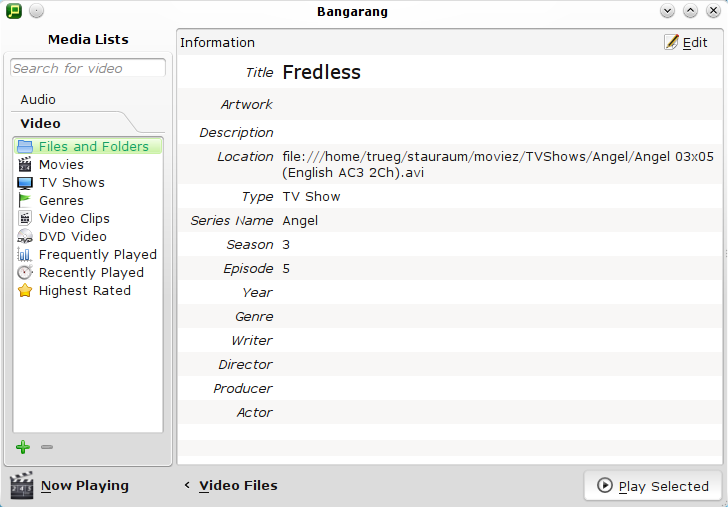
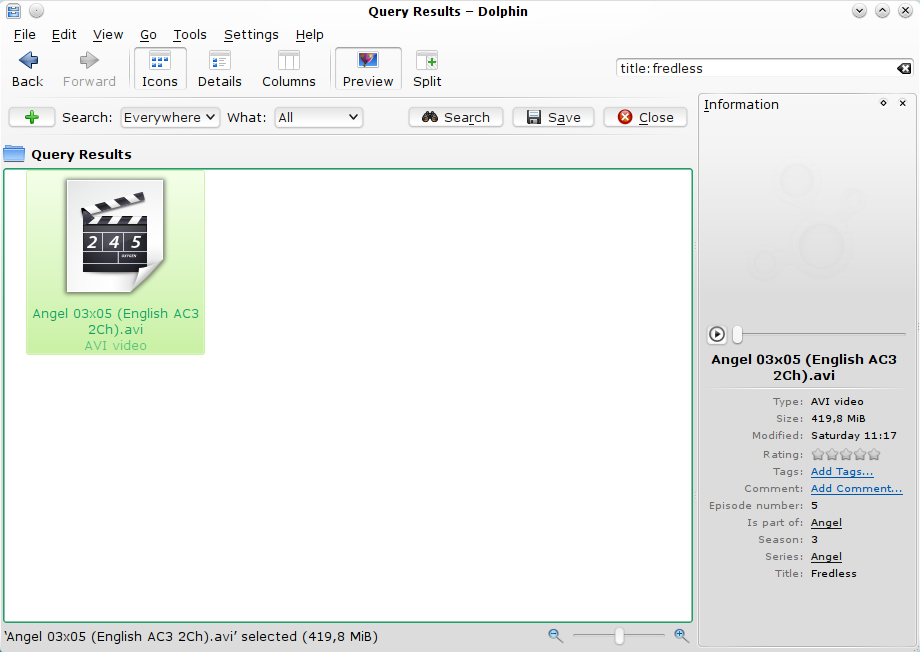
  <content:encoded xmlns:content="http://purl.org/rss/1.0/modules/content/"><![CDATA[<p>For this particular user experience chronicle, I&#39;ve simply inserted the content of <a href="http://trueg.wordpress.com" id="link-id1368b4d8">Sebastian Trueg</a>&#39;s post titled:
<a href="http://trueg.wordpress.com/2010/01/26/what-we-did-last-summer-and-the-rest-of-2009-a-look-back-onto-the-nepomuk-development-year-with-an-obscenely-long-title/#comments" id="link-id139dddb0">What We Did Last Summer (And the Rest of 2009) â A Look Back Onto the Nepomuk Development Year ...</a>, directly into this post, without any additional commentary or modification.</p>
<div class="snap_preview">

<p>2009 is over. <em>Yeah, sure, trueg, we know that, it has been over for a while now!</em> Ok, ok, I am a bit late, but still I would like to get this one out - if only for my archive. So here goes.</p>
<h2>
  <a href="http://virtuoso.openlinksw.com" id="link-id64672f0">Virtuoso</a>
</h2>
<p>Letâs start with the major topic of 2009 (and also the beginning of 2010): The new Nepomuk database backend: <a href="http://virtuoso.openlinksw.com/dataspace/dav/wiki/Main/" id="link-id13cc47e0">Virtuoso</a>. Everybody who used Nepomuk had the same problems: you either used the <a href="http://openrdf.org/" id="link-id13a4ac88">sesame2</a> backend which depends on Java and steals all of your memory or you were stuck with <a href="http://librdf.org/" id="link-id11b6a550">Redland</a> which had the worst performance and missed some <a href="http://dbpedia.org/resource/SPARQL" id="link-id139d82b8">SPARQL</a> features making important parts of NepomukÂ  like queries unusable. So more than a year ago I had the idea to use the one GPLâed database server out there that supported RDF in a professional manner: <a href="http://www.openlinksw.com/" id="link-id139fd948">OpenLin</a>kâs <a href="http://virtuoso.openlinksw.com/dataspace/dav/wiki/Main/" id="link-id12329590">Virtuoso</a>. It has all the features we need, has a very good performance, and scales up to dimensions we will probably never reach on the desktop (<em>yeah, right, and 64k main memory will be enough forever!</em>). So very early I started coding the necessary Soprano plugin which would talk to a locally running Virtuoso server through <a href="http://en.wikipedia.org/wiki/Open_Database_Connectivity" id="link-id14930d90">ODBC</a>. But since I ran into tons of small problems (as always) and got sidetracked by other tasks I did not finish it right away. OpenLink, however, was very interested in the idea of their server being part of every KDE installation (why wouldnât they ;)). So they not only introduced a <a href="http://docs.openlinksw.com/virtuoso/databaseadmsrv.html#ini_Parameters" id="link-id136763c0">lite-mode</a> which makes Virtuoso suitable for the desktop but also helped in debugging all the problems that I had left. Many test runs, patches, and a Virtuoso 5.0.12 release later <a href="http://trueg.wordpress.com/2009/10/22/virtuoso-once-more-with-feeling/" id="link-id13c5a5a0">I could finally announce the Virtuoso integration</a> as usable.</p>
<p>Then end of last year I dropped the support for sesame2 and redland. Virtuoso is now the only supported database backend. The reason is simple: Virtuoso is way more powerful than the rest - not only in terms of performance - and it is fully implemented in <a href="http://dbpedia.org/resource/C%2B%2B" id="link-id13a17cd8">C</a>(++) without any traces of Java. Maybe even more important is the integration of the full text index which makes the previously used CLucene index unnecessary. Thus, we can finally combine full text and graph queries in one SPARQL query. This results in a cleaner API and way faster return ofÂ  search results since there is no need to combine the results from several queries anymore. A direct result of that is the new <a href="http://api.kde.org/4.x-api/kdelibs-apidocs/nepomuk/html/namespaceNepomuk_1_1Query.html" id="link-id149a9fd8">Nepomuk Query API</a> which I will discuss later.</p>
<p>So now the only thing I am waiting for is the first bugfix release of Virtuoso 6, i.e. 6.0.1 which will fix the bugs that make 6.0.0 fail with Nepomuk. Should be out any day now. :)</p>
<h2>The Nepomuk Query API</h2>
<p>Querying <a href="http://dbpedia.org/resource/Data">data</a> in Nepomuk pre-KDE-4.4 could be done in one of two ways: 1. Use the very limited capabilities of the <a href="http://api.kde.org/4.x-api/kdelibs-apidocs/nepomuk/html/classNepomuk_1_1ResourceManager.html" id="link-id139ad3d0">ResourceManager</a> to list resources with certain properties or of a certain type; or 2. Write your own <a href="http://techbase.kde.org/Development/Tutorials/Metadata/Nepomuk/AdvancedQueries" id="link-id13c74608">SPARQL query using ugly QString::arg replacements</a>.</p>
<p>With the introduction of Virtuoso and its awesome power we can now do pretty much everything in one query. This allowed <a href="http://myopenlink.net/dataspace/person/kidehen#this" id="link-id13c4cf18">me</a> to finally create a query API for KDE: <a href="http://api.kde.org/4.x-api/kdelibs-apidocs/nepomuk/html/classNepomuk_1_1Query_1_1Query.html" id="link-id602e818">Nepomuk::Query::Query</a> and friends. I wonât go into much detail here since I did that <a href="http://trueg.wordpress.com/2009/12/07/convenient-querying-in-libnepomuk/" id="link-id11282ff8">before</a>.</p>
<p>All in all you should remember one thing: whenever you think about writing your own SPARQL query in a KDE application - have a look at libnepomukquery. It is very likely that you can avoid the hassle of debugging a query by using the query API.</p>
<p>The first nice effect of the new API (apart from me using it all over the place obviously) is the new query interface in Dolphin. Internally it simply combines a bunch of <a href="http://api.kde.org/4.x-api/kdelibs-apidocs/nepomuk/html/classNepomuk_1_1Query_1_1Term.html" id="link-id11952270">Nepomuk::Query::Term</a> objects into a <a href="http://api.kde.org/4.x-api/kdelibs-apidocs/nepomuk/html/classNepomuk_1_1Query_1_1AndTerm.html" id="link-id13aa85b8">Nepomuk::Query::AndTerm</a>. All very readable and no ugly query strings.</p>
<div id="attachment_234" class="wp-caption aligncenter" style="width: 610px">
  <a href="http://trueg.files.wordpress.com/2010/01/dolphin-kde-4-4-search-panel.png" id="link-id11454028"><img class="size-full wp-image-234" title="Dolphin Search Panel in KDE SC 4.4" src="http://trueg.files.wordpress.com/2010/01/dolphin-kde-4-4-search-panel.png?w=600&amp;h=208" alt="" width="600" height="208" />
  </a>
  <p class="wp-caption-text">Dolphin Search Panel in KDE SC 4.4</p>
</div>
<h2>Shared Desktop Ontologies</h2>
<p>An important part of the <a href="http://nepomuk.semanticdesktop.org/" id="link-id13a35a90">Nepomuk research project</a> was the creation of a set of <a href="http://www.semanticdesktop.org/ontologies/" id="link-id123a6700">ontologies</a> for describing desktop resources and their metadata. After the <a href="http://xesam.org/main/XesamAbout" id="link-id13c70ab8">Xesam</a> project under the umbrella of <a href="http://www.freedesktop.org/" id="link-id139e2108">freedesktop.org</a> had been convinced to use RDF for describing file metadata they developed their own ontology. Thanks to Evgeny (phreedom) Egorochkin and Antonie Mylka both the Xesam ontology and the Nepomuk <a href="http://dbpedia.org/resource/Information" id="link-id119be318">Information</a> Elements Ontology were already very close in design. Thus, it was relatively easy to merge the two and be left with only one ontology to support. Since then not only KDE but also <a href="http://strigi.sourceforge.net/" id="link-id123b63f0">Strigi</a> and <a href="http://projects.gnome.org/tracker/" id="link-id13d02a30">Tracker</a> are using the Nepomuk ontologies.</p>
<p>At the Gran Canaria Desktop Summit I met some of the guys from Tracker and we tried to come up with a plan to create a joint project to maintain the ontologies. This got off to a rough start as nobody really felt responsible. So I simply took the initiative and released the <a href="http://sourceforge.net/projects/oscaf/files/" id="link-id148d7078">shared-desktop-ontologies</a> version 0.1 in November 2009. The result was a s***-load of hate-mails and bug reports due to me breaking KDE build. But in the end it was worth it. Now the package is established and other projects can start to pick it up to create data compatible to the Nepomuk system and Tracker.</p>
<p>Today the ontologies (and the shared-desktop-ontologies package) are maintained in the <a href="http://sourceforge.net/apps/trac/oscaf/" id="link-id10ce1038">Oscaf project at Sourceforge</a>. The situation is far from perfect but it is a good start. If you need specific properties in the ontologies or are thinking about creating one for your own application - come and join us in the <a href="http://sourceforge.net/apps/trac/oscaf/report/1" id="link-id11413910">bug tracker</a>â¦</p>
<h2>Timeline KIO Slave</h2>
<p>It was at the Akonadi meeting that Will Stephenson and myself got into talking about mimicking some <a href="http://live.gnome.org/Zeitgeist" id="link-id116888b0">Zeitgeist</a> functionality through Nepomuk. Basically it meant gathering some data when opening and when saving files. We quickly came up with a hacky patch for KIO and <a href="http://api.kde.org/4.x-api/kdelibs-apidocs/kio/html/classKFileDialog.html" id="link-id13637348">KFileDialog</a> which covered most cases and allowed us to track when a file was modified and by which application. This little experiment did not leave that state though (it will, however, this year) but another one did: Zeitgeist also provides a fuse filesystem which allows to browse the files by modification dates. Well, whatever fuse can do, KIO can do as well. <a href="http://trueg.wordpress.com/2009/10/26/just-another-way-of-browsing-your-files/" id="link-id13cf58c0">Introducing the timeline:/ KIO slave</a> which gives a calendar view onto your files.</p>
<p>
  <a href="http://trueg.wordpress.com/2009/10/26/just-another-way-of-browsing-your-files/" id="link-id113d4988"><img class="aligncenter size-medium wp-image-208" title="timeline-october" src="http://trueg.files.wordpress.com/2009/10/timeline-october.png?w=300&amp;h=235" alt="" width="300" height="235" />
  </a>
</p>
<h2>Tips And Tricks</h2>
<p>Well, I thought I would mention the <a href="http://techbase.kde.org/Development/Tutorials/Metadata/Nepomuk/TipsAndTricks" id="link-id116357d0">Tips And Tricks</a> section I wrote for the <a href="http://techbase.kde.org/Development/Tutorials/Metadata/Nepomuk" id="link-id14473520">techbase</a>. It might not be a big deal but I think it contains some valuable information in case you are using Nepomuk as a developer.</p>
<h2>Google Summer Of Code 2009</h2>
<p>This time around I had the privilege to <a href="http://trueg.wordpress.com/2009/04/22/nepomuk-in-the-summer-x2/" id="link-id116b0cf8">mentor two students</a> in the Google Summer of Code. Alessandro Sivieri and Adam Kidder did outstanding work on <a href="http://trueg.wordpress.com/2009/08/25/gsoc-wrap-up-part-1/" id="link-id13c9f2f8">Improved Virtual Folders</a> and the <a href="http://trueg.wordpress.com/2009/08/28/gsoc-wrap-up-part-2/" id="link-id123bac00">Smart File Dialog</a>.</p>
<p>Adamâs work lead me to some heavy improvements in the Nepomuk KIO slaves myself which I only finished this week (more details on that coming up). Alessandro continued his work on faceted file browsing in KDE and created:</p>
<h3>Sembrowser</h3>
<p>Alessandro is following up on his work to make faceted file browsing a reality in 2010 (and KDE SC 4.5). Since it was too late to get faceted browsing into KDE SC 4.4 he is working on <a href="http://www.kde-apps.org/content/show.php/Sembrowser?content=117692" id="link-id117c67d0">Sembrowser</a>, a stand-alone faceted file browser which will be the grounds for experiments until the code is merged into Dolphin.</p>
<div id="attachment_238" class="wp-caption aligncenter" style="width: 310px">
  <a href="http://trueg.files.wordpress.com/2010/01/sembrowser.png" id="link-id13aa8e80"><img class="size-medium wp-image-238" title="sembrowser" src="http://trueg.files.wordpress.com/2010/01/sembrowser.png?w=300&amp;h=189" alt="" width="300" height="189" />
  </a>
  <p class="wp-caption-text">Faceted Browsing in KDE with Sembrowser</p>
</div>
<h2>Nepomuk Workshops</h2>
<p>In 2009 I organized the first Nepomuk workshop in Freiburg, Germany. And also the second one. While <a href="http://trueg.wordpress.com/2009/06/23/the-first-nepomuk-workshop-its-a-wrap/" id="link-id13b553e0">I reported properly on the first one</a> I still owe a summary for the second one. I will get around to that - sooner or later. ;)</p>
<h2>CMake Magic</h2>
<p>
  <a href="http://soprano.sourceforge.net/" id="link-id148bfad8">Soprano</a> gives us a nice command line tool to create a C++ namespace from an ontology file: <a href="http://soprano.sourceforge.net/apidox/trunk/soprano_devel_tools.html" id="link-iddac3b58">onto2vocabularyclass</a>. It produces nice convenience namespaces like <a href="http://soprano.sourceforge.net/apidox/trunk/namespaceSoprano_1_1Vocabulary_1_1NAO.html" id="link-idfd4b970">Soprano::Vocabulary::NAO</a>. Nepomuk adds another tool named <a href="http://techbase.kde.org/Development/Tutorials/Metadata/Nepomuk/ResourceGenerator" id="link-id11b60200">nepomuk-rcgen</a>. Both were a bit clumsy to use before. Now we have nice cmake macros which make it very simple to use both.</p>
<p>See the <a href="http://techbase.kde.org/Development/Tutorials/Metadata/Nepomuk/ResourceGenerator" id="link-id11963490">techbase article</a> on how to use the new macros.</p>
<h2>Bangarang</h2>
<p>Without my <a href="http://dbpedia.org/resource/Knowledge" id="link-iddcbd7c8">knowledge</a> (imagine that!) Andrew Lake created an amazing new media player named <a href="http://bangarangkde.wordpress.com/" id="link-id113d9500">Bangarang</a> - <em>a Jamaican word for noise, chaos or disorder.</em> This player is Nepomuk-enabled in the sense that it has a media library which lets you browse your media files based on the Nepomuk data. It remembers the number of times a song or a video has been played and when it was played last. It allows to add detail such as the TV series name, season, episode number, or actors that are in the video - all through Nepomuk (I hope we will soon get <a href="http://thetvdb.com/" id="link-id1154d7a0">tvdb</a> integration).</p>
<div id="attachment_242" class="wp-caption aligncenter" style="width: 310px">
  <a href="http://trueg.files.wordpress.com/2010/01/bangarang2.png" id="link-id148bcdb8"><img class="size-medium wp-image-242" title="bangarang2" src="http://trueg.files.wordpress.com/2010/01/bangarang2.png?w=300&amp;h=208" alt="" width="300" height="208" />
  </a>
  <p class="wp-caption-text">Edit metadata directly in Bangarang</p>
</div>
<div id="attachment_243" class="wp-caption aligncenter" style="width: 303px">
  <a href="http://trueg.files.wordpress.com/2010/01/bangarang-dolphin-fileinfo.png" id="link-id11c70a48"><img class="size-full wp-image-243" title="bangarang-dolphin-fileinfo" src="http://trueg.files.wordpress.com/2010/01/bangarang-dolphin-fileinfo.png?w=293&amp;h=242" alt="" width="293" height="242" />
  </a>
  <p class="wp-caption-text">Dolphin showing TV episode metadata created by Bangarang</p>
</div>
<div id="attachment_245" class="wp-caption aligncenter" style="width: 310px">
  <a href="http://trueg.files.wordpress.com/2010/01/bangarang-dolphin-search.png" id="link-id149200f8"><img class="size-medium wp-image-245" title="bangarang-dolphin-search" src="http://trueg.files.wordpress.com/2010/01/bangarang-dolphin-search.png?w=300&amp;h=212" alt="" width="300" height="212" />
  </a>
  <p class="wp-caption-text">And of course searching for it works, too...</p>
</div>
<div id="attachment_244" class="wp-caption aligncenter" style="width: 310px">
  <a href="http://trueg.files.wordpress.com/2010/01/bangarang1.png" id="link-id114f7c80"><img class="size-medium wp-image-244" title="bangarang1" src="http://trueg.files.wordpress.com/2010/01/bangarang1.png?w=300&amp;h=225" alt="" width="300" height="225" />
  </a>
  <p class="wp-caption-text">And it is pretty, too...</p>
</div>
<p>I am especially excited about this since finally applications not written or mentored by me start contributing Nepomuk data.</p>
<h2>Gran Canaria Desktop Summit</h2>
<p>2009 was also the year of the first Gnome-KDE joint-conference. Let me make a bulletin for completeness and refer to <a href="http://trueg.wordpress.com/2009/07/13/gran-canaria-desktop-summit-2009-the-nepomuk-perspective/" id="link-id143ff668">my previous blog post reporting on my experiences on the island</a>.</p>
<p>Well, that was by far not all I did in 2009 but I think I covered most of the important topics. And after all it is âjust a blog entryâ - there is no need for completeness. Thanks for reading.</p>
  <a rel="nofollow" href="http://feeds.wordpress.com/1.0/gocomments/trueg.wordpress.com/232/" id="link-id118a1950"><img alt="" border="0" src="http://feeds.wordpress.com/1.0/comments/trueg.wordpress.com/232/" /></a> <a rel="nofollow" href="http://feeds.wordpress.com/1.0/godelicious/trueg.wordpress.com/232/" id="link-id148ffb08"><img alt="" border="0" src="http://feeds.wordpress.com/1.0/delicious/trueg.wordpress.com/232/" /></a> <a rel="nofollow" href="http://feeds.wordpress.com/1.0/gostumble/trueg.wordpress.com/232/" id="link-id13c65a88"><img alt="" border="0" src="http://feeds.wordpress.com/1.0/stumble/trueg.wordpress.com/232/" /></a> <a rel="nofollow" href="http://feeds.wordpress.com/1.0/godigg/trueg.wordpress.com/232/" id="link-id119b85a0"><img alt="" border="0" src="http://feeds.wordpress.com/1.0/digg/trueg.wordpress.com/232/" /></a> <a rel="nofollow" href="http://feeds.wordpress.com/1.0/goreddit/trueg.wordpress.com/232/" id="link-id13f5d6b8"><img alt="" border="0" src="http://feeds.wordpress.com/1.0/reddit/trueg.wordpress.com/232/" /></a> <img alt="" border="0" src="http://stats.wordpress.com/b.gif?host=trueg.wordpress.com&amp;blog=6648236&amp;post=232&amp;subd=trueg&amp;ref=&amp;feed=1" />
</div>&quot;
]]></content:encoded>
 </rss:item>
 <rss:item xmlns:rss="http://purl.org/rss/1.0/" rdf:about="http://www.openlinksw.com:443/blog/kidehen@openlinksw.com/blog/?date=2010-01-02#1601">
  <rss:title>One Technology That Will Rock 2010 (Update 1)</rss:title>
  <dc:date xmlns:dc="http://purl.org/dc/elements/1.1/">2010-01-02T17:30:38Z</dc:date>
  <dc:description xmlns:dc="http://purl.org/dc/elements/1.1/">Thanks to the TechCrunch post titled: Ten Technologies That Will Rock 2010, I&#39;ve been able to quickly construct a derivative post that condenses the ten item list down to a Single Technology That Will Rock 2010 :-) Sticking with the TechCrunch layout, here is why all roads simply lead to Linked Data come 2010 and beyond: The Tablet: a new form factor addition re. Internet and Web application hosts which is just another way of saying: Linked Data will be accessible from Tablet applications. Geo: GPS chips are now standard features of mobile phones, so geolocation is increasingly becoming a necessary feature for any killer app. Thus, GeoSpatial Linked Data and GeopSpatial Queries are going to be a critical success factor for any endeavor that seeks to engage mobile applications developers and ultimately their end-users. Basiacally, you want to be able to perform Esoteric Search from these devices of the form: Find Vendors of a Camcorder (e.g., with a Zoom Factor: Weight Ratio of X) within a 2km Radius of my current location. Or how many items from my WishList are available from a Vendor within a 2km radius of my current location. Conversely, provide Vendors with the ability to spot potential Customers within a 2km of a given &quot;clicks &amp; mortar&quot; location (e.g. BestBuy store). Realtime Search: Rich Structured Profiles that leverage standards such as FOAF and FOAF+SSL will enable Highly Personalized Realtime Search (HPRS) without compromisng privacy. Tecnically, this is about WebIDs securely bound to X.509 Certificates, providing access to verifiable and highly navigable Personal Profile Data Spaces that also double as personal search index entry points. Chrome OS: Just another operating system for exploiting the burgeoning Web of Linked Data HTML5: Courtesy of RDFa, just another mechanism for exposing Linked Data by making HTML+RDFa a bona fide markup for metadata (i.e., format for describing real world objects via their attribute-value graphs) Mobile Video: Simplifies the production and sharing of Video annotations (comments, reviews etc.) en route to creating rich Linked Discourse Data Spaces. Augmented Reality: Ditto Mobile Transactions: As per points 1&amp;2 above, Vendor Discovery and Transaction Conusmation will increasingly be driven by high SDQ applications. The &quot;Funnel Effect&quot; (more choices based on individual preferences) will be a critical success factor for any one operating in the Mobile Transaction realm. Note, without Linked Data you cannot deliver scalable solutions that handle the combined requirements of: SDQ, &quot;Funnel Effect&quot;, and Mobile Device form factor, will simply maginify the importance of Web accessible Linked Data. Android: An additional platform for items 1-8; basically, 2010 isn&#39;t going to be an iPhone only zone. Personally, this reminds me of a battle from the past i.e., Microsoft vs Apple, re. desktop computing dominance. Google has studied history very well :-) Social CRM: this is simply about applying points 1-9 alongide the construction of Linked Data from eCRM Data Spaces. As I&#39;ve stated in the past (across a variety of mediums), you cannot build applications that have long term value without addressing the following issues: Data Item or Object Identity Data Structure -- Data Models Data Representation -- Data Model Entity &amp; Relationships Representation mechanism (as delivered by metadata oriented markup) Data Storage -- Database Management Systems Data Access -- Data Access Protocols Data Presentation -- How you present Views and Reports from Structured Data Sources Data Security -- Data Access Policies The items above basically showcase the very essence of the HTTP URI abstraction that drives HTTP based Linked Data; which is also the basic payload unit that underlies REST. Conclusion I simply hope that the next decade marks a period of broad appreciation and comprehension of Data Access, Integration, and Management issues on the parts of: application developers, integrators, analysts, end-users, and decision makers. Remember, without structured Data we cannot produce or share Information, and without Information, we cannot produce of share Knowledge. Related HTTP URI Abstraction and Linked Data First Law of Data Quality Who&#39;s Data Is It? Serendipitous Discovery Quotient (SDQ) SDQ: The Future of SEO or an Abstract Concept? SPARQL &amp; GeoSpatial Indexing (implications of SPARQL-GEO) Mastering Your Own Search Index Solving the Paradox of Choice.</dc:description>
  <content:encoded xmlns:content="http://purl.org/rss/1.0/modules/content/"><![CDATA[<p>Thanks to the <a href="http://www.techcrunch.com/" id="link-id114eb070">TechCrunch</a> post titled: <a href="http://www.techcrunch.com/2010/01/01/ten-technologies-2010/" id="link-id1146e550">Ten Technologies That Will Rock 2010</a>, I&#39;ve been able to quickly construct a derivative post that condenses the ten item list down to a Single Technology That Will Rock 2010 :-)</p>
<p>Sticking with the TechCrunch layout, here is why all roads simply lead to <a href="http://dbpedia.org/resource/Linked_Data" id="link-id11141d50">Linked Data</a> come 2010 and beyond: </p>
<ol>
<li>
  <strong>The Tablet: </strong>a new form factor addition re. <a href="http://dbpedia.org/resource/Internet" id="link-id13f09418">Internet</a> and <a href="http://dbpedia.org/resource/World_Wide_Web">Web</a> application hosts which is just another way of saying: Linked Data will be accessible from Tablet applications.</li>
<li>
  <strong>Geo:</strong>  GPS chips are now standard features of mobile phones, so <a href="http://www.techcrunch.com/2009/12/23/location-2010/" id="link-id112cfdd0">geolocation</a> is increasingly becoming a necessary feature for any killer app. Thus, GeoSpatial Linked Data and GeopSpatial Queries are going to be a critical success factor for any endeavor that seeks to engage mobile applications developers and ultimately their end-users. Basiacally, you want to be able to perform Esoteric Search from these devices of the form: Find Vendors of a Camcorder (e.g., with a Zoom Factor: Weight Ratio of X) within a 2km Radius of my current location. Or how many items from my WishList are available from a Vendor within a 2km radius of my current location. Conversely, provide Vendors with the ability to spot potential Customers within a 2km of a given &quot;clicks &amp; mortar&quot; location (e.g. BestBuy store).</li>
<li>
  <strong>Realtime Search: </strong>Rich Structured Profiles that leverage standards such as <a href="http://dbpedia.org/resource/Friend_of_a_friend" id="link-id140ece38">FOAF</a> and <a href="http://blogs.sun.com/bblfish/entry/foaf_ssl_creating_a_global" id="link-id11856318">FOAF+SSL</a> will enable Highly Personalized Realtime Search (HPRS) without compromisng privacy. Tecnically, this is about <a href="http://esw.w3.org/topic/WebID" id="link-id13ec6260">WebID</a>s securely bound to X.509 Certificates, providing access to verifiable and highly navigable Personal Profile <a href="http://dbpedia.org/resource/Data">Data</a> Spaces that also double as personal search index entry points.</li>
<li>
  <strong>Chrome OS: </strong>Just another operating system for exploiting the burgeoning Web of Linked Data</li>
<li>
  <strong>HTML5: </strong>Courtesy of <a href="http://dbpedia.org/resource/RDFa" id="link-id115b08f0">RDFa</a>, just another mechanism for exposing Linked Data by making HTML+RDFa a bona fide markup for <a href="http://dbpedia.org/resource/Metadata" id="link-id1195b070">metadata</a> (i.e., format for describing real world objects via their attribute-value graphs)</li>
<li>
  <strong>Mobile Video:</strong> Simplifies the production and sharing of Video annotations (comments, reviews etc.) en route to creating rich Linked Discourse Data Spaces.</li>
<li>
  <strong>Augmented Reality:</strong> Ditto</li>
<li>
  <strong>Mobile Transactions:</strong> As per points 1&amp;2 above, Vendor Discovery and Transaction Conusmation will increasingly be driven by high SDQ applications. The &quot;Funnel Effect&quot; (more choices based on individual preferences) will be a critical success factor for any one operating in the Mobile Transaction realm. Note, without Linked Data you cannot deliver scalable solutions that handle the combined requirements of: SDQ, &quot;Funnel Effect&quot;, and Mobile Device form factor, will simply maginify the importance of Web accessible Linked Data.</li>
<li>
  <strong>Android:</strong> An additional platform for items 1-8; basically, 2010 isn&#39;t going to be an iPhone only zone. Personally, this reminds <a href="http://myopenlink.net/dataspace/person/kidehen#this" id="link-id111ab5e8">me</a> of a battle from the past i.e., Microsoft vs Apple, re. desktop computing dominance. Google has studied history very well :-)</li>
<li>
  <strong>Social CRM:</strong> this is simply about applying points 1-9 alongide the construction of Linked Data from eCRM Data Spaces.</li>
</ol>
<p>As I&#39;ve stated in the past (across a variety of mediums), you cannot build applications that have long term value without addressing the following issues:</p>
<ol>
<li>Data Item or Object Identity</li>
<li>Data Structure -- Data Models</li>
<li>Data Representation -- Data Model <a href="http://dbpedia.org/resource/Entity" id="link-id1148eaf8">Entity</a> &amp; Relationships Representation mechanism (as delivered by metadata oriented markup)</li>
<li>Data Storage -- Database Management Systems</li> 
<li>Data Access -- Data Access Protocols </li>
<li>Data Presentation -- How you present Views and Reports from Structured Data Sources</li>
<li>Data Security -- Data Access Policies</li>
</ol>
<p>The items above basically showcase the very essence of the HTTP <a href="http://dbpedia.org/resource/Uniform_Resource_Identifier" id="link-id1239af68">URI</a> abstraction that drives HTTP based Linked Data; which is also the basic payload unit that underlies <a href="http://dbpedia.org/resource/Representational_State_Transfer" id="link-id11489a98">REST</a>.</p> 
<h3>Conclusion</h3>
<p>I simply hope that the next decade marks a period of broad appreciation and comprehension of Data Access, Integration, and Management issues on the parts of: application developers, integrators, analysts, end-users, and decision makers. Remember, without structured Data we cannot produce or share <a href="http://dbpedia.org/resource/Information" id="link-id13cb5040">Information</a>, and without Information, we cannot produce of share <a href="http://dbpedia.org/resource/Knowledge" id="link-id647abb0">Knowledge</a>.</p>
<h3>Related</h3>
<ul>
<li>
  <a href="http://www.openlinksw.com/dataspace/kidehen@openlinksw.com/weblog/kidehen@openlinksw.com%27s%20BLOG%20%5B127%5D/1567" id="link-id13fa3a20">HTTP URI Abstraction and Linked Data</a>
</li>
<li>
  <a href="http://www.dataflux.com/dfblog/?p=1458," id="link-id138f3ea8">First Law of Data Quality</a>
</li>
<li>
  <a href="http://walkingoncoals.blogspot.com/2009/12/whos-data-is-it-part-1.html" id="link-id13efccb8">Who&#39;s Data Is It?</a>
</li>
<li>
  <a href="http://www.openlinksw.com/dataspace/kidehen@openlinksw.com/weblog/kidehen@openlinksw.com%27s%20BLOG%20%5B127%5D/1442" id="link-id1355df68">Serendipitous Discovery Quotient</a> (SDQ)</li>
<li>
  <a href="http://www.seangolliher.com/2009/linked-data/serendipitous-discovery-quotient-sdq-the-future-of-seo-or-an-abstract-concept/" id="link-id11217cb8">SDQ: The Future of SEO or an Abstract Concept?</a>
</li>
<li>
  <a href="http://www.openlinksw.com/dataspace/oerling/weblog/Orri%20Erling%27s%20Blog/1587" id="link-id139cfbe0">SPARQL &amp; GeoSpatial Indexing</a> (implications of <a href="http://dbpedia.org/resource/SPARQL" id="link-id13f51b78">SPARQL</a>-GEO)</li>
<li>
  <a href="http://blog.jonudell.net/2009/09/09/talking-with-kingsley-idehen-about-mastering-your-own-search-index/" id="link-id13c5c248">Mastering Your Own Search Index</a>
</li>
<li>
  <a href="http://blog.jonudell.net/2009/11/23/talking-with-martin-hepp-about-solving-the-paradox-of-choice/" id="link-id135ba4d0">Solving the Paradox of Choice</a>.</li>
</ul>]]></content:encoded>
 </rss:item>
 <rss:item xmlns:rss="http://purl.org/rss/1.0/" rdf:about="http://www.openlinksw.com:443/blog/kidehen@openlinksw.com/blog/?date=2009-11-16#1589">
  <rss:title>Personal and/or Service Specific Linked Data Spaces in the Cloud: DBpedia 3.4</rss:title>
  <dc:date xmlns:dc="http://purl.org/dc/elements/1.1/">2009-11-16T18:17:46Z</dc:date>
  <dc:description xmlns:dc="http://purl.org/dc/elements/1.1/">We have just released an Amazon EC2 based public Snapshot of DBpedia 3.4. Thus, you can now instantiate a personal and/or service specific variant of the DBpedia 3.4 Linked Data Space. Basically, you can replicate what we host, within minutes (as opposed to days). In addition, you no longer need to squabble --on an unpredictable basis with others-- for the infrastructure resources behind DBpedia&#39;s public instance, when using the SPARQL Endpoint, Faceted Search &amp; Find Services, or HTML Browser Pages etc. How Does It work? Instantiate a Virtuoso EC2 AMI (paid variety, which is aggressively priced at $49.99 for setup and $19.99 per month thereafter) Mount the shared DBpedia 3.4 public snapshot Start Virtuoso Server Start exploiting the DBpedia Linked Data Space. What Interfaces are exposed? SPARQL Endpoint Linked Data Viewer Pages (as you see in the public DBpedia instance) Faceted Search &amp; Find UI and Web Services (REST or SOAP) All the inference rules for UMBEL, SUMO, YAGO, OpenCYC, and DBpedia-OWL data dictionaries Type Correlations Between DBpedia and Freebase Enjoy!</dc:description>
  <content:encoded xmlns:content="http://purl.org/rss/1.0/modules/content/"><![CDATA[<p>
We have just released an Amazon EC2 based public Snapshot of <a href="http://dbpedia.org/resource/DBpedia" id="link-id18e899b8">DBpedia</a> 3.4. Thus, you can now instantiate a personal and/or service specific variant of the DBpedia 3.4 <a href="http://dbpedia.org/resource/Linked_Data" id="link-id168dec90">Linked Data</a> <a href="http://en.wikipedia.org/wiki/Data_Spaces" id="link-id18911268">Space</a>. Basically, you can replicate what we host, within minutes (as opposed to days). In addition, you no longer need to squabble --on an unpredictable basis with others-- for the infrastructure resources behind DBpedia&#39;s public instance, when using the <a href="http://dbpedia.org/resource/SPARQL" id="link-id18d5bd78">SPARQL</a> Endpoint, Faceted Search &amp; Find Services, or HTML Browser Pages etc.</p>

<h3>How Does It work?</h3>
<ol>
<li>
   <a href="http://virtuoso.openlinksw.com/dataspace/dav/wiki/Main/VirtInstallationEC2" id="link-id115932b8">Instantiate a Virtuoso EC2 AMI</a> (paid variety, which is aggressively priced at $49.99 for setup and $19.99 per month thereafter)</li>
 <li>
  <a href="http://virtuoso.openlinksw.com/dataspace/dav/wiki/Main/VirtAWSDBpedia34S" id="link-id182dc800"> Mount the shared DBpedia 3.4 public snapshot</a>
 </li>
<li>
   Start Virtuoso Server</li>
<li>
   Start exploiting the DBpedia Linked Data Space.</li>
</ol>

<h3>What Interfaces are exposed?</h3>
<ol>
<li>
   SPARQL Endpoint</li>
<li>
   Linked Data Viewer Pages (as you see in the public DBpedia instance)</li>
<li>
   <a href="http://virtuoso.openlinksw.com/dataspace/dav/wiki/Main/VirtFacetBrowserInstallConfig" id="link-id117f6e80">Faceted Search &amp; Find UI and Web Services</a> (REST or SOAP)</li>
<li>
   All the inference rules for <a href="http://umbel.org/about/" id="link-id144b84a8">UMBEL</a>, SUMO, YAGO, <a href="http://dbpedia.org/resource/Cyc" id="link-id16b69da8">OpenCYC</a>, and DBpedia-OWL <a href="http://dbpedia.org/resource/Data">data</a> dictionaries</li>
<li>Type Correlations Between DBpedia and Freebase</li>
</ol>

<p>Enjoy!</p>]]></content:encoded>
 </rss:item>
 <rss:item xmlns:rss="http://purl.org/rss/1.0/" rdf:about="http://www.openlinksw.com:443/blog/kidehen@openlinksw.com/blog/?date=2009-11-16#1599">
  <rss:title>Personal and/or Service Specific Linked Data Spaces in the Cloud: DBpedia 3.4</rss:title>
  <dc:date xmlns:dc="http://purl.org/dc/elements/1.1/">2009-11-16T18:17:46Z</dc:date>
  <dc:description xmlns:dc="http://purl.org/dc/elements/1.1/">We have just released an Amazon EC2 based public Snapshot of DBpedia 3.4. Thus, you can now instantiate a personal and/or service specific variant of the DBpedia 3.4 Linked Data Space. Basically, you can replicate what we host, within minutes (as opposed to days). In addition, you no longer need to squabble --on an unpredictable basis with others-- for the infrastructure resources behind DBpedia&#39;s public instance, when using the SPARQL Endpoint, Faceted Search &amp; Find Services, or HTML Browser Pages etc. How Does It work? Instantiate a Virtuoso EC2 AMI (paid variety, which is aggressively priced at $49.99 for setup and $19.99 per month thereafter) Mount the shared DBpedia 3.4 public snapshot Start Virtuoso Server Start exploiting the DBpedia Linked Data Space. What Interfaces are exposed? SPARQL Endpoint Linked Data Viewer Pages (as you see in the public DBpedia instance) Faceted Search &amp; Find UI and Web Services (REST or SOAP) All the inference rules for UMBEL, SUMO, YAGO, OpenCYC, and DBpedia-OWL data dictionaries Type Correlations Between DBpedia and Freebase Enjoy!</dc:description>
  <content:encoded xmlns:content="http://purl.org/rss/1.0/modules/content/"><![CDATA[<p>
We have just released an Amazon EC2 based public Snapshot of <a href="http://dbpedia.org/resource/DBpedia" id="link-id18e899b8">DBpedia</a> 3.4. Thus, you can now instantiate a personal and/or service specific variant of the DBpedia 3.4 <a href="http://dbpedia.org/resource/Linked_Data" id="link-id168dec90">Linked Data</a> <a href="http://en.wikipedia.org/wiki/Data_Spaces" id="link-id18911268">Space</a>. Basically, you can replicate what we host, within minutes (as opposed to days). In addition, you no longer need to squabble --on an unpredictable basis with others-- for the infrastructure resources behind DBpedia&#39;s public instance, when using the <a href="http://dbpedia.org/resource/SPARQL" id="link-id18d5bd78">SPARQL</a> Endpoint, Faceted Search &amp; Find Services, or HTML Browser Pages etc.</p>

<h3>How Does It work?</h3>
<ol>
<li>
   <a href="http://virtuoso.openlinksw.com/dataspace/dav/wiki/Main/VirtInstallationEC2" id="link-id115932b8">Instantiate a Virtuoso EC2 AMI</a> (paid variety, which is aggressively priced at $49.99 for setup and $19.99 per month thereafter)</li>
 <li>
  <a href="http://virtuoso.openlinksw.com/dataspace/dav/wiki/Main/VirtAWSDBpedia34S" id="link-id182dc800"> Mount the shared DBpedia 3.4 public snapshot</a>
 </li>
<li>
   Start Virtuoso Server</li>
<li>
   Start exploiting the DBpedia Linked Data Space.</li>
</ol>

<h3>What Interfaces are exposed?</h3>
<ol>
<li>
   SPARQL Endpoint</li>
<li>
   Linked Data Viewer Pages (as you see in the public DBpedia instance)</li>
<li>
   <a href="http://virtuoso.openlinksw.com/dataspace/dav/wiki/Main/VirtFacetBrowserInstallConfig" id="link-id117f6e80">Faceted Search &amp; Find UI and Web Services</a> (REST or SOAP)</li>
<li>
   All the inference rules for <a href="http://umbel.org/about/" id="link-id144b84a8">UMBEL</a>, SUMO, YAGO, <a href="http://dbpedia.org/resource/Cyc" id="link-id16b69da8">OpenCYC</a>, and DBpedia-OWL <a href="http://dbpedia.org/resource/Data">data</a> dictionaries</li>
<li>Type Correlations Between DBpedia and Freebase</li>
</ol>

<p>Enjoy!</p>]]></content:encoded>
 </rss:item>
 <rss:item xmlns:rss="http://purl.org/rss/1.0/" rdf:about="http://www.openlinksw.com:443/blog/kidehen@openlinksw.com/blog/?date=2009-09-10#1584">
  <rss:title>Conversation with Jon Udell: Are We There Yet Re. Web++ ?</rss:title>
  <dc:date xmlns:dc="http://purl.org/dc/elements/1.1/">2009-09-10T15:03:01Z</dc:date>
  <dc:description xmlns:dc="http://purl.org/dc/elements/1.1/">Personally, I believe that we&#39;ve actually reached a watershed moment re. the evolution of the Web from a mesh of Linked Data Containers (Web of Linked Documents) to a mesh of Linked Data Items (entities or real world objects). The journey towards this watershed moment started with the Semantic Web Project, gained focus and pragmatism via the Linked Data meme, attained substance &amp; credibility via efforts such as DBpedia and the resulting cloud of Open Linked Data Spaces, and finally arrived at the most important destination of all: broad comprehension and coherence, via RDFa. Over the years, I&#39;ve chronicled the journey above via entries in this particular data space (my blog) and most recently, via my rapid-fire comments and debates on Twitter (basically hastag #linkeddata account: kidehen). On a parallel front re. my chronicles, I&#39;ve periodically had conversations with Jon Udell, who has always provided a coherent sounding board and reconciliation framework for my world views and open data access vision; naturally, this has a lot to do with his holistic grasp of the big picture issues, associated technical details, and special communication prowess :-) Against this backdrop, I refer you to my most recent podcast conversation with Jon, which is about how the tandem of HTML+RDFa and the GoodRelations vocabulary deliver the critical missing links re. broad comprehension of the Semantic Web vision en route to mass exploitation. Related Mark Birbeck Introduces RDFa RDFa Handbook GoodRelations Usage Examples &amp; Templates Be the master of your own search index Jon Udell Interviews Martin Hepp about GoodRelations, RDFa, and Esoteric Web Search</dc:description>
  <content:encoded xmlns:content="http://purl.org/rss/1.0/modules/content/"><![CDATA[
 <p> Personally, I believe that we&#39;ve actually reached a watershed moment re. the evolution of the <a href="http://dbpedia.org/resource/World_Wide_Web">Web</a> from a mesh of <a href="http://dbpedia.org/resource/Linked_Data" id="link-id123169a8">Linked Data</a> Containers (Web of Linked Documents) to a mesh of Linked Data Items (entities or real world objects).</p> <p> The journey towards this watershed moment started with the <a href="http://dbpedia.org/resource/Semantic_Web" id="link-id14f69f48">Semantic Web</a> Project, gained focus and pragmatism via the <a href="http://www.w3.org/DesignIssues/LinkedData.html" id="link-id11155f78">Linked Data meme</a>, attained substance &amp; credibility via efforts such as <a href="http://dbpedia.org/resource/DBpedia" id="link-id15857c78">DBpedia</a> and the resulting cloud of <a href="http://www4.wiwiss.fu-berlin.de/bizer/pub/lod-datasets_2009-07-14.html" id="link-id16adf918">Open Linked Data Spaces</a>, and finally arrived at the most important destination of all: broad comprehension and coherence, via <a href="http://dbpedia.org/resource/RDFa" id="link-id1229b960">RDFa</a>. </p> <p> Over the years, I&#39;ve chronicled the journey above via entries in this particular <a href="http://en.wikipedia.org/wiki/Data_Spaces" id="link-id14f76338">data space</a> (my <a href="http://dbpedia.org/resource/Blog" id="link-idfd32c88">blog</a>) and most recently, via my rapid-fire comments and debates on <a href="http://twitter.com" id="link-id11339e80">Twitter</a> (basically hastag #linkeddata account: <a href="http://twitter.com/kidehen#this" id="link-id115e9af8">kidehen</a>).  </p> <p> On a parallel front re. my chronicles, I&#39;ve periodically had conversations with <a href="http://blog.jonudell.net/about/" id="link-id11829170">Jon Udell</a>, who has always provided a coherent sounding board and reconciliation framework for my world views and open data access vision; naturally, this has a lot to do with his holistic grasp of the big picture issues, associated technical details, and special communication prowess :-) </p> <p> Against this backdrop, I refer you to my <a href="http://itc.conversationsnetwork.org/shows/detail4233.html" id="link-id14ac9c08">most recent podcast conversation with Jon</a>, which is about how the tandem of HTML+RDFa and the <a href="http://www.heppnetz.de/projects/goodrelations/" id="link-id14279be8">GoodRelations vocabulary</a> deliver the critical missing links re. broad comprehension of the Semantic Web vision en route to mass exploitation.  </p> <h3>Related</h3> <ul> <li>   <a href="http://webbackplane.com/node/57" id="link-id113b5b00">Mark Birbeck Introduces RDFa</a> </li> <li>   <a href="http://webbackplane.com/rdfa-handbook" id="link-id11b36ac0">RDFa Handbook</a> </li> <li>   <a href="http://www.ebusiness-unibw.org/wiki/GoodRelations#CookBook:_GoodRelations_Recipes_and_Examples" id="link-id1519f458">GoodRelations Usage Examples &amp; Templates</a> </li> <li>   <a href="http://blog.jonudell.net/2009/09/09/talking-with-kingsley-idehen-about-mastering-your-own-search-index/" id="link-id11a62ce0">Be the master of your own search index</a> </li>  <li>   <a href="http://itc.conversationsnetwork.org/shows/detail4312.html" id="link-id115d54f0">Jon Udell Interviews Martin Hepp about GoodRelations, RDFa, and Esoteric Web Search</a>   <br />  </li> </ul> 
]]></content:encoded>
 </rss:item>
 <rss:item xmlns:rss="http://purl.org/rss/1.0/" rdf:about="http://www.openlinksw.com:443/blog/kidehen@openlinksw.com/blog/?date=2009-08-07#1567">
  <rss:title>The URI, URL, and Linked Data Meme&#39;s Generic HTTP URI (Updated)</rss:title>
  <dc:date xmlns:dc="http://purl.org/dc/elements/1.1/">2009-08-07T18:34:50Z</dc:date>
  <dc:description xmlns:dc="http://purl.org/dc/elements/1.1/">Situation Analysis As the &quot;Linked Data&quot; meme has gained momentum you&#39;ve more than likely been on the receiving end of dialog with Linked Open Data community members (myself included) that goes something like this: &quot;Do you have a URI&quot;, &quot;Get yourself a URI&quot;, &quot;Give me a de-referencable URI&quot; etc.. And each time, you respond with a URL -- which to the best of your Web knowledge is a bona fide URI. But to your utter confusion you are told: Nah! You gave me a Document URI instead of the URI of a real-world thing or object etc.. What&#39;s up with that? Well our everyday use of the Web is an unfortunate conflation of two distinct things, which have Identity: Real World Objects (RWOs) &amp; Address/Location of Documents (Information bearing Resources). The &quot;Linked Data&quot; meme is about enhancing the Web by unobtrusively reintroducing its core essence: the generic HTTP URI, a vital piece of Web Architecture DNA. Basically, its about so realizing the full capabilities of the Web as a platform for Open Data Identification, Definition, Access, Storage, Representation, Presentation, and Integration. What is a Real World Object? People, Places, Music, Books, Cars, Ideas, Emotions etc.. What is a URI? A Uniform Resource Identifier. A global identifier mechanism for network addressable data items. Its sole function is Name oriented Identification. URI Generic Syntax The constituent parts of a URI (from URI Generic Syntax RFC) are depicted below: What is a URL? A location oriented HTTP scheme based URI. The HTTP scheme introduces a powerful and inherent duality that delivers: Resource Address/Location Identifier Data Access mechanism for an Information bearing Resource (Document, File etc..) So far so good! What is an HTTP based URI? The kind of URI Linked Data aficionados mean when they use the term: URI. An HTTP URI is an HTTP scheme based URI. Unlike a URL, this kind of HTTP scheme URI is devoid of any Web Location orientation or specificity. Thus, Its inherent duality provides a more powerful level of abstraction. Hence, you can use this form of URI to assign Names/Identifiers to Real World Objects (RWO). Even better, courtesy of the Identity/Address duality of the HTTP scheme, a single URI can deliver the following: RWO Identfier/Name RWO Metadata document Locator (courtesy of URL aspect) Negotiable Representation of the Located Document (courtesy of HTTP&#39;s content negotiation feature). What is Metadata? Data about Data. Put differently, data that describes other data in a structured manner. How Do we Model Metadata? The predominant model for metadata is the Entity-Attribute-Value + Classes &amp; Relationships model (EAV/CR). A model that&#39;s been with us since the inception of modern computing (long before the Web). What about RDF? The Resource Description Framework (RDF) is a framework for describing Web addressable resources. In a nutshell, its a framework for adding Metadata bearing Information Resources to the current Web. Its comprised of: Entity-Attribute-Value (aka. Subject-Predictate-Object) plus Classes &amp; Relationships (Data Dictionaries e.g., OWL) metadata model A plethora of instance data representation formats that include: RDFa (when doing so within (X)HTML docs), Turtle, N3, TriX, RDF/XML etc. What&#39;s the Problem Today? The ubiquitous use of the Web is primarily focused on a Linked Mesh of Information bearing Documents. URLs rather than generic HTTP URIs are the prime mechanism for Web tapestry; basically, we use URLs to conduct Information -- which is inherently subjective -- instead of using HTTP URIs to conduct &quot;Raw Data&quot; -- which is inherently objective. Note: Information is &quot;data in context&quot;, it isn&#39;t the same thing as &quot;Raw Data&quot;. Thus, if we can link to Information via the Web, why shouldn&#39;t we be able to do the same for &quot;Raw Data&quot;? How Does the Link Data meme solve the problem? The meme simply provides a set of guidelines (best practices) for producing Web architecture friendly metadata. Meaning: when producing EAV/CR model based metadata, endow Subjects, their Attributes, and Attribute Values (optionally) with HTTP URIs. By doing so, a new level of Link Abstraction on the Web is possible i.e., &quot;Data Item to Data Item&quot; level links (aka hyperdata links). Even better, when you de-reference a RWO hyperdata link you end up with a negotiated representations of its metadata. Conclusion Linked Data is ultimately about an HTTP URI for each item in the Data Organization Hierarchy :-) Related History of how &quot;Resource&quot; became part of URI - historic account by TimBL Linked Data Design Issues Document - TimBL&#39;s initial Linked Data Guide Linked Data Rules Simplified - My attempt at simplifying the Linked Data Meme without SPARQL &amp; RDF distraction Linked Data &amp; Identity - another related post The Linked Data Meme&#39;s Value Proposition So What Does &quot;HREF&quot; stand for anyway? My Del.icio.us hosted Bookmark Data Space for Identity Schemes TimBL&#39;s Ted Talk re. &quot;Raw Linked Data&quot; Resource Oriented Architecture More Famous Than Simon Cowell .</dc:description>
  <content:encoded xmlns:content="http://purl.org/rss/1.0/modules/content/"><![CDATA[<h3>
	Situation Analysis</h3>
<p>
	As the &quot;<a href="http://www.w3.org/DesignIssues/LinkedData.html" id="link-id12f96a00">Linked Data&quot; meme</a> has gained momentum you&#39;ve more than likely been on the receiving end of dialog with Linked Open <a href="http://dbpedia.org/resource/Data">Data</a> community members (myself included) that goes something like this:</p>
<blockquote>
	<cite>&quot;Do you have a <a href="http://dbpedia.org/resource/Uniform_Resource_Identifier" id="link-id139252a0">URI</a>&quot;, &quot;Get yourself a URI&quot;, &quot;Give <a href="http://myopenlink.net/dataspace/person/kidehen#this" id="link-id140eab68">me</a> a de-referencable URI&quot; etc..</cite>
</blockquote>
<p>
	And each time, you respond with a <a href="http://dbpedia.org/resource/Uniform_Resource_Locator" id="link-id112c1860">URL</a> -- which to the best of your <a href="http://dbpedia.org/resource/World_Wide_Web">Web</a> <a href="http://dbpedia.org/resource/Knowledge" id="link-id140b51c0">knowledge</a> is a bona fide URI. But to your utter confusion you are told: Nah! You gave me a Document URI instead of the URI of a real-world thing or object etc..</p>
<h3>
	What&#39;s up with that?</h3>
<p>
	Well our everyday use of the Web is an unfortunate conflation of two distinct things, which have Identity: Real World Objects (RWOs) &amp; Address/Location of Documents (<a href="http://dbpedia.org/resource/Information" id="link-id144838b0">Information</a> bearing Resources).</p>
<p>
	The &quot;Linked Data&quot; meme is about enhancing the Web by unobtrusively reintroducing its core essence: the generic HTTP URI, a vital piece of Web Architecture DNA. Basically, its about so realizing the full capabilities of the Web as a platform for Open Data Identification, Definition, Access, Storage, Representation, Presentation, and Integration.</p>
<h3>
	What is a Real World Object?</h3>
<p>
	People, Places, Music, Books, Cars, Ideas, Emotions etc..</p>
<h3>
	What is a URI?</h3>
<p>
	A Uniform Resource Identifier. A global identifier mechanism for network addressable data items. Its sole function is Name oriented Identification.</p>
<h4>
	URI Generic Syntax</h4>
<p>
	The constituent parts of a URI (from <a href="http://www.ietf.org/rfc/rfc2396.txt" id="link-id1180c700">URI Generic Syntax RFC</a>) are depicted below: <img src="http://virtuoso.openlinksw.com/images/generic_uri_syntax_image.png" />
</p>
<h3>
	What is a URL?</h3>
<p>
	A location oriented HTTP scheme based URI. The HTTP scheme introduces a powerful and inherent duality that delivers:</p>
<ol>
	<li>
		Resource Address/Location Identifier</li>
	<li>
		Data Access mechanism for an Information bearing Resource (Document, File etc..)</li>
</ol>
<p>
	So far so good!</p>
<h3>
	What is an HTTP based URI?</h3>
<p>
	The kind of URI <a href="http://dbpedia.org/resource/Linked_Data" id="link-id11100a28">Linked Data</a> aficionados mean when they use the term: URI.</p>
<p>
	An HTTP URI is an HTTP scheme based URI. Unlike a URL, this kind of HTTP scheme URI is devoid of any Web Location orientation or specificity. Thus, Its inherent duality provides a more powerful level of abstraction. Hence, you can use this form of URI to assign Names/Identifiers to Real World Objects (RWO). Even better, courtesy of the Identity/Address duality of the HTTP scheme, a single URI can deliver the following:</p>
<ol>
	<li>
		RWO Identfier/Name</li>
	<li>
		RWO Metadata document Locator (courtesy of URL aspect)</li>
	<li>
		Negotiable Representation of the Located Document (courtesy of HTTP&#39;s content negotiation feature).</li>
</ol>
<h3>
	What is Metadata?</h3>
<p>
	Data about Data. Put differently, data that describes other data in a structured manner.</p>
<h3>
	How Do we Model Metadata?</h3>
<p>
	The predominant model for metadata is the <a href="http://dbpedia.org/resource/Entity-attribute-value_model" id="link-id11193d30">Entity</a>-Attribute-Value + Classes &amp; Relationships model (<a href="http://dbpedia.org/resource/Entity-attribute-value_model" id="link-id11725710">EAV</a>/CR). A model that&#39;s been with us since the inception of modern computing (long before the Web).</p>
<h3>
	What about RDF?</h3>
<p>
	The Resource Description Framework (RDF) is a framework for describing Web addressable resources. In a nutshell, its a framework for adding Metadata bearing Information Resources to the current Web. Its comprised of:</p>
<ol>
	<li>
		Entity-Attribute-Value (aka. Subject-Predictate-Object) plus Classes &amp; Relationships (<a href="http://dbpedia.org/resource/Data_dictionary" id="link-id138df0f8">Data Dictionaries</a> e.g., <a href="http://dbpedia.org/resource/Web_Ontology_Language" id="link-id116bf590">OWL</a>) metadata model</li>
	<li>
		A plethora of instance data representation formats that include: <a href="http://dbpedia.org/resource/RDFa" id="link-id13360b90">RDFa</a> (when doing so within (X)HTML docs), Turtle, N3, TriX, RDF/XML etc.</li>
</ol>
<h3>
	What&#39;s the Problem Today?</h3>
<p>
	The ubiquitous use of the Web is primarily focused on a Linked Mesh of Information bearing Documents. URLs rather than generic HTTP URIs are the prime mechanism for Web tapestry; basically, we use URLs to conduct Information -- which is inherently subjective -- instead of using HTTP URIs to conduct &quot;Raw Data&quot; -- which is inherently objective.</p>
<blockquote>
	<strong>Note:</strong> Information is &quot;data in <a href="http://dbpedia.org/resource/Context_%28language_use%29" id="link-id1395ca50">context</a>&quot;, it isn&#39;t the same thing as &quot;Raw Data&quot;. Thus, if we can link to Information via the Web, why shouldn&#39;t we be able to do the same for &quot;Raw Data&quot;?</blockquote>
<h3>
	How Does the Link Data <a href="http://dbpedia.org/resource/Meme" id="link-id1160ab70">meme</a> solve the problem?</h3>
<p>
	The meme simply provides a set of guidelines (best practices) for producing Web architecture friendly metadata. Meaning: when producing EAV/CR model based metadata, endow Subjects, their Attributes, and Attribute Values (optionally) with HTTP URIs. By doing so, a new level of Link Abstraction on the Web is possible i.e., &quot;Data Item to Data Item&quot; level links (aka <a href="http://dbpedia.org/resource/Linked_Data" id="link-id137a78a0">hyperdata</a> links). Even better, when you de-reference a RWO hyperdata link you end up with a negotiated representations of its metadata.</p>
<h3>
	Conclusion</h3>
<p>
	Linked Data is ultimately about an HTTP URI for each item in the <a href="http://dbpedia.org/resource/Data_hierarchy" id="link-id1393c3e0">Data Organization Hierarchy</a> :-)</p>
<h3>
	Related</h3>
<ol>
	<li>
		<a href="http://lists.w3.org/Archives/Public/www-tag/2009Aug/0000.html" id="link-id140c1e78">History of how &quot;Resource&quot; became part of URI</a> - historic account by <a href="http://www.w3.org/People/Berners-Lee/card#i" id="link-id1172b128">TimBL</a>
</li>
	<li>
		<a href="http://www.w3.org/DesignIssues/LinkedData.html" id="link-id1338cbd0">Linked Data Design Issues Document</a> - <a href="http://www.w3.org/People/Berners-Lee/card#i" id="link-id13536ad8">TimBL</a>&#39;s initial Linked Data Guide</li>
	<li>
		<a href="http://www.openlinksw.com/dataspace/kidehen@openlinksw.com/weblog/kidehen@openlinksw.com%27s%20BLOG%20%5B127%5D/1561" id="link-id116c1af8">Linked Data Rules Simplified</a> - My attempt at simplifying the Linked Data Meme without <a href="http://dbpedia.org/resource/SPARQL" id="link-id116c3b40">SPARQL</a> &amp; RDF distraction</li>
	<li>
		<a href="http://www.openlinksw.com/dataspace/kidehen@openlinksw.com/weblog/kidehen@openlinksw.com%27s%20BLOG%20%5B127%5D/1547" id="link-id135dd1b8">Linked Data &amp; Identity</a> - another related post</li>
	<li>
		<a href="http://www.openlinksw.com/dataspace/kidehen@openlinksw.com/weblog/kidehen@openlinksw.com%27s%20BLOG%20%5B127%5D/1565" id="link-id134afc50">The Linked Data Meme&#39;s Value Proposition</a>
</li>
	<li>
		<a href="http://www.openlinksw.com/dataspace/kidehen@openlinksw.com/weblog/kidehen@openlinksw.com%27s%20BLOG%20%5B127%5D/1323" id="link-id1251e9248">So What Does &quot;HREF&quot; stand for anyway?</a>
</li>
	<li>
		<a href="http://delicious.com/kidehen/identifier_scheme" id="link-id14cc7e18">My Del.icio.us hosted Bookmark Data Space for Identity Schemes</a>
</li>
	<li>
		<a href="http://www.ted.com/talks/tim_berners_lee_on_the_next_web.html" id="link-id115a3748">TimBL&#39;s Ted Talk re. &quot;Raw Linked Data&quot;</a>
</li>
	<li>
		<a href="http://www.infoq.com/articles/roa-rest-of-rest" id="link-id11b25558">Resource Oriented Architecture</a>
</li>
	<li>
		<a href="http://www.blipfoto.com/view.php?id=465380&amp;month=2&amp;year=2010" id="link-id139824c8">More Famous Than Simon Cowell</a> .</li>
</ol>
]]></content:encoded>
 </rss:item>
 <rss:item xmlns:rss="http://purl.org/rss/1.0/" rdf:about="http://www.openlinksw.com:443/blog/kidehen@openlinksw.com/blog/?date=2009-07-24#1566">
  <rss:title>Why Do We Put Stuff On The Web, Really?</rss:title>
  <dc:date xmlns:dc="http://purl.org/dc/elements/1.1/">2009-07-24T15:54:26Z</dc:date>
  <dc:description xmlns:dc="http://purl.org/dc/elements/1.1/">As espoused by the Ubuntu philosophy, no Human is an Island. Thus, although the objects of our sociality are vast and varied; that said, the basic foundation still centers on the pursuit and/or delivery of products and services. Today, the we put stuff on the Web because we want it do be discovered as part of a &quot;sharing act&quot;. Likewise, we make regular use of Search Engine Services because we want to &quot;Find&quot; stuff in a productive manner. Putting, the above in context, you don&#39;t need to be Einstein to figure out that to date the Web hasn&#39;t enabled vendors to describe their products and services clearly. Likewise, it hasn&#39;t enabled us to describe what we want, when we want it, and how much we are willing to pay etc. Basically, the SDQ of Web Content is excruciatingly low! The Linked Data meme is about using the essence of the Web -- HTTP URIs -- as the mechanism for conducting data across the Web that unambiguously unveils basic things like: Using a personal profile to describe exactly who I am, my interests, favorite things, what I want (wishlist), what I have to offer (offerlist) etc. Using an company profile to describe my entire product catalog, inventory levels, store locations, distributor and reseller networks, feature specs, price specs, deal terms and duration, and even opening and closing hours. Conclusions A Web of Linked Data enables a complete redefinition of eCommerce, and that&#39;s just for starters :-) Related Post Introducing SDQ Serendipitous Discovery Quotient (SDQ): The Future of SEO? Or an Abstract Concept?</dc:description>
  <content:encoded xmlns:content="http://purl.org/rss/1.0/modules/content/"><![CDATA[<p>As espoused by the Ubuntu philosophy, no Human is an Island. Thus, although the objects of our sociality are vast and varied; that said, the basic foundation still centers on the pursuit and/or delivery of products and services.</p>

<p>Today, the we put stuff on the <a href="http://dbpedia.org/resource/World_Wide_Web">Web</a> because we want it do be discovered as part of a &quot;sharing act&quot;. Likewise, we make regular use of Search Engine Services because we want to &quot;Find&quot; stuff in a productive manner.</p>

<p>Putting, the above in <a href="http://dbpedia.org/resource/Context_%28language_use%29" id="link-id1340d970">context</a>, you don&#39;t need to be Einstein to figure out that to date the Web hasn&#39;t enabled vendors to describe their products and services clearly. Likewise, it hasn&#39;t enabled us to describe what we want, when we want it, and how much we are willing to pay etc. Basically, the SDQ of Web Content is excruciatingly low!</p>
<p>
The <a href="http://www.w3.org/DesignIssues/LinkedData.html" id="link-id1357e068">Linked Data meme</a> is about using the essence of the Web -- HTTP URIs -- as the mechanism for conducting <a href="http://dbpedia.org/resource/Data">data</a> across the Web that unambiguously unveils basic things like:</p>
<ol>
<li>
Using a personal profile to describe exactly who I am, my interests, favorite things, what I want (wishlist), what I have to offer (offerlist) etc.</li>
<li>
Using an company profile to describe my entire product catalog, inventory levels, store locations, distributor and reseller networks, feature specs, price specs, deal terms and duration, and even opening and closing hours.</li>
</ol>
<h3>Conclusions</h3>
<p>A Web of <a href="http://dbpedia.org/resource/Linked_Data" id="link-id124f7778">Linked Data</a> enables a complete redefinition of eCommerce, and that&#39;s just for starters :-)</p>
<h3>Related</h3>
<ul>
<li>
  <a href="http://www.openlinksw.com/dataspace/kidehen@openlinksw.com/weblog/kidehen@openlinksw.com%27s%20BLOG%20%5B127%5D/1442" id="link-id112b62c0">Post Introducing SDQ</a>
</li>
<li>
  <a href="http://www.seangolliher.com/2009/linked-data/serendipitous-discovery-quotient-sdq-the-future-of-seo-or-an-abstract-concept/" id="link-id110cf500">Serendipitous Discovery Quotient (SDQ): The Future of SEO? Or an Abstract Concept?</a>
</li>
</ul>]]></content:encoded>
 </rss:item>
 <rss:item xmlns:rss="http://purl.org/rss/1.0/" rdf:about="http://www.openlinksw.com:443/blog/kidehen@openlinksw.com/blog/?date=2009-07-23#1565">
  <rss:title>Exploring the Value Proposition of Linked Data</rss:title>
  <dc:date xmlns:dc="http://purl.org/dc/elements/1.1/">2009-07-24T00:17:19Z</dc:date>
  <dc:description xmlns:dc="http://purl.org/dc/elements/1.1/">What is Linked Data? The primary topic of a meme penned by TimBL in the form of a Design Issues Doc (note: this is how TimBL has shared his thoughts since the Beginning of the Web). There are a number of dimensions to the meme, but its primary purpose is the reintroduction of the HTTP URI -- a vital component of the Web&#39;s core architecture. What&#39;s Special about HTTP URIs? They possess an intrinsic duality that combines persistent and unambiguous Data Identity with platform &amp; representation format independent Data Access. Thus, you can use a string of characters that look like a contemporary Web URL to unambiguously achieve the following: Identity or Name Anything of Interest Describe Anything of Interest by associating the Description Subject&#39;s Identity with a constellation of Attribute and Value pairs (technically: an Entity-Attribute-Value or Subject-Predicate-Object graph) Make the Description of Named Things of Interest discoverable on the Web by implicitly binding the aforementioned to Documents that hold their descriptions (technically: metadata documents or information resources) What&#39;s the basic value proposition of the Linked Data meme? Enabling more productive use of the Web by users and developers alike. All of which is achieved by tweaking the Web&#39;s Hyperlinking feature such that it now includes Hypertext and Hyperdata as link types. Note: Hyperdata Linking is simply what an HTTP URI facilitates. Examples problems solved by injecting Linked Data into the Web: Federated Identity by enabling Individuals to unambiguously Identify themselves (Profiles++) courtesy of existing Internet and Web protocols (e.g., FOAF+SSL&#39;s WebIDs which combine Personal Identity with X.509 certificates and HTTPs based client side certification) Security and Privacy challenge alleviation by delivering a mechanism for policy based data access that feeds off federated individual identity and social network (graph) traversal Spam Busting via the above. Increasing the Serendipitous Discovery Quotient (SDQ) of Web accessible resources by embedding Rich Metadata into (X)HTML Documents e.g., structured descriptions of your &quot;WishLists&quot; and &quot;OfferLists&quot; via a common set of terms offered by vocabularies such as GoodRelations and SIOC Coherent integration of disparate data across the Web and/or within the Enterprise via &quot;Data Meshing&quot; rather than &quot;Data Mashing&quot; Moving beyond imprecise statistically driven &quot;Keyword Search&quot; (e.g. Page Rank) to &quot;Precision Find&quot; driven by typed link based Entity Rank plus Entity Type and Entity Property filters. Conclusion If all of the above still falls into the technical mumbo-jumbo realm, then simply consider Linked Data as delivering Open Data Access in granular form to Web accessible data -- that goes beyond data containers (documents or files). The value proposition of Linked Data is inextricably linked to the value proposition of the World Wide Web. This is true, because the Linked Data meme is ultimately about an enhancement of the current Web; achieved by reintroducing its architectural essence -- in new context -- via a new level of link abstraction, courtesy of the Identity and Access duality of HTTP URIs. As a result of Linked Data, you can now have Links on the Web for a Person, Document, Music, Consumer Electronics, Products &amp; Services, Business Opening &amp; Closing Hours, Personal &quot;WishLists&quot; and &quot;OfferList&quot;, an Idea, etc.. in addition to links for Properties (Attributes &amp; Values) of the aforementioned. Ultimately, all of these links will be indexed in a myriad of ways providing the substrate for the next major period of Internet &amp; Web driven innovation, within our larger human-ingenuity driven innovation continuum. Related Recipes for Describing Your Business and its Offerings using the GoodRelations Vocabulary / Schema Solving Real Problems with RDF based Linked Data Other Linked Data Posts from this Blog oriented Linked Data Space (goes back a few years!) Various practical Linked Data demo links from my Del.icio.us Bookmark oriented Data Space My personal WebID which is conduit to a Linked Data mesh covering vast variety of things I&#39;ve opted to share with others via the Web (best viewed using a Linked Data aware User Agent like ODE).</dc:description>
  <content:encoded xmlns:content="http://purl.org/rss/1.0/modules/content/"><![CDATA[<h3>What is <a href="http://dbpedia.org/resource/Linked_Data" id="link-id138c9aa8">Linked Data</a>?</h3>
<p>
The primary topic of a <a href="http://dbpedia.org/resource/Meme" id="link-id12f86100">meme</a> penned by <a href="http://www.w3.org/People/Berners-Lee/card#i" id="link-id115b4c98">TimBL</a> in the form of a <a href="http://www.w3.org/DesignIssues/LinkedData.html" id="link-id1333f300">Design Issues Doc</a> (note: this is how TimBL has shared his thoughts since the <a href="http://www.w3.org/DesignIssues/" id="link-id1128a1d0">Beginning of the Web</a>).
</p>
<p>
There are a number of dimensions to the meme, but its primary purpose is the reintroduction of the HTTP <a href="http://dbpedia.org/resource/Uniform_Resource_Identifier" id="link-id13c43cb8">URI</a> -- a vital component of the Web&#39;s core architecture. 
</p>
<h3>
What&#39;s Special about HTTP URIs?</h3>
<p>
They possess an intrinsic duality that combines persistent and unambiguous <a href="http://dbpedia.org/resource/Data">Data</a> Identity with platform &amp; representation format independent Data Access. Thus, you can use a string of characters that look like a contemporary Web <a href="http://dbpedia.org/resource/Uniform_Resource_Locator" id="link-id119cd8a0">URL</a> to unambiguously achieve the following:
</p>
<ol>
<li>Identity or Name Anything of Interest</li>
<li>Describe Anything of Interest by associating the Description Subject&#39;s Identity with a constellation of Attribute and Value pairs (technically: an <a href="http://dbpedia.org/resource/Entity-attribute-value_model" id="link-id1133e8a8">Entity</a>-Attribute-Value or Subject-Predicate-Object graph)</li>
<li>Make the Description of Named Things of Interest discoverable on the Web by implicitly binding the aforementioned to Documents that hold their descriptions (technically: metadata documents or <a href="http://dbpedia.org/resource/Information" id="link-id1391da40">information</a> resources)</li> 
</ol>
<h3>What&#39;s the basic value proposition of the <a href="http://www.w3.org/DesignIssues/LinkedData.html" id="link-id113bb690">Linked Data meme</a>?</h3>
<p>Enabling more productive use of the Web by users and developers alike. All of which is achieved by tweaking the Web&#39;s Hyperlinking feature such that it now includes Hypertext and <a href="http://dbpedia.org/resource/Linked_Data" id="link-id1337a3f0">Hyperdata</a> as link types.</p>
<p>Note: Hyperdata Linking is simply what an HTTP URI facilitates.</p> 
<p>Examples problems solved by injecting Linked Data into the Web:</p>
<ol>
<li>Federated Identity by enabling Individuals to unambiguously Identify themselves (Profiles++) courtesy of existing <a href="http://dbpedia.org/resource/Internet" id="link-id13926e28">Internet</a> and Web protocols (e.g., <a href="http://dbpedia.org/resource/Friend_of_a_friend" id="link-id13646ec8">FOAF</a>+SSL&#39;s WebIDs which combine Personal Identity with X.509 certificates and HTTPs based client side certification)</li>
<li>Security and Privacy challenge alleviation by delivering a mechanism for policy based data access that feeds off federated individual identity and social network (graph) traversal</li>
<li>Spam Busting via the above</li>. 
<li>
Increasing the Serendipitous Discovery Quotient (SDQ) of Web accessible resources by embedding Rich Metadata into (X)HTML Documents e.g., structured descriptions of your &quot;WishLists&quot; and &quot;OfferLists&quot; via a common set of terms offered by vocabularies such as <a href="http://www.heppnetz.de/projects/goodrelations/" id="link-id1199b4d0">GoodRelations</a> and <a href="http://dbpedia.org/resource/SIOC" id="link-id1334cfb0">SIOC</a> 
</li>
<li>Coherent integration of disparate data across the Web and/or within the Enterprise via &quot;Data Meshing&quot; rather than &quot;Data Mashing&quot;</li>
<li>Moving beyond imprecise statistically driven &quot;Keyword Search&quot; (e.g. Page Rank) to &quot;Precision Find&quot; driven by typed link based <a href="http://dbpedia.org/resource/Entity" id="link-id135f6fe8">Entity</a> Rank plus Entity Type and Entity Property filters.</li> 
</ol>
<h3>Conclusion</h3>
<p>If all of the above still falls into the technical mumbo-jumbo realm, then simply consider Linked Data as delivering Open Data Access in granular form to Web accessible data -- that goes beyond data containers (documents or files).</p> 
<p>The value proposition of Linked Data is inextricably linked to the value proposition of the <a href="http://dbpedia.org/resource/World_Wide_Web" id="link-id1356f5c0">World Wide Web</a>. This is true, because the Linked Data meme is ultimately about an enhancement of the current Web; achieved by reintroducing its architectural essence -- in new <a href="http://dbpedia.org/resource/Context_%28language_use%29" id="link-id11300828">context</a> -- via a new level of link abstraction, courtesy of the Identity and Access duality of HTTP URIs.</p> 
<p>As a result of Linked Data, you can now have Links on the Web for a Person, Document, Music, Consumer Electronics, Products &amp; Services, Business Opening &amp; Closing Hours, Personal &quot;WishLists&quot; and &quot;OfferList&quot;, an Idea, etc.. in addition to links for Properties (Attributes &amp; Values) of the aforementioned. Ultimately, all of these links will be indexed in a myriad of ways providing the substrate for the next major period of Internet &amp; Web driven innovation, within our larger human-ingenuity driven innovation continuum.</p>
<h3>Related</h3>
<ul>
<li>
  <a href="http://www.ebusiness-unibw.org/wiki/GoodRelations#Recipes_and_Examples" id="link-id11386648">Recipes for Describing Your Business and its Offerings using the GoodRelations Vocabulary / Schema</a>
</li>
<li>
  <a href="http://slidesix.com/view/SolvingRealProblemsUsingLinkedData" id="link-id13658ee0">Solving Real Problems with RDF based Linked Data</a>
</li>
<li>
  <a href="http://www.openlinksw.com/weblog/public/search.vspx?blogid=127&amp;q=linked%20data&amp;type=text&amp;output=html" id="link-id1175a650">Other Linked Data Posts from this Blog oriented Linked Data Space</a> (goes back a few years!)</li>
<li>Various practical <a href="http://delicious.com/kidehen/linked_data_demo" id="link-id13390cf8">Linked Data demo links from my Del.icio.us Bookmark oriented Data Space</a>
</li>
<li>
  <a href="http://myopenlink.net/dataspace/person/kidehen#this" id="link-id132cda80">My personal WebID</a> which is conduit to a Linked Data mesh covering vast variety of things I&#39;ve opted to share with others via the Web (best viewed using a Linked Data aware User Agent like ODE).</li>
</ul>


]]></content:encoded>
 </rss:item>
 <rss:item xmlns:rss="http://purl.org/rss/1.0/" rdf:about="http://www.openlinksw.com:443/blog/kidehen@openlinksw.com/blog/?date=2009-06-26#1561">
  <rss:title>Linked Data Rules Simplified</rss:title>
  <dc:date xmlns:dc="http://purl.org/dc/elements/1.1/">2009-06-26T14:49:03Z</dc:date>
  <dc:description xmlns:dc="http://purl.org/dc/elements/1.1/">As a compliment to the most recent Linked Data Design Issues note by TimBL, I would like to add this subtle tweak to the enumerated rules: Identify or Name things using HTTP URIs Describe things using the RDF metadata model Increase link data mesh density on the Web by linking (referring) to things in other data spaces using their HTTP URIs. If you perform the steps above, on any HTTP network (e.g. World Wide Web), you implicitly bind the Names/Identifiers of things to negotiable representations of their metadata (description) bearing documents. Also note, you can create and deploy the resulting RDF metadata using any of the following approaches: RDFa within (X)HTML documents N3, Turtle, TriX, RDF/XML etc. based documents Programmatically generated variants of 1&amp;2. Related What is the Linked Data meme about? Simple Explanation of RDF and Linked Data Dynamics</dc:description>
  <content:encoded xmlns:content="http://purl.org/rss/1.0/modules/content/"><![CDATA[<p>As a compliment to the most recent <a href="http://www.w3.org/DesignIssues/LinkedData.html" id="link-id11a6a9b8">Linked Data Design Issues</a> note by <a href="http://www.w3.org/People/Berners-Lee/card#i" id="link-id114c1ae8">TimBL</a>, I would like to add this subtle tweak to the enumerated rules:</p>
<ol>
<li>
Identify or Name things using HTTP URIs
</li>
<li>
Describe things using the RDF metadata model
</li>
<li>
Increase link <a href="http://dbpedia.org/resource/Data">data</a> mesh density on the <a href="http://dbpedia.org/resource/World_Wide_Web">Web</a> by linking (referring) to things in other data spaces using their HTTP URIs. </li>
</ol>
<p>
If you perform the steps above, on any HTTP network (e.g. <a href="http://dbpedia.org/resource/World_Wide_Web" id="link-iddbef1f0">World Wide Web</a>), you implicitly bind the Names/Identifiers of things to negotiable representations of their metadata (description) bearing documents.
</p>
<p>
Also note, you can create and deploy the resulting RDF metadata using any of the following approaches:</p>
<ol>
<li>
<a href="http://dbpedia.org/resource/RDFa" id="link-id14442c00">RDFa</a> within (X)HTML documents</li>
<li>
N3, Turtle, TriX, RDF/XML etc. based documents
</li>
<li>Programmatically generated variants of 1&amp;2.</li>
</ol>
<h3>Related</h3>
<ul>
<li>
  <a href="http://www.openlinksw.com/dataspace/kidehen@openlinksw.com/weblog/kidehen@openlinksw.com%27s%20BLOG%20%5B127%5D/1546" id="link-id1181ebf0">What is the Linked Data meme about?</a>
</li>
<li>
  <a href="http://www.openlinksw.com/dataspace/kidehen@openlinksw.com/weblog/kidehen@openlinksw.com%27s%20BLOG%20%5B127%5D/1543" id="link-id13039a98">Simple Explanation of RDF and Linked Data Dynamics</a>
</li>
</ul>]]></content:encoded>
 </rss:item>
 <rss:item xmlns:rss="http://purl.org/rss/1.0/" rdf:about="http://www.openlinksw.com:443/blog/kidehen@openlinksw.com/blog/?date=2009-06-12#1560">
  <rss:title>BBC Linked Data Meshup In 3 Steps</rss:title>
  <dc:date xmlns:dc="http://purl.org/dc/elements/1.1/">2009-06-12T18:09:08Z</dc:date>
  <dc:description xmlns:dc="http://purl.org/dc/elements/1.1/">Situation Analysis: Dr. Dre is one of the artists in the Linked Data Space we host for the BBC. He is also referenced in music oriented data spaces such as DBpedia, MusicBrainz and Last.FM (to name a few). Challenge: How do I obtain a holistic view of the entity &quot;Dr. Dre&quot; across the BBC, MusicBrainz, and Last.FM data spaces? We know the BBC published Linked Data, but what about Last.FM and MusicBrainz? Both of these data spaces only expose XML or JSON data via REST APIs? Solution: Simple 3 step Linked Data Meshup courtesy of Virtuoso&#39;s in-built RDFizer Middleware &quot;the Sponger&quot; (think ODBC Driver Manager for the Linked Data Web) and its numerous Cartridges (think ODBC Drivers for the Linked Data Web). Steps: Go to Last.FM and search using pattern: Dr. Dre (you will end up with this URL: http://www.last.fm/music/Dr.+Dre) Go to the Virtuoso powered BBC Linked Data Space home page and enter: http://bbc.openlinksw.com/about/html/http://www.last.fm/music/Dr.+Dre Go to the BBC Linked Data Space home page and type full text pattern (using default tab): Dr. Dre, then view Dr. Dre&#39;s metadata via the Statistics Link. What Happened? The following took place: Virtuoso Sponger sent an HTTP GET to Last.FM Distilled the &quot;Artist&quot; entity &quot;Dr. Dre&quot; from the page, and made a Linked Data graph Inverse Functional Property and sameAs reasoning handled the Meshup (augmented graph from a conjunctive query processing pipeline) Links for &quot;Dr. Dre&quot; across BBC (sameAs), Last.FM (seeAlso), via DBpedia URI. The new enhanced URI for Dr. Dre now provides a rich holistic view of the aforementioned &quot;Artist&quot; entity. This URI is usable anywhere on the Web for Linked Data Conduction :-) Related (as in NearBy) Augmenting Last.fm Data with BBC data on the Talis Platform</dc:description>
  <content:encoded xmlns:content="http://purl.org/rss/1.0/modules/content/"><![CDATA[<h3>Situation Analysis:</h3>
<p>Dr. Dre is one of the artists in the <a href="http://dbpedia.org/resource/Linked_Data" id="link-id1117a230">Linked Data</a> <a href="http://en.wikipedia.org/wiki/Data_Spaces" id="link-id10ff0fc0">Space</a> we host for the <a href="http://dbpedia.org/resource/BBC" id="link-id13cdba70">BBC</a>. He is also referenced in music oriented <a href="http://dbpedia.org/resource/Data">data</a> spaces such as <a href="http://dbpedia.org/resource/DBpedia" id="link-id119688a0">DBpedia</a>, <a href="http://musicbrainz.org/" id="link-id146f7d00">MusicBrainz</a> and <a href="http://last.FM" id="link-id15f50698">Last.FM</a> (to name a few). </p>

<h3>Challenge:</h3>
<p>How do I obtain a holistic view of the <a href="http://dbpedia.org/resource/Entity" id="link-id147a1490">entity</a> &quot;Dr. Dre&quot; across the BBC, MusicBrainz, and Last.FM data spaces? We know the BBC published Linked Data, but what about Last.FM and MusicBrainz? Both of these data spaces only expose XML or JSON data via REST APIs?</p>

<h3>Solution:</h3>
Simple 3 step Linked Data Meshup courtesy of <a href="http://virtuoso.openlinksw.com/dataspace/dav/wiki/Main/VirtSponger" id="link-id147faf78">Virtuoso&#39;s in-built RDFizer Middleware</a> &quot;the Sponger&quot; (think <a href="http://dbpedia.org/resource/Open_Database_Connectivity" id="link-id115ecea0">ODBC</a> Driver Manager for the Linked Data <a href="http://dbpedia.org/resource/Giant_Global_Graph" id="link-id11806418">Web</a>) and its numerous Cartridges (think ODBC Drivers for the Linked Data Web). 

<h3>Steps:</h3>
<ol>
<li>
Go to Last.FM and search using pattern: Dr. Dre (you will end up with this <a href="http://dbpedia.org/resource/Uniform_Resource_Locator" id="link-id11778f10">URL</a>: http://www.last.fm/music/Dr.+Dre)</li>
<li>
Go to the Virtuoso powered <a href="http://bbc.openlinksw.com" id="link-id14f40338">BBC Linked Data Space home page</a> and enter: http://bbc.openlinksw.com/about/html/http://www.last.fm/music/Dr.+Dre</li>
<li>
Go to the BBC Linked Data Space home page and type full text pattern (using default tab): Dr. Dre, then view <a href="http://bbc.openlinksw.com/fct/rdfdesc/usage.vsp?g=http%3A%2F%2Fwww.bbc.co.uk%2Fmusic%2Fartists%2F5f6ab597-f57a-40da-be9e-adad48708203%23artist&amp;tp=4&amp;sid=519&amp;urilookup=&amp;orig_refr=http://bbc.openlinksw.com/describe/?url=http://www.bbc.co.uk/music/artists/5f6ab597-f57a-40da-be9e-adad48708203" id="link-id119ac658">Dr. Dre&#39;s metadata via the Statistics Link</a>.
</li>
</ol>

<h3>What Happened?</h3>
<p>The following took place:</p>
<ol>
<li>
Virtuoso <a href="http://virtuoso.openlinksw.com/Whitepapers/html/VirtSpongerWhitePaper.html" id="link-id11a46fd8">Sponger</a> sent an HTTP GET to Last.FM</li>
<li>
Distilled the &quot;Artist&quot; entity &quot;Dr. Dre&quot; from the page, and made a <a href="http://dbpedia.org/resource/Resource_Description_Framework" id="link-id1297cc68">Linked Data graph</a>
</li>
<li>
Inverse Functional Property and sameAs reasoning handled the Meshup (augmented graph from a conjunctive query processing pipeline)</li>
<li>Links for &quot;Dr. Dre&quot; across <a href="http://bbc.openlinksw.com/describe/?url=http%3A%2F%2Fdbpedia.org%2Fresource%2FDr._Dre" id="link-id119e63e8">BBC (sameAs), Last.FM (seeAlso), via DBpedia URI</a>.</li> 
</ol>

<p>The <a href="http://bbc.openlinksw.com/about/rdf/http/www.last.fm/music/Dr.+Dre#this" id="link-id111f6130">new enhanced URI for Dr. Dre</a> now provides a rich holistic view of the aforementioned &quot;Artist&quot; entity. This URI is usable anywhere on the Web for Linked Data Conduction :-)</p>


<h3>Related (as in NearBy)</h3>
<ul>
<li>
  <a href="http://blogs.talis.com/n2/archives/617" id="link-idf3e0898">Augmenting Last.fm Data with BBC data on the Talis Platform</a>
</li>
</ul>]]></content:encoded>
 </rss:item>
 <rss:item xmlns:rss="http://purl.org/rss/1.0/" rdf:about="http://www.openlinksw.com:443/blog/kidehen@openlinksw.com/blog/?date=2009-06-11#1559">
  <rss:title>Understanding the BBC&#39;s Virtuoso Powered Linked Data Space</rss:title>
  <dc:date xmlns:dc="http://purl.org/dc/elements/1.1/">2009-06-11T21:59:31Z</dc:date>
  <dc:description xmlns:dc="http://purl.org/dc/elements/1.1/">The BBC&#39;s recently announced Linked Data space for Programmes and Music data, joins a growing list of immediately useful &quot;Virtuoso Powered&quot; linked data spaces, driving the burgeoning Web of Linked Data. Others include: DBpedia, Bio2RDF, NeuroCommons etc (the click friendly version of the LOD-Cloud diagram reveals a snapshot of other Virtuoso driven linked data spaces). Why is it important? As a leading media organization, the BBC&#39;s use of Linked Data provides a clear beacon to other media players re. the imminence of a serious Linked Data induced sector inflection. In a nutshell, every Web Site has to evolve into a Linked Data Space: a location on the Web that provides granular access to discrete data items in line with the core principles of the Linked Data meme. Remember, the essence of the Linked Data meme is simply this: you reference data items and access their metadata, in variety of formats via a single HTTP based URI. This approach to Web data publishing is compatible with any HTTP aware user agent (e.g., your Web Browser or tools &amp; applications that provide abstracted access to HTTP). How Do I use it? There a number of very powerful things available to end-users and developers alike. End-Users: The most powerful feature of our variant of the BBC&#39;s Linked Data Space is the exposure of Faceted Find (think Search++ and beyond). Thus, you can go the the home page of the service and commence data discovery and exploration via any of the following interfaces: Full Text Search Tab -- type in a full text pattern and then experience Linked Data Entity Ranking as opposed to Page Ranking URI Lookup (By Label) Tab -- type in part of a URI and let the system auto-complete by looking up Entity Labels URI Lookup (Raw String Pattern) Tab -- type in part of a URI and let the system auto-complete by looking up the raw URI OpenLink Data Explorer Service -- &quot;deceptively simple&quot; Linked Data explorer and Data Mesher (simply type in a URI or Text pattern, then view the data via a myriad of entity type specific viewer tabs). Once you are comfortable with at least one of the items above, you can exploit the system further by performing any of the following: Explore the Linked Data Space via Data Dictionary -- click on a Named Data Set URI and then explore Class instances (rdf:type property values) Explore Entity Metadata -- currently labeled &quot;Statistics&quot; but really is &quot;Metadata&quot; that describes data about an Entity (how you discern identifier co-reference, indirect identifiers, references from other data sets, and provenance/source graphs). Information Architects &amp; Developers Bare bones SPARQL Endpoint -- usable by SPARQL aware user agents SPARQL Query Tool -- type in SPARQL and interact with result pages that enable URI navigation (de-referencing) iSPARQL Query By Example -- paint your SPARQL Query and Learn SPARQL by Example (just take defaults and then click &quot;OK&quot; to get in) Virtuoso Facets API - REST API for Faceted Browsing &amp; Navigation across Linked Data Set Dimensions. Disambiguated Search (aka. Search++ or Find) In line with the time-tested &quot;embrace and extend&quot; pattern, we provide Full Text search capability, but unlike Google, Yahoo!, Bing and other search engines, we don&#39;t use use &quot;Page Rank&quot; algorithm to sort results; instead, we use an &quot;Entity Rank&quot; algorithm since we are dealing with an RDF based Graph model DBMS where links exist between entities across instance data and data dictionary (vocabularies, schemas, ontologies) boundaries. In addition, when you get results (by clicking &quot;show values&quot; or &quot;show values with distinct counts&quot;) that list entities associated with a full text search pattern, we take a quantum leap beyond search engines by allowing you to use &quot;Entity Type&quot; and/or &quot;Entity Properties&quot; (all of these have HTTP URIs too) to set your own context for what you seek. Much more to come in the form of BBC specific demo queries and tutorials :-) Related Live LOD Cloud Cache instance that combines BBC data with other data sets from the LOD Cloud (in a single Virtuoso RDF DBMS hosting 5 Billion+ triples &amp; counting)</dc:description>
  <content:encoded xmlns:content="http://purl.org/rss/1.0/modules/content/"><![CDATA[<p>
The <a href="http://welcomebackstage.com/2009/06/bbc-backstage-sparql-endpoint/" id="link-id12969860">BBC&#39;s recently announced Linked Data space for Programmes and Music data</a>, joins a growing list of immediately useful &quot;<a href="http://virtuoso.openlinksw.com" id="link-id110918f8">Virtuoso</a> Powered&quot; linked data spaces, driving the burgeoning Web of Linked Data. Others include: <a href="http://dbpedia.org/resource/DBpedia" id="link-id12c0e720">DBpedia</a>, <a href="http://www.bio2rdf.org/" id="link-id14ee63a8">Bio2RDF</a>, NeuroCommons etc (the <a href="http://www4.wiwiss.fu-berlin.de/bizer/pub/lod-datasets_2009-03-27.html" id="link-id129a8588">click friendly version of the LOD-Cloud</a> diagram reveals a snapshot of other Virtuoso driven linked data spaces).</p>

<h3>Why is it important?</h3>
<p>
As a leading media organization, the BBC&#39;s use of Linked Data provides a clear beacon to other media players re. the imminence of a serious Linked Data induced sector inflection. In a nutshell, every Web Site has to evolve into a Linked Data Space: a location on the Web that provides granular access to discrete data items in line with the core principles of the <a href="http://www.w3.org/DesignIssues/LinkedData.html" id="link-id11a14710">Linked Data meme</a>.</p>

<p>
Remember, the essence of the Linked Data meme is simply this: you reference data items and access their metadata, in variety of formats via a single HTTP based <a href="http://dbpedia.org/resource/Uniform_Resource_Identifier" id="link-id1136b1c8">URI</a>. This approach to Web data publishing is compatible with any HTTP aware user agent (e.g., your Web Browser or tools &amp; applications that provide abstracted access to HTTP).</p>

<h3>How Do I use it?</h3>
<p>There a number of very powerful things available to end-users and developers alike.</p>

<h4>End-Users:</h4>
<p>
The most powerful feature of our variant of the BBC&#39;s Linked Data Space is the exposure of Faceted Find (think Search++ and beyond). Thus, you can go the the <a href="http://bbc.openlinksw.com" id="link-id12a32770">home page of the service</a> and commence data discovery and exploration via any of the following interfaces:</p>

<ul>
<li>
  <a href="http://dbpedia.org/resource/Full_text_search" id="link-id1179d618">Full Text Search</a> Tab -- type in a full text pattern and then experience <a href="http://bbc.openlinksw.com/facet_doc.html" id="link-id12c6dab0">Linked Data Entity Ranking as opposed to Page Ranking</a>
</li>
<li>URI Lookup (By Label) Tab -- type in part of a URI and let the system auto-complete by looking up Entity Labels</li>
<li>URI Lookup (Raw String Pattern) Tab -- type in part of a URI and let the system auto-complete by looking up the raw URI</li>
<li>
  <a href="http://bbc.openlinksw.com/ode/" id="link-id114b53c8">OpenLink Data Explorer Service</a> -- &quot;deceptively simple&quot; Linked Data explorer and Data Mesher (simply type in a URI or Text pattern, then view the data via a myriad of entity type specific viewer tabs).</li>
</ul>

<p>Once you are comfortable with at least one of the items above, you can exploit the system further by performing any of the following:</p>
<ul>
<li>
  <a href="http://bbc.openlinksw.com/page/void/Dataset" id="link-id117616c0">Explore the Linked Data Space via Data Dictionary</a> -- click on a Named Data Set URI and then <a href="http://bbc.openlinksw.com/describe/?url=http%3A%2F%2Fpurl.org%2Fontology%2Fpo%2FEpisode" id="link-id11664778">explore Class instances</a> (rdf:type property values)
</li>
<li>
  <a href="http://bbc.openlinksw.com/fct/rdfdesc/usage.vsp?g=http%3A%2F%2Fwww.bbc.co.uk%2Fmusic%2Fartists%2F5f6ab597-f57a-40da-be9e-adad48708203%23artist&amp;tp=4&amp;sid=519&amp;urilookup=&amp;orig_refr=http://bbc.openlinksw.com/describe/?url=http://www.bbc.co.uk/music/artists/5f6ab597-f57a-40da-be9e-adad48708203" id="link-id128a1aa8">Explore Entity Metadata</a> -- currently labeled &quot;Statistics&quot; but really is &quot;Metadata&quot; that describes data about an Entity (how you discern identifier co-reference, indirect identifiers, references from other data sets, and provenance/source graphs).</li>
</ul>

<h4>
<a href="http://dbpedia.org/resource/Information" id="link-id1136cc60">Information</a> Architects &amp; Developers</h4>
<ul>
<li>Bare bones <a href="http://dbpedia.org/resource/SPARQL" id="link-id13c15448">SPARQL</a> Endpoint -- usable by SPARQL aware user agents </li>
<li>
  <a href="http://bbc.openlinksw.com/sparql_demo/" id="link-id114ed7f0">SPARQL Query Tool</a> -- type in SPARQL and interact with result pages that enable URI navigation (de-referencing)</li>
<li>
  <a href="http://bbc.openlinksw.com/isparql" id="link-id12a25b38">iSPARQL Query By Example</a> -- paint your SPARQL Query and Learn <a href="http://wikis.openlinksw.com/dataspace/owiki/wiki/OATWikiWeb/InteractiveSparqlQueryBuilder" id="link-id13c0c578">SPARQL by Example</a> (just take defaults and then click &quot;OK&quot; to get in)</li>
<li>
  <a href="http://virtuoso.openlinksw.com/dataspace/dav/wiki/Main/VirtFacetBrowserInstallConfig" id="link-id15001fe0">Virtuoso Facets API</a> - REST API for Faceted Browsing &amp; Navigation across Linked Data Set Dimensions.</li>
</ul>


<h3>Disambiguated Search (aka. Search++ or Find)</h3>
<p>
In line with the time-tested &quot;embrace and extend&quot; pattern, we provide Full Text search capability, but unlike Google, Yahoo!, Bing and other search engines, we don&#39;t use use &quot;Page Rank&quot; algorithm to sort results; instead, we use an &quot;Entity Rank&quot; algorithm since we are dealing with an RDF based Graph model DBMS where links exist between entities across instance data and data dictionary (vocabularies, schemas, ontologies) boundaries. In addition, when you get results (by clicking &quot;show values&quot; or &quot;show values with distinct counts&quot;) that list entities associated with a full text search pattern, we take a quantum leap beyond search engines by allowing you to use &quot;Entity Type&quot; and/or &quot;Entity Properties&quot; (all of these have HTTP URIs too) to set your own <a href="http://dbpedia.org/resource/Context_%28language_use%29" id="link-id13c15c30">context</a> for what you seek.</p>

<p>Much more to come in the form of <a href="http://bbc.openlinksw.com/fct/facet.vsp?cmd=featured&amp;sid=423&amp;no_qry=1" id="link-id128a0fd0">BBC specific demo queries</a> and tutorials :-)</p>

<h3>Related</h3>
<ul>
<li>
Live <a href="http://lod.openlinksw.com" id="link-id14eb3010">LOD Cloud Cache</a> instance that combines BBC data with other data sets from the LOD Cloud (in a single Virtuoso RDF DBMS hosting 5 Billion+ triples &amp; counting)
</li>
</ul>
]]></content:encoded>
 </rss:item>
 <rss:item xmlns:rss="http://purl.org/rss/1.0/" rdf:about="http://www.openlinksw.com:443/blog/kidehen@openlinksw.com/blog/?date=2009-05-05#1556">
  <rss:title>Library of Congress &amp; Reasonable Linked Data</rss:title>
  <dc:date xmlns:dc="http://purl.org/dc/elements/1.1/">2009-05-05T17:53:24Z</dc:date>
  <dc:description xmlns:dc="http://purl.org/dc/elements/1.1/">While exploring the Subject Headings Linked Data Space (LCSH) recently unveiled by the Library of Congress, I noticed that the URI for the subject heading: World Wide Web, exposes an &quot;owl:sameAs&quot; link to resource URI: &quot;info:lc/authorities/sh95000541&quot; -- in fact, a URI.URN that isn&#39;t HTTP protocol scheme based. The observations above triggered a discussion thread on Twitter that involved: @edsu, @iand, and moi. Naturally, it morphed into a live demonstration of: human vs machine, interpretation of claims expressed in the RDF graph. What makes this whole thing interesting? It showcases (in Man vs Machine style) the issue of unambiguously discerning the meaning of the owl:sameAs claim expressed in the LCSH Linked Data Space. Perspectives &amp; Potential Confusion From the Linked Data perspective, it may spook a few people to see owl:sameAs values such as: &quot;info:lc/authorities/sh95000541&quot;, that cannot be de-referenced using HTTP. It may confuse a few people or user agents that see URI de-referencing as not necessarily HTTP specific, thereby attempting to de-reference the URI.URN on the assumption that it&#39;s associated with a &quot;handle system&quot;, for instance. It may even confuse RDFizer / RDFization middleware that use owl:sameAs as a data provider attribution mechanism via hint/nudge URI values derived from original content / data URI.URLs that de-reference to nothing e.g., an original resource URI.URL plus &quot;#this&quot; which produces URI.URN-URL -- think of this pattern as &quot;owl:shameAs&quot; in a sense :-) Unambiguously Discerning Meaning Simply bring OWL reasoning (inference rules and reasoners) into the mix, thereby negating human dialogue about interpretation which ultimately unveils a mesh of orthogonal view points. Remember, OWL is all about infrastructure that ultimately enables you to express yourself clearly i.e., say what you mean, and mean what you say. Path to Clarity (using Virtuoso, its in-built Sponger Middleware, and Inference Engine): GET the data into the Virtuoso Quad store -- what the sponger does via its URIBurner Service (while following designated predicates such as owl:sameAs in case they point to other mesh-able data sources) Query the data in Quad Store with &quot;owl:sameAs&quot; inference rules enabled Repeat the last step with the inference rules excluded. Actual SPARQL Queries: SPARQL Query against the HTTP based Subject Heading URI for WWW SPARQL Query (with reasoning via inference rule for owl:sameAs) against the URN based Subject Heading URI for WWW SPARQL Query (*without* reasoning via inference rule for owl:sameAs) against the URN based Subject Heading URI for WWW Observations: The SPARQL queries against the Graph generated and automatically populated by the Sponger reveal -- without human intervention-- that: &quot;info:lc/authorities/sh95000541&quot;, is just an alternative name for &lt; xmlns=&quot;http&quot; id.loc.gov=&quot;id.loc.gov&quot; authorities=&quot;authorities&quot; sh95000541=&quot;sh95000541&quot; concept=&quot;concept&quot;&gt;, and that the graph produced by LCSH is self-describing enough for an OWL reasoner to figure this all out courtesy of the owl:sameAs property :-). Hopefully, this post also provides a simple example of how OWL facilitates &quot;Reasonable Linked Data&quot;. Related State of the Linked Data Web Making Linked Data Reasonable Using Description Logics Series - post by Mike Bergman</dc:description>
  <content:encoded xmlns:content="http://purl.org/rss/1.0/modules/content/"><![CDATA[<p>
While exploring the <a href="http://id.loc.gov/authorities/" id="link-id1488cca8">Subject Headings Linked Data Space</a> (LCSH) recently unveiled by the <a href="http://id.loc.gov/" id="link-id1672ad10">Library of Congress</a>, I noticed that the <a href="http://dbpedia.org/resource/Uniform_Resource_Identifier" id="link-id158fef78">URI</a> for the subject heading: <a href="http://id.loc.gov/authorities/sh95000541#concept" id="link-id14c8d3e8">World Wide Web</a>, exposes an &quot;owl:sameAs&quot; link to resource URI: &quot;info:lc/authorities/sh95000541&quot;  -- in fact, a URI.URN that isn&#39;t HTTP protocol scheme based.</p>
<p>
The observations above triggered a <a href="http://search.twitter.com/search?q=&amp;ands=&amp;phrase=&amp;ors=&amp;nots=&amp;tag=linkeddata&amp;lang=all&amp;from=kidehen&amp;to=edsu&amp;ref=&amp;near=&amp;within=15&amp;units=mi&amp;since=2009-05-01&amp;until=2009-05-05&amp;rpp=10" id="link-id14e21ba0">discussion thread on Twitter</a> that involved: <a href="http://twitter.com/edsu" id="link-ide411808">@edsu</a>, <a href="http://twitter.com/iand" id="link-id11915ed0">@iand</a>, and <a href="http://twitter.com/kidehen" id="link-id1519c028">moi</a>. Naturally, it morphed into a live demonstration of: human vs machine, interpretation of claims expressed in the RDF graph.</p>

<h3>What makes this whole thing interesting?</h3>
<p>It showcases (in Man vs Machine style) the issue of unambiguously discerning the meaning of the owl:sameAs claim expressed in the LCSH <a href="http://dbpedia.org/resource/Resource_Description_Framework" id="link-id17004728">Linked Data Space</a>.</p>
<h4>Perspectives &amp; Potential Confusion</h4>
<p>
From the Linked Data perspective, it may spook a few people to see owl:sameAs values such as: &quot;info:lc/authorities/sh95000541&quot;, that cannot be de-referenced using HTTP.
</p>
<p>
It may confuse a few people or user agents that see URI de-referencing as not necessarily HTTP specific, thereby attempting to de-reference the URI.URN on the assumption that it&#39;s associated with a &quot;<a href="http://www.handle.net/overviews/overview.html" id="link-id155517a8">handle system</a>&quot;, for instance.</p>
<p>
It may even confuse RDFizer / RDFization middleware that use owl:sameAs as a <a href="http://dbpedia.org/resource/Data">data</a> provider attribution mechanism via hint/nudge URI values derived from original content / data URI.URLs that de-reference to nothing e.g., an original resource URI.<a href="http://dbpedia.org/resource/Uniform_Resource_Locator" id="link-id119e0d80">URL</a> plus &quot;#this&quot; which produces URI.URN-URL -- think of this pattern as &quot;owl:shameAs&quot; in a sense :-)</p>
<h3>
Unambiguously Discerning Meaning</h3>
<p>
Simply bring OWL reasoning (inference rules and reasoners) into the mix, thereby negating human dialogue about interpretation which ultimately unveils a mesh of orthogonal view points. Remember, OWL is all about infrastructure that ultimately enables you to express yourself clearly i.e., say what you mean, and mean what you say.
</p>
<h3>Path to Clarity (using <a href="http://virtuoso.openlinksw.com" id="link-id1537aa68">Virtuoso</a>, its in-built Sponger Middleware, and Inference Engine):</h3>
<ol>
<li>GET the data into the Virtuoso Quad store -- what the sponger does via its <a href="http://linkeddata.uriburner.com/about/html/http://id.loc.gov/authorities/sh95000541#concept" id="link-id1669fa40">URIBurner Service</a> (while following designated predicates such as owl:sameAs in case they point to other mesh-able data sources)</li>
<li>Query the data in Quad Store with &quot;owl:sameAs&quot; inference rules enabled</li> 
<li>Repeat the last step with the inference rules excluded.</li>
</ol>
<h4>Actual <a href="http://dbpedia.org/resource/SPARQL" id="link-id17374110">SPARQL</a> Queries:</h4>
 <ul>
<li>
  <a href="http://demo.openlinksw.com/DAV/home/demo/Public/Queries/DataWeb/lcsh_www_subject_heading.isparql" id="link-id16c986d0">SPARQL Query against the HTTP based Subject Heading URI for WWW</a>
</li>
<li>
  <a href="http://demo.openlinksw.com/DAV/home/demo/Public/Queries/DataWeb/lcsh_www_subject_heading_sameAs_inference_on.isparql" id="link-id16d4fea0">SPARQL Query (with reasoning via inference rule for owl:sameAs)</a> against the URN based Subject Heading URI for WWW</li>
<li>
  <a href="http://demo.openlinksw.com/DAV/home/demo/Public/Queries/DataWeb/lcsh_www_subject_heading_no_sameAs_inference_on.isparql" id="link-id11bad768">SPARQL Query (*without* reasoning via inference rule for owl:sameAs)</a> against the URN based Subject Heading URI for WWW</li>
</ul>
<h4>Observations:</h4>
<p>
The <a href="http://dbpedia.org/resource/SPARQL" id="link-ide6acf68">SPARQL</a> queries against the Graph generated and automatically populated by the Sponger reveal -- without human intervention-- that: &quot;info:lc/authorities/sh95000541&quot;, is just an alternative name for &lt; xmlns=&quot;http&quot; id.loc.gov=&quot;id.loc.gov&quot; authorities=&quot;authorities&quot; sh95000541=&quot;sh95000541&quot; concept=&quot;concept&quot;&gt;, and that the graph produced by LCSH is self-describing enough for an OWL reasoner to figure this all out courtesy of the <a href="http://linkeddata.uriburner.com/about/html/http://www.w3.org/2002/07/owl%23sameAs" id="link-id13e364b0">owl:sameAs</a> property :-).</p>
<p>Hopefully, this post also provides a simple example of how <a href="http://dbpedia.org/resource/Web_Ontology_Language" id="link-id158a3fe8">OWL</a> facilitates &quot;Reasonable Linked Data&quot;. 
</p>
<h3>Related</h3>
<ul>
<li>
  <a href="http://www.openlinksw.com/dataspace/kidehen@openlinksw.com/weblog/kidehen@openlinksw.com%27s%20BLOG%20%5B127%5D/1455" id="link-id164e19f8">State of the Linked Data Web</a>
</li>
<li>
  <a href="http://www.mkbergman.com/?p=474" id="link-id11973d10">Making Linked Data Reasonable Using Description Logics Series</a> - post by <a href="http://community.linkeddata.org/dataspace/person/mkbergman#this" id="link-id1184bfb8">Mike Bergman</a>
</li>
</ul>
]]></content:encoded>
 </rss:item>
 <rss:item xmlns:rss="http://purl.org/rss/1.0/" rdf:about="http://www.openlinksw.com:443/blog/kidehen@openlinksw.com/blog/?date=2009-04-29#1547">
  <rss:title>Linked Data &amp; Identity</rss:title>
  <dc:date xmlns:dc="http://purl.org/dc/elements/1.1/">2009-04-29T20:05:58Z</dc:date>
  <dc:description xmlns:dc="http://purl.org/dc/elements/1.1/">A person, organization, place, idea, subject matter topic/heading, and other real world things possess &quot;identity&quot; -- that is, a constellation of characteristics that distinguish them from any other identity. Associated with this abstraction can be a label used as a reference, or &quot;identifier&quot;. This is the distinction between a thing and the name of the thing. section from IETF&#39;s Domain Keys spec. (paraphrased by me) . The Linked Data meme is based on the use of HTTP based URIs as reference / identifier labels associated with the &quot;identity abstraction&quot; referred to above. Thus, when you de-reference (request information about) an HTTP based URI you ultimately end up with a resource URL that exposes the &quot;constellation of characteristics&quot; mentioned above, in a representation negotiated at request time -- between an HTTP client and server e.g., (X)HTML, JSON, XML, RDF/XML, N3, Turtle, Trix, others :-) Related What is the Linked Data meme About? Simple Explanation of RDF &amp; Linked Data Dynamics. Handle -- Internet wide Identity Scheme and Resolution System</dc:description>
  <content:encoded xmlns:content="http://purl.org/rss/1.0/modules/content/"><![CDATA[<blockquote>
<cite>A person, organization, place, idea, subject matter topic/heading, and other real world things possess &quot;identity&quot; --
that is, a constellation of characteristics that distinguish them from any other identity. Associated with this abstraction can be a label used as a reference, or &quot;identifier&quot;. This is the distinction between a thing and the name of the thing.</cite>
</blockquote>

<blockquote>
<p>section from <a href="http://www.ietf.org/internet-drafts/draft-ietf-dkim-overview-11.txt" id="link-id15a13d40">IETF&#39;s Domain Keys spec</a>. (paraphrased by <a href="http://myopenlink.net/dataspace/person/kidehen#this" id="link-id13d88ed8">me</a>) </p>.</blockquote>
<p>The <a href="http://www.w3.org/DesignIssues/LinkedData.html" id="link-id11d5b9a8">Linked Data meme</a> is based on the use of HTTP based URIs as reference / identifier labels associated with the &quot;identity abstraction&quot; referred to above. Thus, when you de-reference (request <a href="http://dbpedia.org/resource/Information" id="link-id14706fb8">information</a> about) an HTTP based <a href="http://dbpedia.org/resource/Uniform_Resource_Identifier" id="link-id12b4ea50">URI</a> you ultimately end up with a resource <a href="http://dbpedia.org/resource/Uniform_Resource_Locator" id="link-id12127e20">URL</a> that exposes the &quot;constellation of characteristics&quot; mentioned above, in a representation negotiated at request time -- between an HTTP client and server e.g., (X)HTML, JSON, XML, RDF/XML, N3, Turtle, Trix, others :-)</p>

<h3>Related</h3>
<ul>
<li>
  <a href="http://www.openlinksw.com/dataspace/kidehen@openlinksw.com/weblog/kidehen@openlinksw.com%27s%20BLOG%20%5B127%5D/1546" id="link-id11b67288">What is the Linked Data meme About?</a>
</li>
<li>
  <a href="http://www.openlinksw.com/dataspace/kidehen@openlinksw.com/weblog/kidehen@openlinksw.com%27s%20BLOG%20%5B127%5D/1543" id="link-id151fa890">Simple Explanation of RDF &amp; Linked Data Dynamics</a>.</li>
<li>
  <a href="http://www.handle.net/" id="link-id11d9cd30">Handle</a> -- <a href="http://dbpedia.org/resource/Internet" id="link-id0x131986f0">Internet</a> wide Identity Scheme and Resolution System</li>  	
</ul>]]></content:encoded>
 </rss:item>
 <rss:item xmlns:rss="http://purl.org/rss/1.0/" rdf:about="http://www.openlinksw.com:443/blog/kidehen@openlinksw.com/blog/?date=2009-04-29#1546">
  <rss:title>What is the Linked Data Meme about?</rss:title>
  <dc:date xmlns:dc="http://purl.org/dc/elements/1.1/">2009-04-29T15:32:49Z</dc:date>
  <dc:description xmlns:dc="http://purl.org/dc/elements/1.1/">The act of using URIs to &quot;refer to&quot; (reference) Web addressable data objects. It&#39;s also the act of using the same URI to de-reference the description of a referenced data object; in this case, the representation of the description is negotiated by a Web client and/or Web server. Thus, you can access the description of a data object via data representation formats such as: JSON, XML, (X)HTML, RDF/XML, N3, Turtle, TriX etc. Note: In proper Web parlance, a data object is referred to as a resource. Simple example (using DBpedia) In the Linked Data realm, If you want to make a reference to the Linked Data meme in a blog post, you are better off using the resource URI: http://dbpedia.org/resource/Linked_Data, instead of the Web page URL: http://dbpedia.org/page/Linked_Data, which is the address of a physical document (an information conveying artifact) that at best visually presents the negotiated representation of a resource description. Why is this valuable? In the simplest sense, you only have one focal point for referencing (referring to) and de-referencing (retrieving data about) a given Web resource. It protects you from the impact of Web document location changes (amongst many other things). Remember, a single URI is a conduit into a realm where the identity, access, representation, presentation, and storage of a resource (data object) are completely distinct. It&#39;s the mechanism for conducting data across network, machine, operating system, dbms engine, application, and service (API) boundaries. Thus, without &quot;linked data meme&quot; prescribed URI referencing and de-referencing, we are simply back to &quot;business as usual&quot; re. the industry at large, where networks, operating systems, dbms engines, applications, and services (APIs) become the basis for &quot;data lock-in&quot; and silo construction. Going forward Take a second to think about the profound virtues of the ubiquitous Web of Linked Document URLs that we have today, and then apply that thinking to the burgeoning Web of Linked Data URIs, that has just turned corner and heading in everyone&#39;s direction at full blast. Note to &quot;Social Media&quot; players: Who you know isn&#39;t the canonical object of sociality. What you are i.e., your description and the data objects it exposes, are real objects of your sociality :-) Related Other post in this Blog Data Space associated with &quot;Linked Data&quot;.</dc:description>
  <content:encoded xmlns:content="http://purl.org/rss/1.0/modules/content/"><![CDATA[<p>The act of using URIs to &quot;refer to&quot; (reference) <a href="http://dbpedia.org/resource/World_Wide_Web">Web</a> addressable <a href="http://dbpedia.org/resource/Data">data</a> objects. It&#39;s also the act of using the same <a href="http://dbpedia.org/resource/Uniform_Resource_Identifier" id="link-id12b41fc0">URI</a> to de-reference the description of a referenced data object; in this case, the representation of the description is negotiated by a Web client and/or Web server. Thus, you can access the description of a data object via data representation formats such as: JSON, XML, (X)HTML, RDF/XML, N3, Turtle, TriX etc. </p>

<p>
<strong>Note:</strong> In proper Web parlance, a data object is referred to as a resource.</p> 

<h3>Simple example (using <a href="http://dbpedia.org/resource/DBpedia" id="link-id0x131005a0">DBpedia</a>)</h3>

<p>In the <a href="http://dbpedia.org/resource/Linked_Data" id="link-id0x13299d20">Linked Data</a> realm, If you want to make a reference to the <a href="http://www.w3.org/DesignIssues/LinkedData.html" id="link-id0x188210a8">Linked Data meme</a> in a <a href="http://dbpedia.org/resource/Blog" id="link-id0x158a3fc0">blog</a> post, you are better off using the resource <strong>URI</strong>: http://dbpedia.org/resource/Linked_Data, instead of the Web page <strong><a href="http://dbpedia.org/resource/Uniform_Resource_Locator" id="link-id0x142865b0">URL</a></strong>: http://dbpedia.org/page/Linked_Data, which is the address of a physical document (an <a href="http://dbpedia.org/resource/Information" id="link-id0x15884030">information</a> conveying artifact) that at best visually presents the negotiated representation of a resource description.</p>

<h3>Why is this valuable?</h3>

<p>In the simplest sense, you only have one focal point for referencing (referring to) and de-referencing (retrieving data about) a given Web resource. It protects you from the impact of Web document location changes (amongst many other things).</p>

<p>Remember, a single URI is a conduit into a realm where the identity, access, representation, presentation, and storage of a resource (data object) are completely distinct. It&#39;s the mechanism for conducting data across network, machine, operating system, dbms engine, application, and service (API) boundaries. Thus, without &quot;linked data meme&quot; prescribed URI referencing and de-referencing, we are simply back to &quot;business as usual&quot; re. the industry at large, where networks, operating systems, dbms engines, applications, and services (APIs) become the basis for &quot;data lock-in&quot; and silo construction.</p>

<h3>Going forward</h3>
<p>Take a second to think about the profound virtues of the ubiquitous Web of Linked Document URLs that we have today, and then apply that thinking to the burgeoning Web of Linked Data URIs, that has just turned corner and heading in everyone&#39;s direction at full blast.</p> 

<p>
<strong>Note to &quot;Social Media&quot; players:</strong> Who you know isn&#39;t the canonical object of sociality.  What you are i.e., your description and the data objects it exposes, are real objects of your sociality :-)</p>

<h3>Related</h3>
<ul>
<li>
<a href="http://www.openlinksw.com/weblog/public/search.vspx?blogid=127&amp;q=%22Linked%20Data%22&amp;type=text&amp;output=html" id="link-id14d44430">Other post in this Blog Data Space associated with &quot;Linked Data&quot;</a>.
</li>
</ul>]]></content:encoded>
 </rss:item>
 <rss:item xmlns:rss="http://purl.org/rss/1.0/" rdf:about="http://www.openlinksw.com:443/blog/kidehen@openlinksw.com/blog/?date=2009-04-22#1542">
  <rss:title>Take N: Yet Another OpenLink Data Spaces Introduction</rss:title>
  <dc:date xmlns:dc="http://purl.org/dc/elements/1.1/">2009-04-22T18:46:18Z</dc:date>
  <dc:description xmlns:dc="http://purl.org/dc/elements/1.1/">Problem: Your Life, Profession, Web, and Internet do not need to become mutually exclusive due to &quot;information overload&quot;. Solution: A platform or service that delivers a point of online presence that embodies the fundamental separation of: Identity, Data Access, Data Representation, Data Presentation, by adhering to Web and Internet protocols. How: Typical post installation (Local or Cloud) task sequence: Identify myself (happens automatically by way of registration) If in an LDAP environment, import accounts or associate system with LDAP for account lookup and authentication Identify Online Accounts (by fleshing out profile) which also connects system to online accounts and their data Use Profile for granular description (Biography, Interests, WishList, OfferList, etc.) Optionally upstream or downstream data to and from my online accounts Create content Tagging Rules Create rules for associating Tags with formal URIs Create automatic Hyperlinking Rules for reuse when new content is created (e.g. Blog posts) Exploit Data Portability virtues of RSS, Atom, OPML, RDFa, RDF/XML, and other formats for imports and exports Automatically tag imported content Use function-specific helper application UIs for domain specific data generation e.g. AddressBook (optionally use vCard import), Calendar (optionally use iCalendar import), Email, File Storage (use WebDAV mount with copy and paste or HTTP GET), Feed Subscriptions (optionally import RSS/Atom/OPML feeds), Bookmarking (optionally import bookmark.html or XBEL) etc.. Optionally enable &quot;Conversation&quot; feature (today: Social Media feature) across the relevant application domains (manage conversations under covers using NNTP, the standard for this functionality realm) Generate HTTP based Entity IDs (URIs) for every piece of data in this burgeoning data space Use REST based APIs to perform CRUD tasks against my data (local and remote) (SPARQL, GData, Ubiquity Commands, Atom Publishing) Use OpenID, OAuth, FOAF+SSL, FOAF+SSL+OpenID for accessing data elsewhere Use OpenID, OAuth, FOAF+SSL, FOAF+SSL+OpenID for Controlling access to my data (Self Signed Certificate Generation, Browser Import of said Certificate &amp; associated Private Key, plus persistence of Certificate to FOAF based profile data space in &quot;one click&quot;) Have a simple UI for Entity-Attribute-Value or Subject-Predicate-Object arbitrary data annotations and creation since you can&#39;t pre model an &quot;Open World&quot; where the only constant is data flow Have my Personal URI (Web ID) as the single entry point for controlled access to my HTTP accessible data space I&#39;ve just outlined a snippet of the capabilities of the OpenLink Data Spaces platform. A platform built using OpenLink Virtuoso, architected to deliver: open, platform independent, multi-model, data access and data management across heterogeneous data sources. All you need to remember is your URI when seeking to interact with your data space. Related Get Yourself a URI (Web ID) in 5 Minutes or Less! Various posts over the years about Data Spaces Future of Desktop Post Simplify My Life Post by Bengee Nowack</dc:description>
  <content:encoded xmlns:content="http://purl.org/rss/1.0/modules/content/"><![CDATA[
<h3>Problem:</h3>
<p>Your Life, Profession, <a href="http://dbpedia.org/resource/World_Wide_Web">Web</a>, and <a href="http://dbpedia.org/resource/Internet" id="link-id0x1c6687f8">Internet</a> do not need to become mutually exclusive due to &quot;<a href="http://dbpedia.org/resource/Information" id="link-id0x1c6696e8">information</a> overload&quot;.</p>

<h3>Solution:</h3>
<p>
A platform or service that delivers a point of online presence that embodies the fundamental separation of: Identity, <a href="http://dbpedia.org/resource/Data">Data</a> Access, Data Representation, Data Presentation, by adhering to Web and Internet protocols.</p>

<h3>How:</h3>
<p>
Typical post installation (Local or Cloud) task sequence:</p>
<ol>
<li>
Identify myself (happens automatically by way of registration)</li>
<li>If in an LDAP environment, import accounts or associate system with LDAP for account lookup and authentication</li>
<li>
Identify Online Accounts (by fleshing out profile) which also connects system to online accounts and their data</li>
<li>Use Profile for granular description (Biography, Interests, WishList, OfferList, etc.)</li>
<li>Optionally upstream or downstream data to and from my online accounts</li>
<li>Create content Tagging Rules</li>
<li>Create rules for associating Tags with formal URIs</li>
<li>Create automatic Hyperlinking Rules for reuse when new content is created (e.g. <a href="http://dbpedia.org/resource/Blog" id="link-id11a7c660">Blog</a> posts)</li>
<li>Exploit Data Portability virtues of RSS, Atom, OPML, <a href="http://dbpedia.org/resource/RDFa" id="link-id13f54d50">RDFa</a>, RDF/XML, and other formats for imports and exports</li> 
<li>Automatically <a href="http://dbpedia.org/resource/Tag" id="link-id121ddff0">tag</a> imported content</li>
<li>Use function-specific helper application UIs for domain specific data generation e.g. AddressBook (optionally use vCard import), Calendar (optionally use iCalendar import), Email, File Storage (use WebDAV mount with copy and paste or HTTP GET), Feed Subscriptions (optionally import RSS/Atom/OPML feeds), Bookmarking (optionally import bookmark.html or XBEL) etc..</li>
<li>Optionally enable &quot;Conversation&quot; feature (today: Social Media feature) across the relevant application domains (manage conversations under covers using NNTP, the standard for this functionality realm)
</li>
<li>Generate HTTP based <a href="http://dbpedia.org/resource/Entity" id="link-id13d5d378">Entity</a> IDs (URIs) for every piece of data in this burgeoning <a href="http://en.wikipedia.org/wiki/Data_Spaces" id="link-id11a69670">data space</a>
</li>
<li>Use REST based APIs to perform CRUD tasks against my data (local and remote) (<a href="http://dbpedia.org/resource/SPARQL" id="link-id11a76e10">SPARQL</a>, GData, Ubiquity Commands, Atom Publishing)</li> 

<li>Use OpenID, OAuth, <a href="http://dbpedia.org/resource/Friend_of_a_friend" id="link-id11c9b3e0">FOAF</a>+SSL, FOAF+SSL+OpenID for accessing data elsewhere</li>
<li>Use OpenID, OAuth, FOAF+SSL, FOAF+SSL+OpenID for Controlling access to my data (Self Signed Certificate Generation, Browser Import of said Certificate &amp; associated Private Key, plus persistence of Certificate to FOAF based profile data space in &quot;one click&quot;)</li>
<li>Have a simple UI for <a href="http://dbpedia.org/resource/Entity-attribute-value_model" id="link-id14015bd0">Entity</a>-Attribute-Value or Subject-Predicate-Object arbitrary data annotations and creation since you can&#39;t pre model an &quot;<a href="http://dbpedia.org/resource/Open_world_assumption" id="link-id11cd8548">Open World</a>&quot; where the only constant is data flow</li>
<li>Have my Personal <a href="http://dbpedia.org/resource/Uniform_Resource_Identifier" id="link-id142beee8">URI</a> (Web ID) as the single entry point for controlled access to my HTTP accessible data space</li>
</ol>
<p>
I&#39;ve just outlined a snippet of the capabilities of the <a href="http://dbpedia.org/resource/OpenLink_Data_Spaces" id="link-id13d64740">OpenLink Data Spaces</a> platform. A platform built using OpenLink <a href="http://virtuoso.openlinksw.com" id="link-id13d74170">Virtuoso</a>, architected to deliver: open, platform independent, multi-model, data access and data management across heterogeneous data sources.
</p>
<p>
All you need to remember is your URI when seeking to interact with your data space.</p>

<h3>Related</h3>
<ol>
<li>
  <a href="http://virtuoso.openlinksw.com/dataspace/dav/wiki/Main/GetAPersonalURIIn5MinutesOrLess" id="link-id13c97948">Get Yourself a URI (Web ID) in 5 Minutes or Less!</a>
</li>
<li>
<a href="http://www.openlinksw.com/weblog/public/search.vspx?blogid=127&amp;q=%22data%20spaces%22&amp;type=text&amp;output=html" id="link-id1431e088">Various posts over the years about Data Spaces</a>
</li>
<li>
  <a href="http://www.openlinksw.com/dataspace/kidehen@openlinksw.com/weblog/kidehen@openlinksw.com%27s%20BLOG%20%5B127%5D/1415" id="link-id11f837f0">Future of Desktop Post</a>
</li>
 <li>
  <a href="http://bnode.org/blog/2009/04/22/semantic-web-apps-to-simplify-my-life" id="link-id1393f8a8">Simplify My Life Post</a> by <a href="http://bnode.org/about" id="link-id11da0cc8">Bengee Nowack</a>
 </li>
</ol>]]></content:encoded>
 </rss:item>
 <rss:item xmlns:rss="http://purl.org/rss/1.0/" rdf:about="http://www.openlinksw.com:443/blog/kidehen@openlinksw.com/blog/?date=2009-03-30#1539">
  <rss:title>Live Virtuoso instance hosting Linked Open Data (LOD) Cloud</rss:title>
  <dc:date xmlns:dc="http://purl.org/dc/elements/1.1/">2009-03-30T16:27:26Z</dc:date>
  <dc:description xmlns:dc="http://purl.org/dc/elements/1.1/">We have reached a beachead re. the Virtuoso instance hosting the Linked Open Data (LOD) Cloud; meaning, we are not going to be performing any major updates and deletions short-term, bar incorporation of fresh data sets from the Freebase and Bio2RDF projects (both communities a prepping new RDF data sets). At the current time we have loaded 100% of all the very large data sets from the LOD Cloud. As result, we can start the process of exposing Linked Data virtues in a manner that&#39;s palatable to users, developers, and database professionals across the Web 1.0, 2.0, and 3.0 spectrums. What does this mean? You can use the &quot;Search &amp; Find&quot; or&quot;URI Lookup&quot; or SPARQL endpoint associated with the LOD cloud hosting instance to perform the following tasks: Find entities associated with full text search patterns -- Google Style, but with Entity &amp; Text proximity Rank instead of Page Rank, since we are dealing with Entities rather than documents about entities Find and Lookup entities by Identifier (URI) -- which is helpful when locating URIs to use for identify entities in your own linked data spaces on the Web View entity descriptions via a variety of representation formats (HTML, RDFa, RDF/XML, N3, Turtle etc.) Determine uses of entity identifiers across the LOD cloud -- which helps you select preferred URIs based on usage statistics. What does it offer Web 1.0 and 2.0 developers? If you don&#39;t want to use the SPARQL based Web Service, or other Linked Data Web oriented APIs for interacting with the LOD cloud programmatically, you can simply use the powerful REST style Web Service that provides URL parameters for performing full text oriented &quot;Search&quot;, entity oriented &quot;Find&quot; queries, and faceted navigation over the huge data corpus with results data returned in JSON and XML formats. Next Steps: Amazon have agreed to add all the LOD Cloud data sets to their existing public data sets collective. Thus, the data sets we are loading will be available in &quot;raw data&quot; (RDF) format on the public data sets page via Named Elastic Block Storage (EBS) Snapshots); meaning, you can make an EC2 AMI (e.g. a Linux, Windows, Solaris) and install an RDF quad or triple store of choice into your AMI, then simply load data from the LOD cloud based on your needs. In addition to the above, we are also going to offer a Virtuoso 6.0 Cluster Edition based LOD Cloud AMI (as we&#39;ve already done with DBpedia, MusicBrainz, NeuroCommons, and Bio2Rdf) that will enable you to simply instantiate a personal and service specific edition of Virtuoso with all the LOD data in place and fully tuned for performance and scalability; basically, you will simply press &quot;Instantiate AMI&quot; and a LOD cloud data space, in true Linked Data from, will be at your disposal within minutes (i.e. the time it takes the DB to start). Work on the migration of the LOD data to EC2 starts this week. Thus, if you are interested in contributing an RDF based data set to the LOD cloud now is the time to get your archive links in place on the (see: ESW Wiki page for LOD Data Sets).</dc:description>
  <content:encoded xmlns:content="http://purl.org/rss/1.0/modules/content/"><![CDATA[
<p>We have reached a beachead re. the <a href="http://lod.openlinksw.com" id="link-id11a035e0">Virtuoso instance hosting the Linked Open Data (LOD) Cloud</a>; meaning, we are not going to be performing any major updates and deletions short-term, bar incorporation of fresh data sets from the Freebase and <a href="http://www.bio2rdf.org/" id="link-id121d7278">Bio2RDF</a> projects (both communities a prepping new RDF data sets).</p>  <p>At the current time we have loaded 100% of all the very large data sets from the <a href="http://www4.wiwiss.fu-berlin.de/bizer/pub/lod-datasets_2009-03-05.html" id="link-id1441f7e0">LOD Cloud</a>. As result, we can start the process of exposing <a href="http://dbpedia.org/resource/Linked_Data" id="link-id16c53de8">Linked Data</a> virtues in a manner that&#39;s palatable to users, developers, and database professionals across the <a href="http://dbpedia.org/resource/World_Wide_Web" id="link-id0x20165290">Web</a> 1.0, 2.0, and 3.0 spectrums.</p>  <h3>What does this mean?</h3> <p>You can use the &quot;Search &amp; Find&quot; or&quot;<a href="http://dbpedia.org/resource/Uniform_Resource_Identifier" id="link-id119c6878">URI</a> Lookup&quot; or <a href="http://dbpedia.org/resource/SPARQL" id="link-id157acde8">SPARQL</a> endpoint associated with the LOD cloud hosting instance to perform the following tasks:</p> <p>  </p> <ol> <li>Find entities associated with <a href="http://dbpedia.org/resource/Full_text_search" id="link-id11a82f28">full text search</a> patterns -- Google Style, but with <a href="http://dbpedia.org/resource/Entity" id="link-id131b6380">Entity</a> &amp; Text proximity Rank instead of Page Rank, since we are dealing with Entities rather than documents about entities</li> <li>Find and Lookup entities by Identifier (URI) -- which is helpful when locating URIs to use for identify entities in your own linked data spaces on the Web</li> <li>View entity descriptions via a variety of representation formats (HTML, <a href="http://dbpedia.org/resource/RDFa" id="link-id11e323b0">RDFa</a>, RDF/XML, N3, Turtle etc.)</li> <li>Determine uses of entity identifiers across the LOD cloud -- which helps you select preferred URIs based on usage statistics.</li> </ol>  <h3>What does it offer Web 1.0 and 2.0 developers?</h3> <p> If you don&#39;t want to use the <a href="http://lod.openlinksw.com/sparql" id="link-id15c1ec30">SPARQL based Web Service</a>, or other Linked Data <a href="http://dbpedia.org/resource/Giant_Global_Graph" id="link-id15ebd3b0">Web</a> oriented APIs for interacting with the LOD cloud programmatically, you can simply use the powerful <a href="http://virtuoso.openlinksw.com/dataspace/dav/wiki/Main/VirtuosoFacetsWebService" id="link-id12e556a8">REST style Web Service</a> that provides <a href="http://dbpedia.org/resource/Uniform_Resource_Locator" id="link-id12138090">URL</a> parameters for performing full text oriented &quot;Search&quot;, entity oriented &quot;Find&quot; queries, and faceted navigation over the huge data corpus with results data returned in JSON and XML formats.</p>  <h3>Next Steps:</h3> <p> Amazon have agreed to add all the LOD Cloud data sets to their existing <a href="http://aws.amazon.com/publicdatasets" id="link-id11989aa8">public data sets collective</a>. Thus, the data sets we are loading will be available in &quot;raw data&quot; (RDF) format on the public data sets page via Named Elastic Block Storage (EBS) Snapshots); meaning, you can make an EC2 AMI (e.g. a Linux, Windows, Solaris) and install an RDF quad or triple store of choice into your AMI, then simply load data from the LOD cloud based on your needs.</p> <p> In addition to the above, we are also going to offer a <a href="http://virtuoso.openlinksw.com/dataspace/dav/wiki/Main/VirtInstallationEC2" id="link-id13982a88">Virtuoso 6.0 Cluster Edition based LOD Cloud AMI</a> (as we&#39;ve already done with <a href="http://virtuoso.openlinksw.com/dataspace/dav/wiki/Main/VirtEC2AMIDBpediaInstall" id="link-id12cba108">DBpedia</a>, <a href="http://virtuoso.openlinksw.com/dataspace/dav/wiki/Main/VirtEC2AMIMusicBrainzInstall" id="link-id1390d338">MusicBrainz</a>, <a href="http://virtuoso.openlinksw.com/dataspace/dav/wiki/Main/VirtEC2AMINeuroCommonsInstall" id="link-id15801668">NeuroCommons</a>, and <a href="http://virtuoso.openlinksw.com/dataspace/dav/wiki/Main/VirtEC2AMIBio2rdfInstall" id="link-id133e0840">Bio2Rdf</a>) that will enable you to simply instantiate a personal and service specific edition of Virtuoso with all the LOD data in place and fully tuned for performance and scalability; basically, you will simply press &quot;Instantiate AMI&quot; and a LOD cloud <a href="http://en.wikipedia.org/wiki/Data_Spaces" id="link-id15ccbf80">data space</a>, in true Linked Data from, will be at your disposal within minutes (i.e. the time it takes the DB to start).</p>  <p>Work on the migration of the LOD data to EC2 starts this week. Thus, if you are interested in contributing an RDF based data set to the LOD cloud now is the time to get your archive links in place on the (see: <a href="http://esw.w3.org/topic/DataSetRDFDumps" id="link-id154d6f88">ESW Wiki page for LOD Data Sets</a>).</p> 
]]></content:encoded>
 </rss:item>
 <rss:item xmlns:rss="http://purl.org/rss/1.0/" rdf:about="http://www.openlinksw.com:443/blog/kidehen@openlinksw.com/blog/?date=2009-03-22#1534">
  <rss:title>How Linked Data will change Advertising</rss:title>
  <dc:date xmlns:dc="http://purl.org/dc/elements/1.1/">2009-03-23T04:39:49Z</dc:date>
  <dc:description xmlns:dc="http://purl.org/dc/elements/1.1/">This post is a reply to Jason Kolb&#39;s post titled: Using Advertising to Take Over the World. Jason&#39;s post is a response to Robert Scoble&#39;s post titled: Why Facebook has never listened and why it definitely wonât start now. Jason: Scoble is sensing what comes next, but in my opinion, describes it using an old obtrusive advertising model anecdote. I&#39;ve penned a post or two about the &quot;Magic of You&quot; which is all about the new Web power broker (Entity: &quot;You&quot;). Personally, I&#39;ve long envisaged a complete overhaul of advertising where obtrusive advertising simply withers away; ultimately replaced by an unobtrusive model that is driven by individualized relevance and high doses of serendipity. Basically, this is ultimately about &quot;taking the Ad out of item placement in Web pages&quot;. The fundamental ingredients of an unobtrusive advertising landscape would include the following Human facts: We are social beings and need stuff from time to time We know what we need and would like to &quot;Find stuff&quot; when we are in &quot;I Need Stuff&quot; mode. Ideally, we would like to be able to simply state the following, via a Web accessible profile: Here are my &quot;Wants&quot; or &quot;Needs&quot; (my Wish-List) Here are the products and services that I &quot;Offer&quot; (my Offer-List). Now put the above into the context of an evolving Web where data items are becoming more visible by the second, courtesy of the &quot;Linked Data&quot; meme. Thus, things that weren&#39;t discernable via the Web: &quot;People&quot;, &quot;Places&quot;, &quot;Music&quot;, &quot;Books&quot;, &quot;Products&quot;, etc., become much easier to identify and describe. Assuming the comments above hold true re. the Web&#39;s evolution into a collection of Linked Data Spaces, and the following occur: Structured profile pages become the basic units of Web presence Wish-Lists and Offer-Lists are exposed by profile pages Wish-Lists and Offer-Lists will gradually start bonding with increasing degrees of serendipity courtesy of exponential growth in Linked Data Web density. So based on what I&#39;ve stated so far, Scoble would simply browse the Web or visit his profile page, and in either scenario enjoy a &quot;minority report&quot; style of experience albeit all under his control (since he is the one driving his Web user agent). What I describe above simply comes down to &quot;Wish-lists&quot; and associated recommendations becoming the norm outside the confines of Amazon&#39;s data space on the Web. Serendipitous discovery, intelligent lookups, and linkages are going to be the fundamental essence of Linked Data Web oriented applications, services, agents. Beyond Scoble, it&#39;s also important to note that access to data will be controlled by entity &quot;You&quot;. Your data space on the Web will be something you will controll access to in a myriad of ways, and it will include the option to provide licensed access to commercial entities on your terms. Naturally, you will also determine the currency that facilitates the value exchange :-) Related The Numerati &amp; The Magic of You! Serendipitous Discovery Quotient (SDQ) Explained Minority Report Clip</dc:description>
  <content:encoded xmlns:content="http://purl.org/rss/1.0/modules/content/"><![CDATA[<p>This post is a reply to <a href="http://www.jasonkolb.com/" id="link-id11f11e90">Jason Kolb</a>&#39;s post titled: <a href="http://www.jasonkolb.com/weblog/2009/03/using-advertising-to-take-over-the-world.html" id="link-id15528ae8">Using Advertising to Take Over the World</a>. Jason&#39;s post is a response to <a href="http://scobleizer.com/" id="link-id11a41fd0">Robert Scoble</a>&#39;s post titled: <a href="http://scobleizer.com/2009/03/21/why-facebook-has-never-listened-and-why-it-definitely-wont-start-now/" id="link-id143e2d88">Why Facebook has never listened and why it definitely wonât start now.</a> </p> <p>Jason:</p> <p>Scoble is sensing what comes next, but in my opinion, describes it using an old obtrusive advertising model anecdote.</p> <p>I&#39;ve penned a post or two about the &quot;<a href="http://www.openlinksw.com/dataspace/kidehen@openlinksw.com/weblog/kidehen@openlinksw.com%27s%20BLOG%20%5B127%5D/1458" id="link-id15247e90">Magic of You</a>&quot; which is all about the new <a href="http://dbpedia.org/resource/World_Wide_Web" id="link-id0x20b2da18">Web</a> power broker (<a href="http://dbpedia.org/resource/Entity" id="link-id15552ba0">Entity</a>: &quot;You&quot;).</p> <p>Personally, I&#39;ve long envisaged a complete overhaul of advertising where obtrusive advertising simply withers away; ultimately replaced by an unobtrusive model that is driven by individualized relevance and high doses of serendipity. Basically, this is ultimately about &quot;taking the Ad out of item placement in Web pages&quot;.</p> <p>The fundamental ingredients of an unobtrusive advertising landscape would include the following Human facts:</p> <ol> <li>We are social beings and need stuff from time to time </li> <li>We know what we need and would like to &quot;Find stuff&quot; when we are in &quot;I Need Stuff&quot; mode.</li> </ol> <p>Ideally, we would like to be able to simply state the following, via a Web accessible profile:</p> <ol> <li> Here are my &quot;Wants&quot; or &quot;Needs&quot; (my Wish-List) </li> <li> Here are the products and services that I &quot;Offer&quot; (my Offer-List).</li> </ol> <p>Now put the above into the <a href="http://dbpedia.org/resource/Context_%28language_use%29" id="link-id157388c8">context</a> of an evolving Web where <a href="http://dbpedia.org/resource/Data" id="link-id0x226b34d0">data</a> items are becoming more visible by the second, courtesy of the &quot;<a href="http://www.w3.org/DesignIssues/LinkedData.html" id="link-id11ab8f80">Linked Data&quot; meme</a>. Thus, things that weren&#39;t discernable via the Web: &quot;People&quot;, &quot;Places&quot;, &quot;Music&quot;, &quot;Books&quot;, &quot;Products&quot;, etc., become much easier to identify and describe.</p> <p>Assuming the comments above hold true re. the Web&#39;s evolution into a collection of <a href="http://dbpedia.org/resource/Linked_Data" id="link-id11bf4830">Linked Data</a> Spaces, and the following occur:</p> <ol> <li> Structured profile pages become the basic units of Web presence</li> <li> Wish-Lists and Offer-Lists are exposed by profile pages</li> </ol> <p>Wish-Lists and Offer-Lists will gradually start bonding with increasing degrees of serendipity courtesy of exponential growth in Linked Data <a href="http://dbpedia.org/resource/Giant_Global_Graph" id="link-id154a92f8">Web</a> density. </p> <p>So based on what I&#39;ve stated so far, Scoble would simply browse the Web or visit his profile page, and in either scenario enjoy a &quot;<a href="http://www.youtube.com/watch?v=nQbVD5hlddk" id="link-id118d3878">minority report</a>&quot; style of experience albeit all under his control (since he is the one driving his Web user agent).</p> <p>What I describe above simply comes down to &quot;Wish-lists&quot; and associated recommendations becoming the norm outside the confines of Amazon&#39;s <a href="http://en.wikipedia.org/wiki/Data_Spaces" id="link-id11a6c710">data space</a> on the Web. Serendipitous discovery, intelligent lookups, and linkages are going to be the fundamental essence of Linked Data Web oriented applications, services, agents.</p> <p>Beyond Scoble, it&#39;s also important to note that access to data will be controlled by entity &quot;You&quot;. Your data space on the Web will be something you will controll access to in a myriad of ways, and it will include the option to provide licensed access to commercial entities on your terms. Naturally, you will also determine the currency that facilitates the value exchange :-)</p> <h3>Related</h3> <ul> <li> <a href="http://www.openlinksw.com/dataspace/kidehen@openlinksw.com/weblog/kidehen@openlinksw.com%27s%20BLOG%20%5B127%5D/1458" id="link-id11799a58">The Numerati &amp; The Magic of You!</a> </li> <li> <a href="http://www.openlinksw.com/dataspace/kidehen@openlinksw.com/weblog/kidehen@openlinksw.com%27s%20BLOG%20%5B127%5D/1442" id="link-id15246d50">Serendipitous Discovery Quotient (SDQ) Explained</a> </li> <li> <a href="http://www.youtube.com/watch?v=nQbVD5hlddk" id="link-id1360f6d0">Minority Report Clip</a> </li> </ul>]]></content:encoded>
 </rss:item>
 <rss:item xmlns:rss="http://purl.org/rss/1.0/" rdf:about="http://www.openlinksw.com:443/blog/kidehen@openlinksw.com/blog/?date=2009-03-14#1531">
  <rss:title>Simple Compare &amp; Contrast of Web 1.0, 2.0, and 3.0 (Update 1)</rss:title>
  <dc:date xmlns:dc="http://purl.org/dc/elements/1.1/">2009-03-14T18:20:00Z</dc:date>
  <dc:description xmlns:dc="http://purl.org/dc/elements/1.1/">Here is a tabulated &quot;compare and contrast&quot; of Web usage patterns 1.0, 2.0, and 3.0. Â  Web 1.0 Web 2.0 Web 3.0 Simple Definition Interactive / Visual Web Programmable Web Linked Data Web Unit of Presence Web Page Web Service Endpoint Data Space (named structured data enclave) Unit of Value Exchange Page URL Endpoint URL for API Resource / Entity / Object URI Data Granularity Low (HTML) Medium (XML) High (RDF) Defining Services Search Community (Blogs to Social Networks) Find Participation Quotient Low Medium High Serendipitous Discovery Quotient Low Medium High Data Referencability Quotient Low (Documents) Medium (Documents) High (Documents and their constituent Data) Subjectivity Quotient High Medium (from A-list bloggers to select source and partner lists) Low (everything is discovered via URIs) Transclusence Low Medium (Code driven Mashups) HIgh (Data driven Meshups) What You See Is What You Prefer (WYSIWYP) Low Medium High (negotiated representation of resource descriptions) Open Data Access (Data Accessibility) Low Medium (Silos) High (no Silos) Identity Issues Handling Low Medium (OpenID) High (FOAF+SSL) Solution Deployment Model Centralized Centralized with sprinklings of Federation Federated with function specific Centralization (e.g. Lookup hubs like LOD Cloud or DBpedia) Data Model Orientation Logical (Tree based DOM) Logical (Tree based XML) Conceptual (Graph based RDF) User Interface Issues Dynamically generated static interfaces Dyanically generated interafaces with semi-dynamic interfaces (courtesy of XSLT or XQuery/XPath) Dynamic Interfaces (pre- and post-generation) courtesy of self-describing nature of RDF Data Querying Full Text Search Full Text Search Full Text Search + Structured Graph Pattern Query Language (SPARQL) What Each Delivers Democratized Publishing Democratized Journalism &amp; Commentary (Citizen Journalists &amp; Commentators) Democratized Analysis (Citizen Data Analysts) Star Wars Edition Analogy Star Wars (original fight for decentralization via rebellion) Empire Strikes Back (centralization and data silos make comeback) Return of the JEDI (FORCE emerges and facilitates decentralization from &quot;Identity&quot; all the way to &quot;Open Data Access&quot; and &quot;Negotiable Descriptive Data Representation&quot;) Naturally, I am not expecting everyone to agree with me. I am simply making my contribution to what will remain facinating discourse for a long time to come :-) Related Web 3.0 The Best Official Definition Imaginable -- Nova Spivack&#39;s</dc:description>
  <content:encoded xmlns:content="http://purl.org/rss/1.0/modules/content/"><![CDATA[
<p>Here is a tabulated &quot;compare and contrast&quot; of <a href="http://dbpedia.org/resource/World_Wide_Web">Web</a> usage patterns 1.0, 2.0, and 3.0.</p>  <table border="1" width="715" height="286">    <tbody>
  <tr>      <td>Â </td>      <td><strong>Web 1.0</strong></td>      <td><strong>Web 2.0</strong></td>      <td><strong>Web 3.0</strong></td>   </tr>    <tr>      <td><strong>Simple Definition</strong></td>      <td>Interactive / Visual Web</td>      <td>Programmable Web</td>      <td><a href="http://dbpedia.org/resource/Linked_Data" id="link-id117a9a98">Linked Data</a> <a href="http://dbpedia.org/resource/Giant_Global_Graph" id="link-id146bcdb0">Web</a></td>   </tr>    <tr>      <td><strong>Unit of Presence</strong></td>      <td>Web Page</td>      <td>Web Service Endpoint</td>      <td><a href="http://en.wikipedia.org/wiki/Data_Spaces" id="link-id11a66c60">Data Space</a> (named structured data enclave)</td>   </tr>    <tr>      <td><strong>Unit of Value Exchange</strong></td>      <td>Page <a href="http://dbpedia.org/resource/Uniform_Resource_Locator" id="link-id146083f8">URL</a></td>      <td>Endpoint URL for API</td>      <td>Resource / <a href="http://dbpedia.org/resource/Entity" id="link-id121b2148">Entity</a> / Object <a href="http://dbpedia.org/resource/Uniform_Resource_Identifier" id="link-id1467ed00">URI</a></td>   </tr>    <tr>      <td><strong>Data Granularity</strong></td>      <td>Low (HTML)</td>      <td>Medium (XML)</td>      <td>High (RDF)</td>   </tr>    <tr>      <td><strong>Defining Services</strong></td>      <td>Search </td>      <td>Community (Blogs to Social Networks) </td>      <td>Find</td>   </tr>    <tr>      <td><strong>Participation Quotient</strong></td>      <td>Low</td>      <td>Medium</td>      <td>High</td>   </tr>    <tr>      <td><strong>Serendipitous Discovery Quotient </strong></td>      <td>Low</td>      <td>Medium</td>      <td>High</td>   </tr>    <tr>      <td><strong>Data Referencability Quotient </strong></td>      <td>Low (Documents)</td>      <td>Medium (Documents)</td>      <td>High (Documents and their constituent Data)</td>   </tr>    <tr>      <td><strong>Subjectivity Quotient</strong></td>      <td>High</td>      <td>Medium (from A-list bloggers to select source and partner lists)</td>      <td>Low (everything is discovered via URIs)</td>   </tr>    <tr>      <td>    <strong><a href="http://dbpedia.org/resource/Transclusion" id="link-id155308d8">Transclusence</a>    </strong></td>      <td>Low</td>      <td>Medium (Code driven Mashups)</td>      <td>HIgh (Data driven Meshups)</td>   </tr>    <tr>      <td><strong>What You See Is What You Prefer (WYSIWYP)</strong></td>      <td>Low</td>      <td>Medium </td>      <td>High (negotiated representation of resource descriptions)</td>   </tr>    <tr>      <td><strong>Open Data Access (Data Accessibility)</strong></td>      <td>Low</td>      <td>Medium (Silos)</td>      <td>High (no Silos)</td>   </tr>    <tr>      <td><strong>Identity Issues Handling</strong></td>      <td>Low</td>      <td>Medium (<a href="http://dbpedia.org/resource/OpenID" id="link-id119d77f8">OpenID</a>)</td>      <td><p>High (<a href="http://esw.w3.org/topic/foaf+ssl" id="link-id135cc348">FOAF+SSL</a>)</p></td>   </tr>    <tr>      <td><strong>Solution Deployment Model</strong></td>      <td>Centralized</td>      <td>Centralized with sprinklings of Federation</td>      <td>Federated with function specific Centralization (e.g. Lookup hubs like <a href="http://community.linkeddata.org/dataspace/organization/lod#this" id="link-id1496d1d0">LOD</a> Cloud or <a href="http://dbpedia.org/resource/DBpedia" id="link-id1571f690">DBpedia</a>)</td>   </tr>   <tr>     <td><strong>Data Model Orientation</strong></td>     <td>Logical (Tree based DOM)</td>     <td>Logical (Tree based XML)</td>     <td>Conceptual (Graph based RDF)</td>   </tr>   <tr>     <td><strong>User Interface Issues</strong></td>     <td>Dynamically generated static interfaces</td>     <td>Dyanically generated interafaces with semi-dynamic interfaces (courtesy of XSLT or <a href="http://dbpedia.org/resource/XQuery" id="link-id118399e8">XQuery</a>/<a href="http://dbpedia.org/resource/XPath" id="link-id14b00ba0">XPath</a>)</td>     <td>Dynamic Interfaces (pre- and post-generation) courtesy of self-describing nature of RDF</td>   </tr>   <tr>     <td><strong>Data Querying</strong></td>     <td><a href="http://dbpedia.org/resource/Full_text_search" id="link-id14fdd948">Full Text Search</a></td>     <td>Full Text Search</td>     <td>Full Text Search + Structured Graph Pattern Query Language (<a href="http://dbpedia.org/resource/SPARQL" id="link-id154a9368">SPARQL</a>)</td>   </tr>   <tr>     <td><strong>What Each Delivers</strong></td>     <td>Democratized Publishing</td>     <td>Democratized Journalism &amp; Commentary (Citizen Journalists &amp; Commentators)</td>     <td>Democratized Analysis (Citizen Data Analysts)</td>   </tr>     <tr>     <td>    <strong><a href="http://dbpedia.org/resource/Star_Wars" id="link-id155ce920">Star Wars Edition Analogy</a>    </strong></td>     <td>Star Wars (original fight for decentralization via rebellion)</td>     <td>Empire Strikes Back (centralization and data silos make comeback)</td>     <td>Return of the JEDI (<a href="http://www.openlinksw.com/dataspace/kidehen@openlinksw.com/weblog/kidehen@openlinksw.com%27s%20BLOG%20%5B127%5D/1474" id="link-id11706640">FORCE</a> emerges and facilitates decentralization from &quot;Identity&quot; all the way to &quot;Open Data Access&quot; and &quot;Negotiable Descriptive Data Representation&quot;)</td>   </tr> </tbody>
</table>  <p>Naturally, I am not expecting everyone to agree with <a href="http://myopenlink.net/dataspace/person/kidehen#this" id="link-id15be20c0">me</a>. I am simply making my contribution to what will remain facinating discourse for a long time to come :-)</p>  <h3>Related</h3>  <ul>    <li>    <a href="http://novaspivack.typepad.com/nova_spivacks_weblog/2007/10/web-30----the-a.html" id="link-id14a9d738">Web 3.0 The Best Official Definition Imaginable</a> -- Nova Spivack&#39;s </li>  </ul>
]]></content:encoded>
 </rss:item>
 <rss:item xmlns:rss="http://purl.org/rss/1.0/" rdf:about="http://www.openlinksw.com:443/blog/kidehen@openlinksw.com/blog/?date=2009-01-29#1524">
  <rss:title>Response to: What is Web 3.0 and Why Should I Care?</rss:title>
  <dc:date xmlns:dc="http://purl.org/dc/elements/1.1/">2009-01-29T18:16:44Z</dc:date>
  <dc:description xmlns:dc="http://purl.org/dc/elements/1.1/">Another post done in response to lost comments. This time, the comments relate to Robin Bloor&#39;s article titled: What is Web 3.0 and Why Should I Care? Robin: Web 3.0 is fundamentally about the World Wid Web becoming a structured database equipped with a formal data model (RDF which is a moniker for Entity-Attribute-Value with Classes &amp; Relationships based Graph Model), query language, and a protocol for handling divrerse data representational requirements via negotiation. Web 3.0 is about a Web that facilitates serendipitous discovery of relevant things; thereby making serendipitous discovery quotient (SDQ), rather than search engine optimization (SEO), the critical success factor that drives how resources get published on the Web. Personally, I believe we are on the cusp of a major industry inflection re. how we interact with data hosted in computing spaces. In a nutshell, the conceptual model interaction based on real-world entities such as people, places, and other things (including abstract subject matter) will usurp traditional logical model interaction based on rows and columns of typed and/or untyped literal values exemplified by relational data access and management systems. Labels such as &quot;Web 3.0&quot;, &quot;Linked Data&quot;, and &quot;Semantic Web&quot;, are simply about the aforementioned model transition playing out on the World Wide Web and across private Linked Data Webs such as Intranets &amp; Extranets, as exemplified emergence of the &quot;Master Data Management&quot; label/buzzword. What&#39;s the critical infrastructure supporting Web 3.0? As was the case with Web Services re. Web 2.0, there is a critical piece of infrastructure driving the evolution in question, and in this case it comes down to the evolution of Hyperlinking. We now have a new and complimentary variant of Hyperlinking commonly referred to as &quot;Hyperdata&quot; that now sits alongside &quot;Hypertext&quot;. Hyperdata when used in conjunction with HTTP based URIs as Data Source Names (or Identifiers), delivers a potent and granular data access mechanism scoped down to the datum (object or record) level; which is much different from the document (record or entity container) level linkage that Hypertext accords. In addition, the incorporation of HTTP into this new and enhanced granular Data Source Naming mechanism also addresses past challenges relating to separation of data, data representation, and data transmission protocols -- remember XDR woes familiar to all sockets level programmers -- courtesy of in-built content negotiation. Hence, via a simple HTTP GET --against a Data Source Name exposed by a Hyperdata link -- I can negotiate (from client or server sides) the exact representation of the description (entity-attribute-value graph) of an Entity / Data Object / Resource, dispatched by a data server. For example, this is how a description of entity &quot;Me&quot; ends up being available in (X)HTML or RDF document representations (as you will observe when you click on that link to my Personal URI). The foundation of what I describe above comes from: Entity-Attribute-Value &amp; Class Relationship Data Model (originating from LISP era with detours via the Object Database era. into the Triples approach in RDF) Use of HTTP based Identifiers in the Entity ID construction process SPARQL query language for the Data Model. Some live examples from DBpedia: http://dbpedia.org/resource/Linked_Data http://dbpedia.org/resource/Hyperdata http://dbpedia.org/resource/Entity-attribute-value_model http://dbpedia.org/resource/Benjamin_Franklin Related The End of RDBMS Primacy is Nigh Linking Open Data Community</dc:description>
  <content:encoded xmlns:content="http://purl.org/rss/1.0/modules/content/"><![CDATA[<p>Another post done in response to lost comments. This time, the comments relate to Robin Bloor&#39;s article titled: <a href="http://havemacwillblog.com/2008/12/16/what-is-web-30-and-why-should-i-care/" id="link-id12e79d70">What is Web 3.0 and Why Should I Care?</a>
</p>
<p>Robin:</p>

<p>
<a href="http://dbpedia.org/resource/Web_3.0" id="link-id12db8fb0">Web 3.0 </a>is fundamentally about the World Wid Web becoming a structured database equipped with a formal <a href="http://dbpedia.org/resource/Data">data</a> model (RDF which is a moniker for <a href="http://dbpedia.org/resource/Entity-attribute-value_model" id="link-id11490990">Entity-Attribute-Value</a> with Classes &amp; Relationships based Graph Model), query language, and a protocol for handling divrerse data representational requirements via negotiation</p>.

<p>Web 3.0 is about a Web that facilitates serendipitous discovery of relevant things; thereby making serendipitous discovery quotient (SDQ), rather than search engine optimization (SEO), the critical success factor that drives how resources get published on the Web.</p>

<p>Personally, I believe we are on the cusp of a major industry inflection re. how we interact with data hosted in computing spaces. In a nutshell, the conceptual model interaction based on real-world entities such as people, places, and other things (including abstract subject matter) will usurp traditional logical model interaction based on rows and columns of typed and/or untyped literal values exemplified by relational data access and management systems.</p>
<p>Labels such as &quot;Web 3.0&quot;, &quot;<a href="http://dbpedia.org/resource/Linked_Data" id="link-id13664538">Linked Data</a>&quot;, and &quot;<a href="http://dbpedia.org/resource/Semantic_Web" id="link-id157ff968">Semantic Web</a>&quot;, are simply about the aforementioned model transition playing out on the <a href="http://dbpedia.org/resource/World_Wide_Web" id="link-id114bd0e8">World Wide Web</a> and across private Linked Data Webs such as Intranets &amp; Extranets, as exemplified emergence of the &quot;Master Data Management&quot; label/buzzword.</p> 
<h3>What&#39;s the critical infrastructure supporting Web 3.0?</h3>
<p>As was the case with Web Services re. Web 2.0, there is a critical piece of infrastructure driving the evolution in question, and in this case it comes down to the evolution of Hyperlinking.</p> 
<p>We now have a new and complimentary variant of Hyperlinking commonly referred to as &quot;<a href="http://dbpedia.org/resource/Linked_Data" id="link-id152ed150">Hyperdata</a>&quot; that now sits alongside &quot;Hypertext&quot;. Hyperdata when used in conjunction with HTTP based URIs as Data Source Names (or Identifiers), delivers a potent and granular data access mechanism scoped down to  the datum (object or record) level; which is much different from the document (record or <a href="http://dbpedia.org/resource/Entity" id="link-id1141e830">entity</a> container) level linkage that Hypertext accords.</p> 
<p>In addition, the incorporation of HTTP into this new and enhanced granular Data Source Naming mechanism also addresses past challenges relating to separation of data, data representation, and data transmission protocols -- remember XDR woes familiar to all sockets level programmers -- courtesy of in-built content negotiation. Hence, via a simple HTTP GET --against a Data Source Name exposed by a Hyperdata link -- I can negotiate (from client or server sides) the exact representation of the description (entity-attribute-value graph) of an Entity / Data Object / Resource, dispatched by a data server.</p>
<blockquote>For example, this is how a description of entity &quot;<strong><a href="http://myopenlink.net/dataspace/person/kidehen#this" id="link-id141ce520">Me</a></strong>&quot; ends up being available in (X)HTML or RDF document representations (as you will observe when you click on that link to my Personal <a href="http://dbpedia.org/resource/Uniform_Resource_Identifier" id="link-id15f9fed0">URI</a>).</blockquote>

<p>
The foundation of what I describe above comes from:</p>
<ol>
<li>
Entity-Attribute-Value &amp; Class Relationship Data  Model (originating from LISP era with detours via the <a href="http://dbpedia.org/resource/Object_database" id="link-id12db8fb0">Object Database</a> era. into the Triples approach in RDF)
</li>
<li>Use of HTTP based Identifiers in the Entity <a href="http://dbpedia.org/resource/Identity_%28object-oriented_programming%29" id="link-id1193af48">ID</a> construction process</li> 
<li>
  <a href="http://dbpedia.org/resource/SPARQL" id="link-id1348f188">SPARQL</a> query language for the Data Model.</li>
</ol>

<p>Some live examples from <a href="http://dbpedia.org/resource/DBpedia" id="link-id12e62a50">DBpedia</a>:</p>
<ul>
<li>
http://dbpedia.org/resource/Linked_Data</li>
<li>http://dbpedia.org/resource/Hyperdata</li>
<li>http://dbpedia.org/resource/Entity-attribute-value_model</li>
<li>http://dbpedia.org/resource/Benjamin_Franklin</li>
</ul>

<h3>Related</h3>
<ul>
<li>
  <a href="http://www.openlinksw.com/dataspace/kidehen@openlinksw.com/weblog/kidehen@openlinksw.com%27s%20BLOG%20%5B127%5D/1519?sid=5097848d70f69738bd366e2b6374672c&amp;realm=wa" id="link-id13c31500">The End of RDBMS Primacy is Nigh</a>
</li>
<li>
  <a href="http://esw.w3.org/topic/SweoIG/TaskForces/CommunityProjects/LinkingOpenData" id="link-id1356e6a0">Linking Open Data Community</a>
</li>
</ul>

]]></content:encoded>
 </rss:item>
 <rss:item xmlns:rss="http://purl.org/rss/1.0/" rdf:about="http://www.openlinksw.com:443/blog/kidehen@openlinksw.com/blog/?date=2009-01-29#1522">
  <rss:title>ebiz RDF &amp; Data Integration Article Retort</rss:title>
  <dc:date xmlns:dc="http://purl.org/dc/elements/1.1/">2009-01-29T15:12:15Z</dc:date>
  <dc:description xmlns:dc="http://purl.org/dc/elements/1.1/">Yesterday, I stumbled across an ebiz article by David Linthicum titled: RDF &amp; Data Integration. Naturally, I read it, and while reading encountered a number of inaccuracies that compelled me to comment on the post. Today, I revisited the same article -- and to my shock and horror -- my comments do not exist (note: the site did accept my comments yesterday!). Even more frustrating for me, I now have to expend time I don&#39;t have re-writing my comments due to the depth and danger of the inaccuracies in this post re. RDF in general. Important Note to ebiz and David: Please look into what happened to my comments. It&#39;s too early for me to conclude that subjective censorship is a play on the Web -- which isn&#39;t a hard copy journalistic format style of platform where editors get away with such shenanigans. The Web is a sticky database, and outer joining is well and truly functional (meaning: exclusion and omission ultimately come back to bite via full outer join query results against the Web DB). By the way, if you publish the comments I made to the post (yesterday), I will add a note to this post, accordingly. Yes! David just confirmed to me via Twitter that this is yet another comment system related issue and absolutely no intent to censor etc. His words Twervatim :-) For sake of clarity, I&#39;ve itemized the inaccuracies and applied my correction comments (inline) accordingly: Inaccuracy #1: Resource Description Framework (RDF), a part of the XML story, provides interoperability between applications that exchange information. Correction #1: RDF and XML are not inextricably linked in any way. RDF is part Data Model (EAV/CR style Graph) with associated markup and data serialization formats that include: N3, Turtle, TriX, RDF/XML etc. Inaccuracy #2: RDF uses XML to define a foundation for processing metadata and to provide a standard metadata infrastructure for both the Web and the enterprise. Correction #2: RDF/XML is an XML based markup and data serialization format. As a markup language it can be used for creating RDF model records/statements (using Subject, Predicate, Object or Entity, Attribute, Value). As a serialization format, it provides a mechanism for marshaling RDF data across data managers and data consumers. Inaccuracy #3: The difference between the two is that XML is used to transport data using a common format, while RDF is layered on top of XML defining a broad category of data. Correction #3: See earlier corrections above. Inaccuracy #4: When the XML data is declared to be of the RDF format, applications are then able to understand the data without understanding who sent it. Correction #4: You do not declare data to be of RDF format. RDF isn&#39;t a format it is a data model (as stated above). You can &quot;up lift&quot; or map data from XML to RDF (hierarchical to graph model mapping). Likewise you can &quot;down shift&quot; or map data from RDF to XML (example: SPARQL SELECT query patterns &quot;down shift&quot; to SPARQL Results XML, which isn&#39;t RDF/XML, while keeping access to graphs via URIs or Entity Identifiers that reside within the serialization). Inaccuracy #5: RDF extends the XML model and syntax to be specified for describing either resources or a collection of information. (XML points to a resource in order to scope and uniquely identify a set of properties known as the schema.). Correction #5: See earlier comments. The single accurate paragraph in this ebiz article lies right at the end and it states the following: &quot;I&#39;ve always thought RDF has been underutilized for data integration, and it&#39;s really an old standard. Now that we&#39;re focused on both understanding and integrating data, perhaps RDF should make a comeback.&quot; Related: Semantic Web FAQ fragment re. RDF and XML Various posts re. RDF and Data Integration from this Blog Data Space.</dc:description>
  <content:encoded xmlns:content="http://purl.org/rss/1.0/modules/content/"><![CDATA[<p>Yesterday, I stumbled across an <a href="http://www.ebizq.net" id="link-id13e41be8">ebiz</a> article by <a href="http://www.ebizq.net/MT4/mt-cp.cgi?__mode=view&amp;blog_id=43&amp;id=16" id="link-id11c080a0">David Linthicum</a> titled:<a href="http://www.ebizq.net/blogs/linthicum/2009/01/rdf_and_data_integration.php" id="link-id13620940"> RDF &amp; Data Integration</a>. Naturally, I read it, and while reading encountered a number of inaccuracies that compelled <a href="http://myopenlink.net/dataspace/person/kidehen#this" id="link-id152f4828">me</a> to comment on the post. </p>

<p>Today, I revisited the same article -- and to my shock and horror -- my comments do not exist (note: the site did accept my comments yesterday!). Even more frustrating for me, I now have to expend time I don&#39;t have re-writing my comments due to the depth and danger of the inaccuracies in this post re. RDF in general.</p>

<h3>Important Note to ebiz and David: </h3>
<p>Please look into what happened to my comments. It&#39;s too early for me to conclude that subjective censorship is a play on the <a href="http://dbpedia.org/resource/World_Wide_Web">Web</a> -- which isn&#39;t a hard copy journalistic format style of platform where editors get away with such shenanigans. The Web is a sticky database, and outer joining is well and truly functional (meaning: exclusion and omission ultimately come back to bite via full outer join query results against the Web DB).</p>

<p>By the way, if you publish the comments I made to the post (yesterday), I will add a note to this post, accordingly.</p>

<p>Yes! David just confirmed to me via <a href="http://linkeddata.uriburner.com/about/html/http://dbpedia.org/resource/Category:Data_modeling" id="link-id15293c20">Twitter</a> that this is yet another comment system related issue and absolutely no intent to censor etc. His words <a href="http://linkeddata.uriburner.com/about/html/http://linkeddata.uriburner.com/about/rdf/http://twitter.com/DavidLinthicum/status/1159201301%23this" id="link-id14e5ac98">Twervatim</a> :-) </p>

<p>For sake of clarity, I&#39;ve itemized the inaccuracies and applied my correction comments (inline) accordingly:</p>

<blockquote>
<h3>Inaccuracy #1:</h3> 
<p>Resource Description Framework (RDF), a part of the XML story, provides interoperability between applications that exchange <a href="http://dbpedia.org/resource/Information" id="link-id15f48080">information</a>.  </p>

<h3>Correction #1: </h3>
<p>RDF and XML are not inextricably linked in any way. RDF is part Data Model (<a href="http://dbpedia.org/resource/Entity-attribute-value_model" id="link-id119a7300">EAV</a>/CR style Graph) with associated markup and data serialization formats that include: N3, Turtle, TriX, RDF/XML etc.</p>

<h3>Inaccuracy #2:</h3>
<p>RDF uses XML to define a foundation for processing metadata and to provide a standard metadata infrastructure for both the Web and the enterprise. </p>

<h3>Correction #2: </h3>
<p>RDF/XML is an XML based markup and data serialization format. As a markup language it can be used for creating RDF model records/statements (using Subject, Predicate, Object or <a href="http://dbpedia.org/resource/Entity-attribute-value_model" id="link-id15120c28">Entity</a>, Attribute, Value). As a serialization format, it provides a mechanism for marshaling RDF data across   data managers and data consumers.</p>

<h3>Inaccuracy #3:</h3>
<p>The difference between the two is that XML is used to transport data using a common format, while RDF is layered on top of XML defining a broad category of data. </p>

<h3>Correction #3:</h3>
<p>See earlier corrections above.</p>

<h3>Inaccuracy #4:</h3>
<p>When the XML data is declared to be of the RDF format, applications are then able to understand the data without understanding who sent it.
</p>
<h3>Correction #4:</h3>
<p>You do not declare data to be of RDF format. RDF isn&#39;t a format it is a data model (as stated above). You can &quot;up lift&quot; or map data from XML to RDF (hierarchical to graph model mapping). Likewise you can &quot;down shift&quot; or map data from RDF to XML (example: <a href="http://dbpedia.org/resource/SPARQL" id="link-id146966c0">SPARQL</a> SELECT query patterns &quot;down shift&quot; to SPARQL Results XML, which isn&#39;t RDF/XML, while keeping access to graphs via URIs or <a href="http://dbpedia.org/resource/Entity" id="link-id14282528">Entity</a> Identifiers that reside within the serialization).</p>

<h3>Inaccuracy #5:</h3>
<p>RDF extends the XML model and syntax to be specified for describing either resources or a collection of information. (XML points to a resource in order to scope and uniquely identify a set of properties known as the schema.).</p>

<h3>Correction #5:</h3>
<p>See earlier comments. </p>
</blockquote>
<p>The single accurate paragraph in this ebiz article lies right at the end and it states the following:</p>
<blockquote>
<cite>&quot;I&#39;ve always thought RDF has been underutilized for data integration, and it&#39;s really an old standard.  Now that we&#39;re focused on both understanding and integrating data, perhaps RDF should make a comeback.&quot;</cite>
</blockquote>  

<h3>Related:</h3>
<ul>
<li>
  <a href="http://www.w3.org/2001/sw/SW-FAQ#whrdfxml" id="link-id1534cdc8">Semantic Web FAQ fragment re. RDF and XML</a>
</li>
<li>
  <a href="http://www.openlinksw.com/weblog/public/search.vspx?blogid=127&amp;q=rdf%20data%20integration&amp;type=text&amp;output=html" id="link-id15a7dbc0">Various posts re. RDF and Data Integration</a> from this <a href="http://dbpedia.org/resource/Blog" id="link-id15da4618">Blog</a> <a href="http://en.wikipedia.org/wiki/Data_Spaces" id="link-id1120d810">Data Space</a>.</li>
</ul>]]></content:encoded>
 </rss:item>
 <rss:item xmlns:rss="http://purl.org/rss/1.0/" rdf:about="http://www.openlinksw.com:443/blog/kidehen@openlinksw.com/blog/?date=2009-01-27#1520">
  <rss:title>Time for RDBMS Primacy Downgrade is Nigh! (No Embedded Images Edition - Update 1)</rss:title>
  <dc:date xmlns:dc="http://purl.org/dc/elements/1.1/">2009-01-27T19:19:44Z</dc:date>
  <dc:description xmlns:dc="http://purl.org/dc/elements/1.1/">As the world works it way through a &quot;once in a generation&quot; economic crisis, the long overdue downgrade of the RDBMS, from its pivotal position at the apex of the data access and data management pyramid is nigh. What is the Data Access, and Data Management Value Pyramid? As depicted below, a top-down view of the data access and data management value chain. The term: apex, simply indicates value primacy, which takes the form of a data access API based entry point into a DBMS realm -- aligned to an underlying data model. Examples of data access APIs include: Native Call Level Interfaces (CLIs), ODBC, JDBC, ADO.NET, OLE-DB, XMLA, and Web Services. See: AVF Pyramid Diagram. The degree to which ad-hoc views of data managed by a DBMS can be produced and dispatched to relevant data consumers (e.g. people), without compromising concurrency, data durability, and security, collectively determine the &quot;Agility Value Factor&quot; (AVF) of a given DBMS. Remember, agility as the cornerstone of environmental adaptation is as old as the concept of evolution, and intrinsic to all pursuits of primacy. In simpler business oriented terms, look at AVF as the degree to which DBMS technology affects the ability to effectively implement &quot;Market Leadership Discipline&quot; along the following pathways: innovation, operation excellence, or customer intimacy. Why has RDBMS Primacy has Endured? Historically, at least since the late &#39;80s, the RDBMS genre of DBMS has consistently offered the highest AVF relative to other DBMS genres en route to primacy within the value pyramid. The desire to improve on paper reports and spreadsheets is basically what DBMS technology has fundamentally addressed to date, even though conceptual level interaction with data has never been its forte. See: RDBMS Primacy Diagram. For more then 10 years -- at the very least -- limitations of the traditional RDBMS in the realm of conceptual level interaction with data across diverse data sources and schemas (enterprise, Web, and Internet) has been crystal clear to many RDBMS technology practitioners, as indicated by some of the quotes excerpted below: &quot;Future of Database Research is excellent, but what is the future of data?&quot; &quot;..it is hard for me to disagree with the conclusions in this report. It captures exactly the right thoughts, and should be a must read for everyone involved in the area of databases and database research in particular.&quot; -- Dr. Anant Jingran, CTO, IBM Information Management Systems, commenting on the 2007 RDBMS technology retreat attended by a number of key DBMS technology pioneers and researchers. &quot;One size fits all: A concept whose time has come and gone They are direct descendants of System R and Ingres and were architected more than 25 years ago They are advocating &quot;one size fits all&quot;; i.e. a single engine that solves all DBMS needs. -- Prof. Michael Stonebreaker, one of the founding fathers of the RDBMS industry. Until this point in time, the requisite confluence of &quot;circumstantial pain&quot; and &quot;open standards&quot; based technology required to enable an objective &quot;compare and contrast&quot; of RDBMS engine virtues and viable alternatives hasn&#39;t occurred. Thus, the RDBMS has endured it position of primacy albeit on a &quot;one size fits all basis&quot;. Circumstantial Pain As mentioned earlier, we are in the midst of an economic crisis that is ultimately about a consistent inability to connect dots across a substrate of interlinked data sources that transcend traditional data access boundaries with high doses of schematic heterogeneity. Ironically, in a era of the dot-com, we haven&#39;t been able to make meaningful connections between relevant &quot;real-world things&quot; that extend beyond primitive data hosted database tables and content management style document containers; we&#39;ve struggled to achieve this in the most basic sense, let alone evolve our ability to connect inline with the exponential rate at which the Internet &amp; Web are spawning &quot;universes of discourse&quot; (data spaces) that emanate from user activity (within the enterprise and across the Internet &amp; Web). In a nutshell, we haven&#39;t been able to upgrade our interaction with data such that &quot;conceptual models&quot; and resulting &quot;context lenses&quot; (or facets) become concrete; by this I mean: real-world entity interaction making its way into the computer realm as opposed to the impedance we all suffer today when we transition from conceptual model interaction (real-world) to logical model interaction (when dealing with RDBMS based data access and data management). Here are some simple examples of what I can only best describe as: &quot;critical dots unconnected&quot;, resulting from an inability to interact with data conceptually: Government (Globally) - Financial regulatory bodies couldn&#39;t effectively discern that a Credit Default Swap is an Insurance policy in all but literal name. And in not doing so the cost of an unregulated insurance policy laid the foundation for exacerbating the toxicity of fatally flawed mortgage backed securities. Put simply: a flawed insurance policy was the fallback on a toxic security that financiers found exotic based on superficial packaging. Enterprises - Banks still don&#39;t understand that capital really does exists in tangible and intangible forms; with the intangible being the variant that is inherently dynamic. For example, a tech companies intellectual capital far exceeds the value of fixture, fittings, and buildings, but you be amazed to find that in most cases this vital asset has not significant value when banks get down to the nitty gritty of debt collateral; instead, a buffer of flawed securitization has occurred atop a borderline static asset class covering the aforementioned buildings, fixtures, and fittings. In the general enterprise arena, IT executives continued to &quot;rip and replace&quot; existing technology without ever effectively addressing the timeless inability to connect data across disparate data silos generated by internal enterprise applications, let alone the broader need to mesh data from the inside with external data sources. No correlations made between the growth of buzzwords and the compounding nature of data integration challenges. It&#39;s 2009 and only a miniscule number of executives dare fantasize about being anywhere within distance of the: relevant information at your fingertips vision. Looking more holistically at data interaction in general, whether you interact with data in the enterprise space (i.e., at work) or on the Internet or Web, you ultimately are delving into a mishmash of disparate computer systems, applications, service (Web or SOA), and databases (of the RDBMS variety in a majority of cases) associated with a plethora of disparate schemas. Yes, but even today &quot;rip and replace&quot; is still the norm pushed by most vendors; pitting one mono culture against another as exemplified by irrelevances such as: FOSS/LAMP vs Commercial or Web vs. Enterprise, when none of this matters if the data access and integration issues are recognized let alone addressed (see: Applications are Like Fish and Data Like Wine). Like the current credit-crunch, exponential growth of data originating from disparate application databases and associated schemas, within shrinking processing time frames, has triggered a rethinking of what defines data access and data management value today en route to an inevitable RDBMS downgrade within the value pyramid. Technology There have been many attempts to address real-world modeling requirements across the broader DBMS community from Object Databases to Object-Relational Databases, and more recently the emergence of simple Entity-Attribute-Value model DBMS engines. In all cases failure has come down to the existence of one or more of the following deficiencies, across each potential alternative: Query language standardization - nothing close to SQL standardization Data Access API standardization - nothing close to ODBC, JDBC, OLE-DB, or ADO.NET Wire protocol standardization - nothing close to HTTP Distributed Identity infrastructure - nothing close to the non-repudiatable digital Identity that foaf+ssl accords Use of Identifiers as network based pointers to data sources - nothing close to RDF based Linked Data Negotiable data representation - nothing close to Mime and HTTP based Content Negotiation Scalability especially in the era of Internet &amp; Web scale. Entity-Attribute-Value with Classes &amp; Relationships (EAV/CR) data models A common characteristic shared by all post-relational DBMS management systems (from Object Relational to pure Object) is an orientation towards variations of EAV/CR based data models. Unfortunately, all efforts in the EAV/CR realm have typically suffered from at least one of the deficiencies listed above. In addition, the same &quot;one DBMS model fits all&quot; approach that lies at the heart of the RDBMS downgrade also exists in the EAV/CR realm. What Comes Next? The RDBMS is not going away (ever), but its era of primacy -- by virtue of its placement at the apex of the data access and data management value pyramid -- is over! I make this bold claim for the following reasons: The Internet aided &quot;Global Village&quot; has brought &quot;Open World&quot; vs &quot;Closed World&quot; assumption issues to the fore e.g., the current global economic crisis remains centered on the inability to connect dots across &quot;Open World&quot; and &quot;Closed World&quot; data frontiers Entity-Attribute-Value with Classes &amp; Relationships (EAV/CR) based DBMS models are more effective when dealing with disparate data associated with disparate schemas, across disparate DBMS engines, host operating systems, and networks. Based on the above, it is crystal clear that a different kind of DBMS -- one with higher AVF relative to the RDBMS -- needs to sit atop today&#39;s data access and data management value pyramid. The characteristics of this DBMS must include the following: Every item of data (Datum/Entity/Object/Resource) has Identity Identity is achieved via Identifiers that aren&#39;t locked at the DBMS, OS, Network, or Application levels Object Identifiers and Object values are independent (extricably linked by association) Object values should be de-referencable via Object Identifier Representation of de-referenced value graph (entity, attributes, and values mesh) must be negotiable (i.e. content negotiation) Structured query language must provide mechanism for Creation, Deletion, Updates, and Querying of data objects Performance &amp; Scalability across &quot;Closed World&quot; (enterprise) and &quot;Open World&quot; (Internet &amp; Web) realms. Quick recap, I am not saying that RDBMS engine technology is dead or obsolete. I am simply stating that the era of RDBMS primacy within the data access and data management value pyramid is over. The problem domain (conceptual model views over heterogeneous data sources) at the apex of the aforementioned pyramid has simply evolved beyond the natural capabilities of the RDBMS which is rooted in &quot;Closed World&quot; assumptions re., data definition, access, and management. The need to maintain domain based conceptual interaction with data is now palpable at every echelon within our &quot;Global Village&quot; - Internet, Web, Enterprise, Government etc. It is my personal view that an EAV/CR model based DBMS, with support for the seven items enumerated above, can trigger the long anticipated RDBMS downgrade. Such a DBMS would be inherently multi-model because you would need to the best of RDBMS and EAV/CR model engines in a single product, with in-built support for HTTP and other Internet protocols in order to effectively address data representation and serialization issues. EAV/CR Oriented Data Access &amp; Management Technology Examples of contemporary EAV/CR frameworks that provide concrete conceptual layers for data access and data management currently include: Resource Description Framework (RDF) - an EAV/CR based framework RDF Linked Data - EAV/CR based framework that mandates de-referencable HTTP based Identifiers ADO.NET Entity Frameworks - Microsoft .NET based EAV/CR framework Core Data Services - Mac OS X based EAV/CR framework that evolved from NeXT&#39;s Enterprise Object Frameworks (EOF). The frameworks above provide the basis for a revised AVF pyramid, as depicted below, that reflects today&#39;s data access and management realities i.e., an Internet &amp; Web driven global village comprised of interlinked distributed data objects, compatible with &quot;Open World&quot; assumptions. See: New EAV/CR Primacy Diagram. Related How &amp; Why Glue is Using Amazon SimpleDB Object Database Manifesto (Identity excerpt) Database Models Overview Ted Nelson Explaining Irregularity and Idiosyncrasy of Data Structures - ZigZag Demo</dc:description>
  <content:encoded xmlns:content="http://purl.org/rss/1.0/modules/content/"><![CDATA[<p> As the world works it way through a &quot;once in a generation&quot; economic crisis, the long overdue downgrade of the <a href="http://dbpedia.org/resource/Relational_database_management_system" id="link-id15750540">RDBMS</a>, from its pivotal position at the apex of the <a href="http://dbpedia.org/resource/Data" id="link-id0x24ea3650">data</a> access and data management pyramid is nigh.</p> <h3>What is the Data Access, and Data Management Value Pyramid?</h3> <p> As depicted below, a top-down view of the data access and data management value chain. The term: apex, simply indicates value primacy, which takes the form of a data access API based entry point into a DBMS realm -- aligned to an underlying data model. Examples of data access APIs include: Native Call Level Interfaces (CLIs), <a href="http://dbpedia.org/resource/Open_Database_Connectivity" id="link-id11c254c0">ODBC</a>, <a href="http://dbpedia.org/resource/Java_Database_Connectivity" id="link-id149b16a8">JDBC</a>, <a href="http://dbpedia.org/resource/ADO.NET" id="link-id11451eb0">ADO</a>.NET, <a href="http://dbpedia.org/resource/OLE_DB" id="link-id15b02478">OLE-DB</a>, <a href="http://dbpedia.org/resource/XML_for_Analysis" id="link-id1181fa10">XMLA</a>, and <a href="http://dbpedia.org/resource/World_Wide_Web" id="link-id0x1f8394a8">Web</a> Services.</p> See: <a href="http://virtuoso.openlinksw.com/images/Agility_Value_Factors_Pyramid.png" id="link-id146cadd8"> AVF Pyramid Diagram.</a> <p> The degree to which ad-hoc views of data managed by a DBMS can be produced and dispatched to relevant data consumers (e.g. people), without compromising concurrency, data durability, and security, collectively determine the &quot;Agility Value Factor&quot; (AVF) of a given DBMS. Remember, agility as the cornerstone of environmental adaptation is as old as the concept of evolution, and intrinsic to all pursuits of primacy. </p> <p>In simpler business oriented terms, look at AVF as the degree to which DBMS technology affects the ability to effectively implement &quot;Market Leadership Discipline&quot; along the following pathways: innovation, operation excellence, or customer intimacy. </p> <h3>Why has RDBMS Primacy has Endured?</h3> <p> Historically, at least since the late &#39;80s, the RDBMS genre of DBMS has consistently offered the highest AVF relative to other DBMS genres en route to primacy within the value pyramid. The desire to improve on paper reports and spreadsheets is basically what DBMS technology has fundamentally addressed to date, even though conceptual level interaction with data has never been its forte.</p> See: <a href="http://virtuoso.openlinksw.com/images/Old_RDBMS_Primacy_Pyramid.png" id="link-id134dab90"> RDBMS Primacy Diagram.</a> <p> For more then 10 years -- at the very least -- limitations of the traditional RDBMS in the realm of conceptual level interaction with data across diverse data sources and schemas (enterprise, Web, and <a href="http://dbpedia.org/resource/Internet" id="link-id116001c0">Internet</a>) has been crystal clear to many RDBMS technology practitioners, as indicated by some of the quotes excerpted below:</p> <blockquote> <cite> <p> &quot;Future of Database Research is excellent, but what is the future of data?&quot; </p> &quot;..it is hard for <a href="http://myopenlink.net/dataspace/person/kidehen#this" id="link-id14932398">me</a> to disagree with the conclusions in this report. It captures exactly the right thoughts, and should be a must read for everyone involved in the area of databases and database research in particular.&quot; <p>-- <a href="http://jhingran.typepad.com/anant_jhingrans_musings/" id="link-id11334c50">Dr. Anant Jingran</a>, CTO, IBM <a href="http://dbpedia.org/resource/Information" id="link-id150c7970">Information</a> Management Systems, commenting on the <a href="http://db.cs.berkeley.edu/claremont/" id="link-id11c3b408">2007 RDBMS technology retreat</a> attended by a number of key DBMS technology pioneers and researchers.</p> </cite> </blockquote> <blockquote> <cite> <p> &quot;<a href="http://www.databasecolumn.com/2007/09/one-size-fits-all.html" id="link-id15c14f08">One size fits all: A concept whose time has come and gone</a> </p> <p> </p> <ol> <li> They are direct descendants of System R and <a href="http://dbpedia.org/resource/Ingres" id="link-id146da780">Ingres</a> and were architected more than 25 years ago</li> <li> They are advocating &quot;one size fits all&quot;; i.e. a single engine that solves all DBMS needs. </li> </ol> <p>-- Prof. <a href="http://en.wikipedia.org/wiki/Michael_Stonebraker" id="link-id145c4e28">Michael Stonebreaker</a>, one of the founding fathers of the RDBMS industry.</p> </cite> </blockquote> <p>Until this point in time, the requisite confluence of &quot;circumstantial pain&quot; and &quot;open standards&quot; based technology required to enable an objective &quot;compare and contrast&quot; of RDBMS engine virtues and viable alternatives hasn&#39;t occurred. Thus, the RDBMS has endured it position of primacy albeit on a &quot;one size fits all basis&quot;. </p> <h4>Circumstantial Pain</h4> <p> As mentioned earlier, we are in the midst of an economic crisis that is ultimately about a consistent inability to connect dots across a substrate of interlinked data sources that transcend traditional data access boundaries with high doses of schematic heterogeneity. Ironically, in a era of the dot-com, we haven&#39;t been able to make meaningful connections between relevant &quot;real-world things&quot; that extend beyond primitive data hosted database tables and content management style document containers; we&#39;ve struggled to achieve this in the most basic sense, let alone evolve our ability to connect inline with the <a href="http://www.vldb2007.org/program/slides/s1161-brodie.pdf" id="link-id11a0dcf0">exponential rate at which the Internet &amp; Web are spawning &quot;universes of discourse&quot; (data spaces) that emanate from user activity</a> (within the enterprise and across the Internet &amp; Web). In a nutshell, we haven&#39;t been able to upgrade our interaction with data such that &quot;conceptual models&quot; and resulting &quot;<a href="http://dbpedia.org/resource/Context_%28language_use%29" id="link-id12da4b00">context</a> lenses&quot; (or facets) become concrete; by this I mean: real-world <a href="http://dbpedia.org/resource/Entity" id="link-id146a48a8">entity</a> interaction making its way into the computer realm as opposed to the impedance we all suffer today when we transition from conceptual model interaction (real-world) to logical model interaction (when dealing with RDBMS based data access and data management). </p> <p>Here are some simple examples of what I can only best describe as: &quot;critical dots unconnected&quot;, resulting from an inability to interact with data conceptually:</p> <strong>Government (Globally) -</strong> <p> Financial regulatory bodies couldn&#39;t effectively discern that a <a href="http://dbpedia.org/resource/Credit_default_swap" id="link-id115ba0e0">Credit Default Swap</a> is an Insurance policy in all but literal name. And in not doing so the cost of an unregulated <a href="http://dbpedia.org/resource/Insurance" id="link-id158d4960">insurance policy</a> laid the foundation for exacerbating the toxicity of fatally flawed mortgage backed securities. Put simply: a flawed insurance policy was the fallback on a toxic security that financiers found exotic based on superficial packaging.</p> <strong>Enterprises - </strong> <p> Banks still don&#39;t understand that capital really does exists in tangible and intangible forms; with the intangible being the variant that is inherently dynamic. For example, a tech companies intellectual capital far exceeds the value of fixture, fittings, and buildings, but you be amazed to find that in most cases this vital asset has not significant value when banks get down to the nitty gritty of debt collateral; instead, a buffer of flawed securitization has occurred atop a borderline static asset class covering the aforementioned buildings, fixtures, and fittings. </p> <p> In the general enterprise arena, IT executives continued to &quot;rip and replace&quot; existing technology without ever effectively addressing the timeless inability to connect data across disparate data silos generated by internal enterprise applications, let alone the broader need to mesh data from the inside with external data sources. No correlations made between the growth of buzzwords and the compounding nature of data integration challenges. It&#39;s 2009 and only a miniscule number of executives dare fantasize about being anywhere within distance of the: relevant information at your fingertips vision. </p> <p> Looking more holistically at data interaction in general, whether you interact with data in the enterprise space (i.e., at work) or on the Internet or Web, you ultimately are delving into a mishmash of disparate computer systems, applications, service (Web or SOA), and databases (of the RDBMS variety in a majority of cases) associated with a plethora of disparate schemas. Yes, but even today &quot;rip and replace&quot; is still the norm pushed by most vendors; pitting one mono culture against another as exemplified by irrelevances such as: FOSS/LAMP vs Commercial or Web vs. Enterprise, when none of this matters if the data access and integration issues are recognized let alone addressed (see: <a href="http://www.openlinksw.com/dataspace/kidehen@openlinksw.com/weblog/kidehen@openlinksw.com%27s%20BLOG%20%5B127%5D/1497?sid=0df0294caee8b37925c6a888bbbca136&amp;realm=wa" id="link-id15c27300">Applications are Like Fish and Data Like Wine</a>). </p> <p> Like the current credit-crunch, exponential growth of data originating from disparate application databases and associated schemas, within shrinking processing time frames, has triggered a rethinking of what defines data access and data management value today en route to an inevitable RDBMS downgrade within the value pyramid.</p> <h3>Technology</h3> <p>There have been many attempts to address real-world modeling requirements across the broader DBMS community from Object Databases to Object-Relational Databases, and more recently the emergence of simple <a href="http://dbpedia.org/resource/Entity-attribute-value_model" id="link-id1128dad0">Entity</a>-Attribute-Value model DBMS engines. In all cases failure has come down to the existence of one or more of the following deficiencies, across each potential alternative:</p> <ol> <li>Query language standardization - nothing close to <a href="http://dbpedia.org/resource/SQL" id="link-id16002d60">SQL</a> standardization</li> <li>Data Access API standardization - nothing close to ODBC, JDBC, OLE-DB, or ADO.NET</li> <li>Wire protocol standardization - nothing close to HTTP</li> <li>Distributed Identity infrastructure - nothing close to the non-repudiatable digital Identity that <a href="http://dbpedia.org/resource/Friend_of_a_friend" id="link-id14926b18">foaf</a>+ssl accords</li> <li>Use of Identifiers as network based pointers to data sources - nothing close to RDF based <a href="http://dbpedia.org/resource/Linked_Data" id="link-id16180a28">Linked Data</a> </li> <li>Negotiable data representation - nothing close to Mime and HTTP based Content Negotiation</li> <li>Scalability especially in the era of Internet &amp; Web scale.</li> </ol> <h4>Entity-Attribute-Value with Classes &amp; Relationships (<a href="http://dbpedia.org/resource/Entity-attribute-value_model" id="link-id13e741b8">EAV</a>/CR) data models</h4> <p>A common characteristic shared by all post-relational DBMS management systems (from Object Relational to pure Object) is an orientation towards variations of EAV/CR based data models. Unfortunately, all efforts in the EAV/CR realm have typically suffered from at least one of the deficiencies listed above. In addition, the same &quot;one DBMS model fits all&quot; approach that lies at the heart of the RDBMS downgrade also exists in the EAV/CR realm.</p> <h3>What Comes Next?</h3> <p>The RDBMS is not going away (ever), but its era of primacy -- by virtue of its placement at the apex of the data access and data management value pyramid -- is over! I make this bold claim for the following reasons: </p> <ol> <li> The Internet aided &quot;Global Village&quot; has brought &quot;<a href="http://en.wikipedia.org/wiki/Open_World_Assumption" id="link-id1148e560">Open World</a>&quot; vs &quot;<a href="http://en.wikipedia.org/wiki/Closed_World_Assumption" id="link-id11967cd0">Closed World</a>&quot; assumption issues to the fore e.g., the current global economic crisis remains centered on the inability to connect dots across &quot;Open World&quot; and &quot;Closed World&quot; data frontiers </li> <li> Entity-Attribute-Value with Classes &amp; Relationships (EAV/CR) based DBMS models are more effective when dealing with disparate data associated with disparate schemas, across disparate DBMS engines, host operating systems, and networks. </li> </ol> <p>Based on the above, it is crystal clear that a different kind of DBMS -- one with higher AVF relative to the RDBMS -- needs to sit atop today&#39;s data access and data management value pyramid. The characteristics of this DBMS must include the following:</p> <ol> <li> Every item of data (Datum/Entity/Object/Resource) has Identity</li> <li> Identity is achieved via Identifiers that aren&#39;t locked at the DBMS, OS, Network, or Application levels</li> <li> Object Identifiers and Object values are independent (extricably linked by association)</li> <li> Object values should be de-referencable via Object Identifier</li> <li> Representation of de-referenced value graph (entity, attributes, and values mesh) must be negotiable (i.e. content negotiation)</li> <li>Structured query language must provide mechanism for Creation, Deletion, Updates, and Querying of data objects</li> <li> Performance &amp; Scalability across &quot;Closed World&quot; (enterprise) and &quot;Open World&quot; (Internet &amp; Web) realms.</li> </ol> <p>Quick recap, I am not saying that RDBMS engine technology is dead or obsolete. I am simply stating that the era of RDBMS primacy within the data access and data management value pyramid is over. </p> <p>The problem domain (conceptual model views over heterogeneous data sources) at the apex of the aforementioned pyramid has simply evolved beyond the natural capabilities of the RDBMS which is rooted in &quot;Closed World&quot; assumptions re., data definition, access, and management. The need to maintain domain based conceptual interaction with data is now palpable at every echelon within our &quot;Global Village&quot; - Internet, Web, Enterprise, Government etc.</p> <p>It is my personal view that an EAV/CR model based DBMS, with support for the seven items enumerated above, can trigger the long anticipated RDBMS downgrade. Such a DBMS would be inherently multi-model because you would need to the best of RDBMS and EAV/CR model engines in a single product, with in-built support for HTTP and other Internet protocols in order to effectively address data representation and serialization issues.</p> <h4>EAV/CR Oriented Data Access &amp; Management Technology</h4> <p>Examples of contemporary EAV/CR frameworks that provide concrete conceptual layers for data access and data management currently include:</p> <ul> <li> <a href="http://dbpedia.org/resource/Resource_Description_Framework" id="link-id115d1cb0"> Resource Description Framework</a> (RDF) - an EAV/CR based framework</li> <li> <a href="http://dbpedia.org/resource/Linked_Data" id="link-id116cf810">RDF Linked Data </a>- EAV/CR based framework that mandates de-referencable HTTP based Identifiers</li> <li> <a href="http://dbpedia.org/resource/ADO.NET_Entity_Framework" id="link-id13daa160">ADO.NET Entity Frameworks</a> - Microsoft .NET based EAV/CR framework</li> <li> <a href="http://dbpedia.org/page/Core_Data" id="link-id11111838">Core Data Services </a>- Mac OS X based EAV/CR framework that evolved from NeXT&#39;s <a href="http://dbpedia.org/resource/Enterprise_Objects_Framework" id="link-id15c27df0">Enterprise Object Frameworks</a> (EOF).</li> </ul> <p>The frameworks above provide the basis for a revised AVF pyramid, as depicted below, that reflects today&#39;s data access and management realities i.e., an Internet &amp; Web driven global village comprised of interlinked distributed data objects, compatible with &quot;Open World&quot; assumptions.</p> See: <a href="http://virtuoso.openlinksw.com/images/New_EAV_RDBMS_Pyramid.png" id="link-id158e0760">New EAV/CR Primacy Diagram.</a> <h3>Related</h3> <ul> <li> <a href="http://dynamicorange.com/2009/01/22/blueblog-how-and-why-glue-is-using-amazon-simpledb-instead-of-a-relational-database/" id="link-id15e07c10">How &amp; Why Glue is Using Amazon SimpleDB</a> </li> <li> <a href="http://www.cs.cmu.edu/afs/cs.cmu.edu/user/clamen/OODBMS/Manifesto/htManifesto/node4.html#SECTION00022000000000000000" id="link-id116cf450">Object Database Manifesto (Identity excerpt)</a> </li> <li> <a href="http://www.unixspace.com/context/databases.html" id="link-id150b2c20">Database Models Overview</a> </li>
<li>
  <a href="http://www.youtube.com/watch?v=WEj9vqVvHPc&amp;feature=related" id="link-id0x1135d978">Ted Nelson Explaining Irregularity and Idiosyncrasy of Data Structures</a> - ZigZag Demo </li> </ul>]]></content:encoded>
 </rss:item>
 <rss:item xmlns:rss="http://purl.org/rss/1.0/" rdf:about="http://www.openlinksw.com:443/blog/kidehen@openlinksw.com/blog/?date=2009-01-24#1519">
  <rss:title>The Time for RDBMS Primacy Downgrade is Nigh!</rss:title>
  <dc:date xmlns:dc="http://purl.org/dc/elements/1.1/">2009-01-25T00:04:00Z</dc:date>
  <dc:description xmlns:dc="http://purl.org/dc/elements/1.1/">As the world works it way through a &quot;once in a generation&quot; economic crisis, the long overdue downgrade of the RDBMS, from its pivotal position at the apex of the data access and data management pyramid is nigh. What is the Data Access, and Data Management Value Pyramid? As depicted below, a top-down view of the data access and data management value chain. The term: apex, simply indicates value primacy, which takes the form of a data access API based entry point into a DBMS realm -- aligned to an underlying data model. Examples of data access APIs include: Native Call Level Interfaces (CLIs), ODBC, JDBC, ADO.NET, OLE-DB, XMLA, and Web Services. The degree to which ad-hoc views of data managed by a DBMS can be produced and dispatched to relevant data consumers (e.g. people), without compromising concurrency, data durability, and security, collectively determine the &quot;Agility Value Factor&quot; (AVF) of a given DBMS. Remember, agility as the cornerstone of environmental adaptation is as old as the concept of evolution, and intrinsic to all pursuits of primacy. In simpler business oriented terms, look at AVF as the degree to which DBMS technology affects the ability to effectively implement &quot;Market Leadership Discipline&quot; along the following pathways: innovation, operation excellence, or customer intimacy. Why has RDBMS Primacy has Endured? Historically, at least since the late &#39;80s, the RDBMS genre of DBMS has consistently offered the highest AVF relative to other DBMS genres en route to primacy within the value pyramid. The desire to improve on paper reports and spreadsheets is basically what DBMS technology has fundamentally addressed to date, even though conceptual level interaction with data has never been its forte. For more then 10 years -- at the very least -- limitations of the traditional RDBMS in the realm of conceptual level interaction with data across diverse data sources and schemas (enterprise, Web, and Internet) has been crystal clear to many RDBMS technology practitioners, as indicated by some of the quotes excerpted below: &quot;Future of Database Research is excellent, but what is the future of data?&quot; &quot;..it is hard for me to disagree with the conclusions in this report. It captures exactly the right thoughts, and should be a must read for everyone involved in the area of databases and database research in particular.&quot; -- Dr. Anant Jingran, CTO, IBM Information Management Systems, commenting on the 2007 RDBMS technology retreat attended by a number of key DBMS technology pioneers and researchers. &quot;One size fits all: A concept whose time has come and gone They are direct descendants of System R and Ingres and were architected more than 25 years ago They are advocating &quot;one size fits all&quot;; i.e. a single engine that solves all DBMS needs. -- Prof. Michael Stonebreaker, one of the founding fathers of the RDBMS industry. Until this point in time, the requisite confluence of &quot;circumstantial pain&quot; and &quot;open standards&quot; based technology required to enable an objective &quot;compare and contrast&quot; of RDBMS engine virtues and viable alternatives hasn&#39;t occurred. Thus, the RDBMS has endured it position of primacy albeit on a &quot;one size fits all basis&quot;. Circumstantial Pain As mentioned earlier, we are in the midst of an economic crisis that is ultimately about a consistent inability to connect dots across a substrate of interlinked data sources that transcend traditional data access boundaries with high doses of schematic heterogeneity. Ironically, in a era of the dot-com, we haven&#39;t been able to make meaningful connections between relevant &quot;real-world things&quot; that extend beyond primitive data hosted database tables and content management style document containers; we&#39;ve struggled to achieve this in the most basic sense, let alone evolve our ability to connect inline with the exponential rate at which the Internet &amp; Web are spawning &quot;universes of discourse&quot; (data spaces) that emanate from user activity (within the enterprise and across the Internet &amp; Web). In a nutshell, we haven&#39;t been able to upgrade our interaction with data such that &quot;conceptual models&quot; and resulting &quot;context lenses&quot; (or facets) become concrete; by this I mean: real-world entity interaction making its way into the computer realm as opposed to the impedance we all suffer today when we transition from conceptual model interaction (real-world) to logical model interaction (when dealing with RDBMS based data access and data management). Here are some simple examples of what I can only best describe as: &quot;critical dots unconnected&quot;, resulting from an inability to interact with data conceptually: Government (Globally) - Financial regulatory bodies couldn&#39;t effectively discern that a Credit Default Swap is an Insurance policy in all but literal name. And in not doing so the cost of an unregulated insurance policy laid the foundation for exacerbating the toxicity of fatally flawed mortgage backed securities. Put simply: a flawed insurance policy was the fallback on a toxic security that financiers found exotic based on superficial packaging. Enterprises - Banks still don&#39;t understand that capital really does exists in tangible and intangible forms; with the intangible being the variant that is inherently dynamic. For example, a tech companies intellectual capital far exceeds the value of fixture, fittings, and buildings, but you be amazed to find that in most cases this vital asset has not significant value when banks get down to the nitty gritty of debt collateral; instead, a buffer of flawed securitization has occurred atop a borderline static asset class covering the aforementioned buildings, fixtures, and fittings. In the general enterprise arena, IT executives continued to &quot;rip and replace&quot; existing technology without ever effectively addressing the timeless inability to connect data across disparate data silos generated by internal enterprise applications, let alone the broader need to mesh data from the inside with external data sources. No correlations made between the growth of buzzwords and the compounding nature of data integration challenges. It&#39;s 2009 and only a miniscule number of executives dare fantasize about being anywhere within distance of the: relevant information at your fingertips vision. Looking more holistically at data interaction in general, whether you interact with data in the enterprise space (i.e., at work) or on the Internet or Web, you ultimately are delving into a mishmash of disparate computer systems, applications, service (Web or SOA), and databases (of the RDBMS variety in a majority of cases) associated with a plethora of disparate schemas. Yes, but even today &quot;rip and replace&quot; is still the norm pushed by most vendors; pitting one mono culture against another as exemplified by irrelevances such as: FOSS/LAMP vs Commercial or Web vs. Enterprise, when none of this matters if the data access and integration issues are recognized let alone addressed (see: Applications are Like Fish and Data Like Wine). Like the current credit-crunch, exponential growth of data originating from disparate application databases and associated schemas, within shrinking processing time frames, has triggered a rethinking of what defines data access and data management value today en route to an inevitable RDBMS downgrade within the value pyramid. Technology There have been many attempts to address real-world modeling requirements across the broader DBMS community from Object Databases to Object-Relational Databases, and more recently the emergence of simple Entity-Attribute-Value model DBMS engines. In all cases failure has come down to the existence of one or more of the following deficiencies, across each potential alternative: Query language standardization - nothing close to SQL standardization Data Access API standardization - nothing close to ODBC, JDBC, OLE-DB, or ADO.NET Wire protocol standardization - nothing close to HTTP Distributed Identity infrastructure - nothing close to the non-repudiatable digital Identity that foaf+ssl accords Use of Identifiers as network based pointers to data sources - nothing close to RDF based Linked Data Negotiable data representation - nothing close to Mime and HTTP based Content Negotiation Scalability especially in the era of Internet &amp; Web scale. Entity-Attribute-Value with Classes &amp; Relationships (EAV/CR) data models A common characteristic shared by all post-relational DBMS management systems (from Object Relational to pure Object) is an orientation towards variations of EAV/CR based data models. Unfortunately, all efforts in the EAV/CR realm have typically suffered from at least one of the deficiencies listed above. In addition, the same &quot;one DBMS model fits all&quot; approach that lies at the heart of the RDBMS downgrade also exists in the EAV/CR realm. What Comes Next? The RDBMS is not going away (ever), but its era of primacy -- by virtue of its placement at the apex of the data access and data management value pyramid -- is over! I make this bold claim for the following reasons: The Internet aided &quot;Global Village&quot; has brought &quot;Open World&quot; vs &quot;Closed World&quot; assumption issues to the fore e.g., the current global economic crisis remains centered on the inability to connect dots across &quot;Open World&quot; and &quot;Closed World&quot; data frontiers Entity-Attribute-Value with Classes &amp; Relationships (EAV/CR) based DBMS models are more effective when dealing with disparate data associated with disparate schemas, across disparate DBMS engines, host operating systems, and networks. Based on the above, it is crystal clear that a different kind of DBMS -- one with higher AVF relative to the RDBMS -- needs to sit atop today&#39;s data access and data management value pyramid. The characteristics of this DBMS must include the following: Every item of data (Datum/Entity/Object/Resource) has Identity Identity is achieved via Identifiers that aren&#39;t locked at the DBMS, OS, Network, or Application levels Object Identifiers and Object values are independent (extricably linked by association) Object values should be de-referencable via Object Identifier Representation of de-referenced value graph (entity, attributes, and values mesh) must be negotiable (i.e. content negotiation) Structured query language must provide mechanism for Creation, Deletion, Updates, and Querying of data objects Performance &amp; Scalability across &quot;Closed World&quot; (enterprise) and &quot;Open World&quot; (Internet &amp; Web) realms. Quick recap, I am not saying that RDBMS engine technology is dead or obsolete. I am simply stating that the era of RDBMS primacy within the data access and data management value pyramid is over. The problem domain (conceptual model views over heterogeneous data sources) at the apex of the aforementioned pyramid has simply evolved beyond the natural capabilities of the RDBMS which is rooted in &quot;Closed World&quot; assumptions re., data definition, access, and management. The need to maintain domain based conceptual interaction with data is now palpable at every echelon within our &quot;Global Village&quot; - Internet, Web, Enterprise, Government etc. It is my personal view that an EAV/CR model based DBMS, with support for the seven items enumerated above, can trigger the long anticipated RDBMS downgrade. Such a DBMS would be inherently multi-model because you would need to the best of RDBMS and EAV/CR model engines in a single product, with in-built support for HTTP and other Internet protocols in order to effectively address data representation and serialization issues. EAV/CR Oriented Data Access &amp; Management Technology Examples of contemporary EAV/CR frameworks that provide concrete conceptual layers for data access and data management currently include: Resource Description Framework (RDF) - an EAV/CR based framework RDF Linked Data - EAV/CR based framework that mandates de-referencable HTTP based Identifiers ADO.NET Entity Frameworks - Microsoft .NET based EAV/CR framework Core Data Services - Mac OS X based EAV/CR framework that evolved from NeXT&#39;s Enterprise Object Frameworks (EOF). The frameworks above provide the basis for a revised AVF pyramid, as depicted below, that reflects today&#39;s data access and management realities i.e., an Internet &amp; Web driven global village comprised of interlinked distributed data objects, compatible with &quot;Open World&quot; assumptions. Related The Semantic Way - Alan Cho&#39;s Summary of PwC 2009 tech forecast report on the Semantic Web Is the RDBMS Doomed - ReadWriteWeb Article Anti-RDBMS: a list of Distributed Key-Value Stores - by Richard Jones (CTO Last.FM) How &amp; Why Glue is Using Amazon SimpleDB Object Database Manifesto (Identity excerpt) Database Models Overview Ted Nelson Explaining Irregularity and Idiosyncrasy of Data Structures - ZigZag Demo</dc:description>
  <content:encoded xmlns:content="http://purl.org/rss/1.0/modules/content/"><![CDATA[<p> As the world works it way through a &quot;once in a generation&quot; economic crisis, the long overdue downgrade of the <a href="http://dbpedia.org/resource/Relational_database_management_system" id="link-id15750540">RDBMS</a>, from its pivotal position at the apex of the <a href="http://dbpedia.org/resource/Data" id="link-id0x66a74b8">data</a> access and data management pyramid is nigh.</p> <h3>What is the Data Access, and Data Management Value Pyramid?</h3> <p> As depicted below, a top-down view of the data access and data management value chain. The term: apex, simply indicates value primacy, which takes the form of a data access API based entry point into a DBMS realm -- aligned to an underlying data model. Examples of data access APIs include: Native Call Level Interfaces (CLIs), <a href="http://dbpedia.org/resource/Open_Database_Connectivity" id="link-id11c254c0">ODBC</a>, <a href="http://dbpedia.org/resource/Java_Database_Connectivity" id="link-id149b16a8">JDBC</a>, <a href="http://dbpedia.org/resource/ADO.NET" id="link-id11451eb0">ADO</a>.NET, <a href="http://dbpedia.org/resource/OLE_DB" id="link-id15b02478">OLE-DB</a>, <a href="http://dbpedia.org/resource/XML_for_Analysis" id="link-id1181fa10">XMLA</a>, and <a href="http://dbpedia.org/resource/World_Wide_Web" id="link-id0x2fef498">Web</a> Services.</p> <div> <img alt="Image" src="http://virtuoso.openlinksw.com/images/Agility_Value_Factors_Pyramid.png" /> </div> <p> The degree to which ad-hoc views of data managed by a DBMS can be produced and dispatched to relevant data consumers (e.g. people), without compromising concurrency, data durability, and security, collectively determine the &quot;Agility Value Factor&quot; (AVF) of a given DBMS. Remember, agility as the cornerstone of environmental adaptation is as old as the concept of evolution, and intrinsic to all pursuits of primacy. </p> <p>In simpler business oriented terms, look at AVF as the degree to which DBMS technology affects the ability to effectively implement &quot;Market Leadership Discipline&quot; along the following pathways: innovation, operation excellence, or customer intimacy. </p> <h3>Why has RDBMS Primacy has Endured?</h3> <p> Historically, at least since the late &#39;80s, the RDBMS genre of DBMS has consistently offered the highest AVF relative to other DBMS genres en route to primacy within the value pyramid. The desire to improve on paper reports and spreadsheets is basically what DBMS technology has fundamentally addressed to date, even though conceptual level interaction with data has never been its forte.</p> <div> <img alt="Image" src="http://virtuoso.openlinksw.com/images/Old_RDBMS_Primacy_Pyramid.png" /> </div> <p> For more then 10 years -- at the very least -- limitations of the traditional RDBMS in the realm of conceptual level interaction with data across diverse data sources and schemas (enterprise, Web, and <a href="http://dbpedia.org/resource/Internet" id="link-id116001c0">Internet</a>) has been crystal clear to many RDBMS technology practitioners, as indicated by some of the quotes excerpted below:</p> <blockquote> <cite> <p> &quot;Future of Database Research is excellent, but what is the future of data?&quot; </p> &quot;..it is hard for <a href="http://myopenlink.net/dataspace/person/kidehen#this" id="link-id14932398">me</a> to disagree with the conclusions in this report. It captures exactly the right thoughts, and should be a must read for everyone involved in the area of databases and database research in particular.&quot; <p>-- <a href="http://jhingran.typepad.com/anant_jhingrans_musings/" id="link-id11334c50">Dr. Anant Jingran</a>, CTO, IBM <a href="http://dbpedia.org/resource/Information" id="link-id150c7970">Information</a> Management Systems, commenting on the <a href="http://db.cs.berkeley.edu/claremont/" id="link-id11c3b408">2007 RDBMS technology retreat</a> attended by a number of key DBMS technology pioneers and researchers.</p> </cite> </blockquote> <blockquote> <cite> <p> &quot;<a href="http://www.databasecolumn.com/2007/09/one-size-fits-all.html" id="link-id15c14f08">One size fits all: A concept whose time has come and gone</a> </p> <p> </p> <ol> <li> They are direct descendants of System R and <a href="http://dbpedia.org/resource/Ingres" id="link-id146da780">Ingres</a> and were architected more than 25 years ago</li> <li> They are advocating &quot;one size fits all&quot;; i.e. a single engine that solves all DBMS needs. </li> </ol> <p>-- Prof. <a href="http://en.wikipedia.org/wiki/Michael_Stonebraker" id="link-id145c4e28">Michael Stonebreaker</a>, one of the founding fathers of the RDBMS industry.</p> </cite> </blockquote> <p>Until this point in time, the requisite confluence of &quot;circumstantial pain&quot; and &quot;open standards&quot; based technology required to enable an objective &quot;compare and contrast&quot; of RDBMS engine virtues and viable alternatives hasn&#39;t occurred. Thus, the RDBMS has endured it position of primacy albeit on a &quot;one size fits all basis&quot;. </p> <h4>Circumstantial Pain</h4> <p> As mentioned earlier, we are in the midst of an economic crisis that is ultimately about a consistent inability to connect dots across a substrate of interlinked data sources that transcend traditional data access boundaries with high doses of schematic heterogeneity. Ironically, in a era of the dot-com, we haven&#39;t been able to make meaningful connections between relevant &quot;real-world things&quot; that extend beyond primitive data hosted database tables and content management style document containers; we&#39;ve struggled to achieve this in the most basic sense, let alone evolve our ability to connect inline with the <a href="http://www.vldb2007.org/program/slides/s1161-brodie.pdf" id="link-id11a0dcf0">exponential rate at which the Internet &amp; Web are spawning &quot;universes of discourse&quot; (data spaces) that emanate from user activity</a> (within the enterprise and across the Internet &amp; Web). In a nutshell, we haven&#39;t been able to upgrade our interaction with data such that &quot;conceptual models&quot; and resulting &quot;<a href="http://dbpedia.org/resource/Context_%28language_use%29" id="link-id12da4b00">context</a> lenses&quot; (or facets) become concrete; by this I mean: real-world <a href="http://dbpedia.org/resource/Entity" id="link-id146a48a8">entity</a> interaction making its way into the computer realm as opposed to the impedance we all suffer today when we transition from conceptual model interaction (real-world) to logical model interaction (when dealing with RDBMS based data access and data management). </p> <p>Here are some simple examples of what I can only best describe as: &quot;critical dots unconnected&quot;, resulting from an inability to interact with data conceptually:</p> <strong>Government (Globally) -</strong> <p> Financial regulatory bodies couldn&#39;t effectively discern that a <a href="http://dbpedia.org/resource/Credit_default_swap" id="link-id115ba0e0">Credit Default Swap</a> is an Insurance policy in all but literal name. And in not doing so the cost of an unregulated <a href="http://dbpedia.org/resource/Insurance" id="link-id158d4960">insurance policy</a> laid the foundation for exacerbating the toxicity of fatally flawed mortgage backed securities. Put simply: a flawed insurance policy was the fallback on a toxic security that financiers found exotic based on superficial packaging.</p> <strong>Enterprises - </strong> <p> Banks still don&#39;t understand that capital really does exists in tangible and intangible forms; with the intangible being the variant that is inherently dynamic. For example, a tech companies intellectual capital far exceeds the value of fixture, fittings, and buildings, but you be amazed to find that in most cases this vital asset has not significant value when banks get down to the nitty gritty of debt collateral; instead, a buffer of flawed securitization has occurred atop a borderline static asset class covering the aforementioned buildings, fixtures, and fittings. </p> <p> In the general enterprise arena, IT executives continued to &quot;rip and replace&quot; existing technology without ever effectively addressing the timeless inability to connect data across disparate data silos generated by internal enterprise applications, let alone the broader need to mesh data from the inside with external data sources. No correlations made between the growth of buzzwords and the compounding nature of data integration challenges. It&#39;s 2009 and only a miniscule number of executives dare fantasize about being anywhere within distance of the: relevant information at your fingertips vision. </p> <p> Looking more holistically at data interaction in general, whether you interact with data in the enterprise space (i.e., at work) or on the Internet or Web, you ultimately are delving into a mishmash of disparate computer systems, applications, service (Web or SOA), and databases (of the RDBMS variety in a majority of cases) associated with a plethora of disparate schemas. Yes, but even today &quot;rip and replace&quot; is still the norm pushed by most vendors; pitting one mono culture against another as exemplified by irrelevances such as: FOSS/LAMP vs Commercial or Web vs. Enterprise, when none of this matters if the data access and integration issues are recognized let alone addressed (see: <a href="http://www.openlinksw.com/dataspace/kidehen@openlinksw.com/weblog/kidehen@openlinksw.com%27s%20BLOG%20%5B127%5D/1497?sid=0df0294caee8b37925c6a888bbbca136&amp;realm=wa" id="link-id15c27300">Applications are Like Fish and Data Like Wine</a>). </p> <p> Like the current credit-crunch, exponential growth of data originating from disparate application databases and associated schemas, within shrinking processing time frames, has triggered a rethinking of what defines data access and data management value today en route to an inevitable RDBMS downgrade within the value pyramid.</p> <h3>Technology</h3> <p>There have been many attempts to address real-world modeling requirements across the broader DBMS community from Object Databases to Object-Relational Databases, and more recently the emergence of simple <a href="http://dbpedia.org/resource/Entity-attribute-value_model" id="link-id1128dad0">Entity</a>-Attribute-Value model DBMS engines. In all cases failure has come down to the existence of one or more of the following deficiencies, across each potential alternative:</p> <ol> <li>Query language standardization - nothing close to <a href="http://dbpedia.org/resource/SQL" id="link-id16002d60">SQL</a> standardization</li> <li>Data Access API standardization - nothing close to ODBC, JDBC, OLE-DB, or ADO.NET</li> <li>Wire protocol standardization - nothing close to HTTP</li> <li>Distributed Identity infrastructure - nothing close to the non-repudiatable digital Identity that <a href="http://dbpedia.org/resource/Friend_of_a_friend" id="link-id14926b18">foaf</a>+ssl accords</li> <li>Use of Identifiers as network based pointers to data sources - nothing close to RDF based <a href="http://dbpedia.org/resource/Linked_Data" id="link-id16180a28">Linked Data</a> </li> <li>Negotiable data representation - nothing close to Mime and HTTP based Content Negotiation</li> <li>Scalability especially in the era of Internet &amp; Web scale.</li> </ol> <h4>Entity-Attribute-Value with Classes &amp; Relationships (<a href="http://dbpedia.org/resource/Entity-attribute-value_model" id="link-id13e741b8">EAV</a>/CR) data models</h4> <p>A common characteristic shared by all post-relational DBMS management systems (from Object Relational to pure Object) is an orientation towards variations of EAV/CR based data models. Unfortunately, all efforts in the EAV/CR realm have typically suffered from at least one of the deficiencies listed above. In addition, the same &quot;one DBMS model fits all&quot; approach that lies at the heart of the RDBMS downgrade also exists in the EAV/CR realm.</p> <h3>What Comes Next?</h3> <p>The RDBMS is not going away (ever), but its era of primacy -- by virtue of its placement at the apex of the data access and data management value pyramid -- is over! I make this bold claim for the following reasons: </p> <ol> <li> The Internet aided &quot;Global Village&quot; has brought &quot;<a href="http://en.wikipedia.org/wiki/Open_World_Assumption" id="link-id1148e560">Open World</a>&quot; vs &quot;<a href="http://en.wikipedia.org/wiki/Closed_World_Assumption" id="link-id11967cd0">Closed World</a>&quot; assumption issues to the fore e.g., the current global economic crisis remains centered on the inability to connect dots across &quot;Open World&quot; and &quot;Closed World&quot; data frontiers </li> <li> Entity-Attribute-Value with Classes &amp; Relationships (EAV/CR) based DBMS models are more effective when dealing with disparate data associated with disparate schemas, across disparate DBMS engines, host operating systems, and networks. </li> </ol> <p>Based on the above, it is crystal clear that a different kind of DBMS -- one with higher AVF relative to the RDBMS -- needs to sit atop today&#39;s data access and data management value pyramid. The characteristics of this DBMS must include the following:</p> <ol> <li> Every item of data (Datum/Entity/Object/Resource) has Identity</li> <li> Identity is achieved via Identifiers that aren&#39;t locked at the DBMS, OS, Network, or Application levels</li> <li> Object Identifiers and Object values are independent (extricably linked by association)</li> <li> Object values should be de-referencable via Object Identifier</li> <li> Representation of de-referenced value graph (entity, attributes, and values mesh) must be negotiable (i.e. content negotiation)</li> <li>Structured query language must provide mechanism for Creation, Deletion, Updates, and Querying of data objects</li> <li> Performance &amp; Scalability across &quot;Closed World&quot; (enterprise) and &quot;Open World&quot; (Internet &amp; Web) realms.</li> </ol> <p>Quick recap, I am not saying that RDBMS engine technology is dead or obsolete. I am simply stating that the era of RDBMS primacy within the data access and data management value pyramid is over. </p> <p>The problem domain (conceptual model views over heterogeneous data sources) at the apex of the aforementioned pyramid has simply evolved beyond the natural capabilities of the RDBMS which is rooted in &quot;Closed World&quot; assumptions re., data definition, access, and management. The need to maintain domain based conceptual interaction with data is now palpable at every echelon within our &quot;Global Village&quot; - Internet, Web, Enterprise, Government etc.</p> <p>It is my personal view that an EAV/CR model based DBMS, with support for the seven items enumerated above, can trigger the long anticipated RDBMS downgrade. Such a DBMS would be inherently multi-model because you would need to the best of RDBMS and EAV/CR model engines in a single product, with in-built support for HTTP and other Internet protocols in order to effectively address data representation and serialization issues.</p> <h4>EAV/CR Oriented Data Access &amp; Management Technology</h4> <p>Examples of contemporary EAV/CR frameworks that provide concrete conceptual layers for data access and data management currently include:</p> <ul> <li> <a href="http://dbpedia.org/resource/Resource_Description_Framework" id="link-id115d1cb0"> Resource Description Framework</a> (RDF) - an EAV/CR based framework</li> <li> <a href="http://dbpedia.org/resource/Linked_Data" id="link-id116cf810">RDF Linked Data </a>- EAV/CR based framework that mandates de-referencable HTTP based Identifiers</li> <li> <a href="http://dbpedia.org/resource/ADO.NET_Entity_Framework" id="link-id13daa160">ADO.NET Entity Frameworks</a> - Microsoft .NET based EAV/CR framework</li> <li> <a href="http://dbpedia.org/page/Core_Data" id="link-id11111838">Core Data Services </a>- Mac OS X based EAV/CR framework that evolved from NeXT&#39;s <a href="http://dbpedia.org/resource/Enterprise_Objects_Framework" id="link-id15c27df0">Enterprise Object Frameworks</a> (EOF).</li> </ul> <p>The frameworks above provide the basis for a revised AVF pyramid, as depicted below, that reflects today&#39;s data access and management realities i.e., an Internet &amp; Web driven global village comprised of interlinked distributed data objects, compatible with &quot;Open World&quot; assumptions.</p> <div> <image src="http://virtuoso.openlinksw.com/images/New_EAV_RDBMS_Pyramid.png"></image> </div> <h3>Related</h3> <ul> 
<li>
  <a href="http://allanslibrary.blogspot.com/2009/06/semantic-way.html" id="link-id0xb8c5e498">The Semantic Way</a> - Alan Cho&#39;s Summary of <a href="http://www.pwc.com/extweb/home.nsf/docid/1308AF8EA7929CCA852575BA00720F26" id="link-id0xb80f5e10">PwC 2009 tech forecast report on the Semantic Web</a>
</li>
<li>
  <a href="http://www.readwriteweb.com/archives/is_the_relational_database_doomed.php" id="link-id0xb8c20658">Is the RDBMS Doomed</a> - <a href="http://www.readwriteweb.com">ReadWriteWeb</a> Article</li>
<li>
  <a href="http://www.metabrew.com/article/anti-rdbms-a-list-of-distributed-key-value-stores/" id="link-id0x1ab4778">Anti-RDBMS: a list of Distributed Key-Value Stores</a> - by <a href="http://www.last.fm/user/RJ" id="link-id0x5a968060">Richard Jones</a> (CTO Last.FM)</li>
<li> <a href="http://dynamicorange.com/2009/01/22/blueblog-how-and-why-glue-is-using-amazon-simpledb-instead-of-a-relational-database/" id="link-id15e07c10">How &amp; Why Glue is Using Amazon SimpleDB</a> </li> <li> <a href="http://www.cs.cmu.edu/afs/cs.cmu.edu/user/clamen/OODBMS/Manifesto/htManifesto/node4.html#SECTION00022000000000000000" id="link-id116cf450">Object Database Manifesto (Identity excerpt)</a> </li> <li> <a href="http://www.unixspace.com/context/databases.html" id="link-id150b2c20">Database Models Overview</a> </li> <li> <a href="http://www.youtube.com/watch?v=WEj9vqVvHPc&amp;feature=related" id="link-id0x66b0850">Ted Nelson Explaining Irregularity and Idiosyncrasy of Data Structures</a> - ZigZag Demo </li> </ul>]]></content:encoded>
 </rss:item>
 <rss:item xmlns:rss="http://purl.org/rss/1.0/" rdf:about="http://www.openlinksw.com:443/blog/kidehen@openlinksw.com/blog/?date=2009-01-13#1518">
  <rss:title>In Response to: This is Not the Future (Update #3) </rss:title>
  <dc:date xmlns:dc="http://purl.org/dc/elements/1.1/">2009-01-13T04:18:12Z</dc:date>
  <dc:description xmlns:dc="http://purl.org/dc/elements/1.1/">As I cannot post directly to Glenn&#39;s blog titled: This is Not the Near Future (Either), I have to basically respond to him here, in blog post form :-( What is our &quot;Search&quot; and &quot;Find&quot; demonstration about? It is about how you use the &quot;Description&quot; of &quot;Things&quot; to unambiguously locate things in a database at Web Scale. To our perpetual chagrin, we are trying to demonstrate an engine -- not UI prowess -- but the immediate response is to jump to the UI aesthetics. Google, Yahoo etc.. offer a simple input form for full text search patterns, they have a processing window for completing full text searches across Web Content indexed on their servers. Once the search patterns are processed, you get a page ranked result set (collection of Web pages basically that claim/state: we found N pages out of a document corpus of about M indexed pages). Note: the estimate aspect of traditional search results in like &quot;advertising small print&quot; the user lives with the illusion that all possible documents on the Web (or even Internet) have been searched whereas in reality: 25% of the possible total is a major stretch; since the Web and Internet are fractal networks and scale-free, inherently growing at exponential rates &quot;ad infinitum&quot; across boundless dimensions of human comprehension. The power of Linked Data ultimately comes down to the fact that the user constructs the path to what they seek via the properties of the &quot;Things&quot; in question. The routes are not hardwired since URI de-referencing (follow your nose pattern) is available to Linked Data aware query engines and crawlers. We are simply trying to demonstrate how you can combine the best of full text search with the best of structured querying while reusing familiar interaction patterns from Google/Yahoo. Thus, you start with full text search, find get all the entities associated with the pattern, then use the entity types or entity properties to find what you seek. You state in your post: &quot;To state the obvious caveat, the claim OpenLink is making about this demo is not that it delivers better search-term relevance, therefore the ranking of searching results is not the main criteria on which it is intended to be assessed.&quot; Correct. &quot;On the other hand, one of the things they are bragging about is that their server will automatically cut off long-running queries. So how do you like your first page of results?&quot;. Not exactly correct. We are performing aggregates using a configurable interactive time factor. Example: tell me how many entities of type: Person, with interest: Semantic Web, exist in this database within 2 seconds. Also understand that you could retry the same query and get different numbers within the same interactive time factor. It isn&#39;t your basic &quot;query cut-off&quot;. &quot;And on the other other hand, the big claim OpenLink is making about this demo is that the aggregate experience of using it is better than the aggregate experience of using &quot;traditional&quot; search. So go ahead, use it. If you can.&quot; Yes, &quot;Microsoft&quot; was a poor example for sure, the example could have been pattern: &quot;glenn mcdonald&quot;, which should demonstrate the fundamental utility of what we are trying to demonstrate i.e., entity disambiguation courtesy of entity properties and/or entity type filtering. Compare Googles results for: Glenn McDonald with those from our demo (which dissambiguate &quot;Glenn McDonald&quot; via associated properties and/or types), assuming we both agree that your Web Site or Blog Home isn&#39;t the center of your entity graph or personal data space (i.e., data about you); so getting your home page at the top of the Google page rank offers limited value, in reality. What are we bragging about? A little more than what you attempt to explain. Yes, we are showing that we can find stuff within a processing window, but understand the following: Processing Time Window (or interactive time) is configurable Data Corpus is a Billion+ Triples (from Billion Triples Challenge Data Set) SPARQL doesn&#39;t have Aggregation capabilities by default (we have implemented SPARQL-BI to deliver aggregates for analytics against large data sets, we even handle the TPC-H industry standard benchmark with SPARQL-BI) Paging isn&#39;t possible without aggregates, and doing aggregates on a Billion+ triples as part of a query processing cycle isn&#39;t trivial stuff (otherwise it would be everywhere due to inherent and obvious necessity). I hope I&#39;ve clarified what&#39;s going on with our demo? If not, pose your challenge via examples and I will respond with solutions or simply cry out loud: &quot;no mas!&quot;. As for your &quot;Mac OX X Leopard&quot; comments, I can only say this: I emphasized that this is a demo, the data is pretty old, and the input data has issues (i.e. some of the input data is bad as your example shows). The purpose of this demo is not about the text per se., it&#39;s about the size of the data corpus and faceted querying. We are going to have the entire LOD Cloud loaded into the real thing, and in addition to that our Sponger Middleware will be enabled, and then you can take issue with data quality as per your reference to &quot;Cyndi Lauper&quot; (btw - it takes one property filter to find information about her quickly using &quot;dbpprop:name&quot; after filtering for properties with text values). Of all things, this demo had nothing to do with UI and Information presentation aesthetics. It was all about combining full text search and structured queries (sparql behind the scenes) against a huge data corpus en route to solving challenges associated with faceted browsing over large data sets. We have built a service that resides inside Virtuoso. The Service is naturally of the &quot;Web Service&quot; variety and can be used from any consumer / client environment that speaks HTTP (directly or indirectly). To be continued ...</dc:description>
  <content:encoded xmlns:content="http://purl.org/rss/1.0/modules/content/"><![CDATA[<p>As I cannot post directly to Glenn&#39;s <a href="http://dbpedia.org/resource/Blog" id="link-id149ad010">blog</a> titled: <a href="http://www.furia.com/page.cgi?type=log&amp;id=319" id="link-id113ed070">This is Not the Near Future (Either)</a>, I have to basically respond to him here, in blog post form :-(</p>

<p>What is our <a href="http://b3s.openlinksw.com/fct/facet.vsp" id="link-id10fbeec0">&quot;Search&quot; and &quot;Find&quot; demonstration</a> about?
It is about how you use the &quot;Description&quot; of &quot;Things&quot; to unambiguously locate things in a database at <a href="http://dbpedia.org/resource/World_Wide_Web">Web</a> Scale.</p>

<p>To our perpetual chagrin, we are trying to demonstrate an engine -- not UI prowess -- but the immediate response is to jump to the UI aesthetics.</p>

<p>Google, Yahoo etc.. offer a simple input form for <a href="http://dbpedia.org/resource/Full_text_search" id="link-id14296fb8">full text search</a> patterns, they have a processing window for completing full text searches across Web Content indexed on their servers. Once the search patterns are processed, you get a page ranked result set (collection of Web pages basically that claim/state: we found N pages out of a document corpus of about M indexed pages). </p> 

<p>
<strong>Note:</strong> the estimate aspect of traditional search results in like &quot;advertising small print&quot; the user lives with the illusion that all possible documents on the Web (or even <a href="http://dbpedia.org/resource/Internet" id="link-id13436b50">Internet</a>) have been searched whereas in reality: 25% of the possible total is a major stretch; since the Web and Internet are <a href="http://en.wikipedia.org/wiki/Fractal_dimension_on_networks" id="link-id1105ec48">fractal networks</a> and <a href="http://en.wikipedia.org/wiki/Scale-free_network" id="link-id111ad558">scale-free</a>, inherently growing at exponential rates &quot;ad infinitum&quot; across boundless dimensions of human comprehension.</p>
<p>
The power of <a href="http://dbpedia.org/resource/Linked_Data" id="link-id111dc7c8">Linked Data</a> ultimately comes down to the fact that the user constructs the path to what they seek via the properties of the &quot;Things&quot; in question. The routes are not hardwired since <a href="http://dbpedia.org/resource/Uniform_Resource_Identifier" id="link-id15cbc6f8">URI</a> de-referencing (follow your nose pattern) is available to Linked Data aware query engines and crawlers.
</p>

<p>We are simply trying to demonstrate how you can combine the best of full text search with the best of structured querying while reusing familiar interaction patterns from Google/Yahoo. Thus, you start with full text search, find get all the entities associated with the pattern, then use the <a href="http://dbpedia.org/resource/Entity" id="link-id1512c8a8">entity</a> types or entity properties to find what you seek.</p>

<p>You state in your post:</p>
<blockquote>
<cite>&quot;To state the obvious caveat, the claim OpenLink is making about this demo is not that it delivers better search-term relevance, therefore the ranking of searching results is not the main criteria on which it is intended to be assessed.&quot; </cite>
</blockquote>
<p>
Correct.
</p>
<blockquote>
<cite>
&quot;On the other hand, one of the things they are bragging about is that their server will automatically cut off long-running queries. So how do you like your first page of results?&quot;. 
</cite>
</blockquote>
<p>
Not exactly correct. We are performing aggregates using a configurable interactive time factor. Example: tell <a href="http://myopenlink.net/dataspace/person/kidehen#this" id="link-id12fb67c0">me</a> how many entities of type: Person, with interest: <a href="http://dbpedia.org/resource/Semantic_Web" id="link-id159bffc8">Semantic Web</a>, exist in this database within 2 seconds. Also understand that you could retry the same query and get different numbers within the same interactive time factor. It isn&#39;t your basic &quot;query cut-off&quot;.
</p>
<blockquote>
<cite>
&quot;And on the other other hand, the big claim OpenLink is making about this demo is that the aggregate experience of using it is better than the aggregate experience of using &quot;traditional&quot; search. So go ahead, use it. If you can.&quot;</cite> </blockquote>
<p>Yes, &quot;Microsoft&quot; was a poor example for sure, the example could have been pattern: &quot;glenn mcdonald&quot;, which should demonstrate the fundamental utility of what we are trying to demonstrate i.e., entity disambiguation courtesy of entity properties and/or entity type filtering.</p>

<p>
<a href="http://www.google.com/search?q=glenn+mcdonald" id="link-id15e4dbc8">Compare Googles results for: Glenn McDonald</a> with those from our demo (which dissambiguate &quot;Glenn McDonald&quot; via associated properties and/or types), assuming we both agree that your Web Site or Blog Home isn&#39;t the center of your entity graph or personal <a href="http://en.wikipedia.org/wiki/Data_Spaces" id="link-id15754528">data space</a> (i.e., data about you); so getting your home page at the top of the Google page rank offers limited value, in reality.</p>


<p>What are we bragging about? A little more than what you attempt to explain. Yes, we are showing that we can find stuff within a processing window, but understand the following:</p>
<ul>
<li>
Processing Time Window (or interactive time) is configurable
</li>
<li>
Data Corpus is a Billion+ Triples (from <a href="http://challenge.semanticweb.org/" id="link-id149a25e0">Billion Triples Challenge Data Set</a>)
</li>
<li>
<a href="http://dbpedia.org/resource/SPARQL" id="link-id15e13180">SPARQL</a> doesn&#39;t have Aggregation capabilities by default (we have implemented <a href="http://virtuoso.openlinksw.com/dataspace/dav/wiki/Main/VOSArticleBISPARQL2" id="link-id1593a550">SPARQL-BI</a> to deliver aggregates for analytics against large data sets, we even handle the TPC-H industry standard benchmark with SPARQL-BI)</li>
<li>
Paging isn&#39;t possible without aggregates, and doing aggregates on a Billion+ triples as part of a query processing cycle isn&#39;t trivial stuff (otherwise it would be everywhere due to inherent and obvious necessity).</li>
</ul>

<p>I hope I&#39;ve clarified what&#39;s going on with our demo? If not, pose your challenge via examples and I will respond with solutions or simply cry out loud: &quot;no mas!&quot;.</p> 


<p>As for your &quot;Mac OX X Leopard&quot; comments, I can only say this: I emphasized that this is a demo, the data is pretty old, and the input data has issues (i.e. some of the input data is bad as your example shows). The purpose of this demo is not about the text per se., it&#39;s about the size of the data corpus and faceted querying. We are going to have the entire <a href="http://community.linkeddata.org/dataspace/organization/lod#this" id="link-id15dfec08">LOD</a> Cloud loaded into the real thing, and in addition to that our Sponger Middleware will be enabled, and then you can take issue with data quality as per your reference to &quot;Cyndi Lauper&quot; (btw - it takes one property filter to find <a href="http://b3s.openlinksw.com/fct/facet.vsp?cmd=set_view&amp;sid=552&amp;type=text-properties&amp;limit=20&amp;offset=0" id="link-id1496d2a0">information about her quickly</a> using &quot;<strong>dbpprop:name</strong>&quot; after filtering for properties with text values).</p> 

<p>Of all things, this demo had nothing to do with UI and <a href="http://dbpedia.org/resource/Information" id="link-id11009090">Information</a> presentation aesthetics. It was all about combining full text search and structured queries (sparql behind the scenes) against a huge data corpus en route to solving challenges associated with faceted browsing over large data sets. We have built a service that resides inside <a href="http://virtuoso.openlinksw.com" id="link-id118b36a8">Virtuoso</a>. The Service is naturally of the &quot;Web Service&quot; variety and can be used from any consumer / client environment that speaks HTTP (directly or indirectly).</p>

<p>To be continued ...</p>
]]></content:encoded>
 </rss:item>
 <rss:item xmlns:rss="http://purl.org/rss/1.0/" rdf:about="http://www.openlinksw.com:443/blog/kidehen@openlinksw.com/blog/?date=2009-01-09#1517">
  <rss:title>A Linked Data Web Approach To Semantic &quot;Search&quot; &amp; &quot;Find&quot; (Updated)</rss:title>
  <dc:date xmlns:dc="http://purl.org/dc/elements/1.1/">2009-01-09T23:34:50Z</dc:date>
  <dc:description xmlns:dc="http://purl.org/dc/elements/1.1/">The first salvo of what we&#39;ve been hinting about re. server side faceted browsing over Unlimited Data within configurable Interactive Time-frames is now available for experimentation at: http://b3s.openlinksw.com/fct/facet.vsp. Simple example / demo: Enter search pattern: Microsoft You will get the usual result from a full text pattern search i.e., hits and text excerpts with matching patterns in boldface. This first step is akin to throwing your net out to sea while fishing. Now you have your catch, what next? Basically, this is where traditional text search value ends since regex or xpath/xquery offer little when the structure of literal text is the key to filtering or categorization based analysis of real-world entities. Naturally, this is where the value of structured querying of linked data starts, as you seek to use entity descriptions (combination of attribute and relationship properties) to &quot;Find relevant things&quot;. Continuing with the demo. Click on &quot;Properties&quot; link within the Navigation section of the browser page which results in a distillation and aggregation of the properties of the entities associated with the search results. Then use the &quot;Next&quot; link to page through the properties until to find the properties that best match what you seek. Note, this particular step is akin to using the properties of the catch (using fishing analogy) for query filtering, with each subsequent property link click narrowing your selection further. Using property based filtering is just one perspective on the data corpus associated with the text search pattern; thus, you can alter perspectives by clicking on the &quot;Class&quot; link so that you can filter you search results by entity type. Of course, in a number of scenarios you would use a combination of entity types and entity properties filters to locate the entities of interest to you. A Few Notes about this demo instance of Virtuoso: Lookup Data Size (Local Linked Data Corpus): 2 Billion+ Triples (entity-attribute-value tuples) This is a *temporary* teaser / precursor to the LOD (Linking Open Data Cloud) variant of our Linked Data driven &quot;Search&quot; &amp; &quot;Find&quot; service; we decided to implement this functionality prior to commissioning a larger and more up to date instance based on the entire LOD Cloud The browser is simply using a Virtuoso PL function that also exists in Web Service form for loose binding by 3rd parties that have a UI orientation and focus (our UI is deliberately bare boned). The properties and entity types (classes) links expose formal definitions and dictionary provenance information materialized in an HTML page (of course your browser or any other HTTP user agent can negotiation alternative representations of this descriptive information) UMBEL based inference rules are enabled, giving you a live and simple demonstration of the virtues of Linked Data Dictionaries for example: click on the description link of any property or class from the foaf (friend-of-a-friend vocabulary), sioc (semantically-interlinked-online-communities ontology), mo (music ontology), bibo (bibliographic data ontology) namespaces to see how the data between these lower level vocabularies or ontologies are meshed with OpenCyc&#39;s upper level ontology. Related Faceted Search: Unlimited Data in Interactive Time Virtuoso Anytime: No Query Is Too Complex</dc:description>
  <content:encoded xmlns:content="http://purl.org/rss/1.0/modules/content/"><![CDATA[
<p>The first salvo of what we&#39;ve been hinting about re. server side faceted browsing over Unlimited <a href="http://dbpedia.org/resource/Data">Data</a> within configurable Interactive Time-frames is now available for experimentation at:
<a href="http://b3s.openlinksw.com/fct/facet.vsp" id="link-ide41d210">http://b3s.openlinksw.com/fct/facet.vsp</a>.</p>

<h3>Simple example / demo:</h3>

<p>Enter search pattern: Microsoft</p>

<p>You will get the usual result from a full text pattern search i.e., hits and text excerpts with matching patterns in boldface. This first step is akin to throwing your net out to sea while fishing.</p>
<p>
Now you have your catch, what next? Basically, this is where traditional text search value ends since <a href="http://dbpedia.org/resource/regular_expression" id="link-id113b6840">regex</a> or <a href="http://dbpedia.org/resource/XPath" id="link-id1151c140">xpath</a>/<a href="http://dbpedia.org/resource/XQuery" id="link-id14565db8">xquery</a> offer little when the structure of literal text is the key to filtering or categorization based analysis of real-world entities. Naturally, this is where the value of structured querying of <a href="http://dbpedia.org/resource/Linked_Data" id="link-id11bc8208">linked data</a> starts, as you seek to use <a href="http://dbpedia.org/resource/Entity" id="link-id150e7298">entity</a> descriptions (combination of attribute and relationship properties) to &quot;Find relevant things&quot;.</p>

<p>Continuing with the demo.</p>

<p>Click on &quot;Properties&quot; link within the Navigation section of the browser page which results in a distillation and aggregation of the properties of the entities associated with the search results. Then use the  &quot;Next&quot; link to page through the properties until to find the properties that best match what you seek. Note, this particular step is akin to using the properties of the catch (using fishing analogy) for query filtering, with each subsequent property link click narrowing your selection further.</p>

<p>Using property based filtering is just one perspective on the data corpus associated with the text search pattern; thus, you can alter perspectives by clicking on the &quot;Class&quot; link so that you can filter you search results by entity type. Of course, in a number of scenarios you would use a combination of entity types and entity properties filters to locate the entities of interest to you. </p>

<h3>A Few Notes about this demo instance of <a href="http://virtuoso.openlinksw.com" id="link-id14453088">Virtuoso</a>:</h3>
<ul>
<li>
Lookup Data Size (Local Linked Data Corpus): 2 Billion+ Triples (<a href="http://dbpedia.org/page/Entity-attribute-value_model" id="link-id13447558">entity-attribute-value</a> tuples)</li>
<li>
This is a *temporary* teaser / precursor to the <a href="http://community.linkeddata.org/dataspace/organization/lod#this" id="link-id14e3bfc8">LOD</a> (Linking Open Data Cloud) variant of our Linked Data driven &quot;Search&quot; &amp; &quot;Find&quot; service; we decided to implement this functionality prior to commissioning a larger and more up to date instance based on the entire LOD Cloud</li>
<li>
The browser is simply using a <a href="http://virtuoso.openlinksw.com" id="link-id138b5688">Virtuoso</a> PL function that also exists in <a href="http://dbpedia.org/resource/World_Wide_Web">Web</a> Service form for loose binding by 3rd parties that have a UI orientation and focus (our UI is deliberately bare boned).</li>
<li>The properties and entity types (classes) links expose formal definitions and dictionary provenance <a href="http://dbpedia.org/resource/Information" id="link-id10ecc8e0">information</a> materialized in an HTML page (of course your browser or any other HTTP user agent can negotiation alternative representations of this descriptive information)</li> 
<li>
  <a href="http://umbel.org/about/" id="link-id117b95e0">UMBEL</a> based inference rules are enabled, giving you a live and simple demonstration of the virtues of Linked Data Dictionaries for example: click on the description link of any property or class from the <a href="http://dbpedia.org/resource/Friend_of_a_friend" id="link-id1595dd88">foaf</a> (friend-of-a-friend vocabulary), <a href="http://dbpedia.org/resource/SIOC" id="link-id151315e8">sioc</a> (semantically-interlinked-online-communities ontology), <a href="http://musicontology.com/" id="link-id15b9d6e8">mo</a> (music ontology), <a href="http://bibliontology.com/" id="link-id114257e8">bibo</a> (bibliographic data ontology) namespaces to see how the data between these lower level vocabularies or ontologies are meshed with <a href="http://dbpedia.org/resource/Cyc" id="link-id15b9be80">OpenCyc</a>&#39;s upper level ontology.
</li>
</ul>

<h3>Related</h3>
<ul>
<li>
<a href="http://www.openlinksw.com/dataspace/oerling/weblog/Orri%20Erling%27s%20Blog/1515" id="link-id14694eb8">Faceted Search: Unlimited Data in Interactive Time</a>
</li>
<li>
<a href="http://blogs.usnet.private:8893/Virtuoso Anytime: No Query Is Too Complex (updated)" id="link-id1356c630">Virtuoso Anytime: No Query Is Too Complex</a>
</li>
</ul>]]></content:encoded>
 </rss:item>
 <rss:item xmlns:rss="http://purl.org/rss/1.0/" rdf:about="http://www.openlinksw.com:443/blog/kidehen@openlinksw.com/blog/?date=2009-01-08#1514">
  <rss:title>New ADO.NET 3.x Provider for Virtuoso Released (Update 2)</rss:title>
  <dc:date xmlns:dc="http://purl.org/dc/elements/1.1/">2009-01-08T04:36:47Z</dc:date>
  <dc:description xmlns:dc="http://purl.org/dc/elements/1.1/">I am pleased to announce the immediate availability of the Virtuoso ADO.NET 3.5 data provider for Microsoft&#39;s .NET platform. What is it? A data access driver/provider that provides conceptual entity oriented access to RDBMS data managed by Virtuoso. Naturally, it also uses Virtuoso&#39;s in-built virtual / federated database layer to provide access to ODBC and JDBC accessible RDBMS engines such as: Oracle (7.x to latest), SQL Server (4.2 to latest), Sybase, IBM Informix (5.x to latest), IBM DB2, Ingres (6.x to latest), Progress (7.x to OpenEdge), MySQL, PostgreSQL, Firebird, and others using our ODBC or JDBC bridge drivers. Benefits? Technical: It delivers an Entity-Attribute-Value + Classes &amp; Relationships model over disparate data sources that are materialized as .NET Entity Framework Objects, which are then consumable via ADO.NET Data Object Services, LINQ for Entities, and other ADO.NET data consumers. The provider is fully integrated into Visual Studio 2008 and delivers the same &quot;ease of use&quot; offered by Microsoft&#39;s own SQL Server provider, but across Virtuoso, Oracle, Sybase, DB2, Informix, Ingres, Progress (OpenEdge), MySQL, PostgreSQL, Firebird, and others. The same benefits also apply uniformly to Entity Frameworks compatibility. Bearing in mind that Virtuoso is a multi-model (hybrid) data manager, this also implies that you can use .NET Entity Frameworks against all data managed by Virtuoso. Remember, Virtuoso&#39;s SQL channel is a conduit to Virtuoso&#39;s core; thus, RDF (courtesy of SPASQL as already implemented re. Jena/Sesame/Redland providers), XML, and other data forms stored in Virtuoso also become accessible via .NET&#39;s Entity Frameworks. Strategic: You can choose which entity oriented data access model works best for you: RDF Linked Data &amp; SPARQL or .NET Entity Frameworks &amp; Entity SQL. Either way, Virtuoso delivers a commercial grade, high-performance, secure, and scalable solution. How do I use it? Simply follow one of guides below: Using Visual Studio 2008 &amp; Virtuoso to build an Entity Frameworks based Windows forms application Using Visual Studio 2008 &amp; Virtuoso to build an ADO.NET Data Services based application Note: When working with external or 3rd party databases, simply use the Virtuoso Conductor to link the external data source into Virtuoso. Once linked, the remote tables will simply be treated as though they are native Virtuoso tables leaving the virtual database engine to handle the rest. This is similar to the role the Microsoft JET engine played in the early days of ODBC, so if you&#39;ve ever linked an ODBC data source into Microsoft Access, you are ready to do the same using Virtuoso. Related Entity Oriented Data Access Yoda &amp; the Data FORCE.</dc:description>
  <content:encoded xmlns:content="http://purl.org/rss/1.0/modules/content/"><![CDATA[<p>I am pleased to announce the immediate availability of the <a href="http://virtuoso.openlinksw.com/dataspace/dav/wiki/Main/VirtAdoNet35Provider" id="link-id142e7390">Virtuoso ADO.NET 3.5 data provider</a> for Microsoft&#39;s .NET platform.</p>

<h3>What is it?</h3>
<p>A data access driver/provider that provides conceptual <a href="http://dbpedia.org/resource/Entity" id="link-id11c36c00">entity</a> oriented access to <a href="http://dbpedia.org/resource/Relational_database_management_system" id="link-id12fb8618">RDBMS</a> data managed by Virtuoso. Naturally, it also uses Virtuoso&#39;s in-built virtual / <a href="http://dbpedia.org/resource/federated_database_system" id="link-id115bedc8">federated database</a> layer to provide access to <a href="http://dbpedia.org/resource/Open_Database_Connectivity" id="link-id15153c08">ODBC</a> and <a href="http://dbpedia.org/resource/Java_Database_Connectivity" id="link-id13418908">JDBC</a> accessible RDBMS engines such as: <a href="http://dbpedia.org/resource/Oracle_Database" id="link-id134d72f0">Oracle</a> (7.x to latest), <a href="http://dbpedia.org/resource/SQL" id="link-id15757b88">SQL</a> Server (4.2 to latest), <a href="http://dbpedia.org/resource/Sybase" id="link-id15ef8d48">Sybase</a>, IBM <a href="http://dbpedia.org/resource/IBM_Informix" id="link-id12f56aa0">Informix</a> (5.x to latest), IBM <a href="http://dbpedia.org/resource/IBM_DB2" id="link-id119feb38">DB2</a>, <a href="http://dbpedia.org/resource/Ingres" id="link-id14e3d6c8">Ingres</a> (6.x to latest), Progress (7.x to OpenEdge), <a href="http://dbpedia.org/resource/MySQL" id="link-id11295630">MySQL</a>, PostgreSQL, <a href="http://dbpedia.org/resource/Firebird_database_server" id="link-id12f40448">Firebird</a>, and others using our ODBC or JDBC bridge drivers.</p>

<h3>Benefits?</h3>
<h4>Technical:</h4>
<p>It delivers an <a href="http://dbpedia.org/resource/Entity-attribute-value_model" id="link-id14012040">Entity-Attribute-Value + Classes &amp; Relationships model</a> over disparate data sources that are materialized as .NET Entity Framework Objects, which are then consumable via ADO.NET Data Object Services, LINQ for Entities, and other ADO.NET data consumers.</p> 

<p>The provider is fully integrated into Visual Studio 2008 and delivers the same &quot;ease of use&quot; offered by Microsoft&#39;s own SQL Server provider, but across Virtuoso, Oracle, Sybase, DB2, Informix, Ingres, <a href="http://dbpedia.org/resource/Progress_4GL" id="link-id158d1fe8">Progress (OpenEdge</a>), MySQL, PostgreSQL, Firebird, and others. The same benefits also apply uniformly to Entity Frameworks compatibility.</p>
<p>
Bearing in mind that Virtuoso is a multi-model (hybrid) data manager, this also implies that you can use .NET Entity Frameworks against all data managed by Virtuoso. Remember, Virtuoso&#39;s SQL channel is a conduit to Virtuoso&#39;s core; thus, RDF (courtesy of <a href="http://esw.w3.org/topic/SPASQL" id="link-id133c9b70">SPASQL</a> as already implemented re. <a href="http://virtuoso.openlinksw.com/dataspace/dav/wiki/Main/VirtJenaProvider" id="link-id11380b80">Jena</a>/<a href="http://virtuoso.openlinksw.com/dataspace/dav/wiki/Main/VirtSesame2Provider" id="link-id10fc0c88">Sesame</a>/<a href="http://virtuoso.openlinksw.com/dataspace/dav/wiki/Main/VirtRDFDriverRedland" id="link-id1390f730">Redland</a> providers), XML, and other data forms stored in Virtuoso also become accessible via .NET&#39;s Entity Frameworks.</p>
<br />
<h4>Strategic:</h4>
<p>You can choose which entity oriented data access model works best for you: RDF <a href="http://dbpedia.org/resource/Linked_Data" id="link-id151354f0">Linked Data</a> &amp; <a href="http://dbpedia.org/resource/SPARQL" id="link-id15dc5eb0">SPARQL</a> or .NET Entity Frameworks &amp; <a href="http://en.wikipedia.org/wiki/ADO.NET_Entity_Framework#Entity_SQL" id="link-id14404e80">Entity SQL</a>. Either way, Virtuoso delivers a commercial grade, high-performance, secure, and scalable solution.</p>
<br />
<h3>How do I use it?</h3>

Simply follow one of guides below:
<ul>
<li>
  <a href="http://virtuoso.openlinksw.com/dataspace/dav/wiki/Main/VirtEntityFrameworkSchoolDbWinFormApp" id="link-id15e5c580">Using Visual Studio 2008 &amp; Virtuoso to build an Entity Frameworks based Windows forms application</a>
</li>
<li>
  <a href="http://virtuoso.openlinksw.com/dataspace/dav/wiki/Main/VirtUsingMsAdoNetDataServicesWithVirtuoso" id="link-id157912b0">Using Visual Studio 2008 &amp; Virtuoso to build an ADO.NET Data Services based application</a>
</li>
</ul>

<p>
<b>Note:</b> When working with external or 3rd party databases, simply use the Virtuoso Conductor to link the external data source into Virtuoso. Once linked, the remote tables will simply be treated as though they are native Virtuoso tables leaving the <a href="http://dbpedia.org/resource/Virtual_Database" id="link-id15b04b18">virtual database</a> engine to handle the rest. This is similar to the role the Microsoft JET engine played in the early days of ODBC, so if you&#39;ve ever linked an ODBC data source into Microsoft Access, you are ready to do the same using Virtuoso.</p>

<h3>Related</h3>
<ul>
<li>
  <a href="http://www.openlinksw.com/dataspace/kidehen@openlinksw.com/weblog/kidehen@openlinksw.com%27s%20BLOG%20%5B127%5D/1420" id="link-id160afdd0">Entity Oriented Data Access</a>
</li>
<li>
  <a href="http://www.openlinksw.com/dataspace/kidehen@openlinksw.com/weblog/kidehen@openlinksw.com%27s%20BLOG%20%5B127%5D/1474" id="link-id113eeb50">Yoda &amp; the Data FORCE.</a>
</li>
</ul>
]]></content:encoded>
 </rss:item>
 <rss:item xmlns:rss="http://purl.org/rss/1.0/" rdf:about="http://www.openlinksw.com:443/blog/kidehen@openlinksw.com/blog/?date=2009-01-03#1513">
  <rss:title>Linked Data Web Collaborators: Introducing Structured Dynamics</rss:title>
  <dc:date xmlns:dc="http://purl.org/dc/elements/1.1/">2009-01-03T04:03:33Z</dc:date>
  <dc:description xmlns:dc="http://purl.org/dc/elements/1.1/">As indicated in posts from Fred Giasson and Mike Bergman, the Zitgist incubation effort that contributed to the delivery of vital Linked Data Web infrastructure components such as TalkDigger (discourse discovery and participation), PingTheSemanticWeb (ground-zero data source for most Semantic Web search engines), UMBEL (binding layer for Upper and Lower Ontologies amongst other things), Music Ontology (enabling meaningful description of Music), and Bibliographic Ontology (enabling meaningful description of Bibliographic content), is now ready to continue its business development and technology growth as a going concern known as Structured Dynamics. With great joy and pride, I wish Structured Dynamics all the success they deserve. Naturally, the collaborations and close relationship between OpenLink Software and its latest technology partner will continue -- especially as we collectively work towards a more comprehendible and pragmatic Web of Linked Data for developers (across Web 1.0, 2.0, 3.0, and beyond), end-users (information- and knowledge-workers), and entrepreneurs (driven by quality and tangible value contribution). Related Structured Dynamics for the New Year A New Year, a New Beginning and a New Venture</dc:description>
  <content:encoded xmlns:content="http://purl.org/rss/1.0/modules/content/"><![CDATA[<p>As indicated in posts from Fred Giasson and <a href="http://community.linkeddata.org/dataspace/person/mkbergman#this" id="link-id152486c0">Mike Bergman</a>, the <a href="http://zitgist.com/about/" id="link-id1163fb28">Zitgist</a> incubation effort that contributed to the delivery of vital <a href="http://dbpedia.org/resource/Linked_Data" id="link-id1163ff68">Linked Data</a> <a href="http://dbpedia.org/resource/Giant_Global_Graph" id="link-id112a1338">Web</a> infrastructure components such as <a href="http://www.talkdigger.com/" id="link-id11938fe8">TalkDigger</a> (discourse discovery and participation), <a href="http://www.pingthesemanticweb.com/about/" id="link-id15da46f0">PingTheSemanticWeb</a> (ground-zero <a href="http://dbpedia.org/resource/Data">data</a> source for most <a href="http://dbpedia.org/resource/Semantic_Web" id="link-id15ff68f0">Semantic Web</a> search engines), <a href="http://umbel.org/about/" id="link-id112fddb0">UMBEL</a> (binding layer for Upper and Lower Ontologies amongst other things), <a href="http://musicontology.com" id="link-id157ff9e0">Music Ontology</a> (enabling meaningful description of Music), and <a href="http://bibliontology.com/" id="link-id11459180">Bibliographic Ontology</a> (enabling meaningful description of Bibliographic content), is now ready to continue its business development and technology growth as a going concern known as <a href="http://www.structureddynamics.com/" id="link-id110c3b50">Structured Dynamics</a>.</p>

<p>With great joy and pride, I wish Structured Dynamics all the success they deserve. Naturally, the collaborations and close relationship between <a href="http://www.openlinksw.com/dataspace/organization/openlink#this" id="link-id11849528">OpenLink Software</a> and its latest technology partner will continue -- especially as we collectively work towards a more comprehendible and pragmatic Web of Linked Data for developers (across Web 1.0, 2.0, 3.0, and beyond), end-users (<a href="http://dbpedia.org/resource/Information" id="link-id15246af8">information</a>- and <a href="http://dbpedia.org/resource/Knowledge" id="link-id15d27888">knowledge</a>-workers), and entrepreneurs (driven by quality and tangible value contribution).</p>

<h3>Related</h3>
<ul>
<li>
  <a href="http://fgiasson.com/blog/index.php/2009/01/02/structured-dynamics-for-the-new-year/" id="link-id13bf7fd0">Structured Dynamics for the New Year</a>
</li>
<li>
  <a href="http://www.mkbergman.com/?p=468" id="link-id111e9e88">A New Year, a New Beginning and a New Venture</a>
</li>
</ul>
]]></content:encoded>
 </rss:item>
 <rss:item xmlns:rss="http://purl.org/rss/1.0/" rdf:about="http://www.openlinksw.com:443/blog/kidehen@openlinksw.com/blog/?date=2008-12-29#1509">
  <rss:title>Is Linked Data Always Relevant?</rss:title>
  <dc:date xmlns:dc="http://purl.org/dc/elements/1.1/">2008-12-29T22:32:00Z</dc:date>
  <dc:description xmlns:dc="http://purl.org/dc/elements/1.1/">I pose the question above because I stumbled across an interesting claim about OpenLink Software and its representatives expressed in the ReadWriteWeb post titled: XBRL: Mashing Up Financial Statements, where the following claim is made: &quot;..There is evidence that they promote LINKED DATA at any expense without understanding the rationale behind other approaches...&quot;. To answer the question above, Linked Data is always relevant as long as we are actually talking about &quot;Data&quot; which is simply the case all of the time, irrespective of interaction medium. If XBRL can be disconnected in anyway from Linked Data, I desperately would like to be enlightened (as per my comments to the post). Why wouldn&#39;t anyone desire the ability to navigate the linked data inherent in any financial report? Every entity in an XBRL instance document is an entity, directly or indirectly related to other entities. Why &quot;Mash&quot; the data when you can harmonize XBRL data via a Generic Financial Dictionary (schema or ontology) such that descriptions of Balance Sheet, P&amp;L, and other entities are navigable via their attributes and relationships? In short, why &quot;Mash&quot; (code based brute force joining across disparately shaped data) when you can &quot;Mesh&quot; (natural joining of structured data entities)? &quot;Linked Data&quot; is about the ability to connect all our observations (data)? , perceptions (information), and inferences / conclusions (knowledge) across a spectrum of interaction media. And it just so happens that the RDF data model (Entity-Attribute-Vaue + Class Relationships + HTTP based Object Identifiers), a range of RDF data model serialization formats, and SPARQL (Query Language and Web Service combo) actually make this possible, in a manner consistent with the essence of the global space we know as the World Wide Web. Related BBC&#39;s Britain from Above (core message: Data is Everything).</dc:description>
  <content:encoded xmlns:content="http://purl.org/rss/1.0/modules/content/"><![CDATA[
<p>I pose the question above because I stumbled across an interesting claim about <a href="http://www.openlinksw.com/dataspace/organization/openlink#this" id="link-id1193b2b0">OpenLink Software</a> and its representatives expressed in the <a href="http://www.readwriteweb.com" id="link-id14e4e730">ReadWriteWeb</a> post titled: <a href="http://www.readwriteweb.com/archives/xbrl_mashing_up_financial_statements.php" id="link-id1119ecd8">XBRL: Mashing Up Financial Statements</a>, where the following claim is made:</p> <blockquote> <cite>&quot;..There is evidence that they promote <a href="http://dbpedia.org/resource/Linked_Data" id="link-id11933ec0">LINKED DATA</a> at any expense without understanding the rationale behind other approaches...&quot;.</cite> </blockquote> <p> To answer the question above, Linked Data is always relevant as long as we are actually talking about &quot;<a href="http://dbpedia.org/resource/Data" id="link-id0x199ba780">Data</a>&quot; which is simply the case all of the time, irrespective of interaction medium.</p> <p>If XBRL can be disconnected in anyway from Linked Data, I desperately would like to be enlightened (as per my comments to the post). Why wouldn&#39;t anyone desire the ability to navigate the linked data inherent in any financial report? Every <a href="http://dbpedia.org/resource/Entity" id="link-id1145b868">entity</a> in an XBRL instance document is an entity, directly or indirectly related to other entities. Why &quot;Mash&quot; the data when you can harmonize XBRL data via a Generic Financial Dictionary (schema or ontology) such that descriptions of Balance Sheet, P&amp;L, and other entities are navigable via their attributes and relationships? In short, why &quot;Mash&quot; (code based brute force joining across disparately shaped data) when you can &quot;Mesh&quot; (natural joining of structured data entities)?</p>  <p>&quot;Linked Data&quot; is about the ability to connect all our observations (data)? , perceptions (<a href="http://dbpedia.org/resource/Information" id="link-id11b79e98">information</a>), and inferences / conclusions (<a href="http://dbpedia.org/resource/Knowledge" id="link-id143e0aa8">knowledge</a>) across a spectrum of interaction media. And it just so happens that the RDF data model (<a href="http://en.wikipedia.org/wiki/Entity-Attribute-Value_model" id="link-id114e68b0">Entity-Attribute-Vaue</a> + Class Relationships + HTTP based Object Identifiers), a range of RDF data model serialization formats, and <a href="http://dbpedia.org/resource/SPARQL" id="link-id115bca28">SPARQL</a> (Query Language and  <a href="http://dbpedia.org/resource/World_Wide_Web" id="link-id0x1c1ef2c8">Web</a> Service combo) actually make this possible, in a manner consistent with the essence of the global space we know as the <a href="http://dbpedia.org/resource/World_Wide_Web" id="link-id13dc10d8">World Wide Web</a>.</p>  <h3>Related</h3> <ul> <li>   <a href="http://www.bbc.co.uk/britainfromabove/stories/visualisations/communication.shtml" id="link-id115f3858">BBC&#39;s Britain from Above</a> (core message: Data is Everything).</li> </ul>
]]></content:encoded>
 </rss:item>
 <rss:item xmlns:rss="http://purl.org/rss/1.0/" rdf:about="http://www.openlinksw.com:443/blog/kidehen@openlinksw.com/blog/?date=2008-12-23#1508">
  <rss:title>Bio2Rdf EC2 AMI is now Ready! (Updated)</rss:title>
  <dc:date xmlns:dc="http://purl.org/dc/elements/1.1/">2008-12-23T15:37:45Z</dc:date>
  <dc:description xmlns:dc="http://purl.org/dc/elements/1.1/">Adding to the collection of Amazon EC2 AMI based knowledgebases already unveiled for DBpedia and NeuroCommons, we now have a Bio2Rdf knowledgebase AMI. What is Bio2Rdf? A community developed knowledgebase comprised of Bio Informatics data from across 30 or so public data sources. The standard deployment of Bio2Rdf includes a a federation of SPARQL endpoints provided by project members and collaborators. What is the Bio2Rdf EC2 AMI? An Amazon EC2 hosted variant of the Bio2Rdf knowledgebase. In addition to providing a SPARQL endpoint, the data exposed by the Amazon AMI is published in compliance with Linked Data publishing best practices espoused by the Linking Open Data community (LOD). Benefits? The ability to instantiate a personal or service-specific variant of this powerful knowledgebase via the Amazon EC2 Cloud. Instead of a 22+ hour error prone odyssey - you simply get down to the task of data analysis and integration within 1.5 hrs (when setting up you AMI for the first time). How do I get going? Just follow the instructions in the Bio2Rdf EC2 AMI installation guide. Related Bio2Rdf Wiki Sample Bio2Rdf Queries Collection Virtuoso&#39;s Amazon Machine Image (AMI) for EC2 Home Page Cloud Computing Explanation Video</dc:description>
  <content:encoded xmlns:content="http://purl.org/rss/1.0/modules/content/"><![CDATA[<p>Adding to the collection of Amazon EC2 AMI based knowledgebases already unveiled for <a href="http://virtuoso.openlinksw.com/dataspace/dav/wiki/Main/VirtEC2AMIDBpediaInstall" id="link-id117a3710">DBpedia</a> and <a href="http://virtuoso.openlinksw.com/dataspace/dav/wiki/Main/VirtEC2AMINeuroCommonsInstall" id="link-id11293c10">NeuroCommons</a>, we now have a <a href="http://www.bio2rdf.org/" id="link-id14ba6338">Bio2Rdf</a> knowledgebase AMI.</p>

<h3>What is Bio2Rdf?</h3>
<p>A community developed knowledgebase comprised of Bio Informatics <a href="http://dbpedia.org/resource/Data">data</a> from across <a href="http://www.freebase.com/view/user/bio2rdf/public/sparql" id="link-id1468fb90">30 or so public data sources</a>. The standard deployment of Bio2Rdf includes a a federation of <a href="http://dbpedia.org/resource/SPARQL" id="link-id111962a8">SPARQL</a> endpoints provided by project members and collaborators.</p>
<h3>What is the Bio2Rdf EC2 AMI?</h3>
<p>
An Amazon EC2 hosted variant of the Bio2Rdf knowledgebase. In addition to providing a SPARQL endpoint, the data exposed by the Amazon AMI is published in compliance with <a href="http://dbpedia.org/resource/Linked_Data" id="link-id1560ac50">Linked Data</a> publishing best practices espoused by the <a href="http://community.linkeddata.org/dataspace/organization/lod#this" id="link-id153aff30">Linking Open Data community</a> (<a href="http://community.linkeddata.org/dataspace/organization/lod#this" id="link-id1390d968">LOD</a>).</p>

<h3>Benefits?</h3>
<p>The ability to instantiate a personal or service-specific variant of this powerful knowledgebase via the Amazon EC2 Cloud. Instead of a 22+ hour error prone odyssey - you simply get down to the task of data analysis and integration within 1.5 hrs (when setting up you AMI for the first time).</p>

<h3>How do I get going?</h3>
Just follow the instructions in the <a href="http://virtuoso.openlinksw.com/dataspace/dav/wiki/Main/VirtEC2AMIBio2rdfInstall" id="link-id114fc4a8">Bio2Rdf EC2 AMI installation guide</a>.

<h3>Related</h3>
<ul>
<li>
  <a href="http://bio2rdf.wiki.sourceforge.net/" id="link-id19109ed8">Bio2Rdf Wiki</a>
</li> 
<li>
  <a href="http://bio2rdf.wiki.sourceforge.net/Demo+queries" id="link-id1134c988">Sample Bio2Rdf Queries Collection</a>
</li>
<li>
  <a href="http://virtuoso.openlinksw.com/wiki/main/Main/VirtuosoEC2AMI" id="link-id11c28e08">Virtuoso&#39;s Amazon Machine Image (AMI) for EC2 Home Page</a>
</li>
<li>
  <a href="http://www.youtube.com/watch?v=XdBd14rjcs0" id="link-id14b4a390">Cloud Computing Explanation Video</a>
</li>
</ul>]]></content:encoded>
 </rss:item>
 <rss:item xmlns:rss="http://purl.org/rss/1.0/" rdf:about="http://www.openlinksw.com:443/blog/kidehen@openlinksw.com/blog/?date=2008-12-12#1497">
  <rss:title>Cool URIs, Fish, and Wine</rss:title>
  <dc:date xmlns:dc="http://purl.org/dc/elements/1.1/">2008-12-12T21:41:03Z</dc:date>
  <dc:description xmlns:dc="http://purl.org/dc/elements/1.1/">I&#39;ve just read James Governor&#39;s insightful post titled: Why Applications Are Like Fish and Data is Like Wine, where he sums up the comparative value of applications (code containers) and data as follows: &quot;Only one improves with age. With apologies to the originator of the phrase - “Hardware is like fish, operating systems are like wine.” Yes! Applications are like Fish and Data like Wine, which is basically what Linked Data is fundamentally about, especially when you inject memes such as &quot;Cool URIs&quot; into the mix. Remember, the essence of Linked Data is all about a Web of Linked Data Objects endowed with Identifiers that don&#39;t change i.e., they occupy one place in public (e.g. World Wide Web) or private (your corporate Intranet or Extranet) networks, keeping the data that they expose relevant (as in fresh), accessible, and usable in many forms courtesy of the data access &amp; representation dexterity that HTTP facilitates, when incorporated into object identifiers. Here is another excerpt from his post that rings true (amongst many others): What am I talking about? Processes change, and need to change. Baking data into the application is a bad idea because the data can’t then be extended in useful, and “unexpected ways”. But not expecting corporate data to be used in new ways is kind of like not expecting the Spanish Inquisition. But… “NOBODY expects the Spanish Inquisition! Amongst our weaponry are such diverse elements as: fear, surprise, ruthless efficiency, an almost fanatical devotion to the Pope.” (sounds like Enterprise Architecture ...). Related Master Data Management &amp; RDF based Linked Data</dc:description>
  <content:encoded xmlns:content="http://purl.org/rss/1.0/modules/content/"><![CDATA[<p>I&#39;ve just read <a href="http://www.redmonk.com/jgovernor/about/" id="link-id152d07f0">James Governor</a>&#39;s insightful post titled: <a href="http://www.redmonk.com/jgovernor/2007/04/05/why-applications-are-like-fish-and-data-is-like-wine/" id="link-id14e9a200">Why Applications Are Like Fish and Data is Like Wine</a>, where he sums up the comparative value of applications (code containers) and data as follows:</p>
<blockquote>&quot;<cite>Only one improves with age. With apologies to the originator of the phrase - “Hardware is like fish, operating systems are like wine.</cite>”</blockquote>
<p>Yes! Applications are like Fish and Data like Wine, which is basically what <a href="http://dbpedia.org/resource/Linked_Data" id="link-id115defd0">Linked Data</a> is fundamentally about, especially when you inject memes such as &quot;<a href="http://www.w3.org/TR/cooluris/" id="link-id1438f878">Cool URIs</a>&quot; into the mix. Remember, the essence of Linked Data is all about a <a href="http://dbpedia.org/resource/World_Wide_Web">Web</a> of Linked Data Objects endowed with <a href="http://dbpedia.org/resource/Identity_(object-oriented_programming)" id="link-id114df410">Identifiers</a> that don&#39;t change i.e., they occupy one place in public (e.g. <a href="http://dbpedia.org/resource/World_Wide_Web" id="link-id1195e010">World Wide Web</a>) or private (your corporate <a href="http://dbpedia.org/resource/Intranet" id="link-id1149f1b0">Intranet</a> or <a href="http://dbpedia.org/resource/Extranet" id="link-id11927c80">Extranet</a>) networks, keeping the data that they expose relevant (as in fresh), accessible, and usable in many forms courtesy of the data access &amp; representation dexterity that HTTP facilitates, when incorporated into  object identifiers.</p>
<p>
Here is another excerpt from his post that rings true (amongst many others):
</p>
<blockquote>
<cite>What am I talking about? Processes change, and need to change. Baking data into the application is a bad idea because the data can’t then be extended in useful, and “unexpected ways”. But not expecting corporate data to be used in new ways is kind of like not expecting the Spanish Inquisition. But… “NOBODY expects the Spanish Inquisition! Amongst our weaponry are such diverse elements as: fear, surprise, ruthless efficiency, an almost fanatical devotion to the Pope.” (sounds like Enterprise Architecture ...).</cite>
</blockquote>
<h3>Related</h3>
<ul>
<li>
  <a href="http://www.openlinksw.com/dataspace/kidehen@openlinksw.com/weblog/kidehen@openlinksw.com%27s%20BLOG%20%5B127%5D/1482" id="link-id111b6618">Master Data Management &amp; RDF based Linked Data</a>
</li>
</ul>

]]></content:encoded>
 </rss:item>
 <rss:item xmlns:rss="http://purl.org/rss/1.0/" rdf:about="http://www.openlinksw.com:443/blog/kidehen@openlinksw.com/blog/?date=2008-12-08#1491">
  <rss:title>Virtuoso+Neurocommons EC2 AMI released! (Update - 1)</rss:title>
  <dc:date xmlns:dc="http://purl.org/dc/elements/1.1/">2008-12-08T21:13:04Z</dc:date>
  <dc:description xmlns:dc="http://purl.org/dc/elements/1.1/">What is Neurocommons? Excerpted from the project home page: The NeuroCommons project seeks to make all scientific research materials - research articles, annotations, data, physical materials - as available and as useable as they can be. We do this by both fostering practices that render information in a form that promotes uniform access by computational agents - sometimes called &quot;interoperability&quot;. We want knowledge sources to combine meaningfully, enabling semantically precise queries that span multiple information sources. In a nutshell, a great project that makes practical use of Linked Data Web technology in the areas of computational biology and neuroscience. What is Virtuoso and Neurocommons AMI for EC2? A pre-installed and fully tuned edition of Virtuoso that includes a fully configured Neurocommons Knowledgebase (in RDF Linked Data form) on Amazon&#39;s EC2 Cloud platform. Benefits? Generally, it provides a no-hassles mechanism for instantiating personal-, organization-, or service-specific instances of a very powerful research knowledgebase within approximately 1.15 hours compared to a lengthy rebuild from RDF source data alternative that takes 14 hours or more, depending on machine hardware configuration and host operating system resources. Features: Neurocommons public instance functionality replica (re. RDF and (X)HTML resource description representations &amp; SPARQL endpoint) Local URI de-referencing (so no contention with public endpoint) as part of the RDF Linked Data Deployment Fully tuned Virtuoso instance for neurocommons knowledgebase. Installation Guide Simply read the Virtuoso+NeuroCommons EC2 AMI installation guide. Related Science Commons Video</dc:description>
  <content:encoded xmlns:content="http://purl.org/rss/1.0/modules/content/"><![CDATA[<h3>What is Neurocommons?</h3>
<p>Excerpted from the <a href="http://neurocommons.org/" id="link-id142131b8">project home page</a>:</p>
<blockquote>
<cite>The NeuroCommons project seeks to make all scientific research materials - research articles, annotations, <a href="http://dbpedia.org/resource/Data">data</a>, physical materials - as available and as useable as they can be. We do this by both fostering practices that render <a href="http://dbpedia.org/resource/Information" id="link-id112f8418">information</a> in a form that promotes uniform access by computational agents - sometimes called &quot;interoperability&quot;. We want <a href="http://dbpedia.org/resource/Knowledge" id="link-id1195f9b0">knowledge</a> sources to combine meaningfully, enabling semantically precise queries that span multiple information sources.</cite> </blockquote>
<p>In a nutshell, a great project that makes practical use of <a href="http://dbpedia.org/resource/Linked_Data" id="link-id0x1e945010">Linked Data</a> <a href="http://dbpedia.org/resource/Giant_Global_Graph" id="link-id115de818">Web</a> technology in the areas of computational biology and neuroscience.</p>

<h3>What is <a href="http://virtuoso.openlinksw.com" id="link-id0xa1eda880">Virtuoso</a> and Neurocommons AMI for EC2?</h3>
<p>A pre-installed and fully tuned edition of Virtuoso that includes a fully configured Neurocommons Knowledgebase (in RDF <a href="http://dbpedia.org/resource/Linked_Data" id="link-id114d8c88">Linked Data</a> form) on Amazon&#39;s EC2 Cloud platform.</p>

<h3>Benefits?</h3>
<p>Generally, it provides a no-hassles mechanism for instantiating personal-, organization-, or service-specific instances of a very powerful research knowledgebase within approximately 1.15 hours compared to a lengthy rebuild from RDF source data alternative that takes 14 hours or more, depending on machine hardware configuration and host operating system resources.</p>

<h3>Features:</h3>
<ol>
<li>
<a href="http://blogs.usnet.private:8893/sparql.neurocommons.org" id="link-id154c5710">Neurocommons public instance</a> functionality replica (re. RDF and (X)HTML resource description representations &amp; <a href="http://dbpedia.org/resource/SPARQL" id="link-id1188e5f0">SPARQL</a> endpoint)</li>
<li>
Local <a href="http://dbpedia.org/resource/Uniform_Resource_Identifier" id="link-id117092a8">URI</a> de-referencing (so no contention with public endpoint) as part of the RDF Linked Data Deployment</li>
<li>
Fully tuned Virtuoso instance for neurocommons knowledgebase.
</li>
</ol>
<h3>Installation Guide</h3>
Simply read the <a href="http://virtuoso.openlinksw.com/dataspace/dav/wiki/Main/VirtEC2AMINeuroCommonsInstall" id="link-id15267570">Virtuoso+NeuroCommons EC2 AMI installation guide</a>.

<h3>Related</h3>
<ul>
<li>
  <a href="http://sciencecommons.org/about/science-commons-dylan-video/" id="link-id14cb22f0">Science Commons Video</a>
</li>
</ul>]]></content:encoded>
 </rss:item>
 <rss:item xmlns:rss="http://purl.org/rss/1.0/" rdf:about="http://www.openlinksw.com:443/blog/kidehen@openlinksw.com/blog/?date=2008-12-01#1490">
  <rss:title>Virtuoso+DBpedia AMI for EC2 now Live!</rss:title>
  <dc:date xmlns:dc="http://purl.org/dc/elements/1.1/">2008-12-01T16:04:28Z</dc:date>
  <dc:description xmlns:dc="http://purl.org/dc/elements/1.1/">What is Virtuoso+DBpedia AMI for EC2? A pre-installed and fully tuned edition of Virtuoso that includes a fully configured DBpedia instance on Amazon&#39;s EC2 Cloud platform. Benefits? Generally, it provides a no hassles mechanism for instantiating personal, organization, or service specific instances of DBpedia within approximately 1.5 hours as opposed to a lengthy rebuild from RDF source data that takes between 8 - 22 hours depending on machine hardware configuration and host operating system resources. From a Web Entrepreneur perspective it offers all of the generic benefits of a Virtuoso EC2 AMI plus the following: Instant bootstrap of a dense Lookup Hub for Linked Data Web oriented solutions No exposure to any of the complexities and nuances associated with deployment of dereferencable URIs (you have a DBpedia replica) Predictable performance and scalability due localization of query processing (you aren&#39;t sharing the public DBpedia server with the rest of the world). Features: DBpedia public instance functionality replica (re. RDF and (X)HTML resource description representations &amp; SPARQL endpoint) Local URI de-referencing (so no contention with public endpoint) as part of the Linked Data Deployment Fully tuned Virtuoso instance for DBpedia data set hosting. How Do I Get Started? Simply read the Virtuoso-DBpedia EC2 AMI installation guide. Here are a few live examples of DBpedia resource URIs deployed and de-referencable via one of my EC2 based personal data spaces: Linked Data Entity-Attribute-Value (aka. Triples) Model Hyperdata Linking (aka. Object Hyperlinking) Barack Obama</dc:description>
  <content:encoded xmlns:content="http://purl.org/rss/1.0/modules/content/"><![CDATA[<h3>What is <a href="http://virtuoso.openlinksw.com" id="link-id11015c60">Virtuoso</a>+<a href="http://dbpedia.org/resource/DBpedia" id="link-id1140b6f0">DBpedia</a> AMI for EC2?</h3>
<p>A pre-installed and fully tuned edition of Virtuoso that includes a fully configured DBpedia instance on Amazon&#39;s EC2 Cloud platform.</p>

<h3>Benefits?</h3>
<p>Generally, it provides a no hassles mechanism for instantiating personal, organization, or service specific instances of DBpedia within approximately 1.5 hours as opposed to a lengthy rebuild from RDF source <a href="http://dbpedia.org/resource/Data">data</a> that takes between 8 - 22 hours depending on machine hardware configuration and host operating system resources.</p>

<p>From a <a href="http://dbpedia.org/resource/World_Wide_Web">Web</a> Entrepreneur perspective it offers all of the generic benefits of a <a href="http://virtuoso.openlinksw.com/dataspace/dav/wiki/Main/ODSInstallationEC2" id="link-id1148ac90">Virtuoso EC2 AMI</a> plus the following:</p>
<ol>
<li>
Instant bootstrap of a dense Lookup Hub for <a href="http://dbpedia.org/resource/Linked_Data" id="link-id14c94590">Linked Data Web</a> oriented solutions</li>
<li>
No exposure to any of the complexities and nuances associated with deployment of dereferencable URIs (you have a DBpedia replica)</li>
<li>
Predictable performance and scalability due localization of query processing (you aren&#39;t sharing the public DBpedia server with the rest of the world). </li>
</ol>

<h3>Features:</h3>
<ol>
<li>
DBpedia public instance functionality replica (re. RDF and (X)HTML resource description representations &amp; <a href="http://dbpedia.org/resource/SPARQL" id="link-id1188e5f0">SPARQL</a> endpoint)</li>
<li>
Local <a href="http://dbpedia.org/resource/Uniform_Resource_Identifier" id="link-id117092a8">URI</a> de-referencing (so no contention with public endpoint) as part of the Linked Data Deployment</li>
<li>
Fully tuned Virtuoso instance for DBpedia data set hosting.
</li>
</ol>

<h3>How Do I Get Started?</h3>
Simply read the <a href="http://virtuoso.openlinksw.com/dataspace/dav/wiki/Main/VirtEC2AMIDBpediaInstall" id="link-id15836e90">Virtuoso-DBpedia EC2 AMI installation guide</a>.

<p>Here are a few live examples of DBpedia resource URIs deployed and de-referencable via one of my EC2 based <a href="http://dbpedia.org/resource/OpenLink_Data_Spaces" id="link-id14930ab0">personal data spaces</a>:</p>
<ul>
<li>
  <a href="http://kingsley.idehen.name/resource/Linked_Data" id="link-id1104a740">Linked Data</a>
</li>
<li>
  <a href="http://kingsley.idehen.name/resource/Entity-attribute-value_model" id="link-id11200f48">Entity-Attribute-Value</a> (aka. Triples) Model</li>
<li>
  <a href="http://kingsley.idehen.name/resource/Hyperdata" id="link-id11235ef0">Hyperdata</a> Linking (aka. <a href="http://kingsley.idehen.name/resource/Object_hyperlinking" id="link-id15493b90">Object Hyperlinking</a>)</li>
<li>
  <a href="http://kingsley.idehen.name/resource/Barack_Obama" id="link-id15497580">Barack Obama</a>
</li>
</ul>]]></content:encoded>
 </rss:item>
 <rss:item xmlns:rss="http://purl.org/rss/1.0/" rdf:about="http://www.openlinksw.com:443/blog/kidehen@openlinksw.com/blog/?date=2008-11-28#1489">
  <rss:title>Introducing Virtuoso Universal Server (Cloud Edition) for Amazon EC2</rss:title>
  <dc:date xmlns:dc="http://purl.org/dc/elements/1.1/">2008-11-28T19:27:12Z</dc:date>
  <dc:description xmlns:dc="http://purl.org/dc/elements/1.1/">What is it? A pre-installed edition of Virtuoso for Amazon&#39;s EC2 Cloud platform. What does it offer? From a Web Entrepreneur perspective it offers: Low cost entry point to a game-changing Web 3.0+ (and beyond) platform that combines SQL, RDF, XML, and Web Services functionality Flexible variable cost model (courtesy of EC2 DevPay) tightly bound to revenue generated by your services Delivers federated and/or centralized model flexibility for you SaaS based solutions Simple entry point for developing and deploying sophisticated database driven applications (SQL or RDF Linked Data Web oriented) Complete framework for exploiting OpenID, OAuth (including Role enhancements) that simplifies exploitation of these vital Identity and Data Access technologies Easily implement RDF Linked Data based Mail, Blogging, Wikis, Bookmarks, Calendaring, Discussion Forums, Tagging, Social-Networking as Data Space (data containers) features of your application or service offering Instant alleviation of challenges (e.g. service costs and agility) associated with Data Portability and Open Data Access across Web 2.0 data silos LDAP integration for Intranet / Extranet style applications. From the DBMS engine perspective it provides you with one or more pre-configured instances of Virtuoso that enable immediate exploitation of the following services: RDF Database (a Quad Store with SPARQL &amp; SPARUL Language &amp; Protocol support) SQL Database (with ODBC, JDBC, OLE-DB, ADO.NET, and XMLA driver access) XML Database (XML Schema, XQuery/Xpath, XSLT, Full Text Indexing) Full Text Indexing. From a Middleware perspective it provides: RDF Views (Wrappers / Semantic Covers) over SQL, XML, and other data sources accessible via SOAP or REST style Web Services Sponger Service for converting non RDF information resources into RDF Linked Data &quot;on the fly&quot; via a large collection of pre-installed RDFizer Cartridges. From the Web Server Platform perspective it provides an alternative to LAMP stack components such as MySQL and Apace by offering HTTP Web Server WebDAV Server Web Application Server (includes PHP runtime hosting) SOAP or REST style Web Services Deployment RDF Linked Data Deployment SPARQL (SPARQL Query Language) and SPARUL (SPARQL Update Language) endpoints Virtuoso Hosted PHP packages for MediaWiki, Drupal, Wordpress, and phpBB3 (just install the relevant Virtuoso Distro. Package). From the general System Administrator&#39;s perspective it provides: Online Backups (Backup Set dispatched to S3 buckets, FTP, or HTTP/WebDAV server locations) Synchronized Incremental Backups to Backup Set locations Backup Restore from Backup Set location (without exiting to EC2 shell). Higher level user oriented offerings include: OpenLink Data Explorer front-end for exploring the burgeoning Linked Data Web Ajax based SPARQL Query Builder (iSPARQL) that enables SPARQL Query construction by Example Ajax based SQL Query Builder (QBE) that enables SQL Query construction by Example. For Web 2.0 / 3.0 users, developers, and entrepreneurs it offers it includes Distributed Collaboration Tools &amp; Social Media realm functionality courtesy of ODS that includes: Point of presence on the Linked Data Web that meshes your Identity and your Data via URIs System generated Social Network Profile &amp; Contact Data via FOAF? System generated SIOC (Semantically Interconnected Online Community) Data Space (that includes a Social Graph) exposing all your Web data in RDF Linked Data form System generated OpenID and automatic integration with FOAF Transparent Data Integration across Facebook, Digg, LinkedIn, FriendFeed, Twitter, and any other Web 2.0 data space equipped with RSS / Atom support and/or REST style Web Services In-built support for SyncML which enables data synchronization with Mobile Phones. How Do I Get Going with It? Standard Installation Guide Personal or Service Specific DBpedia Installation Guide</dc:description>
  <content:encoded xmlns:content="http://purl.org/rss/1.0/modules/content/"><![CDATA[<h3>What is it?</h3>
<p>A pre-installed edition of <a href="http://virtuoso.openlinksw.com" id="link-id14bea838">Virtuoso</a> for Amazon&#39;s EC2 Cloud platform.</p>

<h3>What does it offer?</h3>
From a <a href="http://dbpedia.org/resource/World_Wide_Web">Web</a> Entrepreneur perspective it offers:
<ol>
<li>
Low cost entry point to a game-changing Web 3.0+ (and beyond) platform that combines <a href="http://dbpedia.org/resource/SQL" id="link-id11309b38">SQL</a>, <a href="http://dbpedia.org/resource/Resource_Description_Framework" id="link-id135f7988">RDF</a>, XML, and Web Services functionality</li>
<li>
Flexible variable cost model (courtesy of <a href="http://aws.amazon.com/devpay/" id="link-id17941018">EC2 DevPay</a>) tightly bound to revenue generated by your services</li>
<li>
Delivers federated and/or centralized model flexibility for you SaaS based solutions</li>
<li>
Simple entry point for developing and deploying sophisticated database driven applications (SQL or RDF <a href="http://dbpedia.org/resource/Linked_Data" id="link-id14ea6b10">Linked Data Web</a> oriented)</li>
<li>
Complete framework for exploiting OpenID, OAuth (including Role enhancements) that simplifies exploitation of these vital Identity and <a href="http://dbpedia.org/resource/Data">Data</a> Access technologies</li>
<li>Easily implement RDF Linked Data based Mail, Blogging, Wikis, Bookmarks, Calendaring, Discussion Forums, Tagging, Social-Networking as <a href="http://en.wikipedia.org/wiki/Data_Spaces" id="link-id11519928">Data Space</a> (data containers) features of your application or service offering</li>
<li>Instant alleviation of challenges (e.g. service costs and agility) associated with <a href="http://dbpedia.org/resource/DataPortability" id="link-id111cb610">Data Portability</a> and Open Data Access across Web 2.0 data silos</li>
<li>
LDAP integration for <a href="http://dbpedia.org/resource/Intranet" id="link-id114a8270">Intranet</a> / <a href="http://dbpedia.org/resource/Extranet" id="link-id10fe4f08">Extranet</a> style applications.</li>
</ol>
<p>From the DBMS engine perspective it provides you with one or more pre-configured instances of Virtuoso that enable immediate exploitation of the following services:</p>
<ol>
<li>
RDF Database (a Quad Store with <a href="http://dbpedia.org/resource/SPARQL" id="link-id11911bf8">SPARQL</a> &amp; SPARUL Language &amp; Protocol support)</li>
<li>
  <a href="http://dbpedia.org/resource/SQL" id="link-id110544c8">SQL</a> Database (with <a href="http://dbpedia.org/resource/Open_Database_Connectivity" id="link-id1524c7d0">ODBC</a>, <a href="http://dbpedia.org/resource/Java_Database_Connectivity" id="link-id14cfb658">JDBC</a>, OLE-DB, <a href="http://dbpedia.org/resource/ADO.NET" id="link-id110ec6c8">ADO</a>.NET, and XMLA driver access)</li>
<li>XML Database (XML Schema, <a href="http://dbpedia.org/resource/XQuery" id="link-id10ebf218">XQuery</a>/<a href="http://dbpedia.org/resource/XPath" id="link-id142a7898">Xpath</a>, XSLT, Full Text Indexing)</li>
<li>Full Text Indexing.</li>
</ol>

<p>From a Middleware perspective it provides:</p>
<ol>
<li>
RDF Views (Wrappers / Semantic Covers) over SQL, XML, and other data sources accessible via SOAP or REST style Web Services</li>
<li>
Sponger Service for converting non RDF <a href="http://dbpedia.org/resource/Information" id="link-id11931c60">information</a> resources into RDF <a href="http://dbpedia.org/resource/Linked_Data" id="link-id118f7168">Linked Data</a> &quot;on the fly&quot; via a large collection of pre-installed  RDFizer Cartridges.</li>
</ol>

<p>From the Web Server Platform perspective it provides an alternative to LAMP stack components such as <a href="http://dbpedia.org/resource/MySQL" id="link-id10f7b780">MySQL</a> and Apace by offering</p>
<ol>
<li>
HTTP Web Server</li>
<li>
WebDAV Server</li>
<li>
Web <a href="http://dbpedia.org/resource/Application_server" id="link-id1268daa8">Application Server</a> (includes <a href="http://dbpedia.org/resource/PHP" id="link-id1585d238">PHP</a> runtime hosting)</li>
<li>
SOAP or REST style Web Services Deployment</li>
<li>
RDF Linked Data Deployment</li>
<li>
SPARQL (SPARQL Query Language) and SPARUL (SPARQL Update Language) endpoints</li>
<li>Virtuoso Hosted PHP packages for <a href="http://dbpedia.org/resource/MediaWiki" id="link-id15568818">MediaWiki</a>, <a href="http://dbpedia.org/resource/Drupal" id="link-id110bd7a8">Drupal</a>, <a href="http://dbpedia.org/resource/WordPress" id="link-id10f66918">Wordpress</a>, and <a href="http://dbpedia.org/resource/PhpBB" id="link-id13fda4d0">phpBB3</a> (just install the relevant Virtuoso Distro. Package).
</li>
</ol>

<p>From the general System Administrator&#39;s perspective it provides:</p>
<ol>
<li>
Online Backups (Backup Set dispatched to S3 buckets, FTP, or HTTP/WebDAV server locations)</li>
<li>Synchronized Incremental Backups to Backup Set locations</li>
<li>Backup Restore from Backup Set location (without exiting to EC2 shell).</li>
</ol>

<p>Higher level user oriented offerings include:</p>
<ol>
<li>OpenLink Data Explorer front-end for exploring the burgeoning Linked Data <a href="http://dbpedia.org/resource/Giant_Global_Graph" id="link-id11646dc8">Web</a>
</li>
<li>
Ajax based SPARQL Query Builder (iSPARQL) that enables SPARQL Query construction by Example</li>
<li>Ajax based SQL Query Builder (QBE) that enables SQL Query construction by Example.</li>
</ol>

<p>For Web 2.0 / 3.0 users, developers, and entrepreneurs it offers it includes Distributed Collaboration Tools &amp; Social Media realm functionality courtesy of <a href="http://dbpedia.org/resource/OpenLink_Data_Spaces" id="link-id11009930">ODS</a> that includes:</p>
<ol>
<li>
Point of presence on the Linked Data Web that meshes your Identity and your Data via URIs</li>
<li>
System generated Social Network Profile &amp; Contact Data via <a href="http://dbpedia.org/resource/Friend_of_a_friend" id="link-id1185a1c0">FOAF</a>?</li>
<li>
System generated <a href="http://dbpedia.org/resource/SIOC" id="link-id14791890">SIOC</a> (Semantically Interconnected Online Community) <a href="http://en.wikipedia.org/wiki/Data_Spaces" id="link-id1577cad8">Data Space</a> (that includes a Social Graph) exposing all your Web data in RDF Linked Data form</li>
<li>
System generated OpenID and automatic integration with FOAF</li>
<li>
Transparent Data Integration across Facebook, Digg, LinkedIn, FriendFeed, Twitter, and any other Web 2.0 data space equipped with RSS / Atom support and/or REST style Web Services</li>
<li>
In-built support for SyncML which enables data synchronization with Mobile Phones.</li>
</ol>
<h3>How Do I Get Going with It?</h3>
<ul>
<li>
<a href="http://virtuoso.openlinksw.com/dataspace/dav/wiki/Main/ODSInstallationEC2" id="link-id114e1600">Standard Installation Guide</a>
</li>
<li>
<a href="http://virtuoso.openlinksw.com/dataspace/dav/wiki/Main/VirtEC2AMIDBpediaInstall" id="link-id110a98e8">Personal or Service Specific DBpedia Installation Guide</a>
</li>
</ul>]]></content:encoded>
 </rss:item>
 <rss:item xmlns:rss="http://purl.org/rss/1.0/" rdf:about="http://www.openlinksw.com:443/blog/kidehen@openlinksw.com/blog/?date=2008-11-25#1486">
  <rss:title>Your Personal Edition of DBpedia in the Clouds</rss:title>
  <dc:date xmlns:dc="http://purl.org/dc/elements/1.1/">2008-11-25T23:23:26Z</dc:date>
  <dc:description xmlns:dc="http://purl.org/dc/elements/1.1/">We are just about done with an end-to-end workflow pattern that enables reconstitution of DBpedia 3.2 instances in the Clouds courtesy of Virtuoso and EC2. Basically this is how it works. Instantiate a Virtuoso EC2 AMI (paid variety) Install the special EC2 extensions (ec2ext_dav.vad) VAD via the Conductor UI or iSQL Restore the Virtuoso+DBpedia backup from our S3 bucket After approx. 1 hr, you will have a complete DBpedia replica in your own data space on the Linked Data Web. DBpedia replica implies: SPARQL Endpoint Linked Data Viewer Pages (as you see in the public DBpedia instance) All requisite re-write rules for URI de-referencing and attribution (i.e., low cost triples that links back to main DBpedia using terms from our little Attribution Ontology) All the inference rules for UMBEL, YAGO, OpenCYC, and DBpedia-OWL data dictionaries All Full Text Indexes All Bitmap Indexes. Tomorrow is the official go live day (due to last minute price changes), but you can instantiate a paid Virtuoso AMI starting now :-) To be continued...</dc:description>
  <content:encoded xmlns:content="http://purl.org/rss/1.0/modules/content/"><![CDATA[<p>We are just about done with an end-to-end workflow pattern that enables reconstitution of <a href="http://dbpedia.org/resource/DBpedia" id="link-id112a4aa0">DBpedia</a> 3.2 instances in the Clouds courtesy of <a href="http://virtuoso.openlinksw.com" id="link-id11969f70">Virtuoso</a> and EC2.</p>

<p>Basically this is how it works.</p>

<ol>
<li>Instantiate a Virtuoso EC2 AMI (paid variety)</li>
<li>Install the special EC2 extensions (ec2ext_dav.vad) VAD via the Conductor UI or iSQL</li>
<li>Restore the Virtuoso+DBpedia backup from our S3 bucket</li>
<li>After approx. 1 hr, you will have a complete DBpedia replica in your own <a href="http://en.wikipedia.org/wiki/Data_Spaces" id="link-id1169c358">data space</a> on the <a href="http://dbpedia.org/resource/Linked_Data" id="link-id10fd39a8">Linked Data</a> <a href="http://dbpedia.org/resource/Giant_Global_Graph" id="link-id141d0c80">Web</a>.</li>
</ol>

<p>DBpedia replica implies:</p>
<ol>
<li>
  <a href="http://dbpedia.org/resource/SPARQL" id="link-id116dfd78">SPARQL</a> Endpoint</li>
<li>Linked Data Viewer Pages (as you see in the public DBpedia instance)</li>
<li>All requisite re-write rules for <a href="http://dbpedia.org/resource/Uniform_Resource_Identifier" id="link-id114ab148">URI</a> de-referencing and attribution (i.e., low cost triples that links back to main DBpedia using terms from our little Attribution Ontology)
</li>
<li>All the inference rules for <a href="http://umbel.org/about/" id="link-id112d4860">UMBEL</a>, YAGO, <a href="http://dbpedia.org/resource/Cyc" id="link-id14612e80">OpenCYC</a>, and DBpedia-OWL data dictionaries </li>
<li>All Full Text Indexes</li>
<li>All Bitmap Indexes.</li>
</ol>

<p>Tomorrow is the official go live day (due to last minute price changes), but you can instantiate a paid <a href="https://aws-portal.amazon.com/gp/aws/user/subscription/index.html?ie=UTF8&amp;offeringCode=6CB89F71" id="link-id115da1a8">Virtuoso AMI</a> starting now :-)</p>

<p>To be continued...</p>
]]></content:encoded>
 </rss:item>
 <rss:item xmlns:rss="http://purl.org/rss/1.0/" rdf:about="http://www.openlinksw.com:443/blog/kidehen@openlinksw.com/blog/?date=2008-11-03#1474">
  <rss:title>YODA &amp; the Data FORCE</rss:title>
  <dc:date xmlns:dc="http://purl.org/dc/elements/1.1/">2008-11-03T17:32:49Z</dc:date>
  <dc:description xmlns:dc="http://purl.org/dc/elements/1.1/">The original design document (by TimBL) that lead to the WWW (*an important read*) was very clear about the need to create an &quot;information space&quot; that connects heterogeneous data sources. Unfortunately, in trying to create a moniker to distinguish one aspect of the Web (the Linked Document Web) from the part that was overlooked (the Linked Data Web), we ended up with a project code name that&#39;s fundamentally a misnomer in the form of: &quot;The Semantic Web&quot;. If we could just take &quot;The Semantic Web&quot; moniker for what it was -- a code name for an aspect of the Web -- and move on, things will get much clearer, fast! Basically, what is/was the &quot;Semantic Web&quot; should really have been code named: (&quot;You&quot; Oriented Data Access) as a play on: Yoda&#39;s appreciation of the FORCE (Fact ORiented Connected Entities) -- the power of inter galactic, interlinked, structured data, fashioned by the World Wide Web courtesy of the HTTP protocol. As stated in a earlier post, the next phase of the Web is all about the magic of entity &quot;You&quot;. The single most important item of reference to every Web user would be the Person Entity ID (URI). Just by remembering your Entity ID, you will have intelligent pathways across, and into, the FORCE that the Linked Data Web delivers. The quality of the pathways and increased density of the FORCE are the keys to high SDQ (tomorrows SEO). Thus, the SDQ of URIs will ultimately be the unit determinant of value to Web Users, along the following personal lines, hence the critical platform questions: Does your platform give me Identity (a URI) with high SDQ? Do the Data Source Names (URIs) in your Data Spaces deliver high SDQ? While most industry commentators continue to ponder and pontificate about what &quot;The Semantic Web&quot; is (unfortunately), the real thing (the &quot;FORCE&quot;) is already here, and self-enhancing rapidly. Assuming we now accept the FORCE is simply an RDF based Linked Data moniker, and that RDF Linked Data is all about the Web as a structured database, we should start to move our attention over to practical exploitation of this burgeoning global database, and in doing so we should not discard knowledge from the past such as the many great examples available gratis from the Relational Database realm. For instance, we should start paying attention to the discovery, development, and deployment of high level tools such as query builders, report writers, and intelligence oriented analytic tools, none of which should -- at first point of interaction -- expose raw RDF or the SPARQL query language. Along similar lines of thinking, we also need development environments and frameworks that are counterparts to Visual Studio, ACCESS, File Maker, and the like. Related Numerati &amp; The Magic of You!</dc:description>
  <content:encoded xmlns:content="http://purl.org/rss/1.0/modules/content/"><![CDATA[<p>
	The original <a href="http://www.w3.org/History/1989/proposal.html" id="link-id13b25ba8">design document</a> (by <a href="http://www.w3.org/People/Berners-Lee/card#i" id="link-id181e4c70">TimBL</a>) that lead to the WWW (*an important read*) was very clear about the need to create an &quot;<a href="http://dbpedia.org/resource/Information" id="link-id10f23918">information</a> space&quot; that connects heterogeneous <a href="http://dbpedia.org/resource/Data">data</a> sources. Unfortunately, in trying to create a moniker to distinguish one aspect of the <a href="http://dbpedia.org/resource/World_Wide_Web">Web</a> (the Linked Document Web) from the part that was overlooked (the <a href="http://dbpedia.org/resource/Linked_Data" id="link-id11096818">Linked Data</a> <a href="http://dbpedia.org/resource/Giant_Global_Graph" id="link-id1b9c6b98">Web</a>), we ended up with a project code name that&#39;s fundamentally a misnomer in the form of: &quot;The <a href="http://dbpedia.org/resource/Semantic_Web" id="link-id10ffe228">Semantic Web</a>&quot;.</p>
<p>
	If we could just take &quot;The Semantic Web&quot; moniker for what it was -- a code name for an aspect of the Web -- and move on, things will get much clearer, fast!</p>
<p>
	Basically, what is/was the &quot;Semantic Web&quot; should really have been code named: (&quot;You&quot; Oriented Data Access) as a play on: Yoda&#39;s appreciation of the FORCE (Fact ORiented Connected Entities) -- the power of inter galactic, interlinked, structured data, fashioned by the <a href="http://dbpedia.org/resource/World_Wide_Web" id="link-id191b22e0">World Wide Web</a> courtesy of the HTTP protocol.</p>
<div>
	<img src="http://motivationalspeaker1.files.wordpress.com/2008/03/yoda.jpg" />
</div>
<p>
	As stated in a earlier post, the next phase of the Web is all about the magic of <a href="http://dbpedia.org/resource/Entity" id="link-id1a7395f0">entity</a> &quot;You&quot;. The single most important item of reference to every Web user would be the Person Entity <a href="http://dbpedia.org/resource/Identity_%28object-oriented_programming%29" id="link-id16ab9308">ID</a> (<a href="http://dbpedia.org/resource/Uniform_Resource_Identifier" id="link-id1d403c88">URI</a>). Just by remembering your Entity ID, you will have intelligent pathways across, and into, the FORCE that the Linked Data Web delivers. The quality of the pathways and increased density of the FORCE are the keys to high <a href="http://www.openlinksw.com/dataspace/kidehen@openlinksw.com/weblog/kidehen@openlinksw.com%27s%20BLOG%20%5B127%5D/1442" id="link-id1c549b28">SDQ</a> (tomorrows SEO). Thus, the SDQ of URIs will ultimately be the unit determinant of value to Web Users, along the following personal lines, hence the critical platform questions:</p>
<ul>
	<li>
		Does your platform give <a href="http://myopenlink.net/dataspace/person/kidehen#this" id="link-id175afe00">me</a> Identity (a URI) with high SDQ?</li>
	<li>
		Do the Data Source Names (URIs) in your Data Spaces deliver high SDQ?</li>
</ul>
<p>
	While most industry commentators continue to ponder and pontificate about what &quot;The Semantic Web&quot; is (unfortunately), the real thing (the &quot;FORCE&quot;) is already here, and self-enhancing rapidly.</p>
<p>
	Assuming we now accept the FORCE is simply an RDF based Linked Data moniker, and that RDF Linked Data is all about the Web as a structured database, we should start to move our attention over to practical exploitation of this burgeoning global database, and in doing so we should not discard <a href="http://dbpedia.org/resource/Knowledge" id="link-id19e2c6e0">knowledge</a> from the past such as the many great examples available gratis from the Relational Database realm. For instance, we should start paying attention to the discovery, development, and deployment of high level tools such as query builders, report writers, and intelligence oriented analytic tools, none of which should -- at first point of interaction -- expose raw RDF or the <a href="http://dbpedia.org/resource/SPARQL" id="link-id117921f0">SPARQL</a> query language. Along similar lines of thinking, we also need development environments and frameworks that are counterparts to Visual Studio, ACCESS, File Maker, and the like.</p>
<h3>
	Related</h3>
<ul>
	<li>
		<a href="http://www.openlinksw.com/dataspace/kidehen@openlinksw.com/weblog/kidehen@openlinksw.com%27s%20BLOG%20%5B127%5D/1458" id="link-id1cec1a40">Numerati &amp; The Magic of You!</a>
</li>
</ul>
]]></content:encoded>
 </rss:item>
 <rss:item xmlns:rss="http://purl.org/rss/1.0/" rdf:about="http://www.openlinksw.com:443/blog/kidehen@openlinksw.com/blog/?date=2008-11-03#1475">
  <rss:title>Entity Oriented Data Access </rss:title>
  <dc:date xmlns:dc="http://purl.org/dc/elements/1.1/">2008-11-03T17:32:08Z</dc:date>
  <dc:description xmlns:dc="http://purl.org/dc/elements/1.1/">Recent perturbations in Data Access and Data Management technology realms are clear signs of an imminent inflection. In a nutshell, the focus of data access is moving from the &quot;Logical Level&quot; (what you see if you&#39;ve ever looked at a DBMS schema derived from an Entity Data Model) to the &quot;Conceptual Level&quot; (i.e., the Entity Model becoming concrete). In recent times I&#39;ve stumbled across Master Data Management (MDM) which is all about entities that provide holistic views of enterprise data (or what I call: Context Lenses). I&#39;ve also stumbled across emerging tensions in the .NET realm between Linq to Entities and Linq to SQL, where in either case the fundamental issues comes down to the optimal paths &quot;Conceptual Level Access&quot; over the &quot;Logical Logical Level&quot; when dealing with data access in the .NET realm. Strangely, the emerging realm of RDF Linked Data, MDM, and .NET&#39;s Entity Frameworks, remain strangely disconnected. Another oddity is the obvious, but barely acknowledged, blurring of the lines between the &quot;traditional enterprise employee&quot; and the &quot;individual Web netizen&quot;. The fusion between these entities is one of the most defining characteristics of how the Web is reshaping the data landscape. At the current time, I tend to crystalize my data access world view under the moniker: YODA (&quot;You&quot; Oriented Data Access), based on the following: Entities are the new focal point of data access, management, and integration &quot;You&quot; are the entry point (Data Source Name) into this new realm of inter connected Entities that the Web exposes &quot;You&quot; the &quot;Person&quot; Entity is associated with many other &quot;Things&quot; such as &quot;Organizations&quot;, &quot;Other People&quot;, &quot;Books&quot;, &quot;Music&quot;, &quot;Subject Matter&quot; etc. &quot;You&quot; the &quot;Person&quot; needs Identity in this new global database, which is why &quot;You&quot; need to Identify &quot;Yourself&quot; using an an HTTP based Entity ID (aka. URI) When &quot;You&quot; have an ID for &quot;Yourself&quot; it becomes much easier for the essence of &quot;You&quot; to be discovered via the Web When &quot;Others&quot; have IDs for &quot;Themselves&quot; on the Web it becomes much easier for &quot;You&quot; to serendipitously discover or explicitly &quot;Find&quot; things on the Web. Related Is LINQ to SQL truly dead? Virtuoso, Linked Data, and Linq2Rdf Enterprise 0.0, Linked Data, and the Semantic Data Web (*an old post*)</dc:description>
  <content:encoded xmlns:content="http://purl.org/rss/1.0/modules/content/"><![CDATA[<p>Recent <a href="http://en.wiktionary.org/wiki/perturbation" id="link-id1bdb9ec8">perturbations</a> in <a href="http://dbpedia.org/resource/Data">Data</a> Access and Data Management technology realms are clear signs of an imminent inflection. In a nutshell, the focus of data access is moving from the &quot;Logical Level&quot; (what you see if you&#39;ve ever looked at a DBMS schema derived from an <a href="http://dbpedia.org/resource/Entity" id="link-id18735f38">Entity</a> Data Model) to the &quot;Conceptual Level&quot; (i.e., the Entity Model becoming concrete).</p>

<p>In recent times I&#39;ve stumbled across Master Data Management (MDM) which is all about entities that provide holistic views of enterprise data (or what I call: <a href="http://dbpedia.org/resource/Context_%28language_use%29" id="link-id18f07ec8">Context</a> Lenses). I&#39;ve also stumbled across emerging tensions in the .NET realm between Linq to Entities and Linq to <a href="http://dbpedia.org/resource/SQL" id="link-id19429e88">SQL</a>, where in either case the fundamental issues comes down to the optimal paths &quot;Conceptual Level Access&quot; over the &quot;Logical Logical Level&quot; when dealing with data access in the .NET realm.</p>
<p>
Strangely, the emerging realm of RDF <a href="http://dbpedia.org/resource/Linked_Data" id="link-id115b3780">Linked Data</a>, MDM, and .NET&#39;s Entity Frameworks, remain strangely disconnected.</p>

<p>Another oddity is the obvious, but barely acknowledged, blurring of the lines between the &quot;traditional enterprise employee&quot; and the &quot;individual <a href="http://dbpedia.org/resource/World_Wide_Web">Web</a> <a href="http://dbpedia.org/resource/Netizen" id="link-id0x1ffd8640">netizen</a>&quot;. The fusion between these entities is one of the most defining characteristics of how the Web is reshaping the data landscape.</p>

<p>At the current time, I tend to crystalize my data access world view under the moniker: <a href="http://www.openlinksw.com/dataspace/kidehen@openlinksw.com/weblog/kidehen@openlinksw.com%27s%20BLOG%20%5B127%5D/1474" id="link-id1544ee60">YODA</a> (&quot;You&quot; Oriented Data Access), based on the following:</p>

<ol>
<li>
Entities are the new focal point of data access, management, and integration
</li>
<li>
&quot;You&quot; are the entry point (Data Source Name) into this new realm of inter connected Entities that the Web exposes</li>
<li>
&quot;You&quot; the &quot;Person&quot; Entity is associated with many other &quot;Things&quot; such as &quot;Organizations&quot;, &quot;Other People&quot;, &quot;Books&quot;, &quot;Music&quot;, &quot;Subject Matter&quot; etc. </li>
<li>
&quot;You&quot; the &quot;Person&quot; needs Identity in this new global database, which is why &quot;You&quot; need to Identify &quot;Yourself&quot; using an an HTTP based Entity <a href="http://dbpedia.org/resource/Identity_%28object-oriented_programming%29" id="link-id145d0438">ID</a> (aka. <a href="http://dbpedia.org/resource/Uniform_Resource_Identifier" id="link-id1873ad08">URI</a>)
</li>
<li>
When &quot;You&quot; have an ID for &quot;Yourself&quot; it becomes much easier for the essence of &quot;You&quot; to be discovered via the Web 
</li>
<li>
When &quot;Others&quot; have IDs for &quot;Themselves&quot; on the Web it becomes much easier for &quot;You&quot; to serendipitously discover or explicitly &quot;Find&quot; things on the Web.
</li>
</ol>
<h3>Related</h3>
<ul>
<li>
  <a href="http://www.infoq.com/news/2008/11/DLINQ-Future" id="link-id17501eb0">Is LINQ to SQL truly dead?</a>
</li>
<li>
  <a href="http://www.openlinksw.com/dataspace/kidehen@openlinksw.com/weblog/kidehen@openlinksw.com%27s%20BLOG%20%5B127%5D/1420" id="link-id10fbf920">Virtuoso, Linked Data, and Linq2Rdf</a>
</li>
<li>
  <a href="http://www.openlinksw.com/dataspace/kidehen@openlinksw.com/weblog/kidehen@openlinksw.com%27s%20BLOG%20%5B127%5D/1224" id="link-id19c44b00">Enterprise 0.0, Linked Data, and the Semantic Data Web</a> (*an old post*)</li>
</ul>


]]></content:encoded>
 </rss:item>
 <rss:item xmlns:rss="http://purl.org/rss/1.0/" rdf:about="http://www.openlinksw.com:443/blog/kidehen@openlinksw.com/blog/?date=2008-11-02#1469">
  <rss:title>Virtuoso Installation Screencasts</rss:title>
  <dc:date xmlns:dc="http://purl.org/dc/elements/1.1/">2008-11-02T01:44:27Z</dc:date>
  <dc:description xmlns:dc="http://purl.org/dc/elements/1.1/">As promised in an earlier post titled: Virtuoso, PHP 3.5 Runtime Hosting, phpBB3, and Linked Data, here are direct links to the &quot;silent movies&quot; mentioned in the past: Installing Virtuoso on Vista with PHP Hosting Installing Virtuoso on Mac OS X (Leopard) with PHP Hosting EC2 Installation Part 1 (*AMIs take about 5 minutes to get assembled*) EC2 Installation Part 2 (*post AMI creation part*) Virtuoso is an extremely compact product that is very easy to install. The ease of installation carries over to the PHP runtime when bound to Virtuoso.</dc:description>
  <content:encoded xmlns:content="http://purl.org/rss/1.0/modules/content/"><![CDATA[<p>As promised in an earlier post titled: <a href="http://www.openlinksw.com/dataspace/kidehen@openlinksw.com/weblog/kidehen@openlinksw.com%27s%20BLOG%20%5B127%5D/1461" id="link-id1c412298">Virtuoso, PHP 3.5 Runtime Hosting, phpBB3, and Linked Data</a>, here are direct links to the &quot;silent movies&quot; mentioned in the past:</p>
<ul>
<li>
  <a href="http://my-movies.s3.amazonaws.com/Virtuoso_PHPBB3_Vista_Linked_Data_Demo.mov" id="link-id13ea5790">Installing Virtuoso on Vista with PHP Hosting</a>
</li>
<li>
  <a href="http://my-movies.s3.amazonaws.com/Virtuoso_PHPBB3_MacOSX_Linked_Data_Demo.mov" id="link-id135299d8">Installing Virtuoso on Mac OS X (Leopard) with PHP Hosting</a>
</li>
<li>
  <a href="http://my-movies.s3.amazonaws.com/Virtuoso_PHPBB3_MacOSX_Linked_Data_Demo.mov" id="link-id1275fd88">EC2 Installation Part 1</a> (*AMIs take about 5 minutes to get assembled*)</li>
<li>
  <a href="http://my-movies.s3.amazonaws.com/Virtuoso_PHPBB3_MacOSX_Linked_Data_Demo.mov" id="link-id10f78ae8">EC2 Installation Part 2</a> (*post AMI creation part*)</li>
</ul>
<p>Virtuoso is an extremely compact product that is very easy to install. The ease of installation carries over to the PHP runtime when bound to Virtuoso.</p>]]></content:encoded>
 </rss:item>
 <rss:item xmlns:rss="http://purl.org/rss/1.0/" rdf:about="http://www.openlinksw.com:443/blog/kidehen@openlinksw.com/blog/?date=2008-10-31#1468">
  <rss:title>Welcoming Freebase to the Linked Data Web</rss:title>
  <dc:date xmlns:dc="http://purl.org/dc/elements/1.1/">2008-10-31T15:02:00Z</dc:date>
  <dc:description xmlns:dc="http://purl.org/dc/elements/1.1/">Finally! That&#39;s all I can say re. Freebase :-) They&#39;ve now plugged their database and their community driven data curation efforts into the burgeoning Linked Data Web. Here are some examples of how we distill Entities (People, Places, Music, and other things) from Freebase (X)HTML pages (meaning: we don&#39;t have to start from RDF information resources as data sources for the eventual RDF Linked Data we generate): Barack Obama Hillary Rodham Clinton Johan McCain Tip: Install our OpenLink Data Explorer extension for Firefox. Once installed, simply browse through Freebase, and whenever you encounter a page about something of interest, simply use the following sequences to distill (via the Page Description feature) the entities from the page you are reading: CTRL-Click (Mac OS X) Right+Click (Windows &amp; Linux) Related State of the Linked Data Web Dynamic Linked Data Web Constellation</dc:description>
  <content:encoded xmlns:content="http://purl.org/rss/1.0/modules/content/"><![CDATA[Finally! That&#39;s all I can say re. Freebase :-) They&#39;ve now plugged their database and their community driven <a href="http://dbpedia.org/resource/Data">data</a> curation efforts into the burgeoning <a href="http://dbpedia.org/resource/Linked_Data" id="link-id111fe3b0">Linked Data</a> <a href="http://dbpedia.org/resource/Giant_Global_Graph" id="link-id1cd46860">Web</a>.

<p>Here are some examples of how we distill Entities (People, Places, Music, and other things) from Freebase (X)HTML pages (meaning: we don&#39;t have to start from RDF <a href="http://dbpedia.org/resource/Information" id="link-id1115cfe8">information</a> resources as data sources for the eventual RDF Linked Data we generate):</p>

<ul>
<li>
<a href="http://linkeddata.uriburner.com/about/html/http://www.freebase.com/view/en/barack_obama" id="link-id1957da00">Barack Obama</a>
</li>
<li>
<a href="http://linkeddata.uriburner.com/about/html/http://www.freebase.com/view/en/hillary_rodham_clinton" id="link-id175786d8">Hillary Rodham Clinton</a>
</li>
<li>
<a href="http://linkeddata.uriburner.com/about/html/http://www.freebase.com/view/en/john_mccain" id="link-id1c7ada58">Johan McCain</a>
</li>
</ul>

<p>Tip: Install our <a href="http://ode.openlinksw.com" id="link-id17a69a20">OpenLink Data Explorer</a> extension for Firefox. Once installed, simply browse through Freebase, and whenever you encounter a page about something of interest, simply use the following sequences to distill (via the Page Description feature) the entities from the page you are reading:</p>
<ul>
<li>
CTRL-Click (Mac OS X)
</li>
<li>
Right+Click (Windows &amp; Linux)
</li>
</ul>
<h3>Related</h3>
<ul>
<li>
  <a href="http://www.openlinksw.com/dataspace/kidehen@openlinksw.com/weblog/kidehen@openlinksw.com%27s%20BLOG%20%5B127%5D/1455" id="link-id17758840">State of the Linked Data Web</a>
</li>
<li>
  <a href="http://www.openlinksw.com/dataspace/kidehen@openlinksw.com/weblog/kidehen@openlinksw.com%27s%20BLOG%20%5B127%5D/1454" id="link-idea627e8">Dynamic Linked Data Web Constellation</a>
</li>
</ul>]]></content:encoded>
 </rss:item>
 <rss:item xmlns:rss="http://purl.org/rss/1.0/" rdf:about="http://www.openlinksw.com:443/blog/kidehen@openlinksw.com/blog/?date=2008-10-24#1463">
  <rss:title>Dog-fooding: Linked Data and OpenLink Product Portfolio</rss:title>
  <dc:date xmlns:dc="http://purl.org/dc/elements/1.1/">2008-10-24T22:05:42Z</dc:date>
  <dc:description xmlns:dc="http://purl.org/dc/elements/1.1/">Thanks to RDF and Linked Data, it&#39;s becoming a lot easier for us to explain and reveal the depth of the OpenLink technology portfolio. Here is a look at our offerings by product family: Universal Data Access Drivers Virtuoso Distributed Collaborative Applications (DCA) Developer Kits &amp; Frameworks Benchamark &amp; Diagnostic Utilities As you explore the Linked Data graph exposed via our product portfolio, I expect you to experience, or at least spot, the virtuous potential of high SDQ (Serendipitous Discovery Quotient) courtesy of Linked Data, which is Web 3.0&#39;s answer to SEO. For instance, how Database, Operating System, and Processor family paths in the product portfolio graph (data network) unveil a lot more about OpenLink Software than meets the proverbial &quot;eye&quot; :-)</dc:description>
  <content:encoded xmlns:content="http://purl.org/rss/1.0/modules/content/"><![CDATA[<p>Thanks to RDF and <a href="http://dbpedia.org/resource/Linked_Data" id="link-id1cf5c700">Linked Data</a>, it&#39;s becoming a lot easier for us to explain and reveal the depth of the OpenLink technology portfolio.</p>
<p>Here is a look at our offerings by product family:</p>
<ul>
<li>
  <a href="http://data.openlinksw.com/about/html/http://data.openlinksw.com/oplweb/product_family/uda" id="link-id1161c6d0">Universal Data Access Drivers</a>
</li>
<li>
  <a href="http://data.openlinksw.com/about/html/http://data.openlinksw.com/oplweb/product_family/virtuoso" id="link-id17945fc8">Virtuoso</a>
</li>
<li>
  <a href="http://data.openlinksw.com/about/html/http://data.openlinksw.com/oplweb/product_family/dca" id="link-id10f899c0">Distributed Collaborative Applications</a> (DCA)</li>
<li>
  <a href="http://data.openlinksw.com/oplweb/product_family/development" id="link-id1c55ac70">Developer Kits &amp; Frameworks</a>
</li>
<li>
  <a href="http://data.openlinksw.com/oplweb/product_family/utilities" id="link-id1a735e50">Benchamark &amp; Diagnostic Utilities</a>
</li>
</ul>
<p>As you explore the <a href="http://dbpedia.org/resource/Resource_Description_Framework" id="link-id10fc4af8">Linked Data graph</a> exposed via our product portfolio, I expect you to experience, or at least spot, the virtuous potential of high SDQ (<a href="http://www.openlinksw.com/dataspace/kidehen@openlinksw.com/weblog/kidehen@openlinksw.com%27s%20BLOG%20%5B127%5D/1442" id="link-id13847698">Serendipitous Discovery Quotient</a>) courtesy of Linked Data, which is <a href="http://dbpedia.org/resource/World_Wide_Web">Web</a> 3.0&#39;s answer to <a href="http://dbpedia.org/resource/Search_engine_optimization" id="link-id115ad4f0">SEO</a>. For instance, how <a href="http://linkeddata.uriburner.com/about/html/http://data.openlinksw.com/oplweb/dbms_family/Oracle" id="link-id1cda63c8">Database</a>, <a href="http://data.openlinksw.com/oplweb/opsys_family/Windows" id="link-id1a803f18">Operating System</a>, and <a href="http://data.openlinksw.com/oplweb/processor/universal_1" id="link-id19cbaba0">Processor</a> family paths in the product portfolio graph (data network) unveil a lot more about <a href="http://linkeddata.uriburner.com/about/html/http://www.openlinksw.com/dataspace/organization/openlink%23this" id="link-ide9b7070">OpenLink Software</a> than meets the proverbial &quot;eye&quot; :-)</p>]]></content:encoded>
 </rss:item>
 <rss:item xmlns:rss="http://purl.org/rss/1.0/" rdf:about="http://www.openlinksw.com:443/blog/kidehen@openlinksw.com/blog/?date=2008-10-24#1461">
  <rss:title>Virtuoso, PHP Runtime Hosting: phpBB, Wordpress, Drupal, MediaWiki, and Linked Data</rss:title>
  <dc:date xmlns:dc="http://purl.org/dc/elements/1.1/">2008-10-24T19:55:00Z</dc:date>
  <dc:description xmlns:dc="http://purl.org/dc/elements/1.1/">Runtime hosting is functionality realm of Virtuoso that is sometimes easily overlooked. In this post I want to provide a simple no-hassles HOWTO guide for installing Virtuoso on Windows (32 or 64 Bit), Mac OS X (Universal or Native 64 Bit), and Linux (32 or 64 Bit). The installation guide also covers the instantiation of phpBB3 as verification of the Virtuoso hosted PHP 3.5 runtime. What are the benefits of PHP Runtime Hosting? Like Apache, Virtuoso is a bona-fide Web Application Server for PHP based applications. Unlike Apache, Virtuoso is also the following: a Hybrid Native DBMS Engine (Relational, RDF-Graph, and Document models) that is accessible via industry standard interfaces (solely) a Virtual DBMS or Master Data Manager (MDM) that virtualizes heterogeneous data sources (ODBC, JDBC, Web Services, Hypermedia Resources, Non Hypermedia Resources) anÂ RDF Middleware solution for RDF-zation of non RDF resources across the Web and enterprise Intranets and/or Extranets (in the form of Cartridges for data exposed via REST or SOA oriented SOAP interfaces) an RDF Linked Data Server (meaning it can deploy RDF Linked Data based on its native and/or virtualized data) As result of the above, when you deploy a PHP application using Virtuoso, you inherit the following benefits: Use of PHP-iODBC for in-process communication with Virtuoso Easy generation of RDF Linked Data Views atop the SQL schemas of PHP applications Easy deployment of RDF Linked Data from virtualized data sources Less LAMP monoculture (*there is no such thing as virtuous monoculture*) when dealing with PHP based Web applications. As indicated in prior posts, producing RDF Linked Data from the existing Web, where a lot of content is deployed by PHP based content managers, should simply come down to RDF Views over the SQL Schemas and deployment / publishing of the RDF Views in RDF Linked data form. In a nutshell, this is what Virtuoso delivers via its PHP runtime hosting and pre packaged VADs (Virtuoso Application Distribution packages), for popular PHP based applications such as: phpBB3, Drupal, WordPress, and MediaWiki. In addition, to the RDF Linked Data deployment, we&#39;ve also taken the traditional LAMP installation tedium out of the typical PHP application deployment process. For instance, you don&#39;t have to rebuild PHP 3.5 (32 or 64 Bit) on Windows, Mac OS X, or Linux to get going, simply install Virtuoso, and then select a VAD package for the relevant application and you&#39;re set. If the application of choice isn&#39;t pre packaged by us, simply install as you would when using Apache, which comes dow to situating the PHP files in your Web structure under the Web Application&#39;s root directory. Installation Guide Download the Virtuoso installer for Windows (32 Bit msi file or 64 Bit msi file), Mac OS X (Universal Binary dmg file), or instantiate the Virtuoso EC2 AMI (*search for pattern: &quot;Virtuoso when using the Firefox extension for EC2 as the AMI ID is currently: ami-7c31d515 and name: virtuoso-test/virtuoso-cloud-beta-9-i386.manifest.xml, for latest cut*) Run the installer (or download the movies using the links in the related section below) Go to the Virtuoso Conductor (*which will show up at the end of the installation process* or go to http://localhost:8890/conductor) Go to the &quot;Admin&quot; tab within the (X)HTML based UI and select the &quot;Packages&quot; sub-menu item (a Tab) Pick phpBB3 (or any other pre-packaged PHP app) and then click on &quot;Install/Upgrase&quot; The watch one of my silent movies or read the initial startup guides for Virtuoso hosted phpBB3, Drupal, Wordpress, MediaWiki. Related At the current time, I&#39;ve only provided links to ZIP files containing the Virtuoso installation &quot;silent movies&quot;. This approach is a short-term solution to some of my current movie publishing challenges re. YouTube and Vimeo -- where the compressed output hasn&#39;t been of acceptable visual quality. Once resolved, I will publish much more &quot;Multimedia Web&quot; friendly movies :-) Windows Vista (x64) Installation Movie Mac OS X (x64 &amp; Universal binary) Installation Movie Virtuoso EC2 Cloud Edition Installation Movie Guide for PHP based Application Deployment using Virtuoso</dc:description>
  <content:encoded xmlns:content="http://purl.org/rss/1.0/modules/content/"><![CDATA[<p>
	Runtime hosting is functionality realm of <a href="http://virtuoso.openlinksw.com" id="link-id1189fee8">Virtuoso</a> that is sometimes easily overlooked. In this post I want to provide a simple no-hassles HOWTO guide for installing Virtuoso on Windows (32 or 64 Bit), Mac OS X (Universal or Native 64 Bit), and Linux (32 or 64 Bit). The installation guide also covers the instantiation of <a href="http://dbpedia.org/resource/PhpBB" id="link-id118af3a8">phpBB3</a> as verification of the Virtuoso hosted <a href="http://dbpedia.org/resource/PHP" id="link-id12736b88">PHP</a> 3.5 runtime.</p>
<h3>
	What are the benefits of PHP Runtime Hosting?</h3>
<p>
	Like <a href="http://dbpedia.org/resource/Apache" id="link-id111ca408">Apache</a>, Virtuoso is a bona-fide <a href="http://dbpedia.org/resource/World_Wide_Web">Web</a> <a href="http://dbpedia.org/resource/Application_server" id="link-id110d2aa8">Application Server</a> for PHP based applications. Unlike Apache, Virtuoso is also the following:</p>
<ul>
	<li>
		a Hybrid Native DBMS Engine (Relational, RDF-Graph, and Document models) that is accessible via industry standard interfaces (solely)</li>
	<li>
		a Virtual DBMS or Master <a href="http://dbpedia.org/resource/Data">Data</a> Manager (MDM) that virtualizes heterogeneous data sources (<a href="http://dbpedia.org/resource/Open_Database_Connectivity" id="link-id0x22b6f0c8">ODBC</a>, <a href="http://dbpedia.org/resource/Java_Database_Connectivity" id="link-id0x23af98c8">JDBC</a>, Web Services, Hypermedia Resources, Non Hypermedia Resources)</li>
	<li>
		anÂ <a href="http://www.openlinksw.com/weblog/public/search.vspx?blogid=127&amp;q=rdf%20middleware&amp;type=text&amp;output=html" id="link-id1116aad8">RDF Middleware</a> solution for RDF-zation of non RDF resources across the Web and enterprise Intranets and/or Extranets (in the form of Cartridges for data exposed via REST or SOA oriented SOAP interfaces)</li>
	<li>
		an RDF <a href="http://dbpedia.org/resource/Linked_Data" id="link-id10fbe088">Linked Data</a> Server (meaning it can deploy RDF Linked Data based on its native and/or virtualized data)</li>
</ul>
<p>
	As result of the above, when you deploy a PHP application using Virtuoso, you inherit the following benefits:</p>
<ol>
	<li>
		Use of PHP-<a href="http://www.iodbc.org" id="link-id1159e070">iODBC</a> for in-process communication with Virtuoso</li>
	<li>
		Easy generation of RDF Linked Data Views atop the <a href="http://dbpedia.org/resource/SQL" id="link-id0x24f44c98">SQL</a> schemas of PHP applications</li>
	<li>
		Easy deployment of RDF Linked Data from virtualized data sources</li>
	<li>
		Less <a href="http://dbpedia.org/resource/LAMP_stack" id="link-id1179dff0">LAMP</a> monoculture (*there is no such thing as virtuous monoculture*) when dealing with PHP based Web applications.</li>
</ol>
<p>
	As indicated in prior posts, producing RDF Linked Data from the existing Web, where a lot of content is deployed by PHP based content managers, should simply come down to RDF Views over the SQL Schemas and deployment / publishing of the RDF Views in RDF Linked data form. In a nutshell, this is what Virtuoso delivers via its PHP runtime hosting and pre packaged VADs (Virtuoso Application Distribution packages), for popular PHP based applications such as: <a href="http://blogs.usnet.private:8893/weblog/kidehen@openlinksw.com/127/dbpedia.org/resource/PhpBB" id="link-id120cc6368">phpBB3</a>, <a href="http://dbpedia.org/resource/Drupal" id="link-id111ff1c0">Drupal</a>, <a href="http://dbpedia.org/resource/WordPress" id="link-id111e26f8">WordPress</a>, and <a href="http://dbpedia.org/resource/MediaWiki" id="link-id10ea0258">MediaWiki</a>.</p>
<p>
	In addition, to the RDF Linked Data deployment, we&#39;ve also taken the traditional LAMP installation tedium out of the typical PHP application deployment process. For instance, you don&#39;t have to rebuild PHP 3.5 (32 or 64 Bit) on Windows, Mac OS X, or Linux to get going, simply install Virtuoso, and then select a VAD package for the relevant application and you&#39;re set. If the application of choice isn&#39;t pre packaged by us, simply install as you would when using Apache, which comes dow to situating the PHP files in your Web structure under the Web Application&#39;s root directory.</p>
<h3>
	Installation Guide</h3>
<ol>
	<li>
		Download the Virtuoso installer for Windows (<a href="http://download.openlinksw.com/downwiz/login.vsp?pfam=2&amp;pform=26&amp;pcat=47&amp;prod=virtuoso-uim-unisvr-ent&amp;os=i686-generic-win-32&amp;os2=i686-generic-win-32&amp;xpfam=virtuoso&amp;xpform=personal&amp;xpcat=unisvr&amp;xos=i686-generic-win-32&amp;release-dbms=6.1-virt61" id="link-id11d084578">32 Bit msi file</a> or <a href="http://download.openlinksw.com/downwiz/login.vsp?pfam=2&amp;pform=26&amp;pcat=47&amp;prod=virtuoso-uim-unisvr-ent&amp;os=x86_64-generic-win-64&amp;os2=x86_64-generic-win-64&amp;xpfam=virtuoso&amp;xpform=personal&amp;xpcat=unisvr&amp;xos=x86_64-generic-win-64&amp;release-dbms=6.1-virt61" id="link-id11aea67a8">64 Bit msi file</a>), Mac OS X (<a href="http://download.openlinksw.com/downwiz/login.vsp?pfam=2&amp;pform=26&amp;pcat=47&amp;prod=virtuoso-uim-unisvr-ent&amp;os=universal-apple-macosx10.6-32&amp;os2=universal-apple-macosx10.6-32&amp;xpfam=virtuoso&amp;xpform=personal&amp;xpcat=unisvr&amp;xos=universal-apple-macosx10.6-32&amp;release-dbms=6.1-virt61" id="link-id11a93bef8">Universal Binary dmg file</a>), or instantiate the <a href="http://www.openlinksw.com/oat/wiki/main/Main/ODSInstallationEC2" id="link-id111fe248">Virtuoso EC2 AMI</a> (*search for pattern: &quot;Virtuoso when using the Firefox extension for EC2 as the AMI ID is currently: ami-7c31d515 and name: virtuoso-test/virtuoso-cloud-beta-9-i386.manifest.xml, for latest cut*)</li>
	<li>
		Run the installer (or download the movies using the links in the related section below)</li>
	<li>
		Go to the Virtuoso Conductor (*which will show up at the end of the installation process* or go to http://localhost:8890/conductor)</li>
	<li>
		Go to the &quot;Admin&quot; tab within the (X)HTML based UI and select the &quot;Packages&quot; sub-menu item (a Tab)</li>
	<li>
		Pick phpBB3 (or any other pre-packaged PHP app) and then click on &quot;Install/Upgrase&quot;</li>
	<li>
		The watch one of my silent movies or read the initial startup guides for Virtuoso hosted phpBB3, Drupal, Wordpress, MediaWiki.</li>
</ol>
<h3>
	Related</h3>
<p>
	At the current time, I&#39;ve only provided links to ZIP files containing the Virtuoso installation &quot;silent movies&quot;. This approach is a short-term solution to some of my current movie publishing challenges re. YouTube and Vimeo -- where the compressed output hasn&#39;t been of acceptable visual quality. Once resolved, I will publish much more &quot;Multimedia Web&quot; friendly movies :-)</p>
<ul>
	<li>
		<a href="http://my-movies.s3.amazonaws.com/Virtuoso_PHPBB3_Vista_Linked_Data_Demo.mov.zip" id="link-id11642450">Windows Vista (x64) Installation Movie</a>
</li>
	<li>
		<a href="http://my-movies.s3.amazonaws.com/Virtuoso_PHPBB3_MacOSX_Linked_Data_Demo.mov.zip" id="link-id11210498">Mac OS X (x64 &amp; Universal binary) Installation Movie</a>
</li>
	<li>
		<a href="http://my-movies.s3.amazonaws.com/Virtuoso_PHPBB3_EC2_AMI_Linked_Data_Demo.zip" id="link-id111ff268">Virtuoso EC2 Cloud Edition Installation Movie</a>
</li>
	<li>
		<a href="http://virtuoso.openlinksw.com/dataspace/dav/wiki/Main/VirtuosoPHP" id="link-id12038b6c8">Guide for PHP based Application Deployment using Virtuoso</a>
</li>
</ul>
]]></content:encoded>
 </rss:item>
 <rss:item xmlns:rss="http://purl.org/rss/1.0/" rdf:about="http://www.openlinksw.com:443/blog/kidehen@openlinksw.com/blog/?date=2008-10-21#1458">
  <rss:title>The Numerati &amp; The Magic of You!</rss:title>
  <dc:date xmlns:dc="http://purl.org/dc/elements/1.1/">2008-10-21T15:42:52Z</dc:date>
  <dc:description xmlns:dc="http://purl.org/dc/elements/1.1/">In response to ReadWriteWeb&#39;s post titled: Who will own your Data in Web 3.0 World?. My simple answer: You! You will control your data in the Web 3.0 realm. If somehow this remains somewhat incomprehensible and nebulous (as is typical in this emerging realm) then simply think about this as: The Magic of You! Remember, &quot;You&quot; was the Times person of the year as an acknowledgement of the Web 2.0 phenomenon, and maybe this time next year it would simply be the &quot;Magic of Being You&quot; that&#39;s the person of the year :-) Web 3.0 brings databasing to the Web (as a feature). The single most important action item at this stage is the act of creating a record for yourself, in this new distributed database held together by an HTTP based Network (e.g., the World Wide Web). Related: Get yourself a Web Database ID in 5 minutes or less 2006 Callout from TimBL: Get Yourself a URI Just watch the Numerati Video</dc:description>
  <content:encoded xmlns:content="http://purl.org/rss/1.0/modules/content/"><![CDATA[
<p>In response to <a href="http://www.readwriteweb.com" id="link-id111d6ae8">ReadWriteWeb</a>&#39;s post titled: <a href="http://www.readwriteweb.com/archives/who_will_control_your_data_web30.php" id="link-id113c27e0">Who will own your Data in Web 3.0 World?</a>. My simple answer: You!</p>  <p>You will control your data in the Web 3.0 realm. If somehow this remains somewhat incomprehensible and nebulous (as is typical in this emerging realm) then simply think about this as: The Magic of You!</p>  <p>Remember, &quot;You&quot; was the <a href="http://en.wikipedia.org/wiki/Time_Magazine" id="link-id144c52a8">Times</a> person of the year as an acknowledgement of the Web 2.0 phenomenon, and maybe this time next year it would simply be the &quot;Magic of Being You&quot; that&#39;s the person of the year :-)</p>  <p>Web 3.0 brings databasing to the Web (as a feature). The single most important action item at this stage is the act of creating a record for yourself, in this new <a href="http://dbpedia.org/resource/federated_database_system" id="link-id11540b50">distributed database</a> held together by an HTTP based Network (e.g., the <a href="http://dbpedia.org/resource/World_Wide_Web" id="link-id115a02f8">World Wide Web</a>).</p>  <h3>Related:</h3> <ol> <li> <a href="http://virtuoso.openlinksw.com/dataspace/dav/wiki/Main/GetAPersonalURIIn5MinutesOrLess" id="link-id113aead0">Get yourself a Web Database ID in 5 minutes or less</a> </li> <li> 2006 Callout from <a href="http://www.w3.org/People/Berners-Lee/card#i" id="link-id118acdd8">TimBL</a>: <a href="http://dig.csail.mit.edu/breadcrumbs/node/71" id="link-id11126580">Get Yourself a URI</a> </li> <li> Just watch the <a href="http://www.youtube.com/watch?v=jBqByfoLGdU" id="link-id13d19568">Numerati Video</a> </li> </ol> 
]]></content:encoded>
 </rss:item>
 <rss:item xmlns:rss="http://purl.org/rss/1.0/" rdf:about="http://www.openlinksw.com:443/blog/kidehen@openlinksw.com/blog/?date=2008-10-12#1457">
  <rss:title>The Trouble with Labels (Contd.): Data Integration &amp; SOA</rss:title>
  <dc:date xmlns:dc="http://purl.org/dc/elements/1.1/">2008-10-12T18:53:44Z</dc:date>
  <dc:description xmlns:dc="http://purl.org/dc/elements/1.1/">I just stumbled across an post from ITBusines Edge titled: How Semantic Technology Can Help Companies with Integration. While reading the post I encountered the term: Master Data Manager (MDM), and wondered to myself, &quot;what&#39;s that?&quot; only to realize it&#39;s the very same thing I described as a Data Virtualization or Virtual Database technology (circa. 1998). Now, if re-labeling can confuse me when applied to a realm I&#39;ve been intimately involved with for eons (internet time). I don&#39;t want to imagine what it does for others who aren&#39;t that intimately involved with the important data access and data integration realms. On the more refreshing side, the article does shed some light on the potency of RDF and OWL when applied to the construction of conceptual views of heterogeneous data sources. &quot;How do you know that data coming from one place calculates net revenue the same way that data coming from another place does? Youâve got people using the same term for different things and different terms for the same things. How do you reconcile all of that? Thatâs really what semantic integration is about.&quot; BTW - I discovered this article via another titled: Understanding Integration And How It Can Help with SOA, that covers SOA and Integration matters. Again, in this piece I feel the gradual realization of the virtues that RDF, OWL, and RDF Linked Data bring to bear in the vital realm of data integration across heterogeneous data silos. Conclusion A number of events, at the micro and macro economic levels, are forcing attention back to the issue of productive use of existing IT resources. The trouble with the aforementioned quest is that it ultimately unveils the global IT affliction known as: heterogeneous data silos, and the challenges of pain alleviation, that have been ignored forever or approached inadequately as clearly shown by the rapid build up of SOA horror stories in the data integration realm. Data Integration via conceptualization of heterogenous data sources, that result in concrete conceptual layer data access and management, remains the greatest and most potent application of technologies associated with the &quot;Semantic Web&quot; and/or &quot;Linked Data&quot; monikers. Related InforWorld 2003 Innovator article 2006 Podcast Interview with Jon Udell Enterprise Information Integration One of several posts about our Virtuoso Universal Server and Conceptual Model based data integration History of Virtuoso Mike Bergman&#39;s post titled: WOA: A New Enterprise Partner for Linked Data</dc:description>
  <content:encoded xmlns:content="http://purl.org/rss/1.0/modules/content/"><![CDATA[<p>I just stumbled across an post from <a href="http://www.itbusinessedge.com" id="link-id10f82f50">ITBusines Edge</a> titled: <a href="http://www.itbusinessedge.com/item/?ci=48119" id="link-id10f37b90">How Semantic Technology Can Help Companies with Integration</a>. While reading the post I encountered the term: <a href="http://dbpedia.org/resource/Master_Data_Management" id="link-id11055eb8">Master Data Manager (MDM)</a>, and wondered to myself, &quot;what&#39;s that?&quot; only to realize it&#39;s the very same thing I described as a <a href="http://dbpedia.org/resource/Federated_database_system" id="link-id13985af0">Data Virtualization</a> or <a href="http://dbpedia.org/resource/Virtual_Database" id="link-id1167c720">Virtual Database technology</a> (circa. 1998).</p> <p>Now, if re-labeling can confuse <a href="http://myopenlink.net/dataspace/person/kidehen#this" id="link-id14aaaaf0">me</a> when applied to a realm I&#39;ve been intimately involved with for eons (<a href="http://dbpedia.org/resource/Internet" id="link-id112042f0">internet</a> time). I don&#39;t want to imagine what it does for others who aren&#39;t that intimately involved with the important data access and data integration realms.
</p>
<p>On the more refreshing side, the article does shed some light on the potency of RDF and OWL when applied to the construction of conceptual views of heterogeneous data sources.</p>
<blockquote>
<cite>&quot;How do you know that data coming from one place calculates net revenue the same way that data coming from another place does? Youâve got people using the same term for different things and different terms for the same things. How do you reconcile all of that? Thatâs really what semantic integration is about.&quot;
</cite>
</blockquote>
<p>BTW - I discovered this article via another titled: <a href="http://www.itbusinessedge.com/blogs/mia/?p=485" id="link-id11134098">Understanding Integration And How It Can Help with SOA</a>, that covers SOA and Integration matters. Again, in this piece I feel the gradual realization of the virtues that RDF, OWL, and RDF <a href="http://dbpedia.org/resource/Linked_Data" id="link-id11048740">Linked Data</a> bring to bear in the vital realm of data integration across heterogeneous data silos.</p>
<h3>Conclusion</h3>
<p>A number of events, at the micro and macro economic levels, are forcing attention back to the issue of productive use of existing IT resources. The trouble with the aforementioned quest is that it ultimately unveils the global IT affliction known as: heterogeneous data silos, and the challenges of pain alleviation, that have been ignored forever or approached inadequately as clearly shown by the rapid build up of SOA horror stories in the data integration realm.</p>
<p>Data Integration via conceptualization of heterogenous data sources, that result in concrete conceptual layer data access and management, remains the greatest and most potent application of technologies associated with the &quot;<a href="http://dbpedia.org/resource/Semantic_Web" id="link-id10fa5050">Semantic Web</a>&quot; and/or &quot;Linked Data&quot; monikers.</p>

<h3>Related</h3>
<ul>
<li>
  <a href="http://www.infoworld.com/article/03/05/23/21FEinnovidehen_1.html" id="link-id118c9c00">InforWorld 2003 Innovator article</a>
</li>
<li>
  <a href="http://weblog.infoworld.com/udell/2006/04/28.html" id="link-id11057298">2006 Podcast Interview with Jon Udell</a>
</li>
<li>
  <a href="http://dbpedia.org/resource/Enterprise_Information_Integration" id="link-id13f89030">Enterprise Information Integration</a>
</li>
<li>One of <a href="http://www.openlinksw.com/weblog/public/search.vspx?blogid=127&amp;q=data%20integration&amp;type=text&amp;output=html" id="link-id11048b98">several posts</a> about our <a href="http://virtuoso.openlinksw.com" id="link-id10fef0e0">Virtuoso</a> <a href="http://dbpedia.org/resource/Virtuoso_Universal_Server" id="link-id10e5a068">Universal Server</a> and <a href="http://www.openlinksw.com/dataspace/kidehen@openlinksw.com/weblog/kidehen@openlinksw.com%27s%20BLOG%20%5B127%5D/1406" id="link-id111d5aa8">Conceptual Model based data integration</a>
</li>
<li>
  <a href="http://virtuoso.openlinksw.com/wiki/main/Main/VOSHistory" id="link-id11020108">History of Virtuoso</a>
</li>
<li>
  <a href="http://www.mkbergman.com/me/" id="link-id1101e7b0">Mike Bergman</a>&#39;s post titled: <a href="http://www.mkbergman.com/?p=459" id="link-id10fdb640">WOA: A New Enterprise Partner for Linked Data</a>
</li>
</ul>
]]></content:encoded>
 </rss:item>
 <rss:item xmlns:rss="http://purl.org/rss/1.0/" rdf:about="http://www.openlinksw.com:443/blog/kidehen@openlinksw.com/blog/?date=2008-10-10#1456">
  <rss:title>The Calamitous Nature of Opportunity</rss:title>
  <dc:date xmlns:dc="http://purl.org/dc/elements/1.1/">2008-10-10T16:30:53Z</dc:date>
  <dc:description xmlns:dc="http://purl.org/dc/elements/1.1/">As articulated in timeless fashion by Albert Einstein: The significant problems we face cannot be solved at the same level of thinking we were at when we created them. This quote also applies to the current global financial mess because the essence of this crisis remains inextricably linked to dependency on outdated &quot;closed world&quot; systems. How we got here (5,000 ft. view) We have a global human network that depends on systems driven by, and confined to, data silos! Every time you hear a CEO, Government Official, work colleague, neighbor, sibling, or relative tell you they didn&#39;t see it coming, just remember: For every action, there is an equal and opposite reaction For every debit there is a credit What goes around, comes around No man is an Island (little tweak: Human) We are all Linked whether we like it or not System preserving reboots are a feature of all intelligently designed systems. Why there won&#39;t be a Depression There won&#39;t be a depression because we can&#39;t afford one. Just like we couldn&#39;t afford to continue with the manner in which our systems work today. Unlike the &#39;30s, we all know that there are no absolute safe havens right now, we have enough information at our disposal to eventually understand (post panic) that stuffing the mattress isn&#39;t an option (even government bonds won&#39;t cut it, ditto money market accounts). The Opportunity Take a deep breadth and tell traditional media to &quot;shut up&quot;. As per usual, the traditional mass media wants to have it both ways by stoking the panic and maxing out on the frenzy with reckless abandon (as per usual). If there is a time to appreciate the blogosphere and quality journalism etc.. It&#39;s now. Anyway, as the saying goes: &quot;It&#39;s always darkest before dawn&quot;, and as bizarre as this may sound in some quarters, things will ultimately change for the better. It just so happened that a really big cane was required in order for us to change our dysfunctional ways :-( I recently wrote a post about &quot;zero based cognition&quot; that sought to bring attention to the power of &quot;Human Thought&quot; in relation to value creation. Innovative creation and dissemination of value is how we will eventually get out of the current mess (as we&#39;ve done in the past). The predictability of the aforementioned reality is significantly increased by the sheer link density and resulting &quot;network effects&quot; potential of the Internet and World Wide Web. Our ability to &quot;connect the dots&quot; as part of our value creation, dissemination, and consumption processing pipelines is what will ultimately separate the winners from the losers (individuals, enterprises, nations). Related Yihong Ding&#39;s insightful perspectives Jason Kolb&#39;s poignant piece titled: The Year Innovation Died Tech Start-ups and the Economy&#39;s Best Hope Money as Debt - (a documentary spotted by Danja) Peter Kalfka&#39;s post: Smart Startup Advice: Don&#39;t Panic - Profit George Soros Interview Mark Cuban (Blog Maverick) echoing &quot;Entrepreneurship is the key&quot; sentiment.</dc:description>
  <content:encoded xmlns:content="http://purl.org/rss/1.0/modules/content/"><![CDATA[<p>As articulated in timeless fashion by <a href="http://dbpedia.org/resource/Albert_Einstein" id="link-id160b76b8">Albert Einstein</a>:
</p>
<blockquote>
<cite>The significant problems we face cannot be solved at the same level of thinking we were at when we created them. </cite>
</blockquote>
<p>This quote also applies to the current global financial mess because the essence of this crisis remains inextricably linked to dependency on outdated &quot;<a href="http://dbpedia.org/resource/Closed_world_assumption" id="link-id14a6b6c0">closed world</a>&quot; systems.</p> 
<h3>How we got here (5,000 ft. view)</h3>
<p>We have a global human network that depends on systems driven by, and confined to, <a href="http://dbpedia.org/resource/Data">data</a> silos! Every time you hear a CEO, Government Official, work colleague, neighbor, sibling, or relative tell you they didn&#39;t see it coming, just remember:
</p>
<ul>
<li>For every action, there is an equal and opposite reaction</li>
<li>For every debit there is a credit</li>
<li>What goes around, comes around</li>
<li>
  <a href="http://www.quotedb.com/quotes/245" id="link-id12ace758">No man is an Island</a> (little tweak: Human)</li>
<li>We are all Linked whether we like it or not</li>
<li>System preserving reboots are a feature of all intelligently designed systems.</li>
</ul>
<h3>Why there won&#39;t be a Depression</h3>
<p>There won&#39;t be a depression because we can&#39;t afford one. Just like we couldn&#39;t afford to continue with the manner in which our systems work today. Unlike the &#39;30s, we all know that there are no absolute safe havens right now, we have enough <a href="http://dbpedia.org/resource/Information" id="link-id13d0c258">information</a> at our disposal to eventually understand (post panic) that stuffing the mattress isn&#39;t an option (even government bonds won&#39;t cut it, ditto money market accounts).</p>

<h3>The Opportunity</h3>
<p>Take a deep breadth and tell traditional media to &quot;shut up&quot;. As per usual, the traditional mass media wants to have it both ways by stoking the panic and maxing out on the frenzy with reckless abandon (as per usual). If there is a time to appreciate the blogosphere and quality journalism etc.. It&#39;s now.</p>
<p>
Anyway, as the saying goes: &quot;It&#39;s always darkest before dawn&quot;, and as bizarre as this may sound in some quarters, things will ultimately change for the better. It just so happened that a really big cane was required in order for us to change our dysfunctional ways :-(</p>
<p>I recently wrote a post about &quot;<a href="http://www.openlinksw.com/dataspace/kidehen@openlinksw.com/weblog/kidehen@openlinksw.com%27s%20BLOG%20%5B127%5D/1440" id="link-id115387f8">zero based cognition</a>&quot; that sought to bring attention to the power of &quot;Human Thought&quot; in relation to value creation.</p>
<p>Innovative creation and dissemination of value is how we will eventually get out of the current mess (as we&#39;ve done in the past). The predictability of the aforementioned reality is significantly increased by the sheer link density and resulting &quot;network effects&quot; potential of the <a href="http://dbpedia.org/resource/Internet" id="link-id14a595e8">Internet</a> and <a href="http://dbpedia.org/resource/World_Wide_Web" id="link-id1112a570">World Wide Web</a>. Our ability to &quot;connect the dots&quot; as part of our value creation, dissemination, and consumption processing pipelines is what will ultimately separate the winners from the losers (individuals, enterprises, nations).</p>

<h3>Related</h3>
<ul>
<li>
  <a href="http://yihongs-research.blogspot.com" id="link-id14b0fb90">Yihong Ding</a>&#39;s insightful
  <a href="http://yihongs-research.blogspot.com/2008/10/financial-crisis-who-will-be-winner.html" id="link-id112197b0">perspectives</a>
</li>
<li>
  <a href="http://www.jasonkolb.com/" id="link-id112d4ad8">Jason Kolb</a>&#39;s poignant piece titled: <a href="http://www.jasonkolb.com/weblog/2008/10/the-year-the-innovation-died.html" id="link-id10fe7008">The Year Innovation Died</a>
</li>
<li>
  <a href="http://www.portfolio.com/views/blogs/the-tech-observer/2008/10/09/tech-start-ups-and-the-economys-best-hope?tid=true" id="link-id14a80788">Tech Start-ups and the Economy&#39;s Best Hope</a>
</li>
<li>
  <a href="http://video.google.com/videoplay?docid=-9050474362583451279" id="link-id11053b90">Money as Debt</a> - (a documentary spotted by <a href="http://hyperdata.org/blog/" id="link-id114c0e30">Danja</a>)</li>
<li>
  <a href="http://www.alleyinsider.com/peter_kafka" id="link-id10f01b10">Peter Kalfka</a>&#39;s post: <a href="http://www.alleyinsider.com/2008/12/startup-advice-how-to-make-the-collapse-work-for-you" id="link-id10de8058">Smart Startup Advice: Don&#39;t Panic - Profit</a>
</li>
<li>
  <a href="http://www.huffingtonpost.com/nathan-gardels/soros-end-of-financial-cr_b_134008.html" id="link-id10fef1e8">George Soros Interview</a>
</li>
<li>Mark Cuban (<a href="http://blogmaverick.com/" id="link-ide8b5298">Blog Maverick</a>) echoing &quot;<a href="http://blogmaverick.com/2008/10/23/the-cure-to-our-economic-problems/" id="link-id10e630d8">Entrepreneurship is the key&quot;</a> sentiment.</li>
</ul>]]></content:encoded>
 </rss:item>
 <rss:item xmlns:rss="http://purl.org/rss/1.0/" rdf:about="http://www.openlinksw.com:443/blog/kidehen@openlinksw.com/blog/?date=2008-10-10#1455">
  <rss:title>State of the Linked Data Web</rss:title>
  <dc:date xmlns:dc="http://purl.org/dc/elements/1.1/">2008-10-10T02:27:44Z</dc:date>
  <dc:description xmlns:dc="http://purl.org/dc/elements/1.1/">The evolution of the Web into a federated database, information space, and knowledge-base hybrid continues at frenetic pace. As more Linked Data is injected into the Web from the Linking Open Data community and other initiatives, it&#39;s important to note that &quot;Linked Data&quot; is available in a variety of forms such as: Data Model Definition oriented Linked Data (aka. Data Dictionary) Data Model Instance Data (aka. Instance Data) Linked Data oriented solutions that leverage the smart data substrate that Models and Instance Data meshes deliver. Note: The common glue across the different types of Linked Data remains the commitment to data object (entity) identification and access via de-referencable URIs (aka. record / entity level data source names). As stated in my recent post titled: Semantic Web: Travails to Harmony Illustrated. Harmonious intersections of instance data, data dictionaries (schemas, ontologies, rules etc.) provide a powerful substrate (smart data) for the development and deployment of &quot;People&quot; and/or &quot;Machine&quot; oriented solutions. Of course, others have commented on these matters and expressed similar views (see related section below). The clickable venn diagram below, provides a simple exploration path that exposes the linkage that already exists, across the different Linked Data types, within the burgeoning Linked Data Web. Related Anant Jingran&#39;s insightful LDP Conference Trip report Anant&#39;s recent post about the future of Data Mike Bergman - A New Constellation in the Linking Open Data (LOD) Sky Frederick Giasson - Exploding DBpedia Domain using UMBEL</dc:description>
  <content:encoded xmlns:content="http://purl.org/rss/1.0/modules/content/"><![CDATA[<p>
	The evolution of the <a href="http://dbpedia.org/resource/World_Wide_Web">Web</a> into a <a href="http://dbpedia.org/resource/federated_database_system" id="link-id13d825f8">federated database</a>, <a href="http://dbpedia.org/resource/Information" id="link-id11821e18">information</a> space, and <a href="http://dbpedia.org/resource/Knowledge" id="link-id147f5d20">knowledge</a>-base hybrid continues at frenetic pace.</p>
<p>
	As more <a href="http://dbpedia.org/resource/Linked_Data" id="link-id14a805a8">Linked Data</a> is injected into the Web from the <a href="http://community.linkeddata.org/dataspace/organization/lod#this" id="link-id114ebeb8">Linking Open Data community</a> and other initiatives, it&#39;s important to note that &quot;Linked Data&quot; is available in a variety of forms such as:</p>
<ul>
	<li>
		<a href="http://dbpedia.org/resource/Data">Data</a> Model Definition oriented Linked Data (aka. Data Dictionary)</li>
	<li>
		Data Model Instance Data (aka. Instance Data)</li>
	<li>
		Linked Data oriented solutions that leverage the smart data substrate that Models and Instance Data meshes deliver.</li>
</ul>
<p>
	Note: The common glue across the different types of Linked Data remains the commitment to data object (<a href="http://dbpedia.org/resource/Entity" id="link-id1103afe8">entity</a>) identification and access via de-referencable URIs (aka. record / entity level data source names).</p>
<p>
	As stated in my recent post titled: <a href="http://dbpedia.org/resource/Semantic_Web" id="link-id11743278">Semantic Web</a>: <a href="http://www.openlinksw.com/dataspace/kidehen@openlinksw.com/weblog/kidehen@openlinksw.com%27s%20BLOG%20%5B127%5D/1444" id="link-id10f44ce0">Travails to Harmony Illustrated</a>. Harmonious intersections of instance data, data dictionaries (schemas, ontologies, rules etc.) provide a powerful substrate (smart data) for the development and deployment of &quot;People&quot; and/or &quot;Machine&quot; oriented solutions. Of course, others have commented on these matters and expressed similar views (see related section below).</p>
<p>
	The clickable venn diagram below, provides a simple exploration path that exposes the linkage that already exists, across the different Linked Data types, within the burgeoning <a href="http://dbpedia.org/resource/Giant_Global_Graph" id="link-id1132fe60">Linked Data Web</a>.</p>
<div>
	<map name="LiveCloud">
  <area coords="356,136,120" href="http://umbel.org/images/lod_constellation.html" shape="circle" /> <area coords="140,136,120" href="http://www4.wiwiss.fu-berlin.de/bizer/pub/lod-datasets_2008-09-18.html" shape="circle" /> <area coords="248,280,120" href="http://virtuoso.openlinksw.com/dataspace/dav/wiki/Main/ClickableVirtSpongerCloud" shape="circle" />
</map>
<img border="0" src="http://virtuoso.openlinksw.com/ldp_presentation/images/linked_data_people_schems_venn.png" usemap="#LiveCloud" />
</div>
<h3>
	Related</h3>
<ul>
	<li>
		<a href="http://jhingran.typepad.com/" id="link-id14aeb438">Anant Jingran</a>&#39;s insightful <a href="http://intranet.usnet.private:8893/anant_jhingrans_musings/2008/08/future-of-database-research-is-excellent-but-what-is-the-future-of-data.html" id="link-id1158ca98">LDP Conference Trip report</a>
</li>
	<li>
		Anant&#39;s recent post about the <a href="http://jhingran.typepad.com/anant_jhingrans_musings/2008/08/future-of-database-research-is-excellent-but-what-is-the-future-of-data.html" id="link-id1128fd78">future of Data</a>
</li>
	<li>
		<a href="http://www.mkbergman.com/me/" id="link-id1114d330">Mike Bergman</a> - <a href="http://www.mkbergman.com/457/a-new-constellation-in-the-linking-open-data-lod-sky/" id="link-id114780f8">A New Constellation in the Linking Open Data (LOD) Sky</a>
</li>
	<li>
		<a href="http://fgiasson.com/me/" id="link-id14aedaf0">Frederick Giasson</a> - <a href="http://fgiasson.com/blog/index.php/2008/09/04/exploding-dbpedias-domain-using-umbel" id="link-id12daa6d0">Exploding DBpedia Domain using UMBEL</a>
</li>
</ul>
]]></content:encoded>
 </rss:item>
 <rss:item xmlns:rss="http://purl.org/rss/1.0/" rdf:about="http://www.openlinksw.com:443/blog/kidehen@openlinksw.com/blog/?date=2008-10-09#1454">
  <rss:title>Dynamic Linked Data Constellation</rss:title>
  <dc:date xmlns:dc="http://purl.org/dc/elements/1.1/">2008-10-09T21:23:25Z</dc:date>
  <dc:description xmlns:dc="http://purl.org/dc/elements/1.1/">Now that the virtues of dynamic generation of RDF based Linked Data are becoming clearer, I guess it&#39;s time to unveil the Virtuoso Sponger driven Dynamic Linked Data constellation diagram. Our diagram depicts the myriad of data sources from which RDF Linked Data is generated &quot;on the fly&quot; via our data source specific RDF-zation cartridges/drivers. It also unveils how the sponger leverages the Linked Data constellations of UMBEL, DBpedia, Bio2Rdf, and others for lookups.</dc:description>
  <content:encoded xmlns:content="http://purl.org/rss/1.0/modules/content/"><![CDATA[<p>Now that the virtues of dynamic generation of RDF based <a href="http://dbpedia.org/resource/Linked_Data" id="link-id14c429a0">Linked Data</a> are becoming clearer, I guess it&#39;s time to unveil the <a href="http://virtuoso.openlinksw.com" id="link-id13d7c7e0">Virtuoso</a> <a href="http://virtuoso.openlinksw.com/Whitepapers/html/VirtSpongerWhitePaper.html" id="link-id115d0c20">Sponger</a> driven Dynamic Linked Data constellation diagram.</p>

<p>Our diagram depicts the myriad of <a href="http://dbpedia.org/resource/Data">data</a> sources from which RDF Linked Data is generated &quot;on the fly&quot; via our data source specific RDF-zation cartridges/drivers. It also unveils how the sponger leverages the Linked Data constellations of <a href="http://umbel.org/" id="link-id14bd5700">UMBEL</a>, <a href="http://dbpedia.org/resource/DBpedia" id="link-id110f5a48">DBpedia</a>, <a href="http://www.bio2rdf.org/" id="link-id11494bc0">Bio2Rdf</a>, and others for lookups.</p>

<map name="GraffleExport">
	<area shape="circle" coords="723,292,36" href="http://linkeddata.uriburner.com/about/html/http://xbel.sourceforge.net/bookmarks/xbel.xbel" />
	<area shape="circle" coords="423,309,36" href="http://linkeddata.uriburner.com/about/html/http://www.w3.org/2001/sw/grddl-wg/doc29/hotel-data.html" />
	<area shape="circle" coords="592,285,36" href="http://linkeddata.uriburner.com/about/html/http://farm4.static.flickr.com/3067/2590298570_304a594899_t.jpg" />
	<area shape="circle" coords="685,220,36" href="http://linkeddata.uriburner.com/about/html/http://microformats.org/feed/" />
	<area shape="circle" coords="817,182,36" href="http://linkeddata.uriburner.com/about/html/http://en.wikipedia.org/wiki/London" />
	<area shape="circle" coords="745,447,36" href="http://linkeddata.uriburner.com/about/http://www.sec.gov/Archives/edgar/data/51143/000110465908059468/ibm-20080429.xml" />
	<area shape="circle" coords="597,387,36" href="http://linkeddata.uriburner.com/about/html/http://www.twine.com/twine/1p2dqhdx-1jg/nova-spivack-my-public-twine" />
	<area shape="circle" coords="659,459,36" href="http://linkeddata.uriburner.com/about/html/http://www.theyworkforyou.com/mp/diane_abbott/hackney_north_and_stoke_newington" />
	<area shape="circle" coords="585,494,36" href="http://linkeddata.uriburner.com/about/html/http://www.discogs.com/release/634302" />
	<area shape="circle" coords="817,503,36" href="http://linkeddata.uriburner.com/about/html/http://getsatisfaction.com/mozilla/topics/ubiquity_mostly_fails_on_mac_ppc" />
	<area shape="circle" coords="753,563,36" href="http://linkeddata.uriburner.com/about/html/http://www.sec.gov/Archives/edgar/data/789019/000119312507259490/msft-20070930.xml" />
	<area shape="circle" coords="676,559,36" href="http://linkeddata.uriburner.com/about/html/http://twitter.com/statuses/user_timeline/633273.rss" />
	<area shape="circle" coords="845,592,36" href="http://linkeddata.uriburner.com/about/html/http://ns.hr-xml.org/2_5/HR-XML-2_5/SEP/ResumeExample.xml" />
	<area shape="circle" coords="845,431,36" href="http://linkeddata.uriburner.com/about/html/http://www.w3.org/2003/12/rdf-in-xhtml-xslts/complete-example.html" />
	<area shape="circle" coords="701,375,36" href="http://linkeddata.uriburner.com/about/html/http://www.molly.com/people.php" />
	<area shape="circle" coords="829,342,36" href="http://linkeddata.uriburner.com/about/html/http://upload.wikimedia.org/wikipedia/commons/b/b0/Hydroxide_lone_pairs-2D.svg" />
	<area shape="circle" coords="341,259,36" href="http://linkeddata.uriburner.com/about/html/http://friendfeed.com/search?q=linked+data" />
	<area shape="circle" coords="294,170,36" href="http://linkeddata.uriburner.com/about/html/http://local.yahooapis.com/MapsService/V1/trafficData?appid=Jz0wAU7V34Ff7gCzblxD.86qjGTEn._H3KA3PEajNE3xBMIbQtEZqIqHRh0G&amp;street=701+First+Street&amp;city=Sunnyvale&amp;state=CA" />
	<area shape="circle" coords="829,262,36" href="http://linkeddata.uriburner.com/about/html/http://blog.disqus.net/2008/08/25/reblog-comments-can-be-blog-posts/" />
	<area shape="circle" coords="407,526,36" href="http://linkeddata.uriburner.com/about/html/http://finance.yahoo.com/q?s=AAPL" />
	<area shape="circle" coords="503,292,36" href="http://linkeddata.uriburner.com/about/html/http://isbndb.com/d/person/berners_lee_tim.html" />
	<area shape="circle" coords="310,501,36" href="http://linkeddata.uriburner.com/about/html/http://musicbrainz.org/release/37e955d4-a53c-45aa-a812-1b23b88dbc13.html" />
	<area shape="circle" coords="413,221,36" href="http://linkeddata.uriburner.com/about/html/http://www.freebase.com/view/en/abraham_lincoln" />
	<area shape="circle" coords="553,213,36" href="http://linkeddata.uriburner.com/about/html/http://slideshow.rubyforge.org/microformats.html" />
	<area shape="circle" coords="445,93,36" href="http://linkeddata.uriburner.com/about/html/http://farm1.static.flickr.com/212/496684670_7122c831ed.jpg" />
	<area shape="circle" coords="680,663,36" href="http://linkeddata.uriburner.com/about/html/http://cgi.ebay.com/Eclipse-by-Stephenie-Meyer-2007_W0QQitemZ250283828939QQcmdZViewItem?hash=item250283828939&amp;_trkparms=240%3A1318&amp;_trksid=p4295" />
	<area shape="circle" coords="553,663,36" href="http://linkeddata.uriburner.com/about/html/http://digg.com/general_sciences/at_last-stem_cells_without_side_effects_" />
	<area shape="circle" coords="248,651,36" href="http://linkeddata.uriburner.com/about/html/http://delicious.com/popular/blog" />
	<area shape="circle" coords="158,554,36" href="http://linkeddata.uriburner.com/about/html/http://www.crunchbase.com/person/sergey-brin" />
	<area shape="circle" coords="214,477,36" href="http://linkeddata.uriburner.com/about/html/http://virtuoso.openlinksw.com/presentations/Creating_Deploying_Exploiting_Linked_Data2/Creating_Deploying_Exploiting_Linked_Data2_TimBL_v3.html" />
	<area shape="circle" coords="209,339,36" href="http://linkeddata.uriburner.com/about/html/https://bugzilla.mozilla.org/show_bug.cgi?id=251714" />
	<area shape="circle" coords="264,405,36" href="http://linkeddata.uriburner.com/about/html/http://ma.gnolia.com/rss/full/tags/microformats" />
	<area shape="circle" coords="417,663,36" href="http://linkeddata.uriburner.com/about/html/http://www.lawyer-directory.net/lawyer/Grand-Rapids-Bar-Association-Grand-Rapids-law434032.htm" />
	<area shape="circle" coords="497,733,36" href="http://linkeddata.uriburner.com/about/html/http://www.concertbuzz.net/genres/classic-rock/jethro-tull.html" />
	<area shape="circle" coords="373,437,36" href="http://linkeddata.uriburner.com/about/html/http://openmediaweb.org/index.php/2008/01/13/publishing-my-workout-music-in-haudio/" />
	<area shape="circle" coords="373,121,36" href="http://linkeddata.uriburner.com/about/html/https://apml.engagd.com/apml/danielabarbosa.myopenid.com.apml" />
	<area shape="circle" coords="245,559,36" href="http://linkeddata.uriburner.com/about/html/http://www.w3.org/2001/sw/grddl-wg/doc29/hotel-data.html" />
	<area shape="circle" coords="170,650,36" href="http://linkeddata.uriburner.com/about/html/http://www.amazon.co.uk/Owl-Representing-Information-Ontology-Language/dp/1412034485/ref=sr_1_1/203-3289794-0348766?ie=UTF8&amp;s=books&amp;qid=1177155160&amp;sr=1-1" />
	<area shape="circle" coords="327,703,36" href="http://virtuoso.openlinksw.com/dataspace/dav/wiki/Main/VirtSponger" />
	<area shape="circle" coords="481,170,36" href="http://linkeddata.uriburner.com/about/html/http://www.w3.org/2004/08/TalkFiles/iCal/TalksAll.ics" />
	<area shape="circle" coords="487,615,36" href="http://linkeddata.uriburner.com/about/html/http://openlibrary.org/b/OL7983950M" />
	<area shape="circle" coords="158,417,36" href="http://linkeddata.uriburner.com/about/html/http://xml.weather.yahoo.com/forecastrss?p=USCA1116&amp;u=f" />
	<area shape="circle" coords="608,729,36" href="http://linkeddata.uriburner.com/about/html/http://www.youtube.com" />
	<area shape="circle" coords="726,148,36" href="http://linkeddata.uriburner.com/about/html/http://www.lespetitescases.net/semantique-et-xhtml" />
	<area shape="circle" coords="773,663,36" href="http://linkeddata.uriburner.com/about/html/http://upcoming.org/event/130719/" />
	<area shape="circle" coords="553,118,36" href="http://linkeddata.uriburner.com/about/html/http://tech.yahoo.com/pr/apple-ipod-video-30gb-black-mp3-player/1992981873" />
	<area shape="circle" coords="608,609,36" href="http://linkeddata.uriburner.com/about/html/http://socialgraph.apis.google.com/otherme?pretty=1&amp;q=www.openlinksw.com/blog/~kidehen/" />
	<area shape="circle" coords="487,516,36" href="http://linkeddata.uriburner.com/about/html/oai:dcmi.ischool.washington.edu:article/8" />
	<area shape="circle" coords="635,158,36" href="http://linkeddata.uriburner.com/about/html/http://news.bbc.co.uk/rss/feeds.opml" />
	<area shape="circle" coords="256,261,36" href="http://linkeddata.uriburner.com/about/html/http://www.google.com/base/feeds/snippets?bq=%20%5bemployer:%20Hewlett-Packard%5d%20%20%5bjob%20type:full-time%5d" />
	<area shape="circle" coords="120,248,36" href="http://linkeddata.uriburner.com/about/html/http://www.apple.com/" />
	<area shape="circle" coords="120,339,36" href="http://linkeddata.uriburner.com/about/html/http://www.fileinfo.net/extension/atom" />
	<area shape="circle" coords="337,343,36" href="http://linkeddata.uriburner.com/about/html/urn:lsid:ubio.org:namebank:12292" />
	<area shape="circle" coords="340,598,36" href="http://linkeddata.uriburner.com/about/html/http://www.maine.gov/portal/government/calendar.shtml" />
	<area shape="circle" coords="337,343,36" href="http://linkeddata.uriburner.com/about/html/urn:lsid:ubio.org:namebank:12292" />
	<area shape="circle" coords="585,494,36" href="http://linkeddata.uriburner.com/about/html/http://www.discogs.com/release/634302" />
	<area shape="circle" coords="491,409,36" href="http://virtuoso.openlinksw.com/dataspace/dav/wiki/Main/VirtSponger" />
	<area shape="poly" coords="992,603,1015,557,1061,557,1100,592,1076,638,1030,638,992,603" href="http://bio2rdf.org/wiki/attach/Main/bio2rdfmap_blanc.png" />
	<area shape="poly" coords="995,454,1018,408,1064,408,1103,443,1079,489,1033,489,995,454" href="http://www4.wiwiss.fu-berlin.de/bizer/pub/lod-datasets_2008-09-18.html" />
	<area shape="poly" coords="919,117,943,71,989,71,1027,106,1004,152,958,152,919,117" href="http://umbel.org/images/081005_lod_constellation.png" />
</map>
<img border="0" src="http://virtuoso.openlinksw.com/images/sponger-cloud.png" usemap="#GraffleExport" />
]]></content:encoded>
 </rss:item>
 <rss:item xmlns:rss="http://purl.org/rss/1.0/" rdf:about="http://www.openlinksw.com:443/blog/kidehen@openlinksw.com/blog/?date=2008-10-06#1453">
  <rss:title>What is Linked Data oriented RDF-ization?</rss:title>
  <dc:date xmlns:dc="http://purl.org/dc/elements/1.1/">2008-10-06T20:14:26Z</dc:date>
  <dc:description xmlns:dc="http://purl.org/dc/elements/1.1/">RDF-ization is a term used by the Semantic Web community to describe the process of generating RDF from non RDF Data Sources such as (X)HTML, Weblogs, Shared Bookmark Collections, Photo Galleries, Calendars, Contact Managers, Feed Subscriptions, Wikis, and other information resource collections. If the RDF generated, results in an entity-to-entity level network (graph) in which each entity is endowed with a de-referencable HTTP based ID (a URI), we end up with an enhancement to the Web that adds Hyperdata linking across extracted entities, to the existing Hypertext based Web of linked documents (pages, images, and other information resource types). Thus, I can use the same URL linking mechanism to reference a broader range of &quot;Things&quot; i.e., documents, things that documents are about, or things loosely associated with documents. The Virtuoso Sponger is an example of an RDF Middleware solution from OpenLink Software. It&#39;s an in-built component of the Virtuoso Universal Server, and deployable in many forms e.g., Software as Service (SaaS) or traditional software installation. It delivers RDF-ization services via a collection of Web information resource specific Cartridges/Providers/Drivers covering Wikipedia, Freebase, CrunchBase, WikiCompany, OpenLibrary, Digg, eBay, Amazon, RSS/Atom/OPML feed sources, XBRL, and many more. RDF-ization alone doesn&#39;t ensure valuable RDF based Linked Data on the Web. The process of producing RDF Linked Data is ultimately about the art of effectively describing resources with an eye for context. RDF-ization Processing Steps Entity Extraction Vocabulary/Schema/Ontology (Data Dictionary) mapping HTTP based Proxy URI generation Linked Data Cloud Lookups (e.g., perform UMBEL lookup to add &quot;isAbout&quot; fidelity to graph and then lookup DBpedia and other LOD instance data enclaves for Identical individuals and connect via &quot;owl:sameAs&quot;) RDF Linked Data Graph projection that uses the description of the container information resource to expose the URIs of the distilled entities. The animation that follows illustrates the process (5,000 feet view), from grabbing resources via HTTP GET, to injecting RDF Linked Data back into the Web cloud: Note: the Shredder is a Generic Cartridge, so you would have one of these per data source type (information resource type).</dc:description>
  <content:encoded xmlns:content="http://purl.org/rss/1.0/modules/content/"><![CDATA[<p>RDF-ization is a term used by the <a href="http://dbpedia.org/resource/Semantic_Web" id="link-id14b4ebd0">Semantic Web</a> community to describe the process of generating RDF from non RDF <a href="http://dbpedia.org/resource/Data">Data</a> Sources such as (X)HTML, Weblogs, Shared Bookmark Collections, Photo Galleries, Calendars, Contact Managers, Feed Subscriptions, Wikis, and other <a href="http://dbpedia.org/resource/Information" id="link-id13f2a2e0">information</a> resource collections.  </p> 

<p>If the RDF generated, results in an <a href="http://dbpedia.org/resource/Entity" id="link-id11281278">entity</a>-to-entity level network (graph) in which each entity is endowed with a de-referencable HTTP based ID (a <a href="http://dbpedia.org/resource/Uniform_Resource_Identifier" id="link-id148200f0">URI</a>), we end up with an enhancement to the <a href="http://dbpedia.org/resource/World_Wide_Web">Web</a> that adds <a href="http://dbpedia.org/resource/Linked_Data" id="link-id112a5980">Hyperdata</a> linking across extracted entities, to the existing Hypertext based Web of linked documents (pages, images, and other information resource types). Thus, I can use the same <a href="http://dbpedia.org/resource/Uniform_Resource_Locator" id="link-id10ebc630">URL</a> linking mechanism to reference a broader range of &quot;Things&quot; i.e., documents, things that documents are about, or things loosely associated with documents.</p>

<p>The <a href="http://virtuoso.openlinksw.com" id="link-id144304a8">Virtuoso</a> <a href="http://virtuoso.openlinksw.com/Whitepapers/html/VirtSpongerWhitePaper.html" id="link-id14a96400">Sponger</a> is an example of an <a href="http://www.openlinksw.com/weblog/public/search.vspx?blogid=127&amp;q=rdf%20middleware&amp;type=text&amp;output=html" id="link-id14d36938">RDF Middleware</a> solution from <a href="http://www.openlinksw.com/dataspace/organization/openlink#this" id="link-id117e5c50">OpenLink Software</a>. It&#39;s an in-built component of the Virtuoso <a href="http://dbpedia.org/resource/Virtuoso_Universal_Server" id="link-id14b4d0e0">Universal Server</a>, and deployable in many forms e.g., Software as Service (SaaS) or traditional software installation. It delivers RDF-ization services via a collection of Web information resource specific Cartridges/Providers/Drivers covering Wikipedia, Freebase, CrunchBase, WikiCompany, OpenLibrary, Digg, eBay, Amazon, RSS/Atom/OPML feed sources, XBRL, and many more.</p>

<p>RDF-ization alone doesn&#39;t ensure valuable RDF based <a href="http://dbpedia.org/resource/Linked_Data" id="link-id14a75b48">Linked Data</a> on the Web. The process of producing RDF Linked Data is ultimately about the art of effectively describing resources with an eye for <a href="http://dbpedia.org/resource/Context_%28language_use%29" id="link-id1442fea0">context</a>. </p>

<h3>RDF-ization Processing Steps</h3>
<ol>
<li>
Entity Extraction</li>
<li>
Vocabulary/Schema/Ontology (Data Dictionary) mapping</li>
<li>
HTTP based Proxy URI generation</li>
<li>Linked Data Cloud Lookups (e.g., perform <a href="http://umbel.org/about/" id="link-id14432f00">UMBEL</a> lookup to add &quot;isAbout&quot; fidelity to graph and then lookup <a href="http://dbpedia.org/resource/DBpedia" id="link-id14485f40">DBpedia</a> and other <a href="http://community.linkeddata.org/dataspace/organization/lod#this" id="link-id115ea410">LOD</a> instance data enclaves for Identical individuals and connect via &quot;owl:sameAs&quot;)</li>
<li>
RDF <a href="http://dbpedia.org/resource/Resource_Description_Framework" id="link-id14ae31c0">Linked Data Graph</a> projection that uses the description of the container information resource to expose the URIs of the distilled entities.</li>
</ol>
<p>The animation that follows illustrates the process (5,000 feet view), from grabbing resources via HTTP GET, to injecting RDF Linked Data back into the Web cloud:</p>
<div>
<object>
<embed src="http://virtuoso.openlinksw.com/screencasts/virtuoso-rdf-middleware.swf" type="application/x-shockwave-flash" width="800" height="600"></embed>
</object>
</div>
<p>Note: the Shredder is a Generic Cartridge, so you would have one of these per data source type (information resource type).</p>


]]></content:encoded>
 </rss:item>
 <rss:item xmlns:rss="http://purl.org/rss/1.0/" rdf:about="http://www.openlinksw.com:443/blog/kidehen@openlinksw.com/blog/?date=2008-10-01#1447">
  <rss:title>Where Are All the RDF-based Semantic Web Applications?</rss:title>
  <dc:date xmlns:dc="http://purl.org/dc/elements/1.1/">2008-10-01T23:09:00Z</dc:date>
  <dc:description xmlns:dc="http://purl.org/dc/elements/1.1/">In response to the &quot;Semantic Web Technology&quot; application classification scheme espoused by ReadWriteWeb (RWW), emphasized in the post titled: Where are all the RDF-based Semantic Web Apps?, here is my attempt to clarify and reintroduce what OpenLink Software offers (today) in relation to Semantic Web technology. From the RWW Top-Down category, which I interpret as: technologies that produce RDF from non RDF data sources. Our product portfolio is comprised of the following; Virtuoso Universal Server, OpenLink Data Spaces, OpenLink Ajax Toolkit, and OpenLink Data Explorer (which includes ubiquity commands). Virtuoso Universal Server functionality summary: Generation of RDF Linked Data Views of SQL, XML, and Web Services in general Deployment of RDF Linked Data &quot;On the Fly&quot; generation of RDF Linked Data from Document Web information resources (i.e. distillation of entities from their containers e.g. Web pages) via Cartridges / Drivers SPARQL query language support SPARQL extensions that bring SPARQL closer to SQL e.g Aggregates, Update, Insert, Delete Named Graph support (i.e. use of logical names to partition RDF data within Virtuoso&#39;s multi-model dbms engine) Inference Engine (currently in use re. DBpedia via Yago and UMBEL) Host and exposes data from Drupal, Wordpress, MediaWiki, phpBB3 as RDF Linked Data via in-built support for PHP runtime Available as an EC2 AMI etc.. OpenLink Data Spaces functionality summary: Simple mechanism for Linked Data Web enabling yourself by giving you an HTTP based User ID (a de-referencable URI) that is linked to a FOAF based Profile page and OpenID Binds all your data sources (blogs, wikis, bookmarks, photos, calendar items etc. ) to your URI so can &quot;Find&quot; things by only remembering your URI Makes your profile page and personal URI the focal point of Linked Data Web presence Delivers Data Portability (using data access by value or data access by reference) across data silos (e.g. Web 2.0 style social networks) Allows you make annotations about anything in your own Data Space(s) on the Web without exposure to RDF markup A Briefcase feature that provides a WebDAV driven RDF Linked Data variant of functionality seen in Mac OS X Spotlight and WinFS with the addition of SPARQL compliance Automatically generates RDFa in its (X)HTML pages Blog, Wiki, WebDAV File Server, Shared Bookmarks, Calendar, and other applications that look and feel like Web 2.0 counterparts but emitt RDF Linked Data amongst a plethora of data exchange formats Available as an EC2 AMI etc.. OpenLink Ajax Toolkit functionality summary: Provides binding to SQL, RDF, XML, and Web Services via Ajax Database Connectivity Layer (you only need an ODBC, JDBC, OLE-DB, ADO.NET, XMLA Driver, or Web Service on the backend for dynamic data access from Javascript) All controls are Ajax Database Connectivity bound (widgets get their data from Ajax Database Connectivity data sources) Bundled with Virtuoso and ODS installations. etc. OpenLink Data Explorer functionality summary Distills entities associated with information resource style containers (e.g. Web Pages or files) as RDF Linked Data Exposes the RDF based Linked Data graph associated with information resources (see the Linked Data behind Web pages) Ubiquity commands for invoking the above Available as a Hosted Service or Firefox Extension Bundled with Virtuoso and ODS installations etc. Note: Of course you could have simply looked up OpenLink Software&#39;s FOAF based Profile page (*note the Linked Data Explorer tab*), or simply passed the FOAF profile page URL to a Linked Data aware client application such as: OpenLink Data Explorer, Zitgist Data Viewer, Marbles, and Tabulator, and obtained information. Remember, OpenLink Software is an Entity of Type: foaf:Organization, on the burgeoning Linked Data Web :-) Related Linked Data Planet Keynote (RDFa based remix edition) On The Cusp: A Global Review of the Semantic Web Industry.</dc:description>
  <content:encoded xmlns:content="http://purl.org/rss/1.0/modules/content/"><![CDATA[<p>
In response to the &quot;<a href="http://dbpedia.org/resource/Semantic_Web" id="link-id15971040">Semantic Web</a> Technology&quot; application classification scheme espoused by <a href="http://www.readwriteweb.com" id="link-id16391540">ReadWriteWeb</a> (RWW), emphasized in the post titled:  <a href="http://www.readwriteweb.com/archives/rdf_semantic_web_apps.php" id="link-id1157eaa0">Where are all the RDF-based Semantic Web Apps?</a>, here is my attempt to clarify and reintroduce what <a href="http://www.openlinksw.com/dataspace/organization/openlink#this" id="link-id15a43758">OpenLink Software</a> offers (today) in relation to Semantic Web technology.
</p>
<p>
From the RWW Top-Down category, which I interpret as: technologies that produce RDF from non RDF <a href="http://dbpedia.org/resource/Data">data</a> sources. Our product portfolio is comprised of the following; <a href="http://virtuoso.openlinksw.com" id="link-id14f05818">Virtuoso Universal Server</a>, <a href="http://dbpedia.org/resource/OpenLink_Data_Spaces" id="link-id162c8630">OpenLink Data Spaces</a>, <a href="http://oat.openlinksw.com" id="link-id134e1a00">OpenLink Ajax Toolkit</a>, and <a href="http://ode.openlinksw.com" id="link-id160b3bf8">OpenLink Data Explorer</a> (which includes ubiquity commands).</p>

<h3>Virtuoso Universal Server functionality summary:</h3>

<ol>
  <li>Generation of RDF <a href="http://dbpedia.org/resource/Linked_Data" id="link-id161d5f50">Linked Data</a> Views of <a href="http://dbpedia.org/resource/SQL" id="link-id161d5978">SQL</a>, XML, and <a href="http://dbpedia.org/resource/World_Wide_Web">Web</a> Services in general </li>
  <li>Deployment of RDF Linked Data </li>
  <li>&quot;On the Fly&quot; generation of RDF Linked Data from Document Web <a href="http://www.w3.org/TR/webarch/" id="link-id178bbc08">information resources</a> (i.e. distillation of entities from their containers e.g. Web pages) via Cartridges / Drivers</li>
  <li>
  <a href="http://dbpedia.org/resource/SPARQL" id="link-id162c2118">SPARQL</a> query language support </li>
  <li>SPARQL extensions that bring SPARQL closer to SQL e.g Aggregates, Update, Insert, Delete
    Named Graph support (i.e. use of logical names to partition RDF data within Virtuoso&#39;s multi-model dbms engine)    </li>
  <li>Inference Engine (currently in use re. <a href="http://dbpedia.org/resource/DBpedia" id="link-id14f563c0">DBpedia</a> via Yago and <a href="http://umbel.org/about/" id="link-id113273b8">UMBEL</a>)</li>
  <li>Host and exposes data from <a href="http://dbpedia.org/resource/Drupal" id="link-id123d3bd8">Drupal</a>, <a href="http://dbpedia.org/resource/WordPress" id="link-id141adf40">Wordpress</a>, <a href="http://dbpedia.org/resource/MediaWiki" id="link-id1604b450">MediaWiki</a>, <a href="http://dbpedia.org/resource/PhpBB" id="link-id141013a8">phpBB3</a> as RDF Linked Data via in-built support for <a href="http://dbpedia.org/resource/PHP" id="link-id14661e58">PHP</a> runtime</li>
  <li>
  <a href="http://virtuoso.openlinksw.com/dataspace/dav/wiki/Main/ODSInstallationEC2" id="link-id146c84d0">Available as an EC2 AMI</a>
</li>
  <li>etc..</li>
</ol>
<h3>OpenLink Data Spaces functionality summary:</h3>
<ol>
  <li>Simple mechanism for Linked Data <a href="http://dbpedia.org/resource/Giant_Global_Graph" id="link-id15473770">Web</a> enabling yourself by giving you an <a href="http://virtuoso.openlinksw.com/dataspace/dav/wiki/Main/GetAPersonalURIIn5MinutesOrLess" id="link-id15f6d278">HTTP based User ID</a> (a de-referencable <a href="http://dbpedia.org/resource/Uniform_Resource_Identifier" id="link-id15aaeb68">URI</a>) that is linked to a <a href="http://myopenlink.net/dataspace/person/kidehen" id="link-id15a7a840">FOAF based Profile page</a> and OpenID</li>
  <li>Binds all your data sources (blogs, wikis, bookmarks, photos, calendar items etc. ) to your URI so can &quot;Find&quot; things by only remembering your URI</li>
  <li>Makes your profile page and personal URI the focal point of Linked Data Web presence</li>
  <li>Delivers Data Portability (using data access by value or <a href="http://dbpedia.org/resource/Reference_(computer_science)" id="link-id16212838">data access by reference</a>) across data silos (e.g. Web 2.0 style social networks)</li>
  <li>Allows you make annotations about anything in your own <a href="http://en.wikipedia.org/wiki/Data_Spaces" id="link-id14668010">Data Space</a>(s) on the Web without exposure to RDF markup</li>
  <li>A Briefcase feature that provides a WebDAV driven RDF Linked Data variant of functionality seen in Mac OS X Spotlight and WinFS with the addition of SPARQL compliance</li>
  <li>Automatically generates <a href="http://dbpedia.org/resource/RDFa" id="link-id14691440">RDFa</a> in its (X)HTML pages</li>
  <li>
  <a href="http://dbpedia.org/resource/Blog" id="link-id14fae7b8">Blog</a>, Wiki, WebDAV File Server, Shared Bookmarks, Calendar, and other applications that look and feel like Web 2.0 counterparts but emitt RDF Linked Data amongst a plethora of data exchange formats</li>
  <li>Available as an EC2 AMI</li>
  <li>etc..</li>
</ol>
<h3>OpenLink Ajax Toolkit functionality summary:</h3>
<ol>
  <li>Provides binding to SQL, RDF, XML, and Web Services via Ajax Database Connectivity Layer (you only need an <a href="http://dbpedia.org/resource/Open_Database_Connectivity" id="link-id11550548">ODBC</a>, <a href="http://dbpedia.org/resource/Java_Database_Connectivity" id="link-id13ae5f68">JDBC</a>, OLE-DB, <a href="http://dbpedia.org/resource/ADO.NET" id="link-id162803e8">ADO</a>.NET,  XMLA Driver, or Web Service on the backend for dynamic data access from Javascript)</li>
  <li>All controls are Ajax Database Connectivity bound (widgets get their data from Ajax Database Connectivity data sources)</li>
  <li>Bundled with Virtuoso and <a href="http://dbpedia.org/resource/OpenLink_Data_Spaces" id="link-id161dfe90">ODS</a> installations.</li>
  <li>etc.</li>
</ol>
<h3>OpenLink Data Explorer functionality summary</h3>
<ol>
  <li>Distills entities associated with information resource style containers (e.g. Web Pages or files) as RDF Linked Data</li>
  <li>Exposes the RDF based <a href="http://dbpedia.org/resource/Resource_Description_Framework" id="link-id12a42ed8">Linked Data graph</a> associated with information resources (see the Linked Data behind Web pages)</li>
  <li>Ubiquity commands for invoking the above</li>
  <li>Available as a <a href="http://linkeddata.uriburner.com/ode" id="link-id15a0d2b0">Hosted Service</a> or <a href="http://ode.openlinksw.com" id="link-id138b9fa8">Firefox Extension</a>
</li>
  <li>Bundled with Virtuoso and ODS installations</li>
  <li>etc.</li>
</ol>
<h3>Note:</h3>
<p>Of course you could have simply looked up <a href="http://www.openlinksw.com/dataspace/organization/openlink" id="link-id14ef2c10">OpenLink Software&#39;s FOAF based Profile page</a> (*note the Linked Data Explorer tab*), or simply passed the <a href="http://dbpedia.org/resource/Friend_of_a_friend" id="link-id14cbf5c8">FOAF</a> profile page <a href="http://dbpedia.org/resource/Uniform_Resource_Locator" id="link-id16453e28">URL</a> to a Linked Data aware client application such as: <a href="http://linkeddata.uriburner.com/ode" id="link-id15a80500">OpenLink Data Explorer</a>, <a href="http://zitgist.com/about/" id="link-id1586a360">Zitgist</a> <a href="http://dataviewer.zitgist.com" id="link-id16249f60">Data Viewer</a>, <a href="http://beckr.org/marbles" id="link-id15993fb0">Marbles</a>, and <a href="http://dig.csail.mit.edu/2005/ajar/release/tabulator/0.8/tab.html" id="link-id14d63048">Tabulator</a>, and obtained information. Remember, <a href="http://www.openlinksw.com/dataspace/organization/openlink#this" id="link-id138ba838">OpenLink Software</a> is an <a href="http://dbpedia.org/resource/Entity" id="link-id1173e120">Entity</a> of Type: <a href="http://xmlns.com/foaf/0.1/Organization" id="link-id138b87b8">foaf:Organization</a>, on the burgeoning Linked Data Web :-)</p>

<h3>Related</h3>
<ul>
<li>
  <a href="http://virtuoso.openlinksw.com/presentations/Creating_Deploying_Exploiting_Linked_Data2/Creating_Deploying_Exploiting_Linked_Data2_TimBL_v3.html" id="link-id163a0c88">Linked Data Planet Keynote</a> (RDFa based remix edition)</li>
<li>
  <a href="http://semanticbusiness.blogspot.com/2008/09/report-on-cusp-global-review-of.html" id="link-id11471a40">On The Cusp: A Global Review of the Semantic Web Industry.</a>
</li>
</ul>]]></content:encoded>
 </rss:item>
 <rss:item xmlns:rss="http://purl.org/rss/1.0/" rdf:about="http://www.openlinksw.com:443/blog/kidehen@openlinksw.com/blog/?date=2008-09-27#1444">
  <rss:title>Semantic Web: Travails to Harmony Illustrated (Updated)</rss:title>
  <dc:date xmlns:dc="http://purl.org/dc/elements/1.1/">2008-09-27T19:14:48Z</dc:date>
  <dc:description xmlns:dc="http://purl.org/dc/elements/1.1/">All about Data Dictionary issues Over emphasis on Description Logics (RDFS, OWL, Inference &amp; Reasoning etc) matters without any actual real-world instance data (e.g., lot&#39;s of reasoning over RDF in zip files or local drives). All about Linking Openly accessible RDF Data Sets Over emphasis on Instance Data without Data Dictionary appreciation and utilization (e.g., Linked Data instance level linkage via &quot;owl:sameAs&quot;). All about Applications &amp; Frameworks Here we are dealing with numerous applications and frameworks that inextricably bind Instance Data Management and Data Dictionaries. Basically, an all or nothing proposition, if you want to delve into the RDF Linked Data solutions realm. Often overlooked, is the fact that the Linked Data Web - as an aspect of the Semantic Web innovation continuum - is fundamentally about designing and constructing an &quot;Open World&quot; compatible DBMS for the Internet. Thus, erstwhile &quot;Closed World&quot; DBMS components such as Data Dictionaries (handlers of Data Definition, Referential Integrity etc.) and actual Instance Data, are now distributed and loosely coupled. Thus, your data could be in one Data Space while the data dictionary resides in another. In actual fact, you could have several loosely bound data dictionaries that serve the specific Inference and Reasoning needs of a variety of applications, services, or agents.</dc:description>
  <content:encoded xmlns:content="http://purl.org/rss/1.0/modules/content/"><![CDATA[<h3>All about <a href="http://dbpedia.org/resource/Data">Data</a> Dictionary issues</h3> <p>Over emphasis on <a href="http://dbpedia.org/resource/Data_dictionary" id="link-id10e99460"><a href="http://dbpedia.org/resource/Description_logic" id="link-id0xa2800c0">Description Logics</a></a> (RDFS, OWL, Inference &amp; Reasoning etc) matters without any actual real-world instance <a href="http://dbpedia.org/resource/Data" id="link-id0x9d3a838">data</a> (e.g., lot&#39;s of reasoning over RDF in zip files or local drives).</p> <img alt="Image" src="http://virtuoso.openlinksw.com/ldp_presentation/images/linked_data_people_schems_venn2_missing_lod.png" /> <h3>All about Linking Openly accessible RDF Data Sets</h3> <p>Over emphasis on Instance Data without Data Dictionary appreciation and utilization (e.g., <a href="http://dbpedia.org/resource/Linked_Data" id="link-id10ea0728">Linked Data</a> instance level linkage via &quot;<a href="http://www.w3.org/TR/owl-ref/#sameAs-def" id="link-id10f2f650">owl:sameAs</a>&quot;). </p> <img alt="Image" src="http://virtuoso.openlinksw.com/ldp_presentation/images/linked_data_people_schems_venn2_missing_dict.png" /> <h3>All about Applications &amp; Frameworks</h3> <p>Here we are dealing with numerous applications and frameworks that inextricably bind Instance Data Management and Data Dictionaries. Basically, an all or nothing proposition, if you want to delve into the RDF <a href="http://dbpedia.org/resource/Linked_Data" id="link-id110b4970">Linked Data</a> solutions realm.</p> <img alt="Image" src="http://virtuoso.openlinksw.com/ldp_presentation/images/linked_data_people_schems_venn2_missing_modularity.png" /> <p>Often overlooked, is the fact that the <a href="http://dbpedia.org/resource/Linked_Data" id="link-ide398d40">Linked Data Web</a> - as an aspect of the <a href="http://dbpedia.org/resource/Semantic_Web" id="link-id19653440">Semantic Web</a> innovation continuum - is fundamentally about designing and constructing an &quot;<a href="http://dbpedia.org/resource/Open_world_assumption" id="link-id19cac3a0">Open World</a>&quot; compatible DBMS for the <a href="http://dbpedia.org/resource/Internet" id="link-id127fd198">Internet</a>. Thus, erstwhile &quot;<a href="http://dbpedia.org/resource/Closed_world_assumption" id="link-id1252b338">Closed World</a>&quot; DBMS components such as Data Dictionaries (handlers of Data Definition, Referential Integrity etc.) and actual Instance Data, are now distributed and loosely coupled. Thus, your data could be in one <a href="http://en.wikipedia.org/wiki/Data_Spaces" id="link-id12bf6338">Data Space</a> while the data dictionary resides in another. In actual fact, you could have several loosely bound data dictionaries that serve the specific Inference and Reasoning needs of a variety of applications, services, or agents. </p> <img alt="Image" src="http://virtuoso.openlinksw.com/ldp_presentation/images/linked_data_people_schems_venn2.png" />]]></content:encoded>
 </rss:item>
 <rss:item xmlns:rss="http://purl.org/rss/1.0/" rdf:about="http://www.openlinksw.com:443/blog/kidehen@openlinksw.com/blog/?date=2008-09-17#1441">
  <rss:title>View Plurality Deficiency &amp; Programming Language Autism</rss:title>
  <dc:date xmlns:dc="http://purl.org/dc/elements/1.1/">2008-09-17T14:38:20Z</dc:date>
  <dc:description xmlns:dc="http://purl.org/dc/elements/1.1/">I&#39;ve just read a really nice post by Henry Story titled: Are OO Languages Autistic? In typical style, Henry walks you through his point of view using simple but powerful illustrations. Here is a key statement in his post that really struck me: &quot;In order to be able to have a mental theory one needs to be able to understand that other people may have a different view of the world. On a narrow three dimensional understanding of &#39;view&#39;, this reveals itself in that people at different locations in a room will see different things. One person may be able to see a cat behind a tree that will be hidden to another. In some sense though these two views can easily be merged into a coherent description.&quot; Opaque Web pages (e.g., generated by Semantic Technology inside offerings that will not expose or share data entity URIs), irrespective of how smart the underlying page generation and visualization technology may be, a fundamentally autistic and counter intuitive as we move toward a Web of Linked Data. Preoccupation with the &quot;V&quot; aspect of the M-V-C trinity is inadvertently compounding and the problem of digital autism on the Web. Unbeknownst to the purveyors of data silos and proprietary service lock-in, digital autism on the Web ultimately implies Web business model autism.</dc:description>
  <content:encoded xmlns:content="http://purl.org/rss/1.0/modules/content/"><![CDATA[<p>I&#39;ve just read a really nice post by <a href="http://demo.openlinksw.com/about/html/http://bblfish.net/people/henry/card%23me" id="link-idea954a0">Henry Story</a> titled: <a href="http://blogs.sun.com/bblfish/entry/are_oo_languages_autistic" id="link-id110164a8">Are OO Languages Autistic?</a> </p>

<p>In typical style, Henry walks you through his point of view using simple but powerful illustrations. Here is a key statement in his post that really struck <a href="http://myopenlink.net/dataspace/person/kidehen#this" id="link-id10f82150">me</a>:</p>

<blockquote>
<cite>&quot;In order to be able to have a mental theory one needs to be able to <strong>understand that other people may have a different view of the world</strong>. On a narrow three dimensional understanding of &#39;view&#39;, this reveals itself in that people at different locations in a room will see different things. One person may be able to see a cat behind a tree that will be hidden to another. In some sense though these two views can easily be merged into a coherent description.&quot;</cite>
</blockquote>

<p>Opaque <a href="http://dbpedia.org/resource/World_Wide_Web">Web</a> pages (e.g., generated by Semantic Technology inside offerings that will not expose or share <a href="http://dbpedia.org/resource/Data">data</a> <a href="http://dbpedia.org/resource/Entity" id="link-id10f81420">entity</a> URIs), irrespective of how smart the underlying page generation and visualization technology may be, a fundamentally autistic and counter intuitive as we move toward a Web of <a href="http://dbpedia.org/resource/Linked_Data" id="link-id10cc3d80">Linked Data</a>.</p>
<p>Preoccupation with the &quot;V&quot; aspect of the <a href="http://dbpedia.org/resource/Model-view-controller" id="link-id10fa86b0">M-V-C</a> trinity is inadvertently compounding and the problem of digital autism on the Web. Unbeknownst to the purveyors of data silos and proprietary service lock-in, digital autism on the Web ultimately implies Web business model autism.</p>
]]></content:encoded>
 </rss:item>
 <rss:item xmlns:rss="http://purl.org/rss/1.0/" rdf:about="http://www.openlinksw.com:443/blog/kidehen@openlinksw.com/blog/?date=2008-09-11#1437">
  <rss:title>Business Value of Linked Data (Enterprise Angle)? </rss:title>
  <dc:date xmlns:dc="http://purl.org/dc/elements/1.1/">2008-09-11T18:59:24Z</dc:date>
  <dc:description xmlns:dc="http://purl.org/dc/elements/1.1/">All enterprises run IS/MIS/EIS systems that are supposed to enable optimized exploitation of data, information, and knowledge. Unfortunately, applications, services (SOAP or REST), database engines, middleware, operating systems, programming languages, development frameworks, network protocols, network topologies, or some other piece of infrastructure, eventually lay claim (possessively) to the data. Courtesy of Linked Data, we are now able to extend the &quot;document to document&quot; linking mechanism of the Web (Hypertext Linking) to more granular &quot;entity to entity&quot; level linking. And in doing so, we have a layer of abstraction that in one swoop alleviates all of the infrastructure oriented data access impediments of yore. I know this sounds simplistic, but be rest assured, imbibing Linked Data&#39;s value proposition is really just that simple, once you engage solutions (e.g. Virtuoso) that enable you to deploy Linked Data across your enterprise. Example: Microsoft ACCESS, SQL Server, and Virtuoso all use the Northwind SQL DB Schema as the basis of the demonstration database shipped with each DBMS product. This schema is comprised of common IS/MIS entities that include: Customers, Contacts, Orders, Products, Employees etc. What we all really want to do as data, information, and knowledge consumers and/or dispatchers, is be no more than a single &quot;mouse click&quot; away from relevant data/information/knowledge data access and/or exploration. Even better (but not always so obvious), we also want anyone in our network (company, division, department, cube-cluster) to inherit these data access efficiencies. In this example, the Web Page about the Customer &quot;ALKI&quot; provides me with a myriad of exploration and data access paths e.g., when I click on the foaf:primarytopic property value link. This simple example, via a single Web Page, should put to rest any doubts about the utility of Linked Data. Of course this is an old demo, but this time around the UI is minimalist as my prior attempts skipped a few steps i.e., starting from within a Linked Data explorer/browser. Important note: I haven&#39;t exported SQL into an RDF data warehouse, I am converting the SQL into RDF Linked Data on the fly which has two fundamental benefits: No vulnerability to changes in the source DBMS Superior performance over the RDF warehouse since the source schema is SQL based and I can leverage the optimization of the underlying SQL engine when translating between SPARQL and SQL. Enjoy! Related Requirements for Relational to RDF Mapping Handling Graph Transitivity in a SQL/RDF Hybrid Engine How Virtuoso handles the Web Aspects of Linked Data Queries.</dc:description>
  <content:encoded xmlns:content="http://purl.org/rss/1.0/modules/content/"><![CDATA[<p>All enterprises run IS/MIS/EIS systems that are supposed to enable optimized exploitation of <a href="http://dbpedia.org/resource/Data">data</a>, <a href="http://dbpedia.org/resource/Information" id="link-id1408bee8">information</a>, and <a href="http://dbpedia.org/resource/Knowledge" id="link-id14c429a8">knowledge</a>. Unfortunately, applications, services (SOAP or REST), database engines, middleware, operating systems, programming languages, development frameworks, network protocols, network topologies, or some other piece of infrastructure, eventually lay claim (possessively) to the data.</p>

<p>Courtesy of <a href="http://dbpedia.org/resource/Linked_Data" id="link-id10f98db8">Linked Data</a>, we are now able to extend the &quot;document to document&quot; linking mechanism of the <a href="http://dbpedia.org/resource/World_Wide_Web">Web</a> (Hypertext Linking) to more granular &quot;<a href="http://dbpedia.org/resource/Entity" id="link-id14410810">entity</a> to <a href="http://dbpedia.org/resource/Entity" id="link-id10dbb420">entity</a>&quot; level linking. And in doing so, we have a layer of abstraction that in one swoop alleviates all of the infrastructure oriented data access impediments of yore. I know this sounds simplistic, but be rest assured, imbibing <a href="http://dbpedia.org/resource/Linked_Data" id="link-id14b6af20">Linked Data</a>&#39;s value proposition is really just that simple, once you engage solutions (e.g. <a href="http://virtuoso.openlinksw.com" id="link-id14ce6a20">Virtuoso</a>) that enable you to deploy <a href="http://dbpedia.org/resource/Linked_Data" id="link-id1151c718">Linked Data</a> across your enterprise.</p>

<h3>Example: </h3>
<p>Microsoft ACCESS, <a href="http://dbpedia.org/resource/SQL" id="link-id14ef3b08">SQL</a> Server, and <a href="http://virtuoso.openlinksw.com" id="link-id10d865b8">Virtuoso</a> all use the Northwind <a href="http://dbpedia.org/resource/SQL" id="link-id10b04250">SQL</a> DB Schema as the basis of the demonstration database shipped with each DBMS product. This schema is comprised of common IS/MIS entities that include: Customers, Contacts, Orders, Products, Employees etc.</p>

<p>What we all really want to do as data, <a href="http://dbpedia.org/resource/Information" id="link-id110dd7a0">information</a>, and <a href="http://dbpedia.org/resource/Knowledge" id="link-id11484408">knowledge</a> consumers and/or dispatchers, is be no more than a single &quot;mouse click&quot; away from relevant data/<a href="http://dbpedia.org/resource/Information" id="link-id10c755c8">information</a>/<a href="http://dbpedia.org/resource/Knowledge" id="link-id1464ac88">knowledge</a> data access and/or exploration. Even better (but not always so obvious), we also want anyone in our network (company, division, department, cube-cluster) to inherit these data access efficiencies.</p>

<p>In this example, the <a href="http://demo.openlinksw.com/Northwind/Customer/ALFKI" id="link-id14ab8ed0">Web Page about the Customer &quot;ALKI&quot;</a> provides <a href="http://myopenlink.net/dataspace/person/kidehen#this" id="link-id14bdb360">me</a> with a myriad of exploration and data access paths e.g., when I click on the <a href="http://dbpedia.org/resource/Friend_of_a_friend" id="link-id10c388e0">foaf</a>:primarytopic property value link.</p>

<p>This simple example, via a single Web Page, should put to rest any doubts about the utility of <a href="http://dbpedia.org/resource/Linked_Data" id="link-id0xb042fd8">Linked Data</a>. Of course this is <a href="http://www.openlinksw.com/weblog/public/search.vspx?blogid=127&q=alfki&type=text&output=html" id="link-id10ccccf0">an old demo</a>, but this time around the UI is minimalist as my prior attempts skipped a few steps i.e., starting from within a <a href="http://ode.openlinksw.com" id="link-id10f8a530">Linked Data explorer/browser</a>.</p>

<p>Important note: I haven&#39;t exported <a href="http://dbpedia.org/resource/SQL" id="link-id0x16dfc2a0">SQL</a> into an RDF data warehouse, I am converting the SQL into RDF <a href="http://dbpedia.org/resource/Linked_Data">Linked Data</a> on the fly which has two fundamental benefits:</p>
<ol>
<li>No vulnerability to changes in the source DBMS</li>
<li>Superior performance over the RDF warehouse since the source schema is SQL based and I can leverage the optimization of the underlying SQL engine when translating between <a href="http://dbpedia.org/resource/SPARQL" id="link-id0xd9a4030">SPARQL</a> and SQL.</li>
</ol>


<p>Enjoy!</p>
<h3>Related</h3>
<ol>
<li>
  <a href="http://www.openlinksw.com/dataspace/oerling/weblog/Orri%20Erling%27s%20Blog/1434" id="link-id11338a48">Requirements for Relational to RDF Mapping</a>
</li>
<li>
  <a href="http://www.openlinksw.com/dataspace/oerling/weblog/Orri%20Erling%27s%20Blog/1433" id="link-id10d84278">Handling Graph Transitivity in a SQL/RDF Hybrid Engine</a>
</li>
<li>
  <a href="http://www.openlinksw.com/dataspace/oerling/weblog/Orri%20Erling%27s%20Blog/1431" id="link-id10c762e8">How Virtuoso handles the Web Aspects of Linked Data Queries</a>.</li>
</ol>
]]></content:encoded>
 </rss:item>
 <rss:item xmlns:rss="http://purl.org/rss/1.0/" rdf:about="http://www.openlinksw.com:443/blog/kidehen@openlinksw.com/blog/?date=2008-09-02#1428">
  <rss:title>Programming the Universe </rss:title>
  <dc:date xmlns:dc="http://purl.org/dc/elements/1.1/">2008-09-02T17:03:59Z</dc:date>
  <dc:description xmlns:dc="http://purl.org/dc/elements/1.1/">I continue to be intrigued by Yihong Ding&#39;s shared insights as expressed in part 2 of his blog series titled: Programming the Universe. The blog series shares Yihong&#39;s thoughts and reflections stimulated by the book, also titled: Programming the Universe. What strikes me the most, is how sharing his findings act as serendipitous connectors to related insights and points of view, that ultimately create deeper shared knowledge about the core subject matter, courtesy of the Web hosted Blogosphere. Related Metcalfe, Einstein, and Linked Data.</dc:description>
  <content:encoded xmlns:content="http://purl.org/rss/1.0/modules/content/"><![CDATA[<p>I continue to be intrigued by <a href="http://feeds.feedburner.com/~r/ThinkingSpace" id="link-id14aa0000">Yihong Ding&#39;s</a> shared insights as expressed in part 2 of his <a href="http://dbpedia.org/resource/Blog" id="link-id17b07d90">blog</a> series titled: <a href="http://feeds.feedburner.com/~r/ThinkingSpace/~3/381149959/programming-universe-part-two.html" id="link-id10c9f740">Programming the Universe</a>. The <a href="http://dbpedia.org/resource/Blog" id="link-id10fbc0f8">blog</a> series shares Yihong&#39;s thoughts and reflections stimulated by the book, also titled: <a href="http://www.amazon.com/Programming-Universe-Quantum-Computer-Scientist/dp/1400033861/ref=pd_bbs_sr_1?ie=UTF8&s=books&qid=1217201256&sr=1-1" id="link-id14a34190">Programming the Universe</a>.</p>
<p> What strikes <a href="http://myopenlink.net/dataspace/person/kidehen#this" id="link-id111dd940">me</a> the most, is how sharing his findings act as serendipitous connectors to related insights and points of view, that ultimately create deeper shared <a href="http://dbpedia.org/resource/Knowledge" id="link-id10d78460">knowledge</a> about the core subject matter, courtesy of the <a href="http://dbpedia.org/resource/World_Wide_Web">Web</a> hosted Blogosphere.</p>

<h3>Related</h3>
<ul>
 <li>
  <a href="http://www.openlinksw.com/dataspace/kidehen@openlinksw.com/weblog/kidehen@openlinksw.com%27s%20BLOG%20%5B127%5D/1390" id="link-id1723bd88">Metcalfe, Einstein, and Linked Data.</a>
 </li>
</ul>]]></content:encoded>
 </rss:item>
 <rss:item xmlns:rss="http://purl.org/rss/1.0/" rdf:about="http://www.openlinksw.com:443/blog/kidehen@openlinksw.com/blog/?date=2008-08-29#1426">
  <rss:title>Is the Semantic Web necessary (and feasible)?</rss:title>
  <dc:date xmlns:dc="http://purl.org/dc/elements/1.1/">2008-08-29T15:00:50Z</dc:date>
  <dc:description xmlns:dc="http://purl.org/dc/elements/1.1/">Here is another &quot;Linked Discourse&quot; effort via a blog post that attempts to add perspective to a developing Web based conversation. In this case, the conversation originates from Juan Sequeda&#39;s recent interview with Jana Thompson titled: Is the Semantic Web necessary (and feasible)? Jana: What are the benefits you see to the business community in adopting semantic technology? Me: Exposure, exploitation, of untapped treasure trove of interlinked data, information, and knowledge across disparate IT infrastructure via conceptual entry points (Entity IDs / URIs / Data Source Names) that refer to as &quot;Context Lenses&quot;. Jana: Do you think these benefits are great enough for businesses to adopt the changes? Me: Yes, infrastructural heterogeneity is a fact of corporate life (growth, mergers, acquisitions etc). Any technology that addresses these challenges is extremely important and valuable. Put differently, the opportunity costs associated with IT infrastructural heterogeneity remains high! Jana: How large do you think this impact will actually be? Me: Huge, enterprise have been aware of their data, information, and knowledge treasure troves etc. for eons. Tapping into these via a materialization of the &quot;information at your fingertips&quot; vision is something they&#39;ve simply been waiting to pursue without any platform lock-in, for as long as I&#39;ve been in this industry. Jana: Iâve heard, from contacts in the Bay Area, that they are skeptical of how large this impact of semantic technology will actually be on the web itself, but that the best uses of the technology are for fields such as medical information, or as you mentioned, geo-spatial data. Me: Unfortunately, those people aren&#39;t connecting the Semantic Web and open access to heterogeneous data sources, or the intrinsic value of holistic exploration location of entity based data networks (aka Linked Data). Jana: Are semantic technologies going to be part of the web because of people championing the cause or because it is actually a necessary step? Me: Linked Data technology on the Web is a vital extension of the current Web. Semantic Technology without the &quot;Web&quot; component, or what I refer to as &quot;Semantics Inside only&quot; solutions, simply offer little or no value as Web enhancements based on their incongruence with the essence of the Web i.e., &quot;Open Linkage&quot; and no Silos! A nice looking Silo is still a Silo. Jana: In the early days of the web, there was an explosion of new websites, due to the ease of learning HTML, from a business to a person to some crackpot talking about aliens. Even today, CSS and XHTML are not so difficult to learn that a determined person canât learn them from W3C or other tutorials easily. If OWL becomes the norm for websites, what do you think the effects will be on the web? Do you think it is easy enough to learn that it will be readily adopted as part of the standard toolkit for web developers for businesses? Me: Correction, learning HTML had nothing to do with the Web&#39;s success. The value proposition of the Web simply reached critical mass and you simply couldn&#39;t afford to not be part of it. The easiest route to joining the Web juggernaut was a Web Page hosted on a Web Site. The question right now is: what&#39;s the equivalent driver for the Linked Data Web bearing in mind the initial Web bootstrap. My answer is simply this: Open Data Access i.e., getting beyond the data silos that have inadvertently emerged from Web 2.0. Jana: Following the same theme, do you think this will lead to an internet full of corporate-controlled websites, with sites only written by developers rather than individuals? Me: Not at all, we will have an Internet owned by it&#39;s participants i.e., You and the agents that work on your behalf. Jana: So, you are imagining technologies such as Drupal or Wordpress, that allow users to manage sites without a great deal of knowledge of the nuts and bolts of current web technologies? Me: Not at all! I envisage simple forms that provide conduits to powerful meshes of interlinked data spaces associated with Web users. Jana: Given all of the buzz, and my own familiarity with ontology, I am just very curious if the semantic web is truly necessary? Me:This question is no different than saying: I hear the Web is becoming a Database, and I wonder if a Data Dictionary is necessary, or even if access to structured data is necessary. It&#39;s also akin to saying: I accept &quot;Search&quot; as my only mechanism for Web interaction even though in reality, I really want to be able to &quot;Find&quot; and &quot;Process&quot; relevant things at a quicker rate than I do today, relative to the amount of information, and information processing time, at my disposal. Jana: Will it be worth it to most people to go away from the web in its current form, with keyword searches on sites like Google, to a richer and more interconnected internet with potentially better search technology? Me: As stated above, we need to add &quot;Find&quot; to the portfolio of functions we seek to perform against the Web. &quot;Finding&quot; and &quot;Searching&quot; are mutually inclusive pursuits at different ends of an activity spectrum. Jana: For our more technical readers, I have a few additional questions: If no standardization comes about for mapping relational databases to domain ontologies, how do you see that as influencing the decisions about adoption of semantic technology by businesses? After all, the success of technology often lives or dies on its ease of adoption. Me: Standardization of RDBMS to RDF Mapping is not the critical success factor here (of course it would be nice). As stated earlier, the issue of data integration that arises from IT infrastructural heterogeneity has been with decision makers in the enterprise for ever. The problem is now seeping into the broader consumer realm via Web ubiquity. The mistakes made in the enterprise realm are now playing out in the consumer Web realm. In both realms the critical success factors are: Scalable productivity relative to exponential growth of data generated across Intranets, Extranets, and the Internet Concept based Context Lenses that transcend logical and physical data heterogeneity by putting dereferencable URIs in front of the Line of Business Application Data and/or Web Data Spaces such as Blogs, Wikis, Discussion Forums etc.).</dc:description>
  <content:encoded xmlns:content="http://purl.org/rss/1.0/modules/content/"><![CDATA[
<p>Here is another &quot;Linked Discourse&quot; effort via a <a href="http://dbpedia.org/resource/Blog" id="link-id13edcda8">blog</a> post that attempts to add perspective to a developing <a href="http://dbpedia.org/resource/World_Wide_Web">Web</a> based conversation. In this case, the conversation originates from <a href="http://geekaustin.org" id="link-id15a33728">Juan Sequeda</a>&#39;s recent interview with <a href="http://www.linkedin.com/in/luxzia" id="link-id182a4a80">Jana Thompson</a> titled: <a href="http://geekaustin.org/2008/08/21/juan-sequeda-jana-thompson-necessity-semantic-web/" id="link-id146e1f40">Is the Semantic Web necessary (and feasible)?</a> </p>

<blockquote>
<cite>Jana: What are the benefits you see to the business community in adopting semantic technology?
</cite>
</blockquote>
<p>
<a href="http://myopenlink.net/dataspace/person/kidehen#this" id="link-id1941e3b0">Me</a>: Exposure, exploitation, of untapped treasure trove of interlinked <a href="http://dbpedia.org/resource/Data">data</a>, <a href="http://dbpedia.org/resource/Information" id="link-id13593fc0">information</a>, and <a href="http://dbpedia.org/resource/Knowledge" id="link-id1290c318">knowledge</a> across disparate IT infrastructure via conceptual entry points (<a href="http://dbpedia.org/resource/Entity" id="link-id107bad60">Entity</a> IDs / URIs / Data Source Names) that refer to as &quot;<a href="http://dbpedia.org/resource/Context_%28language_use%29" id="link-id15fab9f8">Context</a> Lenses&quot;.</p>
<br />
<blockquote>
<cite>
Jana: Do you think these benefits are great enough for businesses to adopt the changes?</cite>
</blockquote>

<p>
<a href="http://myopenlink.net/dataspace/person/kidehen#this" id="link-id0x584ffe0">Me</a>: Yes, infrastructural heterogeneity is a fact of corporate life (growth, mergers, acquisitions etc). Any technology that addresses these challenges is extremely important and valuable. Put differently, the opportunity costs associated with IT infrastructural heterogeneity remains high!</p>
<br />

<blockquote>
<cite>Jana: How large do you think this impact will actually be?</cite>
</blockquote>

<p>Me: Huge, enterprise have been aware of their data, <a href="http://dbpedia.org/resource/Information" id="link-id0x1b8057b0">information</a>, and <a href="http://dbpedia.org/resource/Knowledge" id="link-id0x1b3e3760">knowledge</a> treasure troves etc. for eons. Tapping into these via a materialization of the &quot;<a href="http://dbpedia.org/resource/Information">information</a> at your fingertips&quot; vision is something they&#39;ve simply been waiting to pursue without any platform lock-in, for as long as I&#39;ve been in this industry.</p>
<br />

<blockquote>
<cite>Jana: Iâve heard, from contacts in the Bay Area, that they are skeptical of how large this impact of semantic technology will actually be on the web itself, but that the best uses of the technology are for fields such as medical information, or as you mentioned, geo-spatial data.</cite>
</blockquote>

<p>Me: Unfortunately, those people aren&#39;t connecting the <a href="http://dbpedia.org/resource/Semantic_Web" id="link-id10a337d8">Semantic Web</a> and open access to heterogeneous data sources, or the intrinsic value of holistic exploration location of <a href="http://dbpedia.org/resource/Entity" id="link-id0xaa58c520">entity</a> based data networks (aka <a href="http://dbpedia.org/resource/Linked_Data" id="link-id188a1910">Linked Data</a>).</p>
<br />
<blockquote>
<cite>
Jana: Are semantic technologies going to be part of the web because of people championing the cause or because it is actually a necessary step?</cite>
</blockquote>

<p>Me: <a href="http://dbpedia.org/resource/Linked_Data" id="link-id0x9eb9aca0">Linked Data</a> technology on the Web is a vital extension of the current Web. Semantic Technology without the &quot;Web&quot; component, or what I refer to as &quot;Semantics Inside only&quot; solutions, simply offer little or no value as Web enhancements based on their incongruence with the essence of the Web i.e., &quot;Open Linkage&quot; and no Silos! A nice looking Silo is still a Silo.</p>
<br />

<blockquote>
<cite>Jana: In the early days of the web, there was an explosion of new websites, due to the ease of learning HTML, from a business to a person to some crackpot talking about aliens. Even today, CSS and XHTML are not so difficult to learn that a determined person canât learn them from W3C or other tutorials easily. If OWL becomes the norm for websites, what do you think the effects will be on the web? Do you think it is easy enough to learn that it will be readily adopted as part of the standard toolkit for web developers for businesses?</cite>
</blockquote>

<p>Me: Correction, learning HTML had nothing to do with the Web&#39;s success. The value proposition of the Web simply reached critical mass and you simply couldn&#39;t afford to not be part of it. The easiest route to joining the Web juggernaut was a Web Page hosted on a Web Site. The question right now is: what&#39;s the equivalent driver for the <a href="http://dbpedia.org/resource/Linked_Data">Linked Data</a> <a href="http://dbpedia.org/resource/Giant_Global_Graph" id="link-id12e25c98">Web</a> bearing in mind the initial Web bootstrap. My answer is simply this: Open Data Access i.e., getting beyond the data silos that have inadvertently emerged from Web 2.0.</p> 
<br />
<blockquote>
<cite>
Jana: Following the same theme, do you think this will lead to an <a href="http://dbpedia.org/resource/Internet" id="link-id17041398">internet</a> full of corporate-controlled websites, with sites only written by developers rather than individuals?</cite>
</blockquote>
<p>
Me: Not at all, we will have an <a href="http://dbpedia.org/resource/Internet" id="link-id0x16a4abe0">Internet</a> owned by it&#39;s participants i.e., You and the agents that work on your behalf.</p>
<br />
<blockquote>
<cite>Jana: So, you are imagining technologies such as <a href="http://dbpedia.org/resource/Drupal" id="link-id107d1d70">Drupal</a> or <a href="http://dbpedia.org/resource/WordPress" id="link-id13f48db8">Wordpress</a>, that allow users to manage sites without a great deal of <a href="http://dbpedia.org/resource/Knowledge">knowledge</a> of the nuts and bolts of current web technologies?</cite>
</blockquote>

<p>Me: Not at all! I envisage simple forms that provide conduits to powerful meshes of interlinked data spaces associated with Web users.</p>
<br />

<blockquote>
<cite>Jana: Given all of the buzz, and my own familiarity with ontology, I am just very curious if the <a href="http://dbpedia.org/resource/Semantic_Web" id="link-id0x1955d360">semantic web</a> is truly necessary? </cite>
</blockquote>

<p>Me:This question is no different than saying: I hear the Web is becoming a Database, and I wonder if a Data Dictionary is necessary, or even if access to structured data is necessary. It&#39;s also akin to saying: I accept &quot;Search&quot; as my only mechanism for Web interaction even though in reality, I really want to be able to &quot;Find&quot; and &quot;Process&quot; relevant things at a quicker rate than I do today, relative to the amount of information, and information processing time, at my disposal.</p>
<br />

<blockquote>
<cite>Jana: Will it be worth it to most people to go away from the web in its current form, with keyword searches on sites like Google, to a richer and more interconnected internet with potentially better search technology?</cite>
</blockquote>

<p>Me: As stated above, we need to add &quot;Find&quot; to the portfolio of functions we seek to perform against the Web. &quot;Finding&quot; and &quot;Searching&quot; are mutually inclusive pursuits at different ends of an activity spectrum.</p> 
<br />

<blockquote>
<cite>Jana: For our more technical readers, I have a few additional questions: If no standardization comes about for mapping relational databases to domain ontologies, how do you see that as influencing the decisions about adoption of semantic technology by businesses? After all, the success of technology often lives or dies on its ease of adoption.</cite>
</blockquote>

<p>Me: Standardization of<a href="http://esw.w3.org/topic/Rdb2RdfXG/StateOfTheArt" id="link-id10abbc30"> RDBMS to RDF Mapping</a> is not the critical success factor here (of course it would be nice). As stated earlier, the issue of data integration that arises from IT infrastructural heterogeneity has been with decision makers in the enterprise for ever. The problem is now seeping into the broader consumer realm via Web ubiquity.  The mistakes made in the enterprise realm are now playing out in the consumer Web realm. In both realms the critical success factors are:</p>

<ol>
<li>
Scalable productivity relative to exponential growth of data generated across Intranets, Extranets, and the Internet</li>
<li>Concept based <a href="http://dbpedia.org/resource/Context_%28language_use%29" id="link-id0x114e6888">Context</a> Lenses that transcend logical and physical data heterogeneity by putting dereferencable URIs in front of the Line of Business Application Data and/or Web Data Spaces such as Blogs, Wikis, Discussion Forums etc.).</li>
</ol>


]]></content:encoded>
 </rss:item>
 <rss:item xmlns:rss="http://purl.org/rss/1.0/" rdf:about="http://www.openlinksw.com:443/blog/kidehen@openlinksw.com/blog/?date=2008-08-27#1424">
  <rss:title>Crunchbase &amp; Semantic Web Interview (Remix - Update 1)</rss:title>
  <dc:date xmlns:dc="http://purl.org/dc/elements/1.1/">2008-08-27T18:16:37Z</dc:date>
  <dc:description xmlns:dc="http://purl.org/dc/elements/1.1/">After reading Bengee&#39;s interview with CrunchBase, I decided to knock up a quick interview remix as part of my usual attempt to add to the developing discourse. CrunchBase: When we released the CrunchBase API, you were one of the first developers to step up and quickly released a CrunchBase Sponger Cartridge. Can you explain what a CrunchBase Sponger Cartridge is? Me: A Sponger Cartridge is a data access driver for Web Resources that plugs into our Virtuoso Universal Server (DBMS and Linked Data Web Server combo amongst other things). It uses the internal structure of a resource and/or a web service associated with a resource, to materialize an RDF based Linked Data graph that essentially describes the resource via its properties (Attributes &amp; Relationships). CrunchBase: And what inspired you to create it? Me: Bengee built a new space with your data, and we&#39;ve built a space on the fly from your data which still resides in your domain. Either solution extols the virtues of Linked Data i.e. the ability to explore relationships across data items with high degrees of serendipity (also colloquially known as: following-your-nose pattern in Semantic Web circles). Bengee posted a notice to the Linking Open Data Community&#39;s public mailing list announcing his effort. Bearing in mind the fact that we&#39;ve been using middleware to mesh the realms of Web 2.0 and the Linked Data Web for a while, it was a no-brainer to knock something up based on the conceptual similarities between Wikicompany and CrunchBase. In a sense, a quadrant of orthogonality is what immediately came to mind re. Wikicompany, CrunchBase, Bengee&#39;s RDFization efforts, and ours. Bengee created an RDF based Linked Data warehouse based on the data exposed by your API, which is exposed via the Semantic CrunchBase data space. In our case we&#39;ve taken the &quot;RDFization on the fly&quot; approach which produces a transient Linked Data View of the CrunchBase data exposed by your APIs. Our approach is in line with our world view: all resources on the Web are data sources, and the Linked Data Web is about incorporating HTTP into the naming scheme of these data sources so that the conventional URL based hyperlinking mechanism can be used to access a structured description of a resource, which is then transmitted using a range negotiable representation formats. In addition, based on the fact that we house and publish a lot of Linked Data on the Web (e.g. DBpedia, PingTheSemanticWeb, and others), we&#39;ve also automatically meshed Crunchbase data with related data in DBpedia and Wikicompany data. CrunchBase: Do you know of any apps that are using CrunchBase Cartridge to enhance their functionality? Me: Yes, the OpenLink Data Explorer which provides CrunchBase site visitors with the option to explore the Linked Data in the CrunchBase data space. It also allows them to &quot;Mesh&quot; (rather than &quot;Mash&quot;) CrunchBase data with other Linked Data sources on the Web without writing a single line of code. CrunchBase: You have been immersed in the Semantic Web movement for a while now. How did you first get interested in the Semantic Web? Me: We saw the Semantic Web as a vehicle for standardizing conceptual views of heterogeneous data sources via context lenses (URIs). In 1998 as part of our strategy to expand our business beyond the development and deployment of ODBC, JDBC, and OLE-DB data providers, we decided to build a Virtual Database Engine (see: Virtuoso History), and in doing so we sought a standards based mechanism for the conceptual output of the data virtualization effort. As of the time of the seminal unveiling of the Semantic Web in 1998 we were clear about two things, in relation to the effects of the Web and Internet data management infrastructure inflections: 1) Existing DBMS technology had reached it limits 2) Web Servers would ultimately hit their functional limits. These fundamental realities compelled us to develop Virtuoso with an eye to leveraging the Semantic Web as a vehicle from completing its technical roadmap. CrunchBase: Can you put into laymanâs terms exactly what RDF and SPARQL are and why they are important? Do they only matter for developers or will they extend past developers at some point and be used by website visitors as well? Me: RDF (Resource Description Framework) is a Graph based Data Model that facilitates resource description using the Subject, Predicate, and Object principle. Associated with the core data model, as part of the overall framework, are a number of markup languages for expressing your descriptions (just as you express presentation markup semantics in HTML or document structure semantics in XML) that include: RDFa (simple extension of HTML markup for embedding descriptions of things in a page), N3 (a human friendly markup for describing resources), RDF/XML (a machine friendly markup for describing resources). SPARQL is the query language associated with the RDF Data Model, just as SQL is a query language associated with the Relational Database Model. Thus, when you have RDF based structured and linked data on the Web, you can query against Web using SPARQL just as you would against an Oracle/SQL Server/DB2/Informix/Ingres/MySQL/etc.. DBMS using SQL. That&#39;s it in a nutshell. CrunchBase: On your website you wrote that âRDF and SPARQL as productivity boosters in everyday web developmentâ. Can you elaborate on why you believe that to be true? Me: I think the ability to discern a formal description of anything via its discrete properties is of immense value re. productivity, especially when the capability in question results in a graph of Linked Data that isn&#39;t confined to a specific host operating system, database engine, application or service, programming language, or development framework. RDF Linked Data is about infrastructure for the true materialization of the &quot;Information at Your Fingertips&quot; vision of yore. Even though it&#39;s taken the emergence of RDF Linked Data to make the aforementioned vision tractable, the comprehension of the vision&#39;s intrinsic value have been clear for a very long time. Most organizations and/or individuals are quite familiar with the adage: Knowledge is Power, well there isn&#39;t any knowledge without accessible Information, and there isn&#39;t any accessible Information without accessible Data. The Web has always be grounded in accessibility to data (albeit via compound container documents called Web Pages). Bottom line, RDF based Linked Data is about Open Data access by reference using URIs (HTTP based Entity IDs / Data Object IDs / Data Source Names), and as I said earlier, the intrinsic value is pretty obvious bearing in mind the costs associated with integrating disparate and heterogeneous data sources -- across intranets, extranets, and the Internet. CrunchBase: In his definition of Web 3.0, Nova Spivack proposes that the Semantic Web, or Semantic Web technologies, will be force behind much of the innovation that will occur during Web 3.0. Do you agree with Nova Spivack? What role, if any, do you feel the Semantic Web will play in Web 3.0? Me: I agree with Nova. But I see Web 3.0 as a phase within the Semantic Web innovation continuum. Web 3.0 exists because Web 2.0 exists. Both of these Web versions express usage and technology focus patterns. Web 2.0 is about the use of Open Source technologies to fashion Web Services that are ultimately used to drive proprietary Software as Service (SaaS) style solutions. Web 3.0 is about the use of &quot;Smart Data Access&quot; to fashion a new generation of Linked Data aware Web Services and solutions that exploit the federated nature of the Web to maximum effect; proprietary branding will simply be conveyed via quality of data (cleanliness, context fidelity, and comprehension of privacy) exposed by URIs. Here are some examples of the CrunchBase Linked Data Space, as projected via our CruncBase Sponger Cartridge: Amazon.com Microsoft Google Apple</dc:description>
  <content:encoded xmlns:content="http://purl.org/rss/1.0/modules/content/"><![CDATA[<p>After reading <a href="http://blog.crunchbase.com/2008/08/26/building-a-semantic-web-interview-with-benjamin-nowack/" id="link-id16b8e0e0">Bengee&#39;s interview with CrunchBase</a>, I decided to knock up a quick interview remix as part of my usual attempt to add to the developing discourse.</p>
<blockquote>
<cite><a href="http://www.crunchbase.com/" id="link-id17c8e7b8">CrunchBase</a>: When we released the <a href="http://www.crunchbase.com/help/api" id="link-id16681f68">CrunchBase API</a>, you were one of the first developers to step up and quickly released a <a href="http://www.openlinksw.com/dataspace/kidehen@openlinksw.com/weblog/kidehen@openlinksw.com's%20BLOG%20%5B127%5D/1395" id="link-id1016d5f0">CrunchBase Sponger Cartridge</a>. Can you explain what a CrunchBase Sponger Cartridge is?</cite>
</blockquote>

<blockquote>
<a href="http://myopenlink.net/dataspace/person/kidehen#this" id="link-id13243300">Me</a>: A Sponger Cartridge is a <a href="http://dbpedia.org/resource/Data">data</a> access driver for <a href="http://dbpedia.org/resource/World_Wide_Web">Web</a> Resources that plugs into our <a href="http://virtuoso.openlinksw.com" id="link-id17042f08">Virtuoso</a> <a href="http://dbpedia.org/resource/Virtuoso_Universal_Server" id="link-id1399b588">Universal Server</a> (DBMS and <a href="http://dbpedia.org/resource/Linked_Data" id="link-id137fd188">Linked Data</a> <a href="http://dbpedia.org/resource/Giant_Global_Graph" id="link-id100b23d8">Web</a> Server combo amongst other things). It uses the internal structure of a resource and/or a web service associated with a resource, to materialize an RDF based <a href="http://dbpedia.org/resource/Resource_Description_Framework" id="link-id10418750">Linked Data graph</a> that essentially describes the resource via its properties (Attributes &amp; Relationships).
</blockquote>
<br />
<img src="http://virtuoso.openlinksw.com/presentations/Creating_Deploying_Exploiting_Linked_Data2/images/ldp4.png" />
<br />
<br />
<br />
<blockquote>
<cite>CrunchBase: And what inspired you to create it?</cite>
</blockquote>
<blockquote>
<a href="http://myopenlink.net/dataspace/person/kidehen#this" id="link-id12fa60c0">Me</a>: Bengee built a new space with your data, and we&#39;ve built a space on the fly from your data which still resides in your domain. Either solution extols the virtues of <a href="http://dbpedia.org/resource/Linked_Data" id="link-id101a8d28">Linked Data</a> i.e. the ability to explore relationships across data items with high degrees of serendipity (also colloquially known as: following-your-nose pattern in <a href="http://dbpedia.org/resource/Semantic_Web" id="link-id14a3ff30">Semantic Web</a> circles).</blockquote>

<blockquote>
<a href="http://cb.semsol.org/" id="link-id182a0170">Bengee</a> posted a notice to the <a href="http://esw.w3.org/topic/SweoIG/TaskForces/CommunityProjects/LinkingOpenData" id="link-id131e8d10">Linking Open Data Community</a>&#39;s public <a href="http://lists.w3.org/Archives/Public/public-lod/2008Jul/0110.html" id="link-id11dd0720">mailing list announcing his effort</a>. Bearing in mind the fact that we&#39;ve been using <a href="http://www.openlinksw.com/blog/~kidehen/?id=1144" id="link-id117cf6e8">middleware to mesh the realms of Web 2.0 and the Linked Data Web</a> for a while, it was a no-brainer to knock something up based on the conceptual similarities between <a href="http://wikicompany.org/wiki/Main_Page" id="link-id13b87a68">Wikicompany</a> and CrunchBase. In a sense, a quadrant of orthogonality is what immediately came to mind re. Wikicompany, CrunchBase, Bengee&#39;s RDFization efforts, and ours.</blockquote>

<blockquote>Bengee created an RDF based <a href="http://dbpedia.org/resource/Linked_Data" id="link-id133c8fc8">Linked Data</a> warehouse based on the data exposed by your API, which is exposed via the <a href="http://cb.semsol.org/" id="link-id1826f928">Semantic CrunchBase</a> <a href="http://en.wikipedia.org/wiki/Data_Spaces" id="link-id102d8890">data space</a>. In our case we&#39;ve taken the &quot;RDFization on the fly&quot; approach which produces a transient <a href="http://dbpedia.org/resource/Linked_Data" id="link-id16a0b8d0">Linked Data</a> View of the CrunchBase data exposed by your APIs. Our approach is in line with our world view: all resources on the Web are data sources, and the <a href="http://dbpedia.org/resource/Linked_Data" id="link-id1668e6c8">Linked Data</a> <a href="http://dbpedia.org/resource/Giant_Global_Graph" id="link-id188e7da0">Web</a> is about incorporating HTTP into the  naming scheme of these data sources so that the conventional <a href="http://dbpedia.org/resource/Uniform_Resource_Locator" id="link-id13490710">URL</a> based hyperlinking mechanism can be used to access a structured description of a resource, which is then transmitted using a range negotiable representation formats. In addition, based on the fact that we house and publish a lot of <a href="http://dbpedia.org/resource/Linked_Data" id="link-id169aa568">Linked Data</a> on the Web (e.g. <a href="http://dbpedia.org/resource/DBpedia" id="link-id10af10e8">DBpedia</a>, <a href="http://www.pingthesemanticweb.com/about/" id="link-id10a2b710">PingTheSemanticWeb</a>, and others), we&#39;ve also automatically meshed Crunchbase data with related data in <a href="http://dbpedia.org/resource/DBpedia" id="link-id1403cd40">DBpedia</a> and Wikicompany data.</blockquote> 
<br />

<blockquote>
<cite>CrunchBase: Do you know of any apps that are using CrunchBase Cartridge to enhance their functionality?</cite>
</blockquote>
<blockquote>
<a href="http://myopenlink.net/dataspace/person/kidehen#this" id="link-id177d24c8">Me</a>: Yes, the <a href="http://ode.openlinksw.com" id="link-id10725ca0">OpenLink Data Explorer</a> which provides CrunchBase site visitors with the option to explore the <a href="http://dbpedia.org/resource/Linked_Data" id="link-id17dedea8">Linked Data</a> in the CrunchBase <a href="http://en.wikipedia.org/wiki/Data_Spaces" id="link-id13f02a00">data space</a>. It also allows them to &quot;Mesh&quot; (rather than &quot;Mash&quot;) CrunchBase data with other <a href="http://dbpedia.org/resource/Linked_Data" id="link-id11fb3ba0">Linked Data</a> sources on the Web without writing a single line of code. </blockquote>
<br />

<blockquote>
<cite>CrunchBase: You have been immersed in the <a href="http://dbpedia.org/resource/Semantic_Web" id="link-id12e18a00">Semantic Web</a> movement for a while now. How did you first get interested in the <a href="http://dbpedia.org/resource/Semantic_Web" id="link-id15132110">Semantic Web</a>?</cite>
</blockquote>
<blockquote>
<a href="http://myopenlink.net/dataspace/person/kidehen#this" id="link-id0xddaa9c8">Me</a>: We saw the <a href="http://dbpedia.org/resource/Semantic_Web" id="link-id188b3330">Semantic Web</a> as a vehicle for standardizing conceptual views of heterogeneous data sources via <a href="http://dbpedia.org/resource/Context_%28language_use%29" id="link-id10350978">context</a> lenses (URIs). In 1998 as part of our strategy to expand our business beyond the development and deployment of <a href="http://dbpedia.org/resource/Open_Database_Connectivity" id="link-id171d6798">ODBC</a>, <a href="http://dbpedia.org/resource/Java_Database_Connectivity" id="link-id138120a0">JDBC</a>, and OLE-DB data providers, we decided to build a <a href="http://dbpedia.org/resource/Virtual_Database" id="link-id13ea6618">Virtual Database</a> Engine (see: <a href="http://virtuoso.openlinksw.com/dataspace/dav/wiki/Main/VOSHistory" id="link-id11a4fa30">Virtuoso History</a>), and in doing so we sought a standards based mechanism for the conceptual output of the <a href="http://dbpedia.org/resource/Federated_database_system" id="link-id101a1248">data virtualization</a> effort. As of the time of the <a href="http://www.w3.org/DesignIssues/Semantic.html" id="link-id18882cf8">seminal unveiling of the Semantic Web in 1998</a> we were clear about two things, in relation to the effects of the Web and <a href="http://dbpedia.org/resource/Internet" id="link-id12fa2c58">Internet</a> data management infrastructure inflections: 1) Existing DBMS technology had reached it limits 2) Web Servers would ultimately hit their functional limits. These fundamental realities compelled us to develop <a href="http://virtuoso.openlinksw.com" id="link-id102b09a0">Virtuoso</a> with an eye to leveraging the <a href="http://dbpedia.org/resource/Semantic_Web" id="link-id11984d98">Semantic Web</a> as a vehicle from completing its technical roadmap.</blockquote>
<br />

<blockquote>
<cite>CrunchBase: Can you put into laymanâs terms exactly what RDF and <a href="http://dbpedia.org/resource/SPARQL" id="link-id1066dcf0">SPARQL</a> are and why they are important? Do they only matter for developers or will they extend past developers at some point and be used by website visitors as well?</cite>
</blockquote>
<blockquote>Me: RDF (Resource Description Framework) is a Graph based Data Model that facilitates resource description using the <a href="http://www.eslincanada.com/englishlesson2.html" id="link-id178b94a8">Subject, Predicate, and Object principle</a>. Associated with the core data model, as part of the overall framework,  are a number of markup languages for expressing your descriptions (just as you express presentation markup semantics in HTML or document structure semantics in XML) that include: <a href="http://dbpedia.org/resource/RDFa" id="link-id188db0a8">RDFa</a> (simple extension of HTML markup for embedding descriptions of things in a page), N3 (a human friendly markup for describing resources), RDF/XML (a machine friendly markup for describing resources).</blockquote> 
<blockquote>
<a href="http://dbpedia.org/resource/SPARQL" id="link-id188c2030">SPARQL</a> is the query language associated with the RDF Data Model, just as <a href="http://dbpedia.org/resource/SQL" id="link-id13f0ffe0">SQL</a> is a query language associated with the Relational Database Model. Thus, when you have RDF based structured and <a href="http://dbpedia.org/resource/Linked_Data" id="link-id166874d0">linked data</a> on the Web, you can query against Web using <a href="http://dbpedia.org/resource/SPARQL" id="link-id1016cc98">SPARQL</a> just as you would against an <a href="http://dbpedia.org/resource/Oracle_Database" id="link-id101c9708">Oracle</a>/<a href="http://dbpedia.org/resource/SQL" id="link-id11cb0b18">SQL</a> Server/<a href="http://dbpedia.org/resource/IBM_DB2" id="link-id10760ec0">DB2</a>/<a href="http://dbpedia.org/resource/IBM_Informix" id="link-id1066c8c0">Informix</a>/<a href="http://dbpedia.org/resource/Ingres" id="link-id18894f40">Ingres</a>/<a href="http://dbpedia.org/resource/MySQL" id="link-iddc9ebb0">MySQL</a>/etc.. DBMS using <a href="http://dbpedia.org/resource/SQL" id="link-id1030d120">SQL</a>. That&#39;s it in a nutshell.</blockquote>
<br />

<blockquote>
<cite>CrunchBase: On your website you wrote that âRDF and <a href="http://dbpedia.org/resource/SPARQL" id="link-id168e9ad0">SPARQL</a> as productivity boosters in everyday web developmentâ. Can you elaborate on why you believe that to be true?</cite>
</blockquote>
<blockquote>Me: I think the ability to discern a formal description of anything via its discrete properties is of immense value re. productivity, especially when the capability in question results in a graph of <a href="http://dbpedia.org/resource/Linked_Data" id="link-id0x179f6328">Linked Data</a> that isn&#39;t confined to a specific host operating system, database engine, application or service, programming language, or development framework. RDF <a href="http://dbpedia.org/resource/Linked_Data">Linked Data</a> is about infrastructure for the true materialization of the &quot;<a href="http://dbpedia.org/resource/Information" id="link-id13e475b8">Information</a> at Your Fingertips&quot; vision of yore. Even though it&#39;s taken the emergence of RDF Linked Data to make the aforementioned vision tractable, the comprehension of the vision&#39;s intrinsic value have been clear for a very long time. Most organizations and/or individuals are quite familiar with the adage: <a href="http://dbpedia.org/resource/Knowledge" id="link-id13e38a30">Knowledge</a> is Power, well there isn&#39;t any <a href="http://dbpedia.org/resource/Knowledge" id="link-id188b7348">knowledge</a> without accessible <a href="http://dbpedia.org/resource/Information" id="link-id140415d0">Information</a>, and there isn&#39;t any accessible <a href="http://dbpedia.org/resource/Information" id="link-id11a976e8">Information</a> without accessible Data. The Web has always be grounded in accessibility to data (albeit via compound container documents called Web Pages).</blockquote> <blockquote>Bottom line, RDF based Linked Data is about Open <a href="http://dbpedia.org/resource/Reference_(computer_science)" id="link-id1206bfb8">Data access by reference</a> using URIs (HTTP based <a href="http://dbpedia.org/resource/Entity" id="link-idfaa6ce0">Entity</a> IDs / Data Object IDs / Data Source Names), and as I said earlier, the intrinsic value is pretty obvious bearing in mind the costs associated with integrating disparate and heterogeneous data sources -- across intranets, extranets, and the <a href="http://dbpedia.org/resource/Internet" id="link-id188ecc68">Internet</a>.</blockquote>
<br />

<blockquote>
<cite>CrunchBase: In his definition of Web 3.0, Nova Spivack proposes that the <a href="http://dbpedia.org/resource/Semantic_Web" id="link-id12e2d968">Semantic Web</a>, or Semanti<a href="http://dbpedia.org/resource/C_(programming_language)" id="link-id105744c0">c</a> Web technologies, will be force behind much of the innovation that will occur during Web 3.0. Do you agree with Nova Spivack? What role, if any, do you feel the <a href="http://dbpedia.org/resource/Semantic_Web" id="link-id13fa4218">Semantic Web</a> will play in Web 3.0?</cite>
</blockquote>
<blockquote>Me: I agree with Nova. But I see Web 3.0 as a phase within the <a href="http://dbpedia.org/resource/Semantic_Web" id="link-id188c9000">Semantic Web</a> innovation continuum. Web 3.0 exists because Web 2.0 exists. Both of these Web versions express usage and technology focus patterns. Web 2.0 is about the use of Open Source technologies to fashion Web Services that are ultimately used to drive proprietary Software as Service (SaaS) style solutions. Web 3.0 is about the use of &quot;Smart Data Access&quot; to fashion a new generation of Linked Data aware Web Services and solutions that exploit the federated nature of the Web to maximum effect; proprietary branding will simply be conveyed via quality of data (cleanliness, <a href="http://dbpedia.org/resource/Context_%28language_use%29" id="link-id188d2ef8">context</a> fidelity, and comprehension of privacy) exposed by URIs.</blockquote>
<p>Here are some examples of the CrunchBase Linked Data <a href="http://en.wikipedia.org/wiki/Data_Spaces" id="link-id122756f8">Space</a>, as projected via our CruncBase Sponger  Cartridge:</p>
<ol>
<li>
  <a href="http://demo.openlinksw.com/rdfbrowser2/?uri=http%3A%2F%2Fwww.crunchbase.com%2Fcompany%2Famazon" id="link-id13e0fd18">Amazon.com</a>
</li>
<li>
  <a href="http://demo.openlinksw.com/rdfbrowser2/?uri=http%3A%2F%2Fwww.crunchbase.com%2Fcompany%2Fmicrosoft" id="link-id13eef9e0">Microsoft</a>
</li>
<li>
  <a href="http://demo.openlinksw.com/rdfbrowser2/?uri=http%3A%2F%2Fwww.crunchbase.com%2Fcompany%2Fgoogle" id="link-id13fe47a0">Google</a>
</li>
<li>
  <a href="http://demo.openlinksw.com/rdfbrowser2/?uri=http%3A%2F%2Fwww.crunchbase.com%2Fcompany%2Fapple" id="link-id170c73b8">Apple</a>
</li>
</ol>
]]></content:encoded>
 </rss:item>
 <rss:item xmlns:rss="http://purl.org/rss/1.0/" rdf:about="http://www.openlinksw.com:443/blog/kidehen@openlinksw.com/blog/?date=2008-08-21#1415">
  <rss:title>The Future of the Desktop</rss:title>
  <dc:date xmlns:dc="http://purl.org/dc/elements/1.1/">2008-08-21T15:26:18Z</dc:date>
  <dc:description xmlns:dc="http://purl.org/dc/elements/1.1/">Jason Kolb (who initially nudged me to chime in), and then ReadWriteWeb, and of course Nova&#39;s Twine about the topic, have collectively started an interesting discussion about Web.vNext (3.0 and beyond) under the heading: The Future of the Desktop. My contribution to the developing discourse takes the form of a Q&amp;A session. I&#39;ve taken the questions posed and provided answers that express my particular points of view: Q: Is the desktop of the future going to just be a web-hosted version of the same old-fashioned desktop metaphors we have today? A: No, it&#39;s going to be a more Web Architecture aware and compliant variant exposed by appropriate metaphors. Q: The desktop of the future is going to be a hosted web service A: A vessel for exploiting the virtues of the Linked Data Web. Q: The Browser is Going to Swallow Up the Desktop A: Literally, of course not! Metaphorically, of course! And then the Browser metaphor will decomposes into function specific bits of Web interaction amenable to orchestration by its users. Q: The focus of the desktop will shift from information to attention A: No! Knowledge, Information, and Data sharing courtesy of Hyperdata &amp; Hypertext Linking. Q: Users are going to shift from acting as librarians to acting as daytraders A: They were Librarians at Web 1.0, Journalist at Web 2.0, and Analysts in Web 3.0 (i.e, analyze structured and interlinked data), and CEOs in Web 4.0 (i.e. get Agents to do stuff intelligently en route to making decisions). Q: The Webtop will be more social and will leverage and integrate collective intelligence A: The Linked Data Web vessel will only require you to fill in your profile (once) and then serendipitous discovery and meshing of relevant data will simply happen (the serendipity quotient will grow in line with Linked Data Web density). Q: The desktop of the future is going to have powerful semantic search and social search capabilities built-in A: It is going to be able to &quot;Find&quot; rather than &quot;Search&quot; for stuff courtesy of the Linked Data Web. Q: Interactive shared spaces will replace folders A: Data Spaces and their URIs (Data Source Names) replace everything. You simply choose the exploration metaphor that best suits you space interaction needs. Q: The Portable Desktop A: Ubiquitous Desktop i.e. do the same thing (all answers above) on any device connected to the Web. Q: The Smart Desktop A: Vessels with access to Smart Data (Linked Data + Action driven Context sprinklings). Q: Federated, open policies and permissions A: More federation for sure, XMPP will become a lot more important, and OAuth will enable resurgence of the federated aspects of the Web and Internet. Q: The personal cloud A: Personal Data Spaces plugged into Clouds (Intranet, Extranet, Internet). Q: The WebOS A: An operating system endowed with traditional Database and Host Operating system functionality such as: RDF Data Model, SPARQL Query Language, URI based Pointer mechanism, and HTTP based message Bus. Q: Who is most likely to own the future desktop? A: You! And all you need is a URI (an ID or Data Source Name for &quot;Entity You&quot;) and a Profile Page (a place where &quot;Entity You&quot; is Describe by You). One Last Thing You can get a feel for the future desktop by downloading and then installing the OpenLink Data Explorer plugin for Firefox, which allows you to switch viewing modes between Web Page and Linked Data behind the page. :-) Related OpenLink Data Spaces Get Yourself a URI in 5 Minutes or Less Linked Data Spaces &amp; Data Portability Linked Data Conference Keynote (RDFa based remix edition that includes vital bits from TimBL&#39;s Linked Data Planet presentation).</dc:description>
  <content:encoded xmlns:content="http://purl.org/rss/1.0/modules/content/"><![CDATA[<p>
<a href="http://www.jasonkolb.com/" id="link-id13ba6d90">Jason Kolb</a> (who <a href="http://www.jasonkolb.com/weblog/2008/08/the-future-of-t.html" id="link-id1524e210">initially</a> nudged me to chime in), and then <a href="http://www.readwriteweb.com/archives/future_of_the_desktop.php" id="link-id13a182c0">ReadWriteWeb</a>, and of course <a href="http://www.twine.com/item/11bshgkbr-1k5/the-future-of-the-desktop" id="link-id13f1e1f0">Nova&#39;s Twine about the topic</a>, have collectively started an interesting discussion about <a href="http://dbpedia.org/resource/World_Wide_Web">Web</a>.vNext (3.0 and beyond) under the heading: The Future of the Desktop.</p>

<p>My contribution to the developing discourse takes the form of a Q&amp;A session. I&#39;ve taken the questions posed and provided answers that express my particular points of view:
</p>
<blockquote>
<cite>Q: Is the desktop of the future going to just be a web-hosted version of the same old-fashioned desktop metaphors we have today?</cite>
</blockquote>
<blockquote>A: No, it&#39;s going to be a more <a href="http://www.w3.org/TR/webarch/" id="link-id1524d4a0">Web Architecture</a> aware and compliant variant exposed by appropriate metaphors.</blockquote>
<br />

<blockquote>
<cite>Q: The desktop of the future is going to be a hosted web service</cite>
</blockquote>
<blockquote>A: A vessel for exploiting the virtues of the <a href="http://dbpedia.org/resource/Linked_Data" id="link-id10827ad0">Linked Data</a> <a href="http://dbpedia.org/resource/Giant_Global_Graph" id="link-id155bc698">Web</a>.</blockquote>
<br />
<blockquote>
<cite>Q: The Browser is Going to Swallow Up the Desktop</cite>
</blockquote>
<blockquote>A: Literally, of course not! Metaphorically, of course! And then the Browser metaphor will decomposes into function specific bits of Web interaction amenable to orchestration by its users.</blockquote>
<br />
<blockquote>
<cite>Q: The focus of the desktop will shift from <a href="http://dbpedia.org/resource/Information" id="link-id1667e2e0">information</a> to attention</cite>
</blockquote>
<blockquote>A: No! <a href="http://dbpedia.org/resource/Knowledge" id="link-id104bb9c8">Knowledge</a>, <a href="http://dbpedia.org/resource/Information" id="link-id1524dd48">Information</a>, and <a href="http://dbpedia.org/resource/Data">Data</a> sharing courtesy of <a href="http://dbpedia.org/resource/Linked_Data" id="link-id10723640">Hyperdata</a> &amp; Hypertext Linking.</blockquote>
<br />
<blockquote>
<cite>Q: Users are going to shift from acting as librarians to acting as daytraders</cite>
</blockquote>
<blockquote>A: They were Librarians at Web 1.0, Journalist at Web 2.0, and Analysts in Web 3.0 (i.e, analyze structured and interlinked data), and CEOs in Web 4.0 (i.e. get Agents to do stuff intelligently en route to making decisions).</blockquote>
<blockquote>
<br />
<cite>Q: The Webtop will be more social and will leverage and integrate collective intelligence</cite>
</blockquote>
<blockquote>A: The <a href="http://dbpedia.org/resource/Linked_Data" id="link-id13a01ed0">Linked Data</a> <a href="http://dbpedia.org/resource/Giant_Global_Graph" id="link-id106343a8">Web</a> vessel will only require you to fill in your profile (once) and then serendipitous discovery and meshing of relevant data will simply happen (the serendipity quotient will grow in line with <a href="http://dbpedia.org/resource/Linked_Data" id="link-id10560050">Linked Data</a> <a href="http://dbpedia.org/resource/Giant_Global_Graph" id="link-id100f4940">Web</a> density).</blockquote>
<br />
<blockquote>
<cite>Q: The desktop of the future is going to have powerful semantic search and social search capabilities built-in</cite>
</blockquote>
<blockquote>A: It is going to be able to &quot;Find&quot; rather than &quot;Search&quot; for stuff courtesy of the <a href="http://dbpedia.org/resource/Linked_Data" id="link-id10a18a70">Linked Data</a> <a href="http://dbpedia.org/resource/Giant_Global_Graph" id="link-id10a976f0">Web</a>.</blockquote>
<br />
<blockquote>
<cite>
Q: Interactive shared spaces will replace folders</cite>
</blockquote>
<blockquote>A: Data Spaces and their URIs (Data Source Names) replace everything. You simply choose the exploration metaphor that best suits you space interaction needs.</blockquote>
<br />
<blockquote>
<cite>Q: The Portable Desktop</cite>
</blockquote>
<blockquote>A: Ubiquitous Desktop i.e. do the same thing (all answers above) on any device connected to the Web.</blockquote>
<br />
<blockquote>
<cite>Q: The Smart Desktop</cite>
</blockquote>
<blockquote>A: Vessels with access to Smart Data (<a href="http://dbpedia.org/resource/Linked_Data" id="link-id1666e4e8">Linked Data</a> + Action driven <a href="http://dbpedia.org/resource/Context_%28language_use%29" id="link-id171d1ff0">Context</a> sprinklings).</blockquote>
<br />
<blockquote>
<cite>Q: Federated, open policies and permissions</cite>
</blockquote>
<blockquote>A: More federation for sure, XMPP will become a lot more important, and OAuth will enable resurgence of the federated aspects of the Web and <a href="http://dbpedia.org/resource/Internet" id="link-id100a66a8">Internet</a>.</blockquote>
<br />
<blockquote>
<cite>Q: The personal cloud</cite>
</blockquote>
<blockquote>A: <a href="http://dbpedia.org/resource/OpenLink_Data_Spaces" id="link-id104ba580">Personal Data Spaces</a> plugged into Clouds (<a href="http://dbpedia.org/resource/Intranet" id="link-id15bbb970">Intranet</a>, <a href="http://dbpedia.org/resource/Extranet" id="link-id1026d6b0">Extranet</a>, <a href="http://dbpedia.org/resource/Internet" id="link-id140508c8">Internet</a>).</blockquote>
<br />
<blockquote>
<cite>Q: The WebOS</cite>
</blockquote>
<blockquote>A: An operating system endowed with traditional Database and Host Operating system functionality such as: RDF Data Model, <a href="http://dbpedia.org/resource/SPARQL" id="link-idd86f48">SPARQL</a> Query Language, <a href="http://dbpedia.org/resource/Uniform_Resource_Identifier" id="link-id13f47268">URI</a> based <a href="http://en.wikipedia.org/wiki/Pointer" id="link-id1055bc78">Pointer mechanism</a>, and HTTP based message Bus.</blockquote>
<br />
<blockquote>
<cite>Q: Who is most likely to own the future desktop?</cite>
</blockquote>
<blockquote>A: You! And all you need is a <a href="http://dbpedia.org/resource/Uniform_Resource_Identifier" id="link-id106b79e8">URI</a> (an ID or Data Source Name for &quot;<a href="http://dbpedia.org/resource/Entity" id="link-id133c88a0">Entity</a> You&quot;) and a Profile Page (a place where &quot;<a href="http://dbpedia.org/resource/Entity" id="link-id15fa8060">Entity</a> You&quot; is Describe by You).</blockquote>
<h3>One Last Thing</h3>
<p>You can get a feel for the future desktop by <a href="http://ode.openlinksw.com/#Download" id="link-id165ec048">downloading</a> and then installing the <a href="http://ode.openlinksw.com/" id="link-id13baba38">OpenLink Data Explorer</a> plugin for Firefox, which allows you to switch viewing modes between Web Page and <a href="http://dbpedia.org/resource/Linked_Data" id="link-id13f12410">Linked Data</a> behind the page. :-)</p>
<h3>Related</h3>
<ul>
<li>
  <a href="http://en.wikipedia.org/wiki/OpenLink_Data_Spaces" id="link-id12496e48">OpenLink Data Spaces</a>
</li>
<li>
  <a href="http://virtuoso.openlinksw.com/dataspace/dav/wiki/Main/GetAPersonalURIIn5MinutesOrLess" id="link-id1027f060">Get Yourself a URI in 5 Minutes or Less</a>
</li>
<li>
  <a href="http://virtuoso.openlinksw.com/presentations/DataPortability_and_DataSpaces/DataPortability_and_DataSpaces.html" id="link-id10890f70">Linked Data Spaces &amp; Data Portability</a>
</li>
<li>
  <a href="http://virtuoso.openlinksw.com/presentations/Creating_Deploying_Exploiting_Linked_Data2/Creating_Deploying_Exploiting_Linked_Data2_TimBL_v3.html" id="link-id137efdf8">Linked Data Conference Keynote</a> (<a href="http://dbpedia.org/resource/RDFa" id="link-id1239d300">RDFa</a> based remix edition that includes vital bits from <a href="http://www.w3.org/People/Berners-Lee/card#i" id="link-id1317a048">TimBL</a>&#39;s <a href="http://www.linkeddataplanet.com/" id="link-id165f57c8">Linked Data Planet presentation</a>).</li>
</ul>
]]></content:encoded>
 </rss:item>
 <rss:item xmlns:rss="http://purl.org/rss/1.0/" rdf:about="http://www.openlinksw.com:443/blog/kidehen@openlinksw.com/blog/?date=2008-08-03#1406">
  <rss:title>Virtuoso&#39;s Universal Server Architecture (Conceptual &amp; Technical)</rss:title>
  <dc:date xmlns:dc="http://purl.org/dc/elements/1.1/">2008-08-03T13:07:12Z</dc:date>
  <dc:description xmlns:dc="http://purl.org/dc/elements/1.1/">As they say, a picture speaks a thousand words, so I am exposing two views of Virtuoso that have been on the Web for while. Remember, Virtuoso offers data management, data access, web application server, enterprise service bus, and virtualization of disparate and heterogeneous data sources, as part of a single, multi threaded, cross-platform server solution; hence it&#39;s description as a &quot;Universal Server&quot;. Conceptual View: Technical View (kinda missing PHP, Perl, Python runtime hosting in the Virtual Application Sever realm): Virtuoso&#39;s architecture is not a reaction to current trends. The diagrams above are pretty old (with minor touch ups in recent times). At OpenLink Software, we&#39;ve have a consistent world-view re. standards and the vital role they play when it comes to developing software that enables the construction and exploitation of &quot;Context Lenses&quot; that tap into a substrate of Virtualized Logical Data Sources (SQL, XML, RDF, Web Services, Full Text etc.).</dc:description>
  <content:encoded xmlns:content="http://purl.org/rss/1.0/modules/content/"><![CDATA[As they say, a picture speaks a thousand words, so I am exposing two views of <a href="http://virtuoso.openlinksw.com" id="link-id13fe7df8">Virtuoso</a> that have been on the <a href="http://dbpedia.org/resource/World_Wide_Web">Web</a> for while. <br />
<br />Remember, <a href="http://virtuoso.openlinksw.com" id="link-id13f53ed0">Virtuoso</a> offers <a href="http://dbpedia.org/resource/Data">data</a> management, data access, web <a href="http://dbpedia.org/resource/Application_server" id="link-id109f04b0">application server</a>, enterprise service bus, and virtualization of disparate and heterogeneous data sources, as part of a single, multi threaded, cross-platform server solution; hence it&#39;s description as a &quot;<a href="http://dbpedia.org/resource/Virtuoso_Universal_Server" id="link-id104d2e48">Universal Server</a>&quot;.<br />
<br />Conceptual View:<br />
<br />
<img style="max-width: 800px;" src="http://virtuoso.openlinksw.com/images/vconc650.jpg" />
<br />
<br />Technical View (kinda missing <a href="http://dbpedia.org/resource/PHP" id="link-id10660110">PHP</a>, <a href="http://dbpedia.org/resource/Perl" id="link-id1053d9b8">Perl</a>, <a href="http://dbpedia.org/resource/Python_programming_language" id="link-id107bc9c0">Python</a> runtime hosting in the Virtual Application Sever realm):<br />
<br />
<img style="max-width: 800px;" src="http://virtuoso.openlinksw.com/images/virtuoso3arch.gif" />
<br />
<br />
<br />
<a href="http://virtuoso.openlinksw.com" id="link-id0x13cf3798">Virtuoso</a>&#39;s architecture is not a reaction to current trends. The diagrams above are pretty old (with minor touch ups in recent times). At <a href="http://www.openlinksw.com/dataspace/organization/openlink#this" id="link-id13e194c0">OpenLink Software</a>, we&#39;ve have a consistent world-view re. standards and the vital role they play when it comes to developing software that enables the construction and exploitation of &quot;<a href="http://dbpedia.org/resource/Context_%28language_use%29" id="link-id133c84a8">Context</a> Lenses&quot; that tap into a substrate of Virtualized Logical Data Sources (<a href="http://dbpedia.org/resource/SQL" id="link-id104d1c30">SQL</a>, XML, RDF, Web Services, Full Text etc.).<br />
<br />
<br />
<br />
<br />]]></content:encoded>
 </rss:item>
 <rss:item xmlns:rss="http://purl.org/rss/1.0/" rdf:about="http://www.openlinksw.com:443/blog/kidehen@openlinksw.com/blog/?date=2008-08-02#1405">
  <rss:title>Time for Context Lenses (Update)</rss:title>
  <dc:date xmlns:dc="http://purl.org/dc/elements/1.1/">2008-08-02T19:06:57Z</dc:date>
  <dc:description xmlns:dc="http://purl.org/dc/elements/1.1/">As the Linked Data meme continues on it&#39;s quest to unravel the mysteries of the Semantic Web vision, it&#39;s quite gratifying to see that data virtualization comprehension: creating &quot;Conceptual Views&quot; into logically organized &quot;Disparate &amp; Heterogeneous Data Sources&quot; via &quot;Context Lenses&quot; is taking shape, as illustrated in the &quot;note-to-self&quot; post by David Provost. Virtualization of heterogeneous data sources is only achievable if you have a dexterous data model based &quot;Bus&quot; into which the data sources are plugged. RDF has offered such a model for a long time. When heterogeneous data sources are plugged into an RDF based integration bus e.g., customer records sourced from a variety of tables, across a plethora of databases, you can only end up with true value if the emergent entities from such an effort are coherently linked and (de)referencable; which is what Linked Data&#39;s fundamental preoccupation with dereferencable URIs is all about. Of course, Even when you have all of the above in place, you also need to be able to construct &quot;Context Lenses&quot; i.e., context driven views of the Linked Data Mesh (or Linked Data Spaces). Additional Diagrams: 1. Clients of the RDF Bus 2. RDF Bus Server plugins: Scripts that emit RDF 3. RDF Bus Servers: RDF Data Managers (Triple or Quad Stores) 4. RDF Bus Servers: Relational to RDF Mappers (RDF Views, Semantic Covers etc.) 5. RDF Bus Server plugins: XML to RDF Mappers 6. RDF Bus Server plugins: GRDDL based XSLT stylesheets that emit RDF 7. RDF Bus Server plugins: Intelligent RDF Middleware</dc:description>
  <content:encoded xmlns:content="http://purl.org/rss/1.0/modules/content/"><![CDATA[As the <a href="http://www.w3.org/DesignIssues/LinkedData.html" id="link-id13dfe618">Linked Data meme</a> continues on it&#39;s quest to unravel the mysteries of the <a href="http://dbpedia.org/resource/Semantic_Web" id="link-id10527b30">Semantic Web</a> vision, it&#39;s quite gratifying to see that <a href="http://dbpedia.org/resource/Federated_database_system" id="link-id104f58b0">data virtualization</a> comprehension: creating &quot;Conceptual Views&quot; into logically organized &quot;Disparate &amp; Heterogeneous <a href="http://dbpedia.org/resource/Data">Data</a> Sources&quot; via &quot;<a href="http://dbpedia.org/resource/Context_%28language_use%29" id="link-id14a46998">Context</a> Lenses&quot; is taking shape, as illustrated in the &quot;<a href="http://feeds.feedburner.com/%7Er/SemanticBusiness/%7E3/353668031/note-to-self-virtualconceptual-as-wwwsw.html" id="link-id13179dd8">note-to-self</a>&quot; post by <a href="http://www.linkedin.com/in/davidprovost" id="link-id1403dc88">David Provost</a>.<br />
<br />
<br />
<br />
<br />Virtualization of heterogeneous data sources is only achievable if you have a dexterous data model based &quot;Bus&quot; into which the data sources are plugged. RDF has offered such a model for a long time.<br />
<br />
<br />
<br />
<img style="max-width: 800px;" src="http://www.w3.org/DesignIssues/diagrams/sw-clients.png" />
<br />
<br />
<br />
<br />When heterogeneous data sources are plugged into an RDF based integration bus e.g., customer records sourced from a variety of tables, across a plethora of databases, you can only end up with true value if the emergent entities from such an effort are coherently linked and (de)referencable; which is what <a href="http://dbpedia.org/resource/Linked_Data" id="link-id12b06e20">Linked Data</a>&#39;s fundamental preoccupation with dereferencable URIs is all about. Of course, Even when you have all of the above in place, you also need to be able to construct &quot;<a href="http://dbpedia.org/resource/Context_%28language_use%29" id="link-id103c2c80">Context</a> Lenses&quot; i.e., <a href="http://dbpedia.org/resource/Context_%28language_use%29" id="link-id1037a260">context</a> driven views of the <a href="http://dbpedia.org/resource/Linked_Data" id="link-id13e48ab8">Linked Data</a> Mesh (or <a href="http://dbpedia.org/resource/Linked_Data" id="link-id101c7718">Linked Data</a> Spaces).<br />
<br />
<br />Additional Diagrams:<br />
<br />
<br />1. <a href="http://www.w3.org/2005/Talks/1110-iswc-tbl/#%2824%29" id="link-id10808cb8">Clients of the RDF Bus</a> <br />2. <a href="http://www.w3.org/2005/Talks/1110-iswc-tbl/#%2825%29" id="link-id11e5a300">RDF Bus Server plugins: Scripts that emit RDF</a>
<br />3. <a href="http://www.w3.org/2005/Talks/1110-iswc-tbl/#%2826%29" id="link-id13ea46a0">RDF Bus Servers: RDF Data Managers (Triple or Quad Stores)</a>
<br />4. <a href="http://www.w3.org/2005/Talks/1110-iswc-tbl/#%2827%29" id="link-id101d3470">RDF Bus Servers: Relational to RDF Mappers (RDF Views, Semantic Covers etc.)</a>
<br />5. <a href="http://www.w3.org/2005/Talks/1110-iswc-tbl/#%2828%29" id="link-id1052c450">RDF Bus Server plugins: XML to RDF Mappers </a>
<br />6. <a href="http://www.w3.org/2005/Talks/1110-iswc-tbl/#%2829%29" id="link-id10281ec0">RDF Bus Server plugins: GRDDL based XSLT stylesheets that emit RDF</a>
<br />7. <a href="http://www.w3.org/2005/Talks/1110-iswc-tbl/#%2830%29" id="link-id1444faf0">RDF Bus Server plugins: Intelligent RDF Middleware</a>
<br />
<br />
<br />
<br />
<br />
<br />
<br />]]></content:encoded>
 </rss:item>
 <rss:item xmlns:rss="http://purl.org/rss/1.0/" rdf:about="http://www.openlinksw.com:443/blog/kidehen@openlinksw.com/blog/?date=2008-07-25#1395">
  <rss:title>CrunchBase gets hooked up with the  Linked Data Web! </rss:title>
  <dc:date xmlns:dc="http://purl.org/dc/elements/1.1/">2008-07-25T14:01:01Z</dc:date>
  <dc:description xmlns:dc="http://purl.org/dc/elements/1.1/">It&#39;s getting really hot in Linked Data land! Two days agoÂ Benjamin NowackÂ pinged the LOD community about hisÂ RDFization of CrunchbaseÂ (sample (X)HTML view: http://cb.semsol.org/company/opera-software) courtesy of Crounchbase releasing an API. As you know, I&#39;ve always equated Web Service API to Database CLIs (ODBC, JDBC, ADO.NET etc.) as both offer code level hooks into Data Spaces. Naturally, we&#39;ve decided to join the Crunchbase RDFization party, and have just completed a Virtuoso Sponger Cartridge (an RDFizer) for Crouncbase. What we add in our particular cartridge is additional meshing with DBpedia and Wikicompany Linked Data Spaces, plus RDFizaton of the Crunchbase (X)HTML pages :-) As I&#39;ve postulated for a while, Linked Data is about data &quot;Meshing&quot; and &quot;Meshups&quot;. This isn&#39;t a buzzword play. I am pointing out an important distinction between &quot;Mashups&quot; and &quot;Meshpus&quot;. Which goes as follows: &quot;Mashups&quot; are about code level joining devoid of structured modelling, hence the revelation of code as opposed to data when you look behind a &quot;Mashup&quot;. &quot;Meshups&quot; on the other hand, are about joining disparate structured data sources across the Web. And when you look behind a &quot;Meshup&quot; you see structured data (preferably Linked Data) that enables further &quot;Meshing&quot;. I truly believe that we are now inches away from critical mass re. Linked Data, and because we are dealing with data, the network-effect will be sky-high! I shudder to think about the state of the Linked Data Web in 12 months time. Yes, I am giving the explosion 12 months (or less). These are very exciting times. Demo Links: Opera Software via Benjee&#39;s Linked Data Space for Cunchbase Opera Software via our Linked Data Space for Crunchbas For best experience I encourage you to look at theÂ OpenLink Data Explorer extensionÂ for Firefox (2.x - 3.x). This enables you to go to Crunchbase (X)HTML pages (and other sites on the Web of course), and then simply use the &quot;View | Linked Data Sources&quot; main or context menu sequence to unveil the Linked Data Sources associated with any Web Page. Of course there is much more to come!</dc:description>
  <content:encoded xmlns:content="http://purl.org/rss/1.0/modules/content/"><![CDATA[<p>It&#39;s getting really hot in <a href="http://dbpedia.org/resource/Linked_Data" id="link-id15eea8f8">Linked Data</a> land! Two days agoÂ <a href="http://bnode.org/about" id="link-id107e2f70">Benjamin Nowack</a>Â pinged the <a href="http://community.linkeddata.org/dataspace/organization/lod#this" id="link-id11b93670">LOD</a> community about hisÂ <a href="http://lists.w3.org/Archives/Public/public-lod/2008Jul/0110.html" id="link-id1022a270">RDFization of Crunchbase</a>Â (sample (X)HTML view: http://cb.semsol.org/company/opera-software) courtesy of Crounchbase releasing an API. As you know, I&#39;ve always equated <a href="http://dbpedia.org/resource/World_Wide_Web">Web</a> Service API to Database CLIs (<a href="http://dbpedia.org/resource/Open_Database_Connectivity" id="link-id16327528">ODBC</a>, <a href="http://dbpedia.org/resource/Java_Database_Connectivity" id="link-id1027f410">JDBC</a>, <a href="http://dbpedia.org/resource/ADO.NET" id="link-id10683850">ADO</a>.<a href="http://dbpedia.org/resource/ADO.NET" id="link-id13beb9b8">NET</a> etc.) as both offer code level hooks into <a href="http://dbpedia.org/resource/Data">Data</a> Spaces.</p>
<p></p>
<p></p>
<p>Naturally, we&#39;ve decided to join the Crunchbase RDFization party, and have just completed a <a href="http://virtuoso.openlinksw.com" id="link-id10282208">Virtuoso</a> <a href="http://virtuoso.openlinksw.com/Whitepapers/html/VirtSpongerWhitePaper.html" id="link-id10acf0f8">Sponger</a> Cartridge (an RDFizer) for Crouncbase. What we add in our particular cartridge is additional meshing with <a href="http://dbpedia.org/resource/DBpedia" id="link-id115e2a98">DBpedia</a> and Wikicompany <a href="http://dbpedia.org/resource/Linked_Data" id="link-id132f0568">Linked Data</a> Spaces, plus RDFizaton of the Crunchbase (X)HTML pages :-)</p>
<p></p>
<p></p>
<p>As I&#39;ve postulated for a while, <a href="http://dbpedia.org/resource/Linked_Data" id="link-id13304010">Linked Data</a> is about data &quot;Meshing&quot; and &quot;Meshups&quot;. This isn&#39;t a buzzword play. I am pointing out an important distinction between &quot;Mashups&quot; and &quot;Meshpus&quot;. Which goes as follows: &quot;Mashups&quot; are about code level joining devoid of structured modelling, hence the revelation of code as opposed to data when you look behind a &quot;Mashup&quot;. &quot;Meshups&quot; on the other hand, are about joining disparate structured data sources across the Web. And when you look behind a &quot;Meshup&quot; you see structured data (preferably <a href="http://dbpedia.org/resource/Linked_Data" id="link-id143bdb68">Linked Data</a>) that enables further &quot;Meshing&quot;.</p>
<p></p>
<p></p>
<p>I truly believe that we are now inches away from critical mass re. <a href="http://dbpedia.org/resource/Linked_Data" id="link-id14829640">Linked Data</a>, and because we are dealing with data, the network-effect will be sky-high! I shudder to think about the state of the <a href="http://dbpedia.org/resource/Linked_Data" id="link-id0x1c41d150">Linked Data</a> <a href="http://dbpedia.org/resource/Giant_Global_Graph" id="link-id133364e8">Web</a> in 12 months time. Yes, I am giving the explosion 12 months (or less). These are very exciting times.</p>
<p></p>
<p></p>
<p>Demo Links:</p>
<p></p>
<p></p>
 <ul>
<li>
<a href="http://demo.openlinksw.com/ode/?uri%5B%5D=http%3A%2F%2Fcb.semsol.org%2Fcompany%2Fopera-software&amp;" id="link-id12fe1dc8">Opera Software via Benjee&#39;s Linked Data Space for Cunchbase</a>
 </li>
 <li>
<a href="http://demo.openlinksw.com/ode/?uri=http%3A%2F%2Fwww.crunchbase.com%2Fcompany%2Fopera-software" id="link-id10739a18">Opera Software via our Linked Data Space for Crunchbas</a>
 </li>
</ul>
<p></p>
<p></p>
<p>For best experience I encourage you to look at theÂ <a href="https://addons.mozilla.org/en-US/firefox/addon/8062" id="link-id1499a0f8">OpenLink Data Explorer extension</a>Â for Firefox (2.x - 3.x). This enables you to go to Crunchbase (X)HTML pages (and other sites on the Web of course), and then simply use the &quot;View | <a href="http://dbpedia.org/resource/Linked_Data">Linked Data</a> Sources&quot; main or <a href="http://dbpedia.org/resource/Context_%28language_use%29" id="link-id10051b50">context</a> menu sequence to unveil the Linked Data Sources associated with any Web Page.</p>
<p></p>
<p>Of course there is much more to come!</p>


]]></content:encoded>
 </rss:item>
 <rss:item xmlns:rss="http://purl.org/rss/1.0/" rdf:about="http://www.openlinksw.com:443/blog/kidehen@openlinksw.com/blog/?date=2008-06-26#1391">
  <rss:title>Response to: Where&#39;s the Killer Semantic Web Application (Update #2)</rss:title>
  <dc:date xmlns:dc="http://purl.org/dc/elements/1.1/">2008-06-26T18:28:14Z</dc:date>
  <dc:description xmlns:dc="http://purl.org/dc/elements/1.1/">As is often the case these days, it&#39;s much easier to drop a blog post than it is to make a simple comment in an &quot;old media&quot; style data space :-( My use of &quot;old media&quot; implies: a place that still seeks subscriber data (no OpenID etc..), for the umpteenth time, as the toll fee for discourse development and participation on the Web. Anyway, here is what I attempted to post as a comment to Dan Grigorovici&#39;s post titled: Where is the Semantic Web Killer App? Dan, An intriguing post to say the least :-) &quot;Linked Data&quot; and &quot;Semantic Web&quot; aren&#39;t synonymous, they are simply connected, infrastructure DNA-wise. You can have &quot;Semantic Web&quot; style graphs (i.e RDF Data) and not have &quot;Linked Data&quot; as per Linked Data deployment tenets and best practices, a very important point. I&#39;ve stated repeatedly, the &quot;Linked Data&quot; emphasis has more to do with focusing on a point of crystallization within the larger &quot;Semantic Web&quot; vision, so here is a quick recap: What is Linked Data? A term coined by TimBL that describes an application of HTTP to the time-tested process of &quot;Data Access by Reference&quot;. &quot;Linked Data&quot; adds vital items to the &quot;Data Access by Reference&quot; pattern that have been erstwhile unattainable: The use of a Data Source Naming scoped to Database / Data Container Records as opposed to Tables, Views, Stored Procedures, Databases, and other Record Container tuple collections. Example: in ODBC / JDBC, a Data Source Name&#39;s scope stops at the Table / View level. In the Linked Data realm you get an added layer of granularity due to record level name scope Incorporation of HTTP into the Data Source Naming scheme, which injects the expanse of the Web into the Data Access Range of the Data Source Name (i.e. a Named Record); so you can reference a record&#39;s description directly via HTTP which is simply a major deal (to put things mildly). So we have HTTP based URIs as the Data Sources Names for a &quot;Linked Data Web&quot; i.e a Web of inter-connected Data Source Names that de-emphasize the importance of their host containers (Compound Documents / Information Resources). The business case or value proposition of &quot;Linked Data&quot; is synonymous with the value proposition of data access technologies such as ODBC, JDBC. ADO.NET, OLE-DB, XMLA, and others (enterprise or consumer) in relation to the Individual and Enterprise pursuit of agility; in a realm where data is growing exponentially, and the maximum processing time in a single day remains 24 hrs. Data Access &amp; Data Integration are timeless challenges due to the following constants: Structured Data Schema Heterogeneity - we will always model the same things differently Dirtiness of Data within Structured Data Containers - we are error prone due to laziness / sloppiness, time constraints, and the inherent limitation of our DNA based CPUs when dealing with large volumes of data. Note: The line between the Enterprise &amp; Individuals continue to blur by the second, this is something I covered during my Linked Data Planet keynote, which is like most things I put on the Web (via this blog data space), is a live and practical demonstration of the virtues of Linked Data courtesy of RDFa, the Bibliographic Ontology, and dereferencable URIs (i.e. HTTP based Data Source Names for Documents and the Entities they host). Related Linked Data FAQ - by Mike Bergman The Planetary Computer from Wired Magazine - which is basically the effect of Linked Data under a different label (note to Wired: &quot;Tired of old Media repetitive Registrations&quot; when seeking to make comments in the OpenID era!).</dc:description>
  <content:encoded xmlns:content="http://purl.org/rss/1.0/modules/content/"><![CDATA[<p>As is often the case these days, it&#39;s much easier to drop a <a href="http://dbpedia.org/resource/Blog" id="link-id13519b98">blog</a> post than it is to make a simple comment in an &quot;old media&quot; style<a href="http://en.wikipedia.org/wiki/Data_Spaces" id="link-id134e92c8"> data space </a>:-(</p> <blockquote>
 <p>
  <cite>My use of &quot;old media&quot; implies: a place that still seeks subscriber data (no OpenID etc..), for the umpteenth time, as the toll fee for discourse development and participation on the Web.</cite>
 </p>
</blockquote>
<p>Anyway, here is what I attempted to post as a comment to Dan Grigorovici&#39;s post titled: <a href="http://www.semanticweb.com/article.php/12160_3753806_2" id="link-id134dfb80">Where is the Semantic Web Killer App?</a>
</p>


<p>Dan,</p>

<p>An intriguing post to say the least :-) </p>

<p>&quot;<a href="http://dbpedia.org/resource/Linked_Data" id="link-id134265c0">Linked Data</a>&quot; and &quot;<a href="http://dbpedia.org/resource/Semantic_Web" id="link-id133d7048">Semantic Web</a>&quot; aren&#39;t synonymous, they are simply connected, infrastructure DNA-wise. You can have &quot;<a href="http://dbpedia.org/resource/Semantic_Web" id="link-id1096cb70">Semantic Web</a>&quot; style graphs (i.e RDF Data) and not have &quot;<a href="http://dbpedia.org/resource/Linked_Data" id="link-id133f0f48">Linked Data</a>&quot; as per <a href="http://dbpedia.org/resource/Linked_Data" id="link-id134fc7c0">Linked Data</a> deployment tenets and best practices, a very important point.</p>

<p>I&#39;ve stated repeatedly, the &quot;<a href="http://dbpedia.org/resource/Linked_Data" id="link-id134f03e8">Linked Data</a>&quot; emphasis has more to do with focusing on a point of crystallization within the larger &quot;<a href="http://dbpedia.org/resource/Semantic_Web" id="link-id134104f0">Semantic Web</a>&quot; vision, so here is a quick recap:</p>

<h3>What is <a href="http://dbpedia.org/resource/Linked_Data" id="link-id133decd0">Linked Data</a>?</h3>
<p>A term coined by <a href="http://www.w3.org/People/Berners-Lee/card#i" id="link-id1340dd28">TimBL</a> that describes an application of HTTP to the time-tested process of &quot;<a href="http://dbpedia.org/resource/Reference_(computer_science)">Data Access by Reference</a>&quot;. &quot;<a href="http://dbpedia.org/resource/Linked_Data" id="link-id10695c20">Linked Data</a>&quot; adds vital items to the &quot;Data Access by Reference&quot; pattern that have been erstwhile unattainable:</p>
<ul>
<li>
The use of a Data Source Naming scoped to Database / Data Container Records as opposed to Tables, Views, Stored Procedures, Databases, and other Record Container tuple collections.  Example: in <a href="http://dbpedia.org/resource/Open_Database_Connectivity" id="link-idd9c8af8">ODBC</a> / <a href="http://dbpedia.org/resource/Java_Database_Connectivity" id="link-id130b0df0">JDBC</a>, a Data Source Name&#39;s scope stops at the Table / View level. In the <a href="http://dbpedia.org/resource/Linked_Data">Linked Data</a> realm you get an added layer of granularity due to record level name scope</li>

<li>Incorporation of HTTP into the Data Source Naming scheme, which injects the expanse of the Web into the Data Access Range of the Data Source Name (i.e. a Named Record); so you can reference a record&#39;s description directly via HTTP which is simply a major deal (to put things mildly).</li>
</ul>

<p>So we have HTTP based URIs as the Data Sources Names for a &quot;Linked Data <a href="http://dbpedia.org/resource/Giant_Global_Graph" id="link-id1044a2d8">Web</a>&quot; i.e a Web of inter-connected Data Source Names that de-emphasize the importance of their host containers (Compound Documents / <a href="http://dbpedia.org/resource/Information" id="link-id134e0d38">Information</a> Resources).</p>

<p>The business case or value proposition of &quot;Linked Data&quot; is synonymous with the value proposition of data access technologies such as <a href="http://dbpedia.org/resource/Open_Database_Connectivity" id="link-id13400500">ODBC</a>, <a href="http://dbpedia.org/resource/Java_Database_Connectivity" id="link-id134f0250">JDBC</a>. <a href="http://dbpedia.org/resource/ADO.NET" id="link-id10923840">ADO</a>.<a href="http://dbpedia.org/resource/ADO.NET" id="link-id134ef878">NET</a>, OLE-DB, XMLA, and others (enterprise or consumer) in relation to the Individual and Enterprise pursuit of agility; in a realm where data is growing exponentially, and the maximum processing time in a single day remains 24 hrs. Data Access &amp; Data Integration are timeless challenges due to the following constants:</p>

<ul>
<li>
Structured Data Schema Heterogeneity - we will always model the same things differently</li>
<li>Dirtiness of Data within Structured Data Containers - we are error prone due to laziness / sloppiness, time constraints, and the inherent limitation of our DNA based CPUs when dealing with large volumes of data.</li>
</ul>
<p>
Note: The line between the Enterprise &amp; Individuals continue to blur by the second, this is something I covered during my <a href="http://virtuoso.openlinksw.com/presentations/Creating_Deploying_Exploiting_Linked_Data2/Creating_Deploying_Exploiting_Linked_Data2.html" id="link-id13479488">Linked Data Planet keynote</a>, which is like most things I put on the Web (via this <a href="http://dbpedia.org/resource/Blog" id="link-id130ac870">blog</a> <a href="http://en.wikipedia.org/wiki/Data_Spaces" id="link-id10923ba8">data space</a>), is a live and practical demonstration of the virtues of Linked Data courtesy of <a href="http://dbpedia.org/resource/RDFa" id="link-id133fd270">RDFa</a>, the <a href="http://bibliontology.com/" id="link-id134248d8">Bibliographic Ontology</a>, and dereferencable URIs (i.e. HTTP based Data Source Names for Documents and the Entities they host).</p>
<h3>Related</h3>
<ul>
<li>
  <a href="http://zitgist.com/labs/linked_data.html" id="link-id104778a8">Linked Data FAQ</a> - by <a href="http://community.linkeddata.org/dataspace/person/mkbergman#this" id="link-idd8e71b0">Mike Bergman</a>
</li>
<li>
  <a href="http://www.wired.com/special_multimedia/2008/st_infoporn_1607" id="link-id134c1e80">The Planetary Computer</a> from <a href="http://www.wired.com" id="link-id13416518">Wired Magazine</a> - which is basically the effect of Linked Data under a different label (note to Wired: &quot;Tired of old Media repetitive Registrations&quot; when seeking to make comments in the OpenID era!).</li>
</ul>
]]></content:encoded>
 </rss:item>
 <rss:item xmlns:rss="http://purl.org/rss/1.0/" rdf:about="http://www.openlinksw.com:443/blog/kidehen@openlinksw.com/blog/?date=2008-06-23#1390">
  <rss:title>Metcalfe, Einstein, and Linked Data</rss:title>
  <dc:date xmlns:dc="http://purl.org/dc/elements/1.1/">2008-06-23T20:48:30Z</dc:date>
  <dc:description xmlns:dc="http://purl.org/dc/elements/1.1/">Metcalfeâs law states that the value of a telecommunications network is proportional to the square of the number of users of the system (nÂ²), where the linkages between users (nodes) exist by definition. For information bases, the data objects are the nodes. Linked Data works to add the connections between the nodes. I would tweak of the law modification expressed in Mike Bergman&#39;s post which states: the value of a Linked Data network is proportional to the square of the number of links between the data objects. By simply injecting &quot;Context&quot; which is what a high fidelity linked data mesh facilitates i.e. a mesh of weighted links endowed with specifically typed links (as opposed to a single ambiguous type unspecific link), you end up with an even more insight into the power of a Linked Data Web. Channeling Einstein How about Einstein&#39;s famous equaton: E=mc2? I am talking Energy (vitality) and Mass equivalence, where &quot;E&quot; is for Energy, &quot;m&quot; for Network Mesh base Mass ( where each entity network node contains sub-particles that are themselves dense network meshes all endowed with typed links and weightings), and &quot;c&quot; is for computer processing speed (processing speed is growing exponentially!). When you beam queries down a context rich mesh (a giant global graph comprised of named and dereferencable data sources), especially a mesh to which we are all connected, what do you get? Infrastructure for generating an unbelievable amount of intellectual energy (the result of exploding the sub-data-graphs within graph nodes) that is much better equipped to handle current and future challenges. Even better, we end up making constructive use of Einstein&#39;s findings (remember, we built a bomb the first time around!). TimBL articulates this fundamental value of the Web in slightly different language, but at the core, this is the essence of the Web as I believe he envisioned; the ability to connect us all in such a way that we exploit our collective manpower and knowledge constructively and unobtrusively, en route to making the world a much better place :-) Note: None of this in incongruent with being compensated (i.e. making money) for contributing tangible value into, or around, the Mesh we know as the Web :-) Related Business at the Speed of Thought - by Bill Gates Blink - by Malcolm Gladwell</dc:description>
  <content:encoded xmlns:content="http://purl.org/rss/1.0/modules/content/"><![CDATA[
<p>Metcalfeâs law states that the value of a telecommunications network is proportional to the square of the number of users of the system (nÂ²), where the linkages between users (nodes) exist by definition. For <a href="http://dbpedia.org/resource/Information" id="link-id106b0c10">information</a> bases, the <a href="http://dbpedia.org/resource/Data">data</a> objects are the nodes. <a href="http://dbpedia.org/resource/Linked_Data" id="link-id13fc5940">Linked Data</a> works to add the connections between the nodes.</p>  <p>I would tweak of the law modification expressed in <a href="http://community.linkeddata.org/dataspace/person/mkbergman#this" id="link-id1401cce0">Mike Bergman</a>&#39;s <a href="http://feeds.feedburner.com/%7Er/AI3_AdaptiveInformation/%7E3/318146056/" id="link-id104fc870">post</a> which states:</p> <blockquote> <cite>the value of a <a href="http://dbpedia.org/resource/Linked_Data" id="link-id14b74530">Linked Data</a> network is proportional to the square of the number of links between the data objects.</cite> </blockquote> By simply injecting &quot;<a href="http://dbpedia.org/resource/Context_%28language_use%29" id="link-id10ca1eb8">Context</a>&quot; which is what a high fidelity <a href="http://dbpedia.org/resource/Linked_Data" id="link-id0x9c3d088">linked data</a> mesh facilitates i.e. a mesh of weighted links endowed with specifically typed links (as opposed to a single ambiguous type unspecific link), you end up with an even more insight into the power of a <a href="http://dbpedia.org/resource/Linked_Data">Linked Data</a> <a href="http://dbpedia.org/resource/Giant_Global_Graph" id="link-id10cebfc8">Web</a>.  <h3>Channeling Einstein</h3> <p>How about <a href="http://dbpedia.org/resource/Albert_Einstein" id="link-id1115dd38">Einstein</a>&#39;s famous equaton: <a href="http://en.wikipedia.org/wiki/Mass-energy_equivalence" id="link-id1a783ab8">E=mc<sup>2</sup></a>?  I am talking Energy (vitality) and Mass equivalence, where &quot;E&quot; is for Energy, &quot;m&quot; for Network Mesh base Mass ( where each <a href="http://dbpedia.org/resource/Entity" id="link-id0x97482d0">entity</a> network node contains sub-particles that are themselves dense network meshes all endowed with typed links and weightings), and &quot;<a href="http://dbpedia.org/resource/C_%28programming_language%29" id="link-id10b632c0">c</a>&quot; is for computer processing speed (processing speed is growing exponentially!). When you beam queries down a <a href="http://dbpedia.org/resource/Context_%28language_use%29" id="link-id14398d00">context</a> rich mesh (a <a href="http://dbpedia.org/resource/Giant_Global_Graph" id="link-id10acf280">giant global graph</a> comprised of named and dereferencable data sources), especially a mesh to which we are all connected, what do you get? Infrastructure for generating an unbelievable amount of intellectual energy (the result of exploding the sub-data-graphs within graph nodes) that is much better equipped to handle current and future challenges. Even better, we end up making constructive use of Einstein&#39;s findings (remember, we built a bomb the first time around!). <a href="http://www.w3.org/People/Berners-Lee/" id="link-id10ece0b8">TimBL</a> articulates this fundamental value of the <a href="http://dbpedia.org/resource/World_Wide_Web">Web</a> in slightly different language, but at the core, this is the essence of the Web as I believe he envisioned; the ability to connect us all in such a way that we exploit our collective manpower and <a href="http://dbpedia.org/resource/Knowledge" id="link-id1300bf58">knowledge</a> constructively and unobtrusively, en route to making the world a much better place :-)</p>  <p>Note: None of this in incongruent with being compensated (i.e. making money) for contributing tangible value into, or around, the Mesh we know as the Web :-)</p>  <h3>Related</h3> <ul> <li>   <a href="http://dbpedia.org/resource/Business_@_the_Speed_of_Thought" id="link-id1095d330">Business at the Speed of Thought</a> - by <a href="http://dbpedia.org/resource/Bill_Gates" id="link-id14043c50">Bill Gates</a> </li> <li>   <a href="http://www.gladwell.com/blink/index.html" id="link-id1043a4d0">Blink</a> - by <a href="http://dbpedia.org/resource/Malcolm_Gladwell" id="link-id13825918">Malcolm Gladwell</a> </li> </ul>
]]></content:encoded>
 </rss:item>
 <rss:item xmlns:rss="http://purl.org/rss/1.0/" rdf:about="http://www.openlinksw.com:443/blog/kidehen@openlinksw.com/blog/?date=2008-06-23#1389">
  <rss:title>A Simple Linked Data Guide for the Enterprise</rss:title>
  <dc:date xmlns:dc="http://purl.org/dc/elements/1.1/">2008-06-23T19:29:16Z</dc:date>
  <dc:description xmlns:dc="http://purl.org/dc/elements/1.1/">Mike Bergman has just published a nice Linked Data FAQ aimed at Enterprise audiences. His post draws on a collection of questions collated from a plethora of interactions with Enterprise oriented folks during last week&#39;s Linked Data Planet conference. Enjoy!</dc:description>
  <content:encoded xmlns:content="http://purl.org/rss/1.0/modules/content/"><![CDATA[<p>
<a href="http://community.linkeddata.org/dataspace/person/mkbergman#this" id="link-id12dd9d88">Mike Bergman</a> has just published a nice <a href="http://feeds.feedburner.com/~r/AI3_AdaptiveInformation/~3/318146056/" id="link-id10b96a98">Linked Data FAQ</a> aimed at Enterprise audiences. His post draws on a collection of questions collated from a plethora of interactions with Enterprise oriented folks during last week&#39;s <a href="http://www.linkeddataplanet.com" id="link-id12276c00">Linked Data Planet conference</a>.</p>
<p>Enjoy!</p>]]></content:encoded>
 </rss:item>
 <rss:item xmlns:rss="http://purl.org/rss/1.0/" rdf:about="http://www.openlinksw.com:443/blog/kidehen@openlinksw.com/blog/?date=2008-06-19#1387">
  <rss:title>My Linked Data Planet Keynote (Updated with missing link)</rss:title>
  <dc:date xmlns:dc="http://purl.org/dc/elements/1.1/">2008-06-19T05:25:00Z</dc:date>
  <dc:description xmlns:dc="http://purl.org/dc/elements/1.1/">I&#39;ve finally found a second to drop a note about my keynote. The keynote: Creating, Deploying, and Exploiting Linked Data, sought to achieve the fundamental goal of: Demystify the concept of &quot;Linked Data&quot; using anecdotal material that resonates with enterprise decision makers. To my pleasure, 90% of the audience members confirmed familiarization with the &quot;Data Source Name&quot; concept of Open Database Connectivity (ODBC). Thus, all I had to do was map &quot;Linked Data&quot; to ODBC, and then unveil the fundamental add-ons that &quot;Linked Data&quot; delivers: The ability to give database records names (Identifiers) The use of HTTP in the database record naming mechanism - which expands a named database record&#39;s reference scope via the expanse of the Web (i.e HTTP based Identifiers called URIs). I believe a majority of attendees came to realize that the combination above injects a new Web interaction dynamic: access to &quot;Subject matter Concepts&quot; and Named Entities contained within a page via HTTP base Data Source Names (URIs). BTW - My presentation is a Linked Data Space in it&#39;s own right courtesy of the Bibliographic Ontology (which provides slide show modeling) and RDFa that allows me to embed annotations into my Slidy based presentation :-) Related PowerPoint version of Presentation Slideshare hosted version Authorstream hosted version Google Docs hosted version</dc:description>
  <content:encoded xmlns:content="http://purl.org/rss/1.0/modules/content/"><![CDATA[<p>I&#39;ve finally found a second to drop a note about my keynote.</p>
<p>The keynote: <a href="http://virtuoso.openlinksw.com/presentations/Creating_Deploying_Exploiting_Linked_Data2/Creating_Deploying_Exploiting_Linked_Data2.html" id="link-id103acfb8">Creating, Deploying, and Exploiting Linked Data</a>, sought to achieve the fundamental goal of: Demystify the concept of &quot;<a href="http://dbpedia.org/resource/Linked_Data" id="link-id107134e8">Linked Data</a>&quot; using anecdotal material that resonates with enterprise decision makers.</p>
<p>To my pleasure, 90% of the audience members confirmed familiarization with the &quot;<a href="http://dbpedia.org/resource/Data">Data</a> Source Name&quot; concept of <a href="http://dbpedia.org/resource/Open_Database_Connectivity" id="link-id106d97a8">Open Database Connectivity</a> (<a href="http://dbpedia.org/resource/Open_Database_Connectivity" id="link-id10956268">ODBC</a>). Thus, all I had to do was map &quot;<a href="http://dbpedia.org/resource/Linked_Data" id="link-id10a55728">Linked Data</a>&quot; to <a href="http://dbpedia.org/resource/Open_Database_Connectivity" id="link-id10e77210">ODBC</a>, and then unveil the fundamental add-ons that &quot;<a href="http://dbpedia.org/resource/Linked_Data" id="link-id10d1d290">Linked Data</a>&quot; delivers:</p>
<ul>
<li>The ability to give database records names (Identifiers)</li>
<li>The use of HTTP in the database record naming mechanism - which expands a named database record&#39;s reference scope via the expanse of the <a href="http://dbpedia.org/resource/World_Wide_Web">Web</a> (i.e HTTP based Identifiers called URIs).</li> 
</ul>
<p>I believe a majority of attendees came to realize that the combination above injects a new Web interaction dynamic: access to &quot;<a href="http://dbpedia.org/resource/Topic" id="link-id110978d0">Subject matter Concepts</a>&quot; and <a href="http://dbpedia.org/resource/Named_entity_recognition" id="link-id10ea5160">Named Entities</a> contained within a page via HTTP base Data Source Names (URIs).</p>
<p>BTW - My presentation is a <a href="http://dbpedia.org/resource/Linked_Data" id="link-id109e5e30">Linked Data Space</a> in it&#39;s own right courtesy of the <a href="http://bibliontology.com/" id="link-id10e76d90">Bibliographic Ontology</a> (which provides slide show modeling) and <a href="http://dbpedia.org/resource/RDFa" id="link-id10d48e40">RDFa</a> that allows me to embed annotations into my <a href="http://www.w3.org/Talks/Tools/Slidy/" id="link-id104be488">Slidy</a> based presentation :-)</p>

<h3>Related</h3>
<ul>
<li>
  <a href="http://virtuoso.openlinksw.com/presentations/Creating_Deploying_Exploiting_Linked_Data2/Linked_Data_2008_keynote.ppt" id="link-id10a63640">PowerPoint</a> version of Presentation</li>
<li>
  <a href="http://www.slideshare.net/rumito/linked-data-planet-key-note/" id="link-id103aaff8">Slideshare hosted </a>version</li>
<li>
  <a href="http://www.authorstream.com/Presentation/rumito-72460-linked-data-planet-key-note-2008-keynote-science-technology-ppt-powerpoint/" id="link-id10b97c68">Authorstream hosted </a>version</li>
<li>
  <a href="http://docs.google.com/Presentation?id=dc7jvc6m_1061gz888hdb" id="link-id10e01640">Google Docs hosted </a>version</li>
</ul>
]]></content:encoded>
 </rss:item>
 <rss:item xmlns:rss="http://purl.org/rss/1.0/" rdf:about="http://www.openlinksw.com:443/blog/kidehen@openlinksw.com/blog/?date=2008-06-13#1386">
  <rss:title>Missing Bits from semanticweb.com Interview</rss:title>
  <dc:date xmlns:dc="http://purl.org/dc/elements/1.1/">2008-06-13T02:02:56Z</dc:date>
  <dc:description xmlns:dc="http://purl.org/dc/elements/1.1/">Yikes! I&#39;ve just discovered that the final part of the semanticweb.com&#39;s interview with Jim Hendler and I, includes critical paragraphs that omit my example links :-( As you can imagine, this is a quite excruciating, bearing in mind that &quot;Literals&quot; are of marginal value in a Linked Data world. Anyway, thanks to the Blogosphere, I can attempt to fix this problem myself -- via this post :-) Q. If you wanted to provide a bewildered but still curious novice a public example of Linked Data at work in their everyday life, what would it be? Kingsley Idehen: Any one of the following: My Linking Open Data community Profile Page - the Linked Data integration is exposed via the &quot;Explore Data&quot; Tab My Linked Data Space - viewed via OpenLink&#39;s AJAR (Asynchronous Javascript and RDF) based Linked Data Brower My Events Calendar Tag Cloud - a Linked Data view of my Calendar Space using an RDF-aware browser In all cases, you have the ability to explore my data spaces by simply clicking on the links, which on the surface appear to be standard hypertext links, although in reality you are dealing with hyperdata links (i.e., links to entities that result in the generation of entity description pages that expose entity properties via hyperdata links). Thus, you have a single page that describes me in a very rich way since it encompasses all data associated with me, covering: personal profile, blog posts, bookmarks, tag clouds, social networks etc. Q. What would you show the CEO or CTO of a company outside the tech industry? Kingsley Idehen: A link to the Entity ALFKI, from the popular Northwind Database associated with Microsoft Access and SQL Server database installations. This particular link exposes a typical enterprise data space (orders, customers, employees, suppliers ...) in a single page. The hyperdata links represent intricate data relationships common to most business systems that will ultimately seek to repurpose existing legacy data sources and SOA services as Linked Data. Alternatively, I would show the same links via the Zitgist Data Viewer (another Linked Data-aware browser). In both cases, I am exploiting direct access to entities via HTTP due to the protocols incorporation into the Data Source Naming scheme.</dc:description>
  <content:encoded xmlns:content="http://purl.org/rss/1.0/modules/content/"><![CDATA[<p>Yikes! I&#39;ve just discovered that the final part of the semanticweb.com&#39;s interview with <a href="http://www.cs.umd.edu/~hendler/2003/foaf.rdf#jhendler" id="link-id10483c28">Jim Hendler</a> and I, includes critical paragraphs that omit my example links :-( As you can imagine, this is a quite excruciating, bearing in mind that &quot;Literals&quot; are of marginal value in a <a href="http://dbpedia.org/resource/Linked_Data" id="link-id1418a578">Linked Data</a> world.</p>
<p>Anyway, thanks to the Blogosphere, I can attempt to fix this problem myself -- via this post :-)</p>
<p>
<strong>Q. If you wanted to provide a bewildered but still curious novice a public example of <a href="http://dbpedia.org/resource/Linked_Data" id="link-id107e67d0">Linked Data</a> at work in their everyday life, what would it be?</strong>
</p>

<p>
<strong><a href="http://myopenlink.net/dataspace/person/kidehen#this" id="link-id13851f80">Kingsley Idehen</a>:</strong> Any one of the following:</p>

<p>
<a href="http://community.linkeddata.org/dataspace/person/kidehen2" id="link-id144c84b0">My Linking Open Data community Profile Page</a> - the <a href="http://dbpedia.org/resource/Linked_Data" id="link-id10339910">Linked Data</a> integration is exposed via the &quot;Explore <a href="http://dbpedia.org/resource/Data">Data</a>&quot; Tab
<a href="http://demo.openlinksw.com/rdfbrowser2/?uri%5B%5D=http%3A%2F%2Fmyopenlink.net%2Fdataspace%2Fkidehen&amp;" id="link-id12116d10">My Linked Data Space</a> - viewed via OpenLink&#39;s AJAR (Asynchronous Javascript and RDF) based <a href="http://dbpedia.org/resource/Linked_Data" id="link-id10728ed0">Linked Data</a> Brower
<a href="http://demo.openlinksw.com/rdfbrowser2/?uri=http%3A%2F%2Fmyopenlink.net%2Fdataspace%2Fkidehen%2Fcalendar%2FKingsley%2527s%2520Calendar" id="link-id144ef138">My Events Calendar Tag Cloud</a> - a <a href="http://dbpedia.org/resource/Linked_Data" id="link-id0xb8fdf10">Linked Data</a> view of my Calendar Space using an RDF-aware browser
In all cases, you have the ability to explore my data spaces by simply clicking on the links, which on the surface appear to be standard hypertext links, although in reality you are dealing with  <a href="http://dbpedia.org/resource/Linked_Data" id="link-id142827a8">hyperdata</a> links (i.e., links to entities that result in the generation of <a href="http://dbpedia.org/resource/Entity" id="link-id144c8438">entity</a> description pages that expose <a href="http://dbpedia.org/resource/Entity" id="link-id149c9cf8">entity</a> properties via <a href="http://dbpedia.org/resource/Linked_Data" id="link-id10551628">hyperdata</a> links). Thus, you have a single page that describes me in a very rich way since it encompasses all data associated with me, covering:  personal profile, <a href="http://dbpedia.org/resource/Blog" id="link-id10ac5148">blog</a> posts, bookmarks, <a href="http://dbpedia.org/resource/Tag" id="link-id122ff4b0">tag</a> clouds, social networks etc.</p>

<p>
<strong>Q. What would you show the CEO or CTO of a company outside the tech industry?</strong>
</p>

<p>
<strong><a href="http://myopenlink.net/dataspace/person/kidehen#this" id="link-id106143a8">Kingsley Idehen</a>:</strong> A link to the <a href="http://demo.openlinksw.com/Northwind/Customer/ALFKI#this" id="link-id106144e0">Entity ALFKI</a>, from the popular Northwind Database associated with Microsoft Access and <a href="http://dbpedia.org/resource/SQL" id="link-id10ca6f68">SQL</a> Server database installations. This particular link exposes a typical enterprise <a href="http://en.wikipedia.org/wiki/Data_Spaces" id="link-id14202348">data space</a> (orders, customers, employees, suppliers ...) in a single page. The <a href="http://dbpedia.org/resource/Linked_Data" id="link-id144e9070">hyperdata</a> links represent intricate data relationships common to most business systems that will ultimately seek to repurpose existing legacy data sources and SOA services as <a href="http://dbpedia.org/resource/Linked_Data">Linked Data</a>. Alternatively, I would show the same links via the <a href="http://dataviewer.zitgist.com/?uri=http%3A//demo.openlinksw.com/Northwind/Customer/ALFKI" id="link-id10e2e1d0">Zitgist Data Viewer</a> (another Linked Data-aware browser). In both cases, I am exploiting direct access to entities via HTTP due to the protocols incorporation into the Data Source Naming scheme.</p>
]]></content:encoded>
 </rss:item>
 <rss:item xmlns:rss="http://purl.org/rss/1.0/" rdf:about="http://www.openlinksw.com:443/blog/kidehen@openlinksw.com/blog/?date=2008-06-12#1385">
  <rss:title>Internet.com Interviews Jim Hendler &amp; I</rss:title>
  <dc:date xmlns:dc="http://purl.org/dc/elements/1.1/">2008-06-12T00:40:19Z</dc:date>
  <dc:description xmlns:dc="http://purl.org/dc/elements/1.1/">The build up to Linked Data Planet continues... Here is semanticweb.com&#39;s interview with Jim Hendler and *I* titled: Linked Data Leaders - The Semantic Web is Here.</dc:description>
  <content:encoded xmlns:content="http://purl.org/rss/1.0/modules/content/"><![CDATA[<p>The build up to <a href="http://www.linkeddataplanet.com" id="link-id110a2350">Linked Data Planet</a> continues... Here is <a href="http://www.semanticweb.com" id="link-id11083a68">semanticweb.com</a>&#39;s interview with <a href="http://www.cs.rpi.edu/~hendler/" id="link-id10c4e560">Jim Hendler</a> and *<a href="http://community.linkeddata.org/dataspace/person/kidehen2#this" id="link-id10e71dc8">I</a>* titled: <a href="http://www.semanticweb.com//article.php/3751731" id="link-id1071c688">Linked Data Leaders - The Semantic Web is Here</a>.</p>
]]></content:encoded>
 </rss:item>
 <rss:item xmlns:rss="http://purl.org/rss/1.0/" rdf:about="http://www.openlinksw.com:443/blog/kidehen@openlinksw.com/blog/?date=2008-06-11#1384">
  <rss:title>Linked Data in Action: Library of Congress</rss:title>
  <dc:date xmlns:dc="http://purl.org/dc/elements/1.1/">2008-06-11T16:36:40Z</dc:date>
  <dc:description xmlns:dc="http://purl.org/dc/elements/1.1/">As I start my countdown to the upcoming Linked Data Planet conference, here is the first of a series of posts geared towards showcasing practical use of the burgeoning Linked Data Web. First up, the Library of Congress, take a look at the following pages which are &quot;Human&quot; and machine based &quot;User Agent&quot; friendly: Science Humanities Mathematics Cataloging World Wide Web Key point: The pages above are served up in line with Linked Data deployment and publishing tenets espoused by the Linking Open Data Community (LOD) which include (in my preferred terminology): Giving &quot;Names&quot; to things you observe (aka Data Source Names or &quot;DSNs&quot; for short) Use HTTP URLs in your data source naming scheme so that &quot;access by reference&quot; to your data sources exploits the expanse of the HTTP driven Web i.e make your DSNs &quot;Linked Data Source Names&quot; (LDNS) Remember that Documents / Pages are compound in nature, and they aren&#39;t the only data sources we would want to name; a document&#39;s LDSN must be distinct from the LDSNs used for the subject matter concepts and/or named entities associated with a document Use the RDF Data Model to express structure within your data source(s) Use LDSNs when constructing statements/claims/assertions/records (triples) inside your structured data sources When publishing Web Pages related to your data sources; use at least one of the following to methods to guide user agents to data sources associated with your published page; the HTML LINK tag, RDFa, GRDDL, or Content Negotiation. The items above are features that users and decision makers should start to hone into when seeking, and evaluating, platforms that facilitate cost-effective exploitation of the Linked Data Web.</dc:description>
  <content:encoded xmlns:content="http://purl.org/rss/1.0/modules/content/"><![CDATA[<p>As I start my countdown to the upcoming <a href="http://www.linkeddataplanet.com" id="link-id106a81b8">Linked Data Planet conference</a>, here is the first of a series of posts geared towards showcasing practical use of the burgeoning <a href="http://dbpedia.org/resource/Giant_Global_Graph" id="link-id109470d0">Linked Data Web</a>.</p>
<p>First up, the Library of Congress, take a look at the following pages which are &quot;Human&quot; and machine based &quot;User Agent&quot; friendly:</p> 
<ul>
<li>
  <a href="http://lcsh.info/sh85118553#concept" id="link-id102927f8">Science</a>
</li>
<li>
  <a href="http://lcsh.info/sh85062913#concept" id="link-id10f13820">Humanities</a>
</li>
<li>
  <a href="http://lcsh.info/sh85082139#concept" id="link-id10ca5c58">Mathematics</a>
</li>
<li>
  <a href="http://lcsh.info/sh85020816#concept" id="link-id1230aef8">Cataloging</a>
</li>
<li>
  <a href="http://lcsh.info/sh95000541#concept" id="link-id1110e140">World Wide Web</a>
</li>
</ul>

<p>Key point: The pages above are served up in line with <a href="http://dbpedia.org/resource/Linked_Data" id="link-id102f96a8">Linked Data</a> deployment and publishing tenets espoused by the <a href="http://community.linkeddata.org/dataspace/organization/lod#this" id="link-id10685ed8">Linking Open Data Community</a> (<a href="http://community.linkeddata.org/dataspace/organization/lod#this" id="link-id103915b0">LOD</a>) which include (in my preferred terminology):</p>

<ul>
<li>Giving &quot;Names&quot; to things you observe (aka <a href="http://dbpedia.org/resource/Data">Data</a> Source Names or &quot;DSNs&quot; for short)</li>
<li>Use HTTP URLs in your data source naming scheme so that &quot;access by reference&quot; to your data sources exploits the expanse of the HTTP driven <a href="http://dbpedia.org/resource/World_Wide_Web">Web</a> i.e make your DSNs &quot;<a href="http://dbpedia.org/resource/Linked_Data" id="link-id1071cb88">Linked Data Source Names</a>&quot; (LDNS)</li>
<li>Remember that Documents / Pages are compound in nature, and they aren&#39;t the only data sources we would want to name; a document&#39;s LDSN must be distinct from the LDSNs used for the <a href="http://dbpedia.org/resource/Topic" id="link-id10c020d0">subject matter concepts</a> and/or <a href="http://dbpedia.org/resource/Named_entity_recognition" id="link-ide7a0a58">named entities</a> associated with a document
</li>
<li>
Use the RDF Data Model to express structure within your data source(s)</li>
<li>Use LDSNs when constructing statements/claims/assertions/records (triples) inside your structured data sources</li> 
<li>
When publishing Web Pages related to your data sources; use at least one of the following to methods to guide user agents to data sources associated with your published page; the HTML <a href="http://blogs.usnet.private:8893/RPC2" id="link-id12326c48">LINK tag</a>, <a href="http://dbpedia.org/resource/RDFa" id="link-id10751788">RDFa</a>, <a href="http://dbpedia.org/resource/GRDDL" id="link-id1050e290">GRDDL</a>, or <a href="http://dbpedia.org/resource/Content_negotiation" id="link-id12e930b0">Content Negotiation</a>.
</li>
</ul>
<p>The items above are features that users and decision makers should start to hone into when seeking, and evaluating, platforms that facilitate cost-effective exploitation of the <a href="http://dbpedia.org/resource/Linked_Data" id="link-id0x9dde928">Linked Data</a> <a href="http://dbpedia.org/resource/Giant_Global_Graph" id="link-id0x18c3b1c0">Web</a>.</p> ]]></content:encoded>
 </rss:item>
 <rss:item xmlns:rss="http://purl.org/rss/1.0/" rdf:about="http://www.openlinksw.com:443/blog/kidehen@openlinksw.com/blog/?date=2008-06-06#1373">
  <rss:title>Reasoning Matters Contd</rss:title>
  <dc:date xmlns:dc="http://purl.org/dc/elements/1.1/">2008-06-06T18:29:02Z</dc:date>
  <dc:description xmlns:dc="http://purl.org/dc/elements/1.1/">I just stumbled across a post titled: Why Reasoning Matters: Consistency Checking from Clark and Parsia As you can see from my recent post about how we&#39;ve started the process of inoculating DBpedia against the potential dangers of &quot;contextual incoherence&quot;, we are entering a newer era in the Semantic Web&#39;s evolution. My post and the one from Clark &amp; Parsia both touch different aspects of the &quot;Data Dictionary&quot; for the Semantic Web issue. Note: in my universe of discourse, a Data Dictionary manifests when the constraints and class hierarchies defined in an ontology (e.g. a web accessible shared ontology) are functionally bound to a data manager. Interestingly the binding can take the following forms: Engine Hosted - which is what you get with Virtuoso&#39;s in-built Inference Engine External - which is what you get when the Inference Engine is a distinct component from the data manager (example: Owlgres which can sit in front of 3rd party SPARQL endpoints via ARQ) The classification terminology I use above is very much off-the-cuff, its sole purpose is architectural distinction. Anyway, it&#39;s really nice to see that we are entering an era re. the Semantic Web vision, where the virtues of reasoning are getting simpler to demonstrate and articulate. In a nutshell, the point-point data integration era is coming to an end! The era of intelligent ontology based enterprise data integration is nigh! Of course, there is much more to come on the practical utility front, so stay tuned as we work our way through the DBpedia inoculation program.</dc:description>
  <content:encoded xmlns:content="http://purl.org/rss/1.0/modules/content/"><![CDATA[<p>I just stumbled across a post titled: <a href="http://clarkparsia.com/weblog/2008/06/06/why-reasoning-matters-consistency-checking/" id="link-id11003f00">Why Reasoning Matters: Consistency Checking</a> from <a href="http://clarkparsia.com/about" id="link-id137e8bc0">Clark and Parsia</a>
</p>

<p>As you can see from my recent post about how we&#39;ve started the process of <a href="http://www.openlinksw.com/dataspace/kidehen@openlinksw.com/weblog/kidehen@openlinksw.com%27s%20BLOG%20%5B127%5D/1372" id="link-id100b7d20">inoculating DBpedia against the potential dangers of &quot;contextual incoherence&quot;</a>, we are entering a newer era in the <a href="http://dbpedia.org/resource/Semantic_Web" id="link-id106c35e0">Semantic Web</a>&#39;s evolution. My post and the one from Clark &amp; Parsia both touch different aspects of the &quot;<a href="http://dbpedia.org/resource/Data">Data</a> Dictionary&quot; for the <a href="http://dbpedia.org/resource/Semantic_Web" id="link-id0x9d80080">Semantic Web</a> issue.</p>
<p>Note: in my universe of discourse, a Data Dictionary manifests when the constraints and class hierarchies defined in an ontology (e.g. a <a href="http://dbpedia.org/resource/World_Wide_Web">web</a> accessible shared ontology) are functionally bound to a data manager. Interestingly the binding can take the following forms:</p>
<ul>
<li>Engine Hosted - which is what you get with <a href="http://docs.openlinksw.com:80/virtuoso/rdfsparqlrule.html#rdfsparqlruleintro" id="link-id105c4408">Virtuoso&#39;s in-built Inference Engine</a>
</li>
<li>External - which is what you get when the Inference Engine is a distinct component from the data manager (example: <a href="http://pellet.owldl.org/owlgres" id="link-id13fa37f8">Owlgres</a> which can sit in front of 3rd party <a href="http://dbpedia.org/resource/SPARQL" id="link-id107127e8">SPARQL</a> endpoints via ARQ)</li>
</ul>
<p>The classification terminology I use above is very much off-the-cuff, its sole purpose is architectural distinction.</p>
<p>Anyway, it&#39;s really nice to see that we are entering an era re. the <a href="http://dbpedia.org/resource/Semantic_Web">Semantic Web</a> vision, where the virtues of reasoning are getting simpler to demonstrate and articulate.</p>
<p>In a nutshell, the point-point data integration era is coming to an end! The era of intelligent ontology based enterprise data integration is nigh!</p>
<p>Of course, there is much more to come on the practical utility front, so stay tuned as we work our way through the <a href="http://dbpedia.org/resource/DBpedia" id="link-id10424078">DBpedia</a> inoculation program.</p>

]]></content:encoded>
 </rss:item>
 <rss:item xmlns:rss="http://purl.org/rss/1.0/" rdf:about="http://www.openlinksw.com:443/blog/kidehen@openlinksw.com/blog/?date=2008-06-05#1372">
  <rss:title>DBpedia receives shot #1 of CLASSiness vaccine</rss:title>
  <dc:date xmlns:dc="http://purl.org/dc/elements/1.1/">2008-06-05T17:11:34Z</dc:date>
  <dc:description xmlns:dc="http://purl.org/dc/elements/1.1/">The current live instance of DBpedia has just received dose #1 of a series of planned &quot;Context&quot; oriented booster shots. These shots seek to to protect DBpedia from contextual incoherence as it grows in data set expanse and popularity. Dose #1 (vaccine label: Yago) equips DBpedia with a functional (albeit non exclusive) Data Dictionary component courtesy of the Yago Class Hierarchy . When the DBpedia &amp; Yago integration took place last year (around WWW2007, Banff) there was a little, but costly omission that occurred: nobody sought to load the Yago Class Hierarchy into the Virtuoso&#39;s Inference Engine :-( Anyway, the Class Hierarchy has now been loaded into the Virtuoso&#39;s inference engine (as Virtuoso Inference Rules) and the following queries are now feasible using the live Virtuoso based DBpedia instance hosted by OpenLink Software: -- Find all Fiction Books associated with a property &quot;dbpedia:name&quot; that has literal value: Â &quot;The Lord of the Rings&quot; . Â  DEFINE input:inference &quot;http://dbpedia.org/resource/inference/rules/yago#&quot; PREFIX rdf: &amp;lt;http://www.w3.org/1999/02/22-rdf-syntax-ns#&amp;gt; PREFIX dbpedia: &amp;lt;http://dbpedia.org/property&amp;gt; PREFIX yago: &amp;lt;http://dbpedia.org/class/yago&amp;gt;&amp;nbsp; SELECT DISTINCT Â ?s FROM &lt; xmlns=&quot;http&quot; dbpedia.org=&quot;dbpedia.org&quot;&gt;//dbpedia.org&gt; WHERE { ?s a yago:Fiction106367107 . ?s dbpedia:name &quot;The Lord of the Rings&quot;@en . } -- Variant of query with Virtuoso&#39;s Full Text Index extension via the bif:contains function/magic predicate DEFINE input:inference &quot;http://dbpedia.org/resource/inference/rules/yago#&quot; PREFIX rdf: &amp;lt;http://www.w3.org/1999/02/22-rdf-syntax-ns#&amp;gt; PREFIX dbpedia: &amp;lt;http://dbpedia.org/property&amp;gt; PREFIX yago: &amp;lt;http://dbpedia.org/class/yago&amp;gt;&amp;nbsp; SELECT DISTINCT ?s ?n FROM &lt; xmlns=&quot;http&quot; dbpedia.org=&quot;dbpedia.org&quot;&gt;//dbpedia.org&gt; WHERE { ?s a yago:Fiction106367107 . ?s dbpedia:name ?n . ?n bif:contains &#39;Lord and Rings&#39; } -- Retrieve all individuals instances of Fiction Class which should include all Books. DEFINE input:inference &quot;http://dbpedia.org/resource/inference/rules/yago#&quot; PREFIX rdf: &amp;lt;http://www.w3.org/1999/02/22-rdf-syntax-ns#&amp;gt; PREFIX dbpedia: &amp;lt;http://dbpedia.org/property&amp;gt; PREFIX yago: &amp;lt;http://dbpedia.org/class/yago&amp;gt;&amp;nbsp; SELECT DISTINCT ?s FROM &lt; xmlns=&quot;http&quot; dbpedia.org=&quot;dbpedia.org&quot;&gt;//dbpedia.org&gt; WHERE { ?s a yago:Fiction106367107 . } LIMIT 50 Note: you can also move the inference pragmas to the Virtuoso Sever side i.e place the inference rules in a server instance config file, thereby negating the need to place &quot;define input:inference &#39;http://dbpedia.org/resource/inference/rules/yago#&#39;&quot; pragmas directly in your SPARQL queries. Related Mike&#39;s UMBEL: Making Linked Data Classypost Fred&#39;s announcement about the Yago revamp en route to UMBEL Expanding Data Object Domains via UMBEL My Prior posts about UMBEL</dc:description>
  <content:encoded xmlns:content="http://purl.org/rss/1.0/modules/content/"><![CDATA[<p>
	The current live instance of <a href="http://dbpedia.org/resource/DBpedia" id="link-id107c7b60">DBpedia</a> has just received dose #1 of a series of planned &quot;<a href="http://dbpedia.org/resource/Context_%28language_use%29" id="link-id10d3ec78">Context</a>&quot; oriented booster shots. These shots seek to to protect <a href="http://dbpedia.org/resource/DBpedia" id="link-id143648f0">DBpedia</a> from contextual incoherence as it grows in <a href="http://dbpedia.org/resource/Data">data</a> set expanse and popularity. Dose #1 (vaccine label: <a href="http://www.mpi-inf.mpg.de/~suchanek/downloads/yago/" id="link-id16d497d0">Yago</a>) equips <a href="http://dbpedia.org/resource/DBpedia" id="link-id13f90120">DBpedia</a> with a functional (albeit non exclusive) Data Dictionary component courtesy of the <a href="http://www.mpi-inf.mpg.de/~suchanek/downloads/yago/" id="link-id10509a08">Yago</a> Class Hierarchy .</p>
<p>
	When the <a href="http://dbpedia.org/resource/DBpedia" id="link-id10a1b378">DBpedia</a> &amp; <a href="http://www.mpi-inf.mpg.de/~suchanek/downloads/yago/" id="link-id10934068">Yago</a> integration took place last year (around WWW2007, Banff) there was a little, but costly omission that occurred: nobody sought to load the <a href="http://www.mpi-inf.mpg.de/~suchanek/downloads/yago/" id="link-id106e47f0">Yago</a> Class Hierarchy into the <a href="http://virtuoso.openlinksw.com" id="link-id13f90890">Virtuoso</a>&#39;s Inference Engine :-(</p>
<p>
	Anyway, the Class Hierarchy has now been loaded into the <a href="http://virtuoso.openlinksw.com" id="link-id100004f8">Virtuoso</a>&#39;s inference engine (as <a href="http://virtuoso.openlinksw.com" id="link-id139900e8">Virtuoso</a> Inference Rules) and the following queries are now feasible using the live <a href="http://virtuoso.openlinksw.com" id="link-id109b02c8">Virtuoso</a> based <a href="http://dbpedia.org/resource/DBpedia" id="link-id143624d8">DBpedia</a> instance hosted by <a href="http://www.openlinksw.com/dataspace/organization/openlink#this" id="link-id12f918c0">OpenLink Software</a>:</p>
<p>
	-- Find all Fiction Books associated with a property &quot;dbpedia:name&quot; that has literal value: Â &quot;The Lord of the Rings&quot; .</p>
<p>
	<span _fck_bookmark="1" style="display: none; ">Â </span>
</p>
<p>
	<span style="font-size:16px;"><span style="font-family:courier new,courier,monospace;">DEFINE input:inference &quot;http://dbpedia.org/resource/inference/rules/yago#&quot;<br />
	</span></span>
</p>
<p>
	<span style="font-size:16px;">
  <span style="font-family:courier new,courier,monospace;"><span class="Apple-style-span">PREFIX rdf: &amp;lt;http://www.w3.org/1999/02/22-rdf-syntax-ns#&amp;gt;</span>
  </span></span>
</p>
<p>
	<span style="font-size:16px;"><span style="font-family:courier new,courier,monospace;">PREFIX dbpedia: &amp;lt;http://dbpedia.org/property&amp;gt;</span></span>
</p>
<p>
	<span style="font-size:16px;"><span style="font-family:courier new,courier,monospace;">PREFIX yago: &amp;lt;http://dbpedia.org/class/yago&amp;gt;&amp;nbsp;</span></span>
</p>
<div>
	<span style="font-size:16px;"><span style="font-family:courier new,courier,monospace;"><br />
	</span></span>
</div>
<div>
	<span style="font-size:16px;"><span style="font-family:courier new,courier,monospace;">SELECT DISTINCT Â ?s</span></span>
</div>
<div>
	<span style="font-size:16px;"><span style="font-family:courier new,courier,monospace;">FROM &lt; xmlns=&quot;http&quot; dbpedia.org=&quot;dbpedia.org&quot;&gt;//dbpedia.org&gt;</span></span>
</div>
<div>
	<span style="font-size:16px;"><span style="font-family:courier new,courier,monospace;">WHERE {</span></span>
</div>
<div>
	<span style="font-size:16px;"><span style="font-family:courier new,courier,monospace;">?s a yago:Fiction106367107 .</span></span>
</div>
<div>
	<span style="font-size:16px;"><span style="font-family:courier new,courier,monospace;">?s dbpedia:name &quot;The Lord of the Rings&quot;@en .</span></span>
</div>
<div>
	<span style="font-size:16px;"><span style="font-family:courier new,courier,monospace;">}</span></span>
</div>
<p>
	-- Variant of query with <a href="http://virtuoso.openlinksw.com" id="link-id10870920">Virtuoso</a>&#39;s Full Text Index extension via the bif:contains function/magic predicate</p>
<p>
	<span style="font-size:14px;"><span style="font-family:courier new,courier,monospace;">DEFINE input:inference &quot;http://dbpedia.org/resource/inference/rules/yago#&quot;</span></span>
</p>
<p>
	<span style="font-size:14px;"><span style="font-family:courier new,courier,monospace;">PREFIX rdf: &amp;lt;http://www.w3.org/1999/02/22-rdf-syntax-ns#&amp;gt;</span></span>
</p>
<p>
	<span style="font-size:16px;"><span style="font-family:courier new,courier,monospace;">PREFIX dbpedia: &amp;lt;http://dbpedia.org/property&amp;gt;</span></span>
</p>
<p>
	<span style="font-size:16px;"><span style="font-family:courier new,courier,monospace;">PREFIX yago: &amp;lt;http://dbpedia.org/class/yago&amp;gt;&amp;nbsp;</span></span>
</p>
<p>
	<span style="font-size:16px;"><span style="font-family:courier new,courier,monospace;">SELECT DISTINCT ?s ?n</span></span>
</p>
<p>
	<span style="font-size:16px;"><span style="font-family:courier new,courier,monospace;">FROM &lt; xmlns=&quot;http&quot; dbpedia.org=&quot;dbpedia.org&quot;&gt;//dbpedia.org&gt;</span></span>
</p>
<p>
	<span style="font-size:16px;"><span style="font-family:courier new,courier,monospace;">WHERE {</span></span>
</p>
<p>
	<span style="font-size:16px;"><span style="font-family:courier new,courier,monospace;">?s a yago:Fiction106367107 .</span></span>
</p>
<p>
	<span style="font-size:16px;"><span style="font-family:courier new,courier,monospace;">?s dbpedia:name ?n .</span></span>
</p>
<p>
	<span style="font-size:16px;"><span style="font-family:courier new,courier,monospace;">?n bif:contains &#39;Lord and Rings&#39;</span></span>
</p>
<p>
	<span style="font-size:16px;"><span style="font-family:courier new,courier,monospace;">}</span></span>
</p>
<p>
	-- Retrieve all individuals instances of Fiction Class which should include all Books.</p>
<p>
	<span style="font-family:courier new,courier,monospace;"><span style="font-size:16px;">DEFINE input:inference &quot;http://dbpedia.org/resource/inference/rules/yago#&quot;<br />
	</span></span>
</p>
<p>
	<span style="font-family:courier new,courier,monospace;">
  <span style="font-size:16px;"><span class="Apple-style-span">PREFIX rdf: &amp;lt;http://www.w3.org/1999/02/22-rdf-syntax-ns#&amp;gt;</span>
  </span></span>
</p>
<p style="margin: 0.0px 0.0px 0.0px 0.0px; font: 12.0px Helvetica">
	<span style="font-family:courier new,courier,monospace;"><span style="font-size:16px;">PREFIX dbpedia: &amp;lt;http://dbpedia.org/property&amp;gt;<br />
	</span></span>
</p>
<p style="margin: 0.0px 0.0px 0.0px 0.0px; font: 12.0px Helvetica">
	<span style="font-family:courier new,courier,monospace;"><br />
	</span>
</p>
<p style="margin: 0.0px 0.0px 0.0px 0.0px; font: 12.0px Helvetica">
	<span style="font-family:courier new,courier,monospace;"><span style="font-size:16px;">PREFIX yago: &amp;lt;http://dbpedia.org/class/yago&amp;gt;&amp;nbsp;</span></span>
</p>
<div>
	<span style="font-family:courier new,courier,monospace;"><br />
	</span>
</div>
<div>
	<span style="font-family:courier new,courier,monospace;">SELECT DISTINCT ?s</span>
</div>
<div>
	<span style="font-family:courier new,courier,monospace;">FROM &lt; xmlns=&quot;http&quot; dbpedia.org=&quot;dbpedia.org&quot;&gt;//dbpedia.org&gt;</span>
</div>
<div>
	<span style="font-family:courier new,courier,monospace;">WHERE {</span>
</div>
<div>
	<span style="font-family:courier new,courier,monospace;">?s a yago:Fiction106367107 .</span>
</div>
<div>
	<span style="font-family:courier new,courier,monospace;">} LIMIT 50</span>
</div>
<p>
	Note: you can also move the inference pragmas to the <a href="http://virtuoso.openlinksw.com" id="link-id13dd0d20">Virtuoso</a> Sever side i.e place the inference rules in a server instance config file, thereby negating the need to place &quot;define input:inference &#39;http://dbpedia.org/resource/inference/rules/yago#&#39;&quot; pragmas directly in your <a href="http://dbpedia.org/resource/SPARQL" id="link-id10dddd08">SPARQL</a> queries.</p>
<h3>
	Related</h3>
<ul>
	<li>
		Mike&#39;s <a href="http://www.mkbergman.com/?p=431" id="link-id13f2f318">UMBEL: Making Linked Data Classy</a>post</li>
	<li>
		Fred&#39;s announcement about the <a href="http://fgiasson.com/blog/index.php/2007/12/20/second-version-of-yago-more-facts-and-entities/" id="link-id10a1b178">Yago revamp en route to UMBEL</a>
</li>
	<li>
		<uo> <a href="http://fgiasson.com/blog/index.php/2008/04/20/exploding-the-domain-umbel-web-services-by-zitgist/" id="link-id14363358">Expanding Data Object Domains via UMBEL</a> </uo>
</li>
	<li>
		My <a href="http://www.openlinksw.com/weblog/public/search.vspx?blogid=127&amp;q=umbel&amp;type=text&amp;output=html" id="link-id1101ca98">Prior posts about UMBEL</a>
</li>
</ul>
]]></content:encoded>
 </rss:item>
 <rss:item xmlns:rss="http://purl.org/rss/1.0/" rdf:about="http://www.openlinksw.com:443/blog/kidehen@openlinksw.com/blog/?date=2008-05-22#1365">
  <rss:title>State of the Semantic Web Presentation</rss:title>
  <dc:date xmlns:dc="http://purl.org/dc/elements/1.1/">2008-05-22T20:38:28Z</dc:date>
  <dc:description xmlns:dc="http://purl.org/dc/elements/1.1/">Unfortunately a number of Linking Open Data (LOD) community / Linked Data tribe members (myself included) aren&#39;t at the Semantic Web Technologies conference in San Jose (we are in a busy period for Semantic Web Technology related Conferences). But all isn&#39;t lost as Ivan Herman (W3C Semantic Web Activity Lead) , LOD member, and SWEO colleague has carried the banner with aplomb. Ivan&#39;s presentation titled: State of the Semantic Web, is a must view for those who need a quick update on where things are re. the Semantic Web in general. I also liked the fact that in proper &quot;Lead by example&quot; manner, his presentation isn&#39;t PDF or PPT based, it&#39;s a Web Document :-) Hint: as per usual, this post contains a Linked Data demo nugget. This time around, it&#39;s in the form of a shared calendar covering a large number of Semantic Web Technology events. All I had to do was subscribe to a number of WebDAV accessible iCal files from my Calendar Data Space and the platform did the rest i.e. produce Linked Data Objects for events associated with a plethora of conferences. If you assimilate Ivan&#39;s presentation properly, you will note I&#39;ve just generated, and shared, a large number of URIs covering a range of conference events. Thus, you can extend my contributions (thereby enriching the GGG) by simply associating additional data from your Linked Data Space with mine. All you have to do is use my calendar data objects URIs in your statements.</dc:description>
  <content:encoded xmlns:content="http://purl.org/rss/1.0/modules/content/"><![CDATA[<p>Unfortunately a number of Linking Open <a href="http://dbpedia.org/resource/Data">Data</a> (<a href="http://community.linkeddata.org/dataspace/organization/lod#this" id="link-idffe3680">LOD</a>) community / <a href="http://dbpedia.org/resource/Linked_Data" id="link-id1017b420">Linked Data</a> tribe members (myself included) aren&#39;t at the <a href="http://dbpedia.org/resource/Semantic_Web" id="link-id10035c28">Semantic Web</a> Technologies conference in San Jose (we are in a busy period for <a href="http://idehen.net/dataspace/kidehen/calendar/MyCalendar" id="link-id10228c50">Semantic Web Technology related Conferences</a>). But all isn&#39;t lost as <a href="http://www.w3.org/People/Ivan/" id="link-id100be140">Ivan Herman</a> (W3C <a href="http://dbpedia.org/resource/Semantic_Web" id="link-id10181b78">Semantic Web</a> Activity Lead) , <a href="http://community.linkeddata.org/dataspace/organization/lod#this" id="link-id1004a7e8">LOD</a> member, and SWEO colleague has carried the banner with aplomb.</p>

<p>Ivan&#39;s presentation titled: <a href="http://www.w3.org/2008/Talks/0518-SanJose-IH/HTML/Overview.html" id="link-id11011990">State of the Semantic Web</a>, is a must view for those who need a quick update on where things are re. the <a href="http://dbpedia.org/resource/Semantic_Web" id="link-id101797b0">Semantic Web</a> in general.</p>

<p>I also liked the fact that in proper &quot;Lead by example&quot; manner, his presentation isn&#39;t PDF or PPT based, it&#39;s a <a href="http://dbpedia.org/resource/World_Wide_Web">Web</a> Document :-)</p>

<p>Hint: as per usual, this post contains a <a href="http://dbpedia.org/resource/Linked_Data" id="link-id100bdc28">Linked Data</a> demo nugget. This time around, it&#39;s in the form of a shared calendar covering a large number of <a href="http://dbpedia.org/resource/Semantic_Web" id="link-id1002dd00">Semantic Web</a> Technology events. All I had to do was subscribe to a number of WebDAV accessible iCal files from my <a href="http://idehen.net/dataspace/kidehen/calendar/MyCalendar" id="link-id10f90900">Calendar Data Space</a> and the platform did the rest i.e. produce <a href="http://dbpedia.org/resource/Linked_Data" id="link-id10044188">Linked Data</a> Objects for events associated with a plethora of conferences.</p> 
<p>If you assimilate Ivan&#39;s presentation properly, you will note I&#39;ve just generated, and shared, a large number of URIs covering a range of conference events. Thus, you can extend my contributions (thereby enriching the <a href="http://dbpedia.org/resource/Giant_Global_Graph" id="link-id1018ea80">GGG</a>) by simply associating additional data from your <a href="http://dbpedia.org/resource/Linked_Data" id="link-id10180538">Linked</a> <a href="http://en.wikipedia.org/wiki/Data_Spaces" id="link-id10103330">Data Space</a> with mine. All you have to do is use my calendar data objects URIs in your statements.</p>

]]></content:encoded>
 </rss:item>
 <rss:item xmlns:rss="http://purl.org/rss/1.0/" rdf:about="http://www.openlinksw.com:443/blog/kidehen@openlinksw.com/blog/?date=2008-05-22#1366">
  <rss:title>Context, Tagging, Semantic Web, and  Linked Data (Updated)</rss:title>
  <dc:date xmlns:dc="http://purl.org/dc/elements/1.1/">2008-05-22T17:23:02Z</dc:date>
  <dc:description xmlns:dc="http://purl.org/dc/elements/1.1/">Courtesy of Nova Spivack&#39;s post titled: Tagging and the Semantic Web: Tags as Objects, I stumbled across a related post by John Clarke titled: Tagging and the Semantic Web. Both of these posts use the common practice of tagging to shed light on the increasing realization that &quot;The Pursuit of Context&quot; is the fusion point between the current Web and its evolution into a structured Web of Linked Data. How Semantic Tagging Works (from a 1000 feet) When tagging a document, the semantic tagging service passes the content of a target document through a processing pipeline (a distillation process of sorts) that results in automagic extraction of the following: -- Named Entities -- Subject matter Entities (Subject matter Concepts reflecting topics covered by the document Once the extraction phase is completed, a user is presented with a list of &quot;suggested tags&quot; using a variety of user interaction techniques. The literal values of elected Tags are then associated with one or more Tag and Tag Meaning Data Objects, with each Object type endowed with a unique Identifier. Issues to Note Broad acceptance that: &quot;Context is king&quot;, is gradually taking shape. That said, &quot;Context&quot; landlocked within Literal values offers little over what we have right now (e.g. at Del.icio.us or Technorati), long term. By this I mean: if the end product of semantically enhanced tagging leaves us with: Literal Tag values only, Tags associated with Tag Data Objects endowed with platform specific Identifiers, or Tag Data Objects with any other Identity scheme that excludes HTTP, the ability of Web users to discern or derive multiple perspectives from the base Context (exposed by semantically enhanced Tags) will be lost, or severely impeded at best. The shape, form, and quality of the lookup substrate that underlies semantic tagging services, ultimately affects &quot;context fidelity&quot; matters such as Entity Disambiguation. The importance of quality lookup infrastructure on the burgeoning Linked Data Web is the reason why OpenLink Software is intimately involved with the DBpedia and UMBEL projects. Conclusions I am immensely happy to see that the Web 2.0 and Semantic Web communities are beginning to coalesce around the issue of &quot;Context&quot;. This was the case at the WWW2008 Linked Data Workshop, I am feeling a similar vibe emerging from the Semantic Web Technologies conference currently nearing completion in San Jose. Of course, I will be talking about, and demonstrating practical utility of all of this, at the upcoming Linked Data Planet conference. Related My Data Space Tag Cloud (*a Linked Data Space*) Faviki (note: this service needs to expose Linked Data compliant Tag URIs) MOAT Ontology</dc:description>
  <content:encoded xmlns:content="http://purl.org/rss/1.0/modules/content/"><![CDATA[<p>Courtesy of <a href="http://novaspivack.typepad.com/about.html" id="link-id101d8750">Nova Spivack</a>&#39;s post titled: <a href="http://feeds.feedburner.com/~r/typepad/MindingThePlanet/~3/295624567/tagging-and-the.html" id="link-id11067248">Tagging and the Semantic Web: Tags as Objects</a>, I stumbled across a related post by <a href="http://www.designmills.com/" id="link-idffb9a38">John Clarke</a> titled:
<a href="http://feeds.feedburner.com/~r/DesignMills/~3/294554634/" id="link-id101d6138">Tagging and the Semantic Web</a>. Both of these posts use the common practice of tagging to shed light on the increasing realization that &quot;<a href="http://dbpedia.org/resource/Context_%28language_use%29" id="link-id11011f98"><a href="http://www.openlinksw.com/dataspace/kidehen@openlinksw.com/weblog/kidehen@openlinksw.com%27s%20BLOG%20%5B127%5D/1356" id="link-id1003f248">The Pursuit of Context</a></a>&quot; is the fusion point between the current <a href="http://dbpedia.org/resource/World_Wide_Web">Web</a> and its evolution into a structured Web of <a href="http://dbpedia.org/resource/Linked_Data" id="link-id101d6788">Linked Data</a>.</p>

<h3>How Semantic Tagging Works (from a 1000 feet)</h3>
<p>When tagging a document, the semantic tagging service passes the content of a target document through a processing pipeline (a distillation process of sorts) that results in automagic extraction of the following:</p>
<ul>
-- <a href="http://dbpedia.org/resource/Named_entity_recognition" id="link-id1015fdd0">Named Entities</a> </ul>
<ul>-- <a href="http://dbpedia.org/resource/Topic" id="link-id100ccff8">Subject matter Entities</a> (<a href="http://dbpedia.org/resource/Topic" id="link-idfe9a898">Subject matter Concepts</a> reflecting topics covered by the document</ul>

<p>Once the extraction phase is completed, a user is presented with a list of &quot;suggested tags&quot; using a variety of user interaction techniques. The literal values of elected Tags are then associated with one or more <a href="http://dbpedia.org/resource/Tag" id="link-idfed5eb0">Tag</a> and <a href="http://dbpedia.org/resource/Tag" id="link-id101ae0c8">Tag</a> Meaning <a href="http://dbpedia.org/resource/Data">Data</a> Objects, with each Object type endowed with a unique Identifier.</p>

<h3>Issues to Note</h3>
<p>Broad acceptance that: &quot;<a href="http://dbpedia.org/resource/Context_%28language_use%29" id="link-id100b9010">Context</a> is king&quot;, is gradually taking shape. That said, &quot;<a href="http://dbpedia.org/resource/Context_%28language_use%29" id="link-id101d2670">Context</a>&quot; landlocked within Literal values offers little over what we have right now (e.g. at <a href="http://del.icio.us" id="link-id1004be08">Del.icio.us</a> or <a href="http://www.technorati.com" id="link-id100421c8">Technorati</a>), long term. By this I mean: if the end product of semantically enhanced tagging leaves us with: Literal <a href="http://dbpedia.org/resource/Tag" id="link-id101e5730">Tag</a> values only, Tags associated with <a href="http://dbpedia.org/resource/Tag" id="link-id1004a890">Tag</a> Data Objects endowed with platform specific Identifiers, or <a href="http://dbpedia.org/resource/Tag" id="link-id100364f8">Tag</a> Data Objects with any other Identity scheme that excludes <a href="http://dbpedia.org/resource/Hypertext_Transfer_Protocol" id="link-id101e6630">HTTP</a>, the ability of Web users to discern or derive multiple perspectives from the base <a href="http://dbpedia.org/resource/Context_%28language_use%29" id="link-id10180868">Context</a> (exposed by semantically enhanced Tags) will be lost, or severely impeded at best.</p>

<p>The shape, form, and quality of the lookup substrate that underlies semantic tagging services, ultimately affects &quot;<a href="http://dbpedia.org/resource/Context_%28language_use%29" id="link-id10160f28">context</a> fidelity&quot; matters such as <a href="http://dbpedia.org/resource/Entity" id="link-id100f2618">Entity</a> Disambiguation. The importance of quality lookup infrastructure on the burgeoning <a href="http://dbpedia.org/resource/Giant_Global_Graph" id="link-id10044b10">Linked Data Web</a> is the reason why <a href="http://www.openlinksw.com/dataspace/organization/openlink#this" id="link-id10102360">OpenLink Software</a> is intimately involved with the <a href="http://dbpedia.org/resource/DBpedia" id="link-id110760f8">DBpedia</a> and <a href="http://umbel.org/about/" id="link-id1015fc68">UMBEL</a> projects.
</p>
<h3>Conclusions</h3>
<p>I am immensely happy to see that the Web 2.0 and <a href="http://dbpedia.org/resource/Semantic_Web" id="link-idffb8ca8">Semantic Web</a> communities are beginning to coalesce around the issue of &quot;<a href="http://dbpedia.org/resource/Context_%28language_use%29" id="link-id101656b0">Context</a>&quot;.  This was the case at the <a href="http://events.linkeddata.org/ldow2008/" id="link-id1017b878">WWW2008 Linked Data Workshop</a>, I am feeling a similar vibe emerging from the <a href="http://www.semantic-conference.com/" id="link-idffb9978">Semantic Web Technologies</a> conference currently nearing completion in San Jose. Of course, I will be talking about, and demonstrating practical utility of all of this, at the upcoming <a href="http://www.linkeddataplanet.com" id="link-id10042168">Linked Data Planet</a> conference.</p>

<h3>Related</h3>
<ul>
<a href="http://www.openlinksw.com/dataspace/kidehen@openlinksw.com/weblog/kidehen@openlinksw.com%27s%20BLOG%20%5B127%5D/tagcloud" id="link-id147a1848">My Data Space Tag Cloud</a> (*a <a href="http://dbpedia.org/resource/Linked_Data" id="link-id0x24756e98">Linked Data</a> <a href="http://en.wikipedia.org/wiki/Data_Spaces" id="link-id0x24c2bd20">Space</a>*)
</ul>
<ul>
<a href="http://www.faviki.com/" id="link-id101ac668">Faviki</a> (note: this service needs to expose <a href="http://dbpedia.org/resource/Linked_Data" id="link-id1042cdc0">Linked Data</a> compliant <a href="http://dbpedia.org/resource/Tag" id="link-id1038c2e0">Tag</a> URIs)
</ul>
<ul>
<a href="http://moat-project.org/ontology" id="link-id10199770">MOAT Ontology</a>
</ul>


]]></content:encoded>
 </rss:item>
 <rss:item xmlns:rss="http://purl.org/rss/1.0/" rdf:about="http://www.openlinksw.com:443/blog/kidehen@openlinksw.com/blog/?date=2008-05-20#1364">
  <rss:title>ODBC &amp; WODBC Comparison</rss:title>
  <dc:date xmlns:dc="http://purl.org/dc/elements/1.1/">2008-05-20T19:37:53Z</dc:date>
  <dc:description xmlns:dc="http://purl.org/dc/elements/1.1/">ODBC delivers open data access (by reference) to a broad range of enterprise databases via a &#39;C&#39; based API. Thanks to the iODBC and unixODBC projects, ODBC is available across broad range of platforms beyond Windows. ODBC identifies data sources using Data Source Names (DSNs). WODBC (Web Open Database Connectivity) delivers open data access to Web Databases / Data Spaces. The Data Source Naming scheme: URI or IRI, is HTTP based thereby enabling data access by reference via the Web. ODBC DSNs bind ODBC client applications to Tables, Views, Stored Procedures. WODBC DSNs bind you to a Data Space (e.g. my FOAF based Profile Page where you can use the &quot;Explore Data Tab&quot; to look around if you are a human visitor) or a specific Entity within a Data Space (i.e Person Entity Me). ODBC Drivers are built using APIs (DBMS Call Level Interfaces) provided by DBMS vendors. Thus, a DBMS vendor can chose not to release an API, or do so selectivity, for competitive advantage or market disruption purposes (it&#39;s happened!). WODBC Drivers are also built using APIs (Web Services associated with a Web Data Space). These drivers are also referred to as RDF Middleware or RDFizers. The &quot;Web&quot; component of WODBC ensures openness, you publish Data with URIs from your Linked Data Server and that&#39;s it; your data space or specific data entities are live and accessible (by reference) over the Web! So we have come full circle (or cycle), the Web is becoming more of a structured database everyday! What&#39;s new is old, and what&#39;s old is new! Data Access is everything, without &quot;Data&quot; there is no information or knowledge. Without &quot;Data&quot; there&#39;s not notion of vitality, purpose, or value. URIs make or break everything in the Linked Data Web just as ODBC DSNs do within the enterprise. I&#39;ve deliberately left JDBC, ADO.NET, and OLE-DB out of this piece due to their respective programming languages and frameworks specificity. None of these mechanisms match the platform availability breadth of ODBC. The Web as a true M-V-C pattern is now crystalizing. The &quot;M&quot; (Model) component of M-V-C is finally rising to the realm of broad attention courtesy of the &quot;Linked Data&quot; meme and &quot;Semantic Web&quot; vision. By the way, M-V-C lines up nicely with Web 1.0 (Web Forms / Pages), Web 2.0 (Web Services based APIs), and Web 3.0 (Data Web, Web of Data, or Linked Data Web) :-)</dc:description>
  <content:encoded xmlns:content="http://purl.org/rss/1.0/modules/content/"><![CDATA[<p>
<a href="http://dbpedia.org/resource/Open_Database_Connectivity" id="link-id100eb550">ODBC</a> delivers open <a href="http://dbpedia.org/resource/Data" id="link-idffd2338">data</a> access (by reference) to a broad range of enterprise databases via  a &#39;<a href="http://dbpedia.org/resource/C_(programming_language)" id="link-id104fd1d8">C</a>&#39; based API. Thanks to the <a href="http://www.iodbc.org" id="link-id104721b0">iODBC</a> and <a href="http://www.unixodbc.org" id="link-id10954990">unixODBC</a> projects, <a href="http://dbpedia.org/resource/Open_Database_Connectivity" id="link-id10494670">ODBC</a> is available across broad range of platforms beyond Windows.</p>

<p>
<a href="http://dbpedia.org/resource/Open_Database_Connectivity" id="link-id0xc900928">ODBC</a> identifies <a href="http://dbpedia.org/resource/Data" id="link-id10f82200">data</a> sources using <a href="http://dbpedia.org/resource/Data" id="link-id0xcaad080">Data</a> Source Names (DSNs). </p>
<p>
WODBC (<a href="http://dbpedia.org/resource/World_Wide_Web">Web</a> Open Database Connectivity) delivers open <a href="http://dbpedia.org/resource/Data">data</a> access to Web Databases / Data Spaces. The Data Source Naming scheme: <a href="http://dbpedia.org/resource/Uniform_Resource_Identifier" id="link-id1009ce40">URI</a> or IRI,  is <a href="http://dbpedia.org/resource/Hypertext_Transfer_Protocol" id="link-id101fc1b0">HTTP</a> based thereby enabling data access by reference via the Web. </p>

<p><a href="http://dbpedia.org/resource/Open_Database_Connectivity">ODBC</a> DSNs bind ODBC client applications to Tables, Views, Stored Procedures. </p>

<p>WODBC DSNs bind you to a Data <a href="http://en.wikipedia.org/wiki/Data_Spaces" id="link-id10182a88">Space</a> (e.g. my <a href="http://myopenlink.net/dataspace/person/kidehen" id="link-id105a7858">FOAF based Profile Page</a> where you can use the &quot;Explore Data Tab&quot; to look around if you are a human visitor) or a specific <a href="http://dbpedia.org/resource/Entity" id="link-id10bd8578">Entity</a> within a Data <a href="http://en.wikipedia.org/wiki/Data_Spaces" id="link-id10780dc0">Space</a> (i.e <a href="http://myopenlink.net/dataspace/person/kidehen#this" id="link-id10848e08">Person Entity Me</a>).</p>

<p>ODBC Drivers are built using APIs (DBMS Call Level Interfaces) provided by DBMS vendors. Thus, a DBMS vendor can chose not to release an API, or do so selectivity, for competitive advantage or market disruption purposes (it&#39;s happened!).</p>

<p>WODBC Drivers are also built using APIs (Web Services associated with a Web Data <a href="http://en.wikipedia.org/wiki/Data_Spaces" id="link-id0xcbe6348">Space</a>). These drivers are also referred to as <a href="http://www.openlinksw.com/weblog/public/search.vspx?blogid=127&q=rdf%20middleware&type=text&output=html" id="link-id16564058">RDF Middleware</a> or RDFizers. The &quot;Web&quot; component of WODBC ensures openness, you publish Data with URIs from your <a href="http://dbpedia.org/resource/Linked_Data" id="link-id1064a768">Linked Data</a> Server and that&#39;s it; your data <a href="http://en.wikipedia.org/wiki/Data_Spaces">space</a> or specific data entities are live and accessible (by reference) over the Web!</p>

<p>So we have come full circle (or cycle), the Web is becoming more of a structured database everyday! What&#39;s new is old, and what&#39;s old is new! </p>

<p>Data Access is everything, without &quot;Data&quot; there is no <a href="http://dbpedia.org/resource/Information" id="link-id100a9de8">information</a> or <a href="http://dbpedia.org/resource/Knowledge" id="link-id10bb67e8">knowledge</a>. Without &quot;Data&quot; there&#39;s not notion of vitality, purpose, or value.</p>

<p>URIs make or break everything in the <a href="http://dbpedia.org/resource/Linked_Data" id="link-id10a71638">Linked Data</a> <a href="http://dbpedia.org/resource/Giant_Global_Graph" id="link-id10494400">Web</a> just as ODBC DSNs do within the enterprise.
</p>
<p>I&#39;ve deliberately left <a href="http://dbpedia.org/resource/Java_Database_Connectivity" id="link-id10a05280">JDBC</a>, <a href="http://dbpedia.org/resource/ADO.NET" id="link-id104e4a70">ADO</a>.<a href="http://dbpedia.org/resource/ADO.NET" id="link-id10215668">NET</a>, and OLE-DB out of this piece due to their respective programming languages and frameworks specificity. None of these mechanisms match the platform availability breadth of ODBC.</p>

<p>The Web as a true <a href="http://dbpedia.org/resource/Model-view-controller" id="link-id108ee598">M</a>-<a href="http://dbpedia.org/resource/Model-view-controller" id="link-id0xcda5e90">V</a>-C pattern is now crystalizing. The &quot;M&quot; (Model) component of M-V-C is finally rising to the realm of broad attention courtesy of the &quot;<a href="http://www.w3.org/DesignIssues/LinkedData.html" id="link-id1024ff08">Linked Data&quot; meme</a> and &quot;<a href="http://dbpedia.org/resource/Semantic_Web" id="link-id1831b418">Semantic Web</a>&quot; vision.</p>

<p>By the way, M-V-C lines up nicely with Web 1.0 (Web Forms / Pages), Web 2.0 (Web Services based APIs), and Web 3.0 (Data Web, Web of Data, or <a href="http://dbpedia.org/resource/Linked_Data" id="link-id0xb6d0e90">Linked Data</a> <a href="http://dbpedia.org/resource/Giant_Global_Graph" id="link-id0xb22a158">Web</a>) :-)</p>]]></content:encoded>
 </rss:item>
 <rss:item xmlns:rss="http://purl.org/rss/1.0/" rdf:about="http://www.openlinksw.com:443/blog/kidehen@openlinksw.com/blog/?date=2008-05-16#1361">
  <rss:title>My Talis Podcast re. Semantic Web, Linked Data, and OpenLink Software</rss:title>
  <dc:date xmlns:dc="http://purl.org/dc/elements/1.1/">2008-05-16T00:10:23Z</dc:date>
  <dc:description xmlns:dc="http://purl.org/dc/elements/1.1/">My podcast interview with Paul Miller of Talis is out. As I listened to the podcast (naturally awkward affair) I got a first hand sense of Paul&#39;s mastery of the art of interviewing, even when dealing with a fast talking data blitzers like me. Personally, I think I still talk a little too fast (the Nigerian in me), especially when the subject matter hones right into the epicenter of my professional passions: Open Data Access and Heterogeneous Data Integration (aka. Virtual Database Technology) -- so you may need to rewind every now and then during the interview :-) During this particular podcast interview, I deliberately wanted to have an conversation about the practical value of Linked Data, rather than the technical innards. The fundamental utility of Linked Data remains somewhat mercurial, and I am certainly hoping to do my bit at the upcoming Linked Data Planet conference re. demonstrating and articulating linked data value across the blurring realms of &quot;the individual&quot; and &quot;the enterprise&quot;. Note to my old schoolmates on Facebook: when you listen to this podcast you will at least reconcile &quot;Uyi Idehen&quot; with &quot;Kingsley Idehen&quot;. Unfortunately, Facebook refuses to let me Identify myself in the manner I choose. Ideally, I would like to have the name: &quot;Kingsley (Uyi) Idehen&quot; associated with my Facebook ID since this is the Identifier known to my personal network of friends, family, and old schoolmates. This Identity predicament is a long running Identity case study in the making.</dc:description>
  <content:encoded xmlns:content="http://purl.org/rss/1.0/modules/content/"><![CDATA[<p>
<a href="http://blogs.talis.com/nodalities/2008/05/kingsley-idehen-talks-about-openlink-software-linked-data-and-the-semantic-web.php" id="link-id1036b118">My podcast interview</a> with <a href="http://www.linkedin.com/in/pau1mi11er" id="link-id1026ed10">Paul Miller</a> of <a href="http://www.talis.com" id="link-id12d210d8">Talis</a> is out. As I listened to the podcast (naturally awkward affair) I got a first hand sense of Paul&#39;s mastery of the art of interviewing, even when dealing with a fast talking <a href="http://dbpedia.org/resource/Data" id="link-id180e1208">data</a> blitzers like me. Personally,  I think I still talk a little too fast  (the Nigerian in me), especially when the subject matter hones right into the epicenter of my professional passions: Open <a href="http://dbpedia.org/resource/Data" id="link-id1737a258">Data</a> Access and Heterogeneous <a href="http://dbpedia.org/resource/Data" id="link-id180f0668">Data</a> Integration (aka. <a href="http://dbpedia.org/resource/Virtual_Database" id="link-id10c62348">Virtual Database</a> Technology) -- so you may need to rewind every now and then during the interview :-)</p>
<p>During this particular podcast interview, I deliberately wanted to have an conversation about the practical value of <a href="http://dbpedia.org/resource/Linked_Data" id="link-id180c9f88">Linked Data</a>, rather than the technical innards. The fundamental utility of <a href="http://dbpedia.org/resource/Linked_Data" id="link-id17387618">Linked Data</a> remains somewhat mercurial, and I am certainly hoping to do my bit at the upcoming <a href="http://dbpedia.org/resource/Linked_Data" id="link-id183ec288">Linked Data</a> Planet conference re. demonstrating and articulating <a href="http://dbpedia.org/resource/Linked_Data" id="link-id1401f250">linked data</a> value across the blurring realms of &quot;the individual&quot; and &quot;the enterprise&quot;.</p>
<p>
<strong>Note to my old schoolmates on Facebook</strong>: when you listen to this podcast you will at least reconcile &quot;Uyi Idehen&quot; with &quot;<a href="http://myopenlink.net/dataspace/person/kidehen#this" id="link-id180a7060">Kingsley Idehen</a>&quot;. Unfortunately, Facebook refuses to let me Identify myself in the manner I choose. Ideally, I  would like to have the name: &quot;Kingsley (Uyi) Idehen&quot; associated with my Facebook ID since this is the Identifier known to my personal network of friends, family, and old schoolmates. This Identity predicament is a long running Identity case study in the making.</p>]]></content:encoded>
 </rss:item>
 <rss:item xmlns:rss="http://purl.org/rss/1.0/" rdf:about="http://www.openlinksw.com:443/blog/kidehen@openlinksw.com/blog/?date=2008-05-15#1360">
  <rss:title>On &quot;Semantic&quot;, &quot;Semantic Web&quot;, and &quot;Linked Data Web&quot;</rss:title>
  <dc:date xmlns:dc="http://purl.org/dc/elements/1.1/">2008-05-15T14:11:13Z</dc:date>
  <dc:description xmlns:dc="http://purl.org/dc/elements/1.1/">Nova Spivack has just penned a post titled: On the Difference Between &quot;Semantic&quot; and &quot;Semantic Web&quot;, where he covers the fundamental difference between &quot;Semantic&quot; (what I call &quot;Semantics Inside&quot;) and &quot;Semantic Web&quot; applications. I would like to extend the distinctions further by adding the &quot;Linked Data Web&quot; distinctions to the developing discourse. The Linked Data Web (aka. Linked Data) describes RDF data injected into the Web, where the Data Object Identifiers (URIs) in an RDF graph (collection of RDF triples) are endowed with HTTP based URIs. The net effect of this approach to Data Object Identity is that it facilitates &quot;Open Data Access by Reference&quot; on the Web (aka data dereferencing). If you recall pre Web ubiquity, in the enterprise realm for instance, Open Database Connectivity (ODBC) emerged as a mechanism for separating Data Access and Data Management in the database oriented Client-Sever model. Although ODBC gave you access to data, the data access entry point took the form of a data access specific naming mechanism called a &quot;Data Source Name&quot; (DSN). ODBC DSNs typically exposed Tables or Views. The same thing applies to JDBC where a non HTTP based URN scheme applies. Zip forward to where we are today on the Web; the Web is evolving from a Document centric Database to a Distributed Object Database, and you should see that in Linked Data we are now truly looking at the best of all worlds: Web Open Database Connectivity (WODBC) with the following advantages: - direct Access to a single Record (an Entity) or Record Sets (RDF based Entity Sets) by reference over HTTP across disparate Data Spaces on the Web - the ability to mesh disparate data sources without being impeded by back-end DBMS engine model, vendor, host operating development frameworks, or host operating system specificity - an opportunity to learn from the enterprise DBMS market and Client-Server markets of yore with regards to the shape and form of next generation Linked Data Web oriented solutions. To conclude, we now have &quot;Semantics Inside&quot; (RDF or non RDF), &quot;Semantic Web&quot; (RDF graphs with Object Identifiers that may or may not be HTTP based), and &quot;Linked Data Web&quot; (RDF graphs with Object Identifiers that must be HTTP based and dereferencable) oriented applications, in the emerging landscape associated with the &quot;Semantics&quot; moniker. As per usual, this post is a record in my Blog oriented Data Space on the Web. The permalink of this post is a URI constructed with Giant Global Graph enrichment in mind :-)</dc:description>
  <content:encoded xmlns:content="http://purl.org/rss/1.0/modules/content/"><![CDATA[<p>
<a href="http://novaspivack.typepad.com/" id="link-id102f4e00">Nova Spivack</a> has just penned a post titled: <a href="http://novaspivack.typepad.com/nova_spivacks_weblog/2008/05/on-the-differen.html" id="link-id101a2300">On the Difference Between &quot;Semantic&quot; and &quot;Semantic Web</a>&quot;, where he covers the fundamental difference between &quot;Semantic&quot; (what I call &quot;Semantics Inside&quot;) and &quot;<a href="http://dbpedia.org/resource/Semantic_Web" id="link-id11dd0578">Semantic Web</a>&quot; applications. I would like to extend the distinctions further by adding the &quot;<a href="http://dbpedia.org/resource/Linked_Data" id="link-id10b54ca0">Linked Data</a> <a href="http://dbpedia.org/resource/Giant_Global_Graph" id="link-id106f73d0">Web</a>&quot; distinctions to the developing discourse. </p>

<p>The <a href="http://dbpedia.org/resource/Linked_Data" id="link-id1089ff48">Linked Data Web</a> (aka. <a href="http://dbpedia.org/resource/Linked_Data" id="link-id10653828">Linked Data</a>) describes <a href="http://dbpedia.org/resource/Resource_Description_Framework" id="link-id134abfb0">RDF</a> <a href="http://dbpedia.org/resource/Data" id="link-id140283a8">data</a> injected into the Web, where the <a href="http://dbpedia.org/resource/Identity_(object-oriented_programming)" id="link-id1029ebf0">Data Object Identifiers</a> (URIs) in an <a href="http://dbpedia.org/resource/Resource_Description_Framework" id="link-id1011b180">RDF</a> graph (collection of <a href="http://dbpedia.org/resource/Resource_Description_Framework" id="link-id103a4960">RDF</a> triples) are endowed with <a href="http://dbpedia.org/resource/Hypertext_Transfer_Protocol" id="link-id104362d8">HTTP</a> based URIs. The net effect of this approach to <a href="http://dbpedia.org/resource/Data" id="link-id107963a0">Data</a> Object Identity is that it facilitates &quot;Open <a href="http://dbpedia.org/resource/Data" id="link-id1331f640">Data</a> Access by Reference&quot; on the Web (aka <a href="http://dbpedia.org/resource/Data" id="link-id10a3c608">data</a> dereferencing).</p>
<p>If you recall pre Web ubiquity, in the enterprise realm for instance, Open Database Connectivity (<a href="http://dbpedia.org/resource/Open_Database_Connectivity" id="link-id12c6dd40">ODBC</a>) emerged as a mechanism for separating <a href="http://dbpedia.org/resource/Data" id="link-id13d6a5b0">Data</a> Access and <a href="http://dbpedia.org/resource/Data" id="link-id10b29488">Data</a> Management in the database oriented Client-Sever model. Although <a href="http://dbpedia.org/resource/Open_Database_Connectivity" id="link-id106a8bd8">ODBC</a> gave you access to <a href="http://dbpedia.org/resource/Data">data</a>, the data access entry point took the form of a data access specific naming mechanism called a &quot;Data Source Name&quot; (DSN). <a href="http://dbpedia.org/resource/Open_Database_Connectivity" id="link-id106eef18">ODBC</a> DSNs typically exposed Tables or Views. The same thing applies to <a href="http://dbpedia.org/resource/Java_Database_Connectivity" id="link-id12c6dfe8">JDBC</a> where a non <a href="http://dbpedia.org/resource/Hypertext_Transfer_Protocol" id="link-id104cb620">HTTP</a> based URN scheme applies.</p>
<p>Zip forward to where we are today on the Web; the Web is evolving from a Document centric Database to a Distributed <a href="http://dbpedia.org/resource/Object_database" id="link-id12d15268">Object Database</a>, and you should see that in <a href="http://dbpedia.org/resource/Linked_Data" id="link-id10716bb8">Linked Data</a> we are now truly looking at the best of all worlds: Web Open Database Connectivity (WODBC) with the following advantages:</p>

<ul>- direct Access to a single Record (an <a href="http://dbpedia.org/resource/Entity" id="link-id1037d530">Entity</a>) or Record Sets (<a href="http://dbpedia.org/resource/Resource_Description_Framework" id="link-id10d48e98">RDF</a> based <a href="http://dbpedia.org/resource/Entity" id="link-id1402c8f0">Entity</a> Sets) by reference over <a href="http://dbpedia.org/resource/Hypertext_Transfer_Protocol" id="link-id10bae7a8">HTTP</a> across disparate Data Spaces on the Web</ul>

<ul>- the ability to mesh disparate data sources without being impeded by back-end DBMS engine model, vendor, host operating development frameworks, or host operating system specificity</ul>

<ul>- an opportunity to learn from the enterprise DBMS market and Client-Server markets of yore with regards to the shape and form of next generation <a href="http://dbpedia.org/resource/Linked_Data" id="link-id10fe4558">Linked Data</a> <a href="http://dbpedia.org/resource/Giant_Global_Graph" id="link-id10153c98">Web</a> oriented solutions.</ul>

<p>To conclude, we now have &quot;Semantics Inside&quot; (<a href="http://dbpedia.org/resource/Resource_Description_Framework" id="link-id109d1280">RDF</a> or non <a href="http://dbpedia.org/resource/Resource_Description_Framework">RDF</a>), &quot;<a href="http://dbpedia.org/resource/Semantic_Web" id="link-id106741a8">Semantic Web</a>&quot; (RDF graphs with Object Identifiers that may or may not be <a href="http://dbpedia.org/resource/Hypertext_Transfer_Protocol" id="link-id1011cc28">HTTP</a> based), and &quot;<a href="http://dbpedia.org/resource/Linked_Data" id="link-id10793f70">Linked Data</a> <a href="http://dbpedia.org/resource/Giant_Global_Graph" id="link-id149ecc10">Web</a>&quot; (RDF graphs with Object Identifiers that must be <a href="http://dbpedia.org/resource/Hypertext_Transfer_Protocol" id="link-id10a3b860">HTTP</a> based and dereferencable) oriented applications, in the emerging landscape associated with the &quot;Semantics&quot; moniker.</p>
<p>As per usual, this post is a record in my <a href="http://dbpedia.org/resource/Blog" id="link-id1020e240">Blog</a> oriented <a href="http://en.wikipedia.org/wiki/Data_Spaces" id="link-id105cbf90">Data Space</a> on the Web. The permalink of this post is a <a href="http://dbpedia.org/resource/Uniform_Resource_Identifier" id="link-id10ce53a8">URI</a> constructed with <a href="http://dbpedia.org/resource/Giant_Global_Graph" id="link-id1082f0f8">Giant Global Graph</a> enrichment in mind :-)</p> 
]]></content:encoded>
 </rss:item>
 <rss:item xmlns:rss="http://purl.org/rss/1.0/" rdf:about="http://www.openlinksw.com:443/blog/kidehen@openlinksw.com/blog/?date=2008-05-02#1357">
  <rss:title>Comments about recent Semantic Gang Podcast</rss:title>
  <dc:date xmlns:dc="http://purl.org/dc/elements/1.1/">2008-05-02T21:44:31Z</dc:date>
  <dc:description xmlns:dc="http://purl.org/dc/elements/1.1/">After listening to the latest Semantic Web Gang podcast, I found myself agreeing with some of the points made by Alex Iskold, specifically: -- Linked Data does not implicitly imply making all your data public -- Linked Data principles benefit Intranet and Extranet style data integration (trumps alternative distributed database integration approaches any day) -- Business exploitation of Linked Data on the Web will certainly be driven by the correlation of opportunity costs (which is more than likely what Alex meant by &quot;use cases&quot;) associated with the lack of URIs originating from the domain of a given business (Tom Heath: also effectively alluded to this via his BBC and URI land grab anecdotes; same applies Georgi&#39;s examples) -- History is a great tutor, answers to many of today&#39;s problems always lie somewhere in plain sight of the past. Of course, I also believe that Linked Data serves Web Data Integration across the Internet very well too, and the fact that it will be beneficial to businesses in a big way. No individual or organization is an island, I think the Internet and Web have done a good job of demonstrating that thus far :-) We&#39;re all data nodes in a Giant Global Graph. Daniel lewis did shed light on the read-write aspects of the Linked Data Web, which is actually very close to the callout for a Wikipedia for Data. TimBL has been working on this via Tabulator (see Tabulator Editing Screencast), Bengamin Nowack also added similar functionality to ARC, and of course we support the same SPARQL UPDATE into an RDF information resource via the RDF Sink feature of our WebDAV and ODS-Briefcase implementations.</dc:description>
  <content:encoded xmlns:content="http://purl.org/rss/1.0/modules/content/"><![CDATA[<p>After listening to the <a href="http://semanticgang.talis.com/2008/05/02/april-2008-the-semantic-web-gang-discuss-a-wikipedia-for-data/" id="link-id1089e218">latest Semantic Web Gang podcast</a>, I found myself agreeing with some of the points made by <a href="http://www.linkedin.com/in/iskold" id="link-id10b91e58">Alex Iskold</a>, specifically:

</p>
<ul>-- <a href="http://dbpedia.org/resource/Linked_Data" id="link-id106e24e0">Linked Data</a> does not implicitly imply making all your <a href="http://dbpedia.org/resource/Data" id="link-id17ab3d48">data</a> public</ul>
<ul>-- <a href="http://dbpedia.org/resource/Linked_Data" id="link-id11fdcef0">Linked Data</a> principles benefit <a href="http://dbpedia.org/resource/Intranet" id="link-id109756e8">Intranet</a> and <a href="http://dbpedia.org/resource/Extranet" id="link-id1099cfd8">Extranet</a> style <a href="http://dbpedia.org/resource/Data" id="link-id10cd25b0">data</a> integration (trumps alternative <a href="http://dbpedia.org/resource/federated_database_system" id="link-id14f29940">distributed database</a> integration approaches any day)</ul>
<ul>-- Business exploitation of <a href="http://dbpedia.org/resource/Linked_Data" id="link-id0xca51940">Linked Data</a> on the <a href="http://dbpedia.org/resource/World_Wide_Web">Web</a> will certainly be driven by the correlation of opportunity costs (which is more than likely what Alex meant by &quot;use cases&quot;) associated with the lack of URIs originating from the domain of a given business (Tom Heath: also effectively alluded to this via his <a href="http://dbpedia.org/resource/BBC" id="link-id16f33348">BBC</a> and <a href="http://dbpedia.org/resource/Uniform_Resource_Identifier" id="link-id10decf38">URI</a> land grab anecdotes; same applies Georgi&#39;s examples)</ul>
<ul>-- History is a great tutor, answers to many of today&#39;s problems always lie somewhere in plain sight of the past.</ul>

<p>Of course, I also believe that <a href="http://dbpedia.org/resource/Linked_Data">Linked Data</a> serves Web <a href="http://dbpedia.org/resource/Data" id="link-id0x1afebd58">Data</a> Integration across the <a href="http://dbpedia.org/resource/Internet" id="link-id10aa5668">Internet</a> very well too, and the fact that it will be beneficial to businesses in a big way. No individual or organization is an island, I think the <a href="http://dbpedia.org/resource/Internet" id="link-id0xb25fbd0">Internet</a> and Web have done a good job of demonstrating that thus far :-) We&#39;re all <a href="http://dbpedia.org/resource/Data">data</a> nodes in a <a href="http://dbpedia.org/resource/Giant_Global_Graph" id="link-id5d8a3a8">Giant Global Graph</a>.</p>

<p>
<a href="http://myopenlink.net/dataspace/person/danieljohnlewis#this" id="link-id17cac8a0">Daniel lewis</a> did shed light on the read-write aspects of the Linked Data <a href="http://dbpedia.org/resource/Giant_Global_Graph" id="link-id10be8590">Web</a>, which is actually very close to the callout for a Wikipedia for Data. <a href="http://www.w3.org/People/Berners-Lee/card#i" id="link-id10a810c0">TimBL</a> has been working on this via <a href="http://dig.csail.mit.edu/2005/ajar/release/tabulator/0.8/tab.html" id="link-id184b7108">Tabulator</a> (see <a href="http://dig.csail.mit.edu/2007/tab/tutorial/editing.mov" id="link-id1416f1e8">Tabulator Editing Screencast</a>), <a href="http://bnode.org/about" id="link-id17e33750">Bengamin Nowack</a> also added <a href="http://arc.semsol.org/download/plugins/data_wiki" id="link-id1688cc40">similar functionality to ARC</a>, and of course we support the same <a href="http://dbpedia.org/resource/SPARQL" id="link-id10bff7c8">SPARQL</a> UPDATE into an <a href="http://dbpedia.org/resource/Resource_Description_Framework" id="link-id168ace08">RDF</a> <a href="http://dbpedia.org/resource/Information" id="link-id10641878">information</a> resource via the <a href="http://dbpedia.org/resource/Resource_Description_Framework" id="link-id0xddb5240">RDF</a> Sink feature of our WebDAV and <a href="http://virtuoso.openlinksw.com/dataspace/dav/wiki/Main/OdsBriefcase" id="link-id0x11199310">ODS</a>-Briefcase implementations.</p>]]></content:encoded>
 </rss:item>
 <rss:item xmlns:rss="http://purl.org/rss/1.0/" rdf:about="http://www.openlinksw.com:443/blog/kidehen@openlinksw.com/blog/?date=2008-05-02#1355">
  <rss:title>XTech Talks covering Linked Data </rss:title>
  <dc:date xmlns:dc="http://purl.org/dc/elements/1.1/">2008-05-02T14:53:08Z</dc:date>
  <dc:description xmlns:dc="http://purl.org/dc/elements/1.1/">Courtesy a post by Chris Bizer to the LOD community mailing list, here is a list of Linked Data oriented talks at the upcoming XTech 2008 event (also see the XTech 2008 Schedule which is Linked Data friendly). Of course, I am posting this to my Blog Data Space with the sole purpose of adding data to the rapidly growing Giant Global Graph of Linked Data, basically adding to my collection of live Linked Data utility demos :-) Here is the list: Linked Data Deployment (Daniel Lewis, OpenLink Software) The Programmes Ontology (Tom Scott, BBC and all) SemWebbing the London Gazette (Jeni Tennison, The Stationery Office) Searching, publishing and remixing a Web of Semantic Data (Richard Cyganiak, DERI Galway) Building a Semantic Web Search Engine: Challenges and Solutions (Aidan Hogan, DERI Galway) &#39;That&#39;s not what you said yesterday!&#39; - evolving your Web API (Ian Davis, Talis) Representing, indexing and mining scientific data using XML and RDF: Golem and CrystalEye (Andrew Walkingshaw, University of Cambridge) For the time challenged (i.e. those unable to view this post using it&#39;s permalink / URI as a data source via the OpenLink RDF Browser, Zitgist Data Viewer, DISCO Hyperdata Browser, or Tabulator), the benefits of this post are as follows: automatic URI generation for all linked items in this post automatic propagation of tags to del.icio.us, Technorati, and PingTheSemanticWeb automatic association of formal meanings to my Tags using the MOAT Ontology automatic collation and generation of statistical data about my tags using the SCOT Ontology (*missing link is a callout to SCOT Tag Ontology folks to sort the project&#39;s home page URL at the very least*) explicit typing of my Tags as SKOS Concepts. Put differently, I cost-effectively contribute to the GGG across all Web interaction dimensions (1.0, 2.0, 3.0) :-)</dc:description>
  <content:encoded xmlns:content="http://purl.org/rss/1.0/modules/content/"><![CDATA[<p>Courtesy a post by <a href="http://community.linkeddata.org/dataspace/person/bizer#this" id="link-id10868548">Chris Bizer</a> to the <a href="http://community.linkeddata.org/dataspace/organization/lod#this" id="link-id15739748">LOD</a> community <a href="http://lists.w3.org/Archives/Public/public-lod/" id="link-id10fae0f8">mailing list</a>, here is a list of <a href="http://dbpedia.org/resource/Linked_Data" id="link-id140a0880">Linked Data</a> oriented talks at the upcoming <a href="http://2008.xtech.org" id="link-id12801f00">XTech</a> 2008 event (also see the <a href="http://2008.xtech.org/public/schedule/grid" id="link-id10f65940">XTech 2008 Schedule</a> which is <a href="http://dbpedia.org/resource/Linked_Data" id="link-id1258a4c8">Linked Data</a> friendly). Of course, I am posting this to my <a href="http://dbpedia.org/resource/Blog" id="link-id140a29c0">Blog</a> <a href="http://dbpedia.org/resource/Data" id="link-id12d5a640">Data</a> <a href="http://en.wikipedia.org/wiki/Data_Spaces" id="link-id10979b80">Space</a> with the sole purpose of adding <a href="http://dbpedia.org/resource/Data" id="link-id176be078">data</a> to the rapidly growing <a href="http://dbpedia.org/resource/Giant_Global_Graph" id="link-id1099aec8">Giant Global Graph</a> of <a href="http://dbpedia.org/resource/Linked_Data" id="link-id10d72d88">Linked Data</a>, basically adding to my collection of live <a href="http://dbpedia.org/resource/Linked_Data" id="link-id11014000">Linked Data</a> utility demos :-)</p>


<p>Here is the list:</p>


<ol>


  <li>


  <a href="http://2008.xtech.org/public/schedule/detail/561" id="link-id17df4d78">Linked Data Deployment</a> (<a href="http://myopenlink.net/dataspace/person/danieljohnlewis#this" id="link-id17c47d28">Daniel Lewis</a>, <a href="http://www.openlinksw.com/dataspace/organization/openlink#this" id="link-id108fce00">OpenLink Software</a>)</li>


  <li>


  <a href="http://2008.xtech.org/public/schedule/detail/524" id="link-id1068c0e0">The Programmes Ontology</a> (Tom Scott, <a href="http://dbpedia.org/resource/BBC" id="link-id1566da50">BBC</a> and all) </li>


  <li>


  <a href="http://2008.xtech.org/public/schedule/detail/528" id="link-id1072be40">SemWebbing the London Gazette</a> (Jeni Tennison, The Stationery Office) </li>


  <li>


  <a href="http://2008.xtech.org/public/schedule/detail/583" id="link-id1099e4e0">Searching, publishing and remixing a Web of Semantic Data</a> (<a href="http://community.linkeddata.org/dataspace/person/cygri#this" id="link-id17e25b78">Richard Cyganiak</a>,  DERI Galway) </li>


  <li>


  <a href="http://2008.xtech.org/public/schedule/detail/477" id="link-idf9764c8">Building a Semantic Web Search Engine: Challenges and Solutions</a> (Aidan Hogan, DERI Galway) </li>


  <li>&#39;<a href="http://2008.xtech.org/public/schedule/detail/550" id="link-id140a3c50">That&#39;s not what you said yesterday!</a>&#39; - evolving your <a href="http://dbpedia.org/resource/World_Wide_Web">Web</a> API (<a href="http://iandavis.com/id/me" id="link-id14f8d498">Ian Davis</a>, Talis) </li>

<li>
  <a href="http://2008.xtech.org/public/schedule/detail/527" id="link-id10c5a9c8">Representing, indexing and mining scientific data using XML and RDF: Golem and CrystalEye</a> (<a href="http://wwmm.ch.cam.ac.uk/blogs/walkingshaw/" id="link-id108c5e28">Andrew Walkingshaw</a>,
<a href="http://dbpedia.org/resource/University_of_Cambridge" id="link-id10891560">University of Cambridge</a>)</li>


</ol>


<p>For the time challenged (i.e. those unable to view this post using it&#39;s permalink / <a href="http://dbpedia.org/resource/Uniform_Resource_Identifier" id="link-id10db39f0">URI</a> as a <a href="http://dbpedia.org/resource/Data" id="link-id10f29bb8">data</a> source via the <a href="http://demo.openlinksw.com/rdfbrowser" id="link-id10f72778">OpenLink RDF Browser</a>, <a href="http://zitgist.com/about/" id="link-id107b73b0">Zitgist</a> <a href="http://dataviewer.zitgist.com" id="link-id1686d528">Data Viewer</a>, <a href="http://www4.wiwiss.fu-berlin.de/rdf_browser" id="link-id110479e8">DISCO Hyperdata Browser</a>, or <a href="http://dig.csail.mit.edu/2005/ajar/release/tabulator/0.8/tab.html" id="link-id140ba0e8">Tabulator</a>), the benefits of this post  are as follows:</p>


<ul>

  <li>automatic <a href="http://dbpedia.org/resource/Uniform_Resource_Identifier" id="link-id172d2fc8">URI</a> generation for all linked items in this post</li>

  <li>automatic propagation of tags to <a href="http://del.icio.us" id="link-id10547380">del</a>.<a href="http://del.icio.us" id="link-id1093cc10">icio</a>.<a href="http://del.icio.us" id="link-id168ce3a0">us</a>, <a href="http://www.technorati.com" id="link-id17aa8af0">Technorati</a>, and <a href="http://www.pingthesemanticweb.com/about/" id="link-id10868ad8">PingTheSemanticWeb</a> </li>

  <li>automatic association of formal meanings to my Tags using the <a href="http://moat-project.org/ontology" id="link-id10c98608">MOAT Ontology</a> </li>

  <li>automatic collation and generation of statistical <a href="http://dbpedia.org/resource/Data" id="link-id10a4d1d8">data</a> about my tags using the SCOT Ontology (*missing link is a callout to SCOT <a href="http://dbpedia.org/resource/Tag" id="link-id168b7c10">Tag</a> Ontology  folks to sort the project&#39;s home page <a href="http://dbpedia.org/resource/Uniform_Resource_Locator" id="link-id11fd4118">URL</a> at the very least*) </li>

  <li>explicit typing of my Tags as <a href="http://dbpedia.org/resource/SKOS" id="link-id10940eb8">SKOS</a> Concepts. </li>

</ul>

<p>Put differently, I cost-effectively contribute to the <a href="http://dbpedia.org/resource/Giant_Global_Graph" id="link-id10a081a8">GGG</a> across all <a href="http://www.openlinksw.com/weblog/public/search.vspx?blogid=127&q=web%20dimensions&type=text&output=html" id="link-id10597530">Web interaction dimensions</a> (1.0, 2.0, 3.0) :-)</p>]]></content:encoded>
 </rss:item>
 <rss:item xmlns:rss="http://purl.org/rss/1.0/" rdf:about="http://www.openlinksw.com:443/blog/kidehen@openlinksw.com/blog/?date=2008-04-30#1352">
  <rss:title>Clearing Up RDF misrepresentation once again!</rss:title>
  <dc:date xmlns:dc="http://purl.org/dc/elements/1.1/">2008-04-30T15:51:17Z</dc:date>
  <dc:description xmlns:dc="http://purl.org/dc/elements/1.1/">Daniel Lewis has penned a post titled: Clearing up some misconceptions..again, in response to Ben Werdmuller&#39;s post titled: Introducing the Open Data Definition. The great thing about the Linked Data Web is that it&#39;s much easier to discovery and respond to these points of view before the ink dries :-) Ben certainly needs to take a look at the Semantic Web FAQ pre or post assimilation of Daniel&#39;s response.</dc:description>
  <content:encoded xmlns:content="http://purl.org/rss/1.0/modules/content/"><![CDATA[<p>
<a href="http://myopenlink.net/dataspace/person/danieljohnlewis#this" id="link-id12d57690">Daniel Lewis</a> has penned a post titled: <a href="http://vanirsystems.com/danielsblog/2008/04/30/clearing-up-some-misconceptions-again/" id="link-id10c99f18">Clearing up some misconceptions..again</a>, in response to <a href="http://elgg.org/bwerdmuller/foaf#elgg2" id="link-id14fe1bc8">Ben Werdmuller</a>&#39;s post titled: <a href="http://blogs.zdnet.com/social/?p=477" id="link-id141cee58">Introducing the Open Data Definition</a>. </p>
<p>The great thing about the <a href="http://dbpedia.org/resource/Linked_Data" id="link-id105991a8">Linked Data</a> <a href="http://dbpedia.org/resource/Giant_Global_Graph" id="link-id10a6ec78">Web</a> is that it&#39;s much easier to discovery and respond to these points of view before the ink dries :-) Ben certainly needs to take a look at the <a href="http://www.w3.org/RDF/FAQ" id="link-id10f78958">Semantic Web FAQ</a> pre or post assimilation of Daniel&#39;s response.</p>
]]></content:encoded>
 </rss:item>
 <rss:item xmlns:rss="http://purl.org/rss/1.0/" rdf:about="http://www.openlinksw.com:443/blog/kidehen@openlinksw.com/blog/?date=2008-04-29#1351">
  <rss:title>Linked Data enters state of Evoluation</rss:title>
  <dc:date xmlns:dc="http://purl.org/dc/elements/1.1/">2008-04-29T19:56:14Z</dc:date>
  <dc:description xmlns:dc="http://purl.org/dc/elements/1.1/">During a brief chat with Michael Hausenblas about a new Linked Data project he is championing called: LForum, I made a freudian slip, in the form of the typo: Evoluation, which at the time was supposed to have been: Evolution. Anyway, we had a chuckle and realized we were on to something, so I proceeded to formalize the definition: Evoluation is evolution devoid of the randomness of mutation. A state of being in which it is possible to evaluate and choose evolutionary paths. Evoluation actually describes where we are today in relation to the World Wide Web; to the Linking Open Data community (LOD), it&#39;s taking the path towards becoming a Giant Global Graph of Linked Data; to the Web 2.0 community, it&#39;s simply a collection of Web Services and associated APIs; and to many others, it remains an opaque collection of interlinked documents. The great thing about the Web is that it allows netizens to explore a plethora of paths without adversely affecting the paths of others. That said, controlling one&#39;s path may take mutation out of evolution, but we are still left with the requirement to adapt and eventually survive in a competitive environment. Thus, although we can evaluate and choose from the many paths the Web&#39;s evolution offers us, the path that delivers the most benefits ultimately dominates. :-)</dc:description>
  <content:encoded xmlns:content="http://purl.org/rss/1.0/modules/content/"><![CDATA[<p>During a brief chat with <a href="http://community.linkeddata.org/dataspace/person/mhausenblas#this" id="link-idfeb0100">Michael Hausenblas</a> about a new <a href="http://dbpedia.org/resource/Linked_Data" id="link-id1049feb0">Linked Data</a> project he is championing called: <a href="http://esw.w3.org/topic/SweoIG/TaskForces/CommunityProjects/LinkingOpenData/LForum" id="link-id16a857d8">LForum</a>, I made a freudian slip, in the form of the typo: <strong>Evoluation</strong>, which at the time was supposed to have been: <strong>Evolution</strong>. Anyway, we had a chuckle and realized we were on to something, so I proceeded to formalize the definition: </p>

<blockquote>
<cite>Evoluation is evolution devoid of the randomness of mutation. A state of being in which it is possible to evaluate and choose evolutionary paths.</cite>
</blockquote>

<p>
<strong>Evoluation</strong> actually describes where we are today in relation to the <a href="http://dbpedia.org/resource/World_Wide_Web" id="link-id105c1518">World Wide Web</a>; to the <a href="http://community.linkeddata.org/dataspace/organization/lod#this" id="link-id103f9d00">Linking Open Data community</a> (<a href="http://community.linkeddata.org/dataspace/organization/lod#this" id="link-id1048c210">LOD</a>), it&#39;s taking the path towards becoming a <a href="http://dbpedia.org/resource/Giant_Global_Graph" id="link-id104c3a20">Giant Global Graph</a> of <a href="http://dbpedia.org/resource/Linked_Data" id="link-id104968e0">Linked Data</a>; to the <a href="http://dbpedia.org/resource/World_Wide_Web">Web</a> 2.0 community, it&#39;s simply a collection of Web Services and associated APIs;  and to many others,  it remains an opaque collection of interlinked documents.</p>
<p>The great thing about the Web is that it allows netizens to explore a plethora of paths without adversely affecting the paths of others. That said, controlling one&#39;s path may take mutation out of evolution, but we are still left with the requirement to adapt and eventually survive in a competitive environment. Thus, although we can evaluate and choose from the many paths the Web&#39;s evolution offers us, the path that delivers the most benefits ultimately dominates. :-) </p>


]]></content:encoded>
 </rss:item>
 <rss:item xmlns:rss="http://purl.org/rss/1.0/" rdf:about="http://www.openlinksw.com:443/blog/kidehen@openlinksw.com/blog/?date=2008-04-28#1343">
  <rss:title>Linked Data Trip Report - Part 1 (Update 2)</rss:title>
  <dc:date xmlns:dc="http://purl.org/dc/elements/1.1/">2008-04-28T18:48:33Z</dc:date>
  <dc:description xmlns:dc="http://purl.org/dc/elements/1.1/">Typo cleansed edition :-) Objectives Meet LOD Community Members Participate in Workshop Meeting LOD Community Members Although the Web continues to shrink the planet by removing the restrictions of geopgrahic location, meeting people face-to-face remains invaluable (*priceless in Mastercard AD speak*). Naturally, meeting and chatting with as many LOD community members as possible was high up on my agenda. Participate in Workshop As one of the co-chairs of the Linking Open Data Workshop (LODW), I had a 5 minute workshop opening slot during which I spoke about the following: Where we are today: We have DBpedia as a major hub on the burgeoning Linked Data Web. When OpenLink offered to host DBpedia (a combination of Virtuoso DBMS Software and sizable backend Hardware infrastructure), it did so knowing that such an effort would emphatically address the &quot;chicken and egg&quot; conundrum that, prior to this undertaking, stifled the ability to demonstrate practical utility of HTTP based Linked Data. Today, the Linked Data bootstrap mission has been accomplished. Where we go next: Although DBpedia is a hub (ground zero of Linked Data), we have to put it into perspective in relation to a new set of needs and expectations moving forward. Today, DBpedia is a Sun at the heart of a Solar System within the Linked Data Galaxy. But unlike Space as we know it, in Cyberspace we can have connectivity and collaboration across Solar Systems -- life exists elsewhere and we are part of a collaborative collective unimpeded by constraints of space travel etc. Thus, expect to see the emergence of other Solar Systems accessible to DBpedia and its collections of planets (see. LOD diagram). Examples underway include UMBEL which will serve the Linked Data planets from OpenCyc (Subject Matter Concepts), Yago (Named Entities), and Bio2RDF (which provides powerful Bio Informatics based Linked Data planet). I urged the community to veer more aggressively towards developing and demonstrating practical Linked Data driven solutions that are aligned to well known problems. Of course, I encouraged all presenters to make this an integral part of their presentations :-) Workshop Summary: The workshop was well attended and I found all the presentations engaging and full of enthusiasm. As the sessions progressed, it became clear during a number of accompanying Q&amp;A sessions that a new Linked Data exploitation frontier is emerging. The frontier in question takes the form of a Linked Data substrate capable of addressing the taxonomic needs of solutions aimed at automated Named Entity Extraction, Disambiguation, Subject matter Concept alignment, transparently integrated with existing Web Content. Thus, we are moving beyond the minting and deployment of of dereferencable URIs and RDF data sets to automagically associating existing Web Content with Named Entities (People, Organizations, Places, Events etc..) and Subject matter Concepts (Politics, Music, Sports, and others) while remaining true to the Linking Open Data Community creed i.e. ensuring the Named Entity and Subject matter Concept URIs are available to user agents or users seeking to produce alternative data views (i.e. Mesh-ups). I will get to part 2 of this report once the actual workshop sessions slides go live (*these are different from the pre-event PDFs links*).</dc:description>
  <content:encoded xmlns:content="http://purl.org/rss/1.0/modules/content/"><![CDATA[<p>Typo cleansed edition :-)</p>
<h2>Objectives</h2>

<ul>

  <li>Meet <a href="http://community.linkeddata.org/dataspace/organization/lod#this" id="link-id12c52e40">LOD</a> Community Members</li>

  <li>Participate in Workshop </li>

</ul>

<h3>Meeting <a href="http://community.linkeddata.org/dataspace/organization/lod#this" id="link-id10456058">LOD</a> Community Members</h3>

<p>Although the <a href="http://dbpedia.org/resource/World_Wide_Web">Web</a> continues to shrink the planet by removing the restrictions of geopgrahic location, meeting people face-to-face remains invaluable (*priceless in Mastercard AD speak*). Naturally, meeting and chatting with as many <a href="http://community.linkeddata.org/dataspace/organization/lod#this" id="link-id1382d4f8">LOD</a> community members as possible was high up on my agenda.</p>

<h3>Participate in Workshop </h3>

<p>As one of the co-chairs of the Linking Open <a href="http://dbpedia.org/resource/Data" id="link-id143a8c30">Data</a> Workshop (<a href="http://events.linkeddata.org/ldow2008/" id="link-id10621d70">LODW</a>), I had a 5 minute workshop opening slot during which I spoke about the following:</p>

<h4>Where we are today: </h4>

<p>We have <a href="http://dbpedia.org/resource/DBpedia" id="link-id109b40a0">DBpedia</a> as a major hub on the burgeoning <a href="http://dbpedia.org/resource/Linked_Data" id="link-id1074f248">Linked Data</a> <a href="http://dbpedia.org/resource/Giant_Global_Graph" id="link-id101ed948">Web</a>. When OpenLink offered to host <a href="http://dbpedia.org/resource/DBpedia" id="link-id10cd1b20">DBpedia</a> (a combination of <a href="http://virtuoso.openlinksw.com" id="link-id13d19880">Virtuoso</a> DBMS Software and sizable backend Hardware infrastructure), it did so knowing that such an effort would emphatically address the &quot;chicken and egg&quot; conundrum that, prior to this undertaking, stifled the ability to demonstrate practical utility of <a href="http://dbpedia.org/resource/Hypertext_Transfer_Protocol" id="link-id13835980">HTTP</a> based <a href="http://dbpedia.org/resource/Linked_Data" id="link-id14a89c28">Linked Data</a>.<br />
  <br />
Today, the <a href="http://dbpedia.org/resource/Linked_Data" id="link-id10aa9fe0">Linked Data</a> bootstrap mission has been accomplished.</p>
<h4>Where we go next:</h4>

<p>Although <a href="http://dbpedia.org/resource/DBpedia" id="link-id12fe5d98">DBpedia</a> is a hub (ground zero of <a href="http://dbpedia.org/resource/Linked_Data" id="link-id14aca9b8">Linked Data</a>), we have to put it into perspective in relation to a new set of needs and expectations moving forward. Today, <a href="http://dbpedia.org/resource/DBpedia" id="link-id1027f098">DBpedia</a> is a Sun at the heart of a Solar System within the <a href="http://dbpedia.org/resource/Linked_Data" id="link-id14a6adf8">Linked Data</a> Galaxy. But unlike Space as we know it, in <a href="http://dbpedia.org/resource/Cyberspace" id="link-id14a80398">Cyberspace</a> we can have connectivity and collaboration across Solar Systems -- life exists elsewhere and we are part of a collaborative collective unimpeded by constraints of space travel etc. Thus, expect to see the emergence of other Solar Systems accessible to <a href="http://dbpedia.org/resource/DBpedia" id="link-id14904998">DBpedia</a> and its collections of planets (see. <a href="http://community.linkeddata.org/dataspace/organization/lod#this" id="link-id1097d200">LOD</a> <a href="http://richard.cyganiak.de/2007/10/lod/" id="link-id14acecf0">diagram</a>). Examples underway include <a href="http://umbel.org/about/" id="link-idfe92c08">UMBEL</a> which will serve the <a href="http://dbpedia.org/resource/Linked_Data" id="link-id107fac40">Linked Data</a> planets from <a href="http://dbpedia.org/resource/Cyc" id="link-id12fb9e88">OpenCyc</a> (Subject Matter Concepts), <a href="http://www.mpi-inf.mpg.de/~suchanek/downloads/yago/" id="link-id147ea790">Yago</a> (<a href="http://dbpedia.org/resource/Named_entity_recognition" id="link-id14ae83a8">Named Entities</a>), and <a href="http://www.bio2rdf.org/" id="link-id10890640">Bio2RDF</a> (which provides powerful Bio Informatics based <a href="http://dbpedia.org/resource/Linked_Data" id="link-id1439a858">Linked Data</a> planet).</p>
<p>I urged the community to veer more aggressively towards developing and demonstrating practical <a href="http://dbpedia.org/resource/Linked_Data" id="link-id11f8e188">Linked Data</a> driven solutions that are aligned to well known problems. Of course, I encouraged all presenters to make this an integral part of their presentations :-) </p>

<h4>Workshop Summary: </h4>

<p>The workshop was well attended and I found all the presentations engaging and full of enthusiasm. </p>

<p>As the sessions progressed, it became clear during a number of accompanying Q&amp;A sessions that a new <a href="http://dbpedia.org/resource/Linked_Data" id="link-idff249b0">Linked Data</a> exploitation frontier is emerging. The frontier in question takes the form of a <a href="http://dbpedia.org/resource/Linked_Data" id="link-id10f73b50">Linked Data</a> substrate capable of addressing the taxonomic needs of solutions aimed at automated <a href="http://dbpedia.org/resource/Named_entity_recognition" id="link-id10d16e00">Named Entity Extraction</a>, Disambiguation, Subject matter Concept alignment, transparently integrated with existing Web Content. Thus, we are moving beyond the minting and deployment of of dereferencable URIs and <a href="http://dbpedia.org/resource/Resource_Description_Framework" id="link-id10419210">RDF</a> <a href="http://dbpedia.org/resource/Data" id="link-id151520d0">data</a> sets to automagically associating existing Web Content with <a href="http://dbpedia.org/resource/Named_entity_recognition" id="link-id105573b0">Named Entities</a> (People, Organizations, Places, Events etc..) and Subject matter Concepts (Politics, Music, Sports, and others) while remaining true to the <a href="http://community.linkeddata.org/dataspace/organization/lod#this" id="link-id14579108">Linking Open Data Community</a> creed i.e. ensuring the Named <a href="http://dbpedia.org/resource/Entity" id="link-id147d31e8">Entity</a> and Subject matter Concept URIs are available to user agents or users seeking to produce alternative <a href="http://dbpedia.org/resource/Data" id="link-id14ae41f0">data</a> views (i.e. Mesh-ups).</p>

<p>I will get to part 2 of this report once the actual workshop sessions slides go live (*these are different from the <a href="http://events.linkeddata.org/ldow2008/" id="link-id1034eee8">pre-event PDFs links</a>*).</p>
]]></content:encoded>
 </rss:item>
 <rss:item xmlns:rss="http://purl.org/rss/1.0/" rdf:about="http://www.openlinksw.com:443/blog/kidehen@openlinksw.com/blog/?date=2008-04-28#1342">
  <rss:title>Linked Data Illustrated and a Virtuoso Functionality Reminder</rss:title>
  <dc:date xmlns:dc="http://purl.org/dc/elements/1.1/">2008-04-28T17:32:47Z</dc:date>
  <dc:description xmlns:dc="http://purl.org/dc/elements/1.1/">Daniel Lewis has put together a nice collection of Linked Data related posts that illustrate the fundamentals of the Linked Data Web and the vital role that Virtuoso plays as a deployment platform. Remember, Virtuoso was architected in 1998 (see Virtuoso History) in anticipation of the eventual Internet, Intranet, and Extranet level requirements for a different kind of Server. At the time of Virtuoso&#39;s inception, many thought our desire to build a multi-protocol, multi-model, and multi-purpose, virtual and native data server was sheer craziness, but we pressed on (courtesy of our vision and technical capabilities). Today, we have a very sophisticated Universal Server Platform (in Open Source and Commercial forms) that is naturally equipped to do the following via very simple interfaces: - Produce RDF Linked Data from non RDF Data Sources (Heterogeneous SQL, XML, Web Services) - Provide highly scalable RDF Data Management via a Quad Store (DBpedia is an example of a live demonstration) - Sophisticated Deployment of Linked Data that exploits the power of SPARQL - Powerful WebDAV innovations that simplify read-write mode interaction with Linked Data - Use Web Data Virtualization to address the pain and frustration associated with Web Data Silos (e.g. OpenLink Data Spaces layer stop Virtuoso that delivers Personal Data Spaces / Unified Storage in the Clouds) - Deliver a Linked Data development and deployment platform to .NET (VB, C#) , Java, PHP, Ruby, Perl, Python, &#39;C&#39;, C++, and other developers - More...</dc:description>
  <content:encoded xmlns:content="http://purl.org/rss/1.0/modules/content/"><![CDATA[<a href="http://myopenlink.net/dataspace/person/danieljohnlewis#this" id="link-id156ceb30">Daniel Lewis</a> has put together a nice <a href="http://vanirsystems.com/danielsblog/2008/04/27/linked-data-the-role-of-the-data-server/" id="link-id10456040">collection of Linked Data related posts</a> that illustrate the fundamentals of the <a href="http://dbpedia.org/resource/Linked_Data" id="link-id1033f6f0">Linked Data</a> <a href="http://dbpedia.org/resource/Giant_Global_Graph" id="link-id106fa168">Web</a> and the vital role that <a href="http://virtuoso.openlinksw.com" id="link-id10141c20">Virtuoso</a> plays as a deployment platform.

Remember, <a href="http://virtuoso.openlinksw.com" id="link-id10301e38">Virtuoso</a> was architected in 1998 (see <a href="http://virtuoso.openlinksw.com/wiki/main/Main/VOSHistory" id="link-id10c44088">Virtuoso History</a>) in anticipation of the eventual <a href="http://dbpedia.org/resource/Internet" id="link-id1383a1e8">Internet</a>, <a href="http://dbpedia.org/resource/Intranet" id="link-id1028e770">Intranet</a>, and <a href="http://dbpedia.org/resource/Extranet" id="link-id14b07b40">Extranet</a> level requirements for a different kind of Server. At the time of <a href="http://virtuoso.openlinksw.com" id="link-id14ad24a8">Virtuoso</a>&#39;s inception, many thought our desire to build a multi-protocol, multi-model, and multi-purpose, virtual and native <a href="http://dbpedia.org/resource/Data" id="link-id108dac48">data</a> server was sheer craziness, but we pressed on (courtesy of our vision and technical capabilities). 

Today, we have a very sophisticated <a href="http://dbpedia.org/resource/Virtuoso_Universal_Server" id="link-id14a65d48">Universal Server</a> Platform (in Open Source and Commercial forms) that is naturally equipped to do the following via very simple interfaces: 
<ul>
- Produce <a href="http://dbpedia.org/resource/Resource_Description_Framework" id="link-id11fb1170">RDF</a> <a href="http://dbpedia.org/resource/Linked_Data" id="link-id10871da8">Linked Data</a> from non <a href="http://dbpedia.org/resource/Resource_Description_Framework" id="link-id156ec3d0">RDF</a> <a href="http://dbpedia.org/resource/Data" id="link-id10f0ca38">Data</a> Sources (Heterogeneous <a href="http://dbpedia.org/resource/SQL" id="link-id15133078">SQL</a>, XML, <a href="http://dbpedia.org/resource/World_Wide_Web">Web</a> Services)</ul>
<ul>
- Provide highly scalable <a href="http://dbpedia.org/resource/Resource_Description_Framework" id="link-id10585940">RDF</a> <a href="http://dbpedia.org/resource/Data" id="link-id15151e10">Data</a> Management via a Quad Store (<a href="http://dbpedia.org/resource/DBpedia" id="link-id1530d640">DBpedia</a> is an example of a live demonstration)</ul>
<ul>
- Sophisticated Deployment of <a href="http://dbpedia.org/resource/Linked_Data" id="link-id10141c80">Linked Data</a> that exploits the power of <a href="http://dbpedia.org/resource/SPARQL" id="link-id1064fa18">SPARQL</a>
</ul>
<ul>
- Powerful WebDAV innovations that simplify read-write mode interaction with <a href="http://dbpedia.org/resource/Linked_Data" id="link-id1396ff68">Linked Data</a>
</ul>
<ul>
- Use Web <a href="http://dbpedia.org/resource/Federated_database_system" id="link-id108256e8">Data Virtualization</a> to address the pain and frustration associated with Web <a href="http://dbpedia.org/resource/Data" id="link-id147e65f8">Data</a> Silos (e.g. <a href="http://dbpedia.org/resource/OpenLink_Data_Spaces" id="link-idffaf078">OpenLink Data Spaces</a> layer stop <a href="http://virtuoso.openlinksw.com" id="link-id14ae8fe8">Virtuoso</a> that delivers <a href="http://dbpedia.org/resource/OpenLink_Data_Spaces" id="link-id0xa0fb5e40">Personal Data Spaces</a> / Unified Storage in the Clouds)
</ul>
<ul>
- Deliver a <a href="http://dbpedia.org/resource/Linked_Data" id="link-id10869700">Linked Data</a> development and deployment platform to .<a href="http://dbpedia.org/resource/.NET_Framework" id="link-id1514cac0">NET</a> (<a href="http://dbpedia.org/resource/Visual_Basic" id="link-id10c107a8">VB</a>, <a href="http://dbpedia.org/resource/C_(programming_language)" id="link-id101f3c68">C</a>#) , Java, <a href="http://dbpedia.org/resource/PHP" id="link-id106e4710">PHP</a>, <a href="http://dbpedia.org/resource/Ruby_programming_language" id="link-id10277448">Ruby</a>, <a href="http://dbpedia.org/resource/Perl" id="link-id10a75748">Perl</a>, <a href="http://dbpedia.org/resource/Python_programming_language" id="link-id12fdb118">Python</a>, &#39;<a href="http://dbpedia.org/resource/C_(programming_language)" id="link-id10c9d9e0">C</a>&#39;, <a href="http://dbpedia.org/resource/C%2B%2B" id="link-id10392400">C++</a>, and other developers </ul>
<ul>- More...</ul>]]></content:encoded>
 </rss:item>
 <rss:item xmlns:rss="http://purl.org/rss/1.0/" rdf:about="http://www.openlinksw.com:443/blog/kidehen@openlinksw.com/blog/?date=2008-04-15#1341">
  <rss:title>Explaining the Granular Social Network</rss:title>
  <dc:date xmlns:dc="http://purl.org/dc/elements/1.1/">2008-04-15T21:03:54Z</dc:date>
  <dc:description xmlns:dc="http://purl.org/dc/elements/1.1/">Courtesy of Thomas Vander Wal&#39;s interesting blog post titled: Explaining the Granular Social Network, I found a nice video that highlights the Who + What you know aspect of Social Networking ad the GGG in general. As I can&#39;t quite remix Videos on the spur of the moment (yet), I would encourage you to watch the video and then click on the link to my FOAF Profile, then follow the &quot;Linked Data&quot; tab to see how Linked Data oriented platforms (in my case OpenLink Data Spaces) that exist today actually deliver what&#39;s explained in the video. &quot;What You Know&quot; (Data &amp; Friend Networks) ultimately trumps &quot;Who You Know&quot; (Friend only Networks). The exploitation power of this reality is enhanced exponentially via the Linked Data Web once the implications of beaming SPARQL queries down specific URIs (entry points to Linked Data graphs) become clearer :-)</dc:description>
  <content:encoded xmlns:content="http://purl.org/rss/1.0/modules/content/"><![CDATA[<p>Courtesy of <a href="http://www.vimeo.com/user321809/l:embed_898144" id="link-id10c725a8">Thomas Vander Wal</a>&#39;s interesting <a href="http://dbpedia.org/resource/Blog" id="link-id142dfb90">blog</a> post titled: Explaining the Granular Social Network, I found a nice video that highlights the Who + What you know aspect of Social Networking ad the <a href="http://dbpedia.org/resource/Giant_Global_Graph" id="link-id1054bc58">GGG</a> in general. </p>

<p>As I can&#39;t quite remix Videos on the spur of the moment (yet), I would encourage you to watch the video and then click on the link to <a href="http://myopenlink.net/dataspace/person/kidehen" id="link-id130b7410">my FOAF Profile</a>, then follow the &quot;<a href="http://dbpedia.org/resource/Linked_Data" id="link-id18485a48">Linked Data</a>&quot; tab to see how <a href="http://dbpedia.org/resource/Linked_Data" id="link-id14070380">Linked Data</a> oriented platforms (in my case <a href="http://dbpedia.org/resource/OpenLink_Data_Spaces" id="link-id10a30f60">OpenLink Data Spaces</a>) that exist today actually deliver what&#39;s explained in the video.
</p>
<p>&quot;What You Know&quot; (<a href="http://www.jasonkolb.com/weblog/2008/03/users-as-data-c.html" id="link-id140f4e28">Data &amp; Friend Networks</a>)  ultimately trumps &quot;Who You Know&quot; (Friend only Networks). The exploitation power of this reality is enhanced exponentially via the <a href="http://dbpedia.org/resource/Linked_Data" id="link-id0xdcf0460">Linked Data</a> <a href="http://dbpedia.org/resource/World_Wide_Web" id="link-id0xa008f990">Web</a> once the implications of beaming <a href="http://dbpedia.org/resource/SPARQL" id="link-idfdfa2f0">SPARQL</a> queries down specific URIs (entry points to <a href="http://dbpedia.org/resource/Linked_Data" id="link-id15ce0dc0">Linked Data</a> graphs) become clearer :-)</p>
]]></content:encoded>
 </rss:item>
 <rss:item xmlns:rss="http://purl.org/rss/1.0/" rdf:about="http://www.openlinksw.com:443/blog/kidehen@openlinksw.com/blog/?date=2008-04-10#1334">
  <rss:title>Linked Data enabling PHP Applications</rss:title>
  <dc:date xmlns:dc="http://purl.org/dc/elements/1.1/">2008-04-10T18:09:49Z</dc:date>
  <dc:description xmlns:dc="http://purl.org/dc/elements/1.1/">Daniel lewis has penned a variation of post about Linked Data enabling PHP applications such as: Wordpress, phpBB3, MediaWiki etc. Daniel simplifies my post by using diagrams to depict the different paths for PHP based applications exposing Linked Data - especially those that already provide a significant amount of the content that drives Web 2.0. If all the content in Web 2.0 information resources are distillable into discrete data objects endowed with HTTP based IDs (URIs), with zero &quot;RDF handcrafting Tax&quot;, what do we end up with? A Giant Global Graph of Linked Data; the Web as a Database. So, what used to apply exclusively, within enterprise settings re. Oracle, DB2, Informix, Ingres, Sybase, Microsoft SQL Server, MySQL, PostrgeSQL, Progress Open Edge, Firebird, and others, now applies to the Web. The Web becomes the &quot;Distributed Database Bus&quot; that connects database records across disparate databases (or Data Spaces). These databases manage and expose records that are remotely accessible &quot;by reference&quot; via HTTP. As I&#39;ve stated at every opportunity in the past, Web 2.0 is the greatest thing that every happened to the Semantic Web vision :-) Without the &quot;Web 2.0 Data Silo Conundrum&quot; we wouldn&#39;t have the cry for &quot;Data Portability&quot; that brings a lot of clarity to some fundamental Web 2.0 limitations that end-users ultimately find unacceptable. In the late &#39;80s, the SQL Access Group (now part of X/Open) addressed a similar problem with RDBMS silos within the enterprise that lead to the SAG CLI which is exists today as Open Database Connectivity. In a sense we now have WODBC (Web Open Database Connectivity), comprised of Web Services based CLIs and/or traditional back-end DBMS CLIs (ODBC, JDBC, ADO.NET, OLE-DB, or Native), Query Language (SPARQL Query Language), and a Wire Protocol (HTTP based SPARQL Protocol) delivering Web infrastructure equivalents of SQL and RDA, but much better, and with much broader scope for delivering profound value due to the Web&#39;s inherent openness. Today&#39;s PHP, Python, Ruby, Tcl, Perl, ASP.NET developer is the enterprise 4GL developer of yore, without enterprise confinement. We could even be talking about 5GL development once the Linked Data interaction is meshed with dynamic languages (delivering higher levels of abstraction at the language and data interaction levels). Even the underlying schemas and basic design will evolve from Closed World (solely) to a mesh of Closed &amp; Open World view schemas.</dc:description>
  <content:encoded xmlns:content="http://purl.org/rss/1.0/modules/content/"><![CDATA[<p>
<a href="http://myopenlink.net/dataspace/person/danieljohnlewis#this" id="link-id10820610">Daniel lewis</a> has penned a variation of post about <a href="http://vanirsystems.com/danielsblog/2008/04/10/simplified-adding-wordpress-blogs-into-the-linked-data-web-using-virtuoso/" id="link-id10827948">Linked Data enabling PHP applications</a> such as: <a href="http://dbpedia.org/resource/WordPress" id="link-id10426278">Wordpress</a>, <a href="http://dbpedia.org/resource/PhpBB" id="link-id13f431c0">phpBB3</a>, <a href="http://dbpedia.org/resource/MediaWiki" id="link-id10dd8760">MediaWiki</a> etc.</p>

<p>Daniel simplifies my post by using diagrams to depict the different paths for <a href="http://dbpedia.org/resource/PHP" id="link-id10adcc08">PHP</a> based applications exposing <a href="http://dbpedia.org/resource/Linked_Data" id="link-id107b4e60">Linked Data</a> - especially those that already provide a significant amount of the content that drives <a href="http://dbpedia.org/resource/World_Wide_Web" id="link-id13b0ab48">Web</a> 2.0.</p>

<p>If all the content in <a href="http://dbpedia.org/resource/World_Wide_Web" id="link-id0x1d499470">Web</a> 2.0 <a href="http://dbpedia.org/resource/Information" id="link-id12bd3b10">information</a> resources are distillable into discrete <a href="http://dbpedia.org/resource/Data" id="link-id10962060">data</a> objects endowed with <a href="http://dbpedia.org/resource/Hypertext_Transfer_Protocol" id="link-id176a30e8">HTTP</a> based IDs (URIs), with zero &quot;<a href="http://www.openlinksw.com/weblog/public/search.vspx?blogid=127&q=rdf%20tax&type=text&output=html" id="link-id1098bcd8">RDF handcrafting Tax</a>&quot;, what do we end up with? A <a href="http://dbpedia.org/resource/Giant_Global_Graph" id="link-id1372ce88">Giant Global Graph</a> of <a href="http://dbpedia.org/resource/Linked_Data" id="link-id0xa29f0658">Linked Data</a>; the <a href="http://dbpedia.org/resource/World_Wide_Web">Web</a> as a Database.</p> <p>So, what used to apply exclusively, within enterprise settings re. <a href="http://dbpedia.org/resource/Oracle_Database" id="link-id12d91448">Oracle</a>, <a href="http://dbpedia.org/resource/IBM_DB2" id="link-id13dd27d8">DB2</a>, <a href="http://dbpedia.org/resource/IBM_Informix" id="link-id108e6b98">Informix</a>, <a href="http://dbpedia.org/resource/Ingres" id="link-id13383708">Ingres</a>, <a href="http://dbpedia.org/resource/Sybase" id="link-idfed8aa8">Sybase</a>, <a href="http://dbpedia.org/resource/Microsoft_SQL_Server" id="link-id10b8b190">Microsoft SQL Server</a>, <a href="http://dbpedia.org/resource/MySQL" id="link-id13066ea8">MySQL</a>, PostrgeSQL, Progress Open Edge, <a href="http://dbpedia.org/resource/Firebird_database_server" id="link-id104f0a78">Firebird</a>, and others, now applies to the Web. The Web becomes the &quot;<a href="http://dbpedia.org/resource/federated_database_system" id="link-id105a5340">Distributed Database</a> Bus&quot; that connects database records across disparate databases (or <a href="http://dbpedia.org/resource/Data" id="link-id0xc706c68">Data</a> Spaces). These databases manage and expose records that are remotely accessible &quot;by reference&quot; via <a href="http://dbpedia.org/resource/Hypertext_Transfer_Protocol" id="link-id0x1c8f7fe0">HTTP</a>.</p>

<p>As I&#39;ve stated at every opportunity in the past, Web 2.0 is the greatest thing that every happened to the <a href="http://dbpedia.org/resource/Semantic_Web" id="link-id13d65278">Semantic Web</a> vision :-) Without the &quot;<a href="http://www.openlinksw.com/weblog/public/search.vspx?blogid=127&q=Web%202.0%20%20conundrum&type=text&output=html" id="link-id100d16d0">Web 2.0 Data Silo Conundrum</a>&quot; we wouldn&#39;t have the cry for &quot;<a href="http://dbpedia.org/resource/Data">Data</a> Portability&quot; that brings a lot of clarity to some fundamental Web 2.0 limitations that end-users ultimately find unacceptable.</p> 
<p>
In the late &#39;80s, the <a href="http://dbpedia.org/resource/SQL" id="link-idff4f0d0">SQL</a> <a href="http://dbpedia.org/resource/SQL_Access_Group" id="link-id138fbd40">Access Group</a> (now part of <a href="http://dbpedia.org/resource/X/Open" id="link-id104ee010">X</a>/<a href="http://dbpedia.org/resource/X/Open" id="link-id0xac9eab8">Open</a>) addressed a similar problem with <a href="http://dbpedia.org/resource/Relational_database_management_system" id="link-id106d2008">RDBMS</a> silos within the enterprise that lead to the SAG <a href="http://dbpedia.org/resource/Call_Level_Interface" id="link-id105d45d0">CLI</a> which is exists today as Open Database Connectivity.</p>

<p>In a sense we now have WODBC (Web Open Database Connectivity), comprised of Web Services based CLIs and/or traditional back-end DBMS CLIs (<a href="http://dbpedia.org/resource/Open_Database_Connectivity" id="link-id13f58708">ODBC</a>, <a href="http://dbpedia.org/resource/Java_Database_Connectivity" id="link-id10aa81e0">JDBC</a>, <a href="http://dbpedia.org/resource/ADO.NET" id="link-id5fddb68">ADO</a>.<a href="http://dbpedia.org/resource/ADO.NET" id="link-id0x9f085a10">NET</a>, OLE-DB, or Native),  Query Language (<a href="http://dbpedia.org/resource/SPARQL" id="link-id10adb5c8">SPARQL</a> Query Language), and a Wire Protocol (<a href="http://dbpedia.org/resource/Hypertext_Transfer_Protocol">HTTP</a> based <a href="http://www.w3.org/TR/rdf-sparql-protocol/" id="link-id126fa068">SPARQL Protocol</a>) delivering Web infrastructure equivalents of <a href="http://dbpedia.org/resource/SQL" id="link-id0x1d0a5fc8">SQL</a> and RDA, but much better, and with much broader scope for delivering profound value due to the Web&#39;s inherent openness. Today&#39;s <a href="http://dbpedia.org/resource/PHP" id="link-id0xc88ed68">PHP</a>, <a href="http://dbpedia.org/resource/Python_programming_language" id="link-id10a70530">Python</a>, <a href="http://dbpedia.org/resource/Ruby_programming_language" id="link-id13d9da18">Ruby</a>, <a href="http://dbpedia.org/resource/Tcl" id="link-id10a3c2a8">Tcl</a>, <a href="http://dbpedia.org/resource/Perl" id="link-id13e1b6f0">Perl</a>, <a href="http://dbpedia.org/resource/ASP.NET" id="link-id10810388">ASP</a>.<a href="http://dbpedia.org/resource/ASP.NET" id="link-id0xa22ce378">NET</a>  developer is the enterprise <a href="http://dbpedia.org/resource/4GL" id="link-id1396a500">4GL</a> developer of yore, without enterprise confinement. We could even be talking about <a href="http://dbpedia.org/resource/5GL" id="link-id1077f250">5GL</a> development once the <a href="http://dbpedia.org/resource/Linked_Data">Linked Data</a> interaction is meshed with dynamic languages (delivering higher levels of abstraction at the language and data interaction levels). Even the underlying schemas and  basic design will evolve from <a href="http://dbpedia.org/resource/Closed_world_assumption" id="link-id10b280c8">Closed World</a> (solely) to a mesh of Closed &amp; <a href="http://dbpedia.org/resource/Open_world_assumption" id="link-id104b9978">Open World</a> view schemas.</p>]]></content:encoded>
 </rss:item>
 <rss:item xmlns:rss="http://purl.org/rss/1.0/" rdf:about="http://www.openlinksw.com:443/blog/kidehen@openlinksw.com/blog/?date=2008-04-09#1333">
  <rss:title>Adding Wordpress Blogs into the Linked Data Web using Virtuoso</rss:title>
  <dc:date xmlns:dc="http://purl.org/dc/elements/1.1/">2008-04-09T21:27:34Z</dc:date>
  <dc:description xmlns:dc="http://purl.org/dc/elements/1.1/">Wordpress is a Weblog platform comprised of the following: User Interface - PHP Application Logic - PHP Data Storage (SQL RDBMS) - MySQL via PHP-MySQL Application Server - Apache In the form above (the norm), Wordpress data can be injected into the Linked Data Web via RDFization middleware such as theVirtuoso Sponger (built into all Virtuoso instances) and Triplr. The downside of this approach is that the blog owner doesn&#39;t necessary possess full control over their contributions to the emerging Giant Global Graph or Linked Data. Another route to Linked Data exposure is via Virtuoso&#39;s Metaschema Language for producing RDF Views over ODBC/JDBC accessible Data Sources, that enables the following setup: User Interface - PHP Application Logic - PHP Data Storage (SQL RDBMS) - MySQL via the PHP-MySQL data access interface Virtual Database linkage of MySQL Tables into Virtuoso RDF View generated over the Virtual SQL Tables Application Server - Virtuoso which provides Linked Data Deployment such that RDF Linked Data is exposed when requested by Web User Agents. Alternatively, you can also exploit Virtuoso as the SQL DBMS, RDF DBMS, Application Server, and Linked Data Deployment platform: User Interface - PHP Application Logic - PHP Data Storage (SQL RDBMS) - Virtuoso via PHP-ODBC data access interface (* ODBC is Virtuoso&#39;s native SQL CLI/API *) RDF View generated over the Native SQL Tables Application Server - Virtuoso which provides Linked Data Deployment such that RDF Linked Data is exposed when requested by Web User Agents (e.g. OpenLink RDF Browser, Zitgist Data Viewer, DISCO Hyperdata Browser, and Tabulator). Benefits? Each user account gets a proper Linked Data URI (ID) that can me meshed/smushed with other IDs (so you add data from this new blog space to other linked data sources associated with you other URIs/IDs) Each post gets a proper URI All data is now query-able via SPARQL Discoverability increases exponentially (without drop in relevance in either direction i.e. discovering or being discovered) How Do I map the WordPress SQL Schema to RDF using Virtuoso? Determine the RDF Schema or Ontologies that define the Classes for which you will be producing instance data (e.g. SIOC and FOAF) Declare URI/IRI generator functions (*special Virtuoso functions*) Use SPARQL Graph patterns to apply URI/IRI generator functions to Tables, Views, Table Values mode Stored Procedures, Query Resultsets as part of RDBMS to RDF mapping Read the Meta Schema Language guide or simply apply our &quot;WordPress SQL Schema to RDF&quot; script to your Virtuoso hosted instance. Of course, there are other mappings that cover other PHP applications deployed via Virtuoso: phpBB3 SQL Schema to RDF Drupal SQL Schema to RDF MediaWiki SQL Schema to RDF Live Demos? Virtuoso Hosting phpBB3 (example User URI) Virtuoso Hosting Drupal (example User URI) Virtuoso Hosting MediaWiki (example User URI)</dc:description>
  <content:encoded xmlns:content="http://purl.org/rss/1.0/modules/content/"><![CDATA[<p>
<a href="http://dbpedia.org/resource/WordPress" id="link-id101103b0">Wordpress</a> is a Weblog platform comprised of the following: </p>
<ol>
  <li>User Interface - <a href="http://dbpedia.org/resource/PHP" id="link-id107ba368">PHP</a>
</li>
  <li>Application Logic - <a href="http://dbpedia.org/resource/PHP" id="link-id107066b8">PHP</a> </li>
  <li>
  <a href="http://dbpedia.org/resource/Data" id="link-id13968340">Data</a> Storage (<a href="http://dbpedia.org/resource/SQL" id="link-id104c5350">SQL</a> <a href="http://dbpedia.org/resource/Relational_database_management_system" id="link-id1076d790">RDBMS</a>) - <a href="http://dbpedia.org/resource/MySQL" id="link-id109c4ea0">MySQL</a> via <a href="http://dbpedia.org/resource/PHP" id="link-id133af570">PHP</a>-<a href="http://dbpedia.org/resource/MySQL" id="link-idf0b03b0">MySQL</a> </li>
  <li>
  <a href="http://dbpedia.org/resource/Application_server" id="link-id13217630">Application Server</a> - <a href="http://dbpedia.org/resource/Apache" id="link-id108219d8">Apache</a>
</li>
</ol>
<p>In the form above (the norm), <a href="http://dbpedia.org/resource/WordPress" id="link-id105c6d88">Wordpress</a> <a href="http://dbpedia.org/resource/Data" id="link-id104938f8">data</a> can be injected into the <a href="http://dbpedia.org/resource/Linked_Data" id="link-id107a5f18">Linked Data</a> <a href="http://dbpedia.org/resource/World_Wide_Web" id="link-id177329c0">Web</a> via RDFization middleware such as the<a href="http://virtuoso.openlinksw.com/Whitepapers/html/VirtSpongerWhitePaper.html" id="link-id10531b50">Virtuoso Sponger</a> (built into all <a href="http://virtuoso.openlinksw.com" id="link-id10d7e710">Virtuoso</a> instances) and <a href="http://triplr.org/" id="link-id107dcab8">Triplr</a>. The downside of this approach is that the <a href="http://dbpedia.org/resource/Blog" id="link-id1055ab68">blog</a> owner doesn&#39;t necessary possess full control over their contributions to the emerging <a href="http://dbpedia.org/resource/Giant_Global_Graph" id="link-idfed0358">Giant Global Graph</a> or <a href="http://dbpedia.org/resource/Linked_Data" id="link-id10d70668">Linked Data</a>.</p>
<p>Another route to <a href="http://dbpedia.org/resource/Linked_Data" id="link-id104c7f68">Linked Data</a> exposure is via <a href="http://virtuoso.openlinksw.com" id="link-id0xa255fb50">Virtuoso</a>&#39;s Metaschema Language for producing <a href="http://dbpedia.org/resource/Resource_Description_Framework" id="link-id10968388">RDF</a> Views over <a href="http://dbpedia.org/resource/Open_Database_Connectivity" id="link-id13f594c8">ODBC</a>/<a href="http://dbpedia.org/resource/Java_Database_Connectivity" id="link-id138f69a8">JDBC</a> accessible <a href="http://dbpedia.org/resource/Data" id="link-id1393c068">Data</a> Sources, that enables the following setup:</p>
<ol>
  <li>User Interface - <a href="http://dbpedia.org/resource/PHP" id="link-id0x9fb9c478">PHP</a> </li>
  <li>Application Logic - PHP  </li>
  <li>
  <a href="http://dbpedia.org/resource/Data" id="link-id0xc605960">Data</a> Storage (<a href="http://dbpedia.org/resource/SQL" id="link-id0xc2be608">SQL</a> <a href="http://dbpedia.org/resource/Relational_database_management_system" id="link-id0xc7a28a8">RDBMS</a>) - <a href="http://dbpedia.org/resource/MySQL" id="link-id0xc7228f0">MySQL</a> via the PHP-MySQL <a href="http://dbpedia.org/resource/Data">data</a> access interface  </li>
  <li>
  <a href="http://dbpedia.org/resource/Virtual_Database" id="link-id134b1ee8">Virtual Database</a> linkage of MySQL Tables into Virtuoso  </li>
  <li>
  <a href="http://dbpedia.org/resource/Resource_Description_Framework" id="link-idfe31548">RDF</a> View generated over the Virtual SQL Tables  </li>
  <li>
  <a href="http://dbpedia.org/resource/Application_server" id="link-id0xb8dfa68">Application Server</a> - Virtuoso which provides <a href="http://dbpedia.org/resource/Linked_Data" id="link-id0xc149518">Linked Data</a> Deployment such that <a href="http://dbpedia.org/resource/Resource_Description_Framework" id="link-id10ad9ca0">RDF</a> <a href="http://dbpedia.org/resource/Linked_Data">Linked Data</a> is exposed when requested by <a href="http://dbpedia.org/resource/World_Wide_Web" id="link-idfd352e0">Web</a> User Agents.</li>
</ol>
<p>Alternatively, you can also exploit Virtuoso as the SQL DBMS, <a href="http://dbpedia.org/resource/Resource_Description_Framework" id="link-id0x9ec4f440">RDF</a> DBMS, Application Server, and Linked Data Deployment platform:</p>
<ol>
  <li>User Interface - PHP
  </li>
  <li> Application Logic - PHP                                </li>
  <li>Data Storage (SQL RDBMS) - Virtuoso via PHP-<a href="http://dbpedia.org/resource/Open_Database_Connectivity" id="link-id14197218">ODBC</a> data access interface (* <a href="http://dbpedia.org/resource/Open_Database_Connectivity" id="link-id103d1a80">ODBC</a> is Virtuoso&#39;s native SQL CLI/API *)                                  </li>
  <li><a href="http://dbpedia.org/resource/Resource_Description_Framework">RDF</a> View generated over the Native SQL Tables                                    </li>
  <li>Application Server - Virtuoso which provides Linked Data Deployment such that RDF Linked Data is exposed when requested by <a href="http://dbpedia.org/resource/World_Wide_Web" id="link-id13918d68">Web</a> User Agents (e.g. <a href="http://demo.openlinksw.com/rdfbrowser" id="link-idff835f0">OpenLink RDF Browser</a>, <a href="http://zitgist.com/about/" id="link-id1372e510">Zitgist</a> <a href="http://dataviewer.zitgist.com" id="link-id109c3048">Data Viewer</a>, <a href="http://www4.wiwiss.fu-berlin.de/rdf_browser" id="link-id105d97f0">DISCO Hyperdata Browser</a>, and <a href="http://dig.csail.mit.edu/2005/ajar/release/tabulator/0.8/tab.html" id="link-id10cc20d8">Tabulator</a>). </li>
</ol>

  <h2 align="left">Benefits?</h2>
  <ul>
    <li>Each user account gets a proper Linked Data <a href="http://dbpedia.org/resource/Uniform_Resource_Identifier" id="link-id108c92b0">URI</a> (ID) that can me meshed/smushed with other IDs (so you add data from this new <a href="http://dbpedia.org/resource/Blog" id="link-idfd39648">blog</a> space to other linked data sources associated with you other URIs/IDs)
    </li>
    <li>Each post gets a proper <a href="http://dbpedia.org/resource/Uniform_Resource_Identifier" id="link-id10add540">URI</a>
                                  All data is now query-able via <a href="http://dbpedia.org/resource/SPARQL" id="link-id101b98f0">SPARQL</a>
                                  Discoverability increases exponentially (without drop in relevance in either direction i.e. discovering or being discovered)</li>
  </ul>
  <p>How Do I map the <a href="http://dbpedia.org/resource/WordPress" id="link-id12e448c0">WordPress</a> SQL Schema to RDF using Virtuoso?    </p>
  <ul>
    <li>Determine the RDF Schema or Ontologies that define the Classes for which you will be producing instance data (e.g. SIOC and FOAF)    </li>
    <li>Declare <a href="http://dbpedia.org/resource/Uniform_Resource_Identifier" id="link-idfaf5c80">URI</a>/IRI generator functions (*special Virtuoso functions*)    </li>
    <li>Use <a href="http://dbpedia.org/resource/SPARQL" id="link-id100436b8">SPARQL</a> Graph patterns to apply <a href="http://dbpedia.org/resource/Uniform_Resource_Identifier" id="link-id0x9de74950">URI</a>/IRI generator functions to Tables, Views, Table Values mode Stored Procedures, Query Resultsets as part of RDBMS to RDF mapping </li>
  </ul>
  <p> Read the <a href="http://virtuoso.openlinksw.com/dataspace/dav/wiki/Main/VOSSQL2RDF" id="link-idfaf5d58">Meta Schema Language guide</a> or simply apply our &quot;<a href="http://dbpedia.org/resource/WordPress" id="link-id0x9ef73c78">WordPress</a> SQL Schema to RDF&quot; script to your Virtuoso hosted instance.
                                                        
Of course, there are other mappings that cover other PHP applications deployed via Virtuoso:</p>
  <ul>
    <li> <a href="http://dbpedia.org/resource/PhpBB" id="link-id179f4870">phpBB3</a> SQL Schema to RDF </li>
    <li>
  <a href="http://dbpedia.org/resource/Drupal" id="link-id10b263d8">Drupal</a> SQL Schema to RDF </li>
    <li>
  <a href="http://dbpedia.org/resource/MediaWiki" id="link-id10263a40">MediaWiki</a> SQL Schema to RDF </li>
  </ul>
<h2>Live Demos?</h2>
  <ul>
    <li>
  <a href="http://demo.openlinksw.com/phpBB3" id="link-id17761e88">Virtuoso Hosting phpBB3</a> (<a href="http://demo.openlinksw.com/phpBB3/user/demo#this" id="link-id10087e68">example User URI</a>)</li>
    <li>
  <a href="http://demo.openlinksw.com/drupal" id="link-id1091f1d8">Virtuoso Hosting Drupal</a> (<a href="http://demo.openlinksw.com/drupal/user/demo#this" id="link-id13e3d468">example User URI</a>)</li>
    <li>
  <a href="http://demo.openlinksw.com/mediawiki" id="link-id10531be0">Virtuoso Hosting MediaWiki</a> (<a href="http://demo.openlinksw.com/mediawiki/user/KingsleyIdehen#this" id="link-id109c5d40">example User URI</a>)</li>
  </ul>
  ]]></content:encoded>
 </rss:item>
 <rss:item xmlns:rss="http://purl.org/rss/1.0/" rdf:about="http://www.openlinksw.com:443/blog/kidehen@openlinksw.com/blog/?date=2008-03-27#1330">
  <rss:title>The Cost of doing the Right Thing</rss:title>
  <dc:date xmlns:dc="http://purl.org/dc/elements/1.1/">2008-03-27T18:41:43Z</dc:date>
  <dc:description xmlns:dc="http://purl.org/dc/elements/1.1/">One of the biggest impediments to the adoption of technology is the cost burden typically associated with doing the right thing. For instance, requirements for making the Linked Data Web (GGG) buzz would include the following (paraphrasing TimBL&#39;s original Linked Data meme): -- identifying the things you observe, or stumble upon, using URIs (aka Entity IDs) -- construct URIs using HTTP so that the Web provides a channel for referencing things elsewhere (remote object referencing) -- Expose things in your Data Space(s) that are potentially useful to other Web users via URIs -- Link to other Web accessible things using their URIs. The list is nice, but actual execution can be challenging. For instance, when writing a blog post, or constructing a WikiWord, would you have enough disposable time to go searching for these URIs? Or would you compromise and continue to inject &quot;Literal&quot; values into the Web, leaving it to the reasoning endowed human reader to connect the dots? Anyway, OpenLink Data Spaces is now equipped with a Glossary system that allows me to manage terms, meaning of terms, and hyper-linking of phrases and words matching associated with my terms. The great thing about all of this is that everything I do is scoped to my Data Space (my universe of discourse), I don&#39;t break or impede the other meanings of these terms outside my Data Space. The Glossary system can be shared with anyone I choose to share it with, and even better, it makes my upstreaming (rules based replication) style of blogging even more productive :-) Remember, on the Linked Data Web, who you know doesn&#39;t matter as much as what your are connected to, directly or indirectly. Jason Kolb covers this issue in his post: People as Data Connectors, and so doesFrederick Giasson via a recent post titled: Networks are everywhere. For instance, this blog post (or the entire Blog) is a bona fide RDF Linked Data Source, you can use it as the Data Source of a SPARQL Query to find things that aren&#39;t even mentioned in this post, since all you are doing is beaming a query through my Data Space (a container of Linked Data Graphs). On that note, let&#39;s re-watch Jon Udell&#39;s &quot;On-Demand-Blogosphere&quot; screencast from 2006 :-)</dc:description>
  <content:encoded xmlns:content="http://purl.org/rss/1.0/modules/content/"><![CDATA[<p>One of the biggest impediments to the adoption of technology is the cost burden typically associated with doing the right thing. For instance, requirements for making the <a href="http://dbpedia.org/resource/Linked_Data">Linked Data</a> <a href="http://dbpedia.org/resource/World_Wide_Web">Web</a> (<a href="http://dbpedia.org/resource/Giant_Global_Graph">GGG</a>) buzz would include the following (paraphrasing <a href="http://www.w3.org/People/Berners-Lee/card#i">TimBL</a>&#39;s original <a href="http://www.w3.org/DesignIssues/LinkedData.html">Linked Data meme</a>): </p>

<ul>-- identifying the things you observe, or stumble upon, using URIs (aka <a href="http://dbpedia.org/resource/Entity">Entity</a> IDs)</ul>

<ul>-- construct URIs using <a href="http://dbpedia.org/resource/Hypertext_Transfer_Protocol">HTTP</a> so that the Web provides a channel for referencing things elsewhere (remote object referencing)</ul>

<ul>-- Expose things in your <a href="http://dbpedia.org/resource/Data">Data</a> <a href="http://en.wikipedia.org/wiki/Data_Spaces">Space</a>(s) that are potentially useful to other Web users via URIs</ul>

<ul>-- Link to other Web accessible things using their URIs.</ul>

<p>The list is nice, but actual execution can be challenging. For instance, when writing a <a href="http://dbpedia.org/resource/Blog">blog</a> post, or constructing a <a href="http://dbpedia.org/resource/WikiWord">WikiWord</a>, would you have enough disposable time to go searching for these URIs? Or would you compromise and continue to inject &quot;Literal&quot; values into the Web, leaving it to the reasoning endowed human reader to connect the dots?</p>

<p>Anyway, <a href="http://dbpedia.org/resource/OpenLink_Data_Spaces">OpenLink Data Spaces</a> is now equipped with a <a href="http://dbpedia.org/resource/Glossary">Glossary</a> system that allows me to manage terms, meaning of terms, and hyper-linking of phrases and words matching associated with my terms. The great thing about all of this is that everything I do is scoped to <a href="http://myopenlink.net/dataspace/kidehen">my Data Space</a> (my universe of discourse), I don&#39;t break or impede the other meanings of these terms outside my Data Space. The Glossary system can be shared with anyone I choose to share it with, and even better, it makes my upstreaming (rules based replication) style of blogging even more productive :-) </p>

<p>Remember, on the Linked Data Web, who you know doesn&#39;t matter as much as what your are connected to, directly or indirectly. <a href="http://www.jasonkolb.com/">Jason Kolb</a> covers this issue in his post: <a href="http://www.jasonkolb.com/weblog/2008/03/users-as-data-c.html" id="link-id1586a468">People as Data Connectors</a>, and so doesFrederick Giasson via a recent post titled: <a href="http://fgiasson.com/blog/index.php/2008/03/11/networks-are-everywhere/" id="link-id108b9010">Networks are everywhere</a>. For instance, this blog post (or the entire Blog) is a bona fide <a href="http://dbpedia.org/resource/Resource_Description_Framework">RDF</a> Linked Data Source, you can use it as the Data Source of a <a href="http://dbpedia.org/resource/SPARQL">SPARQL</a> Query to find things that aren&#39;t even mentioned in this post, since all you are doing is beaming a query through my Data Space (a container of Linked Data Graphs). On that note, let&#39;s re-watch <a href="http://blog.jonudell.net/">Jon Udell</a>&#39;s <a href="http://weblog.infoworld.com/udell/gems/queryingBlogs.html" id="link-id108c0908">&quot;On-Demand-Blogosphere&quot; screencast from 2006</a> :-)</p>

]]></content:encoded>
 </rss:item>
 <rss:item xmlns:rss="http://purl.org/rss/1.0/" rdf:about="http://www.openlinksw.com:443/blog/kidehen@openlinksw.com/blog/?date=2008-03-27#1329">
  <rss:title>Semantic Web Patterns: A Guide to Semantic Technologies (Update 2)</rss:title>
  <dc:date xmlns:dc="http://purl.org/dc/elements/1.1/">2008-03-27T00:08:13Z</dc:date>
  <dc:description xmlns:dc="http://purl.org/dc/elements/1.1/">For all the one-way feed consumers and aggregators, and readers of the original post, here is a variant equipped hyperlinked phrases as opposed to words. As I stated in the prior post, the post (like most of my posts) was part experiment / dog-fodding of automatic tagging and hyper-linking functionality in OpenLink Data Spaces. ReadWriteWeb via Alex Iskold&#39;s post have delivered another iteration of their &quot;Guide to Semantic Technologies&quot;. If you look at the title of this post (and their article) they seem to be accurately providing a guide to Semantic Technologies, so no qualms there. If on the other hand, this is supposed to he a guide to the &quot;Semantic Web&quot; as prescribed by TimBL then they are completely missing the essence of the whole subject, and demonstrably so I may add, since the entities: &quot;ReadWriteWeb&quot; and &quot;Alex Iskold&quot; are only describable today via the attributes of the documents they publish i.e their respective blogs and hosted blog posts. Preoccupation with Literal objects as describe above, implies we can only take what &quot;ReadWriteWeb&quot; and &quot;Alex Iskold&quot; say &quot;Literally&quot; (grep, regex, and XPath/Xquery are the only tools for searching deeper in this Literal realm), we have no sense of what makes them tick or where they come from, no history (bar &quot;About Page&quot; blurb), no data connections beyond anchored text (more pointers to opaque data sources) in post and blogrolls. The only connection between this post and them is the my deliberate use of the same literal text in the Title of this post. TimBL&#39;s vision as espoused via the &quot;Semantic Web&quot; vision is about the production, consumption, and sharing of Data Objects via HTTP based Identifiers called URIs/IRIs (Hyperdata Links / Linked Data). It&#39;s how we use the Web as a Distributed Database where (as Jim Hendler once stated with immense clarity): I can point to records (entity instances) in your database (aka Data Space) from mine. Which is to say that if we can all point to data entities/objects (not just data entities of type &quot;Document&quot;) using these Location, Value, and Structure independent Object Identifiers (courtesy of HTTP) we end up with a much more powerful Web, and one that is closer to the &quot;Federated and Open&quot; nature of the Web. As I stated in a prior post, if you or your platform of choice aren&#39;t producing de-referencable URIs for your data objects, you may be Semantic (this data model predates the Web), but there is no &quot;World Wide Web&quot; in what you are doing. What are the Benefits of the Semantic Web? Consumer - &quot;Discovery of relevant things&quot; and be being &quot;Discovered by relevant things&quot; (people, places, events, and other things) Enterprise - ditto plus the addition of enterprise domain specific things such as market opportunities, product portfolios, human resources, partners, customers, competitors, co-opetitors, acquisition targets, new regulation etc..) Simple demo: I am a Kingsley Idehen, a Person who authors this weblog. I also share bookmarks gathered over the years across an array of subjects via my bookmark data space. I also subscribe to a number of RSS/Atom/RDF feeds, which I share via my feeds subscription data space. Of course, all of these data sources have Tags which are collectively exposed via my weblog tag-cloud, feeds subscriptions tag-cloud, and bookmarks tag-cloud data spaces. As I don&#39;t like repeating myself, and I hate wasting my time or the time of others, I simply share my Data Space (a collection of all of my purpose specific data spaces) via the Web so that others (friends, family, employees, partners, customers, project collaborators, competitors, co-opetitors etc.) can can intentionally or serendipitously discover relevant data en route to creating new information (perspectives) that is hopefully exposed others via the Web. Bottom-line, the Semantic Web is about adding the missing &quot;Open Data Access &amp; Connectivity&quot; feature to the current Document Web (we have to beyond regex, grep, xpath, xquery, full text search, and other literal scrapping approaches). The Linked Data Web of de-referencable data object URIs is the critical foundation layer that makes this feasible. Remember, It&#39;s not about &quot;Applications&quot; it&#39;s about Data and actually freeing Data from the &quot;tyranny of Applications&quot;. Unfortunately, application inadvertently always create silos (esp. on the Web) since entity data modeling, open data access, and other database technology realm matters, remain of secondary interest to many application developers. Final comment, RDF facilitates Linked Data on the Web, but all RDF isn&#39;t endowed with de-referencable URIs (a major source of confusion and misunderstanding). Thus, you can have RDF Data Source Providers that simply project RDF data silos via Web Services APIs if RDF output emanating from a Web Service doesn&#39;t provide out-bound pathways to other data via de-referencable URIs. Of course the same also applies to Widgets that present you with all the things they&#39;ve discovered without exposing de-referencable URIs for each item. BTW - my final comments above aren&#39;t in anyway incongruent with devising successful business models for the Web. As you may or may not know, OpenLink is not only a major platform provider for the Semantic Web (expressed in our UDA, Virtuoso, OpenLink Data Spaces, and OAT products), we are also actively seeding Semantic Web (tribe: Linked Data of course) startups. For instance, Zitgist, which now has Mike Bergman as it&#39;s CEO alongside Frederick Giasson as CTO. Of course, I cannot do Zitgist justice via a footnote in a blog post, so I will expand further in a separate post. Additional information about this blog post: I didn&#39;t spent hours looking for URIs used in my hyperlinks The post is best viewed via an RDF Linked Data aware user agents (OpenLink RDF Browser, Zitgist Data Viewer, DISCO Hyperdata Browser, Tabulator).</dc:description>
  <content:encoded xmlns:content="http://purl.org/rss/1.0/modules/content/"><![CDATA[
<p>For all the one-way feed consumers and aggregators, and readers of the original post, here is a variant equipped hyperlinked phrases as opposed to words. As I stated in the prior post, the post (like most of my posts) was part experiment / dog-fodding of automatic tagging and hyper-linking functionality in <a href="http://dbpedia.org/resource/OpenLink_Data_Spaces" id="link-id0x194f56f0">OpenLink Data Spaces</a>. </p> <p> <a href="http://www.readwriteweb.com" id="link-id0x1bddde00">ReadWriteWeb</a> via <a href="http://alexiskold.wordpress.com/" id="link-id154ae848">Alex Iskold&#39;s post</a> have delivered another iteration of their &quot;Guide to Semantic Technologies&quot;. </p>  <p>If you look at the title of this post (and <a href="http://feeds.feedburner.com/%7Er/readwriteweb/%7E3/257943334/semantic_web_patterns.php" id="link-id10a9a900">their article</a>) they seem to be accurately providing a guide to Semantic Technologies, so no qualms there. If on the other hand, this is supposed to he a guide to the &quot;<a href="http://dbpedia.org/resource/Semantic_Web" id="link-id0x15ccef28">Semantic Web</a>&quot; as prescribed by <a href="http://www.w3.org/People/Berners-Lee/card#i" id="link-id0xb94a2d40">TimBL</a> then they are completely missing the essence of the whole subject, and demonstrably so I may add, since the entities: &quot;<a href="http://www.readwriteweb.com">ReadWriteWeb</a>&quot; and &quot;<a href="http://www.linkedin.com/in/iskold" id="link-id0x19960308">Alex Iskold</a>&quot; are only describable today via the attributes of the documents they publish i.e their respective blogs and hosted <a href="http://dbpedia.org/resource/Blog" id="link-id0x1a719968">blog</a> posts.</p> <blockquote> <p>Preoccupation with Literal objects as describe above, implies we can only take what &quot;ReadWriteWeb&quot; and &quot;<a href="http://www.linkedin.com/in/iskold">Alex Iskold</a>&quot; say &quot;Literally&quot; (<a href="http://dbpedia/resource/Grep" id="link-id0xbc8568f8">grep</a>, <a href="http://dbpedia.org/resource/regular_expression" id="link-id0x1d915e70">regex</a>, and <a href="http://dbpedia.org/resource/XPath" id="link-id0xbc617820">XPath</a>/<a href="http://dbpedia.org/resource/XQuery" id="link-id0x150e1c50">Xquery</a> are the only tools for searching deeper in this Literal realm), we have no sense of what makes them tick or where they come from, no history (bar &quot;About Page&quot; blurb), no <a href="http://dbpedia.org/resource/Data">data</a> connections beyond anchored text (more pointers to opaque data sources) in post and blogrolls. The only connection between this post and them is the my deliberate use of the same literal text in the Title of this post.</p> </blockquote>  <p><a href="http://www.w3.org/People/Berners-Lee/card#i">TimBL</a>&#39;s vision as espoused via the &quot;<a href="http://dbpedia.org/resource/Semantic_Web">Semantic Web</a>&quot; vision is about the production, consumption, and sharing of Data Objects via HTTP based Identifiers called URIs/IRIs (<a href="http://dbpedia.org/resource/Linked_Data" id="link-id0xb867ced0">Hyperdata</a> Links / <a href="http://dbpedia.org/resource/Linked_Data" id="link-id0x3c8f438">Linked Data</a>). It&#39;s how we use the <a href="http://dbpedia.org/resource/World_Wide_Web">Web</a> as a <a href="http://dbpedia.org/resource/federated_database_system" id="link-id0xbcb04f20">Distributed Database</a> where (as <a href="http://www.cs.umd.edu/~hendler/2003/foaf.rdf#jhendler" id="link-id0xb8595f18">Jim Hendler</a> once stated with immense clarity): I can point to records (<a href="http://dbpedia.org/resource/Entity" id="link-id0xbc9c8ab8">entity</a> instances) in your database (aka <a href="http://en.wikipedia.org/wiki/Data_Spaces" id="link-id0x3b911c0">Data Space</a>) from mine. Which is to say that if we can all point to data entities/objects (not just data entities of type &quot;Document&quot;) using these Location, Value, and Structure independent Object Identifiers (courtesy of HTTP) we end up with a much more powerful Web, and one that is closer to the &quot;Federated and Open&quot; nature of the Web.</p>  <p>As I stated in a prior post, if you or your platform of choice aren&#39;t producing de-referencable URIs for your data objects, you may be Semantic (this data model predates the Web), but there is no &quot;<a href="http://dbpedia.org/resource/World_Wide_Web" id="link-id0xbcb968b0">World Wide Web</a>&quot; in what you are doing.</p>  <h2>What are the Benefits of the Semantic Web?</h2> <ul> <strong>Consumer</strong> - &quot;Discovery of relevant things&quot; and be being &quot;Discovered by relevant things&quot; (people, places, events, and other things)</ul> <ul> <strong>Enterprise</strong> - ditto plus the addition of enterprise domain specific things such as market opportunities, product portfolios, human resources, partners, customers, competitors, co-opetitors, acquisition targets, new regulation  etc..)</ul>  <h2>Simple demo:</h2> <blockquote> <p>I am a <a href="http://myopenlink.net/dataspace/person/kidehen#this" id="link-id0x150661b0">Kingsley Idehen</a>, a Person who authors <a href="http://www.openlinksw.com/blog/~kidehen" id="link-id0x3b956d0">this weblog</a>. I also share bookmarks gathered over the years across an array of subjects via <a href="http://myopenlink.net/dataspace/kidehen/bookmark/KingsleyBookmarks" id="link-id0x164fecb0">my bookmark data space</a>. I also subscribe to a number of RSS/Atom/RDF feeds, which I share via my feeds subscription data <a href="http://en.wikipedia.org/wiki/Data_Spaces">space</a>. Of course, all of these data sources have Tags which are collectively exposed via my <a href="http://myopenlink.net/dataspace/kidehen/weblog/MyBlogDataSpace/tagcloud" id="link-id0x15188c50">weblog tag-cloud</a>, feeds subscriptions <a href="http://dbpedia.org/resource/Tag" id="link-id0x5f38b98">tag</a>-cloud, and <a href="http://myopenlink.net/dataspace/kidehen/bookmark/KingsleyBookmarks/tagcloud" id="link-id0xb93c2a50">bookmarks tag-cloud</a> data spaces.</p>  <p>As I don&#39;t like repeating myself, and I hate wasting my time or the time of others, I simply share <a href="http://myopenlink.net/dataspace/kidehen" id="link-id0x3aeba98">my Data Space</a> (a collection of all of my purpose specific data spaces) via the Web so that others (friends, family, employees, partners, customers, project collaborators, competitors, co-opetitors etc.) can can intentionally or serendipitously discover relevant data en route to creating new <a href="http://dbpedia.org/resource/Information" id="link-id0x14e35d78">information</a> (perspectives) that is hopefully exposed others via the Web.</p> </blockquote>  <p>Bottom-line, the Semantic Web is about adding the missing &quot;Open Data Access &amp; Connectivity&quot; feature to the current Document Web (we have to beyond <a href="http://dbpedia.org/resource/regular_expression">regex</a>, <a href="http://dbpedia/resource/Grep">grep</a>, <a href="http://dbpedia.org/resource/XPath">xpath</a>, <a href="http://dbpedia.org/resource/XQuery">xquery</a>, <a href="http://dbpedia.org/resource/Full_text_search" id="link-id0x1c1bf9c8">full text search</a>, and other literal scrapping approaches). The <a href="http://dbpedia.org/resource/Linked_Data">Linked Data</a> <a href="http://dbpedia.org/resource/Giant_Global_Graph" id="link-id0x14c9e0e8">Web</a> of de-referencable data object URIs is the critical foundation layer that makes this feasible.</p> <p> Remember, It&#39;s not about &quot;Applications&quot; it&#39;s about Data and actually freeing Data from the &quot;tyranny of Applications&quot;. Unfortunately, application inadvertently always create silos (esp. on the Web) since <a href="http://dbpedia.org/resource/Entity">entity</a> data modeling, open data access, and other database technology realm matters, remain of secondary interest to many application developers.</p>  <p>Final comment, RDF facilitates Linked Data on the Web, but all RDF isn&#39;t endowed with de-referencable URIs (a major source of confusion and misunderstanding). Thus, you can have RDF Data Source Providers that simply project RDF data silos via Web Services APIs if RDF output emanating from a Web Service doesn&#39;t provide out-bound pathways to other data via de-referencable URIs. Of course the same also applies to Widgets that present you with all the things they&#39;ve discovered without exposing de-referencable URIs for each item.</p>  <p>BTW - my final comments above aren&#39;t in anyway incongruent with devising successful business models for the Web. As you may or may not know, OpenLink is not only a major platform provider for the Semantic Web (expressed in our UDA, <a href="http://virtuoso.openlinksw.com" id="link-id0xb919b098">Virtuoso</a>, OpenLink Data Spaces, and OAT products), we are also actively seeding Semantic Web (tribe: Linked Data of course) startups. For instance, <a href="http://zitgist.com/about/" id="link-id0x1481b218">Zitgist</a>, which now has <a href="http://community.linkeddata.org/dataspace/person/mkbergman#this" id="link-id0xb869bb18">Mike Bergman</a> as it&#39;s CEO alongside <a href="http://fgiasson.com/me/" id="link-id0x1d18fe50">Frederick Giasson</a> as CTO. Of course, I cannot do <a href="http://zitgist.com/about/">Zitgist</a> justice via a footnote in a <a href="http://dbpedia.org/resource/Blog">blog</a> post, so I will expand further in a separate post.</p>  <h2>Additional <a href="http://dbpedia.org/resource/Information">information</a> about this blog post: </h2> <ol> <li> I didn&#39;t spent hours looking for URIs used in my hyperlinks</li> <li> The post is best viewed via an RDF Linked Data aware user agents (<a href="http://demo.openlinksw.com/rdfbrowser" id="link-id0x19af3468">OpenLink RDF Browser</a>, Zitgist <a href="http://dataviewer.zitgist.com" id="link-id0x13b17138">Data Viewer</a>, <a href="http://www4.wiwiss.fu-berlin.de/rdf_browser" id="link-id0xbc8579e0">DISCO Hyperdata Browser</a>, <a href="http://dig.csail.mit.edu/2005/ajar/release/tabulator/0.8/tab.html" id="link-id0x18ad0ec8">Tabulator</a>).</li> </ol>
]]></content:encoded>
 </rss:item>
 <rss:item xmlns:rss="http://purl.org/rss/1.0/" rdf:about="http://www.openlinksw.com:443/blog/kidehen@openlinksw.com/blog/?date=2008-03-26#1328">
  <rss:title>Semantic Web Patterns: A Guide to Semantic Technologies (Update 1)</rss:title>
  <dc:date xmlns:dc="http://purl.org/dc/elements/1.1/">2008-03-26T22:44:00Z</dc:date>
  <dc:description xmlns:dc="http://purl.org/dc/elements/1.1/">ReadWriteWeb via Alex Iskold have delivered another iteration of their &quot;Guide to Semantic Technologies&quot;. If you look at the title of this post (and their article) they seem to be accurately providing a guide to Semantic Technologies, so no qualms there. If on the other hand, this is supposed to he a guide to the &quot;Semantic Web&quot; as prescribed by TimBL then they are completely missing the essence of the whole subject, and demonstrably so I may add, since the entities: &quot;ReadWriteWeb&quot; and &quot;Alex Iskold&quot; are only describable today via the attributes of the documents they publish i.e their respective blogs and hosted blog posts. Preoccupation with Literal objects as describe above, implies we can only take what &quot;ReadWriteWeb&quot; and &quot;Alex Iskold&quot; say &quot;Literally&quot; (grep, regex, and XPath/Xquery are the only tools for searching deeper in this Literal realm), we have no sense of what makes them tick or where they come from, no history (bar &quot;About Page&quot; blurb), no data connections beyond anchored text (more pointers to opaque data sources) in post and blogrolls. The only connection between this post and them is the my deliberate use of the same literal text in the Title of this post. TimBL&#39;s vision as espoused via the &quot;Semantic Web&quot; vision is about the production, consumption, and sharing of Data Objects via HTTP based Identifiers called URIs/IRIs (Hyperdata Links / Linked Data). It&#39;s how we use the Web as a Distributed Database where (as Jim Hendler once stated with immense clarity): I can point to records (entity instances) in your database (aka Data Space) from mine. Which is to say that if we can all point to data entities/objects (not just data entities of type &quot;Document&quot;) using these Location, Value, and Structure independent Object Identifiers (courtesy of HTTP) we end up with a much more powerful Web, and one that is closer to the &quot;Federated and Open&quot; nature of the Web. As I stated in a prior post, if you or your platform of choice aren&#39;t producing de-referencable URIs for your data objects, you may be Semantic (this data model predates the Web), but there is no &quot;World Wide Web&quot; in what you are doing. What are the Benefits of the Semantic Web? Consumer - &quot;Discovery of relevant things&quot; and be being &quot;Discovered by relevant things&quot; (people, places, events, and other things) Enterprise - ditto plus the addition of enterprise domain specific things such as market opportunities, product portfolios, human resources, partners, customers, competitors, co-opetitors, acquisition targets, new regulation etc..) Simple demo: I am a Kingsley Idehen, a Person who authors this weblog. I also share bookmarks gathered over the years across an array of subjects via my bookmark data space. I also subscribe to a number of RSS/Atom/RDF feeds, which I share via my feeds subscription data space. Of course, all of these data sources have Tags which are collectively exposed via my weblog tag-cloud, feeds subscriptions tag-cloud, and bookmarks tag-cloud data spaces. As I don&#39;t like repeating myself, and I hate wasting my time or the time of others, I simply share my Data Space (a collection of all of my purpose specific data spaces) via the Web so that others (friends, family, employees, partners, customers, project collaborators, competitors, co-opetitors etc.) can can intentionally or serendipitously discover relevant data en route to creating new information (perspectives) that is hopefully exposed others via the Web. Bottom-line, the Semantic Web is about adding the missing &quot;Open Data Access &amp; Connectivity&quot; feature to the current Document Web (we have to beyond regex, grep, xpath, xquery, full text search, and other literal scrapping approaches). The Linked Data Web of de-referencable data object URIs is the critical foundation layer that makes this feasible. Remember, It&#39;s not about &quot;Applications&quot; it&#39;s about Data and actually freeing Data from the &quot;tyranny of Applications&quot;. Unfortunately, application inadvertently always create silos (esp. on the Web) since entity data modeling, open data access, and other database technology realm matters, remain of secondary interest to many application developers. Final comment, RDF facilitates Linked Data on the Web, but all RDF isn&#39;t endowed with de-referencable URIs (a major source of confusion and misunderstanding). Thus, you can have RDF Data Source Providers that simply project RDF data silos via Web Services APIs if RDF output emanating from a Web Service doesn&#39;t provide out-bound pathways to other data via de-referencable URIs. Of course the same also applies to Widgets that present you with all the things they&#39;ve discovered without exposing de-referencable URIs for each item. BTW - my final comments above aren&#39;t in anyway incongruent with devising successful business models for the Web. As you may or may not know, OpenLink is not only a major platform provider for the Semantic Web (expressed in our UDA, Virtuoso, OpenLink Data Spaces, and OAT products), we are also actively seeding Semantic Web (tribe: Linked Data of course) startups. For instance, Zitgist, which now has Mike Bergman as it&#39;s CEO alongside Frederick Giasson as CTO. Of course, I cannot do Zitgist justice via a footnote in a blog post, so I will expand further in a separate post. Additional information about this blog post: I didn&#39;t spent hours looking for URIs used in my hyperlinks The post is best viewed via an RDF Linked Data aware user agents (OpenLink RDF Browser, Zitgist Data Viewer, DISCO Hyperdata Browser, Tabulator).</dc:description>
  <content:encoded xmlns:content="http://purl.org/rss/1.0/modules/content/"><![CDATA[
<p> <a href="http://www.readwriteweb.com" id="link-id11846528">ReadWriteWeb</a> via <a href="http://alexiskold.wordpress.com/" id="link-id154ae848">Alex Iskold</a> have delivered another iteration of their &quot;Guide to Semantic Technologies&quot;. </p>  <p>If you look at the title of this post (and <a href="http://feeds.feedburner.com/%7Er/readwriteweb/%7E3/257943334/semantic_web_patterns.php" id="link-id10a9a900">their article</a>) they seem to be accurately providing a guide to Semantic Technologies, so no qualms there. If on the other hand, this is supposed to he a guide to the &quot;<a href="http://dbpedia.org/resource/Semantic_Web" id="link-id0xbcb19320">Semantic Web</a>&quot; as prescribed by <a href="http://www.w3.org/People/Berners-Lee/card#i" id="link-id0xb8725878">TimBL</a> then they are completely missing the essence of the whole subject, and demonstrably so I may add, since the entities: &quot;<a href="http://www.readwriteweb.com" id="link-id0x16804040">ReadWriteWeb</a>&quot; and &quot;<a href="http://www.linkedin.com/in/iskold" id="link-id0x13f08538">Alex Iskold</a>&quot; are only describable today via the attributes of the documents they publish i.e their respective blogs and hosted <a href="http://dbpedia.org/resource/Blog" id="link-id0x1850ca98">blog</a> posts. </p> <blockquote> <p>Preoccupation with Literal objects as describe above, implies we can only take what &quot;<a href="http://www.readwriteweb.com">ReadWriteWeb</a>&quot; and &quot;<a href="http://www.linkedin.com/in/iskold">Alex Iskold</a>&quot; say &quot;Literally&quot; (<a href="http://dbpedia/resource/Grep" id="link-id0xb95a6a40">grep</a>, <a href="http://dbpedia.org/resource/regular_expression" id="link-id0x1a719968">regex</a>, and <a href="http://dbpedia.org/resource/XPath" id="link-id0xb89d78b8">XPath</a>/<a href="http://dbpedia.org/resource/XQuery" id="link-id0x1bddde00">Xquery</a> are the only tools for searching deeper in this Literal realm), we have no sense of what makes them tick or where they come from, no history (bar &quot;About Page&quot; blurb), no <a href="http://dbpedia.org/resource/Data">data</a> connections beyond anchored text (more pointers to opaque data sources) in post and blogrolls. The only connection between this post and them is the my deliberate use of the same literal text in the Title of this post.</p> </blockquote>  <p><a href="http://www.w3.org/People/Berners-Lee/card#i">TimBL</a>&#39;s vision as espoused via the &quot;<a href="http://dbpedia.org/resource/Semantic_Web">Semantic Web</a>&quot; vision is about the production, consumption, and sharing of Data Objects via HTTP based Identifiers called URIs/IRIs (<a href="http://dbpedia.org/resource/Linked_Data" id="link-id0x150e7be0">Hyperdata</a> Links / <a href="http://dbpedia.org/resource/Linked_Data" id="link-id0x18e50818">Linked Data</a>). It&#39;s how we use the <a href="http://dbpedia.org/resource/World_Wide_Web">Web</a> as a <a href="http://dbpedia.org/resource/federated_database_system" id="link-id0x194f56f0">Distributed Database</a> where (as <a href="http://www.cs.umd.edu/~hendler/2003/foaf.rdf#jhendler" id="link-id0x17043b38">Jim Hendler</a> once stated with immense clarity): I can point to records (<a href="http://dbpedia.org/resource/Entity" id="link-id0x1476f788">entity</a> instances) in your database (aka <a href="http://en.wikipedia.org/wiki/Data_Spaces" id="link-id0x2621140">Data Space</a>) from mine. Which is to say that if we can all point to data entities/objects (not just data entities of type &quot;Document&quot;) using these Location, Value, and Structure independent Object Identifiers (courtesy of HTTP) we end up with a much more powerful Web, and one that is closer to the &quot;Federated and Open&quot; nature of the Web.</p>  <p>As I stated in a prior post, if you or your platform of choice aren&#39;t producing de-referencable URIs for your data objects, you may be Semantic (this data model predates the Web), but there is no &quot;<a href="http://dbpedia.org/resource/World_Wide_Web" id="link-id0xb860eec8">World Wide Web</a>&quot; in what you are doing.</p>  <h2>What are the Benefits of the Semantic Web?</h2> <ul> <strong>Consumer</strong> - &quot;Discovery of relevant things&quot; and be being &quot;Discovered by relevant things&quot; (people, places, events, and other things)</ul> <ul> <strong>Enterprise</strong> - ditto plus the addition of enterprise domain specific things such as market opportunities, product portfolios, human resources, partners, customers, competitors, co-opetitors, acquisition targets, new regulation  etc..)</ul>  <h2>Simple demo:</h2> <blockquote> <p>I am a <a href="http://myopenlink.net/dataspace/person/kidehen#this" id="link-id0x15394798">Kingsley Idehen</a>, a Person who authors <a href="http://www.openlinksw.com/blog/~kidehen" id="link-id0x2556670">this weblog</a>. I also share bookmarks gathered over the years across an array of subjects via <a href="http://myopenlink.net/dataspace/kidehen/bookmark/KingsleyBookmarks" id="link-id0x142eaa10">my bookmark data space</a>. I also subscribe to a number of RSS/Atom/RDF feeds, which I share via my feeds subscription data <a href="http://en.wikipedia.org/wiki/Data_Spaces">space</a>. Of course, all of these data sources have Tags which are collectively exposed via my <a href="http://myopenlink.net/dataspace/kidehen/weblog/MyBlogDataSpace/tagcloud" id="link-id0x140b8050">weblog tag-cloud</a>, feeds subscriptions <a href="http://dbpedia.org/resource/Tag" id="link-id0x15158d60">tag</a>-cloud, and <a href="http://myopenlink.net/dataspace/kidehen/bookmark/KingsleyBookmarks/tagcloud" id="link-id0xb8652490">bookmarks tag-cloud</a> data spaces.</p>  <p>As I don&#39;t like repeating myself, and I hate wasting my time or the time of others, I simply share <a href="http://myopenlink.net/dataspace/kidehen" id="link-id0x13b63208">my Data Space</a> (a collection of all of my purpose specific data spaces) via the Web so that others (friends, family, employees, partners, customers, project collaborators, competitors, co-opetitors etc.) can can intentionally or serendipitously discover relevant data en route to creating new <a href="http://dbpedia.org/resource/Information" id="link-id0x14365150">information</a> (perspectives) that is hopefully exposed others via the Web.</p> </blockquote>  <p>Bottom-line, the Semantic Web is about adding the missing &quot;Open Data Access &amp; Connectivity&quot; feature to the current Document Web (we have to beyond <a href="http://dbpedia.org/resource/regular_expression">regex</a>, <a href="http://dbpedia/resource/Grep">grep</a>, <a href="http://dbpedia.org/resource/XPath">xpath</a>, <a href="http://dbpedia.org/resource/XQuery">xquery</a>, <a href="http://dbpedia.org/resource/Full_text_search" id="link-id0x15ccef28">full text search</a>, and other literal scrapping approaches). The <a href="http://dbpedia.org/resource/Linked_Data">Linked Data</a> <a href="http://dbpedia.org/resource/Giant_Global_Graph" id="link-id0x1a2810b8">Web</a> of de-referencable data object URIs is the critical foundation layer that makes this feasible.</p> <p> Remember, It&#39;s not about &quot;Applications&quot; it&#39;s about Data and actually freeing Data from the &quot;tyranny of Applications&quot;. Unfortunately, application inadvertently always create silos (esp. on the Web) since <a href="http://dbpedia.org/resource/Entity">entity</a> data modeling, open data access, and other database technology realm matters, remain of secondary interest to many application developers.</p>  <p>Final comment, RDF facilitates Linked Data on the Web, but all RDF isn&#39;t endowed with de-referencable URIs (a major source of confusion and misunderstanding). Thus, you can have RDF Data Source Providers that simply project RDF data silos via Web Services APIs if RDF output emanating from a Web Service doesn&#39;t provide out-bound pathways to other data via de-referencable URIs. Of course the same also applies to Widgets that present you with all the things they&#39;ve discovered without exposing de-referencable URIs for each item.</p>  <p>BTW - my final comments above aren&#39;t in anyway incongruent with devising successful business models for the Web. As you may or may not know, OpenLink is not only a major platform provider for the Semantic Web (expressed in our UDA, <a href="http://virtuoso.openlinksw.com" id="link-id0x19e44e80">Virtuoso</a>, <a href="http://dbpedia.org/resource/OpenLink_Data_Spaces" id="link-id0xb8637720">OpenLink Data Spaces</a>, and OAT products), we are also actively seeding Semantic Web (tribe: Linked Data of course) startups. For instance, <a href="http://zitgist.com/about/" id="link-id0x397b940">Zitgist</a>, which now has <a href="http://community.linkeddata.org/dataspace/person/mkbergman#this" id="link-id0x5fabcf0">Mike Bergman</a> as it&#39;s CEO alongside <a href="http://fgiasson.com/me/" id="link-id0xb84720f8">Frederick Giasson</a> as CTO. Of course, I cannot do <a href="http://zitgist.com/about/">Zitgist</a> justice via a footnote in a <a href="http://dbpedia.org/resource/Blog">blog</a> post, so I will expand further in a separate post.</p>  <h2>Additional <a href="http://dbpedia.org/resource/Information">information</a> about this blog post:</h2> <ol> <li> I didn&#39;t spent hours looking for URIs used in my hyperlinks </li> <li> The post is best viewed via an RDF Linked Data aware user agents (<a href="http://demo.openlinksw.com/rdfbrowser" id="link-id0x3ac1b68">OpenLink RDF Browser</a>, Zitgist <a href="http://dataviewer.zitgist.com" id="link-id0x1d8e7ec0">Data Viewer</a>, <a href="http://www4.wiwiss.fu-berlin.de/rdf_browser" id="link-id0x19af3468">DISCO Hyperdata Browser</a>, <a href="http://dig.csail.mit.edu/2005/ajar/release/tabulator/0.8/tab.html" id="link-id0x1532e630">Tabulator</a>).</li> </ol>
]]></content:encoded>
 </rss:item>
 <rss:item xmlns:rss="http://purl.org/rss/1.0/" rdf:about="http://www.openlinksw.com:443/blog/kidehen@openlinksw.com/blog/?date=2008-03-21#1325">
  <rss:title>Linked Data is vital to Enterprise Integration driven Agility</rss:title>
  <dc:date xmlns:dc="http://purl.org/dc/elements/1.1/">2008-03-22T01:56:00Z</dc:date>
  <dc:description xmlns:dc="http://purl.org/dc/elements/1.1/">John Schmidt, from Informatica, penned an interesting post titled: IT Doesn&#39;t Matter - Integration Does. Yes, integration is hard, but I do profoundly believe that what&#39;s been happening on the Web over the last 10 or so years also applies to the Enterprise, and by this I absolutely do not mean &quot;Enterprise 2.0&quot; since &quot;2.0&quot; and productive agility do not compute in my realm of discourse. large collections of RSS feeds, Wikiwords, Shared Bookmarks, Discussion Forums etc.. when disconnected at the data level (i.e. hosted in pages with no access to the &quot;data behind&quot;) simply offer information deluge and inertia (there are only so many hours for processing opaque information sources in a given day). Enterprises fundamentally need to process information efficiently as part of a perpetual assessment of their relative competitive Strengths, Weaknesses, Opportunities, and Threats (SWOT), in existing and/or future markets. Historically, IT acquisitions have run counter intuitively to the aforementioned quest for &quot;Ability&quot; due to the predominance of &quot;rip and replace&quot; approach technology acquisition that repeatedly creates and perpetuates information silos across Application, Database, Operating System, Development Environment boundaries. The sequence of events typically occurs as follows: applications are acquired on a problem by problem basis back-end application databases are discovered once ad-hoc information views are sought by information workers back-end database disparity across applications is discovered once holistic views are sought by knowledge workers (typically domain experts). In the early to mid 90&#39;s (pre ubiquitous Web), operating system, programming language, operating system, and development framework independence inside the enterprise was technically achievable via ODBC (due to it&#39;s platform independence). That said, DBMS specific ODBC channels alone couldn&#39;t address the holistic requirements associated with Conceptual Views of disparate data sources, hence the need for Data Access Virtualization via Virtual Database Engine technology. Just as is the case on the Web today, with the emergence of the &quot;Linked Data&quot; meme, enterprises now have a powerful mechanism for exploiting the Data Integration benefits associated with generating Data Objects from disparate data sources, endowed with HTTP based IDs (URIs). Conceptualizing access to data exposed Databases APIs, SOA based Web Services (SOAP style Web Services), Web 2.0 APIs (REST style Web Services), XML Views of SQL Data (SQLX), pure XML etc.. is problem area addressed by RDF aware middleware (RDFizers e.g Virtuoso Sponger). Here are examples of what SQL Rows exposed as RDF Data Objects (identified using HTTP based URIs) would look like outside or behind a corporate firewall: Customer - Alfreds Futterkiste Customer Contact - Maria Anders Salesrep - Nancy Davolio Customer Orders Numbers - 11084, 11011, 11078, 11085 What&#39;s Good for the Web Goose (Personal Data Space URIs) is good for the Enterprise Gander (Enterprise Data Space URIs). Related Data Access - A Cultural or Technical Challenge?</dc:description>
  <content:encoded xmlns:content="http://purl.org/rss/1.0/modules/content/"><![CDATA[
<p> <a href="http://www.linkedin.com/pub/0/207/489" id="link-id10914030">John Schmidt</a>, from Informatica, penned an interesting post titled: <a href="http://blogs.informatica.com/enterprise_data_management/2008/03/it_doesnt_matter_integration_d.html" id="link-idd6d76d8">IT Doesn&#39;t Matter - Integration Does</a>.  </p> <p>Yes, integration is hard, but I do profoundly believe that what&#39;s been happening on the Web over the last 10 or so years also applies to the Enterprise, and by this I absolutely do not mean &quot;Enterprise 2.0&quot; since &quot;2.0&quot; and productive agility do not compute in my realm of discourse. </p> <blockquote>large collections of RSS feeds, Wikiwords, Shared Bookmarks, Discussion Forums etc.. when disconnected at the data level (i.e. hosted in  pages with no access to the &quot;data behind&quot;) simply offer information deluge and inertia (there are only so many hours for processing opaque information sources in a given day).</blockquote>  <p>Enterprises fundamentally need to process information efficiently as part of a perpetual assessment of their relative competitive Strengths, Weaknesses, Opportunities, and Threats (<a href="http://dbpedia.org/resource/SWOT_analysis" id="link-id10776fe8">SWOT</a>), in existing and/or future markets. Historically, IT acquisitions have run counter intuitively to the aforementioned quest for &quot;Ability&quot; due to the predominance of &quot;rip and replace&quot; approach technology acquisition that repeatedly creates and perpetuates information silos across Application, Database, Operating System, Development Environment boundaries. The sequence of events typically occurs as follows:</p> <ol> <li> applications are acquired on a problem by problem basis</li> <li>back-end application databases are discovered once ad-hoc information views are sought by <a href="http://dbpedia.org/resource/Information_worker" id="link-id10a111c8">information workers</a> </li> <li>back-end database disparity across applications is discovered once holistic views are sought by <a href="http://dbpedia.org/resource/Knowledge_worker" id="link-id107997d8">knowledge workers</a> (typically <a href="http://dbpedia.org/resource/Domain_expert" id="link-id102ddf08">domain experts</a>).</li> </ol> <p>In the early to mid 90&#39;s (pre ubiquitous Web), operating system, programming language, operating system, and development framework independence inside the enterprise was technically achievable via ODBC (due to it&#39;s platform independence). That said, DBMS specific <a href="http://dbpedia.org/resource/Open_Database_Connectivity" id="link-id10889d20">ODBC</a> channels alone couldn&#39;t address the holistic requirements associated with Conceptual Views of disparate data sources, hence the need for Data Access Virtualization via <a href="http://dbpedia.org/resource/Federated_database_system" id="link-id10884490">Virtual Database</a> Engine technology.</p> <p>Just as is the case on the Web today, with the emergence of the &quot;Linked Data&quot; meme, enterprises now have a powerful mechanism for exploiting the Data Integration benefits associated with generating Data Objects from disparate data sources, endowed with HTTP based IDs (URIs).</p> <p>Conceptualizing access to data exposed Databases APIs, SOA based Web Services (SOAP style Web Services), Web 2.0 APIs (REST style Web Services), XML Views of <a href="http://dbpedia.org/resource/SQL" id="link-id117f8a00">SQL</a> Data (<a href="http://dbpedia.org/resource/SQL/XML" id="link-id104bb730">SQLX</a>), pure XML etc.. is problem area addressed by RDF aware middleware (<a href="http://esw.w3.org/topic/ConverterToRdf" id="link-id10a9deb8">RDFizers</a> e.g <a href="http://virtuoso.openlinksw.com/presentations/Virtuoso_Sponger_1/Virtuoso_Sponger_1.html" id="link-id10256fb0">Virtuoso Sponger</a>).</p>  <img src="http://myopenlink.net:8890/%7Ekidehen/Public/images/URI_Data_Source_Pyra_Enterp.png" /> <p>Here are examples of what <a href="http://virtuoso.openlinksw.com/presentations/RDF_Mapping_Presentation_W3C_workshop3/RDF_Mapping_Presentation_W3C_workshop3.html" id="link-id129a6a30">SQL Rows exposed as RDF Data Objects </a>(identified using HTTP based URIs) would look like outside or behind a corporate firewall:</p>  <ul> Customer - <a href="http://demo.openlinksw.com/Northwind/Customer/ALFKI#this" id="link-id1183acd8">Alfreds Futterkiste</a> </ul> <ul>Customer Contact - <a href="http://demo.openlinksw.com/Northwind/CustomerContact/ALFKI#this" id="link-id11746bb0">Maria Anders</a> </ul> <ul>Salesrep - <a href="http://demo.openlinksw.com/Northwind/Employee/NancyDavolio1#this" id="link-idff76ed8">Nancy Davolio</a> </ul> <ul>Customer Orders Numbers - <a href="http://demo.openlinksw.com/Northwind/Order/11084#this" id="link-id10ca2648">11084</a>, <a href="http://demo.openlinksw.com/Northwind/Order/11011#this" id="link-id11736160">11011</a>, <a href="http://demo.openlinksw.com/Northwind/Order/11078#this" id="link-id108156e0">11078</a>, <a href="http://demo.openlinksw.com/Northwind/Order/11088#this" id="link-id10747f30">11085</a> </ul>  <p>What&#39;s Good for the Web Goose (<a href="http://kidehen.idehen.net/dataspace/person/kidehen%23this%3E" id="link-id10a33c50">Personal Data Space URIs</a>) is good for the Enterprise Gander (<a href="http://www.openlinksw.com/dataspace/organization/openlink#this" id="link-id109fbbe0">Enterprise Data Space URIs</a>).</p>   <h2>Related</h2> <ul> <a href="http://blogs.informatica.com/enterprise_data_management/2008/02/data_access_a_cultural_or_tech.html" id="link-idffe8168">Data Access - A Cultural or Technical Challenge?</a> </ul>   
]]></content:encoded>
 </rss:item>
 <rss:item xmlns:rss="http://purl.org/rss/1.0/" rdf:about="http://www.openlinksw.com:443/blog/kidehen@openlinksw.com/blog/?date=2008-03-20#1324">
  <rss:title>Semantic Web Advocate of Tribe Linked Data! (Updated)</rss:title>
  <dc:date xmlns:dc="http://purl.org/dc/elements/1.1/">2008-03-20T16:03:35Z</dc:date>
  <dc:description xmlns:dc="http://purl.org/dc/elements/1.1/">These days I increasingly qualify myself and my Semantic Web advocacy as falling under the realm Linked Data. Thus, I tend to use the following introduction: I am Kingsley Idehen, of the Tribe Linked Data. The aforementioned qualification is increasingly necessary for the following reasons: The Semantic Web vision is broad and comprised of many layers A new era of confusion is taking shape just as we thought we had quelled the prior AI dominated realm of confusion None of the Semantic Web vision layers are comprehensible in practical ways without a basic foundation Open Data Access is the foundation of the Semantic Web (in prior post I used the term: Semantic Web Layer 1) URIs units of Open Data Access in Semantic Web parlance i.e.. each datum on the Web must have an ID (minted by the host Data Space). The terms GGG, Linked Data, Data Web, Web of Data, and Web 3.0 (when I use this term) all imply URI driven Open Data Access for the Web Database (maybe call this ODBC for the Web) -- ability to point to records across data spaces without any adverse effect to the remote data spaces. It&#39;s really important to note that none of the aforementioned terms have nothing to do with the &quot;Linguistic Meaning of blurb&quot;. Building a smarter document exposed via a URL without exposing descriptive data links doesn&#39;t provide open access to information data sources. As human beings we are all endowed with reasoning capability. But we can&#39;t reason without access to data. Dearth of openly accessible structured data is the source of many ills in cyberspace and across society in general. Today we still have Subjectivity reigning over Objectivity due to the prohibitive costs of open data access. We can&#39;t cost-effectively pursue objectivity without cost-effective infrastructure for creating alternative views of the data behind information sources (e.g. Web Pages). More Objectivity and less Subjectivity is what the next Web Frontier is about. At OpenLink we simply use the moniker: Analysis for All! Everyone becomes a data analyst in some form, and even better, the analysis are easily accessible to anyone connected to the Web. Of course, you will be able to share special analysis with your private network of friends and family, or if you so choose, not at all :-) Recap, it&#39;s important to note that Linked Data is the foundation layer of the Semantic Web vision. It&#39;s not only facilitates open data access, it also enables data integration (Meshing as opposed to Mashing) across disparate data schemas As demonstrated by DBpedia and the Linked Data Solar system emerging around it, if you URI everything, then everything is Cool. Linked Data and Information Silos are mutually exclusive concepts. Thus, you cannot produce a web accessible Information Silo and then refer to it as &quot;Semantic Web&quot; technology. Of course, it might be very Semantic, but it&#39;s fundamentally devoid of critical &quot;Semantic Web&quot; essence (DNA). My acid test for any Semantic Web solution is simply this (using a Web User Agent or Client): go to the profile page of the service ask for an RDF representation of my profile (by this I mean &quot;get me the raw data in structured form&quot;) attempt to traverse the structured data graph (RDF) that the service provides via live de-referncable URIs. Here is the Acid test against my Data Space: My Profile Page (HTML representation dispatched via an instance of OpenLink Data Spaces) Click on the &quot;Linked Data Tab&quot; (HTML representation endowed with Data Links the link to information resources containing other structured descriptions of things).</dc:description>
  <content:encoded xmlns:content="http://purl.org/rss/1.0/modules/content/"><![CDATA[<p>These days I increasingly qualify myself and my Semantic Web advocacy as falling under the realm Linked Data. Thus, I tend to use the following introduction: I am <a href="http://kidehen.idehen.net/dataspace/person/kidehen%23this" id="link-idfd257f0">Kingsley Idehen</a>, of the Tribe <a href="http://dbpedia.org/resource/Linked_Data" id="link-idfec62f8">Linked Data</a>.</p>

<p>The aforementioned qualification is increasingly necessary for the following reasons:</p>

<ol>
<li>The Semantic Web vision is broad and comprised of many layers</li>
<li>A new era of confusion is taking shape just as we thought we had quelled the prior AI dominated realm of confusion</li>
<li>None of the Semantic Web vision layers are comprehensible in practical ways without a basic foundation</li>
<li>Open Data Access is the foundation of the Semantic Web (in prior post I used the term: <a href="http://www.openlinksw.com/dataspace/kidehen@openlinksw.com/weblog/kidehen@openlinksw.com%27s%20BLOG%20%5B127%5D/1037" id="link-idfe71640">Semantic Web Layer 1</a>)</li>
<li>URIs units of Open Data Access in Semantic Web parlance i.e.. each datum on the Web must have an ID (minted by the host Data Space).</li>
</ol>

<p>The terms <a href="http://dbpedia.org/resource/Giant_Global_Graph" id="link-id1224e020">GGG</a>, Linked Data, Data Web, Web of Data, and Web 3.0 (when I use this term) all imply URI driven Open Data Access for the Web Database (maybe call this <a href="http://dbpedia.org/resource/Open_Database_Connectivity" id="link-idfeb86e8">ODBC</a> for the Web) -- ability to point to records across data spaces without any adverse effect to the remote data spaces. It&#39;s really important to note that none of the aforementioned terms have nothing to do with the &quot;Linguistic Meaning of blurb&quot;.  Building a smarter document exposed via a URL without exposing descriptive data links doesn&#39;t provide open access to information data sources. </p>

<p>As human beings we are all endowed with reasoning capability. But we can&#39;t reason without access to data. Dearth of openly accessible structured data is the source of many ills in cyberspace and across society in general. Today we still have Subjectivity reigning over Objectivity due to the prohibitive costs of open data access.</p>

<p>We can&#39;t cost-effectively pursue objectivity without cost-effective infrastructure for creating alternative views of the data behind information sources (e.g. Web Pages). More Objectivity and less Subjectivity is what the next Web Frontier is about. At OpenLink we simply use the moniker: Analysis for All! Everyone becomes a data analyst in some form, and even better, the analysis are easily accessible to anyone connected to the Web. Of course, you will be able to share special analysis with your private network of friends and family, or if you so choose, not at all :-)</p>

<p>Recap, it&#39;s important to note that Linked Data is the foundation layer of the Semantic Web vision. It&#39;s not only facilitates open data access, it also enables data integration (Meshing as opposed to Mashing) across disparate data schemas</p>

<p>As demonstrated by <a href="http://dbpedia.org/about" id="link-idfe37fd8">DBpedia</a> and the <a href="http://richard.cyganiak.de/2007/10/lod/" id="link-idfeeef40">Linked Data Solar system</a> emerging around it, if you <a href="http://www.w3.org/Provider/Style/URI" id="link-idee98310">URI everything, then everything is Cool</a>.</p>

<p>Linked Data and <a href="http://dbpedia.org/resource/Information_silo" id="link-idfcae4a0">Information Silos</a> are mutually exclusive concepts. Thus, you cannot produce a web accessible Information Silo and then refer to it as &quot;Semantic Web&quot; technology. Of course, it might be very Semantic, but it&#39;s fundamentally devoid of critical &quot;Semantic Web&quot; essence (<a href="http://dbpedia.org/resource/DNA" id="link-id10dddd08">DNA</a>).</p>

<p>My acid test for any Semantic Web solution is simply this (using a <a href="http://dbpedia.org/resource/User_agent" id="link-idff7b4e8">Web User Agent or Client</a>):</p>
<ol>
<li>go to the profile page of the service</li>
<li>ask for an RDF representation of my profile (by this I mean &quot;get me the raw data in structured form&quot;)</li>
<li>attempt to traverse the structured data graph (RDF) that the service provides via live de-referncable URIs.</li>
</ol>
<p>Here is the Acid test against my Data Space:</p>
<ol>
<li>
  <a href="http://kidehen.idehen.net/dataspace/person/kidehen" id="link-idfd2e5c8">My Profile Page</a> (HTML representation dispatched via an instance of <a href="http://en.wikipedia.org/wiki/OpenLink_Data_Spaces" id="link-id10d3d0f8">OpenLink Data Spaces</a>)</li>
<li>Click on the &quot;Linked Data Tab&quot; (HTML representation endowed with Data Links the link to information resources containing other structured descriptions of things).</li>
</ol>

]]></content:encoded>
 </rss:item>
 <rss:item xmlns:rss="http://purl.org/rss/1.0/" rdf:about="http://www.openlinksw.com:443/blog/kidehen@openlinksw.com/blog/?date=2008-03-12#1323">
  <rss:title>So, What Does &quot;HREF&quot; Stand For, Anyway</rss:title>
  <dc:date xmlns:dc="http://purl.org/dc/elements/1.1/">2008-03-12T16:08:46Z</dc:date>
  <dc:description xmlns:dc="http://purl.org/dc/elements/1.1/">As per usual I am writing this post with the aim of killing a number of meme-birds with a single post in relation to the emerging Linked Data Web. *On* the ubiquitous Web of &quot;Linked Documents&quot;, HREF means (by definition and usage): Hypertext Reference to an HTTP accessible Data Object of Type: &quot;Document&quot; (an information resource). Of course we don&#39;t make the formal connection of Object Type when dealing with the Web on a daily basis, but whenever you encounter the &quot;resource not found&quot; condition notice the message: HTTP/1.0 404 Object Not Found, from the HTTP Server tasked with retrieving and returning the resource. *In* the Web of &quot;Linked Data&quot;, a complimentary addition to the current Web of &quot;Linked Documents&quot;, HREF is used to reference Data Objects that are of a variety of &quot;Types&quot;, not just &quot;Documents&quot;. And the way this is achieved, is by using Data Object Identifiers (URIs / IRIs that are generated by the Linked Data deployment platform) in the strict sense i.e. Data Identity (URI) is separated from Data Address (URL). Thus, you can reference a Person Data Object (aka an instance of a Person Class) in your HREF and the HTTP Server returns a Description of the Data Object via a Document (again, an information resource). A document containing the Description of a Data Object typically contains HREFs to other Data Objects that expose the Attributes and Relationships of the initial Person Data Object, and it this collection of Data Objects that is technically called a &quot;Graph&quot; -- which is what RDF models. What I describe above is basic stuff for anyone that&#39;s familiar with Object Database or Distributed Objects technology and concepts. URI and URL confusion The Linked Document Web is a collection of physical resources that traverse the Web Information Bus in palatable format i.e documents. Thus, Document Object Identity and Document Object Data Address can be the same thing i.e. a URL can serve as the ID/URI of a Document Data Object. The Linked Data Web on the other hand, is a Distributed Object Database, and each Data Object must be uniquely defined, otherwise we introduce ambiguity that ultimately taints the Database itself (making incomprehensible to reasoning challenged machines). Thus we must have unique Object IDs (URIs / IRIs) for People, Places, Events, and other things that aren&#39;t Documents. Once we follow the time tested rules of Identity, People can then be associated with the things they create (blog posts, web pages, bookmarks, wikiwords etc). RDF is about expressing these graph model relationships while RDF serialization formats enables the information resources to transport these data object link ladden information resources to requesting User Agents. Put in more succinct terms, all documents on the Web are compound documents in reality (e.g. mast contain a least an image these days). The Linked Data Web is about a Web where Data Object IDs (URIs) enable us to distill source data from the information contained in a compound document. Examples: &lt;http://community.linkeddata.org/dataspace/person/kidehen2#this&gt; - the ID (URI minted from URL via addition of #this) of a Data Object of Type Person that Identifies me. The Person definition I use comes from the FOAF vocabulary/schema/ontology/data dictionary &lt;http://community.linkeddata.org/dataspace/person/kidehen2&gt; - the URI (also a URL) of a FOAF file that contains a description of the Data Object ID: &lt;http://community.linkeddata.org/dataspace/person/kidehen2#this&gt; (me) As an information resource &lt;http://community.linkeddata.org/dataspace/person/kidehen2&gt; can be dispatched from an HTTP server to a User Agent in (X)HTML, RDF/XML, N3/Turtle representations via HTTP Content Negotiation (note: Look at the &quot;Linked Data&quot; tab to see one example of what Data Links facilitate re. Data Discovery and Exploration) If I choose an Object ID of &lt;http://community.linkeddata.org/dataspace/person/kidehen2/this&gt; instead of &lt;http://community.linkeddata.org/dataspace/person/kidehen2#this&gt; then the HTTP Server should not return an information resource (i.e provide 200 OK response) when a User Agent requests a resource via HTTP using the URI: &lt;http://community.linkeddata.org/dataspace/person/kidehen2/this&gt;, because a Data Object ID (URI) and the Data Object Address (URL) cannot be the same when my Data Object isn&#39;t of Type Document; the sever has to use response code 303 to redirect the user agent to the URL of an information resource that matches the Content-type designated in the HTTP Request or determine representation based on it&#39;s own quality of service rules for the information resource associated with the Object ID (URI). The degree of unobtrusiveness of new technology, concepts, or new applications of existing technology, is what ultimately determines eventual uptake and meme virulence (network effects). For a while, the Semantic Web meme was mired in confusion and general misunderstanding due to a shortage of practical use case scenario demos. The emergence of the SPARQL Query Language has provided critical infrastructure for a number of products, projects, and demos, that now make the utility of the Semantic Web vision mush clearly via the simplicity of Linked Data, as exemplified by the following: Linking Open Data Community - collection of People and Linked Data Spaces (across a variety of domains) DBpedia - Ground zero for experiencing and comprehending Linked Data OpenLink Data Spaces - a simple solution for creating Linked Data Web presence via from existing Web Data Sources (Blogs, Wikis, Shared Bookmarks, Tag Spaces, Web Sites, Social Networking Services, Web Services, Discussion Forums etc..) OpenLink Virtuoso - a Universal Server for generating, managing, and deploying RDF Linked Data from SQL, XML, Web Services based data sources Why Is This Post a Linked Data Demo, Again? Place the permalink of this post in a Linked Data aware user agent (OpenLink RDF Browser1, OpenLink RDF Browser2, Zitgist, DISCO, Tabulator), and the you can see the universal of interlinked data exposed by this post. The Title of this post should not be the sole mechanism for determining that it is Linked to other posts about the same topic. Related Ryan Tomayko&#39;s post titled: So, What Does &quot;HREF&quot; Stand For, Anyway Elias Torre&#39;s post titled: The Web FTW Cool URIs for the Semantic Web.</dc:description>
  <content:encoded xmlns:content="http://purl.org/rss/1.0/modules/content/"><![CDATA[<p>As per usual I am writing this post with the aim of killing a number of <a href="http://dbpedia.org/resource/Meme" id="link-id0x1caa10d8">meme</a>-birds with a single post in relation to the emerging <a href="http://dbpedia.org/resource/Linked_Data" id="link-id156867c8">Linked Data Web</a>.</p>

<p>*On* the ubiquitous <a href="http://dbpedia.org/resource/World_Wide_Web" id="link-id0x1e5a1a08">Web</a> of &quot;Linked Documents&quot;, HREF means (by definition and usage): <a href="http://dbpedia.org/resource/Hypertext" id="link-id16078f10">Hypertext</a> Reference to an <a href="http://dbpedia.org/resource/Hypertext_Transfer_Protocol" id="link-id0x9e840368">HTTP</a> accessible <a href="http://dbpedia.org/resource/Data" id="link-id0x9e570ce8">Data</a> Object of Type: &quot;Document&quot; (an <a href="http://dbpedia.org/resource/Information" id="link-id0xccc6ee8">information</a> resource). Of course we don&#39;t make the formal connection of Object Type when dealing with the <a href="http://dbpedia.org/resource/World_Wide_Web">Web</a> on a daily basis, but whenever you encounter the  &quot;resource not found&quot; condition  notice the message: <a href="http://dbpedia.org/resource/HTTP_404" id="link-id153b4d98">HTTP/1.0 404</a> Object Not Found, from the <a href="http://dbpedia.org/resource/Hypertext_Transfer_Protocol">HTTP</a> Server tasked with retrieving and returning the resource. </p>

<p>*In* the Web of &quot;<a href="http://dbpedia.org/resource/Linked_Data" id="link-id0x9ed9fb78">Linked Data</a>&quot;, a complimentary addition to the current Web of &quot;Linked Documents&quot;, HREF is used to reference <a href="http://dbpedia.org/resource/Data">Data</a> Objects that are of a variety of &quot;Types&quot;, not just &quot;Documents&quot;. And the way this is achieved, is by using <a href="http://dbpedia.org/resource/Surrogate_key" id="link-id153d4438">Data Object Identifiers</a> (URIs / IRIs that are generated by the <a href="http://dbpedia.org/resource/Linked_Data">Linked Data</a> deployment platform) in the strict sense i.e. Data Identity (<a href="http://dbpedia.org/resource/Uniform_Resource_Identifier" id="link-id0xc9ef280">URI</a>) is separated from Data Address (<a href="http://dbpedia.org/resource/Uniform_Resource_Locator" id="link-id0x1cb62390">URL</a>). Thus, you can reference a Person Data Object (aka an instance of a Person Class) in your HREF and the <a href="http://dbpedia.org/resource/Hypertext_Transfer_Protocol" id="link-id1554e458">HTTP</a> Server returns a Description of the Data Object via a Document (again, an <a href="http://dbpedia.org/resource/Information">information</a> resource). A document containing the Description of a Data Object typically contains HREFs to other Data Objects that expose the Attributes and Relationships of the initial Person Data Object, and it this collection of Data Objects that is technically called a &quot;Graph&quot; -- which is what <a href="http://dbpedia.org/resource/Resource_Description_Framework" id="link-id0xc67a780">RDF</a> models.</p>
<blockquote>What I describe above is basic stuff for anyone that&#39;s familiar with Object Database or Distributed Objects technology and concepts.</blockquote>

<h2><a href="http://dbpedia.org/resource/Uniform_Resource_Identifier">URI</a> and <a href="http://dbpedia.org/resource/Uniform_Resource_Locator">URL</a> confusion</h2>
<p>The Linked Document Web is a collection of physical resources that traverse the Web Information Bus in palatable format i.e documents. Thus, Document Object Identity and Document Object Data Address can be the same thing i.e. a <a href="http://dbpedia.org/resource/Uniform_Resource_Locator" id="link-id1525d028">URL</a> can serve as the <a href="http://dbpedia.org/resource/Uniform_Resource_Identifier" id="link-id16e50b50">ID/URI</a> of a Document Data Object.</p>

<p>The Linked Data Web on the other hand, is a Distributed Object Database, and each Data Object must be uniquely defined, otherwise we introduce ambiguity that ultimately taints the Database itself (making incomprehensible to reasoning challenged machines). Thus we must have unique Object IDs (URIs / IRIs) for People, Places, Events, and other things that aren&#39;t Documents. Once we follow the time tested rules of Identity, People can then be associated with the things they create (<a href="http://dbpedia.org/resource/Blog" id="link-id0xc7c3ce0">blog</a> posts, web pages, bookmarks, wikiwords etc). <a href="http://dbpedia.org/resource/Resource_Description_Framework">RDF</a> is about expressing these graph model relationships while RDF serialization formats enables the information resources to transport these data object link ladden information resources to requesting User Agents.</p>

<p>Put in more succinct terms, all documents on the Web are compound documents in reality (e.g. mast contain a least an image these days). The Linked Data Web is about a Web where Data Object IDs (URIs) enable us to distill source data from the information contained in a compound document.</p>

<h2>Examples:</h2>

<ol>
<li>&lt;http://community.linkeddata.org/dataspace/person/kidehen2#this&gt; - the ID (URI minted from URL via addition of #this) of a Data Object of Type Person that Identifies me. The Person definition I use comes from the FOAF vocabulary/schema/ontology/data dictionary</li>

<li>&lt;http://community.linkeddata.org/dataspace/person/kidehen2&gt; - the URI (also a URL) of a FOAF file that contains a description of the Data <a href="http://dbpedia.org/resource/Identity_%28object-oriented_programming%29" id="link-id0xca491e0">Object ID</a>: &lt;http://community.linkeddata.org/dataspace/person/kidehen2#this&gt; (me)</li>

<li>As an information resource &lt;http://community.linkeddata.org/dataspace/person/kidehen2&gt; can be dispatched from an HTTP server to a User Agent in (X)HTML, RDF/XML, N3/Turtle representations via HTTP Content Negotiation (<strong>note:</strong> Look at the &quot;Linked Data&quot; tab to see one example of what Data Links facilitate re. Data Discovery and Exploration)</li>

<li>If I choose an <a href="http://dbpedia.org/resource/Identity_%28object-oriented_programming%29">Object ID</a> of &lt;http://community.linkeddata.org/dataspace/person/kidehen2/this&gt; instead of &lt;http://community.linkeddata.org/dataspace/person/kidehen2#this&gt; then the HTTP Server should not return an information resource (i.e provide 200 OK response) when a User Agent requests a resource via HTTP using the URI: &lt;http://community.linkeddata.org/dataspace/person/kidehen2/this&gt;, because a Data Object ID (URI) and the Data Object Address (URL) cannot be the same when my Data Object isn&#39;t of Type Document; the sever has to use response code 303 to redirect the user agent to the URL of an information resource that matches the Content-type designated in the HTTP Request or determine representation based on it&#39;s own quality of service rules for the information resource associated with the Object ID (URI).</li>
</ol>
 
<p>The degree of unobtrusiveness of new technology, concepts, or new applications of existing technology, is what ultimately determines eventual uptake and <a href="http://dbpedia.org/resource/Meme">meme</a> virulence (network effects). For a while, the <a href="http://dbpedia.org/resource/Semantic_Web" id="link-id0xc86cda0">Semantic Web</a> meme was mired in confusion and general misunderstanding due to a shortage of practical use case scenario demos.  </p>

<p>The emergence of the <a href="http://dbpedia.org/resource/SPARQL" id="link-id0xc614158">SPARQL</a> Query Language has provided critical infrastructure for a number of products, projects, and demos, that now make the utility of the <a href="http://dbpedia.org/resource/Semantic_Web">Semantic Web</a> vision mush clearly via the simplicity of Linked Data, as exemplified by the following:</p>

<ol>
<li>
  <a href="http://community.linkeddata.org/dataspace/organization/lod#this" id="link-id0xc7c19f0">Linking Open Data Community</a> - collection of People and Linked Data Spaces (across a variety of domains)</li>
<li>
  <a href="http://dbpedia.org/resource/DBpedia" id="link-id0xcb1c398">DBpedia</a>  - Ground zero for experiencing and comprehending Linked Data</li>
<li>
  <a href="http://dbpedia.org/resource/OpenLink_Data_Spaces" id="link-id0xc16e458">OpenLink Data Spaces</a> - a simple solution for creating Linked Data Web presence via from existing Web Data Sources (Blogs, Wikis, Shared Bookmarks, <a href="http://dbpedia.org/resource/Tag" id="link-id0xc340200">Tag</a> Spaces,  Web Sites, Social Networking Services, Web Services, Discussion Forums etc..)</li>
<li>OpenLink <a href="http://virtuoso.openlinksw.com" id="link-id0xca83470">Virtuoso</a> - a Universal Server for generating, managing, and deploying RDF Linked Data from <a href="http://dbpedia.org/resource/SQL" id="link-id0xcce3870">SQL</a>, XML, Web Services based data sources</li>
</ol>

Why Is This Post a Linked Data Demo, Again?
Place the permalink of this post in a Linked Data aware user agent (<a href="http://demo.openlinksw.com/rdfbrowser" id="link-id17b79488">OpenLink RDF Browser1</a>, <a href="http://demo.openlinksw.com/rdfbrowser2" id="link-id15957150">OpenLink RDF Browser2</a>, <a href="http://dataviewer.zitgist.com/" id="link-id15550cf8">Zitgist</a>, <a href="http://www4.wiwiss.fu-berlin.de/rdf_browser" id="link-id1565a680">DISCO</a>, <a href="http://dig.csail.mit.edu/2005/ajar/release/tabulator/0.8/tab.html" id="link-id15700350">Tabulator</a>), and the you can see the universal of interlinked data exposed by this post. The Title of this post should not be the sole mechanism for determining that it is Linked to other posts about the same topic. 

<h2>Related</h2>
<ul>
<a href="http://tomayko.com" id="link-id15c56720">Ryan Tomayko</a>&#39;s post titled: <a href="http://tomayko.com/writings/wtf-is-an-href-anyway" id="link-id1514a328">So, What Does &quot;HREF&quot; Stand For, Anyway</a>
</ul>
<ul>
<a href="http://torrez.us/who#elias" id="link-id14eec928">Elias Torre</a>&#39;s post titled: <a href="http://torrez.us/archives/2008/03/10/563/" id="link-id15722c08">The Web FTW</a>
</ul>
<ul>
<a href="http://www.w3.org/TR/cooluris/" id="link-id1576c118">Cool URIs for the Semantic Web.</a>
</ul>]]></content:encoded>
 </rss:item>
 <rss:item xmlns:rss="http://purl.org/rss/1.0/" rdf:about="http://www.openlinksw.com:443/blog/kidehen@openlinksw.com/blog/?date=2008-03-05#1320">
  <rss:title>New W3C Incubator Group: Relational Database to RDF Mapping</rss:title>
  <dc:date xmlns:dc="http://purl.org/dc/elements/1.1/">2008-03-05T17:13:35Z</dc:date>
  <dc:description xmlns:dc="http://purl.org/dc/elements/1.1/">The new RDB2RDF Incubator Group is now official. The group is sponsored by Oracle, HP, PartnersHealth, and OpenLink Software. Goals The goal of this effort is standardization of approaches (syntax and methodology) for mapping Relational Data Model instance data to RDF (Graph Data Model). Benefits Every record in a relational table/view/stored procedure (Table Valued Functions/Procedures) is declaratively morphed into an Entity (instance of a Class associated with a Schema/Ontology). The derived entities become part of a graph that exposes relationships and relationship traversal paths that have lower JOIN Costs than attempting the same thing directly via SQL. In a nutshell, you end up with a conceptual interface atop a logical data layer that enables a much more productive mechanism for exploring homogeneous and/or heterogeneous data without confinement at the DB instance, SQL DBMS type, host operating system, local area network, or wide area network levels. Just as we have to mesh the Linked Data and Document Webs, unobtrusively. It&#39;s also important that the same principles to apply to exposure of RDBMS hosted data as RDF based Linked Data. We all know that a large amount of data driving the IT engines of most enterprises resides in Relational Databases. And contrary to recent RDBMS vs RDF database misunderstandings espoused (hopefully inadvertently) by some commentators, Relational Database engines aren&#39;t going away anytime soon. Meshing Relational (logical) and Graph (conceptual) data models a natural progression along an evolutionary path towards: Analysis for All. By the way, there is a parallel evolution occurring in others realms such as Microsoft&#39;s ADO.NET&#39;s Entity Framework. How would I use RDB2RDF Mapping? To Unobtrusively expose existing data sources as RDF Linked Data. The links that follow provide examples: -- Enterprise Databases e.g. Northwind SQL Database as Linked Data (Zitgist View, OpenLink RDF Browser View, DISCO Browser View, Tabulator View) -- Content Management e.g. Drupal hosted Blog Posts as Linked Data -- Weblog Platform e.g. Wordpress hosted Blog Posts as Linked Data -- Wiki Platform e.g. MediaWiki hosted Wikiwords as Linked Data Related Virtuoso&#39;s Meta Schema Language for Declaratively generating RDF Views of SQL Data (Presentation, White Paper, Tutorial, and Online Docs) ESW Wiki&#39;s Collection of SQL-RDF Mapping Tools What the Semantic Web means for your Business</dc:description>
  <content:encoded xmlns:content="http://purl.org/rss/1.0/modules/content/"><![CDATA[<p>The new <a href="http://www.w3.org/2005/Incubator/rdb2rdf/" id="link-id17fb5440">RDB2RDF Incubator Group</a> is now official. The group is sponsored by <a href="http://dbpedia.org/resource/Oracle_Corporation" id="link-id1c93f338">Oracle</a>, <a href="http://dbpedia.org/resource/Hewlett-Packard" id="link-id18f4bce8">HP</a>, PartnersHealth, and <a href="http://www.openlinksw.com/dataspace/organization/openlink#this>" id="link-id175ed3a8">OpenLink Software</a>.</p>
<h2>Goals</h2>
<p>The goal of this effort is standardization of approaches (syntax and methodology) for mapping Relational Data Model instance data to RDF (Graph Data Model).</p>
<h2>Benefits</h2>
<p>Every record in a relational table/view/stored procedure (Table Valued Functions/Procedures) is declaratively morphed into an Entity (instance of a Class associated with a Schema/Ontology). The derived entities become part of a graph that exposes relationships and relationship traversal paths that have lower JOIN Costs than attempting the same thing directly via SQL. In a nutshell, you end up with a conceptual interface atop a logical data layer that enables a much more productive mechanism for exploring homogeneous and/or heterogeneous data without confinement at the DB instance, SQL DBMS type, host operating system, local area network, or wide area network levels.</p>
<p>Just as we have to mesh the Linked Data and Document Webs, unobtrusively. It&#39;s also important that the same principles to apply to exposure of RDBMS hosted data as RDF based Linked Data.</p>
<p>We all know that a large amount of data driving the IT engines of most enterprises resides in <a href="http://dbpedia.org/resource/Relational_database" id="link-id190ee500">Relational Databases</a>. And contrary to recent <a href="http://www.readwriteweb.com/archives/semantic_web_11_things_to_know.php" id="link-id175e6c58">RDBMS vs RDF database misunderstandings</a> espoused (hopefully inadvertently) by some commentators, Relational Database engines aren&#39;t going away anytime soon. Meshing Relational (logical) and Graph (conceptual) data models a natural progression along an evolutionary path towards: <a href="http://virtuoso.openlinksw.com/presentations/RDF_Mapping_Presentation_W3C_workshop3/RDF_Mapping_Presentation_W3C_workshop3.html" id="link-id175e56c0">Analysis for All</a>. By the way, there is a parallel evolution occurring in others realms such as <a href="http://dbpedia.org/resource/ADO.NET_Entity_Framework" id="link-id13037248">Microsoft&#39;s ADO.NET&#39;s Entity Framework</a>.</p>
<h2>How would I use RDB2RDF Mapping?</h2>
<p>To Unobtrusively expose existing data sources as RDF Linked Data. The links that follow provide examples:</p>
<ul>-- Enterprise Databases e.g. Northwind SQL Database as Linked Data (<a href="http://dataviewer.zitgist.com/?uri=http%3A//demo.openlinksw.com/Northwind/Customer/ALFKI" id="link-id176c79c0">Zitgist View</a>, <a href="http://demo.openlinksw.com/Northwind/Customer/ALFKI" id="link-id175ed1b8">OpenLink RDF Browser View</a>, <a href="http://www4.wiwiss.fu-berlin.de/rdf_browser/?browse_uri=http%3A%2F%2Fdemo.openlinksw.com%2FNorthwind%2FCustomer%2FALFKI%23this" id="link-id16ee5730">DISCO Browser View</a>, <a href="http://dig.csail.mit.edu/2005/ajar/release/tabulator/0.8/tab.html?uri=http://demo.openlinksw.com/Northwind/Customer/ALFKI#this" id="link-id18e35570">Tabulator View</a>)</ul>
<ul>-- Content Management e.g. <a href="http://dbpedia.org/resource/Drupal" id="link-id17687bf0">Drupal</a> hosted <a href="http://demo.openlinksw.com/drupal/user/demo" id="link-id179ed818">Blog Posts as Linked Data</a>
</ul>
<ul>-- Weblog Platform e.g. <a href="http://dbpedia.org/resource/WordPress" id="link-id17441650">Wordpress</a> hosted <a href="http://demo.openlinksw.com/wordpress/user/demo" id="link-id18fab188">Blog Posts as Linked Data</a>
</ul>
<ul>-- Wiki Platform e.g. <a href="http://dbpedia.org/resource/MediaWiki" id="link-id1c93e1c8">MediaWiki</a> hosted <a href="http://demo.openlinksw.com/mediawiki/user/KingsleyIdehen" id="link-id17d05448">Wikiwords as Linked Data</a>
</ul> 
<h2>Related</h2>
<ol>
<li>Virtuoso&#39;s Meta Schema Language for Declaratively generating RDF Views of SQL Data (<a href="http://virtuoso.openlinksw.com/presentations/Virtuoso_RDF_Views/Virtuoso_RDF_Views_1.html#(1)" id="link-id19156058">Presentation</a>, <a href="http://virtuoso.openlinksw.com/Whitepapers/pdf/Virtuoso_SQL_to_RDF_Mapping.pdf" id="link-id18bab048">White Paper</a>, <a href="http://virtuoso.openlinksw.com/Whitepapers/html/rdf_views/virtuoso_rdf_views_example.html" id="link-id18e36480">Tutorial</a>, and <a href="http://docs.openlinksw.com/virtuoso/rdfviews.html" id="link-id18e34380">Online Docs</a>)</li>
<li>ESW Wiki&#39;s Collection of<a href="http://esw.w3.org/topic/RdfAndSql" id="link-id18d3b5d8"> SQL-RDF Mapping Tools</a>
</li>
<li>
  <a href="http://www.bitaplanet.com/article.php/3696281" id="link-id12dc20e8">What the Semantic Web means for your Business </a>
</li>
</ol>


]]></content:encoded>
 </rss:item>
 <rss:item xmlns:rss="http://purl.org/rss/1.0/" rdf:about="http://www.openlinksw.com:443/blog/kidehen@openlinksw.com/blog/?date=2008-03-05#1319">
  <rss:title>My 5 Favorite Things about Linked Data on the Web</rss:title>
  <dc:date xmlns:dc="http://purl.org/dc/elements/1.1/">2008-03-05T04:49:10Z</dc:date>
  <dc:description xmlns:dc="http://purl.org/dc/elements/1.1/">End to Buzzword Blur - how buzzwords are used to obscure comprehension of core concepts. Let SKOS, MOAT, SCOT reign! End of Data Silos - you don&#39;t own me, my data, my data&#39;s mobility (import/export), or accessibility (by reference) just because I signed up for Yet Another Software as Service (ySaaS) End of Misinformation - Sins of omission will no longer go unpunished the era of self induced amnesia due to competitive concerns is over, Co-opetition shall reign (Ray Noorda always envisoned this reality) Serendipitous information and data discovery gets cheaper by the second - you&#39;re only a link away for a universe of relevant and accessible data Rise of Quality - Contrary to historic president (due to all of the above) well engineered solutions will no longer be sure indicators of commercial failure BTW - Benjamin Nowack penned an interesting post titled: Semantic Web Aliases, that covers a variety of labels used to describe the Semantic Web. The great thing about this post is that it provides yet another demonstration-in-the-making for the virtues of Linked Data :-) Labels are harmless when their sole purpose is the creation of routes of comprehension for concepts. Unfortunately, Labels aren&#39;t always constructed with concept comprehension in mind, most of the time they are artificial inflectors and deflectors servicing marketing communications goals. Anyway, irrespective of actual intent, I&#39;ve endowed all of the labels from Bengee&#39;s post with URIs as my contribution important disambiguation effort re. the Semantic Web: Semantic Web (timbl) Web of Data (timbl) lowercase semantic [wW]eb (tantek) Semantic Web 2.0 (by stefandecker, IIRC) Web 3.0 (by nova and others) Semantic Graph (by nova and others) Hyperdata (by danja) Linked Data (by timbl, and implemented by the Chris Bizer and Richard Cyganiak inspired, Linking Open Data Community and it&#39;s poster project DBpedia) Linked Data Web (by kidehen) Structured Web (by mkbergman) Semantic Data Web (by kidehen) SemWeb (by the developer community) GGG - The Giant Global Graph (by timbl) Web 3G (by iand) As per usual this post is best appreciated when processed via an Linked Data aware user agent.</dc:description>
  <content:encoded xmlns:content="http://purl.org/rss/1.0/modules/content/"><![CDATA[<ol>
  <li>End to <a href="http://dbpedia.org/resource/Buzzword" id="link-id17844268">Buzzword</a> Blur - how buzzwords are used to obscure comprehension of core concepts. Let <a href="http://dbpedia.org/resource/SKOS" id="link-id17445960">SKOS</a>, <a href="http://moat-project.org/" id="link-id175e6d80">MOAT</a>, <a href="http://scot-project.org/2007/04/03/scot-ontology-model/" id="link-id17fb2440">SCOT</a> reign! </li>
  <li>End of Data Silos - you don&#39;t own me, my data, my data&#39;s mobility (import/export), or accessibility (by reference) just because I signed up for Yet Another Software as Service (ySaaS)</li>
  <li>End of <a href="http://dbpedia.org/resource/Misinformation" id="link-id17fb02d0">Misinformation</a> - Sins of omission will no longer go unpunished the era of self induced amnesia due to competitive concerns is over, <a href="http://dbpedia.org/resource/Coopetition" id="link-id18f01838">Co-opetition</a> shall reign (<a href="http://dbpedia.org/page/Raymond_Noorda" id="link-id176cdb28">Ray Noorda</a> always envisoned this reality)</li>
  <li>Serendipitous information and data discovery gets cheaper by the second - you&#39;re only a link away for a universe of relevant and accessible data </li>
  <li>Rise of Quality - Contrary to historic president (due to all of the above) well engineered solutions will no longer be sure indicators of commercial failure</li>
</ol>
<p>BTW -  <a href="http://bnode.org/about" id="link-id18d3eb20">Benjamin Nowack</a> penned an interesting post titled: <a href="http://bnode.org/blog/2008/03/04/semantic-web-aliases" id="link-id17fafc20">Semantic Web Aliases</a>, that covers a variety of labels used to describe the Semantic Web. The great thing about this post is that it provides yet another demonstration-in-the-making for the virtues of Linked Data :-)</p>
<p>Labels are harmless when their sole purpose is the creation of routes of comprehension for concepts. Unfortunately, Labels aren&#39;t always constructed with concept comprehension in mind, most of the time they are artificial inflectors and deflectors servicing marketing communications goals.</p>
<p>Anyway, irrespective of actual intent, I&#39;ve endowed all of the labels from Bengee&#39;s post with URIs as my contribution important disambiguation effort re. the Semantic Web: </p>
<ul>
  <li>
  <a href="http://dbpedia.org/resource/Semantic_Web" id="link-id18e476d8">Semantic Web</a> (timbl) </li>
  <li>
  <a href="http://www.w3.org/1999/04/WebData" id="link-id17fb2ca0">Web of Data</a> (timbl) </li>
  <li>
  <a href="http://tantek.com/presentations/2004etech/realworldsemanticspres.html" id="link-id1bd0a110">lowercase semantic [wW]eb </a>(tantek) </li>
  <li>
  <a href="http://www.stefandecker.org/blog/archives/7-Semantic-Web-2.0....html" id="link-id1bd08808">Semantic Web 2.0</a> (by stefandecker, IIRC) </li>
  <li>
  <a href="http://dbpedia.org/resource/Web_3.0" id="link-id175e7098">Web 3.0</a> (by <a href="http://novaspivack.typepad.com/about.html" id="link-id19202cb8">nova</a> and others) </li>
  <li>
  <a href="http://en.wikipedia.org/wiki/Semantic_network" id="link-id1bd097f8">Semantic Graph</a> (by nova and others) </li>
  <li>
  <a href="http://dbpedia.org/resource/Hyperdata" id="link-id177a5b58">Hyperdata</a> (by <a href="http://dannyayers.com/" id="link-id178fdfc0">danja</a>) <a href="http://dbpedia.org/resource/Linked_Data" id="link-id17442ce8">Linked Data</a> (by timbl, and implemented by the <a href="http://www.wiwiss.fu-berlin.de/institute/pwo/suhl/mitarbeiter/BizerChristian.html" id="link-id174431f8">Chris Bizer</a> and <a href="http://richard.cyganiak.de/foaf.rdf%23cygri" id="link-id1c37a478">Richard Cyganiak</a> inspired, <a href="http://esw.w3.org/topic/SweoIG/TaskForces/CommunityProjects/LinkingOpenData" id="link-id1b93c368">Linking Open Data Community</a> and it&#39;s poster project <a href="http://dbpedia.org" id="link-id18d399f0">DBpedia</a>) </li>
  <li>
  <a href="http://www.openlinksw.com/weblog/public/search.vspx?blogid=127&q=linked%20data%20web&type=text&output=html" id="link-id18e344f0">Linked Data Web</a> (by <a href="http://community.linkeddata.org/dataspace/person/kidehen2#this" id="link-id1c853578">kidehen</a>) </li>
  <li>
  <a href="http://www.mkbergman.com/?p=390" id="link-id16c0e998">Structured Web</a> (by <a href="http://www.mkbergman.com" id="link-id18f4bd28">mkbergman</a>)</li>
  <li> <a href="http://www.openlinksw.com/weblog/public/search.vspx?blogid=127&q=semantic%20data%20web&type=text&output=html" id="link-id1a4284d8">Semantic Data Web</a> (by <a href="http://myopenlink.net/dataspace/person/kidehen%23this" id="link-id16ce8888">kidehen</a>) </li>
  <li>SemWeb (by the developer community) </li>
  <li>GGG - <a href="http://dig.csail.mit.edu/breadcrumbs/node/215" id="link-id17687f18">The Giant Global Graph</a> (by <a href="http://www.w3.org/People/Berners-Lee/card#i" id="link-id1916f8d0">timbl</a>) <a href="http://blogs.talis.com/nodalities/2008/03/web_3g.php" id="link-id198c2938">Web 3G</a> (by <a href="http://iandavis.com/id/me" id="link-id17fb3d78">iand</a>) </li>
</ul>
<p>As per usual this post is best appreciated when processed via an Linked Data aware user agent.</p>]]></content:encoded>
 </rss:item>
 <rss:item xmlns:rss="http://purl.org/rss/1.0/" rdf:about="http://www.openlinksw.com:443/blog/kidehen@openlinksw.com/blog/?date=2008-03-04#1318">
  <rss:title>Driving Lanes on the Web based Information Super Highway </rss:title>
  <dc:date xmlns:dc="http://purl.org/dc/elements/1.1/">2008-03-04T23:16:32Z</dc:date>
  <dc:description xmlns:dc="http://purl.org/dc/elements/1.1/">Post absorption of Web 3G commentary emanating from the Talis blog space. Ian Davis appears to be expending energy on the definition of, and timeframes for, the next Web Frontier (which is actually here btw) :-) Daniel Lewis also penned an interesting post in response to Ian&#39;s, that actually triggered this post. I think definition time has long expired re. the Web&#39;s many interaction dimensions, evolutionary stages, and versions. On my watch it&#39;s simply demo / dog-food time. Or as Dan Brickley states: Just Show It. Below, I&#39;ve created a tabulated view of the various lanes on the Web&#39;s Information Super Highway. Of course, this is a Linked Data demo should you be interested in the universe of data exposed via the links embedded in this post :-) The Web&#39;s Information Super Highway Lanes 1.0 2.0 3.0 Desire Information Creation &amp; Retrieval Information Creation, Retrieval, and Extraction Distillation of Data from Information Meme Information Linkage (Hypertext) Information Mashing (Mash-ups) Linked Data Meshing (Hyperdata) Enabling Protocol HTTP HTTP HTTP Markup HTML (X)HTML&amp; various XML based formats (RSS, ATOM, others) Turtle, N3, RDF/XML, others Basic Data Unit Resource (Data Object) of type &quot;Document&quot; Resource (Data Object) of type &quot;Document&quot; Resource (Data Object) that may be one of a variety of Types: Person, Place, Event, Music etc. Basic Data Unit Identity Resource URL (Web Data Object Address) Â  Resource URL (Web Data Object Address) Â  Unique Identifier (URI) that is indepenent of actual Resource (Web Data Object) Address. Note: An Identifier by itself has no utility beyond Identifying a place around which actual data may be clustered. Â  Query or Search Full Text Search patterns Full Text Search patterns Structured Querying via SPARQL Deployment Web Server (Document Server) Web Server + Web Services Deployment modules Web Server + Linked Data Deployment modules (Data Server) Auto-discovery &lt;link rel=&quot;alternate&quot;..&gt; &lt;link rel=&quot;alternate&quot;..&gt; &lt;link rel=&quot;alternate&quot; | &quot;meta&quot;..&gt;, basic and/or transparent content negotiation Target User Humans Humans &amp; Text extraction and manipulation oriented agents (Scrappers) Agents with varying degrees of data processing intelligence and capacity Serendipitous Discovery Quotient (SDQ) Low Low High Pain Information Opacity Information Silos Data Graph Navigability (Quality)</dc:description>
  <content:encoded xmlns:content="http://purl.org/rss/1.0/modules/content/"><![CDATA[<p>Post absorption of<a href="http://blogs.talis.com/nodalities/2008/03/web_3g.php" id="link-id19156118"> Web 3G commentary</a> emanating from the <a href="http://blogs.talis.com/nodalitie" id="link-id1c37b868">Talis blog</a> space. <a href="http://iandavis.com/id/me" id="link-id1a6b3360">Ian Davis</a> appears to be expending energy on the definition of, and timeframes for, the next Web Frontier (which is actually here btw) :-)</p>
<p>
<a href="http://myopenlink.net/dataspace/person/danieljohnlewis#this" id="link-id1907f9f8">Daniel Lewis</a> also penned an <a href="http://vanirsystems.com/danielsblog/2008/03/04/web-3g/" id="link-id18f8f740">interesting post in response to Ian&#39;s</a>, that actually triggered this post.</p>
<p>I think definition time has long expired re. the Web&#39;s many <a href="http://www.openlinksw.com/weblog/public/search.vspx?blogid=127&q=web%20dimensions&type=text&output=html" id="link-id1a41b078">interaction dimensions, evolutionary stages, and versions</a>.</p>
<p>On my watch it&#39;s simply demo / dog-food time. Or as <a href="http://danbri.org" id="link-id17847778">Dan Brickley</a> states: <a href="http://danbri.org/words/2008/03/04/288" id="link-idb4a34a8">Just Show It</a>.</p>
<p>Below, I&#39;ve created a tabulated view of the various lanes on the Web&#39;s <a href="http://dbpedia.org/resource/Information_superhighway" id="link-id17cff4c8">Information Super Highway</a>. Of course, this is a Linked Data demo should you be interested in the universe of data exposed via the links embedded in this post :-)</p>
<table border="1" cellpadding="0" cellspacing="0"> <caption>
  The <a href="http://dbpedia.org/resource/World_Wide_Web" id="link-id167bd1a8">Web</a>&#39;s Information Super Highway Lanes 
</caption>
  <tr>
    <td width="97" valign="top"></td>
    <td width="194" valign="top"></td>
    <td width="302" valign="top"></td>
    <td width="330" valign="top"></td>
  </tr>
  <tr>
    <td width="97" valign="top"><div align="center"></div></td>
    <td width="194" valign="top">
   <p align="center">
    <strong>1.0</strong>
   </p></td>
    <td width="302" valign="top">
   <p align="center">
    <strong>2.0</strong>
   </p></td>
    <td width="330" valign="top">
   <p align="center">
    <strong>3.0</strong>
   </p></td>
  </tr>
  <tr>
    <td width="97" valign="top">
   <p>
    <strong>Desire</strong>
   </p></td>
    <td width="194" valign="top"><p align="left">
    <a href="http://dbpedia.org/resource/Information" id="link-id16c0b9a0">Information</a> Creation &amp; Retrieval </p></td>
    <td width="302" valign="top"><p align="left">Information Creation, Retrieval, and Extraction </p></td>
    <td width="330" valign="top"><p align="left">Distillation of Data from Information </p></td>
  </tr>
  <tr>
    <td width="97" valign="top">
   <p>
    <a href="http://dbpedia.org/resource/Idea_virus" id="link-id17003280">Meme</a>
   </p></td>
    <td width="194" valign="top"><p align="left">Information Linkage (<a href="http://dbpedia.org/resource/Hypertext" id="link-id1b939870">Hypertext</a>) </p></td>
    <td width="302" valign="top"><p align="left">Information Mashing (<a href="http://dbpedia.org/resource/Mashup_%28web_application_hybrid%29" id="link-id18baf9e0">Mash-ups</a>)</p></td>
    <td width="330" valign="top"><p align="left">
    <a href="http://dbpedia.org/resource/Linked_Data" id="link-id18f01838">Linked Data</a> Meshing (<a href="http://dbpedia.org/resource/Hyperdata" id="link-id18a1de38">Hyperdata</a>)</p></td>
  </tr>
  <tr>
    <td width="97" valign="top">
   <p>
    <strong>Enabling Protocol</strong>
   </p></td>
    <td width="194" valign="top">
   <p align="left">
    <a href="http://dbpedia.org/resource/Hypertext_Transfer_Protocol" id="link-id190ed430">HTTP</a>
   </p></td>
    <td width="302" valign="top"><p align="left">HTTP</p></td>
    <td width="330" valign="top"><p align="left">HTTP</p></td>
  </tr>
  <tr>
    <td width="97" valign="top">
   <p>
    <strong>Markup </strong>
   </p></td>
    <td width="194" valign="top">
   <p align="left">
    <a href="http://dbpedia.org/resource/HTML" id="link-id1a41b438">HTML</a>
   </p></td>
    <td width="302" valign="top"><p align="left">
    <a href="http://dbpedia.org/resource/XHTML" id="link-id18d4a340">(X)HTML</a>&amp; various <a href="http://dbpedia.org/resource/XML" id="link-id17faf780">XML</a> based formats (RSS, <a href="http://dbpedia.org/resource/Atom_%28standard%29" id="link-id17928df0">ATOM</a>, others) </p></td>
    <td width="330" valign="top"><p align="left">
    <a href="http://dbpedia.org/resource/Turtle_(syntax)" id="link-id17b22478">Turtle</a>, <a href="http://dbpedia.org/resource/Notation_3" id="link-id1c871a58">N3</a>, <a href="http://dbpedia.org/resource/RDF/XML" id="link-id1c508bf8">RDF/XML</a>, others</p></td>
  </tr>
  <tr>
    <td valign="top"><strong>Basic Data Unit </strong></td>
    <td valign="top"><div align="left">Resource (Data Object) of type &quot;Document&quot; </div></td>
    <td valign="top"><div align="left">Resource (Data Object) of type &quot;Document&quot; </div></td>
    <td valign="top"><div align="left">Resource (Data Object) that may be one of a variety of Types: Person, Place, Event, Music etc.</div></td>
  </tr>
  <tr>
    <td width="97" height="148" valign="top">
   <p>
    <strong>Basic Data Unit Identity </strong>
   </p></td>
    <td width="194" valign="top"><p align="left">Resource <a href="http://dbpedia.org/resource/Uniform_Resource_Locator" id="link-id1bd05908">URL</a> (Web Data Object Address) </p>
        <p align="left">Â </p>
    </td>
    <td width="302" valign="top"><p align="left">Resource URL (Web Data Object Address)</p>
        <p align="left">Â </p>
    </td>
    <td width="330" valign="top"><p align="left">Unique Identifier (<a href="http://dbpedia.org/resource/Uniform_Resource_Identifier" id="link-id174404d8">URI</a>) that is indepenent of actual Resource (Web Data Object) Address. </p>
      <p align="left">Note: An Identifier by itself has no utility beyond Identifying a place around which actual data may be clustered. </p>
      <p align="left">Â </p>
    </td>
  </tr>
  <tr>
    <td width="97" valign="top">
   <p>
    <strong>Query or Search</strong>
   </p></td>
    <td width="194" valign="top"><p align="left">
    <a href="http://dbpedia.org/resource/Full_text_search" id="link-id18d3d020">Full Text Search</a> patterns</p></td>
    <td width="302" valign="top"><p align="left">Full Text Search patterns</p></td>
    <td width="330" valign="top">
   <p align="left">Structured Querying via <a href="http://dbpedia.org/resource/SPARQL" id="link-id175ebd30">SPARQL</a>
   </p></td>
  </tr>
  <tr>
    <td width="97" valign="top">
   <p>
    <strong>Deployment</strong>
   </p></td>
    <td width="194" valign="top"><p align="left">
    <a href="http://dbpedia.org/resource/Web_server" id="link-id1a6b0b28">Web Server</a> (Document Server)</p></td>
    <td width="302" valign="top"><p align="left">Web Server + Web Services Deployment modules</p></td>
    <td width="330" valign="top"><p align="left">Web Server + Linked Data Deployment modules (Data Server)</p></td>
  </tr>
  <tr>
    <td width="97" valign="top">
   <p>
    <strong>Auto-discovery </strong>
   </p></td>
    <td width="194" valign="top"><div align="left">&lt;link rel=&quot;alternate&quot;..&gt;</div></td>
    <td width="302" valign="top"><p align="left">&lt;link rel=&quot;alternate&quot;..&gt;</p></td>
    <td width="330" valign="top"><p align="left">&lt;link rel=&quot;alternate&quot; | &quot;meta&quot;..&gt;, basic and/or transparent content negotiation</p></td>
  </tr>
  <tr>
    <td valign="top"><strong>Target User </strong></td>
    <td valign="top"><div align="left">Humans </div></td>
    <td valign="top"><div align="left">Humans &amp; Text extraction and manipulation oriented agents (Scrappers) </div></td>
    <td valign="top"><div align="left">Agents  with varying degrees of data processing intelligence and capacity </div></td>
  </tr>
  <tr>
    <td valign="top">Serendipitous Discovery Quotient (SDQ)</td>
    <td valign="top">Low</td>
    <td valign="top">Low</td>
    <td valign="top">High </td>
  </tr>
  <tr>
    <td width="97" valign="top">
   <p>
    <strong>Pain</strong>
   </p></td>
    <td width="194" valign="top"><p align="left">Information Opacity</p></td>
    <td width="302" valign="top"><p align="left">Information Silos</p></td>
    <td width="330" valign="top"><p align="left">Data Graph Navigability (Quality)</p></td>
  </tr>
</table>]]></content:encoded>
 </rss:item>
 <rss:item xmlns:rss="http://purl.org/rss/1.0/" rdf:about="http://www.openlinksw.com:443/blog/kidehen@openlinksw.com/blog/?date=2008-02-11#1316">
  <rss:title>Contd: Why we need Linked Data</rss:title>
  <dc:date xmlns:dc="http://purl.org/dc/elements/1.1/">2008-02-12T00:19:00Z</dc:date>
  <dc:description xmlns:dc="http://purl.org/dc/elements/1.1/">Increasingly, I am encountering commentary from the ReadWriteWeb data space that highlights critical problems solved by a Linked Data Web. Unfortunately, most of the time, there is a disconnect between the problem and the solution. By this I mean: technology in the Semantic Web realm isn&#39;t seen as the solution. A while back, I wrote a post titled:Why we need Linked Data. The aim of the post was to bring attention to the implications of exponential growth of User Generated Content (typically, semi-structured and unstructured data) on the Web. The growth in question is occurring within a fixed data &amp; information processing timeframe (i.e. there will always be 24hrs in a day), which sets the stage for Information Overload as expressed in a recent post from ReadWriteWeb titled: Visualizing Social Media Fatigue. The emerging &quot;Web of Linked Data&quot; augments the current &quot;Web of Linked Documents&quot;, by providing a structured data corpus partitioned by containers I prefer to call: Data Spaces. These spaces enable Linked Data aware solutions to deliver immense value such as, complex data graph traversal, starting from document beachheads, that expose relevant data within a faction of the time it would take to achieve the same thing using traditional document web methods such as full text search patterns, scraping, and mashing etc. Remember, our DNA based data &amp; information system far exceeds that of any inorganic system when it comes to reasoning, but it remains immensely incapable of accurately and efficiently processing huge volumes of data &amp; information -- irrespective of data model. The Idea behind the Semantic Web has always been about an evolution of the Web into a structured data collective comprised of interlinked Data items and Data Containers (Data Spaces). Of course we can argue forever about the Semantics of the solution (ironically), but we can&#39;t shirk away from the impending challenges that &quot;Information Overload&quot; is about to unleash on our limited processing time and capabilities. For those looking for a so called &quot;killer application&quot; for the Semantic Web, I would urge you to align this quest with the &quot;Killer Problem&quot; of our times, because when you do so you will that all routes lead to: Linked Data that leverages existing Web Architecture. Once you understand the problem, you will hopefully understand that we all need some kind of &quot;Data Junction Box&quot; that provides a &quot;Data Access Focal Point&quot; for all of the data we splatter across the net as we sign up for the next greatest and latest Web X.X hosted service, or as we work on a daily basis with a variety of tools within enterprise Intranets. BTW - these &quot;Data Junction Boxes&quot; will also need to be unobtrusively bound to our individual Identities.</dc:description>
  <content:encoded xmlns:content="http://purl.org/rss/1.0/modules/content/"><![CDATA[<p>Increasingly, I am encountering commentary from the <a href="http://www.readwriteweb.com" id="link-id166f5440">ReadWriteWeb</a> data space that highlights critical problems solved by a <a href="http://en.wikipedia.org/wiki/Linked_Data" id="link-id1698f0e0">Linked Data</a> Web. Unfortunately, most of the time, there is a disconnect between the problem and the solution. By this I mean: technology in the Semantic Web realm isn&#39;t seen as the solution.</p>
<p>A while back, I wrote a post titled:<a href="http://www.openlinksw.com/dataspace/kidehen@openlinksw.com/weblog/kidehen@openlinksw.com%27s%20BLOG%20%5B127%5D/1267" id="link-id1676b440">Why we need Linked Data</a>. The aim of the post was to bring attention to the implications of <a href="http://www.johnbreslin.com/blog/2008/01/23/an-interesting-talk-by-mike-brodie/" id="link-id16f14740">exponential growth of User Generated Content</a> (typically, semi-structured and unstructured data) on the Web. The growth in question is occurring within a fixed data &amp; information processing timeframe (i.e. there will always be 24hrs in a day), which sets the stage for Information Overload as expressed in a recent post from ReadWriteWeb titled: <a href="http://www.readwriteweb.com/archives/visualizing_social_media_fatigue.php" id="link-id164a6278">Visualizing Social Media Fatigue</a>.</p>
<p>The emerging &quot;Web of Linked Data&quot; augments the current &quot;Web of Linked Documents&quot;, by providing a structured data corpus partitioned by containers I prefer to call: Data Spaces. These spaces enable Linked Data aware solutions to deliver immense value such as, complex data graph traversal, starting from document beachheads, that expose relevant data within a faction of the time it would take to achieve the same thing using traditional document web methods such as full text search patterns, scraping, and mashing etc.</p>
<p>Remember, our DNA based data &amp; information system far exceeds that of any inorganic system when it comes to reasoning, but it remains immensely incapable of accurately and efficiently processing huge volumes of data &amp; information -- irrespective of data model.</p>
<p>The Idea behind the Semantic Web has always been about an evolution of the Web into a structured data collective comprised of interlinked Data items and Data Containers (Data Spaces). Of course we can argue forever about the Semantics of the solution (ironically), but we can&#39;t shirk away from the impending challenges that &quot;Information Overload&quot; is about to unleash on our limited processing time and capabilities.</p>
<p>For those looking for a so called &quot;killer application&quot; for the Semantic Web, I would urge you to align this quest with the &quot;Killer Problem&quot; of our times, because when you do so you will that all routes lead to: Linked Data that leverages existing Web Architecture. </p>
<p>Once you understand the problem, you will hopefully understand that we all need some kind of &quot;Data Junction Box&quot; that provides a &quot;Data Access Focal Point&quot; for all of the data we splatter across the net as we sign up for the next greatest and latest Web X.X hosted service, or as we work on a daily basis with a variety of tools within enterprise Intranets.</p>
<p>BTW - these &quot;Data Junction Boxes&quot; will also need to be unobtrusively bound to our individual Identities. </p>
]]></content:encoded>
 </rss:item>
 <rss:item xmlns:rss="http://purl.org/rss/1.0/" rdf:about="http://www.openlinksw.com:443/blog/kidehen@openlinksw.com/blog/?date=2008-02-09#1315">
  <rss:title>Additional OpenLink Data Spaces Features</rss:title>
  <dc:date xmlns:dc="http://purl.org/dc/elements/1.1/">2008-02-09T17:54:35Z</dc:date>
  <dc:description xmlns:dc="http://purl.org/dc/elements/1.1/">Daniel Lewis has published another post about OpenLink Data Spaces (ODS) functionality titled:A few new features in OpenLink Data Spaces, that exposes additional features (some hot out the oven). OpenLink Data Spaces (ODS) now officially supports: Attention Profiling Markup Language (APML). Meaning of a Tag (MOAT) in conjunction with Simple Knowledge Organisation System (SKOS) and Social-Semantic Cloud of Tags (SCOT). OAuth - an Open Authentication Protocol Which means that OpenLink Data Spaces support all of the main standards being discussed in the DataPortability Interest Group! APML Example: All users of ODS automatically get a dynamically created APML file, for example: APML profile for Kingsley Idehen The URI for an APML profile is: http://myopenlink.net/dataspace/&lt;ods-username&gt;/apml.xml Meaning of a Tag Example: All users of ODS automatically have tag cloud information embedded inside their SIOC file, for example: SIOC for Kingsley Idehen on the Myopenlink.net installation of ODS. But even better, MOAT has been implemented in the ODS Tagging System. This has been demonstrated in a recent test blog post by my colleague Mitko Iliev, the blog post comes up on the tag search: http://myopenlink.net/dataspace/imitko/weblog/Mitko%27s%20Weblog/tag/paris Which can be put through the OpenLink Data Browser: OpenLink Data Browser with Mitko Ilievâs Paris Blog Tag OAuth Example: OAuth Tokens and Secrets can be created for any ODS application. To do this: you can log in to MyOpenlink.net beta service, the Live Demo ODS installation, an EC2 instance, or your local installation then go to âSettingsâ and then you will see âOAuth Keysâ you will then be able to choose the applications that you have instantiated and generate the token and secret for that app. Related Document (Human) Links OpenLink Data Spaces Official Page OpenLink Software Page OpenLink Data Spaces Wikipedia Page Attention Profiling Markup Language Project Website Meaning of a Tag Project Website Simple Knowledge Organisation Systems Project Website Social-Semantic Cloud of Tags Project Website OAuth Protocol Website DataPortability.org Website Semantically Interlinked Online Communities Project Website Remember (as per my most recent post about ODS), ODS is about unobtrusive fusion of Web 1.0, 2.0, and 3.0+ usage and interaction patterns. Thanks to a lot of recent standardization in the Semantic Web realm (e.g SPARQL), we are now employ the MOAT, SKOS, and SCOT ontologies as vehicles for Structured Tagging. Structured Tagging? This is how we take a key Web 2.0 feature (think 2D in a sense), bend it over, to create a Linked Data Web (Web 3.0) experience unobtrusively (see earlier posts re. Dimensions of Web). Thus, nobody has to change how they tag or where they tag, just expose ODS to the URLs of your Web 2.0 tagged content and it will produce URIs (Structured Data Object Identifiers) and a lnked data graph for your Tags Data Space (nee. Tag Cloud). ODS will construct a graph which exposes tag subject association, tag concept alignment / intended meaning, and tag frequencies, that ultimately deliver &quot;relative disambiguation&quot; of intended Tag Meaning (i.e. you can easily discern the taggers meaning via the Tags actual Data Space which is associated with the tagger). In a nutshell, the dynamics of relevance matching, ranking, and the like, change immensely without futile timeless debates about matters such as: What&#39;s the Linked Data value proposition? What&#39;s the Linked Data business model? XML vs RDF XQuery vs SPARQL What&#39;s the Semantic Web Killer application? We can just get on with demonstrating Linked Data value using what exists on the Web today. This is the approach we are deliberately taking with ODS. Related Items Stefano Mazzocch&#39;s response to Clay Shirky&#39;s 2005 talk titled: Ontology is Overrated: Links, Tags and Post-hoc Metadata Tom Gruber&#39;s post titled: Ontology of Folksonomy: A Mash-up of Apples and Oranges . Tip: This post is best viewed via an RDF aware User Agent (e.g. a Browser or Data Viewer). I say this because the permalink of this post is a URI in a Linked Data Space (My Blog) comprised of more data than meets the eye (i.e. what you see when you read this post via a Document Web Browser) :-)</dc:description>
  <content:encoded xmlns:content="http://purl.org/rss/1.0/modules/content/"><![CDATA[<p>
<a href="http://vanirsystems.com/danielsblog" id="link-id13df7aa0">Daniel Lewis</a> has published another post about <a href="http://en.wikipedia.org/wiki/OpenLink_Data_Spaces" id="link-id170b4ce8">OpenLink Data Spaces</a> (ODS) functionality  titled:<a href="http://vanirsystems.com/danielsblog/2008/02/09/a-few-new-features-in-openlink-data-spaces/#comments" id="link-idf6ad9e8">A few new features in OpenLink Data Spaces</a>, that exposes additional features (some hot out the oven).</p>

<blockquote>
<p>
  <a href="http://dbpedia.org/resource/OpenLink_Data_Space" id="link-id16f42c90">OpenLink Data Spaces (<acronym title="OpenLink Data Spaces">ODS</acronym>)</a> now officially supports:</p>
<ul>
<li>
    <a href="http://apml.pbwiki.com/" id="link-id15baf3e0">Attention Profiling Markup Language (<acronym title="Attention Profiling Markup Language">APML</acronym>)</a>.</li>
<li>
    <a href="http://moat-project.org/" id="link-iddd45db0">Meaning of a Tag (<acronym title="Meaning of a Tag">MOAT</acronym>)</a> in conjunction with <a href="http://dbpedia.org/resource/SKOS" id="link-id14b97300">Simple Knowledge Organisation System (SKOS)</a> and <a href="http://scot-project.org/" id="link-id16e84910">Social-Semantic Cloud of Tags (<acronym title="Social-Semantic Cloud of Tags">SCOT</acronym>)</a>.</li>
<li>
    <a href="http://oauth.net/" id="link-id13e5ae50">OAuth - an Open Authentication Protocol</a>
  </li>
</ul>
<p>Which means that OpenLink Data Spaces support all of the main standards being discussed in the DataPortability Interest Group!</p>
<p>
  <strong><em>APML Example:</em>
  </strong>
</p>
<p>All users of ODS automatically get a dynamically created APML file, for example: <a href="http://myopenlink.net/dataspace/kidehen/apml.xml" id="link-id14b59220">APML profile</a> for <a href="http://myopenlink.net/dataspace/kidehen#this" id="link-id13dbb298">Kingsley Idehen</a>
</p>
<p>The URI for an APML profile is: http://myopenlink.net/dataspace/&lt;ods-username&gt;/apml.xml</p>
<p>
  <em><strong>Meaning of a Tag Example:</strong>
  </em>
</p>
<p>All users of ODS automatically have tag cloud information embedded inside their <a href="http://dbpedia.org/resource/SIOC" id="link-idf7182c8"><acronym title="Semantically Interlinked Online Communities">SIOC</acronym></a> file, for example: SIOC for Kingsley Idehen on the Myopenlink.net installation of ODS.</p>
<p>But even better, MOAT has been implemented in the ODS Tagging System. This has been demonstrated in a recent test blog post by my colleague Mitko Iliev, the blog post comes up on the tag search: <a href="http://myopenlink.net/dataspace/imitko/weblog/Mitko%27s%20Weblog/tag/paris" id="link-idfc14cf0">http://myopenlink.net/dataspace/imitko/weblog/Mitko%27s%20Weblog/tag/paris</a>
</p>
<p>Which can be put through the <a href="http://demo.openlinksw.com/rdfbrowser/" id="link-id14954fc8">OpenLink Data Browser</a>:</p>
<ul>
<li>
    <a href="http://demo.openlinksw.com/rdfbrowser/?uri=http%3A%2F%2Fmyopenlink.net%2Fdataspace%2Fimitko%2Fweblog%2FMitko%2527s%2520Weblog%2Ftag%2Fparis" id="link-id164edd88">OpenLink Data Browser with Mitko Ilievâs Paris Blog Tag</a>
  </li>
</ul>
<p>
  <strong><em>OAuth Example:</em>
  </strong>
</p>
<p>OAuth Tokens and Secrets can be created for any ODS application. To do this:</p>
<ol>
<li> you can log in to <a href="http://myopenlink.net:8890/ods/index.html" id="link-id167224c0">MyOpenlink.net</a> beta service, the <a href="http://demo.openlinksw.com/ods/index.html" id="link-id169733d8">Live Demo ODS installation</a>, an <a href="http://www.openlinksw.com/dataspace/kidehen@openlinksw.com/weblog/kidehen@openlinksw.com%27s%20BLOG%20%5B127%5D/1261" id="link-id14b2d380">EC2 instance</a>, or your local installation</li>
<li>then go to âSettingsâ</li>
<li>and then you will see âOAuth Keysâ</li>
<li>you will then be able to choose the applications that you have instantiated and generate the token and secret for that <abbr title="application">app</abbr>.</li>
</ol>
<p>
  <strong>Related Document (Human) Links</strong>
</p>
<ul>
<li>
    <a href="http://virtuoso.openlinksw.com/wiki/main/Main/Ods" id="link-id16d1c2d8">OpenLink Data Spaces Official Page</a>
  </li>
<li>
    <a href="http://www.openlinksw.com/" id="link-id16d8c500">OpenLink Software Page</a>
  </li>
<li>
    <a href="http://en.wikipedia.org/wiki/OpenLink_Data_Spaces" id="link-idf6b05f0">OpenLink Data Spaces Wikipedia Page</a>
  </li>
<li>
    <a href="http://www.apml.org/" id="link-id12d8bbd0">Attention Profiling Markup Language Project Website</a>
  </li>
<li>
    <a href="http://moat-project.org/" id="link-id137e7108">Meaning of a Tag Project Website</a>
  </li>
<li>
    <a href="http://www.w3.org/2004/02/skos/" id="link-id110f1028">Simple Knowledge Organisation Systems Project Website</a>
  </li>
<li>
    <a href="http://scot-project.org/" id="link-id14b8d1e0">Social-Semantic Cloud of Tags Project Website</a>
  </li>
<li>
    <a href="http://oauth.net/" id="link-id12da2dd0">OAuth Protocol Website</a>
  </li>
<li>
    <a href="http://www.dataportability.org/" id="link-id13f52e08">DataPortability.org Website</a>
  </li>
<li>
    <a href="http://www.sioc-project.org/" id="link-id15ebb6a0">Semantically Interlinked Online Communities Project Website<br />
</a>
  </li>
</ul>
</blockquote>
<p>Remember (as per my <a href="http://www.openlinksw.com/dataspace/kidehen@openlinksw.com/weblog/kidehen@openlinksw.com%27s%20BLOG%20%5B127%5D/1314" id="link-id16ea8bb8">most recent post about ODS</a>), ODS is about unobtrusive fusion of Web 1.0, 2.0, and 3.0+ usage and interaction patterns. Thanks to a lot of recent standardization in the Semantic Web realm (e.g SPARQL), we are now employ the MOAT, SKOS, and SCOT ontologies as vehicles for Structured Tagging.</p>
<h2>Structured Tagging?</h2>
<p>This is how we take a key <a href="http://dbpedia.org/resource/Web_2.0" id="link-id1884ac58">Web 2.0 </a>feature (think 2D in a sense), bend it over, to create a Linked Data Web (Web 3.0) experience unobtrusively (see <a href="http://www.openlinksw.com/weblog/public/search.vspx?blogid=127&q=web%20dimensions&type=text&output=html" id="link-id14b3d8a0">earlier posts re. Dimensions of Web</a>). Thus, nobody has to change how they tag or where they tag, just expose ODS to the URLs of your Web 2.0 tagged content and it will produce URIs (Structured Data Object Identifiers) and a lnked data graph for your Tags Data Space (nee. Tag Cloud). ODS will construct a graph which exposes tag subject association, tag concept alignment / intended meaning, and tag frequencies, that ultimately deliver &quot;relative disambiguation&quot; of intended Tag Meaning (i.e. you can easily discern the taggers meaning via the Tags actual Data Space which is associated with the tagger). In a nutshell, the dynamics of relevance matching, ranking, and the like, change immensely without futile timeless debates about matters such as: </p>
<ul>What&#39;s the Linked Data value proposition?</ul>
<ul>What&#39;s the Linked Data business model?</ul>
<ul>
<a href="http://dbpedia.org/resource/XML" id="link-id105abcb0">XML</a> vs <a href="http://dbpedia.org/resource/Resource_Description_Framework" id="link-id14b27b28">RDF</a>
</ul>
<ul>
<a href="http://dbpedia.org/resource/XQuery" id="link-id10572dd0">XQuery</a> vs <a href="http://dbpedia.org/resource/SPARQL" id="link-id1326d4c8">SPARQL</a>
</ul>
<ul>What&#39;s the Semantic Web Killer application?</ul>

<p>We can just get on with demonstrating Linked Data value using what exists on the Web today. This is the approach we are deliberately taking with ODS.</p>

<h2>Related Items</h2>
<ul>
<a href="http://www.betaversion.org/~stefano" id="link-id170849b0">Stefano Mazzocch</a>&#39;s <a href="http://blogs.usnet.private:8893/linotype/news/85/" id="link-idfde2e08"> response to Clay Shirky&#39;s 2005 talk</a> titled: <a href="http://conferences.oreillynet.com/cs/et2005/view/e_sess/6117" id="link-id13f45030">Ontology is Overrated: Links, Tags and Post-hoc Metadata</a>
</ul>
<ul>
<a href="http://tomgruber.org" id="link-id16c745b8"> Tom Gruber</a>&#39;s post titled: <a href="http://tomgruber.org/writing/ontology-of-folksonomy.htm" id="link-id13cbe7b0">Ontology of Folksonomy: A Mash-up of Apples and Oranges</a>
</ul>.
<p>
<strong>Tip:</strong> This post is best viewed via an RDF aware User Agent (e.g. a <a href="http://demo.openlinksw.com/rdfbrowser" id="link-id14b325b8">Browser</a> or <a href="http://dataviewer.zitgist.com" id="link-id164bfab0">Data Viewer</a>). I say this because the permalink of this post is a URI in a Linked Data Space (My Blog) comprised of more data than meets the eye (i.e. what you see when you read this post via a Document Web Browser) :-)</p>


]]></content:encoded>
 </rss:item>
 <rss:item xmlns:rss="http://purl.org/rss/1.0/" rdf:about="http://www.openlinksw.com:443/blog/kidehen@openlinksw.com/blog/?date=2008-02-08#1314">
  <rss:title>10 Reasons to use OpenLink Data Spaces (ODS)</rss:title>
  <dc:date xmlns:dc="http://purl.org/dc/elements/1.1/">2008-02-08T17:33:45Z</dc:date>
  <dc:description xmlns:dc="http://purl.org/dc/elements/1.1/">Via post by Daniel Lewis, titled:10 Reasons to use OpenLink Data Spaces There are quite a few reasons to use OpenLink Data Spaces (ODS). Here are 10 of the reasons why I use ODS: Its native support of DataPortability Recommendations such as RSS, Atom, APML, Yadis, OPML, Microformats, FOAF, SIOC, OpenID and OAuth. Its native support of Semantic Web Technologies such as: RDF and SPARQL/SPARUL for querying. Everything in ODS is an Object with its own URI, this is due to the underlying Object-Relational Architecture provided by Virtuoso. It has all the social media components that you could need, including: blogs, wikis, social networks, feed readers, CRM and a calendar. It is expandable by installing pre-configured components (called VADs), or by re-configuring a LAMP application to use Virtuoso. Some examples of current VADs include: MediaWiki, Wordpress and Drupal. It works with external webservices such as: Facebook, del.icio.us and Flickr. Everything within OpenLink Data Spaces is Linked Data, which provides more meaningful information than just plain structural information. This meaningful information could be used for complex inferencing systems, as ODS can be seen as a Knowledge Base. ODS builds bridges between the existing static-document based web (aka âWeb 1.0â), the more dynamic,Â  services-oriented, social and/or user-orientated webs (aka âWeb 2.0â) and the web which we are just going into, which is more data-orientated (aka âWeb 3.0â or âLinked Data Webâ). It is fully supportive of Cloud Computing, and can be installed on Amazon EC2. Its released free under the GNU General Public License (GPL). [note]However, it is technically dual licensed as it lays on top of the Virtuoso Universal Server which has both Commercial and GPL licensing[/note] The features above collectively provide users with a Linked Data Junction Box that may reside with corporate intranets or &quot;out in the clouds&quot; (Internet). You can consume, share, and publish data in a myriad of formats using a plethora of protocols, without any programming. ODS is simply about exposing the data from your Web 1.0, 2.0, 3.0 application interactions in structured from, with Linking, Sharing, and ultimately Meshing (not Mashing) in mind. Note: Although ODS is equipped with a broad array of Web 2.0 style Applications, you do not need to use native ODS apps in order to exploit it&#39;s power. It binds to anything that supports the relevant protocols and data formats.</dc:description>
  <content:encoded xmlns:content="http://purl.org/rss/1.0/modules/content/"><![CDATA[<p>Via post by <a href="http://vanirsystems.com/danielsblog" id="link-id1480d7c0">Daniel Lewis</a>, titled:<a href="http://vanirsystems.com/danielsblog/2008/02/08/10-reasons-to-use-openlink-data-spaces/#comments" id="link-id1320a618">10 Reasons to use OpenLink Data Spaces</a>
</p>
<blockquote>
<p>There are quite a few reasons to use <a href="http://en.wikipedia.org/wiki/OpenLink_Data_Space" id="link-id103eb060">OpenLink Data Spaces (ODS)</a>. Here are 10 of the reasons why I use ODS:</p>
<ol>
<li>Its native support of DataPortability Recommendations such as <a href="http://dbpedia.org/resource/RSS" id="link-id18957e88">RSS</a>, <a href="http://dbpedia.org/resource/Atom_%28standard%29" id="link-id1410a9c0">Atom</a>, <a href="http://www.apml.org/" id="link-idfde4b90">APML</a>, <a href="http://dbpedia.org/resource/Yadis" id="link-id1328c260">Yadis</a>, <a href="http://dbpedia.org/resource/OPML" id="link-id10133f70">OPML</a>, <a href="http://dbpedia.org/resource/Microformat" id="link-id16e19be0">Microformats</a>, <a href="http://dbpedia.org/resource/Friend_of_a_friend" id="link-id12deef98">FOAF</a>, <a href="http://dbpedia.org/resource/SIOC" id="link-id15fb99b0">SIOC</a>, <a href="http://dbpedia.org/resource/OpenID" id="link-id1390ae10">OpenID</a> and <a href="http://en.wikipedia.org/wiki/OAuth" id="link-id14dcce70">OAuth</a>.</li>
<li>Its native support of Semantic Web Technologies such as: <a href="http://dbpedia.org/resource/Resource_Description_Framework" id="link-id15fc75a0">RDF</a> and <a href="http://dbpedia.org/resource/SPARQL" id="link-id14255238">SPARQL</a>/<a href="http://jena.hpl.hp.com/~afs/SPARQL-Update.html" id="link-id15fe2e40">SPARUL</a> for querying.</li>
<li>Everything in ODS is an <a href="http://dbpedia.org/resource/Object_%28computer_science%29" id="link-id11c204a0">Object</a> with its own <a href="http://dbpedia.org/resource/Uniform_Resource_Identifier" id="link-id14812560">URI</a>, this is due to the underlying <a href="http://dbpedia.org/resource/Object-relational_database" id="link-idf663e08">Object-Relational</a> Architecture provided by <a href="http://dbpedia.org/resource/Virtuoso_Universal_Server" id="link-id1484e4c8">Virtuoso</a>.</li>
<li>It has all the social media components that you could need, including: <a href="http://dbpedia.org/resource/Blog" id="link-id10120b58">blogs</a>, <a href="http://dbpedia.org/resource/Wiki" id="link-id14d9a608">wikis</a>, <a href="http://dbpedia.org/resource/Social_network_service" id="link-idf0b3a30">social networks</a>, <a href="http://dbpedia.org/resource/Aggregator" id="link-id188d7c78">feed readers</a>, <a href="http://dbpedia.org/resource/Customer_relationship_management" id="link-id134a2c48">CRM</a> and a <a href="http://dbpedia.org/resource/Calendar" id="link-idf66af80">calendar</a>.</li>
<li>It is expandable by installing pre-configured components (called VADs), or by re-configuring a <a href="http://dbpedia.org/resource/LAMP_%28software_bundle%29" id="link-id102e8008">LAMP</a> application to use <a href="http://dbpedia.org/resource/Virtuoso_Universal_Server" id="link-id13fe2b68">Virtuoso</a>. Some examples of current VADs include: <a href="http://dbpedia.org/resource/MediaWiki" id="link-id1011d9f0">MediaWiki</a>, <a href="http://dbpedia.org/resource/WordPress" id="link-id13624060">Wordpress</a> and <a href="http://dbpedia.org/resource/Drupal" id="link-id100c4510">Drupal</a>.</li>
<li>It works with external webservices such as: <a href="http://dbpedia.org/resource/Facebook" id="link-id131fe6d0">Facebook</a>, <a href="http://dbpedia.org/resource/Del.icio.us" id="link-idfdd1580">del.icio.us</a> and <a href="http://dbpedia.org/resource/Flickr" id="link-id1496aff0">Flickr.</a>
  </li>
<li>Everything within OpenLink Data Spaces is <a href="http://dbpedia.org/resource/Linked_Data" id="link-id17114c00">Linked Data</a>, which provides more meaningful information than just plain structural information. This meaningful information could be used for complex inferencing systems, as ODS can be seen as a <a href="http://dbpedia.org/resource/Expert_system" id="link-id15ea4108">Knowledge Base</a>.</li>
<li>ODS builds bridges between the existing static-document based web (aka â<a href="http://dbpedia.org/resource/Web_1.0" id="link-idf08b338">Web 1.0</a>â), the more dynamic,Â  services-oriented, social and/or user-orientated webs (aka â<a href="http://dbpedia.org/resource/Web_2.0" id="link-idfde26e0">Web 2.0</a>â) and the web which we are just going into, which is more data-orientated (aka â<a href="http://dbpedia.org/resource/Web_3.0" id="link-idf9b7328">Web 3.0</a>â or âLinked Data Webâ).</li>
<li>It is fully supportive of <a href="http://dbpedia.org/resource/Cloud_computing" id="link-id189480d0">Cloud Computing</a>, and can be installed on <a href="http://dbpedia.org/resource/Amazon_Elastic_Compute_Cloud" id="link-id10026778">Amazon EC2</a>.</li>
<li>Its released free under the GNU <a href="http://dbpedia.org/resource/GNU_General_Public_License" id="link-id16002fb0">General Public License (GPL)</a>. [note]However, it is technically dual licensed as it lays on top of the <a href="http://en.wikipedia.org/wiki/Virtuoso_Universal_Server" id="link-id132d4238">Virtuoso Universal Server</a> which has both Commercial and GPL licensing[/note]</li>
</ol>
</blockquote>
<p>The features above collectively provide users with a Linked Data Junction Box that may reside with corporate intranets or &quot;out in the clouds&quot; (Internet). You can consume, share, and publish data in a myriad of formats using a plethora of protocols, without any programming. ODS is simply about exposing the data from your Web 1.0, 2.0, 3.0 application interactions in structured from, with Linking, Sharing, and ultimately Meshing (not Mashing) in mind.</p>

<p>
<strong>Note:</strong> Although ODS is equipped with a broad array of Web 2.0 style Applications, you do not need to use native ODS apps in order to exploit it&#39;s power. It binds to anything that supports the relevant protocols and data formats.</p>

]]></content:encoded>
 </rss:item>
 <rss:item xmlns:rss="http://purl.org/rss/1.0/" rdf:about="http://www.openlinksw.com:443/blog/kidehen@openlinksw.com/blog/?date=2008-02-04#1311">
  <rss:title>Data Spaces, User Identity, and Data Portability</rss:title>
  <dc:date xmlns:dc="http://purl.org/dc/elements/1.1/">2008-02-04T14:54:40Z</dc:date>
  <dc:description xmlns:dc="http://purl.org/dc/elements/1.1/">If your Data Space was a Solar System, your personal Identity would be the Sun. I say this because your Identity is the conduit (access mechanism) to your data graph; the data you generate from various application interaction activities such as: Blogging, Bookmarking, Photo Sharing, Feed Aggregation etc. Daniel Lewis has just published a nice blog post titled: The Data Space Philosophy, that puts the underlying Data Space concept in perspective. The Linked Data Web is a Giant Global Graph of Data Spaces (meshes of data and identity exposed by graphs connecting data and identity) Data Portability ultimately depends on platforms that provide unobtrusive generation of Linked Data (for data referencing) alongside support for a plethora of industry standard data formats -- which is what OpenLink Data Spaces has been about for a very long time :-) Related - Identity - Philosophy - Identity - Mathematics - Identity - Object Oriented Programming</dc:description>
  <content:encoded xmlns:content="http://purl.org/rss/1.0/modules/content/"><![CDATA[<p>If your Data Space was a Solar System, your personal Identity would be the Sun. I say this because your Identity is the conduit (access mechanism) to your data graph; the data you generate from various application interaction activities such as: Blogging, Bookmarking, Photo Sharing, Feed Aggregation etc.</p>
<p>
<a href="http://vanirsystems.com" id="link-id1082e330">Daniel Lewis</a> has just published a nice blog post titled: <a href="http://vanirsystems.com/danielsblog/2008/02/04/the-data-space-philosophy/" id="link-id102c7ff0">The Data Space Philosophy</a>, that puts the underlying Data Space concept in perspective.</p>
<p>The <a href="http://dbpedia.org/resource/Linked_Data" id="link-id103021f0">Linked Data</a> Web is a <a href="http://en.wikipedia.org/wiki/Giant_Global_Graph" id="link-id130e28e8">Giant Global Graph</a> of <a href="http://en.wikipedia.org/wiki/OpenLink_Data_Spaces" id="link-id16cec640">Data Spaces</a> (meshes of data and identity exposed by graphs connecting data and identity)</p>
<p>
<a href="http://en.wikipedia.org/wiki/Data_portability" id="link-id10a41148">Data Portability</a> ultimately depends on platforms that provide unobtrusive generation of Linked Data (for data referencing) alongside support for a plethora of industry standard data formats -- which is what <a href="http://en.wikipedia.org/wiki/OpenLink_Data_Spaces" id="link-iddf76678">OpenLink Data Spaces</a> has been about for a very long time :-)</p>
<h2>Related</h2>
<ul>- <a href="http://en.wikipedia.org/wiki/Identity_%28philosophy%29" id="link-id13fdf718">Identity - Philosophy</a>
</ul>
<ul>- <a href="http://en.wikipedia.org/wiki/Identity_%28mathematics%29" id="link-id103d9368">Identity - Mathematics</a>
</ul>
<ul>- <a href="http://en.wikipedia.org/wiki/Identity_%28object-oriented_programming%29" id="link-id102d4300">Identity - Object Oriented Programming</a>
</ul>]]></content:encoded>
 </rss:item>
 <rss:item xmlns:rss="http://purl.org/rss/1.0/" rdf:about="http://www.openlinksw.com:443/blog/kidehen@openlinksw.com/blog/?date=2008-01-31#1306">
  <rss:title>FOAF-ing Linked Data is quite SIOC-ing</rss:title>
  <dc:date xmlns:dc="http://purl.org/dc/elements/1.1/">2008-01-31T02:40:12Z</dc:date>
  <dc:description xmlns:dc="http://purl.org/dc/elements/1.1/">The title of this post is a &quot;Tongue in cheek&quot; expression of euphoria now that I have FOAF and SIOC (pronounced SHOCK) based data spaces exposed via my FOAF and my SIOC information resource (RDF files) URIs. If you want to explore who I know, what I read, and what I&#39;ve tagged (amongst other things), all you have to do is: Beam a SPARQL query down my data space URIs which expose FOAF or SIOC based interconnected Linked Data graphs. Walkthrough using an RDF Browser until you reach a beachhead and then beam your SPARQL from there (remember you only need the URI of the RDF Data Source, and while in my Data Space every data item has a proper URI). Some Tools that help you comprehend what I am saying: Browsers Zitgist Data Viewer (SIOC and FOAF data spaces) OpenLink RDF Browser (SIOC and FOAF data spaces) DISCO (SIOC and FOAF data spaces) Tabulator Query Tools SPARQL Demo iSPARQL QBE</dc:description>
  <content:encoded xmlns:content="http://purl.org/rss/1.0/modules/content/"><![CDATA[<p>The title of this post is a &quot;Tongue in cheek&quot; expression of euphoria now that I have <a href="http://dbpedia.org/resource/Friend_of_a_friend" id="link-idfa63488">FOAF</a> and <a href="http://dbpedia.org/resource/SIOC" id="link-idfa976f0">SIOC</a> (pronounced SHOCK) based data spaces exposed via <a href="http://myopenlink.net/dataspace/person/kidehen" id="link-idfde41f8">my FOAF</a> and <a href="http://myopenlink.net/dataspace/kidehen" id="link-idfdca6c8">my SIOC</a> information resource (<a href="http://dbpedia.org/resource/Resource_Description_Framework" id="link-id16d0b0d8">RDF</a> files) <a href="http://dbpedia.org/resource/Uniform_Resource_Identifier" id="link-idfa97070">URI</a>s.</p>

<p>If you want to explore who I know, what I read, and what I&#39;ve tagged (amongst other things), all you have to do is:</p>

<ol>
<li>Beam a <a href="http://dbpedia.org/resource/SPARQL" id="link-idfdca878">SPARQL</a> query down my data space URIs which expose FOAF or SIOC based interconnected <a href="http://dbpedia.org/resource/Linked_Data" id="link-idfa954e8">Linked Data</a> graphs.</li>
<li>
Walkthrough using an RDF Browser until you reach a beachhead and then beam your SPARQL from there (remember you only need the URI of the RDF Data Source, and while in my Data Space every data item has a proper URI).</li>
</ol>

<p>Some Tools that help you comprehend what I am saying:</p>

<h2>Browsers</h2>
<ul>
Zitgist Data Viewer (<a href="http://dataviewer.zitgist.com/?uri=http%3A//myopenlink.net/dataspace/kidehen" id="link-id16d410c0">SIOC</a> and <a href="http://dataviewer.zitgist.com/?uri=http%3A//myopenlink.net/dataspace/person/kidehen" id="link-idfa489e8">FOAF</a> data spaces)</ul>
<ul>OpenLink RDF Browser (<a href="http://demo.openlinksw.com/rdfbrowser/?uri=http%3A%2F%2Fmyopenlink.net%2Fdataspace%2Fkidehen" id="link-idfa8b0d8">SIOC</a> and <a href="http://demo.openlinksw.com/rdfbrowser/?uri=http%3A%2F%2Fmyopenlink.net%2Fdataspace%2Fperson%2Fkidehen" id="link-idfa974a8">FOAF</a> data spaces)</ul>
<ul>DISCO (<a href="http://www4.wiwiss.fu-berlin.de/rdf_browser/?browse_uri=http%3A%2F%2Fmyopenlink.net%2Fdataspace%2Fkidehen%2Fspace%23this" id="link-idfa62288">SIOC</a> and <a href="http://myopenlink.net/dataspace/person/kidehen#this" id="link-idf940338">FOAF</a> data spaces)</ul>
<ul>
<a href="http://dig.csail.mit.edu/2005/ajar/release/tabulator/0.8/tab.html" id="link-id16d6a4b8">Tabulator</a>
</ul>

<h2>Query Tools</h2>

<ul>
<a href="http://demo.openlinksw.com/sparql_demo" id="link-idfdd43b8">SPARQL Demo</a>
</ul>
<ul>
<a href="http://demo.openlinksw.com/isparql" id="link-idfa96bd0">iSPARQL QBE</a>
</ul>
]]></content:encoded>
 </rss:item>
 <rss:item xmlns:rss="http://purl.org/rss/1.0/" rdf:about="http://www.openlinksw.com:443/blog/kidehen@openlinksw.com/blog/?date=2008-01-17#1300">
  <rss:title>Semantic Data Web Epiphanies: One Node at a Time</rss:title>
  <dc:date xmlns:dc="http://purl.org/dc/elements/1.1/">2008-01-17T22:59:00Z</dc:date>
  <dc:description xmlns:dc="http://purl.org/dc/elements/1.1/">In 2006, I stumbled across Jason Kolb (online) via a 4-part series of posts titled: Reinventing the Internet. At the time, I realized that Jason was postulating about what is popularly known today as &quot;Data Portability&quot;, so I made contact with him (blogosphere style) via a post of my own titled: Data Spaces, Internet Reinvention, and the Semantic Web. Naturally, I tried to unveil to Jason the connection between his vision and the essence of the Semantic Web. Of course, he was skeptical :-) Jason recently moved to Massachusetts which lead to me pinging him about our earlier blogosphere encounter and the emergence of a Data Portability Community. I also informed him about the fact that TimBL, myself, and a number of other Semantic Web technology enthusiasts, frequently meet on the 2nd Tuesday of each month at the MIT hosted Cambridge Semantic Web Gatherings, to discuss, demonstrate, debate all aspects of the Semantic Web. Luckily (for both of us), Jason attended the last event, and we got to meet each other in person. Following our face to face meeting in Cambridge, a number of follow-on conversations ensued covering, Linked Data and practical applications of the Semantic Web vision. Jason writes about our exchanges a recent post titled: The Semantic Web. His passion for Data Portability enabled me to use OpenID and FOAF integration to connect the Semantic Web and Data Portability via the Linked Data concept. During our conversations, Jason also eluded to the fact that he had already encountered OpenLink Software while working with our ODBC Drivers (part of or UDA product family) for IBM Informix (Single-Tier or Multi-Tier Editions) a few years ago (interesting random connection). As I&#39;ve stated in the past, I&#39;ve always felt that the Semantic Web vision will materialize by way of a global epiphany. The count down to this inevitable event started at the birth of the blogosphere, ironically. And accelerated more recently, through the emergence of Web 2.0 and Social Networking, even more ironically :-) The blogosphere started the process of Data Space coalescence via RSS/Atom based semi-strucutured data enclaves, Web 2.0 RDFpropagated Web Service usage en route to creating service provider controlled, data and information silosRDF, Social NetworkingRDF brought attention to the fact that User Generated Data wasn&#39;t actually owned or controlled by the Data Creators etc. The emergence of &quot;Data Portability&quot; has created a palatable moniker for a clearly defined, and slightly easier to understand, problem: the meshing of Data and Identity in cyberspace i.e. individual points of presence in cyberspace, in the form of &quot;Personal Data Spaces in the Clouds&quot; (think: doing really powerful stuff with .name domains). In a sense, this is the critical inflection point between the document centric &quot;Web of Linked Documents&quot; and the data centric &quot;Web or Linked Data&quot;. There is absolutely no other way solve this problem in a manner that alleviates the imminent challenges presented by information overload -- resulting from the exponential growth of user generated data across the Internet and enterprise Intranets.</dc:description>
  <content:encoded xmlns:content="http://purl.org/rss/1.0/modules/content/"><![CDATA[<p>In 2006, I stumbled across <a href="http://www.jasonkolb.com" id="link-id17165b98">Jason Kolb</a> (online) via a 4-part series of posts titled: <a href="http://www.jasonkolb.com/weblog/2006/08/reinventing_the_1.html" id="link-id14204cf8">Reinventing the Internet</a>. At the time, I realized that Jason was postulating about what is popularly known today as &quot;<a href="http://en.wikipedia.org/wiki/Data_portability" id="link-id1412b280">Data Portability</a>&quot;, so I made contact with him (blogosphere style) via a post of my own titled: <a href="http://www.openlinksw.com/dataspace/kidehen@openlinksw.com/weblog/kidehen@openlinksw.com%27s%20BLOG%20%5B127%5D/1033" id="link-id13b1cb20">Data Spaces, Internet Reinvention, and the Semantic Web</a>. Naturally, I tried to unveil to Jason the connection between his vision and the essence of the <a href="http://dbpedia.org/resource/Semantic_Web" id="link-id143117f0">Semantic Web</a>. Of course, he was skeptical :-)</p>

<p>Jason recently moved to <a href="http://dbpedia.org/resource/Massachusetts" id="link-id13c4a470">Massachusetts</a> which lead to me pinging him about our earlier blogosphere encounter and the emergence of a <a href="http://dataportability.org/" id="link-id17395c60">Data Portability Community</a>. I also informed him about the fact that <a href="http://dbpedia.org/resource/Tim_Berners-Lee" id="link-id105507f0">TimBL</a>, myself, and a number of other Semantic Web technology enthusiasts, frequently meet on the 2nd Tuesday of each month at the <a href="http://dbpedia.org/resource/Massachusetts_Institute_of_Technology" id="link-id1719f798">MIT</a> hosted <a href="http://esw.w3.org/topic/CambridgeSemanticWebGatherings" id="link-id1734d460">Cambridge Semantic Web Gatherings</a>, to discuss, demonstrate, debate all aspects of the Semantic Web. Luckily (for both of us), Jason attended the last event, and we got to meet each other in person.</p>

<p>Following our face to face meeting in Cambridge,  a number of follow-on conversations ensued covering,  Linked Data and practical applications of the Semantic Web vision. Jason writes about our exchanges a recent post titled: <a href="http://www.jasonkolb.com/weblog/2008/01/the-semantic-we.html" id="link-id13be6280">The Semantic Web</a>. His passion for Data Portability enabled me to use <a href="http://esw.w3.org/topic/FoafOpenid" id="link-id141516a8">OpenID and FOAF integration</a> to connect the Semantic Web and Data Portability via the Linked Data concept.</p>

<p>During our conversations, Jason also eluded to the fact that he had already encountered <a href="http://en.wikipedia.org/wiki/OpenLink_Software" id="link-id17038218">OpenLink Software</a> while working with our <a href="http://data.openlinksw.com/oplweb/product_category/odbc#this" id="link-id14325f08">ODBC Drivers</a> (part of or <a href="http://data.openlinksw.com/oplweb/product_family/uda#this" id="link-id11ab1008">UDA product family</a>) for <a href="http://dbpedia.org/resource/Informix" id="link-id125858d0">IBM Informix</a> (<a href="http://data.openlinksw.com/oplweb/product/odbc-informix-st#this" id="link-id13b85e30">Single-Tier</a> or <a href="http://data.openlinksw.com/oplweb/product/odbc-informix-mt#this" id="link-id13edceb0">Multi-Tier</a> Editions) a few years ago (interesting random connection).</p>

<p>As I&#39;ve stated in the past, I&#39;ve always felt that the Semantic Web vision will materialize by way of a global epiphany. The count down to this inevitable event started at the birth of the blogosphere, ironically. And accelerated more recently, through the emergence of <a href="http://dbpedia.org/resource/Web_2.0" id="link-id171d4ec8">Web 2.0</a> and <a href="http://dbpedia.org/page/Social_network" id="link-id140da830">Social Networking</a>, even more ironically :-)</p>

<p>The blogosphere started the process of Data Space coalescence via RSS/Atom based semi-strucutured data enclaves, Web 2.0 RDFpropagated Web Service usage en route to creating service provider controlled, data and information silosRDF, Social NetworkingRDF brought attention to the fact that User Generated Data wasn&#39;t actually owned or controlled by the Data Creators etc.</p>

<p>The emergence of &quot;Data Portability&quot; has created a palatable moniker for a clearly defined, and slightly easier to understand, problem: the meshing of Data and Identity in cyberspace i.e. individual points of presence in cyberspace, in the form of &quot;Personal Data Spaces in the Clouds&quot; (think: doing really powerful stuff with .name domains). In a sense, this is the critical inflection point between the document centric &quot;Web of Linked Documents&quot; and the data centric &quot;Web or Linked Data&quot;.  There is absolutely no other way solve this problem in a manner that alleviates the imminent challenges presented by information overload -- resulting from the exponential growth of user generated data across the Internet and enterprise Intranets.</p>]]></content:encoded>
 </rss:item>
 <rss:item xmlns:rss="http://purl.org/rss/1.0/" rdf:about="http://www.openlinksw.com:443/blog/kidehen@openlinksw.com/blog/?date=2008-01-15#1295">
  <rss:title>W3C&#39;s SPARQLing Data Access Ingenuity</rss:title>
  <dc:date xmlns:dc="http://purl.org/dc/elements/1.1/">2008-01-15T22:58:53Z</dc:date>
  <dc:description xmlns:dc="http://purl.org/dc/elements/1.1/">The W3C officially unveiled the SPARQL Query Language today via a press release titled: W3C Opens Data on the Web with SPARQL. What is SPARQL? A query language for the burgeoning Structured &amp; Linked Data Web (aka Semantic Web / Giant Global Graph). Like SQL, for the Relational Data Model, it provides a query language for the Graph based RDF Data Model. It&#39;s also a REST or SOAP based Web Service that exposes SPARQL access to RDF Data via an endpoint. In addition, it&#39;s also a Query Results Serialization format that includes XML and JSON support. Why is it Important? It brings important clarity to the notion of the &quot;Web as a Database&quot; by transforming existing Web Sites, Portals, and Web Services into bona fide corpus of Mesh-able (rather than Mash-able) Data Sources. For instance, you can perform queries that join one or more of the aforementioned data sources in exactly the same manner (albeit different syntax) as you would one or more SQL Tables. Example: -- SPARQL equivalent of SQL SELECT * against my personal data space hosted FOAF file SELECT DISTINCT ?s ?p ?o FROM &lt;http://myopenlink.net/dataspace/person/kidehen&gt; WHERE {?s ?p ?o} -- SPARQL against my social network -- Note: My SPARQL will be beamed across all of contacts in the social networks of my contacts as long as they are all HTTP URI based within each data space PREFIX foaf: &lt;http://xmlns.com/foaf/0.1/&gt; SELECT DISTINCT ?Person FROM &lt;http://myopenlink.net/dataspace/person/kidehen&gt; WHERE {?s a foaf:Person; foaf:knows ?Person} Note: you can use the basic SPARQL Endpoint, SPARQL Query By Example, or SPARQL Query Builder Demo tool to experiment with the demonstration queries above. How Do I use It? SPARQL is implemented by RDF Data Management Systems (Triple or Quad Stores) just as SQL is implemented by Relational Database Management Systems. The aforementioned data management systems will typically expose SPARQL access via a SPARQL endpoint. Where are it&#39;s implementations? A SPARQL implementors Testimonial page accompanies the SPARQL press release. In addition the is a growing collection of implementations on the ESW Wiki Page for SPARQL compliant RDF Triple &amp; Quad Stores. Is this really a big deal? Yes! SPARQL facilitates an unobtrusive manifestation of a Linked Data Web by way of natural extension of the existing Document Web i.e these Web enclaves co-exist in symbiotic fashion. As DBpedia very clearly demonstrates, Linked Data makes the Semantic Web demonstrable and much easier to comprehend. Without SPARQL there would be no mechanism for Linked Data deployment, and without Linked Data there is no mechanism for Beaming Queries (directly or indirectly) across the Giant Global Graph of data hosted by Social Networks, Shard Bookmarks Services, Weblogs, Wikis, RSS/Atom/OPML feeds, Photo Galleries and other Web accessible Data Sources (Data Spaces). Related items Cool URIs Publishing Linked Data Tutorial Detailed SPARQL Query Examples using SIOC Data Spaces Detailed SPARQL Query Examples using FOAF Data Spaces</dc:description>
  <content:encoded xmlns:content="http://purl.org/rss/1.0/modules/content/"><![CDATA[<p>The W3C officially unveiled the SPARQL Query Language today via a press release titled: <a href="http://www.w3.org/2007/12/sparql-pressrelease" id="link-id10074ca8">W3C Opens Data on the Web with SPARQL</a>.</p>

<h2>What is <a href="http://dbpedia.org/resource/SPARQL" id="link-id10183f60">SPARQL</a>?</h2>
<p>A query language for the burgeoning Structured &amp; <a href="http://dbpedia.org/resource/Linked_Data" id="link-id10426b18">Linked Data</a> Web (aka <a href="http://dbpedia.org/resource/Semantic_Web" id="link-idffde090">Semantic Web</a> / <a href="http://en.wikipedia.org/wiki/Giant_Global_Graph" id="link-id103e3688">Giant Global Graph</a>). Like <a href="http://dbpedia.org/resource/SQL" id="link-id103365f8">SQL</a>, for the Relational Data Model, it provides a query language for the Graph based <a href="http://dbpedia.org/resource/RDF" id="link-id103e33e8">RDF</a> Data Model.</p>

<p>It&#39;s also a <a href="http://dbpedia.org/resource/Representational_State_Transfer" id="link-id1036a3d0">REST</a> or <a href="http://dbpedia.org/resource/SOAP" id="link-id103b36d8">SOAP</a> based Web Service that exposes SPARQL access to RDF Data via an endpoint.
</p>
<p>In addition, it&#39;s also a Query Results Serialization format that includes <a href="http://dbpedia.org/resource/XML" id="link-id1023bc60">XML</a> and <a href="http://dbpedia.org/resource/JSON" id="link-id102c3f88">JSON</a> support.</p>

<h2>Why is it Important?</h2>
<p>It brings important clarity to the notion of the &quot;Web as a Database&quot; by transforming existing Web Sites, Portals, and Web Services into bona fide corpus of Mesh-able (rather than Mash-able) Data Sources. For instance, you can perform queries that join one or more of the aforementioned data sources in exactly the same manner (albeit different syntax) as you would one or more SQL Tables. </p>

<h3>Example:</h3>
<p>-- SPARQL equivalent of SQL SELECT * against my personal data space hosted FOAF file</p>
<b><pre>
SELECT DISTINCT ?s ?p ?o
FROM &lt;http://myopenlink.net/dataspace/person/kidehen&gt; 
WHERE {?s ?p ?o}</pre></b>


<p>-- SPARQL against my social network
-- Note: My SPARQL will be beamed across all of contacts in the social networks of my contacts as long as they are all HTTP URI based within each data space</p>
<b><pre>PREFIX foaf: &lt;http://xmlns.com/foaf/0.1/&gt;
SELECT DISTINCT ?Person
FROM &lt;http://myopenlink.net/dataspace/person/kidehen&gt;
WHERE {?s a foaf:Person; foaf:knows ?Person}</pre></b>

<p>Note: you can use the basic <a href="http://demo.openlinksw.com/sparql" id="link-id1007d9b8">SPARQL Endpoint</a>, <a href="http://demo.openlinksw.com/isparql" id="link-id102c3e08">SPARQL Query By Example</a>, or <a href="http://demo.openlinksw.com/sparql_demo" id="link-id10201f98">SPARQL Query Builder Demo tool</a> to experiment with the demonstration queries above.</p>

<h2>How Do I use It?</h2>
<p>SPARQL is implemented by RDF Data Management Systems (Triple or Quad Stores) just as SQL is implemented by Relational Database Management Systems. The aforementioned data management systems will typically expose SPARQL access via a SPARQL endpoint.</p>

<h2>Where are it&#39;s implementations?</h2>
<p>A SPARQL implementors Testimonial page accompanies the SPARQL press release. In addition the is a growing collection of implementations on the<a href="http://esw.w3.org/topic/SparqlImplementations" id="link-id10066ca8"> ESW Wiki Page for SPARQL compliant RDF Triple &amp; Quad Stores</a>.</p>

<h2>Is this really a big deal?</h2>

<p>Yes! SPARQL facilitates an<a href="http://virtuoso.openlinksw.com/presentations/Virtuoso_Sponger_1/Virtuoso_Sponger_1.html" id="link-id101ee5b0"> unobtrusive manifestation of a Linked Data Web</a> by way of natural extension of the existing Document Web i.e these Web enclaves co-exist in symbiotic fashion. </p>

<p>As <a href="http://dbpedia.org" id="link-id1037edc0">DBpedia</a> very clearly demonstrates, Linked Data makes the Semantic Web demonstrable and much easier to comprehend. Without SPARQL there would be no mechanism for <a href="http://virtuoso.openlinksw.com/presentations/Virtuoso_Deploying_Linked_Data/Virtuoso_Deploying_Linked_Data.html" id="link-id10455da8">Linked Data deployment</a>, and without Linked Data there is no mechanism for Beaming Queries (directly or indirectly) across the Giant Global Graph of data hosted by Social Networks, Shard Bookmarks Services, Weblogs, Wikis, RSS/Atom/OPML feeds, Photo Galleries and other Web accessible Data Sources (Data Spaces).</p>

<h2>Related items</h2>
<ul>
<a href="http://www.w3.org/TR/cooluris/" id="link-id102021d8">Cool URIs</a>
</ul>
<ul>
<a href="http://sites.wiwiss.fu-berlin.de/suhl/bizer/pub/LinkedDataTutorial/" id="link-id1020d5c0">Publishing Linked Data Tutorial</a>
</ul>
<ul a="a" href="http://virtuoso.openlinksw.com/wiki/main/Main/ODSSIOCRef"> Detailed SPARQL Query Examples using SIOC Data Spaces</ul>
<ul>
<a href="http://virtuoso.openlinksw.com/wiki/main/Main/ODSFOAFRef" id="link-id102c4608">Detailed SPARQL Query Examples using FOAF Data Spaces</a>
</ul>]]></content:encoded>
 </rss:item>
 <rss:item xmlns:rss="http://purl.org/rss/1.0/" rdf:about="http://www.openlinksw.com:443/blog/kidehen@openlinksw.com/blog/?date=2008-01-10#1293">
  <rss:title>Semantic Web Killer Application?</rss:title>
  <dc:date xmlns:dc="http://purl.org/dc/elements/1.1/">2008-01-10T19:49:00Z</dc:date>
  <dc:description xmlns:dc="http://purl.org/dc/elements/1.1/">In response to the ReadWriteWeb piece titled: Semantic Web: What is the Killer App. by Alex Iskold: Information overload and Data Portability are two of the most pressing and imminent challenges affecting every individual connected to the global village exposed by the Internet and World Wide Web. I wrote an earlier post titled: Why We Need Linked Data that shed light on frequently overlooked realities about the Document Web. The real Killer application of the Semantic Web (imho) is Linked Data (or Hyperdata), just as the killer application of the Document Web was Linked Documents (Hyperlinks). Linked Data enables human users (indirectly) and software agents (directly in response to human instruction) to traverse Web Data Spaces (Linked Data enclaves within the Giant Global Graph). Semantic Web applications (conduits between humans and agents) that take advantage of Linked Data include: DBpedia - General Knowledge sourced from Wikipedia and a host of other Linked Data Spaces. Various Linked Data Browsers: Zitgist Data Viewer, OpenLink RDF Browser, DISCO Browser, and TimBL&#39;s Tabulator. zLknks - Linked Data Lookup technology for Web Content Publishing systems (note: more to come on this in a future post). OpenLink Data Spaces - a solution for Data Portability via a Linked Data Junction Box for Web 1.0 ((X)HTML Document Webs), 2.0 (XML Web Services based Content Publishing, Content Syndication, and Aggregation), and 3.0 (Linked Data) Data Spaces. Thus, via my URI (when viewed through a Linked Data Browser/Viewer) you can traverse my Data Space (i.e my Linked Data Graph) generated by the following activities: Blog Posts publishing My RSS &amp; Atom Content Subscriptions (what used to be called a &quot;Blogroll&quot;) My Bookmarks (from my Desktop and Del.icio.us) and other things I choose to share with the public via the Web Virtuoso - a Universal Server Platform that includes RDF Data Management, RDFization Middleware, SQL-RDF Mapping, RDF Linked Data Deployment, alongside a hybrid/multi-model, virtual/federated data service in a single product offering. BTW - There is a Linked Data Workshop at this years World Wide Web conference. Also note the Healthcare &amp; Life Science Workshop which is a related Linked Data technology and Semantic Web best practices realm.</dc:description>
  <content:encoded xmlns:content="http://purl.org/rss/1.0/modules/content/"><![CDATA[
<p>In response to the <a href="http://www.readwriteweb.com" id="link-id0x1f562c28">ReadWriteWeb</a> piece titled: <a href="http://www.readwriteweb.com/archives/semantic_web_what_is_the_killer_app.php" id="link-id0x16961368">Semantic Web: What is the Killer App.</a> by <a href="http://www.readwriteweb.com/about_alex.php" id="link-id0x16909678">Alex Iskold</a>:</p>
<p>Information overload and Data Portability are two of the most pressing and imminent challenges affecting every individual connected to the global village exposed by the Internet and World Wide Web. I wrote an earlier post titled: <a href="http://www.openlinksw.com/dataspace/kidehen@openlinksw.com/weblog/kidehen@openlinksw.com%27s%20BLOG%20%5B127%5D/1267" id="link-idfeb7718">Why We Need Linked Data</a> that shed light on frequently overlooked realities about the Document Web.</p>  <p>The real Killer application of the Semantic Web (imho) is <a href="http://dbpedia.org/resource/Linked_Data" id="link-id10571ef0">Linked Data</a> (or Hyperdata), just as the killer application of the <a href="http://dbpedia.org/resource/World_Wide_Web" id="link-id102be888">Document Web</a> was Linked Documents (Hyperlinks). Linked Data enables human users (indirectly) and software agents (directly in response to human instruction) to traverse Web Data Spaces (Linked Data enclaves within the <a href="http://en.wikipedia.org/wiki/Giant_Global_Graph" id="link-id10b6ba08">Giant Global Graph</a>).</p>  <p>Semantic Web applications (conduits between humans and agents) that take advantage of Linked Data include:</p>  <p> <a href="http://dbpedia.org/resource/DBpedia" id="link-id10fcc8f8">DBpedia</a> - General Knowledge sourced from <a href="http://dbpedia.org/resource/Wikipedia" id="link-id10570808">Wikipedia</a> and a host of other Linked Data Spaces.</p>  <p>Various Linked Data Browsers: <a href="http://dataviewer.zitgist.com" id="link-id139a2300">Zitgist Data Viewer</a>, <a href="http://demo.openlinksw.com/rdfbrowser" id="link-id12fb46f0">OpenLink RDF Browser</a>, <a href="http://www4.wiwiss.fu-berlin.de/rdf_browser" id="link-idff652c0">DISCO Browser</a>, and TimBL&#39;s <a href="http://dig.csail.mit.edu/2005/ajar/ajaw/tab.html" id="link-idff63998">Tabulator</a>.</p>  <p> <a href="http://zlinks.zitgist.com/" id="link-idff62b90">zLknks </a>- Linked Data Lookup technology for Web Content Publishing systems (note: more to come on this in a future post).</p>   <p> <a href="http://en.wikipedia.org/wiki/OpenLink_Data_Spaces" id="link-id1054a708">OpenLink Data Spaces</a> - a solution for Data Portability via a Linked Data Junction Box for Web 1.0 ((X)HTML Document Webs), 2.0 (XML Web Services based Content Publishing, Content Syndication, and Aggregation), and 3.0 (Linked Data) Data Spaces. Thus, via my URI (when viewed through a Linked Data Browser/Viewer) you can traverse my Data Space (i.e my Linked Data Graph) generated by the following activities:</p>  <ul>Blog Posts publishing</ul> <ul>My RSS &amp; Atom Content Subscriptions (what used to be called a &quot;Blogroll&quot;)</ul> <ul>My Bookmarks (from my Desktop and Del.icio.us)</ul> <ul>and other things I choose to share with the public via the Web</ul>  <p> <a href="http://dbpedia.org/resource/Virtuoso_Universal_Server" id="link-idff89b08">Virtuoso</a> - a Universal Server Platform that includes <a href="http://virtuoso.openlinksw.com/wiki/main/Main/VOSRDF" id="link-id12ff8810">RDF Data Management</a>, <a href="http://virtuoso.openlinksw.com/presentations/Virtuoso_Sponger_1/Virtuoso_Sponger_1.html" id="link-idf7739b8">RDFization Middleware</a>, <a href="http://virtuoso.openlinksw.com/presentations/RDF_Mapping_Presentation_W3C_workshop3/RDF_Mapping_Presentation_W3C_workshop3.html" id="link-id1025ca28">SQL-RDF Mapping</a>, <a href="http://virtuoso.openlinksw.com/presentations/Virtuoso_Deploying_Linked_Data/Virtuoso_Deploying_Linked_Data.html" id="link-id1324db10">RDF Linked Data Deployment</a>, alongside a hybrid/multi-model, virtual/federated data service in a single product offering.</p>
<p></p>BTW - There is a <a href="http://events.linkeddata.org/ldow2008/" id="link-id117a0190">Linked Data Workshop</a> at this years <a href="http://www2008.org/" id="link-id102abe28">World Wide Web conference</a>. Also note the <a href="http://esw.w3.org/topic/HCLS/WWW2008" id="link-id100c3a88">Healthcare &amp; Life Science Workshop</a> which is a related Linked Data technology and Semantic Web best practices realm. 
]]></content:encoded>
 </rss:item>
 <rss:item xmlns:rss="http://purl.org/rss/1.0/" rdf:about="http://www.openlinksw.com:443/blog/kidehen@openlinksw.com/blog/?date=2008-01-07#1290">
  <rss:title>Politics, Old Media, and Linked Data</rss:title>
  <dc:date xmlns:dc="http://purl.org/dc/elements/1.1/">2008-01-07T03:30:21Z</dc:date>
  <dc:description xmlns:dc="http://purl.org/dc/elements/1.1/">According to current media: Senator Barack Obama is a beacon of change within the democratic party while Senator Hillary Clinton is status quo. According to the data in the GovtTrack.us data space: Senator Barack Obama is a rank-and-file Democrat according to GovTrack&#39;s analysis of his track record in congress. Whereas, Senator Hillary Clinton is a radical democrat, according to the same Govt. Track analysis of her track record in congress. Who do we believe? The GovtTrack.us performance data, old media pundits, or postulations of the candidates? GovtTrack.us is a new approach to candidate vetting. It provides data in traditional Document Web and Linked Data Web forms, placing analytic power in the hands of the citizen. Here are insights into the track records of Senators Hillary Clinton and Barack Obama via the Zitgist Linked Data Viewer: Senator Hillary Clinton Senator Barack Obama Note: I am not aligned to any political party or candidate, this is just a demonstration of Linked Data that has a high degree of poignancy relative to US primary elections etc..</dc:description>
  <content:encoded xmlns:content="http://purl.org/rss/1.0/modules/content/"><![CDATA[<p>According to current media:</p>
<p>Senator <a href="http://dbpedia.org/resource/Barack_Obama" id="link-idfa3e498">Barack Obama</a> is a beacon of change within the democratic party while Senator <a href="http://dbpedia.org/page/Hillary_Rodham_Clinton" id="link-idfd9ead8">Hillary Clinton</a> is status quo.</p>

<p>According to the data in the <a href="http://www.govtrack.us/" id="link-idfcdd5f0">GovtTrack.us</a> data space:</p>
<p>Senator Barack Obama is a rank-and-file Democrat according to <a href="http://www.govtrack.us/congress/person.xpd?id=400629" id="link-idfc172f8">GovTrack&#39;s analysis of his track record in congress</a>. Whereas, Senator Hillary Clinton is a radical democrat, according to the same <a href="http://www.govtrack.us/congress/person.xpd?id=300022" id="link-idf9463c8">Govt. Track analysis of her track record in congress</a>.</p>

<p>Who do we believe? The GovtTrack.us performance data, old media pundits, or postulations of the candidates? GovtTrack.us is a new approach to candidate vetting. It provides data in traditional <a href="http://www.govtrack.us/" id="link-idf9cadc0">Document Web</a> and <a href="http://www.govtrack.us/sparql.xpd" id="link-idfb7af50">Linked Data Web</a> forms, placing analytic power in the hands of the citizen.</p>

<p>Here are insights into the track records of Senators Hillary Clinton and Barack Obama via the Zitgist <a href="http://dbpedia.org/resource/Linked_Data" id="link-id13325908">Linked Data</a> Viewer:</p>

<ol>
 <li>
  <a href="http://dataviewer.zitgist.com/?uri=http%3A//www.govtrack.us/congress/person.xpd%3Fid%3D300022" id="link-idfada448">Senator Hillary Clinton</a>
 </li>
 <li>
  <a href="http://dataviewer.zitgist.com/?uri=http%3A//www.govtrack.us/congress/person.xpd%3Fid%3D400629" id="link-idfa3a860">Senator Barack Obama</a>
 </li>
</ol>
<p>Note: I am not aligned to any political party or candidate, this is just a demonstration of Linked Data that has a high degree of poignancy relative to US primary elections etc..</p>]]></content:encoded>
 </rss:item>
 <rss:item xmlns:rss="http://purl.org/rss/1.0/" rdf:about="http://www.openlinksw.com:443/blog/kidehen@openlinksw.com/blog/?date=2008-01-05#1289">
  <rss:title>2008, Facebook Data Portability, and the Giant Global Graph of Linked Data</rss:title>
  <dc:date xmlns:dc="http://purl.org/dc/elements/1.1/">2008-01-05T17:11:55Z</dc:date>
  <dc:description xmlns:dc="http://purl.org/dc/elements/1.1/">As 2007 came to a close I repeatedly mulled over the idea of putting together a usual &quot;year in review&quot; and a set of predictions for the coming year etc. Anyway, the more I pondered, the smaller the list became. While pondering (as 2008 rolled around), the Blogosphere was set ablaze with the Robert Scoble&#39;s announcement of his account suspension by Facebook. Of course, many chimed in expressing views either side of the ensuing debate: Who is right -- Scoble or Facebook. The more I assimilated the views expressed about this event, the more ironic I found the general discourse, for the following reasons: Web 2.0 is fundamentally about Web Services as the prime vehicle for interactions across &quot;points of Web presence&quot; Facebook is a Web 2.0 hosted service for social networking that provides Web Services APIs for accessing data in the Facebook data space. You have to do so &quot;on the fly&quot; within clearly defined constraints i.e you can interact with data across your social network via Facebook APIs, but you cannot cache the data (perform an export style dump of the data) Facebook is a main driver of the term: &quot;social graph&quot;, but their underlying data model is relational and the Web Services response (data you get back) doesn&#39;t return a data graph, instead it returns an tree (i.e XML) Scoble&#39;s had a number of close encounters with Linked Data Web | Semantic Data Web | Web 3.0 aficionados in various forms throughout 2007, but still doesn&#39;t quite make the connection between Web Services APIs as part of a processing pipeline that includes structured data extraction from XML data en route to producing Data Graphs comprised of Data Objects (Entities) endowed with: Unique Identifiers, Classification or Categorization schemes, Attributes, and Relationships prescribed by one or more shared Data Dictionaries/Schemas/Ontologies A global information bus that exposes a Linked Data mesh comprised of Data Objects, Object Attributes, and Object Relationships across &quot;points of Web presence&quot; is what TimBL described in 1998 (Semantic Web Roadmap) and more recently in 2007 (Giant Global Graph) The Linked Data mesh (i.e Linked Data Web or GGG) is anchored by the use of HTTP to mint Location, Structure, and Value independent Object Identifiers called URIs or IRIs. In addition, the Linked Data Web is also equipped with a query language, protocol, and results serialization format for XML and JSON called: SPARQL. So, unlike Scoble, I am able to make my Facebook Data portable without violating Facebook rules (no data caching outside Facebook realm) by doing the following: Use an RDFizer for Facebook to convert XML response data from Facebook Web Services into RDF &quot;on the fly&quot; Ensure that my RDF is comprised of Object Identifiers that are HTTP based and thereby dereferencable (i.e. I can use SPARQL to unravel the Linked Data Graph in my Facebook data space) The act of data dereferencing enables me to expose my Facebook Data as Linked Data associated with my Personal URI This interaction only occurs via my data space and in all cases the interactions with data work via my RDFizer middleware (e.g the Virtuoso Sponger) that talks directly to Facebook Web Services. In a nutshell, my Linked Data Space enables you to reference data in my data space via Object Identifiers (URIs), and some cases the Object IDs and Graphs are constructed on the fly via RDFization middleware. Here are my URIs that provide different paths to my Facebook Data Space: Personal URI My Facebook Data Space (best viewed via a Linked Data Browser/Viewer session) My Facebook Photo Gallery -- WWW2007 Photo Collection (also best viewed via a Linked Data Browser/Viewer session) To conclude, 2008 is clearly the inflection year during which we will final unshackle Data and Identity from the confines of &quot;Web Data Silos&quot; by leveraging the HTTP, SPARQL, and RDF induced virtues of Linked Data. Related Posts: 2008 and the Rise of Linked Data Scoble Right, Wrong, and Beyond Scoble interviewing TimBL (note to Scoble: re-watch your interview since he made some specific points about Linked Data and URIs that you need to grasp) Prior Blog posts my this Blog Data Space that include the literal patterns: Scoble Semantic Web</dc:description>
  <content:encoded xmlns:content="http://purl.org/rss/1.0/modules/content/"><![CDATA[<p>As 2007 came to a close I repeatedly mulled over the idea of putting together a usual &quot;year in review&quot; and a set of predictions for the coming year etc. Anyway, the more I pondered, the smaller the list became. While pondering (as 2008 rolled around), the <a href="http://www.techmeme.com/080103/p154#a080103p154" id="link-id113db9a0">Blogosphere was set ablaze with the <a href="http://dbpedia.org/resource/Robert_Scoble" id="link-idfe12a58">Robert Scoble</a>&#39;s announcement of his account suspension by Facebook</a>. Of course, many chimed in expressing views either side of the ensuing debate: <a href="http://www.scripting.com/stories/2008/01/03/scobleAndHisFacebookData.html" id="link-id161e7c48">Who is right -- Scoble or Facebook</a>. The more I assimilated the views expressed about this event, the more ironic I found the general discourse, for the following reasons:</p>

<ol>
<li>
<a href="http://dbpedia.org/resource/Web_2.0" id="link-id16f6f3e0">Web 2.0</a> is fundamentally about <a href="http://dbpedia.org/resource/Web_service" id="link-id1770f3c0">Web Services</a> as the prime vehicle for interactions across &quot;points of Web presence&quot;</li>
<li>
<a href="http://dbpedia.org/resource/Facebook" id="link-id162f3f60">Facebook</a> is a Web 2.0 hosted service for <a href="http://dbpedia.org/resource/Social_Networking" id="link-id16e1dfc8">social networking</a> that provides Web Services APIs for accessing data in the Facebook data space. You have to do so &quot;on the fly&quot; within clearly defined constraints i.e you can interact with data across your social network via Facebook APIs, but you cannot cache the data (perform an export style dump of the data)</li>
<li>
Facebook is a main driver of the term: &quot;social graph&quot;, but their underlying data model is relational and the Web Services response (data you get back) doesn&#39;t return a data graph, instead it returns an tree (i.e XML)</li>
<li>
<a href="http://blogsearch.google.com/blogsearch?hl=en&q=scoble+semantic+web&btnG=Search+Blogs" id="link-id16680d08">Scoble&#39;s had a number of close encounters with Linked Data Web | Semantic Data Web | Web 3.0 aficionados</a> in various forms throughout 2007, but still doesn&#39;t quite make the connection between Web Services APIs as part of a processing pipeline that includes structured data extraction from XML data en route to producing Data Graphs comprised of Data Objects (Entities) endowed with: <a href="http://dbpedia.org/resource/Identity_%28object-oriented_programming%29" id="link-id16af1f98">Unique Identifiers</a>, Classification or Categorization schemes, Attributes, and Relationships prescribed by one or more shared Data Dictionaries/Schemas/Ontologies</li>
<li>
A global information bus that exposes a <a href="http://dbpedia.org/resource/Linked_Data" id="link-id16ce7c68">Linked Data</a> mesh comprised of Data Objects, Object Attributes, and Object Relationships across &quot;points of Web presence&quot; is what <a href="http://www.w3.org/People/Berners-Lee/card#i" id="link-id1aa304e0">TimBL</a> described in 1998 (<a href="http://www.w3.org/DesignIssues/Semantic.html" id="link-id1a822db0">Semantic Web Roadmap</a>) and more recently in 2007 (<a href="http://dig.csail.mit.edu/breadcrumbs/node/215" id="link-id181e5998">Giant Global Graph</a>)</li>
<li>
The Linked Data mesh (i.e Linked Data Web or GGG) is anchored by the use of HTTP to mint Location, Structure, and Value independent Object Identifiers called <a href="http://dbpedia.org/resource/Uniform_Resource_Identifier" id="link-id16eae370">URI</a>s or <a href="http://dbpedia.org/resource/IRI" id="link-idffe16b8">IRI</a>s. In addition, the Linked Data Web is also equipped with a query language, protocol, and results serialization format for XML and JSON called: SPARQL.
</li>
</ol>

<p>So, unlike Scoble, I am able to make my Facebook Data portable without violating Facebook rules (no data caching outside Facebook realm) by doing the following:</p>
<ol>
<li>
Use an RDFizer for Facebook to convert XML response data from Facebook Web Services into RDF &quot;on the fly&quot;
Ensure that my RDF is comprised of Object Identifiers that are HTTP based and thereby dereferencable (i.e. I can use SPARQL to unravel the Linked Data Graph in my Facebook data space)</li>
<li>
The act of data dereferencing enables me to expose my Facebook Data as Linked Data associated with my <a href="http://myopenlink.net/dataspace/person/kidehen#this" id="link-id16b3e9d0">Personal URI</a> 
</li>
<li>
This interaction only occurs via my data space and in all cases the interactions with data work via my <a href="http://www.openlinksw.com/dataspace/kidehen@openlinksw.com/weblog/kidehen@openlinksw.com%27s%20BLOG%20%5B127%5D/1172" id="link-id16c628b8">RDFizer middleware</a> (e.g the <a href="http://virtuoso.openlinksw.com/presentations/Virtuoso_Sponger_1/Virtuoso_Sponger_1.html" id="link-id1572fb28">Virtuoso Sponger</a>) that talks directly to Facebook Web Services.
</li>
</ol>

<p>In a nutshell, my Linked Data Space enables you to reference data in my data space via Object Identifiers (URIs), and some cases the Object IDs and Graphs are constructed on the fly via RDFization middleware.</p>

<p>Here are my URIs that provide different paths to my Facebook Data Space:</p>
<ul>
<a href="http://myopenlink.net/dataspace/person/kidehen#this" id="link-id16f817a8">
Personal URI</a>
</ul>
<ul>
<a href="http://myopenlink.net/proxy?url=http%3A//www.facebook.com/people/Kingsley_Idehen/605980750&force=rdf&login=kidehen" id="link-id1a8e5950">My Facebook Data Space</a> (best viewed via a <a href="http://demo.openlinksw.com/rdfbrowser/?uri=http%3A%2F%2Fmyopenlink.net%2Fproxy%3Furl%3Dhttp%253A%2F%2Fwww.facebook.com%2Fpeople%2FKingsley_Idehen%2F605980750%26force%3Drdf%26login%3Dkidehen" id="link-id15476588">Linked Data Browser/Viewer</a> session)
</ul>
<ul>
<a href="http://myopenlink.net/proxy?url=http%3A//www.facebook.com/album.php%3Faid%3D14768%26id%3D605980750&force=rdf&login=kidehen" id="link-id16e3bcf0">My Facebook Photo Gallery -- WWW2007 Photo Collection</a> (also best viewed via a <a href="http://demo.openlinksw.com/rdfbrowser/?uri=http%3A%2F%2Fmyopenlink.net%2Fproxy%3Furl%3Dhttp%253A%2F%2Fwww.facebook.com%2Falbum.php%253Faid%253D14768%2526id%253D605980750%26force%3Drdf%26login%3Dkidehen" id="link-id16e10270">Linked Data Browser/Viewer</a> session)
</ul>

<p>To conclude, 2008 is clearly the inflection year during which we will final unshackle Data and Identity from the confines of &quot;Web Data Silos&quot; by leveraging the HTTP, SPARQL, and RDF induced virtues of Linked Data. </p>

<p>Related Posts:</p>
<ol>
<li>
  <a href="http://blogs.sun.com/bblfish/entry/2008_the_rise_of_linked" id="link-id156baac0">2008 and the Rise of Linked Data</a>
</li>
<li>
  <a href="http://blogs.sun.com/bblfish/entry/data_portability_scoble_explains" id="link-id16291310">Scoble Right, Wrong, and Beyond</a>
</li>
<li>
  <a href="http://scobleizer.com/2007/11/30/talking-with-tim-berners-lee-inventor-of-the-web/" id="link-id163c9c38">Scoble  interviewing TimBL</a> (note to Scoble: re-watch your interview since he made some specific points about Linked Data and URIs that you need to grasp)</li>
<li>Prior Blog posts my this Blog Data Space that include the literal patterns: <a href="http://www.openlinksw.com/weblog/public/search.vspx?blogid=127&q=scoble%20semantic%20web&type=text&output=html" id="link-id163e6cd0">Scoble Semantic Web</a>
</li>
</ol>]]></content:encoded>
 </rss:item>
 <rss:item xmlns:rss="http://purl.org/rss/1.0/" rdf:about="http://www.openlinksw.com:443/blog/kidehen@openlinksw.com/blog/?date=2008-01-04#1288">
  <rss:title>OpenOffice.org, SPARQL, and the Linked Data Web</rss:title>
  <dc:date xmlns:dc="http://purl.org/dc/elements/1.1/">2008-01-05T02:50:00Z</dc:date>
  <dc:description xmlns:dc="http://purl.org/dc/elements/1.1/">Question posed by Dan Brickley via a blog post: SQL, OpenOffice: would a JDBC driver for SPARQL protocol make sense? Writing a JDBC Driver for SPARQL is a little overkill. OpenOffice.org simply needs to make XML or Web Data (HTML, XHTML, and XML) bonafide data sources within its &quot;Pivot Table&quot; functionality realm. Then all that would then be required is a SPARQL SELECT Query transported via the SPARQL Protocol with results sent back using the SPARQL XML results serialization format (all part of a single SPARQL Protocol URL). Excel successfully consumes the following information resource URI: http://tinyurl.com/yvoccj (a tiny url for a SPARQL SELECT against my FOAF file). Alternatively, and currently achievable, you could simply use SPASQL (SPARQL within SQL) using a DBMS engine that supports SQL, SPARQL, and SPARQL e.g. Virtuoso. Virtuoso SPASQL support is exposed via it&#39;s ODBC and/or JDBC Drivers. Thus you can do things such as: Use a SPARQL Query in the FROM CLAUSE of a SQL statement Execute SPARQL via SQL processor by prepending SPARQL query text with the literals &quot;sparql&quot; BTW - My News Years Resolution: get my act together and shrink the ever increasing list of &quot;simple &amp; practical Virtuoso use case demos&quot; on my todo which now spans all the way back to 2006 :-(</dc:description>
  <content:encoded xmlns:content="http://purl.org/rss/1.0/modules/content/"><![CDATA[<p>Question posed by Dan Brickley via a blog post: SQL, OpenOffice: <a href="http://danbri.org/words/2008/01/04/245" id="link-id1689abd8">would a JDBC driver for SPARQL protocol make sense?</a>
</p>


<p>Writing a <a href="http://dbpedia.org/resource/JDBC_driver" id="link-id16a96580">JDBC Driver</a> for <a href="http://dbpedia.org/resource/SPARQL" id="link-id1a908a70">SPARQL</a> is a little overkill. <a href="http://dbpedia.org/resource/OpenOffice.org" id="link-id16ae69a8">OpenOffice.org</a> simply needs to make <a href="http://dbpedia.org/resource/XML" id="link-id168d3880">XML</a> or Web Data (<a href="http://dbpedia.org/resource/HTML" id="link-id1a7f1f50">HTML</a>, <a href="http://dbpedia.org/resource/XHTML" id="link-id16c1ae60">XHTML</a>, and XML) bonafide data sources within its &quot;<a href="http://dbpedia.org/resource/Pivot_table" id="link-id16665398">Pivot Table</a>&quot; functionality realm.  Then all that would then be required is a <a href="http://www.w3.org/TR/rdf-sparql-query/#select" id="link-id168bcbe8">SPARQL SELECT Query</a> transported via the <a href="http://www.w3.org/TR/rdf-sparql-protocol/" id="link-id16c1bbc0">SPARQL Protocol</a> with results sent back using the <a href="http://www.w3.org/TR/rdf-sparql-XMLres/" id="link-id1aa61118">SPARQL XML results serialization</a> format (all part of a single SPARQL Protocol URL).</p>
<p>Excel successfully consumes the following information resource URI: http://tinyurl.com/yvoccj (a tiny url for a SPARQL SELECT against my<a href="http://myopenlink.net/dataspace/person/kidehen" id="link-id16702ba8"> FOAF file</a>).</p>

<p>Alternatively, and currently achievable, you could simply use <a href="http://esw.w3.org/topic/SPASQL" id="link-id1a1b6b78">SPASQL</a> (SPARQL within SQL) using a <a href="http://dbpedia.org/resource/DBMS" id="link-id1661f240">DBMS</a> engine that supports SQL, SPARQL, and SPARQL e.g. <a href="http://dbpedia.org/resource/Virtuoso_Universal_Server" id="link-id168bba60">Virtuoso</a>. </p>

<p>
<a href="http://docs.openlinksw.com/virtuoso/rdfapiandsql.html" id="link-id167d9508">Virtuoso SPASQL support</a> is exposed via it&#39;s <a href="http://dbpedia.org/resource/Open_Database_Connectivity" id="link-id16c62160">ODBC</a> and/or JDBC Drivers.  Thus you can do things such as:
</p>
<ol>
<li>Use a SPARQL Query in the FROM CLAUSE of a <a href="http://dbpedia.org/resource/SQL" id="link-id1657a3a8">SQL</a> statement</li>
<li>Execute  SPARQL via SQL processor by prepending SPARQL query text with the literals &quot;sparql&quot; </li>
</ol>

<p>BTW - My News Years Resolution: get my act together and shrink the ever increasing list of &quot;simple &amp; practical Virtuoso use case demos&quot; on my todo which now spans all the way back to 2006 :-(</p>]]></content:encoded>
 </rss:item>
 <rss:item xmlns:rss="http://purl.org/rss/1.0/" rdf:about="http://www.openlinksw.com:443/blog/kidehen@openlinksw.com/blog/?date=2007-12-01#1280">
  <rss:title>Discussion: OpenLink Data Spaces </rss:title>
  <dc:date xmlns:dc="http://purl.org/dc/elements/1.1/">2007-12-01T15:41:56Z</dc:date>
  <dc:description xmlns:dc="http://purl.org/dc/elements/1.1/">I&#39;ve been a little busier than usual, of late. So busy, that even minimal blog based discourse participation has been a challenge. Anyway, during this quiet period, a number of interesting data streams have come my way that relate to OpenLink Data Spaces (ODS). Thus, in typical fashion, I&#39;ll use this post (via URIs) to contribute a few nodes to the Giant Global Graph that is the Web of Structured Linked Data, also known as the Data Web, Semantic Data Web, or Web of Data (also see prior Data Web posts). Here goes: Alan Wilensky recalls his early encounters with OpenLink Data Spaces (circa. 2004) Daniel Lewis shares his &quot;state of the Semantic Data Web&quot; findings Daniel Lewis experiences OpenLink Data Space first hand en route to creating Data Spaces in the Clouds (the Fourth Platform). In addition, in one week, courtesy of the Web, UK Semnantic Web Gatherings in Bristol and Oxford, I discover, interview, and employ Daniel :-) Imagine how long this would have taken to pull off via the Document Web, assuming I would even discover Daniel. As with all things these days, the Web and Internet change everything, which includes talent discovery and recruitment. A Global Social graph that is a mesh of Linked Data enables the process of recruitment, marketing, and other elements of busines management to be condensed down to a sending powerful beams across the aforementioned Graph :-) The only variable pieces are the traversal paths exposed to your beam via the beam&#39;s entry point URI. In my case, I have a single URI that exposes a Graph of critical paths for the Blogosphere (i.e data spaces of RSS Atom Feeds). Thus, I can discover if your profile matches the requirements associated with an opening at OpenLink Software (most of the time) before you do :-) BTW - I just noticed that John Breslin described ODS as social-graph++ in his recent post, titled: Tales from the SIOC-o-sphere, part 6. In a funny way, this reminds of a post from the early blogosphere days about platforms and Weblog APIs (circa. 2003) about ODS (then exposed via the Blog Platform realm of Virtuoso).</dc:description>
  <content:encoded xmlns:content="http://purl.org/rss/1.0/modules/content/"><![CDATA[<p>I&#39;ve been a little busier than usual, of late. So busy, that even minimal blog based discourse participation has been a challenge. Anyway, during this quiet period, a number of interesting data streams have come my way that relate to <a href="http://virtuoso.openlinksw.com/wiki/main/Main/OdsIndex" id="link-id142b7e40">OpenLink Data Spaces</a> (ODS). Thus, in typical fashion, I&#39;ll use this post (via <a href="http://dbpedia.org/resource/Uniform_Resource_Identifier" id="link-id1474d810">URI</a>s) to contribute a few nodes to the <a href="http://dig.csail.mit.edu/breadcrumbs/node/215" id="link-id149d8210">Giant Global Graph </a>that is the Web of Structured <a href="http://dbpedia.org/resource/Linked_Data" id="link-id139f9190">Linked Data</a>, also known as the <a href="http:dbpedia.org/resource/Semantic_Web" id="link-id1470e588">Data Web, Semantic Data Web, or Web of Data</a> (also see <a href="http://www.openlinksw.com/weblog/public/search.vspx?blogid=127&q='data%20web'&type=text&output=html" id="link-id13a4f828">prior Data Web posts</a>).</p>

<p>Here goes:</p>
<ol>
<li>
  <a href="http://bizcast.typepad.com/" id="link-id14769268">Alan Wilensky</a> recalls his <a href="http://bizcast.typepad.com/clients/2007/11/social-networks.html" id="link-id14478c48">early encounters with OpenLink Data Spaces</a> (circa. 2004)</li>
<li>
  <a href="http://www.vanirsystems.co.uk/foaf.rdf" id="link-id14516938">Daniel Lewis</a> shares his &quot;<a href="http://vanirsystems.com/danielsblog/2007/11/29/where-is-the-semantic-web-well-it-is-here-already/" id="link-id149e2518">state of the Semantic Data Web&quot;</a> findings</li>
<li>
  <a href="http://vanirsystems.com/danielsblog/2007/11/30/openlink-data-spaces/" id="link-id14cddaf0">Daniel Lewis experiences OpenLink Data Space first hand</a> en route to creating Data Spaces in the Clouds (the <a href="http://www.openlinksw.com/dataspace/kidehen@openlinksw.com/weblog/kidehen@openlinksw.com%27s%20BLOG%20%5B127%5D/1261" id="link-id146c35c8">Fourth Platform</a>).</li>
</ol>

<p>In addition, in one week, courtesy of the Web, UK Semnantic Web Gatherings in <a href="http://blogs.talis.com/nodalities/2007/11/cindy_che_and_other_interestin.php" id="link-id14304738">Bristol</a> and <a href="http://oxford.geeknights.net/2007/nov-28th/" id="link-id145589d8">Oxford</a>, I <a href="http://vanirsystems.com/danielsblog/2007/11/21/wanted-job/" id="link-id1399de08">discover</a>, interview, and employ Daniel :-) Imagine how long this would have taken to pull off via the Document Web, assuming I would even discover Daniel.</p>

<p>As with all things these days, the <a href="http://dbpedia.org/resource/World_Wide_Web" id="link-id1477a7e0">Web</a> and <a href="http://dbpedia.org/resource/Internet" id="link-id14c3f428">Internet</a> change everything, which includes talent discovery and recruitment.</p>

<p>A Global Social graph that is a mesh of Linked Data enables the process of recruitment, marketing, and other elements of busines management to be condensed down to a sending powerful beams across the aforementioned Graph :-) The only variable pieces are the traversal paths exposed to your beam via the beam&#39;s entry point URI. In my case, <a href="http://kidehen.idehen.net/dataspace/person/kidehen#this" id="link-id1395e5f0">I have a single URI</a> that exposes a Graph of critical paths for the Blogosphere (i.e data spaces of RSS  Atom Feeds). Thus, I can discover if your profile matches the requirements associated with an opening at OpenLink Software (most of the time) before you do :-)</p>

<p>BTW - I just noticed that John Breslin described ODS as social-graph++ in his recent post, titled: <a href="http://www.johnbreslin.com/blog/2007/11/30/tales-from-the-sioc-o-sphere-part-6/" id="link-id14c82bc8">Tales from the SIOC-o-sphere, part 6</a>. In a funny way, this reminds of a post from the early blogosphere days about <a href="http://www.cadenhead.org/workbench/news/1427/commercial-server-supports-four-weblog-apis" id="link-id14a24c58">platforms and Weblog APIs </a>(circa. 2003) about ODS (then exposed via the Blog Platform realm of <a href="http://dbpedia.org/resource/Virtuoso_Universal_Server" id="link-id14745100">Virtuoso</a>).</p>
]]></content:encoded>
 </rss:item>
 <rss:item xmlns:rss="http://purl.org/rss/1.0/" rdf:about="http://www.openlinksw.com:443/blog/kidehen@openlinksw.com/blog/?date=2007-11-02#1267">
  <rss:title>Reminder: Why We Need Linked Data!</rss:title>
  <dc:date xmlns:dc="http://purl.org/dc/elements/1.1/">2007-11-02T22:50:00Z</dc:date>
  <dc:description xmlns:dc="http://purl.org/dc/elements/1.1/">&quot;The phrase Open Social implies portability of personal and social data. That would be exciting but there are entirely different protocols underway to deal with those ideas. As some people have told me tonight, it may have been more accurate to call this &quot;OpenWidget&quot; - though the press wouldn&#39;t have been as good. We&#39;ve been waiting for data and identity portability - is this all we get?&quot; [Source: Read/Write Web&#39;s Commentary &amp; Analysis of Google&#39;s OpenSocial API] ..Perhaps the world will read the terms of use of the API, and realize this is not an open API; this is a free API, owned and controlled by one company only: Google. Hopefully, the world will remember another time when Google offered a free API and then pulled it. Maybe the world will also take a deeper look and realize that the functionality is dependent on Google hosted technology, which has its own terms of service (including adding ads at the discretion of Google), and that building an OpenSocial application ties Google into your application, and Google into every social networking site that buys into the Dream. Hopefully the world will remember. Unlikely, though, as such memories are typically filtered in the Great Noise....[Source: Poignant commentary excerpt from Shelly Power&#39;s Blog (as always)] The &quot;Semantic Data Web&quot; vision has always been about &quot;Data &amp; Identity&quot; portability across the Web. Its been that and more from day one. In a nutshell, we continue to exhibit varying degrees of Cognitive Dissonance re the following realities: The Network is the Computer (Internet/Intranet/Extranet depending on your TCP/IP usage scenarios) The Web is the OS (ditto) and it provides a communications subsystem (Information BUS) comprised of - HTTP Protocol - URIs (pointer system for identifying, accessing, and manipulating data) HTTP based Interprocess (i.e Web Apps are processes when you discard the HTML UI and interact with the application logic containers called &quot;Web Services&quot; behind the pages) ultimately hit data Web Data is best Modeled as a Graph (RDF, Containers/Items/Item Types, Property &amp; Value Pairs associated with something, and other labels) Network are Graphs and vice versa Social Networks are graphs where nodes are connected via social connectors ( [x]--knows--&gt;[y] ) The Web is a Graph that exposes a People and Data Network (to the degree we allude to humans not being data containers i.e. just nodes in a network, otherwise we are talking about a Data Network) Data access and manipulation depends inherently on canonical Data Access mechanisms such as Data Source Identifiers / Names (time-tested practice in various DBMS realms) Data is forever, it is the basis of Information, and it is increasing exponentially due to proliferation of Web Services induced user activities (User Generated Content) Survival, Vitality, Longevity, Efficiency, Productivity etc.. are all depend on our ability to process data effectively in a shrinking time continuum where Data and/or Information overload is the alternative. The Data Web is about Presence over Eyeballs due to the following realities: Eyeballs are input devices for a DNA based processing system (Humans). The aforementioned processing system can reason very well, but simply cannot effectively process masses of data or information Widgets offer little value long term re. the imminent data and information overload dilemma, ditto Web pages (however pretty), and any other Eyeballs-only centric Web Apps Computers (machines) are equipped with inorganic (non DNA) based processing power, they are equipped to process huge volumes of data and/or information, but they cannot reason To be effective in the emerging frontier comprised of a Network Computer and a Web OS, we need an effective mechanism that makes best use of the capabilities possessed by humans and machines, by shifting the focus to creation and interaction with points of &quot;Data Web Presence&quot; that openly expose &quot;Structured Linked Data&quot;. This is why we need to inject a mesh of Linked Data into the existing Web. This is what the often misunderstood vision of the &quot;Semantic Data Web&quot; or &quot;Web of Data&quot; or &quot;Web or Structured Data&quot; is all about. As stated earlier (point 10 above), &quot;Data is forever&quot; and there is only more of it to come! Sociality and associated Social Networking oriented solutions are at best a spec in the Web&#39;s ocean of data once you comprehend this reality. Note: I am writing this post as an early implementor of GData and an implementor of RDF Linked Data technology and a &quot;Web Purist&quot;. OpenSocial implementation and support across our relevant product families: Virtuoso (i.e the Sponger Middleware for RDF component), OpenLink Data Spaces (Data Space Controller / Services), and the OpenLink Ajaxt Toolkit (i.e OAT Widgets and Libraries), is a triviality now that the OpenSocial APIs are public. The concern I have, and the problem that remains mangled in the vast realms of Web Architecture incomprehension, is the fact that GData and GData based APIs cannot deliver Structured Linked Data in line with the essence of the Web without introducing &quot;lock-in&quot; that ultimately compromises the &quot;Open Purity&quot; of the Web. Facebook and Google&#39;s OpenSocial response to the Facebook juggernaut (i.e. open variant of the Facebook Activity Dashboard and Social Network functionality realms, primarily), are at best icebergs in the ocean we know as the &quot;World Wide Web&quot;. The nice and predictable thing about icebergs is that they ultimately melt into the larger ocean :-) On a related note, I had the pleasure of attending the W3C&#39;s RDF and DBMS Integration Workshop, last week. The event was well attended by organizations with knowledge, experience, and a vested interested in addressing the issues associated with exposing none RDF data (e.g. SQL) as RDF, and the imminence of data and/or information overload covered in different ways via the following presentations: - RDF Views of SQL Data - Orri Erling on behalf of OpenLink Software - Computer Science 2.0 (covering User Generated Content Explosion) - Michael Brodie - Experiences re. solving SPARQL Access to Distributed Data Sources - Phil Ashworth - Other presentations .</dc:description>
  <content:encoded xmlns:content="http://purl.org/rss/1.0/modules/content/"><![CDATA[
<blockquote>
<p>&quot;The phrase Open Social implies portability of personal and social data. That would be exciting but there are entirely different protocols underway to deal with those ideas. As some people have told me tonight, it may have been more accurate to call this &quot;OpenWidget&quot; - though the press wouldn&#39;t have been as good. We&#39;ve been waiting for data and identity portability - is this all we get?&quot; <br /> 
[Source: <a href="http://blogs.usnet.private:8893/[Excerpted from: http://feeds.feedburner.com/~r/readwriteweb/~3/178622741/opensocial_three_big_concerns.php]" id="link-id1143a428">Read/Write Web&#39;s Commentary &amp; Analysis of Google&#39;s OpenSocial API</a>]</p>
</blockquote>
<blockquote>
<p>..Perhaps the world will read the terms of use of the API, and realize this is not an open API; this is a free API, owned and controlled by one company only: Google. Hopefully, the world will remember another time when Google offered a free API and then pulled it. Maybe the world will also take a deeper look and realize that the functionality is dependent on Google hosted technology, which has its own terms of service (including adding ads at the discretion of Google), and that building an OpenSocial application ties Google into your application, and Google into every social networking site that buys into the Dream. Hopefully the world will remember. Unlikely, though, as such memories are typically filtered in the Great Noise....</p>[Source: <a href="http://burningbird.net/technology/terms/" id="link-id116f8c98">Poignant commentary excerpt from <a href="http://burningbird.net" id="link-id11216e98">Shelly Power&#39;s Blog</a></a> (as always)]</blockquote>


<p>The &quot;<a href="http://dbpedia.org/resource/Semantic_Web" id="link-id1102bc20">Semantic Data Web</a>&quot; vision has always been about &quot;Data &amp; Identity&quot; portability across the Web. Its been that and more from day one.</p>

<p>In a nutshell, we continue to exhibit varying degrees of <a href="http://dbpedia.org/resource/Cognitive_dissonance" id="link-id121bb728">Cognitive Dissonance</a> re the following realities:</p>
<ol>
<li>The <a href="http://dbpedia.org/resource/Network" id="link-id114567b0">Network</a> is the Computer (Internet/Intranet/Extranet depending on your TCP/IP usage scenarios)</li>
<li>The Web is the OS (ditto) and it provides a communications subsystem (<a href="http://www.openlinksw.com/dataspace/kidehen@openlinksw.com/weblog/kidehen@openlinksw.com%27s+BLOG+%5B127%5D/1231" id="link-id1212b390">Information BUS</a>) comprised of</li>
   <ul>- <a href="http://dbpedia.org/resource/Hypertext_Transfer_Protocol" id="link-id11b1b760">HTTP</a> Protocol</ul>
   <ul>- <a href="http://dbpedia.org/resource/Uniform_Resource_Identifier" id="link-id11043020">URI</a>s (pointer system for identifying, accessing, and manipulating data)</ul>
<li>HTTP based Interprocess (i.e Web Apps are processes when you discard the HTML UI and interact with the application logic containers called &quot;Web Services&quot; behind the pages) ultimately hit data</li>
<li>Web Data is best Modeled as a Graph (RDF, Containers/Items/Item Types, Property &amp; Value Pairs associated with something, and other labels)</li>
<li>Network are Graphs and vice versa</li>
<li>Social Networks are graphs where nodes are connected via social connectors ( [x]--knows--&gt;[y] )
</li>
<li>The Web is a Graph that exposes a People and Data Network (to the degree we allude to humans not being data containers i.e. just nodes in a network, otherwise we are talking about a Data Network)</li>
<li>Data access and manipulation depends inherently on canonical Data Access mechanisms such as Data Source Identifiers / Names (time-tested practice in various DBMS realms)</li>
<li>Data is forever, it is the basis of Information, and it is increasing exponentially due to proliferation of Web Services induced user activities (User Generated Content)</li>
<li>Survival, Vitality, Longevity, Efficiency, Productivity etc.. are all depend on our ability to process data effectively in a shrinking time continuum where Data and/or Information overload is the alternative.</li>
</ol>

<p>
The Data Web is about Presence over Eyeballs due to the following realities:</p>
<ol>
<li>Eyeballs are input devices for a <a href="http://dbpedia.org/resource/DNA" id="link-id118b29a0">DNA</a> based processing system (Humans). The aforementioned processing system can reason very well, but simply cannot effectively process masses of data or information</li>
<li>Widgets offer little value long term re. the imminent data and information overload dilemma, ditto Web pages (however pretty), and any other Eyeballs-only centric Web Apps</li>
<li>Computers (machines) are equipped with inorganic (non DNA) based processing power, they are equipped to process huge volumes of data and/or information, but they cannot reason</li>
<li>To be effective in the emerging frontier comprised of a Network Computer and a Web OS, we need an effective mechanism that makes best use of the capabilities possessed by humans and machines, by shifting the focus to creation and interaction with points of &quot;Data Web Presence&quot; that openly expose &quot;<a href="http://dbpedia.org/resource/Data_structure" id="link-id10e56458">Structured Linked Data</a>&quot;.
</li>
</ol>
<p>This is why we need to inject a mesh of Linked Data into the existing Web. This is what the often misunderstood vision of the &quot;Semantic Data Web&quot; or &quot;Web of Data&quot; or &quot;Web or Structured Data&quot; is all about. </p>

<p>As stated earlier (point 10 above), &quot;Data is forever&quot; and there is only more of it to come! Sociality and associated Social Networking oriented solutions are at best a spec in the Web&#39;s ocean of data once you comprehend this reality.</p>

<p>Note: I am writing this post as an early implementor of <a href="http://dbpedia.org/resource/GData" id="link-id11349808">GData</a> and an implementor of <a href="http://dbpedia.org/resource/Linked_Data" id="link-id120f3a68">RDF Linked Data</a> technology and a &quot;Web Purist&quot;. </p> <blockquote>
<p>OpenSocial implementation and support across our relevant product families: <a href="http://dbpedia.org/resource/Virtuoso_Universal_Server" id="link-id1217bf20">Virtuoso</a> (i.e the <a href="http://virtuoso.openlinksw.com/Whitepapers/html/VirtSpongerWhitePaper.html" id="link-id12154258">Sponger Middleware</a> for RDF component), <a href="http://virtuoso.openlinksw.com/wiki/main/Main/Ods" id="link-id11369930">OpenLink Data Spaces</a> (Data Space Controller / Services), and the <a href="http://oat.openlinksw.com/" id="link-id113e4da0">OpenLink Ajaxt Toolkit</a> (i.e OAT Widgets and Libraries), is a triviality now that the OpenSocial APIs are public. </p>
</blockquote>

<p>The concern I have, and the problem that remains mangled in the vast realms of Web Architecture incomprehension, is the fact that GData and GData based APIs cannot deliver Structured Linked Data in line with the essence of the Web without introducing &quot;lock-in&quot; that ultimately compromises the &quot;Open Purity&quot; of the Web. <a href="http://dbpedia.org/resource/Facebook" id="link-id11073980">Facebook</a> and Google&#39;s <a href="http://code.google.com/apis/opensocial/docs/" id="link-id1215e020">OpenSocial</a> response to the Facebook juggernaut  (i.e. open variant of the Facebook Activity Dashboard and Social Network functionality realms, primarily), are at best icebergs in the ocean we know as the &quot;World Wide Web&quot;. The nice and predictable thing about icebergs is that they ultimately melt into the larger ocean :-)</p>

On a related note, I had the pleasure of attending the <a href="http://www.w3.org/2007/03/RdfRDB/" id="link-id1106f678">W3C&#39;s RDF and DBMS Integration Workshop</a>, last week. The event was well attended by organizations with knowledge, experience, and a vested interested in addressing the issues associated with exposing none RDF data (e.g. SQL) as RDF, and the imminence of data and/or information overload covered in different ways via the following presentations:
<ul>- <a href="http://virtuoso.openlinksw.com/presentations/RDF_Mapping_Presentation_W3C_workshop3.ppt" id="link-id11053440">RDF Views of SQL Data</a> - <a href="http://www.openlinksw.com/weblog/oerling" id="link-id1218bf70">Orri Erling </a>on behalf of OpenLink Software</ul> 
<ul>- <a href="http://www.michaelbrodie.com/documents/Brodie%20VLDB%202007%20V3.zip" id="link-id11eda380">Computer Science 2.0</a> (covering User Generated Content Explosion) - Michael Brodie</ul> 
<ul>- <a href="http://www.w3.org/2007/03/RdfRDB/talks/Finding_our_way.ppt" id="link-id113b9620">Experiences re. solving SPARQL Access to Distributed Data Sources</a> - Phil Ashworth </ul> 
<ul>- <a href="http://www.w3.org/2007/03/RdfRDB/program" id="link-id11265180">Other presentations</a>
</ul>.


]]></content:encoded>
 </rss:item>
 <rss:item xmlns:rss="http://purl.org/rss/1.0/" rdf:about="http://www.openlinksw.com:443/blog/kidehen@openlinksw.com/blog/?date=2007-09-22#1261">
  <rss:title>Fourth Platform: Data Spaces in The Cloud (Update)</rss:title>
  <dc:date xmlns:dc="http://purl.org/dc/elements/1.1/">2007-09-22T23:43:00Z</dc:date>
  <dc:description xmlns:dc="http://purl.org/dc/elements/1.1/">I&#39;ve written extensively on the subject of Data Spaces in relation to the Data Web for while. I&#39;ve also written sparingly about OpenLink Data Spaces (a Data Web Platform that build using Virtuoso). On the other hand, I haven&#39;t shed much light on installation and deployment of OpenLink Data Spaces. Jon Udell recently penned a post titled: The Fourth Platform. The post arrives at a spookily coincidental time (this happens quite often between Jon and I as demonstrated last year during our podcast; the &quot;Fourth&quot; in his Innovators Podcast series). The platform that Jon describes is &quot;Cloud Based&quot; and comprised of Storage and Computation. I would like to add Data Access and Management (native and virtual) under the fourth platform banner with the end product called: &quot;Cloud based Data Spaces&quot;. As I write, we are releasing a Virtuoso AMI (Amazon Image) labeled: virtuoso-dataspace-server. This edition of Virtuoso includes the OpenLink Data Spaces Layer and all of the OAT applications we&#39;ve been developing for a while. What Benefits Does this offer? Personal Data Spaces in the Cloud - a place where you can control and consolidate data across your Blogs, Wikis, RSS/Atom Feed Subscriptions, Shared Bookmarks, Shared Calendars, Discussion Threads, Photo Galleries etc All the data in your Data Space is SPARQL or GData accessible. All of the data in your Personal Data Space is Linked Data from the get go. Each Item of data is URI addressable SIOC support - your Blogs, Wikis, Bookmarks etc.. are based on the SIOC ontology for Semantically Interlinking Online Communities (think: Open social-graph++) FOAF support - your FOAF Profile page provides a URI that is an in-road to all Data in your Data Space. OpenID support - your Personal Data Space ID is usable wherever OpenID is supported. OpenID and FOAF are integrated as per latest FOAF specs Two Integration with Facebook - You can access your Data Space from Facebook or access Facebook from your Data Space Unified Storage - The WebDAV based filesystem provides Cloud Storage that&#39;s integrated with Amazon S3; It also exposes all of your Data Space data via a traditional filesystem UI (think virtual Spotlight); You can also mount this drive to your local filesystem via your native operating system&#39;s WebDAV support SyncML - you can sync calendar and contact details with your Data Space in the cloud from your Mobile phone. A practical Semantic Data Web solution - based on Web Infrastructure and doesn&#39;t require you to do anything beyond exposing URIs for data in your Data Spaces. EC2-AMI Details: AMI ID: ami-e2ca2f8b Manifest file: virtuoso-images/virtuoso-dataspace-server.manifest.xml Installation Guide: Get an Amazon Web Services (AWS) account Signup for S3 and EC2 services Install the EC2 plugin for Firefox Start the EC2 plugin Locate the row containingÂ ami-7c31d515Â Â ManifestÂ virtuoso-test/virtuoso-cloud-beta-9-i386.manifest.xmlÂ (sort using the AMI ID or Manifest Columns or search on pattern: virtuoso, due to name flux) Start the Virtuoso Data Space Server AMI Wait 4-5 minutes (*take a few minutes to create the pre-configured Linux Image*) Connect to http://http://your-ec2-instance-cname:8890/ Log in with user/password dba/dba Go to the Admin UI (Virtuoso Conductor) and change the PWDs for the &#39;dba&#39; and &#39;dav&#39; accounts (*Important!*) Give the &quot;SPARQL&quot; user &quot;SPARQL_UPDATE&quot; privileges (required if you want to exploit the in-built Sponger Middleware) Click on the ODS (OpenLink Data Spaces) link to start an Personal Editon of OpenLink Data Spaces (or go to: http://your-ec2-instance-cname/dataspace/ods/index.html) Log-in using the username and password credentials for the &#39;dav&#39; account (or register a new user note: OpenID is an option here also) Create an Data Space Application Instance by clicking on a Data Space App. Tab Import data from your existing Web 2.0 style applications into OpenLink Data Spaces e.g. subscribe to a few RSS/Atom feeds via the &quot;Feeds Manager&quot; application or import some Bookmarks using the &quot;Bookmarks&quot; application Then look at the imported data in Linked Data form via your ODS generated URIs based on the patterns: http://your-ec2-instance-cname/dataspace/person/your-ods-id#this (URI for You the Person), http://your-ec2-instance-cname/dataspace/person/your-ods-id (FOAF File URI), http://your-ec2-instance-cname/dataspace/your-ods-id (SIOC File URI) (OAT) from your Data Space instanceInstall the OAT VAD package via the Admin UI and then apply the URI patterns below within your browser: http://:8890/oatdemo - Entire OAT Demo Collection http://:8890/rdfbrowser - RDF Browser http://:8890/isparql - SPARQL Query Builder (iSPARQL) http://:8890/qbe - SQL Query Builder (iSQL) http://:8890/formdesigner - Forms Builder (for building Meshups based on RDF, SQL, or Web Servives Data Souces) http://:8890/dbdesigner - SQL DB Schema Designer (note a Visual SQL-RDF Mapper is also on it&#39;s way http://:8890/DAV/JS/ - To view the OAT Tree (there are some experimental demos that are missing from the main demo app etc..) There&#39;s more to come!</dc:description>
  <content:encoded xmlns:content="http://purl.org/rss/1.0/modules/content/"><![CDATA[
<p>I&#39;ve written extensively on the subject of <a href="http://www.openlinksw.com/weblog/public/search.vspx?blogid=127&amp;q=data%20spaces&amp;type=text&amp;output=html" id="link-id134c2280">Data Spaces</a> in relation to the <a href="http://www.openlinksw.com/weblog/public/search.vspx?blogid=127&amp;q=data%20web%0D%0A&amp;type=text&amp;output=html" id="link-id105aef90">Data Web</a> for while. I&#39;ve also written sparingly about <a href="http://virtuoso.openlinksw.com/wiki/main/Main/OdsIndex" id="link-id105bd100">OpenLink Data Spaces</a> (a Data Web Platform that build using Virtuoso). On the other hand, I haven&#39;t shed much light on installation and deployment of OpenLink Data Spaces.</p> <p> <a href="http://blog.jonudell.net" id="link-id14347f20">Jon Udell</a> recently penned a post titled: <a href="http://blog.jonudell.net/2007/09/21/the-fourth-platform/" id="link-id1439ed48">The Fourth Platform</a>. The post arrives at a spookily coincidental time (this happens quite often between Jon and I as demonstrated last year during our <a href="http://weblog.infoworld.com/udell/gems/ju_idehen.mp3" id="link-id107d17a8">podcast</a>; the &quot;Fourth&quot; in his Innovators Podcast series).</p> <p>The platform that Jon describes is &quot;Cloud Based&quot; and comprised of Storage and Computation. I would like to add Data Access and Management (native and virtual) under the fourth platform banner with the end product called: &quot;Cloud based Data Spaces&quot;. </p> <p>As I write, we are releasing a Virtuoso AMI (Amazon Image) labeled: virtuoso-dataspace-server. This edition of<a href="http://virtuoso.openlinksw.com" id="link-id13543210"> Virtuoso</a> includes the OpenLink Data Spaces Layer and all of the OAT applications we&#39;ve been developing for a while.</p> <h2>What Benefits Does this offer?</h2> <ol> <li>Personal Data Spaces in the Cloud - a place where you can control and consolidate data across your Blogs, Wikis, RSS/Atom Feed Subscriptions, Shared Bookmarks, Shared Calendars, Discussion Threads, Photo Galleries etc</li> <li>All the data in your Data <a href="http://en.wikipedia.org/wiki/Data_Spaces">Space</a> is <a href="http://dbpedia.org/resource/SPARQL" id="link-id1149a4f8">SPARQL</a> or <a href="http://dbpedia.org/resource/GData" id="link-id107a9f28">GData</a> accessible.</li> <li>All of the data in your Personal Data Space is <a href="http://dbpedia.org/resource/Linked_Data">Linked Data</a> from the get go. Each Item of data is <a href="http://dbpedia.org/resource/Uniform_Resource_Identifier">URI</a> addressable</li> <li> <a href="http://dbpedia.org/resource/SIOC" id="link-id104f4160">SIOC</a> support - your Blogs, Wikis, Bookmarks etc.. are based on the SIOC ontology for Semantically Interlinking Online Communities (think: Open social-graph++) </li> <li> <a href="http://dbpedia.org/resource/Friend_of_a_friend" id="link-id105beb78">FOAF</a> support - your FOAF Profile page provides a URI that is an in-road to all Data in your Data Space.</li> <li> <a href="http://dbpedia.org/resource/OpenID" id="link-id1144e138">OpenID</a> support - your Personal Data Space ID is usable wherever OpenID is supported. OpenID and FOAF are integrated as per latest FOAF specs</li> <li>Two Integration with Facebook - You can access your Data Space from Facebook or access Facebook from your Data Space</li> <li>Unified Storage - The WebDAV based filesystem provides Cloud Storage that&#39;s integrated with Amazon S3; It also exposes all of your Data Space data via a traditional filesystem UI (think virtual Spotlight); You can also mount this drive to your local filesystem via your native operating system&#39;s WebDAV support</li> <li> <a href="http://dbpedia.org/resource/SyncML" id="link-id11128f48">SyncML</a> - you can sync calendar and contact details with your Data Space in the cloud from your Mobile phone.</li> <li>A practical Semantic Data Web solution - based on Web Infrastructure and doesn&#39;t require you to do anything beyond exposing URIs for data in your Data Spaces.</li> </ol> <h2> <a href="http://dbpedia.org/resource/Amazon_Elastic_Compute_Cloud" id="link-id115d1920">EC2</a>-AMI Details:</h2> <ul>AMI ID: ami-e2ca2f8b</ul> <ul>Manifest file: virtuoso-images/virtuoso-dataspace-server.manifest.xml</ul> <h2>Installation Guide:</h2> <ol> <li>Get an Amazon Web Services (AWS) account</li> <li>Signup for S3 and EC2 services</li> <li>Install the EC2 plugin for Firefox</li> <li>Start the EC2 plugin</li> <li>Locate the row containingÂ <b>ami-7c31d515Â Â ManifestÂ virtuoso-test/virtuoso-cloud-beta-9-i386.manifest.xmlÂ </b>(sort using the AMI ID or Manifest Columns or search on pattern: virtuoso, due to name flux)</li> <li>Start the Virtuoso Data Space Server AMI</li> <li>Wait 4-5 minutes (*take a few minutes to create the pre-configured Linux Image*)</li> <li>Connect to http://<public_dns_name_of_your_instance>http://your-ec2-instance-cname:8890/ Log in with user/password dba/dba</public_dns_name_of_your_instance> </li> <li>Go to the Admin UI (Virtuoso Conductor) and change the PWDs for the &#39;dba&#39; and &#39;dav&#39; accounts (*Important!*)</li> <li>Give the &quot;SPARQL&quot; user &quot;SPARQL_UPDATE&quot; privileges (required if you want to exploit the in-built Sponger Middleware)</li> <li>Click on the <a href="http://dbpedia.org/resource/OpenLink_Data_Spaces">ODS</a> (OpenLink Data Spaces) link to start an Personal Editon of OpenLink Data Spaces (or go to: http://your-ec2-instance-cname/dataspace/ods/index.html)</li> <li>Log-in using the username and password credentials for the &#39;dav&#39; account (or register a new user note: OpenID is an option here also) Create an Data Space Application Instance by clicking on a Data Space App. Tab</li> <li>Import data from your existing Web 2.0 style applications into OpenLink Data Spaces e.g. subscribe to a few RSS/Atom feeds via the &quot;Feeds Manager&quot; application or import some Bookmarks using the &quot;Bookmarks&quot; application</li> <li>Then look at the imported data in Linked Data form via your ODS generated URIs based on the patterns: http://your-ec2-instance-cname/dataspace/person/your-ods-id#this (URI for You the Person), http://your-ec2-instance-cname/dataspace/person/your-ods-id (FOAF File URI), http://your-ec2-instance-cname/dataspace/your-ods-id (SIOC File URI)<br /> </li> </ol> <h2> (OAT) from your Data Space instance</h2>Install the OAT VAD package via the Admin UI and then apply the URI patterns below within your browser:<br /> <ol> <li>http://<public_dns_name_of_your_instance>:8890/oatdemo - Entire OAT Demo Collection</public_dns_name_of_your_instance> </li> <li>http://<public_dns_name_of_your_instance>:8890/rdfbrowser - RDF Browser</public_dns_name_of_your_instance> </li> <li>http://<public_dns_name_of_your_instance>:8890/isparql - SPARQL Query Builder (iSPARQL)</public_dns_name_of_your_instance> </li> <li>http://<public_dns_name_of_your_instance>:8890/qbe - SQL Query Builder (iSQL)</public_dns_name_of_your_instance> </li> <li>http://<public_dns_name_of_your_instance>:8890/formdesigner - Forms Builder (for building Meshups based on RDF, SQL, or Web Servives Data Souces)</public_dns_name_of_your_instance> </li> <li>http://<public_dns_name_of_your_instance>:8890/dbdesigner - SQL DB Schema Designer (note a Visual SQL-RDF Mapper is also on it&#39;s way</public_dns_name_of_your_instance> </li> <li>http://<public_dns_name_of_your_instance>:8890/DAV/JS/ - To view the OAT Tree (there are some experimental demos that are missing from the main demo app etc..) </public_dns_name_of_your_instance> </li> </ol> <p>There&#39;s more to come!</p>

]]></content:encoded>
 </rss:item>
 <rss:item xmlns:rss="http://purl.org/rss/1.0/" rdf:about="http://www.openlinksw.com:443/blog/kidehen@openlinksw.com/blog/?date=2007-09-20#1254">
  <rss:title>Semantic Web Value Proposition</rss:title>
  <dc:date xmlns:dc="http://purl.org/dc/elements/1.1/">2007-09-21T02:23:00Z</dc:date>
  <dc:description xmlns:dc="http://purl.org/dc/elements/1.1/">The motivation behind this post is a response to the Read/WriteWeb post titled: Semantic Web: Difficulties with the Classic Approach. First off, I am going to focus on the Semantic Data Web aspect of the overall Semantic Web vision (a continuum) as this is what we have now. I am also writing this post as a deliberate contribution to the discourse swirling around the real topic: Semantic Web Value Proposition. Situation Analysis We are in the early stages of the long anticipated Knowledge Economy. That being the case, it would be safe to assume that information access, processing, and dissemination are of utmost importance to individuals and organizations alike. You don&#39;t produce knowledge in a vacum! Likewise, you can produce Information in a vacum, you need Data. The Semantic Data Web&#39;s value to Individuals Problem: Increasingly, Blogs, Wikis, Shared Bookmarks, Photo Galleries, Discussion Forums, Shared Calendars and the like, have become invaluable tools for individual and organizational participation in Web enabled global discourse (where a lot of knowledge is discovered). These tools, are typically associated with Web 2.0, implying Read-Write access via Web Services, centralized application hosting, and data lock-in (silos). The reality expressed above is a recipe for &quot;Information Overload&quot; and complete annihilation of ones effective pursuit and exploitation of knowledge due &quot;Time Scarcity&quot; (note: disconnecting is not an option). Information abundance is inversely related to available processing time (for humans in particular). In my case for instance, I was actively subscribed to over 500+ RSS feeds in 2003. As of today, I&#39;ve simply stopped counting, and that&#39;s just my Weblog Data Space. Then add to that, all of the Discussions I track across Blogs, wikis, message boards, mailing lists, traditional usnet discussion forumns, and the like, and I think you get the picture. Beyond information overload, Web 2.0 data is &quot;Semi-Structured&quot; by way of it&#39;s dominant data containers ((X)HTML, RSS, Atom documents and data streams etc.) lacking semantics that formally expose individual data items as distinct entities, endowed with unambiguous naming / identification, descriptive attributes (a type of property/predicate), and relationships (a type of property/predicate). Solution: Devise a standard for Structured Data Semantics that is compatible with the Web Information BUS. Produce structured data (entities, entity types, entity relationships) from Web 1.0 and Web 2.0 resources that already exists on the Web such that individual entities, their attributes, and relationships are accessible and discernible to software agents (machines). Once the entities are individually exposed, the next requirement is a mechanism for selective access to these entities i.e. a query language. Semantic Data Web Technologies that facilitate the solution described above include: Structured Data Standards: RDF - Data Model for structured data RDF/XML - A serialization format for RDF based structured data N3 / Turtle - more human friendly serialization formats for RDF based structured data Entity Exposure &amp; Generation: GRDDL - enables association between XHTML pages and XSLT stylesheets that facilitates loosely coupled &quot;on the fly&quot; extraction of RDF from non RDF documents RDFa - enables document publishers or viewers (i.e those repurposing or annotating) to embed structured data into existing XHTML documents eRDF - another option for embedding structured RDF data within (X)HTML documents RDF Middleware - typically incorporating GRDDL, RDFa, eRDF, and custom extraction and mapping as part of a structured data production pipeline. Entity Naming &amp; Identification: Use of URIs or IRIs for uniquely identifying physical (HTML Documents, Image Files, Multimedia Files etc..) and abstract (People, Places, Music, and other abstract things). Entity Access &amp; Querying: SPARQL Query Language - the SQL analog of the Semantic Data Web that enables query constructs that target named entities, entity attributes, and entity relationships SPARQL Protocol - a REST or SOAP style Web Service for transporting SPARQL Queries to Structured Data Sources. SPARQL Results Serialization Formats - query results serialization formats that includes XML(sparql+xml) and JSON. The Semantic Data Web&#39;s value to Organizations Problem: Organizations are rife with a plethora of business systems that are built atop a myriad of database engines, sourced from a variety of DBMS vendors. A typical organization would have a different database engine, from a specific DBMS vendor, underlying critical business applications such as: Human Resource Management (HR), Customer Relationship Management (CRM), Accounting, Supply Chain Management etc. In a nutshell, you have DBMS Engines, and DBMS Schema heterogeneity permeating the IT infrastructure of organizations on a global scale, making Data &amp; Information Integration the biggest headache across all IT driven organizations. Solution: Alleviation of the pain (costs) associated with Data &amp; Information Integration. Semantic Data Web offerings: A dexterous data model (RDF) that enables the construction of conceptual views of disparate data sources across an organization based on existing web architecture components such as HTTP and URIs. Existing middleware solutions that facilitate the exposure of SQL DBMS data as RDF based Structured Data include: Virtuoso&#39;s Meta Schema Language for RDF Views of SQL Data (also see the Virtuoso SQL-RDF Technical White Paper) D2RQ DataGrid Others BTW - There is an upcoming W3C Workshop covering the integration of SQL and RDF data. Conclusion The Semantic Data Web is here, it&#39;s value delivery vehicle is the URI. The URI is a conduit to Interlinked Structured Data (RDF based Linked Data) derived from existing data sources on the World Wide Web alongside data continuously injected into the Web by organizations world wide. Ironically, the Semantic Data Web only platform that crystallizes the: Information at Your Fingertips vision, without development environment, operating system, application, or database lock-in. You simply click on a Linked Data URI and the serendipitous exploration and discovery of data commences. The unobtrusive emergence of the Semantic Data Web is a reflection of the soundness of the underlying Semantic Web vision. If you are excited about Mash-ups then your are a Semantic Web enthusiast and benefactor in the making, because you only &quot;Mash&quot; (brute force data extraction and interlinking) because you can&#39;t &quot;Mesh&quot; (natural data extraction and interlinking). Likewise, if you are a social-networking, open social-graph, or portable social-network enthusiast, then you are also a Semantic Data Web benefactor and enthusiasts, because your &quot;values&quot; (yes, the values associated with the properties that define you e.g your interests etc) are the fundamental basis for portable, open, social-networking, which is what the Semantic Data Web hands to you on a platter without compromise (i.e. data lock-in or loss of data ownership). Some practical examples of Semantic Data Web prowess: Read/WriteWeb via the OpenLink Data Web Browser (click on the different viewing tabs to see what structured data exploitation in action) Read/WriteWeb via the Zitgist Data Web Browser DBpedia (*note: I deliberately use DBpedia URIs in my posts where I would otherwise have used a Wikipedia article URI*) Zitgist zLinks - Mike Bergman&#39;s Blog Post also demonstrating zLinks</dc:description>
  <content:encoded xmlns:content="http://purl.org/rss/1.0/modules/content/"><![CDATA[
<p>The motivation behind this post is a response to the <a href="http://www.readwriteweb.com">Read/WriteWeb</a> post titled: <a href="http://www.readwriteweb.com/archives/semantic_web_difficulties_with_classic_approach.php">Semantic Web: Difficulties with the Classic Approach</a>.</p>  <p>First off, I am going to focus on the Semantic Data Web aspect of the overall Semantic Web vision (a continuum) as this is what we have now. I am also writing this post as a deliberate contribution to the discourse swirling around the real topic: Semantic Web Value Proposition.</p>  <h2>Situation Analysis</h2> <p>We are in the early stages of the long anticipated<a href="http://dbpedia.org/resource/Knowledge_economy"> Knowledge Economy</a>. That being the case, it would be safe to assume that information access, processing, and dissemination are of utmost importance to individuals and organizations alike. You don&#39;t produce knowledge in a vacum! Likewise, you can produce Information in a vacum, you need Data.</p>  <h2>The Semantic Data Web&#39;s value to Individuals</h2> <b>Problem:</b> <p>Increasingly, <a href="http://dbpedia.org/resource/Blog">Blogs</a>, <a href="http://dbpedia.org/resource/Wiki">Wikis</a>, <a href="http://dbpedia.org/resource/Social_bookmarking">Shared Bookmarks</a>, Photo Galleries, Discussion Forums, Shared Calendars and the like, have become invaluable tools for individual and organizational participation in Web enabled global discourse (where a lot of knowledge is discovered). These tools, are typically associated with <a href="http://dbpedia.org/resource/Web_2">Web 2.0</a>, implying Read-Write access via <a href="http://dbpedia.org/resource/Web_service">Web Services</a>, centralized application hosting, and data lock-in (silos).</p>  <p>The reality expressed above is a recipe for &quot;<a href="http://dbpedia.org/resource/Information_overload">Information Overload</a>&quot; and complete annihilation of ones effective pursuit and exploitation of knowledge due &quot;Time Scarcity&quot; (note: disconnecting is not an option). Information abundance is inversely related to available processing time (for humans in particular). In my case for instance, I was actively subscribed to over 500+ RSS feeds in 2003. As of today, I&#39;ve simply stopped counting, and that&#39;s just my Weblog Data Space. Then add to that, all of the Discussions I track across Blogs, wikis, message boards, mailing lists, traditional usnet discussion forumns, and the like, and I think you get the picture. </p>  <p>Beyond information overload, Web 2.0 data is &quot;Semi-Structured&quot; by way of it&#39;s dominant data containers ((X)HTML, RSS, Atom documents and data streams etc.) lacking semantics that formally expose individual data items as distinct entities, endowed with unambiguous naming / identification, descriptive attributes (a type of property/predicate), and relationships (a type of property/predicate).</p>  <b>Solution:</b> <p>Devise a standard for Structured Data Semantics that is compatible with the <a href="http://www.openlinksw.com/dataspace/kidehen@openlinksw.com/weblog/kidehen@openlinksw.com%27s%20BLOG%20%5B127%5D/1231">Web Information BUS</a>.</p>  <p>Produce <a href="http://www.mkbergman.com/?p=153">structured data</a> (entities, entity types, entity relationships) from Web 1.0 and Web 2.0 resources that already exists on the Web such that individual entities, their attributes, and relationships are accessible and discernible to software agents (machines).</p>   <p>Once the entities are individually exposed, the next requirement is a mechanism for selective access to these entities i.e. a query language. </p> <p> Semantic Data Web Technologies that facilitate the solution described above include:</p>  <b>Structured Data Standards:</b> <ul> <a href="http://dbpedia.org/resource/RDF">RDF</a> - Data Model for structured data</ul> <ul>RDF/XML - A serialization format for RDF based structured data</ul> <ul> <a href="http://dbpedia.org/resource/Notation_3">N3</a> / <a href="http://dbpedia.org/resource/Turtle_%28syntax%29">Turtle</a> - more human friendly serialization formats for RDF based structured data</ul>  <b>Entity Exposure &amp; Generation:</b> <ul> <a href="http://dbpedia.org/resource/GRDDL">GRDDL</a> - enables association between XHTML pages and XSLT stylesheets that facilitates loosely coupled &quot;on the fly&quot; extraction of RDF from non RDF documents</ul> <ul> <a href="http://dbpedia.org/resource/RDFa">RDFa</a> - enables document publishers or viewers (i.e those repurposing or annotating) to embed structured data into existing XHTML documents</ul> <ul> <a href="http://research.talis.com/2005/erdf/wiki/Main/RdfInHtml">eRDF</a> - another option for embedding structured RDF data within (X)HTML documents</ul> <ul> <a href="http://www.openlinksw.com/blog/%7Ekidehen/?id=1172">RDF Middleware</a> - typically incorporating GRDDL, RDFa, eRDF, and custom extraction and mapping as part of a structured data production pipeline</ul>.  <b>Entity Naming &amp; Identification:</b> <p>Use of URIs or IRIs for uniquely identifying physical (HTML Documents, Image Files, Multimedia Files etc..) and abstract (People, Places, Music, and other abstract things). </p>  <b>Entity Access &amp; Querying:</b> <ul> <p>   <a href="http://dbpedia.org/resource/SPARQL">SPARQL</a> Query Language - the <a href="http://dbpedia.org/resource/SQL">SQL</a> analog of the Semantic Data Web that enables query constructs that target named entities, entity attributes, and entity relationships</p> </ul> <ul> <a href="http://www.w3.org/TR/rdf-sparql-protocol/">SPARQL Protocol</a> - a <a href="http://dbpedia.org/resource/Representational_State_Transfer">REST</a> or <a href="http://dbpedia.org/resource/SOAP">SOAP</a> style Web Service for transporting SPARQL Queries to Structured Data Sources.</ul> <ul> <a href="http://www.w3.org/TR/rdf-sparql-XMLres/">SPARQL Results Serialization Formats</a> - query results serialization formats that includes XML(sparql+xml) and JSON.</ul>   <h2>The Semantic Data Web&#39;s value to Organizations</h2> <b>Problem:</b> <p>Organizations are rife with a plethora of business systems that are built atop a myriad of database engines, sourced from a variety of DBMS vendors. A typical organization would have a different database engine, from a specific DBMS vendor, underlying critical business applications such as: Human Resource Management (HR), Customer Relationship Management (CRM), Accounting, Supply Chain Management etc. In a nutshell, you have DBMS Engines, and DBMS Schema heterogeneity permeating the IT infrastructure of organizations on a global scale, making Data &amp; Information Integration the biggest headache across all IT driven organizations.</p> <b>Solution:</b> <p>Alleviation of the pain (costs) associated with Data &amp; Information Integration. </p>  <b>Semantic Data Web offerings:</b> <p>A dexterous data model (RDF) that enables the construction of conceptual views of disparate data sources across an organization based on existing web architecture components such as HTTP and URIs.</p>  <p>Existing middleware solutions that facilitate the exposure of SQL DBMS data as RDF based Structured Data include:</p> <ul> <a href="http://virtuoso.openlinksw.com/wiki/main/Main/VOSSQLRDF">Virtuoso&#39;s Meta Schema Language for RDF Views of SQL Data</a> (also see the <a href="http://virtuoso.openlinksw.com/Whitepapers/pdf/Virtuoso_SQL_to_RDF_Mapping.pdf">Virtuoso SQL-RDF Technical White Paper</a>)</ul> <ul> <a href="http://sites.wiwiss.fu-berlin.de/suhl/bizer/D2RQ/">D2RQ</a> </ul> <ul> <a href="http://ccnt.zju.edu.cn/projects/dartgrid">DataGrid</a> </ul> <ul> <a href="http://esw.w3.org/topic/RdfAndSql">Others</a> </ul> <p> BTW - There is an upcoming <a href="http://www.w3.org/2007/03/RdfRDB/">W3C Workshop covering the integration of SQL and RDF data</a>.</p>  <h2>Conclusion</h2>  <p>The Semantic Data Web is here, it&#39;s value delivery vehicle is the URI. The URI is a conduit to Interlinked Structured Data (RDF based Linked Data) derived from existing data sources on the World Wide Web alongside data continuously injected into the Web by organizations world wide. Ironically, the Semantic Data Web only platform that crystallizes the: Information at Your Fingertips vision, without development environment, operating system, application, or database lock-in. You simply click on a <a href="http://dbpedia.org/resource/Linked_Data">Linked Data URI</a> and the serendipitous exploration and discovery of data commences.</p>  <p>The unobtrusive emergence of the Semantic Data Web is a reflection of the soundness of the underlying Semantic Web vision.</p>  <p>If you are excited about <a href="http://dbpedia.org/resource/Mashup_%28web_application_hybrid%29">Mash-ups</a> then your are a Semantic Web enthusiast and benefactor in the making, because you only &quot;Mash&quot; (brute force data extraction and interlinking) because you can&#39;t &quot;Mesh&quot; (natural data extraction and interlinking). Likewise, if you are a social-networking, open social-graph, or portable social-network enthusiast, then you are also a Semantic Data Web benefactor and enthusiasts, because your &quot;values&quot; (yes, the values associated with the properties that define you e.g your interests etc) are the fundamental basis for portable, open, social-networking, which is what the Semantic Data Web hands to you on a platter without compromise (i.e. data lock-in or loss of data ownership).</p>  <b>Some practical examples of Semantic Data Web prowess:</b> <ul> <a href="http://demo.openlinksw.com/DAV/JS/rdfbrowser/index.html?uri=http%3A%2F%2Fwww.readwriteweb.com%2Farchives%2Fsemantic_web_difficulties_with_classic_approach.php">Read/WriteWeb via the OpenLink Data Web Browser</a> (click on the different viewing tabs to see what structured data exploitation in action)</ul> <ul> <a href="http://browser.zitgist.com/?uri=http%3A//www.readwriteweb.com/archives/semantic_web_difficulties_with_classic_approach.php">Read/WriteWeb via the Zitgist Data Web Browser</a> </ul> <ul> <a href="http:/dbpedia.org">DBpedia</a> (*note: I deliberately use DBpedia URIs in my posts where I would otherwise have used a Wikipedia article URI*)</ul> <ul> <a href="http://wordpress.org/extend/plugins/zitgist-browser-linker/">Zitgist zLinks</a> - <a href="http://www.mkbergman.com/?p=400">Mike Bergman&#39;s Blog Post also demonstrating zLinks</a> </ul> 
]]></content:encoded>
 </rss:item>
 <rss:item xmlns:rss="http://purl.org/rss/1.0/" rdf:about="http://www.openlinksw.com:443/blog/kidehen@openlinksw.com/blog/?date=2007-09-19#1253">
  <rss:title>RDF Browser View of My Hyperdata &amp; Linked Data Post</rss:title>
  <dc:date xmlns:dc="http://purl.org/dc/elements/1.1/">2007-09-19T20:46:59Z</dc:date>
  <dc:description xmlns:dc="http://purl.org/dc/elements/1.1/">Bearing in mind we are all time challenged, here are links to OpenLink and Zitgist RDF Browser views of my earlier blog post re. Hyperdata &amp; Linked Data. OpenLink RDF Browser view of Hyperdata &amp; Linked Data post Zitgist Browser view of Hyperdata &amp; Linked Data post Both browsers should lead you to the posts from Danny, Nova, and Tim. In both cases the URI &lt; xmlns=&quot;http&quot; www.openlinksw.com=&quot;www.openlinksw.com&quot; dataspace=&quot;dataspace&quot; kidehen=&quot;kidehen&quot; openlinksw.com=&quot;openlinksw.com&quot; weblog=&quot;weblog&quot; s=&quot;s&quot; blog=&quot;blog&quot; b127=&quot;b127&quot; d=&quot;d&quot;&gt; is a pointer to structured data (in my Blog Data Space) if your user agent (browser or other Web Client) requests an RDF representation of this post via its HTTP request payload (what the Browser are doing via the &quot;Accept:&quot; headers).&lt;/&gt; As you can see the Data Web is actually here! Without RDF generation upheaval (or Tax).</dc:description>
  <content:encoded xmlns:content="http://purl.org/rss/1.0/modules/content/"><![CDATA[<p>Bearing in mind we are all time challenged, here are links to OpenLink and Zitgist RDF Browser views of my earlier blog post re. Hyperdata &amp; Linked Data.</p>

<p>
</p>
<ul>
<a href="http://demo.openlinksw.com/rdfbrowser/?uri=http%3A%2F%2Fwww.openlinksw.com%2Fdataspace%2Fkidehen%40openlinksw.com%2Fweblog%2Fkidehen%40openlinksw.com%2527s%2520BLOG%2520%255B127%255D%2F1252">OpenLink RDF Browser view of Hyperdata &amp; Linked Data post</a>
</ul>
<ul>
<a href="http://browser.zitgist.com/?uri=http%3A//www.openlinksw.com/dataspace/kidehen@openlinksw.com/weblog/kidehen@openlinksw.com%2527s%2520BLOG%2520%255B127%255D/1252">Zitgist Browser view of Hyperdata &amp; Linked Data post</a>
</ul>

<p>Both browsers should lead you to the posts from Danny, Nova, and Tim. In both cases the URI &lt; xmlns=&quot;http&quot; www.openlinksw.com=&quot;www.openlinksw.com&quot; dataspace=&quot;dataspace&quot; kidehen=&quot;kidehen&quot; openlinksw.com=&quot;openlinksw.com&quot; weblog=&quot;weblog&quot; s=&quot;s&quot; blog=&quot;blog&quot; b127=&quot;b127&quot; d=&quot;d&quot;&gt; is a pointer to structured data (in my Blog Data Space) if your user agent (browser or other Web Client) requests an RDF representation of this post via its HTTP request payload (what the Browser are doing via the &quot;Accept:&quot; headers).&lt;/&gt;
</p>
<p>As you can see the Data Web is actually here! Without RDF generation upheaval (or Tax).</p>]]></content:encoded>
 </rss:item>
 <rss:item xmlns:rss="http://purl.org/rss/1.0/" rdf:about="http://www.openlinksw.com:443/blog/kidehen@openlinksw.com/blog/?date=2007-09-03#1249">
  <rss:title>Yet Another RDFa Demo</rss:title>
  <dc:date xmlns:dc="http://purl.org/dc/elements/1.1/">2007-09-03T17:59:02Z</dc:date>
  <dc:description xmlns:dc="http://purl.org/dc/elements/1.1/">Ivan Herman just posted another nice example of practical RDFa usage in a blog post titled: Yet Another RDFa Proccessor. In his post, Ivan exposes a URI for his FOAF-in-RDFa file. Since I am aggressively tracking RDFa developments, I decided to quickly view Ivan&#39;s FOAF-in-RDFa file via the OpenLink RDF Browser. The full implications are best understood when you click on each of the Browser&#39;s Tabs -- each providing a different perspective on this interesting addition to the Semantic Data Web (note: the Fresnel Tab which demonstrates declarative UI templating using N3). What&#39;s Going on Here? The OpenLink RDF Browser is a Rich Internet Application built using OAT (OpenLink Ajax Toolkit). In my case, I am deploying the RDF Browser from a Virtuoso instance, which implies that the Browser is able to use the Virtuoso Sponger Middleware (exposed as a REST Service at the Virtuoso instance endpoint: /proxy); which includes an RDFa Cartridge comprised of a metadata extractor and an RDF Schema / OWL Ontology mapper. That&#39;s it!</dc:description>
  <content:encoded xmlns:content="http://purl.org/rss/1.0/modules/content/"><![CDATA[<p>
<a href="http://www.ivan-herman.net/Ivan_Herman">Ivan Herman</a> just posted another nice example of practical <a href="http://dbpedia.org/resource/RDFa">RDFa</a> usage in a blog post titled: <a href="http://ivanherman.wordpress.com/2007/09/03/yet-another-rdfa-processor…/">Yet Another RDFa Proccessor</a>. In his post, Ivan exposes a <a href="http://dbpedia.org/resource/Uniform_Resource_Identifier">URI</a> for his<a href="http://www.ivan-herman.net/foaf.html"> FOAF-in-RDFa file</a>.</p>

<p>Since I am <a href="http://www.openlinksw.com/dataspace/kidehen@openlinksw.com/weblog/kidehen@openlinksw.com%27s%20BLOG%20%5B127%5D/1243">aggressively tracking RDFa developments</a>, I decided to quickly view <a href="http://demo.openlinksw.com/DAV/home/demo/Public/Queries/DataWeb/ivan_herman_foaf_via_rdfa.wqx">Ivan&#39;s FOAF-in-RDFa file via the OpenLink RDF Browser</a>. The full implications are best understood when you click on each of the Browser&#39;s Tabs -- each providing a different perspective on this interesting addition to the Semantic Data Web (note: the <a href="http://www.w3.org/2005/04/fresnel-info/">Fresnel</a> Tab which demonstrates declarative UI templating using N3).</p>

<h3>What&#39;s Going on Here?</h3>
<p>The <a href="http://demo.openlinksw.com/DAV/JS/rdfbrowser/index.html">OpenLink RDF Browser</a> is a <a href="http://en.wikipedia.org/wiki/Rich_internet_application">Rich Internet Application</a> built using OAT (<a href="http://oat.openlinksw.com">OpenLink Ajax Toolkit</a>). In my case, I am deploying the RDF Browser from a <a href="http://virtuoso.openlinksw.com">Virtuoso</a> instance, which implies that the Browser is able to use the <a href="http://www.openlinksw.com/blog/~kidehen/?id=1172">Virtuoso Sponger</a> Middleware (exposed as a REST Service at the Virtuoso instance endpoint: /proxy); which includes an RDFa Cartridge comprised of a metadata extractor and an <a href="http://dbpedia.org/resource/RDF_Schema">RDF Schema</a> / <a href="http://dbpedia.org/resource/Web_Ontology_Language">OWL Ontology</a> mapper. That&#39;s it!</p>]]></content:encoded>
 </rss:item>
 <rss:item xmlns:rss="http://purl.org/rss/1.0/" rdf:about="http://www.openlinksw.com:443/blog/kidehen@openlinksw.com/blog/?date=2007-07-25#1236">
  <rss:title>Virtuoso Sponger &amp; RDFa</rss:title>
  <dc:date xmlns:dc="http://purl.org/dc/elements/1.1/">2007-07-25T11:15:14Z</dc:date>
  <dc:description xmlns:dc="http://purl.org/dc/elements/1.1/">Triggered by Ivan&#39;s Herman&#39;s post about Triplr and RDFa, I quickly took the RDFa Info page URI from his post and pasted it into the OpenLink RDF Browser. As expected, I received RDF Triples from the RDFa Data Source. Note:This all happens because the OAT based RDF Browser simply makes a call to the Virtuoso Sponger&#39;s REST service which is exposed at the endpoint &quot;/proxy&quot; (note: this is standard with all Virtuoso Installations).</dc:description>
  <content:encoded xmlns:content="http://purl.org/rss/1.0/modules/content/"><![CDATA[<p>Triggered by <a href="http://ivanherman.wordpress.com/2007/07/22/yet-another-rdfa-converter/">Ivan&#39;s Herman&#39;s post about Triplr </a>and <a href="http://www.w3.org/TR/xhtml-rdfa-primer/">RDFa</a>, I quickly took the <a href="http://rdfa.info/">RDFa Info page URI</a> from his post and pasted it into the <a href="http://demo.openlinksw.com/DAV/JS/rdfbrowser/index.html">OpenLink RDF Browser</a>. As expected, I received <a href="http://demo.openlinksw.com/DAV/home/demo/Public/Queries/DataWeb/RDFa_Tracker.wqx">RDF Triples from the RDFa Data Source</a>. </p>
<p>Note:This all happens because the <a href="http://sourceforge.net/projects/oat">OAT</a> based RDF Browser simply makes a call to the <a href="http://www.openlinksw.com/dataspace/kidehen@openlinksw.com/weblog/kidehen@openlinksw.com%27s+BLOG+%5B127%5D/1172">Virtuoso Sponger</a>&#39;s REST service which is exposed at the endpoint &quot;/proxy&quot; (note: this is standard with all Virtuoso Installations).</p>]]></content:encoded>
 </rss:item>
 <rss:item xmlns:rss="http://purl.org/rss/1.0/" rdf:about="http://www.openlinksw.com:443/blog/kidehen@openlinksw.com/blog/?date=2007-07-20#1232">
  <rss:title>Terminology &amp; Specificity </rss:title>
  <dc:date xmlns:dc="http://purl.org/dc/elements/1.1/">2007-07-20T17:15:04Z</dc:date>
  <dc:description xmlns:dc="http://purl.org/dc/elements/1.1/">Terminology is a pain to construct, and an even bigger pain to diffuse effectively, when dealing with large collections of superficially heterogeneous, and factually homogeneous, interlinked individuals. In my &quot;Linked Data &amp; Web Information BUS&quot; post (plus a few LOD mailing list posts), I had the delight and displeasure (on the brain primarily) of attempting to get terminology right with regards to Information- and Non-Information Web Resources. I eventually settled for Data Sources instead of the simpler and more obvious term: Data Resources :-) Thus, I redefine the URIs from earlier past as follows: http://demo.openlinksw.com/Northwind/Customer/ALFKI (Information Resource) http://demo.openlinksw.com/Northwind/Customer/ALFKI#this (Data Resource) Thanks to today&#39;s internet connectivity, it took a simple Skype ping from Mike Bergman, and a 30 minute (or so) session that followed for us to arrive at &quot;Data Resource&quot; as a clearer term for Non Information Resources. Mike has promised to write a detailed post covering our Linked Data and the Structured Web terminology meshing odyssey.</dc:description>
  <content:encoded xmlns:content="http://purl.org/rss/1.0/modules/content/"><![CDATA[<p>Terminology is a pain to construct, and an even bigger pain to diffuse effectively, when dealing with large collections of superficially heterogeneous, and factually homogeneous, interlinked individuals.</p>

<p>In my &quot;<a href="http://www.openlinksw.com/dataspace/kidehen@openlinksw.com/weblog/kidehen@openlinksw.com%27s+BLOG+%5B127%5D/1231">Linked Data &amp; Web Information BUS</a>&quot; post (plus a few LOD mailing list posts), I had the delight and displeasure (on the brain primarily) of attempting to get terminology right with regards to Information- and Non-Information Web Resources. I eventually settled for Data Sources instead of the simpler and more obvious term: Data Resources :-)</p>

<p>Thus, I redefine the URIs from earlier past as follows:</p>

<ul>http://demo.openlinksw.com/Northwind/Customer/ALFKI (Information Resource)</ul>
<ul>http://demo.openlinksw.com/Northwind/Customer/ALFKI#this (Data Resource)</ul>
<p>
Thanks to today&#39;s internet connectivity, it took a simple Skype ping from <a href="http://www.mkbergman.com/">Mike Bergman</a>, and a 30 minute (or so) session that followed for us to arrive at &quot;Data Resource&quot; as a clearer term for Non Information Resources.</p>

<p>Mike has promised to write a detailed post covering our Linked Data and the Structured Web terminology meshing odyssey.</p>]]></content:encoded>
 </rss:item>
 <rss:item xmlns:rss="http://purl.org/rss/1.0/" rdf:about="http://www.openlinksw.com:443/blog/kidehen@openlinksw.com/blog/?date=2007-07-20#1231">
  <rss:title>Linked Data &amp; The Web Information BUS</rss:title>
  <dc:date xmlns:dc="http://purl.org/dc/elements/1.1/">2007-07-20T07:50:00Z</dc:date>
  <dc:description xmlns:dc="http://purl.org/dc/elements/1.1/">Chris Bizer, Richard Cyganiak, and Tom Heath have just published a Linked Data Publishing Tutorial that provides a guide to the mechanics of Linked Data injection into the Semantic Data Web. On different, but related, thread, Mike Bergman recently penned a post titled: What is the Structured Web?. Both of these public contributions shed light on the &quot;Information BUS&quot; essence of the World Wide Web by describing the evolving nature of the payload shuttled by the BUS. What is an Information BUS? Middleware infrastructure for shuttling &quot;Information&quot; between endpoints using a messaging protocol. The Web is the dominant Information BUS within the Network Computer we know as the &quot;Internet&quot;. It uses HTTP to shuttle information payloads between &quot;Data Sources&quot; and &quot;Information Consumers&quot; - what happens when we interact with Web via User Agents / Clients (e.g Browsers). What are Web Information Payloads? HTTP transported streams of contextualized data. Hence the terms: &quot;Information Resource&quot; and &quot;Non Information&quot; when reading material related to http-range-14 and Web Architecture. For example, an (X)HTML document is a specific data context (representation) that enables us to perceive, or comprehend, a data stream originating from a Web Server as a Web Page. On the other hand, if the payload lacks contextualized data, a fundamental Web requirement, then the resource is referred to as a &quot;Non Information&quot; resource. Of course, there is really no such thing as a &quot;Non Information&quot; resource, but with regards to Web Architecture, it&#39;s the short way of saying: &quot;the Web Transmits Information only&quot;. That said, I prefer to refer to these &quot;Non Information&quot; resources as &quot;Data Sources&quot;, are term well understood in the world of Data Access Middleware (ODBC, JDBC, OLEDB, ADO.NET etc.) and Database Management Systems (Relational, Objec-Relational, Object etc). Examples of Information Resource and Data Source URIs: http://demo.openlinksw.com/Northwind/Customer/ALFKI (Information Resource) http://demo.openlinksw.com/Northwind/Customer/ALFKI#this (Data Source) Explanation: The Information Resource is a conduit to the Entity identified by Data Source (an entity in my RDF Data Space that is the Subject or Object of one of more Triple based Statements. The triples in question can that can be represented as an RDF resource when transmitted over the Web via an Information Resource that takes the form of a SPARQL REST Service URL or a Physical RDF based Information Resource URL). What about Structured Data? Prior to the emergence of the Semantic Data Web, the payloads shuttled across the Web Information BUS comprised primarily of the following: HTML - Web Resource with presentation focused structure (Web 1.0 dominant payload form) XML - Web Resource with structure that separates presentation and data (Web 2.0&#39;s dominant payload form). The Semantic Data Web simply adds RDF to the payload formats that shuttle the Web Information BUS. RDF addresses formal data structure which XML doesn&#39;t cover since it is semi-structured (distinct data entities aren&#39;t formally discernible). In a nutshell, an RDF payload is basically a conceptual model database packaged as an Information Resource. It&#39;s comprised of granular data items called &quot;Entities&quot;, that expose fine grained properties values, individual and/or group characteristics (attributes), and relationships (associations) with other Entities. Where is this all headed? The Web is in the final stages of the 3rd phase of it&#39;s evolution. A phase characterized by the shuttling of structured data payloads (RDF) alongside less data oriented payloads (HTML, XHTML, XML etc.). As you can see, Linked Data and Structured Data are both terms used to describe the addition of more data centric payloads to the Web. Thus, you could view the process of creating a Structured Web of Linked Data as follows: Identify or Create Structured Data Sources Name these Data Sources using Data Source URIs Expose Structured Data Sources to the Web as Linked Data using Information Resource (conduit) URIs Conclusions The Semantic Data Web is an evolution of the current Web (an Information Space) that adds structured data payloads (RDF) to current, less data oriented, structured payloads (HTML, XHTML, XML, and others). The Semantic Data Web is increasingly seen as an inevitability because it&#39;s rapidly reaching the point of critical mass (i.e. network effect kick-in). As a result, Data Web emphasis is moving away from: &quot;What is the Semantic Data Web?&quot; To: &quot;How will Semantic Data Web make our globally interconnected village an even better place?&quot;, relative to the contributions accrued from the Web thus far. Remember, the initial &quot;Document Web&quot; (Web 1.0) bootstrapped because of the benefits it delivered to blurb-style content publishing (remember the term electronic brochure-ware?). Likewise, in the case of the &quot;Services Web&quot; (Web 2.0), the bootstrap occurred because it delivered platform independence to Web Application Developers - enabling them to expose application logic behind Web Services. It is my expectation that the Data Integration prowess of the Data Web will create a value exchange realm for data architects and other practitioners from the database and data access realms. Related Items Mike Bergman&#39;s post about Semi-Structured Data My Posts covering Structured and Un-Structured Containers</dc:description>
  <content:encoded xmlns:content="http://purl.org/rss/1.0/modules/content/"><![CDATA[<p>
<a href="http://www.wiwiss.fu-berlin.de/suhl/ueber_uns/team/chris_bizer.htm">Chris Bizer</a>, <a href="http://richard.cyganiak.de/">Richard Cyganiak</a>, and <a href="http://kmi.open.ac.uk/people/tom/html">Tom Heath</a> have just published a <a href="http://sites.wiwiss.fu-berlin.de/suhl/bizer/pub/LinkedDataTutorial/">Linked Data Publishing Tutorial</a> that provides a guide to the mechanics of Linked Data injection into the Semantic Data Web.</p>
<p>
On different, but related, thread, <a href="http://www.mkbergman.com">Mike Bergman</a> recently penned a post titled: <a href="http://feeds.feedburner.com/~r/AI3_AdaptiveInformation/~3/134989485/">What is the Structured Web?</a>. Both of these public contributions shed light on the &quot;Information BUS&quot; essence of the World Wide Web by describing the evolving nature of the payload shuttled by the BUS. </p>

<h3>What is an Information BUS?
</h3>
<p>Middleware infrastructure for shuttling &quot;Information&quot; between endpoints using a messaging protocol.</p>

<p>The Web is the dominant Information BUS within the Network Computer we know as the &quot;Internet&quot;. It uses HTTP to shuttle information payloads between &quot;Data Sources&quot; and &quot;Information Consumers&quot; - what happens when we interact with Web via User Agents / Clients (e.g Browsers). 
</p>
<h3>What are Web Information Payloads?</h3>

<p>HTTP transported streams of contextualized data. Hence the terms: &quot;Information Resource&quot; and &quot;Non Information&quot; when reading material related to <a href="http://www.w3.org/2001/tag/doc/httpRange-14/2007-05-31/HttpRange-14#iddiv2104118728">http-range-14 and Web Architecture</a>. For example, an (X)HTML document is a specific data context (representation) that enables us to perceive, or comprehend, a data stream originating from a Web Server as a Web Page. On the other hand, if the payload lacks contextualized data, a fundamental Web requirement, then the resource is referred to as a &quot;Non Information&quot; resource. Of course, there is really no such thing as a &quot;Non Information&quot; resource, but with regards to Web Architecture, it&#39;s the short way of saying: &quot;the Web Transmits Information only&quot;. That said, I prefer to refer to these &quot;Non Information&quot; resources as &quot;Data Sources&quot;, are term well understood in the world of Data Access Middleware (ODBC, JDBC, OLEDB, ADO.NET etc.) and Database Management Systems (Relational, Objec-Relational, Object etc).</p>

<p>Examples of Information Resource and Data Source URIs:</p>

<ul>
<a href="http://demo.openlinksw.com/Northwind/Customer/ALFKI">http://demo.openlinksw.com/Northwind/Customer/ALFKI</a> (Information Resource)</ul>
<ul>
<a href="http://demo.openlinksw.com/sparql?query=CONSTRUCT+{+%3Chttp%3A//demo.openlinksw.com/Northwind/Customer/ALFKI%23this%3E+%3Fp+%3Fo+}+FROM+%3Chttp%3A//demo.openlinksw.com/Northwind%3E+WHERE+{+%3Chttp%3A//demo.openlinksw.com/Northwind/Customer/ALFKI%23this%3E+%3Fp+%3Fo+}&format=application/rdf%2Bxml">http://demo.openlinksw.com/Northwind/Customer/ALFKI#this</a> (Data Source)</ul>

<p>Explanation: The Information Resource  is a conduit to the Entity identified by Data Source (an entity in my RDF Data Space that is the Subject or Object of one of more Triple based Statements. The triples in question can that can be represented as an RDF resource when transmitted over the Web via an Information Resource that takes the form of a SPARQL REST Service URL or a Physical RDF based Information Resource URL).
</p>

<h3>What about Structured Data?</h3>

<p>Prior to the emergence of the Semantic Data Web, the payloads shuttled across the Web Information BUS comprised primarily of the following:</p>

<ol>
<li>HTML - Web Resource with presentation focused structure (Web 1.0 dominant payload form)</li>
<li>XML - Web Resource with structure that separates presentation and data (Web 2.0&#39;s dominant payload form).</li>
</ol>

<p>The Semantic Data Web simply adds <a href="http://blogs.usnet.private:8893/Resource_Description_Framework">RDF</a> to the payload formats that shuttle the Web Information BUS. RDF addresses formal data structure which XML doesn&#39;t cover since it is semi-structured (distinct data entities aren&#39;t formally discernible). In a nutshell, an RDF payload is basically a conceptual model database packaged as an Information Resource. It&#39;s comprised of granular data items called &quot;Entities&quot;, that expose fine grained properties values, individual and/or group characteristics (attributes), and relationships (associations) with other Entities.</p>

<h3>Where is this all headed?
</h3>
<p>The Web is in the final stages of the 3rd phase of it&#39;s evolution. A phase characterized by the shuttling of structured data payloads (RDF) alongside less data oriented payloads (HTML, XHTML, XML etc.). 

As you can see, <a href="http://linkeddata.org">Linked Data</a> and Structured Data are both terms used to describe the addition of more data centric payloads to the Web. Thus, you could view the process of creating a Structured Web of Linked Data as follows:</p>
<ol>
<li>Identify or Create Structured Data Sources</li>
<li>Name these Data Sources using Data Source URIs</li>
<li>Expose Structured Data Sources to the Web as Linked Data using Information Resource (conduit) URIs</li>
</ol>


<h3>Conclusions</h3>
<p>The Semantic Data Web is an evolution of the current Web (an Information Space) that adds structured data payloads (RDF) to current, less data oriented, structured payloads (HTML, XHTML, XML, and others).</p>

<p>The Semantic Data Web is increasingly seen as an inevitability because it&#39;s rapidly reaching the point of critical mass (i.e. network effect kick-in). As a result, Data Web emphasis is moving away from: &quot;What is the Semantic Data Web?&quot; To: &quot;How will Semantic Data Web make our globally interconnected village an even better place?&quot;, relative to the contributions accrued from the Web thus far.  Remember, the initial &quot;Document Web&quot; (Web 1.0) bootstrapped because of the benefits it delivered to blurb-style content publishing (remember the term electronic brochure-ware?). Likewise, in the case of the &quot;Services Web&quot; (Web 2.0), the bootstrap occurred  because it delivered platform independence to Web Application Developers - enabling them to expose application logic behind Web Services. It is my expectation that the Data Integration prowess of the Data Web will create a value exchange realm for data architects and other practitioners from the database and data access realms.</p>

<h3>Related Items</h3>
<ol>
<li>
  <a href="http://www.mkbergman.com/?p=153">Mike Bergman&#39;s post about Semi-Structured Data</a>
</li>
<li>
  <a href="http://www.openlinksw.com/weblog/public/search.vspx?blogid=127&q=structured%20data&type=text&output=html">My Posts covering Structured and Un-Structured Containers</a>
</li>
</ol>
]]></content:encoded>
 </rss:item>
 <rss:item xmlns:rss="http://purl.org/rss/1.0/" rdf:about="http://www.openlinksw.com:443/blog/kidehen@openlinksw.com/blog/?date=2007-06-14#1224">
  <rss:title>Enterprise 0.0, Linked Data, and Semantic Data Web</rss:title>
  <dc:date xmlns:dc="http://purl.org/dc/elements/1.1/">2007-06-14T15:28:26Z</dc:date>
  <dc:description xmlns:dc="http://purl.org/dc/elements/1.1/">Last week we officially released Virtuoso 5.0.1 (in Commercial and Open Source Editions). The press release provided us with an official mechanism and timestamp for the current Virtuoso feature set. A vital component of the new Virtuoso release is the finalization of our SQL to RDF mapping functionality -- enabling the declarative mapping of SQL Data to RDF. Additional technical insight covering other new features (delivered and pending) is provided by Orri Erling, as part of a series of post-Banff posts. Why is SQL to RDF Mapping a Big Deal? A majority of the world&#39;s data (especially in the enterprise realm) resides in SQL Databases. In addition, Open Access to the data residing in said databases remains the biggest challenge to enterprises for the following reasons: SQL Data Sources are inherently heterogeneous because they are acquired with business applications that are in many cases inextricably bound to a particular DBMS engine Data is predictably dirty DBMS vendors ultimately hold the data captive and have traditionally resisted data access standards such as ODBC (*trust me they have, just look at the unprecedented bad press associated with ODBC the only truly platform independent data access API. Then look at how this bad press arose..*) Enterprises have known from the beginning of modern corporate times that data access, discovery, and manipulation capabilities are inextricably linked to the &quot;Real-time Enterprise&quot; nirvana (hence my use of 0.0 before this becomes 3.0). In my experience, as someone whose operated in the data access and data integration realms since the late &#39;80s, I&#39;ve painfully observed enterprises pursue, but unsuccessfully attain, full control over enterprise data (the prized asset of any organization) such that data-, information-, knowledge-workers are just a click away from commencing coherent platform and database independent data drill-downs and/or discovery that transcend intranet, internet, and extranet boundaries -- serendipitous interaction with relevant data, without compromise! Okay, situation analysis done, we move on.. At our most recent (12th June) monthly Semantic Web Gathering, I unveiled to TimBL and a host of other attendees a simple, but powerful, demonstration of how Linked Data, as an aspect of the Semantic Data Web, can be applied to enterprise data integration challenges. Actual SQL to RDF Mapping Demo / Experiment Hypothesis A SQL Schema can be effectively mapped declaratively to RDF such that SQL Rows morph into RDF Instance Data (Entity Sets) based on the Concepts &amp; Properties defined in a Concrete Conceptual Data Model oriented Data Dictionary (RDF Schema and/or OWL Ontology). In addition, the solution must demonstrate how &quot;Linked Data in the Web&quot; is completely different from &quot;Data on the Web&quot; or &quot;Linked Data on the Web&quot; (btw - Tom Heath eloquently unleashed this point in his recent podcast interview with Talis). Apparatus An Ontology - in this case we simply derived the Northwind Ontology from the XML Schema based CSDL (Conceptual Schema Definition Language) used by Microsoft&#39;s public Astoria demo (specifically the Northwind Data Services demo). SQL Database Schema - Northwind (comes bundled with ACCESS, SQL Server, and Virtuoso) comprised of tables such as: Customer, Employee, Product, Category, Supplier, Shipper etc. OpenLink Virtuoso - SQL DBMS Engine (although this could have been any ODBC or JDBC accessible Database), SQL-RDF Metaschema Language, HTTP URL-rewriter, WebDAV Engine, and DBMS hosted XSLT processor Client Tools - iSPARQL Query Builder, RDF Browser (which could also have been Tabulator or DISCO or a standard Web Browser) Experiment / Demo Declaratively map the Northwind SQL Schema to RDF using the Virtuoso Meta Schema Language (see: Virtuoso PL based Northwind_SQL_RDF script) Start browsing the data by clicking on the URIs that represent the RDF Data Model Entities resulting from the SQL to RDF Mapping Observations Via a single Data Link click I was able to obtain specific information about the Customer represented by the URI &quot;ALFKI&quot; (act of URI Dereferencing as you would an Object ID in an Object or Object-Relational Database) Via a Dynamic Data Page I was able to explore all the entity relationships or specific entity data (i.e Exploratory or Entity specific dereferencing) in the Northwind Data Space I was able to perform similar exploration (as per item 2) using our OpenLink Browser. Conclusions The vision of data, information, or knowledge at your fingertips is nigh! Thanks to the infrastructure provided by the Semantic Data Web (URIs, RDF Data Model, variety of RDF Serialization Formats[1][2][3], and Shared Data Dictionaries / Schemas / Ontologies [1][2][3][4][5]) it&#39;s now possible to Virtualize enterprise data from the Physical Storage Level, through the Logical Data Management Levels (Relational), up to a Concrete Conceptual Model (Graph) without operating system, development environment or framework, or database engine lock-in. Next Steps We produce a shared ontology for the CRM and Business Reporting Domains. I hope this experiment clarifies how this is quite achievable by converting XML Schemas to RDF Data Dictionaries (RDF Schemas or Ontologies). Stay tuned :-) Also watch TimBL amplify and articulate Linked Data value in a recent interview. Other Related Matters To deliver a mechanism that facilitates the crystallization of this reality is a contribution of boundless magnitude (as we shall all see in due course). Thus, it is easy to understand why even &quot;her majesty&quot;, the queen of England, simply had to get in on the act and appoint TimBL to the &quot;British Order of Merit&quot; :-) Note: All of the demos above now work with IE &amp; Safari (a &quot;remember what Virtuoso is epiphany&quot;) by simply putting Virtuoso&#39;s DBMS hosted XSLT engine to use :-) This also applies to my earlier collection of demos from the Hello Data Web and other Data Web &amp; Linked Data related demo style posts.</dc:description>
  <content:encoded xmlns:content="http://purl.org/rss/1.0/modules/content/"><![CDATA[<p>Last week we <a href="http://www.openlinksw.com/press/virt_501.htm">officially released Virtuoso 5.0.1</a> (in Commercial and Open Source Editions). The press release provided us with an official mechanism and timestamp for the current Virtuoso feature set.</p> 
<p>A vital component of the new Virtuoso release is the finalization of our SQL to RDF mapping functionality -- enabling the declarative mapping of SQL Data to RDF. Additional technical insight covering other new features (delivered and pending) is provided by <a href="http://www.openlinksw.com/weblogs/oerling/">Orri Erling</a>, as part of a series of post-Banff posts.</p>

<h2>Why is SQL to RDF Mapping a Big Deal?</h2>

<p>A majority of the world&#39;s data (especially in the enterprise realm) resides in SQL Databases. In addition, Open Access to the data residing in said databases remains the biggest challenge to enterprises for the following reasons:</p>
<ol>
<li>
SQL Data Sources are inherently heterogeneous because they are acquired with business applications that are in many cases inextricably bound to a particular DBMS engine
</li>
<li>
Data is predictably dirty
</li>
<li>
DBMS vendors ultimately hold the data captive and have traditionally resisted data access standards such as ODBC (*trust me they have, just look at the unprecedented bad press associated with ODBC the only truly platform independent data access API. Then look at how this bad press arose..*)
</li>
</ol>

<p>
Enterprises have known from the beginning of modern corporate times that data access, discovery, and manipulation capabilities are inextricably linked to the &quot;Real-time Enterprise&quot; nirvana (hence my use of 0.0 before this becomes 3.0).</p>
<p>In my experience, as someone whose operated in the data access and data integration realms since the late &#39;80s, I&#39;ve painfully observed enterprises pursue, but unsuccessfully attain, full control over enterprise data (the prized asset of any organization) such that data-, information-, knowledge-workers are just a click away from commencing coherent platform and database independent data drill-downs and/or discovery that transcend intranet, internet, and extranet boundaries -- serendipitous interaction with relevant data, without compromise!</p>

<p>Okay, situation analysis done, we move on..  </p>

<p>At our most recent (<a href="http://esw.w3.org/topic/CambridgeSemanticWebGatherings/Meeting/2007-06-12_Gathering">12th June</a>) monthly <a href="http://esw.w3.org/topic/CambridgeSemanticWebGatherings">Semantic Web Gathering</a>, I unveiled to <a href="http://www.w3.org/People/Berners-Lee/card#i">TimBL</a> and a host of other attendees a simple, but powerful, demonstration of how <a href="http://en.wikipedia.org/wiki/Linked_Data">Linked Data</a>, as an aspect of the <a href="http://www.businessweek.com/technology/content/apr2007/tc20070409_961951.htm">Semantic Data Web</a>, can be applied to enterprise data integration challenges.</p>

<h2>Actual SQL to RDF Mapping Demo / Experiment</h2>

<h4>Hypothesis</h4>
A SQL Schema can be effectively mapped declaratively to RDF such that SQL Rows morph into RDF Instance Data (Entity Sets) based on the Concepts &amp; Properties defined in a Concrete Conceptual Data Model oriented Data Dictionary (<a href="http://www.w3schools.com/rdf/rdf_schema.asp">RDF Schema</a> and/or <a href="http://www.w3schools.com/rdf/rdf_owl.asp">OWL Ontology</a>). In addition, the solution must demonstrate how &quot;Linked Data in the Web&quot; is completely different from &quot;Data on the Web&quot; or &quot;Linked Data on the Web&quot; (btw - <a href="http://kasei.us/people/Tom_Heath/">Tom Heath</a> eloquently unleashed this point in his recent <a href="http://blogs.talis.com/nodalities/2007/06/tom_heath_talks_with_talis_abo.php">podcast interview with Talis</a>).

<h4>Apparatus</h4>
An Ontology - in this case we simply derived the <a href="http://demo.openlinksw.com/DAV/home/demo/Public/Queries/SQLRDFIntegraton/Explore_Northwind_Ontology.isparql">Northwind Ontology</a> from the XML Schema based CSDL (<a href="http://blogs.msdn.com/adonet/archive/2007/01/30/entity-data-model-part-1.aspx">Conceptual Schema Definition Language</a>) used by Microsoft&#39;s public <a href="http://astoria.mslivelabs.com/Default.aspx">Astoria demo</a> (specifically the <a href="http://astoria.mslivelabs.com/termsOfUseNorthwind.aspx?returnURL=Northwind">Northwind Data Services demo</a>).  

SQL Database Schema - <a href="http://www.microsoft.com/library/media/1033/technet/images/prodtechnol/sql/2000/maintain/sscpop07_big.gif">Northwind</a> (comes bundled with ACCESS, SQL Server, and Virtuoso) comprised of tables such as: <a href="http://www.openlinksw.com/schemas/northwind#Customer">Customer</a>, <a href="http://www.openlinksw.com/schemas/northwind#Employee">Employee</a>, <a href="http://www.openlinksw.com/schemas/northwind#Product">Product</a>, <a href="http://www.openlinksw.com/schemas/northwind#Category">Category</a>, <a href="http://www.openlinksw.com/schemas/northwind#Supplier">Supplier</a>, <a href="http://www.openlinksw.com/schemas/northwind#Shipper">Shipper</a> etc.

<a href="http://www.openlinksw.com/virtuoso/">OpenLink Virtuoso</a> - SQL DBMS Engine (although this could have been any <a href="http://en.wikipedia.org/wiki/Open_Database_Connectivity">ODBC</a> or <a href="http://en.wikipedia.org/wiki/Java_Database_Connectivity">JDBC</a> accessible Database), <a href="http://www.openlinksw.com/virtuoso/Whitepapers/pdf/Virtuoso_SQL_to_RDF_Mapping.pdf">SQL-RDF Metaschema Language</a>, HTTP URL-rewriter, WebDAV Engine, and DBMS hosted XSLT processor

Client Tools -<a href="http://demo.openlinksw.com/isparql/"> iSPARQL Query Builder</a>, <a href="http://demo.openlinksw.com/DAV/JS/rdfbrowser/index.html">RDF Browser</a> (which could also have been <a href="http://www.w3.org/2005/ajar/tab">Tabulator</a> or<a href="http://sites.wiwiss.fu-berlin.de/suhl/bizer/ng4j/disco/"> DISCO</a> or a standard Web Browser)

<h4>Experiment / Demo</h4>
<ol>
<li>
Declaratively map the Northwind SQL Schema to RDF using the Virtuoso Meta Schema Language (see: <a href="http://demo.openlinksw.com/DAV/home/demo/Public/Queries/SQLRDFIntegraton/northwind_sql_rdf.sql">Virtuoso PL based Northwind_SQL_RDF script</a>)
</li>
<li>
Start browsing the data by clicking on the URIs that represent the RDF Data Model Entities resulting from the SQL to RDF Mapping 
</li>
</ol>

<h4>Observations</h4>
<ol>
<li>
Via a single Data Link click I was able to obtain specific information about the Customer represented by the URI <a href="http://demo.openlinksw.com/Northwind/Customer/ALFKI">&quot;ALFKI&quot;</a> (act of URI Dereferencing as you would an Object ID in an Object or Object-Relational Database) </li>
<li>
Via a 
<a href="http://demo.openlinksw.com/DAV/home/demo/Public/Queries/SQLRDFIntegraton/Explore_Northwind.isparql">Dynamic Data Page </a> I was able to explore all the entity relationships or specific entity data (i.e Exploratory or Entity specific dereferencing) in the Northwind Data Space
</li>
<li>
I was able to perform similar exploration (as per item 2) using our
<a href="http://demo.openlinksw.com/DAV/home/demo/Public/Queries/SQLRDFIntegraton/Explore_Northwind_Customer_ALFKI.wqx">OpenLink Browser. </a>
</li>
</ol>

<h4>Conclusions</h4>
<p>The vision of data, information, or knowledge at your fingertips is nigh! Thanks to the infrastructure provided by the Semantic Data Web (URIs, <a href="http://en.wikipedia.org/wiki/Resource_Description_Framework">RDF Data Model</a>, variety of RDF Serialization Formats[<a href="http://www.dajobe.org/2004/01/turtle/">1</a>][<a href="http://www.w3.org/DesignIssues/Notation3">2</a>][<a href="http://www.w3.org/TR/2002/WD-rdf-syntax-grammar-20020325/">3</a>], and Shared Data Dictionaries / Schemas / Ontologies [<a href="http://xmlns.com/foaf/spec/">1</a>][<a href="http://rdfs.org/sioc/spec/">2</a>][<a href="http://www.w3.org/TR/swbp-skos-core-guide/">3</a>][<a href="http://musicontology.com/">4</a>][<a href="http://bblfish.net/work/atom-owl/2006-06-06/AtomOwl.html">5</a>]) it&#39;s now possible to Virtualize enterprise data from the Physical Storage Level, through the Logical Data Management Levels (Relational), up to a Concrete Conceptual Model (Graph) without operating system, development environment or framework, or database engine lock-in.</p>

<h2>Next Steps</h2>
<p>We produce a shared ontology for the CRM and Business Reporting Domains. I hope this experiment clarifies how this is quite achievable by converting XML Schemas to RDF Data Dictionaries (RDF Schemas or Ontologies). Stay tuned :-) 
</p>
<p>Also watch <a href="http://news.com.com/1606-2-6189377.html">TimBL amplify and articulate Linked Data value</a> in a recent interview.</p>

<h2>Other Related Matters</h2>
<p>To deliver a mechanism that facilitates the crystallization of this reality is a contribution of boundless magnitude (as we shall all see in due course). Thus, it is easy to understand why even &quot;her majesty&quot;, the queen of England, simply had to get in on the act and <a href="http://www.royal.gov.uk/output/Page1880.asp">appoint TimBL to the &quot;British Order of Merit</a>&quot; :-)</p>

<p>Note: All of the demos above now work with IE &amp; Safari (a &quot;remember what Virtuoso is epiphany&quot;) by simply putting Virtuoso&#39;s DBMS hosted XSLT engine to use :-) This also applies to my earlier collection of demos from the <a href="http://www.openlinksw.com/weblog/public/search.vspx?blogid=127&q=hello%20data%20web&type=text&output=html">Hello Data Web</a> and other <a href="http://www.openlinksw.com/weblog/public/search.vspx?blogid=127&q=.isparql&type=text&output=html">Data Web &amp; Linked Data related demo style posts</a>.</p>]]></content:encoded>
 </rss:item>
 <rss:item xmlns:rss="http://purl.org/rss/1.0/" rdf:about="http://www.openlinksw.com:443/blog/kidehen@openlinksw.com/blog/?date=2007-05-25#1204">
  <rss:title>Exploring a Music Data Space via Linked Data </rss:title>
  <dc:date xmlns:dc="http://purl.org/dc/elements/1.1/">2007-05-25T22:57:32Z</dc:date>
  <dc:description xmlns:dc="http://purl.org/dc/elements/1.1/">Frederick Giasson has put out a number of interesting posts (via his blog) about a conceptual Music Data Space (one of many Data Spaces that will ultimately permeate the Semantic Data Web). Anyway, While reading his initial post covering Music Domain URIs and Linked Data, it occurred to me that by only exposing the raw RDF instance data (RDF/XML format in this case) via URIs for: Diana Ross, Paul McCartney, The Beatles, and Madonna, the essence of the post may not be revealed to all, so I&#39;ve knocked up a few demos to illustrate the core message: Note: the enhanced hyperlink (typed data link) lookup presents options to perform an Explore (all data about subject across Domains in the data space i.e. data links to and from Subject), Dereference (specific data in the Subject&#39;s Domain i.e. data links originating from subject). Diana Ross Paul McCartney The Beatles Madonna I built these Linked Data Pages by simply doing the following: Open up our OAT based iSPARQL (Interactive SPARQL Query By Example) Tool Paste a URI of Interest into the Data Source URI input field Execute the Query (hitting the &quot;&gt;&quot; button) Saving the Query to WebDAV as a Linked Data Page (or what I initial called Dynamic Data Web pages in my Hello Data Web series of posts). Share your Data, Information, Knowledge with others via URIs (as shown in the section above).</dc:description>
  <content:encoded xmlns:content="http://purl.org/rss/1.0/modules/content/"><![CDATA[<p>
<a href="http://fgiasson.com/">Frederick Giasson</a> has put out a number of interesting posts (via his <a href="http://fgiasson.com/blog/">blog</a>) about a conceptual <a href="http://fgiasson.com/blog/index.php/2007/05/24/the-music-data-space">Music Data Space</a> (one of many Data Spaces that will ultimately permeate the Semantic Data Web). Anyway, While reading his initial post covering <a href="http://fgiasson.com/blog/index.php/2007/05/22/browsing-musicbrainzs-dataset-via-uri-dereferencing">Music Domain URIs and Linked Data</a>, it occurred to me that by only exposing the raw RDF instance data (RDF/XML format in this case) via URIs for: Diana Ross, Paul McCartney, The Beatles, and Madonna, the essence of the post may not be revealed to all, so I&#39;ve knocked up a few demos to illustrate the core message:</p>

<p>
<b>Note</b>: the enhanced hyperlink (typed data link) lookup presents options to perform an Explore (all data about subject across Domains in the data space i.e. data links to and from Subject), Dereference (specific data in the Subject&#39;s Domain i.e. data links originating from subject).</p>
<ol>
<li>
  <a href="http://dbpedia.openlinksw.com:8890/DAV/home/demo/dataweb/linked_data_pages/Diana_Ross.isparql">Diana Ross</a>
</li>
 <li>
  <a href="http://dbpedia.openlinksw.com:8890/DAV/home/demo/dataweb/linked_data_pages/Paul_McCartney.isparql">Paul McCartney</a>
 </li>
<li>
  <a href="http://dbpedia.openlinksw.com:8890/DAV/home/demo/dataweb/linked_data_pages/The_Beatles.isparql">The Beatles</a>
</li>
<li>
  <a href="http://dbpedia.openlinksw.com:8890/DAV/home/demo/dataweb/linked_data_pages/Madonna.isparql">Madonna</a>
</li>
</ol>

<p>I built these Linked Data Pages by simply doing the following:</p>
<ol>
<li>Open up our <a href="http://oat.openlinksw.com">OAT</a> based <a href="http://dbpedia.openlinksw.com:8890/isparql">iSPARQL (Interactive SPARQL Query By Example)</a> Tool</li>
<li>Paste a URI of Interest into the Data Source URI input field</li>
<li>Execute the Query (hitting the &quot;&gt;&quot; button)
</li>
<li>Saving the Query to WebDAV as a Linked Data Page (or what I initial called Dynamic Data Web pages in my Hello Data Web series of posts).</li>
<li>Share your Data, Information, Knowledge with others via URIs (as shown in the section above).
</li>
</ol>

]]></content:encoded>
 </rss:item>
 <rss:item xmlns:rss="http://purl.org/rss/1.0/" rdf:about="http://www.openlinksw.com:443/blog/kidehen@openlinksw.com/blog/?date=2007-05-25#1203">
  <rss:title>Shared Ontologies Linked Data Style!</rss:title>
  <dc:date xmlns:dc="http://purl.org/dc/elements/1.1/">2007-05-25T21:12:36Z</dc:date>
  <dc:description xmlns:dc="http://purl.org/dc/elements/1.1/">As the Linked Data meme beams across the Web, it is important to note that Ontology / Schema sharing and reuse is critical to the overall vitality of the burgeoning Semantic Data Web. The items that follow attempt to demonstrate the point by way of SIOC (Semantically-Interlinked Online Communities Ontology) and MO (Music Ontology) domain exploration: Linked Data or Dynamic Data Web Pages: Music Ontology Overview SIOC Ontology Overview SIOC Type Ontology Module (how you extend SIOC Concepts unobtrusively) SIOC Services Ontology Module (how you extend SIOC in relation to Services Modeling). Semantic Web Browser Sessions: Music Ontology Overview via OpenLink RDF Browser SIOC Ontology Overview via OpenLink RDF Browser SIOC Type Ontology Module via OpenLink RDF Browser SIOC Services Ontology Module via OpenLink RDF Browser. Key point, if you are modeling People, Communities, Organizations, Documents, and other entities in the People, Organizations, Documents etc. Data Space, don&#39;t forget to : FOAF-FOAF-FOAF it Up! :-)</dc:description>
  <content:encoded xmlns:content="http://purl.org/rss/1.0/modules/content/"><![CDATA[
 <p>As the <a href="http://blogs.talis.com/nodalities/2007/05/linked_data_the_real_semantic.php">Linked Data meme</a> beams across the Web, it is important to note that Ontology / Schema sharing and reuse is critical to the overall vitality of the burgeoning Semantic Data Web.</p>  <p>The items that follow attempt to demonstrate the point by way of SIOC (<a href="http://rdfs.org/sioc/spec/">Semantically-Interlinked Online Communities Ontology</a>) and MO (<a href="http://musicontology.com/">Music Ontology</a>) domain exploration:</p> <p> <b>Linked Data or Dynamic Data Web Pages</b>:</p> <ol> <li>   <a href="http://dbpedia.openlinksw.com:8890/DAV/home/demo/dataweb/linked_data_pages/music_ontology_overview.isparql">Music Ontology Overview</a> </li> <li>   <a href="http://dbpedia.openlinksw.com:8890/DAV/home/demo/dataweb/linked_data_pages/sioc_ontology_overview.isparql">SIOC Ontology Overview</a> </li> <li>   <a href="http://dbpedia.openlinksw.com:8890/DAV/home/demo/dataweb/linked_data_pages/sioc_types_ontology_module.isparql">SIOC Type Ontology Module</a> (how you extend SIOC Concepts unobtrusively)</li> <li>   <a href="http://dbpedia.openlinksw.com:8890/DAV/home/demo/dataweb/linked_data_pages/sioc_services_ontology_overview.isparql">SIOC Services Ontology Module</a> (how you extend SIOC in relation to Services Modeling).</li> </ol>  <p> <b>Semantic Web Browser Sessions</b>:</p> <ol> <li>   <a href="http://dbpedia.openlinksw.com:8890/DAV/home/demo/dataweb/browser_sessions/exploring_music_the_ontology.wqx">Music Ontology Overview via OpenLink RDF Browser</a> </li> <li>   <a href="http://dbpedia.openlinksw.com:8890/DAV/home/demo/dataweb/browser_sessions/exploring_sioc.wqx">SIOC Ontology Overview via OpenLink RDF Browser</a> </li>  <li>   <a href="http://dbpedia.openlinksw.com:8890/DAV/home/demo/dataweb/browser_sessions/exploring_sioc_types_modules.wqx">SIOC Type Ontology Module </a>via OpenLink RDF Browser<br />  </li> <li>   <a href="http://dbpedia.openlinksw.com:8890/DAV/home/demo/dataweb/browser_sessions/exploring_sioc_services.wqx">SIOC Services Ontology Module </a>via OpenLink RDF Browser.</li> </ol>  <p>Key point, if you are modeling People, Communities, Organizations, Documents, and other entities in the People, Organizations, Documents etc. Data Space, don&#39;t forget to : FOAF-FOAF-FOAF it Up! :-)</p> 
]]></content:encoded>
 </rss:item>
 <rss:item xmlns:rss="http://purl.org/rss/1.0/" rdf:about="http://www.openlinksw.com:443/blog/kidehen@openlinksw.com/blog/?date=2007-04-13#1185">
  <rss:title>Semantic Web Data Spaces</rss:title>
  <dc:date xmlns:dc="http://purl.org/dc/elements/1.1/">2007-04-13T21:15:54Z</dc:date>
  <dc:description xmlns:dc="http://purl.org/dc/elements/1.1/">Web Data Spaces Now that broader understanding of the Semantic Data Web is emerging, I would like to revisit the issue of &quot;Data Spaces&quot;. A Data Space is a place where Data Resides. It isn&#39;t inherently bound to a specific Data Model (Concept Oriented, Relational, Hierarchical etc..). Neither is it implicitly an access point to Data, Information, or Knowledge (the perception is purely determined through the experiences of the user agents interacting with the Data Space. A Web Data Space is a Web accessible Data Space. Real world example: Today we increasing perform one of more of the following tasks as part of our professional and personal interactions on the Web: Blog via many service providers or personally managed weblog platforms Create Event Calendars via Upcoming.com and Eventful Maintain and participate in Social Networks (e.g. Facebook, Orkut, MySpace) Create and Participate in Discussions (note: when you comment on blogs or wikis for instance, you are participating in, or creating, a conversation) Track news by subscribing to RSS 1.0, RSS 2.0, or Atom Feeds Share Bookmarks &amp; Tags via Del.icio.us and other Services Share Photos via Flickr Buy, Review, or Search for books via Amazon Participates in auctions via eBay Search for data via Google (of course!) John Breslin has nice a animation depicting the creation of Web Data Spaces that drives home the point. Web Data Space Silos Unfortunately, what isn&#39;t as obvious to many netizens, is the fact that each of the activities above results in the creation of data that is put into some context by you the user. Even worse, you eventually realize that the service providers aren&#39;t particularly willing, or capable of, giving you unfettered access to your own data. Of course, this isn&#39;t always by design as the infrastructure behind the service can make this a nightmare from security and/or load balancing perspectives. Irrespective of cause, we end up creating our own &quot;Data Spaces&quot; all over the Web without a coherent mechanism for accessing and meshing these &quot;Data Spaces&quot;. What are Semantic Web Data Spaces? Data Spaces on the Web that provide granular access to RDF Data. What&#39;s OpenLink Data Spaces (ODS) About? Short History In anticipation of this the &quot;Web Data Silo&quot; challenge (an issue that we tackled within internal enterprise networks for years) we commenced the development (circa. 2001) of a distributed collaborative application suite called OpenLink Data Spaces (ODS). The project was never released to the public since the problems associated with the deliberate or inadvertent creation of Web Data silos hadn&#39;t really materialized (silos only emerged in concreted form after the emergence of the Blogosphere and Web 2.0). In addition, there wasn&#39;t a clear standard Query Language for the RDF based Web Data Model (i.e. the SPARQL Query Language didn&#39;t exist). Today, ODS is delivered as a packaged solution (in Open Source and Commercial flavors) that alleviates the pain associated with Data Space Silos that exist on the Web and/or behind corporate firewalls. In either scenario, ODS simply allows you to create Open and Secure Data Spaces (via it&#39;s suite of applications) that expose data via SQL, RDF, XML oriented data access and data management technologies. Of course it also enables you to integrates transparently with existing 3rd party data space generators (Blogs, Wikis, Shared Bookmrks, Discussion etc. services) by supporting industry standards that cover: Content Publishing - Atom, Moveable Type, MetaWeblog, Blogger protocols Content Syndication Formats - RSS 1.0, RSS 2.0, Atom, OPML etc. Data Management - SQL, RDF, XML, Free Text Data Access - SQL, SPARQL, GData, Web Services (SOAP or REST styles), WebDAV/HTTP Semantic Data Web Middleware - GRDDL, XSLT, SPARQL, XPath/XQuery, HTTP (Content Negotiation) for producing RDF from non RDF Data ((X)HTML, Microformats, XML, Web Services Response Data etc). Thus, by installing ODS on your Desktop, Workgroup, Enterprise, or public Web Server, you end up with a very powerful solution for creating Open Data access oriented presence on the &quot;Semantic Data Web&quot; without incurring any of the typically assumed &quot;RDF Tax&quot;. Naturally, ODS is built atop Virtuoso and of course it exploits Virtuoso&#39;s feature-set to the max. It&#39;s also beginning to exploit functionality offered by the OpenLink Ajax Toolkit (OAT).</dc:description>
  <content:encoded xmlns:content="http://purl.org/rss/1.0/modules/content/"><![CDATA[<b>Web Data Spaces</b>
<p>Now that broader understanding of the Semantic Data Web is emerging, I would like to revisit the issue of &quot;<a href="http://www.openlinksw.com/weblog/public/search.vspx?blogid=127&q='data%20spaces'&type=text&output=html">Data Spaces</a>&quot;.</p>
<p>A Data Space is a place where Data Resides. It isn&#39;t inherently bound to a specific Data Model (<a href="http://en.wikipedia.org/wiki/Network_model">Concept Oriented</a>, <a href="http://en.wikipedia.org/wiki/Relational_model">Relational</a>, <a href="http://en.wikipedia.org/wiki/Hierarchical_database">Hierarchical</a> etc..). Neither is it implicitly an access point to Data, Information, or Knowledge (the perception is purely determined through the experiences of the user agents interacting with the Data Space.</p>
<p>A Web Data Space is a Web accessible Data Space.</p>
<p>Real world example:</p>
<p>Today we increasing perform one of more of the following tasks as part of our professional and personal interactions on the Web:</p>
<ol>
<li>Blog via many service providers or personally managed weblog platforms</li>
<li>Create Event Calendars via <a href="http://upcoming.com">Upcoming.com</a> and <a href="http://eventful.com">Eventful</a>
</li>
<li>Maintain and participate in Social Networks (e.g. <a href="http://facebook.com">Facebook</a>, <a href="http://orkut.com">Orkut</a>, <a href="http://myspace.com">MySpace</a>)</li>
<li>Create and Participate in Discussions (note: when you comment on blogs or wikis for instance, you are participating in, or creating, a conversation)</li>
<li>Track news by subscribing to <a href="http://web.resource.org/rss/1.0/">RSS 1.0</a>, <a href="http://cyber.law.harvard.edu/rss/rss.html">RSS 2.0</a>, or <a href="http://en.wikipedia.org/wiki/Atom_(standard)">Atom</a> Feeds</li>
<li>Share Bookmarks &amp; Tags via <a href="http://del.icio.us">Del.icio.us</a> and other Services</li>
<li>Share Photos via <a href="http://flickr.com">Flickr</a>
</li>
<li>Buy, Review, or Search for books via <a href="http://amazon.com">Amazon</a>
</li>
<li>Participates in auctions via <a href="http://ebay.com">eBay</a> </li>
<li>Search for data via <a href="http://google.com">Google</a> (of course!)</li>
</ol>
<p>
<a href="http://www.johnbreslin.com/">John Breslin</a> has nice a <a href="http://www.johnbreslin.com/blog/wp-content/20051015a.gif">animation depicting the creation of Web Data Spaces</a> that drives home the point.</p>
<b>Web Data Space Silos</b>
<p>
Unfortunately, what isn&#39;t as obvious to many netizens, is the fact that each of the activities above results in the creation of data that is put into some context by you the user. Even worse, you eventually realize that the service providers aren&#39;t particularly willing, or capable of,  giving you unfettered access to your own data. Of course, this isn&#39;t always by design as the infrastructure behind the service can make this a nightmare from security and/or load balancing perspectives. Irrespective of cause, we end up creating our own &quot;Data Spaces&quot; all over the Web without a coherent mechanism for accessing and meshing these &quot;Data Spaces&quot;.</p>
<b>What are Semantic Web Data Spaces?</b>
<p>Data Spaces on the Web that provide granular access to RDF Data.</p>
<b>What&#39;s OpenLink Data Spaces (ODS) About?</b>
<blockquote>
<p>Short History</p>
<p>In anticipation of this the &quot;Web Data Silo&quot; challenge (an issue that we tackled within internal enterprise networks for years) we commenced the development (circa. 2001) of a distributed collaborative application suite called OpenLink Data Spaces (ODS). The project was never released to the public since the problems associated with the deliberate or inadvertent creation of Web Data silos hadn&#39;t really materialized (silos only emerged  in concreted form after the emergence of the Blogosphere and Web 2.0). In addition, there wasn&#39;t a clear standard Query Language for the RDF based Web Data Model (i.e. the SPARQL Query Language didn&#39;t exist).</p>
</blockquote>

<p>
Today, ODS is delivered as a packaged solution (in Open Source and Commercial flavors) that alleviates the pain associated with Data Space Silos that exist on the Web and/or behind corporate firewalls. In either scenario, ODS simply allows you to create Open and Secure Data Spaces (via it&#39;s suite of applications) that expose data via SQL, RDF, XML oriented data access and data management technologies. Of course it also enables you to integrates transparently with existing 3rd party data space generators (Blogs, Wikis, Shared Bookmrks, Discussion etc. services) by supporting industry standards that cover:</p>
<ol>
<li>
Content Publishing - Atom, <a href="http://www.sixapart.com/developers/product_documentation/movable_type/">Moveable Type</a>, <a href="http://www.xmlrpc.com/metaWeblogApi">MetaWeblog</a>, Blogger protocols
</li>
<li>
Content Syndication Formats - RSS 1.0, RSS 2.0, Atom, OPML etc.
</li>
<li>
Data Management - <a href="http://en.wikipedia.org/wiki/SQL">SQL</a>, <a href="http://www.w3.org/RDF/">RDF</a>, XML, Free Text
</li>
<li>
Data Access - SQL, <a href="http://www.w3.org/TR/rdf-sparql-query/">SPARQL</a>, GData, Web Services (SOAP or REST styles), WebDAV/HTTP
</li>
<li>
Semantic Data Web Middleware - <a href="http://www.w3.org/2004/01/rdxh/spec">GRDDL</a>, <a href="http://www.w3.org/TR/xslt">XSLT</a>, SPARQL, XPath/XQuery, HTTP (Content Negotiation) for producing RDF from non RDF Data ((X)HTML, Microformats, XML, Web Services Response Data etc).
</li>
</ol>
<p>Thus, by installing ODS on your Desktop, Workgroup, Enterprise, or public Web Server, you end up with a very powerful solution for creating Open Data access oriented presence on the &quot;Semantic Data Web&quot; without incurring any of the typically assumed &quot;RDF Tax&quot;.</p>  
<p>Naturally, ODS is built atop <a href="http://virtuoso.openlinksw.com">Virtuoso</a> and of course it exploits Virtuoso&#39;s feature-set to the max. It&#39;s also beginning to exploit functionality offered by the OpenLink Ajax Toolkit (<a href="http://demo.openlinksw.com/DAV/JS/demo/index.html">OAT</a>).</p>


]]></content:encoded>
 </rss:item>
 <rss:item xmlns:rss="http://purl.org/rss/1.0/" rdf:about="http://www.openlinksw.com:443/blog/kidehen@openlinksw.com/blog/?date=2007-04-04#1177">
  <rss:title> More Ajax Security </rss:title>
  <dc:date xmlns:dc="http://purl.org/dc/elements/1.1/">2007-04-04T12:16:21Z</dc:date>
  <dc:description xmlns:dc="http://purl.org/dc/elements/1.1/">The Recent security Ajax security alert have attracted comments from: Shelley Powers via her post titled: More Ajax Security and many others. In anticipation of the obvious concerns of many Javascript based developers, Ondrej Zara (lead developer of the OpenLink Ajax Toolkit) has written a post titled: OAT and JS Hijacking, that explains the security aspects our Javascript Toolkit in relation to this alert</dc:description>
  <content:encoded xmlns:content="http://purl.org/rss/1.0/modules/content/"><![CDATA[<p>The Recent security Ajax security alert <a href="http://blogs.usnet.private:8893/RPC2"></a> have attracted comments from: </p>
<p>
<a href="http://burningbird.net/">Shelley Powers</a> via her post titled: <a href="http://burningbird.net/adding-ajax/more-ajax-security/"> More Ajax Security </a> and many others.</p>
<p>In anticipation of the obvious concerns of many Javascript based developers,<a href="http://myopenlink.net/dataspace/ondras"> Ondrej Zara</a> (lead developer of the <a href="http://oat.openlinksw.com">OpenLink Ajax Toolkit</a>) has written a post titled: <a href="http://www.openlinksw.com/weblog/oat/index.vspx?page=&id=1176">OAT and JS Hijacking</a>, that explains the security aspects our Javascript Toolkit in relation to this alert</p>
 ]]></content:encoded>
 </rss:item>
 <rss:item xmlns:rss="http://purl.org/rss/1.0/" rdf:about="http://www.openlinksw.com:443/blog/kidehen@openlinksw.com/blog/?date=2007-03-30#1174">
  <rss:title>RDF based Integration Challenges (update)</rss:title>
  <dc:date xmlns:dc="http://purl.org/dc/elements/1.1/">2007-03-30T21:18:26Z</dc:date>
  <dc:description xmlns:dc="http://purl.org/dc/elements/1.1/">Danny Ayers responds, via his post titled: Sampling, to &quot;Stefano Mazzochi&#39;s post about Data Integration using Semantic Web Technologies. &quot;There is a potential problem with republication of transformed data, in that right away there may be inconsistency with the original source data. Here provenance tracking (probably via named graphs) becomes a must-have. The web data space itself can support very granular separation. Whatever, data integration is a hard problem. But if you have a uniform language for describing resources, at least it can be possible.&quot; Alex James also chimes in with valuable insights in his post: Sampling the global data model, where he concludes: &quot;Exactly we need to use projected views, or conceptual models. &#39; See a projected view can be thought of as a conceptual model that has some mapping to a *sampling* of the global data model. The benefits of introducing this extra layer are many and varied: Simplicity, URI predictability, Domain Specificity and the ability to separate semantics from lower level details like data mapping. Unfortunately if you look at todayâs ORMs you will quickly notice that they simply map directly from Object Model to Data Model in one step. This naÃ¯ve approach provides no place to manage the mapping to a conceptual model that sampling the worldâs data requires. What we need to solve the problems Stefano sees is to bring together the world of mapping and semantics. And the place they will meet is simply the Conceptual Model.&quot; Data Integration challenges arise because the following facts hold true all of the time (whether we like it or not): Data Heterogeneity is a fact of life at the intranet and internet levels Data is rarely clean Data Integration prowess are ultimately measured by pain alleviation A some point human participation is required, but the trick is to move human activity up the value chain Glue code size and Data Integration success are inversely related Data Integration is best addressed via &quot;M&quot; rather than &quot;C&quot; (if we use the MVC pattern as a guide. &quot;V&quot; is dead on arrival for the scrappers out there) In 1997 we commenced the Virtuoso Virtual DBMS Project that morphed into the Virtuoso Universal Server; A fusion of DBMS functionality and Middleware functionality in a single product. The goal of this undertaking remains alleviation of the costs associated with Data Integration Challenges by Virtualizing Data at the Logical and Conceptual Layers. The Logical Data Layer has been concrete for a while (e.g Relational DBMS Engines), what hasn&#39;t reached the mainstream is the Concrete Conceptual Model, but this is changing fast courtesy of the activity taking place in the realm of RDF. RDF provides an Open and Standards compliant vehicle for developing and exploiting Concrete Conceptual Data Models that ultimately move the Human aspect of the &quot;Data Integration alleviation quest&quot; higher up the value chain.</dc:description>
  <content:encoded xmlns:content="http://purl.org/rss/1.0/modules/content/"><![CDATA[<p>
<a href="http://dannyayers.com/">Danny Ayers</a> responds, via his post titled:
<a href="http://dannyayers.com/2007/03/30/sampling">Sampling</a>, to &quot;Stefano Mazzochi&#39;s post about <a href="http://www.betaversion.org/~stefano/linotype/news/101/">Data Integration using Semantic Web Technologies</a>.</p>
<blockquote>
<p>&quot;There is a potential problem with republication of transformed data, in that right away there may be inconsistency with the original source data. Here provenance tracking (probably via named graphs) becomes a must-have. The web data space itself can support very granular separation. Whatever, data integration is a hard problem. But if you have a uniform language for describing resources, at least it can be possible.&quot;<br />
</p>
<p>Alex James also chimes in with valuable insights in his post: <a href="http://www.base4.net">Sampling the global data model</a>, where he concludes:</p>
<blockquote>&quot;Exactly we need to use projected views, or conceptual models. &#39;
<p>
See a projected view can be thought of as a conceptual model that has some mapping to a *sampling* of the global data model.</p>

<p>The benefits of introducing this extra layer are many and varied: Simplicity, URI predictability, Domain Specificity and the ability to separate semantics from lower level details like data mapping.</p>

<p>Unfortunately if you look at todayâs ORMs you will quickly notice that they simply map directly from Object Model to Data Model in one step.</p>

<p>This naÃ¯ve approach provides no place to manage the mapping to a conceptual model that sampling the worldâs data requires.</p>

<p>What we need to solve the problems Stefano sees is to bring together the world of mapping and semantics. And the place they will meet is simply the Conceptual Model.&quot;</p>
</blockquote>
<p>Data Integration challenges arise because the following facts hold true all of the time (whether we like it or not):</p>
<ol>
<li>Data Heterogeneity is a fact of life at the intranet and internet levels </li>
<li>Data is rarely clean</li>
<li>Data Integration prowess are ultimately measured by pain alleviation</li>
<li>A some point human participation is required, but the trick is to move human activity up the value chain</li>
<li>Glue code size and Data Integration success are inversely related</li>
<li>Data Integration is best addressed via &quot;M&quot;  rather than &quot;C&quot; (if we use the MVC pattern as a guide. &quot;V&quot; is dead on arrival for the scrappers out there)</li>  
</ol>
<p>In 1997 we commenced the <a href="http://www.openlinksw.com/virtuoso/">Virtuoso</a> Virtual DBMS Project that morphed into the <a href="http://en.wikipedia.org/wiki/Virtuoso_Universal_Server">Virtuoso Universal Server</a>; A fusion of DBMS functionality and Middleware functionality in a single product. The goal of this undertaking remains alleviation of the costs associated with Data Integration Challenges by Virtualizing Data at the Logical and Conceptual Layers.</p>
<p>The Logical Data Layer has been concrete for a while (e.g Relational DBMS Engines), what hasn&#39;t reached the mainstream is the <a href="http://www.openlinksw.com/weblog/public/search.vspx?blogid=127&q=conceptual%20data%20model&type=text&output=html">Concrete Conceptual Model</a>, but this is changing fast courtesy of the activity taking place in the realm of RDF.</p>
<p>RDF provides an Open and Standards compliant vehicle for developing and exploiting Concrete Conceptual Data Models that ultimately move the Human aspect of the &quot;Data Integration alleviation quest&quot; higher up the value chain. </p>


</blockquote>]]></content:encoded>
 </rss:item>
 <rss:item xmlns:rss="http://purl.org/rss/1.0/" rdf:about="http://www.openlinksw.com:443/blog/kidehen@openlinksw.com/blog/?date=2007-03-01#1148">
  <rss:title>Personal URIs &amp; Data Spaces</rss:title>
  <dc:date xmlns:dc="http://purl.org/dc/elements/1.1/">2007-03-01T19:42:41Z</dc:date>
  <dc:description xmlns:dc="http://purl.org/dc/elements/1.1/">Linking personal posted content across communities: &quot; With the help of Kingsley, Uldis and I have been looking at how SIOC can be used to link the content that a single person posts to a number of community sites. The picture below shows an example of stuff that Iâve created on Flickr, YouTube, etc. through my various user identities on those sites (these match some SIOC types that we want to add to a separate module). We can also say that each Web 2.0 content item is a user-contributed post, with some attached or embedded content (e.g. a file or maybe just some metadata). This is part of a new discussion on the sioc-dev mailing list, and weâd value your contributions. Edit: The inner layer is a person (semantically described in FOAF), the next layer is their user accounts (described in FOAF, SIOC) and the outer layer is the posted content - text, files, associated metadata - on community sites (again described using SIOC). No Tags&quot; (Via John Breslin - Cloudlands.) The point that John is making about the Data Web and Interlinked Data Spaces exposed via URIs (e.g Personal URIs), crystallizes a number of very important issues about the Data Web that may remain unclear. I am hoping that by digesting the post excerpt above, in conjunction with the items below, aids the pursuit of clarity and comprehension about the all important Data Web (Semantic Web - Layer 1): Your OpenID can be Your Personal URI (as noted by Henry Story&#39;s post about: The Many Uses of OpenID). That that&#39;s what I have courtesy of OpenLink Data Spaces (ODS) The above only works unobtrusively (i.e. OpenID and Personal sharing a URI) if Content Negotiation is exploited on the Client and Server sides. TimBL&#39;s call out to Share Your Data and Link to Other Data via URIs via post titled: Give Yourself a URI. W3C&#39;s Best Practice Recipes for Publishing RDF Vocabularies W3C&#39;s Architecture of the World Wide Web - Vol 1 which covers URI Dereferencing (HTTP GET-ing the data that a URI points to) Richard Cyganiak&#39;s post titled: Debugging Semantic Web Sites with Curl. Examples of some of these principles in practice: Chris Bizer, Tobias Gaub, and Richard&#39;s Javascript based Semantic Web Client Library DISCO RDF Browser OpenLink Ajax Toolkit&#39;s (OAT) RDF Browser OpenLink Interactive SPARQL Query by Example (iSPARQL QBE) Dynamic Data Web Pages from my prior posts [1][2][3] dbpedia (Wikipedia as a Data Web oriented Data Source) And of course this blog post&#39;s permalink is a bona fide dereferencable URI. And of course there is more to come such as Grandma&#39;s Semantic Web Browser which is coming from Zitgist LLC (pronounced: Zeitgeist) a joint venture of OpenLink Software and Frederick Giasson.</dc:description>
  <content:encoded xmlns:content="http://purl.org/rss/1.0/modules/content/"><![CDATA[<blockquote>
<p>
  <a href="http://www.johnbreslin.com/blog/2007/03/01/linking-personal-posted-content-across-communities/#comments">Linking personal posted content across communities</a>: &quot;</p>
<p>With the help of Kingsley, Uldis and I have been looking at how <a href="http://sioc-project.org/">SIOC</a> can be used to link the content that a single person posts to a number of community sites.  The picture below shows an example of stuff that Iâve created on Flickr, YouTube, etc. through my various user identities on those sites (these match some <a href="http://wiki.sioc-project.org/index.php/TypesModule">SIOC types</a> that we want to add to a separate module).  We can also say that each Web 2.0 content item is a user-contributed post, with some attached or embedded content (e.g. a file or maybe just some metadata).  This is part of a new discussion on the <a href="http://groups.google.com/group/sioc-dev">sioc-dev</a> mailing list, and weâd value your contributions.</p>
<p>
  <img id="image1178" src="http://www.johnbreslin.com/blog/wp-content/uploads/2007/03/20070228a.png" alt="20070228a.png" />
</p>
<p>Edit: The inner layer is a person (semantically described in FOAF), the next layer is their user accounts (described in FOAF, SIOC) and the outer layer is the posted content - text, files, associated metadata - on community sites (again described using SIOC).
</p>
No Tags&quot;

<p>(Via <a href="http://www.johnbreslin.com/blog">John Breslin - Cloudlands</a>.)</p>
</blockquote>
<p>The point that John is making about the Data Web and Interlinked <a href="http://www.openlinksw.com/weblog/public/search.vspx?blogid=127&q='data%20spaces'&type=text&output=html">Data Spaces</a> exposed via <a href="http://en.wikipedia.org/wiki/Uniform_Resource_Identifier">URI</a>s (e.g Personal URIs), crystallizes a number of very important issues about the Data Web that may remain unclear. I am hoping that by digesting the post excerpt above, in conjunction with the items below, aids the pursuit of clarity and comprehension about the all important Data Web (Semantic Web - Layer 1):</p>
<ol>
<li>
  <a href="http://kidehen.idehen.net/dataspace/kidehen">Your OpenID can be Your Personal URI</a> (as noted by <a href="http://blogs.sun.com/bblfish/">Henry Story</a>&#39;s post about: <a href="http://blogs.sun.com/bblfish/entry/openid_for_blogs_sun_com">The Many Uses of OpenID</a>). That that&#39;s what I have courtesy of OpenLink Data Spaces (ODS)</li>
<li>The above only works unobtrusively (i.e. OpenID and Personal sharing a URI) if Content Negotiation is exploited on the Client and Server sides.</li>
<li>
  <a href="http://www.w3.org/People/Berners-Lee/card.rdf">TimBL</a>&#39;s call out to <a href="http://www.w3.org/DesignIssues/LinkedData.html">Share Your Data and Link to Other Data</a> via URIs via post titled: <a href="http://dig.csail.mit.edu/breadcrumbs/node/71">Give Yourself a URI</a>.</li>
<li>
  <a href="http://www.w3.org/TR/swbp-vocab-pub/">W3C&#39;s Best Practice Recipes for Publishing RDF Vocabularies</a>
</li>
<li>
  <a href="http://www.w3.org/TR/2004/REC-webarch-20041215/#dereference-uri">W3C&#39;s Architecture of the World Wide Web - Vol 1</a> which covers URI Dereferencing (HTTP GET-ing the data that a URI points to)</li>
<li>
  <a href="http://www4.wiwiss.fu-berlin.de/is-group/page/persons/Person6">Richard Cyganiak</a>&#39;s post titled: <a href="http://dowhatimean.net/2007/02/debugging-semantic-web-sites-with-curl">Debugging Semantic Web Sites with Curl</a>.</li>
</ol>
<p>Examples of some of these principles in practice:</p>
<ol>
<li>Chris Bizer, Tobias Gaub, and Richard&#39;s Javascript based<a href="http://sites.wiwiss.fu-berlin.de/suhl/bizer/ng4j/semwebclient/"> Semantic Web Client Library</a>
</li>
<li>
  <a href="http://sites.wiwiss.fu-berlin.de/suhl/bizer/ng4j/disco/">DISCO RDF Browser</a>
</li>
<li>
  <a href="http://oat.openlinksw.com">OpenLink Ajax Toolkit</a>&#39;s (OAT) <a href="http://demo.openlinksw.com/DAV/JS/tests/rdfbrowser/index.html">RDF Browser</a>
</li>
<li>OpenLink <a href="http://demo.openlinksw.com/isparql">Interactive SPARQL Query by Example</a> (iSPARQL QBE)</li>
<li>Dynamic Data Web Pages from my prior posts [<a href="http://www.openlinksw.com/blog/~kidehen/?id=1144">1</a>][<a href="http://www.openlinksw.com/blog/~kidehen/index.vspx?page=&id=1145">2</a>][<a href="http://www.openlinksw.com/blog/~kidehen/index.vspx?page=&id=1146">3</a>]</li>
<li>
  <a href="http://dbpedia.org/docs/">dbpedia</a> (Wikipedia as a Data Web oriented Data Source)</li>
<li>And of course this blog post&#39;s permalink is a bona fide dereferencable URI.</li>
</ol>
<p>And of course there is more to come such as Grandma&#39;s Semantic Web Browser which is coming from <a href="http://fgiasson.com/blog/index.php/2007/02/18/zitgist_a_semantic_web_search_engine">Zitgist LLC</a> (pronounced: Zeitgeist) a joint venture of OpenLink Software and <a href="http://fgiasson.com/blog/">Frederick Giasson</a>.</p>]]></content:encoded>
 </rss:item>
 <rss:item xmlns:rss="http://purl.org/rss/1.0/" rdf:about="http://www.openlinksw.com:443/blog/kidehen@openlinksw.com/blog/?date=2007-02-25#1145">
  <rss:title>Rich Clients, Conceptual Models, and Self-Describing Data</rss:title>
  <dc:date xmlns:dc="http://purl.org/dc/elements/1.1/">2007-02-25T18:45:00Z</dc:date>
  <dc:description xmlns:dc="http://purl.org/dc/elements/1.1/">Alex James has just written an interesting piece titled: Who Controls Your Model, that sets the stage for introducing the concept of &quot;Self Describing Data&quot;. To cut a long story short, RDF is one example of a mechanism that facilitates the assembly/construction of self-describing databases (built around a Concrete Conceptual Model) that allows instance data to be serialized using open serialization formats such as: XML, N3, Turtle, TriX. Rich Internet Applications ultimately enable intelligent processing of self-describing databases originating from data servers as demonstrated by these examples: My Dynamic Data Web Start Page Chris Bizer Data Space Our RDF Browser (just enter a Web URI e.g http://sites.wiwiss.fu-berlin.de/suhl/bizer/foaf.rdf or http://www.openlinksw.com and then drill down; not Grandma&#39;s unobtrusive Data Web Navigator, but headed in that direction..)</dc:description>
  <content:encoded xmlns:content="http://purl.org/rss/1.0/modules/content/"><![CDATA[<p>
<a href="http://www.base4.net">Alex James</a> has just written an interesting piece titled: <a href="http://www.base4.net/Blog.aspx?ID=329">Who Controls Your Model</a>, that sets the stage for introducing the concept of &quot;Self Describing Data&quot;. To cut a long story short, RDF is one example of a mechanism that facilitates the assembly/construction of self-describing databases (built around a Concrete Conceptual Model) that allows instance data to be serialized using open serialization formats such as: XML, N3, Turtle, TriX.</p>
<p>Rich Internet Applications ultimately enable intelligent processing of self-describing databases originating from data servers as demonstrated by these examples:</p>
<ol>
<li>
  <a href="http://demo.openlinksw.com/DAV/home/demo/Public/Queries/kidehen_dataspace.isparql.xml">My Dynamic Data Web Start Page</a>
</li>
<li>
  <a href="http://demo.openlinksw.com/DAV/home/demo/Public/Queries/bizer_dataspace.isparql.xml">Chris Bizer Data Space</a>
</li>
<li>
  <a href="http://demo.openlinksw.com/DAV/JS/tests/rdfbrowser/index.html">Our RDF Browser</a> (just enter a Web URI e.g http://sites.wiwiss.fu-berlin.de/suhl/bizer/foaf.rdf or http://www.openlinksw.com and then drill down; not Grandma&#39;s unobtrusive Data Web Navigator, but headed in that direction..)</li>
</ol>]]></content:encoded>
 </rss:item>
 <rss:item xmlns:rss="http://purl.org/rss/1.0/" rdf:about="http://www.openlinksw.com:443/blog/kidehen@openlinksw.com/blog/?date=2006-12-07#1095">
  <rss:title>SPARQL, Ajax, Tagging, Folksonomies, Share Ontologies and Semantic Web</rss:title>
  <dc:date xmlns:dc="http://purl.org/dc/elements/1.1/">2006-12-07T17:35:29Z</dc:date>
  <dc:description xmlns:dc="http://purl.org/dc/elements/1.1/">A quick dump that demonstrates how I integrate tags and links from del.icio.us with links from my local bookmark database via one of my public Data Spaces (this demo uses the kidehen Data Space). SPARQL (query language for the Semantic Web) basically enables me to query a collection of typed links (predicates/properties/attributes) in my Data Space (ODS based of course) without breaking my existing local bookmarks database or the one I maintain at del.icio.us. I am also demonstrating how Web 2.0 concepts such as Tagging mesh nicely with the more formal concepts of Topics in the Semantic Web realm. The key to all of this is the ability to generate RDF Data Model Instance Data based on Shared Ontologies such as SIOC (from DERI&#39;s SIOC Project) and SKOS (again showing that Ontologies and Folksonomies are complimentary). This demo also shows that Ajax also works well in the Semantic Web realm (or web dimension of interaction 3.0) especially when you have a toolkit with Data Aware controls (for SQL, RDF, and XML) such as OAT (OpenLink Ajax Toolkit). For instance, we&#39;ve successfully used this to build a Visual Query Building Tool for SPARQL (alpha) that really takes a lot of the pain out of constructing SPARQL Queries (there is much more to come on this front re. handling of DISTINCT, FILTER, ORDER BY etc..). For now, take a look at the SPARQL Query dump generated by this SIOC &amp; SKOS SPARQL QBE Canvas Screenshot. You can cut and paste the queries that follow into the Query Builder or use the screenshot to build your variation of this query sample. Alternatively, you can simply click on *This* SPARQL Protocol URL to see the query results in a basic HTML Table. And one last thing, you can grab the SPARQL Query File saved into my ODS-Briefcase (the WebDAV repository aspect of my Data Space). Note the following SPARQL Protocol Endpoints: MyOpenLink Data Space Experimental Data Space SPARQL Query Builder (you need to register at http://myopenlink.net:8890/ods to use this version) Live Demo Sever Demo Server SPARQL Query Builder (use: demo for both username and pwd when prompted) My beautified Version of the SPARQL Generated by QBE (you can cut and paste into &quot;Advanced Query&quot; section of QBE) is presented below: PREFIX rdf: &lt;http://www.w3.org/1999/02/22-rdf-syntax-ns#&gt; PREFIX sioc: &lt;http://rdfs.org/sioc/ns#&gt; PREFIX dct: &lt;http://purl.org/dc/elements/1.1/&gt; PREFIX skos: &lt;http://www.w3.org/2004/02/skos/core#&gt; SELECT distinct ?forum_name, ?owner, ?post, ?title, ?link, ?url, ?tag FROM &lt;http://myopenlink.net/dataspace&gt; WHERE { ?forum a sioc:Forum; sioc:type &quot;bookmark&quot;; sioc:id ?forum_name; sioc:has_member ?owner. ?owner sioc:id &quot;kidehen&quot;. ?forum sioc:container_of ?post . ?post dct:title ?title . optional { ?post sioc:link ?link } optional { ?post sioc:links_to ?url } optional { ?post sioc:topic ?topic. ?topic a skos:Concept; skos:prefLabel ?tag}. } Unmodified dump from the QBE (this will be beautified automatically in due course by the QBE): PREFIX rdf: &lt;http://www.w3.org/1999/02/22-rdf-syntax-ns#&gt; PREFIX sioc: &lt;http://rdfs.org/sioc/ns#&gt; PREFIX dct: &lt;http://purl.org/dc/elements/1.1/&gt; PREFIX skos: &lt;http://www.w3.org/2004/02/skos/core#&gt; SELECT ?var8 ?var9 ?var13 ?var14 ?var24 ?var27 ?var29 ?var54 ?var56 WHERE { graph ?graph { ?var8 rdf:type sioc:Forum . ?var8 sioc:container_of ?var9 . ?var8 sioc:type &quot;bookmark&quot; . ?var8 sioc:id ?var54 . ?var8 sioc:has_member ?var56 . ?var9 rdf:type sioc:Post . OPTIONAL {?var9 dc:title ?var13} . OPTIONAL {?var9 sioc:links_to ?var14} . OPTIONAL {?var9 sioc:link ?var29} . ?var9 sioc:has_creator ?var37 . OPTIONAL {?var9 sioc:topic ?var24} . ?var24 rdf:type skos:Concept . OPTIONAL {?var24 skos:prefLabel ?var27} . ?var56 rdf:type sioc:User . ?var56 sioc:id &quot;kidehen&quot; . } } Current missing items re. Visual QBE for SPARQL are: Ability to Save properly to WebDAV so that I can then expose various saved SPARQL Queries (.rq file) from my Data Space via URIs Handling of DISTINCT, FILTERS (note: OPTIONAL is handled via dotted predicate-links) General tidying up re. click event handling etc. Note: You can even open up your own account (using our Live Demo or Live Experiment Data Space servers) which enables you to repeat this demo by doing the following (post registration/sign-up): Export some bookmarks from your local browser to the usual HTML bookmarks dump file Create an ODS-Bookmarks Instance using your new ODS account Use the ODS-Bookmark Instance to import your local bookmarks from the HTML dump file Repeat the same import sequence using the ODS-Bookmark Instance, but this time pick the del.icio.us option Build your query (change &#39;kidehen&#39; to your ODS-user-name) That&#39;s it you now have Semantic Web presence in the form of a Data Space for your local and del.icio.us hosted bookmarks with tags integrated Quick Query Builder Tip: You will need to import the following (using the Import Button in the Ontologies &amp; Schemas side-bar); http://www.w3.org/1999/02/22-rdf-syntax-ns# (RDF) http://rdfs.org/sioc/ns# (SIOC) http://purl.org/dc/elements/1.1/ (Dublin Core) http://www.w3.org/2004/02/skos/core# (SKOS) Browser Support: The SPARQL QBE is SVG based and currently works fine with the following browsers; Firefox 1.5/2.0, Camino (Cocoa variant of Firefox for Mac OS X), Webkit (Safari pre-release / advanced sibling), Opera 9.x. We are evaluating the use of the Adobe SVG plugin re. IE 6/7 support. Of course this should be a screencast, but I am the middle of a plethora of things right now :-)</dc:description>
  <content:encoded xmlns:content="http://purl.org/rss/1.0/modules/content/"><![CDATA[<p>A quick dump that demonstrates how I integrate tags and links from del.icio.us with links from my local bookmark database via one of my public Data Spaces (this demo uses the <a href="http://myopenlink.net:8890/dataspace/kidehen">kidehen Data Space</a>).</p>

<p>
<a href="http://www.w3.org/TR/rdf-sparql-query/">SPARQL</a> (query language for the Semantic Web) basically enables me to query a collection of typed links (predicates/properties/attributes) in my Data Space (<a href="http://virtuoso.openlinksw.com/wiki/main/Main/OdsIndex">ODS</a> based of course) without breaking my existing local bookmarks database or the one I maintain at del.icio.us.</p>

<p>I am also demonstrating how <a href="http://en.wikipedia.org/wiki/Web_2.0">Web 2.0</a> concepts such as <a href="http://en.wikipedia.org/wiki/Tags">Tagging</a> mesh nicely with the more formal concepts of Topics in the Semantic Web realm. The key to all of this is the ability to generate <a href="http://www.w3.org/TR/rdf-primer/">RDF Data Model</a> Instance Data based on <a href="http://en.wikipedia.org/wiki/Upper_ontology_(computer_science)">Shared Ontologies</a> such as <a href="http://rdfs.org/sioc/spec/">SIOC</a> (from <a href="http://www.semanticweb.org/">DERI</a>&#39;s <a href="http://sioc-project.org/">SIOC Project</a>) and <a href="http://www.w3.org/2004/02/skos/">SKOS</a> (again showing that <a href="http://tomgruber.org/writing/ontology-of-folksonomy.htm">Ontologies and Folksonomies</a> are complimentary).</p>

<p>This demo also shows that Ajax also works well in the Semantic Web realm (or <a href="http://www.openlinksw.com/blog/~kidehen/?id=1037">web dimension of interaction 3.0</a>) especially when you have a toolkit with Data Aware controls (for SQL, RDF, and XML) such as OAT (<a href="http://demo.openlinksw.com/DAV/JS/demo/index.html">OpenLink Ajax Toolkit</a>). For instance, we&#39;ve successfully used this to build a <a href="http://myopenlink.net:8890/isparl/">Visual Query Building Tool for SPARQL</a> (alpha) that really takes a lot of the pain out of constructing SPARQL Queries (there is much more to come on this front re. handling of DISTINCT, FILTER, ORDER BY etc..). </p>

<p>For now, take a look at the SPARQL Query dump generated by this <a href="http://myopenlink.net:8890/DAV/home/kidehen/gallery/my_photos/sparql_qbe_sioc_skos_shot1.png">SIOC &amp; SKOS SPARQL QBE Canvas Screenshot</a>. </p>

<p>You can cut and paste the queries that follow into the Query Builder or use the screenshot to build your variation of this query sample. Alternatively, you can simply click on *<a href="http://myopenlink.net:8890/sparql?default-graph-uri=http%3A%2F%2Fmyopenlink.net%2Fdataspace&query=PREFIX+rdf%3A+%3Chttp%3A%2F%2Fwww.w3.org%2F1999%2F02%2F22-rdf-syntax-ns%23%3E%0D%0APREFIX+sioc%3A+++%3Chttp%3A%2F%2Frdfs.org%2Fsioc%2Fns%23%3E%0D%0APREFIX+dct%3A+%3Chttp%3A%2F%2Fpurl.org%2Fdc%2Felements%2F1.1%2F%3E%0D%0APREFIX+skos%3A+%3Chttp%3A%2F%2Fwww.w3.org%2F2004%2F02%2Fskos%2Fcore%23%3E%0D%0A%0D%0ASELECT+distinct+%3Fforum_name%2C+%3Fowner%2C+%3Fpost%2C+%3Ftitle%2C+%3Flink%2C+%3Furl+%3Ftag%0D%0AFROM+%3Chttp%3A%2F%2Fmyopenlink.net%2Fdataspace%3E%0D%0AWHERE+%7B%0D%0A++++++++%3Fforum+a+sioc%3AForum.%0D%0A++++++++%3Fforum+sioc%3Atype+%22bookmark%22.%0D%0A++++++++%3Fforum+sioc%3Aid+%3Fforum_name.%0D%0A++++++++%3Fforum+sioc%3Ahas_member+%3Fowner.%0D%0A++++++++%3Fowner+sioc%3Aid+%22kidehen%22.%0D%0A++++++++%3Fforum+sioc%3Acontainer_of+%3Fpost+.%0D%0A++++++++%3Fpost++dct%3Atitle+%3Ftitle+.%0D%0A++++++++optional+%7B+%3Fpost+sioc%3Atopic+%3Ftopic.%0D%0A+++++++++++++++++++%3Ftopic+a+skos%3AConcept%3B%0D%0A+++++++++++++++++++++++++skos%3AprefLabel+%3Ftag.+%7D%0D%0A++++++++optional%7B+%3Fpost+sioc%3Alink+%3Flink++%7D+.%0D%0A++++++++optional%7B+%3Fpost+sioc%3Alinks_to+%3Furl+%7D%0D%0A++++++%7D%0D%0AORDER+BY+%3Ftitle&format=text%2Fhtml">This</a>* <a href="http://www.w3.org/TR/rdf-sparql-protocol/">SPARQL Protocol</a> URL to see the query results in a basic HTML Table. And one last thing, you can grab the <a href="http://myopenlink.net:8890/DAV/home/kidehen/SPARQL/tagging_sioc_skos_delicios_my_bookmarks.rq">SPARQL Query File</a> saved into my <a href="http://virtuoso.openlinksw.com/wiki/main/Main/OdsBriefcase">ODS-Briefcase</a> (the <a href="http://en.wikipedia.org/wiki/WebDAV">WebDAV</a> repository aspect of my Data Space).
</p>

<p>
<b>Note the following SPARQL Protocol Endpoints:</b>
</p>
<ol>
<li>
  <a href="http://myopenlink.net:8890/sparql/">MyOpenLink Data Space</a>
</li>
<li>
  <a href="http://myopenlink.net:8890/isparql/">Experimental Data Space SPARQL Query Builder</a> (you need to register at http://myopenlink.net:8890/ods to use this version)</li>
 <li>
  <a href="http://demo.openlinksw.com/sparql/">Live Demo Sever</a>
 </li>
<li>
  <a href="http://demo.openlinksw.com/isparql/">Demo Server SPARQL Query Builder</a> (use: demo for both username and pwd when prompted)</li>
</ol>

<p>My beautified Version of the SPARQL Generated by QBE (you can cut and paste into &quot;Advanced Query&quot; section of QBE) is presented below:</p>
<pre>
PREFIX rdf: &lt;http://www.w3.org/1999/02/22-rdf-syntax-ns#&gt;
PREFIX sioc: &lt;http://rdfs.org/sioc/ns#&gt;
PREFIX dct: &lt;http://purl.org/dc/elements/1.1/&gt;
PREFIX skos: &lt;http://www.w3.org/2004/02/skos/core#&gt;
<br />
SELECT distinct 
       ?forum_name, 
       ?owner, 
       ?post, 
       ?title, 
       ?link, 
       ?url, 
       ?tag
FROM &lt;http://myopenlink.net/dataspace&gt;
WHERE {
       ?forum a sioc:Forum;
                   sioc:type &quot;bookmark&quot;;
                   sioc:id ?forum_name;
                   sioc:has_member ?owner.
       ?owner sioc:id &quot;kidehen&quot;.
       ?forum sioc:container_of ?post .
       ?post  dct:title ?title .
       optional { ?post sioc:link ?link  }
       optional { ?post sioc:links_to ?url }
       optional { ?post sioc:topic ?topic.
                        ?topic a skos:Concept;
                                  skos:prefLabel ?tag}.
     } 
</pre>
<p>Unmodified dump from the QBE (this will be beautified automatically in due course by the QBE):</p>

<pre>
PREFIX rdf: &lt;http://www.w3.org/1999/02/22-rdf-syntax-ns#&gt;
PREFIX sioc: &lt;http://rdfs.org/sioc/ns#&gt;
PREFIX dct: &lt;http://purl.org/dc/elements/1.1/&gt;
PREFIX skos: &lt;http://www.w3.org/2004/02/skos/core#&gt;
<br />
SELECT ?var8 ?var9 ?var13 ?var14 ?var24 ?var27 ?var29 ?var54 ?var56
WHERE
{
graph ?graph {
 ?var8 rdf:type sioc:Forum .
 ?var8 sioc:container_of ?var9 .
 ?var8 sioc:type &quot;bookmark&quot; .
 ?var8 sioc:id ?var54 .
 ?var8 sioc:has_member ?var56 .
 ?var9 rdf:type sioc:Post .
 OPTIONAL {?var9 dc:title ?var13} .
 OPTIONAL {?var9 sioc:links_to ?var14} .
 OPTIONAL {?var9 sioc:link ?var29} .
 ?var9 sioc:has_creator ?var37 .
 OPTIONAL {?var9 sioc:topic ?var24} .
 ?var24 rdf:type skos:Concept .
 OPTIONAL {?var24 skos:prefLabel ?var27} .
 ?var56 rdf:type sioc:User .
 ?var56 sioc:id &quot;kidehen&quot; .
 }
} 
</pre>

<p>
Current missing items re. Visual QBE for SPARQL are:</p>
<ol>
<li>
Ability to Save properly to WebDAV so that I can then expose various saved SPARQL Queries (.rq file) from my Data Space via URIs
</li>
<li>
Handling of DISTINCT, FILTERS (note: OPTIONAL is handled via dotted predicate-links)
</li>
<li>General tidying up re. click event handling etc.
</li>
</ol>

Note:
You can even open up your own account (using our <a href="http://demo.openlinksw.com/ods">Live Demo</a> or <a href="http://myopenlink.net:8890/ods">Live Experiment Data</a> Space servers) which enables you to repeat this demo by doing the following (post registration/sign-up):

<ol>
<li>Export some bookmarks from your local browser to the usual HTML bookmarks dump file</li>
<li>Create an ODS-Bookmarks Instance using your new ODS account</li>
<li>Use the ODS-Bookmark Instance to import your local bookmarks from the HTML dump file</li>
<li>Repeat the same import sequence using the ODS-Bookmark Instance, but this time pick the del.icio.us option</li>
<li>Build your query (change &#39;kidehen&#39; to your ODS-user-name)</li>
<li>That&#39;s it you now have Semantic Web presence in the form of a Data Space for your local and del.icio.us hosted bookmarks with tags integrated</li>
</ol>

<p>Quick Query Builder Tip:
You will need to import the following (using the Import Button in the Ontologies &amp; Schemas side-bar); </p>
<ol>
<li>
  <a href="http://www.w3.org/1999/02/22-rdf-syntax-ns#">http://www.w3.org/1999/02/22-rdf-syntax-ns#</a> (<a href="http://www.w3.org/TR/rdf-primer/">RDF</a>)</li>
<li>
  <a href="http://rdfs.org/sioc/ns#">http://rdfs.org/sioc/ns#</a> (<a href="http://rdfs.org/sioc/spec/">SIOC</a>)</li>
<li>
  <a href="http://purl.org/dc/elements/1.1/">http://purl.org/dc/elements/1.1/</a> (<a href="http://dublincore.org/">Dublin Core</a>)</li>
<li>
  <a href="http://www.w3.org/2004/02/skos/core#">http://www.w3.org/2004/02/skos/core#</a> (<a href="http://www.w3.org/TR/2005/WD-swbp-skos-core-guide-20050510/">SKOS</a>)</li>
</ol>

<p>Browser Support: The SPARQL QBE is SVG based and currently works fine with the following browsers; Firefox 1.5/2.0, Camino (Cocoa variant of Firefox for Mac OS X), Webkit (Safari pre-release / advanced sibling), Opera 9.x. We are evaluating the use of the Adobe SVG plugin re. IE 6/7 support.</p>

<p>Of course this should be a screencast, but I am the middle of a plethora of things right now :-)
</p>]]></content:encoded>
 </rss:item>
 <rss:item xmlns:rss="http://purl.org/rss/1.0/" rdf:about="http://www.openlinksw.com:443/blog/kidehen@openlinksw.com/blog/?date=2006-11-15#1081">
  <rss:title>Web Me2.0 -- Exploding the Myth of Web 2.0</rss:title>
  <dc:date xmlns:dc="http://purl.org/dc/elements/1.1/">2006-11-15T23:17:36Z</dc:date>
  <dc:description xmlns:dc="http://purl.org/dc/elements/1.1/">Nova Spivack provides poignant insights into the recent Web 2.0 vs Web 3.0 brouhaha which I&#39;ve excerpted below: Web Me2.0 -- Exploding the Myth of Web 2.0: &quot;Many people have told me this week that they think &#39;Web 2.0&#39; has not been very impressive so far and that they really hope for a next-generation of the Web with some more significant innovation under the hood -- regardless of what it&#39;s called. A lot of people found the Web 2.0 conference in San Francisco to be underwhelming -- there was a lot of self-congratulation by the top few brands and the companies they have recently bought, but not much else happening. Where was all the innovation? Where was the focus on what&#39;s next? It seemed to be a conference mainly about what happened in the last year, not about what will happen in the coming year. But what happened last year is already so &#39;last year.&#39; And frankly Web 2.0 still leaves a lot to be desired. The reason Tim Berners-Lee proposed the Semantic Web in the first place is that it will finally deliver on the real potential and vision of the Web. Not that today&#39;s Web 2.0 sucks completely -- it only sort of sucks. It&#39;s definitely useful and there are some nice bells and whistles we didn&#39;t have before. But it could still suck so much less!&quot; Web 2.0 is a (not was) a piece of the overall Web puzzle. The Data Web (so called Web 3.0) is another critical piece of this puzzle, especially as it provides the foundation layer (Layer 1) of the Semantic Web. Web 2.0 was never about &quot;Open Data Access&quot;, &quot;Flexible Data Models&quot;, or &quot;Open World&quot; meshing of disparate data sources built atop disparate data schemas (see: Web 2.0&#39;s Open Data Access Conundrum). It was simply about &quot;Execution and APIs&quot;. I already written about &quot;Web Interaction Dimensions&quot;, but you call also look at the relationship of the currently perceived dimensions through the M-V-C programming pattern: Viewer (V) - Web 1.0 (Interaction, Dimension 1 - Interactive-Web) Controller (C) - Web 2.0 (Services, Dimension 2 - Services-Web which is about Execution &amp; Application Logic; SOA outside/in-front-of the Firewall for Enterprise 2.0 crowd) Model (M) - Web 3.0 (Data, Dimension 3 - Data-Web which is about data model dexterity and open data access) Another point to note, Social Networking is hot, but nearly every social network that I know (and I know and use most of them) suffers from an impedance mismatch between the service(s) they provide (social networks) and their underlying data models (in many cases Relational as opposed to Graph). Networks are about Relationships (N-ary) and your cannot effectively exploit the deep potential of: &quot;Network Effects&quot; (Wisdom of Crowds, Viral Marketing etc..) without a complimentary data model, you simply can&#39;t. Finally, the Data Web is already here, I promised a long time ago (Internet Time) that the manifestation of the Semantic Web would occur unobtrusively, meaning, we will wake up one day and realize we are using critical portions of the Semantic Web (i.e. Data-Web) without even knowing it. Guess what? It&#39;s already happening. Simple case in point, you may have started to notice the emergence of SIOC gems in the same way you may have observed those RSS 2.0 gems at the dawn of Web 2.0. What I am implying here is that the real question we should be asking is: Where is the Semantic Web Data? And how easy or difficult will it be to generate? And where are the tools? My answers are presented below: Pingthesemanticweb.com - Semantic Web Data Source Lookup &amp; Tracking Service Swoogle - Semantic Web Ontology Location Service Semantic Web Solutions for Generating RDF Data from SQL Data Semantic Web Solutions Directory SIOC Project - Semantically-Interlinked Online Communities Ontology, a grassroots effort that provides a critical bridge between Web 2.0 and the Data-Web. For instance, existing Web 2.0 application profiles such as; Blogs, Wikis, Feed Aggregators, Content Managers, Discussion Forums etc.. are much closer to the Data-Web than you may think :-) Virtuoso - our Universal Server for the Data-Web OpenLink Data Spaces (ODS) - our SIOC based platform for transparent incorporation of the Data-Web into Web 1.0 and Web 2.0 Next stop, less writing, more demos, these are long overdue! At least from my side of the fence :-) I need to produce a little step-by-guide oriented screencasts that demonstrates how Web 2.0 meshes nicely with the Data-Web. Here are some (not so end-user friendly) examples of how you can use SPARQL (Data-Web&#39;s Query Language) to query Web 2.0 Instance Data projected through the SIOC Ontology: Weblog Data Query Wiki Data Query Aggregated Feeds Data Query - (RSS 1.0, RSS 2.0, Atom etc) Shared Bookmarks Data Space Web Filesystem Data Query - (Briefcase - Virtual Spotlight of sorts) Photo Gallery Data Query (this could be data from Flickr etc..) Discussion Data Query (e.g. Blog posts comments) Data Queries across different Data Spaces - combining data from Wikis, Blogs, Feeds, Photos, Bookmarks, Discussions etc.. Note: You can use the online SPARQL Query Interface at: http://demo.openlinksw.com/isparql. Other Data-Web Technology usage demos include: TimBL&#39;s Tabulator - A Data-Web Browser Semantic Web Client Library - RDF Data Drill Down Demos using SPARQL Semantic Radar - A Firefox plug-in for auto-discovering SIOC Instance Data Talk Digger - SIOC based Web Conversation Tracker</dc:description>
  <content:encoded xmlns:content="http://purl.org/rss/1.0/modules/content/"><![CDATA[<p>
<a href="http://novaspivack.typepad.com/nova_spivacks_weblog/">Nova Spivack</a> provides poignant insights into the recent Web 2.0 vs Web 3.0 brouhaha which I&#39;ve excerpted below: </p>

<blockquote>
<a href="http://novaspivack.typepad.com/nova_spivacks_weblog/2006/11/web_me20_explod.html">Web Me2.0 -- Exploding the Myth of Web 2.0</a>: <p>&quot;Many people have told me this week that they think &#39;Web 2.0&#39; has not been very impressive so far and that they really hope for a next-generation of the Web with some more significant innovation under the hood -- regardless of what it&#39;s called. A lot of people found the Web 2.0 conference in San Francisco to be underwhelming -- there was a lot of self-congratulation by the top few brands and the companies they have recently bought, but not much else happening. Where was all the innovation? Where was the focus on what&#39;s next? It seemed to be a conference mainly about what happened in the last year, not about what will happen in the coming year.

But what happened last year is already so &#39;last year.&#39; And frankly Web 2.0 still leaves a lot to be desired. The reason Tim Berners-Lee proposed the Semantic Web in the first place is that it will finally deliver on the real potential and vision of the Web. Not that today&#39;s Web 2.0 sucks completely -- it only sort of sucks. It&#39;s definitely useful and there are some nice bells and whistles we didn&#39;t have before. But it could still suck so much less!&quot;</p>
</blockquote>

<p>Web 2.0 is a (not was) a piece of the overall Web puzzle. The Data Web (so called Web 3.0) is another critical piece of this puzzle, especially as it provides the foundation layer (Layer 1) of the Semantic Web.</p>

<p>Web 2.0 was never about &quot;Open Data Access&quot;, &quot;Flexible Data Models&quot;, or &quot;Open World&quot; meshing of disparate data sources built atop disparate data schemas (see: <a href="http://www.openlinksw.com/blog/~kidehen/?id=1032">Web 2.0&#39;s Open Data Access Conundrum</a>). It was simply about &quot;Execution and APIs&quot;. I already written about &quot;Web Interaction Dimensions&quot;, but you call also look at the relationship of the currently perceived dimensions through the M-V-C programming pattern:
</p>
<ol>
<li>Viewer (V) - Web 1.0 (Interaction, Dimension 1 - Interactive-Web)</li>
<li>Controller (C) - Web 2.0 (Services, Dimension 2 - Services-Web which is about Execution &amp; Application Logic; SOA outside/in-front-of the Firewall for Enterprise 2.0 crowd)</li>
<li>Model (M) - Web 3.0 (Data, Dimension 3 - Data-Web which is about data model dexterity and open data access)</li>
</ol>

<p>Another point to note, Social Networking is hot, but nearly every social network that I know (and I know and use most of them) suffers from an impedance mismatch between the service(s) they provide (social networks) and their underlying data models (in many cases Relational as opposed to Graph). Networks are about Relationships (N-ary) and your cannot effectively exploit the deep potential of: &quot;Network Effects&quot; (Wisdom of Crowds, Viral Marketing etc..) without a complimentary data model, you simply can&#39;t.</p>
<p>Finally, the Data Web is already here, I promised a long time ago (Internet Time) that the manifestation of the Semantic Web would occur unobtrusively, meaning, we will wake up one day and realize we are using critical portions of the Semantic Web (i.e. Data-Web) without even knowing it. Guess what? It&#39;s already happening. Simple case in point, you may have started to notice the emergence of <a href="http://rdfs.org/sioc/spec/">SIOC</a> gems in the same way you may have observed those RSS 2.0 gems at the dawn of Web 2.0. What I am implying here is that the real question we should be asking is: Where is the Semantic Web Data? And how easy or difficult will it be to generate? And where are the tools? My answers are presented below:</p>
<p>
</p>
<ol>
<li>
  <a href="http://pingthesemanticweb.com/">Pingthesemanticweb.com</a> - Semantic Web Data Source Lookup &amp; Tracking Service</li>
<li>
  <a href="http://swoogle.umbc.edu/">Swoogle </a>- Semantic Web Ontology Location Service</li>
<li>
  <a href="http://esw.w3.org/topic/RdfAndSql">Semantic Web Solutions for Generating RDF Data from SQL Data</a>
</li>
<li>
  <a href="http://esw.w3.org/topic/SemanticWebTools">Semantic Web Solutions Directory</a>
</li>
<li>
  <a href="http://sioc-project.org/">SIOC Project</a> - Semantically-Interlinked Online Communities Ontology, a grassroots effort that provides a critical bridge between Web 2.0 and the Data-Web. For instance, existing Web 2.0 application profiles such as; Blogs, Wikis, Feed Aggregators, Content Managers, Discussion Forums etc.. are much closer to the Data-Web than you may think :-) </li>
<li>
  <a href="http://virtuoso.openlinksw.com/wiki/main/Main/">Virtuoso</a> - our <a href="http://en.wikipedia.org/wiki/Virtuoso_Universal_Server">Universal Server</a> for the Data-Web</li>
<li>
  <a href="http://virtuoso.openlinksw.com/wiki/main/Main/OdsIndex">OpenLink Data Spaces</a> (ODS) - our SIOC based platform for transparent incorporation of the Data-Web into Web 1.0 and Web 2.0</li>
</ol>
<p>Next stop, less writing, more demos, these are long overdue! At least from my side of the fence :-) I need to produce a little step-by-guide oriented screencasts that demonstrates how Web 2.0 meshes nicely with the Data-Web.</p>
<p>Here are some (not so end-user friendly) examples of how you can use <a href="http://www.w3.org/TR/rdf-sparql-query/">SPARQL</a> (Data-Web&#39;s Query Language) to query Web 2.0 Instance Data projected through the SIOC Ontology:</p>
<p>
</p>
<ol>
<li>
  <a href="http://virtuoso.openlinksw.com/wiki/main/Main/ODSSIOCRef#Weblog%20Data%20Space">Weblog Data Query</a>
</li>
<li>
  <a href="http://virtuoso.openlinksw.com/wiki/main/Main/ODSSIOCRef#Wiki%20Data%20Space">Wiki Data Query</a>
</li>
<li>
  <a href="http://virtuoso.openlinksw.com/wiki/main/Main/ODSSIOCRef#Feeds%20/%20Subscriptions%20Data%20Space%20(Feed%20Aggregation)">Aggregated Feeds Data Query</a> - (RSS 1.0, RSS 2.0, Atom etc)</li>
<li a="a" href="http://virtuoso.openlinksw.com/wiki/main/Main/ODSSIOCRef#Bookmarks%20Data%20Space">Shared Bookmarks Data Space</li>
<li>
  <a href="http://virtuoso.openlinksw.com/wiki/main/Main/ODSSIOCRef#Briefcase%20Applications%20Data%20Space">Web Filesystem Data Query</a> - (Briefcase - Virtual Spotlight of sorts)</li>
<li>
  <a href="http://virtuoso.openlinksw.com/wiki/main/Main/ODSSIOCRef#Photo%20Gallery%20Data%20Space">Photo Gallery Data Query</a> (this could be data from Flickr etc..)</li>
<li>
  <a href="http://virtuoso.openlinksw.com/wiki/main/Main/ODSSIOCRef#Discussion%20/%20Conversation%20Data%20Space">Discussion Data Query</a> (e.g. Blog posts comments)</li>
<li>
  <a href="http://virtuoso.openlinksw.com/wiki/main/Main/ODSSIOCRef#Generic%20Data%20Space%20Queries">Data Queries across different Data Spaces</a> - combining data from Wikis, Blogs, Feeds, Photos, Bookmarks, Discussions etc..</li>
</ol>

<p>Note: You can use the online SPARQL Query Interface at: http://demo.openlinksw.com/isparql.</p>
<p>
</p>
<p> Other Data-Web Technology usage demos include:</p>
<p> 
</p>
<ol>
<li>
  <a href="http://www.w3.org/2005/ajar/tab">TimBL&#39;s Tabulator</a> - A Data-Web Browser</li>
<li>
<a href="http://sites.wiwiss.fu-berlin.de/suhl/bizer/ng4j/semwebclient/#examples">Semantic Web Client Library</a> - <a href="http://www.w3.org/TR/rdf-concepts/">RDF</a> Data Drill Down Demos using SPARQL</li>
<li>
  <a href="http://sioc-project.org/firefox">Semantic Radar</a> - A Firefox plug-in for auto-discovering SIOC Instance Data</li>
<li>
  <a href="http://www.talkdigger.com/">Talk Digger</a> - SIOC based Web Conversation Tracker</li>
</ol>


]]></content:encoded>
 </rss:item>
 <rss:item xmlns:rss="http://purl.org/rss/1.0/" rdf:about="http://www.openlinksw.com:443/blog/kidehen@openlinksw.com/blog/?date=2006-10-18#1064">
  <rss:title>Virtuoso&#39;s SQL Schema to RDF Ontology Mapping Language (1.0)</rss:title>
  <dc:date xmlns:dc="http://purl.org/dc/elements/1.1/">2006-10-18T22:18:00Z</dc:date>
  <dc:description xmlns:dc="http://purl.org/dc/elements/1.1/">A new technical white paper about our declarative language for SQL Schema to RDF Ontology Mapping has just been published. What is this? A declarative language adapted from SPARQL&#39;s graph pattern language (N3/Turtle) for mapping SQL Data to RDF Ontologies. We currently refer to this as a Graph Pattern based RDF VIEW Definition Language. Why is it important? It provides an effective mechanism for exposing existing SQL Data as virtual RDF Data Sets (Graphs) negating the data duplication associated with generating physical RDF Graphs from SQL Data en route to persistence in a dedicated Triple Store. Enterprise applications (traditional and web based) and most Web Applications (Web 1.0 and Web 2.0) sit atop relational databases, implying that SQL/RDF model and data integration is an essential element of the burgeoning &quot;Data Web&quot; (Semantic Web - Layer 1) comprehension and adoption process. In a nutshell, this is a quick route for non disruptive exposure of existing SQL Data to SPARQL supporting RDF Tools and Development Environments. How does it work? RDF Side locate one or more Ontologies (e.g FOAF, SIOC, AtomOWL, SKOS etc.) that effectively defines the Concepts (Classes) and Terms (Predicates) to be exposed via your RDF Graph Using the Virtuoso&#39;s RDF View Definition Language declare a International Resource Identifier (or URI) for your Graph. Example:CREATE GRAPH IRI(&quot;http://myopenlink.net/dataspace&quot;) Then create Classes (Concepts), Class Properties/Predicates (Memb), and Class Instances (Inst) for the new Graph. Example: CREATE IRI CLASS odsWeblog:feed_iri &quot;http://myopenlink.net/dataspace/kidehen/weblog/MyFeeds&quot; ( in memb varchar not null, in inst varchar not null) SQL Side If Virtuoso isn&#39;t your SQL Data Store, Identify the ODBC or JDBC SQL data source(s) containing the SQL data to be mapped to RDF and then link the relevant tables into Virtuoso&#39;s Virtual DBMS Layer Then use the RDF View Definition Language&#39;s graph pattern feature to generate SQL to RDF Mapping Template for your Graph. As shown in this ODS Weblog -&gt; AtomOWL Mapping example.</dc:description>
  <content:encoded xmlns:content="http://purl.org/rss/1.0/modules/content/"><![CDATA[<p>A new technical white paper about our declarative language for SQL Schema to RDF Ontology Mapping has just been published.</p>

<h2>What is this?</h2>
<p>A declarative language adapted from SPARQL&#39;s graph pattern language (N3/Turtle) for mapping SQL Data to RDF Ontologies. We currently refer to this as a Graph Pattern based RDF VIEW Definition Language.</p>

<h2>Why is it important?</h2>
<p>It provides an effective mechanism for exposing existing SQL Data as virtual RDF Data Sets (Graphs) negating the data duplication associated with generating physical RDF Graphs from SQL Data en route to persistence in a dedicated Triple Store. </p>

<p>Enterprise applications (traditional and web based) and most Web Applications (Web 1.0 and Web 2.0) sit atop relational databases, implying that SQL/RDF model and data integration is an essential element of the burgeoning &quot;Data Web&quot; (Semantic Web - Layer 1) comprehension and adoption process.</p>

<p>In a nutshell, this is a quick route for non disruptive exposure of existing SQL Data to SPARQL supporting RDF Tools and Development Environments.</p>

<h2>How does it work?</h2>
<h3>RDF Side</h3>
<ol>
<li>locate one or more Ontologies (e.g FOAF, SIOC, AtomOWL, SKOS etc.) that effectively defines the Concepts (Classes) and Terms (Predicates) to be exposed via your RDF Graph</li>

<li>Using the Virtuoso&#39;s RDF View Definition Language declare a International Resource Identifier (or URI) for your Graph. Example:<pre>CREATE GRAPH IRI(&quot;http://myopenlink.net/dataspace&quot;)</pre>  </li>
<li>Then create Classes (Concepts), Class Properties/Predicates (Memb), and Class Instances (Inst) for the new Graph. Example: <pre>CREATE IRI CLASS odsWeblog:feed_iri  &quot;http://myopenlink.net/dataspace/kidehen/weblog/MyFeeds&quot; (
  in memb varchar not null, in inst varchar not null)</pre>
</li>
</ol>
<h3>SQL Side</h3>
<ol>
<li>If Virtuoso isn&#39;t your SQL Data Store, Identify the ODBC or JDBC SQL data source(s) containing the SQL data to be mapped to RDF and then link the relevant tables into Virtuoso&#39;s Virtual DBMS Layer</li>

<li>Then use the RDF View Definition Language&#39;s graph pattern feature to generate SQL to RDF Mapping Template for your Graph. As shown in this <a href="http://www.usnet.private:8889/wiki/main/Main/VOSSQLRDF#MappingOdsBlogToAtomOwlExample">ODS Weblog -&gt; AtomOWL Mapping example</a>.</li>

</ol>]]></content:encoded>
 </rss:item>
 <rss:item xmlns:rss="http://purl.org/rss/1.0/" rdf:about="http://www.openlinksw.com:443/blog/kidehen@openlinksw.com/blog/?date=2006-09-20#1048">
  <rss:title>OpenID meets Data Spaces etc..</rss:title>
  <dc:date xmlns:dc="http://purl.org/dc/elements/1.1/">2006-09-20T14:47:17Z</dc:date>
  <dc:description xmlns:dc="http://purl.org/dc/elements/1.1/">I have written extensively about &quot;Presence&quot;, &quot;Data Spaces&quot;, and &quot;Open Access to Data&quot;. What I haven&#39;t emphasized is how &quot;Identity&quot; brings this together, primarily becuase I didn&#39;t have something to demonstrate, or point to, coherently etc.. Anyway, we now have OpenID support in OpenLink Data Spaces (ODS) which coincides nicely with the growing support of OpenID across the web. The beauty of OpenID support in ODS is that I now have a URL that meshes with my identity (at least in line with what I have chosed to share with the public via the Web). For instance, http://www.openlinksw.com/dataspace/kidehen@openlinksw.com is my OpenID as well as my personal URI (you look closer at this link and you have a map of my Data Space). To really understand what I am getting at here you should open up My OpenID URL using one of the following: Semantic Radar PiggyBank SIOC Enabled Wiki To be continued....</dc:description>
  <content:encoded xmlns:content="http://purl.org/rss/1.0/modules/content/"><![CDATA[
<p>I have written extensively about &quot;<a href="http://www.openlinksw.com/weblog/public/search.vspx?blogid=127&q=presence%0D%0A&type=text&output=html">Presence</a>&quot;, &quot;<a href="http://www.openlinksw.com/weblog/public/search.vspx?blogid=127&q=%27data%20spaces%27&type=text&output=html">Data Spaces</a>&quot;, and &quot;<a href="http://www.openlinksw.com/weblog/public/search.vspx?blogid=127&q=open%20data%20access&type=text&output=html">Open Access to Data</a>&quot;. What I haven&#39;t emphasized is how &quot;Identity&quot; brings this together, primarily becuase I didn&#39;t have something to demonstrate, or point to, coherently etc..</p>  <p>Anyway, we now have <a href="http://openid.net/">OpenID</a> support in OpenLink Data Spaces (ODS) which coincides nicely with the <a href="http://www.openidenabled.com/software">growing support of OpenID</a> across the web. </p>  <p>The beauty of OpenID support in ODS is that I now have a URL that meshes with my identity (at least in line with what I have chosed to share with the public via the Web). For instance, http://www.openlinksw.com/dataspace/kidehen@openlinksw.com is my OpenID as well as my personal URI (you look closer at this link and you have a map of my Data Space).</p>  <p>To really understand what I am getting at here you should open up <a href="http://www.openlinksw.com/dataspace/kidehen@openlinkswl.com">My OpenID URL</a> using one of the following:</p> <ol> <li>   <a href="http://sioc-project.org/firefox">Semantic Radar</a> </li>  <li>   <a href="http://simile.mit.edu/piggy-bank/">PiggyBank</a> </li>  <li>   <a href="http://esw.w3.org/topic/SIOC/Implementations">SIOC Enabled Wiki</a> </li>  </ol> <p> To be continued.... </p> <p>  </p>
]]></content:encoded>
 </rss:item>
 <rss:item xmlns:rss="http://purl.org/rss/1.0/" rdf:about="http://www.openlinksw.com:443/blog/kidehen@openlinksw.com/blog/?date=2006-09-07#1036">
  <rss:title>Creating connections between discussion clouds with SIOC</rss:title>
  <dc:date xmlns:dc="http://purl.org/dc/elements/1.1/">2006-09-08T00:56:00Z</dc:date>
  <dc:description xmlns:dc="http://purl.org/dc/elements/1.1/">Another example of Data Spaces in action by John Breslin.. In this case John visualizes the connections that are exploitable by creating SIOC (Semantically-Interlinked Online Communities) instance data from existing Distributed Collaborative Application profiles (Web 2.0 in current parlance). Of course, SIOC is an Ontology for RDF data since it describes the Concepts and Terms for a a network mesh of online communities. Which by implication provides another insight into the realization that the Web we know has always been a &quot;Web of Databases&quot; (federation of Graph Model Databases encapsulated in Data Spaces). The emergence of SPARQL as the standard Query Language for querying RDF Data Sets, alongside the SPARQL Protocol for transmitting SPARQL Queries over HTTP, and the SPARQL Query Results Serialization formats (XML or JSON) Results Serialization Format), basically set the stage truly open and flexible data access across Web Data Space clusters such as: the Blogosphere, Wikispehere, Usenetverse, Linkspaces, Boardscapes, and others. For additional clarity re. my comments above, you can also look at the SPARQL &amp; SIOC Usecase samples document for our OpenLink Data Spaces platform. Bottom line, the Semantic Web and SPARQL aren&#39;t BORING. In fact, quite the contrary, since they are essential ingredients of a more powerful Web than the one we work with today! Enjoy the rest of John&#39;s post: Creating connections between discussion clouds with SIOC: (Extract from our forthcoming BlogTalk paper about browsers for SIOC.) SIOC provides a unified vocabulary for content and interaction description: a semantic layer that can co-exist with existing discussion platforms. Using SIOC, various linkages are created between the aforementioned concepts, which allow new methods of accessing this linked data, including: Virtual Forums. These may be a gathering of posts or threads which are distributed across discussion platforms, for example, where a user has found posts from a number of blogs that can be associated with a particular category of interest, or an agent identifies relevant posts across a certain timeframe. Distributed Conversations. Trackbacks are commonly used to link blog posts to previous posts on a related topic. By creating links in both directions, not only across blogs but across all types of internet discussions, conversations can be followed regardless of what point or URI fragment a browser enters at. Unified Communities. Apart from creating a web page with a number of relevant links to the blogs or forums or people involved in a particular community, there is no standard way to define what makes up an online community (apart from grouping the people who are members of that community using FOAF or OPML). SIOC allows one to simply define what objects are constituent parts of a community, or to say to what community an object belongs (using sioc:has_part / part_of): users, groups, forums, blogs, etc. Shared Topics. Technorati (a search engine for blogs) and BoardTracker (for bulletin boards) have been leveraging the free-text tags that people associate with their posts for some time now. SIOC allows the definition of such tags (using the subject property), but also enables hierarchial or non-hierarchial topic definition of posts using sioc:topic when a topic is ambiguous or more information on a topic is required. Combining with other Semantic Web vocabularies, tags and topics can be further described using the SKOS organisation system. One Person, Many User Accounts. SIOC also aims to help the issue of multiple identities by allowing users to define that they hold other accounts or that their accounts belong to a particular personal identity (via foaf:holdsOnlineAccount or sioc:account_of). Therefore, all the posts or comments made by a particular person using their various associated user accounts across platforms could be identified.</dc:description>
  <content:encoded xmlns:content="http://purl.org/rss/1.0/modules/content/"><![CDATA[
 <p>Another example of <a href="http://www.openlinksw.com/weblog/public/search.vspx?blogid=127&q=%27data%20spaces%27&type=text&output=html">Data Spaces</a> in action by <a href="http://www.johnbreslin.com/blog">John Breslin</a>.. In this case John visualizes the connections that are exploitable by creating SIOC (<a href="http://rdfs.org/sioc/">Semantically-Interlinked Online Communities</a>) instance data from existing Distributed Collaborative Application profiles (<a href="http://www.openlinksw.com/weblog/public/search.vspx?blogid=127&q=web%202.0&type=text&output=html">Web 2.0</a> in current parlance). Of course, SIOC is an Ontology for RDF data since it describes the Concepts and Terms for a a network mesh of online communities. Which by implication provides another insight into the realization that the Web we know has always been a &quot;Web of Databases&quot; (federation of Graph Model Databases encapsulated in Data Spaces). The emergence of <a href="http://www.openlinksw.com/weblog/public/search.vspx?blogid=127&q=sparql%0D%0A&type=text&output=html">SPARQ</a>L as the standard <a href="http://www.w3.org/TR/rdf-sparql-query/">Query Language for querying RDF Data Sets</a>, alongside the SPARQL Protocol for transmitting SPARQL Queries over HTTP, and the SPARQL Query Results Serialization formats (XML or JSON) Results Serialization Format), basically set the stage truly open and flexible data access across Web Data Space clusters such as: the Blogosphere, Wikispehere, Usenetverse, Linkspaces, Boardscapes, and others.</p> <p> For additional clarity re. my comments above, you can also look at the <a href="http://virtuoso.openlinksw.com/wiki/main/Main/ODSSIOCRef">SPARQL &amp; SIOC Usecase samples document</a> for our <a href="http://virtuoso.openlinksw.com/wiki/main/Main/OdsIndex">OpenLink Data Spaces platform</a>. Bottom line, the Semantic Web and SPARQL aren&#39;t <a href="http://morenews.blogspot.com/2006/09/myth-of-web-20.html"> BORING.</a> In fact, quite the contrary, since they are essential ingredients of a more powerful Web than the one we work with today!</p> <p>Enjoy the rest of John&#39;s post:</p> <blockquote> <p>   <a href="http://www.johnbreslin.com/blog/2006/09/07/creating-connections-between-discussion-clouds-with-sioc/#comments">Creating connections between discussion clouds with SIOC</a>: </p> <p>(Extract from our forthcoming <a href="http://blogtalk.net/Main/Program"> BlogTalk</a> paper about browsers for SIOC.)</p> <p>   <a class="imagelink" title="20060907b.png" href="http://www.johnbreslin.com/blog/wp-content/uploads/2006/09/20060907a.png"><img id="image515" alt="20060907b.png" src="http://www.johnbreslin.com/blog/wp-content/uploads/2006/09/20060907b.png" />   </a> </p> <p>SIOC provides a unified vocabulary for content and interaction description: a semantic layer that can co-exist with existing discussion platforms. Using SIOC, various linkages are created between the aforementioned concepts, which allow new methods of accessing this linked data, including:</p> <ul> <li>     <strong>Virtual Forums</strong>. These may be a gathering of posts or threads which are distributed across discussion platforms, for example, where a user has found posts from a number of blogs that can be associated with a particular category of interest, or an agent identifies relevant posts across a certain timeframe.</li> <li>     <strong>Distributed Conversations</strong>. Trackbacks are commonly used to link blog posts to previous posts on a related topic. By creating links in both directions, not only across blogs but across all types of internet discussions, conversations can be followed regardless of what point or URI fragment a browser enters at.</li> <li>     <strong>Unified Communities</strong>. Apart from creating a web page with a number of relevant links to the blogs or forums or people involved in a particular community, there is no standard way to define what makes up an online community (apart from grouping the people who are members of that community using FOAF or OPML). SIOC allows one to simply define what objects are constituent parts of a community, or to say to what community an object belongs (using sioc:has_part / part_of): users, groups, forums, blogs, etc.</li> <li>     <strong>Shared Topics</strong>. Technorati (a search engine for blogs) and BoardTracker (for bulletin boards) have been leveraging the free-text tags that people associate with their posts for some time now. SIOC allows the definition of such tags (using the subject property), but also enables hierarchial or non-hierarchial topic definition of posts using sioc:topic when a topic is ambiguous or more information on a topic is required. Combining with other Semantic Web vocabularies, tags and topics can be further described using the SKOS organisation system.</li> <li>     <strong>One Person, Many User Accounts</strong>. SIOC also aims to help the issue of multiple identities by allowing users to define that they hold other accounts or that their accounts belong to a particular personal identity (via foaf:holdsOnlineAccount or sioc:account_of). Therefore, all the posts or comments made by a particular person using their various associated user accounts across platforms could be identified.</li> </ul>  </blockquote>  
]]></content:encoded>
 </rss:item>
 <rss:item xmlns:rss="http://purl.org/rss/1.0/" rdf:about="http://www.openlinksw.com:443/blog/kidehen@openlinksw.com/blog/?date=2006-09-05#1035">
  <rss:title>Data Spaces and Semantic Web Animation</rss:title>
  <dc:date xmlns:dc="http://purl.org/dc/elements/1.1/">2006-09-05T20:14:00Z</dc:date>
  <dc:description xmlns:dc="http://purl.org/dc/elements/1.1/">I just spotted a nice Semantic Desktop animation Courtesy of John Breslin. This is fundamentally an animation demonstrating Semantic Web exploitation in the classic: picture speaks a thousand words manner. It also illustrates (yet again) the important Data Space(s) aspect of creating Semantic Web presence. Finally, the Web 2.0 usage pattern tries to espouse what&#39;s demonstrated in this animation via data-context-challenged interactions (due to its &quot;Walled Garden&quot; and &quot;Data Silo&quot; approach to Data Access etc..). The Semantic Web (as per numerous posts on the subject) on the other hand achieves this via data-context-aware interactions (as will be exemplified via meshups).</dc:description>
  <content:encoded xmlns:content="http://purl.org/rss/1.0/modules/content/"><![CDATA[
<p>I just spotted a nice <a href="http://www.johnbreslin.com/blog/wp-content/20051015a.gif">Semantic Desktop animation</a> Courtesy of <a href="http://www.johnbreslin.com/">John Breslin</a>.</p>  <p>This is fundamentally an animation demonstrating Semantic Web exploitation in the classic: picture speaks a thousand words manner. It also illustrates (yet again) the important <a href="http://www.openlinksw.com/weblog/public/search.vspx?blogid=127&q=%27data%20spaces%27&type=text&output=html">Data Space(s)</a> aspect of creating Semantic Web presence.</p>  <p>Finally, the Web 2.0 usage pattern tries to espouse what&#39;s demonstrated in this animation via data-context-challenged interactions (due to its <a href="http://www.openlinksw.com/weblog/public/search.vspx?blogid=127&q=connundrum&type=text&output=html">&quot;Walled Garden&quot; and &quot;Data Silo&quot; approach to Data Access</a> etc..). The <a href="http://www.openlinksw.com/weblog/public/search.vspx?blogid=127&q=%27semantic%20web%27&type=text&output=html">Semantic Web</a> (as per numerous posts on the subject) on the other hand achieves this via data-context-aware interactions (as will be exemplified via meshups).</p>
]]></content:encoded>
 </rss:item>
 <rss:item xmlns:rss="http://purl.org/rss/1.0/" rdf:about="http://www.openlinksw.com:443/blog/kidehen@openlinksw.com/blog/?date=2006-09-04#1033">
  <rss:title>Data Spaces, Internet Reinvention, and Semantic Web</rss:title>
  <dc:date xmlns:dc="http://purl.org/dc/elements/1.1/">2006-09-04T21:06:00Z</dc:date>
  <dc:description xmlns:dc="http://purl.org/dc/elements/1.1/">In the last week I&#39;ve dispatch some thoughts about a number of issues (Data Spaces and Web 2.0&#39;s Open Data Access Paradox) that basically equate to the identification of the Web 2.0 to Semantic Web (Data Web, Web of Databases, Web.next etc..) inflection. One of the great things about the moderate “open data access” that we have today (courtesy of the blogosphere) is the fact that you can observe the crystallization of new thinking, and/or new appreciation of emerging ideas, in near real-time. Of course, when we really hit the tracks with the Semantic Web this will be in “conditional real-time” (i.e. you choose and control your scope and sensitivity to data changes etc..). For instance, by way of feed subscriptions, I stumbled upon a series of posts by Jason Kolb that basically articulate what I (and others who believe in the Semantic Web vision) have been attempting to convey in a myriad of ways via posts and commentary etc.. Here are the links to the 4 part series by Jason: Reinventing the Internet part 1 (appreciating “Presence” over traditional “Web Sites”) Reinventing the Internet part 2 Reinventing the Internet part 3 (appreciating and comprehending URIs) Reinventing the Internet part 4 (nice visualization of what “Data Spaces”) Reinventing the Internet part 5 (everyone will have a Data Space in due course becuase the Internet is really a Federation of Data Spaces)</dc:description>
  <content:encoded xmlns:content="http://purl.org/rss/1.0/modules/content/"><![CDATA[
<p> In the last week I&#39;ve dispatch some thoughts about a number of issues (<a href="http://www.openlinksw.com/blog/%7Ekidehen/index.vspx?page=&id=1030">Data Spaces</a> and <a href="http://www.openlinksw.com/blog/%7Ekidehen/index.vspx?page=&id=1032">Web 2.0&#39;s Open Data Access Paradox</a>) that basically equate to the identification of the Web 2.0 to Semantic Web (Data Web, Web of Databases, Web.next etc..) inflection. </p> <p> One of the great things about the moderate “open data access” that we have today (courtesy of the blogosphere) is the fact that you can observe the crystallization of new thinking, and/or new appreciation of emerging ideas, in near real-time. Of course, when we really hit the tracks with the Semantic Web this will be in “conditional real-time” (i.e. you choose and control your scope and sensitivity to data changes etc..). </p> <p> For instance, by way of feed subscriptions, I stumbled upon a series of posts by <a href="http://www.jasonkolb.com/weblog/">Jason Kolb</a> that basically articulate what I (and others who believe in the Semantic Web vision) have been attempting to convey in a myriad of ways via posts and commentary etc.. </p> <p> Here are the links to the 4 part series by Jason: </p> <ol> <li>   <a href="http://www.jasonkolb.com/weblog/2006/08/reinventing_the.html">Reinventing the Internet part 1</a> (appreciating “Presence” over traditional “Web Sites”)</li> <li>   <a href="http://www.jasonkolb.com/weblog/2006/08/reinventing_the_1.html">Reinventing the Internet part 2</a> </li> <li>   <a href="http://www.jasonkolb.com/weblog/2006/08/reinventing_the_2.html">Reinventing the Internet part 3</a> (appreciating and comprehending URIs)</li> <li>   <a href="http://www.jasonkolb.com/weblog/2006/08/reinventing_the_3.html">Reinventing the Internet part 4</a> (nice visualization of what “<a href="http://www.openlinksw.com/blog/%7Ekidehen/index.vspx?page=&id=1030">Data Spaces</a>”)</li>
 <li>
  <a href="http://www.jasonkolb.com/weblog/2006/09/reinventing_the.html">Reinventing the Internet part 5</a> (everyone will have a Data Space in due course becuase the Internet is really a Federation of Data Spaces)<br />
 </li> </ol>
]]></content:encoded>
 </rss:item>
 <rss:item xmlns:rss="http://purl.org/rss/1.0/" rdf:about="http://www.openlinksw.com:443/blog/kidehen@openlinksw.com/blog/?date=2006-08-28#1030">
  <rss:title>Data Spaces and Web of Databases</rss:title>
  <dc:date xmlns:dc="http://purl.org/dc/elements/1.1/">2006-08-28T19:38:00Z</dc:date>
  <dc:description xmlns:dc="http://purl.org/dc/elements/1.1/">Note: An updated version of a previously unpublished blog post: Continuing from our recent Podcast conversation, Jon Udell sheds further insight into the essence of our conversation via a âStrategic Developerâ column article titled: Accessing the web of databases. Below, I present an initial dump of a DataSpace FAQ below that hopefully sheds light on the DataSpace vision espoused during my podcast conversation with Jon. What is a DataSpace? A moniker for Web-accessible atomic containers that manage and expose Data, Information, Services, Processes, and Knowledge. What would you typically find in a Data Space? Examples include: Raw Data - SQL, HTML, XML (raw), XHTML, RDF etc. Information (Data In Context) - XHTML (various microformats), Blog Posts (in RSS, Atom, RSS-RDF formats), Subscription Lists (OPML, OCS, etc), Social Networks (FOAF, XFN etc.), and many other forms of applied XML. Web Services (Application/Service Logic) - REST or SOAP based invocation of application logic for context sensitive and controlled data access and manipulation. Persisted Knowledge - Information in actionable context that is also available in transient or persistent forms expressed using a Graph Data Model. A modern knowledgebase would more than likely have RDF as its Data Language, RDFS as its Schema Language, and OWL as its DomainÂ  Definition (Ontology) Language. Actual Domain, Schema, and Instance Data would be serialized using formats such as RDF-XML, N3, Turtle etc). How do Data Spaces and Databases differ? Data Spaces are fundamentally problem-domain-specific database applications. They offer functionality that you would instinctively expect of a database (e.g. AICD data management) with the additonal benefit of being data model and query language agnostic. Data Spaces are for the most part DBMS Engine and Data Access Middleware hybrids in the sense that ownership and control of data is inherently loosely-coupled. How do Data Spaces and Content Management Systems differ?Data Spaces are inherently more flexible, they support multiple data models and data representation formats. Content management systems do not possess the same degree of data model and data representation dexterity. How do Data Spaces and Knowledgebases differ?A Data Space cannot dictate the perception of its content. For instance, what I may consider as knowledge relative to my Data Space may not be the case to a remote client that interacts with it from a distance, Thus, defining my Data Space as Knowledgebase, purely, introduces constraints that reduce its broader effectiveness to third party clients (applications, services, users etc..). A Knowledgebase is based on a Graph Data Model resulting in significant impedance for clients that are built around alternative models. To reiterate, Data Spaces support multiple data models. What Architectural Components make up a Data Space? ORDBMS Engine - for Data Modeling agility (via complex purpose specific data types and data access methods), Data Atomicity, Data Concurrency, Transaction Isolation, and Durability (aka ACID). Virtual Database Engine - for creating a single view of, and access point to, heterogeneous SQL, XML, Free Text, and other data. This is all about Virtualization at the Data Access Level. Web Services Platform - enabling controlled access and manipulation (via application, service, or protocol logic) of Virtualized or Disparate Data. This layer handles the decoupling of functionality from monolithic wholes for function specific invocation via Web Services using either the SOAP or REST approach. Where do Data Spaces fit into the Web&#39;s rapid evolution?They are an essential part of the burgeoning Data Web / Semantic Web. In short, they will take us from data âMash-upsâ (combining web accessible data that exists without integration and repurposing in mind) to âMesh-upsâ (combining web accessible data that exists with integration and repurposing in mind). Where can I see a DataSpace along the lines described, in action? Just look at my blog, and take the journey as follows: Front Door (Web 1.0) Lounge (Web 2.0) via GData or OpenSearch Floor Plan via FOAF or SIOC RDF Data Sets (Graphs) Rest of the house (beyond Web 2.0) sendingÂ  SPARQL Queries to a SPARQL Endpoint. What about other Data Spaces? There are several and I will attempt to categorize along the lines of query method available: Type 1 (Free Text Search over HTTP): Google, MSN, Yahoo!, Amazon, eBay, and most Web 2.0 plays . Type 2 (Free Text Search and XQuery/XPath over HTTP) A few blogs and Wikis (Jon Udell&#39;s and a few others)Type 3 (RDF Data Sets and SPARQL Queryable): Â Â  SIOC enabled sites (aka points of semantic web presence) Â Â  PingTheSemantic Type 4 (Generic Free Text Search, OpenSearch, GData, XQuery/XPath, and SPARQL):Points of Semantic Web presence such as the Data Spaces at: My Blog Data Space (as stated earlier in this post) My General Data Space - (ditto; note that this is currently experimental) What About Data Space aware tools? Â Â  OpenLink Ajax Toolkit - provides Javascript Control level binding to Query Services such as XMLA for SQL, GData for Free Text, OpenSearch for Free Text, SPARQL for RDF, in addition to service specific Web Services (Web 2.0 hosted solutions that expose service specific APIs) Â Â  Semantic Radar - a Firefox Extension Â Â  PingTheSemantic - the Semantic Webs equivalent of Web 2.0&#39;s weblogs.com Â Â  PiggyBank - a Firefox Extension</dc:description>
  <content:encoded xmlns:content="http://purl.org/rss/1.0/modules/content/"><![CDATA[<p>Note: An updated version of a previously unpublished blog post:</p>
    <p> Continuing from <a href="http://weblog.infoworld.com/udell/2006/04/28.html">our recent Podcast conversation</a>, Jon Udell sheds further insight into the essence of our conversation via a âStrategic Developerâ column article titled: <a href="http://www.infoworld.com/cgi-bin/redirect?source=rss&url=http://www.infoworld.com/article/06/05/03/77873_19OPstrategic_1.html">Accessing the web of databases</a>. </p> <p> Below, I present an initial dump of a DataSpace FAQ below that hopefully sheds light on the DataSpace vision espoused during my podcast conversation with Jon. </p> <p> What is a DataSpace? <br /> </p> <p>A moniker for Web-accessible atomic containers that manage and expose Data, Information, Services, Processes, and Knowledge.  </p> <p> What would you typically find in a Data Space? Examples include: </p> <ul> <li>Raw Data - SQL, HTML, XML (raw), XHTML, RDF etc.<br />   <br /> </li> <li>Information (Data In Context) - XHTML (various microformats), Blog Posts (in RSS, Atom, RSS-RDF formats), Subscription Lists (OPML, OCS, etc), Social Networks (FOAF, XFN etc.), and many other forms of applied XML.</li>  </ul> <ul> <li>Web Services (Application/Service Logic) - REST or SOAP based invocation of application logic for context sensitive and controlled data access and manipulation.</li> </ul> <ul> <li>Persisted Knowledge - Information in actionable context that is also available in transient or persistent forms expressed using a Graph Data Model. A modern knowledgebase would more than likely have RDF as its Data Language, RDFS as its Schema Language, and OWL as its DomainÂ  Definition  (Ontology) Language. Actual Domain, Schema, and  Instance Data would be serialized using formats such as RDF-XML, N3, Turtle etc).</li> </ul> <p> How do Data Spaces and Databases differ? <br />Data Spaces are fundamentally problem-domain-specific database applications. They offer functionality that you would instinctively expect of a database (e.g. AICD data management) with the additonal benefit of being data model and query language agnostic. Data Spaces are for the most part DBMS Engine and Data Access Middleware hybrids in the sense that ownership and control of data is inherently loosely-coupled. </p> <p>How do Data Spaces and Content Management Systems differ?<br />Data Spaces are inherently more flexible, they support multiple data models and data representation formats. Content management systems do not possess the same degree of data model and data representation dexterity. </p>  <p>How do Data Spaces and Knowledgebases differ?<br />A Data Space cannot dictate the perception of its content. For instance, what I may consider as knowledge relative to my Data Space may not be the case to a remote client that interacts with it from a distance, Thus, defining my Data Space as Knowledgebase, purely, introduces constraints that reduce its broader effectiveness to third party clients (applications, services, users etc..). A Knowledgebase is based on a Graph Data Model resulting in significant impedance for clients that are built around alternative models. To reiterate, Data Spaces support multiple data models.  </p> <p> What Architectural Components make up a Data Space? </p>  <ul> <li>ORDBMS Engine - for Data Modeling agility (via complex purpose specific data types and data access methods), Data Atomicity, Data Concurrency, Transaction Isolation, and Durability (aka ACID).<br />   <br /> </li> <li>Virtual Database Engine - for creating a single view of, and access point to,  heterogeneous SQL, XML, Free Text, and other data. This is all about Virtualization at the Data Access Level.</li> </ul> <ul> <li>Web Services Platform - enabling controlled access and manipulation (via application, service, or protocol logic) of Virtualized or Disparate Data. This layer handles the decoupling of functionality from monolithic wholes for function specific invocation via Web Services using either the SOAP or REST approach.</li> </ul> <br />Where do Data Spaces fit into the Web&#39;s rapid evolution?<br />They are an essential part of the burgeoning Data Web / Semantic Web. In short, they will take us from data âMash-upsâ (combining web accessible data that exists without integration and repurposing in mind) to âMesh-upsâ (combining web accessible data that exists with integration and repurposing in mind).<p> Where can I see a DataSpace along the lines described, in action? </p> <p> Just look at my blog, and take the journey as follows: </p>  <ul> <li>   <a href="http://www.openlinksw.com/blog/%7Ekidehen/">Front Door</a> (Web 1.0)</li> <li>Lounge (Web 2.0) via <a href="http://www.openlinksw.com/GData/127">GData</a> or <a href="http://www.openlinksw.com/weblog/public/search.vspx?blogid=127&type=text&kwds=%27semantic+web%27&amp;OpenSearch">OpenSearch</a> </li> <li>Floor Plan via <a href="http://www.openlinksw.com/dataspace/kidehen@openlinksw.com/about.rdf">FOAF</a> or <a href="http://www.openlinksw.com/dataspace/kidehen@openlinksw.com/sioc.rdf">SIOC</a> RDF Data Sets (Graphs)</li>  <li>Rest of the house (beyond Web 2.0) sendingÂ  <a href="http://virtuoso.openlinksw.com/wiki/main/Main/VOSODSSparqlSamples">SPARQL Queries</a> to a <a href="http://myopenlink.net:8890/sparql/">SPARQL Endpoint</a>.<br />  </li> </ul>  <p> What about other Data Spaces? </p> <p> There are several and I will attempt to categorize along the lines of query method available: <br />Type 1 (Free Text Search over HTTP): <br />Google, MSN, Yahoo!, Amazon, eBay, and most Web 2.0 plays . </p> <p> Type 2 (Free Text Search and XQuery/XPath over HTTP) <br />A few blogs and Wikis (Jon Udell&#39;s and a few others)</p>Type 3 (RDF Data Sets and SPARQL Queryable):<br /> <ul> <li>Â Â  <a href="http://esw.w3.org/topic/SIOC/EnabledSites">SIOC enabled sites</a> (aka points of semantic web presence)<br />
</li>  <li>Â Â  <a href="http://pingthesemanticweb.com/">PingTheSemantic</a> <br />  </li> </ul>Type 4 (Generic Free Text Search, OpenSearch, GData, XQuery/XPath, and SPARQL):<br />Points of Semantic Web presence such as the Data Spaces at: <br /> <ul>  <li>
  <a href="http://www.openlinksw.com/dataspace/kidehen@openlinksw.com">My Blog Data Space</a> (as stated earlier in this post)<br />  </li>  <li>
  <a href="http://myopenlink.net:8890/dataspace/kidehen@openlinksw.com">My General Data Space</a> - (ditto; note that this is currently experimental)<br />  </li> </ul> <p>What About Data Space aware tools?<br /> <br /> </p> <ul> <li>Â Â  <a href="http://demo.openlinksw.com/DAV/JS/oat/index.html/">OpenLink Ajax Toolkit </a>- provides Javascript Control level binding to Query Services such as XMLA for SQL, GData for Free Text, OpenSearch for Free Text, SPARQL for RDF, in addition to service specific Web Services (Web 2.0 hosted solutions that expose service specific APIs)</li> <li>Â Â  <a href="http://rdfs.org/sioc/firefox">Semantic Radar </a>- a Firefox Extension</li> <li>Â Â  <a href="http://pingthesemanticweb.com/">PingTheSemantic</a> - the Semantic Webs equivalent of Web 2.0&#39;s weblogs.com</li> <li>Â Â  <a href="http://simile.mit.edu/piggy-bank/">PiggyBank</a> - a Firefox Extension</li> </ul> <p> </p>    
]]></content:encoded>
 </rss:item>
 <rss:item xmlns:rss="http://purl.org/rss/1.0/" rdf:about="http://www.openlinksw.com:443/blog/kidehen@openlinksw.com/blog/?date=2006-06-26#990">
  <rss:title>DBMS Hosted Filesystems &amp; WinFS</rss:title>
  <dc:date xmlns:dc="http://purl.org/dc/elements/1.1/">2006-06-26T21:41:33Z</dc:date>
  <dc:description xmlns:dc="http://purl.org/dc/elements/1.1/">The return of WinFS back into SQL Server has re-ignited interest in the somewhat forgotten “DBMS Engine hosted Unified Storage System” vision. The WinFS project struggles have more to do with the futility of “Windows Platform Monoculture” than the actual vision itself. In today&#39;s reality you simply cannot seek to deliver a “Unified Storage” solution that&#39;s inherently operating system specific, and even worse, ignores existing complimentary industry standards and the loosely coupled nature of the emerging Web Operating System. A quick FYI: Virtuoso has offered a DBMS hosted Filesystem via WebDAV for a number of years, but the implications of this functionality have remained unclear for just as long. Thus, we developed (a few years ago) and released (recently) an application layer above Virtuoso&#39;s WebDAV storage realm called: “The OpenLink Briefcase” (nee. oDrive). This application allows you to view items uploaded by content type and/or kind (People, Business Cards, Calendars, Business Reports, Office Documents, Photos, Blog Posts, Feed Channels/Subscriptions, Bookmarks etc..). it also includes automatic metadata extraction (where feasible) and indexing. Naturally, as an integral part of our “OpenLink Data Spaces” (ODS) product offering, it supports GData, URIQA, SPARQL (note: WebDAV metadata is sync&#39;ed with Virtuoso&#39;s RDF Triplestore), SQL, and WebDAV itself. You can explore the power of this product via the following routes: Download the Virtuoso Open Source Edition and the ODS add-ons or Visit our live demo server (note: this is strictly a demo server with full functionality available) and simply register and then create a “Briefcase” application instance Digest this Briefcase Home Page Screenshot</dc:description>
  <content:encoded xmlns:content="http://purl.org/rss/1.0/modules/content/"><![CDATA[<p>
The return of WinFS back into SQL Server has re-ignited interest in the somewhat forgotten “DBMS Engine hosted Unified Storage System” vision. The WinFS project struggles have more to do with the futility of “Windows Platform Monoculture” than the actual vision itself. In today&#39;s reality you simply cannot seek to deliver a “Unified Storage” solution that&#39;s inherently operating system specific, and even worse, ignores existing complimentary industry standards and the loosely coupled nature of the emerging Web Operating System.
</p>
<p>
A quick FYI:
<br />Virtuoso has offered a DBMS hosted Filesystem via WebDAV for a number of years, but the implications of this functionality have remained unclear for just as long. Thus,  we developed (a few years ago) and released (recently) an application layer above <a href="http://virtuoso.openlinksw.com/wiki/main/Main/VOSDAV">Virtuoso&#39;s WebDAV storage</a> realm called: “<a href="http://virtuoso.openlinksw.com/wiki/main/Main/OdsBriefcase">The OpenLink Briefcase</a>”  (nee. oDrive). This application allows you to view items uploaded by content type and/or kind (People, Business Cards, Calendars, Business Reports, Office Documents, Photos, Blog Posts, Feed Channels/Subscriptions, Bookmarks etc..). it also includes automatic metadata extraction (where feasible) and indexing. Naturally, as an integral part of our “OpenLink Data Spaces” (ODS) product offering, it  supports GData, URIQA, SPARQL (note: WebDAV metadata is sync&#39;ed with <a href="http://virtuoso.openlinksw.com/wiki/main/Main/VOSRDF">Virtuoso&#39;s RDF Triplestore</a>), SQL, and WebDAV itself.
</p>
<p>
You can explore the power of this product via the following routes:
</p>
<ol>
<li>Download the <a href="http://virtuoso.openlinksw.com/wiki/main/">Virtuoso Open Source Edition</a> and the <a href="http://virtuoso.openlinksw.com/wiki/main/Main/OdsIndex">ODS add-ons </a>or</li>
<li>Visit  <a href="http://demo.openlinksw.com">our live demo server</a> (note: this is strictly a demo server with full functionality available) and simply register and then create a “Briefcase” application instance</li>
<li>Digest this <a href="http://www.openlinksw.com/dataspace/~kidehen/blog/public/graphics/briefcase_home_page.png">Briefcase Home Page Screenshot</a>
</li>
</ol>]]></content:encoded>
 </rss:item>
 <rss:item xmlns:rss="http://purl.org/rss/1.0/" rdf:about="http://www.openlinksw.com:443/blog/kidehen@openlinksw.com/blog/?date=2006-05-26#985">
  <rss:title>Screencast: Building Database Centric Web 2.0 Mash-ups using Ajax Database Connectivity</rss:title>
  <dc:date xmlns:dc="http://purl.org/dc/elements/1.1/">2006-05-26T22:38:00Z</dc:date>
  <dc:description xmlns:dc="http://purl.org/dc/elements/1.1/">This screencast covers the actual codeless process of building a database centric Web 2.0 mash-up using OAT&#39;s database-aware Forms Designer. This is basically the simplicity of Paradox or Microsoft ACCESS form building delivered via Ajax without any database or operating system lock-in. This demo uses the Google Mapping Service (note: there is a Yahoo! Mapping Service screencast demo that follows this post). Also note that fact that in this demonstration I actually incorporate the Pivot building functionality from an earlier Ajax based Pivot Building screencast.</dc:description>
  <content:encoded xmlns:content="http://purl.org/rss/1.0/modules/content/"><![CDATA[
     This screencast covers the actual codeless process of building a database centric Web 2.0 mash-up using OAT&#39;s database-aware Forms Designer. This is basically the simplicity of Paradox or Microsoft ACCESS form building delivered via Ajax without any database or operating system lock-in. This demo uses the Google Mapping Service (note: there is a <a href="http://www.openlinksw.com/dataspace/%7Ekidehen/blog/public/Screencasts/oat-formdesigner-mashup-yahoo-maps-demo1.mov">Yahoo! Mapping Service screencast demo</a> that follows this post). Also note that fact that in this demonstration I actually incorporate the Pivot building functionality from an earlier <a href="http://www.openlinksw.com/blog/%7Ekidehen/index.vspx?page=&id=983">Ajax based Pivot Building screencast</a>.<br /> <br />       
]]></content:encoded>
 </rss:item>
 <rss:item xmlns:rss="http://purl.org/rss/1.0/" rdf:about="http://www.openlinksw.com:443/blog/kidehen@openlinksw.com/blog/?date=2006-05-25#981">
  <rss:title>A Web 2.0 Style Mash-up using the OpenLink Ajax Toolkit (OAT)</rss:title>
  <dc:date xmlns:dc="http://purl.org/dc/elements/1.1/">2006-05-25T20:47:00Z</dc:date>
  <dc:description xmlns:dc="http://purl.org/dc/elements/1.1/">We are now on the verge of finally releasing one of the many items discussed in my recent chat with Jon Udell. The item in question is the OpenLink Ajax Toolkit (OAT) that enables the rapid development of Database Independent Rich Internet Applications. My very first public screencast is deliberately silent (since its a live work in progress etc.). The screencast style demo covers the production of a map based mashup that simply unveils the national flag of each country underneath its map marker (a lookup associated with geocoded map pin). This post is also a deliberate test of the automatic production of IPod and Yahoo RSS sytle syndication gems based on the content of my blog post. Naturally, this is a demonstration of the soon to be unveiled OpenLink Data Spaces technology (the one that supports GData and SPARQL Query Services). BTW - The the Data Space that is this blog has been GData aware for a few weeks now (I digress, just watch the movie!): Note: If you are reading this post Web 1.0 style (i.e. via traditional non aggregating browser UI) then click on the &quot;enclosure&quot; link to grab the quicktime movie file. If on the other hand your are reading via a Web 2.0 aggregator, note that the Podcast Gem should alert you to the existence of the movie enclosure.</dc:description>
  <content:encoded xmlns:content="http://purl.org/rss/1.0/modules/content/"><![CDATA[
           We are now on the verge of finally releasing one of the many items discussed in my recent <a href="http://www.usnet.private:8889/weblog/kidehen@openlinksw.com/127/index.vspx?page=&id=965&sid=e295397b4a9d07fa9c12baf31569aa97&realm=wa">chat with Jon Udell</a>. The item in question is the OpenLink Ajax Toolkit (OAT) that enables the rapid development of Database Independent Rich Internet Applications. My very first public screencast is deliberately silent (since its a live work in progress etc.). <br /> <br />The screencast style demo covers the production of a map based mashup that simply unveils the national flag of each country underneath its map marker (a lookup associated with geocoded map pin).<br /> <br />This post is also a deliberate test of the automatic production of IPod and Yahoo RSS sytle syndication gems based on the content of my blog post. Naturally, this is a demonstration of the soon to be unveiled OpenLink Data Spaces technology (the one that supports GData and SPARQL Query Services).<br /> <br />BTW - The the Data Space that is this blog has been <a href="http://www.openlinksw.com/dataspace/%7Ekidehen/GData">GData</a> aware for a few weeks now (I digress, just watch the movie!):<br /> <br />Note: If you are reading this post Web 1.0 style (i.e. via traditional non aggregating browser UI) then click on the &quot;enclosure&quot; link to grab the quicktime movie file. If on the other hand your are reading via a Web 2.0 aggregator, note that the Podcast Gem should alert you to the existence of the movie enclosure.<br />             
]]></content:encoded>
 </rss:item>
 <rss:item xmlns:rss="http://purl.org/rss/1.0/" rdf:about="http://www.openlinksw.com:443/blog/kidehen@openlinksw.com/blog/?date=2006-05-08#969">
  <rss:title>Slightly enigmatic OPML Directory Service</rss:title>
  <dc:date xmlns:dc="http://purl.org/dc/elements/1.1/">2006-05-08T15:56:30Z</dc:date>
  <dc:description xmlns:dc="http://purl.org/dc/elements/1.1/">Share Your OPML is an instant...: &quot;Share Your OPML is an instant hit. I can&#39;t believe how much traffic the server is taking, lots of new users, lists, feeds.&quot; (Via Scripting News.) Am I missing something here? Why doesn&#39;t this Data Space offer an OPML feed that aggregates the RSS links culled from the OPML content contributions of its membership? I was expecting to be able to search this Data Space / Service (at least using Free Text) over HTTP, but I am restricted to a set of canned searches offered by the system. Even so, why isn&#39;t there a subscription gem beside each of these canned queries? There could be one OPML for each query. Why doesn&#39;t this system have the ability to consume OPML feed URLs? At the current time you are limited to file uploads. I hope to receive some clarification re. my observations in due course. This Directory style Data Space could be a little more useful if it offered a tad more flexibility :-)</dc:description>
  <content:encoded xmlns:content="http://purl.org/rss/1.0/modules/content/"><![CDATA[<blockquote>
<p>
  <a href="http://share.opml.org/">Share Your OPML is an instant...</a>: &quot;<a href="http://share.opml.org/">Share Your OPML</a> is an instant hit. I can&#39;t believe how much traffic the server is taking, lots of new users, lists, feeds.&quot;</p>

<p>(Via <a href="http://www.scripting.com/">Scripting News</a>.)</p>
</blockquote>

<p>Am I missing something here? Why doesn&#39;t this Data Space offer an OPML feed that aggregates the RSS links culled from the OPML content contributions of its membership? </p>

<p>I was expecting to be able to search this Data Space / Service (at least using Free Text) over HTTP, but I am restricted to a set of canned searches offered by the system. Even so, why isn&#39;t there a subscription gem beside each of these canned  queries? There could be one OPML for each query.</p>

<p>Why doesn&#39;t this system have the ability to consume OPML feed URLs? At the current time you are limited to file uploads.</p>

<p>I hope to receive some clarification re. my observations in due course. This Directory style Data Space could be a little more useful if it offered a tad more flexibility :-)</p>]]></content:encoded>
 </rss:item>
 <rss:item xmlns:rss="http://purl.org/rss/1.0/" rdf:about="http://www.openlinksw.com:443/blog/kidehen@openlinksw.com/blog/?date=2006-05-05#968">
  <rss:title>&quot;Free&quot; Databases: Express vs. Open-Source RDBMSs</rss:title>
  <dc:date xmlns:dc="http://purl.org/dc/elements/1.1/">2006-05-05T16:02:17Z</dc:date>
  <dc:description xmlns:dc="http://purl.org/dc/elements/1.1/">Very detailed and insightful peek into the state of affairs re. database engines (Open &amp; Closed Source). I added the missing piece regarding the &quot;Virtuoso Conductor&quot; (the Web based Admin UI for Virtuoso) to the original post below. I also added a link to our live SPARQL Demo so that anyone interested can start playing around with SPARQL and SPARQL integrated into SQL right away. Another good thing about this post is the vast amount of valuable links that it contains. To really appreciate this point simply visit my Linkblog (excuse the current layout :-) - a Tab if you come in via the front door of this Data Space (what I used to call My Weblog Home Page). &quot;Free&quot; Databases: Express vs. Open-Source RDBMSs: &quot;Open-source relational database management systems (RDBMSs) are gaining IT mindshare at a rapid pace. As an example, BusinessWeek&#39;s February 6, 2006 &#39; Taking On the Database Giants &#39; article asks &#39;Can open-source upstarts compete with Oracle, IBM, and Microsoft?&#39; and then provides the answer: &#39;It&#39;s an uphill battle, but customers are starting to look at the alternatives.&#39; There&#39;s no shortage of open-source alternatives to look at. The BusinessWeek article concentrates on MySQL, which BW says &#39;is trying to be the Ikea of the database world: cheap, needs some assembly, but has a sleek, modern design and does the job.&#39; The article also discusses Postgre[SQL] and Ingres, as well as EnterpriseDB, an Oracle clone created from PostgreSQL code*. Sun includes PostgreSQL with Solaris 10 and, as of April 6, 2006, with Solaris Express.** *Frank Batten, Jr., the investor who originally funded Red Hat, invested a reported $16 million into Great Bridge with the hope of making a business out of providing paid support to PostgreSQL users. Great Bridge stayed in business only 18 months , having missed an opportunity to sell the business to Red Hat and finding that selling $50,000-per-year support packages for an open-source database wasn&#39;t easy. As Batten concluded, &#39;We could not get customers to pay us big dollars for support contracts.&#39; Perhaps EnterpriseDB will be more successful with a choice of $5,000, $3,000, or $1,000 annual support subscriptions . **Interestingly, Oracle announced in November 2005 that Solaris 10 is &#39;its preferred development and deployment platform for most x64 architectures, including x64 (x86, 64-bit) AMD Opteron and Intel Xeon processor-based systems and Sun&#39;s UltraSPARC(R)-based systems.&#39; There is a surfeit of reviews of current MySQL, PostgreSQL andâto a lesser extentâIngres implementations. These three open-source RDBMSs come with their own or third-party management tools. These systems compete against free versions of commercial (proprietary) databases: SQL Server 2005 Express Edition (and its MSDE 2000 and 1.0 predecessors), Oracle Database 10g Express Edition, IBM DB2 Express-C, and Sybase ASE Express Edition for Linux where database size and processor count limitations aren&#39;t important. Click here for a summary of recent InfoWorld reviews of the full versions of these four databases plus MySQL, which should be valid for Express editions also. The FTPOnline Special Report article, &#39;Microsoft SQL Server Turns 17,&#39; that contains the preceding table is here (requires registration.) SQL Server 2005 Express Edition SP-1 Advanced Features SQL Server 2005 Express Edition with Advanced Features enhances SQL Server 2005 Express Edition (SQL Express or SSX) dramatically, so it deserves special treatment here. SQL Express gains full text indexing and now supports SQL Server Reporting Services (SSRS) on the local SSX instance. The SP-1 with Advanced Features setup package, which Microsoft released on April 18, 2006, installs the release version of SQL Server Management Studio Express (SSMSE) and the full version of Business Intelligence Development Studio (BIDS) for designing and editing SSRS reports. My &#39;Install SP-1 for SQL Server 2005 and Express&#39; article for FTPOnline&#39;s SQL Server Special Report provides detailed, illustrated installation instructions for and related information about the release version of SP-1. SP-1 makes SSX the most capable of all currently available Express editions of commercial RDBMSs for Windows. OpenLink Software&#39;s Virtuoso Open-Source Edition OpenLink Software announced an open-source version of it&#39;s Virtuoso Universal Server commercial DBMS on April 11, 2006. On the initial date of this post, May 2, 2006, Virtuoso Open-Source Edition (VOS) was virtually under the radar as an open-source product. According to this press release, the new edition includes: SPARQL compliant RDF Triple Store SQL-200n Object-Relational Database Engine (SQL, XML, and Free Text) Integrated BPEL Server and Enterprise Service Bus WebDAV and Native File Server Web Application Server that supports PHP, Perl, Python, ASP.NET, JSP, etc. Runtime Hosting for Microsoft .NET, Mono, and Java VOS only lacks the virtual server and replication features that are offered by the commercial edition. VOS includes a Web-based administration tool called the &quot;Virtuoso Conductor&quot; According to Kingsley Idehen&#39;s Weblog, &#39;The Virtuoso build scripts have been successfully tested on Mac OS X (Universal Binary Target), Linux, FreeBSD, and Solaris (AIX, HP-UX, and True64 UNIX will follow soon). A Windows Visual Studio project file is also in the works (ETA some time this week).&#39; InfoWorld&#39;s Jon Udell has tracked Virtuoso&#39;s progress since 2002, with an additional article in 2003 and a one-hour podcast with Kingsley Idehen on April 26, 2006. A major talking point for Virtuoso is its support for Atom 0.3 syndication and publication, Atom 1.0 syndication and (forthcoming) publication, and future support for Google&#39;s GData protocol, as mentioned in this Idehen post. Yahoo!&#39;s Jeremy Zawodny points out that the &#39;fingerprints&#39; of Adam Bosworth, Google&#39;s VP of Engineering and the primary force behind the development of Microsoft Access, &#39;are all over GData.&#39; Click here to display a list of all OakLeaf posts that mention Adam Bosworth. One application for the GData protocol is querying and updating the Google Base database independently of the Google Web client, as mentioned by Jeremy: &#39;It&#39;s not about building an easier onramp to Google Base. ... Well, it is. But, again, that&#39;s the small stuff.&#39; Click here for a list of posts about my experiences with Google Base. Watch for a future OakLeaf post on the subject as the GData APIs gain ground. Open-Source and Free Embedded Database Contenders Open-source and free embedded SQL databases are gaining importance as the number and types of mobile devices and OSs proliferate. Embedded databases usually consist of Java classes or Windows DLLs that are designed to minimize file size and memory consumption. Embedded databases avoid the installation hassles, heavy resource usage and maintenance cost associated with client/server RDBMSs that run as an operating system service. Andrew Hudson&#39;s December 2005 &#39;Open Source databases rounded up and rodeoed&#39; review for The Enquirer provides brief descriptions of one commercial and eight open source database purveyors/products: Sleepycat, MySQL, PostgreSQL, Ingres, InnoBase, Firebird, IBM Cloudscape (a.k.a, Derby), Genezzo, and Oracle. Oracle Sleepycat* isn&#39;t an SQL Database, Oracle InnoDB* is an OEM database engine that&#39;s used by MySQL, and Genezzo is a multi-user, multi-server distributed database engine written in Perl. These special-purpose databases are beyond the scope of this post. * Oracle purchased Sleepycat Software, Inc. in February 2006 and purchased Innobase OY in October 2005 . The press release states: &#39;Oracle intends to continue developing the InnoDB technology and expand our commitment to open source software.&#39; Derby is an open-source release by the Apache Software Foundation of the Cloudscape Java-based database that IBM acquired when it bought Informix in 2001. IBM offers a commercial release of Derby as IBM Cloudscape 10.1. Derby is a Java class library that has a relatively light footprint (2 MB), which make it suitable for client/server synchronization with the IBM DB2 Everyplace Sync Server in mobile applications. The IBM DB2 Everyplace Express Edition isn&#39;t open source or free*, so it doesn&#39;t qualify for this post. The same is true for the corresponding Sybase SQL Anywhere components.** * IBM DB2 Everyplace Express Edition with synchronization costs $379 per server (up to two processors) and $79 per user. DB2 Everyplace Database Edition (without DB2 synchronization) is $49 per user. (Prices are based on those when IBM announced version 8 in November 2003.) ** Sybase&#39;s iAnywhere subsidiary calls SQL Anywhere &#39;the industry&#39;s leading mobile database.&#39; A Sybase SQL Anywhere Personal DB seat license with synchronization to SQL Anywhere Server is $119; the cost without synchronization wasn&#39;t available from the Sybase Web site. Sybase SQL Anywhere and IBM DB2 Everyplace perform similar replication functions. Sun&#39;s Java DB, another commercial version of Derby, comes with the Solaris Enterprise Edition, which bundles Solaris 10, the Java Enterprise System, developer tools, desktop infrastructure and N1 management software. A recent Between the Lines blog entry by ZDNet&#39;s David Berlind waxes enthusiastic over the use of Java DB embedded in a browser to provide offline persistence. RedMonk analyst James Governor and eWeek&#39;s Lisa Vaas wrote about the use of Java DB as a local data store when Tim Bray announced Sun&#39;s Derby derivative and Francois Orsini demonstrated Java DB embedded in the Firefox browser at the ApacheCon 2005 conference. Firebird is derived from Borland&#39;s InterBase 6.0 code, the first commercial relational database management system (RDBMS) to be released as open source. Firebird has excellent support for SQL-92 and comes in three versions: Classic, SuperServer and Embedded for Windows, Linux, Solaris, HP-UX, FreeBSD and MacOS X. The embedded version has a 1.4-MB footprint. Release Candidate 1 for Firebird 2.0 became available on March 30, 2006 and is a major improvement over earlier versions. Borland continues to promote InterBase, now at version 7.5, as a small-footprint, embedded database with commercial Server and Client licenses. SQLite is a featherweight C library for an embedded database that implements most SQL-92 entry- and transitional-level requirements (some through the JDBC driver) and supports transactions within a tiny 250-KB code footprint. Wrappers support a multitude of languages and operating systems, including Windows CE, SmartPhone, Windows Mobile, and Win32. SQLite&#39;s primary SQL-92 limitations are lack of nested transactions, inability to alter a table design once committed (other than with RENAME TABLE and ADD COLUMN operations), and foreign-key constraints. SQLite provides read-only views, triggers, and 256-bit encryption of database files. A downside is the the entire database file is locked when while a transaction is in progress. SQLite uses file access permissions in lieu of GRANT and REVOKE commands. Using SQLite involves no license; its code is entirely in the public domain. The Mozilla Foundation&#39;s Unified Storage wiki says this about SQLite: &#39;SQLite will be the back end for the unified store [for Firefox]. Because it implements a SQL engine, we get querying &#39;for free&#39;, without having to invent our own query language or query execution system. Its code-size footprint is moderate (250k), but it will hopefully simplify much existing code so that the net code-size change should be smaller. It has exceptional performance, and supports concurrent access to the database. Finally, it is released into the public domain, meaning that we will have no licensing issues.&#39; Vieka Technology, Inc.&#39;s eSQL 2.11 is a port of SQLite to Windows Mobile (Pocket PC and Smartphone) and Win32, and includes development tools for Windows devices and PCs, as well as a .NET native data provider. A conventional ODBC driver also is available. eSQL for Windows (Win32) is free for personal and commercial use; eSQL for Windows Mobile requires a license for commercial (for-profit or business) use. HSQLDB isn&#39;t on most reviewers&#39; radar, which is surprising because it&#39;s the default database for OpenOffice.org (OOo) 2.0&#39;s Base suite member. HSQLDB 1.8.0.1 is an open-source (BSD license) Java dembedded database engine based on Thomas Mueller&#39;s original Hypersonic SQL Project. Using OOo&#39;s Base feature requires installing the Java 2.0 Runtime Engine (which is not open-source) or the presence of an alternative open-source engine, such as Kaffe. My prior posts about OOo Base and HSQLDB are here, here and here. The HSQLDB 1.8.0 documentation on SourceForge states the following regarding SQL-92 and later conformance: HSQLDB 1.8.0 supports the dialect of SQL defined by SQL standards 92, 99 and 2003. This means where a feature of the standard is supported, e.g. left outer join, the syntax is that specified by the standard text. Many features of SQL92 and 99 up to Advanced Level are supported and here is support for most of SQL 2003 Foundation and several optional features of this standard. However, certain features of the Standards are not supported so no claim is made for full support of any level of the standards. Other less well-known embedded databases designed for or suited to mobile deployment are Mimer SQL Mobile and VistaDB 2.1 . Neither product is open-source and require paid licensing; VistaDB requires a small up-front payment by developers but offers royalty-free distribution. Java DB, Firebird embedded, SQLite and eSQL 2.11 are contenders for lightweight PC and mobile device database projects that aren&#39;t Windows-only. SQL Server 2005 Everywhere If you&#39;re a Windows developer, SQL Server Mobile is the logical embedded database choice for mobile applications for Pocket PCs and Smartphones. Microsoft&#39;s April 19, 2006 press release delivered the news that SQL Server 2005 Mobile Editon (SQL Mobile or SSM) would gain a big brotherâSQL Server 2005 Everywhere Edition. Currently, the SSM client is licensed (at no charge) to run in production on devices with Windows CE 5.0, Windows Mobile 2003 for Pocket PC or Windows Mobile 5.0, or on PCs with Windows XP Tablet Edition only. SSM also is licensed for development purposes on PCs running Visual Studio 2005. Smart Device replication with SQL Server 2000 SP3 and later databases has been the most common application so far for SSM. By the end of 2006, Microsoft will license SSE for use on all PCs running any Win32 version or the preceding device OSs. A version of SQL Server Management Studio Express (SSMSE)âupdated to support SSEâis expected to release by the end of the year. These features will qualify SSE as the universal embedded database for Windows client and smart-device applications. For more details on SSE, read John Galloway&#39;s April 11, 2006 blog post and my &#39;SQL Server 2005 Mobile Goes Everywhere&#39; article for the FTPOnline Special Report on SQL Server.&quot; (Via OakLeaf Systems.)</dc:description>
  <content:encoded xmlns:content="http://purl.org/rss/1.0/modules/content/"><![CDATA[
 <p>Very detailed and insightful peek into the state of affairs re. database engines (Open &amp; Closed Source).</p>   <p>I added the missing piece regarding the &quot;Virtuoso Conductor&quot; (the Web based Admin UI for Virtuoso) to the original post below. I also added a link to our live SPARQL Demo so that anyone interested can start playing around with SPARQL and SPARQL integrated into SQL right away.</p>  <p>Another good thing about this post is the vast amount of valuable links that it contains. To really appreciate this point simply visit my Linkblog (excuse the current layout :-) - a Tab if you come in via the front door of this <a href="http://www.infoworld.com/opinions/index.html">Data Space</a> (what I used to call <a href="http://www.openlinksw.com/blog/%7Ekidehen/">My Weblog Home Page</a>).</p>   <blockquote>  <p>   <a href="http://oakleafblog.blogspot.com/2006/05/free-databases-express-vs-open-source.html">&quot;Free&quot; Databases: Express vs. Open-Source RDBMSs</a>: &quot;<span style="font-family: verdana;">Open-source relational database management systems (RDBMSs) are gaining IT mindshare at a rapid pace. As an example, <em>BusinessWeek</em>&#39;s February 6, 2006 &#39;</span>   <a href="http://www.businessweek.com/technology/content/feb2006/tc20060206_918648.htm"><span style="font-family: verdana;">Taking On the Database Giants</span>   </a><span style="font-family: verdana;">&#39; article asks &#39;Can open-source upstarts compete with Oracle, IBM, and Microsoft?&#39; and then provides the answer: &#39;It&#39;s an uphill battle, but customers are starting to look at the alternatives.&#39;</span>   <br />   <span style="font-family: Verdana;"></span>   <br />   <span style="font-family: Verdana;">There&#39;s no shortage of open-source alternatives to look at. The <em>BusinessWeek</em> article concentrates on <a href="http://www.mysql.com/">MySQL</a>, which <em>BW</em> says &#39;is trying to be the Ikea of the database world: cheap, needs some assembly, but has a sleek, modern design and does the job.&#39; The article also discusses <a href="http://www.postgresql.org/">Postgre[SQL]</a> and <a href="http://www.ingres.com/products/Prod_Ingres_2006.html">Ingres</a>, as well as <a href="http://www.enterprisedb.com/">EnterpriseDB</a>, an Oracle clone created from PostgreSQL code*. Sun includes <a href="http://www.sun.com/software/solaris/postgres.jsp">PostgreSQL with Solaris 10</a> and, as of April 6, 2006, with <a href="http://docs.sun.com/app/docs/doc/819-2183/6n4g726uc?a=view">Solaris Express</a>.**</span>   <br />   <span style="font-family: Verdana;"></span>   <br />   <span style="font-family: Verdana;"><span style="font-size: 85%;">*Frank Batten, Jr., the investor who originally funded Red Hat, invested a reported </span>    <a href="http://www.theinquirer.net/?article=28201"><span style="font-size: 85%;">$16 million into Great Bridge</span>    </a><span style="font-size: 85%;"> with the hope of making a business out of providing paid support to PostgreSQL users. </span>    <a href="http://news.com.com/2100-1001-272715.html"><span style="font-size: 85%;">Great Bridge stayed in business only 18 months</span>    </a><span style="font-size: 85%;">, having </span>    <a href="http://news.com.com/2100-1001-268915.html"><span style="font-size: 85%;">missed an opportunity to sell the business to Red Hat</span>    </a><span style="font-size: 85%;"> and finding that selling </span>    <a href="http://news.com.com/2100-1001-269729.html"><span style="font-size: 85%;">$50,000-per-year support packages</span>    </a><span style="font-size: 85%;"> for an open-source database wasn&#39;t easy. As Batten concluded, &#39;We could not get customers to pay us big dollars for support contracts.&#39; Perhaps EnterpriseDB will be more successful with a choice of </span>    <a href="http://www.enterprisedb.com/shop.do?cID=10000&pID=10001"><span style="font-size: 85%;">$5,000, $3,000, or $1,000 annual support subscriptions</span>    </a><span style="font-size: 85%;">.</span>   </span>   <br />   <span style="font-family: Verdana;"></span><span style="font-family: Verdana;"></span><span style="font-family: Verdana;"></span>   <br />   <span style="font-family: Verdana; font-size: 85%;">**Interestingly, <a href="http://www.sun.com/smi/Press/sunflash/2005-11/sunflash.20051115.4.xml">Oracle announced in November 2005</a> that Solaris 10 is &#39;its preferred development and deployment platform for most x64 architectures, including x64 (x86, 64-bit) AMD Opteron and Intel Xeon processor-based systems and Sun&#39;s UltraSPARC(R)-based systems.&#39;</span>   <br />   <br />   <span style="font-family: Verdana;">There is a surfeit of reviews of current MySQL, PostgreSQL andâto a lesser extentâIngres implementations. These three open-source RDBMSs come with their own or third-party management tools. These systems compete against free versions of commercial (proprietary) databases: <a href="http://msdn.microsoft.com/vstudio/express/sql/">SQL Server 2005 Express Edition</a> (and its MSDE 2000 and 1.0 predecessors), <a href="http://www.oracle.com/technology/products/database/xe/index.html" target="_blank">Oracle Database 10g Express Edition</a>, <a href="http://www-306.ibm.com/software/data/db2/udb/db2express/download.html" target="_blank">IBM DB2 Express-C</a>, and <a href="http://www.sybase.com/linux_promo" target="_blank">Sybase ASE Express Edition for Linux</a> where database size and processor count limitations aren&#39;t important. Click <a href="http://www.ftponline.com/special/sqlserver/rjennings-overview/table4.aspx">here</a> for a summary of recent <em>InfoWorld</em> reviews of the full versions of these four databases plus MySQL, which should be valid for Express editions also. The <a href="http://www.ftponline.com/special/sqlserver/">FTPOnline Special Report</a> article, &#39;Microsoft SQL Server Turns 17,&#39; that contains the preceding table is <a href="http://www.ftponline.com/special/sqlserver/rjennings-overview/">here</a> (requires registration.)</span>   <br />   <br />  </p>  <p>   <strong><span style="font-family: verdana;">SQL Server 2005 Express Edition SP-1 Advanced Features</span>   </strong>  </p>  <p>   <span style="font-family: Verdana;"><a href="http://www.microsoft.com/downloads/details.aspx?familyid=4C6BA9FD-319A-4887-BC75-3B02B5E48A40&displaylang=en">SQL Server 2005 Express Edition with Advanced Features</a> enhances SQL Server 2005 Express Edition (SQL Express or SSX) dramatically, so it deserves special treatment here. SQL Express gains full text indexing and now supports SQL Server Reporting Services (SSRS) on the local SSX instance. The SP-1 with Advanced Features setup package, which Microsoft released on April 18, 2006, installs the release version of SQL Server Management Studio Express (SSMSE) and the full version of Business Intelligence Development Studio (BIDS) for designing and editing SSRS reports. My &#39;<a href="http://www.ftponline.com/special/sqlserver/rjennings-sp1/">Install SP-1 for SQL Server 2005 and Express</a>&#39; article for FTPOnline&#39;s <a href="http://www.ftponline.com/special/sqlserver/">SQL Server Special Report</a> provides detailed, illustrated installation instructions for and related information about the release version of SP-1. SP-1 makes SSX the most capable of all currently available Express editions of commercial RDBMSs for Windows.</span>  </p>  <p>   <strong><span style="font-family: verdana;">OpenLink Software&#39;s Virtuoso Open-Source Edition</span>   </strong>   <br />   <span style="font-family: verdana;"></span>   <br />   <span style="font-family: verdana;"><a href="http://openlinksw.com/">OpenLink Software</a> announced an <a href="http://virtuoso.openlinksw.com/wiki/main/Main/">open-source version</a> of it&#39;s <a href="http://virtuoso.openlinksw.com/">Virtuoso Universal Server</a> commercial DBMS on April 11, 2006. On the initial date of this post, May 2, 2006, Virtuoso Open-Source Edition (VOS) was virtually under the radar as an open-source product. According to <a href="http://www.openlinksw.com/press/VOSPressRelease.htm">this press release</a>, the new edition includes:</span> <span style="font-family: Verdana;"></span>  </p>  <blockquote>   <span style="font-family: Verdana;"></span>  </blockquote> <blockquote></blockquote> <blockquote></blockquote>  <ul>   <li>     <a href="http://demo.openlinksw.com/sparql_demo/">SPARQL compliant RDF Triple Store</a> </li>   <li>SQL-200n Object-Relational Database Engine (SQL, XML, and Free Text) </li>   <li>Integrated BPEL Server and Enterprise Service Bus</li>   <li>WebDAV and Native File Server </li>   <li>Web Application Server that supports PHP, Perl, Python, ASP.NET, JSP, etc. </li>   <li>Runtime Hosting for Microsoft .NET, Mono, and Java </li>  </ul>VOS only lacks the virtual server and replication features that are offered by the commercial edition. VOS includes a Web-based administration tool called the &quot;Virtuoso Conductor&quot; According to <a href="http://www.openlinksw.com/blog/%7Ekidehen/index.vspx?page=&id=951&sid=&realm=">Kingsley Idehen&#39;s Weblog</a>, &#39;The Virtuoso build scripts have been successfully tested on Mac OS X (Universal Binary Target), Linux, FreeBSD, and Solaris (AIX, HP-UX, and True64 UNIX will follow soon). A Windows Visual Studio project file is also in the works (ETA some time this week).&#39;<br /> <br /> <em>InfoWorld</em>&#39;s Jon Udell has tracked Virtuoso&#39;s progress since <a href="http://www.infoworld.com/article/02/04/12/020415plvirtuoso_1.html">2002</a>, with an <a href="http://www.infoworld.com/article/03/03/21/12virtuoso_1.html">additional article in 2003</a> and a <a href="http://weblog.infoworld.com/udell/2006/04/28.html#a1437">one-hour podcast with Kingsley Idehen</a> on April 26, 2006. A major talking point for Virtuoso is its support for Atom 0.3 syndication and publication, Atom 1.0 syndication and (forthcoming) publication, and future support for Google&#39;s <a href="http://code.google.com/apis/gdata/overview.html">GData protocol</a>, as mentioned in <a href="http://www.openlinksw.com/blog/%7Ekidehen/index.vspx?page=&id=965">this Idehen post</a>. Yahoo!&#39;s <a href="http://jeremy.zawodny.com/blog/archives/006687.html">Jeremy Zawodny</a> points out that the &#39;fingerprints&#39; of <a href="http://oakleafblog.blogspot.com/2005/11/adam-bosworth-learning-from-web-and.html">Adam Bosworth</a>, Google&#39;s VP of Engineering and the primary force behind the development of Microsoft Access, &#39;are all over GData.&#39; Click <a href="http://search.blogger.com/?as_q=bosworth&ie=UTF-8&ui=blg&amp;bl_url=oakleafblog.blogspot.com&x=50&y=10">here</a> to display a list of all OakLeaf posts that mention Adam Bosworth.<br /> <br />One application for the GData protocol is querying and updating the Google Base database independently of the Google Web client, as mentioned by Jeremy: &#39;It&#39;s not about building an easier onramp to Google Base. ... Well, it is. But, again, that&#39;s the small stuff.&#39; Click <a href="http://search.blogger.com/?as_q=%22google+base%22&ie=UTF-8&x=50&y=9&q=%22google+base%22+blogurl:oakleafblog.blogspot.com&filter=0&ui=blg&sa=N&start=0">here</a> for a list of posts about my experiences with Google Base. Watch for a future OakLeaf post on the subject as the GData APIs gain ground.<br /> <span style="font-family: Verdana;"></span> <br />  <span style="font-family: Verdana;"><strong>Open-Source and Free Embedded Database Contenders</strong>  </span> <br /> <span style="font-family: Verdana;"></span> <br /> <span style="font-family: Verdana;">Open-source and free embedded SQL databases are gaining importance as the number and types of mobile devices and OSs proliferate. Embedded databases usually consist of Java classes or Windows DLLs that are designed to minimize file size and memory consumption. Embedded databases avoid the installation hassles, heavy resource usage and maintenance cost associated with client/server RDBMSs that run as an operating system service.</span> <br /> <br /> <span style="font-family: Verdana;">Andrew Hudson&#39;s December 2005 &#39;<a href="http://www.theinquirer.net/?article=28201">Open Source databases rounded up and rodeoed</a>&#39; review for The Enquirer provides brief descriptions of one commercial and eight open source database purveyors/products: Sleepycat, MySQL, PostgreSQL, Ingres, InnoBase, Firebird, IBM Cloudscape (a.k.a, Derby), Genezzo, and Oracle. Oracle <a href="http://www.sleepycat.com/">Sleepycat</a>* isn&#39;t an SQL Database, Oracle <a href="http://www.innodb.com/index.php">InnoDB</a>* is an OEM database engine that&#39;s used by MySQL, and <a href="http://www.genezzo.com/">Genezzo</a> is a multi-user, multi-server distributed database engine written in Perl. These special-purpose databases are beyond the scope of this post.</span> <br /> <br />  <span style="font-family: Verdana;"><span style="font-size: 85%;">* Oracle <a href="http://www.oracle.com/sleepycat/index.html">purchased Sleepycat Software, Inc. in February 2006</a> and </span>   <a href="http://www.oracle.com/innodb/index.html"><span style="font-size: 85%;">purchased Innobase OY in October 2005</span>   </a><span style="font-size: 85%;">. The press release states: &#39;Oracle intends to continue developing the InnoDB technology and expand our commitment to open source software.&#39; </span>  </span> <br /> <span style="font-family: Verdana; font-size: 85%;"></span> <br /> <span style="font-family: Verdana;">   <a href="http://db.apache.org/derby/"><strong>Derby</strong>   </a> is an open-source release by the <a href="http://www.apache.org/">Apache Software Foundation</a> of the <a href="http://www.infoworld.com/article/04/08/03/HNcloudscape_1.html">Cloudscape Java-based database that IBM acquired</a> when it bought Informix in 2001. IBM offers a commercial release of Derby as <a href="http://www-128.ibm.com/developerworks/db2/library/techarticle/dm-0408cline/">IBM Cloudscape 10.1</a>. Derby is a Java class library that has a relatively light footprint (2 MB), which make it suitable for <a href="http://www-128.ibm.com/developerworks/db2/library/techarticle/dm-0503stumpf/">client/server synchronization</a> with the IBM DB2 Everyplace Sync Server in <a href="http://www-128.ibm.com/developerworks/library/wi-cloud/">mobile applications</a>. The IBM DB2 Everyplace Express Edition isn&#39;t open source or free*, so it doesn&#39;t qualify for this post. The same is true for the corresponding Sybase SQL Anywhere components.**</span> <br /> <br /> <br />  <p>   <span style="font-family: verdana; font-size: 85%;">* IBM DB2 Everyplace Express Edition with synchronization costs $379 per server (up to two processors) and $79 per user. DB2 Everyplace Database Edition (without DB2 synchronization) is $49 per user. (Prices are based on those when </span>   <a href="http://news.earthweb.com/wireless/article.php/3107101"><span style="font-family: verdana; font-size: 85%;">IBM announced version 8</span>   </a><span style="font-family: verdana; font-size: 85%;"> in November 2003.)</span>  </p>  <p>   <span style="font-family: verdana; font-size: 85%;">** Sybase&#39;s iAnywhere subsidiary calls SQL Anywhere &#39;the industry&#39;s leading mobile database.&#39; A Sybase SQL Anywhere Personal DB seat license with synchronization to SQL Anywhere Server is $119; the cost without synchronization wasn&#39;t available from the Sybase Web site. Sybase SQL Anywhere and IBM DB2 Everyplace perform similar replication functions.</span>  </p>  <p>   <span style="font-family: Verdana;">Sun&#39;s <a href="http://developers.sun.com/prodtech/javadb/"><strong>Java DB</strong></a>, another commercial version of Derby, comes with the <a href="http://www.sun.com/software/solaris/">Solaris Enterprise Edition</a>, which bundles Solaris 10, the Java Enterprise System, developer tools, desktop infrastructure and N1 management software. A recent Between the Lines blog entry by ZDNet&#39;s David Berlind waxes enthusiastic over the use of <a href="http://blogs.zdnet.com/BTL/?p=2298">Java DB embedded in a browser</a> to provide offline persistence. RedMonk analyst <a href="http://www.redmonk.com/jgovernor/archives/001151.html">James Governor</a> and <em>eWeek</em>&#39;s <a href="http://www.eweek.com/article2/0,1895,1902407,00.asp">Lisa Vaas</a> wrote about the use of Java DB as a local data store when <a href="http://www.sauria.com/blog/2005/12/13#1440">Tim Bray announced Sun&#39;s Derby derivative</a> and <a href="http://blogs.sun.com/roller/page/FrancoisOrsini?entry=derby_apachecon_demo">Francois Orsini</a> demonstrated Java DB embedded in the Firefox browser at the ApacheCon 2005 conference.</span>   <br />   <span style="font-family: Verdana;"></span>   <br />   <span style="font-family: Verdana;">    <a href="http://www.firebirdsql.org/"><strong>Firebird</strong>    </a> is derived from Borland&#39;s InterBase 6.0 code, the first commercial relational database management system (RDBMS) to be released as open source. Firebird has excellent support for SQL-92 and comes in three versions: Classic, SuperServer and Embedded for Windows, Linux, Solaris, HP-UX, FreeBSD and MacOS X. The embedded version has a 1.4-MB footprint. Release Candidate 1 for Firebird 2.0 became available on March 30, 2006 and is a major improvement over earlier versions. <a href="http://www.borland.com/us/products/interbase/index.html">Borland continues to promote InterBase</a>, now at version 7.5, as a small-footprint, embedded database with commercial Server and Client licenses.</span>   <br />   <span style="font-family: Verdana;"></span>   <br />   <span style="font-family: Verdana;">    <a href="http://www.sqlite.org/index.html"><strong>SQLite</strong>    </a> is a featherweight C library for an embedded database that implements most SQL-92 entry- and transitional-level requirements (some through the JDBC driver) and supports transactions within a tiny 250-KB code footprint. <a href="http://www.sqlite.org/cvstrac/wiki?p=SqliteWrappers">Wrappers</a> support a multitude of languages and operating systems, including Windows CE, SmartPhone, Windows Mobile, and Win32. SQLite&#39;s primary <a href="http://www.sqlite.org/omitted.html">SQL-92 limitations</a> are lack of nested transactions, inability to alter a table design once committed (other than with RENAME TABLE and ADD COLUMN operations), and foreign-key constraints. SQLite provides read-only views, triggers, and 256-bit encryption of database files. A downside is the the entire database file is <a href="http://weblogs.asp.net/jgalloway/archive/2006/04/12/442615.aspx">locked when while a transaction is in progress</a>. SQLite uses file access permissions in lieu of GRANT and REVOKE commands. Using SQLite involves no license; its code is entirely in the public domain.</span>  </p>  <p>   <span style="font-family: Verdana; font-size: 85%;">The Mozilla Foundation&#39;s <a href="http://wiki.mozilla.org/Mozilla2:Unified_Storage">Unified Storage wiki</a> says this about SQLite: &#39;SQLite will be the back end for the unified store [for Firefox]. Because it implements a SQL engine, we get querying &#39;for free&#39;, without having to invent our own query language or query execution system. Its code-size footprint is moderate (250k), but it will hopefully simplify much existing code so that the net code-size change should be smaller. It has exceptional performance, and supports concurrent access to the database. Finally, it is released into the public domain, meaning that we will have no licensing issues.&#39;</span>  </p>  <p>   <span style="font-family: verdana;">Vieka Technology, Inc.&#39;s <a href="http://vieka.com/esql.htm"><strong>eSQL 2.11</strong></a> is a port of SQLite to Windows Mobile (Pocket PC and Smartphone) and Win32, and includes development tools for Windows devices and PCs, as well as a .NET native data provider. A conventional ODBC driver also is available. eSQL for Windows (Win32) is free for personal and commercial use; eSQL for Windows Mobile requires a license for commercial (for-profit or business) use.</span>  </p>  <p>   <span style="font-family: verdana;">    <a href="http://hsqldb.org/"><strong>HSQLDB</strong>    </a> isn&#39;t on most reviewers&#39; radar, which is surprising because it&#39;s the default database for <a href="http://www.openoffice.org/">OpenOffice.org</a> (OOo) 2.0&#39;s <a href="http://www.openoffice.org/product/base.html">Base</a> suite member. HSQLDB 1.8.0.1 is an open-source (BSD license) Java dembedded database engine based on Thomas Mueller&#39;s original Hypersonic SQL Project. Using OOo&#39;s Base feature requires installing the Java 2.0 Runtime Engine (which is not open-source) or the presence of an alternative open-source engine, such as Kaffe. My prior posts about OOo Base and HSQLDB are <a href="http://oakleafblog.blogspot.com/2005/10/openoffice-base-20-vs-microsoft-access.html">here</a>, <a href="http://oakleafblog.blogspot.com/2005/10/openoffice-base-20-vs-microsoft-access_22.html">here</a> and <a href="http://oakleafblog.blogspot.com/2005/10/openoffice-20-base-matches-microsoft.html">here</a>.</span>  </p>  <p>   <span style="font-family: verdana;">The <a href="http://hsqldb.sourceforge.net/web/hsqlDocsFrame.html">HSQLDB 1.8.0 documentation</a> on SourceForge states the following regarding SQL-92 and later conformance:</span>  </p>  <span style="font-family: verdana;">   <blockquote>    <p>     <span style="font-family: verdana;">HSQLDB 1.8.0 supports the dialect of SQL defined by SQL standards 92, 99 and 2003. This means where a feature of the standard is supported, e.g. left outer join, the syntax is that specified by the standard text. Many features of SQL92 and 99 up to Advanced Level are supported and here is support for most of SQL 2003 Foundation and several optional features of this standard. However, certain features of the Standards are not supported so no claim is made for full support of any level of the standards. </span>    </p>   </blockquote>   <span style="font-family: verdana;"><span style="font-size: 85%;">Other less well-known embedded databases designed for or suited to mobile deployment are </span>    <a href="http://www.mimer.com/leftright.asp?secId=172"><span style="font-size: 85%;">Mimer SQL Mobile</span>    </a><span style="font-size: 85%;"> and </span>    <a href="http://www.vistadb.net/"><span style="font-size: 85%;">VistaDB 2.1</span>    </a><span style="font-size: 85%;">. Neither product is open-source and require paid licensing; VistaDB requires a small up-front payment by developers but offers royalty-free distribution.</span>   </span> <br /> <br /> <span style="font-family: Verdana;">Java DB, Firebird embedded, SQLite and eSQL 2.11 are contenders for lightweight PC and mobile device database projects that aren&#39;t Windows-only.</span> <br /> <br />   <strong>    <span style="font-family: verdana;">SQL Server 2005 Everywhere<br />    </span><span style="font-family: Verdana;"></span>   </strong> <br /> <span style="font-family: verdana;">If you&#39;re a Windows developer, SQL Server Mobile is the logical embedded database choice for mobile applications for Pocket PCs and Smartphones. Microsoft&#39;s April 19, 2006 press release delivered the news that SQL Server 2005 Mobile Editon (SQL Mobile or SSM) would gain a big brotherâSQL Server 2005 Everywhere Edition. </span> <br /> <span style="font-family: verdana;"></span> <br /> <span style="font-family: verdana;">Currently, the SSM client is licensed (at no charge) to run in production on devices with Windows CE 5.0, Windows Mobile 2003 for Pocket PC or Windows Mobile 5.0, or on PCs with Windows XP Tablet Edition only. SSM also is licensed for development purposes on PCs running Visual Studio 2005.</span>   <span style="font-family: verdana;"> Smart Device replication with SQL Server 2000 SP3 and later databases has been the most common application so far for SSM.<br /> <br />   </span><span style="font-family: verdana;">By the end of 2006, Microsoft will license SSE for use on <em>all</em> PCs running any Win32 version or the preceding device OSs. A version of SQL Server Management Studio Express (SSMSE)âupdated to support SSEâis expected to release by the end of the year. These features will qualify SSE as <em>the universal embedded database</em> for Windows client and smart-device applications. </span> <br /> <br /> <span style="font-family: verdana;">For more details on SSE, read <a href="http://weblogs.asp.net/jgalloway/archive/2006/04/11/442451.aspx">John Galloway&#39;s April 11, 2006 blog post</a> and my &#39;<a href="http://www.ftponline.com/special/sqlserver/rjennings-mobile/">SQL Server 2005 Mobile Goes Everywhere</a>&#39; article for the <a href="http://www.ftponline.com/special/sqlserver/">FTPOnline Special Report on SQL Server</a>.</span><span style="font-family: verdana;"></span>&quot;  <p>(Via <a href="http://oakleafblog.blogspot.com">OakLeaf Systems</a>.)</p>  </span> </blockquote> 
]]></content:encoded>
 </rss:item>
 <rss:item xmlns:rss="http://purl.org/rss/1.0/" rdf:about="http://www.openlinksw.com:443/blog/kidehen@openlinksw.com/blog/?date=2006-04-28#965">
  <rss:title>My podcast conversation with Jon Udell </rss:title>
  <dc:date xmlns:dc="http://purl.org/dc/elements/1.1/">2006-04-28T14:43:12Z</dc:date>
  <dc:description xmlns:dc="http://purl.org/dc/elements/1.1/">Jon and I had a recent chat yesterday that is now available in Podcast form. &quot;In my fourth Friday podcast we hear from Kingsley Idehen, CEO of OpenLink Software. I wrote about OpenLink&#39;s universal database and app server, Virtuoso, back in 2002 and 2003. Earlier this month Virtuoso became the first mature SQL/XML hybrid to make the transition to open source. The latest incarnation of the product also adds SPARQL (a semantic web query language) to its repertoire. ...&quot; (Via Jon&#39;s Radio.) I would like to make an important clarification re. the GData Protocol and what is popularly dubbed as &quot;Adam Bosworth&#39;s fingerprints.&quot; I do not believe in a one solution (a simple one for the sake of simplicity) to a deceptively complex problem. Virtuoso supports Atom 1.0 (syndication only at the current time) and Atom 0.3 (syndication and publication which have been in place for years). BTW - the GData Protocol and Atom 1.0 publishing support will be delivered in both the Open Source and Commercial Edition updates to Virtuoso next week (very little work due to what&#39;s already in place). I make the clarification above to eliminate the possibility of assuming mutual exclusivity of my perspective/vison and Adam&#39;s (Jon also makes this important point when he speaks about our opinions being on either side of a spectrum/continuum). I simply want to broaden the scope of this discussion. I am a profound believer in the Semantic Web / Data Web vision, and I predict that we will be querying the Googlebase via SPARQL in the not to distant future (this doesn&#39;t mean that netizens will be forced to master SPARQL, absolutely not! But there will be conduit technologies that deal with matter). Side note: I actually last spoke with Adam at the NY Hilton in 2000 (the day I unveiled Virtuoso to the public for the first time, in person). We bumped into each other and I told him about Virtuoso (at the time the big emphasis was SQL to XML and the vocabulary we had chosen re. SQL extension...), and he told me about his departure from Microsoft and the commencement of his new venture (CrossGain prior to his stint at BEA), what struck me even more was his interest in Linux and Open Source (bearing in mind this was about 3 or so week after he departed Microsoft.) If you are encountering Virtuoso for the first time via this post or Jon&#39;s, please make time to read the product history article on the Virtuoso Wiki (which is one of many Virtuoso based applications that make up our soon to be released OpenLink DataSpace offering). That said, I better go listen to the podcast :-)</dc:description>
  <content:encoded xmlns:content="http://purl.org/rss/1.0/modules/content/"><![CDATA[<p>Jon and I had a recent chat yesterday that is now available in <a href="http://weblog.infoworld.com/udell/2006/04/28.html#a1437">Podcast</a> form.</p>
<blockquote>
 <cite><p>&quot;In my <a href="http://weblog.infoworld.com/udell/gems/ju_idehen.mp3">fourth Friday podcast</a> we hear from Kingsley Idehen, CEO of <a href="http://openlinksw.com/">OpenLink Software</a>. I wrote about OpenLink&#39;s universal database and app server, Virtuoso, back in <a href="http://www.infoworld.com/article/02/04/12/020415plvirtuoso_1.html">2002</a> and <a href="http://www.infoworld.com/article/03/03/21/12virtuoso_1.html">2003</a>. Earlier this month Virtuoso became the first mature SQL/XML hybrid to make the <a href="http://www.openlinksw.com/blog/~kidehen/?id=951">transition to open source</a>. The latest incarnation of the product also adds SPARQL (a semantic web query language) to its repertoire.
 <b>...</b>&quot;</p>
<p>(Via <a href="http://weblog.infoworld.com/udell/">Jon&#39;s Radio</a>.)</p>
 </cite>
</blockquote>

I would like to make an important clarification re. the GData Protocol and what is popularly dubbed as &quot;<a href="http://jeremy.zawodny.com/blog/archives/006687.html">Adam Bosworth&#39;s fingerprints.</a>&quot; I do not believe in a one solution (a simple one for the sake of simplicity) to a deceptively complex problem. Virtuoso supports Atom 1.0 (syndication only at the current time) and Atom 0.3 (syndication and publication which have been in place for years). 

<blockquote>BTW - the GData Protocol and Atom 1.0 publishing support will be delivered in both the Open Source and Commercial Edition updates to Virtuoso next week (very little work due to what&#39;s already in place).</blockquote>
<p>I make the clarification above to eliminate the possibility of assuming mutual exclusivity of my perspective/vison and Adam&#39;s (Jon also makes this important point when he speaks about our opinions being on either side of a spectrum/continuum). I simply want to broaden the scope of this discussion. I am a profound believer in the Semantic Web / Data Web vision, and I predict that we will be querying the Googlebase via SPARQL in the not to distant future (this doesn&#39;t mean that netizens will be forced to master SPARQL, absolutely not! But there will be conduit technologies that deal with matter).</p>
<p>Side note: I actually last spoke with Adam at the NY Hilton in 2000 (the day I unveiled Virtuoso to the public for the first time, in person). We bumped into each other and I told him about Virtuoso (at the time the big emphasis was SQL to XML and the vocabulary we had chosen re. SQL extension...), and he told me about his departure from Microsoft and the commencement of his new venture (CrossGain prior to his stint at BEA), what struck me even more was his interest in Linux and Open Source (bearing in mind this was about 3 or so week after he departed Microsoft.)</p>
<p>If you are encountering Virtuoso for the first time via this post or Jon&#39;s, please make time to read the <a href="http://virtuoso.openlinksw.com/wiki/main/Main/VOSHistory/">product history</a> article on the <a href="http://virtuoso.openlinksw.com/wiki/main/Main/">Virtuoso Wiki</a> (which is one of many Virtuoso based applications that make up our soon to be released OpenLink DataSpace offering).</p>
<p>That said, I better go listen to the podcast :-)</p>]]></content:encoded>
 </rss:item>
 <rss:item xmlns:rss="http://purl.org/rss/1.0/" rdf:about="http://www.openlinksw.com:443/blog/kidehen@openlinksw.com/blog/?date=2006-04-28#993">
  <rss:title>My podcast conversation with Jon Udell</rss:title>
  <dc:date xmlns:dc="http://purl.org/dc/elements/1.1/">2006-04-28T14:43:12Z</dc:date>
  <dc:description xmlns:dc="http://purl.org/dc/elements/1.1/">Jon and I had a recent chat yesterday that is now available in Podcast form. &quot;In my fourth Friday podcast we hear from Kingsley Idehen, CEO of OpenLink Software. I wrote about OpenLink&#39;s universal database and app server, Virtuoso, back in 2002 and 2003. Earlier this month Virtuoso became the first mature SQL/XML hybrid to make the transition to open source. The latest incarnation of the product also adds SPARQL (a semantic web query language) to its repertoire. ...&quot; (Via Jon&#39;s Radio.) I would like to make an important clarification re. the GData Protocol and what is popularly dubbed as &quot;Adam Bosworth&#39;s fingerprints.&quot; I do not believe in a one solution (a simple one for the sake of simplicity) to a deceptively complex problem. Virtuoso supports Atom 1.0 (syndication only at the current time) and Atom 0.3 (syndication and publication which have been in place for years). BTW - the GData Protocol and Atom 1.0 publishing support will be delivered in both the Open Source and Commercial Edition updates to Virtuoso next week (very little work due to what&#39;s already in place). I make the clarification above to eliminate the possibility of assuming mutual exclusivity of my perspective/vison and Adam&#39;s (Jon also makes this important point when he speaks about our opinions being on either side of a spectrum/continuum). I simply want to broaden the scope of this discussion. I am a profound believer in the Semantic Web / Data Web vision, and I predict that we will be querying the Googlebase via SPARQL in the not to distant future (this doesn&#39;t mean that netizens will be forced to master SPARQL, absolutely not! But there will be conduit technologies that deal with matter). Side note: I actually last spoke with Adam at the NY Hilton in 2000 (the day I unveiled Virtuoso to the public for the first time, in person). We bumped into each other and I told him about Virtuoso (at the time the big emphasis was SQL to XML and the vocabulary we had chosen re. SQL extension...), and he told me about his departure from Microsoft and the commencement of his new venture (CrossGain prior to his stint at BEA), what struck me even more was his interest in Linux and Open Source (bearing in mind this was about 3 or so week after he departed Microsoft.) If you are encountering Virtuoso for the first time via this post or Jon&#39;s, please make time to read the product history article on the Virtuoso Wiki (which is one of many Virtuoso based applications that make up our soon to be released OpenLink DataSpace offering). That said, I better go listen to the podcast :-)</dc:description>
  <content:encoded xmlns:content="http://purl.org/rss/1.0/modules/content/"><![CDATA[
 <p>Jon and I had a recent chat yesterday that is now available in <a href="http://weblog.infoworld.com/udell/2006/04/28.html#a1437">Podcast</a> form.</p> <blockquote>  <cite></cite> <p>&quot;In my <a href="http://weblog.infoworld.com/udell/gems/ju_idehen.mp3">fourth Friday podcast</a> we hear from Kingsley Idehen, CEO of <a href="http://openlinksw.com/">OpenLink Software</a>. I wrote about OpenLink&#39;s universal database and app server, Virtuoso, back in <a href="http://www.infoworld.com/article/02/04/12/020415plvirtuoso_1.html">2002</a> and <a href="http://www.infoworld.com/article/03/03/21/12virtuoso_1.html">2003</a>. Earlier this month Virtuoso became the first mature SQL/XML hybrid to make the <a href="http://www.openlinksw.com/blog/%7Ekidehen/?id=951">transition to open source</a>. The latest incarnation of the product also adds SPARQL (a semantic web query language) to its repertoire.  <b>...</b>&quot;</p> <p>(Via <a href="http://weblog.infoworld.com/udell/">Jon&#39;s Radio</a>.)</p>   </blockquote>  I would like to make an important clarification re. the GData Protocol and what is popularly dubbed as &quot;<a href="http://jeremy.zawodny.com/blog/archives/006687.html">Adam Bosworth&#39;s fingerprints.</a>&quot; I do not believe in a one solution (a simple one for the sake of simplicity) to a deceptively complex problem. Virtuoso supports Atom 1.0 (syndication only at the current time) and Atom 0.3 (syndication and publication which have been in place for years).   <blockquote>BTW - the GData Protocol and Atom 1.0 publishing support will be delivered in both the Open Source and Commercial Edition updates to Virtuoso next week (very little work due to what&#39;s already in place).</blockquote> <p>I make the clarification above to eliminate the possibility of assuming mutual exclusivity of my perspective/vison and Adam&#39;s (Jon also makes this important point when he speaks about our opinions being on either side of a spectrum/continuum). I simply want to broaden the scope of this discussion. I am a profound believer in the Semantic Web / Data Web vision, and I predict that we will be querying the Googlebase via SPARQL in the not to distant future (this doesn&#39;t mean that netizens will be forced to master SPARQL, absolutely not! But there will be conduit technologies that deal with matter).</p> <p>Side note: I actually last spoke with Adam at the NY Hilton in 2000 (the day I unveiled Virtuoso to the public for the first time, in person). We bumped into each other and I told him about Virtuoso (at the time the big emphasis was SQL to XML and the vocabulary we had chosen re. SQL extension...), and he told me about his departure from Microsoft and the commencement of his new venture (CrossGain prior to his stint at BEA), what struck me even more was his interest in Linux and Open Source (bearing in mind this was about 3 or so week after he departed Microsoft.)</p> <p>If you are encountering Virtuoso for the first time via this post or Jon&#39;s, please make time to read the <a href="http://virtuoso.openlinksw.com/wiki/main/Main/VOSHistory">product history</a> article on the <a href="http://virtuoso.openlinksw.com/wiki/main/">Virtuoso Wiki</a> (which is one of many Virtuoso based applications that make up our soon to be released OpenLink DataSpace offering).</p> <p>That said, I better go listen to the podcast :-)</p> 
]]></content:encoded>
 </rss:item>
</rdf:RDF>